


Abstract
Background and Objectives: Phase angle measured by bioelectrical impedance analysis (BIA) may reflect physiological status following hip surgery. This study compared functional status between patients undergoing surgery for fracture and osteoarthritis (OA) and examined factors associated with low functional status four weeks after rehabilitation admission. Materials and Methods: This retrospective study included 147 patients admitted to a rehabilitation hospital after hip surgery between June 2022 and March 2025, comprising 114 fracture and 33 OA patients. Functional status was assessed using the Berg Balance Scale (BBS), Functional Ambulation Category (FAC), and Korean version of the Modified Barthel Index (K-MBI). Logistic regression models included surgical indication, age, the interval from acute-care discharge to rehabilitation admission, sarcopenia, body mass index, and admission phase angle. Results: The fracture group was older and had lower phase angle and functional scores than the OA group. Adjusted ORs for low functional status in fracture versus OA patients were 6.498 (95% CI, 1.934–21.828) for BBS, 7.360 (2.302–23.536) for FAC, and 3.759 (1.179–11.983) for K-MBI. Corresponding adjusted ORs per 1° higher admission phase angle were 0.521 (95% CI, 0.296–0.918), 0.491 (0.273–0.883), and 0.418 (0.240–0.729), respectively. Conclusions: Surgical indication and admission phase angle were associated with functional status four weeks after rehabilitation admission. These observational associations require cautious interpretation because admission functional scores were not included in the models. The clinical prognostic value of phase angle beyond baseline functional assessment requires further evaluation.
1. Introduction
Hip surgery is commonly performed to treat conditions such as hip fracture and osteoarthritis (OA) [1,2], both of which are highly prevalent among older adults [3,4]. Following hip surgery, patients may experience impairments in balance and gait, an increased risk of falls, and other functional limitations, which can subsequently affect their ability to perform activities of daily living and their quality of life [5,6,7,8]. Surgical procedures vary depending on the underlying condition requiring surgery, and differences in surgical procedures may influence functional outcomes. Therefore, the underlying condition leading to surgery, as well as the surgical procedure itself, should be considered when developing rehabilitation strategies [9].
Differences in functional recovery following hip surgery may be influenced by a range of clinical and physiological factors. Previous studies have reported associations with age, sarcopenia, muscle strength, and body composition [10]. Increasing attention has also been given to phase angle measured by bioelectrical impedance analysis (BIA) as an indicator of physiological status. In patients undergoing total hip arthroplasty (THA), preoperative phase angle was associated with postoperative muscle volume and fatty degeneration of the affected lower limb [11]. In patients with hip fracture, preoperative phase angle was associated with the Functional Independence Measure (FIM) score at 2 weeks after surgery and the change in FIM score [12]. Relevant evidence also exists in rehabilitation settings. Lim and Lim reported that phase angle of the non-fractured limb was associated with balance and ambulation at discharge after inpatient rehabilitation for hip fracture [13]. Shiraishi et al. reported that trunk phase angle measured at admission to a convalescent rehabilitation ward was associated with walking independence at discharge in patients with hip fracture [14].
In Korea, the convalescent rehabilitation system provides intensive rehabilitation during the period of functional recovery after surgery or disease onset, with the aim of minimizing disability and facilitating return to daily life. The musculoskeletal conditions covered by this framework include fractures and arthroplasty of the hip, pelvis, and femur [15]. This framework provides a clinical context for examining patients undergoing hip surgery for different indications within a shared rehabilitation setting. Examining the association between admission phase angle and subsequent functional status in this setting may help clarify its clinical relevance in routine rehabilitation practice.
Therefore, this study aimed to compare functional status at 4 weeks after rehabilitation admission between patients who underwent hip surgery for fracture and those who underwent surgery for OA, and to examine clinical and body composition-related factors associated with low functional status. In particular, we examined whether the data supported the hypothesis that lower phase angle at rehabilitation admission would be associated with higher odds of low functional status at 4 weeks, after accounting for surgical indication and other measured clinical factors.
2. Materials and Methods
2.1. Study Design
This study was a retrospective study conducted to investigate functional status at 4 weeks after admission and its associated factors in patients admitted to a rehabilitation hospital following hip surgery. The study population consisted of patients admitted to Gwangju 365 Rehabilitation Hospital between June 2022 and March 2025. All patients had been transferred to the rehabilitation hospital for rehabilitation after undergoing hip surgery and completing acute care at other hospitals. This study was approved by the Public Institutional Review Board designated by the Ministry of Health and Welfare (IRB No. P01-202509-01-026). All data were anonymized, and personal information was protected in accordance with research ethics guidelines.
2.2. Study Participants
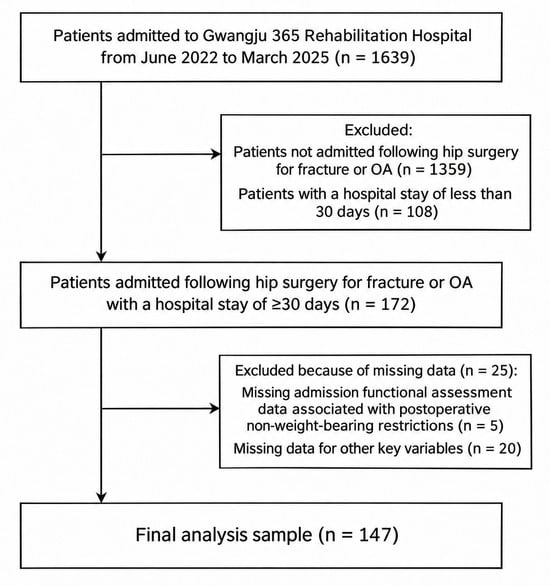
The study participants were patients admitted to Gwangju 365 Rehabilitation Hospital between June 2022 and March 2025. Eligible patients had been transferred to the rehabilitation hospital after completing acute care following hip surgery for fracture or OA. During the study period, a total of 1639 patients were admitted. Of these, 1359 patients were excluded because they had not been admitted following hip surgery for fracture or OA. This category included patients admitted for neurological conditions, such as stroke, and patients who had undergone hip surgery for developmental dysplasia of the hip or avascular necrosis of the femoral head. A further 108 patients with a rehabilitation hospital stay of less than 30 days were excluded, leaving 172 patients who received inpatient rehabilitation for at least 30 days following hip surgery for fracture or OA.
Twenty-five patients were subsequently excluded because of missing data. These included five patients with missing admission functional assessment data associated with postoperative non-weight-bearing restrictions and 20 patients with missing data for other key variables. Finally, 147 patients were included in the analysis (Figure 1).
Figure 1.
Flow diagram of participant selection for the retrospective analysis.
2.3. Rehabilitation Program
All patients received 240 min of rehabilitation per day, seven days per week, comprising physical therapy and occupational therapy. The program shared common therapeutic components across patients. Physical therapy included range-of-motion exercises, lower-extremity strengthening exercises, balance training, gait training, and pain management. Occupational therapy primarily focused on activities of daily living (ADL) training, including toileting and dressing. Within these common components, specific exercises, repetition counts, and exercise intensity were individualized according to each patient’s clinical condition and functional ability.
2.4. Data Collection and Outcome Measures
Study data were collected based on measurements obtained at admission and 4 weeks after admission.
2.4.1. General and Clinical Characteristics
General characteristics consisted of demographic information, medical information, and body composition and physiological parameters. Demographic information included sex, age, height, and body weight. Medical information included the underlying condition leading to surgery, the interval between discharge from the acute care hospital and admission to the rehabilitation hospital, and the length of stay in the rehabilitation hospital. Body composition and physiological parameters included skeletal muscle index (SMI), body mass index (BMI), phase angle, and handgrip strength. Handgrip strength was measured bilaterally using a Jamar hydraulic dynamometer, and the maximum value was recorded. Sarcopenia was defined in this study as the presence of both low muscle mass and low handgrip strength, using the Asian Working Group for Sarcopenia (AWGS) 2019 criteria [16]. Low muscle mass was defined as a BIA-derived SMI < 7.0 kg/m2 in men and <5.7 kg/m2 in women. Low handgrip strength was defined as <28 kg in men and <18 kg in women.
2.4.2. Bioelectrical Impedance Analysis
Body composition was assessed using a BIA device ((BWA2.0S, InBody, Seoul, Republic of Korea). Measurements were performed at rehabilitation admission by a trained nurse, with participants resting supine on their beds in the ward and electrodes attached to both hands and feet. Phase angle was calculated from impedance measurements obtained at 50 kHz. Where feasible, measurements were performed before meals, although a uniform fasting interval was not strictly applied across all participants. Postoperative lower-limb edema did not lead to postponement of measurement or patient exclusion. Hydration status and postoperative edema were not separately quantified or systematically controlled.
2.4.3. Functional Outcome Measures
Functional assessments performed at admission and 4 weeks after admission were used in the analysis. Balance ability was assessed using the Berg Balance Scale (BBS), which consists of 14 items with a total score of 56 points; higher scores indicate better balance ability [17,18]. Ambulatory function was assessed using the Functional Ambulation Category (FAC), which consists of six levels ranging from 0 to 5 [18,19]. Activities of daily living were assessed using the Korean version of the Modified Barthel Index (K-MBI), which consists of 10 items with a total score ranging from 0 to 100; higher scores indicate better functional status [20,21].
2.4.4. Functional Classification
Based on the results of the functional assessments performed 4 weeks after admission, each functional outcome was classified into high- and low-function groups. Cut-off values were established according to the clinical interpretation criteria for each assessment tool to reflect the level of functional independence. For the BBS, patients with scores of 41 or higher were classified into the high-function group, whereas those with scores of 40 or lower were classified into the low-function group [17,18]. For the FAC, patients with scores of 3 or higher were classified into the high-function group, whereas those with scores of 2 or lower were classified into the low-function group [18,19]. For the K-MBI, patients with scores of 75 or higher were classified into the high-function group, whereas those with scores of 74 or lower were classified into the low-function group [20,21].
2.5. Statistical Analysis
The general characteristics of the study participants were summarized using descriptive statistics. Participants were classified into fracture and OA groups according to the underlying condition leading to surgery. Differences between the two groups were analyzed using the independent-samples t-test for continuous variables and the chi-square test for categorical variables. Functional status at 4 weeks after admission, as assessed using the BBS, FAC, and K-MBI, was converted into binary variables according to the respective cut-off values.
Univariable logistic regression analyses were performed to identify factors associated with functional status. Variables for the multivariable analyses were selected with reference to the study objectives and the between-group comparisons presented in Table 1. The models included surgical indication, age, the interval before rehabilitation admission, sarcopenia, BMI, and phase angle. Handgrip strength and SMI were not entered separately because they were used to determine sarcopenia status. Height and body weight were not entered separately because they were incorporated into the calculation of BMI. Multicollinearity among the six explanatory variables included in the multivariable models was assessed using variance inflation factors. All statistical analyses were performed using SPSS Statistics version 25.0 (IBM Corp., Armonk, NY, USA), and statistical significance was set at p < 0.05.
Table 1.
Comparison of characteristics between the fracture and osteoarthritis groups.
The sample size required for logistic regression analysis was calculated using G*Power version 3.1.9.7. A moderate effect size was assumed, with the odds ratio set at 2.0 and the event probability of the dependent variable assumed to be 0.5. The significance level (α) was set at 0.05, and statistical power (1−β) was set at 0.80. Considering the inclusion of six predictor variables, the squared multiple correlation coefficient with other predictors (R2 other X) was set at 0.2. Under these assumptions, the minimum required sample size was calculated to be 102 participants.
3. Results
3.1. Participant Characteristics and Between-Group Comparisons
The characteristics of 147 patients admitted to a rehabilitation hospital following hip surgery were compared according to the underlying condition leading to surgery (Table 1). Of these, 114 patients (77.6%) underwent surgery for fracture and 33 (22.4%) underwent surgery for OA. The distribution of surgical procedures differed significantly between the groups (p < 0.001). In the fracture group, 62 patients (54.4%) underwent arthroplasty, 51 (44.7%) underwent fixation, and one (0.9%) underwent combined arthroplasty and fixation. All 33 patients (100%) in the OA group underwent arthroplasty. Compared with the OA group, the fracture group was significantly older and had significantly lower body weight, BMI, phase angle, handgrip strength, and SMI. In addition, the duration of rehabilitation treatment and the interval between discharge from the acute care hospital and admission to the rehabilitation hospital were significantly longer in the fracture group (p < 0.05). Regarding functional outcomes, the OA group had significantly higher BBS, FAC, and K-MBI scores than the fracture group, indicating an overall better functional status (p < 0.001).
3.2. Comparison of Characteristics According to Functional Status
In the comparisons according to functional status at 4 weeks after admission (Table 2), similar patterns were observed across all three functional measures (BBS, FAC, and K-MBI). Compared with the low-function groups, the high-function groups were younger, had higher BMI and phase angle, and had a lower prevalence of sarcopenia. The underlying condition leading to surgery and the presence of sarcopenia were also significantly associated with functional status (p < 0.05). In contrast, the interval between discharge from the acute care hospital and admission to the rehabilitation hospital did not differ significantly according to functional status.
Table 2.
Comparison of Covariates According to Functional Status at 4 Weeks.
3.3. Factors Associated with Functional Outcomes
Logistic regression analyses were performed to identify factors associated with functional status at 4 weeks of rehabilitation, as assessed using the BBS, FAC, and K-MBI (Table 3). The multicollinearity assessment included all 147 patients. VIFs ranged from 1.202 to 2.215, with the highest value observed for phase angle. All values were below 5, suggesting no substantial multicollinearity among the included explanatory variables. In the univariable analyses, the underlying condition leading to surgery, age, presence of sarcopenia, BMI, and phase angle were significantly associated with all three functional outcomes (p < 0.05). After adjustment for the included covariates, surgical indication and admission phase angle remained significantly associated with low functional status across the BBS, FAC, and K-MBI outcomes.
Table 3.
Logistic regression analysis of factors associated with functional outcomes 4 weeks after rehabilitation.
Specifically, patients who underwent surgery for fracture had significantly higher odds of being classified into the low-function group than those who underwent surgery for OA (Exp(B) = 3.76–7.36, p < 0.05). In contrast, higher phase angle was significantly associated with lower odds of being classified into the low-function group (Exp(B) = 0.418–0.521, p < 0.05). Age, presence of sarcopenia, BMI, and the interval between discharge from the acute care hospital and admission to the rehabilitation hospital were not independently associated with functional status in the multivariable analyses (p > 0.05).
4. Discussion
This study investigated the associations of the underlying condition leading to hip surgery (fracture vs. OA) and phase angle with functional status at 4 weeks during the early rehabilitation period among patients admitted to a rehabilitation hospital following hip surgery. The results showed that patients in the fracture group were older and had lower body weight, BMI, phase angle, handgrip strength, and SMI than those in the OA group. They also demonstrated significantly poorer functional status across all outcome measures, including the BBS, FAC, and K-MBI. In addition, when patients were compared according to functional status at 4 weeks after admission, those in the low-function groups were older, had lower BMI and phase angle, had a higher prevalence of sarcopenia, and were more likely to have undergone surgery for fracture. After adjustment for the included covariates, only the underlying condition leading to surgery and admission phase angle remained significantly associated with low functional status across the BBS, FAC, and K-MBI outcomes.
When the groups were compared according to the underlying condition leading to surgery, patients in the fracture group were approximately 12 years older on average than those in the OA group and had lower body weight, BMI, SMI, handgrip strength, and phase angle, as well as a markedly higher prevalence of sarcopenia (50.9% vs. 12.1%). These differences may be understood in the context of the fundamentally different clinical backgrounds of the two groups. Hip surgery for OA is generally performed as a planned elective procedure in patients who are relatively medically stable, whereas hip fracture typically occurs as a result of acute trauma, such as a fall, and is more common among older adults with osteoporosis, frailty, and multiple comorbidities [22,23,24]. These characteristics may themselves contribute to functional prognosis. Although age and sarcopenia were included in the multivariable models, residual differences in baseline clinical characteristics may have contributed to the observed association between surgical indication and four-week functional status. Previous studies involving patients with fragility hip fractures have consistently reported that age, comorbidity burden, baseline cognitive function, and prefracture ambulatory ability are major predictors of postoperative functional recovery and the regain of independent ambulation [20,25]. Accordingly, patients in the fracture group may have had a greater burden of factors associated with poorer functional recovery than those in the OA group. In addition, in the present study, the interval between discharge from the acute care hospital and admission to the rehabilitation hospital was approximately twice as long in the fracture group (30.4 days vs. 15.2 days), suggesting that patients with fracture may have required more time for the management of postoperative complications and medical stabilization. Differences in surgical procedures should also be considered. Whereas patients with OA generally undergo THA, patients with fracture may undergo various procedures, including internal fixation, hemiarthroplasty, or THA, depending on the location and type of fracture. The permitted level of weight bearing and the progression of early rehabilitation may therefore vary according to fixation stability, bone quality, and postoperative medical status [26,27]. Although surgical procedures were not analyzed separately in this study, these factors may have acted in combination and contributed to the poorer early functional status and slower recovery observed in the fracture group.
A key finding was that admission phase angle was associated with low functional status at four weeks across the BBS, FAC, and K-MBI after adjustment for surgical indication and the other included covariates. Phase angle is calculated from the relationship between resistance and reactance measured at 50 kHz and is known to reflect cell membrane integrity and the distribution of intracellular and extracellular fluids, thereby serving as an indicator of body cell mass and cellular physiological health [28]. Previous studies have reported that a low phase angle in older adults is associated with reduced muscle strength and physical function, sarcopenia, falls, and increased mortality [29,30,31,32]. In the present study, each 1° higher admission phase angle was associated with lower odds of low functional status, with adjusted ORs of 0.521 (95% CI, 0.296–0.918) for BBS, 0.491 (95% CI, 0.273–0.883) for FAC, and 0.418 (95% CI, 0.240–0.729) for K-MBI. The estimated magnitudes of these associations should be interpreted cautiously given the uncertainty reflected in the confidence intervals. These findings are consistent with previous reports of associations between phase angle and functional outcomes. However, whether admission phase angle provides prognostic information beyond admission functional status remains undetermined.
Previous studies have examined phase angle in relation to postoperative and rehabilitation outcomes after hip surgery. Ukai et al. [11] reported associations between preoperative phase angle and postoperative lower-extremity muscle volume and fatty degeneration after THA. Unno et al. [12] reported associations with FIM scores at two weeks after hip fracture surgery and changes in FIM scores. Evidence also exists in inpatient rehabilitation settings. Lim and Lim [13] reported associations between phase angle of the non-fractured limb and balance and ambulation at discharge after rehabilitation for hip fracture. Shiraishi et al. [14] reported an association between trunk phase angle measured at convalescent rehabilitation admission and walking independence at discharge. The present study complements this evidence by examining patients admitted for rehabilitation after surgery for either hip fracture or OA and assessing balance, ambulation, and activities of daily living at a common time point of four weeks after rehabilitation admission. This approach addresses the clinical question of how admission phase angle relates to functional status in a rehabilitation cohort comprising different surgical indications. Admission phase angle remained associated with four-week functional status after adjustment for surgical indication and the other included covariates. This finding describes an adjusted association in the combined cohort, while its consistency within each surgical indication group remains uncertain. Similar associations across BBS, FAC, and K-MBI describe related aspects of functional status and should be interpreted with recognition of the overlap among these measures.
Age, sarcopenia, and BMI showed statistically significant associations in the univariable analyses, but these associations were not statistically significant in the multivariable analyses. This may be explained by their close relationships with the underlying condition leading to surgery and phase angle. Compared with the OA group, the fracture group was older and had a higher prevalence of sarcopenia, while phase angle has been reported to decrease with increasing age and to be lower in individuals with sarcopenia [33,34]. Therefore, a substantial proportion of the associations of age and sarcopenia with functional status may have been accounted for by the underlying condition leading to surgery and phase angle. In particular, sarcopenia is a binary variable defined according to cut-off values for skeletal muscle mass and muscle strength, whereas phase angle is a continuous variable reflecting qualitative muscle status and may therefore retain more information statistically. Su et al. [35] reported that sarcopenia was associated with greater dependence on walking aids at discharge among older patients undergoing elective THA, suggesting that sarcopenia may be associated with poorer early postoperative ambulatory independence and functional recovery. In addition, the interval between discharge from the acute care hospital and admission to the rehabilitation hospital was not significant in either the univariable or multivariable analyses. Although earlier initiation of rehabilitation is generally considered beneficial for functional recovery [36], all participants in this study had completed acute care before being transferred to the rehabilitation hospital, which may have limited variability in this interval. Moreover, given that this interval was longer in the fracture group, its effect may have been partly accounted for by the variable representing the underlying condition leading to surgery.
The findings suggest potential clinical implications for assessing functional status during early rehabilitation after hip surgery. Phase angle can be measured noninvasively using BIA at rehabilitation admission, and its association with four-week functional status warrants further investigation. Previous studies have reported that resistance exercise may improve phase angle in older adults [37,38]. However, the present study did not evaluate whether more intensive rehabilitation or resistance exercise improves functional outcomes in patients with lower phase angles, or whether changes in phase angle reflect treatment response. Prospective interventional studies are therefore needed to determine whether phase angle can inform the selection, intensity, or monitoring of rehabilitation interventions.
This study has several limitations. First, the retrospective, single-center design limits the generalizability of the findings. The completeness of clinical and surgical records varied among patients transferred from different hospitals. Broad surgical categories were identified from admission radiographs (Table 1), but detailed fracture types and surgical techniques were not consistently available, and outcomes were not analyzed by procedure. Admission functional scores were not included in the regression models, and preoperative functional status, comorbidities, cognition, nutritional status, and pain could not be adequately controlled for, leaving the observed associations subject to residual confounding. Pre-existing functional impairment and immobility may also have contributed to lower admission phase angle, and reverse causation cannot be excluded. Exclusion of patients with missing data may also have introduced selection bias, particularly the five patients whose baseline functional assessment data were unavailable in association with postoperative non-weight-bearing restrictions. These restrictions may reflect surgical or clinical characteristics and may therefore have affected the composition of the analyzed cohort and the observed associations. Restricting inclusion to patients hospitalized for at least 30 days may have introduced selection bias by excluding earlier discharges, including patients with faster functional recovery. Second, the OA group had a smaller sample size (n = 33) than the fracture group, resulting in an imbalance between the groups and wide confidence intervals for the odds ratios associated with the underlying condition leading to surgery. Third, because functional outcomes were assessed at a single time point, 4 weeks after admission, the associations of phase angle with mid- to long-term functional recovery and return to the community after discharge could not be evaluated. Fourth, phase angle was measured only once at admission; therefore, the relationship between changes in phase angle and changes in functional status during rehabilitation could not be examined. Although BIA measurements were performed in a consistent supine position and before meals where feasible, fasting intervals were not strictly standardized, and hydration status and postoperative edema were not separately quantified or systematically controlled. These factors may have affected both phase angle and BIA-derived SMI, potentially leading to sarcopenia misclassification and influencing the observed associations. Fifth, dichotomizing functional outcomes according to predefined cut-off values may have resulted in a loss of information inherent in continuous data. Future multicenter prospective studies should systematically collect information on fracture type, surgical procedure, and preoperative functional status to enable appropriately stratified or adjusted analyses. These studies should also incorporate repeated measurements of phase angle and long-term follow-up and evaluate the effectiveness of early interventions for high-risk patients identified on the basis of phase angle.
5. Conclusions
Surgical indication and admission phase angle were associated with functional status at 4 weeks after rehabilitation admission. Patients who underwent surgery for fracture had higher odds of low functional status than those who underwent surgery for OA, whereas higher admission phase angle was associated with lower odds of low functional status. These associations were observed after adjustment for age, the interval before rehabilitation admission, sarcopenia, and BMI. The findings should be interpreted in light of the observational design and the absence of adjustment for admission functional scores. Further research is needed to establish whether phase angle provides clinically useful prognostic information beyond baseline functional assessments.
Author Contributions
Conceptualization, Y.S., S.K., J.K. and B.K.; methodology, Y.S., S.K., J.K. and B.K.; software, S.K. and B.K.; validation, S.K. and J.K.; formal analysis, S.K., J.K. and B.K.; investigation, Y.S., S.K. and B.K.; resources, Y.S., S.K. and J.K.; data curation, Y.S. and S.K.; writing—original draft preparation, Y.S., S.K., J.K. and B.K.; writing—review and editing, S.K. and B.K.; visualization, Y.S. and S.K.; supervision, B.K.; project administration, B.K.; funding acquisition, B.K. All authors have read and agreed to the published version of the manuscript.
Funding
This research received no external funding.
Institutional Review Board Statement
The study was conducted in accordance with the Declaration of Helsinki and was approved by the Public Institutional Bioethics Committee, Republic of Korea (Approval No. P01-202509-01-026, date of approval: 5 September 2025).
Informed Consent Statement
The requirement for informed consent was waived due to the retrospective nature of the study.
Data Availability Statement
The data can be requested from the corresponding author and will be released on reasonable request.
Conflicts of Interest
The authors declare no conflicts of interest.
Abbreviations
The following abbreviations are used in this manuscript:
| OA | Osteoarthritis |
| THA | Total Hip Arthroplasty |
| BIA | Bioelectrical Impedance Analysis |
| FIM | Functional Independence Measure |
| SMI | Skeletal Muscle Index |
| BMI | Body Mass Index |
| BBS | Berg Balance Scale |
| FAC | Functional Ambulation Category |
| K-MBI | Korean version of the Modified Barthel Index |
References
- Guyen, O. Hemiarthroplasty or total hip arthroplasty in recent femoral neck fractures? Orthop. Traumatol. Surg. Res. 2019, 105, S95–S101. [Google Scholar] [CrossRef] [Scilit] [PubMed]
- Gademan, M.G.; Hofstede, S.N.; Vliet Vlieland, T.P.; Nelissen, R.G.; Marang-van de Mheen, P.J. Indication criteria for total hip or knee arthroplasty in osteoarthritis: A state-of-the-science overview. BMC Musculoskelet. Disord. 2016, 17, 463. [Google Scholar] [CrossRef] [Scilit] [PubMed]
- Wang, Y.; Tan, L.; Dong, J.; Zhang, J.; Zhu, J.; Zhang, Y. Global epidemiology of hip fractures in adults aged 70 years and older from 1990 to 2021: A cross-sectional analysis from Global Burden of Disease Study 2021. Chin. J. Traumatol. 2026. Online ahead of print.
- GBD 2021 Osteoarthritis Collaborators. Global, regional, and national burden of osteoarthritis, 1990-2020, and projections to 2050: A systematic analysis of the Global Burden of Disease Study 2021. Lancet Rheumatol. 2023, 5, e508–e522. [Google Scholar] [CrossRef] [Scilit] [PubMed]
- Wareńczak, A.; Lisiński, P. Does total hip replacement impact on postural stability? BMC Musculoskelet. Disord. 2019, 20, 229. [Google Scholar] [CrossRef] [Scilit] [PubMed]
- Kolk, S.; Minten, M.J.; van Bon, G.E.; Rijnen, W.H.; Geurts, A.C.; Verdonschot, N.; Weerdesteyn, V. Gait and gait-related activities of daily living after total hip arthroplasty: A systematic review. Clin. Biomech. 2014, 29, 705–718. [Google Scholar] [CrossRef] [Scilit] [PubMed]
- Ikutomo, H.; Nagai, K.; Nakagawa, N.; Masuhara, K. Falls in patients after total hip arthroplasty in Japan. J. Orthop. Sci. 2015, 20, 663–668. [Google Scholar] [CrossRef] [Scilit] [PubMed]
- Amarilla-Donoso, F.J.; López-Espuela, F.; Roncero-Martín, R.; Leal-Hernandez, O.; Puerto-Parejo, L.M.; Aliaga-Vera, I.; Toribio-Felipe, R.; Lavado-García, J.M. Quality of life in elderly people after a hip fracture: A prospective study. Health Qual. Life Outcomes 2020, 18, 71. [Google Scholar] [CrossRef] [Scilit] [PubMed]
- Yoo, J.I.; Ha, Y.C.; Lim, J.Y.; Kang, H.; Yoon, B.H.; Kim, H. Early Rehabilitation in Elderly after Arthroplasty versus Internal Fixation for Unstable Intertrochanteric Fractures of Femur: Systematic Review and Meta-Analysis. J. Korean Med. Sci. 2017, 32, 858–867. [Google Scholar] [CrossRef] [Scilit] [PubMed]
- Kristensen, M.T. Factors affecting functional prognosis of patients with hip fracture. Eur. J. Phys. Rehabil. Med. 2011, 47, 257–264. [Google Scholar] [PubMed]
- Ukai, T.; Yokoyama, K.; Watanabe, M. Preoperative Body Composition Correlates with Postoperative Muscle Volume and Degeneration after Total Hip Arthroplasty. Nutrients 2024, 16, 386. [Google Scholar] [CrossRef] [Scilit] [PubMed]
- Unno, H.; Hasegawa, T.; Takigawa, S.; Sato, M.; Hasegawa, M. Association Between the Phase Angle and Function Recovery in Patients With Hip Fractures. Cureus 2025, 17, e96754. [Google Scholar] [CrossRef] [Scilit] [PubMed]
- Lim, S.K.; Lim, J.Y. Phase angle as a predictor of functional outcomes in patients undergoing in-hospital rehabilitation after hip fracture surgery. Arch. Gerontol. Geriatr. 2020, 89, 104060. [Google Scholar] [CrossRef] [Scilit] [PubMed]
- Shiraishi, R.; Sato, K.; Chijiiwa, N.; Tajima, F.; Ogawa, T. Calculation of trunk muscle mass and trunk muscle quality indices for walking independence in Asian patients with hip fractures. Clin. Nutr. ESPEN 2024, 60, 11–16. [Google Scholar] [CrossRef] [Scilit] [PubMed]
- Health Insurance Review & Assessment Service. Rehabilitation Medical Institution Designation Assessment. Available online: https://www.hira.or.kr/dummy.do?pgmid=HIRAA020020000007 (accessed on 12 November 2026).
- Chen, L.K.; Woo, J.; Assantachai, P.; Auyeung, T.W.; Chou, M.Y.; Iijima, K.; Jang, H.C.; Kang, L.; Kim, M.; Kim, S.; et al. Asian Working Group for Sarcopenia: 2019 Consensus Update on Sarcopenia Diagnosis and Treatment. J. Am. Med. Dir. Assoc. 2020, 21, 300–307.e2. [Google Scholar] [CrossRef] [Scilit] [PubMed]
- Radosavljevic, N.; Nikolic, D.; Lazovic, M.; Petronic, I.; Milicevic, V.; Radosavljevic, Z.; Potic, J.; Ilic-Stojanovic, O.; Jeremic, A. Estimation of functional recovery in patients after hip fracture by Berg Balance Scale regarding the sex, age and comorbidity of participants. Geriatr. Gerontol. Int. 2013, 13, 365–371. [Google Scholar] [CrossRef] [Scilit] [PubMed]
- Kim, S.Y.; Cho, W.S.; Park, C.B.; Kim, B.G. Impact of Sarcopenia and Functional Relationships Between Balance and Gait After Total Hip Arthroplasty. J. Clin. Med. 2025, 14, 2036. [Google Scholar] [CrossRef] [Scilit] [PubMed]
- Takahashi, A.; Naruse, H.; Kitade, I.; Shimada, S.; Tsubokawa, M.; Kokubo, Y.; Matsumine, A. Functional outcomes after the treatment of hip fracture. PLoS ONE 2020, 15, e0236652. [Google Scholar] [CrossRef] [Scilit] [PubMed]
- Kang, M.J.; Kim, B.R.; Lee, S.Y.; Beom, J.; Choi, J.H.; Lim, J.Y. Factors predictive of functional outcomes and quality of life in patients with fragility hip fracture: A retrospective cohort study. Medicine 2023, 102, e32909. [Google Scholar] [CrossRef] [Scilit] [PubMed]
- Unnanuntana, A.; Jarusriwanna, A.; Nepal, S. Validity and responsiveness of Barthel index for measuring functional recovery after hemiarthroplasty for femoral neck fracture. Arch. Orthop. Trauma. Surg. 2018, 138, 1671–1677. [Google Scholar] [CrossRef] [Scilit] [PubMed]
- Le Manach, Y.; Collins, G.; Bhandari, M.; Bessissow, A.; Boddaert, J.; Khiami, F.; Chaudhry, H.; De Beer, J.; Riou, B.; Landais, P.; et al. Outcomes After Hip Fracture Surgery Compared with Elective Total Hip Replacement. JAMA 2015, 314, 1159–1166. [Google Scholar] [CrossRef] [Scilit] [PubMed]
- Lowe, J.; Mitchell, S.M.; Agarwal, S.; Jones, C.B. Traumatic Hip Fracture and Primary Elective Total Hip Patients are Not the Same: A Comparison of Comorbidity Burden, Hospital Course, Postoperative Complications, and Cost of Care Analysis. J. Orthop. Trauma 2020, 34, 583–588. [Google Scholar] [CrossRef] [Scilit] [PubMed]
- Wu, V.J.; Ross, B.J.; Sanchez, F.L.; Billings, C.R.; Sherman, W.F. Complications Following Total Hip Arthroplasty: A Nationwide Database Study Comparing Elective vs Hip Fracture Cases. J. Arthroplast. 2020, 35, 2144–2148.e3. [Google Scholar] [CrossRef] [Scilit] [PubMed]
- Tam, T.L.; Tsang, K.K.; Lee, K.B. Development of a prognostic model to predict post-operative mobility of patients with fragility hip fractures: A retrospective cohort study. Int. J. Orthop. Trauma Nurs. 2020, 38, 100770. [Google Scholar] [CrossRef] [Scilit] [PubMed]
- Ravikumar, K.J.; Marsh, G. Internal fixation versus hemiarthroplasty versus total hip arthroplasty for displaced subcapital fractures of femur--13 year results of a prospective randomised study. Injury 2000, 31, 793–797. [Google Scholar] [CrossRef] [Scilit] [PubMed]
- Min, K.; Beom, J.; Kim, B.R.; Lee, S.Y.; Lee, G.J.; Lee, J.H.; Lee, S.Y.; Won, S.J.; Ahn, S.; Bang, H.J.; et al. Clinical Practice Guideline for Postoperative Rehabilitation in Older Patients With Hip Fractures. Ann. Rehabil. Med. 2021, 45, 225–259. [Google Scholar] [CrossRef] [Scilit] [PubMed]
- da Silva, B.R.; Orsso, C.E.; Gonzalez, M.C.; Sicchieri, J.M.F.; Mialich, M.S.; Jordao, A.A.; Prado, C.M. Phase angle and cellular health: Inflammation and oxidative damage. Rev. Endocr. Metab. Disord. 2023, 24, 543–562. [Google Scholar] [CrossRef] [Scilit] [PubMed]
- Custódio Martins, P.; de Lima, T.R.; Silva, A.M.; Santos Silva, D.A. Association of phase angle with muscle strength and aerobic fitness in different populations: A systematic review. Nutrition 2022, 93, 111489. [Google Scholar] [CrossRef] [Scilit] [PubMed]
- Di Vincenzo, O.; Marra, M.; Di Gregorio, A.; Pasanisi, F.; Scalfi, L. Bioelectrical impedance analysis (BIA) -derived phase angle in sarcopenia: A systematic review. Clin. Nutr. 2021, 40, 3052–3061. [Google Scholar] [CrossRef] [Scilit] [PubMed]
- Uemura, K.; Yamada, M.; Okamoto, H. Association of bioimpedance phase angle and prospective falls in older adults. Geriatr. Gerontol. Int. 2019, 19, 503–507. [Google Scholar] [CrossRef] [Scilit] [PubMed]
- Wilhelm-Leen, E.R.; Hall, Y.N.; Horwitz, R.I.; Chertow, G.M. Phase angle, frailty and mortality in older adults. J. Gen. Intern. Med. 2014, 29, 147–154. [Google Scholar] [CrossRef] [Scilit] [PubMed]
- Barbosa-Silva, M.C.; Barros, A.J.; Wang, J.; Heymsfield, S.B.; Pierson, R.N., Jr. Bioelectrical impedance analysis: Population reference values for phase angle by age and sex. Am. J. Clin. Nutr. 2005, 82, 49–52. [Google Scholar] [CrossRef] [Scilit] [PubMed]
- Zhang, J.; Wang, N.; Li, J.; Wang, Y.; Xiao, Y.; Sha, T. The Diagnostic Accuracy and Cutoff Value of Phase Angle for Screening Sarcopenia: A Systematic Review and Meta-Analysis. J. Am. Med. Dir. Assoc. 2024, 25, 105283. [Google Scholar] [CrossRef] [Scilit] [PubMed]
- Su, Y.; Peng, L.; Dong, D.; Ma, Z.; Gu, X. Impact of sarcopenia in elderly patients undergoing elective total hip arthroplasty on postoperative outcomes: A propensity score-matched study. BMC Anesthesiol. 2024, 24, 158. [Google Scholar] [CrossRef] [Scilit] [PubMed]
- Lee, D.; Jo, J.Y.; Jung, J.S.; Kim, S.J. Prognostic Factors Predicting Early Recovery of Pre-fracture Functional Mobility in Elderly Patients With Hip Fracture. Ann. Rehabil. Med. 2014, 38, 827–835. [Google Scholar] [CrossRef] [Scilit] [PubMed]
- Nabuco, H.C.G.; Tomeleri, C.M.; Sugihara, P., Jr.; Fernandes, R.R.; Cavalcante, E.F.; Dos Santos, L.; Silva, A.M.; Sardinha, L.B.; Cyrino, E.S. Effect of whey protein supplementation combined with resistance training on cellular health in pre-conditioned older women: A randomized, double-blind, placebo-controlled trial. Arch. Gerontol. Geriatr. 2019, 82, 232–237. [Google Scholar] [CrossRef] [Scilit] [PubMed]
- Campa, F.; Colognesi, L.A.; Moro, T.; Paoli, A.; Casolo, A.; Santos, L.; Correia, R.R.; Lemes, Í.R.; Milanez, V.F.; Christofaro, D.D.; et al. Effect of resistance training on bioelectrical phase angle in older adults: A systematic review with Meta-analysis of randomized controlled trials. Rev. Endocr. Metab. Disord. 2023, 24, 439–449. [Google Scholar] [CrossRef] [Scilit] [PubMed]

Disclaimer/Publisher’s Note: The statements, opinions and data contained in all publications are solely those of the individual author(s) and contributor(s) and not of MDPI and/or the editor(s). MDPI and/or the editor(s) disclaim responsibility for any injury to people or property resulting from any ideas, methods, instructions or products referred to in the content. |
© 2026 by the authors. Published by MDPI on behalf of the Lithuanian University of Health Sciences. Licensee MDPI, Basel, Switzerland. This article is an open access article distributed under the terms and conditions of the Creative Commons Attribution (CC BY) license.