




Clinical Management of Hip Fractures

A special issue of Medicina (ISSN 1648-9144). This special issue belongs to the section "Orthopedics".

Deadline for manuscript submissions: 30 November 2026 | Viewed by 4070
Editor


E-Mail Website
Guest Editor
1. School of Medicine and Surgery, Università degli Studi di Milano-Bicocca, 20900 Monza, Italy
2. Acute Geriatrics Unit, Fondazione IRCCS San Gerardo dei Tintori, 20900 Monza, Italy
Interests: frailty and hip fracture; orthogeriatric co-management; orthogeriatric models of care; preoperative assessment; hip fracture surgery; hip fracture clinical and functional outcomes; hip fracture complications in the elderly; quality of life in hip-fracture elderly patients; orthogeriatric research
Special Issues, Collections and Topics in MDPI journals

Special Issue Information

Dear Colleagues,

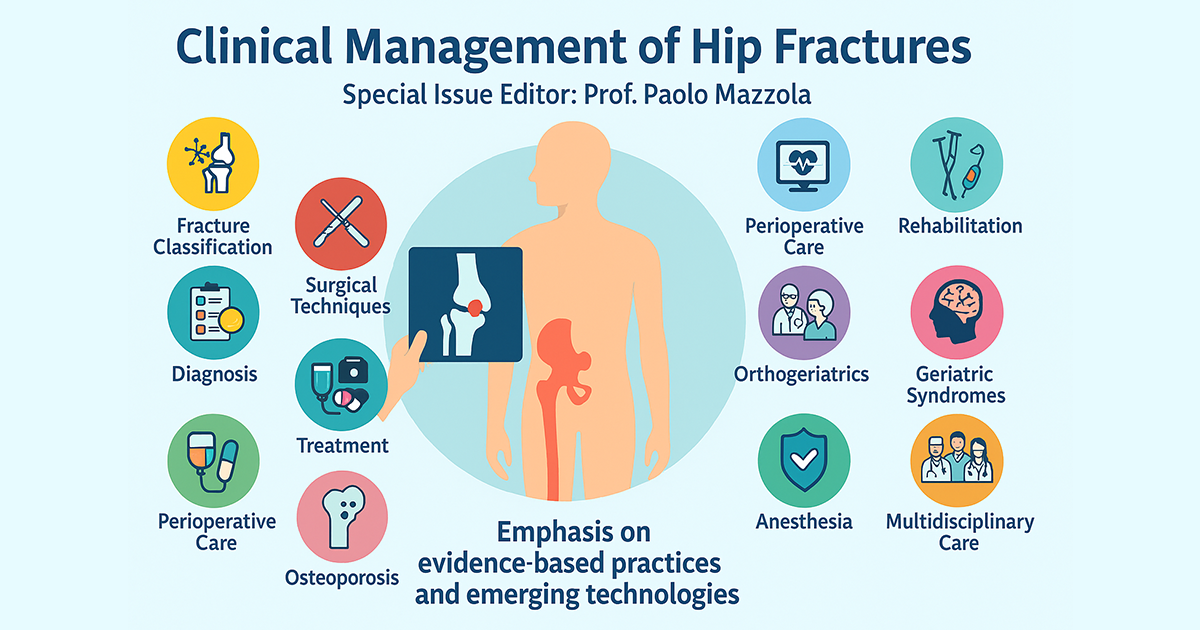
Hip fractures represent a significant clinical challenge worldwide, particularly in aging populations, often due to their high incidence, associated morbidity, and long-term impact on functional and health outcomes. This Special Issue, entitled "Clinical Management of Hip Fractures", provides a comprehensive overview of current strategies and innovations in the diagnosis, treatment, perioperative care, and rehabilitation of individuals experiencing hip fractures. Topics of interest include, but are not limited to, fracture classification, surgical techniques, anesthesia approaches, the management of comorbidities and complications, rehabilitation strategies. This Special Issue also welcomes research on multidisciplinary care models, orthogeriatrics, osteoporosis management, and strategies to prevent secondary fractures. Emphasis is placed on evidence-based practices and emerging technologies that may enhance patient recovery, reduce healthcare costs, and improve long-term outcomes. Professionals from different backgrounds—including orthopedic surgeons, geriatricians, anesthesiologists, nurses, multidisciplinary rehabilitation teams, and other related fields—are encouraged to submit their innovative original research articles and reviews.

Dr. Paolo Mazzola
Guest Editor

Manuscript Submission Information

Manuscripts should be submitted online at www.mdpi.com by registering and logging in to this website. Once you are registered, click here to go to the submission form. Manuscripts can be submitted until the deadline. All submissions that pass pre-check are peer-reviewed. Accepted papers will be published continuously in the journal (as soon as accepted) and will be listed together on the special issue website. Research articles, review articles as well as short communications are invited. For planned papers, a title and short abstract (about 250 words) can be sent to the Editorial Office for assessment.

Submitted manuscripts should not have been published previously, nor be under consideration for publication elsewhere (except conference proceedings papers). All manuscripts are thoroughly refereed through a single-anonymized peer-review process. A guide for authors and other relevant information for submission of manuscripts is available on the Instructions for Authors page. Medicina is an international peer-reviewed open access monthly journal published by MDPI.

Please visit the Instructions for Authors page before submitting a manuscript. The Article Processing Charge (APC) for publication in this open access journal is 2200 CHF (Swiss Francs). Submitted papers should be well formatted and use good English. Authors may use MDPI's English editing service prior to publication or during author revisions.

Keywords

  • hip fracture
  • femur fracture
  • orthopedic surgery
  • orthogeriatrics co-management
  • geriatric syndromes
  • arthroplasty
  • osteoporosis
  • perioperative care
  • fracture fixation
  • multidisciplinary approach
  • postoperative complications
  • rehabilitation

Benefits of Publishing in a Special Issue

  • Ease of navigation: Grouping papers by topic helps scholars navigate broad scope journals more efficiently.
  • Greater discoverability: Special Issues support the reach and impact of scientific research. Articles in Special Issues are more discoverable and cited more frequently.
  • Expansion of research network: Special Issues facilitate connections among authors, fostering scientific collaborations.
  • External promotion: Articles in Special Issues are often promoted through the journal's social media, increasing their visibility.
  • Reprint: MDPI Books provides the opportunity to republish successful Special Issues in book format, both online and in print.

Further information on MDPI's Special Issue policies can be found here.

Published Papers (4 papers)

Order results
Result details
Select all
Export citation of selected articles as:

Research

8 pages, 329 KB  
Article
Risk Factors Associated with Complications and Early Mortality of Hip Fracture Surgery in Elderly Patients
by Povilas Masionis, Giedrius Vaitukaitis, Agnietė Masionienė, Valentinas Uvarovas and Igoris Šatkauskas
Medicina 2026, 62(5), 825; https://doi.org/10.3390/medicina62050825 - 27 Apr 2026
Cited by 2 | Viewed by 434
Abstract
Background and Objectives: High rates of mortality and morbidity among elderly hip fracture patients are a recognized global issue. This study aimed to evaluate risk factors for early complications and 30-day mortality in hip fracture patients. Materials and Methods: The prospective [...] Read more.
Background and Objectives: High rates of mortality and morbidity among elderly hip fracture patients are a recognized global issue. This study aimed to evaluate risk factors for early complications and 30-day mortality in hip fracture patients. Materials and Methods: The prospective study included 583 patients over 65 years old who sustained hip fractures from fall and underwent surgery. Each patient was followed up for 30 days and complications were recorded. Regression models were used to assess the influence of patient characteristics and laboratory markers on 30-day mortality and complications. Results: Any complication increased the risk of mortality by 5.6 times (95% CI 1.6–19.9, p = 0.008). Having > 6 comorbidities increased the risk of mortality by 8.2 (95% CI 1.9–35.5, p = 0.005) and the risk of complications by 2.3 (95% CI 1.9–35.5, p = 0.000). Patients > 85 years old had increased risk of mortality by 2.2 times (95% CI 1.2–4.1, p = 0.015) and a 1.7-fold increase in risk of complications (95% CI 1.2–2.4, p = 0.005). Vitamin D significantly predicted mortality with odds ratio of 2.1 (95% CI 1.1–4.1, p = 0.028). Serum N-terminal pro-brain natriuretic peptide levels > 780 ng/L predicted 2.3-fold increase in mortality (95% CI 1.0–4.9, p = 0.040) and a 2.6-fold risk of complications (95% CI 1.7–3.9, p = 0.000). Conclusions: Occurrence of complication increases the risk of mortality. Age and comorbidities are significant factors associated with 30-day mortality and complications. Vitamin D levels are associated with higher risk of mortality. N-terminal pro-brain natriuretic peptide levels correspond to higher risks of death and complications. Full article
(This article belongs to the Special Issue Clinical Management of Hip Fractures)
Show Figures

Figure 1

14 pages, 3368 KB  
Article
Short Femoral Stem Performance in Femoral Hip Fracture: Clinical and Radiological Evaluation and Comparative Study of Patients Older than 65 Years
by Daniel Godoy-Monzon, Jose Manuel Pascual Espinosa and Patricio Telesca
Medicina 2026, 62(1), 126; https://doi.org/10.3390/medicina62010126 - 8 Jan 2026
Viewed by 742
Abstract
Background and Objectives: Short femoral stems are increasingly used in total hip arthroplasty (THA), yet evidence regarding their performance in elderly femoral neck fracture (FNF) patients is limited. In this study, we compared clinical and radiographic outcomes of the use of a [...] Read more.
Background and Objectives: Short femoral stems are increasingly used in total hip arthroplasty (THA), yet evidence regarding their performance in elderly femoral neck fracture (FNF) patients is limited. In this study, we compared clinical and radiographic outcomes of the use of a short femoral stem (SFS) versus a conventional standard stem (CSS) in cementless THA. Materials and Methods: This prospective, single-center case–control study (1:2) included patients ≥ 65 years of age with displaced FNF (Garden 3–4) treated with cementless THA. Follow-up lasted a minimum of 2 years. Clinical evaluations included the Harris Hip Score (HHS), Roles and Maudsley satisfaction score, and thigh pain assessment. Radiographic evaluations assessed cup position, osseointegration (Moore signs), radiolucencies (DeLee–Charnley and Gruen zones), subsidence, leg length discrepancy (LLD), and heterotopic ossification. Results: A total of 114 patients were analyzed (38 with SFS versus 76 with CSS). The final follow-up HHS was 87 ± 2.7 (SFS) and 88 ± 2.5 (CSS) (p = 0.231), and satisfaction was excellent in nearly all patients in both groups. Thigh pain was rare and resolved by final follow-up in all SFS patients, and no radiographic loosening was observed. Early subsidence (≤3 mm) occurred in two SFSs and three CSSs without progression, while LLD < 1 cm was present in three SFS and eight CSS cases. No implant-related revisions occurred, and complication rates were low and comparable. Conclusions: Short femoral stems provided clinical and radiographic outcomes equivalent to those of conventional stems in elderly FNF patients treated with cementless THA. Short stems appear to be a safe and effective option in this population, and further studies with longer follow-up are needed to confirm their durability. Full article
(This article belongs to the Special Issue Clinical Management of Hip Fractures)
Show Figures

Figure 1

15 pages, 989 KB  
Article
Inferior Screw Referenced Calcar Tip Apex Distance as the Most Accurate Predictor of Mechanical Cut Out in Dual-Screw Proximal Femoral Nails
by Yavuz Akalın, Hünkar Cagdas Bayrak, Fatih Türkmensoy, Mert Güneş, Füsun Gözen and Alpaslan Öztürk
Medicina 2026, 62(1), 37; https://doi.org/10.3390/medicina62010037 - 24 Dec 2025
Viewed by 1088
Abstract
Background and Objectives: Screw cut-out is the most common mechanical complication after intertrochanteric fracture fixation with proximal femoral nails (PFNs). While the traditional tip–apex distance (TAD) is widely used, the calcar-referenced TAD (CalTAD) may better represent inferomedial cortical support. This study aimed to [...] Read more.
Background and Objectives: Screw cut-out is the most common mechanical complication after intertrochanteric fracture fixation with proximal femoral nails (PFNs). While the traditional tip–apex distance (TAD) is widely used, the calcar-referenced TAD (CalTAD) may better represent inferomedial cortical support. This study aimed to identify radiographic predictors of cut-out in dual-screw PFN fixations and establish a clinically relevant threshold for inferior-screw-based CalTAD. Materials and Methods: A retrospective cohort of patients treated with a dual cephalic screw PFN between 2017 and 2024 was analyzed. The implant uses two equal-diameter screws. Radiographic parameters included TAD, inferior-screw CalTAD, reduction quality, lateral wall thickness (LWT), collodiaphyseal angle (CDA), and Cleveland zone positioning. Logistic regression analyses were used to identify independent predictors of mechanical failure. Results: Both TAD and CalTAD values were significantly higher in patients who experienced screw cut-out. ROC analysis identified an inferior-screw-referenced CalTAD cutoff with strong predictive accuracy (AUC = 0.84). Optimal screw positioning, particularly avoiding superior placement on AP radiographs, was associated with reduced cut-out risk, while anterior positioning on the lateral view demonstrated only a borderline effect. Reduction quality showed borderline significance in univariate testing but remained independently predictive in multivariate modeling, while LWT and CDA were not significantly different between groups. Conclusions: Ensuring the inferior lag screw is positioned close to the calcar and achieving a low CalTAD, together with proper Cleveland zone alignment, appear to be key technical goals for minimizing mechanical cut-out in dual-screw PFN fixations. These findings support the use of inferior-screw–referenced CalTAD as a reliable and reproducible parameter for surgical optimization. Full article
(This article belongs to the Special Issue Clinical Management of Hip Fractures)
Show Figures

Figure 1

11 pages, 684 KB  
Article
Evaluation of Risk Factors for Revision Surgery After Proximal Femoral Nailing for Intertrochanteric Fractures
by Evrim Duman, Ömer Torun, Ahmet Berkay Girgin, Mehmet Alperen Özçelik, Ahmet Acar and Hüseyin Bilgehan Çevik
Medicina 2025, 61(12), 2085; https://doi.org/10.3390/medicina61122085 - 22 Nov 2025
Cited by 1 | Viewed by 1227
Abstract
Background and Objectives: Intertrochanteric femur fractures are very common, especially in the elderly population, and cause serious morbidity and mortality. Today, the most commonly used implants in the treatment of these fractures are proximal femoral nails (PFNs). This study aimed to analyze the [...] Read more.
Background and Objectives: Intertrochanteric femur fractures are very common, especially in the elderly population, and cause serious morbidity and mortality. Today, the most commonly used implants in the treatment of these fractures are proximal femoral nails (PFNs). This study aimed to analyze the clinical and radiological results of patients who underwent surgical treatment with a proximal femoral nail (PFN) for intertrochanteric femur fractures and later required revision surgery for various reasons. Materials and Methods: Patients who underwent surgical treatment PFN due to intertrochanteric femur fractures between 2022 and 2025 were included in the study, and the patients were divided into revision and non-revision groups. Demographic information, postoperative radiological measurements, complications, and reasons for revision surgery were noted, and risk factors leading to revision were determined using bivariate and multivariate analyses. Results: A total of 207 patients, 97 revision (46.9%) and 110 non-revision (53.1%), were included in this study. Cut-out was identified as the most common revision cause (n = 52, 53.6%), followed by loss of reduction (n = 15, 15.5%), implant failure (n = 14, 14.4%), nonunion (n = 6, 6.2%), infection (n = 4, 4.1%), cut-through (n = 3, 3.1%), and avascular necrosis of the femoral head (n = 3, 3.1%). When bivariate analysis was performed to identify risk factors for revision, it was observed that female gender (p = 0.004), presence of posteromedial comminution (p < 0.001), operation under spinal anesthesia (p = 0.023), surgery in supine position (p < 0.001), using closed reduction techniques (p < 0.001), presence of infection (p = 0.004), and higher Charlson comorbidity index values (p < 0.001) increased the risk of revision. Additionally, positive and neutral medial cortex support (p < 0.001) decreased the risk of revision. Multivariate analysis was also applied to the parameters found to be significant in bivariate analysis. As a result of this analysis, surgery in the supine position (p < 0.001), using closed reduction techniques (p < 0.001), and higher Charlson comorbidity index values (p < 0.001) remained significant. Conclusions: Careful evaluation of the fracture morphology, ensuring optimal reduction, and considering the accompanying comorbidities of the patients in the surgical planning of unstable trochanteric fractures stand out as key elements in increasing surgical success. Full article
(This article belongs to the Special Issue Clinical Management of Hip Fractures)
Show Figures

Figure 1

Back to TopTop