


Abstract
Background and Objectives: Previous abdominoplasty may be associated with differences in operative outcomes during subsequent laparoscopic surgery. This retrospective study evaluated the outcomes of conversion from sleeve gastrectomy (SG) to Roux-en-Y gastric bypass (RYGB). Materials and Methods: This single-center retrospective cohort study included 53 patients who underwent conversion from SG to RYGB for weight recurrence between 2020 and 2024. Patients were grouped according to previous post-bariatric abdominoplasty (n = 17) or no abdominoplasty (n = 36). Primary outcomes were operative time and conversion to open surgery. Secondary outcomes included 30-day morbidity, hospital stay, and 1-year weight loss. Results: The median operative time was 150 (140–150) versus 120 (100–120) minutes (p < 0.001). Conversion occurred in 3/17 (17.6%) versus 0/36 patients (p = 0.029); the absolute risk difference was 17.6 percentage points (95% CI, 2.7–41.0). The overall morbidity was 29.4% versus 19.4% (p = 0.490). The mean hospital stay was 5.8 ± 8.1 (range, 3–37) versus 3.5 ± 2.6 (range, 2–18) days, and the corresponding medians (IQRs) were 3 (3–4) versus 3 (3–3) days (Mann–Whitney U p = 0.018). No statistically significant differences were detected in 1-year EWL (71.4% ± 17.8% versus 74.8% ± 16.9%; p = 0.509) or TWL (25.1% ± 5.5% versus 27.5% ± 5.9%; p = 0.200). Conclusions: Previous abdominoplasty was associated with a longer operative duration and more observed conversions to open surgery, but surgical difficulty was not directly measured. The small cohort, limit of three conversion events, and residual confounding limit causal interpretation and do not establish equivalent safety or weight loss outcomes.
1. Introduction
Sleeve gastrectomy (SG) is among the most commonly performed bariatric surgical procedures worldwide, and its short- and medium-term effectiveness has been well-documented. Nevertheless, two major concerns emerge during long-term follow-up: gastroesophageal reflux disease (GERD) and weight recurrence [1]. Long-term data indicate that clinically significant weight recurrence occurs in approximately 30% of patients after SG [2]. Although this condition is initially managed through lifestyle modification and dietary interventions, approximately 12% of patients ultimately require revisional surgery within 10 years [3].
Weight regain is reported to be the most common indication for revisional surgery, with Roux-en-Y gastric bypass (RYGB) being the most frequently selected revisional procedure [4]. However, revisional bariatric procedures are associated with greater technical complexity and higher complication rates than primary bariatric operations [4,5,6]. As the number of revisional bariatric procedures continues to increase, surgeons are becoming increasingly likely to encounter patients with complex operative histories and altered abdominal wall anatomy.
One of the most prominent esthetic and functional consequences of massive weight loss is the development of excess and lax skin. Although measures such as resistance exercise and nutritional support with adequate protein and collagen intake may have beneficial effects on skin quality, thus far, no evidence-based strategy has been shown to prevent post-weight loss skin laxity completely [7,8]. Approximately 70–80% of patients who have undergone bariatric surgery report concerns related to excess skin and express an interest in body-contouring surgery. However, only 14–21% ultimately undergo body-contouring procedures, including abdominoplasty [9,10,11]. Consequently, as the post-bariatric population continues to grow, an increasing number of patients with a history of body-contouring surgery may subsequently require revisional or conversional bariatric procedures.
Previous abdominoplasty has been reported to create technical challenges even during primary bariatric procedures, occasionally necessitating modified port placement or alternative operative strategies [12]. Similarly, in other laparoscopic intra-abdominal procedures, reduced abdominal wall compliance following previous abdominal surgery has been suggested to increase operative difficulty [13]. Evidence specifically addressing revisional bariatric surgery after abdominoplasty remains limited. Karip et al. reported that a history of post-bariatric abdominoplasty may be associated with perioperative technical difficulties during subsequent revisional surgery, although postoperative outcomes did not appear to be adversely affected [14]. Colorectal and primary bariatric surgery reports provide indirect mechanistic context, rather than direct evidence for revisional RYGB; the limited procedure-specific literature should be interpreted separately.
This study aimed to examine the associations between previous post-bariatric abdominoplasty and operative duration, conversion to open surgery, postoperative morbidity, and 1-year weight loss outcomes during laparoscopic SG-to-RYGB conversion. Operative duration and conversion were considered indirect indicators of procedural complexity, not validated direct measures of surgical difficulty.
2. Materials and Methods
2.1. Study Design and Patient Population
This retrospective cohort study was conducted using prospectively maintained data from 132 patients who underwent revisional bariatric surgery after primary sleeve gastrectomy (SG) at the Department of Gastroenterological Surgery, Antalya Training and Research Hospital, between January 2020 and December 2024. The present analysis included patients who underwent laparoscopic conversion from SG to Roux-en-Y gastric bypass (RYGB) because of weight recurrence. This study was approved by the Antalya Training and Research Hospital Scientific Research Ethics Committee (study No. 2026-182; Decision No. 7/25, dated 9 April 2026) and was conducted in accordance with the ethical principles of the Declaration of Helsinki. Written informed consent for the surgical procedures was obtained from all patients before surgery, and the clinical data were analyzed retrospectively and anonymously. The study was reported in accordance with the Strengthening the Reporting of Observational Studies in Epidemiology (STROBE) statement.
All included patients underwent revision for weight recurrence after SG, with their BMI reaching at least 35 kg/m2. This was selected as the clinical threshold for revision rather than a formal percentage-based definition of weight recurrence. Patients undergoing revision primarily for complications resulting from SG (including GERD or stenosis) were ineligible. Among the excluded patients, 2 with previous abdominoplasty and 11 controls lacked adequate early postoperative follow-up records and longitudinal follow-up data; as such, their 30-day morbidity could not be reliably ascertained. The 53 patients included in the final cohort had 12-month postoperative weight measurements.
The inclusion criteria were as follows:
- Age between 18 and 65 years;
- Previous primary SG for morbid obesity;
- A follow-up period of at least 24 months after SG;
- Laparoscopic conversion to RYGB because of weight recurrence after SG.
The exclusion criteria were as follows:
- A history of another major intra-abdominal operation, aside from laparoscopic cholecystectomy, appendectomy, or cesarean delivery through a Pfannenstiel incision;
- Revisional surgery initiated using an open approach;
- Incomplete clinical or follow-up data.
Group 1 was composed of patients who underwent post-bariatric abdominoplasty after primary SG and subsequently underwent laparoscopic revisional RYGB.
Group 2 comprised patients who underwent laparoscopic revisional RYGB after primary SG without having undergone abdominoplasty.
2.2. Abdominoplasty Technique
Only patients who underwent abdominoplasty using a standardized surgical technique for weight loss stabilization post-SG were included. Following a transverse lower abdominal incision, the abdominal flap was elevated to the level of the xiphoid process while preserving the umbilicus, and umbilical transposition was performed. All 17 patients underwent midline anterior rectus sheath plication, which was initially performed in a single layer; an additional layer was placed if necessary during intraoperative assessment. The number of plication layers was not consistently recorded at the patient level. Excess skin and subcutaneous tissue were excised, drains were placed, and closure was performed in anatomical layers. The exclusion criteria included fleur-de-lis abdominoplasty, concomitant liposuction, and mesh-based abdominal wall reconstruction.
2.3. Revisional RYGB Technique
All revisional RYGB procedures were initiated laparoscopically by the same experienced bariatric team using five ports: two 12 mm working ports, two 5 mm working ports, and one 5 mm port for a Nathanson liver retractor. Detailed intraoperative records of trocar repositioning, cannulation difficulty, adhesion burden, pneumoperitoneum establishment time, and abdominal wall compliance were not systematically available; thus, these parameters could not be analyzed as patient-level outcomes.
The pneumoperitoneum was maintained at a pressure of 13–15 mmHg. The jejunum was divided 70 cm distal to the Treitz ligament. An antecolic gastrojejunostomy was created between the gastric pouch and the distal jejunal limb using a linear stapler, and the common enterotomy was closed with a hand-sewn suture. A side-to-side jejunojejunostomy was then created 150 cm distal to the gastrojejunostomy using a linear stapler, and the common enterotomy was closed by hand. Petersen’s space and the jejunojejunostomy mesenteric defect were routinely closed. At the end of the procedure, an intraoperative methylene blue test was routinely performed to assess the integrity of the gastrojejunostomy.
2.4. Data Collection and Outcome Definitions
The recorded demographic and clinical variables included age; sex; BMI before primary SG; BMI before revisional RYGB; the intervals between primary SG, abdominoplasty, and revisional bariatric surgery; fundus resection; operative time; conversion to open surgery; anastomotic leakage; wound infection; postoperative ileus; postoperative bleeding or hematoma; thromboembolic complications; length of hospital stay; and weight loss outcomes at 1 year after revisional RYGB.
Postoperative anastomotic leakage was defined as leakage of gastrointestinal contents confirmed by contrast-enhanced computed tomography, an upper gastrointestinal contrast study, endoscopy, or surgical exploration, or as a clinical condition requiring percutaneous drainage, endoscopic intervention, or reoperation because of suspected gastrointestinal leakage.
Wound infection was defined as purulent discharge from a surgical incision during the postoperative period. Postoperative ileus was defined as a failure to pass flatus or stool by postoperative day 3 or the presence of air–fluid levels and small-bowel dilatation on radiological imaging. Postoperative bleeding was defined as a decrease in hemoglobin concentration of more than 2 g/dL compared with the preoperative value accompanied by clinical evidence of bleeding, or bleeding requiring transfusion of at least one unit of packed red blood cells. Thromboembolic complications were defined as deep vein thrombosis and/or pulmonary embolism confirmed by an appropriate imaging modality. Patients experiencing more than one postoperative adverse event were counted once when calculating overall morbidity.
2.5. Study Outcomes
The co-primary outcomes were operative time and conversion to open surgery. Operative time was defined as the interval from insertion of the first trocar to completion of skin closure. Conversion to open surgery was defined as the conversion of a procedure initiated laparoscopically to an open approach. Specific intraoperative reasons for conversion were not systematically documented and could not be independently verified from the retrospective dataset. No validated direct technical-difficulty score was recorded.
The secondary outcomes were early postoperative complications occurring within 30 days after surgery, including anastomotic leakage, wound infection, postoperative ileus, bleeding or hematoma, and thromboembolic events. Additional operative variables included fundus resection, whereas secondary outcomes comprised length of postoperative hospital stay, overall postoperative morbidity, and EWL and TWL at 1 year after revisional RYGB.
The percentage of total weight loss (%TWL) was calculated as [(baseline weight − follow-up weight)/baseline weight] × 100. The percentage of excess weight loss (%EWL) was calculated as [(baseline weight − follow-up weight)/(baseline weight − ideal weight)] × 100, with the ideal weight defined as the weight corresponding to a BMI of 25 kg/m2. For weight loss outcomes after revisional RYGB, the patient’s weight at the time of revisional surgery was used as the baseline weight.
2.6. Statistical Analysis
All statistical analyses were performed using IBM SPSS Statistics for Windows, version 26.0 (IBM Corp., Armonk, NY, USA). The distribution of continuous variables was assessed using the Shapiro–Wilk test. Normally distributed continuous variables were presented as the mean ± standard deviation (SD), whereas non-normally distributed continuous variables were presented as the median and interquartile range (IQR). Categorical variables were reported as numbers and percentages.
Normally distributed continuous variables were compared between Groups 1 and 2 using the independent-samples Student’s t-test, whereas non-normally distributed continuous variables were compared using the Mann–Whitney U test. Categorical variables were compared using the chi-square or Fisher’s exact test, as appropriate, according to the expected cell frequencies. All statistical tests were two-sided, and a p-value of <0.05 was considered statistically significant. For skewed hospital length-of-stay, the Mann–Whitney U test was used for the primary comparison, and the median (IQR) was the principal summary. Absolute risk differences for binary outcomes and 95% confidence intervals were calculated using the Newcombe method. All comparisons were exploratory and unadjusted; conventional multivariable adjustment for conversion was not attempted because only three conversion events were observed. Multiple comparisons were not formally adjusted, increasing the possibility of chance findings.
3. Results
3.1. Demographic and Preoperative Characteristics
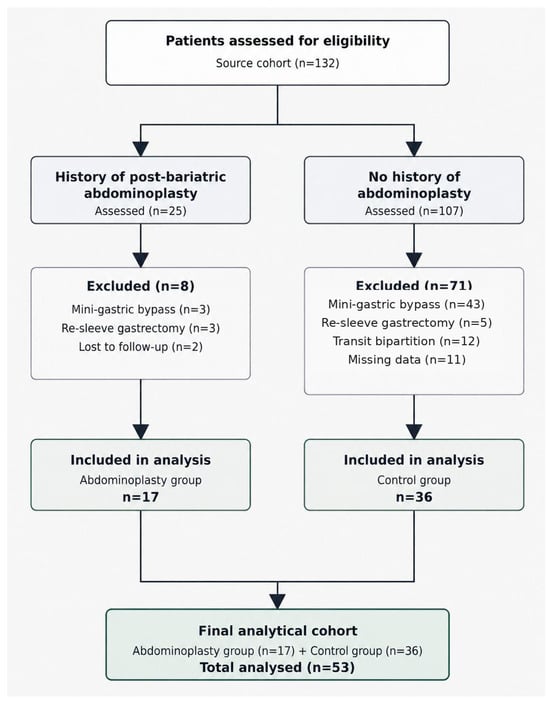
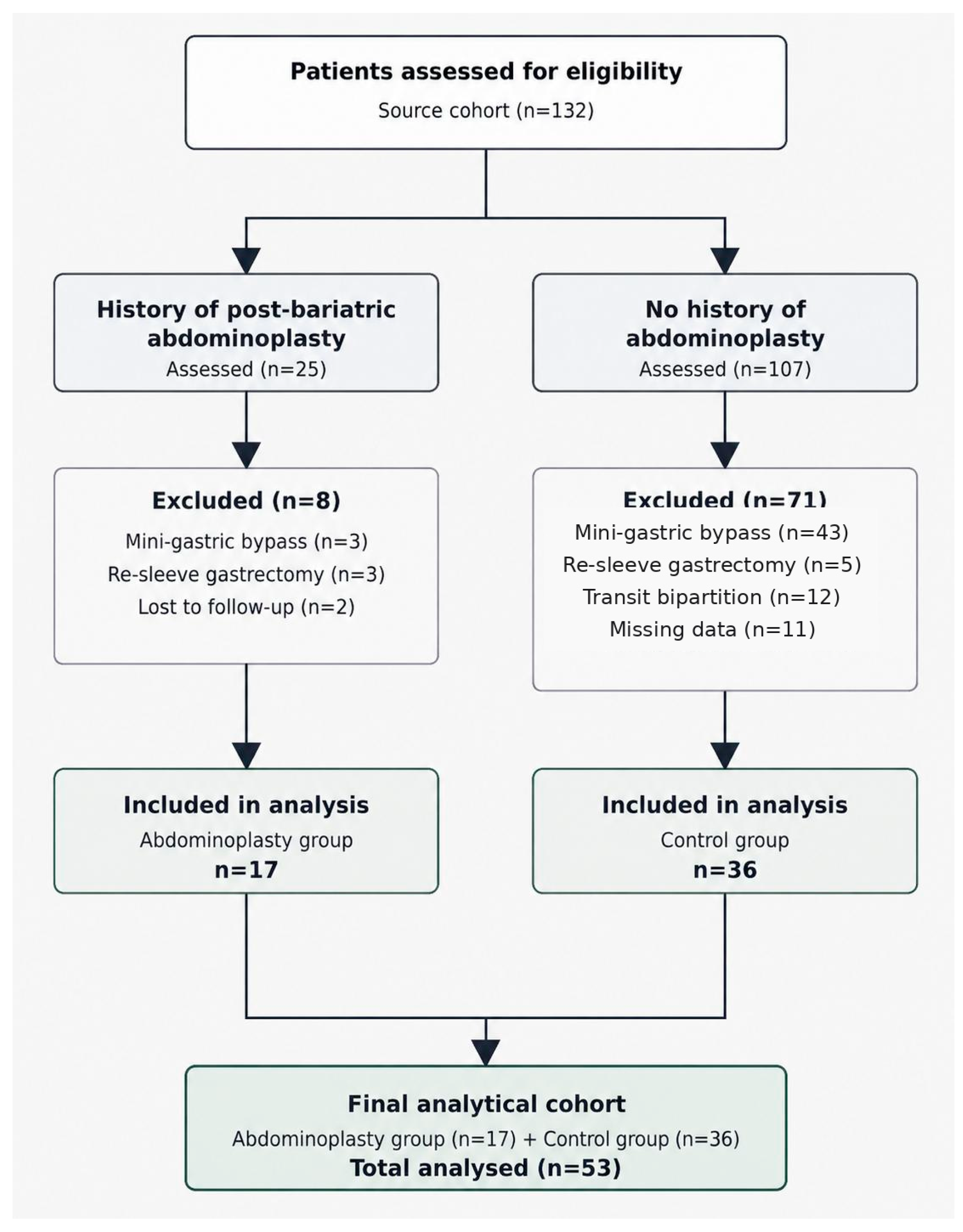
A total of 132 patients were assessed for eligibility. Of the 25 patients with a history of post-bariatric abdominoplasty, 8 were excluded, leaving a total of 17 patients in the abdominoplasty group. Of the 107 patients without a history of abdominoplasty, 71 were excluded, leaving 36 patients in the control group. The final analytical cohort comprised 53 patients: 17 in the abdominoplasty group and 36 in the control group (Figure 1).
Figure 1.
Patient selection flow diagram.
The demographic and preoperative characteristics of the patients are presented in Table 1. The abdominoplasty group included 13 women (76.5%) and 4 men (23.5%), whereas the control group included 27 women (75.0%) and 9 men (25.0%). Sex distribution did not differ significantly between the groups (p = 1.000). The mean age at the time of revision was 42.3 ± 5.5 years in Group 1 and 39.4 ± 6.6 years in Group 2 (p = 0.110). The mean BMI before revisional surgery was 39.0 ± 2.8 kg/m2 and 39.7 ± 2.8 kg/m2, respectively (p = 0.396). No significant difference was observed between the groups in the distribution of ASA classifications (p = 0.161).
Table 1.
Demographic and preoperative characteristics.
The mean BMI before sleeve gastrectomy was significantly higher in Group 1 than in Group 2 (46.7 ± 3.0 vs. 44.8 ± 3.2 kg/m2; p = 0.004). Meanwhile, 1 year after sleeve gastrectomy, the mean EWL was 83.8% ± 18.5% in Group 1 and 84.4% ± 18.2% in Group 2 (p = 0.907), while the corresponding TWL values were 38.9% ± 8.4% and 37.4% ± 8.6%, respectively (p = 0.554). In Group 1, the mean interval between sleeve gastrectomy and abdominoplasty was 18.7 ± 4.5 months (range, 13–29 months). The mean interval between sleeve gastrectomy and revisional RYGB was 54.1 ± 9.3 months in Group 1 and 48.6 ± 15.7 months in Group 2 (p = 0.121).
3.2. Operative Outcomes
The operative outcomes are shown in Table 2. The median operative duration was 150 (140–150) minutes in Group 1 and 120 (100–120) minutes in Group 2 (p < 0.001). The difference remained statistically significant when the three converted procedures were excluded [145 (140–150) vs. 120 (100–120) minutes; p < 0.001]. Conversion to open surgery occurred in 3/17 patients (17.6%) in Group 1 and 0/36 (0%) in Group 2 (p = 0.029), with an absolute risk difference of 17.6 percentage points (95% CI, 2.7–41.0; Newcombe’s method). Although the retrospective surgical records do not contain detailed information regarding the reasons for conversion to open surgery, in these three patients, difficulty with exploration due to inadequate pneumoperitoneum was cited as the cause. Fundus resection was performed in 8/17 (47.1%) versus 22/36 (61.1%) patients (p = 0.384).
Table 2.
Operative findings of revisional RYGB (primary endpoints).
3.3. Postoperative Outcomes
Postoperative outcomes are shown in Table 3. Anastomotic leakage occurred in 1/17 versus 1/36 patients; wound infection was reported in 1/17 versus 2/36; ileus was present in 4/17 versus 2/36; and bleeding occurred in 4/17 versus 4/36. No thromboembolic events were recorded. Overall morbidity (at least one complication) occurred in 5/17 (29.4%) versus 7/36 (19.4%) patients (p = 0.490), with an absolute risk difference of 10.0 percentage points (95% CI, approximately −12.5 to 35.6; Newcombe’s method). The mean hospital stay was 5.8 ± 8.1 (range, 3–37) versus 3.5 ± 2.6 (range, 2–18) days, respectively; the medians (IQRs) were 3 (3–4) versus 3 (3–3) days (Mann–Whitney U p = 0.018). One patient in Group 1 remained hospitalized for 37 days due to multiple complications, including leakage, bleeding requiring transfusion, ileus, and wound infection; a control patient with leakage and wound infection stayed 18 days. These outlying stays were associated with postoperative complications and should not be attributed directly to the previous abdominoplasty.
Table 3.
Postoperative complications following revisional RYGB (secondary outcomes).
Complication severity and management
Each patient was assigned only their highest Clavien–Dindo grade, including those with overlapping events. In Group 1, four patients had grade I and one had grade IIIa complications, whereas in Group 2, four had grade I, two had grade II, and one had grade IIIb complications. The Group 1 patient who was hospitalized for 37 days had leakage, wound infection, ileus, and bleeding requiring transfusion; the endoscopic management of the leak under sedation and analgesia was grade IIIa. The control patient with a leak required another operation under general anesthesia (grade IIIb). Six ileus events were treated conservatively without parenteral nutrition. Six bleeding events were managed without additional medication or transfusion (grade I), while two required transfusion (grade II). Three wound infections required extension or modification of antibiotic therapy (grade II).
3.4. Weight Loss Outcomes
The weight loss outcomes at 1 year after revisional RYGB are presented in Table 4. The mean EWL at 1 year was 71.4% ± 17.8% in Group 1 and 74.8% ± 16.9% in Group 2 (p = 0.509). The corresponding mean TWL values were 25.1% ± 5.5% and 27.5% ± 5.9%, respectively (p = 0.200). No significant differences in 1-year weight loss outcomes were observed between the groups.
Table 4.
Weight loss outcomes at 1 year after revisional RYGB.
4. Discussion
This study examined the association between previous post-bariatric abdominoplasty and the operative and postoperative outcomes of laparoscopic conversion from SG to RYGB. The principal findings were that patients with a history of abdominoplasty had a significantly longer operative time and a higher observed frequency of conversion to open surgery, based on only three events. In contrast, no statistically significant differences were detected in anastomotic leakage, wound infection, postoperative bleeding, overall morbidity, or 1-year weight loss outcomes. Although the distribution of postoperative hospital stay differed significantly between the groups, both had a median length of stay of 3 days. Collectively, these findings suggest that previous abdominoplasty may be associated with differences in the technical conduct of revisional RYGB; however, the present sample was insufficient to exclude clinically relevant differences in postoperative morbidity.
One possible explanation for the longer operative time is altered abdominal wall mechanics. Conventional abdominoplasty involves extensive elevation of the abdominal flap, umbilical transposition, and, frequently, midline plication of the anterior rectus sheath [15]. In the present cohort, rectus sheath plication had been performed in all patients during a previous abdominoplasty. Together with postoperative fibrosis and altered surface landmarks, plication may theoretically reduce abdominal wall compliance and expansion during pneumoperitoneum, thereby restricting the available intra-abdominal working space. Such changes could potentially complicate trocar entry, port positioning, instrument triangulation, and laparoscopic manipulation [14]. Because abdominoplasty is predominantly an extraperitoneal procedure, abdominal wall alterations are a plausible mechanism, but the relative contribution of adhesions was not documented. Patient-level records of trocar repositioning and objective abdominal wall compliance were unavailable; nevertheless, individualized port planning may prove useful [12,13,14].
Our findings can be considered alongside the limited available literature. Saber et al. reported that SG after previous abdominoplasty was associated with longer operative times and a greater need for additional ports because of reduced intra-abdominal working space [12]. Similarly, in patients undergoing laparoscopic colorectal surgery after abdominoplasty, Atallah et al. identified reduced abdominal wall compliance as the principal technical challenge and emphasized the need for an adapted laparoscopic approach [13]. Karip et al. described technical difficulties that arose during bariatric surgery after abdominoplasty, particularly during abdominal entry and trocar placement, but concluded that minimally invasive bariatric surgery remained feasible with appropriate modifications [14]. The present study examines a different setting—revisional bariatric surgery—in which altered gastric anatomy and dissection related to the previous SG already increase procedural complexity. The combination of revisional upper gastrointestinal surgery and an altered abdominal wall may provide a possible explanation for the longer operative time observed in the abdominoplasty group.
Conversion to open surgery occurred in three patients with previous abdominoplasty, but in none of the control group. Although the unadjusted difference was statistically significant (p = 0.029), it is based on only three events (with an absolute risk difference of 17.6 percentage points; 95% CI, 2.7–41.0) and should be interpreted cautiously. All conversions were prompted by inadequate abdominal wall expansion despite pneumoperitoneum, resulting in insufficient intra-abdominal exposure and limited laparoscopic exploration. Nevertheless, this finding is clinically relevant and raises the possibility of access-related challenges during revisional laparoscopy, although the association cannot be interpreted as causal. Conversion should be regarded as a potential intraoperative safety decision rather than automatically being deemed a technical failure; however, evidence from colorectal surgery [16] is indirect in this setting.
Despite the longer operative duration and more frequent observed conversions, previous abdominoplasty was not associated with a statistically significant increase in overall postoperative morbidity. This finding is consistent with a case–control study by Saber et al., in which patients undergoing primary SG after abdominoplasty required longer operative times and additional port placement but did not differ from controls in terms of postoperative complications, length of hospital stay, or weight loss outcomes [12]. Although these authors evaluated primary SG rather than revisional RYGB, these indirect findings do not establish equivalent postoperative safety after revisional RYGB. In our study, rates of anastomotic leakage and wound infection were low, without statistically significant between-group differences, whereas postoperative bleeding and ileus were numerically more frequent in the abdominoplasty group but did not reach statistical significance. In particular, postoperative ileus occurred in 23.5% of patients with previous abdominoplasty compared with 5.6% of controls. This numerical difference may warrant further investigation; however, the small number of events and limited sample size preclude a definitive conclusion. Accordingly, the absence of statistical significance should not be interpreted as evidence of equivalent safety. Larger studies are required to determine whether the observed numerical differences represent clinically relevant associations.
Postoperative hospital stay also requires cautious interpretation. Although the mean hospital stay was 5.8 ± 8.1 days (range, 3–37) in the abdominoplasty group and 3.5 ± 2.6 days (range, 2–18) for controls, the median duration was 3 days in both groups, with only a modest difference in the IQR. The distributional comparison was statistically significant (Mann–Whitney U p = 0.018), but the difference in means should not be interpreted as a separately tested effect. A 37-day admission in the abdominoplasty group followed four overlapping complications, and an 18-day admission in the control group followed postoperative complications. These outlying admissions contributed to the observed variability rather than demonstrating a consistent shift in routine recovery. Therefore, the finding should not be interpreted as evidence of a substantial difference in routine recovery without additional analysis of the factors responsible for prolonged admission, particularly postoperative complications; an independent effect of abdominoplasty could not be established.
No statistically significant difference in 12-month weight loss outcomes was detected after revisional RYGB. The observed EWL and TWL estimates did not differ significantly; however, the study was not powered to establish equivalence. Although they followed a different sequence of procedures from that described in the present study, Sandvik et al. reported that post-bariatric abdominoplasty after primary RYGB was associated with less secondary weight regain at 5 years [17]. This study involved a different surgical sequence and offers only indirect context for our findings. In our cohort, the absence of a statistically significant difference should not be taken as proof of equal weight loss effectiveness. Nevertheless, the present analysis was limited to 1-year anthropometric outcomes and did not evaluate longer-term weight trajectories, remission or recurrence of obesity-related comorbidities, GERD outcomes, nutritional deficiencies, or quality of life.
From a practical perspective, a history of abdominoplasty should be regarded as an important component of preoperative planning for revisional bariatric surgery. The previous abdominoplasty operative report should be reviewed whenever available, particularly with regard to information about rectus sheath plication, mesh placement, liposuction, and the extent of flap dissection. Physical examination should include an assessment of the patient’s scar configuration and abdominal wall mobility, while trocar entry and positioning should be individualized according to the altered surface anatomy and available working space [14]. Patients may also be counseled about the observed longer operative time and the possibility of conversion to open surgery, with emphasis on the uncertainty of the estimates. These procedures may be best undertaken by teams that are experienced in both revisional bariatric surgery and alternative laparoscopic access strategies.
This study has several strengths. It addresses a clinically relevant but insufficiently investigated scenario and provides a control group rather than relying solely on isolated case reports. The revisional procedures were performed at a single center by an experienced bariatric surgical team using a standardized technique, thereby reducing technical heterogeneity. Furthermore, both operative and postoperative outcomes, together with 1-year weight loss results, were evaluated.
However, several limitations should be acknowledged. The retrospective, single-center design and small sample size limit the generalizability and statistical power of the findings. Because the groups were not matched or randomized, selection bias and residual confounding cannot be excluded, particularly given the baseline BMI and ASA differences and the exclusion of patients with missing early follow-up data. Operative difficulty was assessed indirectly from operative time and conversion rather than measured using a validated scale, and patient-level access details and quantitative abdominal wall compliance were unavailable. Because all patients in the abdominoplasty group had undergone rectus sheath plication, the independent effects of abdominoplasty and rectus plication on operative difficulty could not be distinguished. Although all procedures were performed by the same experienced bariatric surgical team using a standardized technique, the potential effect of operation year and temporal changes in team experience was not specifically evaluated. The three conversions limit statistical precision and preclude reliable adjusted analysis. Finally, the 1-year follow-up period was insufficient to evaluate long-term weight loss and clinical outcomes. Larger prospective multicenter studies are required to confirm these findings.
5. Conclusions
Previous abdominoplasty was associated with longer operative duration and a higher observed frequency of conversion to open surgery during SG-to-RYGB revision. These unadjusted findings may suggest greater procedural complexity, but direct technical-difficulty measures were unavailable and the mechanism remains uncertain. No statistically significant between-group differences in overall morbidity or 1-year weight loss were detected; equivalent safety or efficacy cannot be inferred. Larger prospective studies are needed.
Author Contributions
Conceptualization, H.Ç. and O.İ.D.; methodology, H.Ç. and O.İ.D.; formal analysis, O.İ.D. and H.Ç.; investigation, H.Ç., Ö.K., H.E.P., M.K., O.A., R.Y., T.Ç., C.Ö.E., H.E.Ö. and S.D.; data curation, H.Ç., Ö.K., H.E.P., M.K., O.A., R.Y., T.Ç., C.Ö.E., H.E.Ö. and S.D.; writing—original draft preparation, O.İ.D.; writing—review and editing, H.Ç., O.İ.D., Ö.K., H.E.P., M.K., O.A., R.Y., T.Ç., C.Ö.E., H.E.Ö. and S.D. All authors have read and agreed to the published version of the manuscript.
Funding
This research received no external funding.
Institutional Review Board Statement
This study was approved by the Antalya Training and Research Hospital Scientific Research Ethics Committee (study No. 2026-182; Decision No. 7/25, dated 9 April 2026). The study was conducted in accordance with the ethical principles of the Declaration of Helsinki. Written informed consent for the surgical procedures was obtained from all patients before surgery, and the clinical data were analyzed retrospectively and anonymously. The requirement for additional informed consent for inclusion in this retrospective study was waived by the ethics committee because the study used anonymized clinical data.
Informed Consent Statement
The requirement for written informed consent was waived because of the retrospective nature of the study and the use of anonymized clinical data.
Data Availability Statement
The data supporting the findings of this study are not publicly available due to patient privacy and confidentiality considerations. De-identified data may be made available from the corresponding author upon reasonable request, subject to applicable institutional and ethical requirements.
Acknowledgments
During the preparation of this work, the authors used ChatGPT (GPT-5, OpenAI) for English-language editing and to improve the clarity and readability of the manuscript. The authors reviewed and edited all AI-assisted output as needed and take full responsibility for the content of the published article.
Conflicts of Interest
The authors declare no conflicts of interest.
Abbreviations
| ASA | American Society of Anesthesiologists |
| BMI | Body mass index |
| EWL | Excess weight loss |
| GERD | Gastroesophageal reflux disease |
| IQR | Interquartile range |
| RYGB | Roux-en-Y gastric bypass |
| SD | Standard deviation |
| SG | Sleeve gastrectomy |
| SPSS | Statistical Package for the Social Sciences |
| STROBE | Strengthening the Reporting of Observational Studies in Epidemiology |
| TWL | Total weight loss |
References
- Himpens, J.; Dobbeleir, J.; Peeters, G. Long-term results of laparoscopic sleeve gastrectomy for obesity. Ann. Surg. 2010, 252, 319–324. [Google Scholar] [CrossRef] [Scilit] [PubMed]
- Clapp, B.; Wynn, M.; Martyn, C.; Foster, C.; O’Dell, M.; Tyroch, A. Long term (7 or more years) outcomes of the sleeve gastrectomy: A meta-analysis. Surg. Obes. Relat. Dis. 2018, 14, 741–747. [Google Scholar] [CrossRef] [Scilit] [PubMed]
- Lazzati, A.; Bechet, S.; Jouma, S.; Paolino, L.; Jung, C. Revision surgery after sleeve gastrectomy: A nationwide study with 10 years of follow-up. Surg. Obes. Relat. Dis. 2020, 16, 1497–1504. [Google Scholar] [CrossRef] [Scilit] [PubMed]
- van Rutte, P.W.; Smulders, J.F.; de Zoete, J.P.; Nienhuijs, S.W. Indications and short-term outcomes of revisional surgery after failed or complicated sleeve gastrectomy. Obes. Surg. 2012, 22, 1903–1908. [Google Scholar] [CrossRef] [Scilit] [PubMed]
- Yilmaz, H.; Ece, I.; Sahin, M. Revisional Surgery After Failed Laparoscopic Sleeve Gastrectomy: Retrospective Analysis of Causes, Results, and Technical Considerations. Obes. Surg. 2017, 27, 2855–2860. [Google Scholar] [CrossRef] [Scilit] [PubMed]
- Dang, J.T.; Vaughan, T.; Mocanu, V.; Mubashir, H.; Barajas-Gamboa, J.S.; Codina, R.C.; Rodriguez, J.; Karmali, S.; Kroh, M. Conversion of Sleeve Gastrectomy to Roux-en-Y Gastric Bypass: Indications, Prevalence, and Safety. Obes. Surg. 2023, 33, 1486–1493. [Google Scholar] [CrossRef] [Scilit] [PubMed]
- Toninello, P.; Montanari, A.; Bassetto, F.; Vindigni, V.; Paoli, A. Nutritional Support for Bariatric Surgery Patients: The Skin beyond the Fat. Nutrients 2021, 13, 1565. [Google Scholar] [CrossRef] [Scilit] [PubMed]
- Oppert, J.M.; Bellicha, A.; Roda, C.; Bouillot, J.L.; Torcivia, A.; Clement, K.; Poitou, C.; Ciangura, C. Resistance Training and Protein Supplementation Increase Strength After Bariatric Surgery: A Randomized Controlled Trial. Obesity 2018, 26, 1709–1720. [Google Scholar] [CrossRef] [Scilit] [PubMed]
- Abela, C.; Stevens, T.; Reddy, M.; Soldin, M. A multidisciplinary approach to post-bariatric plastic surgery. Int. J. Surg. 2011, 9, 29–35. [Google Scholar] [CrossRef] [Scilit] [PubMed]
- Jiang, Z.; Zhang, G.; Huang, J.; Shen, C.; Cai, Z.; Yin, X.; Yin, Y.; Zhang, B. A systematic review of body contouring surgery in post-bariatric patients to determine its prevalence, effects on quality of life, desire, and barriers. Obes. Rev. 2021, 22, e13201. [Google Scholar] [CrossRef] [Scilit] [PubMed]
- Kitzinger, H.B.; Abayev, S.; Pittermann, A.; Karle, B.; Kubiena, H.; Bohdjalian, A.; Langer, F.B.; Prager, G.; Frey, M. The prevalence of body contouring surgery after gastric bypass surgery. Obes. Surg. 2012, 22, 8–12. [Google Scholar] [CrossRef] [Scilit] [PubMed]
- Saber, A.A.; Shoar, S.; El-Matbouly, M.; Karem, M.; Bashah, M.M.; Al Najjar, A.; Alkuwari, M.J.; Soltanian, H. Laparoscopic sleeve gastrectomy in patients with abdominoplasty: A case-control study. Surg. Obes. Relat. Dis. 2017, 13, 144–149. [Google Scholar] [CrossRef] [Scilit] [PubMed]
- Atallah, S.; Albert, M.; Felix, O.; Izfar, S.; Debeche-Adams, T.; Larach, S. The technical approach to laparoscopic colectomy in patients who have undergone prior abdominoplasty. Tech Coloproctol. 2013, 17, 111–116. [Google Scholar] [CrossRef] [Scilit] [PubMed]
- Karip, B.; Altun, H.; Işcan, Y.; Bazan, M.; Celik, K.; Ozcabı, Y.; Ağca, B.; Memişoğlu, K. Difficulties of bariatric surgery after abdominoplasty. Case Rep. Surg. 2014, 2014, 620175. [Google Scholar] [CrossRef] [Scilit] [PubMed]
- Sadeghi, P.; Duarte-Bateman, D.; Ma, W.; Khalaf, R.; Fodor, R.; Pieretti, G.; Ciccarelli, F.; Harandi, H.; Cuomo, R. Post-Bariatric Plastic Surgery: Abdominoplasty, the State of the Art in Body Contouring. J. Clin. Med. 2022, 11, 4315. [Google Scholar] [CrossRef] [Scilit] [PubMed]
- 2015 European Society of Coloproctology (ESCP) collaborating groups. The impact of conversion on the risk of major complication following laparoscopic colonic surgery: An international, multicentre prospective audit. Colorectal Dis. 2018, 20, 69–89. [Google Scholar] [CrossRef] [Scilit] [PubMed]
- Sandvik, J.; Hole, T.; Klöckner, C.; Kulseng, B.; Wibe, A. The Impact of Post-bariatric Abdominoplasty on Secondary Weight Regain After Roux-en-Y Gastric Bypass. Front. Endocrinol. 2020, 11, 459. [Google Scholar] [CrossRef] [Scilit] [PubMed]

Disclaimer/Publisher’s Note: The statements, opinions and data contained in all publications are solely those of the individual author(s) and contributor(s) and not of MDPI and/or the editor(s). MDPI and/or the editor(s) disclaim responsibility for any injury to people or property resulting from any ideas, methods, instructions or products referred to in the content. |
© 2026 by the authors. Published by MDPI on behalf of the Lithuanian University of Health Sciences. Licensee MDPI, Basel, Switzerland. This article is an open access article distributed under the terms and conditions of the Creative Commons Attribution (CC BY) license.