


Abstract
Gallstone disease and benign or premalignant gynecologic disease frequently coexist in women, and both are routinely treated by laparoscopy. Combining laparoscopic cholecystectomy and gynecologic surgery in a single session avoids a second anesthetic episode and hospitalization, but it raises questions about patient selection, technique, and safety. This narrative review summarizes the evidence on concomitant laparoscopic cholecystectomy and gynecologic procedures, distinguishing direct evidence from mixed cohorts. In a population-based study of more than 1.7 million women undergoing outpatient laparoscopic cholecystectomy, concurrent gynecologic procedures, mainly adnexal surgery and conization, were not associated with significantly higher morbidity (adjusted odds ratio 1.39, 95% confidence interval 0.75–2.59), although this wide interval does not establish equivalent safety. Institutional series report low major complication rates, but evidence specifically supporting combined hysterectomy is limited to case reports and small series. In contrast, evidence from bariatric surgery shows that adding cholecystectomy to procedures with an anastomosis increases complications, so the safety of a combination depends on the index operation. We describe the authors’ preferred, adaptable workflow covering indications, risk assessment, team organization, port placement, sequence of procedures, and specimen extraction. Combined surgery is feasible in selected patients, with reassuring reported outcomes, although comparative safety remains uncertain; prospective registries with standardized outcome reporting are needed.
1. Introduction
Laparoscopy has become the standard approach for many abdominal operations, including cholecystectomy and hysterectomy for benign disease. Compared with open surgery, laparoscopic cholecystectomy and laparoscopic hysterectomy reduce postoperative pain, nosocomial infections, and hospital stay and allow a faster return to normal activities [1,2,3]. Since the first laparoscopic hysterectomy was reported in 1989 [4], laparoscopically assisted vaginal hysterectomy (LAVH), total laparoscopic hysterectomy (TLH), and their single-incision and robotic variants have been widely adopted [2,5].
Gallstone disease is one of the most common digestive disorders, with a global pooled prevalence of 6.1%, higher in women (7.6%) and increasing to about 13% in people older than 70 years [6]. Uterine and adnexal pathology requiring surgery are also frequent in middle-aged women, so the two conditions often coexist. When both require surgery, they can be treated in two separate operations or in a single laparoscopic session. The latter avoids a second anesthetic episode, a second recovery period, and a second hospitalization, and laparoscopy provides access to both the upper abdomen and the pelvis through the same ports [7,8].
Combined procedures, however, also prolong operating time and pneumoperitoneum, require changes in patient position, may mix different wound classes, and require cooperation between general surgeons and gynecologists. Data from bariatric surgery show that adding a cholecystectomy is not always harmless [9,10]. This narrative review summarizes the evidence on concomitant laparoscopic cholecystectomy and gynecologic surgery, places it in the context of other combined laparoscopic procedures, and proposes an adaptable workflow that reflects the authors’ preferred approach, based on the literature and on our own experience [7,9].
2. Methods
We performed a narrative review of the literature. PubMed and Google Scholar were searched for articles published in English from 1989 to September 2026, using combinations of the terms “laparoscopic cholecystectomy”, “hysterectomy”, “laparoscopically assisted vaginal hysterectomy”, “adnexectomy”, “gynecologic surgery”, “combined”, “concomitant”, “concurrent”, “simultaneous”, and “single-session”. The search terms were combined as follows: (“laparoscopic cholecystectomy”) AND (“hysterectomy” OR “laparoscopically assisted vaginal hysterectomy” OR “adnexectomy” OR “gynecologic surgery”) AND (“combined” OR “concomitant” OR “concurrent” OR “simultaneous” OR “single-session”). The search was last updated in September 2026. Reference lists of relevant articles were screened manually. We included population-based analyses, cohort studies, case series, case reports describing a technique, systematic reviews, meta-analyses, and guidelines relevant to indications, technique, or outcomes of combined procedures. Titles and abstracts were screened for relevance, and the full texts of potentially relevant articles were reviewed. Studies were classified as direct evidence when they reported patients undergoing laparoscopic cholecystectomy combined with a gynecologic procedure, and as indirect evidence when gynecologic combinations could not be separated from other combined procedures or when other procedures were combined with cholecystectomy. Within each category, priority was given to population-based and comparative studies, followed by cohort studies, case series, and case reports; case reports were retained when they described a distinct technical variant (sequence of procedures, port arrangement, single-site or robotic approach, or extraction route). Nine studies reporting combined cholecystectomy and gynecologic surgery are summarized in Table 1, and three studies of other combinations providing indirect evidence are summarized in Table 2. Given the heterogeneity and predominantly observational nature of the evidence, no formal risk-of-bias assessment or meta-analysis was performed; instead, the relevance and strength of each study were appraised qualitatively according to study design, sample size, presence and type of comparator, and whether the results for gynecologic combinations were reported separately. The results are presented descriptively.
Table 1.
Studies reporting concomitant laparoscopic cholecystectomy and gynecologic surgery. Studies are classified as direct evidence or as mixed cohorts (indirect evidence).
3. Rationale for Combined Procedures
3.1. Epidemiological Overlap
The coexistence of gallstones and gynecologic disease reflects shared epidemiology: both are more frequent in women, and gallstone prevalence rises with age, parity, and obesity [6,16]. In a cross-sectional analysis of 1,722,479 women undergoing outpatient laparoscopic cholecystectomy in the United States between 2016 and 2019, a concurrent gynecologic diagnosis was present in 11.3 per 1000 cases. Among women with such diagnoses, concurrent minimally invasive gynecologic procedures were common: laparoscopic adnexectomy was performed in 652 per 1000 women with benign ovarian tumors and 386 per 1000 with endometrioma, and cervical conization in 304 per 1000 women with cervical carcinoma in situ [8].
3.2. Expected Benefits
The main expected benefits are a single anesthetic episode, a single postoperative recovery, and a single hospitalization, with lower overall costs and a faster return to activity [9,11]. Laparoscopy also allows a complete inspection of the abdominal and pelvic cavity, which may reveal unexpected pathology such as adhesions, endometriosis, or adnexal lesions [2,7]. For patients with cardiopulmonary comorbidity, avoiding a second anesthetic episode and a second pneumoperitoneum may be particularly relevant, provided that the combined procedure does not become excessively long [7,17].
3.3. Indications
Each procedure must be indicated on its own merits. Cholecystectomy is recommended for symptomatic gallstones and their complications; for most patients with asymptomatic gallstones, current European guidelines do not recommend cholecystectomy [16]. The finding of asymptomatic gallstones during gynecologic surgery is therefore not, by itself, an indication for concomitant cholecystectomy. Similarly, the route of hysterectomy should be chosen according to gynecologic criteria: vaginal hysterectomy remains preferred when feasible, and laparoscopy is favored when the vaginal route is not feasible or when concomitant intra-abdominal procedures are planned [2,5]. The need to perform a cholecystectomy is one of the situations in which a laparoscopic or laparoscopically assisted route is preferable to a purely vaginal hysterectomy [5,7]. This review concerns benign gynecologic disease and premalignant lesions, such as cervical intraepithelial neoplasia or carcinoma in situ. When invasive gynecologic malignancy is suspected or confirmed, the surgical route and extent must follow disease-specific oncologic principles, and a planned cholecystectomy should not modify the oncologic procedure.
4. Evidence on Concomitant Laparoscopic Cholecystectomy and Gynecologic Surgery
The available studies are summarized in Table 1; the table distinguishes direct evidence (patients undergoing cholecystectomy combined with gynecologic surgery) from mixed cohorts, in which gynecologic combinations represent only part of the series. The largest dataset is the population-based analysis by Matsuo et al., in which surgical morbidity was 2.8 per 1000 in women who underwent concurrent gynecologic surgery and 1.9 per 1000 in those who underwent cholecystectomy alone, a difference that was not statistically significant after adjustment (adjusted odds ratio 1.39; 95% CI 0.75–2.59) [8]. This study was limited to outpatient procedures, which consisted mainly of adnexal surgery and conization rather than hysterectomy. The absence of a statistically significant difference should not be interpreted as equivalent safety: the confidence interval remains compatible with a clinically relevant increase in morbidity, and these findings cannot be generalized to hysterectomy or to other, more extensive gynecologic procedures.
Institutional series provide additional information. Among 3144 laparoscopic cholecystectomies performed between 2005 and 2009, Savita et al. combined another procedure in 401 cases (12.8%), of which 46 were gynecologic (ovarian cystectomy, ovarian drilling, tubal ligation, oophorectomy, myomectomy, and TLH in six patients). For the whole combined group, the mean operative time was 80 min and the mean hospital stay 3.2 days, both longer than after cholecystectomy alone, and no increase in postoperative complications was reported; however, outcomes were not reported separately for the gynecologic combinations [9]. In a retrospective cohort of 147 obese women undergoing combined laparoscopic gynecologic surgery with cholecystectomy (n = 93) or appendectomy (n = 54), Wang et al. reported intraoperative complications in 4.8%, minor postoperative complications in 20.4%, and no major postoperative complications; operative time and blood loss varied with the type of combination, whereas the time to resume oral intake and the length of hospital stay did not differ [10]. A recent case series of 139 concomitant laparoscopic procedures with prospectively collected data, including 61 combined with cholecystectomy, reported shorter total operative time and hospital stay, with similar pain scores at 24 h [11]. However, the comparators were the component procedures performed individually by the same surgeon or other treatment modalities during the same period, rather than staged operations in the same patients, and the number of gynecologic combinations was not specified.
Case reports and small series have described the technical variants of the combination. LAVH with bilateral adnexectomy and laparoscopic cholecystectomy was performed through five trocars without a uterine manipulator in a 52-year-old woman with significant cardiac comorbidity; the operative time was 125 min, there were no complications, and the gallbladder was extracted transvaginally together with the uterus [7]. Similar single-session TLH, bilateral salpingo-oophorectomy, and cholecystectomy using a vessel-sealing device has been reported with discharge within 24 h [12], and the feasibility of combined LAVH and cholecystectomy has been confirmed in selected cases [18]. Laparoendoscopic single-site surgery allows both procedures through one umbilical incision [13], and robotic single-site platforms have been used for combined hysterectomy and cholecystectomy, with operative times of 2.75 to 4 h, discharge within 36 h to 5 days, and no major complications, although switching between the upper abdomen and the pelvis required a second robotic docking [14,15]. Thus, apart from cohorts that do not analyze hysterectomy separately, the direct evidence for combining cholecystectomy with hysterectomy is limited to case reports and small series.
5. Lessons from Other Combined Laparoscopic Procedures
Evidence from other combinations helps define when the addition of a procedure is safe (Table 2). A meta-analysis of ten studies including 598 patients undergoing simultaneous laparoscopic cholecystectomy and laparoscopic hernia repair found low rates of mesh and surgical site infection, seroma, and hernia recurrence, supporting the safety of this combination despite the theoretical risk of contaminating a prosthetic mesh with bile [19].
Table 2.
Evidence from other combinations with laparoscopic cholecystectomy.
Bariatric surgery provides a counterpoint. In the Metabolic and Bariatric Surgery Accreditation and Quality Improvement Program database, 15,614 of 464,674 bariatric operations (3.4%) included a concomitant procedure; the addition of cholecystectomy increased operative time and hospital stay, and sleeve gastrectomy combined with cholecystectomy was associated with higher rates of readmission, reintervention, and reoperation [20]. A 2025 meta-analysis of 26 studies including 656,830 patients with gallstones found that concomitant cholecystectomy during metabolic and bariatric surgery increased postoperative bleeding (odds ratio [OR] 1.31), wound complications (OR 1.61), respiratory complications (OR 1.49), and anastomotic complications (OR 1.86), without significant differences in mortality or hospital stay [21]. The authors recommended reserving concomitant cholecystectomy for symptomatic or high-risk patients and avoiding it in procedures involving an anastomosis.
Taken together, these data suggest that the added risk of a concomitant cholecystectomy depends on the complexity of the index operation, on whether an anastomosis or prosthetic material is involved, and on the baseline risk of the patient. Gynecologic procedures such as LAVH, TLH, and adnexectomy do not involve a digestive anastomosis, which may explain the reassuring results reported for this combination [8,10].
6. Technical Considerations
6.1. Preoperative Assessment and Team Organization
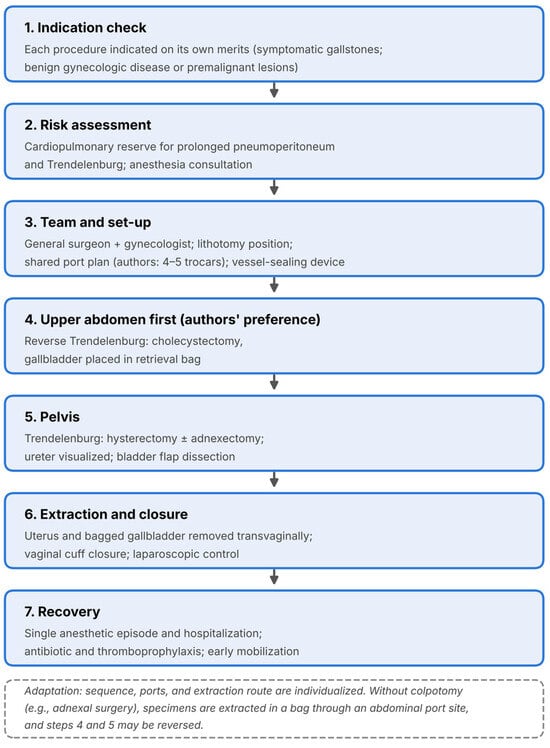
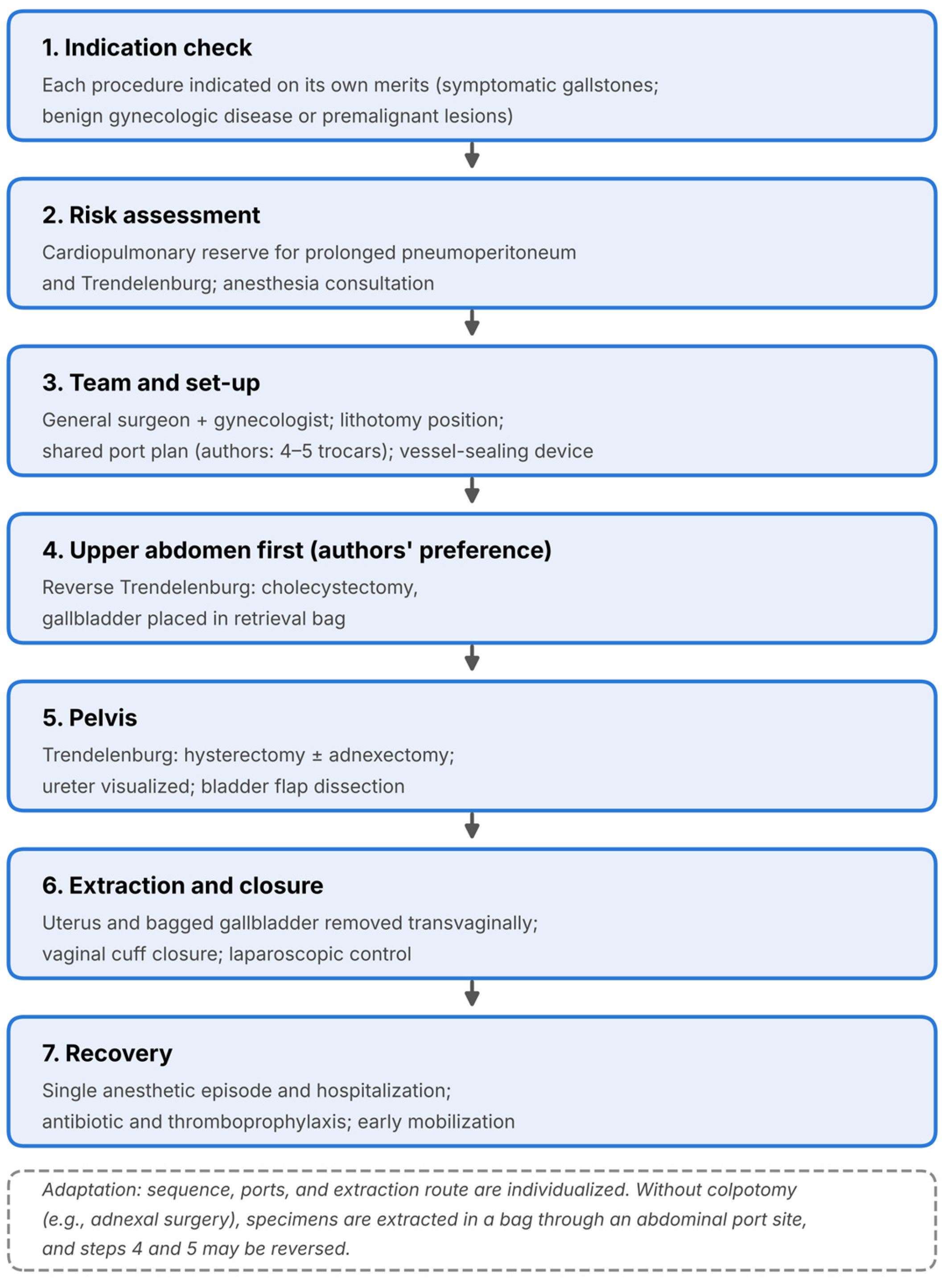
The technical workflow described below (Figure 1, Table 3) reflects the authors’ preferred approach for combined cholecystectomy and hysterectomy, derived from our experience and from limited evidence. It is not an established standard: the sequence of procedures, port arrangement, and extraction route should be individualized according to the procedures planned, patient characteristics, and the experience of the surgical teams. Preoperative assessment should confirm the indication for each procedure, exclude choledocholithiasis and malignancy when suspected, and evaluate cardiopulmonary reserve. Prolonged pneumoperitoneum and steep Trendelenburg positioning increase intrathoracic pressure and alter hemodynamics; however, according to the European Association for Endoscopic Surgery, cardiopulmonary disease is not an absolute contraindication to laparoscopy when the lowest effective intra-abdominal pressure and appropriate monitoring, including end-tidal and, when indicated, arterial CO2 measurement, are used [17]. In our case, laparoscopy was chosen after anesthetic consultation in a patient with hypertension, atrial fibrillation, valvular disease, and pulmonary hypertension, and the combined procedure avoided two separate anesthetic episodes [7]. The operation is best planned jointly by a general surgeon and a gynecologist, with agreement on port placement, sequence, and specimen extraction.
Figure 1.
Authors’ preferred workflow for concomitant laparoscopic cholecystectomy and hysterectomy (LAVH or TLH, with or without adnexectomy), based on the literature and the authors’ experience. The sequence, port arrangement, and extraction route should be individualized. For adnexal or other gynecologic procedures without colpotomy, step 6 is adapted by extracting the specimens in retrieval bags through an abdominal port site, and the order of steps 4 and 5 may be reversed.
Table 3.
Practical recommendations for concomitant laparoscopic cholecystectomy and gynecologic surgery. The table reflects the authors’ preferred approach, which should be adapted to the procedures planned, patient characteristics, and team experience.
6.2. Positioning and Port Placement
The patient is placed in the lithotomy (gynecologic) position, which allows vaginal access and changes between reverse Trendelenburg for the upper abdomen and Trendelenburg for the pelvis. Port placement should allow both procedures with the minimum number of trocars. In our technique, five trocars were used: an 11 mm umbilical optical trocar, an 11 mm suprapubic trocar, an 11 mm left lateral trocar for the vessel-sealing device, and two 5.5 mm trocars in the right upper quadrant (subcostal midclavicular and right lateral rectus border), the latter serving for gallbladder retraction [7]. The telescope can be moved between trocars to optimize the view of each field. Single-incision approaches reduce the number of incisions but prolong operating time and increase technical difficulty, particularly when working in two distant quadrants [13,14,15,25]. Each approach has advantages and drawbacks. Conventional multiport laparoscopy with shared trocars is the most widely available and reproducible option and provides good triangulation in both the upper abdomen and the pelvis, at the cost of four to five incisions [7,12]. Laparoendoscopic single-site surgery improves cosmesis but reduces triangulation, causes instrument crowding, and becomes more demanding when the operative field changes from the gallbladder to the pelvis [13,25]. Robotic single-site platforms improve ergonomics and instrument stability but may require redocking between the two fields, prolong operating time, and increase costs, and experience is limited to case reports and small series [14,15]. Transvaginal extraction avoids enlarging an abdominal port site when a colpotomy is already performed for hysterectomy, but it is not applicable to procedures that do not open the vagina [7]. No comparative data are available to recommend one approach over another, and the choice should depend on the procedures planned, patient characteristics, and the experience and equipment of the surgical teams.
6.3. Sequence of Procedures
In our preferred approach, the cholecystectomy is performed first [7]. Starting in the upper abdomen allows the biliary part of the operation, which may be shorter and technically more predictable, to be completed before the patient is placed in steep Trendelenburg for the pelvic phase; the gallbladder is placed in a retrieval bag and left in the abdomen, which limits bile spillage and allows extraction at the end of the operation. Performing the cholecystectomy before opening the vagina also keeps the upper abdominal field clean until the colpotomy. Both procedures are classified as clean-contaminated, and standard perioperative antibiotic prophylaxis is recommended [23]. This sequence reflects the authors’ preference rather than a standard. The gynecologic procedure may be performed first when, for example, its findings determine the extent of surgery, when the pelvic phase is expected to be longer or more difficult, or when a vaginal approach is attempted first and laparoscopic assistance must remain available. The order should be agreed preoperatively by the two teams.
6.4. Hysterectomy Technique
LAVH and TLH can be performed with or without a uterine manipulator. Without a manipulator, the uterus is mobilized by traction with laparoscopic graspers, which was feasible in our patient [7]. Avoiding a uterine manipulator has been suggested when a premalignant cervical lesion is present, but the available data on combined procedures do not establish any oncologic benefit of this choice. When invasive cervical or endometrial cancer is suspected or confirmed, the surgical route and extent of hysterectomy must follow disease-specific oncologic principles and guidelines, independently of the planned cholecystectomy. Bipolar vessel-sealing devices allow progressive section of the round ligaments, adnexal or utero-ovarian pedicles, broad ligaments, and uterine vessels with limited blood loss, and they can also be used during cholecystectomy [7,12]. The ureters should be visualized transperitoneally, as urinary tract injury is more frequent after laparoscopic than after abdominal hysterectomy [2,26]. Vaginal cuff dehiscence is more frequent after TLH than after vaginal or abdominal hysterectomy [27]; in LAVH, the vaginal cuff is closed through the vaginal route with absorbable sutures [7].
6.5. Specimen Extraction
When a hysterectomy is performed, the opened vagina offers a natural route for extracting both the uterus and the bagged gallbladder, avoiding enlargement of an abdominal port site [7]. Transvaginal extraction of the gallbladder is well established in hybrid natural orifice transluminal endoscopic surgery (NOTES) cholecystectomy, which was the most frequent procedure in the German NOTES registry of 551 patients, with low complication rates [22]. After extraction, pneumoperitoneum is re-established for a final laparoscopic check of hemostasis and, when indicated, drainage. When the gynecologic procedure does not include a colpotomy, as in adnexal surgery, the specimens are removed in retrieval bags through the umbilical or another port site, enlarged as needed.
6.6. Postoperative Care
Postoperative management follows enhanced recovery principles, including multimodal analgesia, early feeding and mobilization, and thromboprophylaxis [28]. Intermittent pneumatic compression of the lower limbs is recommended during prolonged laparoscopic procedures [17], and pharmacological prophylaxis should be adapted to the combined operative time and the patient’s risk profile. Laparoscopic cholecystectomy and hysterectomy each reduce the odds of nosocomial infection by more than 50% compared with open surgery [1], and patient-reported quality of life recovers earlier after laparoscopic than after open surgery for both gallstones and uterine disease [3].
7. Complications and Safety
The complications of a combined procedure are, in principle, those of each component: bleeding, bile leakage and bile duct injury for cholecystectomy; urinary tract injury, vaginal cuff complications, and bleeding for hysterectomy; and port-site complications, pneumoperitoneum-related events, and conversion for both [26,27,29]. With experienced surgeons, the rate of major complications of laparoscopic hysterectomy is comparable to that of other routes [29]. The additional risks of combination are mainly related to longer operative and anesthesia time, repeated changes of position, and the combination of two clean-contaminated fields. Available data have not shown a statistically significant increase in morbidity when gynecologic procedures are added to cholecystectomy [8,9,10], but this should not be interpreted as proof of equivalent safety. The studies are mostly retrospective, are subject to selection bias, include mainly minor gynecologic procedures, and are underpowered to detect uncommon but serious complications such as bile duct or ureteral injury; rare serious events therefore cannot be excluded. Complications should be reported using standardized systems such as the Clavien–Dindo classification [24] to allow comparison between studies.
8. Limitations of the Evidence and Future Directions
The evidence is limited. No randomized trial has compared combined with staged procedures, and most data come from retrospective series, case reports, and administrative databases with limited clinical detail. In several cohorts, gynecologic combinations are not analyzed separately from other combined procedures, and comparisons are made with single procedures in other patients rather than with staged operations. Selection bias is likely, as combined procedures are offered to healthier patients with less complex disease. Outcomes are inconsistently defined, operative times and costs are rarely reported in a comparable way, and long-term results, including patient-reported outcomes, are largely unknown. Future research should include prospective multicenter registries of combined laparoscopic procedures with standardized reporting of indications, operative time, complications graded by the Clavien–Dindo classification, hospital stay, readmissions, and costs, as well as comparisons with staged procedures. The role of robotic single-site platforms, vaginal natural orifice approaches, and low-pressure pneumoperitoneum in combined surgery also deserves evaluation.
9. Conclusions
Concomitant laparoscopic cholecystectomy and gynecologic surgery is feasible in selected patients treated by experienced teams, with reassuring reported outcomes, and avoids a second anesthetic episode and hospitalization, although comparative safety remains uncertain. The largest dataset concerns mainly adnexal procedures and conization, whereas evidence specifically supporting combined hysterectomy remains limited to case reports and small series. Each procedure should be indicated independently, cardiopulmonary reserve should be assessed before prolonged pneumoperitoneum, and the operation should be planned jointly by general surgeons and gynecologists, with a shared port layout. In our preferred approach, cholecystectomy is performed first and specimens are extracted transvaginally when a hysterectomy is performed, but the sequence, port arrangement, and extraction route should be individualized. The approach applies to benign and premalignant gynecologic disease; when invasive malignancy is suspected, disease-specific oncologic principles take precedence. Evidence from bariatric surgery shows that combinations involving an anastomosis carry additional risk, so the safety of combined procedures cannot be generalized. Prospective registries with standardized outcome reporting are needed to define the benefits and limits of this approach.
Author Contributions
F.M.—conceptualization, methodology, O.A.—literature review and editing, C.D.G.—literature review, writing—original draft preparation, R.C.—review and editing, S.C.—methodology, review, I.C.—review and editing, G.O.—editing and writing, D.P.—review and editing, S.U.—methodology, review, L.T.—review and editing, B.S.—conceptualization, writing. All authors have read and agreed to the published version of the manuscript.
Funding
This research received no external funding.
Institutional Review Board Statement
Not applicable.
Informed Consent Statement
Not applicable.
Data Availability Statement
No new data were created or analyzed in this study. Data sharing is not applicable to this article.
Acknowledgments
During the preparation of this manuscript, the authors used Claude (Claude Sonnet 5.5, made by Anthropic) for literature searching, language editing, structuring the manuscript, and drafting the figure. The authors have reviewed and edited the output and take full responsibility for the content of this publication.
Conflicts of Interest
The authors declare no conflicts of interest.
Abbreviations
The following abbreviations are used in this manuscript:
| aOR | adjusted odds ratio |
| BSO | bilateral salpingo-oophorectomy |
| CI | confidence interval |
| LAVH | laparoscopically assisted vaginal hysterectomy |
| LC | laparoscopic cholecystectomy |
| NOTES | natural orifice transluminal endoscopic surgery |
| OR | odds ratio |
| TLH | total laparoscopic hysterectomy |
References
- Brill, A.; Ghosh, K.; Gunnarsson, C.; Rizzo, J.; Fullum, T.; Maxey, C.; Brossette, S. The Effects of Laparoscopic Cholecystectomy, Hysterectomy, and Appendectomy on Nosocomial Infection Risks. Surg. Endosc. 2008, 22, 1112–1118. [Google Scholar] [CrossRef] [Scilit]
- Pickett, C.M.; Seeratan, D.D.; Mol, B.W.J.; Nieboer, T.E.; Johnson, N.; Bonestroo, T.; Aarts, J.W. Surgical Approach to Hysterectomy for Benign Gynaecological Disease. Cochrane Database Syst. Rev. 2023, 8, CD003677. [Google Scholar] [CrossRef] [Scilit]
- Korolija, D.; Sauerland, S.; Wood-Dauphinée, S.; Abbou, C.C.; Eypasch, E.; Caballero, M.G.; Lumsden, M.A.; Millat, B.; Monson, J.R.T.; Nilsson, G.; et al. Evaluation of Quality of Life after Laparoscopic Surgery: Evidence-Based Guidelines of the European Association for Endoscopic Surgery. Surg. Endosc. 2004, 18, 879–897. [Google Scholar] [CrossRef] [Scilit]
- Reich, H.; DeCaprio, J.; McGlynn, F. Laparoscopic Hysterectomy. J. Gynecol. Surg. 1989, 5, 213–216. [Google Scholar] [CrossRef] [Scilit]
- American College of Obstetricians and Gynecologists. Committee Opinion No. 701: Choosing the Route of Hysterectomy for Benign Disease. Obstet. Gynecol. 2017, 129, e155–e159. [Google Scholar] [CrossRef] [Scilit]
- Wang, X.; Yu, W.; Jiang, G.; Li, H.; Li, S.; Xie, L.; Bai, X.; Cui, P.; Chen, Q.; Lou, Y.; et al. Global Epidemiology of Gallstones in the 21st Century: A Systematic Review and Meta-Analysis. Clin. Gastroenterol. Hepatol. 2024, 22, 1586–1595. [Google Scholar] [CrossRef] [Scilit]
- Stancu, B.; Grad, N.O.; Mihaileanu, V.F.; Chiorescu, S.; Pintea, S.D.; Constantinescu, M.I. Surgical Technique of Concomitant Laparoscopically Assisted Vaginal Hysterectomy and Laparoscopic Cholecystectomy. Clujul Med. 2017, 90, 348–352. [Google Scholar] [CrossRef] [Scilit]
- Matsuo, K.; Rau, A.R.; Ciesielski, K.M.; Vallejo, A.; Mandelbaum, R.S.; Roman, L.D.; Klar, M.; Matsushima, K.; Wright, J.D. Concurrent Minimally Invasive Gynecologic Procedures at the Time of Laparoscopic Cholecystectomy. Obstet. Gynecol. 2023, 142, 1491–1495. [Google Scholar] [CrossRef] [Scilit]
- Savita, K.S.; Khedkar, I.; Bhartia, V.K. Combined Procedures with Laparoscopic Cholecystectomy. Indian J. Surg. 2010, 72, 377–380. [Google Scholar] [CrossRef] [Scilit]
- Wang, H.; Zhou, A.; Fan, M.; Li, P.; Qi, S.; Gao, L.; Li, X.; Zhao, J. Application of Laparoscopy in the Combined Surgical Procedures of Gynecological and Digestive Disorders in Obese Women: A Retrospective Cohort Study. Int. J. Surg. 2015, 16, 83–87. [Google Scholar] [CrossRef] [Scilit]
- Rudramani; Singh, S.K.; Chandra, A.; Singh, V. Concomitant Laparoscopic Surgery: A Step Ahead. Indian J. Surg. 2025, 87, 109–116. [Google Scholar] [CrossRef] [Scilit]
- Gümüş, İ.İ.; Sürgit, Ö.; Simavlı, S.; Kaygusuz, İ. Minimally Invasive Approach for Combined Cholecystectomy and Total Hysterectomy with LigaSure. Gynecol. Obstet. Reprod. Med. 2010, 16, 59–61. [Google Scholar]
- Hart, S.; Ross, S.; Rosemurgy, A. Laparoendoscopic Single-Site Combined Cholecystectomy and Hysterectomy. J. Minim. Invasive Gynecol. 2010, 17, 798–801. [Google Scholar] [CrossRef] [Scilit]
- Pluchino, N.; Buchs, N.C.; Drakopoulos, P.; Wenger, J.M.; Morel, P.; Dällenbach, P. Robotic Single-Site Combined Cholecystectomy and Hysterectomy: Advantages and Limits. Int. J. Surg. Case Rep. 2014, 5, 1025–1027. [Google Scholar] [CrossRef] [Scilit]
- Na, E.D.; Choi, S.H.; Park, H. Robotic Laparoendoscopic Single-Site Surgery for Concurrent Hysterectomy and Cholecystectomy. Clin. Exp. Obstet. Gynecol. 2020, 47, 792–796. [Google Scholar] [CrossRef] [Scilit]
- European Association for the Study of the Liver (EASL). EASL Clinical Practice Guidelines on the Prevention, Diagnosis and Treatment of Gallstones. J. Hepatol. 2016, 65, 146–181. [Google Scholar] [CrossRef] [Scilit]
- Neudecker, J.; Sauerland, S.; Neugebauer, E.; Bergamaschi, R.; Bonjer, H.J.; Cuschieri, A.; Fuchs, K.-H.; Jacobi, C.; Jansen, F.W.; Koivusalo, A.-M.; et al. The European Association for Endoscopic Surgery Clinical Practice Guideline on the Pneumoperitoneum for Laparoscopic Surgery. Surg. Endosc. 2002, 16, 1121–1143. [Google Scholar] [CrossRef] [Scilit]
- Dalmia, S.; Dalmia, R. Combined Laparoscopic Cholecystectomy and Laparoscopic Assisted Vaginal Hysterectomy Is Feasible and Safe in Selected Cases. Br. J. Med. Med. Res. 2015, 7, 405–409. [Google Scholar] [CrossRef] [Scilit]
- Aljohani, E. Complications in Simultaneous Laparoscopic Cholecystectomy and Laparoscopic Hernia Repair: A Meta-Analysis. Heliyon 2025, 11, e43579. [Google Scholar] [CrossRef] [Scilit]
- Clapp, B.; Lee, I.; Liggett, E.; Cutshall, M.; Tudor, B.; Pradhan, G.; Aguirre, K.; Tyroch, A. Are Concomitant Operations During Bariatric Surgery Safe? An Analysis of the MBSAQIP Database. Obes. Surg. 2020, 30, 4474–4481. [Google Scholar] [CrossRef] [Scilit]
- Soares, G.A.d.R.; Godoi, A.; Reis, P.C.A.; Farias, A.G.P.; Brandao, G.R.; Pompeu, B.F.; Pereira, M.; Ivano, V.K.; de Figueiredo, S.M.P. Is It Safe to Perform Concomitant Cholecystectomy in Patients with Confirmed Gallbladder Disease Undergoing Metabolic and Bariatric Surgery? An Updated Meta-Analysis. Obes. Surg. 2025, 35, 1911–1924. [Google Scholar] [CrossRef] [Scilit]
- Lehmann, K.S.; Ritz, J.P.; Wibmer, A.; Gellert, K.; Zornig, C.; Burghardt, J.; Büsing, M.; Runkel, N.M.; Kohlhaw, K.; Albrecht, R.; et al. The German Registry for Natural Orifice Translumenal Endoscopic Surgery: Report of the First 551 Patients. Ann. Surg. 2010, 252, 263–270. [Google Scholar] [CrossRef] [Scilit]
- Bratzler, D.W.; Dellinger, E.P.; Olsen, K.M.; Perl, T.M.; Auwaerter, P.G.; Bolon, M.K.; Fish, D.N.; Napolitano, L.M.; Sawyer, R.G.; Slain, D.; et al. Clinical Practice Guidelines for Antimicrobial Prophylaxis in Surgery. Am. J. Health Syst. Pharm. 2013, 70, 195–283. [Google Scholar] [CrossRef] [Scilit]
- Dindo, D.; Demartines, N.; Clavien, P.A. Classification of Surgical Complications: A New Proposal with Evaluation in a Cohort of 6336 Patients and Results of a Survey. Ann. Surg. 2004, 240, 205–213. [Google Scholar] [CrossRef] [Scilit]
- Alshammary, S.A.; Boumarah, D.N. Systematic Review of Utilized Ports in Laparoscopic Cholecystectomy: Pushing the Boundaries. Minim. Invasive Surg. 2024, 2024, 9961528. [Google Scholar] [CrossRef] [Scilit]
- Johnson, N.; Barlow, D.; Lethaby, A.; Tavender, E.; Curr, L.; Garry, R. Methods of Hysterectomy: Systematic Review and Meta-Analysis of Randomised Controlled Trials. BMJ 2005, 330, 1478. [Google Scholar] [CrossRef] [Scilit]
- Hur, H.C.; Guido, R.S.; Mansuria, S.M.; Hacker, M.R.; Sanfilippo, J.S.; Lee, T.T. Incidence and Patient Characteristics of Vaginal Cuff Dehiscence after Different Modes of Hysterectomies. J. Minim. Invasive Gynecol. 2007, 14, 311–317. [Google Scholar] [CrossRef] [Scilit]
- Gustafsson, U.O.; Scott, M.J.; Hubner, M.; Nygren, J.; Demartines, N.; Francis, N.; Rockall, T.A.; Young-Fadok, T.M.; Hill, A.G.; Soop, M.; et al. Guidelines for Perioperative Care in Elective Colorectal Surgery: Enhanced Recovery After Surgery (ERAS®) Society Recommendations: 2018. World J. Surg. 2019, 43, 659–695. [Google Scholar] [CrossRef] [Scilit]
- Donnez, O.; Jadoul, P.; Squifflet, J.; Donnez, J. A Series of 3190 Laparoscopic Hysterectomies for Benign Disease from 1990 to 2006: Evaluation of Complications Compared with Vaginal and Abdominal Procedures. BJOG 2009, 116, 492–500. [Google Scholar] [CrossRef] [Scilit]

Disclaimer/Publisher’s Note: The statements, opinions and data contained in all publications are solely those of the individual author(s) and contributor(s) and not of MDPI and/or the editor(s). MDPI and/or the editor(s) disclaim responsibility for any injury to people or property resulting from any ideas, methods, instructions or products referred to in the content. |
© 2026 by the authors. Published by MDPI on behalf of the Lithuanian University of Health Sciences. Licensee MDPI, Basel, Switzerland. This article is an open access article distributed under the terms and conditions of the Creative Commons Attribution (CC BY) license.