


Abstract
Background and Objectives: Breast cancer is the most common malignancy among women in Brazil (41.89/100,000 women, 2023–2025) and is associated with high psychosocial morbidity. Sleep disturbances are frequent in this population and pain is a known contributor, but the time of day when pain occurs has rarely been considered, particularly in Latin American cohorts. This study aimed to assess the prevalence of self-reported nocturnal pain and its associations with insomnia, sleep quality, daytime sleepiness, obstructive sleep apnea (OSA) risk, anxiety, and depression in women with breast cancer. Materials and Methods: This is an analytical cross-sectional study with 211 patients under oncological outpatient follow-up at three referral hospitals in Greater São Paulo, Brazil (CEP-FMABC approval No. 7,920,023). Five validated instruments were applied: Insomnia Severity Index (ISI), Pittsburgh Sleep Quality Index (PSQI), Epworth Sleepiness Scale (ESS), STOP-Bang, and Hospital Anxiety and Depression Scale (HADS). Comparisons were performed using t-tests and chi-square tests. Adjusted odds ratios (aORs) were estimated by multiple logistic regression adjusted for anxiety, depression, age, body mass index (BMI), and menopausal status. Sensitivity analyses added medication burden, comorbidities, and oncological treatment history, and used Firth penalized regression. Results: Nocturnal pain prevalence was 29.9% (n = 63; 95% confidence interval [CI]: 23.8–36.5). The pain group showed significantly worse ISI, PSQI, HADS-Anxiety, and HADS-Depression scores. Nocturnal pain was associated with poor sleep quality (aOR = 3.54; 95% CI: 1.49–8.45; p = 0.004) and clinical insomnia (aOR = 2.16; 95% CI: 1.08–4.33; p = 0.029). Point estimates were stable in sensitivity analyses (aOR 3.40–3.67 for poor sleep quality and 1.92–2.16 for insomnia in conventional logistic models), although the confidence interval for insomnia included unity after additional adjustment for comorbidities. Conclusions: Self-reported nocturnal pain was associated with poor sleep quality and insomnia in women with breast cancer, beyond anxiety and depression symptoms. Given the cross-sectional design, these associations do not establish causality. Asking about pain at night is simple and may help identify patients who need a sleep assessment.
1. Introduction
Breast cancer is the most common malignant neoplasm among women in Brazil, excluding non-melanoma skin tumors, with an estimated incidence of 41.89 new cases per 100,000 women in the 2023–2025 triennium [1]. Globally, approximately 2.3 million new cases were recorded in 2022, accounting for roughly 25% of all female cancers [2]. With advances in therapeutic modalities, including surgery, chemotherapy, radiotherapy, hormone therapy, and targeted therapies, five-year survival rates exceed 85% in early stage disease, expanding the population of survivors who live with physical and psychosocial sequelae of treatment [3].
Sleep disturbance is one of the most frequent complaints of women with breast cancer. A meta-analysis of breast cancer survivors estimated a pooled prevalence of 40%, with study estimates ranging from 14% to 93% [4]. In Brazil, poor sleep quality measured by the Pittsburgh Sleep Quality Index (PSQI) was reported by 58.9% of women before breast cancer surgery and by 71.9% of survivors [5,6]. Even so, insomnia in patients with cancer remains underdiagnosed and undertreated [7], and changes in sleep architecture have been documented by polysomnography during adjuvant treatment [8].
Pain is also common. It affects 39.3% of patients after curative cancer treatment [9], and persistent pain after breast cancer surgery is reported by about one third to one half of women [10,11]. Pain and sleep are linked in both directions: pain fragments sleep, and poor sleep lowers pain thresholds [12,13,14]. In breast cancer studies, however, pain has usually been measured as overall intensity or interference, or included only as a covariate, without considering when it occurs [15,16,17]. Nocturnal pain is directly relevant to sleep because it can interrupt sleep when it happens, and it may therefore identify patients at higher risk of sleep disturbance more specifically than pain in general.
Anxiety and depression are also frequent in breast cancer. A Greek study with 152 patients reported depression in 38.2% and anxiety in 32.2% [18], and a meta-analysis of Iranian women estimated a depression prevalence of about 50% [19]. These symptoms tend to cluster with pain, insomnia, and fatigue [20,21], which makes it difficult to know whether the relation between pain and poor sleep is explained by emotional distress.
Brazilian studies on sleep in breast cancer are few and did not examine the timing of pain [5,6]. The present study aimed to assess the prevalence of self-reported nocturnal pain and its associations with sleep quality, insomnia, daytime sleepiness, obstructive sleep apnea (OSA) risk, anxiety, and depression in a Brazilian outpatient cohort, using five validated instruments and regression models adjusted for anxiety and depression symptoms and other potential confounders.
2. Materials and Methods
This is an analytical cross-sectional study with a prevalence component. Data collection was conducted at the specialized oncology and mastology outpatient clinics of three referral hospitals in the state of São Paulo, Brazil: Hospital Estadual Mário Covas (Santo André), Hospital Anchieta (São Bernardo do Campo), and Hospital da Mulher de São Bernardo do Campo. Data were collected between December 2025 and January 2026, after the study was approved by the Research Ethics Committee on 22 October 2025.
2.1. Eligibility Criteria
Women were considered eligible if they had a histopathologically confirmed diagnosis of breast cancer and were under regular outpatient follow-up at the participating institutions, regardless of age, molecular subtype, clinical staging, or ongoing treatment modality. Participants were excluded if they: (i) did not meet the established inclusion criteria; (ii) refused to sign the informed consent form; (iii) had a prior diagnosis of a sleep disorder under specific treatment; or (iv) did not have internet access or a mobile device compatible with the Biologix® oximeter (Oxistar™, Biologix Sistemas S.A., São Paulo, Brazil), a technical requirement for the portable sleep monitoring phase.
2.2. Sample Size
Sample size was calculated using the Wald method to estimate the prevalence of the primary outcome with a 10% confidence interval width, 95% confidence level, and an expected prevalence of 16.1% (the prevalence of sleep disorders in the general Brazilian population) [22,23], yielding a minimum of 208 participants. The final sample comprised 211 participants.
2.3. Primary Exposure Variable
The primary exposure was the presence of nocturnal pain, assessed by a dichotomous item (“Do you experience pain at night?”; yes/no) included in the structured clinical form. Based on this variable, participants were allocated into two groups: with nocturnal pain (n = 63; 29.9%) and without nocturnal pain (n = 148; 70.1%).
2.4. Clinical and Oncological Covariates
Sociodemographic and clinical data were obtained with a structured form. Oncological treatment history was recorded as surgery, chemotherapy, and radiotherapy, alone or combined, and was analyzed as three binary variables (any surgery, any chemotherapy, and any radiotherapy). Medications in continuous use and comorbidities were recorded as predefined categories and combinations. From these categories, we derived the number of medication classes in continuous use (antidiabetics, antihypertensives, statins, levothyroxine, endocrine therapy, antidepressants, and other drugs, each counted once), current endocrine therapy, and the number of comorbidities (hypertension, diabetes mellitus, dyslipidemia, hypothyroidism, depression, osteoporosis, and other conditions, each counted once). The year of breast cancer diagnosis was also recorded. Disease stage, metastatic status, molecular subtype, and analgesic use were not part of the structured form.
2.5. Assessment Instruments
Sleep outcomes and emotional symptoms were assessed using validated instruments adapted to Brazilian Portuguese, as described below.
Insomnia Severity Index (ISI). The ISI comprises seven items with a total score ranging from 0 to 28 points. Classification follows four categories: no insomnia (0–7), subthreshold insomnia (8–14), moderate insomnia (15–21), and severe insomnia (22–28). For dichotomous analyses, a cut-off of ≥15 was adopted as the criterion for clinically significant insomnia. The instrument has psychometric validation for the Brazilian population [24,25].
Pittsburgh Sleep Quality Index (PSQI). This instrument comprises 19 items organized into seven components, with a global score ranging from 0 to 21. Scores above 5 indicate poor sleep quality, based on the cut-off proposed in the original study and used in the validated Brazilian Portuguese version [26,27]. Component 5 (sleep disturbances) includes one item on waking because of pain, which was examined in a sensitivity analysis.
Epworth Sleepiness Scale (ESS). The ESS evaluates the propensity to fall asleep across eight everyday situations, with a total score ranging from 0 to 24. Scores ≥ 10 indicate excessive daytime sleepiness. The instrument is validated for use in Brazil [28,29].
STOP-Bang Questionnaire. The STOP-Bang is a screening tool for OSA, consisting of eight dichotomous questions. Risk is stratified as low (0–2), intermediate (3–4), or high (5–8). High risk is also indicated when there are ≥2 positive responses to the first four questions in combination with a body mass index (BMI) > 35 kg/m2 or a neck circumference ≥ 41 cm. For dichotomous analyses, a cut-off of ≥3 was adopted as indicative of elevated risk [30,31].
Hospital Anxiety and Depression Scale (HADS). The HADS consists of 14 items distributed across two subscales, anxiety (HADS-A) and depression (HADS-D), each with scores ranging from 0 to 21. Scores ≥ 8 on each subscale are indicative of probable caseness. The instrument was validated for Brazilian Portuguese [32,33].
2.6. Portable Sleep Monitoring
Participants classified as being at elevated risk for OSA (STOP-Bang ≥ 3) were invited to undergo home sleep monitoring using a wireless high-resolution portable pulse oximeter (Oxistar™, Biologix Sistemas S.A., São Paulo, Brazil), previously validated in the Brazilian population [34,35,36]. The device records peripheral oxygen saturation (SpO2) with a resolution of 0.1% at a sampling rate of 100 samples per second, along with accelerometry data. Recordings are transmitted via Bluetooth to an automated cloud-based analysis platform, with results expressed as the oxygen desaturation index per hour (ODI/h), calculated over three consecutive nights of monitoring. The objective data from this phase do not constitute an outcome of the present article and will be reported in a separate publication.
2.7. Statistical Analysis
Continuous variables were described as mean ± SD and compared using Student’s t-test, with Cohen’s d as the effect size. The year of diagnosis was described as the median (interquartile range) and compared with the Mann–Whitney test. Categorical variables were expressed as absolute and relative frequencies and compared using Pearson’s chi-square test with Yates’ continuity correction, or Fisher’s exact test when expected counts were below five. For binary outcomes, crude odds ratios (ORs, 95% CI) and the number needed to harm (NNH = 1/absolute risk difference) were calculated. Adjusted odds ratios (aORs) were estimated by multiple logistic regression for clinical insomnia (ISI ≥ 15) and poor sleep quality (PSQI > 5), and multiple linear regression was used for continuous ISI and PSQI scores, with standardized β coefficients for magnitude comparison. Covariates were selected a priori because of their known relation with both pain and sleep (HADS-A, HADS-D, age, BMI, and menopausal status) and were entered simultaneously. With 61 cases of clinical insomnia and six predictors, the main models had about ten events per variable [37,38]. Logistic model fit was assessed by McFadden’s pseudo-R2, the area under the ROC curve (AUC), the Hosmer–Lemeshow test, and the link test, and collinearity by variance inflation factors. For linear models, heteroskedasticity was checked with the Breusch–Pagan test and estimates were repeated with HC3 robust standard errors. Sensitivity analyses added the following variables to the main logistic models: (i) the number of medication classes, (ii) the number of comorbidities, (iii) oncological treatment history (surgery, chemotherapy, radiotherapy, current endocrine therapy, and year of diagnosis), and (iv) all these variables together. Because few women with nocturnal pain had good sleep quality and the extended models had fewer events per variable, the main and fully adjusted models were also fitted with Firth penalized likelihood [39,40,41]. Two alternative definitions of poor sleep quality were also tested: the PSQI recalculated without the item on waking because of pain, and the cut-off PSQI > 8 proposed for cancer populations [42]. A two-tailed p-value < 0.05 was adopted as the threshold for statistical significance. Analyses were performed using Stata version 18 (StataCorp, College Station, TX, USA).
2.8. Ethical Considerations
The study was approved by the Research Ethics Committee of Centro Universitário FMABC (CEP-FMABC; Opinion No. 7,920,023; CAAE: 90818825.2.0000.0082) on 22 October 2025 and was conducted in accordance with Brazilian National Health Council Resolution No. 466/2012 and the Declaration of Helsinki. All participants were enrolled after this approval. Written informed consent was obtained from all participants prior to enrollment.
3. Results
A total of 211 patients with a diagnosis of breast cancer under outpatient follow-up were evaluated. The prevalence of self-reported nocturnal pain was 29.9% (n = 63; 95% confidence interval [CI]: 23.8–36.5). The groups with and without nocturnal pain were comparable in age (58.0 ± 11.1 vs. 59.5 ± 12.4 years; p = 0.406; d = 0.13), BMI (28.9 ± 5.5 vs. 28.0 ± 5.3 kg/m2; p = 0.272; d = 0.17), menopausal status (79.4% vs. 80.4%; p = 1.000), hours of sleep per night (7.4 ± 2.4 vs. 7.7 ± 2.1; p = 0.340), sleep onset latency (71.7 ± 68.4 vs. 59.6 ± 74.4 min; p = 0.268), race/ethnicity, smoking status, and alcohol consumption. Oncological treatment history was also similar: prior surgery (69.8% vs. 66.2%; p = 0.724), chemotherapy (90.5% vs. 83.8%; p = 0.290), radiotherapy (60.3% vs. 52.7%; p = 0.386), current endocrine therapy (28.6% vs. 20.3%; p = 0.256), and year of diagnosis (median 2023 vs. 2024; p = 0.346). Women with nocturnal pain used more classes of medication in continuous use (1.57 ± 0.98 vs. 1.21 ± 0.92; p = 0.011; d = 0.39) and reported more comorbidities (1.29 ± 0.92 vs. 0.96 ± 0.87; p = 0.015; d = 0.37). Complete data are presented in Table 1.
Table 1.
Sociodemographic, clinical characteristics, and sleep instrument scores by nocturnal pain status (n = 211).
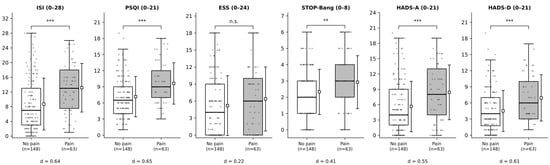
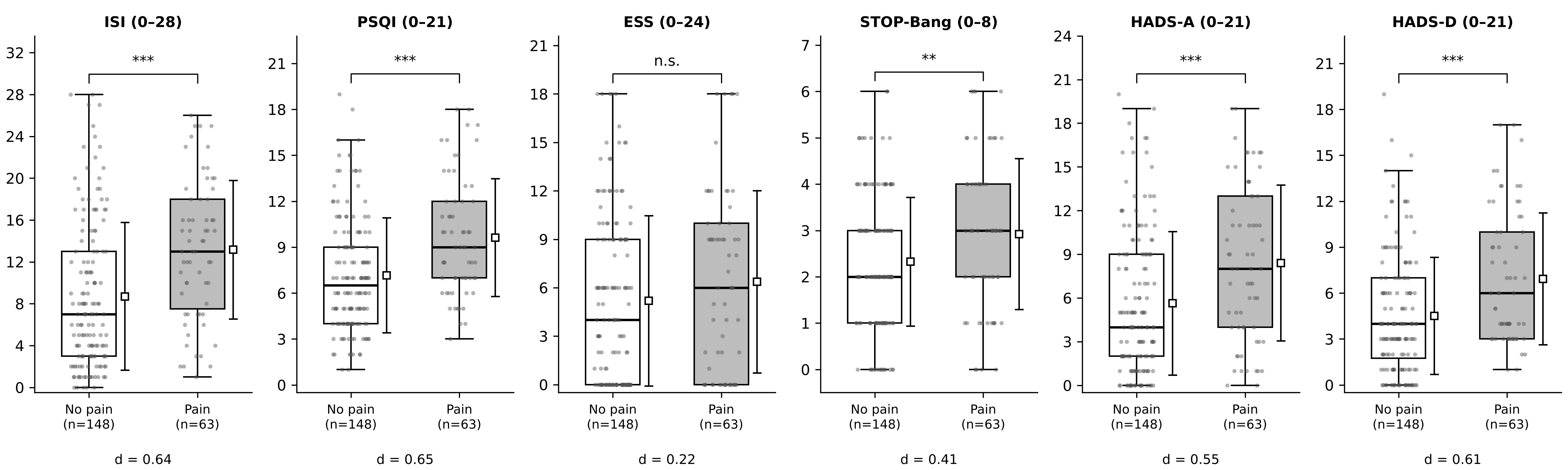
Patients with nocturnal pain showed significantly higher prevalence rates across five of the six categorical outcomes assessed. The most pronounced difference was for poor sleep quality (PSQI > 5): 87.3% in the nocturnal pain group versus 59.5% in the pain-free group (crude OR = 4.69; 95% CI: 2.08–10.55; p < 0.001; NNH = 3.6). Clinical insomnia (ISI ≥ 15) was almost twice as common, rising from 22.3% to 44.4% (crude OR = 2.79; 95% CI: 1.48–5.23; p = 0.002; NNH = 4.5). Elevated OSA risk (STOP-Bang ≥ 3) was 60.3% versus 42.6% (crude OR = 2.05; 95% CI: 1.12–3.74; p = 0.027; NNH = 5.6). Clinical anxiety (HADS-A ≥ 8) was 54.0% versus 32.4% (crude OR = 2.44; 95% CI: 1.34–4.47; p = 0.005; NNH = 4.6). Depression (HADS-D ≥ 8) was 38.1% versus 20.3% (crude OR = 2.42; 95% CI: 1.27–4.62; p = 0.011; NNH = 5.6). The only non-significant outcome was excessive daytime sleepiness (ESS ≥ 10): 27.0% versus 21.6% (crude OR = 1.34; p = 0.505). An NNH of 3.6–5.6 means that for every four to six patients with nocturnal pain, one additional case of sleep disturbance or psychological symptom is observed in association with nocturnal pain (Table 2). The distribution of instrument scores is illustrated in Figure 1.
Table 2.
Prevalence of sleep disorders and psychological symptoms by nocturnal pain status. Crude (unadjusted) odds ratios (n = 211).
Figure 1.
Score distribution by nocturnal pain status: boxplots with individual data points and mean ± SD (n = 211). Boxes represent interquartile range (IQR); horizontal line = median; whiskers = 1.5 × IQR; dots = individual observations (horizontal jitter only); white squares with bars = mean ± SD. ISI = Insomnia Severity Index; PSQI = Pittsburgh Sleep Quality Index; ESS = Epworth Sleepiness Scale; HADS-A = Hospital Anxiety and Depression Scale—Anxiety; HADS-D = HADS—Depression. d = Cohen’s d. *** p < 0.001; ** p < 0.01; n.s. = not significant.
Analysis of the seven ISI subdomains revealed that six of the seven components were significantly worse in the nocturnal pain group. The largest effect size was observed for sleep maintenance (2.98 ± 1.34 vs. 1.94 ± 1.57; t = −4.62; p < 0.001; d = 0.69), followed by sleep satisfaction (2.41 ± 1.09 vs. 1.74 ± 1.16; d = 0.59) and daytime interference (1.65 ± 1.45 vs. 0.99 ± 1.37; d = 0.48). Early awakening (d = 0.47), sleep onset (2.10 ± 1.57 vs. 1.44 ± 1.60; d = 0.41), and subjective quality perception (1.19 ± 1.38 vs. 0.76 ± 1.23; d = 0.34) were also significantly worse. Sleep-related worry was the only subdomain without a statistically significant difference (1.37 ± 1.38 vs. 1.01 ± 1.32; p = 0.082; d = 0.26). The larger difference for sleep maintenance than for sleep onset (d = 0.69 vs. d = 0.41) suggests that the insomnia associated with nocturnal pain is mainly a difficulty in staying asleep. These data are presented in Table 3.
Table 3.
Comparison of ISI subdomains by nocturnal pain status, Student’s t-test (n = 211).
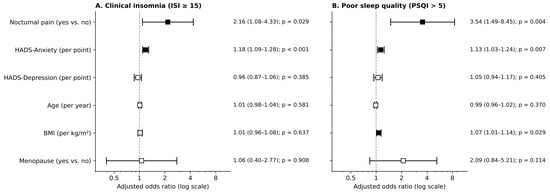
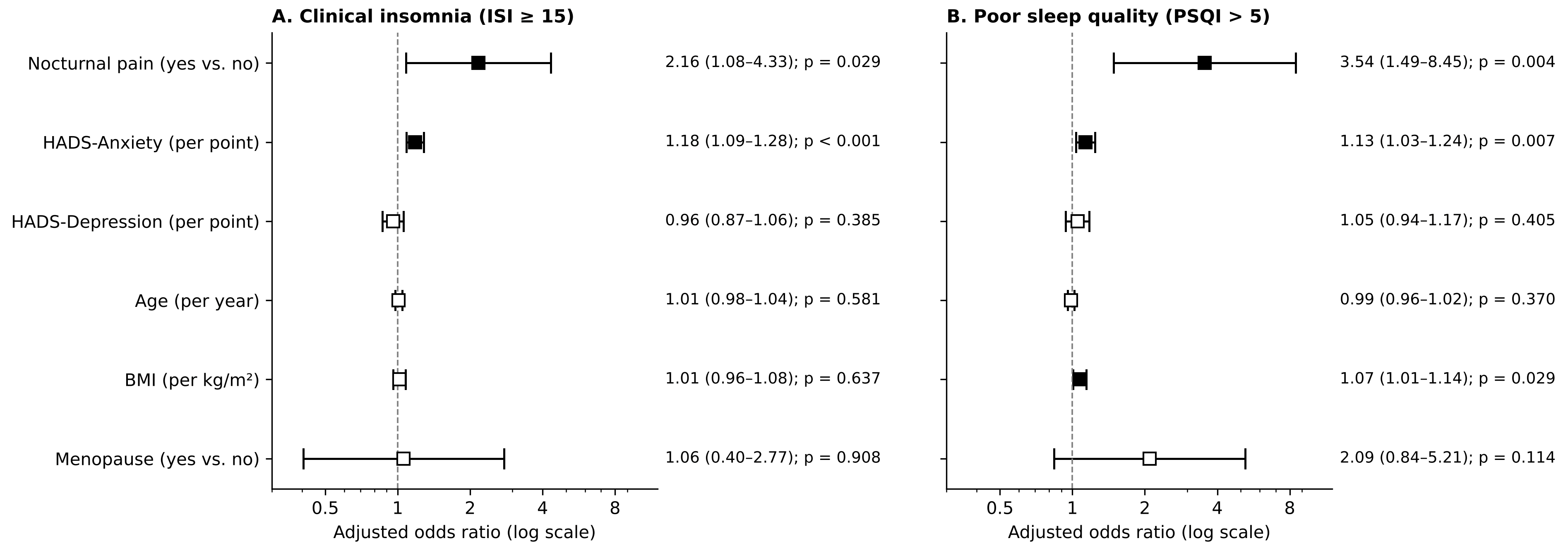
In the multiple logistic regression for clinical insomnia (ISI ≥ 15), nocturnal pain remained significantly associated with the outcome after adjustment (aOR = 2.16; 95% CI: 1.08–4.33; z = 2.18; p = 0.029). HADS-Anxiety was the only other significant covariate (aOR = 1.18 per point; 95% CI: 1.09–1.28; p < 0.001). Age, BMI, HADS-Depression, and menopausal status did not reach statistical significance in this model. McFadden’s pseudo-R2 was 0.131 and the AUC was 0.736 (Table 4).
Table 4.
Multiple logistic regression: adjusted odds ratios for clinical insomnia (ISI ≥ 15) and poor sleep quality (PSQI > 5), n = 211.
For poor sleep quality (PSQI > 5), nocturnal pain showed the strongest association after adjustment (aOR = 3.54; 95% CI: 1.49–8.45; z = 2.85; p = 0.004), together with HADS-Anxiety (aOR = 1.13 per point; p = 0.007) and BMI (aOR = 1.07 per kg/m2; p = 0.029). McFadden’s pseudo-R2 was 0.171 and the AUC was 0.771. In both models, the Hosmer–Lemeshow test showed no evidence of poor fit (p > 0.10), the link test did not suggest misspecification, and variance inflation factors were below 1.8. The adjusted odds ratios for both models are presented in Figure 2.
Figure 2.
Adjusted odds ratios from multiple logistic regression models for clinical insomnia (ISI ≥ 15) and poor sleep quality (PSQI > 5) in women with breast cancer (n = 211). Squares = adjusted odds ratio (aOR); horizontal bars = 95% confidence interval; logarithmic scale. Dashed line at aOR = 1.0 (no association). Filled squares = p < 0.05; open squares = p ≥ 0.05. Models adjusted for nocturnal pain, HADS-Anxiety, HADS-Depression, age, BMI, and menopausal status. Values correspond to those reported in Table 4.
In the multiple linear regression, nocturnal pain was independently associated with higher ISI scores (β = 2.692; SE = 0.987; t = 2.73; p = 0.007; 95% CI: 0.747–4.637) and higher PSQI scores (β = 1.647; SE = 0.546; t = 3.02; p = 0.003; 95% CI: 0.571–2.723). The models explained 26.3% of ISI variance (R2 = 0.263; F(6,204) = 12.12; p < 0.001) and 24.3% of PSQI variance (R2 = 0.243; F(6,204) = 10.88; p < 0.001). Results were unchanged with HC3 robust standard errors (p = 0.007 for ISI and p = 0.005 for PSQI). In both models, HADS-Anxiety presented the largest standardized coefficient (β_std = 0.375 for ISI; β_std = 0.335 for PSQI), followed by nocturnal pain (β_std = 0.171 and 0.192, respectively). For the PSQI, menopausal status (β = 1.397; p = 0.044) and BMI (β = 0.098; p = 0.030) also emerged as significant independent predictors, a clinically relevant finding given that 80.1% of the sample was postmenopausal (Table 5).
Table 5.
Multiple linear regression: factors associated with continuous ISI and PSQI scores, n = 211.
Sensitivity analyses are shown in Table 6. For poor sleep quality, the association with nocturnal pain was stable across all model specifications (aOR 3.40–3.67) and remained significant with Firth penalized regression (aOR 3.15–3.30), after removal of the PSQI pain item (aOR = 2.73; 95% CI: 1.21–6.16), and with the cut-off PSQI > 8 (aOR = 2.21; 95% CI: 1.11–4.40). For clinical insomnia, the point estimate changed little (aOR 1.86–2.16), but the confidence interval included unity after additional adjustment for the number of comorbidities (aOR = 1.92; 95% CI: 0.95–3.90; p = 0.070) and in the fully adjusted model (aOR = 1.95; 95% CI: 0.94–4.03; p = 0.072). In the linear models, nocturnal pain remained associated with higher ISI and PSQI scores in all specifications (all p < 0.03).
Table 6.
Sensitivity analyses: adjusted odds ratios for nocturnal pain under alternative model specifications and outcome definitions (n = 211).
4. Discussion
In this sample of women with breast cancer under outpatient follow-up, almost one in three reported pain at night. Nocturnal pain was associated with poor sleep quality (aOR = 3.54) and clinical insomnia (aOR = 2.16) after adjustment for anxiety, depression, age, BMI, and menopausal status. The association with sleep quality was consistent in all sensitivity analyses. The association with insomnia kept a similar magnitude, but lost precision when comorbidities were added. Together, these results suggest that the relation between nocturnal pain and sleep is not fully explained by psychological distress, although the cross-sectional design only allows us to describe associations.
The 29.9% prevalence is consistent with the international literature. In the updated meta-analysis by van den Beuken-van Everdingen et al., pain was present in 39.3% of patients after curative treatment [9], and persistent pain after breast cancer surgery affects about 35% of women, reaching almost half when only patient-reported pain is considered [11]. Our estimate is somewhat lower, which is expected because we asked about pain at a specific time of day and not about pain in general. Few studies in breast cancer have looked at the timing of pain, and most cohorts measured pain intensity or interference without distinguishing night from day [15,16,17].
Poor sleep quality was present in 67.8% of the whole sample and clinical insomnia in 28.9%. These figures are within the wide range reported for breast cancer survivors [4] and are close to Brazilian studies that used the PSQI, which found poor sleep in 58.9% of women before surgery [5] and in 71.9% of survivors [6]. Our findings agree with breast cancer studies that examined pain as a correlate of sleep. Among 413 women using aromatase inhibitors, severe joint pain was the factor most strongly associated with clinically significant insomnia (aOR = 4.84) [15]. In a recent Chinese cross-sectional study, each additional point in pain intensity was associated with higher odds of severe sleep disturbance, independently of fatigue and depression [16], and in women treated in medically underserved areas of the United States, pain was worse across increasing categories of insomnia severity [17]. In the Brazilian study by Mansano-Schlosser et al., pain was associated with poor sleep before surgery, but only depression and menopausal symptoms remained in the final model [5]. The present study adds that pain reported specifically at night is associated with sleep outcomes after adjustment for anxiety and depression.
The ISI domain most affected was sleep maintenance (d = 0.69), while difficulty initiating sleep showed a smaller difference (d = 0.41). Frequent night awakenings are the most commonly reported sleep problem among breast cancer survivors [43], and midsleep awakenings were among the sleep characteristics that changed most during and after chemotherapy in a longitudinal cohort [44]. Pain during the night is a plausible cause of awakenings, and the relation probably runs both ways: experimental sleep loss and selective REM sleep loss increase pain sensitivity [45], and sleep deficiency has been linked to weaker pain inhibition and greater inflammatory signaling [14,46]. These mechanisms were not measured in our study, so the contrast between maintenance and onset should be read as descriptive. Still, it suggests that in women with nocturnal pain, the sleep complaint is mainly about staying asleep, which differs from the profile of insomnia driven mostly by pre-sleep cognitive arousal [47].
The absence of a significant difference in daytime sleepiness (ESS; p = 0.146; d = 0.22) was unexpected given the worse nocturnal sleep in the pain group. One possible explanation is daytime hyperarousal, and altered cortisol rhythms have been described in women with breast cancer and insomnia [48]. Cortisol was not measured here, so this remains a hypothesis. Our medication data did not specifically record analgesics or adjuvant drugs, which could also influence sleepiness.
The higher proportion of elevated STOP-Bang scores in the nocturnal pain group (60.3% vs. 42.6%; crude OR = 2.05) deserves further study. Sleep-disordered breathing is frequent in patients with cancer [49], and intermittent hypoxia with repeated arousals could lower pain thresholds. However, STOP-Bang is a screening tool, and objective monitoring results will be reported separately, so this finding should be considered exploratory.
In the multivariable analysis, HADS-Anxiety presented the largest standardized coefficients for both outcomes (β_std = 0.375 for ISI; 0.335 for PSQI). This fits the observation that pain, insomnia, anxiety, depression, and fatigue tend to occur together in breast cancer. In women using aromatase inhibitors, about half of the variance in insomnia severity was shared with this symptom cluster [20], and almost one in five survivors followed a high-burden trajectory for pain, fatigue, and insomnia over three years [21]. Cognitive appraisals of pain, such as perceived injustice, also seem to mediate the effect of pain on sleep [50]. In our data, nocturnal pain remained associated with sleep outcomes in models that included both HADS subscales, which suggests that pain at night adds information beyond emotional distress. In the PSQI linear model, menopausal status (β = 1.397; p = 0.044) and BMI (β = 0.098; p = 0.030) also emerged as independent predictors, which should be interpreted as secondary findings.
The sensitivity analyses addressed the main sources of uncertainty in the original models. Women with nocturnal pain used more classes of medication and reported more comorbidities, but adding these variables, together with treatment history and year of diagnosis, changed the aOR for poor sleep quality very little. For insomnia, the estimate decreased from 2.16 to 1.92 when the number of comorbidities was added, and the confidence interval included unity. Part of this attenuation may reflect adjustment for conditions that share pathways with both pain and sleep, such as depression, which was one of the comorbidity categories and is also captured by the HADS-D. It also shows that the insomnia estimate is less precise and should be interpreted with caution. The wide confidence interval for poor sleep quality reflects the small number of women with nocturnal pain and good sleep quality (n = 8). Firth penalized regression, which reduces small-sample and sparse-data bias [39,41], produced slightly smaller but consistent estimates. Finally, because one PSQI item asks about waking because of pain, part of the association could come from overlap between exposure and outcome. Removing this item reduced the aOR to 2.73, but the association remained.
From a practical standpoint, a single question about pain at night is quick to apply during routine visits and may help identify women who would benefit from a structured sleep assessment. Cognitive behavioral therapy for insomnia improves insomnia severity and several comorbid symptoms in cancer survivors [51] and has been tested specifically in breast cancer survivors [52], and nonpharmacological approaches have been evaluated for the pain, fatigue, and sleep disturbance cluster [53]. Whether treating nocturnal pain improves sleep, or the reverse, needs to be tested in longitudinal and interventional studies.
This study has limitations. First, the cross-sectional design precludes causal inference and does not establish the direction of the association. Second, nocturnal pain was assessed by a single dichotomous item, without measurement of intensity, location, etiology, or frequency. Third, disease stage, metastatic status, molecular subtype, and analgesic use were not recorded in the structured form, so residual confounding by disease severity cannot be excluded, and treatment history and medication classes were available only as categories. Fourth, women with a previously diagnosed sleep disorder under treatment were excluded, which probably underestimates the burden of sleep disturbance and limits generalization to patients already receiving sleep treatment. Fifth, the absence of objective polysomnography limits characterization of sleep architecture. Sixth, the sample was drawn from three hospitals in a single metropolitan region of Brazil. Finally, several outcomes were tested without correction for multiplicity, and formal mediation analysis was not performed, so the pathways linking pain, psychological distress, and sleep cannot be disentangled. Prospective studies incorporating multidimensional pain assessment combined with actigraphy or polysomnography are needed to confirm the directionality of this relationship.
5. Conclusions
Self-reported nocturnal pain affects 29.9% of women with breast cancer under outpatient follow-up and was associated with greater odds of poor sleep quality (aOR = 3.54; 95% CI: 1.49–8.45; p = 0.004) and clinical insomnia (aOR = 2.16; 95% CI: 1.08–4.33; p = 0.029), independently of anxiety, depression, age, BMI, and menopausal status. The association with sleep quality was consistent across sensitivity analyses, while the association with insomnia was less precise after additional adjustment. Sleep maintenance was the most affected insomnia domain. Given the cross-sectional design, these findings are associative. Asking about pain at night is simple and, integrated with screening for sleep disorders using validated instruments, may help clinicians identify women who need a sleep assessment.
Author Contributions
L.V.d.A.S.: Study conception and design; integrative data analysis; identification and analysis of the nocturnal pain variable; multivariable statistical modeling; manuscript drafting; critical revision; and approval of the final version. P.A.R.R.: Data collection (ISI, STOP-Bang, and portable monitoring); critical revision; and approval of the final version. V.M.d.A.: Data collection (PSQI, ESS, and HADS); critical revision; and approval of the final version. L.d.S.P.: Supervision of patient recruitment and clinical follow-up; critical revision; and approval of the final version. D.d.I.G.C.: Oncological supervision; contribution to clinical interpretation of results; critical revision; and approval of the final version. A.D.G.: Overall study supervision; methodological guidance; critical revision; and approval of the final version. All authors have read and agreed to the published version of the manuscript.
Funding
This research received no external funding.
Institutional Review Board Statement
This study was approved by the Research Ethics Committee of Centro Universitário FMABC (CEP-FMABC; Opinion No. 7,920,023; CAAE: 90818825.2.0000.0082; approval date 22 October 2025) and was conducted in accordance with Brazilian National Health Council Resolution No. 466/2012 and the Declaration of Helsinki. Data were collected between December 2025 and January 2026, after ethical approval.
Informed Consent Statement
Written informed consent was obtained from all individual participants included in the study prior to enrollment.
Data Availability Statement
The datasets used and analyzed during the current study are available from the corresponding author upon reasonable request.
Acknowledgments
During the preparation of this manuscript, the authors used Claude Opus 4.5 (Anthropic) for English language editing, internal consistency checks (numbers, cut-offs and terminology across text and tables), reference formatting, and adaptation of the manuscript and cover letter to the journal format. The tool was not used to generate data, perform analyses, or interpret results. The authors reviewed and edited all output and take full responsibility for the content of this publication.
Conflicts of Interest
The authors declare no competing interests.
References
- Instituto Nacional de Câncer (INCA). Controle do Câncer de Mama No Brasil: Dados e Números 2024; INCA: Rio de Janeiro, Brazil, 2024.
- Bray, F.; Laversanne, M.; Sung, H.; Ferlay, J.; Siegel, R.L.; Soerjomataram, I.; Jemal, A. Global cancer statistics 2022: GLOBOCAN estimates of incidence and mortality worldwide for 36 cancers in 185 countries. CA Cancer J. Clin. 2024, 74, 229–263. [Google Scholar] [CrossRef] [Scilit]
- Giaquinto, A.N.; Sung, H.; Miller, K.D.; Kramer, J.L.; Newman, L.A.; Minihan, A.; Jemal, A.; Siegel, R.L. Breast Cancer Statistics, 2022. CA Cancer J. Clin. 2022, 72, 524–541. [Google Scholar] [CrossRef] [Scilit]
- Leysen, L.; Lahousse, A.; Nijs, J.; Adriaenssens, N.; Mairesse, O.; Ivakhnov, S.; Bilterys, T.; Van Looveren, E.; Pas, R.; Beckwée, D. Prevalence and risk factors of sleep disturbances in breast cancer survivors: Systematic review and meta-analyses. Support. Care Cancer 2019, 27, 4401–4433. [Google Scholar] [CrossRef] [Scilit]
- Mansano-Schlosser, T.C.; Ceolim, M.F.; Valerio, T.D. Poor sleep quality, depression and hope before breast cancer surgery. Appl. Nurs. Res. 2017, 34, 7–11. [Google Scholar] [CrossRef] [Scilit]
- Lourenço, A.; Dantas, A.A.G.; de Souza, J.C.; Araujo, C.M.; Araujo, D.N.; Lima, I.N.D.F.; Dantas, D.d.S. Sleep quality is associated with disability and quality of life in breast cancer survivors: A cross-sectional pilot study. Eur. J. Cancer Care 2021, 30, e13339. [Google Scholar] [CrossRef] [Scilit]
- Savard, J.; Morin, C.M. Insomnia in the context of cancer: A review of a neglected problem. J. Clin. Oncol. 2001, 19, 895–908. [Google Scholar] [CrossRef] [Scilit]
- Tag Eldin, E.S.; Younis, S.G.; Aziz, L.M.A.E.; Heba, S.T.; Sad, L. Evaluation of sleep pattern disorders in breast cancer patients receiving adjuvant treatment using polysomnography. J. BUON 2019, 24, 529–534. [Google Scholar]
- van den Beuken-van Everdingen, M.H.; Hochstenbach, L.M.; Joosten, E.A.; Tjan-Heijnen, V.C.G.; Janssen, D.J.A. Update on Prevalence of Pain in Patients With Cancer: Systematic Review and Meta-Analysis. J. Pain Symptom Manag. 2016, 51, 1070–1090. [Google Scholar] [CrossRef] [Scilit]
- Gärtner, R.; Jensen, M.B.; Nielsen, J.; Ewertz, M.; Kroman, N.; Kehlet, H. Prevalence of and factors associated with persistent pain following breast cancer surgery. JAMA 2009, 302, 1985–1992. [Google Scholar] [CrossRef] [Scilit]
- Wang, L.; Cohen, J.C.; Devasenapathy, N.; Hong, B.Y.; Kheyson, S.; Lu, D.; Oparin, Y.; Kennedy, S.A.; Romerosa, B.; Arora, N.; et al. Prevalence and intensity of persistent post-surgical pain following breast cancer surgery: A systematic review and meta-analysis of observational studies. Br. J. Anaesth. 2020, 125, 346–357. [Google Scholar] [CrossRef] [Scilit]
- Smith, M.T.; Haythornthwaite, J.A. How do sleep disturbance and chronic pain inter-relate? Insights from the longitudinal and cognitive-behavioral clinical trials literature. Sleep Med. Rev. 2004, 8, 119–132. [Google Scholar] [CrossRef] [Scilit]
- Finan, P.H.; Goodin, B.R.; Smith, M.T. The association of sleep and pain: An update and a path forward. J. Pain 2013, 14, 1539–1552. [Google Scholar] [CrossRef] [Scilit]
- Haack, M.; Simpson, N.; Sethna, N.; Kaur, S.; Mullington, J. Sleep deficiency and chronic pain: Potential underlying mechanisms and clinical implications. Neuropsychopharmacology 2020, 45, 205–216. [Google Scholar] [CrossRef] [Scilit]
- Desai, K.; Mao, J.J.; Su, I.; DeMichele, A.; Li, Q.; Xie, S.X.; Gehrman, P.R. Prevalence and risk factors for insomnia among breast cancer patients on aromatase inhibitors. Support. Care Cancer 2013, 21, 43–51. [Google Scholar] [CrossRef] [Scilit]
- Xie, Y.; Wang, Y.; Fang, Y.; Zhu, G.; Sui, B.; Yuan, X.; Chen, Y.; Li, M.; Fan, W.; Zhang, Y. Characteristics and influencing factors of sleep disturbance in breast cancer patients: A cross-sectional study. Front. Oncol. 2026, 16, 1749557. [Google Scholar] [CrossRef] [Scilit]
- Fisher, H.M.; Winger, J.G.; Chou, N.A.; Banani, S.S.; Kelleher, S.A.; Hyland, K.A.; Majestic, C.M.; Shelby, R.A.; Sutton, L.M.; Broadwater, G.; et al. Insomnia and Related Symptom Severity in Women with Breast Cancer and Pain Receiving Treatment in Medically Underserved Areas. Behav. Sleep Med. 2025, 23, 834–849. [Google Scholar] [CrossRef] [Scilit]
- Tsaras, K.; Papathanasiou, I.V.; Mitsi, D.; Veneti, A.; Kelesi, M.; Zyga, S.; Fradelos, E.C. Assessment of Depression and Anxiety in Breast Cancer Patients: Prevalence and Associated Factors. Asian Pac. J. Cancer Prev. 2018, 19, 1661–1669. [Google Scholar] [CrossRef] [Scilit]
- Rezagholi, P.; Abdi, K.; Barzanji, A.; Ghanei-Gheshlagh, R.; Eghabali, T.; Dehkordi, A.H. Prevalence of depression in Iranian women with breast cancer: A systematic review and meta-analysis. Prz. Epidemiol. 2022, 76, 29–36. [Google Scholar] [CrossRef] [Scilit]
- Gehrman, P.R.; Garland, S.N.; Matura, L.A.; Mao, J. Insomnia in breast cancer: Independent symptom or symptom cluster? Palliat. Support. Care 2017, 15, 369–375. [Google Scholar] [CrossRef] [Scilit]
- Nielsen, A.W.M.; Lundorff, M.; Nielsen, H.M.; Alsner, J.; Offersen, B.V.; Kristensen, M.H.; Zachariae, R. Symptom trajectories in breast cancer survivors: Growth mixture analysis of patient-reported pain, fatigue, insomnia, breast and arm symptoms. Acta Oncol. 2021, 60, 1659–1667. [Google Scholar] [CrossRef] [Scilit]
- Mota, S.G.; Jesus, I.T.M.; Inouye, K.; Macedo, M.N.G.F.; Brito, T.R.P.; Santos-Orlandi, A.A. Is poor quality sleep present in older adults with worse social and health status? Texto Contexto-Enferm. 2021, 30, e20200614. [Google Scholar] [CrossRef] [Scilit]
- Araújo, M.F.S.; Souza, T.A.; Medeiros, A.A.; Souza, J.C.; Barbosa, I.R. Factors associated with sleep problems and sleeping pill use in Brazilians. Rev. Saúde Pública 2022, 56, 68. [Google Scholar]
- Morin, C.M.; Belleville, G.; Bélanger, L.; Ivers, H. The Insomnia Severity Index: Psychometric indicators to detect insomnia cases and evaluate treatment response. Sleep 2011, 34, 601–608. [Google Scholar] [CrossRef] [Scilit]
- Castro, L.S. Adaptação e Validação do Índice de Gravidade de Insônia (IGI). Master’s Thesis, Universidade Federal de São Paulo, São Paulo, Brazil, 2011. [Google Scholar]
- Buysse, D.J.; Reynolds, C.F.; Monk, T.H.; Berman, S.R.; Kupfer, D.J. The Pittsburgh Sleep Quality Index: A new instrument for psychiatric practice and research. Psychiatry Res. 1989, 28, 193–213. [Google Scholar] [CrossRef] [Scilit]
- Bertolazi, A.N.; Fagondes, S.C.; Hoff, L.S.; Dartora, E.G.; Miozzo, I.C.d.S.; de Barba, M.E.F.; Barreto, S.S.M. Validation of the Brazilian Portuguese version of the Pittsburgh Sleep Quality Index. Sleep Med. 2011, 12, 70–75. [Google Scholar] [CrossRef] [Scilit]
- Bertolazi, A.N.; Fagondes, S.C.; Hoff, L.S.; Pedro, V.D.; Barreto, S.S.M.; Johns, M.W. Portuguese-language version of the Epworth sleepiness scale: Validation for use in Brazil. J. Bras. Pneumol. 2009, 35, 877–883. [Google Scholar] [CrossRef] [Scilit]
- Gonçalves, M.T.; Malafaia, S.; Moutinho Dos Santos, J.; Roth, T.; Marques, D.R. Epworth sleepiness scale: A meta-analytic study on the internal consistency. Sleep Med. 2023, 109, 261–269. [Google Scholar] [CrossRef] [Scilit]
- Chung, F.; Yegneswaran, B.; Liao, P.; Chung, S.A.; Vairavanathan, S.; Islam, S.; Khajehdehi, A.; Shapiro, C.M. STOP Questionnaire: A Tool to Screen Patients for Obstructive Sleep Apnea. Anesthesiology 2008, 108, 812–821. [Google Scholar]
- Nagappa, M.; Liao, P.; Wong, J.; Auckley, D.; Ramachandran, S.K.; Memtsoudis, S.; Mokhlesi, B.; Chung, F. Validation of the STOP-Bang Questionnaire as a Screening Tool for Obstructive Sleep Apnea among Different Populations: A Systematic Review and Meta-Analysis. PLoS ONE 2015, 10, e0143697. [Google Scholar]
- Zigmond, A.S.; Snaith, R.P. The Hospital Anxiety and Depression Scale. Acta Psychiatr. Scand. 1983, 67, 361–370. [Google Scholar] [CrossRef] [Scilit]
- Botega, N.J.; Bio, M.R.; Zomignani, M.A.; Garcia, C., Jr.; Pereira, W.A.B. Transtornos do humor em enfermaria de clínica médica e validação de escala de medida (HAD) de ansiedade e depressão. Rev. Saúde Pública 1995, 29, 355–363. [Google Scholar] [CrossRef] [Scilit]
- Hasan, R.; Genta, P.R.; Pinheiro, G.; Garcia, M.L.; Scudeller, P.G.; de Carvalho, C.R.R.; Lorenzi-Filho, G. Validation of an overnight wireless high-resolution oximeter for the diagnosis of obstructive sleep apnea at home. Sci. Rep. 2022, 12, 15136. [Google Scholar] [CrossRef] [Scilit]
- Pinheiro, G.D.L.; Cruz, A.F.; Domingues, D.M.; Genta, P.R.; Drager, L.F.; Strollo, P.J.; Lorenzi-Filho, G. Validation of an Overnight Wireless High-Resolution Oximeter plus Cloud-Based Algorithm for the Diagnosis of Obstructive Sleep Apnea. Clinics 2020, 75, e2414. [Google Scholar] [CrossRef] [Scilit]
- Domingues, D.M.; Rocha, P.R.; Miachon, A.C.M.V.; Giampá, S.Q.d.C.; Soares, F.; Genta, P.R.; Lorenzi-Filho, G. Sleep prediction using data from oximeter, accelerometer and snoring for portable monitor obstructive sleep apnea diagnosis. Sci. Rep. 2024, 14, 24562. [Google Scholar] [CrossRef] [Scilit]
- Peduzzi, P.; Concato, J.; Kemper, E.; Holford, T.R.; Feinstein, A.R. A simulation study of the number of events per variable in logistic regression analysis. J. Clin. Epidemiol. 1996, 49, 1373–1379. [Google Scholar] [CrossRef] [Scilit]
- Vittinghoff, E.; McCulloch, C.E. Relaxing the rule of ten events per variable in logistic and Cox regression. Am. J. Epidemiol. 2007, 165, 710–718. [Google Scholar] [CrossRef] [Scilit]
- Firth, D. Bias reduction of maximum likelihood estimates. Biometrika 1993, 80, 27–38. [Google Scholar] [CrossRef] [Scilit]
- Heinze, G.; Schemper, M. A solution to the problem of separation in logistic regression. Stat. Med. 2002, 21, 2409–2419. [Google Scholar] [CrossRef] [Scilit]
- Greenland, S.; Mansournia, M.A.; Altman, D.G. Sparse data bias: A problem hiding in plain sight. BMJ 2016, 352, i1981. [Google Scholar] [CrossRef] [Scilit]
- Carpenter, J.S.; Andrykowski, M.A. Psychometric evaluation of the Pittsburgh Sleep Quality Index. J. Psychosom. Res. 1998, 45, 5–13. [Google Scholar] [CrossRef] [Scilit]
- Goyal, N.; Levine, B.J.; Crawford, S.L.; Avis, N.E. Sleep disturbance among breast cancer survivors and controls from midlife to early older adulthood: Pink SWAN. J. Cancer Surviv. 2024, 18, 489–498. [Google Scholar] [CrossRef] [Scilit]
- Yang, G.S.; Starkweather, A.R.; Lynch Kelly, D.; Meegan, T.; Byon, H.D.; Lyon, D.E. Longitudinal Analysis of Sleep Disturbance in Breast Cancer Survivors. Nurs. Res. 2022, 71, 177–188. [Google Scholar] [CrossRef] [Scilit]
- Roehrs, T.; Hyde, M.; Blaisdell, B.; Greenwald, M.; Roth, T. Sleep loss and REM sleep loss are hyperalgesic. Sleep 2006, 29, 145–151. [Google Scholar] [CrossRef] [Scilit]
- Irwin, M.R. Sleep and inflammation: Partners in sickness and in health. Nat. Rev. Immunol. 2019, 19, 702–715. [Google Scholar] [CrossRef] [Scilit]
- Harvey, A.G. A cognitive model of insomnia. Behav. Res. Ther. 2002, 40, 869–893. [Google Scholar] [CrossRef] [Scilit]
- Palesh, O.; Zeitzer, J.M.; Conrad, A.; Giese-Davis, J.; Mustian, K.M.; Popek, V.; Nga, K.; Spiegel, D. Vagal regulation, cortisol, and sleep disruption in women with metastatic breast cancer. J. Clin. Sleep Med. 2008, 4, 441–449. [Google Scholar]
- Büttner-Teleagă, A.; Kim, Y.T.; Osel, T.; Richter, K. Sleep Disorders in Cancer—A Systematic Review. Int. J. Environ. Res. Public Health 2021, 18, 11696. [Google Scholar]
- Lahousse, A.; Ivakhnov, S.; Nijs, J.; Beckwée, D.; Cools, W.; Peñas, C.F.d.L.; Roose, E.; Leysen, L.; Nijs, P.; Beckwée, P.; et al. The Mediating Effect of Perceived Injustice and Pain Catastrophizing in the Relationship of Pain on Fatigue and Sleep in Breast Cancer Survivors: A Cross-Sectional Study. Pain Med. 2022, 23, 1299–1310. [Google Scholar] [CrossRef] [Scilit]
- Squires, L.R.; Rash, J.A.; Fawcett, J.; Garland, S.N. Systematic review and meta-analysis of cognitive-behavioural therapy for insomnia on subjective and actigraphy-measured sleep and comorbid symptoms in cancer survivors. Sleep Med. Rev. 2022, 63, 101615. [Google Scholar] [CrossRef] [Scilit]
- Irwin, M.R.; Olmstead, R.; Carrillo, C.; Sadeghi, N.; Nicassio, P.; Ganz, P.A.; Bower, J.E. Tai Chi Chih Compared With Cognitive Behavioral Therapy for the Treatment of Insomnia in Survivors of Breast Cancer: A Randomized, Partially Blinded, Noninferiority Trial. J. Clin. Oncol. 2017, 35, 2656–2665. [Google Scholar] [CrossRef] [Scilit]
- He, C.C.; Lin, D.M.; Liu, H.Z.; Wang, F.-F.; Guo, X.-F.; Zhang, X.-B.; Ai, Y.-Q.; Meng, L.-M. Nonpharmacological Interventions for Management of the Pain-Fatigue-Sleep Disturbance Symptom Cluster in Breast Cancer Patients: A Systematic Review and Network Meta-Analysis of Randomized Controlled Trials. J. Pain Res. 2023, 16, 2713–2728. [Google Scholar] [CrossRef] [Scilit]

Disclaimer/Publisher’s Note: The statements, opinions and data contained in all publications are solely those of the individual author(s) and contributor(s) and not of MDPI and/or the editor(s). MDPI and/or the editor(s) disclaim responsibility for any injury to people or property resulting from any ideas, methods, instructions or products referred to in the content. |
© 2026 by the authors. Published by MDPI on behalf of the Lithuanian University of Health Sciences. Licensee MDPI, Basel, Switzerland. This article is an open access article distributed under the terms and conditions of the Creative Commons Attribution (CC BY) license.