


Abstract
Background and Objectives: Loss from peritoneal dialysis (PD) therapy occurs most frequently during the first year, yet whether hemodialysis (HD) transfer and death share the same risk factors is unclear. We examined the causes of first-year dropout and whether the factors associated with each component differ. Materials and Methods: We retrospectively studied 297 adults initiating PD. First-year dropout was defined as a composite of HD transfer or death within 12 months, with HD transfer defined as transfer to HD without return to PD within 90 days. Associations were assessed by multivariable logistic regression, and the individual components were assessed by multinomial logistic regression. Results: Dropout occurred in 33 patients (11%), including HD transfer in 8.4% and death in 2.7% (n = 8). Dialysis or ultrafiltration failure was the leading cause of HD transfer, followed by infection-related causes. Smoking was associated with dropout (OR 3.499, 95% CI 1.570–7.800), and each 1 g/dL decrease in serum albumin was associated with higher odds of dropout (OR 1.988, 95% CI 1.037–3.809). Smoking was associated with HD transfer (OR 3.447, 95% CI 1.430–8.309) and each 1 g/dL decrease in serum albumin was associated with death (OR 6.246, 95% CI 2.013–19.382). Conclusions: Smoking and lower serum albumin were associated with first-year PD dropout. The association with serum albumin was stronger for death than for HD transfer, whereas the association with smoking did not differ significantly between components, although component-specific analyses were limited by the small number of deaths. Assessment of smoking status and serum albumin at PD initiation may help identify patients at increased risk.
1. Introduction
Peritoneal dialysis (PD) is a well-established kidney replacement therapy (KRT) for patients with end-stage kidney disease [1]. Relative to hemodialysis (HD), PD has been reported to provide a slower decline in residual kidney function (RKF), more stable hemodynamics, and higher patient-reported quality of life [2,3,4]. Nevertheless, loss from PD therapy remains a major challenge and continues to threaten the long-term sustainability of PD programs. Understanding the causes and determinants of loss from PD therapy is therefore essential for supporting treatment continuity and maintaining patients on PD.
Reported causes of loss from PD therapy include inadequate dialysis, infectious complications, catheter-related problems, psychosocial factors, and center- or healthcare system–related reasons [5,6]. Loss from PD therapy occurs most frequently during the first year after PD initiation [7,8], with reported rates ranging from 4.9% to 26.2% across centers [7,9,10]. Loss from PD therapy during this period is associated with poorer clinical outcomes, unplanned modality transitions, and increased healthcare utilization and costs [11,12].
Although several studies have examined loss from PD therapy during the first year, the reported risk factors have varied across studies. Previous studies have identified infectious complications, catheter dysfunction, and death as major causes of loss from PD therapy [13,14]. In addition, factors such as older age, diabetes, cardiovascular disease, peripheral vascular disease, and nutritional status have been shown to increase the risk of loss from PD therapy [7,9,13,14]. However, the contribution of potentially modifiable behavioral factors to early loss from PD therapy remains poorly understood, particularly whether such factors act through HD transfer or through death.
In this study, we investigated the causes of loss from PD therapy during the first year among incident PD patients. We also examined whether the factors associated with HD transfer differ from those associated with death, with particular emphasis on potentially modifiable behavioral factors.
2. Materials and Methods
2.1. Study Design and Population
We retrospectively studied a single-center cohort of patients who began PD between 1 January 2000 and 30 September 2024, with the date of the first PD exchange defined as the treatment initiation date. For analyses of secular trends, the enrolment period was divided at its midpoint into two periods of approximately equal duration (2000–2011 and 2012–2024). A total of 297 patients were included in the analysis, and outcomes were assessed during the first year after PD initiation. Patients younger than 18 years and those with missing key baseline data were excluded.
2.2. Data Collection
Demographic, clinical, and laboratory information was extracted from medical records at PD initiation. The variables evaluated, selected based on previous studies and clinical relevance, included age, sex, body mass index (BMI), smoking status, comorbidities (diabetes mellitus, hypertension, and coronary artery disease), previous HD treatment, and history of hernia. Smoking status was recorded as a binary variable, with patients smoking at PD initiation categorized as smokers. Serum hemoglobin, albumin, parathyroid hormone (PTH), and C-reactive protein (CRP) levels were measured at or within one week before PD initiation. RKF was defined as urine output exceeding 100 mL/day at PD initiation, and baseline urine volume was also recorded.
2.3. Peritoneal Dialysis Management and Definitions
PD modality was categorized as continuous ambulatory peritoneal dialysis (CAPD) or automated peritoneal dialysis (APD) according to the treatment prescribed at PD initiation. Assisted PD was defined as PD performed with regular support from a caregiver or healthcare professional due to physical, cognitive, or social limitations preventing independent treatment. Mandatory PD initiation was defined as PD selected due to limited alternative KRT options, such as lack of vascular access or contraindications to HD. Remote patient monitoring (RPM), defined as the use of digital or telemonitoring systems for patient follow-up, has been available at our center since 2019 and was documented for patients who initiated PD thereafter.
2.4. Outcome Definition
First-year dropout was defined as a prespecified composite of HD transfer or death within the first year after PD initiation, with both components also analyzed separately. Recent International Society for Peritoneal Dialysis (ISPD) recommendations advise reporting all HD transfers regardless of duration but permit a 90-day definition when longer-term transfer is the outcome of interest [15]. Accordingly, HD transfer was defined as transfer from PD to HD without return to PD within 90 days. If such a patient experienced death, kidney transplantation (KT), recovery of kidney function, transfer out of the program, or loss to follow-up within this period, that event rather than HD transfer was considered the outcome.
Patients were followed from the first PD exchange until first-year dropout, KT, recovery of kidney function, transfer out of the program, loss to follow-up, completion of 12 months, or study end, whichever occurred first. Patients without first-year dropout were censored at the corresponding event.
Causes of HD transfer were categorized as dialysis or ultrafiltration failure, infection-related causes (peritonitis and tunnel infection), catheter-related complications (including leakage and catheter dysfunction), hernia, and psychosocial causes.
2.5. Statistical Analysis
Conformity of continuous variables to a normal distribution was examined with the Shapiro–Wilk test. Normally distributed variables were reported as mean ± standard deviation and compared by Student’s t-test, whereas non-normally distributed variables were reported as median (interquartile range) and compared by the Mann–Whitney U test. Categorical variables were reported as counts and percentages and compared by the chi-square test, or Fisher’s exact test where expected cell counts were insufficient. Candidate variables were specified before analysis and were examined by univariable logistic regression to identify factors associated with first-year dropout. Variables with p < 0.10 in univariable analyses were included in the multivariable logistic regression model. In the regression analyses, which do not account for time to event, patients who did not experience first-year dropout formed a single reference group regardless of the duration of observation. As a sensitivity analysis, the multivariable logistic model was repeated after excluding patients who underwent KT and those who had not completed 12 months of follow-up by the end of the study period.
Dropout-free survival was analyzed using the Kaplan–Meier method, and differences between groups were assessed using the log-rank test. To examine factors associated with the individual components of first-year dropout, multinomial logistic regression analysis was performed. Outcomes were categorized as HD transfer and death, with patients who remained on PD during the first year serving as the reference group. Variables associated with either outcome at p < 0.10 in univariable analyses were included in the multivariable multinomial logistic regression model. A reduced multinomial model including only smoking and serum albumin was fitted as a sensitivity analysis. To compare the magnitude of associations between the two outcomes, cross-equation Wald tests of the equality of coefficients were performed in this model. Results were reported as odds ratios (ORs) with 95% confidence intervals (CIs). A two-sided p-value < 0.05 was considered statistically significant. All statistical analyses were performed using IBM SPSS Statistics version 23 (IBM Corp., Armonk, NY, USA) and R version 4.5.2 (R Foundation for Statistical Computing, Vienna, Austria).
3. Results
3.1. Patient Characteristics
A total of 297 patients were included, of whom 33 (11.1%) experienced first-year dropout, including 25 HD transfers (8.4%) and 8 deaths (2.7%) (Table 1). During the first year, 14 patients (4.7%) underwent KT and 23 had not completed 12 months of follow-up by the end of the study period; the remaining 227 patients completed 12 months on PD. No patient recovered kidney function, transferred out of the program, or was lost to follow-up. Among patients transferred to HD, none experienced an intervening event during the 90-day observation period.
Table 1.
Baseline Characteristics of Patients According to First-Year Dropout Status.
Patients who experienced first-year dropout had lower BMI (23.7 vs. 25.2 kg/m2, p = 0.04), a higher prevalence of smoking (39.4% vs. 15.5%, p = 0.001), and a higher proportion of APD use (36.4% vs. 20.5%, p = 0.04). Other baseline characteristics, including age, sex, comorbidities, and RKF, were comparable between groups. The proportion of patients with first-year dropout did not differ significantly by period of PD initiation (15/171, 8.8% in 2000–2011 vs. 18/126, 14.3% in 2012–2024; p = 0.14) or by the use of RPM (9/58, 15.5% with vs. 24/239, 10.0% without; p = 0.23).
3.2. Distribution of Dropout Causes
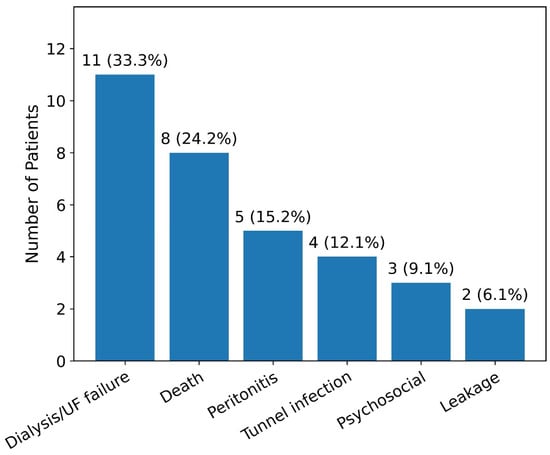
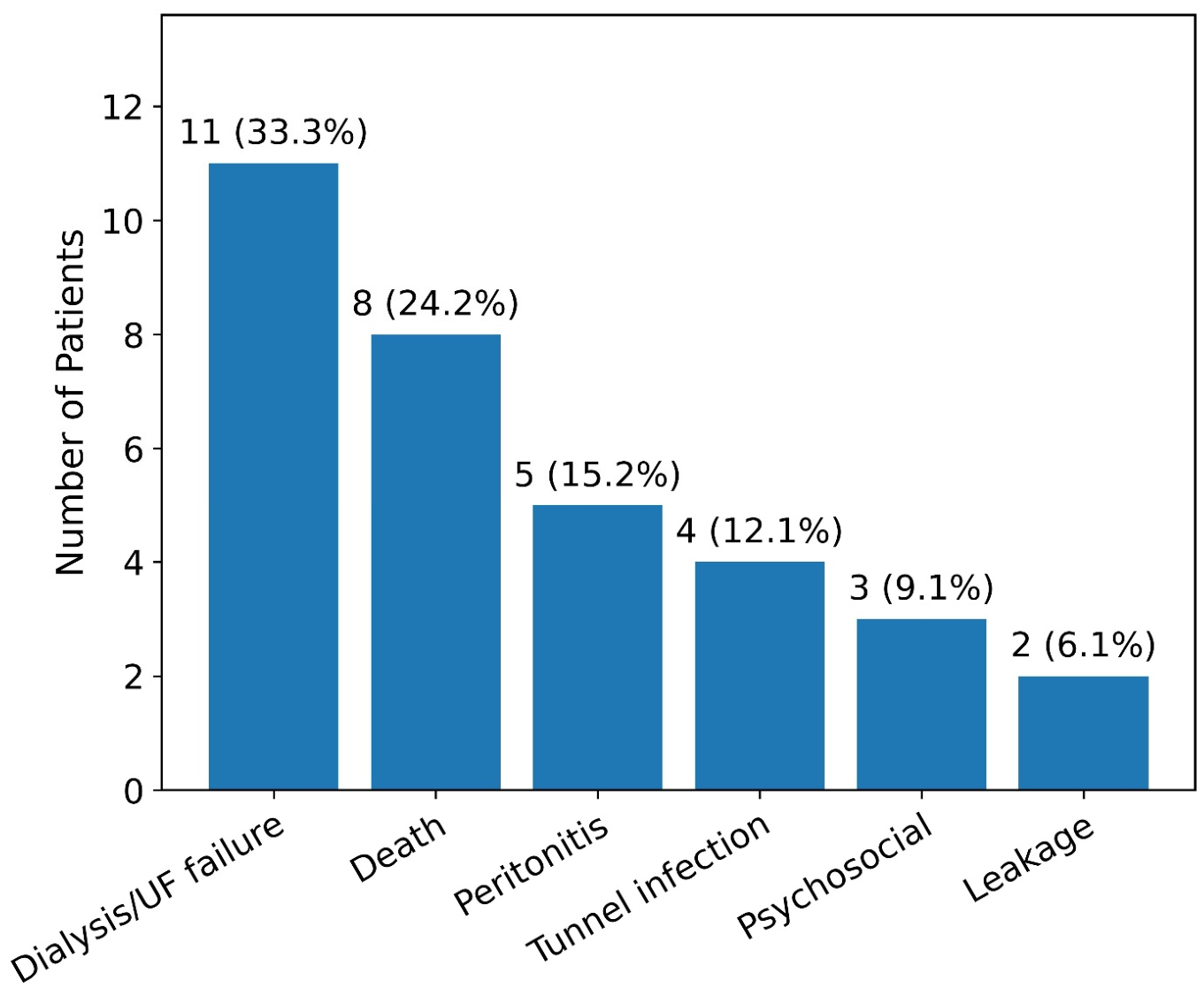
Among the 33 first-year dropout events, dialysis or ultrafiltration failure was the most common cause, accounting for 11 events (33.3%). Infection-related causes accounted for 9 events (27.3%), including peritonitis in 5 (15.2%) and tunnel infection in 4 (12.1%). Catheter-related complications accounted for 2 events (6.1%), both due to leakage, while psychosocial causes accounted for 3 (9.1%), including patient choice in two patients and caregiver burden in one. Death accounted for the remaining 8 dropout events (24.2%) (Figure 1).
Figure 1.
Distribution of first-year dropout events among incident peritoneal dialysis patients. Percentages are calculated from all 33 first-year dropout events. Death is shown alongside the causes of HD transfer, as both were components of the composite outcome. HD: hemodialysis; UF: ultrafiltration.
3.3. Factors Associated with First-Year Dropout
In univariable logistic regression analysis, smoking (OR: 3.535, 95% CI: 1.631–7.663, p = 0.001) and APD use (OR: 2.222, 95% CI: 1.029–4.798, p = 0.04) were significantly associated with first-year dropout, and each 1 g/dL decrease in serum albumin was associated with higher odds of dropout (OR: 2.026, 95% CI: 1.091–3.763, p = 0.03). Neither BMI (OR: 0.927, 95% CI: 0.856–1.004, p = 0.06) nor the period of PD initiation (OR: 1.733, 95% CI: 0.837–3.589, p = 0.14) was significantly associated with first-year dropout.
In multivariable analysis, smoking remained independently associated with first-year dropout (OR: 3.499, 95% CI: 1.570–7.800, p = 0.002), and each 1 g/dL decrease in serum albumin remained associated with higher odds of dropout (OR: 1.988, 95% CI: 1.037–3.809, p = 0.04). The association between PD modality and dropout did not reach statistical significance (APD vs. CAPD; OR: 2.125, 95% CI: 0.950–4.753, p = 0.07), and BMI was not independently associated with dropout (Table 2). In a sensitivity analysis excluding the 14 patients who underwent KT and the 23 who had not completed 12 months of follow-up (n = 260, 33 events), smoking (OR: 3.124, 95% CI: 1.397–6.989, p = 0.006) and each 1 g/dL decrease in serum albumin (OR: 1.995, 95% CI: 1.024–3.890, p = 0.04) remained independently associated with first-year dropout.
Table 2.
Univariable and Multivariable Logistic Regression Analyses of Factors Associated with First-Year Dropout.
During the first year of follow-up, the overall peritonitis rate was 0.21 episodes/patient-year. Peritonitis rates did not differ significantly by smoking status (0.31 vs. 0.18 episodes/patient-year, p = 0.53). Likewise, the frequencies of at least one peritonitis episode (16.7% vs. 14.0%, p = 0.62) and recurrent peritonitis (7.4% vs. 4.1%, p = 0.30) were comparable between smokers and non-smokers.
3.4. Time-to-Event Analysis
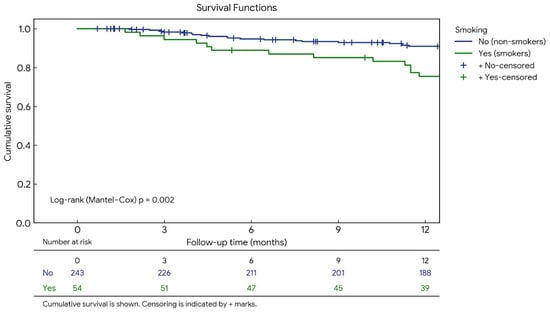
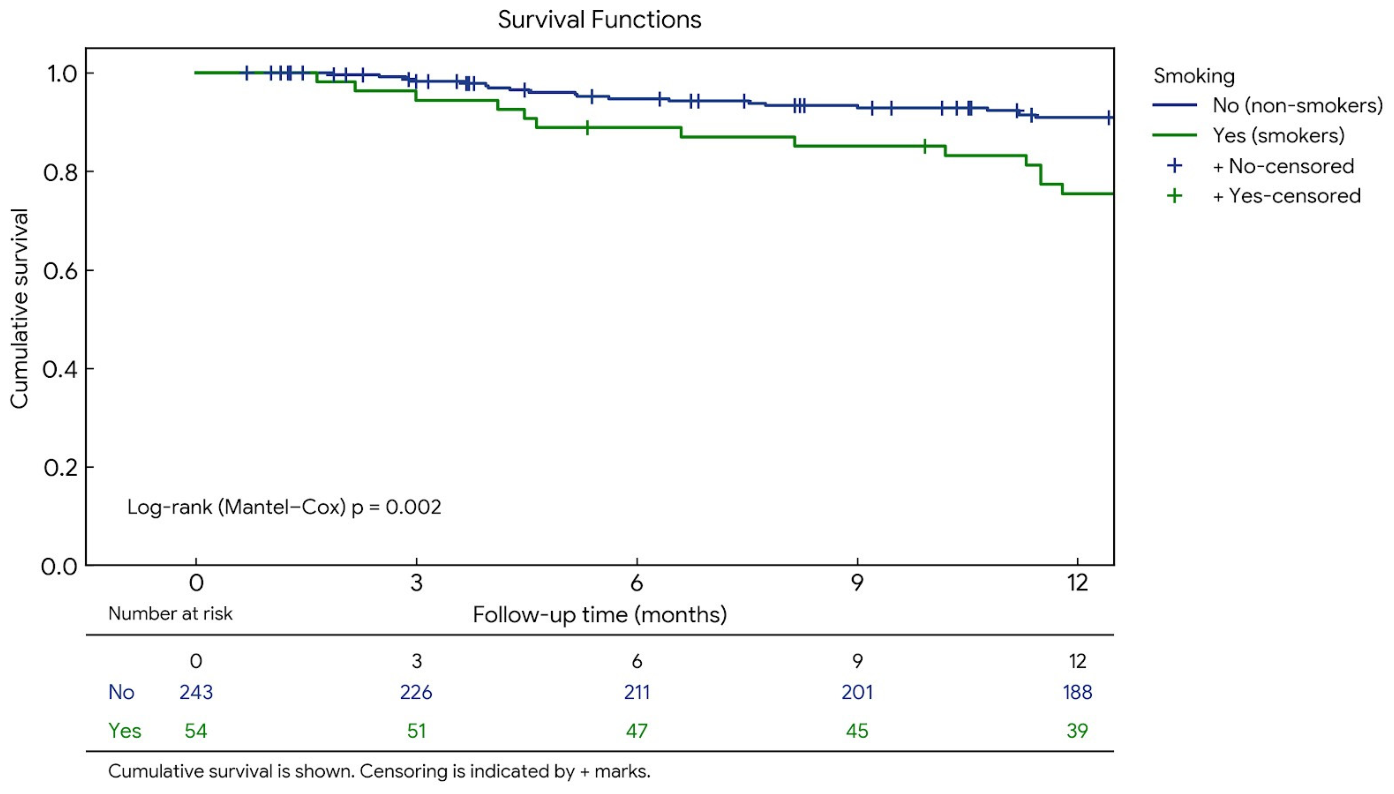
Kaplan–Meier analysis demonstrated significantly lower dropout-free survival among smokers compared to non-smokers (log-rank p = 0.002), as shown in Figure 2. The curves separated during follow-up, with smokers showing lower dropout-free survival throughout the first year.
Figure 2.
Kaplan–Meier analysis of first-year dropout-free survival according to smoking status. Blue line non-smokers, green line smokers. Plus signs indicate censored observations, and numbers at risk are shown below the curves. Log-rank p = 0.002.
3.5. Multinomial Logistic Regression Analysis
In multivariable multinomial logistic regression analysis (Table 3), the OR for smoking was 3.447 (95% CI: 1.430–8.309, p = 0.006) for HD transfer and 3.609 (95% CI: 0.711–18.330, p = 0.12) for death. The OR for each 1 g/dL decrease in serum albumin was 1.171 (95% CI: 0.521–2.630, p = 0.70) for HD transfer and 6.246 (95% CI: 2.013–19.382, p = 0.002) for death. Neither BMI nor PD modality was significantly associated with either outcome.
Table 3.
Multivariable multinomial logistic regression analysis of factors associated with first-year dropout outcomes.
In a reduced model including smoking and serum albumin, the OR for smoking was 3.658 (95% CI: 1.535–8.715, p = 0.003) for HD transfer and 4.129 (95% CI: 0.851–20.025, p = 0.08) for death, and the OR for each 1 g/dL decrease in serum albumin was 1.241 (95% CI: 0.564–2.733, p = 0.59) for HD transfer and 7.851 (95% CI: 2.551–24.167, p < 0.001) for death. In cross-equation Wald tests, the association with decreasing serum albumin was stronger for death than for HD transfer (χ2 = 7.58, df = 1, p = 0.006), whereas the association with smoking did not differ significantly between the two outcomes (χ2 = 0.02, df = 1, p = 0.89).
4. Discussion
In this study, we evaluated factors associated with first-year dropout in patients undergoing PD and examined component-specific associations using a multinomial approach. Identifying potentially modifiable risk factors for early PD dropout may provide opportunities to improve treatment retention and optimize patient management. Smoking and lower serum albumin were both associated with first-year dropout. When the two components were compared directly, the association with serum albumin was stronger for death than for HD transfer, whereas the association with smoking did not differ significantly between the two outcomes.
In our study, first-year dropout occurred in 11% of incident PD patients, comprising HD transfer in 8.4% and death in 2.7%. This rate falls within the range reported in previous studies (4.9–26.2%) [7,10,13,14]. Differences across studies reflect variations in patient characteristics and center experience, but also, and importantly, in how the outcome is defined. The lowest rate in this range (4.9%) comes from a national cohort in which technique failure was defined as a modality change lasting at least 30 days, with death treated as a competing event rather than as part of the outcome; in that cohort the cumulative incidence of death at 1 year was 10.0% [10]. Studies reporting higher rates, like ours, included death in the outcome [7,13,14]. Recent ISPD recommendations have similarly drawn attention to this heterogeneity, emphasizing the importance of distinguishing HD transfer from death as separate outcomes and of reporting the reasons for transfer [15].
Dialysis or ultrafiltration failure was the most common cause of HD transfer in our cohort, followed closely by infection-related causes, while death accounted for nearly one-quarter of all dropout events. These findings are consistent with previous reports indicating that early loss from PD therapy is primarily driven by HD transfer due to technical or infectious complications and by death [13,14,16].
One of the most notable findings of this study was that smoking was associated with approximately 3.4-fold higher odds of HD transfer during the first year of PD. A large Canadian study using national registry data has similarly identified smoking as an independent risk factor for transfer from PD to HD [17]. Biological plausibility for this association is supported by experimental evidence. Data have shown that after cigarette smoking, plasma contains factors cytotoxic to peritoneal mesothelial cells, and that rat peritoneal mesothelial cells exposed to this plasma develop marked structural damage [18]. Similarly, nicotine has been reported to increase oxidative stress in peritoneal macrophages, stimulate superoxide production, and reduce both antioxidant enzyme activity and glutathione levels [19]. Nicotine may also promote pathological angiogenesis through endothelial nicotinic acetylcholine receptors and interact with vascular endothelial growth factor–mediated angiogenic pathways [20]. These processes may be relevant to HD transfer because loss of ultrafiltration capacity in PD can result from peritoneal fibrosis, angiogenesis, and vasculopathy, with vascular endothelial growth factor signaling implicated in the angiogenic component [21]. The experimental observations above derive from animal and in vitro models. We did not examine peritoneal histology or dialysate markers of peritoneal injury, and our data cannot establish whether these processes contributed to the association we observed. The explanation proposed here therefore remains hypothetical.
Previous studies have reported that smoking is associated with an increased risk of peritonitis in patients undergoing PD [22,23]. However, peritonitis frequency was similar between smokers and non-smokers in our study, and our findings did not suggest that peritonitis was the principal mechanism underlying the association between smoking and early dropout.
With respect to serum albumin, lower levels were associated with higher odds of first-year dropout. When the two components were compared directly, the association was significantly stronger for death than for HD transfer. This finding is consistent with previous studies identifying serum albumin as a strong predictor of mortality in PD populations [24,25,26]. Although CRP levels were comparable between groups in our cohort, a single baseline measurement may not fully reflect the inflammatory burden over time. Taken together, these findings suggest that low serum albumin may serve as a marker of overall clinical vulnerability rather than solely reflecting nutritional status.
The lack of a significant association between serum albumin and HD transfer in our cohort may seem inconsistent with previous reports. Indeed, a large cohort study identified low serum albumin as an independent risk factor for transfer from PD to HD [27]. In that study, however, the effect was weaker during the first nine months than thereafter, suggesting that the association between hypoalbuminemia and HD transfer may increase with time on PD. The limited number of HD transfers in our cohort, together with our focus on the first year after PD initiation, may therefore account for the absence of a significant association. In the present analysis, the association between lower serum albumin and death was significantly stronger than that with HD transfer, suggesting that its prognostic relevance during the early phase of PD may be greater for mortality.
Several limitations should be considered when interpreting our findings. The retrospective single-center design limits both causal inference and the generalizability of the results. Only current smoking status at PD initiation was recorded as a binary variable, precluding assessment of smoking duration, cumulative exposure, and potential dose–response relationships. The relatively small number of dropout events, particularly deaths (n = 8), may have limited statistical power and affected the precision of the component-specific estimates. Although HD transfer and death were separately examined in line with current ISPD recommendations, the outcome was a composite and HD transfer was defined using the 90-day criterion, which may have underestimated its incidence. Patients who underwent KT or whose follow-up was incomplete remained in the reference group of the logistic and multinomial models, and competing risks were not formally modeled. In addition, the long study period may have introduced heterogeneity related to changes in PD practices and patient care over time; period of PD initiation was not retained in the multivariable model, so a period-adjusted estimate is not available and residual confounding by calendar time cannot be excluded. Finally, treatment adherence could not be systematically evaluated.
5. Conclusions
In conclusion, smoking and lower serum albumin were associated with first-year dropout in patients undergoing PD. When the two components were compared directly, the association with serum albumin was stronger for death than for HD transfer, whereas the association with smoking did not differ significantly between the components. These findings are exploratory and require external validation. Assessing smoking status and serum albumin at PD initiation may help identify patients at increased risk of early dropout.
Author Contributions
Conceptualization, methodology, investigation, resources and data curation, A.D., Y.K., V.B.T., Ö.H., K.A., Ü.D., Y.E., G.G. and Ö.F.A.; formal analysis, A.D., V.B.T. and Ö.F.A.; writing—original draft preparation, A.D. and Ö.F.A.; writing—review and editing, A.D., Y.K., V.B.T., Ö.H., K.A., Ü.D., Y.E., G.G. and Ö.F.A.; supervision, Ö.H., K.A., Ü.D., Y.E., G.G. and Ö.F.A. All authors have read and agreed to the published version of the manuscript.
Funding
This research received no external funding.
Institutional Review Board Statement
The study was conducted in accordance with the Declaration of Helsinki and approved by the Ethics Committee of Gazi University (protocol code 2025-2127, date of approval: 9 December 2025).
Informed Consent Statement
Patient consent was waived due to the retrospective design of the study, in which only anonymized data from existing medical records were analyzed.
Data Availability Statement
The data presented in this study are available on request from the corresponding author. The data are not publicly available due to privacy and ethical restrictions.
Acknowledgments
The authors thank the nursing staff of the peritoneal dialysis unit for their contributions to patient care. During the preparation of this manuscript, the authors used ChatGPT (GPT-5.6 Sol; OpenAI, San Francisco, CA, USA) and Claude (Opus 5.5; Anthropic, San Francisco, CA, USA) for the purposes of improving clarity, coherence, and grammatical accuracy. The authors have reviewed and edited the output and take full responsibility for the content of this publication.
Conflicts of Interest
The authors declare no conflicts of interest.
Abbreviations
The following abbreviations are used in this manuscript:
| APD | automated peritoneal dialysis |
| BMI | body mass index |
| CAD | coronary artery disease |
| CAPD | continuous ambulatory peritoneal dialysis |
| CI | confidence interval |
| CRP | C-reactive protein |
| DM | diabetes mellitus |
| HD | hemodialysis |
| HT | hypertension |
| ISPD | International Society for Peritoneal Dialysis |
| KRT | kidney replacement therapy |
| KT | kidney transplantation |
| OR | odds ratio |
| PD | peritoneal dialysis |
| PTH | parathyroid hormone |
| RKF | residual kidney function |
| RPM | remote patient monitoring |
| UF | ultrafiltration |
References
- Teitelbaum, I. Peritoneal Dialysis. N. Engl. J. Med. 2021, 385, 1786–1795. [Google Scholar] [CrossRef] [Scilit] [PubMed]
- Tam, P. Peritoneal dialysis and preservation of residual renal function. Perit. Dial. Int. 2009, 29, S108–S110. [Google Scholar] [CrossRef] [Scilit]
- Sarnak, M.J.; Auguste, B.L.; Brown, E.; Chang, A.R.; Chertow, G.M.; Hannan, M.; Herzog, C.A.; Nadeau-Fredette, A.C.; Tang, W.H.W.; Wang, A.Y.; et al. Cardiovascular Effects of Home Dialysis Therapies: A Scientific Statement from the American Heart Association. Circulation 2022, 146, e146–e164. [Google Scholar] [CrossRef] [Scilit] [PubMed]
- Chuasuwan, A.; Pooripussarakul, S.; Thakkinstian, A.; Ingsathit, A.; Pattanaprateep, O. Comparisons of quality of life between patients underwent peritoneal dialysis and hemodialysis: A systematic review and meta-analysis. Health Qual. Life Outcomes 2020, 18, 191. [Google Scholar] [CrossRef] [Scilit] [PubMed]
- Chaudhary, K. Peritoneal Dialysis Drop-out: Causes and Prevention Strategies. Int. J. Nephrol. 2011, 2011, 434608. [Google Scholar] [CrossRef] [Scilit] [PubMed]
- Scarmignan, R.; Alfano, G.; Morisi, N.; Fontana, F.; Mori, G.; Ferrarini, M.; Ferri, C.; Tonelli, L.; Ligabue, G.; Magistroni, R.; et al. Long-term mortality and technique survival in peritoneal dialysis patients: A 25-year retrospective analysis in a single center. Clin. Kidney J. 2025, 18, sfaf215. [Google Scholar] [CrossRef] [Scilit] [PubMed]
- See, E.J.; Johnson, D.W.; Hawley, C.M.; Pascoe, E.M.; Badve, S.V.; Boudville, N.; Clayton, P.A.; Sud, K.; Polkinghorne, K.R.; Borlace, M.; et al. Risk Predictors and Causes of Technique Failure Within the First Year of Peritoneal Dialysis: An Australia and New Zealand Dialysis and Transplant Registry (ANZDATA) Study. Am. J. Kidney Dis. 2018, 72, 188–197. [Google Scholar] [CrossRef] [Scilit] [PubMed]
- Cho, Y.; See, E.J.; Htay, H.; Hawley, C.M.; Johnson, D.W. Early Peritoneal Dialysis Technique Failure: Review. Perit. Dial. Int. 2018, 38, 319–327. [Google Scholar] [CrossRef] [Scilit] [PubMed]
- Dong, X.; Wu, H.; Ye, H.; Yi, C.; Diao, X.; Liu, R.; Mao, H.; Huang, F.; Yu, X.; Yang, X. Incidence and Risk Factors Associated with Technique Failure in the First Year of Peritoneal Dialysis: A Single Center Retrospective Cohort Study in Southern China. BMC Nephrol. 2022, 23, 207. [Google Scholar] [CrossRef] [Scilit] [PubMed]
- Lee, S.; Kim, H.; Kim, K.H.; Hann, H.J.; Ahn, H.S.; Kim, S.J.; Kang, D.H.; Choi, K.B.; Ryu, D.R. Technique failure in Korean incident peritoneal dialysis patients: A national population-based study. Kidney Res. Clin. Pract. 2016, 35, 245–251. [Google Scholar] [CrossRef] [Scilit] [PubMed]
- Teakell, J.M.; Piraino, B.M. Transferring from Peritoneal Dialysis to Hemodialysis: Proceed with Caution. Kidney Int. Rep. 2022, 7, 942–944. [Google Scholar] [CrossRef] [Scilit] [PubMed]
- Chui, B.K.; Manns, B.; Pannu, N.; Dong, J.; Wiebe, N.; Jindal, K.; Klarenbach, S.W. Health care costs of peritoneal dialysis technique failure and dialysis modality switching. Am. J. Kidney Dis. 2013, 61, 104–111. [Google Scholar] [CrossRef] [Scilit] [PubMed]
- Koniman, R.; Foo, M.W.Y.; Johnson, D.W.; Wu, S.Y.; Hao, Y.; Jayaballa, M.; Phang, C.C.; Oei, E.L.; Htay, H. Early technique failure in peritoneal dialysis patients in a multi-ethnic Asian country. Int. Urol. Nephrol. 2020, 52, 1987–1994. [Google Scholar] [CrossRef] [Scilit] [PubMed]
- Kolesnyk, I.; Dekker, F.W.; Boeschoten, E.W.; Krediet, R.T. Time-dependent reasons for peritoneal dialysis technique failure and mortality. Perit. Dial. Int. 2010, 30, 170–177. [Google Scholar] [CrossRef] [Scilit] [PubMed]
- Quinn, R.R.; Johnson, D.W.; Mehrotra, R.; Davies, S.J.; Wang, A.Y.; Nadeau-Fredette, A.C.; Perl, J.; Abu-Alfa, A.K.; Heimbürger, O.; Boyer, A.; et al. 2026 ISPD Position Statement on tracking and reporting loss from PD therapy. Perit. Dial. Int. 2026, 1–11. [Google Scholar] [CrossRef] [Scilit] [PubMed]
- Piarulli, P.; Vizzardi, V.; Alberici, F.; Riva, H.; Aramini, M.; Regusci, L.; Cippa, P.; Bellasi, A. Peritoneal dialysis discontinuation: To the root of the problem. J. Nephrol. 2023, 36, 1763–1776. [Google Scholar] [CrossRef] [Scilit] [PubMed]
- Trinh, E.; Hanley, J.A.; Nadeau-Fredette, A.C.; Perl, J.; Chan, C.T. A comparison of technique survival in Canadian peritoneal dialysis and home hemodialysis patients. Nephrol. Dial. Transplant. 2019, 34, 1941–1949. [Google Scholar] [CrossRef] [Scilit] [PubMed]
- Pittilo, R.M.; Nicholson, L.J.; Clarke, J.M.; Blow, C.M.; Woolf, N. Cigarette smoke-induced injury of peritoneal mesothelial cells. Br. J. Exp. Pathol. 1985, 66, 365–370. [Google Scholar] [PubMed]
- Mahapatra, S.K.; Das, S.; Bhattacharjee, S.; Gautam, N.; Majumdar, S.; Roy, S. In vitro nicotine-induced oxidative stress in mice peritoneal macrophages: A dose-dependent approach. Toxicol. Mech. Methods 2009, 19, 100–108. [Google Scholar] [CrossRef] [Scilit] [PubMed]
- Lee, J.; Cooke, J.P. Nicotine and pathological angiogenesis. Life Sci. 2012, 91, 1058–1064. [Google Scholar] [CrossRef] [Scilit] [PubMed]
- Ito, Y.; Sun, T.; Tawada, M.; Kinashi, H.; Yamaguchi, M.; Katsuno, T.; Kim, H.; Mizuno, M.; Ishimoto, T. Pathophysiological Mechanisms of Peritoneal Fibrosis and Peritoneal Membrane Dysfunction in Peritoneal Dialysis. Int. J. Mol. Sci. 2024, 25, 8607. [Google Scholar] [CrossRef] [Scilit] [PubMed]
- So, S.; Aw, L.; Sud, K.; Lee, V.W. Membrane transport status does not predict peritonitis risk in patients on peritoneal dialysis. Nephrology 2018, 23, 633–639. [Google Scholar] [CrossRef] [Scilit] [PubMed]
- Terada, K.; Sumi, Y.; Aratani, S.; Hirama, A.; Kashiwagi, T.; Sakai, Y. Smoking is a Risk Factor for Endogenous Peritonitis in Patients Undergoing Peritoneal Dialysis. J. Nippon Med. Sch. 2021, 88, 461–466. [Google Scholar] [CrossRef] [Scilit] [PubMed]
- Mehrotra, R.; Duong, U.; Jiwakanon, S.; Kovesdy, C.P.; Moran, J.; Kopple, J.D.; Kalantar-Zadeh, K. Serum albumin as a predictor of mortality in peritoneal dialysis: Comparisons with hemodialysis. Am. J. Kidney Dis. 2011, 58, 418–428. [Google Scholar] [CrossRef] [Scilit] [PubMed]
- Lai, K.J.; Hsieh, Y.P.; Chiu, P.F.; Lin, P.R. Association of Albumin and Globulin with Mortality Risk in Incident Peritoneal Dialysis Patients. Nutrients 2022, 14, 2850. [Google Scholar] [CrossRef] [Scilit] [PubMed]
- Cankaya, E.; Altunok, M. Comparison of mortality according to baseline, first year, and mean albumin levels in peritoneal dialysis: A retrospective study. Ren. Fail. 2023, 45, 2176165. [Google Scholar] [CrossRef] [Scilit] [PubMed]
- Hsu, C.M.; Li, N.C.; Lacson, E.K., Jr.; Weiner, D.E.; Paine, S.; Majchrzak, K.; Argyropoulos, C.; Roumelioti, M.E.; Pankratz, V.S.; Miskulin, D.; et al. Peritoneal Dialysis Technique Survival: A Cohort Study. Am. J. Kidney Dis. 2024, 84, 298–305.e291. [Google Scholar] [CrossRef] [Scilit] [PubMed]

Disclaimer/Publisher’s Note: The statements, opinions and data contained in all publications are solely those of the individual author(s) and contributor(s) and not of MDPI and/or the editor(s). MDPI and/or the editor(s) disclaim responsibility for any injury to people or property resulting from any ideas, methods, instructions or products referred to in the content. |
© 2026 by the authors. Published by MDPI on behalf of the Lithuanian University of Health Sciences. Licensee MDPI, Basel, Switzerland. This article is an open access article distributed under the terms and conditions of the Creative Commons Attribution (CC BY) license.