


Abstract
Background and Objectives: Admission C-reactive protein (CRP) may assist risk assessment in community-acquired pneumonia (CAP), but its prognostic value remains uncertain. Materials and Methods: In this retrospective single-center database cohort, 134 adults with records classified as CAP/pneumonia during 2019–2023 were evaluated. Admission CRP discrimination for in-hospital mortality was assessed using ROC analysis. Logistic regression was supplemented by Firth bias-reduced sensitivity analyses because only nine deaths occurred. Exploratory Spearman correlations with length of stay (LOS) were repeated among survivors. Results: Nine patients (6.7%) died. Median admission CRP was 274.4 (IQR 198.6–319.0) mg/L in non-survivors versus 126.2 (86.0–177.9) mg/L in survivors (p = 0.0045). Conventional age-adjusted logistic regression yielded an odds ratio (OR) of 5.66 per 100 mg/L CRP increase (95% CI 1.92–16.75; p = 0.0017); the Firth age-adjusted sensitivity analysis yielded OR 4.85 (95% penalized profile-likelihood CI 1.93–15.27; p < 0.001). The ROC AUC was 0.785 (bootstrap 95% CI 0.552–0.973). Among survivors, admission CRP was not significantly correlated with LOS (n = 124; Spearman ρ = 0.083; p = 0.357). Conclusions: Admission CRP remained associated with in-hospital mortality after age adjustment and penalized sensitivity analysis, but limited events, incomplete clinical characterization, and uncertainty in CAP case ascertainment constrain inference. The data-derived threshold and non-standardized serial CRP results are exploratory and require prospective validation.
1. Introduction
Community-acquired pneumonia (CAP) continues to be a leading cause of hospital admission and death among adults, with the heaviest burden falling on older patients and those with significant comorbidity [1,2,3]. Identifying patients at elevated risk of a poor outcome early in the hospital course remains a core clinical priority. Current practice guidelines call for combining bedside clinical judgment with validated severity tools such as the Pneumonia Severity Index (PSI) and CURB-65 to inform decisions about admission, monitoring intensity, and treatment [1,2]. These composite scores, however, depend on assembling multiple clinical and laboratory inputs, which keeps the search for a simple, complementary biomarker clinically relevant. In CAP, pulmonary infection activates innate immune pathways and inflammatory cytokine signaling, including interleukin-6-mediated hepatic CRP synthesis. CRP is therefore a marker of the systemic host response rather than a pneumonia-specific measure of pathogen burden. The temporal evolution of CRP is important: concentrations depend on the interval between symptom onset and sampling, and serial changes may better reflect evolving inflammatory activity than a single measurement [4,5].
C-reactive protein (CRP), a hepatic acute-phase protein released in response to inflammatory cytokine signaling, rises quickly once an infection triggers a systemic inflammatory response [4]. Its low cost, wide availability, and routine use in the initial workup of suspected infection make it an appealing candidate biomarker for both diagnosing and risk-stratifying CAP [4,6]. That being said, the relationship between the size of the CRP response and clinical outcome is not straightforward—concentrations can be shaped by how long symptoms were present before admission, individual host biology, and underlying disease severity [5].
The evidence on CRP as a mortality predictor in CAP is mixed. A systematic review and meta-analysis of prognostic biomarkers concluded that CRP alone offered only modest discriminative value for short-term mortality [7]. By contrast, cohorts focused specifically on severe CAP have found meaningful associations between elevated CRP and worse outcomes [8], and combining inflammatory biomarkers with established clinical scores has been shown to sharpen mortality prediction beyond the scores alone [9].
Recent investigations have highlighted the importance of inflammatory pathways and multimarker approaches in CAP management. Dequin et al. [10] demonstrated that hydrocortisone treatment reduced 28-day mortality in patients with severe CAP, supporting the clinical relevance of inflammation in disease progression. However, this therapeutic trial did not directly evaluate the prognostic accuracy of admission CRP. Similarly, Farhat et al. [11] reported improved prediction of death or ICU admission when troponin and procalcitonin were incorporated into CRB-65-based risk assessment. Although these findings support the potential value of combining biomarkers with established clinical severity scores, they do not constitute direct evidence for CRP-based mortality prediction. Consequently, further studies specifically evaluating the incremental prognostic contribution of CRP are warranted.
Beyond a single admission value, the trajectory of CRP over the course of hospitalization may carry additional prognostic signal. A CRP level that fails to fall over the first several days of treatment has been linked to worse prognosis and treatment failure [12], and serial CRP measurements have shown moderate predictive value in hospitalized CAP cohorts [13]. Travlos et al. more recently reported that in-hospital CRP measurements tracked with survival and length of stay, with a sizable early decline associated with a more favorable course [14]. Variation across studies in measurement timing, patient populations, endpoints, and statistical methods, however, has kept any single CRP mortality threshold from becoming widely accepted.
Against this backdrop, further real-world data on admission CRP could help clarify its practical role in the earliest phase of CAP risk assessment. A marker already drawn routinely at presentation would be especially valuable if it could flag high-risk patients before clinical deterioration becomes apparent.
The present study therefore set out to evaluate the association between admission CRP and in-hospital mortality among adults hospitalized with CAP, and to characterize its discriminatory performance for that outcome. As secondary aims, we explored a data-derived CRP threshold linked to mortality and examined whether admission CRP and its change during hospitalization were associated with length of stay. Because the study is observational and the derived threshold has not been externally validated, it is presented as exploratory rather than as a ready-to-use clinical cutoff.
2. Materials and Methods
This was a single-center retrospective database cohort study conducted at Edith Wolfson Medical Center, Israel, covering hospitalizations in 2019–2023. The study was approved by the medical center’s Helsinki committee (0034-24-WOMC). Patients were identified retrospectively from institutional clinical database records classified as community-acquired pneumonia (CAP) or pneumonia. CAP was clinically defined as an acute infection of the lung parenchyma acquired outside a hospital or healthcare facility, typically supported by compatible respiratory symptoms and radiographic evidence of pulmonary consolidation. Elevated CRP was documented as part of the diagnostic evaluation; however, it was not a mandatory inclusion criterion for the study.
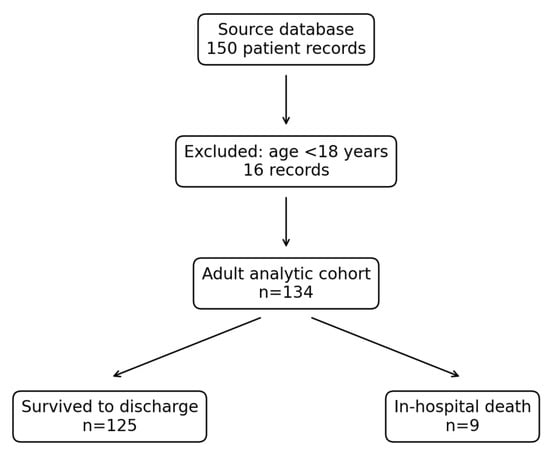
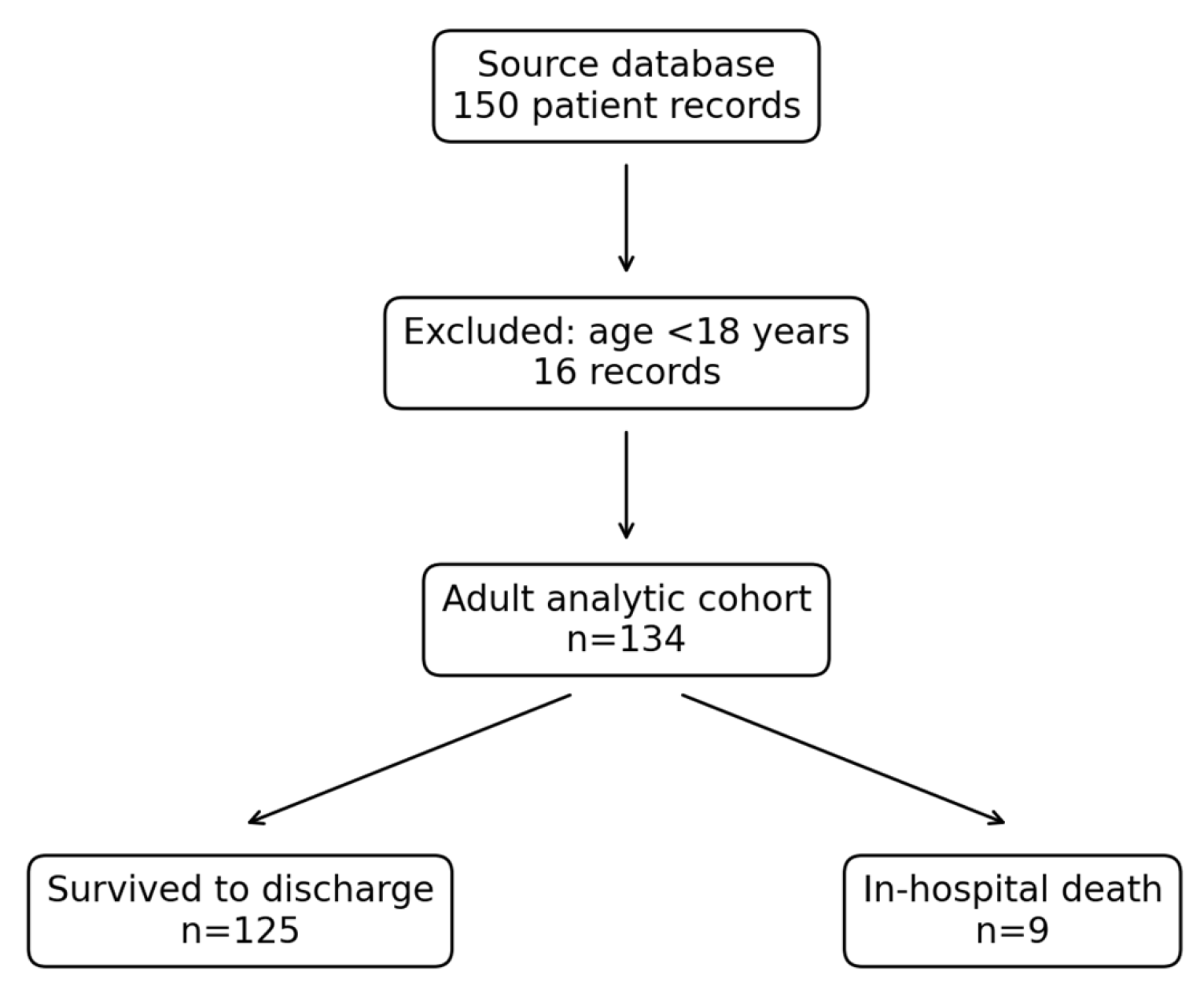
Records were retrieved from the institutional clinical database under CAP/pneumonia labels. Of the 150 records examined, 16 patients younger than 18 years were excluded, leaving 134 adults. Whether admissions were consecutive and whether aspiration pneumonia or SARS-CoV-2 pneumonia were systematically excluded could not be established from the available analysis documentation. Detailed comorbidities, microbiology, ICU status, oxygenation indices, and PSI/CURB-65 were not consistently available for analysis.
The primary objective was to assess the association between admission CRP and in-hospital mortality and its discriminatory performance. Secondary exploratory objectives were CRP change and hospital LOS. Admission CRP was the value registered in the database at hospital admission; the precise sampling interval from presentation was not recorded. CRP was stored in mg/dL and converted to mg/L (×10). CRP was measured using an immunoturbidimetric assay, which quantifies the increase in sample turbidity caused by the formation of immune complexes between CRP antigens and specific anti-human CRP antibodies. The laboratory reference interval was 0–0.5 mg/dL (0–5 mg/L). The final recorded CRP was the last available measurement during hospitalization, not a standardized day-3 or day-4 sample. Absolute reduction was admission minus final CRP, and percentage reduction was calculated relative to admission CRP.
Statistical Analysis
Because CRP and LOS were right-skewed, continuous data were summarized as median (IQR), and survivors and non-survivors were compared using Mann–Whitney U tests. Admission CRP discrimination for in-hospital mortality was assessed using ROC analysis with 5000 stratified bootstrap resamples for the AUC 95% CI; the Youden index identified an exploratory threshold. Conventional logistic regression estimated mortality odds per 100 mg/L admission CRP increase, with an exploratory model adjusted only for age because nine deaths occurred. Firth bias-reduced penalized logistic regression was additionally fitted without and with age adjustment; penalized profile-likelihood 95% confidence intervals and approximate penalized likelihood-ratio p values were calculated. Spearman correlations between CRP measures and LOS were calculated for the full cohort and, as a sensitivity analysis, for survivors only. Complete-case analysis was used for each measure without imputation (admission CRP n = 133; final CRP n = 129). Tests were two-sided with p < 0.05. The original statistical analyses were performed using IBM SPSS Statistics, version 24 (IBM Corp., Armonk, NY, USA). The supplementary Firth analysis was perfermed using the Paython software v0.8.2 firthmodels package. Five adult final-CRP entries were missing or nonnumeric, including reference-range strings, and were excluded from numeric final-CRP analyses; one adult admission-CRP value was missing. No imputation was performed.
3. Results
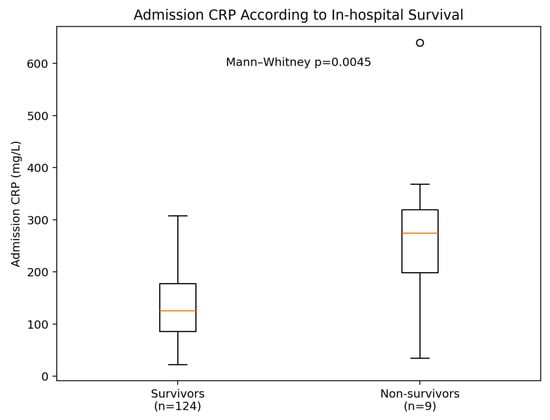
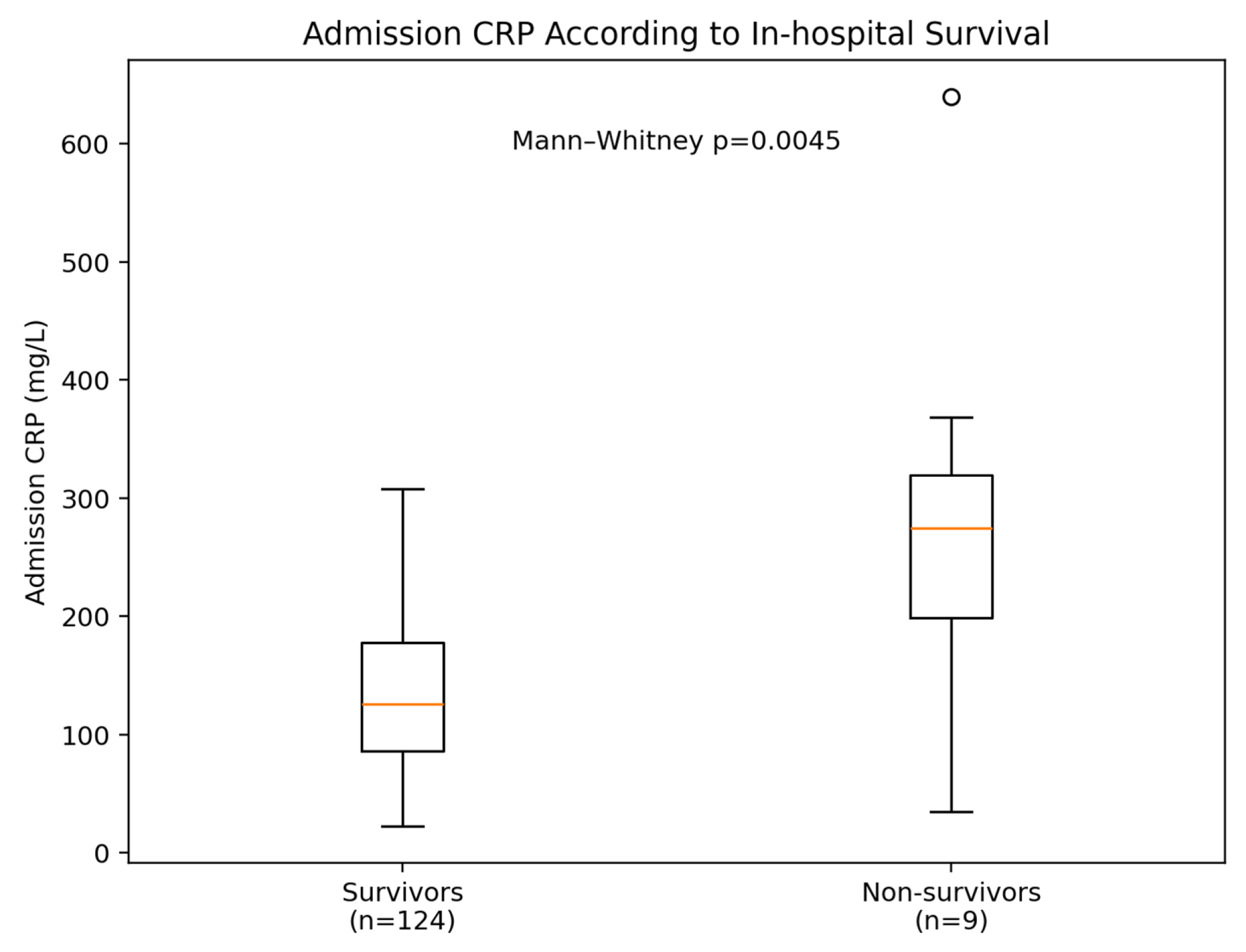
After the exclusion of 16 patients younger than 18 years, 134 adults were left (Figure 1), including nine in-hospital deaths (6.7%). The median age was 80.0 years (IQR 67.0–87.0). Admission CRP was available for 133 patients; final numeric CRP was available for 129 patients. The complete cohort included 60 women (44.8%) and 74 men (55.2%). Median admission CRP was 274.4 (198.6–319.0) mg/L in non-survivors versus 126.2 (86.0–177.9) mg/L in survivors (p = 0.0045; Table 1, Figure 2). Conventional unadjusted logistic regression gave OR 5.87 per 100 mg/L CRP increase (95% CI 1.99–17.26; p = 0.0013), and the age-adjusted model gave OR 5.66 (95% CI 1.92–16.75; p = 0.0017). Admission CRP distribution according to in-hospital survival status is described in Table 2. In the prespecified-for-revision Firth sensitivity analysis (133 complete cases, nine deaths), the unadjusted OR was 5.20 (95% penalized profile-likelihood CI 2.02–16.53; p < 0.001), and the age-adjusted OR was 4.85 (95% CI 1.93–15.27; p < 0.001; Table 3). These estimates support an association after age adjustment but do not establish independence from other clinical confounders.
Figure 1.
Study cohort flow diagram.
Table 1.
Baseline characteristics of the study cohort according to survival status.
Figure 2.
Admission CRP distribution according to in-hospital survival status. Boxplots illustrate admission CRP concentrations in survivors (n = 124) and non-survivors (n = 9). Admission CRP concentrations were significantly higher among non-survivors (median 274.4 mg/L, IQR 198.6–319.0) than survivors (median 126.2 mg/L, IQR 86.0–177.9; Mann–Whitney U test, p = 0.0045).
Table 2.
Prognostic performance of admission CRP for in-hospital mortality.
Table 3.
Firth penalized logistic regression sensitivity analysis for in-hospital mortality.
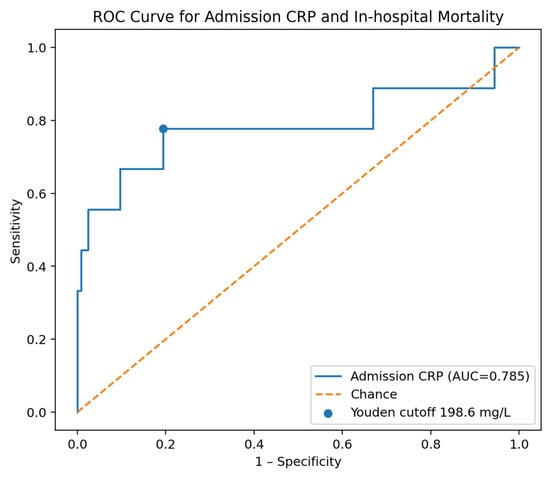
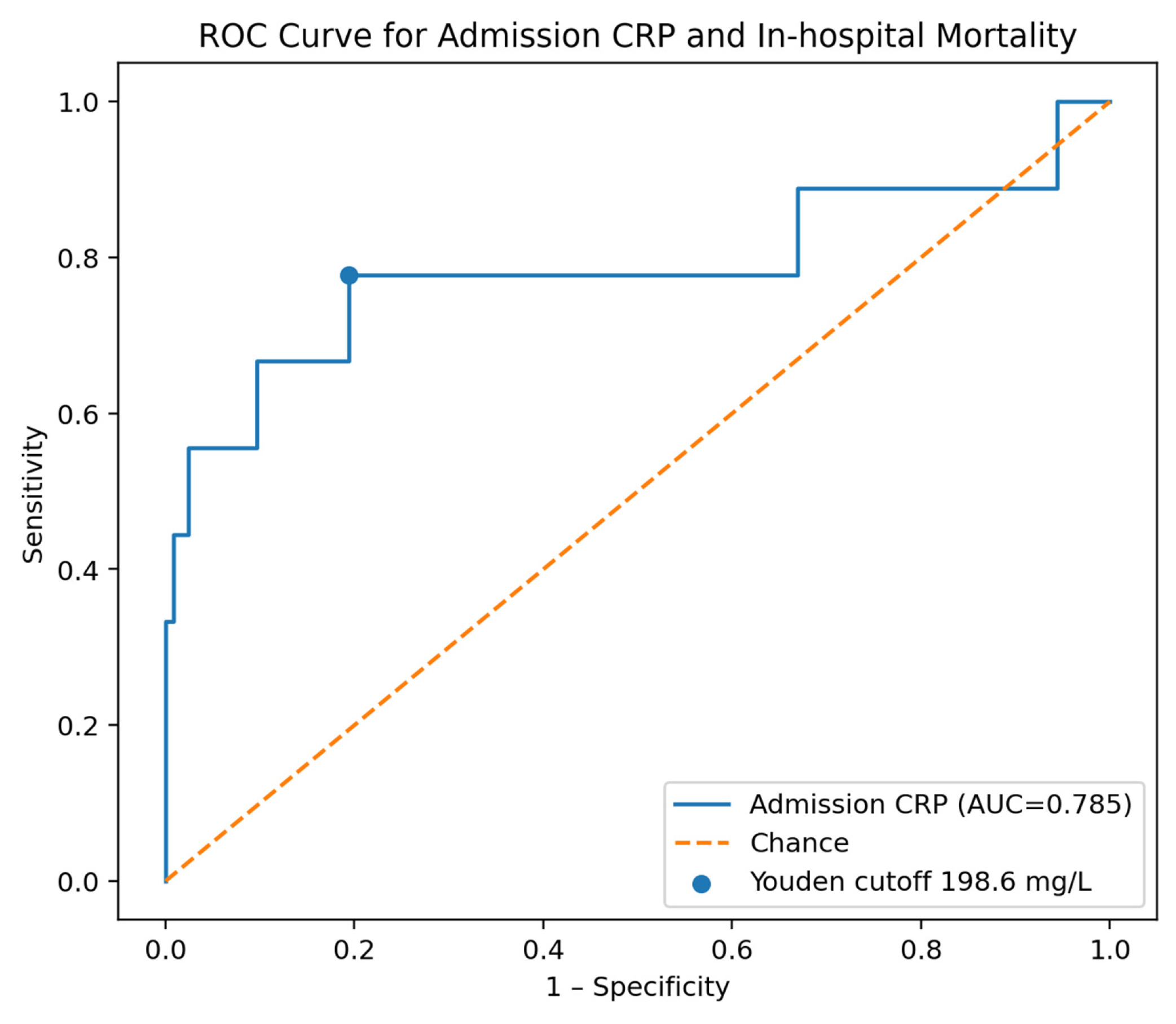
The ROC curve demonstrates the discriminatory performance of admission CRP for in-hospital mortality among 133 patients with available admission CRP measurements, including nine deaths. The area under the curve (AUC) was 0.785 (bootstrap 95% CI 0.552–0.973). The exploratory optimal threshold determined using the Youden index was 198.6 mg/L, corresponding to a sensitivity of 77.8% and specificity of 80.6%. The diagonal reference line represents discrimination equivalent to chance. The threshold was derived and evaluated in the same cohort and has not undergone external validation.
Admission CRP demonstrated an AUC of 0.785 (bootstrap 95% CI 0.552–0.973) for in-hospital mortality (Figure 3). The exploratory Youden-derived threshold was 198.6 mg/L, with a sensitivity of 77.8% and a specificity of 80.6%. Mortality was 22.6% among patients at or above this threshold compared with 2.0% among those below it (Fisher exact OR 14.58; p = 0.0005). Because the cutoff was derived and tested in the same small cohort, it should not be interpreted as a validated clinical threshold.
Figure 3.
Receiver operating characteristic (ROC) curve for admission CRP in predicting in-hospital mortality.
LOS was right-skewed, with a median of 6.0 (IQR 4.0–10.8) days. In the full cohort, admission CRP was not correlated with LOS (Spearman ρ = 0.072, p = 0.410); other CRP measures also lacked statistically significant correlations (Table 4). Because in-hospital death can truncate LOS, survivor-only sensitivity analyses were performed: admission CRP (n = 124; ρ = 0.083, p = 0.357), final CRP (n = 120; ρ = 0.171, p = 0.062), absolute reduction (n = 120; ρ = 0.014, p = 0.882), and percentage reduction (n = 120; ρ = −0.122, p = 0.184; Table 5). No survivor-only association reached statistical significance. Ten database records had zero-day LOS values; their interpretation as true same-day encounters or data artifacts was not established. All LOS analyses remain exploratory.
Table 4.
Spearman correlations between CRP measures and hospital length of stay.
Table 5.
Survivors-only exploratory correlations between CRP and hospital length of stay.
4. Discussion
In this retrospective cohort of 134 adults with database records classified as CAP/pneumonia, higher levels of admission CRP were associated with increased in-hospital mortality. Median admission CRP was 274.4 (IQR 198.6–319.0) mg/L in non-survivors versus 126.2 (86.0–177.9) mg/L in survivors (p = 0.0045). The association remained after age adjustment (conventional aOR 5.66, 95% CI 1.92–16.75) and in a Firth penalized age-adjusted sensitivity model (aOR 4.85, 95% profile CI 1.93–15.27). These findings are encouraging, but the nine deaths and lack of comprehensive clinical adjustment preclude an assertion of an independent prognostic effect.
CAP may activate pulmonary and systemic inflammatory pathways, including cytokine-driven hepatic CRP synthesis. Elevated CRP may reflect greater inflammatory or overall disease burden but is not a direct measure of pathogen load. Host characteristics, symptom duration, prior treatment, and comorbid inflammation may also affect CRP [4,5]. Neither microbiological burden nor the relevant clinical severity measures were available to separate these explanations.
The findings should also be considered alongside more recent studies. Dequin et al. found that hydrocortisone reduced 28-day mortality in severe CAP, reinforcing the clinical significance of the inflammatory response, although the trial was therapeutic and did not validate CRP-based mortality prediction [10]. Farhat et al. showed that adding troponin and procalcitonin to CRB-65 improved discrimination for death or ICU admission (AUC 0.77 versus 0.67 for CRB-65 alone) [11]. Their findings support the principle of biomarker-enhanced risk assessment but cannot establish the incremental value of CRP in our cohort. Because PSI, CURB-65, and respiratory severity data were unavailable, we could not compare models with and without CRP or assess incremental calibration or clinical utility.
These findings sit within a genuinely mixed evidence base. A systematic review and meta-analysis of prognostic biomarkers in CAP found that CRP alone gave only modest discrimination for short-term mortality [7], while biomarker-accuracy work more broadly has cautioned that no single inflammatory marker reliably separates CAP from other causes of respiratory illness or reliably predicts outcome in isolation [6]. Against that skepticism, studies restricted to severe CAP have found clear associations between elevated CRP and adverse outcomes [8], and combining CRP-type biomarkers with validated clinical scores has been shown to improve mortality prediction over the scores alone [9]. Our results land closer to the severe-CAP end of this spectrum, and add a plausible explanation for the heterogeneity: cohorts with a low death rate and modest CRP spread will tend to show weak discrimination, while a cohort like ours, which is small, but with a wide separation between survivor and non-survivor CRP, will show strong discrimination.
Admission CRP produced an AUC of 0.785 for in-hospital mortality, which at face value suggests moderate-to-good discrimination. However, the bootstrap 95% CI was wide (0.552–0.973), reflecting the small number of deaths and the substantial uncertainty around this estimate. The Youden-derived cutoff of 198.6 mg/L yielded a sensitivity of 77.8% and specificity of 80.6%, with a mortality rate of 22.6% among patients at or above this threshold compared with 2.0% below it (Fisher exact OR 14.58; p = 0.0005). Because this cutoff was derived and evaluated within the same 134-patient cohort, it is susceptible to overfitting and optimistic bias almost by construction, and we would frame it as hypothesis-generating rather than decision-ready.
This distinction matters because contemporary CAP guidelines emphasize integrated clinical evaluation using established severity frameworks such as PSI and CURB-65 [1,2]. Nothing in the present findings suggests that CRP is superior to these scores or that a CRP-based threshold alone should determine hospitalization, escalation of care, or treatment decisions. Rather, our results make the case for evaluating whether CRP adds incremental prognostic information when layered onto established severity assessment, consistent with prior evidence that biomarkers can sharpen prediction when combined with clinical scores [9].
The interpretation of CRP kinetics also differs fundamentally between standardized serial measurements and the last available inpatient measurement. Our final CRP values were obtained at variable time points and may reflect differences in survival time, treatment exposure, and clinical decisions to repeat testing. Consequently, the large survivor–non-survivor differences in final CRP should not be interpreted as a validated longitudinal prediction rule [12,13,14].
The non-standardized serial CRP data provide an exploratory signal: final CRP was 221.0 (153.0–283.0) mg/L in non-survivors versus 23.0 (14.3–40.2) mg/L in survivors (p < 0.001); percentage CRP reduction was 15.2% (−45.3 to 40.6) versus 80.2% (70.6–85.8), respectively (p < 0.001). Previous work has linked delayed CRP decline to poor outcomes [12,13,14]. However, our last CRP measurements were obtained at variable times, so timing and survivorship biases prevent direct interpretation as standardized treatment-response kinetics.
We would stop short of treating this final-CRP finding as equivalent to those studies, however. Our database captured whichever CRP happened to be drawn last during a variable-length stay, not a CRP obtained at a fixed day-3 or day-4 time point, so the comparison is entangled with survivorship and measurement-timing bias—a patient who died early simply had less opportunity for CRP to fall. The direction of the finding is credible; the magnitude is not something we would generalize.
Our findings should be interpreted in the context of existing evidence on inflammatory biomarkers in CAP. Although the studies by Dequin et al. [10] and Farhat et al. [11] provide important insights into inflammation-related treatment and multimarker risk stratification, respectively, neither directly validates admission CRP as an independent mortality predictor. The present study provides observational evidence of an association between elevated admission CRP and in-hospital mortality, but its small number of events and lack of comprehensive adjustment for clinical severity prevent conclusions regarding incremental prognostic utility. Future prospective studies should determine whether CRP improves discrimination, calibration, and clinical decision-making beyond validated CAP severity scores.
In contrast to mortality, admission CRP was not significantly associated with LOS in the overall cohort (ρ = 0.072, p = 0.410) or among survivors only (ρ = 0.083, p = 0.357). The survivor-only analyses of final CRP, absolute reduction, and percentage reduction were likewise nonsignificant (Table 5). These exploratory associations may be influenced by comorbidities, complications, discharge arrangements, unstandardized CRP timing, and the ten zero-day LOS records in the database. The survivors-only analysis reduces, but does not eliminate, the complexity introduced by death as a competing outcome.
The principal clinical implication is the need to test admission CRP as a potential adjunct to validated CAP severity assessment, not to implement a stand-alone CRP cutoff. The AUC of 0.785 had a wide bootstrap confidence interval, and the threshold of 198.6 mg/L was derived and evaluated in the same small cohort. Prospective studies should assess incremental discrimination and calibration when CRP is combined with PSI, CURB-65, oxygenation, and comorbidity information [1,2,9].
Strengths include real-world retrospective data, use of medians and nonparametric tests for skewed measurements, a bootstrap confidence interval for the ROC AUC, conservative age-only conventional adjustment, and additional Firth penalized and survivor-only sensitivity analyses. The Firth estimates were directionally consistent with conventional models, although they cannot correct unmeasured confounding.
Important limitations include the single-center retrospective design, the advanced age of the cohort (median 80 years), and uncertain generalizability to younger adults. Although CAP was clinically characterized by compatible symptoms and radiographic consolidation, and elevated CRP was not a mandatory study inclusion criterion, the retrospective records did not establish whether aspiration or hospital-acquired pneumonia were systematically excluded, whether cases were consecutive, or how SARS-CoV-2 pneumonia was handled. An additional methodological limitation concerns the potential use of CRP during initial case ascertainment. Because CRP was the primary biomarker under investigation, any selection process requiring elevated CRP could introduce incorporation-related selection bias and limit the applicability of our findings to patients presenting with low or normal CRP concentrations. Such selection could also influence the observed distribution of CRP values, estimated associations with mortality, and discriminatory performance. Consequently, the reported ROC characteristics and exploratory threshold should be interpreted within the context of the selected retrospective cohort rather than generalized to all patients with CAP. Only nine deaths occurred, producing imprecise estimates and potential model instability despite Firth sensitivity analysis. Detailed comorbidities, microbiology, ICU admission, oxygenation, and PSI/CURB-65 were unavailable for comprehensive adjustment. The final CRP was measured at non-standardized time points, exposing change analyses to timing and survivorship bias. LOS analyses were exploratory, including a survivors-only sensitivity analysis; ten zero-day LOS records also require source verification. Finally, the data-derived 198.6 mg/L threshold was not externally validated.
5. Conclusions
In this retrospective single-center cohort of older adults with records classified as CAP/pneumonia, admission CRP was associated with in-hospital mortality, including after age adjustment and Firth penalized sensitivity analysis. The AUC suggested a potential discriminatory value, but this was imprecise. The exploratory 198.6 mg/L threshold should not guide care without external validation. Admission CRP was not significantly correlated with LOS, including among survivors. Prospective studies using confirmed CAP definitions, standardized serial CRP, and comprehensive severity adjustment are needed.
Author Contributions
Conceptualization, M.T. and O.F.; methodology, F.F. and O.F.; software, A.S. and M.T.; validation, A.S., M.T. and O.F.; formal analysis, A.S.; investigation, M.T.; resources, O.F.; data curation, A.S. and M.T.; writing—original draft preparation, M.T. and A.S.; writing—review and editing, F.F. and O.F.; visualization, O.F.; supervision, O.F.; project administration, A.S., M.T. and O.F. All authors have read and agreed to the published version of the manuscript.
Funding
This research received no external funding.
Institutional Review Board Statement
The study was conducted in accordance with the Declaration of Helsinki and approved by the Helsinki Committee of Edith Wolfson Medical Center (protocol code 0034-24-WOMC, date: 26.02.2024).
Informed Consent Statement
Patient consent was waived in this study due to its retrospective -observational design, non-invasive nature involving only chart review. Re-contacting participants is not feasible and all data were analyzed and reported in anonymized/coded form, posing no additional risk to participants.
Data Availability Statement
All data generated or analysed during this study are included in this published article. The datasets used and/or analysed during the current study are available from the corresponding author upon reasonable request.
Conflicts of Interest
The authors declare no conflicts of interest.
References
- Jones, B.E.; Ramirez, J.A.; Oren, E.; Soni, N.J.; Sullivan, L.R.; Restrepo, M.I.; Musher, D.M.; Erstad, B.L.; Pickens, C.; Vaughn, V.M.; et al. American Thoracic Society Assembly on Pulmonary Infections and Tuberculosis. Diagnosis and Management of Community-acquired Pneumonia: An Official American Thoracic Society Clinical Practice Guideline. Am. J. Respir. Crit. Care Med. 2026, 212, 24–44. [Google Scholar] [PubMed]
- Metlay, J.P.; Waterer, G.W.; Long, A.C.; Anzueto, A.; Brozek, J.; Crothers, K.; Cooley, L.A.; Dean, N.C.; Fine, M.J.; Flanders, S.A.; et al. Diagnosis and Treatment of Adults with Community-acquired Pneumonia: An Official Clinical Practice Guideline of the American Thoracic Society and Infectious Diseases Society of America. Am. J. Respir. Crit. Care Med. 2019, 200, e45–e67. [Google Scholar] [CrossRef] [Scilit] [PubMed]
- Wunderink, R.G.; Waterer, G.W. Community-acquired pneumonia. N. Engl. J. Med. 2014, 370, 543–551. [Google Scholar] [PubMed]
- Pepys, M.B.; Hirschfield, G.M. C-reactive protein: A critical update. J. Clin. Investig. 2003, 111, 1805–1812. [Google Scholar] [CrossRef] [Scilit]
- Méndez, R.; Menéndez, R.; Cillóniz, C.; Amara-Elori, I.; Amaro, R.; González, P.; Posadas, T.; Gimeno, A.; España, P.P.; Almirall, J.; et al. Initial Inflammatory Profile in Community-acquired Pneumonia Depends on Time since Onset of Symptoms. Am. J. Respir. Crit. Care Med. 2018, 198, 370–378. [Google Scholar] [CrossRef] [Scilit] [PubMed]
- Ebell, M.H.; Bentivegna, M.; Cai, X.; Hulme, C.; Kearney, M. Accuracy of Biomarkers for the Diagnosis of Adult Community-acquired Pneumonia: A Meta-analysis. Acad. Emerg. Med. 2020, 27, 195–206. [Google Scholar] [CrossRef] [Scilit] [PubMed]
- Viasus, D.; Del Rio-Pertuz, G.; Simonetti, A.F.; Garcia-Vidal, C.; Acosta-Reyes, J.; Garavito, A.; Carratalà, J. Biomarkers for predicting short-term mortality in community-acquired pneumonia: A systematic review and meta-analysis. J. Infect. 2016, 72, 273–282. [Google Scholar] [CrossRef] [Scilit] [PubMed]
- Qiao, L.; Yuan, H. Prognostic value of C-reactive protein levels in pulmonary infections: A systematic review and meta-analysis. Medicine 2025, 104, e41722. [Google Scholar] [CrossRef] [Scilit]
- Menendez, R.; Martinez, R.; Reyes, S.; Mensa, J.; Filella, X.; A Marcos, M.; Martinez, A.; Esquinas, C.; Ramirez, P.; Torres, A. Biomarkers improve mortality prediction by prognostic scales in community-acquired pneumonia. Thorax 2009, 64, 587–591. [Google Scholar] [CrossRef] [Scilit] [PubMed]
- Dequin, P.-F.; Meziani, F.; Quenot, J.-P.; Kamel, T.; Ricard, J.-D.; Badie, J.; Reignier, J.; Heming, N.; Plantefève, G.; Souweine, B.; et al. Hydrocortisone in severe community-acquired pneumonia. N. Engl. J. Med. 2023, 388, 1931–1941. [Google Scholar] [CrossRef] [Scilit] [PubMed]
- Farhat, I.; Rosolowski, M.; Ahrens, K.; Lienau, J.; Ahnert, P.; Pletz, M.; Rohde, G.; Rupp, J.; Scholz, M.; Witzenrath, M.; et al. Biomarkers troponin and procalcitonin in addition to CRB-65 enhance risk stratification in patients with community-acquired pneumonia. ERJ Open Res. 2024, 10, 00420–02024. [Google Scholar] [CrossRef] [Scilit] [PubMed]
- Andersen, S.B.; Egelund, G.B.; Jensen, A.V.; Petersen, P.T.; Rohde, G.; Ravn, P. Failure of CRP decline within three days of hospitalization is associated with poor prognosis of community-acquired pneumonia. Infect. Dis. 2017, 49, 251–260. [Google Scholar] [CrossRef] [Scilit] [PubMed]
- Guo, S.; Mao, X.; Liang, M. The moderate predictive value of serial serum CRP and PCT levels for the prognosis of hospitalized community-acquired pneumonia. Respir. Res. 2018, 19, 193. [Google Scholar] [CrossRef] [Scilit] [PubMed]
- Travlos, A.; Bakakos, A.; Vlachos, K.F.; Rovina, N.; Koulouris, N.; Bakakos, P. C-Reactive Protein as a Predictor of Survival and Length of Hospital Stay in Community-Acquired Pneumonia. J. Pers. Med. 2022, 12, 1710. [Google Scholar] [CrossRef] [Scilit] [PubMed]

Disclaimer/Publisher’s Note: The statements, opinions and data contained in all publications are solely those of the individual author(s) and contributor(s) and not of MDPI and/or the editor(s). MDPI and/or the editor(s) disclaim responsibility for any injury to people or property resulting from any ideas, methods, instructions or products referred to in the content. |
© 2026 by the authors. Published by MDPI on behalf of the Lithuanian University of Health Sciences. Licensee MDPI, Basel, Switzerland. This article is an open access article distributed under the terms and conditions of the Creative Commons Attribution (CC BY) license.