


Abstract
Background and Objectives: Bile duct injury (BDI) is the most serious complication of cholecystectomy. Whether robotic cholecystectomy (RC), now rapidly adopted, changes this risk compared with laparoscopic cholecystectomy (LC), including in acute cholecystitis, is disputed. Materials and Methods: Following PRISMA 2020, PubMed, Scopus and Web of Science were searched from inception to October 2026, with complementary and citation searching. Major BDI was the principal outcome; any coded BDI and conversion were secondary outcomes. Heterogeneous definitions and overlapping datasets required narrative synthesis. Results: Thirty-two observational studies published in 2017–2026 (11 database studies and 21 clinical series) were included. Medicare and New York State analyses of BDI requiring operative repair reported a higher risk after RC, whereas studies of coded BDI and clinical series with classified injuries reported similar or lower rates. In eight acute cholecystitis cohorts, BDI rates did not differ, but evidence for advanced inflammation was scarce. Conversion was lower with RC in most studies, although three database studies reported the opposite. Risk of bias was serious or critical in all studies. Conclusions: Current observational evidence neither demonstrates nor excludes a difference in major BDI between RC and LC. Prospective studies with standardised BDI classification, severity grading and surgeon-level adjustment are needed.
1. Introduction
Gallstone disease is one of the most common digestive disorders: up to 20% of adults develop gallstones, and more than one in five of them will develop symptoms or complications [1]. Cholecystectomy is accordingly one of the most frequently performed abdominal operations, with more than one million procedures performed each year in the United States alone [2]. Since its introduction in the late 1980s, laparoscopic cholecystectomy (LC) has replaced open surgery as the standard treatment of symptomatic cholelithiasis [3], and it is now also the preferred approach for acute cholecystitis, including more severe grades, provided that safe steps and bail-out options are respected [4].
Bile duct injury (BDI) remains the most feared complication. In contemporary series, major BDI occurs in approximately 0.2–0.4% of cholecystectomies [5,6,7], and it carries substantial morbidity, impaired long-term quality of life, high costs and, in the most severe cases, a need for liver transplantation [8,9,10]. The critical view of safety (CVS), introduced by Strasberg and colleagues in 1995, and the Strasberg classification, which grades injuries from type A (cystic duct or liver-bed leak) to type E (circumferential injury of the major bile ducts, E1–E5), remain the reference framework for prevention and reporting [11,12,13].
Robotic cholecystectomy (RC) offers three-dimensional magnified vision, a stable camera, wristed instruments, better ergonomics and integrated near-infrared fluorescence cholangiography, at the price of docking time, loss of haptic feedback and higher costs. Its use has risen steeply. Among United States Medicare beneficiaries, the share of RC increased from 0.1% of cholecystectomies in 2010 to 5.2% in 2019 [14], and nationally from 1.5% in 2016 to 11.7% in 2022 [15]. RC accounted for 12% of minimally invasive cholecystectomies in the 2022–2023 American College of Surgeons National Surgical Quality Improvement Program [16], 31% of elective cholecystectomies in a 69-hospital statewide registry in 2020–2024 [17] and nearly 30% of emergency cholecystectomies in a national hospital database in 2024 [18]. The number of surgeons performing RC has grown accordingly: in a Medicare analysis, 4443 surgeons performed at least one RC, but 87% of them had performed fewer than 10 [19]. RC generally takes longer than LC: in meta-analyses, mean operative time was approximately 12–13 min longer, largely because of set-up and docking [20,21,22]. Costs are also higher, by approximately USD 2400–2700 per case in United States database studies [15,23,24] and by approximately EUR 360 per case in a European centre [25].
Population-based studies have raised concerns that BDI may be more frequent after RC [14,26], whereas other analyses have found no such signal [15,27]. Experts have therefore called for RC to be evaluated within the framework of safe cholecystectomy principles [28]. The aim of this systematic review was to compare the risk of BDI after robotic and laparoscopic cholecystectomy, with particular attention to patients with acute cholecystitis.
2. Materials and Methods
2.1. Protocol, Reporting and Scope
This systematic review was conducted and reported in accordance with the Preferred Reporting Items for Systematic Reviews and Meta-Analyses (PRISMA) 2020 statement [29]; the PRISMA 2020 checklist is provided in Supplementary Table S2. The protocol was not prospectively registered. At revision, in response to peer review, the scope was restricted to the RC-versus-LC comparison, major BDI was designated as the principal outcome and the search was extended to Scopus and Web of Science. The formal systematic review addressed a single question: in adults undergoing cholecystectomy, is RC associated with a different risk of BDI than LC? Prevention, intraoperative biliary imaging, training and the management of established BDI were not the subject of dedicated systematic searches and are therefore discussed separately as a clearly labelled narrative synthesis (Section 4.5). An earlier PubMed search on BDI after LC (10 July 2024), performed during the initial preparation of this work, is not part of the systematic review; the nine studies it retrieved are used only as contextual evidence in that narrative section and are listed in Supplementary Table S3.
2.2. Eligibility Criteria
Eligibility was defined according to the PICOS (population, intervention, comparator, outcomes, study design) framework (Table 1). Population: adults (≥18 years) undergoing cholecystectomy for benign gallbladder disease in elective, urgent or emergency settings, including acute cholecystitis. Intervention: robotic (robot-assisted) cholecystectomy on any platform, multiport or single-site. Comparator: conventional multiport laparoscopic cholecystectomy. Outcomes: BDI reported separately for each approach. Study design: original comparative clinical studies of any design. Non-comparative robotic series, paediatric studies, studies of BDI repair only, studies of imaging adjuncts without an RC–LC comparison, case reports, technical notes, editorials, letters, conference abstracts, animal studies and narrative reviews were excluded. Systematic reviews and meta-analyses comparing RC with LC were not included in the primary synthesis but were summarised separately (Section 3.7), and their reference lists were screened. Studies published from database inception to October 2026 were eligible, with no language restriction; non-English reports were to be translated for assessment.
Table 1.
Search strategy and eligibility criteria of the systematic review.
2.3. Outcomes
The principal safety outcome was major BDI, defined as an injury of the extrahepatic bile ducts requiring operative repair or biliary reconstruction, or one classified by the source study as a major injury (Strasberg type D or E in most studies) [11]. Many studies reported BDI only as a composite or as an administratively coded diagnosis. The following were therefore analysed as secondary outcomes and were not used interchangeably with major BDI: (i) any BDI as defined or coded by the source study, of unspecified severity; (ii) minor biliary injury (Strasberg type A–C, or bile leak not requiring reconstruction); (iii) conversion to open surgery; (iv) other bail-out procedures (subtotal cholecystectomy, cholecystostomy); and (v) reoperation or readmission when reported. For each study, the BDI definition was classified as major (operative repair or reconstruction, or major injury as defined by the authors), Strasberg-classified (all types, with major injuries extracted separately where possible), coded or unspecified (diagnosis or procedure codes, or “common bile duct injury” without grading), or not defined.
2.4. Information Sources and Search Strategy
PubMed/MEDLINE was searched from inception on 11 October 2026 (records published up to 10 October 2026), and the search was updated on 19 October 2026. At revision, the search was extended on 19 October 2026 to Scopus and Web of Science Core Collection, accessed through the institutional ANELIS Plus subscription, using equivalent search strings from database inception (Table 1; Supplementary Table S4). Embase was not available through our institutional subscription and the Cochrane Central Register of Controlled Trials (CENTRAL) was not searched separately; to mitigate this, the reference lists of published RC-versus-LC meta-analyses that had searched Embase and the Cochrane Library were screened [20,21,30,31]. Because comparative studies frequently report BDI only in their results tables and not in the title or abstract, a complementary PubMed search without the BDI term, restricted to comparative studies of RC and LC, was also performed, and related-article and citation searching of the included studies was undertaken. No date, language or text-availability filters were applied.
2.5. Study Selection and Data Extraction
Records from all sources were de-duplicated, and titles and abstracts, followed by full texts, were screened independently by two reviewers (C.D.G. and F.V.M.); disagreements were resolved by discussion or by a third reviewer (A.C.). The same reviewers extracted data independently using a standardised form. Study-level items were the first author, year and country; study design and data source; study period; robotic platform; and overlap of the underlying data source with that of other included studies. Clinical items were the setting; the proportion of patients with acute cholecystitis and its severity grade (Tokyo Guidelines, American Association for the Surgery of Trauma [AAST], Parkland, Nassar or other intraoperative grading) whenever reported; whether surgeon- or hospital-level variables (volume, experience, learning curve or clustering) were incorporated into the analysis; and use of near-infrared fluorescence cholangiography with indocyanine green (ICG). Outcome items were the BDI definition and type; length of follow-up; event counts in each group; the main adjusted effect estimate; conversion to open surgery; and subtotal cholecystectomy and other bail-out procedures. Items not reported by the source study were recorded as not reported (NR). Full texts were obtained through the institutional subscription; when a full text could not be obtained, data were extracted from the abstract and the study was retained if BDI was reported for each group. At revision, all records retrieved from the three databases and by the other methods were re-screened against the revised eligibility criteria, and data from the additional studies were extracted. The full texts of previously abstract-only studies were re-checked where they became accessible.
2.6. Classification of Clinical Setting
To avoid combining different types of evidence, studies were grouped into four clinical settings: (a) dedicated acute cholecystitis cohorts, in which all patients had acute cholecystitis, or a separate acute cholecystitis analysis was reported; (b) broader urgent, emergency or acute care surgery series, in which acute cholecystitis was mixed with other urgent biliary indications such as biliary colic, choledocholithiasis or gallstone pancreatitis; (c) elective series; and (d) mixed or all-indication series.
2.7. Risk of Bias Assessment
Because all eligible studies were non-randomised, risk of bias was assessed at study level with the Risk Of Bias In Non-randomised Studies of Interventions (ROBINS-I) tool [32]. Particular attention was paid to confounding by indication (adjustment for disease severity, comorbidity, surgeon experience and learning curve), classification of the intervention (administrative coding of the robotic approach), outcome ascertainment (clinically classified versus administratively coded BDI, and length of follow-up) and selective reporting. Each study received an overall judgement (low, moderate, serious or critical), reported in Section 3.8; when only the abstract was available and information was insufficient, the judgement was not rated better than serious. Reporting bias across studies (including publication bias and small-study effects) was not formally assessed, because no quantitative pooling was performed and funnel-plot methods would not have been valid. The certainty of the evidence was not formally graded.
2.8. Data Synthesis
Because BDI was defined heterogeneously, several administrative datasets overlapped in time and population, and event counts in institutional series were very small, no meta-analysis was performed. A structured narrative synthesis was undertaken, in which studies were grouped by BDI definition (major versus any or coded BDI), data source (population-based administrative, claims or electronic health record databases versus institutional series) and clinical setting (Section 2.6). For key proportions derived from event counts, exact (Clopper–Pearson) 95% confidence intervals (CIs) were calculated [33]; calculations were performed in Python 3.13 (Python Software Foundation, Wilmington, DE, USA) with the SciPy library, version 1.18 (open-source; https://scipy.org). Sample sizes are summarised as median and interquartile range (IQR) because their distribution was highly skewed.
3. Results
3.1. Study Selection
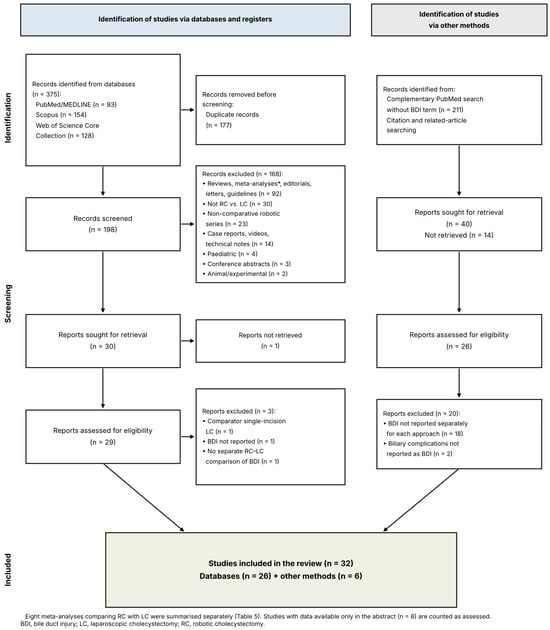
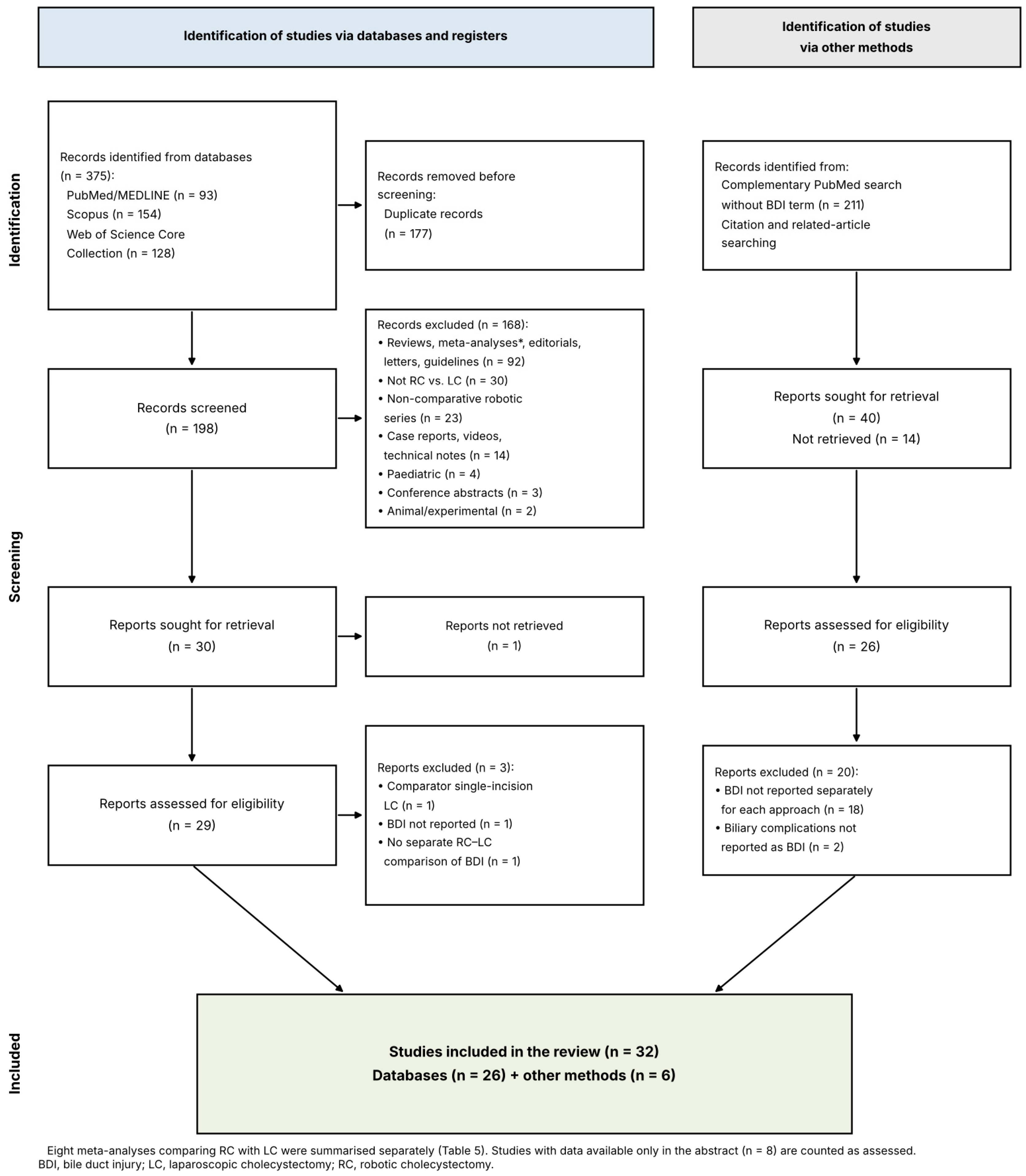
The database searches identified 375 records (PubMed, n = 93; Scopus, n = 154; Web of Science, n = 128). After removal of 177 duplicates, 198 records were screened, and 168 were excluded on title and abstract (reviews, systematic reviews, meta-analyses, editorials, letters, guidelines or book chapters, n = 92; studies not comparing RC with LC, such as BDI repair or imaging adjuncts, n = 30; non-comparative robotic series, n = 23; case reports, videos or technical notes, n = 14; paediatric populations, n = 4; conference abstracts, n = 3; animal or experimental studies, n = 2). Of the 30 reports sought, one could not be retrieved; of the 29 assessed in full text, three were excluded (single-incision rather than conventional laparoscopic comparator, n = 1; BDI not reported, n = 1; no separate RC–LC comparison of BDI, n = 1), leaving 26 studies; for 8 of the 32 included studies, only the abstract was available, and these were assessed and included on the basis of the abstract (Section 2.5). Three of these had been excluded at the initial screening of the PubMed results and were identified on re-screening [34,35,36], and one was identified only in Scopus [37]. The complementary PubMed search (211 records) and citation and related-article searching identified 40 further reports; 14 could not be retrieved in full text and 20 were excluded after assessment (BDI not reported separately for each approach, n = 18, including the only two randomised trials identified, both comparing single-site RC with multiport LC; biliary complications not reported as BDI, n = 2), leaving 6 additional studies. In total, 32 studies were included (Figure 1). Eight RC-versus-LC meta-analyses were summarised separately (Section 3.7). The full screening log and the reports that could not be retrieved are provided in Supplementary Tables S1a,b and S5.
Figure 1.
PRISMA 2020 flow diagram of study selection. BDI, bile duct injury; LC, laparoscopic cholecystectomy; RC, robotic cholecystectomy.
3.2. Characteristics of the Included Studies
The 32 studies were published between 2017 and 2026 and covered operations performed between 2008 and 2026. All were published in English; the only non-English comparative report identified (in German) could not be retrieved (Supplementary Table S5). Twenty-four studies originated from the United States, 5 from India, and 1 each from the United Kingdom, Austria and Lithuania (Table 2). All were observational, and data for 8 were available from the abstract only. Eleven used population-based administrative, claims or electronic health record databases and 21 were institutional or multicentre clinical series. The median size of the analysed cohorts was 936 (IQR 211–39,971; range 40–1,255,764). Because several datasets overlap in time and population (Table 2), the total of approximately 4.1 million procedures should not be interpreted as unique patients. The robotic platform was reported in only 10 studies, all clinical series (da Vinci in 9 and Senhance in 1). By setting, 8 studies were dedicated acute cholecystitis cohorts (including 2 of interval cholecystectomy after gallbladder drainage) and one further study reported a separate acute cholecystitis analysis, 6 were broader urgent, emergency or acute care surgery series, 3 were elective or non-acute series and 15 were mixed or did not report the setting. Acute cholecystitis severity was graded in only 6 studies (Tokyo and Parkland grades; AAST grade in 2; Parkland grade; Tokyo grade II–III only; and an intraoperative A–D scale). Surgeon- or hospital-level variables were incorporated into the analysis (adjustment, multilevel modelling, matching or stratified analysis) in 8 studies [15,18,35,38,39,40,41,42], and 6 single-surgeon series excluded between-surgeon variation by design; and fluorescence cholangiography use was reported in 6.
Table 2.
Characteristics of the comparative studies of robotic (RC) versus laparoscopic (LC) cholecystectomy.
3.3. Major Bile Duct Injury (Principal Outcome)
Seven studies reported major BDI or provided data from which it could be extracted (Table 3). Their results were discordant and differed systematically by data source and outcome ascertainment. In more than one million Medicare beneficiaries operated on between 2010 and 2019, BDI requiring hepaticojejunostomy or choledochojejunostomy within one year occurred in 0.7% after RC and 0.2% after LC (relative risk [RR] 3.16, 95% CI 2.57–3.75) [14]. An instrumental variable analysis designed to address unmeasured confounding attenuated but did not abolish the difference (RR 1.88, 95% CI 1.14–2.63). An extended Medicare analysis to 2021, which contains the same patients and is therefore not independent, found a similar excess across low-, medium- and high-risk strata (RR 3.11–3.14) [43]. In New York State (2009–2017), major reconstruction was required after 0.6% of RCs and 0.1% of LCs [26]. None of these three studies could adjust for disease severity or surgeon experience.
Table 3.
Bile duct injury, conversion and bail-out procedures in the comparative studies of robotic (RC) versus laparoscopic (LC) cholecystectomy.
By contrast, four studies that reported major injuries separately, three clinical series and one national interval-cholecystectomy cohort, found few or no major injuries after RC. In a six-hospital cohort of 4316 patients, 7 major duct injuries (defined by the authors as Strasberg C–E) occurred after LC (0.19%; 95% CI 0.08–0.39) and none after 580 RCs (95% CI 0.00–0.63) [46]. In a single institution, no major (Strasberg D–E) injury occurred after 676 fluorescence-guided RCs, compared with 0.34% after 289 LCs performed by the same team [53]. In interval cholecystectomy after gallbladder drainage for acute cholecystitis, one of 177 LCs and none of 38 RCs required hepaticojejunostomy [37], and no injury requiring repair was coded after 209 robotic or 2970 laparoscopic interval cholecystectomies in a national database [35]. These estimates rest on very few events and were not adjusted for confounding. Taken together, the evidence on major BDI is inconsistent and does not establish whether the robotic approach increases, decreases or does not change the risk of injuries requiring operative reconstruction.
3.4. Any or Coded Bile Duct Injury (Secondary Outcome)
Studies that reported any BDI, usually identified from diagnosis codes during the index admission or within 30 days, mostly found no difference or fewer injuries after RC. In 70,074 propensity-matched commercially insured patients, BDI occurred in 0.37% (95% CI 0.30–0.43) after RC and in 0.39% (0.33–0.47) after LC (odds ratio [OR] 0.93, 95% CI 0.73–1.18) [27]. In the Nationwide Readmissions Database, the adjusted odds of BDI were similar for RC and LC (adjusted OR 0.79, 95% CI 0.47–1.35) [15]. In an electronic health record dataset, no BDI was coded among 23,684 elective RCs, compared with 15 among 93,087 LCs (0.02%) [38]. Among clinical series, the multisite academic cohort, adjusted for severity grades and surgeon learning curve, reported Strasberg-classified injuries in 0.65% (95% CI 0.42–0.98) of RCs and 1.02% (0.89–1.17) of LCs (absolute risk difference −0.37%, 95% CI −0.72 to −0.02) [41]. A propensity-matched cohort with a structured robotic training programme for residents reported 2 versus 10 injuries among 547 matched pairs (LC-versus-RC OR 5.17, 95% CI 1.12–23.9) [47]. A 15-centre acute care surgery study reported no BDI among 335 RCs versus 2 among 1007 LCs (0.2%) [45]. The New York State analysis was the only one to report a higher rate of any BDI after RC (1.3% vs. 0.4%) [26]. The remaining clinical series (40–907 patients) reported zero or single events per group and were underpowered to detect differences [25,34,36,42,48,49,50,51,52,54,55,56,57,58,59].
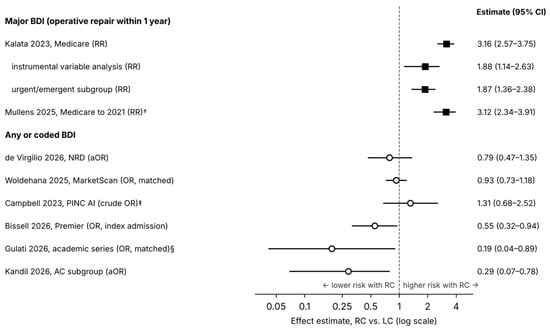
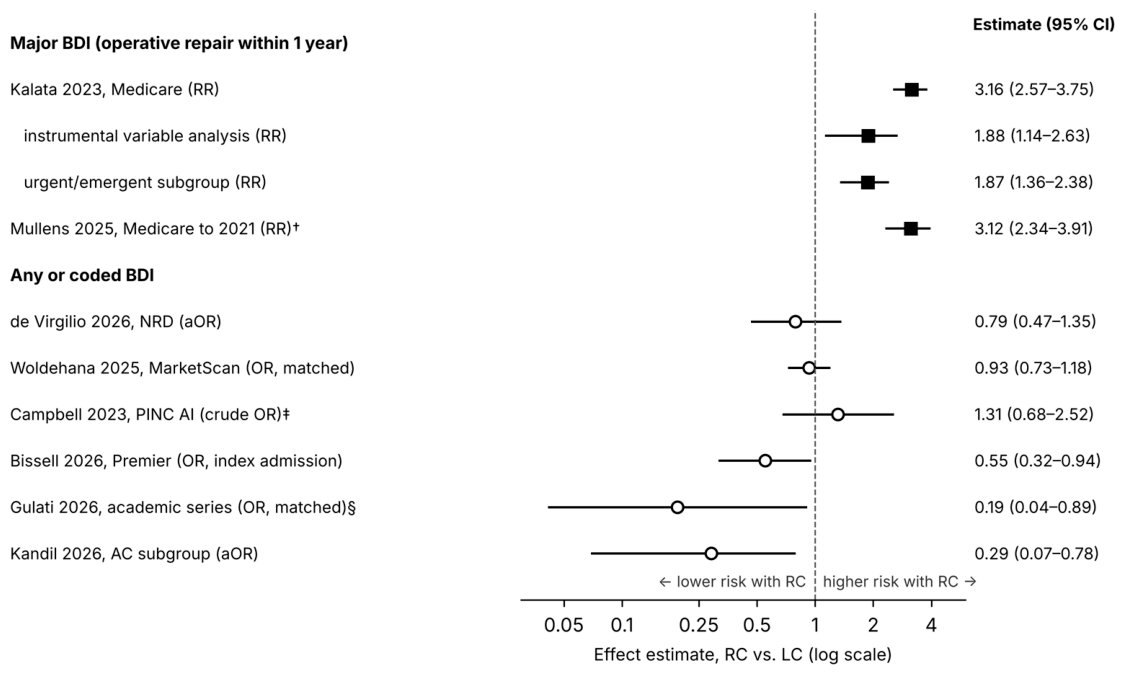
Coded BDI rates after LC varied more than tenfold between databases, from 0.05% in one emergency cohort [18] to 0.39% [27] and 1.6% [40] in others. This variation reflects differences in coding, case mix and follow-up rather than true differences in risk and confirms that coded BDI and major BDI are not interchangeable outcomes. The ratio estimates reported by the included studies are displayed in Figure 2, grouped by outcome definition; they were deliberately not pooled. All estimates for major BDI came from overlapping Medicare data and lay above 1, whereas all point estimates for any or coded BDI except one crude estimate lay below 1.
Figure 2.
Effect estimates for bile duct injury after robotic versus laparoscopic cholecystectomy, as reported by the included studies and grouped by outcome definition. Filled squares, major BDI requiring operative repair within one year; open circles, any or coded BDI. Estimates are shown as reported (relative risk or odds ratio, adjusted where available) and were not pooled because of overlapping datasets and heterogeneous definitions. Studies that reported only counts with zero events in one group, or only p values, are not shown (see Table 3). Studies shown: Kalata 2023 [14], Mullens 2025 [43], de Virgilio 2026 [15], Woldehana 2025 [27], Campbell 2023 [39], Bissell 2026 [18], Gulati 2026 [47] and Kandil 2026 [41]. † Mullens 2025 [43] contains the patients of Kalata 2023 [14] and is not independent. ‡ Crude odds ratio for the index admission calculated by the review authors from the reported counts (21/9996 vs. 16/9996) [39]. § Reported as LC vs. RC (OR 5.17, 95% CI 1.12–23.9) [47] and inverted. AC, acute cholecystitis; aOR, adjusted odds ratio; BDI, bile duct injury; CI, confidence interval; LC, laparoscopic cholecystectomy; NRD, Nationwide Readmissions Database; OR, odds ratio; RC, robotic cholecystectomy; RR, relative risk.
Minor biliary injury and bile leak were reported separately by approach in few studies. In the fluorescence-guided series, minor (Strasberg A–C) injuries differed between approaches (p = 0.049) [53]; bile leak did not differ in a single-surgeon series [54]; and one electronic health record study reported only a composite of BDI and bile leak [44]. Reoperation and readmission were reported inconsistently and were not specific to biliary complications. In the extended Medicare cohort, 90-day reoperation was more frequent after RC (5.18% vs. 3.52%; RR 1.47), with similar readmission rates (20.19% vs. 19.85%) [43]; readmission was higher after RC in New York State (7.3% vs. 4.4%) [26] and similar in emergent surgery (5.5% vs. 4.8%) [39]. These outcomes were therefore not synthesised further.
3.5. Acute Cholecystitis and Urgent or Emergency Cholecystectomy
3.5.1. Dedicated Acute Cholecystitis Cohorts
The evidence from acute and urgent settings is summarised separately for the two types of cohort in Table 4. Eight dedicated cohorts and one subgroup analysis provided evidence specific to acute cholecystitis. In 384,617 patients from two state databases, coded BDI rates were identical (1.6% in both groups), but disease severity was not reported [40]. Among 592 patients graded with the AAST system, 80% of whom had grade I disease, one BDI occurred after LC (in grade II–V disease) and none after RC [42]. No BDI occurred in cohorts graded with an intraoperative A–D scale (260 patients) [49] or with the Parkland scale (200 patients, 32% grade III–V) [36], in a single-surgeon series restricted to Tokyo grade II–III disease (142 patients) [50], or in 322 patients with histologically confirmed acute cholecystitis and Strasberg-classified outcomes [48]. In interval cholecystectomy after gallbladder drainage, no BDI occurred after 38 RCs and three (one requiring hepaticojejunostomy) after 177 LCs, with conversion in 0% versus 19% [37], whereas no injury requiring repair occurred in either group of a national interval-cholecystectomy cohort [35]. In the acute cholecystitis subgroup of the multisite academic cohort, adjusted for Tokyo and Parkland grades, RC was associated with lower adjusted odds of BDI (OR 0.29, 95% CI 0.07–0.78) [41]. Severity was graded in only five of these nine sources, and one cohort consisted mainly of mild disease. Because most cohorts had no or single events, the data do not allow firm conclusions on BDI risk in advanced (Tokyo grade II–III or Parkland ≥ 4) inflammation.
Table 4.
Evidence on bile duct injury, conversion and bail-out procedures in acute and urgent settings, separated into dedicated acute cholecystitis cohorts and broader urgent series.
3.5.2. Broader Urgent, Emergency and Acute Care Surgery Series
Six studies included urgent or emergency cholecystectomy for a mixture of indications; only one graded disease severity. Coded BDI rates were similar in emergent or urgent cases in the PINC AI database (0.2% in both groups) [39], in an electronic health record dataset (BDI or bile leak) [44] and in commercially insured patients operated on by acute care surgeons (0.37% vs. 0.39%) [27]. The last of these studies, however, reported more major postoperative complications after RC (OR 1.57). In a national hospital database of 2019–2024, which partly overlaps the PINC AI cohort, RC was associated with lower odds of coded BDI during the index admission (OR 0.55, 95% CI 0.32–0.94) and within 30 days (OR 0.56, 95% CI 0.39–0.81) [18]. In a 15-centre acute care surgery study, in which RC was used more often for higher AAST grades, no BDI occurred after 335 RCs versus 2 after 1007 LCs [45], and a small acute care surgery series found no difference [52]. Conversely, in the urgent or emergent subgroup of the Medicare analysis, the risk of major BDI requiring repair remained higher after RC (RR 1.87, 95% CI 1.36–2.38) [14].
3.6. Conversion and Other Bail-Out Procedures
Conversion to open surgery was less frequent after RC in most studies reporting it (Table 3 and Table 4). This included the matched emergent or urgent database cohorts (1.9% vs. 3.2% [39] and 0.7% vs. 2.1% [18]), the electronic health record datasets (OR 0.51 in elective [38] and OR 0.68 in emergent surgery [44]) and most clinical series [25,34,36,37,41,42,46,47,48,49,50,51,52,53,54]. Three population-based studies found more conversions with RC: the early New York State experience (4.9% vs. 2.8%) [26], the two-state acute cholecystitis cohort (OR 1.61) [40] and the Nationwide Readmissions Database (adjusted OR 10.40, 95% CI 9.08–11.90) [15]. In the commercial claims cohort and the 15-centre acute care surgery study, conversion did not differ significantly [27,45], and the Medicare data could not identify conversion [14].
Conversion was rarely reported together with other bail-out procedures. In acute cholecystitis, RC was associated with a higher overall bail-out rate (1.7% vs. 1.4%; adjusted OR 1.38), more subtotal cholecystectomies (OR 2.02) and fewer cholecystostomies (OR 0.42) [40]. Among patients who required a bail-out procedure, RC was followed by fewer endoscopic (3.1% vs. 7.7%) and surgical (2.3% vs. 7.5%) biliary interventions [40]. Subtotal cholecystectomy was also more frequent after RC in emergent surgery (OR 1.64) [44] and in acute care surgery (4.2% vs. 1.8%) [45], but not after elective RC (OR 0.91) [38] or in a graded acute cholecystitis cohort (1.4% vs. 2.7%) [42]. Costs were higher with RC, by approximately USD 2700 per admission in national data [15] and by more than USD 5000 in cumulative one-year costs in acute cholecystitis [40].
3.7. Evidence from Published Meta-Analyses
Eight meta-analyses comparing RC with LC were identified (Table 5). The two earliest, including 13 and 26 mostly small studies, did not pool BDI separately; they found longer operative times with RC and no significant differences in intraoperative complications or conversion [20,21]. Of the more recent meta-analyses, three found no significant difference in BDI, including two restricted to non-elective surgery or acute cholecystitis [22,31,60], and one found no significant difference in major BDI [61]. One meta-analysis reported a higher pooled BDI rate with RC (0.72% vs. 0.23%; RR 3.12); this estimate is identical to that of the Medicare analysis described above and was acknowledged by its authors to be vulnerable to learning-curve effects and coding variability [30,43]. A 2026 meta-analysis of eight cohort studies did not pool BDI separately [62]. All five meta-analyses published since 2024 that analysed conversion found fewer conversions with RC, whereas the 2017 meta-analysis found no significant difference (OR 0.30, 95% CI 0.08–1.06; p = 0.06) [20].
Table 5.
Published meta-analyses comparing robotic (RC) with laparoscopic (LC) cholecystectomy.
3.8. Risk of Bias
All 32 studies were observational. Overall risk of bias was serious in 29 studies and critical in 3 (Table 2); no study was judged at low or moderate risk. The main concerns were confounding by indication (severity graded in only 6 studies and surgeon- or hospital-level variables incorporated in only 8); misclassification of exposure and outcome, where both the robotic approach and BDI were identified from administrative codes; short or undefined follow-up, although BDI is often recognised after discharge; and overlap between data sources. Only one study combined clinically classified injuries with adjustment for severity grades and surgeon learning curve [41]; its design would support a moderate judgement, but because only the abstract was available, it was rated serious for lack of information. Clinical series were mostly unadjusted, from single surgeons or centres, and had very few events; three were judged at critical risk because of historical or external control groups or marked imbalance in urgency [34,53,55]. For eight studies, the full text could not be obtained, and data were extracted from the abstract [18,26,40,41,44,52,55,56]. Several large database studies were funded by, or included authors employed by, the manufacturer of the most widely used robotic platform [18,38,39,44].
4. Discussion
4.1. Principal Findings
This systematic review, updated to October 2026, identified 32 observational studies comparing RC with LC. The evidence on the principal outcome, major BDI requiring operative reconstruction, is discordant: Medicare and New York State claims analyses reported a higher risk after RC [14,26,43]. By contrast, four studies that reported such injuries separately found few or none after RC, on the basis of very few events [35,37,46,53]. For any or coded BDI, most studies, including large all-payer, commercial claims and electronic health record analyses and the only severity- and surgeon-adjusted clinical study, found similar or lower rates after RC [15,18,27,38,39,41,45,47]. In dedicated acute cholecystitis cohorts, BDI rates did not differ, but severity was graded inconsistently. The most consistent difference between approaches was a lower rate of conversion to open surgery after RC in most studies, at higher cost. Overall, the current evidence neither demonstrates nor excludes a clinically relevant difference in major BDI between the two approaches.
4.2. Interpreting Discordant Results
The discordance is better explained by differences in study design than by the surgical platform itself. First, outcome ascertainment differed fundamentally: BDI requiring reconstruction within one year is a specific but late end-point that captures injuries recognised after discharge, whereas coded injuries during the index admission or within 30 days may include minor events, miss delayed presentations and be coded differently between approaches. Second, the populations differed: the Medicare studies were restricted to patients aged 66 years or older, whereas other databases included younger, commercially insured or all-payer populations. Third, residual confounding is likely in both directions, as RC was preferentially used for obese patients and higher-grade disease in some datasets [38,41] and for older patients with more comorbidities in others [26], and no database study could adjust for intraoperative difficulty. Fourth, overlapping datasets may create a misleading impression of consistency when the same patients are analysed repeatedly, as with the two Medicare cohorts, the two Nationwide Readmissions Database cohorts, the New York and Florida state data, the PINC AI/Premier cohorts and three cohorts from the same academic enterprise. The studies reporting higher and lower risks also covered different calendar periods, but because period, data source, BDI definition, follow-up and population changed together, the present data do not allow any conclusion that the risk associated with RC has changed over time.
4.3. Learning to Perform Robotic Cholecystectomy Efficiently Versus Safely
Meta-analyses consistently found longer operative times with RC, mainly because of set-up and docking [20,21,22]. The operative learning curve for RC, measured by operative time, appears short, at approximately 11–34 cases [63], and several training programmes reported no BDI during the first cases of each surgeon [63,64]. These observations should not be interpreted as evidence that the risk of major BDI has stabilised. When the learning curve was measured by BDI itself, a Medicare analysis of 4443 surgeons found that BDI rates after RC decreased with experience but that 300–450 robotic procedures would be needed to reach the national laparoscopic benchmark, a volume far above that of most surgeons performing RC [19]. Because major BDI occurs in only 2–4 per 1000 cholecystectomies, learning-curve series of a few hundred procedures cannot detect a change in its incidence. Moreover, operative efficiency in straightforward cases is a different competence from the judgement needed to recognise unsafe anatomy, to abandon dissection and to choose an appropriate bail-out in a difficult gallbladder. In the Medicare analysis, the excess risk was greatest in hospitals with the lowest robotic volume [14], which is consistent with, but does not prove, an effect of institutional experience. Whether surgeons who learn cholecystectomy primarily on the robotic platform acquire safe judgement in difficult cases as quickly as with laparoscopy remains unknown and requires adequately powered studies with long-term follow-up.
4.4. Conversion and Bail-Out Strategies as Markers of Safe Practice
Conversion to open surgery should not be interpreted only as a technical failure. When the CVS cannot be achieved because of severe inflammation or fibrosis, conversion, subtotal cholecystectomy (preferably the fenestrating or reconstituting techniques described by Strasberg et al.), fundus-first dissection and cholecystostomy are all recognised bail-out strategies that protect the bile duct [4,12,65,66,67]. A lower conversion rate is therefore desirable only if it reflects completion of a safe dissection, and not the continuation of dissection in unsafe anatomy. The available data suggest that the robotic platform changes the pattern of bail-out rather than eliminating it. In emergent surgery, RC was associated with fewer conversions but more subtotal cholecystectomies [44]. In a large acute cholecystitis cohort, RC was associated with more bail-out procedures overall, including conversion and subtotal cholecystectomy, but with fewer downstream biliary interventions [40]. Future comparative studies should report conversion, subtotal cholecystectomy and cholecystostomy together, with their indications and downstream consequences, rather than conversion alone.
4.5. Narrative Synthesis: Context, Prevention and Management of Bile Duct Injury
The topics in this section were not the subject of a dedicated systematic search and are presented as a narrative synthesis to place the findings of the systematic review in clinical context.
4.5.1. Bile Duct Injury After Laparoscopic Cholecystectomy
Studies retrieved by the earlier search on BDI after LC (Supplementary Table S3), together with other published series, confirm that BDI is uncommon at the population level but considerably more frequent in difficult gallbladders. In more than 1.48 million patients admitted with acute cholecystitis in the United States and England, BDI after laparoscopic surgery occurred in 0.1% in both countries [68], and in a prospective multicentre Indian cohort of 6666 LCs, BDI occurred in 0.30% [69]. In contrast, BDI occurred in 3–4% of standard LCs in difficult or severely inflamed gallbladders and was avoided by retroinfundibular or subtotal approaches [70,71]. Inflammation, male sex, older age, previous upper abdominal surgery and emergency surgery are well-known predictors of difficulty, conversion and BDI [72,73,74] and should be anticipated regardless of the approach.
4.5.2. Prevention: Safe Cholecystectomy Principles Are Platform-Independent
The CVS remains the cornerstone of BDI prevention for both approaches [11,12], yet its adequate documentation is inconsistent in practice [75,76]. The robotic platform offers better visualisation and dexterity, but it removes haptic feedback and may encourage dissection in planes that should be avoided; therefore, the white paper on RC emphasised that safe cholecystectomy principles, including the CVS, must remain paramount [28]. A recent critical synthesis similarly concluded that training and discipline, rather than the platform, protect the bile duct [77].
4.5.3. Intraoperative Biliary Imaging
Preoperative magnetic resonance cholangiopancreatography can identify silent duct stones and cystic duct variants before LC [78]. Routine intraoperative cholangiography did not reduce BDI in a randomised trial [79], but multi-society guidelines recommend intraoperative biliary imaging whenever the anatomy is uncertain or a BDI is suspected [12]. Near-infrared fluorescence cholangiography with ICG improves visualisation of the extrahepatic bile ducts [80], was associated with fewer BDIs and conversions in a meta-analysis [81] and, in a national cohort of more than 1.2 million LCs, with a lower rate of common bile duct injury (0.25% vs. 0.40%) [82]. ICG is integrated into most robotic systems, but its use was reported in only six of the comparative studies in this review and was much more frequent with RC (for example, 50% vs. 5% in a 15-centre acute care surgery study [45]). In emergent RC, fluorescence was not associated with a further reduction in BDI [39]. Differences in ICG use may therefore confound comparisons between approaches, and visualising the duct does not replace the CVS. Artificial intelligence-based navigation systems are emerging but still require clinical validation [83].
4.5.4. Training and Credentialing
Cholecystectomy is frequently used as the index procedure in robotic training curricula. In the United Kingdom robotic hepatopancreatobiliary training programme, 600 RCs were performed without BDI and with a conversion rate of 0.8% [64]; chief residents performed RC with outcomes similar to LC [55], and an academic programme with structured robotic training reported lower BDI and conversion rates with RC [47]. For the reasons given in Section 4.3, such series demonstrate feasibility rather than equivalent safety in difficult cases. Structured, proctored and competency-based training and credentialing are recommended for safe adoption [28], and surgeons trained mainly on the robotic platform must remain competent in laparoscopic and open bail-out techniques.
4.5.5. Recognition and Management of Bile Duct Injury
Whatever the approach, early recognition and referral are decisive. Current guidelines recommend immediate referral of patients with suspected or confirmed major BDI to an experienced hepatopancreatobiliary team [12,13]. Endoscopic stenting is the first-line treatment of minor injuries and leaks [13,84], whereas Roux-en-Y hepaticojejunostomy remains the standard for major transections, with relevant long-term stricture rates [85]; early repair appears safe once abdominal sepsis is controlled [86]. Liver transplantation is a last resort, mainly for secondary biliary cirrhosis or associated vascular injury, and national series show that most such injuries occurred and were first treated in non-expert centres [87,88]. National registries demonstrate the value of systematic outcome monitoring for benchmarking [89,90].
4.6. Implications for Practice and Research
For surgeons, there is no “zero-risk” platform: BDI occurs with both LC and RC, and its prevention depends on adherence to the CVS, liberal use of intraoperative imaging, early recourse to bail-out procedures and timely referral. Robotic surgery may facilitate difficult dissections and is associated with fewer conversions, but a lower conversion rate is a benefit only if it does not come at the cost of persisting in unsafe dissection; RC should be introduced within structured training and quality-monitoring programmes, taking its higher costs into account. For researchers, adequately powered prospective studies, ideally randomised trials or high-quality clinical registries, are needed. Such studies should use major BDI requiring reconstruction, classified by Strasberg type, as the principal safety outcome, with follow-up of at least one year. They should also grade disease severity (Tokyo, Parkland, AAST or Nassar), adjust for surgeon experience and hospital volume, report conversion, subtotal cholecystectomy and other bail-out procedures together, and record the use of fluorescence cholangiography.
4.7. Strengths and Limitations
This review separated major BDI from coded BDI, distinguished dedicated acute cholecystitis cohorts from broader urgent series, recorded severity grading, surgeon adjustment and data overlap for each study, and included data published up to October 2026. Several limitations must be acknowledged. The search covered PubMed, Scopus and Web of Science, complemented by a search without BDI terms and by citation searching, but Embase and CENTRAL were not searched; 15 potentially relevant reports could not be retrieved in full text, and data for eight included studies were extracted from abstracts only. All comparative evidence was observational, BDI definitions and follow-up were heterogeneous, severity grading and surgeon adjustment were rarely available, and several databases overlapped, which precluded a valid meta-analysis. Small institutional series were underpowered, reporting bias was not formally assessed, and the certainty of evidence was not graded. Finally, the review protocol was not registered.
5. Conclusions
Current observational evidence neither demonstrates nor excludes a difference in major BDI between robotic and laparoscopic cholecystectomy. Claims-based analyses that measured BDI requiring operative repair reported a higher risk after RC, whereas studies of coded BDI and the only severity- and surgeon-adjusted study with clinically classified injuries reported similar or lower rates. In dedicated acute cholecystitis cohorts, BDI rates did not differ, but evidence for advanced inflammation is scarce. Beyond the main question, this review found that RC is associated with fewer conversions to open surgery in most studies, but with more subtotal cholecystectomies in acute settings, with longer operative times and with higher costs. The platform alone does not determine safety: adherence to the CVS, appropriate use of intraoperative imaging, timely bail-out procedures and structured training remain decisive for both approaches. Prospective studies with standardised BDI classification, severity grading, surgeon-level adjustment and complete reporting of bail-out procedures are needed.
Supplementary Materials
The following supporting information can be downloaded at: https://www.mdpi.com/article/10.3390/medicina62112070/s1, Table S1a: Screening log of database records (PubMed, n = 93; Scopus, n = 154; Web of Science Core Collection, n = 128; after removal of 177 duplicates, 198 unique records). Searches run on 11 and 19 October 2026. In Tables S1a–S5, numbers in square brackets refer to the reference list of the main article. Records without a reference number were excluded or could not be retrieved; they are listed here only as screening data, identified by PMID, DOI or database accession number, and are not cited as sources of evidence; Table S1b: Reports identified by other methods (complementary PubMed search without the BDI term, 211 records; citation and related-article searching): 40 reports sought; Table S2: PRISMA 2020 checklist (corrected at revision: items 14, 15, 21 and 22 are reported as “not assessed”); Table S3: Studies of bile duct injury after laparoscopic cholecystectomy retrieved by the earlier PubMed search (10 July 2024), used as contextual evidence only (not part of the systematic review); Table S4: Search strings for each information source; Table S5: Reports sought for retrieval but not retrieved in full text (n = 15). References [12,14,15,18,19,20,21,22,23,24,25,26,27,28,29,30,31,34,35,36,37,38,39,40,41,42,43,44,45,46,47,48,49,50,51,52,53,54,55,56,57,58,59,60,61,62,63,64,68,69,70,71,77,78,79,81,82,86,87,88] are cited in the Supplementary Materials.
Author Contributions
Conceptualization, F.V.M., O.A.A. and B.S.; methodology, R.A.C.; software, A.C.; validation, C.D.G. and F.V.M.; formal analysis, R.A.C. and A.C.; investigation, R.A.C.; resources, Ș.C.; data curation, A.C., C.D.G. and I.M.C.; writing—original draft preparation, R.A.C. and F.V.M.; writing—review and editing, B.S. and A.N.; visualization, D.P. and C.M.B.; supervision, C.D.G.; project administration, R.A.C.; funding acquisition, O.A.A. and B.S. All authors have read and agreed to the published version of the manuscript.
Funding
This research received no external funding.
Institutional Review Board Statement
Not applicable.
Informed Consent Statement
Not applicable.
Data Availability Statement
No new data were created. All data analysed in this review were extracted from the published studies cited in the article; the screening log is provided in the Supplementary Materials.
Acknowledgments
During the preparation of this manuscript, the authors used Claude (Opus 5.5; Anthropic PBC, San Francisco, CA, USA) for assistance with drafting and language editing. The authors have reviewed and edited the output and take full responsibility for the content of this publication.
Conflicts of Interest
The authors declare no conflicts of interest.
Abbreviations
The following abbreviations are used in this manuscript:
| AAST | American Association for the Surgery of Trauma |
| AC | acute cholecystitis |
| aOR | adjusted odds ratio |
| ARD | absolute risk difference |
| BDI | bile duct injury |
| CBD | common bile duct |
| CENTRAL | Cochrane Central Register of Controlled Trials |
| CI | confidence interval |
| CVS | critical view of safety |
| EAST | Eastern Association for the Surgery of Trauma |
| EHR | electronic health record |
| ERCP | endoscopic retrograde cholangiopancreatography |
| HCUP | Healthcare Cost and Utilization Project |
| ICG | indocyanine green |
| ICHA | Intuitive Custom Hospital Analytics |
| IPTW | inverse probability of treatment weighting |
| IQR | interquartile range |
| IV | instrumental variable |
| LC | laparoscopic cholecystectomy |
| MD | mean difference |
| NR | not reported |
| OR | odds ratio |
| PICOS | population, intervention, comparator, outcomes, study design |
| PRISMA | Preferred Reporting Items for Systematic Reviews and Meta-Analyses |
| RC | robotic cholecystectomy |
| RCT | randomised controlled trial |
| ROBINS-I | Risk Of Bias In Non-randomised Studies of Interventions |
| RR | relative risk |
References
- Lammert, F.; Gurusamy, K.; Ko, C.W.; Miquel, J.F.; Méndez-Sánchez, N.; Portincasa, P.; van Erpecum, K.J.; van Laarhoven, C.J.; Wang, D.Q. Gallstones. Nat. Rev. Dis. Primers 2016, 2, 16024. [Google Scholar] [CrossRef] [Scilit] [PubMed]
- Shenoy, R.; Kirkland, P.; Hadaya, J.E.; Tranfield, M.W.; DeVirgilio, M.; Russell, M.M.; Maggard-Gibbons, M. Management of symptomatic cholelithiasis: A systematic review. Syst. Rev. 2022, 11, 267. [Google Scholar] [CrossRef] [Scilit] [PubMed]
- Cuschieri, A.; Dubois, F.; Mouiel, J.; Mouret, P.; Becker, H.; Buess, G.; Trede, M.; Troidl, H. The European experience with laparoscopic cholecystectomy. Am. J. Surg. 1991, 161, 385–387. [Google Scholar] [CrossRef] [Scilit] [PubMed]
- Wakabayashi, G.; Iwashita, Y.; Hibi, T.; Takada, T.; Strasberg, S.M.; Asbun, H.J.; Endo, I.; Umezawa, A.; Asai, K.; Suzuki, K.; et al. Tokyo Guidelines 2018: Surgical management of acute cholecystitis: Safe steps in laparoscopic cholecystectomy for acute cholecystitis (with videos). J. Hepatobiliary Pancreat. Sci. 2018, 25, 73–86. [Google Scholar] [CrossRef] [Scilit] [PubMed]
- Wong, G.Y.M.; Wadhawan, H.; Roth Cardoso, V.; Bravo Merodio, L.; Rajeev, Y.; Maldonado, R.D.; Martinino, A.; Balasubaramaniam, V.; Ashraf, A.; Siddiqui, A.; et al. 30-day Morbidity and Mortality after Cholecystectomy for Benign Gallbladder Disease (AMBROSE): A Prospective, International Collaborative Cohort Study. Ann. Surg. 2025, 281, 312–321. [Google Scholar] [CrossRef] [Scilit] [PubMed]
- Pucher, P.H.; Brunt, L.M.; Davies, N.; Linsk, A.; Munshi, A.; Rodriguez, H.A.; Fingerhut, A.; Fanelli, R.D.; Asbun, H.; Aggarwal, R. Outcome trends and safety measures after 30 years of laparoscopic cholecystectomy: A systematic review and pooled data analysis. Surg. Endosc. 2018, 32, 2175–2183. [Google Scholar] [CrossRef] [Scilit] [PubMed]
- Halbert, C.; Pagkratis, S.; Yang, J.; Meng, Z.; Altieri, M.S.; Parikh, P.; Pryor, A.; Talamini, M.; Telem, D.A. Beyond the learning curve: Incidence of bile duct injuries following laparoscopic cholecystectomy normalize to open in the modern era. Surg. Endosc. 2016, 30, 2239–2243. [Google Scholar] [CrossRef] [Scilit] [PubMed]
- O’Brien, S.; Wei, D.; Bhutiani, N.; Rao, M.K.; Johnston, S.S.; Patkar, A.; Vitale, G.C.; Martin, R.C.G. Adverse outcomes and short-term cost implications of bile duct injury during cholecystectomy. Surg. Endosc. 2020, 34, 628–635. [Google Scholar] [CrossRef] [Scilit] [PubMed]
- Barrett, M.; Asbun, H.J.; Chien, H.L.; Brunt, L.M.; Telem, D.A. Bile duct injury and morbidity following cholecystectomy: A need for improvement. Surg. Endosc. 2018, 32, 1683–1688. [Google Scholar] [CrossRef] [Scilit] [PubMed]
- Pesce, A.; Palmucci, S.; La Greca, G.; Puleo, S. Iatrogenic bile duct injury: Impact and management challenges. Clin. Exp. Gastroenterol. 2019, 12, 121–128. [Google Scholar] [CrossRef] [Scilit] [PubMed]
- Strasberg, S.M.; Hertl, M.; Soper, N.J. An analysis of the problem of biliary injury during laparoscopic cholecystectomy. J. Am. Coll. Surg. 1995, 180, 101–125. [Google Scholar] [PubMed]
- Brunt, L.M.; Deziel, D.J.; Telem, D.A.; Strasberg, S.M.; Aggarwal, R.; Asbun, H.; Bonjer, J.; McDonald, M.; Alseidi, A.; Ujiki, M.; et al. Safe cholecystectomy multi-society practice guideline and state-of-the-art consensus conference on prevention of bile duct injury during cholecystectomy. Surg. Endosc. 2020, 34, 2827–2855. [Google Scholar] [CrossRef] [Scilit] [PubMed]
- de’Angelis, N.; Catena, F.; Memeo, R.; Coccolini, F.; Martínez-Pérez, A.; Romeo, O.M.; De Simone, B.; Di Saverio, S.; Brustia, R.; Rhaiem, R.; et al. 2020 WSES guidelines for the detection and management of bile duct injury during cholecystectomy. World J. Emerg. Surg. 2021, 16, 30. [Google Scholar] [CrossRef] [Scilit] [PubMed]
- Kalata, S.; Thumma, J.R.; Norton, E.C.; Dimick, J.B.; Sheetz, K.H. Comparative Safety of Robotic-Assisted vs Laparoscopic Cholecystectomy. JAMA Surg. 2023, 158, 1303–1310. [Google Scholar] [CrossRef] [Scilit] [PubMed]
- de Virgilio, M.J.; Chervu, N.L.; Nguyen, P.D.; Dang, A.N.; Wright, K.; Girgis, M.D.; Benharash, P. Contemporary analysis of early outcomes following robotic cholecystectomy in the United States. Surgery 2026, 197, 110388. [Google Scholar] [CrossRef] [Scilit] [PubMed]
- Airhart, A.E.; AbuHasan, Q.; Stefanidis, D.; Yuce, T.K. Differences in utilization and outcomes for laparoscopic versus robotic cholecystectomy in patients with class IV obesity: A retrospective cohort analysis of the NSQIP database. Surg. Endosc. 2026, 40, 5858–5870. [Google Scholar] [CrossRef] [Scilit] [PubMed]
- VanWinkle, C.K.; Howard, R.; Sow, M.K.; Finks, J.; Shao, J.M.; Obeid, N.; Jackson, H.T. Trends in Use and Outcomes of Laparoscopic vs Robotic Cholecystectomy Based on BMI: A Statewide Analysis. J. Am. Coll. Surg. 2026, 242, 1373–1381. [Google Scholar] [CrossRef] [Scilit] [PubMed]
- Bissell, J.N.; Waghmare, P.H.; Shih, I.F.; Bossie, H.M.; Mukherjee, K. Robotic Care Outcomes Project (ROBOCOP): Emergency Cholecystectomy and Bile Duct Injury. J. Am. Coll. Surg. 2026, in press. [Google Scholar] [CrossRef] [Scilit] [PubMed]
- Sheetz, K.H.; Thumma, J.R.; Kalata, S.; Norton, E.C.; Dimick, J.B. Learning Curve for Robotic-Assisted Cholecystectomy. JAMA Surg. 2024, 159, 833–836. [Google Scholar] [CrossRef] [Scilit] [PubMed]
- Huang, Y.; Chua, T.C.; Maddern, G.J.; Samra, J.S. Robotic cholecystectomy versus conventional laparoscopic cholecystectomy: A meta-analysis. Surgery 2017, 161, 628–636. [Google Scholar] [CrossRef] [Scilit] [PubMed]
- Han, C.; Shan, X.; Yao, L.; Yan, P.; Li, M.; Hu, L.; Tian, H.; Jing, W.; Du, B.; Wang, L.; et al. Robotic-assisted versus laparoscopic cholecystectomy for benign gallbladder diseases: A systematic review and meta-analysis. Surg. Endosc. 2018, 32, 4377–4392. [Google Scholar] [CrossRef] [Scilit] [PubMed]
- Delgado, L.M.; Pompeu, B.F.; Pasqualotto, E.; Magalhães, C.M.; Oliveira, A.F.M.; Kato, B.K.; Leme, L.F.P.; de Figueiredo, S.M.P. Robotic-assisted cholecystectomy versus conventional laparoscopic cholecystectomy for benign gallbladder disease: A systematic review and meta-analysis. J. Robot. Surg. 2024, 18, 242. [Google Scholar] [CrossRef] [Scilit] [PubMed]
- Aguayo, E.; Dobaria, V.; Nakhla, M.; Seo, Y.J.; Hadaya, J.; Cho, N.Y.; Sareh, S.; Sanaiha, Y.; Benharash, P. National trends and outcomes of inpatient robotic-assisted versus laparoscopic cholecystectomy. Surgery 2020, 168, 625–630. [Google Scholar] [CrossRef] [Scilit] [PubMed]
- Pokala, B.; Flores, L.; Armijo, P.R.; Kothari, V.; Oleynikov, D. Robot-assisted cholecystectomy is a safe but costly approach: A national database review. Am. J. Surg. 2019, 218, 1213–1218. [Google Scholar] [CrossRef] [Scilit] [PubMed]
- Gantschnigg, A.; Koch, O.O.; Singhartinger, F.; Tschann, P.; Hitzl, W.; Emmanuel, K.; Presl, J. Short-term outcomes and costs analysis of robotic-assisted versus laparoscopic cholecystectomy—A retrospective single-center analysis. Langenbecks Arch. Surg. 2023, 408, 299. [Google Scholar] [CrossRef] [Scilit] [PubMed]
- Hoffman, A.B.; Myneni, A.A.; Towle-Miller, L.M.; Karim, S.A.; Train, A.T.; Burstein, M.; Schwaitzberg, S.D.; Noyes, K. The Early (2009-2017) Experience With Robot-assisted Cholecystectomy in New York State. Ann. Surg. 2021, 274, e245–e252. [Google Scholar] [CrossRef] [Scilit] [PubMed]
- Woldehana, N.A.; Jung, A.; Parker, B.C.; Coker, A.M.; Haut, E.R.; Adrales, G.L. Clinical Outcomes of Laparoscopic vs Robotic-Assisted Cholecystectomy in Acute Care Surgery. JAMA Surg. 2025, 160, 755–762. [Google Scholar] [CrossRef] [Scilit] [PubMed]
- Porter, E.; Jorge, I.; Malino, C.M.; Sarin, A.; Sweigert, P.J.; Butler, D.; Belekar, D.M.; Bosley, M.; Asbun, D.; Bianco, F.M.; et al. White paper: Robotic cholecystectomy-new technology but safe principles still apply. Surg. Endosc. 2026, 40, 3575–3586. [Google Scholar] [CrossRef] [Scilit] [PubMed]
- Page, M.J.; McKenzie, J.E.; Bossuyt, P.M.; Boutron, I.; Hoffmann, T.C.; Mulrow, C.D.; Shamseer, L.; Tetzlaff, J.M.; Akl, E.A.; Brennan, S.E.; et al. The PRISMA 2020 statement: An updated guideline for reporting systematic reviews. BMJ 2021, 372, n71. [Google Scholar] [CrossRef] [Scilit] [PubMed]
- Coco, D.; Leanza, S. Comparative effectiveness, safety, and cost of laparoscopic versus robotic minimally invasive cholecystectomy: A systematic review and meta-analysis. J. Robot. Surg. 2026, 20, 177. [Google Scholar] [CrossRef] [Scilit] [PubMed]
- Camarotti, T.A.F.; Lenzi, M.C.; Cardoso, J.H.C.O.; de Oliveira, T.T.C.; Vieira, T.A.I.; de Carvalho, M.C.Á.P.; Saraiva, V.S.; Ribeiro, M.A.F. Clinical outcomes of robotic-assisted versus laparoscopic cholecystectomy in nonelective procedures: A systematic review and meta-analysis. J. Trauma. Acute Care Surg. 2026, 100, 652–659. [Google Scholar] [CrossRef] [Scilit] [PubMed]
- Sterne, J.A.; Hernán, M.A.; Reeves, B.C.; Savović, J.; Berkman, N.D.; Viswanathan, M.; Henry, D.; Altman, D.G.; Ansari, M.T.; Boutron, I.; et al. ROBINS-I: A tool for assessing risk of bias in non-randomised studies of interventions. BMJ 2016, 355, i4919. [Google Scholar] [CrossRef] [Scilit] [PubMed]
- Clopper, C.J.; Pearson, E.S. The use of confidence or fiducial limits illustrated in the case of the binomial. Biometrika 1934, 26, 404–413. [Google Scholar] [CrossRef]
- Kawka, M.; Jawad, Z.A.R.; Hakim, D.; Pai, M.; Nazarian, S.; Gall, T.M.H.; Wadsworth, C.; Nicol, D.; Jiao, L.R. Robotic versus laparoscopic cholecystectomy for difficult gallbladders: An observational study of tertiary centre cases. Surg. Endosc. 2025, 39, 2958–2963. [Google Scholar] [CrossRef] [Scilit] [PubMed]
- Nzenwa, I.C.; Sanyal, R.; Arda, Y.; Panossian, V.S.; Argandykov, D.; DeWane, M.P.; Bartek, M.A.; Ng-Kamstra, J.S.; Hwabejire, J.O.; Velmahos, G.C.; et al. Robot-Assisted Interval Cholecystectomy Is Not Inferior to Laparoscopic Interval Cholecystectomy in Advanced Cholecystitis. J. Surg. Res. 2025, 315, 313–323. [Google Scholar] [CrossRef] [Scilit] [PubMed]
- Marthandam, S.; Gunjiganvi, M.; Jasthi, S.; Atluri, R.; Reddy, Y.S.; Martandam, V. A Comparative Study of Laparoscopic Versus Robotic Cholecystectomies Based on the Parkland Grading Scale. Cureus 2024, 16, e68523. [Google Scholar] [CrossRef] [Scilit] [PubMed]
- Mahmoud, K.; Delgado, I.M.B.; Vierkant, R.A.; Stephens, D.; Davis, R.W.; Buckarma, E.H.; Heller, S.F.; Sawyer, M.D.; Vu, D.N.; Zietlow, J.M.; et al. Adoption of robotic interval cholecystectomy: A retrospective comparison with the laparoscopic approach at a single center. Surg. Endosc. 2026, 40, 3996–4003. [Google Scholar] [CrossRef] [Scilit] [PubMed]
- Abou Assali, M.; Li, Y.; Bossie, H.; Neighorn, C.; Wu, E.; Mukherjee, K. Robotic Care Outcomes Project (ROBOCOP) for elective cholecystectomy. Surg. Endosc. 2025, 39, 7262–7271. [Google Scholar] [CrossRef] [Scilit] [PubMed]
- Campbell, S.; Lee, S.H.; Liu, Y.; Wren, S.M. A retrospective study of laparoscopic, robotic-assisted, and open emergent/urgent cholecystectomy based on the PINC AI Healthcare Database 2017-2020. World J. Emerg. Surg. 2023, 18, 55. [Google Scholar] [CrossRef] [Scilit] [PubMed]
- Yu, S.; Cheung, D.; Stucky, C.C.; Li, X.; Deshpande, A.; Wasif, N.; Chang, Y.H.; Sanford, D.E.; Lim, P.W.; Fong, Z.V. Bailout Procedures, Downstream Outcomes, and Cost After Robotic vs Laparoscopic Cholecystectomy for Acute Cholecystitis. J. Am. Coll. Surg. 2026, in press. [Google Scholar] [CrossRef] [Scilit] [PubMed]
- Kandil, O.; Rehman, N.; Saleeb, A.; Thompson, E.; Krosch, T.; Beckermann, J.; Veenstra, B.; Nelson, M.; Joshi, D.; Abutaka, A.; et al. Robotic vs Laparoscopic Cholecystectomy: Preoperative and Intraoperative Severity-Adjusted Outcomes with Strasberg-Classified Bile Duct Injury. J. Am. Coll. Surg. 2026, in press. [Google Scholar] [CrossRef] [Scilit] [PubMed]
- Sugiyama, A.; Dhillon, N.K.; Zakhary, B.; Ruff, T.; Kovalev, V.; Curti Oborsky, K.Y.; Gonzalez, R.T.; Albini, P.T.; Ventro, G.; Edwards, S.B.; et al. Outcomes are equivalent between robotic and laparoscopic cholecystectomy in all grades of acute cholecystitis. Surgery 2026, 194, 110170. [Google Scholar] [CrossRef] [Scilit] [PubMed]
- Mullens, C.L.; Sheskey, S.; Thumma, J.R.; Dimick, J.B.; Norton, E.C.; Sheetz, K.H. Patient Complexity and Bile Duct Injury After Robotic-Assisted vs Laparoscopic Cholecystectomy. JAMA Netw. Open 2025, 8, e251705. [Google Scholar] [CrossRef] [Scilit] [PubMed]
- Greenberg, S.; Abou Assali, M.; Li, Y.; Bossie, H.; Neighorn, C.; Wu, E.; Mukherjee, K. ROBOtic Care Outcomes Project for acute gallbladder pathology. J. Trauma. Acute Care Surg. 2024, 96, 971–979. [Google Scholar] [CrossRef] [Scilit] [PubMed]
- Jones, L.M.; Sanderfer, V.C.; Lambert, B.C.; Lauer, C.; Thomas, B.; Mrad, T.; Brake, J.; Yang, H.; Mukherjee, K.; Montenegro, M.; et al. Robotics on the rise: An Eastern Association for the Surgery of Trauma multicenter trial of robotic versus laparoscopic cholecystectomy in acute care surgery. Surg. Endosc. 2026, in press. [Google Scholar] [CrossRef] [Scilit] [PubMed]
- Rhodes, M.A.; Otero, J.; Rochester, S.N.; Blackhurst, D.W.; Schneider, A.M. Comparative Analysis of Laparoscopic and Robotic Cholecystectomy: A Multihospital Retrospective Study. JSLS 2025, 29, e2024.00068. [Google Scholar] [CrossRef] [Scilit] [PubMed]
- Gulati, S.; Salevitz, N.; Wee, S.; Cogua, L.; Riley, D.J.; da Silveira, C.B.; Hoener, K.; Fike, H.; Kang, P.; Low, T.; et al. Propensity score match analysis of laparoscopic versus robotic-assisted cholecystectomy: A 5-year retrospective study. J. Robot. Surg. 2026, 20, 345. [Google Scholar] [CrossRef] [Scilit] [PubMed]
- Pontecorvo, A.A.; Cornejo, J.; Tsenteradze, T.; Kim, G.; Price, T.; Veenstra, B.; Elli, E.F. Acute cholecystitis in the robotic era: Comparative safety and feasibility of robotic and laparoscopic cholecystectomy in an acute care surgery service. J. Robot. Surg. 2026, 20, 559. [Google Scholar] [CrossRef] [Scilit] [PubMed]
- Klein, J.; Lemma, M.; Prabhakaran, K.; Rafieezadeh, A.; Kirsch, J.M.; Rodriguez, G.; Blazar, I.; Jose, A.; Zangbar, B. Robotic versus Laparoscopic Emergency and Acute Care Surgery: Redefining Novelty (RLEARN): Feasibility and benefit of robotic cholecystectomy for acute cholecystitis at a level 1 trauma center. Trauma. Surg. Acute Care Open 2024, 9, e001522. [Google Scholar] [CrossRef] [Scilit] [PubMed]
- Das, B.; Sahu, S.K.; Bhavani, D.; Priya, N. Robotic Versus Laparoscopic Cholecystectomy in Complex Acute Cholecystitis: A Comparative Analysis of Postoperative Recovery. Cureus 2026, 18, e102933. [Google Scholar] [CrossRef] [Scilit] [PubMed]
- Ottaviano, K.E.; Petchers, A.; Singh, T.P.; Zaman, J.A. Robot-assisted cholecystectomies take less time to perform than laparoscopy in the urgent setting: A single-centered study evaluating elective and urgent cases. J. Robot. Surg. 2026, 20, 623. [Google Scholar] [CrossRef] [Scilit] [PubMed]
- Shen, A.; Barmparas, G.; Melo, N.; Chung, R.; Burch, M.; Bhatti, U.; Margulies, D.R.; Wang, A. Incorporating Robotic Cholecystectomy in an Acute Care Surgery Practice Model is Feasible. Am. Surg. 2024, 90, 2457–2462. [Google Scholar] [CrossRef] [Scilit] [PubMed]
- Gangemi, A.; Danilkowicz, R.; Elli, F.E.; Bianco, F.; Masrur, M.; Giulianotti, P.C. Could ICG-aided robotic cholecystectomy reduce the rate of open conversion reported with laparoscopic approach? A head to head comparison of the largest single institution studies. J. Robot. Surg. 2017, 11, 77–82. [Google Scholar] [CrossRef] [Scilit] [PubMed]
- Strosberg, D.S.; Nguyen, M.C.; Muscarella, P.; Narula, V.K. A retrospective comparison of robotic cholecystectomy versus laparoscopic cholecystectomy: Operative outcomes and cost analysis. Surg. Endosc. 2017, 31, 1436–1441. [Google Scholar] [CrossRef] [Scilit] [PubMed]
- Eid, J.J.; Jyot, A.; Macedo, F.I.; Sabir, M.; Mittal, V.K. Robotic Cholecystectomy Is a Safe Educational Alternative to Laparoscopic Cholecystectomy During General Surgical Training: A Pilot Study. J. Surg. Educ. 2020, 77, 1266–1270. [Google Scholar] [CrossRef] [Scilit] [PubMed]
- Samalavicius, N.E.; Kaminskas, T.; Zidonis, Z.; Janusonis, V.; Deduchovas, O.; Eismontas, V.; Nausediene, V.; Dulskas, A. Robotic cholecystectomy using Senhance robotic platform versus laparoscopic conventional cholecystectomy: A propensity score analysis. Acta Chir. Belg. 2022, 122, 160–163. [Google Scholar] [CrossRef] [Scilit] [PubMed]
- Ray, U.; Dhar, R. A Retrospective Analysis of Short-Term Outcomes of Robotic and Laparoscopic Cholecystectomy: An Indian Tertiary Care Comparative Experience. Cureus 2024, 16, e69295. [Google Scholar] [CrossRef] [Scilit] [PubMed]
- Wadhawan, R.; Galhotra, A.; Veetil, D.K.; Bhardwaj, A.; Verma, N. Perioperative and Patient-Reported Clinical Outcomes of Robotic Versus Laparoscopic Cholecystectomy. JSLS 2024, 28, e2024.00051. [Google Scholar] [CrossRef] [Scilit] [PubMed]
- Setty, S.; Anusha, A.; J, R.S. Short-Term Clinical Outcomes of Robotic and Laparoscopic Cholecystectomy in Indian Patients. Cureus 2025, 17, e92120. [Google Scholar] [CrossRef] [Scilit] [PubMed]
- Jamal, Z.; Talal, M.A.; Saeed, J.; Siddiqui, A.; Haider, M.I.; Zafar, K.; Zaidi, H. Is robotic surgery ready for emergency cholecystectomy? A systematic review and meta-analysis of robotic versus laparoscopic approach in acute cholecystitis. J. Robot. Surg. 2026, 20, 166. [Google Scholar] [CrossRef] [Scilit] [PubMed]
- Qadri, M.; Habib, E.; Ghawas, A.A.; Aftab, M.; Jamshed, A.; Adnan, M.; Fatima, E.; Javaid, H.; Bilal, M.; Shabbir, H.; et al. Clinical outcomes of laparoscopic versus robotic cholecystectomy approaches: A systematic review and GRADE assessment meta-analysis. J. Robot. Surg. 2026, 20, 61. [Google Scholar] [CrossRef] [Scilit] [PubMed]
- Saraswati, N.R.; Jusni, L.F.J. Efficacy and Safety of Robotic-Assisted Laparoscopic Cholecystectomy for Benign Gallbladder Disease: A Systematic Review and Meta-Analysis. Formos. J. Surg. 2026, 59, 130–137. [Google Scholar] [CrossRef] [Scilit]
- Schena, C.A.; Mita, M.T.; De Palma, C.; Bianco, G.; Marotta, A.; Grillea, G.; Delvecchio, A.; Memeo, R.; Viola, M.G.; Reitano, E.; et al. Mapping the learning curve of robotic cholecystectomy: A multi-surgeon cohort analysis. Surg. Endosc. 2026, 40, 8723–8734. [Google Scholar] [CrossRef] [Scilit] [PubMed]
- Stefanova, I.; Alkhatib, O.; Sheel, A.; Alabraba, E.; Alibrahim, M.; Arshad, A.; Awan, A.; Baron, R.; Bhatti, I.; Bhogal, R.; et al. Safety of robotic cholecystectomy as index training procedure: The UK experience. Surg. Endosc. 2024, 38, 4880–4886. [Google Scholar] [CrossRef] [Scilit] [PubMed]
- Strasberg, S.M.; Pucci, M.J.; Brunt, L.M.; Deziel, D.J. Subtotal Cholecystectomy-”Fenestrating” vs “Reconstituting” Subtypes and the Prevention of Bile Duct Injury: Definition of the Optimal Procedure in Difficult Operative Conditions. J. Am. Coll. Surg. 2016, 222, 89–96. [Google Scholar] [CrossRef] [Scilit] [PubMed]
- Sinha, I.; Smith, M.L.; Safranek, P.; Dehn, T.; Booth, M. Laparoscopic subtotal cholecystectomy without cystic duct ligation. Br. J. Surg. 2007, 94, 1527–1529. [Google Scholar] [CrossRef] [Scilit] [PubMed]
- Kaplan, D.; Inaba, K.; Chouliaras, K.; Low, G.M.; Benjamin, E.; Lam, L.; Grabo, D.; Demetriades, D. Subtotal cholecystectomy and open total cholecystectomy: Alternatives in complicated cholecystitis. Am. Surg. 2014, 80, 953–955. [Google Scholar] [CrossRef] [Scilit]
- Murray, A.C.; Markar, S.; Mackenzie, H.; Baser, O.; Wiggins, T.; Askari, A.; Hanna, G.; Faiz, O.; Mayer, E.; Bicknell, C.; et al. An observational study of the timing of surgery, use of laparoscopy and outcomes for acute cholecystitis in the USA and UK. Surg. Endosc. 2018, 32, 3055–3063. [Google Scholar] [CrossRef] [Scilit] [PubMed]
- Thapar, V.B.; Thapar, P.M.; Goel, R.; Agarwalla, R.; Salvi, P.H.; Nasta, A.M.; Mahawar, K. Evaluation of 30-day morbidity and mortality of laparoscopic cholecystectomy: A multicenter prospective observational Indian Association of Gastrointestinal Endoscopic Surgeons (IAGES) Study. Surg. Endosc. 2023, 37, 2611–2625. [Google Scholar] [CrossRef] [Scilit] [PubMed]
- Sewefy, A.M.; Hassanen, A.M.; Atyia, A.M.; Gaafar, A.M. Retroinfundibular laparoscopic cholecystectomy versus standard laparoscopic cholecystectomy in difficult cases. Int. J. Surg. 2017, 43, 75–80. [Google Scholar] [CrossRef] [Scilit] [PubMed]
- Purzner, R.H.; Ho, K.B.; Al-Sukhni, E.; Jayaraman, S. Safe laparoscopic subtotal cholecystectomy in the face of severe inflammation in the cystohepatic triangle: A retrospective review and proposed management strategy for the difficult gallbladder. Can. J. Surg. 2019, 62, 402–411. [Google Scholar] [CrossRef] [Scilit] [PubMed]
- Georgiades, C.P.; Mavromatis, T.N.; Kourlaba, G.C.; Kapiris, S.A.; Bairamides, E.G.; Spyrou, A.M.; Kokkinos, C.N.; Spyratou, C.S.; Ieronymou, M.I.; Diamantopoulos, G.I. Is inflammation a significant predictor of bile duct injury during laparoscopic cholecystectomy? Surg. Endosc. 2008, 22, 1959–1964. [Google Scholar] [CrossRef] [Scilit] [PubMed]
- Liu, C.L.; Fan, S.T.; Lai, E.C.; Lo, C.M.; Chu, K.M. Factors affecting conversion of laparoscopic cholecystectomy to open surgery. Arch. Surg. 1996, 131, 98–101. [Google Scholar] [CrossRef] [Scilit] [PubMed]
- Mangieri, C.W.; Hendren, B.P.; Strode, M.A.; Bandera, B.C.; Faler, B.J. Bile duct injuries (BDI) in the advanced laparoscopic cholecystectomy era. Surg. Endosc. 2019, 33, 724–730. [Google Scholar] [CrossRef] [Scilit] [PubMed]
- Sgaramella, L.I.; Gurrado, A.; Pasculli, A.; de Angelis, N.; Memeo, R.; Prete, F.P.; Berti, S.; Ceccarelli, G.; Rigamonti, M.; Badessi, F.G.A.; et al. The critical view of safety during laparoscopic cholecystectomy: Strasberg Yes or No? An Italian Multicentre study. Surg. Endosc. 2021, 35, 3698–3708. [Google Scholar] [CrossRef] [Scilit] [PubMed]
- Vettoretto, N.; Saronni, C.; Harbi, A.; Balestra, L.; Taglietti, L.; Giovanetti, M. Critical view of safety during laparoscopic cholecystectomy. JSLS 2011, 15, 322–325. [Google Scholar] [CrossRef] [Scilit] [PubMed]
- Carvalho, G.L.; Sette, I.S.; Moreno Paquentin, E. Has the Robot Made Cholecystectomy Safer? Bile Duct Injury, Minilaparoscopy, and the Enduring Lesson of Training and Discipline. Surg. Laparosc. Endosc. Percutan. Tech. 2026, in press. [Google Scholar] [CrossRef] [Scilit] [PubMed]
- Bahram, M.; Gaballa, G. The value of pre-operative magnetic resonance cholangiopancreatography (MRCP) in management of patients with gall stones. Int. J. Surg. 2010, 8, 342–345. [Google Scholar] [CrossRef] [Scilit] [PubMed][Green Version]
- Ding, G.Q.; Cai, W.; Qin, M.F. Is intraoperative cholangiography necessary during laparoscopic cholecystectomy for cholelithiasis? World J. Gastroenterol. 2015, 21, 2147–2151. [Google Scholar] [CrossRef] [Scilit] [PubMed]
- Dip, F.; LoMenzo, E.; Sarotto, L.; Phillips, E.; Todeschini, H.; Nahmod, M.; Alle, L.; Schneider, S.; Kaja, L.; Boni, L.; et al. Randomized Trial of Near-infrared Incisionless Fluorescent Cholangiography. Ann. Surg. 2019, 270, 992–999. [Google Scholar] [CrossRef] [Scilit] [PubMed]
- Dip, F.; Lo Menzo, E.; White, K.P.; Rosenthal, R.J. Does near-infrared fluorescent cholangiography with indocyanine green reduce bile duct injuries and conversions to open surgery during laparoscopic or robotic cholecystectomy?—A meta-analysis. Surgery 2021, 169, 859–867. [Google Scholar] [CrossRef] [Scilit] [PubMed]
- Neel, N.C.; Van Doosselaere, L.; Thareja, N.S.; Kang Sim, D.E.; Broderick, R.; Clary, B.; Sicklick, J.K.; Lowy, A.M.; Mehtsun, W.T. Indocyanine Green Fluorescent Cholangiography During Laparoscopic Cholecystectomy and Bile Duct Injury. JAMA Surg. 2026, 161, 927–934. [Google Scholar] [CrossRef] [Scilit] [PubMed]
- Nakano, Y.; Sonoda, K.; Abe, Y.; Takeuchi, M.; Kitago, M.; Kawakubo, H.; Kitagawa, Y. New navigation for laparoscopic and robotic cholecystectomy using artificial intelligence. J. Gastrointest. Surg. 2025, 29, 102063. [Google Scholar] [CrossRef] [Scilit] [PubMed]
- Rystedt, J.; Lindell, G.; Montgomery, A. Bile Duct Injuries Associated With 55,134 Cholecystectomies: Treatment and Outcome from a National Perspective. World J. Surg. 2016, 40, 73–80. [Google Scholar] [CrossRef] [Scilit] [PubMed]
- AbdelRafee, A.; El-Shobari, M.; Askar, W.; Sultan, A.M.; El Nakeeb, A. Long-term follow-up of 120 patients after hepaticojejunostomy for treatment of post-cholecystectomy bile duct injuries: A retrospective cohort study. Int. J. Surg. 2015, 18, 205–210. [Google Scholar] [CrossRef] [Scilit] [PubMed]
- Omar, M.A.; Kamal, A.; Redwan, A.A.; Alansary, M.N.; Ahmed, E.A. Post-cholecystectomy major bile duct injury: Ideal time to repair based on a multicentre randomized controlled trial with promising results. Int. J. Surg. 2023, 109, 1208–1221. [Google Scholar] [CrossRef] [Scilit] [PubMed]
- Parrilla, P.; Robles, R.; Varo, E.; Jiménez, C.; Sánchez-Cabús, S.; Pareja, E. Liver transplantation for bile duct injury after open and laparoscopic cholecystectomy. Br. J. Surg. 2014, 101, 63–68. [Google Scholar] [CrossRef] [Scilit] [PubMed]
- Chiche, L.; Guieu, M.; Bachellier, P.; Suc, B.; Soubrane, O.; Boudjema, K.; Navarro, F.; Adam, R.; Vaillant, J.C.; Salame, E.; et al. Liver transplantation for iatrogenic bile duct injury during cholecystectomy: A French retrospective multicenter study. HPB 2022, 24, 94–100. [Google Scholar] [CrossRef] [Scilit] [PubMed]
- Enochsson, L.; Thulin, A.; Osterberg, J.; Sandblom, G.; Persson, G. The Swedish Registry of Gallstone Surgery and Endoscopic Retrograde Cholangiopancreatography (GallRiks): A nationwide registry for quality assurance of gallstone surgery. JAMA Surg. 2013, 148, 471–478. [Google Scholar] [CrossRef] [Scilit] [PubMed]
- CholeS Study Group, West Midlands Research Collaborative. Population-based cohort study of outcomes following cholecystectomy for benign gallbladder diseases. Br. J. Surg. 2016, 103, 1704–1715. [Google Scholar] [CrossRef] [Scilit] [PubMed]

Disclaimer/Publisher’s Note: The statements, opinions and data contained in all publications are solely those of the individual author(s) and contributor(s) and not of MDPI and/or the editor(s). MDPI and/or the editor(s) disclaim responsibility for any injury to people or property resulting from any ideas, methods, instructions or products referred to in the content. |
© 2026 by the authors. Published by MDPI on behalf of the Lithuanian University of Health Sciences. Licensee MDPI, Basel, Switzerland. This article is an open access article distributed under the terms and conditions of the Creative Commons Attribution (CC BY) license.