


Abstract
Background and objectives: Low back pain is one of the most common health problems. In 85% of cases, it is not possible to identify a specific cause, and it is therefore called Non-Specific Low Back Pain (NSLBP). Among the various attempted classifications, the subgroup of patients with impairment of motor control of the lower back (MCI) is between the most studied. The objective of this systematic review is to summarize the results from trials about validity and reliability of clinical tests aimed to identify MCI in the NSLBP population. Materials and Methods: The MEDLINE, Cochrane Library, and MedNar databases have been searched until May 2018. The criteria for inclusion were clinical trials about evaluation methods that are affordable and applicable in a usual clinical setting and conducted on populations aged > 18 years. A single author summarized data in synoptic tables relating to the clinical property; a second reviewer intervened in case of doubts about the relevance of the studies. Results: 13 primary studies met the inclusion criteria: 10 investigated inter-rater reliability, 4 investigated intra-rater reliability, and 6 investigated validity for a total of 23 tests (including one cluster of tests). Inter-rater reliability is widely studied, and there are tests with good, consistent, and substantial values (waiter’s bow, prone hip extension, sitting knee extension, and one leg stance). Intra-rater reliability has been less investigated, and no test have been studied for more than one author. The results of the few studies about validity aim to discriminate only the presence or absence of LBP in the samples. Conclusions: At the state of the art, results related to reliability support the clinical use of the identified tests. No conclusions can be drawn about validity.
1. Introduction
Low Back Pain (LBP) is one of the most frequent health problems causing absenteeism and disability, and it is the most expensive diagnosis in the Western World [1,2,3]. LBP is defined as pain “strong enough to limit normal activities for more than one day” [4] in the lower part of the column, between the 12th thoracic vertebra and the 1st sacral, with possible projection to the lower limb [5].
Temporal staging defines LBP acute when an episode occurred not more than 6 weeks previously, subacute between 6 and 12 weeks, and chronic beyond 3 months [6].
Smoking and obesity have shown a significant association for developing LBP [7], while sedentary lifestyle, low aerobic capacity [8], and psychological factors related to personal or professional discomfort [9] have been indicated as highly related.
Patients with LBP generally improve in the first 6 weeks after an acute episode [10], but approximately 70% of patients show a recurrence in the following year [11,12] while 40% develop chronic LBP [13].
Only in 10–15% of patients with LBP is it possible to identify the triggering factor (root compressions, vertebral fractures, tumors, infections, inflammatory diseases, spondylolisthesis and vertebral stenosis, or proclaimed instability [14]); in the remaining 85–90%, it is difficult to recognize the source of pain. In these cases, the term Non-specific Low Back Pain (NSLBP) is generally used [15,16,17].
Since there is no clear detrimental mechanism identifiable as the source of the disorder, in the last years, researchers focused on identification of subcategories with the aim of developing targeted interventions. The heterogeneity of the samples of study seems to be the basis of the disappointing results obtained in clinical trials that have investigated the management of LBP in the past [18].
The subgroup of patients with motor control impairment (MCI) was proposed for the first time by O’Sullivan [19]. In the literature, different synonyms are used, including movement control dysfunction, movement system impairment or clinical instability, and segmental instability [20].
Patients with MCI tend to experience pain during motor tasks that load the spine mainly in one plane of space. They performed it with unconscious compensation strategies or with the adoption of postures traceable to typical patterns. In order to allow for a more detailed classification and targeted treatment, patients are categorized according to the type of posture and the direction of provocative movement (e.g., flexion pattern and extension pattern) [21].
Strategies for conducting the objective examination are based mainly on the interpretation of the quality of execution of specific tasks or on the use of technology through motion analysis tools. Several tests have been proposed to diagnose MCI, but diagnostic properties have not been thoroughly and conclusively investigated. In order for a classification system to be useful, examiners must be able to determine a valid and reliable individual’s classification.
Reliability is the degree of agreement between a series of measurements of the same occurrence when the measurements are made by changing one or more conditions; validity is the ability of a test to actually measure what the author intended to measure [22].
To date, only two systematic reviews are available, limited purely to the reliability parameters [23,24].
The aim of this review is to summarize the results derived from diagnostic accuracy studies and to update the knowledge about reproducibility in order to provide an exhaustive overview of the state of the art of the diagnostic procedures useful to identify MCI.
2. Materials and Methods
No protocol has been previous registered. In order to ensure transparency and reproducibility of the research results, the indications from the PRISMA statement [25] and the COSMIN checklist have been integrated [26].
2.1. Eligibility Criteria
2.1.1. Study Design
Primary studies investigating the clinical properties of tests developed to detect MCI have been included. The study design did not influence the decision to include it in this review. Only papers published in English or Italian were considered, with no filters on the date of publication.
2.1.2. Participants Characteristics
The studied population is defined by the presence of NSLBP (with or without lower limb pain) and age > 18 years, without gender distinction.
2.1.3. Test
Only evaluation methods that are easy to use in clinical practice have been considered, excluding examinations that require complex and expensive technological instrumentation.
2.1.4. Diagnostic Values
Properties of tests taken into consideration in the synthesis are validity and reliability, described through the typical coefficients of biomedical statistics.
2.1.5. Data Sources and Search
A systematic search was conducted on the Medline, Cochrane Library, and MedNar (grey or unpublished literature) databases without time filters. The selection of articles can be considered updated to 13 May 2018. Table 1 summarizes the strategy used.
Table 1.
Search strategy used for every database.
2.2. Data Synthesis and Analysis
2.2.1. Study Selection
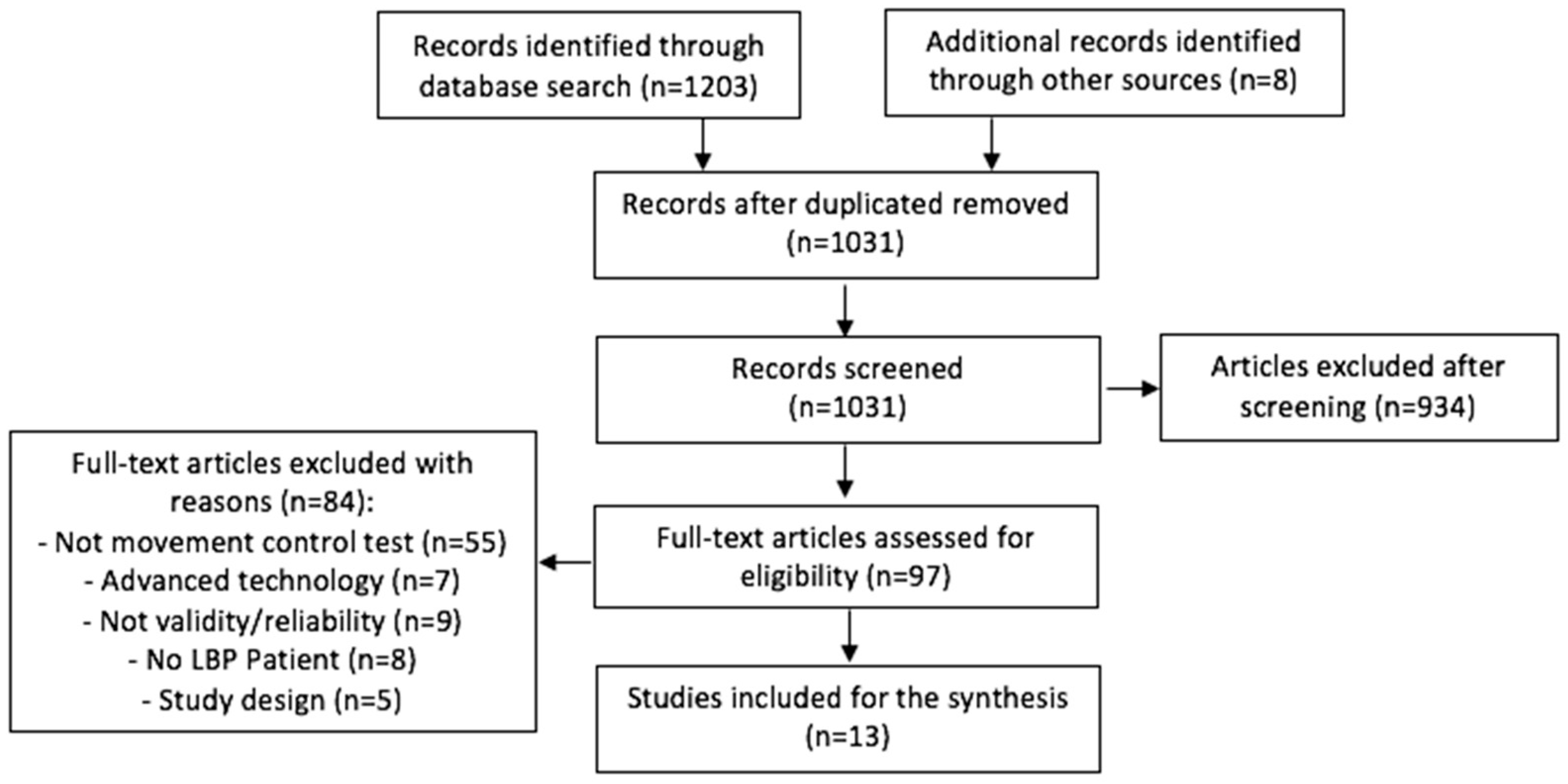
The studies obtained were initially reported in a comprehensive database, and double reports were excluded. Only one reviewer performed the first screening following the reading of the title and abstracts. Relevance was then assessed by reading the full text: any doubts were resolved with the intervention of a second reviewer. The inclusion process is summarized graphically in a flowchart in the results section (Figure 1). Hand searching has been conducted checking bibliographies of included articles.
Figure 1.
Study selection process.
2.2.2. Data Extraction and Synthesis
The relevant data were organized in a synoptic tables (Table A1, Table A2, Table A3 and Table A4) which shows author and year of publication, objectives of the study, the characteristics of the participants (number, sex, age, and condition), the characteristics of the examiners, the diagnostic test/examination and the procedure followed, the statistical values, and the main results. No meta-analysis of the collected data was performed, but a narrative synthesis in accordance with the emerging evidence was performed.
2.2.3. Risk of Bias Assessment
The quality of each study was assessed for methodological rigor and risk of bias by one reviewer using the tool described by Brink and Louw [27] (Table A5) and developed for the analysis of validity and reliability studies. Doubtful opinions have been resolved with the help of a second reviewer. This appraisal tool does not incorporate a quality score, but instead, the impact of each item on the study design should be considered individually. This tool contains 13 items, which should be considered according to the nature of the study: 4 are useful only for the evaluation of reliability studies, 4 are useful only for validity studies, and 9 are useful for both. The results were summarized in a synoptic table (Table A1), and a critical discussion of the strengths and weaknesses of the studies included was drafted.
3. Results
The database research identified 1203 articles, while 8 others have been identified with free research in the bibliographies of relevant studies for a total of 1211 articles; 180 articles were deleted because they were duplicated, resulting in 1031 basic articles as a partial result. Following the reading of the title, 386 articles were discarded; following the reading of abstract, 548 remained. Following the reading of the full text, 13 studies were included in the review and 84 studies were excluded as not relevant. The steps related to the selection of articles are outlined in the flow-diagram below (Figure 1). Of the 13 studies included, 10 investigated inter-rater reliability [28,29,30,31,32,33,34,35,36,37], 4 investigated intra-rater reliability [31,32,33,38], and only 6 studies analyzed validity [28,29,31,32,39,40]. Overall, the tests showed reliability ranging from fair to excellent (K value between 0.32 and 1.00) for the inter-rater and from moderate to excellent for the intra-rater (K value from 0.42 to 1.00). The ICC also varied from 0.41 to 0.98, indicating a range from poor to very good (Table A1). A meta-analysis of collected data was not conducted due to the small number of studies that have investigated the same test. In addition to this, the highly heterogeneous nature of the descriptions and the small samples make the calculation superfluous.
3.1. Inter-Rater Reliability
The results for inter-observer reliability are shown in Table A2.
Seventeen tests were investigated by a single author [28,30,31,32,33,36,37]. In the remaining 6 evaluated by multiple studies, only 4 (waiter’s bow, one leg stance, sitting knee extension, and prone hip extension) showed agreement between reliability values [29,33,34,36], while for the other 2 (bent knee fall out and active straight leg raising), this did not happen [29,30,33,35,36,37].
3.1.1. Tests Described by More Than One Study that Did Not Give Consistent Results
Bent knee fall out was studied by 3 authors out of 132 patients. It was identified as having modest reliability by Luomajoki et al. [33] (K = 0.38) and as poor-excellent by Roussel et al. [36] (ICC = 0.61–0.91) and Enoch et al. [30] (ICC = 0.94). Active straight leg raising has been described in 3 studies on 158 total subjects. Roussel et al. [35] and Bruno et al. [29] showed good reliability (K from 0.70 left leg to 0.71 right leg for the first study and 0.79 for the second). Also, Roussel et al. in the study of 2009 [36] provide more variable values, with an ICC from poor to excellent (ICC = 0.41–0.91).
Bent knee fall out was studied by 3 authors out of 132 patients. It was identified as having modest reliability by Luomajoki et al. [33] (K = 0.38) and as poor-excellent by Roussel et al. [36] (ICC = 0.61–0.91) and Enoch et al. [30] (ICC = 0.94). Active straight leg raising has been described in 3 studies on 158 total subjects. Roussel et al. [35] and Bruno et al. [29] showed good reliability (K from 0.70 left leg to 0.71 right leg for the first study and 0.79 for the second). Also, Roussel et al. in the study of 2009 [36] provide more variable values, with an ICC from poor to excellent (ICC = 0.41–0.91).
3.1.2. Tests Described by More Than One Study that Showed Agreement between the Results
Substantial reproducibility was found for both waiter’s bow (investigated in 2 studies [33,36], 92 subjects, K = 0.62 and 0.78) and prone hip extension (investigated in 2 studies [29,34], with 112 total subjects, K = 0.72–0.76). The Sitting knee extension was analyzed in 2 studies for a total of 80 subjects. It provided a good K in the study by Luomajoki et al. [33] (K = 0.72) and was excellent in the study by Enoch et al. [30] (ICC = 0.95). The one leg stance was described in 3 studies for a total of 95 participants. Only Luomajoki et al. [33] identified a moderate-good reliability (K = 0.43–0.65), while both Roussel et al. [35] and Tidstrand and Horneij [37] obtained good-excellent values (K from 0.75 to 1.00).
3.1.3. Tests Described by a Single Study
Excellent reliability has been identified for joint position sense [30], sitting forward lean [30], and leg lowering [30]. Substantial reliability was identified for pelvic tilt [33], rocking pelvis forwards [33], standing back extension test [31], static lunge test [32], and dynamic lunge test [32]. Moderate reliability was identified for knee lift abdominal test [36], rocking pelvis backwards [33], prone active knee flexion [33], and standing knee-lift test [32]. The unilateral pelvic lift showed moderate reliability for the left side (K = 0.47) and substantial for the right side (K = 0.61) [37]. The sitting-on-a-ball test, on the other hand, was substantial for the right (K = 0.79) but excellent for the left (K = 0.88) [37]. The trunk forward bending and return to upright test, described by Biely et al. [28], showed K values from 0.35 to 0.89, depending on the criterion used to define the positivity of the test. Also, static lunge test [32], dynamic lunge test [32], and standing knee-lift test [32] showed different reliability values depending on each component observed during the execution of the test.
3.2. Intra-Rater Reliability
A total of 13 tests were investigated for intra-examiner reliability (Table A3), all by a single author. Waiter’s bow, pelvic tilt, one leg stance, sitting knee extension, rocking backwards, rocking forwards, prone active knee flexion, and crook lying hip abduction were investigated by Luomajoki et al. [33] on 40 subjects; the standing back extension test was investigated by Gondhalekar et al. [31] on 50 subjects; and the knee-lift abdominal test was investigated by Ohe et al. [38] on 60 subjects. The K value is between 0.51 and 0.95, indicating moderate to excellent reliability; it is the same for the good ICC value for Knee lift abdominal test (KLAT) (0.71–0.79). Standing knee-lift test, static lunge test, and dynamic lunge test were studied by Granström et al. [32] and showed good to poor reliability (ICC from 0.54 to 0.87). In the same study, the intra-examiner reliability of different aberrant movements analyzed during the execution of the above 3 tests was also investigated, and in this case, an extreme variability in the results also emerged (K from 0.42 to 1.00).
3.3. Validity
A total of 10 tests (including batteries) have been reported with indicating their validity, represented in Table A4 and all investigated by a single author. The battery of Luomajoki et al. [39], the knee-lift abdominal test, the bent knee fall out, the prone hip extension, and the active straight leg raise showed significant relationships between test positivity and the presence of LBP compared to healthy subjects (all p < 0.05). The use of Judder/shake/instability catch (JUD), deviation from sagittal plane (DEV)and aberrant movement score (AMS) as positive criteria in anterior trunk flexion movement and return to upright position also showed significant correlations with the presence of LBP. On the contrary, for the standing back extension test, standing knee-lift test, static lunge test, and dynamic Lunge, test there were not enough high values of diagnostic power (AUC from 0.47 to 0.78).
3.4. Risk of Bias in Included Studies
All studies included reported a complete description of the selected sample (Table 2). In several [29,34,37,38], however, there was no method for calculating the sample size, so we do not know with certainty the statistical power of the results obtained. The presence of an adequate method for calculating the sample size was not described as a parameter to be evaluated in criterion 1, and for this reason, it was considered satisfied in all the studies. Three studies [36,38,40] did not clarify the characteristics of the evaluators. The main source of risk of bias in 8 out of 11 studies dealing with reproducibility was the simultaneous evaluation by the observers [34,37]. Three studies did not clarify or carry out the randomization of the order of the patients evaluated [33,36,39]. Four did not randomized the order of the tests administered [30,33,37,39], and one did not clarify it [36]. In addition, in 2 studies, the blindness of the evaluators to the results between them was not clearly explained [36,37]. In studies dealing with intra-operator reproducibility, the concealment of patients or an adequate time gap between the two observations was adopted, except for 1 study [38], where the assessments were re-performed in a matter of minutes. In the studies that dealt with validity, they were not met or it was not possible to judge the criteria (3,7,9,11) because there is no shared reference in the literature. Analyses of diagnostic accuracy were developed with respect to the presence of LBP or not. Only 1 study [31] gave a description of the reference standard used, but in our opinion, the choice was not appropriate. The choice of statistical methods was considered appropriate for all studies; only 1 study [34] introduced a possible distortion of the effect of the results because it presented data of a nonparametric nature by inserting the standard deviation.
Table 2.
Risk of bias summary.
4. Discussion
This review is the first to include and summarize results from reliability (inter- and intra-rater) and validity studies of tests designed to detect MCI in subjects with NSLBP.
In 2013, Carlsson and Rasmussen-Barr [23] studied the reliability of tests to diagnose MCI and found it difficult to identify consistent results because they were investigated by studies with a high risk of bias. At the time (with a research updated to October 2011) only prone knee bend and the one leg stance were indicated by the author as useful because they were presented in one study with a low risk of bias. Recently, Denteneer et al. [24] identified a greater number of tests (specifically 30) but the limit of his research were the inclusion criteria. Studies included populations classified with functional lumbar instability or MCI or with the association of both. This leads to sampling limits with difficult interpretation and comparison of results.
In the present research, 15 tests have shown good inter-examiner reliability in at least one study, but only waiter’s bow, one leg stance, sitting knee extension, and prone hip extension had almost overlapping values in at least 2 studies.
As is well known, inter-rater reliability is just a component of the reliability of a test and take greater importance when its context of use is characterized by the alternation of operators. NSLBP rehabilitation process is in most cases managed by a single therapist; nevertheless, the number of studies that have dealt with intra-rater reliability is far less than those of the inter-rater reliability.
From the few data available, there seems to be a good degree of agreement in the case of repeated measurements by the same therapist for almost all tests. The summary of results about intra- and inter-rater reliability shows that observing abnormal movement strategies in patients with NSLBP seems to be possible through simple tests; anyway, positivity criteria and execution modalities need to be standardized with precise protocols, as suggested by Enoch et al. [30].
The clinical use of the tests has to be based on consistent evidence both for the intra/inter-rater reliability, and these conclusions must derive from at least 2 studies of good quality.
Compared to knowledge set by Carlsson and Rasmussen-Barr [23], we can still recommend the use of the one leg stance, but we add also waiter’s bow and sitting knee extension for the low risk of bias of the studies. These 3 tests are the only ones to have been studied both for inter-rater and intra-rater reliability. The use of prone knee bend suggested by Carlsson and Rasmussen-Barr [23] is less corroborated because, to date, it remains investigated only by one author and values of inter-rater reliability are moderate. Prone hip extension cannot be recommended due to high risk of bias in one of the two studies in which it is investigated. Moreover, there are no studies available about intra-rater reliability for prone hip extension.
Since 2011, the literature did not add much to previous knowledge, because of both the number of studies published and the quality of them.
As well as for the intra-rater reliability, the studies that have dealt with the validity are few in number. There is not a single test that has been evaluated by more than one author. The studies included in this review show that most tests are able to distinguish only subjects with LBP from healthy subjects (knee-lift abdominal test, bent knee fall out, and trunk forward bending and return to upright) [28,40]. This means that they do not provide any additional information to that which may result from a well-conducted medical history. It must be said that, in general, there is a higher sensitivity of the tests [39] towards subjects with chronic LBP, suggesting an association between the duration of symptoms and MCI, which would require observational studies to be demonstrated. At the same time, more patients with a history of LBP than healthy subjects [28] were positive, indicating the possibility that MCI may persist over time despite the resolution of symptoms. Again, only the design of ad hoc cohort studies could demonstrate the relationship between MCI and recurrence due to possible overloading of the tissues of the lower spine.
The validity data also shows the small number of researches that dealt with the diagnostic procedures aimed at identifying directional patterns of MCI [31]. The most important barrier to the development of validity research is the absence of a golden standard to compare the same outcome with different methods of investigation. Considering that tests for MCI evaluate the performance of certain motor tasks, the use and validation of motion capture tools seems to be the most appropriate strategy to make the evaluation as objective as possible. To date, only Wattananon et al. [41] has tried to establish reference values for the interpretation of clinical trials through comparison between the observation of examiners and the digital data collected.
Summarizing, only waiter’s bow, sitting knee extension, and one leg stance are assessed across studies of good quality with good-excellent values both for intra-rater and inter-rater reliability; therefore, their use in clinical practice may be considered. However, the main problem remains the lack of clarity about the validity, which today, does not allow conclusions on the accuracy of the subgrouping procedure.
5. Conclusions
Implications for clinical practice:
- Inter-rater reliability is widely studied. Waiter’s bow, prone hip extension, sitting knee extension, and one leg stance showed good values confirmed by at least two studies;
- Intra-rater reliability is not largely investigated. From the few studies available, good repeatability values seem to emerge;
- Only waiter’s bow, sitting knee extension, and one leg stance are assessed across studies of good quality with good-excellent values both for intra-rater and inter-rater reliability;
- There is a lack of evidence regarding the validity of MCI tests, which results from diagnostic accuracy analyses aimed at discriminating only the presence or absence of LBP in the study samples;
- Final conclusions regarding the clinical and scientific use of the identified tests can be drawn only when consistent values of reliability and validity can be found in the literature.
Review limitations:
- Processes of identification, selection, evaluation, and data collection were carried out by a single author, contrary to the indications contained in the PRISMA statement. Intervention of a second author was required only in case of doubt;
- Inclusion of studies published only in Italian and English;
- Absence of protocol registration procedure.
Review strengths:
- Inclusion of grey literature.
Implications for research and future research:
- Investigate further intra-rater reliability of MCI tests in patients with NSLBP;
- Indicate subgroups of patients with NSLBP having salient characteristics related to MCI and deductibles in history. Develop an analysis of diagnostic accuracy of tests for motor control as a function of them;
- Identify a gold standard to evaluate the diagnostic accuracy of individual tests;
- Standardize protocols for the preparation, execution, and evaluation of the tests in order to allow a comparison between them and the generalization of the results.
Author Contributions
Conceptualization, A.P. and S.S.; methodology, A.P.; investigation S.S.; writing—original draft preparation, S.S.; writing—review and editing, A.P. and M.T.; supervision, M.T.
Funding
This research received no external funding.
Acknowledgments
The papers were obtained through the NILDE library network system through the University of Genoa.
Conflicts of Interest
The authors declare that there are no conflicts of interest.
Appendix A
Table A1.
Characteristics of included studies.
Table A2.
Inter-rater reliability of clinical tests.
Table A3.
Intra-rater Reliability of clinical tests.
Table A4.
Validity of clinical tests.
Table A5.
Critical appraisal tool for validity and reliability studies of objective clinical tools as described by Brink and Louw [27].
References
- Airaksinen, O.; Brox, J.I.; Cedraschi, C.; Hildebrandt, J.; Klaber-Moffett, J.; Kovacs, F.; Zanoli, G. Chapter 4 European guidelines for the management of chronic nonspecific low back pain on behalf of the COST B13 Working Group on Guidelines for Chronic Low Back Pain. Eur. Spine. J. 2006, 15, 192–300. [Google Scholar] [CrossRef] [Scilit] [PubMed]
- Dagenais, S.; Caro, J.; Haldeman, S. A systematic review of low back pain cost of illness studies in the United States and internationally. Spine J. 2008, 8, 8–20. [Google Scholar] [CrossRef] [Scilit] [PubMed]
- Katz, R.T. Impairment and disability rating in low back pain. Phy. Med. Rehabil. Clin. N. Am. 2001, 12, 681–694. [Google Scholar] [CrossRef] [Scilit]
- Dionne, C.E.; Dunn, K.M.; Croft, P.R.; Nachemson, A.L.; Buchbinder, R.; Walker, B.F.; Von Korff, M. A Consensus Approach Toward the Standardization of Back Pain Definitions for Use in Prevalence Studies. Spine 2008, 33, 95–103. [Google Scholar] [CrossRef] [Scilit] [PubMed]
- Waddell, G. The Back Pain Revolution; Churchill Livingstone: London, UK, 2004. [Google Scholar]
- van Tulder, M.; Becker, A.; Bekkering, T.; Breen, A.; Gil del Real, M.T.; Hutchinson, A.; COST B13 Working Group on Guidelines for the Management of Acute Low Back Pain in Primary Care. Chapter 3 European guidelines for the management of acute nonspecific low back pain in primary care. Eur. Spine J. 2006, 15, s169–s191. [Google Scholar] [CrossRef] [Scilit] [PubMed]
- Shiri, R.; Karppinen, J.; Leino-Arjas, P.; Solovieva, S.; Viikari-Juntura, E. The association between smoking and low back pain: A meta-analysis. Am. J. Med. 2010, 123, 87.e7–87.e35. [Google Scholar] [CrossRef] [Scilit] [PubMed]
- Smeets, R.J.E.M.; Wittink, H.; Hidding, A.; Knottnerus, J.A. Do patients with chronic low back pain have a lower level of aerobic fitness than healthy controls? Are pain, disability, fear of injury, working status, or level of leisure time activity associated with the difference in aerobic fitness level? Spine 2006, 31, 90–97, discussion 98. [Google Scholar] [CrossRef] [Scilit] [PubMed]
- Nachemson, A.L. Work related low back pain treatment outcomes: The experience in Gothenburg, Sweden. Bulletin 1996, 55, 203. [Google Scholar]
- Actis, J.A.; Honegger, J.D.; Gates, D.H.; Petrella, A.J.; Nolasco, L.A.; Silverman, A.K. Validation of lumbar spine loading from a musculoskeletal model including the lower limbs and lumbar spine. J. Biomech. 2008, 68, 107–114. [Google Scholar] [CrossRef] [Scilit]
- Hestbaek, L.; Leboeuf-Yde, C.; Manniche, C. Low back pain: What is the long-term course? A review of studies of general patient populations. Eur. Spine J. Off. Publ. Eur. Spine Soc. Eur. Spin Deform. Soc. Eur. Sect. Cerv. Spine Res. Soc. 2003, 12, 149–165. [Google Scholar] [CrossRef] [Scilit]
- Pengel, L.H.M.; Herbert, R.D.; Maher, C.G.; Refshauge, K.M. Acute low back pain: Systematic review of its prognosis. BMJ (Clin. Res. Ed.) 2003, 327, 323. [Google Scholar] [CrossRef] [Scilit] [PubMed]
- Costa, L.C.M.; Maher, C.G.; Hancock, M.J.; McAuley, J.H.; Herbert, R.D.; Costa, L.O.P. The prognosis of acute and persistent low-back pain: A meta-analysis. CMAJ Can. Med. Assoc. J. (J. de l’Assoc. Med. Can.) 2002, 184, E613–E624. [Google Scholar] [CrossRef] [Scilit] [PubMed]
- Wieser, S.; Horisberger, B.; Schmidhauser, S.; Eisenring, C.; Brügger, U.; Ruckstuhl, A.; Müller, U. Cost of low back pain in Switzerland in 2005. Eur. J. Health Econ. HEPAC Health Econ. Prev. Care 2001, 12, 455–467. [Google Scholar] [CrossRef] [Scilit] [PubMed]
- Hancock, M.J.; Maher, C.G.; Latimer, J.; Spindler, M.F.; McAuley, J.H.; Laslett, M.; Bogduk, N. Systematic review of tests to identify the disc, SIJ or facet joint as the source of low back pain. Eur. Spine J 2003, 16, 1539–1550. [Google Scholar] [CrossRef] [Scilit] [PubMed]
- Niemisto, L.; Rissanen, P.; Sarna, S.; Lahtinen-Suopanki, T.; Lindgren, K.-A.; Hurri, H. Cost-effectiveness of combined manipulation, stabilizing exercises, and physician consultation compared to physician consultation alone for chronic low back pain: A prospective randomized trial with 2-year follow-up. Spine 2005, 30, 1109–1115. [Google Scholar] [CrossRef] [Scilit] [PubMed]
- Panjabi, M.M. Clinical spinal instability and low back pain. J. Electromyogr. Kinesiol. 2003, 13, 371–379. [Google Scholar] [CrossRef] [Scilit]
- Fritz, J.M.; Cleland, J.A.; Childs, J.D. Subgrouping patients with low back pain: Evolution of a classification approach to physical therapy. J. Orthop. Sports Phy. Ther. 2007, 37, 290–302. [Google Scholar] [CrossRef] [Scilit]
- O’Sullivan, P. Diagnosis and classification of chronic low back pain disorders: Maladaptive movement and motor control impairments as underlying mechanism. Man. Ther. 2007, 10, 242–255. [Google Scholar] [CrossRef] [Scilit]
- Luomajoki, H. Movement Control Impairment as a Sub-Group of Non-Specific Low Back Pain. Evaluation of Movement Control Test Battery as a Practical Tool in the Diagnosis of Movement Control Impairment and Treatment of This Dysfunction. Ph.D. Thesis, University of Eastern Finland, Kuopio, Finland, 2010. [Google Scholar]
- O’sullivan, P.B. Masterclass: Lumbar segmental ‘instability’: Clinical presentation and specific stabilizing exercise management. Man. Ther. 2000, 5, 1–12. [Google Scholar] [CrossRef] [Scilit]
- Molina, K.M.; Molina, K.M.; Goltz, H.H.; Kowalkouski, M.A.; Hart, S.L.; Latini, D.; Gidron, Y. Reliability and Validity. In Encyclopedia of Behavioral Medicine; Springer: New York, NY, USA, 2003; pp. 1643–1644. [Google Scholar] [CrossRef] [Scilit]
- Carlsson, H.; Rasmussen-Barr, E. Clinical screening tests for assessing movement control in non-specific low-back pain. A systematic review of intra- and inter-observer reliability studies. Man. Ther. 2013, 18, 103–110. [Google Scholar] [CrossRef] [Scilit] [PubMed]
- Denteneer, L.; Stassijns, G.; De Hertogh, W.; Truijen, S.; Van Daele, U. Inter- and Intrarater Reliability of Clinical Tests Associated with Functional Lumbar Segmental Instability and Motor Control Impairment in Patients with Low Back Pain: A Systematic Review. Arch. Phy. Med. Rehabil. 2017, 98, 151–164.e6. [Google Scholar] [CrossRef] [Scilit] [PubMed]
- Moher, D.; Liberati, A.; Tetzlaff, J.; Altman, D.G.; Group, T.P. Linee guida per il reporting di revisioni sistematiche e meta-analisi: Il PRISMA Statement. Evidence 2015, 7, e1000114. [Google Scholar]
- Mokkink, L.B.; Terwee, C.B.; Patrick, D.L.; Alonso, J.; Stratford, P.W.; Stratford, P.W.; Knol, D.L.; Bouter, L.M.; de Vet, H.C. The COSMIN checklist for assessing the methodological quality of studies on measurement properties of health status measurement instruments: An international Delphi study. Qual. Life Res. 2010, 19, 539–549. [Google Scholar] [CrossRef] [Scilit] [PubMed]
- Brink, Y.; Louw, Q.A. Clinical instruments: Reliability and validity critical appraisal. J. Eval. Clin. Pract. 2012, 18, 1126–1132. [Google Scholar] [CrossRef] [Scilit] [PubMed]
- Biely, S.A.; Silfies, S.P.; Smith, S.S.; Hicks, G.E. Clinical Observation of Standing Trunk Movements: What Do the Aberrant Movement Patterns Tell Us? J. Orthop. Sports Phy. Ther. 2014, 44, 262–272. [Google Scholar] [CrossRef] [Scilit] [PubMed]
- Bruno, P.A.; Goertzen, D.A.; Millar, D.P. Patient-reported perception of difficulty as a clinical indicator of dysfunctional neuromuscular control during the prone hip extension test and active straight leg raise test. Man. Ther. 2014, 19, 602–607. [Google Scholar] [CrossRef] [Scilit] [PubMed]
- Enoch, F.; Kjaer, P.; Elkjaer, A.; Remvig, L.; Juul-Kristensen, B. Inter-examiner reproducibility of tests for lumbar motor control. BMC Musculoskelet. Disord. 2011, 12, 114. [Google Scholar] [CrossRef] [Scilit] [PubMed]
- Gondhalekar, G.A.; Kumar, S.P.; Eapen, C.; Mahale, A. Reliability and Validity of Standing Back Extension Test for Detecting Motor Control Impairment in Subjects with Low Back Pain. J. Clin. Diagn. Res. 2016, 10, KC07-11. [Google Scholar] [CrossRef] [Scilit] [PubMed]
- Granström, H.; Äng, B.O.; Rasmussen-Barr, E. Movement control tests for the lumbopelvic complex. Are these tests reliable and valid? Physiother. Theory Pract. 2017, 33, 386–397. [Google Scholar] [CrossRef] [Scilit]
- Luomajoki, H.; Kool, J.; Kool, J.; de Bruin, E.D.; Airaksinen, O. Reliability of movement control tests in the lumbar spine. BMC Musculoskelet. Disord. 2007, 8, 90. [Google Scholar] [CrossRef] [Scilit]
- Murphy, D.R.; Byfield, D.; McCarthy, P.; Humphreys, K.; Gregory, A.A.; Rochon, R. Interexaminer Reliability of the Hip Extension Test for Suspected Impaired Motor Control of the Lumbar Spine. J. Manip. Physiol. Ther. 2006, 29, 374–377. [Google Scholar] [CrossRef] [Scilit] [PubMed]
- Roussel, N.A.; Nijs, J.; Truijen, S.; Smeuninx, L.; Stassijns, G. Low Back Pain: Clinimetric Properties of the Trendelenburg Test, Active Straight Leg Raise Test, and Breathing Pattern During Active Straight Leg Raising. J. Manip. Physiol. Ther. 2007, 30, 270–278. [Google Scholar] [CrossRef] [Scilit] [PubMed]
- Roussel, N.A.; Nijs, J.; Mottram, S.; Van Moorsel, A.; Truijen, S.; Stassijns, G. Altered lumbopelvic movement control but not generalized joint hypermobility is associated with increased injury in dancers. A prospective study. Man. Ther. 2009, 14, 630–635. [Google Scholar] [CrossRef] [Scilit] [PubMed]
- Tidstrand, J.; Horneij, E. Inter-rater reliability of three standardized functional tests in patients with low back pain. BMC Musculoskelet. Disord. 2009, 10, 58. [Google Scholar] [CrossRef] [Scilit] [PubMed]
- Ohe, A.; Kimura, T.; Goh, A.-C.; Oba, A.; Takahashi, J.; Mogami, Y. Characteristics of trunk control during crook-lying unilateral leg raising in different types of chronic low back pain patients. Spine 2015, 40, 550–559. [Google Scholar] [CrossRef] [Scilit] [PubMed]
- Luomajoki, H.; Kool, J.; de Bruin, E.D.; Airaksinen, O. Movement control tests of the low back; evaluation of the difference between patients with low back pain and healthy controls. BMC Musculoskelet. Disord. 2008, 9, 170. [Google Scholar] [CrossRef] [Scilit] [PubMed]
- Roussel, N.; De Kooning, M.; Schutt, A.; Mottram, S.; Truijen, S.; Nijs, J.; Daenen, L. Motor Control and Low Back Pain in Dancers. Int. J. Sports Med. 2012, 34, 138–143. [Google Scholar] [CrossRef] [Scilit] [PubMed]
- Wattananon, P.; Ebaugh, D.; Biely, S.A.; Smith, S.S.; Hicks, G.E.; Silfies, S.P. Kinematic characterization of clinically observed aberrant movement patterns in patients with non-specific low back pain: A cross-sectional study. BMC Musculoskelet. Disord. 2017, 18, 455. [Google Scholar] [CrossRef] [Scilit]


© 2019 by the authors. Licensee MDPI, Basel, Switzerland. This article is an open access article distributed under the terms and conditions of the Creative Commons Attribution (CC BY) license (http://creativecommons.org/licenses/by/4.0/).