Article

E/E Architecture Synthesis: Challenges and Technologies
by
Hadi Askaripoor
1,*,
Morteza Hashemi Farzaneh
2 and
Alois Knoll
1
1
Chair of Robotics, Artificial Intelligence and Real-Time Systems, Technical University of Munich, Botlzmannstrasse 3, 85768 Garching bei Muenchen, Germany
2
RealtimeIT MHF GmbH, Landwehrstr. 61, 80336 Muenchen, Germany
*
Author to whom correspondence should be addressed.
Electronics 2022, 11(4), 518; https://doi.org/10.3390/electronics11040518

Submission received: 29 December 2021 / Revised: 24 January 2022 / Accepted: 2 February 2022 / Published: 10 February 2022
(This article belongs to the Topic Intelligent Transportation Systems)

Abstract

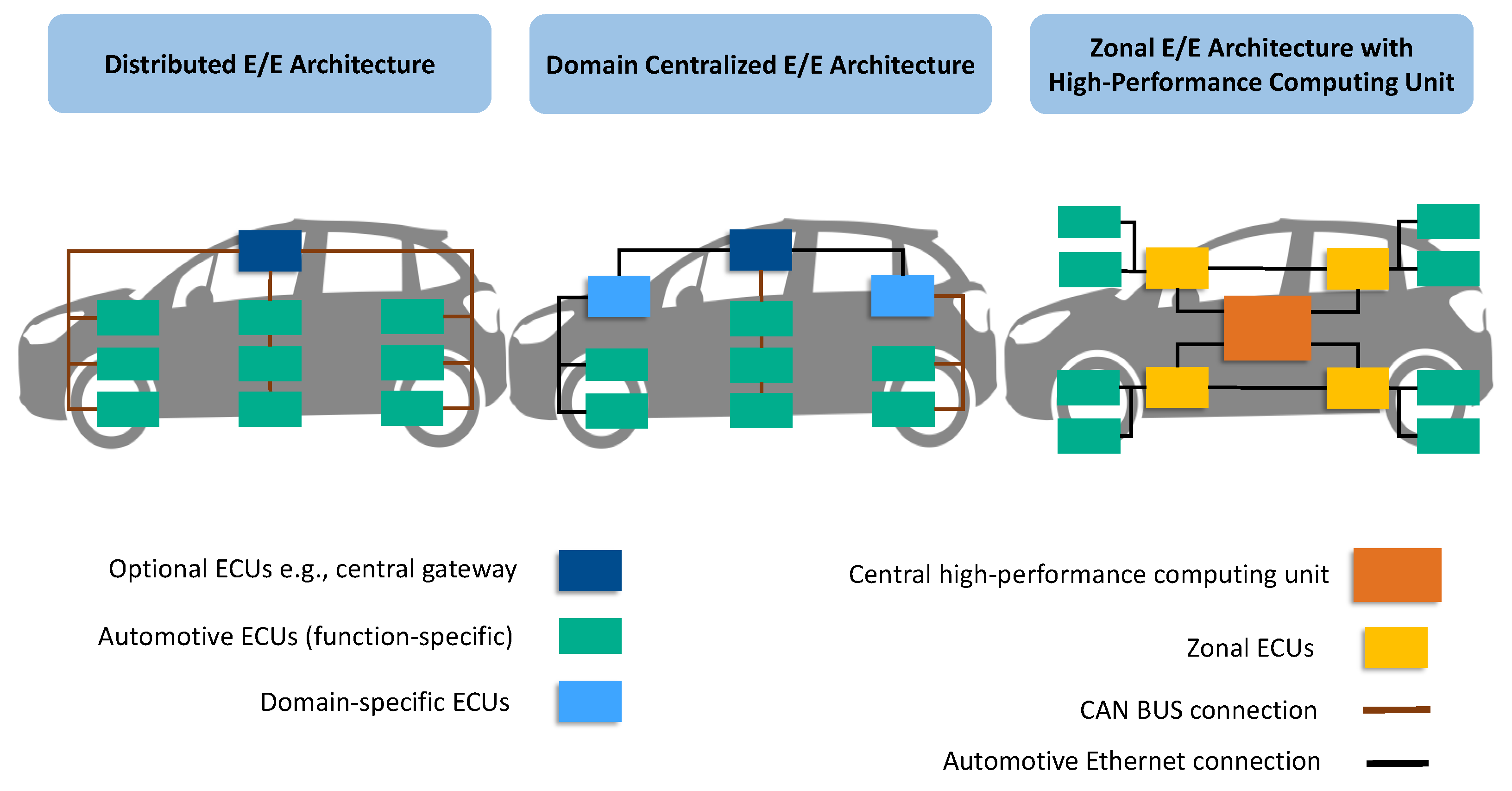
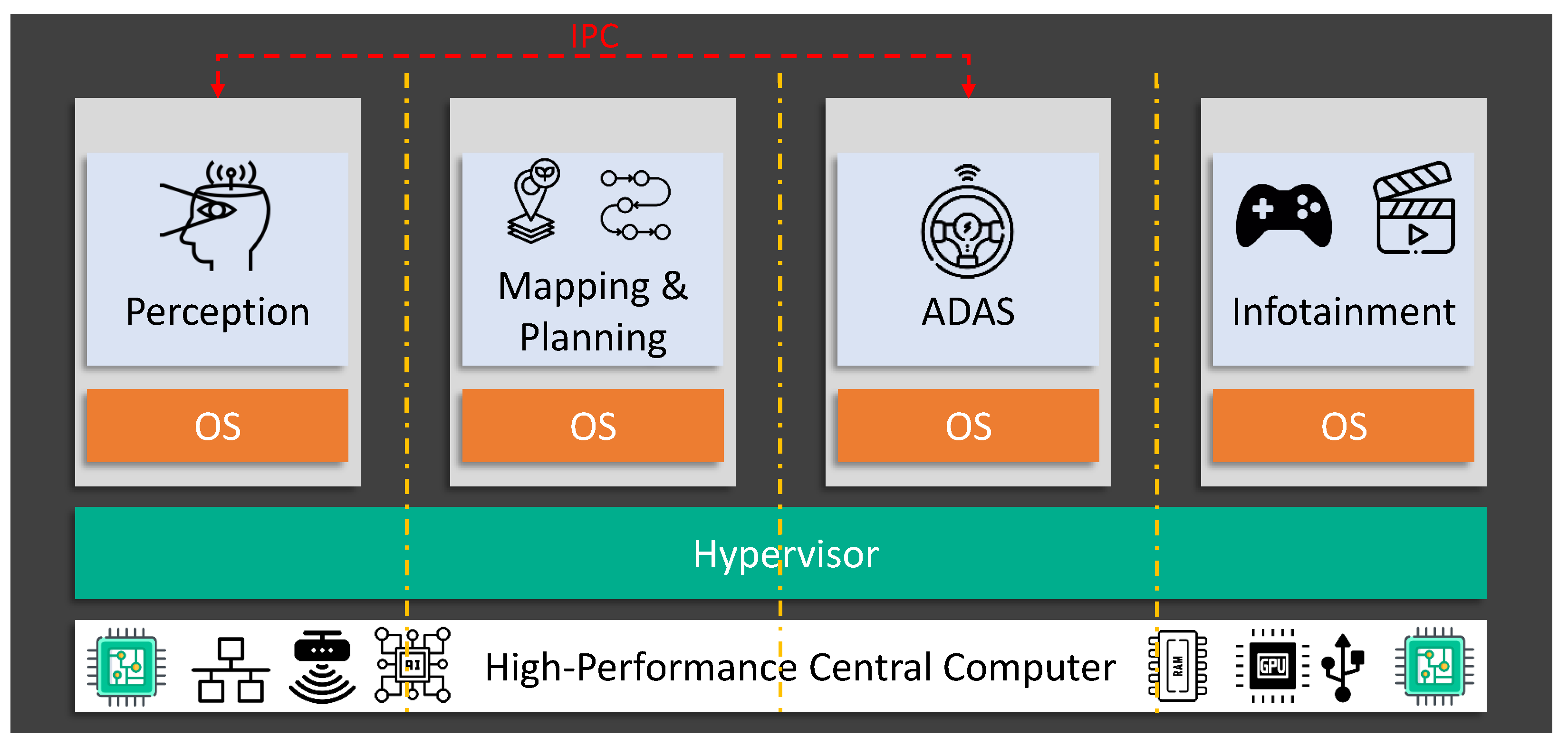
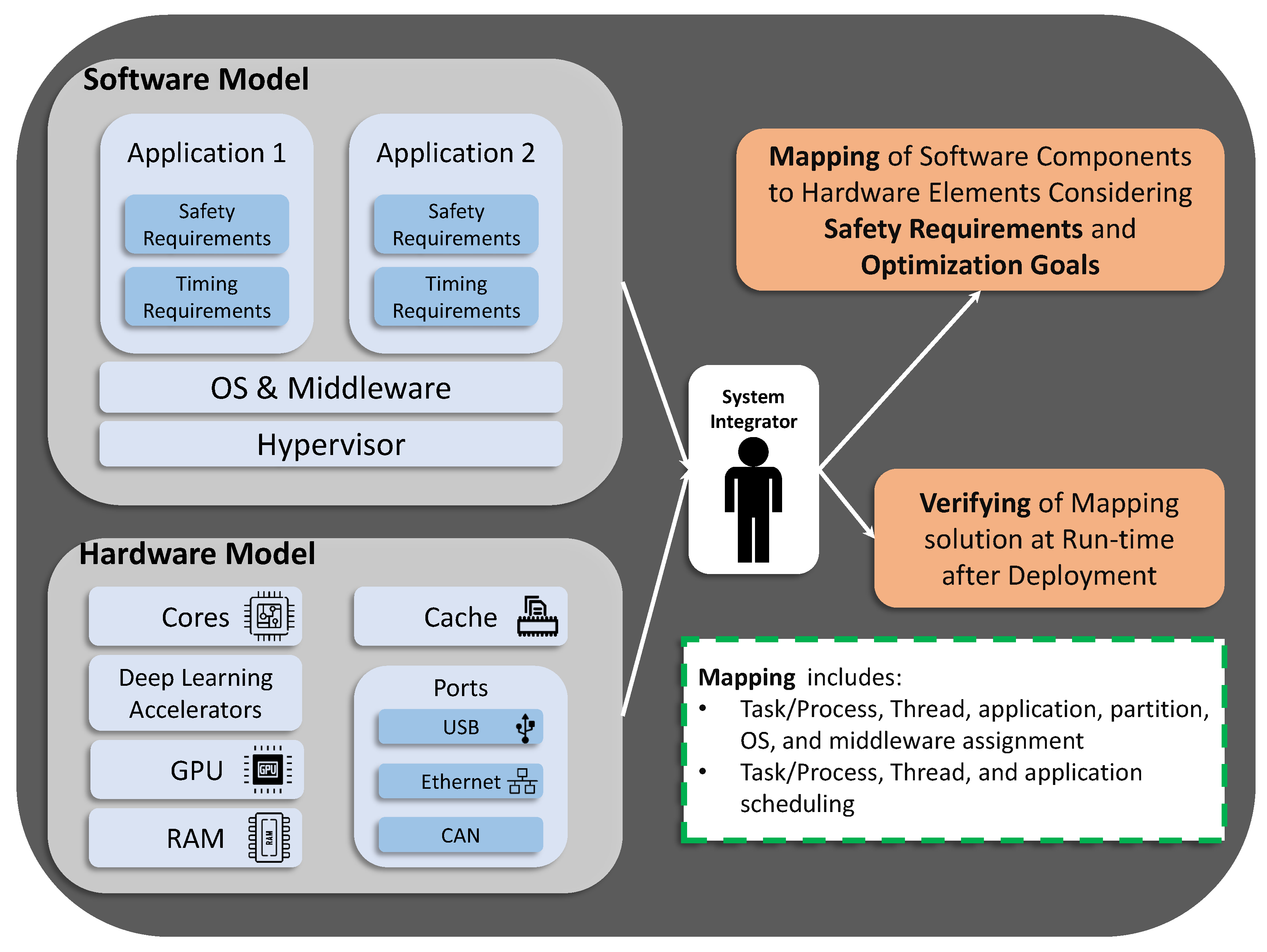
In recent years, the electrical and/or electronic architecture of vehicles has been significantly evolving. The new generation of cars demands a considerable amount of computational power due to a large number of safety-critical applications and driver-assisted functionalities. Consequently, a high-performance computing unit is required to provide the demanded power and process these applications while, in this case, vehicle architecture moves toward a centralized architecture. Simultaneously, appropriate software architecture has to be defined to fulfill the needs of the main computing unit and functional safety requirements. However, the process of configuring and integrating critical applications into a vehicle central computer while meeting safety requirements and optimization objectives is a time-consuming, complicated, and error-prone process. In this paper, we firstly present the evolution of the vehicle architecture, past, present, and future, and its current bottlenecks and future key technologies. Then, challenges of software configuration and mapping for automotive systems are discussed. Accordingly, mapping techniques and optimization objectives for mapping tasks to multi-core processors using design space exploration method are studied. Moreover, the current technologies and frameworks regarding the vehicle architecture synthesis, model analysis with regard to software integration and configuration, and solving the mapping problem for automotive embedded systems are expressed. Finally, we propose four research questions as future works for this field of study.
Keywords: E/E architecture; automotive software configuration; task mapping; multi-core processors; functional safety; architecture synthesis; design space exploration; optimization E/E architecture; automotive software configuration; task mapping; multi-core processors; functional safety; architecture synthesis; design space exploration; optimization