


Abstract
Fine-grained sleep posture recognition distinguishes postures with different head and limb configurations within the same coarse body orientation. In contactless millimeter-wave (mmWave) radar sensing, weak or partially occluded limb reflections make local posture differences difficult to observe. Differences in body size and shape further complicate generalization to unseen subjects. We propose FineSleep-Net for 12-class fine-grained sleep posture recognition using complementary spatial and micro-motion radar maps. Map-specific multi-scale feature extraction learns local posture patterns together with the broader context, while input-dependent channel gating reweights the concatenated radar-map features for classification. A lightweight branch encodes the age, height, and weight to provide subject-related context for posture classification. Experiments on 32 participants performing 12 predefined static sleep postures showed that FineSleep-Net achieved a 74.8% accuracy under leave-one-subject-out evaluation, exceeding the strongest task-adapted baseline by 10.9 percentage points.
1. Introduction
Sleep posture is an important in-bed behavior for sleep assessments and health monitoring [1]. Coarse body orientations, such as supine, prone, and lateral postures, describe the overall orientation of the torso, but do not fully describe the head orientation or limb arrangement. For example, two supine postures may differ in arm placement, whereas two lateral postures may differ in leg flexion and forearm position. Recognizing posture differences within each coarse body orientation can provide a more detailed description of in-bed behavior than coarse orientation recognition. In this work, we studied 12-class fine-grained sleep posture recognition using millimeter-wave (mmWave) radar. The task comprised three predefined postures within each of four coarse orientations (supine, prone, left lateral, and right lateral) and was evaluated under subject-independent protocols.
Sleep posture sensing has been explored using wearable devices, pressure sensors, imaging, and wireless signals, each providing different observations of body configuration [2,3,4,5,6]. mmWave radar provides contactless measurements of body structure and micro-motion without acquiring optical images [7,8]. Radar-based systems have progressed from estimating body orientation to recognizing posture categories and describing joint-level body configuration. BodyCompass estimates trunk orientation from RF reflections and studies adaptation to new users in home monitoring [9]. PosMonitor combines radar point clouds with respiratory features for six-posture recognition [7], while Argosleep and MiSleep relate sleep posture sensing to joint-level estimation and resting-state or toss–turn processing [10,11]. Other studies extend radar sleep sensing to under-blanket posture and transition monitoring or dual-person recognition [12,13]. Despite these advances, reliably distinguishing similar postures within the same coarse body orientation across unseen subjects remains challenging.
Extending mmWave-based sleep posture recognition from coarse body orientations to fine-grained categories introduces two key challenges. First, fine-grained sleep posture recognition requires the reliable characterization of limb configurations. Postures within the same coarse orientation can differ in head orientation as well as arm placement, leg bending, and limb extension. The corresponding limb reflections are often weaker than torso responses and may be partially occluded or difficult to separate when limbs overlap with the torso, fold against the body, or lie close to the mattress under the radar viewpoint. Consequently, the local observations needed to distinguish these postures can be weak, sparse, and incomplete.
Second, subject-specific body differences can obscure fine-grained posture differences. Even for the same posture, differences in height, weight, and body shape can alter the intensity and spatial distribution of human body reflections represented in the radar maps. These subject-induced variations can become confounded with posture-induced variations, making it difficult to distinguish similar sleep postures in unseen subjects.
To address these challenges, we propose FineSleep-Net for the 12-class fine-grained sleep posture recognition task. We generated range–azimuth (RA), range–elevation (RE), and range–Doppler (RD) maps to describe the horizontal body layout, vertical structural variation, and micro-motion, respectively, providing complementary observations when local limb responses were weak or incomplete. The network employs map-specific branches with multi-scale feature extraction and spatial attention to jointly model global body structure and localized posture variations. Adaptive gated fusion then reweights the concatenated map features according to the current input before classification. In addition, a lightweight auxiliary subject-information branch encodes age, height, and weight and concatenates the resulting embedding with the radar features for classification.
The main contributions are summarized as follows:
- We combined spatial and micro-motion radar maps for fine-grained sleep posture recognition. The complementary body-layout and motion information helps distinguish localized posture differences within the same coarse body orientation.
- We designed FineSleep-Net for the adaptive fusion of complementary radar maps. It combines local and global posture features through map-specific multi-scale extraction and channel gating, while lightweight subject information provides auxiliary context for subject-independent recognition.
- We evaluated the proposed method on 32 subjects with 12 predefined sleep postures. The results showed a 74.8% accuracy on the primary 12-class LOSO task, exceeding the strongest task-adapted baseline by 10.9 percentage points.
2. Related Work
2.1. Contactless Sleep Posture Recognition
Vision-Based Sensing. Vision-based methods use infrared, RGB-D, or thermal imaging to recover body contours and anatomical landmarks [4,14,15]. Liu et al. exploited thermal diffusion in long-wavelength infrared imaging for physics-guided in-bed pose estimation under covers [14]. Tam et al. used anatomical landmark-guided deep learning for depth-camera-based under-blanket sleep posture classification [4]. Torres et al. combined multiview RGB-D observations with hidden semi-Markov models to analyze pose sequences, motion patterns, and pose duration [15].
RF-Based Sensing. Wireless sleep sensing has also been explored using RFID and WiFi. TagSheet uses a passive RFID tag matrix for sleep posture recognition [5]. WiFi-based methods exploit wireless channel responses for contactless sleep monitoring [6]. BodyCompass uses FMCW measurements in the 5.4–7.2 GHz band to isolate the body-related multipath from environmental interference and estimate trunk orientation relative to the bed [9]. Its evaluation covered more than 200 nights from 26 participants at home and included an adaptation with labeled target-user data. Islam et al. [16] used a radar cross section and chest-displacement features from dual-frequency microwave Doppler radar at 2.4 and 5.8 GHz to distinguish three basic postures. Lai et al. [17] used IR-UWB radars with a center frequency of 7.29 GHz to study the effects of sensor number and placement on sleep posture predictions. They constructed spatial radio echo maps (SREMs) and used a multiview convolutional neural network (MVCNN) to combine observations from different radar positions. Zha et al. [18] used spatial echo feature maps from an eight-radar UWB array in a two-stage framework that first detects human occupancy and then jointly classifies posture and other attributes, such as blanket coverage. They also used cross-modal visualization to aid in the interpretation of the radar features.
2.2. mmWave-Based Sleep Posture Recognition
mmWave-based sleep posture recognition uses spatial and motion-related radar features for posture classification. UniSleepPos [19] learns from angle and range spectra, while Li et al. [20] combined residual blocks and temporal convolutions to extract the frequency and sequential information from radar time series. PosMonitor [7] combines radar point clouds with respiratory features to distinguish six postures. Zhou et al. [21] combined multidimensional radar features with a lightweight CNN containing inception–residual modules to recognize sleep-related movements, including turning over, getting into and out of bed, and lying down.
Joint-level estimation and dynamic posture-transition monitoring extend sleep sensing beyond static category prediction. Argosleep estimates three-dimensional body-joint locations and distinguishes resting states from toss–turn events [10], while MiSleep uses deep learning to estimate three-dimensional body-joint positions from mmWave reflections and distinguishes rest and toss–turn states for posture monitoring [11]. Zhou et al. [12] used fixed beamforming to extract limb-motion features and combined CNN-based transition classification with rules based on the previous posture for continuous under-blanket sleep posture monitoring. mmWave sleep posture studies also examined bedding coverage and dual-person settings. Zhou et al. [22] fused spatial and temporal features for sleep posture recognition under different quilt conditions, and mm2Sleep [13] addressesed dual-person sleep posture recognition using azimuth heatmaps.
Our study recognized 12 predefined static sleep postures within four coarse body orientations. It combined RA, RE, and RD maps from a single radar and evaluated their adaptive fusion under subject-independent protocols.
2.3. mmWave-Based Human Pose Estimation
Beyond sleep-specific systems, mmWave human pose estimation studies how radar observations encode body structure at the joint level. mm-Pose learns human pose from radar observations [23], while Ding et al. incorporated forward-kinematic constraints into skeleton reconstruction [24]. mmHPE combines three-dimensional target detection, enhanced point-cloud generation, and coarse-to-fine skeleton estimation to recover the body structure at multiple scales [25]. JGLNet combines whole-body reflections with decomposed body-part signals through attention-based fusion to coordinate global and local pose estimates [26]. These studies demonstrate the use of kinematic constraints, coarse-to-fine estimation, and global–local feature fusion for radar-based pose estimation.
Complementary radar representations can also be combined at the feature level. HuPR uses cross- and self-attention to fuse multi-scale radar features [27], whereas ProbRadarM3F combines FFT-based heatmap features with probability-map positional features for skeletal pose estimation [28]. The former emphasizes interactions among radar features, while the latter introduces positional information through an additional representation. In adjacent indoor perception tasks, RETR uses positional encoding that prioritizes the shared depth dimension of horizontal and vertical radar views, together with tri-plane geometric supervision, for object detection and instance segmentation [29]. Channel recalibration also has an established basis in squeeze-and-excitation networks [30].
Cross-subject learning addresses the dependence of radar observations on individual characteristics. mPose first localizes the user and extracts spatial features from the corresponding human body reflections, then uses domain-adversarial training with a domain discriminator to reduce subject-specific information in the features used for joint-coordinate regression [31]. In the present fine-grained classification task, FineSleep-Net uses map-specific multi-scale extraction and channel gating to combine spatial and micro-motion features, with age, height, and weight supplied as the auxiliary classification context.
3. Method
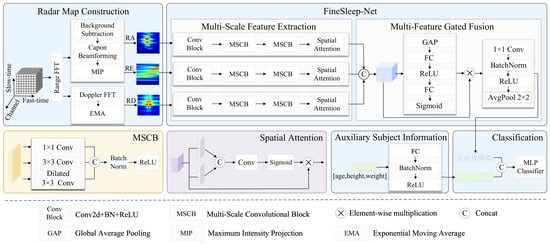
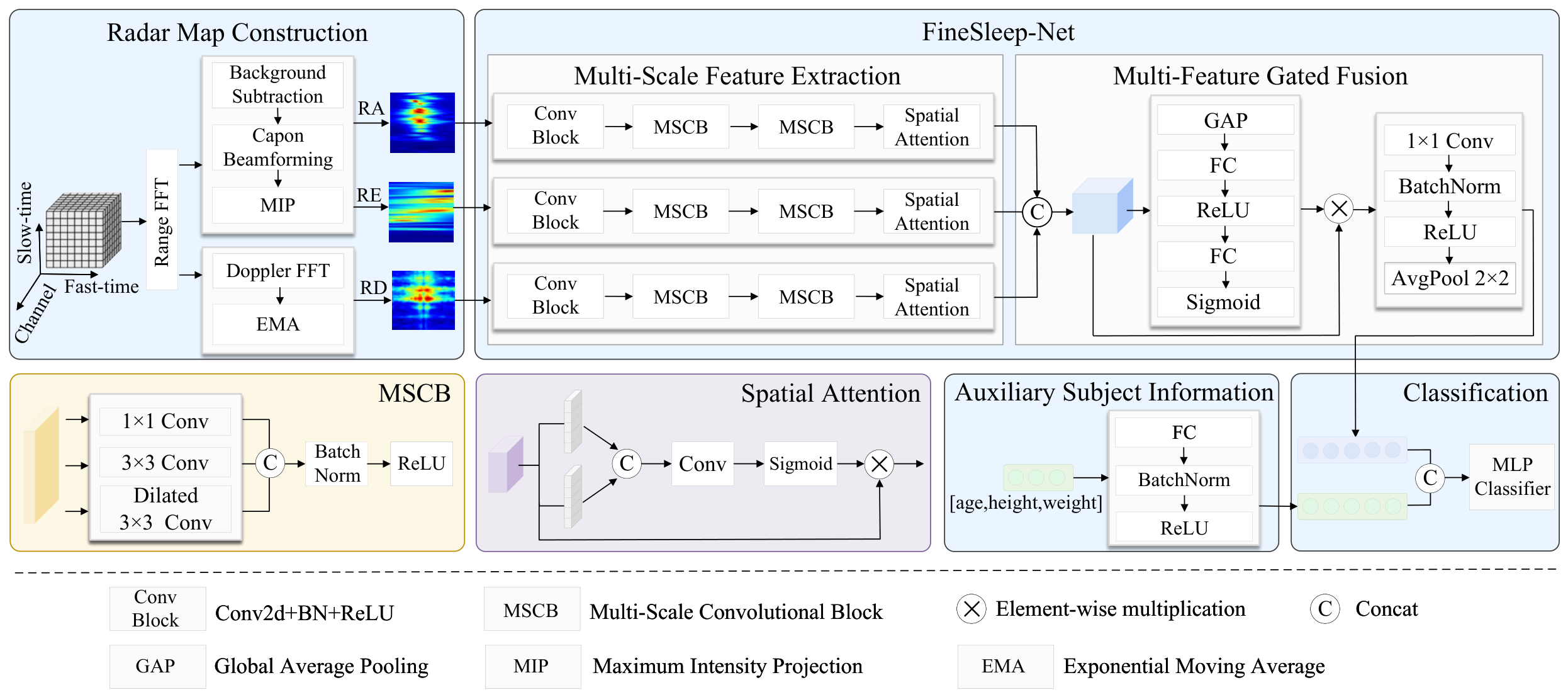
As shown in Figure 1, the proposed framework consists of two main components: (1) radar map generation, which processes raw mmWave radar echoes to generate RA, RE, and RD maps, and (2) FineSleep-Net, which learns complementary radar-map features and incorporates auxiliary subject information for final posture prediction.
Figure 1.
Overall framework of the proposed method.
3.1. Radar Map Generation
The predefined sleep postures were grouped into four coarse body orientations and included local differences in head orientation and limb configuration. After analog-to-digital conversion, the raw radar signals were organized as complex intermediate-frequency sequences and divided into fixed-length observation windows using a sliding-window strategy. For each window, a Hann window was applied before a 256-point-range fast Fourier transform (Range FFT) along the fast-time dimension to obtain range profiles. Range-domain region-of-interest (ROI) selection then retained the distance interval associated with the human body (1.5–4.0 m), reducing reflections from outside this interval.
We generated three complementary radar maps from the ROI-cropped range profiles to characterize body layout and micro-motion. The RA map characterizes horizontal body layout and lateral extent, the RE map describes vertical structural variation, and the RD map captures short-term micro-motion. Together, these maps provide complementary observations for distinguishing similar sleep postures, whose local differences may not be clearly represented in any single view.
3.1.1. RA and RE Map Generation
To suppress static clutter, we averaged the ROI-cropped complex range profiles from a separate 200-frame empty-bed recording and subtracted the resulting background reference from the corresponding profiles of the occupied-bed recording. We then applied Capon beamforming to estimate the angle of arrival. For each view , the Capon spatial spectrum at frame t, range bin r, and scan angle is given by
where is the steering vector and is the spatial covariance matrix for view v at frame t and range bin r after any applicable temporal smoothing and before the diagonal loading applied for the current inversion. At each frame and range bin, the sample covariance is estimated as , where the columns of are the 128 chirp-loop snapshots after TDM demultiplexing and the rows correspond to the selected virtual antenna channels. The current covariance estimate is combined with the cached covariance from the corresponding relative frame and range-bin position in the preceding sliding window, using weights of 0.7 and 0.3, respectively. The cached covariance includes the diagonal loading applied in the preceding window. Diagonal loading with is then applied before inversion. The scan angle denotes the azimuth for RA and elevation for RE.
We used eight virtual antenna channels to estimate the azimuth spectrum and two vertically separated channels to estimate the elevation spectrum. The azimuth and elevation spectra were evaluated on 64 uniformly spaced angles per view, spanning and , respectively. For each range–angle location, we retained the maximum response over the T frames in the observation window to form the window-level map . We recommend collecting a new empty-bed reference if the bedding configuration or radar placement changes.
3.1.2. RD Map Generation
To avoid damaging the phase integrity through background subtraction, this branch directly uses ROI-cropped range profiles and averages them along the chirp dimension, reducing the data dimensionality while retaining the phase variation across frames. Then, T frames within each sliding window are treated as a slow-time sequence, and Doppler FFT is performed along the temporal dimension to obtain the Doppler spectrum at each range bin. Before the Doppler FFT, we subtracted the slow-time mean and applied a Hann window. We summed the Doppler magnitudes across all virtual antenna channels to obtain the RD map before temporal smoothing:
where is the complex Doppler FFT coefficient for virtual antenna channel c at range bin r and Doppler frequency . We retained Doppler frequencies within Hz and smoothed successive RD maps using an exponential moving average with , assigning weights of 0.8 to the current map and 0.2 to the previous smoothed map.
After the three feature maps were obtained, logarithmic compression was applied to each map to compress the dynamic range of radar signals. Min–max normalization then mapped each radar map independently to using its own pixel minimum and maximum, and all radar maps were resized to as the input to the subsequent network.
3.2. Model Architecture
As shown in Figure 1, FineSleep-Net first leverages three feature extraction branches to learn multi-scale spatial patterns from RA, RE, and RD maps, respectively. Then, it integrates them through adaptive channel gating over the concatenated representation, and finally, it incorporates auxiliary subject information for fine-grained posture prediction.
3.2.1. Multi-Scale Feature Extraction (MSFE)
The RA, RE, and RD maps encode different physical observations, including the horizontal body layout, vertical structural variation, and micro-motion. FineSleep-Net therefore learns a map-specific representation from each input before feature fusion. The three single-channel maps are processed by feature extraction branches that share the same architecture, but use independent parameters. This design maintains a consistent processing structure across the three maps while allowing each branch to learn patterns specific to its corresponding radar representation.
Multi-scale networks with feature attention have been used for mmWave-based user identification and emotion recognition [32]. In RA and RE maps, the overall body extent and localized posture differences are represented at different spatial scales. In RD maps, micro-motion responses can extend over different range and Doppler-frequency intervals. Each branch uses convolutional filters with different receptive fields to extract features at multiple scales within its corresponding radar map. To this end, after the initial downsampling convolution, each branch introduces two multi-scale convolutional blocks (MSCBs). Each MSCB concatenates the outputs of three parallel convolutional operations: a convolution for channel interaction, a standard convolution for local spatial patterns, and a dilated convolution with a dilation rate of 2, which captures the broader spatial context through a larger effective receptive field. This multi-branch design combines local responses with the broader context within each radar representation.
Considering that the extracted radar features contain spatial responses with different levels of relevance to posture classification, we applied a spatial attention (SA) module [33] after multi-scale feature extraction. The module performed average pooling and max pooling along the channel dimension, concatenated the two pooled maps, and generated a spatial attention map through a convolution followed by a sigmoid function. The resulting spatial attention map was applied to each feature channel by element-wise multiplication, producing spatially reweighted features for subsequent fusion.
3.2.2. Multi-Feature Gated Fusion (MFGF)
After map-specific feature extraction, we concatenated the branch features along the channel dimension. The relative importance of these feature channels varied across inputs. MFGF therefore learns input-dependent weights to recalibrate the concatenated channels before classification.
Let denote the concatenated feature tensor. Global average pooling then extracts the channel-wise context, and two fully connected layers followed by a sigmoid function produce channel-level gating weights:
where denotes the global average pooling, and denote the two fully connected mappings, and is the ReLU activation function. The resulting gating weights were applied channel by channel to the concatenated representation, allowing its feature channels to be adaptively reweighted according to the current input. This recalibration was designed to emphasize informative channels and attenuate redundant or noisy responses. After gated fusion, a convolution reduced the channel dimension, and adaptive average pooling fixed the spatial resolution to . The resulting feature was flattened into a 256-dimensional representation for classification.
3.2.3. Auxiliary Subject Information and Classification
Radar observations of the same posture can vary across subjects because differences in body size and subject-specific scattering characteristics affect the range, intensity, and spatial distribution of body reflections. Under subject-independent evaluation, such variation may affect the radar features used to distinguish similar sleep postures. We therefore incorporated age, height, and weight as auxiliary subject information in the classifier.
Age, height, and weight were z-score-normalized using statistics computed from the training subjects in each split and mapped to a 16-dimensional embedding by a fully connected layer followed by batch normalization and ReLU activation. The embedding was concatenated with the 256-dimensional radar representation and fed to a two-layer MLP classifier with a 128-dimensional hidden layer, followed by batch normalization, ReLU activation, dropout, and a 12-way output layer. This late-fusion design retains the radar representation as the primary basis for posture prediction while allowing the classifier to account for subject-related variation.
4. Experimental Setup
4.1. Hardware Platform and Deployment
Data were collected using a Texas Instruments AWR1843BOOST mmWave radar (Texas Instruments, Dallas, TX, USA) operating in the 77-GHz band. The radar employed three transmitting and four receiving antennas and was configured with a bandwidth of 3.49 GHz, providing a range resolution of approximately 0.043 m. The detailed radar configuration is summarized in Table 1.
Table 1.
Radar configuration.
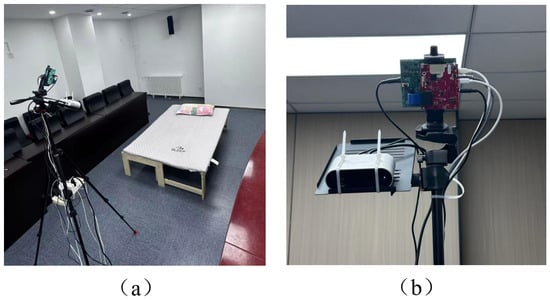
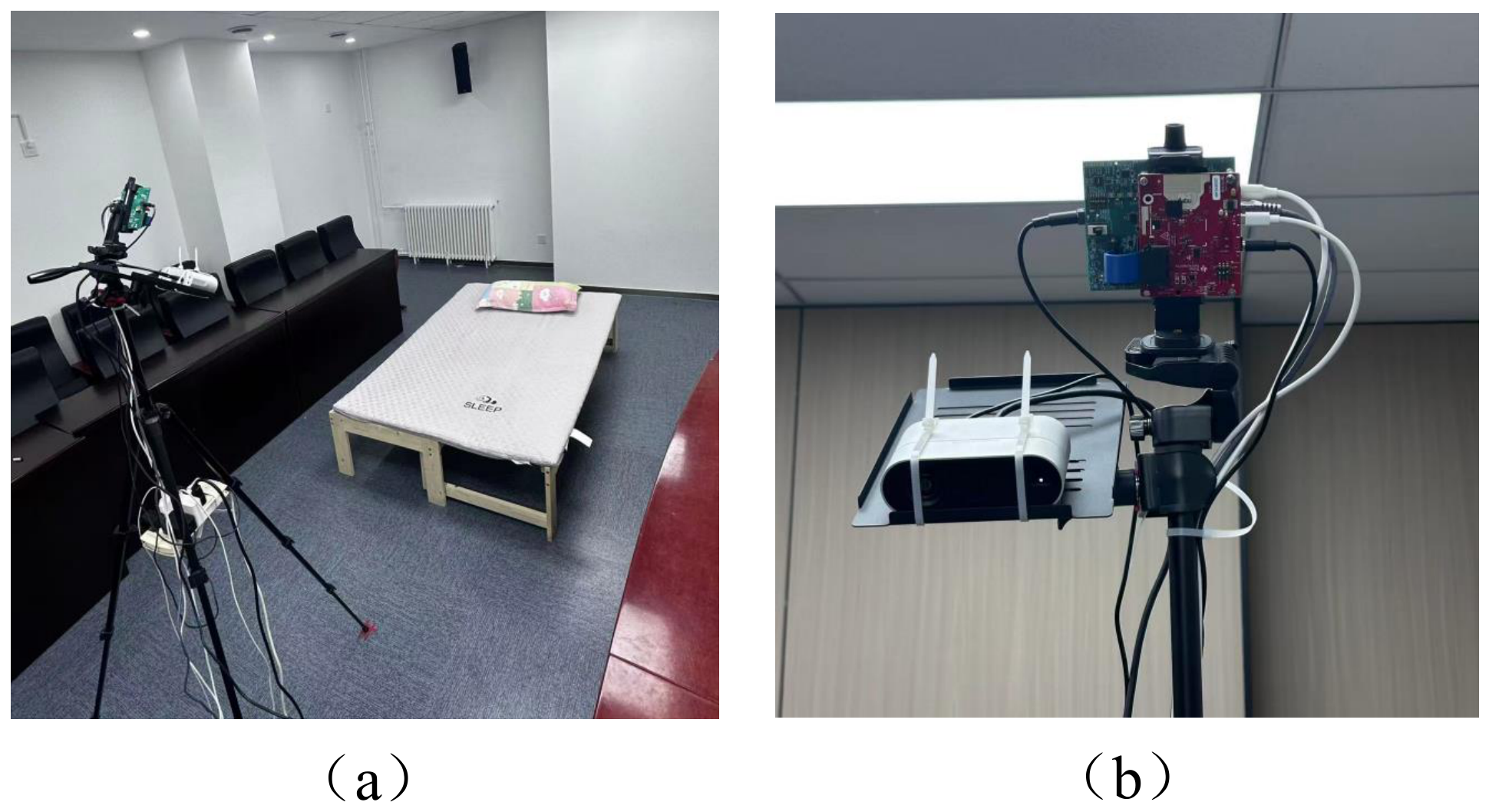
As shown in Figure 2, the radar was mounted above and behind the foot of the bed, approximately 1.3 m horizontally from the bed foot and 1.4 m above the bed surface. The bed measured . To examine nominal geometric coverage, we defined the origin at the projection of the radar onto the bed plane, with x along the bed width, y horizontally toward the bed head, and z vertically upward. The radar was located at , where , and the bed-surface points were , with and .
Figure 2.
Experimental setup. (a) Experimental scene. (b) Experimental device.
The radar board was tilted in the longitudinal vertical plane. The board tilt angle was measured relative to the vertical direction, and the corresponding boresight angle relative to the vertically downward direction was . For each bed-surface point, the components along the radar boresight and along the perpendicular direction in the longitudinal vertical plane are
The lateral component remains x because the tilt is in the longitudinal vertical plane. The azimuth and elevation relative to the radar boresight are
Nominal coverage is assessed using and .
As shown in Table 2, a board tilt angle of yielded bed-surface elevation angles ranging from to , within the nominal elevation FOV. The azimuth angles also remained within the nominal azimuth FOV. At , part of the bed-foot region fell outside the nominal elevation FOV, whereas at , part of the bed-head region exceeded this range. These calculations indicate that the bed surface lies within the nominal radar FOV at a board tilt angle of . We therefore used a board tilt angle of during data collection.
Table 2.
Bed-surface coverage within the nominal radar FOV at different board tilt angles.
4.2. Dataset Construction
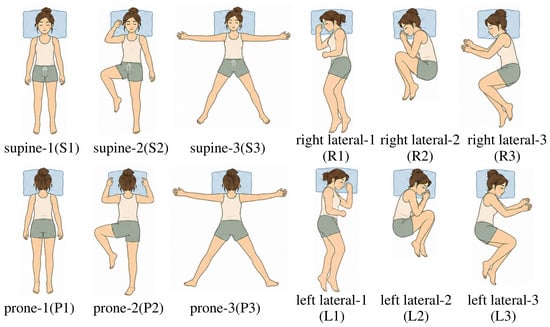
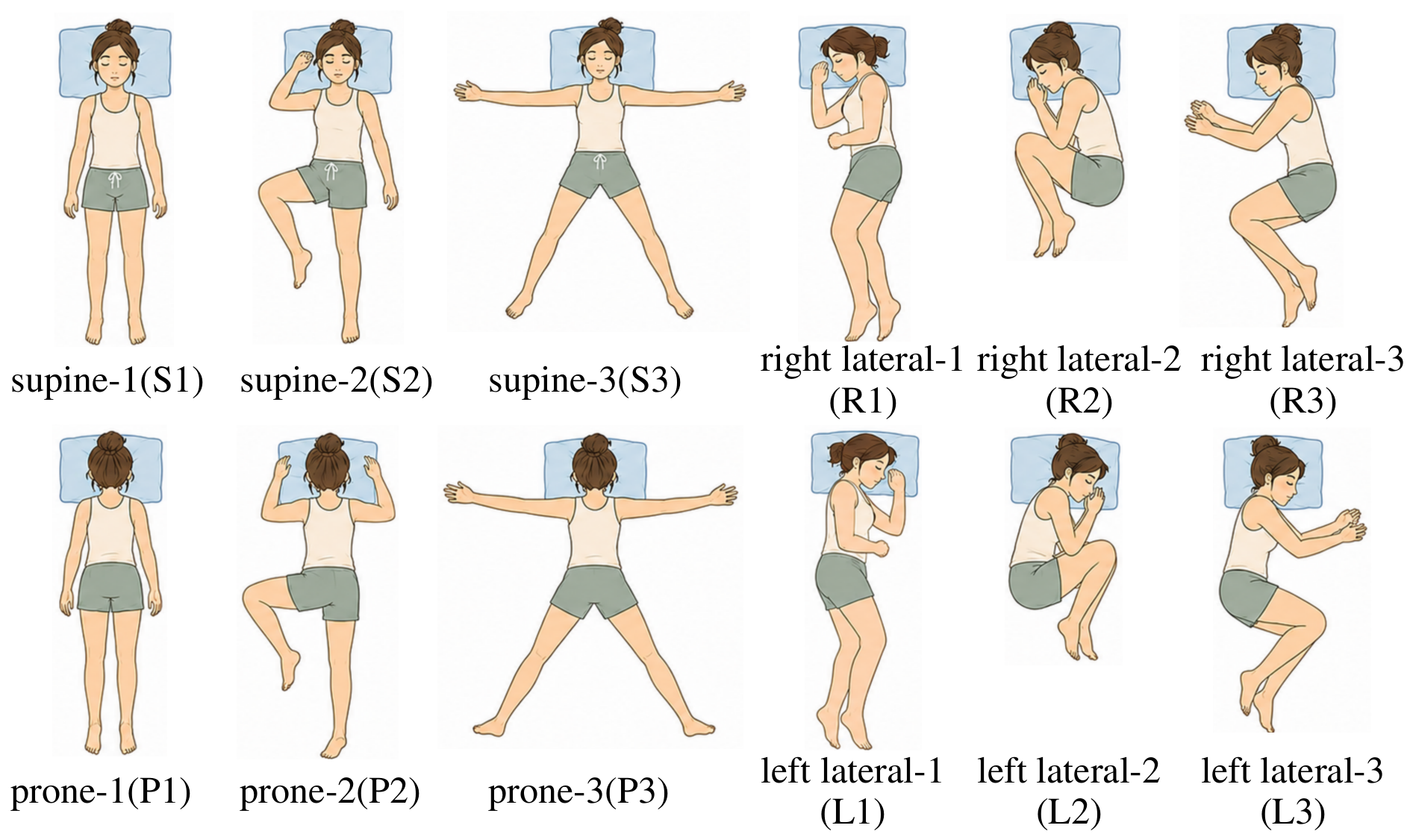
We recruited 32 participants (18 women and 14 men), aged 23–32 years, with BMI values ranging from 16.69 to 35.51 kg/m2. Each participant sequentially performed the 12 predefined postures in Figure 3. The 12 classes comprised three predefined static postures within each of four coarse body orientations: supine, prone, left lateral, and right lateral. Before each recording, the experimenter checked the posture against the reference illustration. Radar data were recorded after the participant reached a stable resting state, while natural respiratory motion and minor involuntary movements were retained to preserve static in-bed micro-motion characteristics. Each posture was recorded for 2 min, giving about 24 min of effective radar data per participant.
Figure 3.
Twelve predefined sleep postures.
Figure 3 illustrates the twelve predefined postures. S1 and P1 have the arms alongside the torso and the legs extended. S2 has one arm raised near the head and one leg bent, whereas P2 has both arms bent near the head and one leg bent. S3 and P3 have the arms extended laterally and the legs spread apart. For both right and left lateral orientations, posture 1 shows a relatively extended body with one hand near the head; posture 2 adopts a tightly curled configuration with the knees drawn toward the torso and the hands near the face; and posture 3 has both arms extended in front of the body and the knees bent.
Based on the 12 predefined postures, we further derived 4-class and 6-class subsets to examine the recognition performance as the number and similarity of candidate postures increased. The 4-class subset contained one representative posture from each coarse orientation: supine-1, prone-1, left lateral-1, and right lateral-1. The 6-class subset further included left lateral-3 and right lateral-3, introducing within-orientation ambiguity into the two lateral categories. We additionally constructed a 12-to-4 coarse-orientation task using all recordings from the 12 predefined postures. In this task, the three fine-grained postures within each coarse orientation were assigned the same class label, yielding the four classes of supine, prone, left lateral, and right lateral. We trained a four-output classifier using these orientation labels, retaining recordings from all 12 posture variants in training and evaluation. This setting differs from the selected 4-class subset because it retains the posture variations within each orientation.
For each posture recording, the first 40 frames were discarded to exclude the initial acquisition transient after the radar started. The remaining sequence was segmented using a 100-frame sliding window with a step size of 40 frames, corresponding to 60% overlap. This produced 57 samples per subject per posture, yielding 7296 and 10,944 samples for the selected 4-class and 6-class subsets, respectively. Both the full 12-class task and the 12-to-4 coarse-orientation task contained 21,888 samples. All tasks were class-balanced.
4.3. Evaluation Protocols
We evaluated cross-subject generalization with two subject-independent protocols. All splits were made at the subject level, with no subject overlap among the training, validation, and test sets within each round. (1) 6-Fold cross-validation: The 32 subjects were divided into six mutually exclusive folds, four with five subjects and two with six. Each round used one fold for testing, the next fold in cyclic order for validation, and the remaining four folds for training. (2) Leave-one-subject-out (LOSO): Each subject served once as the test subject. The next subject in a fixed cyclic ordering was used for validation, and the remaining 30 subjects were used for training. In both protocols, early stopping and checkpoint selection were based on validation loss. Each round was repeated with three training seeds using the same subject assignments.
The performance was evaluated using the accuracy (Acc), macro-F1 (F1), and macro-precision (Prec.). Unless otherwise stated, the metrics were averaged without weighting across folds for each seed and reported as the mean ± std across the three seeds.
Statistical significance was assessed at the participant level. For each participant, F1 was computed from their held-out test predictions and averaged across the three seeds. A two-sided paired Wilcoxon signed-rank test then compared FineSleep-Net with each of the nine baselines using the 32 participant-level scores.
4.4. Implementation Details
FineSleep-Net was implemented in PyTorch 2.4.1 and trained on an NVIDIA GeForce RTX 3090 GPU. We used Adam with an initial learning rate of , weight decay of , batch size of 32, cosine annealing to a minimum learning rate of , and cross-entropy loss with a label-smoothing coefficient of 0.1. Training lasted for, at most, 100 epochs, with early stopping based on the validation loss using a patience of 15 epochs.
4.5. Baseline Reimplementation
We retrained nine baselines on our dataset: three general-purpose classifiers (ResNet18, ViT, and Mamba) and six radar-based models adapted to single-person static posture classification. The model-specific architectures and adaptations are described below, with denoting the number of posture classes.
ResNet18 was implemented using torchvision without ImageNet pretraining. RA, RE, and RD maps were stacked into a tensor and processed by the residual encoder with an -class output layer.
ViT divided the three-map input into 64 patches of size , each projected into a 256-dimensional embedding. Six transformer layers used eight attention heads, a feed-forward dimension of 512, and a dropout of 0.1. A learnable class token and positional embeddings supported -class prediction.
Mamba used an patch embedding layer to convert the stacked RA, RE, and RD maps into 64 tokens with 256-dimensional features. The module used , , , and an expansion ratio of 2, followed by global aggregation and a linear posture classifier.
MiSleep [11] used a DCNN-based posture classifier for the three-map input, omitting keypoint estimation and toss–turn processing. Five convolutional blocks had 4, 8, 16, 32, and 64 channels, each using two convolutions with dilation rates of 2 and 1, BatchNorm, and LeakyReLU; the first four blocks also used max pooling. Adaptive pooling yielded 512 features, followed by a 128–64–32–16– classifier.
UniSleepPos [19] retained dual-view feature extraction, cross-view fusion, and auxiliary subject classification. The RA and RD maps were stacked into a input, while the RE map served as a separate input. Each input was processed by a one-dimensional convolutional branch comprising DenseLayer and TransitionBlock groups. Each branch produced 64 features, yielding a 128-dimensional fused representation. Subject identity labels provided auxiliary supervision during training and were not used as model inputs. The posture and subject-identity heads were jointly trained using , where at epoch t. Only the posture prediction was used during inference.
mm2Sleep [13] retained residual feature extraction and replaced user separation and dual-person prediction with single-person classification. Four residual blocks produced 32, 64, 128, and 256 channels, with stride-2 downsampling in the first three blocks. Global average pooling fed a 256–256– classifier with a dropout of 0.3.
MSAResNet [22] used its spatial component for individual-window classification, omitting the LSTM branch. Multi-scale convolution produced 64-channel features, followed by three SE-based residual stages with 64, 128, and 256 channels. Global average pooling fed a 256–128– classifier with a dropout of 0.5.
ProbRadarM3F [28] used a posture-classification head and a learned spatial mask in place of skeleton regression and ADC-based probability-map generation, respectively. Three convolutional branches extracted RA, RE, and RD features, and a convolution–sigmoid branch supplied feature weights. The original and weighted features were concatenated and compressed, followed by global average pooling and a 32–64– head with a dropout of 0.3.
Lightweight CNN [12] was adapted from four fixed-beam Doppler inputs and transition labels to RA, RE, and RD maps and an -class posture head. Two convolutions produced 8 and 16 channels, followed by residual blocks with 32 and 64 channels, global average pooling, and a fully connected classifier. Each residual block used two convolutions and projection shortcuts for channel changes. Fixed-beam preprocessing, motion detection, and the previous-state rule layer were omitted.
All baselines used cross-entropy for posture classification, and UniSleepPos additionally optimized the subject-classification objective described above. ResNet18, ViT, MiSleep, and the lightweight CNN used Adam at ; Mamba and mm2Sleep used Adam at ; MSAResNet used SGD at ; and ProbRadarM3F used Adam at . UniSleepPos used a learning rate of 0.1. The batch size was 32 except for MiSleep (4), mm2Sleep (16), and UniSleepPos (128). Weight decay was for ResNet18, ViT, Mamba, mm2Sleep, and the lightweight CNN. ResNet18, Mamba, mm2Sleep, MSAResNet, and the lightweight CNN used a maximum of 100 epochs, while MiSleep and UniSleepPos used 1000. Early-stopping patience was 15 epochs for ResNet18, ViT, Mamba, and the lightweight CNN, 30 for mm2Sleep, and 100 for UniSleepPos. MSAResNet reduced its learning rate on validation plateaus, ProbRadarM3F multiplied it by 0.999 every 2000 iterations, and the lightweight CNN used cosine annealing to .
The adapted radar baselines retained components relevant to single-window posture classification, including MiSleep’s convolutional classifier, MSAResNet’s spatial branch, and UniSleepPos’s dual-view feature extraction and fusion. We retrained and evaluated these adaptations on our 12-class dataset under the same participant splits as FineSleep-Net. The reported scores compare the adapted models on a common task, rather than the original systems under their published protocols. This comparison did not evaluate capabilities such as skeletal pose estimation, two-person monitoring, or posture transition tracking.
5. Evaluation
5.1. Overall Performance
5.1.1. Comparison with Baseline Methods
We compared FineSleep-Net with three general deep learning architectures and six task-adapted radar-based methods, using the reimplementations described in Section 4.5. All methods used the same preprocessing pipeline, participant-level splits, and evaluation metrics under both the 6-fold and LOSO protocols.
FineSleep-Net achieved the highest accuracy, F1, and precision under both evaluation protocols (Table 3). Its 12-class accuracy exceeded that of the strongest baseline by 13.2 percentage points under 6-fold validation and 10.9 percentage points under LOSO evaluation. The accompanying gains in F1 and macro-precision showed an improvement in the average class-level recognition as well as the overall accuracy. This is important for the 12-class task, where postures with different head and limb configurations can share the same torso orientation. FineSleep-Net therefore improved the discrimination of the predefined fine-grained classes under subject-independent evaluation.
Table 3.
Comparison with baseline methods on the 12-class task.
5.1.2. Latency Analysis
All methods used the same radar-map generation pipeline. Using the 100-frame observation window and 40-frame step, we measured the steady-state latency of the complete FineSleep-Net pipeline on an NVIDIA GeForce RTX 3090 over 30 windows. As shown in Table 4, the total computation time was ms per update and was dominated by radar-map generation, particularly range FFT/ROI processing and Capon beamforming.
Table 4.
Stage-wise latency of the shared radar-map generation pipeline and FineSleep-Net prediction.
Each update used a 5 s retained radar observation window, with successive windows spaced by 2 s. Timing started after a 100-frame retained window was available in the memory and excluded file I/O and one-time empty-bed background construction. Thus, the approximately 6.34 s delay was estimated from retained-window acquisition (5 s plus mean end-to-end computation), not from radar startup; the initially discarded 40 frames were excluded. Because the measured steady-state processing time was below the 2 s window stride, buffered processing was feasible on the tested RTX 3090 workstation. Online acquisition and processing were not evaluated as an integrated system, and the edge-hardware performance was not assessed.
Table 5 then compares the isolated neural-network forward-pass latency of the different models using the same generated radar maps. The network-stage value in Table 4 was measured once per end-to-end update and included output selection, whereas Table 5 reports an isolated forward-pass microbenchmark. FineSleep-Net had 0.105 M parameters and a forward-pass latency of 2.211 ms. The parameter count does not directly determine the latency because different network operations have different computational and memory-access costs.
Table 5.
Model complexity and isolated network forward-pass latency.
5.1.3. Participant-Level Performance
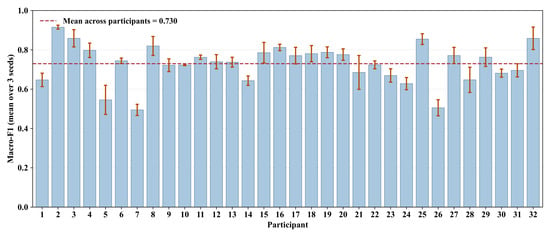
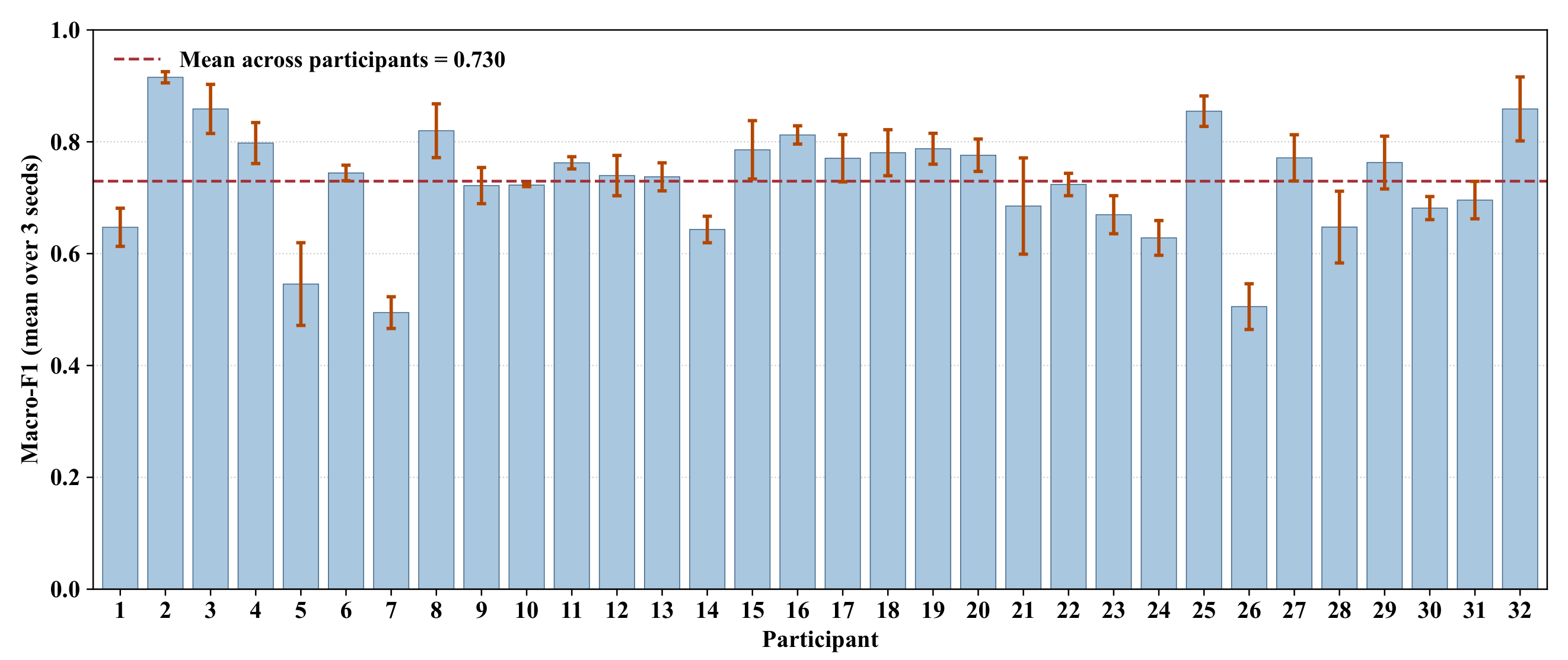
Figure 4 shows the LOSO F1 for each participant, averaged over three random seeds. Across the 32 held-out participants, the mean F1 was 0.730 (95% bootstrap CI: ), with a between-participant standard deviation of 0.098. The variation in the performance across participants motivated the few-shot personalization experiments described below.
Figure 4.
Participant-level F1 on the 12-class LOSO task. Bars show the mean across three random seeds, and error bars represent ± one standard deviation.
5.1.4. Task Granularity and Error Analysis
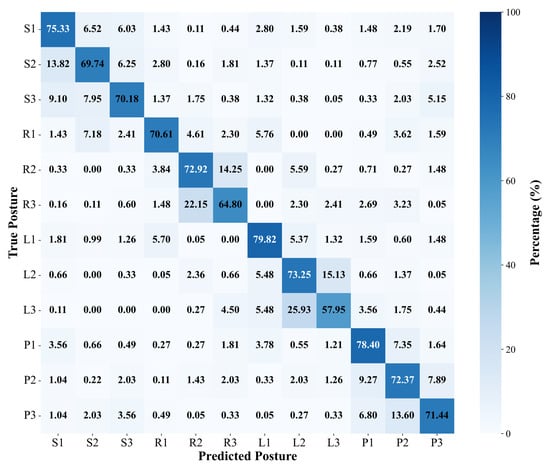
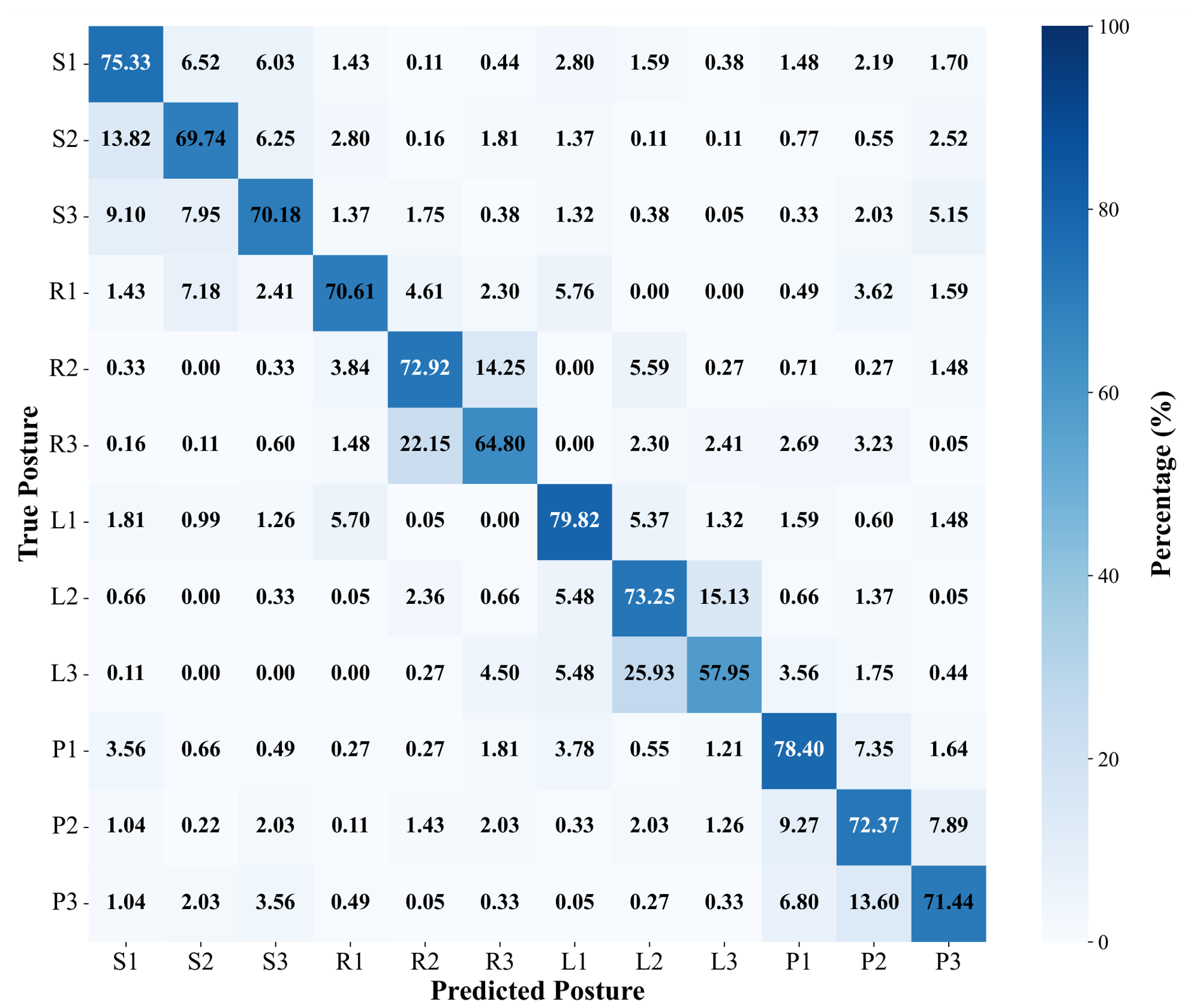
The 12-class confusion matrix in Figure 5 shows that most errors occurred among postures within the same coarse body orientation. The most pronounced confusions were left lateral-3 being classified as left lateral-2 (25.93%) and right lateral-3 as right lateral-2 (22.15%). As illustrated in Figure 3, these posture pairs share a lateral torso orientation and bent legs, with differences in arm placement and the degree of leg flexion. Similar torso layouts can produce similar dominant reflection patterns. Differences in arm placement and leg flexion may therefore be harder to distinguish when limb reflections are weak or partially occluded.
Figure 5.
A 12-class confusion matrix under 6-fold evaluation. Held-out prediction counts are summed across the six folds, averaged over three random seeds, and then normalized by row.
The full 12-class task distinguishes three predefined static postures within each of the four coarse body orientations. To examine how recognition changes with the number and similarity of candidate postures, we evaluated the selected 6-class and 4-class posture subsets. The LOSO accuracy increased from 74.8% on the 12-class task to 86.1% on the 6-class subset and 93.7% on the selected 4-class subset (Table 6). The selected 4-class subset contained one posture per coarse orientation, whereas the 6-class subset added two lateral postures that introduced within-orientation ambiguity.
Table 6.
Performance across fine-grained and coarse-orientation tasks.
We further evaluated a 12-to-4 coarse-orientation task that retained all recordings from the 12 postures while mapping the three postures within each orientation to the same label. FineSleep-Net achieved a 91.1% LOSO accuracy and 90.8% F1 in this setting. Its performance was lower than that of the selected four-class subset because the 12-to-4 task includes a wider range of arm and leg configurations within each orientation. Nevertheless, the result showed that the model can recognize the four coarse body orientations while being exposed to the full posture variability of the dataset. The reduced performance on tasks with more fine-grained labels or greater within-class posture variability is consistent with the confusion matrix, where most errors occur between postures sharing the same coarse orientation.
5.2. Method Analysis
5.2.1. Effect of Capon-Based Angle Estimation
Fine-grained sleep posture recognition relies on spatial differences such as arm placement and leg overlap. The angle estimation method affects how clearly these differences appear in the RA and RE maps. We compared Capon beamforming with conventional angle FFT, keeping all other preprocessing steps, the network architecture, and the training settings unchanged.
Capon beamforming achieved a 74.8% accuracy on the 12-class LOSO task, compared with 71.1% for angle FFT, a gain of 3.7 percentage points (Table 7). F1 also increases from 68.6% to 73.0%, showing that the improvement extends to the class-averaged performance.
Table 7.
Results comparing angle estimation methods.
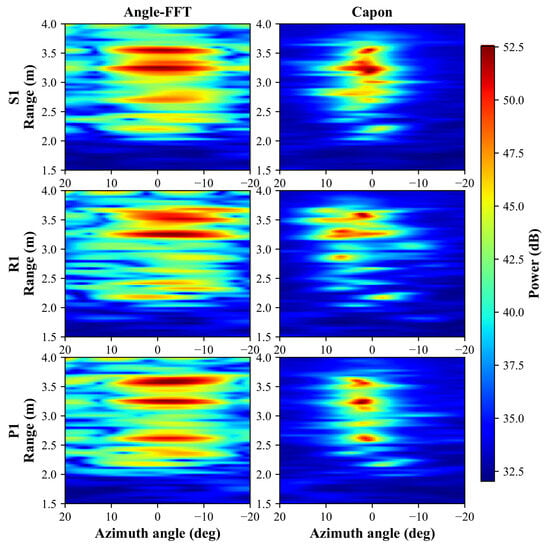
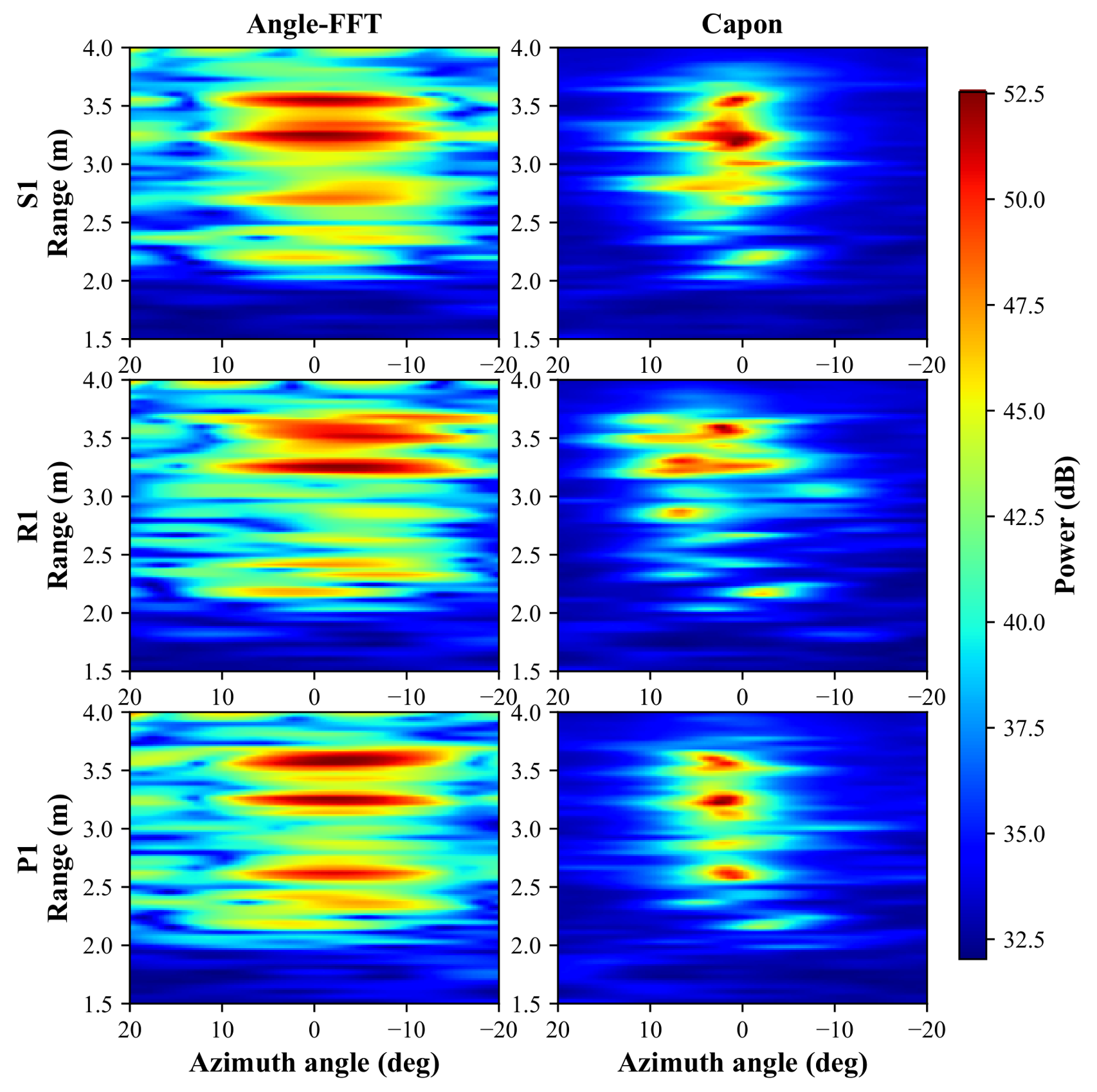
Figure 6 compares the RA maps produced by angle FFT and Capon beamforming from the same radar samples. Capon produced more concentrated angular responses around the human body, whereas angle FFT distributed energy more broadly. Broad angular responses can merge nearby reflection patterns and reduce the visibility of small spatial differences. The clearer structures in the Capon maps are consistent with the higher classification accuracy in Table 7. Together, the map comparison and classification results favor Capon for RA and RE map generation.
Figure 6.
RA map comparison between angle FFT and Capon beamforming for one representative subject.
5.2.2. Effect of Radar-Map Combinations
Table 8 compares radar-map combinations on the 12-class LOSO task. RA was the strongest single-map input, with a 63.4% accuracy, followed by RD at 52.3% and RE at 32.3%. RA describes the horizontal body extent and lateral spread associated with head and limb placement, which are relevant to differences among the predefined postures. RD represents micro-motion across range and Doppler bins, while RE describes vertical structural variation. The single-map results identified a horizontal body layout as the most informative representation in this setting; the vertical structure alone provided less discrimination among the 12 classes. RA + RD was the strongest two-map combination, achieving a 74.4% accuracy, an 11.0-percentage-point increase over RA alone. This gain indicates that the micro-motion information in RD complements the horizontal body layout in RA. RD added range-resolved micro-motion information from respiration and other small involuntary movements. RA + RE yielded smaller gains over RA alone in accuracy and F1. Combining all three maps gave a 74.8% accuracy, 73.0% F1, and 78.3% precision, exceeding RA alone by 11.4, 12.0, and 11.0 percentage points, respectively. Adding RE to RA + RD provided a further 0.4-percentage-point increase in the accuracy. The combined spatial and micro-motion representation therefore gives the best performance, with RA and RD contributing most of the gain and RE supplying a smaller addition.
Table 8.
Results with different radar-map combinations.
5.2.3. Ablation Study
We evaluated the main components by individually removing them from the full model under the 12-class LOSO protocol. We also tested a variant without both MSCB and SA.
Table 9 reports the ablation results. The complete model achieved a 74.8% accuracy. Removing MSCB lowered the accuracy by 1.5 percentage points, the largest decrease among single-component ablations. Features at multiple scales captured local posture differences together with the broader spatial context in RA and RE, and micro-motion patterns spanning different range and Doppler intervals in RD. The accuracy decreased by 0.6 percentage points without SA and by 1.4 percentage points when both MSCB and SA were removed. The decrease without SA shows the value of spatially reweighting the extracted features before fusion.
Table 9.
Component ablation study.
Removing MFGF lowered the accuracy by 0.9 percentage points. Its input-dependent channel weights adjusted the relative contributions of the concatenated radar-map features according to the current observation. The age, height, and weight provided additional classification information, with a 0.6-percentage-point decrease when these attributes were excluded. These attributes entered the classifier alongside the radar features, providing subject-related context for interpreting variations in the observations. Overall, the ablations show that combining multi-scale extraction with spatial and channel reweighting improves fine-grained recognition.
To assess these two contributions at the participant level, we further compared the full model with the RA + RD variant and the variant without auxiliary subject information. For each participant, F1 was first averaged over the three random seeds, and paired bootstrap resampling was then performed across the 32 participants. As shown in Table 10, removing RE changed F1 by percentage points, with a 95% confidence interval of percentage points. Removing the auxiliary information changed F1 by percentage points, with a 95% confidence interval of percentage points. Both intervals included zero. Thus, although the point estimates were consistent with the ablation results, the present participant-level analysis did not establish a clear average improvement from RE or auxiliary subject information alone. Their use should therefore be considered in light of the additional processing and metadata requirements.
Table 10.
Participant-level paired analysis of RE and auxiliary subject information under the 12-class LOSO protocol.
Sensitivity to Auxiliary Inputs. Because auxiliary information may be missing or inaccurate at deployment, we assessed the inference-time sensitivity using the trained full model under the 12-class LOSO protocol, while keeping the trained models and test windows fixed. For the all-missing condition, we replaced the age, height, and weight with their respective training-fold means. To simulate reporting errors, we tested all four combinations of errors in height and errors in weight, keeping age unchanged and applying the same errors to all windows from each participant.
As shown in Table 11, imputing the missing attributes with their training-fold means changed F1 by percentage points (95% CI: ). Under the tested height and weight perturbations, the largest mean decrease was percentage points, observed when the height was underestimated by and the weight was overestimated by . These results concern the inference-time input sensitivity; radar-inferred attributes were not evaluated.
Table 11.
Sensitivity to missing or inaccurate auxiliary inputs under the 12-class LOSO protocol.
5.3. Few-Shot Personalization
We evaluated few-shot personalization for the held-out test subject in each LOSO round. The base model was trained on 30 subjects, with early stopping based on the validation subject’s loss. For , we selected the number of fine-tuning epochs from by fine-tuning on the validation subject’s calibration block and comparing F1 on that subject’s evaluation block. We then reloaded the base checkpoint and fine-tuned it on the held-out test subject’s calibration block for the selected number of epochs. The test subject’s evaluation block was used only for final scoring.
For each posture recording of the target subject, windows formed a non-overlapping calibration pool, using zero-based indices. Windows 28–31 were discarded as a guard interval, and the windows from index 32 onward formed the fixed evaluation set. In the retained raw radar sequence, the last calibration window (window 27) spans frames , leaving a 100-frame (5-s) gap before the first evaluation window (window 32). We generated the evaluation maps independently using only the retained frames from index 1280 onward, resetting the Capon covariance history for RA and RE and the exponential moving average state for RD before processing the first evaluation window. For each k, we randomly selected k labeled windows per class from the calibration pool and evaluated on the same fixed set, including at . During personalization, we updated the last feature-extraction block, gated fusion module, and classifier, keeping the remaining layers frozen.
On the fixed within-session evaluation set, the 12-class accuracy increased from 74.6% without personalization () to 79.1% with one labeled calibration window per posture (). The accuracy continued to improve to 82.8% at , 85.4% at , and 89.5% at (Table 12). The last setting used 120 labeled windows across the 12 postures and gave a 14.9-percentage-point gain over the unpersonalized model. Because the calibration and evaluation data came from the same recording session, this gain reflects the within-session personalization and does not establish that comparable gains would be achieved across independent sessions.
Table 12.
Within-session personalization on a fixed evaluation set; k is the number of labeled calibration windows per posture.
Personalization retained the early feature-extraction layers and adjusted the final feature block, fusion module, and classifier to the target subject’s observations. Additional calibration windows allowed these trainable layers to use more subject-specific examples. The accuracy continued to increase as k increased, with a smaller average gain per additional window. These results show that limited calibration data can improve the within-session recognition for a new user, with further gains as more labeled windows become available.
6. Discussion
FineSleep-Net distinguishes in-bed postures that share the same torso orientation, but differ in arm placement or leg configuration. Using a single mmWave radar, it combines body-layout cues from the RA and RE maps with short-term micro-motion cues from the RD map. FineSleep-Net extracts multi-scale features separately from each radar map and uses input-dependent weights to reweight the concatenated channels before classification. We evaluated this approach on 12 predefined postures in 32 participants aged 23–32 years under participant-independent protocols. The participants held stable postures without blankets under a fixed radar setup, so the results characterize controlled posture recognition rather than natural overnight monitoring. Generalization across independent recording sessions, bedding conditions, and radar placements was not evaluated. In practice, both blanket coverage and posture transitions can affect the radar cues used to distinguish similar postures.
Even when a participant remains still, blankets may attenuate weak limb echoes and introduce additional scattering and multipath, depending on their material and thickness. These effects can reduce the contrast of arm and leg responses in the RA and RE maps, making it harder to distinguish postures that share the same torso orientation.
During a posture transition, the limb configuration itself can change within an observation window. Temporal maximum projection may retain strong echoes from different stages of a turn in the same RA or RE map, while gross motion may dominate the RD map and mask subtler micro-motion cues. A motion-state detector could flag transition windows and defer posture classification until a stable window is available. FineSleep-Net could then be applied to stable intervals, consistent with the conditions evaluated in this study.
7. Conclusions
We present FineSleep-Net for 12-class fine-grained sleep posture recognition using complementary RA, RE, and RD radar maps. The network combines map-specific multi-scale feature extraction and adaptive gated fusion to integrate body-layout and micro-motion features, with age, height, and weight providing the auxiliary classification context. Experiments on 32 subjects achieved a 74.8% accuracy under LOSO evaluation. On a fixed within-session evaluation subset, personalization with 10 labeled windows per posture reached a 89.5% accuracy.
In future work, we will model temporal relationships between successive radar observations to recognize dynamic posture transitions. We will also investigate dual-person sleep posture monitoring by separating the two sleepers’ human body reflections and associating posture predictions with each individual.
Author Contributions
Conceptualization, H.C., Y.L. and H.Y.; methodology, H.C. and Y.L.; investigation, H.C. and Y.L.; data curation, Y.L., M.M. and X.S.; writing—original draft preparation, H.C. and Y.L.; writing—review and editing, H.Y.; supervision, H.C.; funding acquisition, H.C. and H.Y. All authors have read and agreed to the published version of the manuscript.
Funding
This work was supported in part by the Beijing Municipal Natural Science Foundation (No. 4244078), the National Natural Science Foundation of China (No. 62307001, No. 62277001) and the scientific research program of Beijing Municipal Education Commission (KZ202110011017).
Institutional Review Board Statement
The study was conducted in accordance with the Declaration of Helsinki, and the protocol was approved by the Scientific Research Ethics Committee of Beijing Technology and Business University (ethics approval No. 19 of 2025; project No. 4244078) on 15 January 2025.
Informed Consent Statement
Informed consent was obtained from all of the participants involved in the study.
Data Availability Statement
The data presented in this study are available from the corresponding author upon reasonable request, subject to participant consent and applicable institutional requirements. The data are not publicly available due to participant privacy restrictions.
Acknowledgments
The authors thank Hui Li for her support in funding acquisition and for her valuable comments and editing suggestions on the manuscript.
Conflicts of Interest
The authors declare no conflicts of interest.
References
- Ramar, K.; Malhotra, R.K.; Carden, K.A.; Martin, J.L.; Abbasi-Feinberg, F.; Aurora, R.N.; Kapur, V.K.; Olson, E.J.; Rosen, C.L.; Rowley, J.A.; et al. Sleep Is Essential to Health: An American Academy of Sleep Medicine Position Statement. J. Clin. Sleep Med. 2021, 17, 2115–2119. [Google Scholar] [CrossRef] [Scilit] [PubMed]
- Fallmann, S.; van Veen, R.; Chen, L.; Walker, D.; Chen, F.; Pan, C. Wearable Accelerometer Based Extended Sleep Position Recognition. In Proceedings of the 2017 IEEE 19th International Conference on E-Health Networking, Applications and Services (Healthcom), Dalian, China, 12–15 October 2017; pp. 1–6. [Google Scholar]
- Wu, S.; Diao, H.; Feng, Y.; Zhang, Y.; Chen, H.; Akay, Y.M.; Akay, M.; Chen, C.; Chen, W. Lightweight Neural Network for Sleep Posture Classification Using Pressure Sensing Mat at Various Sensor Densities. IEEE Trans. Neural Syst. Rehabil. Eng. 2024, 32, 3410–3421. [Google Scholar] [CrossRef] [Scilit] [PubMed]
- Tam, A.Y.C.; Zha, L.W.; So, B.P.H.; Lai, D.K.H.; Mao, Y.J.; Lim, H.J.; Wong, D.W.C.; Cheung, J.C.W. Depth-Camera-Based Under-Blanket Sleep Posture Classification Using Anatomical Landmark-Guided Deep Learning Model. Int. J. Environ. Res. Public Health 2022, 19, 13491. [Google Scholar] [CrossRef] [Scilit] [PubMed]
- Liu, J.; Chen, X.; Chen, S.; Liu, X.; Wang, Y.; Chen, L. TagSheet: Sleeping Posture Recognition with an Unobtrusive Passive Tag Matrix. In Proceedings of the IEEE INFOCOM 2019-IEEE Conference on Computer Communications, Paris, France, 29 April–2 May 2019; pp. 874–882. [Google Scholar]
- Gu, Y.; Zhang, Y.; Li, J.; Ji, Y.; An, X.; Ren, F. Sleepy: Wireless Channel Data Driven Sleep Monitoring via Commodity WiFi Devices. IEEE Trans. Big Data 2020, 6, 258–268. [Google Scholar] [CrossRef] [Scilit]
- Liu, X.; Jiang, W.; Chen, S.; Xie, X.; Liu, H.; Cai, Q.; Tong, X.; Shi, T.; Qu, W. PosMonitor: Fine-grained Sleep Posture Recognition with mmWave Radar. IEEE Internet Things J. 2024, 11, 11175–11189. [Google Scholar] [CrossRef] [Scilit]
- Zhao, X.; Zhang, D.; Yin, H.; Mao, D.; Li, H. Remote Vital Sign Monitoring Based Millimeter-Wave Sensing. IEEE Access 2024, 12, 142760–142771. [Google Scholar] [CrossRef] [Scilit]
- Yue, S.; Yang, Y.; Wang, H.; Rahul, H.; Katabi, D. BodyCompass: Monitoring Sleep Posture with Wireless Signals. Proc. ACM Interact. Mob. Wearable Ubiquitous Technol. 2020, 4, 1–25. [Google Scholar]
- Adhikari, A.; Sur, S. Argosleep: Monitoring Sleep Posture from Commodity Millimeter-Wave Devices. In Proceedings of the IEEE INFOCOM 2023-IEEE Conference on Computer Communications, New York, NY, USA, 17–20 May 2023; pp. 800–809. [Google Scholar]
- Adhikari, A.; Sur, S. MiSleep: Human Sleep Posture Identification from Deep Learning Augmented Millimeter-Wave Wireless Systems. ACM Trans. Internet Things 2024, 5, 1–33. [Google Scholar] [CrossRef] [Scilit]
- Zhou, B.; Zhou, K.; Feng, W.; Zhu, W.; Jiao, X. A mmWave Radar Based System for Fine-Grained Sleep Postures Monitoring Under Blanket. In Proceedings of the 2025 IEEE Smart World Congress (SWC), Calgary, AB, Canada, 18–22 August 2025; pp. 850–857. [Google Scholar]
- Yao, Y.; Zhang, H.; Xia, P.; Liu, C.; Geng, F.; Bai, Z.; Du, L.; Chen, X.; Wang, P.; Yao, W.; et al. mm2Sleep: Highly Generalized Dual-Person Sleep Posture Recognition Using FMCW Radar. Biomed. Signal Process. Control 2025, 103, 107430. [Google Scholar] [CrossRef] [Scilit]
- Liu, S.; Ostadabbas, S. Seeing under the Cover: A Physics Guided Learning Approach for in-Bed Pose Estimation. In Proceedings of the Medical Image Computing and Computer Assisted Intervention–MICCAI 2019; Shen, D., Liu, T., Peters, T.M., Staib, L.H., Essert, C., Zhou, S., Yap, P.T., Khan, A., Eds.; Springer: Berlin/Heidelberg, Germany, 2019; pp. 236–245. [Google Scholar]
- Torres, C.; Fried, J.C.; Rose, K.; Manjunath, B.S. A Multiview Multimodal System for Monitoring Patient Sleep. IEEE Trans. Multimed. 2018, 20, 3057–3068. [Google Scholar] [CrossRef] [Scilit]
- Islam, S.M.M.; Lubecke, V.M. Sleep Posture Recognition with a Dual-Frequency Microwave Doppler Radar and Machine Learning Classifiers. IEEE Sens. Lett. 2022, 6, 3500404. [Google Scholar] [CrossRef] [Scilit]
- Lai, D.K.H.; Tam, A.Y.C.; So, B.P.H.; Chan, A.C.H.; Zha, L.W.; Wong, D.W.C.; Cheung, J.C.W. Deciphering Optimal Radar Ensemble for Advancing Sleep Posture Prediction through Multiview Convolutional Neural Network (MVCNN) Approach Using Spatial Radio Echo Map (SREM). Sensors 2024, 24, 5016. [Google Scholar] [CrossRef] [Scilit] [PubMed]
- Zha, L.; Chen, M.; Tam, A.Y.C.; Wong, D.W.C.; Cheung, C.W.J. IoT UWB-Radar Array System with Two-Stage Multitask Deep Network for Bed Occupancy and Posture Surveillance via Spatial Echo Feature Map and Cross-Modal Visual Explainability. IEEE Internet Things J. 2026, 13, 24876–24892. [Google Scholar] [CrossRef] [Scilit]
- Liu, K.; Li, M.; He, C.; Tian, X.; Mao, J.; Zeng, M.; Liu, J. UniSleepPos: Sleep Posture Identification System Utilizing Millimeter-Wave Radar. In Proceedings of the 2024 IEEE International Conference on Bioinformatics and Biomedicine (BIBM), Lisbon, Portugal, 3–6 December 2024; pp. 2232–2237. [Google Scholar]
- Li, Z.; Chen, K.; Xie, Y. A Deep Learning Method for Human Sleeping Pose Estimation with Millimeter Wave Radar. Sensors 2024, 24, 5900. [Google Scholar] [CrossRef] [Scilit] [PubMed]
- Zhou, T.; Xia, Z.; Wang, X.; Xu, F. Human Sleep Posture Recognition Based on Millimeter-Wave Radar. In Proceedings of the 2021 Signal Processing Symposium (SPSympo), Łódź, Poland, 20–23 September 2021; pp. 316–321. [Google Scholar]
- Zhou, K.; Zhou, B.; Zhu, W.; Jiao, X.; Wu, R.; Fan, C. Human Sleep Posture Classification: Leveraging mmWave Radar with Multi-Feature Fusion. In Proceedings of the 2025 IEEE International Symposium on Parallel and Distributed Processing with Applications (ISPA), Shenyang, China, 10–12 October 2025; pp. 1350–1357. [Google Scholar]
- Sengupta, A.; Jin, F.; Zhang, R.; Cao, S. Mm-Pose: Real-time Human Skeletal Posture Estimation Using mmWave Radars and CNNs. IEEE Sens. J. 2020, 20, 10032–10044. [Google Scholar] [CrossRef] [Scilit]
- Ding, W.; Cao, Z.; Zhang, J.; Chen, R.; Guo, X.; Wang, G. Radar-Based 3D Human Skeleton Estimation by Kinematic Constrained Learning. IEEE Sens. J. 2021, 21, 23174–23184. [Google Scholar] [CrossRef] [Scilit]
- Wu, Y.; Jiang, Z.; Ni, H.; Mao, C.; Zhou, Z.; Wang, W.; Han, J. mmHPE: Robust Multiscale 3-D Human Pose Estimation Using a Single mmWave Radar. IEEE Internet Things J. 2025, 12, 1032–1046. [Google Scholar] [CrossRef] [Scilit]
- Cao, Z.; Ding, W.; Chen, R.; Zhang, J.; Guo, X.; Wang, G. A Joint Global–Local Network for Human Pose Estimation with Millimeter Wave Radar. IEEE Internet Things J. 2023, 10, 7152–7164. [Google Scholar] [CrossRef] [Scilit]
- Lee, S.P.; Kini, N.P.; Peng, W.H.; Ma, C.W.; Hwang, J.N. HuPR: A Benchmark for Human Pose Estimation Using Millimeter Wave Radar. In Proceedings of the IEEE/CVF Winter Conference on Applications of Computer Vision, Waikoloa, HI, USA, 2–7 January 2023; pp. 5715–5724. [Google Scholar]
- Zhu, B.; He, Z.; Xiong, W.; Ding, G.; Huang, T.; Xiang, W. ProbRadarM3F: mmWave Radar-based Human Skeletal Pose Estimation with Probability Map Guided Multi-Format Feature Fusion. IEEE Trans. Aerosp. Electron. Syst. 2025, 61, 15832–15842. [Google Scholar] [CrossRef] [Scilit]
- Yataka, R.; Cardace, A.; Wang, P.P.; Boufounos, P.; Takahashi, R. RETR: Multi-View Radar Detection Transformer for Indoor Perception. In Proceedings of the Advances in Neural Information Processing Systems, Vancouver, BC, Canada, 10–15 December 2024; Volume 37. [Google Scholar]
- Hu, J.; Shen, L.; Sun, G. Squeeze-and-Excitation Networks. In Proceedings of the IEEE Conference on Computer Vision and Pattern Recognition, Salt Lake City, UT, USA, 18–23 June 2018; pp. 7132–7141. [Google Scholar]
- Shi, C.; Lu, L.; Liu, J.; Wang, Y.; Chen, Y.; Yu, J. mPose: Environment- and Subject-Agnostic 3D Skeleton Posture Reconstruction Leveraging a Single mmWave Device. Smart Health 2022, 23, 100228. [Google Scholar] [CrossRef] [Scilit]
- Yin, H.; Yu, S.; Zhang, Y.; Zhou, A.; Wang, X.; Liu, L.; Ma, H.; Liu, J.; Yang, N. Let IoT Know You Better: User Identification and Emotion Recognition Through Millimeter-Wave Sensing. IEEE Internet Things J. 2023, 10, 1149–1161. [Google Scholar] [CrossRef] [Scilit]
- Woo, S.; Park, J.; Lee, J.Y.; Kweon, I.S. CBAM: Convolutional Block Attention Module. In Proceedings of the European Conference on Computer Vision (ECCV), Munich, Germany, 8–14 September 2018; pp. 3–19. [Google Scholar]

Disclaimer/Publisher’s Note: The statements, opinions and data contained in all publications are solely those of the individual author(s) and contributor(s) and not of MDPI and/or the editor(s). MDPI and/or the editor(s) disclaim responsibility for any injury to people or property resulting from any ideas, methods, instructions or products referred to in the content. |
© 2026 by the authors. Licensee MDPI, Basel, Switzerland. This article is an open access article distributed under the terms and conditions of the Creative Commons Attribution (CC BY) license.