


Abstract
This paper addresses the complex problem of multi-goal robot navigation, framed as an NP-hard traveling salesman problem (TSP), in environments with both static and dynamic obstacles. The proposed approach integrates a novel path planning algorithm based on the Bump-Surface concept to optimize the shortest collision-free path among static obstacles, while a Genetic Algorithm (GA) is employed to determine the optimal sequence of goal points. To manage static or dynamic obstacles, two fuzzy controllers are developed: one for real-time path tracking and another for dynamic obstacle avoidance. This dual-controller system enables the robot to adaptively adjust its trajectory while ensuring collision-free navigation in unpredictable environments. The integration of fuzzy logic with TSP-based path planning and real-time dynamic obstacle handling represents a significant advancement in autonomous robot navigation. Simulations conducted in CoppeliaSim validate the effectiveness of the proposed method, demonstrating robust navigation and obstacle avoidance in realistic environments. This work provides a comprehensive framework for solving multi-goal navigation tasks by incorporating TSP optimization with dynamic, real-time path adjustments.
1. Introduction
Mobile robots are autonomous systems designed to operate in a wide range of environments without direct human intervention. Equipped with various sensors, actuators, and computational components, these robots can perceive their surroundings, make decisions based on sensory input, and execute actions to accomplish specific tasks. Their applications span numerous fields, including industrial automation, logistics, the exploration of hazardous areas, and personal assistance. The increasing versatility of mobile robots is a direct result of advances in robotics, artificial intelligence, and computer vision, enabling them to operate more efficiently and adapt to different scenarios.
One of the most complex challenges in mobile robotics is multi-goal navigation, particularly in environments with static and dynamic obstacles. Efficient and safe navigation requires advanced techniques such as localization, mapping, and path planning, which enable the robot to determine its position, model its environment, and compute optimal, collision-free routes. The problem of determining the shortest collision-free path that connects a set of specified goal points within the robot’s operational environment is known as the multi-goal path planning (MGPP) problem [1,2,3], a complex variation of the NP-hard traveling salesman problem (TSP). MGPP involves two key tasks: first, optimizing the sequence in which the goal points, situated in the free workspace, should be visited; and second, calculating the shortest collision-free path between these points.
In the context of MGPP, determining the optimal sequence of goal points within the robot’s workspace is a variation of the traveling salesman problem (TSP), with the added complexity of requiring navigable and collision-free paths. This requirement for safe traversal between goal points significantly increases the complexity of MGPP compared to the standard TSP, as it must account for the presence of static and dynamic obstacles. Recently, TSP-based approaches have gained significance in robotic multi-goal navigation due to their efficiency in optimizing travel routes while minimizing travel distances and avoiding obstacles. To address these challenges, both online and offline path planning methods have been developed—online techniques rely on real-time sensor data to adapt to dynamic environments [4,5], while offline approaches use pre-existing environmental information [6].
The multi-goal path planning (MGPP) problem has been extensively studied, with many proposed approaches driven by practical applications such as planning for robotic arms [2], industrial manipulators [7], coordinate measuring machines (CMMs) [8,9], rescue missions [10], and pick-up and delivery tasks [11]. In the realm of mobile robotics, Genetic Algorithms (GAs) have been frequently applied to solve the TSP due to their robust optimization capabilities [1,12,13,14]. The GA, an adaptive search technique inspired by natural selection and genetic reproduction, is widely employed to conduct random searches for the solving of complex optimization problems.
This paper addresses the challenge of determining the optimal tour for multi-goal navigation while ensuring collision-free movement in the presence of both static and dynamic obstacles. It presents a fuzzy logic-based control strategy designed for autonomous navigation in environments where obstacles include unpredictable and dynamic objects. The proposed approach involves the development of an intelligent control system utilizing fuzzy logic. The key contributions of this work can be outlined in four main aspects:
- A novel control strategy is developed to address the multi-goal navigation problem for mobile robots in environments with both static and dynamic obstacles. This problem is classified as NP-hard due to its connection to the TSP;
- An advanced path planning algorithm is implemented to enhance the process of determining optimal trajectories, strongly enhancing the efficiency and effectiveness of autonomous robot navigation;
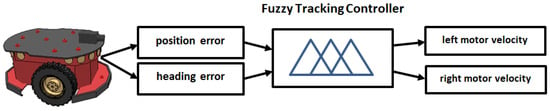
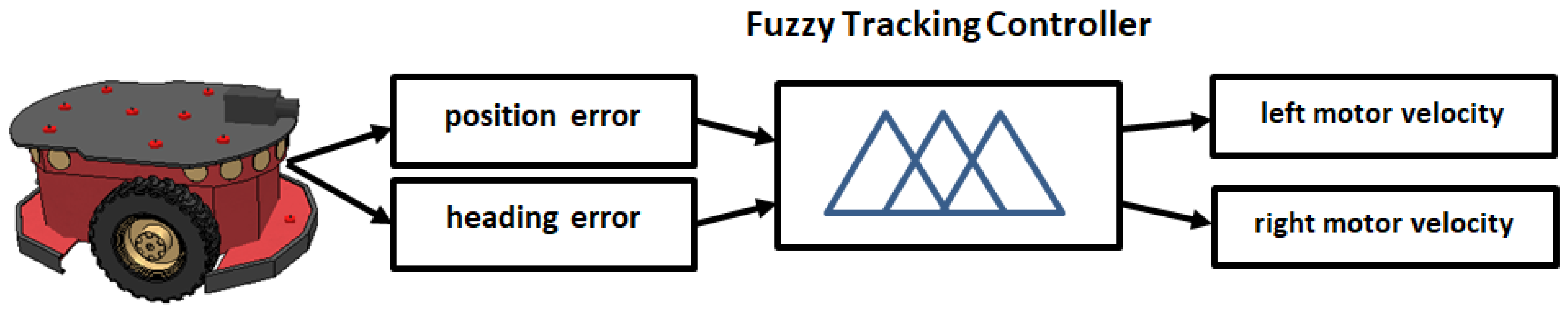
- Two fuzzy controllers capable of handling the dynamic aspects of the navigation problem are designed. These controllers operate in real-time applications, ensuring responsive and adaptive behavior;
- A robust path planning algorithm for static obstacle avoidance combined with fuzzy controllers for dynamic obstacle navigation is integrated to ensure smooth and collision-free navigation, significantly enhancing the robot’s ability to navigate complex and unpredictable environments;
- The solution addresses a global optimization problem by combining two NP-hard problems: the TSP within the robotic context and real-time collision-free path planning. This integrated approach offers a robust framework for tackling both static and dynamic navigation challenges.
The structure of this paper is as follows: Section 2 provides a review of the related literature. Section 3 presents robot kinematics and outlines the problem being addressed. Section 4 details the path planning framework designed for collision avoidance. Section 5 introduces the key concepts related to autonomous multi-goal navigation and analyzes the developed fuzzy controllers for navigation toward the goal and for collision avoidance in a complex environment. Section 6 presents the experimental results obtained through simulations in the CoppeliaSim (Edu version 4.5.1) environment. Lastly, conclusions and suggestions for future research directions are made in Section 6.
2. Literature Review
In the following paragraphs, key studies on recent advancements and methodologies are presented that address challenges in obstacle avoidance, the optimization of navigation paths, and adaptive control strategies.
The work in [15] presents a novel approach for robotic path planning in dynamic and pedestrian-heavy environments like airports. The authors formulate the problem as a variation of the traveling salesman problem (TSP), incorporating a potential field to account for obstacles and pedestrians. They introduce a socially compliant path planning scheme using a Self-Organizing Map (SOM) to optimize the robot’s route while minimizing disturbances to nearby pedestrians. Their approach successfully combines social awareness with efficient path planning, demonstrating its effectiveness in simulation environments.
The authors in [16] investigate the use of the TSP for optimizing multi-goal navigation tasks. The authors focus on planning paths in uncertain environments using belief space, where the robot’s knowledge of its environment evolves as it gathers data. The study utilizes the TSP to determine the optimal sequence of goal points, addressing challenges posed by incomplete or imprecise information. By incorporating belief space into the planning process, the approach aims to improve the efficiency and adaptability of mobile robots in dynamic environments.
The authors in [17] investigate the MGPP problem, which focuses on finding the shortest collision-free path for robots visiting multiple goal points. The study proposes a two-step solution: first, optimizing the sequence of goal points using a Genetic Algorithm (GA), and second, generating an initial path using the Boundary Node Method (BNM), followed by the Path Enhancement Method (PEM) to minimize the overall path length. The authors also extend their approach to multi-robot systems, ensuring collision avoidance between robots and obstacles. The paper demonstrates its effectiveness through simulations and real-world experiments using a mobile robot.
The work in [18] introduces an approach for indoor mobile robot navigation that integrates an improved A* algorithm, the TSP, and the Dynamic Window Approach (DWA). The authors propose using the improved A* to determine the optimal paths between goal points while removing redundant nodes for a more efficient solution. To optimize the order in which the robot visits multiple goals, the TSP is solved using the Ant Colony Optimization (ACO) algorithm. Additionally, the DWA is applied for real-time obstacle avoidance and adaptive speed control, ensuring smooth and safe traversal for all targets.
The authors in [19] study the problem of autonomous navigation for unmanned surface vehicles (USVs) in complex and unknown environments. The authors enhance the traditional D* Lite algorithm to achieve multi-goal path planning and dynamic obstacle avoidance. Their improvements include expanding the search range to accommodate the limited maneuverability of USVs and using a minimum binary heap to optimize the priority queue, significantly reducing path planning time. The experimental results show the enhanced algorithm’s efficiency in dynamic environments, highlighting its practical application in real-world scenarios. While the study effectively improves global path planning for USVs, it focuses primarily on static environmental modeling and dynamic obstacle avoidance without employing adaptive real-time control strategies.
In [20], the authors present a novel approach to enhance multi-goal motion planning for robots operating in complex, obstacle-rich environments. The authors combine machine learning with TSP solvers and sampling-based motion planning to address the challenges of determining feasible paths and goal sequences. The machine learning models predict distances and directions between locations, incorporating obstacle information and robot dynamics, which are then used by the TSP solver to compute optimal tours. The proposed method was tested on vehicle- and snake-like robot models, demonstrating efficiency and scalability in navigating multiple goals under dynamic constraints. This approach integrates predictive modeling for efficient goal sequencing and focuses on improving path planning without explicitly addressing adaptive real-time collision avoidance with dynamic obstacles.
The work in [21] addresses the problem of autonomous navigation for mobile robots in multi-goal missions, particularly focusing on scenarios with challenging environments. The authors propose the SMUG planner, which integrates a two-stage planning approach combining the TSP solver and Iterative Dynamic Programming (IDP). The SMUG planner aims to generate an efficient and collision-free global path to visit a set of predefined targets while accounting for safety by employing a hierarchical state validity checking mechanism. Implementation in the quadruped robot ANYmal demonstrates the method’s effectiveness, particularly in rough terrains. This approach primarily focuses on global path planning without extensively addressing real-time adaptation to dynamic obstacles.
In [22], the authors present a combined approach for optimizing navigation in agricultural scenarios. It leverages a global planning algorithm based on the TSP and the Capacitated Vehicle Routing Problem (CVRP) to schedule harvest locations effectively. The local planning uses the Informed Rapidly Exploring Random Tree Star (IRRT*) method to navigate complex terrains, addressing challenges posed by obstacles and low-traction surfaces. The study demonstrates improved path smoothness and efficiency in navigating agricultural environments, particularly in avoiding obstacles and slippage zones, making it suitable for precision farming applications. However, while the proposed strategy effectively integrates global and local planning methods, it primarily focuses on static environments with predictable terrain characteristics.
The already published studies have demonstrated effectiveness in handling static and dynamic obstacles, especially in structured or semi-predictable environments. To address the challenges posed by unpredictable and dynamic obstacles, our research work introduces a fuzzy logic-based control system designed to enhance real-time adaptability in highly dynamic and unpredictable environments. The proposed system effectively integrates dynamic obstacle avoidance with path tracking, enabling robots to navigate complex environments with increased flexibility and robustness.
3. Preliminaries and Problem Framework
3.1. Robot Kinematics
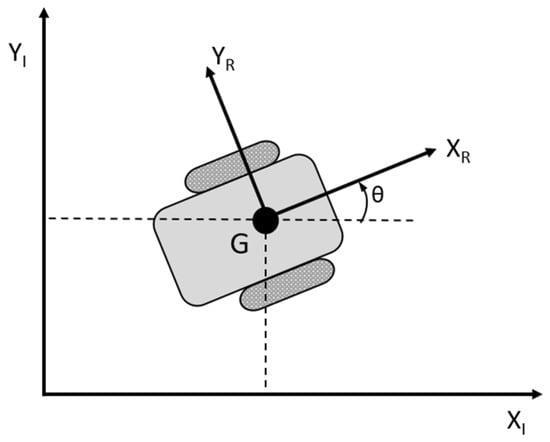
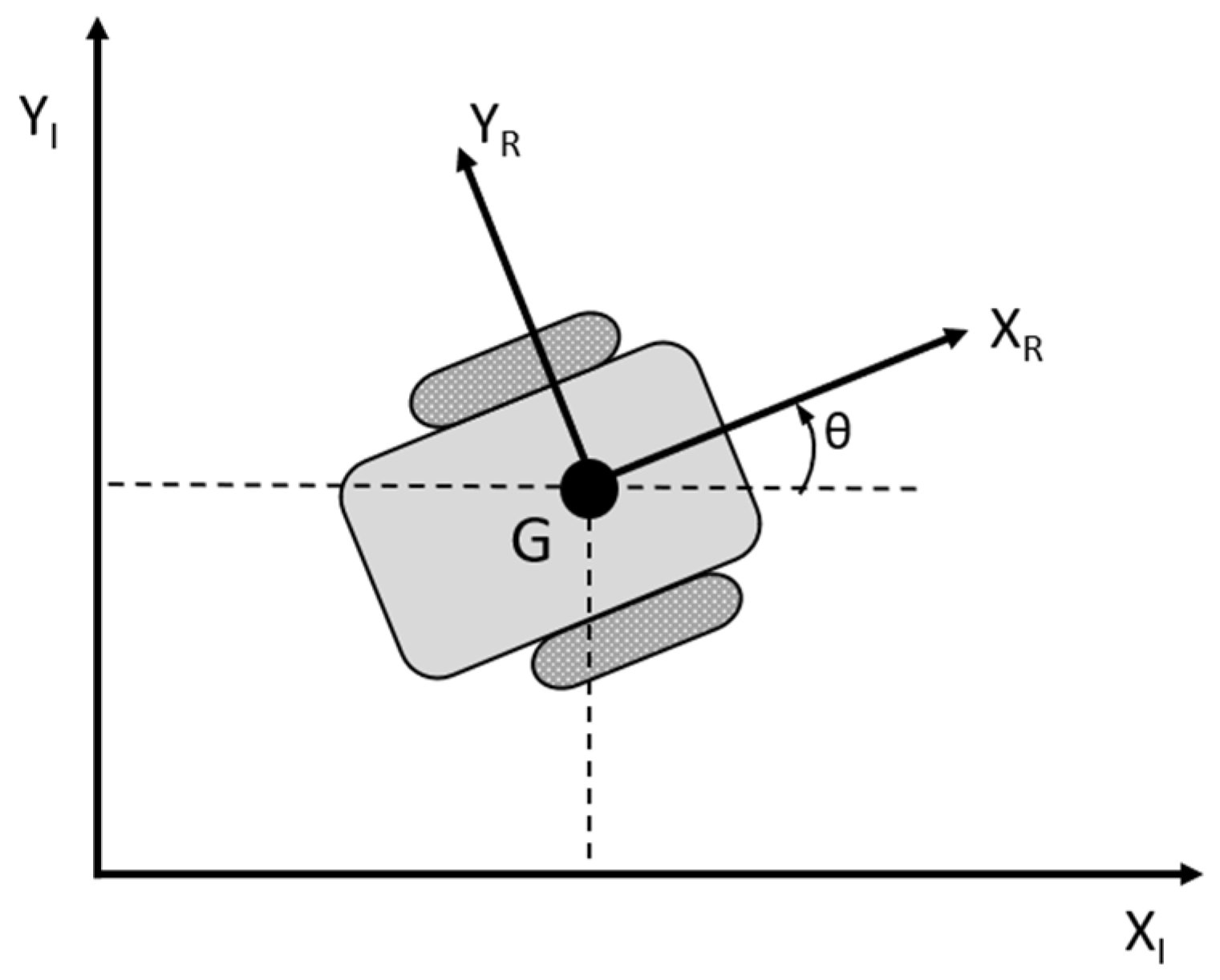
The primary objective of this study is to develop a control system that enables the safe navigation of a mobile robot in a dynamic environment while accounting for its kinematic and geometric properties. To describe the robot’s movement, two critical reference frames are established: a global reference frame, fixed in the environment, and a local reference frame, attached to the robot, which is treated as a rigid body (see Figure 1). The robot’s position and orientation are thus expressed as a vector with three elements: . This study employs a two-wheeled differential drive robot to create a kinematic model (Figure 1).
Figure 1.
The mobile robot within the global and local reference frames.
The kinematic model of the wheeled robot during motion is based on several key assumptions. First, each wheel remains perpendicular to its plane throughout the movement. Second, there is only one point of contact between each wheel and the surface. Lastly, the wheels are assumed to roll without slipping. In addition to these assumptions, two constraints are applied: the rolling constraint, where the motion component along the wheel’s plane matches the wheel’s rotational velocity, and the slipping constraint, which ensures that the motion component in the direction perpendicular to the wheel’s plane is zero. According to [23], a differential drive system consists of two wheels mounted on the same axis, each powered by separate motors. Since both wheels contribute to the robot’s motion, the overall movement is determined by calculating the contribution of each wheel independently.
3.2. Problem Formulation
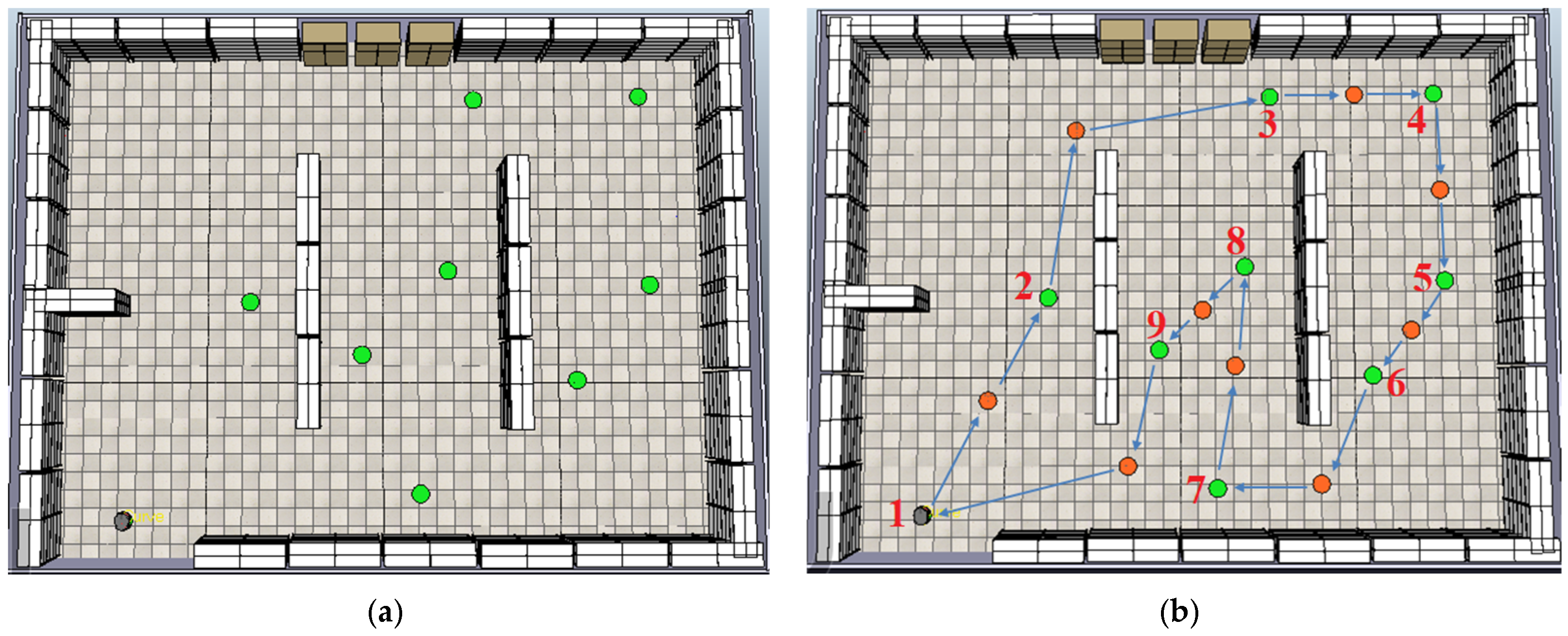
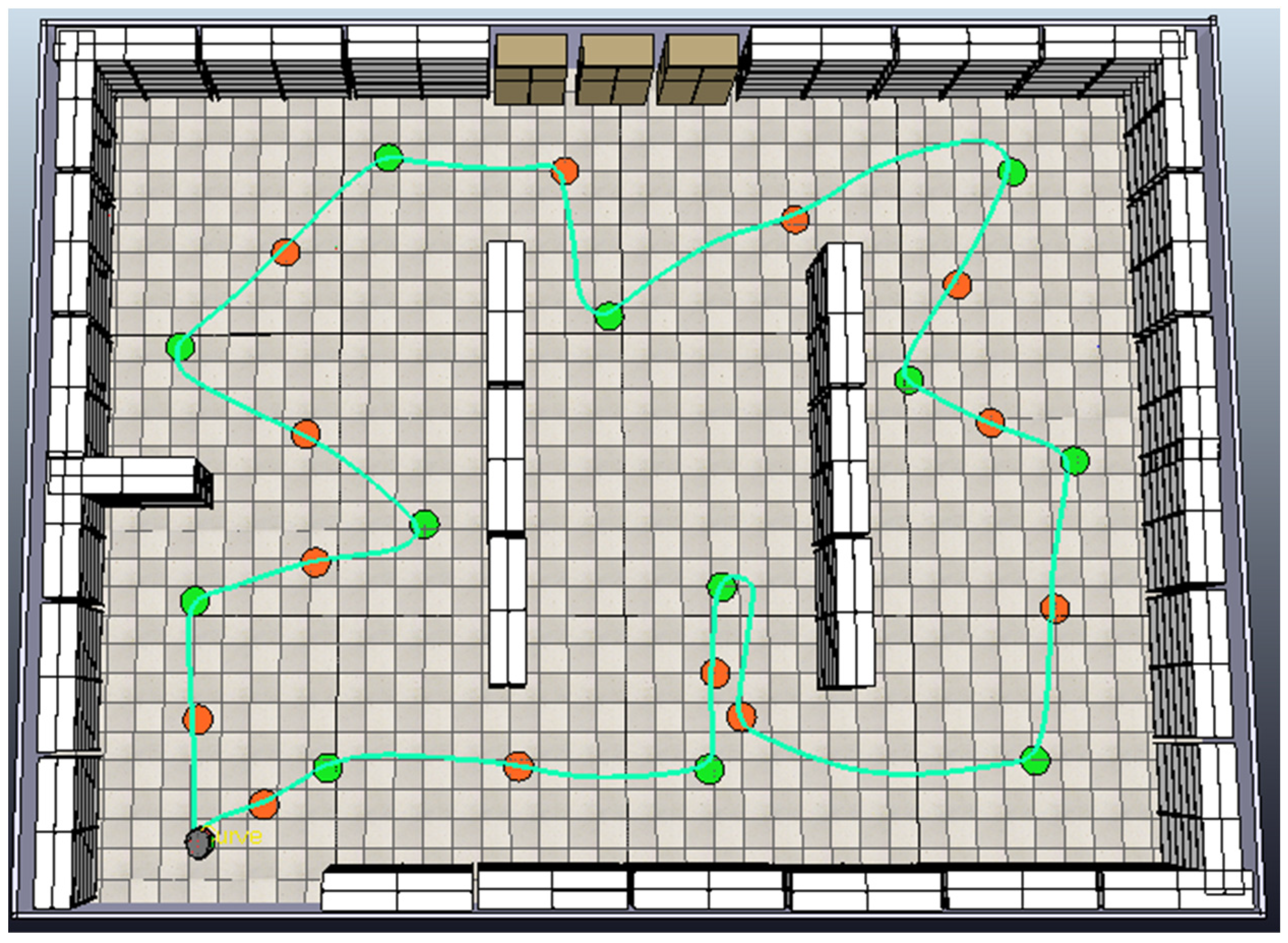
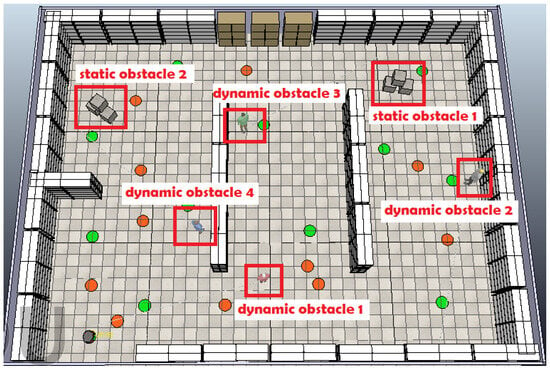
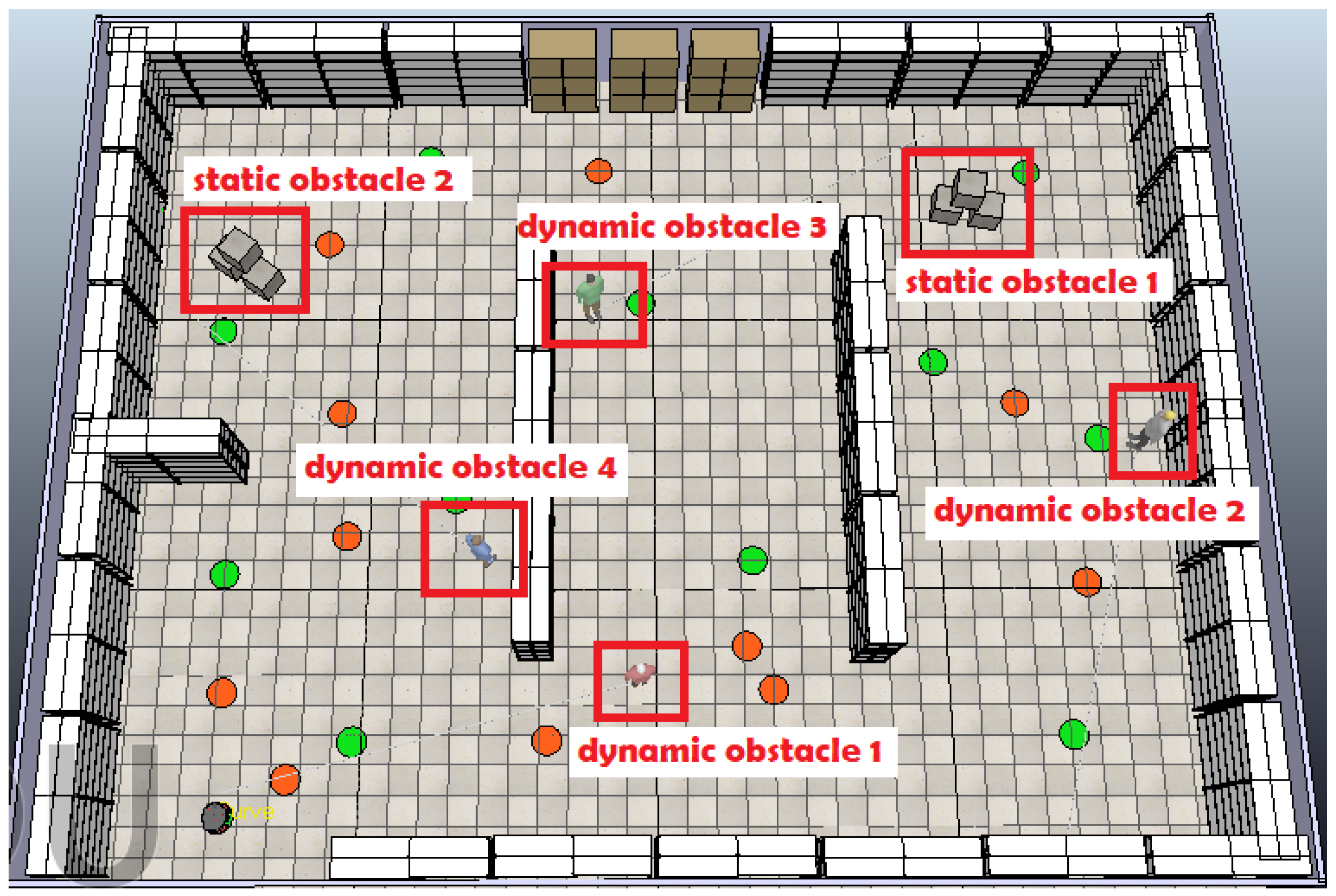
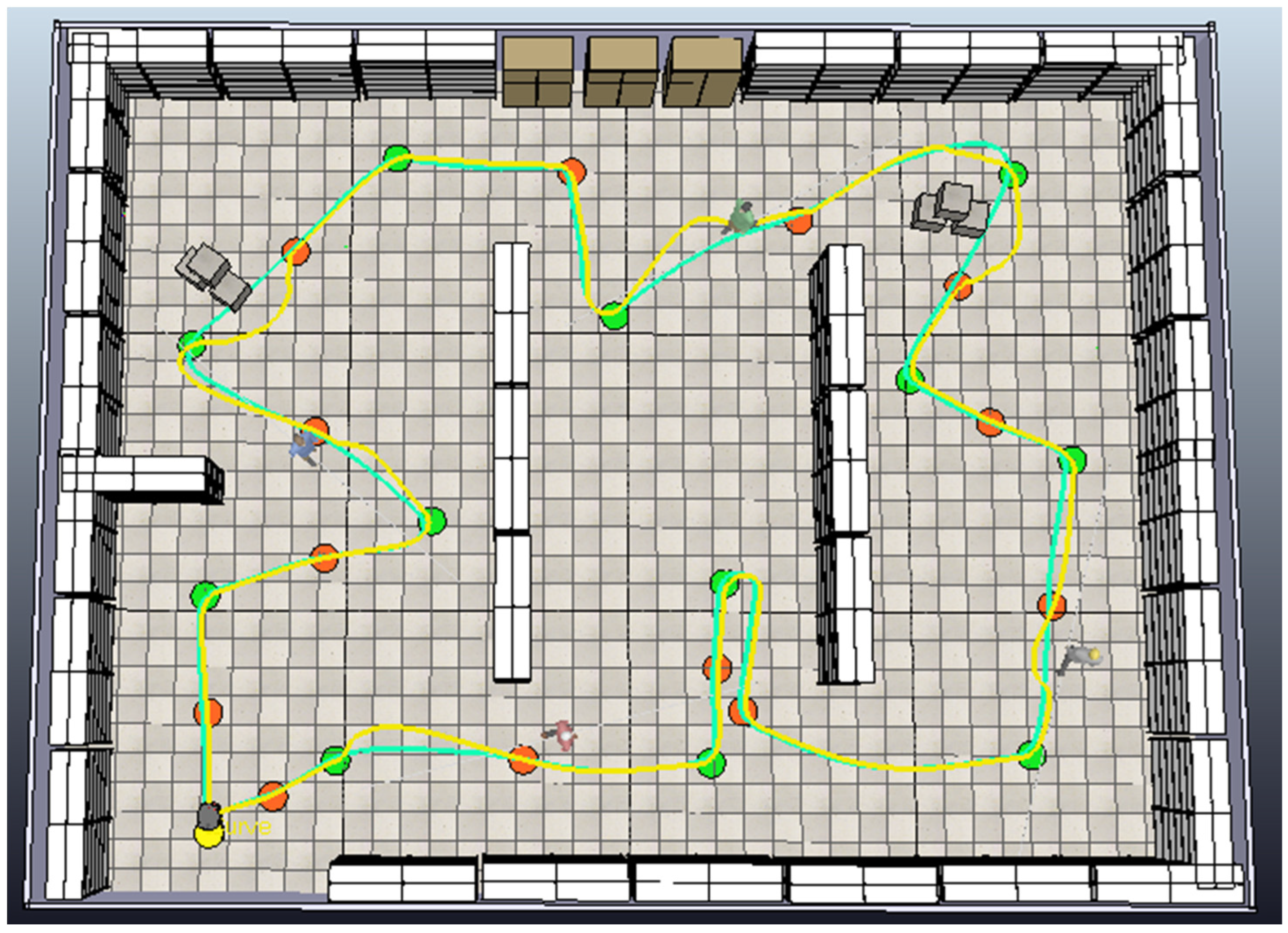
Assume a mobile robot (in our case, the Pioneer P3-DX model provided by CoppeliaSim) that navigates in a warehouse environment and is requested to visit a set of designated task points to perform tasks (e.g., shelf inspection and safety checks). Shelf inspection concerns checking for damaged or misplaced items and safety checks concern the clearance of emergency exits, hazard detection, etc. The robot must find the optimal tour between the goal points, minimizing the total travel distance while avoiding obstacles and ensuring that each goal point is visited exactly once.
The warehouse environment constitutes a bounded area representing the warehouse layout with aisles, containing static and dynamic obstacles (e.g., shelves, walls, other robots, or workers). The predefined task points represent locations where the robot must perform specific tasks. The robot is equipped with a camera and ultrasonic sensors for navigation and obstacle avoidance.
The task allocation problem for a mobile robot refers to the process in which the mobile robot departs from the base, visits all task targets (goal points), and then returns to the base with the minimum cost.
The main objectives of the problem discussed are as follows:
- The robot must visit all task points exactly once and complete the associated task at each point;
- The robot must avoid obstacles and follow a collision-free path;
- The total distance traveled should be minimized (this is a TSP with task execution).
This problem involves a combination of path optimization, real-time navigation, and task management.
4. Path Planning Framework
4.1. Path Planning
Path planning is a critical component in the navigation of autonomous mobile robots. Over the last two decades, significant research efforts [24,25,26,27] have focused on developing path planning strategies for various operational environments. The objective of this process is to determine a collision-free path between two points while optimizing the route in terms of cost. In the case of online path planning, robots rely on sensor data to gather real-time information about their surroundings and build a corresponding map. On the other hand, offline path planning involves the robot obtaining environmental data independently, without the need for real-time sensor input. This process is essential for achieving efficient and reliable autonomous navigation.
To address the motion planning problem for a robot which is requested to operate in a static environment and to visit a set of goal points, we assume that the midpoint traces a route represented as a first-degree B-Spline curve:
where
are the control points defined as follows:
- denotes the depot point;
- ;
- is the total number of control points;
- is the B-Spline basis function;
- The overall number of intermediate points is defined by the user.
The solution of the path planning problem consists of generating the position of the unknown intermediate points such that the overall path is collision-free and has the minimum length . The length is calculated by computing the arc length of the image of onto the Bump-Surface (Section 3.2). This process incorporates features such as the curve’s curvature (robot’s kinematical characteristics) and robot’s safety (obstacle avoidance). Detailed computations based on specific metrics can be found in [28].
4.2. The Bump-Surface Concept
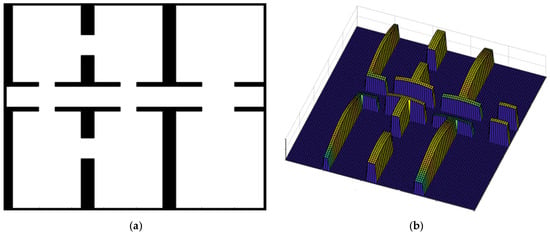
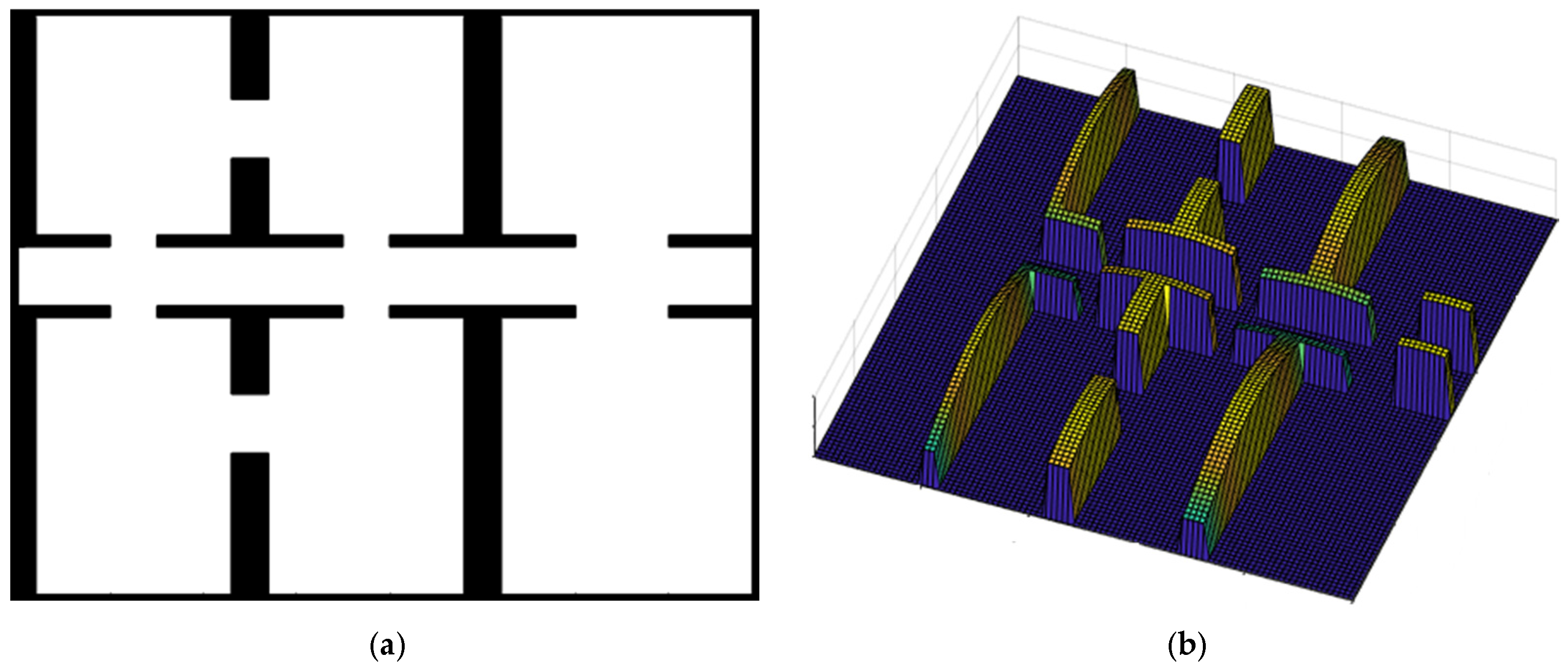
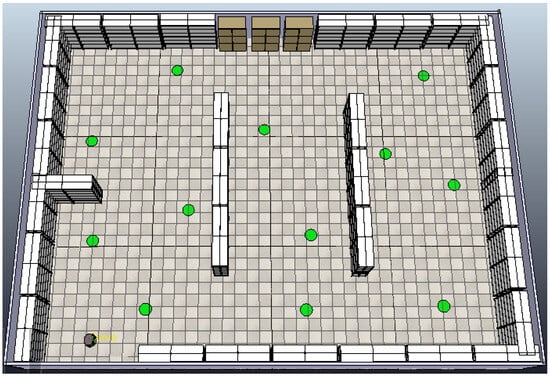
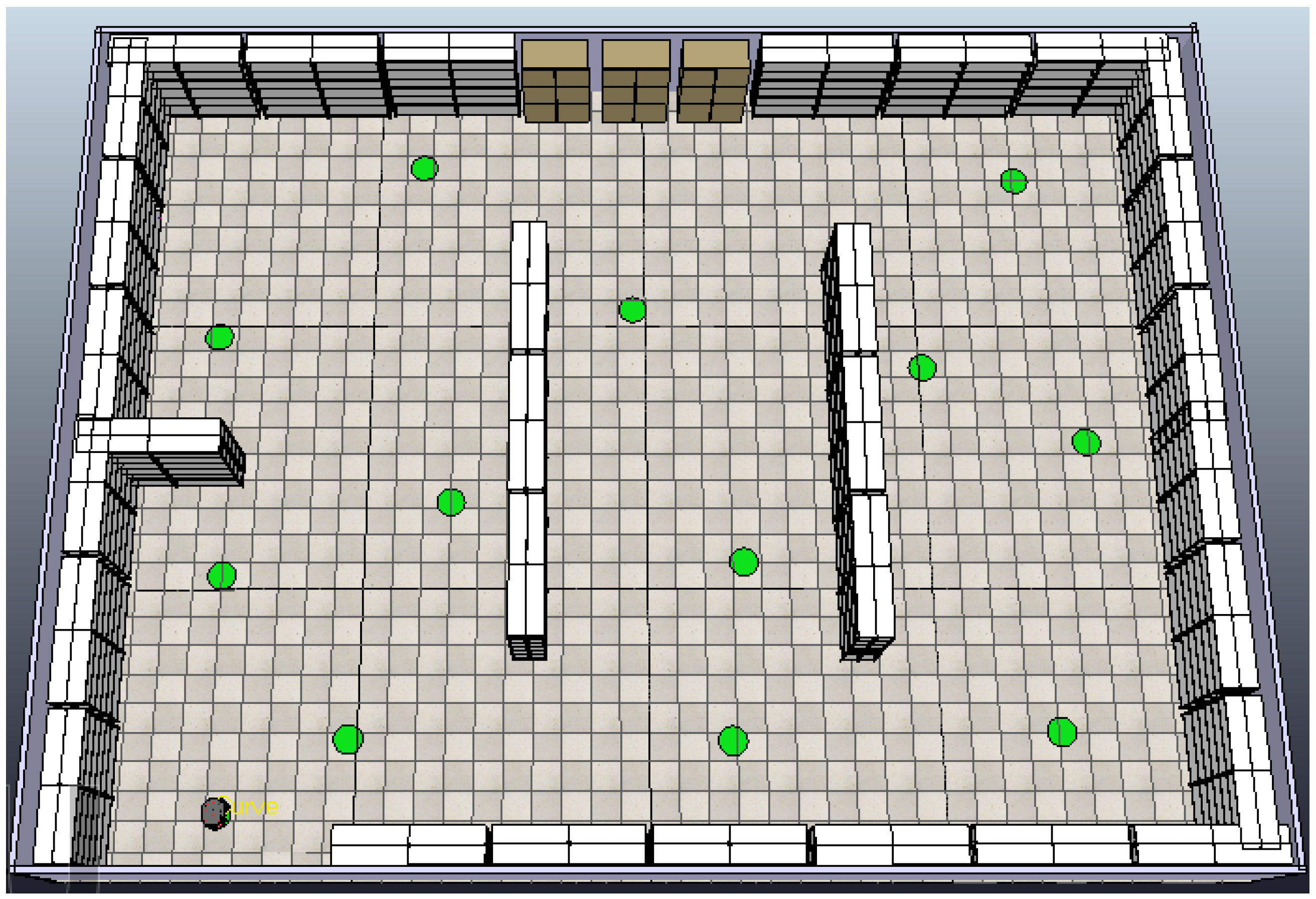
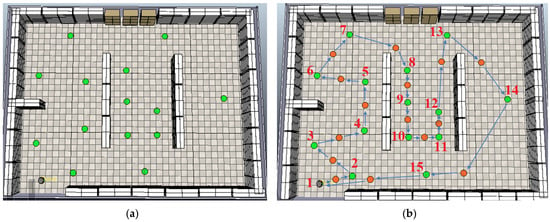
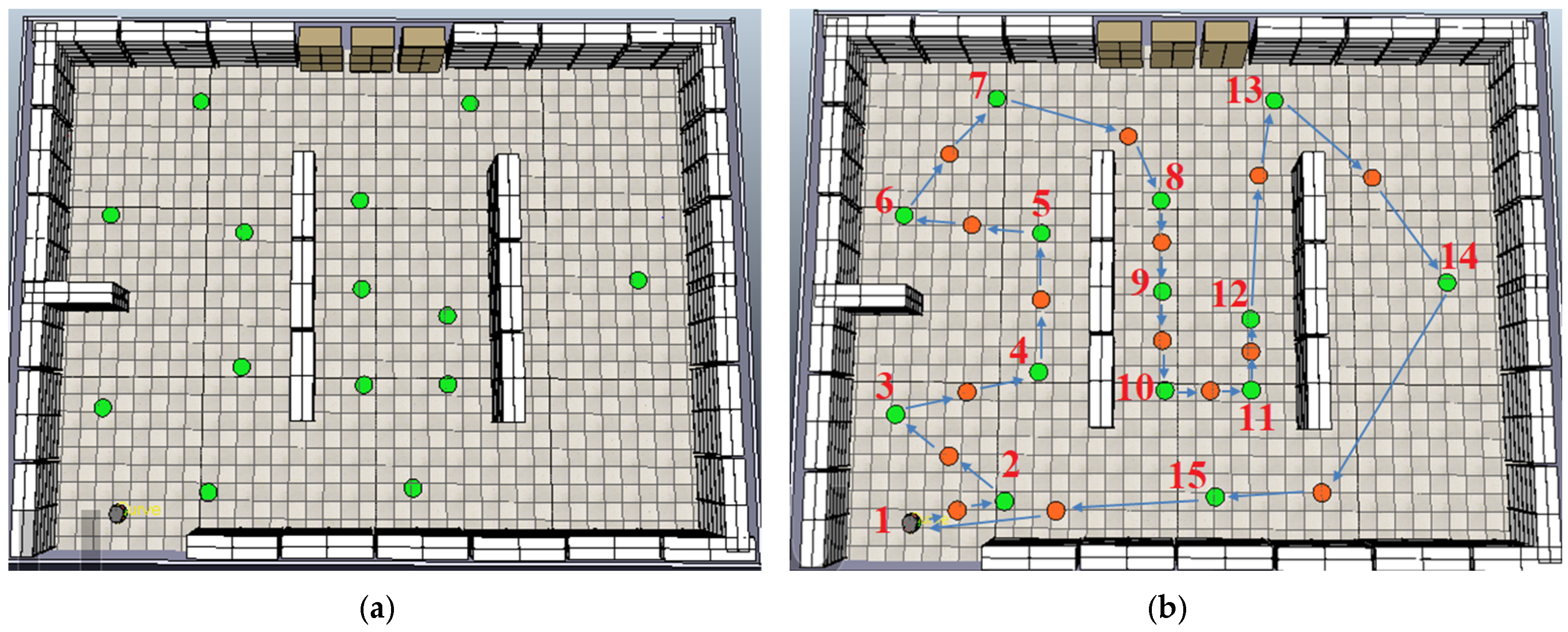
To address path planning challenges, the Bump-Surface concept [29] is applied as a strategic framework for collision avoidance. This approach is particularly effective for mobile robots navigating 2D static environments. The Bump-Surface technique is based on a network of control points, with an adjustable density to meet specific accuracy requirements for path planning. In essence, increasing the grid density enhances the precision of the planned path. Additionally, the use of B-Spline surfaces provides the flexibility needed for both local and global path control, allowing for the desired level of accuracy. An optimization algorithm is then utilized to search the surface, searching for a collision-free path that satisfies the constraints and goals of the path planning process. Figure 2 presents an illustrative example of the Bump-Surface concept for a mobile robot which is requested to move in a 2D environment cluttered with narrow passages.
Figure 2.
(a) The 2D environment layout. (b) The Bump-Surface representation.
8. Conclusions
In this work, we presented a novel approach to solving the complex problem of multi-goal robot navigation, which integrates the NP-hard traveling salesman problem (TSP) with a robust path planning algorithm for static obstacle avoidance and two fuzzy controllers for dynamic obstacle handling. Our approach effectively addresses the challenge of determining the shortest collision-free path among multiple goal points while navigating through unpredictable environments with both static and dynamic obstacles. Our method combined a Genetic Algorithm (GA) to optimize the sequence of goals with the Bump-Surface method for path planning so that the robot was able to calculate efficient routes in cluttered environments.
A significant contribution of this study lies in the integration of two fuzzy logic controllers: one dedicated to real-time path tracking and the other to dynamic obstacle avoidance. The fuzzy control system enabled the robot to dynamically adjust its trajectory in response to the unpredictable movement of obstacles, ensuring collision-free navigation. This hybrid strategy combines TSP-based optimization for static environments and fuzzy logic for real-time dynamic obstacle avoidance. Consequently, the developed control strategy not only provides smooth collision-free navigation paths but also adapts to dynamic changes in real time.
The effectiveness of the developed fuzzy control strategy is validated through experimental analysis conducted in the CoppeliaSim simulation environment comprising static and dynamic obstacles. The system’s adaptability to dynamic environments was validated under diverse conditions. In all tested scenarios, the robot successfully avoided collisions and reached all designated goal points, confirming the reliability and adaptability of the proposed system. The experimental analysis shows that the robot consistently achieved efficient, collision-free navigation across various simulated scenarios, demonstrating the robustness of the proposed approach.
Future work will focus on extending this approach to more complex, real-world scenarios involving larger, more dynamic environments and incorporating additional environmental factors such as varying terrain and multi-robot coordination. Additionally, further improvements to the fuzzy controllers could enhance adaptability to highly unpredictable obstacle behavior.
Author Contributions
Conceptualization, S.S. and P.Z.; methodology, S.S., P.Z. and E.X.; validation, S.S. and P.Z.; formal analysis, S.S. and P.Z.; investigation, S.S. and P.Z.; writing—original draft preparation, S.S. and P.Z.; writing—review and editing, S.S. and P.Z.; visualization, S.S. and P.Z.; supervision, P.Z. All authors have read and agreed to the published version of the manuscript.
Funding
This research received no external funding.
Data Availability Statement
Data sharing is not applicable.
Conflicts of Interest
The authors declare no conflicts of interest.
References
- Wurll, C.; Henrich, D.; Wörn, H. Multi-goal path planning for industrial robots. In Proceedings of the International Conference on Robotics and Application (RA’99), Santa Barbara, CA, USA, 28–30 October 1999. [Google Scholar]
- Saha, M.; Roughgarden, T.; Latombe, J.-C.; Sanchez-Ante, G. Planning tours of robotic arms among partitioned goals. Int. J. Robot. Res. 2006, 25, 207–223. [Google Scholar] [CrossRef] [Scilit]
- Glorieux, E.; Franciosa, P.; Ceglarek, D. Coverage path planning with targeted viewpoint sampling for robotic free-from surface inspection. Robot. Comput.-Integr. Manuf. 2020, 61, 101843. [Google Scholar] [CrossRef] [Scilit]
- Schmid, L.; Pantic, M.; Khanna, R.; Ott, L.; Siegwart, R.; Nieto, J. An efficient sampling-based method for online informative path planning in unknown environments. IEEE Robot. Autom. Lett. 2020, 5, 1500–1507. [Google Scholar] [CrossRef] [Scilit]
- Xiao, X.; Liu, B.; Warnell, G.; Stone, P. Motion planning and control for mobile robot navigation using machine learning: A survey. Auton. Robot. 2022, 46, 569–597. [Google Scholar] [CrossRef] [Scilit]
- Zhou, C.; Huang, B.; Fränti, P. A review of motion planning algorithms for intelligent robots. J. Intell. Manuf. 2022, 33, 387–424. [Google Scholar] [CrossRef] [Scilit]
- Zacharia, P.T.; Xidias, E.K.; Aspragathos, N.A. Task Scheduling and Motion Planning for an industrial manipulator. Robot. Comput.-Integr. Manuf. 2013, 29, 449–462. [Google Scholar] [CrossRef] [Scilit]
- Spitz, S.N.; Requicha, A.A. Multiple-goals path planning for coordinate measuring machines. In 2000 ICRA. Millennium Conference, Proceedings of the IEEE International Conference on Robotics and Automation. Symposia Proceedings, San Francisco, CA, USA, 24–28 April 2000; IEEE: New York, NY, USA, 2000; Volume 3, pp. 2322–2327. [Google Scholar]
- Xidias, E.K.; Zacharia, P.T.; Aspragathos, N.A. Optimal task scheduling for Coordinate Measuring Machines. In Proceedings of the 8th International Conference and Exhibition on Laser Metrology, Machine Tool, CMM & Robotic Performance (LAMDAMAP), Cardiff, UK, 25–28 June 2007; pp. 400–409. [Google Scholar]
- Kulich, M.; Faigl, J.; Preucil, L. Cooperative planning for heterogeneous teams in rescue operations. In Proceedings of the IEEE International Safety, Security and Rescue Rototics, Workshop, Kobe, Japan, 6–9 June 2005; pp. 230–235. [Google Scholar]
- Zacharia, P.; Stavrinidis, S. The Vehicle Routing Problem with Simultaneous Pick-Up and Delivery under Fuzziness Considering Fuel Consumption. Vehicles 2024, 6, 231–241. [Google Scholar] [CrossRef] [Scilit]
- Yu, Z.; Liang, J.; Gu, G.; Zhang, R.; Yang, H. An implementation of evolutionary computation for path planning of cooperative mobile robots. In Proceedings of the 4th World Congress on Intelligent Control and Automation, Shanghai, China, 10–14 June 2002; Volume 3. Cat. No. 02EX527. [Google Scholar]
- Zacharia, P.T.; Aspragathos, N.A. Optimal robot task scheduling based on Genetic Algorithms. Robot. Comput.-Integr. Manuf. 2005, 21, 67–79. [Google Scholar] [CrossRef] [Scilit]
- Zacharia, P.T.; Xidias, E.K. Optimal robot task scheduling in cluttered environments considering mechanical advantage. Robotica 2024, 42, 3230–3246. [Google Scholar] [CrossRef] [Scilit]
- Wang, J.; Meng, M.Q.-H. Socially Compliant Path Planning for Robotic Autonomous Luggage Trolley Collection at Airports. Sensors 2019, 19, 2759. [Google Scholar] [CrossRef] [Scilit] [PubMed]
- Noormohammadi-Asl, A.; Taghirad, H.D. Multi-goal motion planning using traveling salesman problem in belief space. Inf. Sci. 2019, 471, 164–184. [Google Scholar] [CrossRef] [Scilit]
- Saeed, R.A.; Reforgiato Recupero, D.; Remagnino, P. The boundary node method for multi-robot multi-goal path planning problems. Expert Syst. 2021, 38, e12691. [Google Scholar] [CrossRef] [Scilit]
- Zhang, B.; Jin, W.; Gao, X.; Chen, W. A Multi-Goal Global Dynamic Path Planning Method for Indoor Mobile Robot. In Proceedings of the 2021 3rd International Symposium on Robotics & Intelligent Manufacturing Technology (ISRIMT), Changzhou, China, 24–26 September 2021; pp. 97–103. [Google Scholar]
- Zhu, X.; Yan, B.; Yue, Y. Path Planning and Collision Avoidance in Unknown Environments for USVs Based on an Improved D* Lite. Appl. Sci. 2021, 11, 7863. [Google Scholar] [CrossRef] [Scilit]
- Lu, Y.; Plaku, E. Leveraging Single-Goal Predictions to Improve the Efficiency of Multi-Goal Motion Planning with Dynamics. In Proceedings of the 2023 IEEE/RSJ International Conference on Intelligent Robots and Systems (IROS), Detroit, MI, USA, 1–5 October 2023; pp. 850–857. [Google Scholar]
- Chen, C.; Frey, J.; Arm, P.; Hutter, M. SMUG Planner: A Safe Multi-Goal Planner for Mobile Robots in Challenging Environments. IEEE Robot. Autom. Lett. 2023, 8, 7170–7177. [Google Scholar] [CrossRef] [Scilit]
- Urvina, R.P.; Guevara, C.L.; Vásconez, J.P.; Prado, A.J. An Integrated Route and Path Planning Strategy for Skid–Steer Mobile Robots in Assisted Harvesting Tasks with Terrain Traversability Constraints. Agriculture 2024, 14, 1206. [Google Scholar] [CrossRef] [Scilit]
- Dudek, G.; Jenkin, Μ. Computational Principles of Mobile Robotics, 2nd ed.; Cambridge University Press: New York, NY, USA, 2010. [Google Scholar]
- Nayab Zafar, M.; Mohanta, J.C. Methodology for Path Planning and Optimization of Mobile Robots: A Review. Procedia Comput. Sci. 2018, 133, 141–152. [Google Scholar] [CrossRef] [Scilit]
- Gul, F.; Rahiman, W.; Sahal Nazli Alhady, S. A comprehensive study for robot navigation techniques. Cogent Eng. 2019, 6, 1632046. [Google Scholar] [CrossRef] [Scilit]
- Abdulsaheb, J.A.; Kadhim, D.J. Classical and Heuristic Approaches for Mobile Robot Path Planning: A Survey. Robotics 2023, 12, 93. [Google Scholar] [CrossRef] [Scilit]
- Liu, L.; Wang, X.; Yang, X.; Liu, H.; Li, J.; Wang, P. Path planning techniques for mobile robots: Review and prospect. Expert Syst. Appl. 2023, 227, 120254. [Google Scholar] [CrossRef] [Scilit]
- Xidias, E.K.; Nearchou, A.C.; Aspragathos, N.A. Vehicle scheduling in 2D shop floor environments. Ind. Robot. Int. J. 2009, 36, 176–183. [Google Scholar] [CrossRef] [Scilit]
- Azariadis, P.; Aspragathos, N. Obstacle representation by Bump-Surfaces for optimal motion-planning. J. Robot. Auton. Syst. 2005, 51, 129–150. [Google Scholar] [CrossRef] [Scilit]
- Lawer, E.; Lenstra, J.; Rinnooy Kan, A.; Shmoys, D. The Travelling Salesman Problem; Wiley: Chichester, UK, 1985. [Google Scholar]
- Goldberg, D. Genetic algorithms in search. In Optimation and Machine Learning; Addison-Wesley: Reading, MA, USA, 1989; pp. 80–82. [Google Scholar]
- Holland, J.H. Adaption in Natural and Artificial Systems, 2nd ed.; University of Michigan Press: Ann Arbor, MI, USA; MIT Press: Cambridge, MA, USA, 1992. [Google Scholar]
- Michalewitz, Z. Genetic Algorithms + Data Structures = Evolution Programs, 3rd ed.; Springer: Berlin/Heidelberg, Germany, 1996. [Google Scholar]
- Zadeh, L. Fuzzy sets. Inf. Control 1965, 8, 338–353. [Google Scholar] [CrossRef] [Scilit]
- Hong, T.S.; Nakhaeinia, D.; Karasfi, B. Application of Fuzzy Logic in Mobile Robot Navigation. In Fuzzy Logic—Controls, Concepts, Theories and Applications; Dadios, E.P., Ed.; IntechOpen: London, UK, 2012. [Google Scholar] [CrossRef] [Scilit]
- Stavrinidis, S.; Zacharia, P. An ANFIS-Based Strategy for Autonomous Robot Collision-Free Navigation in Dynamic Environments. Robotics 2024, 13, 124. [Google Scholar] [CrossRef] [Scilit]


Disclaimer/Publisher’s Note: The statements, opinions and data contained in all publications are solely those of the individual author(s) and contributor(s) and not of MDPI and/or the editor(s). MDPI and/or the editor(s) disclaim responsibility for any injury to people or property resulting from any ideas, methods, instructions or products referred to in the content. |
© 2025 by the authors. Licensee MDPI, Basel, Switzerland. This article is an open access article distributed under the terms and conditions of the Creative Commons Attribution (CC BY) license (https://creativecommons.org/licenses/by/4.0/).