Article

EarGait: Estimation of Temporal Gait Parameters from Hearing Aid Integrated Inertial Sensors

1
Machine Learning and Data Analytics Lab (MaD Lab), Department Artificial Intelligence in Biomedical Engineering (AIBE), Friedrich-Alexander-Universität Erlangen-Nürnberg (FAU), 91052 Erlangen, Germany
2
WS Audiology, 91058 Erlangen, Germany
*
Author to whom correspondence should be addressed.
Sensors 2023, 23(14), 6565; https://doi.org/10.3390/s23146565
Submission received: 6 June 2023 / Revised: 14 July 2023 / Accepted: 18 July 2023 / Published: 20 July 2023
(This article belongs to the Section Wearables)

Abstract

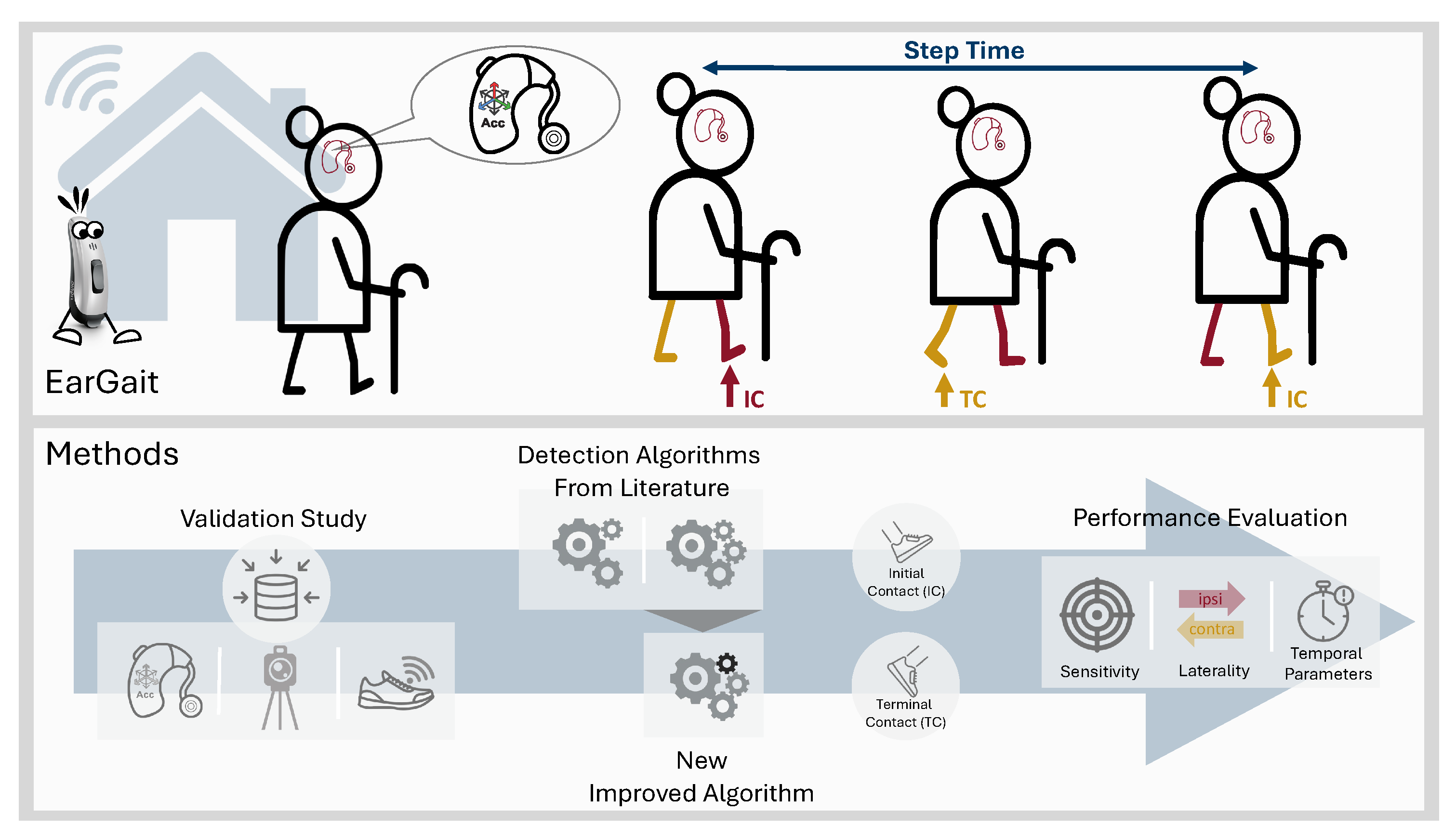
Wearable sensors are able to monitor physical health in a home environment and detect changes in gait patterns over time. To ensure long-term user engagement, wearable sensors need to be seamlessly integrated into the user’s daily life, such as hearing aids or earbuds. Therefore, we present EarGait, an open-source Python toolbox for gait analysis using inertial sensors integrated into hearing aids. This work contributes a validation for gait event detection algorithms and the estimation of temporal parameters using ear-worn sensors. We perform a comparative analysis of two algorithms based on acceleration data and propose a modified version of one of the algorithms. We conducted a study with healthy young and elderly participants to record walking data using the hearing aid’s integrated sensors and an optical motion capture system as a reference. All algorithms were able to detect gait events (initial and terminal contacts), and the improved algorithm performed best, detecting 99.8% of initial contacts and obtaining a mean stride time error of 12 ± 32 ms. The existing algorithms faced challenges in determining the laterality of gait events. To address this limitation, we propose modifications that enhance the determination of the step laterality (ipsi- or contralateral), resulting in a 50% reduction in stride time error. Moreover, the improved version is shown to be robust to different study populations and sampling frequencies but is sensitive to walking speed. This work establishes a solid foundation for a comprehensive gait analysis system integrated into hearing aids that will facilitate continuous and long-term home monitoring.
Keywords: earables; gait analysis; gait event detection; inertial sensor; SSA; wearables earables; gait analysis; gait event detection; inertial sensor; SSA; wearables