Machine Learning for 5G MIMO Modulation Detection

Abstract
1. Introduction
1.1. Related Works
1.2. Contributions
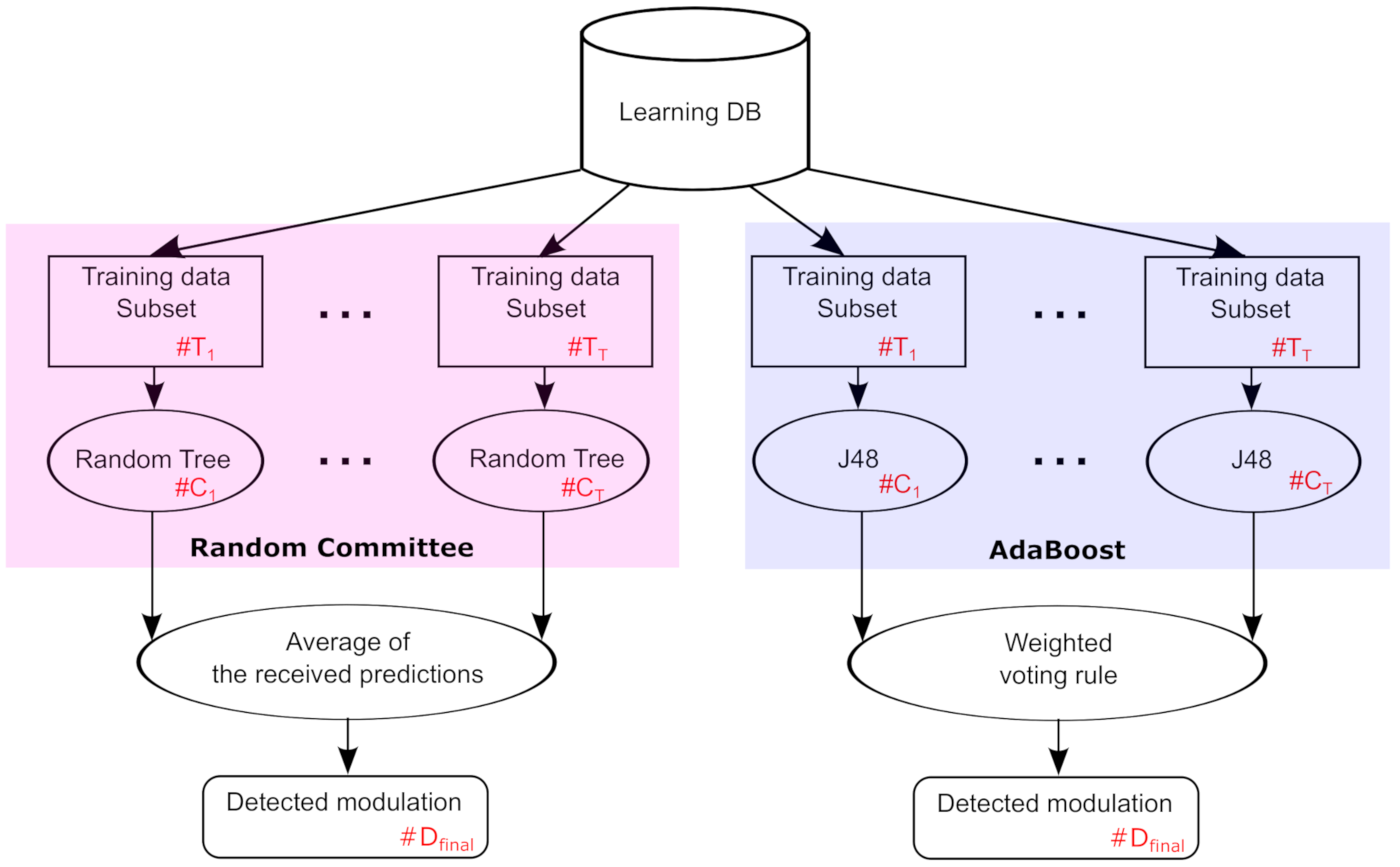
- We proposed a modulation detection using random committee MLT for multi-relay cooperative MIMO systems over the imperfectly estimated correlated channels. To the best of the authors knowledge, this is the first time that random committee MLT is used for the modulation detection. The purpose is to detect the modulation types and orders among different M-ary shift-keying linear modulations (M-PSK and M-QAM) used by broadband technologies, especially 5G NR.
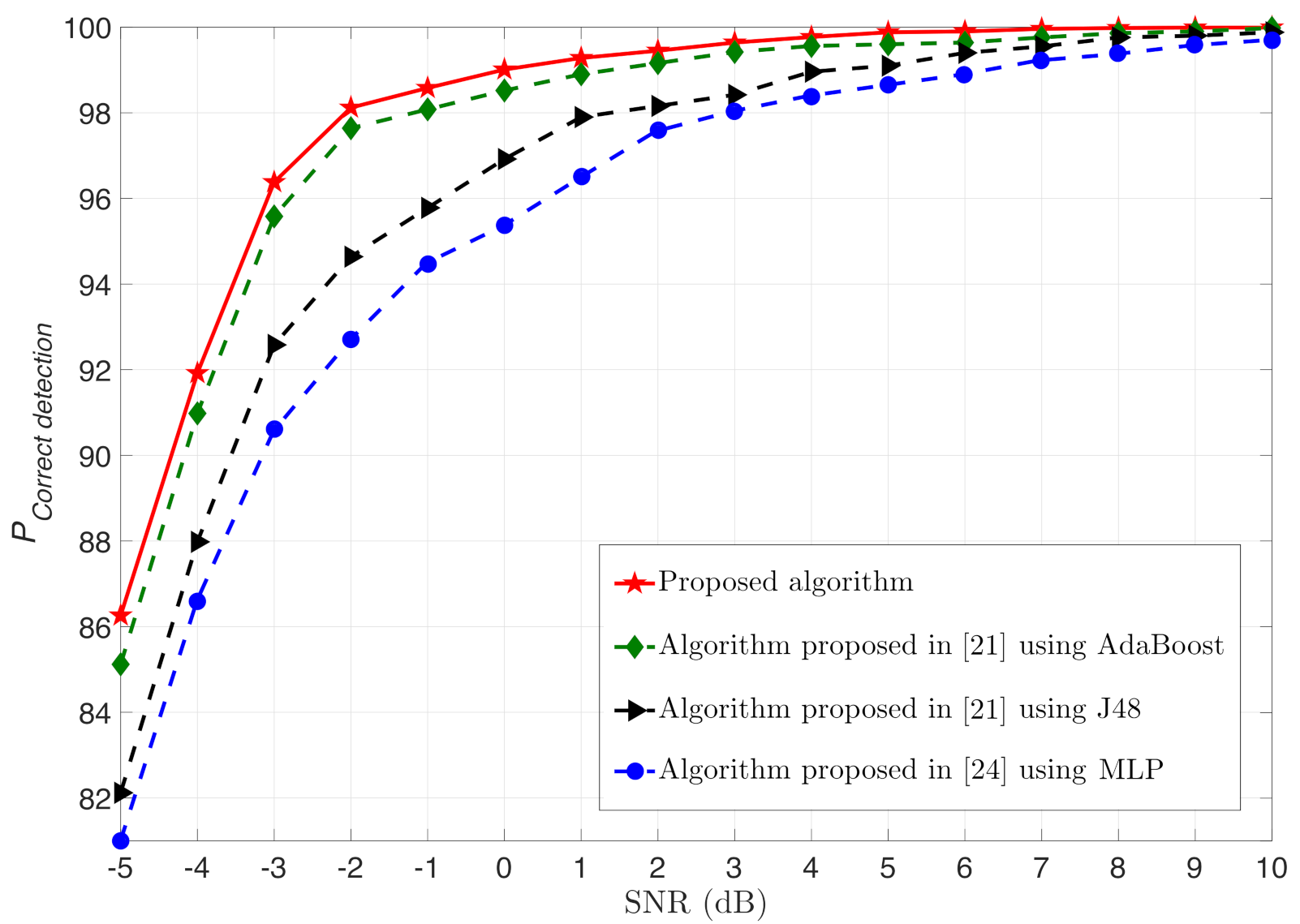
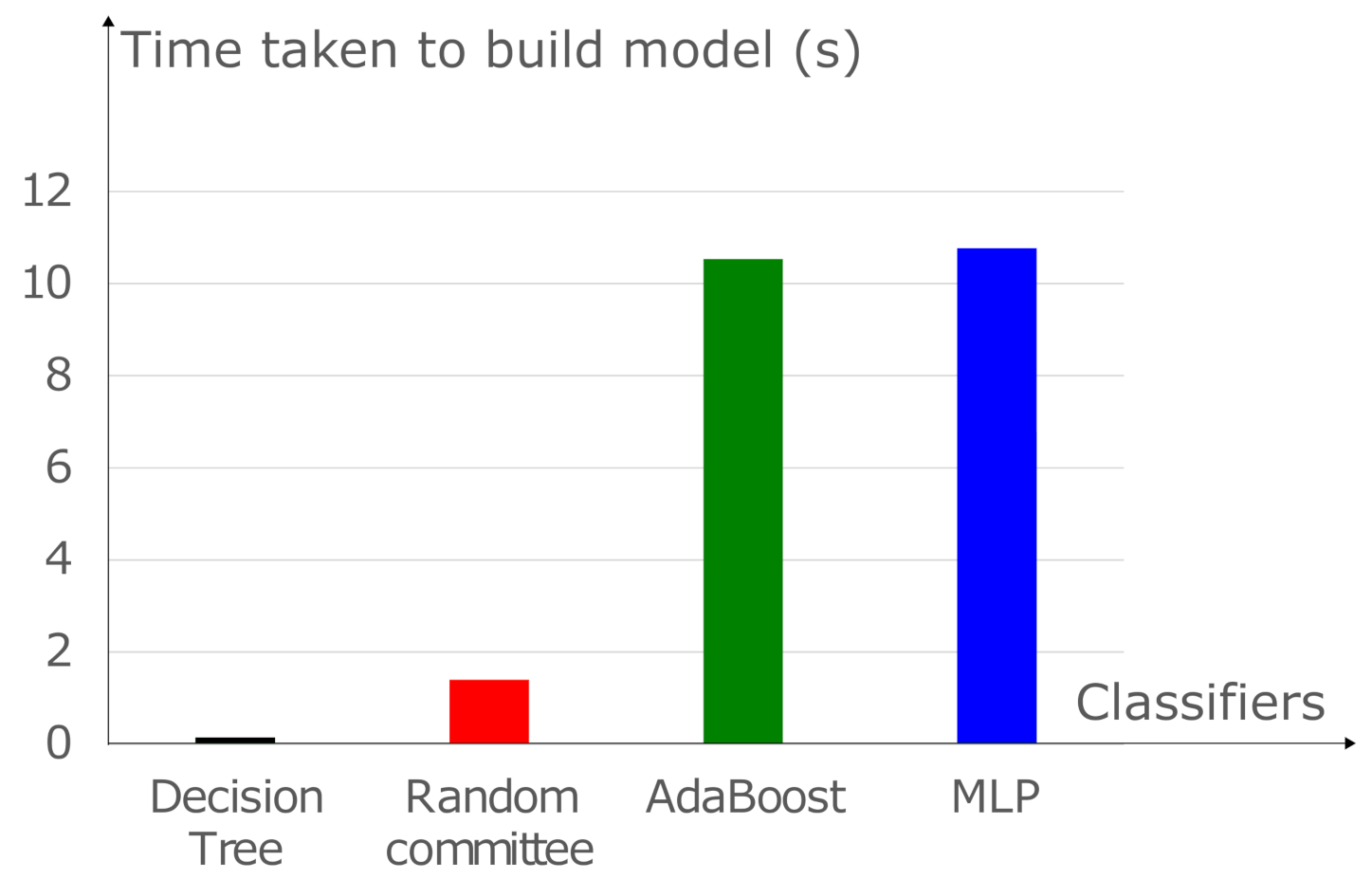
- The modulation detection algorithms proposed in [21,24] are considered as benchmarks, and the comparative study is provided. The performance of the proposed modulation detection algorithm is investigated and evaluated with the number of efficiency metrics, such as the true positive rate, false positive rate, precision, recall, F-Measure, and the time taken. The superiority of the proposed modulation detection algorithm in terms of computational complexity and modulation detection is verified through the simulation results.
1.3. Outline
1.4. Notations
2. System Model and Assumptions
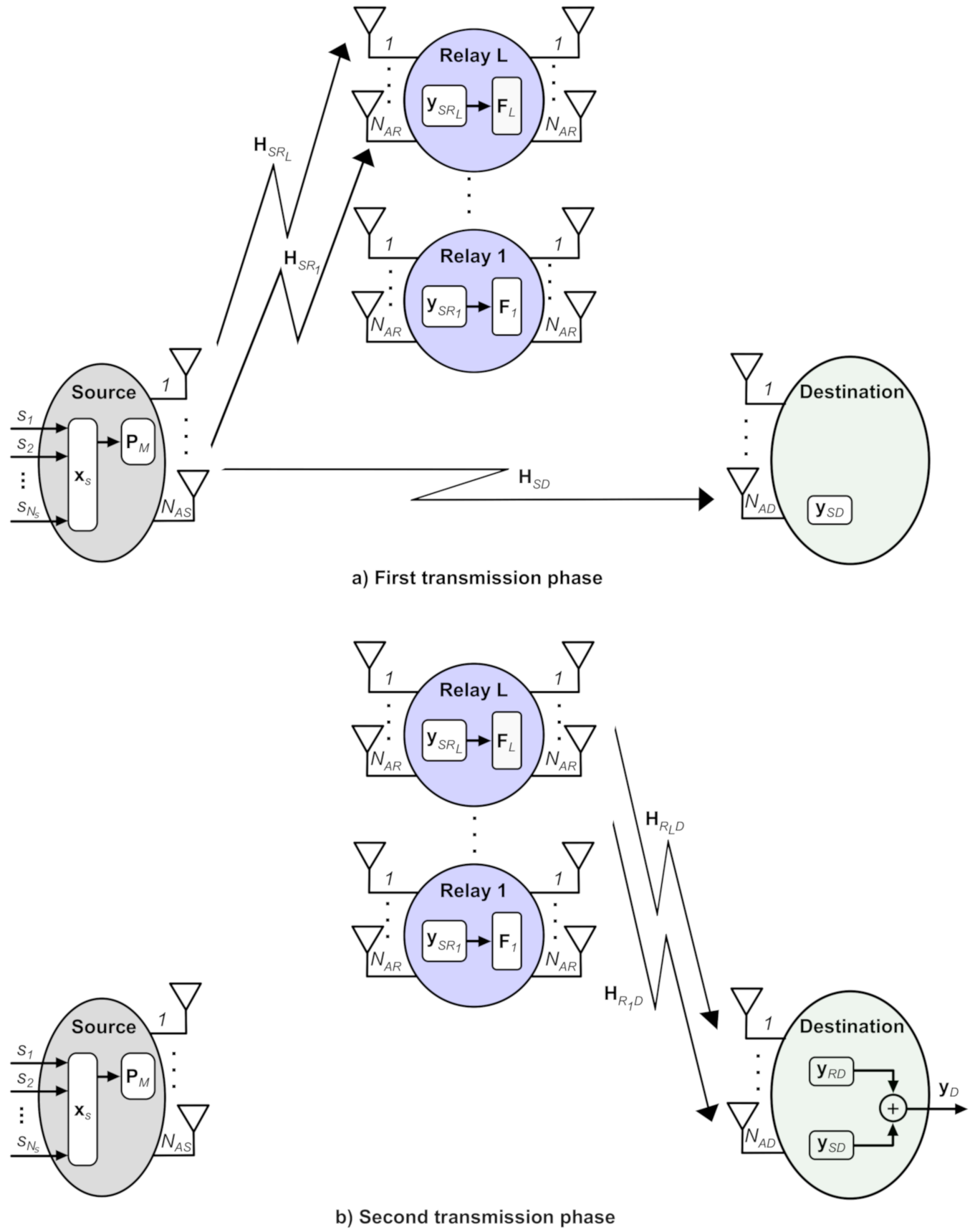
2.1. System Model
2.2. Spatial Correlation Model
2.3. Imperfect Channel Estimation Model
3. Modulation Detection Algorithm
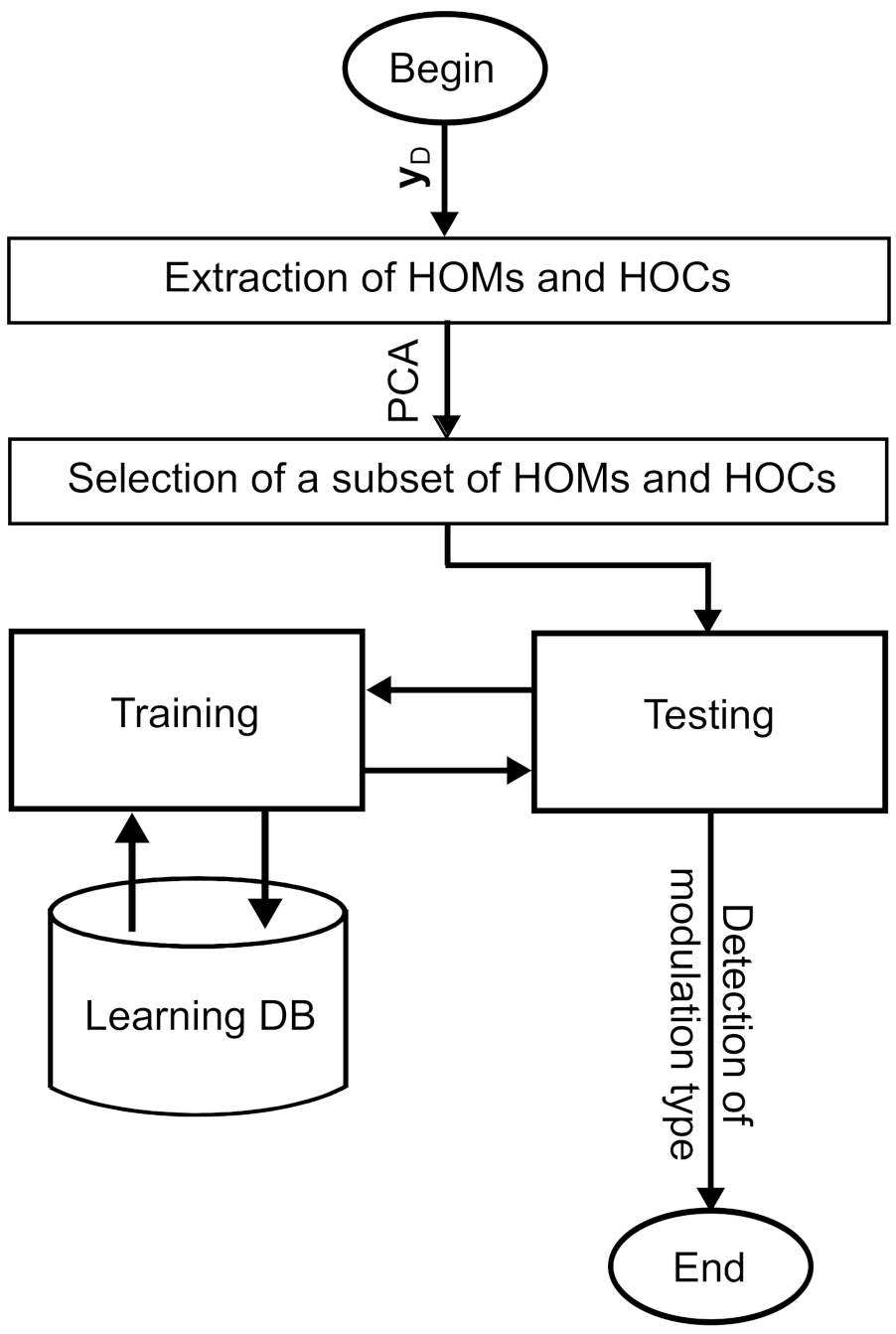
3.1. Features Extraction
3.2. Random Committee Operating with Random Tree MLT
3.3. Adaptive Boosting (AdaBoost) Operating with Decision Tree
3.4. Multilayer Perceptron (MLP)
3.5. Metrics Used for Performance Evaluation of MLTs
4. Simulation Results
5. Conclusions
Author Contributions
Funding
Institutional Review Board Statement
Informed Consent Statement
Data Availability Statement
Conflicts of Interest
Appendix A
References
- Li, Y.N.R.; Gao, B.; Zhang, X.; Huang, K. Beam Management in Millimeter-Wave Communications for 5G and Beyond. IEEE Access 2020, 8, 13282–13293. [Google Scholar] [CrossRef] [Scilit]
- Nadeem, Q.-U.-A.; Kammoun, A.; Alouini, M.S. Elevation beamforming with full dimension MIMO architectures in 5G systems: A tutorial. IEEE Commun. Surv. Tutor. 2019, 21, 3238–3273. [Google Scholar] [CrossRef] [Scilit]
- Moualeu, J.M.; Hamouda, W.; Xu, H.; Takawira, F. Multi-Relay Turbo-Coded Cooperative Diversity Networks Over Nakagami-m Fading Channels. IEEE Trans. Veh. Technol. 2013, 62, 4458–4470. [Google Scholar] [CrossRef] [Scilit]
- Fang, Y.; Chen, P.; Cai, G.; Lau, F.C.; Liew, S.C.; Han, G. Outage-limit-approaching channel coding for future wireless communications: Root-protograph low-density parity-check codes. IEEE Veh. Technol. Mag. 2019, 14, 85–93. [Google Scholar] [CrossRef] [Scilit]
- Arti, M.; Mallik, R.K.; Schober, R. Beamforming and combining in two-way AF MIMO relay networks. IEEE Commun. Lett. 2013, 17, 1400–1403. [Google Scholar] [CrossRef] [Scilit]
- Arti, M.; Bhatnagar, M.R. Maximal Ratio Transmission in AF MIMO Relay Systems Over Nakagami-Fading Channels. IEEE Trans. Veh. Technol. 2015, 64, 1895–1903. [Google Scholar]
- Sugiura, S.; Chen, S.; Hanzo, L. MIMO-aided near-capacity turbo transceivers: Taxonomy and performance versus complexity. IEEE Commun. Surv. Tutor. 2011, 14, 421–442. [Google Scholar] [CrossRef] [Scilit]
- Yang, Y.; Hu, H.; Xu, J.; Mao, G. Relay technologies for WiMAX and LTE-advanced mobile systems. IEEE Commun. Mag. 2009, 47, 100–105. [Google Scholar] [CrossRef] [Scilit]
- Mostafa, H.; Marey, M. Soft-Information Assisted Modulation Recognition for Reconfigurable Radios. IEEE Wirel. Commun. Lett. 2020. [Google Scholar] [CrossRef] [Scilit]
- Eldemerdash, Y.A.; Dobre, O.A.; Üreten, O.; Yensen, T. A robust modulation classification method for PSK signals using random graphs. IEEE Trans. Instrum. Meas. 2018, 68, 642–644. [Google Scholar] [CrossRef] [Scilit]
- Dabbagh, A.D.; Love, D.J. Multiple antenna MMSE based downlink precoding with quantized feedback or channel mismatch. IEEE Trans. Commun. 2008, 56, 1859–1868. [Google Scholar] [CrossRef] [Scilit]
- Nguyen, D.D.; Liu, Y.; Chen, Q. On the energy efficient multi-pair two-way massive MIMO AF relaying with imperfect CSI and optimal power allocation. IEEE Access 2017, 6, 2589–2603. [Google Scholar] [CrossRef] [Scilit]
- Turan, M.; Öner, M.; Çırpan, H.A. Joint modulation classification and antenna number detection for MIMO systems. IEEE Commun. Lett. 2015, 20, 193–196. [Google Scholar] [CrossRef] [Scilit]
- Mohammadkarimi, M.; Karami, E.; Dobre, O.A. A novel algorithm for blind detection of the number of transmit antenna. In Proceedings of the International Conference on Cognitive Radio Oriented Wireless Networks, Doha, Qatar, 21–23 April 2015; pp. 441–450. [Google Scholar]
- Oularbi, M.R.; Gazor, S.; Aissa-El-Bey, A.; Houcke, S. Enumeration of base station antennas in a cognitive receiver by exploiting pilot patterns. IEEE Commun. Lett. 2012, 17, 8–11. [Google Scholar] [CrossRef] [Scilit]
- Marey, M.; Dobre, O.A.; Liao, B. Classification of STBC systems over frequency-selective channels. IEEE Trans. Veh. Technol. 2014, 64, 2159–2164. [Google Scholar] [CrossRef] [Scilit]
- Karami, E.; Dobre, O.A. Identification of SM-OFDM and AL-OFDM signals based on their second-order cyclostationarity. IEEE Trans. Veh. Technol. 2014, 64, 942–953. [Google Scholar] [CrossRef]
- Liu, K.; Da Costa, J.P.C.; So, H.C.; De Almeida, A.L. Semi-blind receivers for joint symbol and channel estimation in space-time-frequency MIMO-OFDM systems. IEEE Trans. Signal Process. 2013, 61, 5444–5457. [Google Scholar] [CrossRef] [Scilit]
- Cai, S.; Matsumoto, T.; Yang, K. SIMO channel estimation using space-time signal subspace projection and soft information. IEEE Trans. Signal Process. 2012, 60, 4219–4235. [Google Scholar] [CrossRef] [Scilit]
- Ullah, R.; Marwat, S.N.K.; Ahmad, A.M.; Ahmed, S.; Hafeez, A.; Kamal, T.; Tufail, M. A Machine Learning Approach for 5G SINR Prediction. Electronics 2020, 9, 1660. [Google Scholar] [CrossRef] [Scilit]
- Ben Chikha, H. Performance of AdaBoost in modulation recognition for spatially-correlated cooperative MIMO systems. In Proceedings of the 2018 IEEE Wireless Communications and Networking Conference (WCNC), Barcelona, Spain, 15–18 April 2018; pp. 1–6. [Google Scholar]
- Ben Chikha, W.; Chaoui, S.; Attia, R. Identification of superposed modulations for two-way relaying MIMO systems with physical-layer network coding. IET Commun. 2017, 11, 225–231. [Google Scholar] [CrossRef] [Scilit]
- Lau, K.; Salibian-Barrera, M.; Lampe, L. Modulation recognition in the 868 MHz band using classification trees and random forests. AEU-Int. J. Electron. Commun. 2016, 70, 1321–1328. [Google Scholar] [CrossRef] [Scilit]
- Ben Chikha, W.; Dayoub, I.; Hamouda, W.; Attia, R. Modulation Recognition for MIMO Relaying Broadcast Channels with Direct Link. IEEE Wirel. Commun. Lett. 2014, 3, 50–53. [Google Scholar] [CrossRef] [Scilit]
- Ben Chikha, W.; Dayoub, I.; Attia, R. Modulation detection in intelligent transportation systems based on cooperative MIMO networks over nakagami-m fading. In Proceedings of the 2014 International Conference on Electrical Sciences and Technologies in Maghreb (CISTEM), Tunis, Tunisia, 3–6 November 2014; pp. 1–6. [Google Scholar]
- Ha, C.B.; You, Y.H.; Song, H.K. Machine learning model for adaptive modulation of multi-stream in MIMO-OFDM system. IEEE Access 2018, 7, 5141–5152. [Google Scholar] [CrossRef] [Scilit]
- Laneman, J.N.; Tse, D.N.; Wornell, G.W. Cooperative diversity in wireless networks: Efficient protocols and outage behavior. IEEE Trans. Inf. Theory 2004, 50, 3062–3080. [Google Scholar] [CrossRef] [Scilit]
- Peel, C.B.; Hochwald, B.M.; Swindlehurst, A.L. A vector-perturbation technique for near-capacity multiantenna multiuser communication-part I: Channel inversion and regularization. IEEE Trans. Commun. 2005, 53, 195–202. [Google Scholar] [CrossRef] [Scilit]
- Wan, H.; Chen, W.; Ji, J. Efficient linear transmission strategy for MIMO relaying broadcast channels with direct links. IEEE Wirel. Commun. Lett. 2012, 1, 14–17. [Google Scholar] [CrossRef] [Scilit]
- Shiu, D.S.; Foschini, G.J.; Gans, M.J.; Kahn, J.M. Fading correlation and its effect on the capacity of multielement antenna systems. IEEE Trans. Commun. 2000, 48, 502–513. [Google Scholar] [CrossRef] [Scilit]
- Loyka, S.L. Channel capacity of MIMO architecture using the exponential correlation matrix. IEEE Commun. Lett. 2001, 5, 369–371. [Google Scholar] [CrossRef] [Scilit]
- Van Zelst, A.; Hammerschmidt, J. A single coefficient spatial correlation model for multiple-input multiple-output (MIMO) radio channels. In Proceedings of the URSI General Assembly, Maastricht, The Netherlands, 17–24 August 2002; pp. 17–24. [Google Scholar]
- Zhang, B.; He, Z.; Niu, K.; Zhang, L. Robust linear beamforming for MIMO relay broadcast channel with limited feedback. IEEE Signal Process. Lett. 2010, 17, 209–212. [Google Scholar] [CrossRef] [Scilit]
- Thornton, C.; Hutter, F.; Hoos, H.H.; Leyton-Brown, K. Auto-WEKA: Combined selection and hyperparameter optimization of classification algorithms. In Proceedings of the 19th ACM SIGKDD International Conference on Knowledge Discovery and Data Mining, Chicago, IL, USA, 11–14 August 2013; pp. 847–855. [Google Scholar]
- Swami, A.; Sadler, B. Hierarchical digital modulation classification using cumulants. IEEE Trans. Commun. 2000, 48, 416–429. [Google Scholar] [CrossRef] [Scilit]
- Dobre, O.A.; Abdi, A.; Bar-Ness, Y.; Su, W. Survey of automatic modulation classification techniques: Classical approaches and new trends. IET Commun. 2007, 1, 137–156. [Google Scholar] [CrossRef] [Scilit]
- McCullagh, P. Tensor Methods in Statistics; Chapman Hall: London, UK, 1987. [Google Scholar]
- Spooner, C.M. On the Utility of Sixth-Order Cyclic Cumulants for RF Signal Classification. In Proceedings of the Conference Record of Thirty-Fifth Asilomar Conference on Signals, Systems and Computers, Pacific Grove, CA, USA, 4–7 November 2001; Volume 1, pp. 890–897. [Google Scholar]
- Kwak, N. Principal component analysis based on L1-norm maximization. IEEE Trans. Pattern Anal. Mach. Intell. 2008, 30, 1672–1680. [Google Scholar] [CrossRef] [Scilit] [PubMed]
- Cutler, A.; Zhao, G. Fast Classification Using Perfect Random Trees; Utah State University: Logan, UT, USA, 1999. [Google Scholar]
- Freund, Y.; Schapire, R.E. A desicion-theoretic generalization of on-line learning and an application to boosting. In Proceedings of the European Conference on Computational Learning Theory, Barcelona, Spain, 13–15 March 1995; pp. 23–37. [Google Scholar]
- Riedmiller, M.; Braun, H. A direct adaptive method for faster backpropagation learning: The RPROP algorithm. In Proceedings of the IEEE international conference on neural networks, San Francisco, CA, USA, 28 March–1 April 1993; pp. 586–591. [Google Scholar]
- Refaeilzadeh, P.; Tang, L.; Liu, H. Cross-Validation. Encycl. Database Syst. 2009, 5. [Google Scholar] [CrossRef] [Scilit]


| Abbreviation | Description |
|---|---|
| AdaBoost | Adaptive Boosting |
| ANN | Artificial neural networks |
| BM | Beamforming matrix |
| CSI | Channel state information |
| DB | Learning database |
| FP | False positive |
| HOCs | Higher order cumulants |
| HOMs | Higher order moments |
| HOSs | Higher order statistics |
| i.i.d. | Independent, identically distributed |
| LTE | Long term evolution |
| LTE-A | LTE-advanced |
| MLP | Multilayer perceptron |
| MLT | Machine learning technique |
| MIMO | Multiple-input multiple-output |
| RPROP | resilient backpropagation |
| RZF | Regularized zero forcing |
| SNR | Signal-to-noise ratio |
| SM | Spatial multiplexing |
| TP | True positive |
| ZF-RZF | Zero forcing and regularized zero forcing |
| MLTs | Time Complexities |
|---|---|
| Random committe | |
| AdaBoost |
| TP Rate | FP Rate | Precision | Recall | F-Measure | |
|---|---|---|---|---|---|
| BPSK | 0.952 | 0.014 | 0.945 | 0.952 | 0.949 |
| QPSK | 0.703 | 0.081 | 0.686 | 0.703 | 0.694 |
| 8PSK | 0.652 | 0.071 | 0.696 | 0.652 | 0.674 |
| 16QAM | 0.960 | 0.014 | 0.945 | 0.960 | 0.952 |
| 64QAM | 0.976 | 0.010 | 0.962 | 0.976 | 0.969 |
| Avg. | 0.849 | 0.038 | 0.847 | 0.849 | 0.847 |
| TP Rate | FP Rate | Precision | Recall | F-Measure | |
|---|---|---|---|---|---|
| BPSK | 0.951 | 0.013 | 0.949 | 0.951 | 0.950 |
| QPSK | 0.659 | 0.079 | 0.677 | 0.659 | 0.668 |
| 8PSK | 0.663 | 0.083 | 0.667 | 0.663 | 0.665 |
| 16QAM | 0.965 | 0.014 | 0.945 | 0.965 | 0.954 |
| 64QAM | 0.978 | 0.008 | 0.967 | 0.978 | 0.972 |
| Avg. | 0.843 | 0.039 | 0.841 | 0.843 | 0.842 |
| a | b | c | d | e | Detected as |
|---|---|---|---|---|---|
| 3807 | 55 | 78 | 40 | 20 | a = BPSK |
| 75 | 2813 | 1026 | 54 | 32 | b = QPSK |
| 109 | 1211 | 2609 | 49 | 22 | c = 8PSK |
| 30 | 19 | 31 | 3838 | 82 | d = 16QAM |
| 6 | 5 | 2 | 82 | 3905 | e = 64QAM |
| Correctly detected modulations | 16,972 | 84.86% | |||
| Incorrectly detected modulations | 3028 | 15.14% | |||
| a | b | c | d | e | Detected as |
|---|---|---|---|---|---|
| 3803 | 62 | 82 | 39 | 14 | a = BPSK |
| 71 | 2635 | 1214 | 55 | 25 | b = QPSK |
| 107 | 1168 | 2650 | 56 | 19 | c = 8PSK |
| 21 | 24 | 21 | 3858 | 76 | d = 16QAM |
| 6 | 3 | 4 | 76 | 3911 | e = 64QAM |
| Correctly detected modulations | 16,857 | 84.285% | |||
| Incorrectly detected modulations | 3143 | 15.715% | |||
Publisher’s Note: MDPI stays neutral with regard to jurisdictional claims in published maps and institutional affiliations. |
© 2021 by the authors. Licensee MDPI, Basel, Switzerland. This article is an open access article distributed under the terms and conditions of the Creative Commons Attribution (CC BY) license (http://creativecommons.org/licenses/by/4.0/).
Share and Cite
Chikha, H.B.; Almadhor, A.; Khalid, W. Machine Learning for 5G MIMO Modulation Detection. Sensors 2021, 21, 1556. https://doi.org/10.3390/s21051556
Chikha HB, Almadhor A, Khalid W. Machine Learning for 5G MIMO Modulation Detection. Sensors. 2021; 21(5):1556. https://doi.org/10.3390/s21051556
Chicago/Turabian StyleChikha, Haithem Ben, Ahmad Almadhor, and Waqas Khalid. 2021. "Machine Learning for 5G MIMO Modulation Detection" Sensors 21, no. 5: 1556. https://doi.org/10.3390/s21051556
APA StyleChikha, H. B., Almadhor, A., & Khalid, W. (2021). Machine Learning for 5G MIMO Modulation Detection. Sensors, 21(5), 1556. https://doi.org/10.3390/s21051556