


Abstract
Araucaria angustifolia (Bertol.) Kuntze, a critically endangered tree species, plays an irreplaceable ecological role in its native habitats. Under global climate change, identifying the drivers governing its geographic distribution and assessing climate-related threats can provide scientific guidance for the long-term conservation and habitat restoration of this species. In this study, a total of 287 valid occurrence records from 27 countries were compiled. Combined with 14 screened environmental variables, an optimized Maximum Entropy (MaxEnt) model was used to predict the potential suitable habitats of A. angustifolia under historical climate conditions (1970–2000), as well as under low-emission (SSP126) and high-emission (SSP585) scenarios for the future periods of 2050, 2070, and 2090. Under historical climatic conditions, the average training AUC value from 10 replicate model runs was 0.979, indicating excellent and reliable model performance. Globally, the species has 1.91 × 10⁶ km2 of moderately suitable habitat and 0.95 × 10⁶ km2 of highly suitable habitat, with a total suitable habitat area of 2.86 × 10⁶ km2, accounting for only 1.92% of the global terrestrial area. Mean annual temperature (bio1), mean temperature of the coldest quarter (bio11), and annual temperature range (bio7) are the dominant environmental variables shaping the distribution of A. angustifolia, followed by annual precipitation (bio12). Under future climate scenarios, the overall suitable habitats of A. angustifolia exhibit a slight contracting trend, whereas their spatial distribution patterns remain relatively stable.
1. Introduction
Since the 20th century, climate change has become one of the most severe environmental challenges facing the world today [1]. The Sixth Assessment Report of the Intergovernmental Panel on Climate Change (IPCCcurrent) clearly states that global warming is becoming increasingly significant: the global surface temperature in 2011–2020 was 1.1 °C higher than that in 1850–1900. Under greenhouse gas emission scenarios, global warming is projected to reach 2.2–3.5 °C by 2100 [2].
Climate is considered the most important factor limiting species distribution [3], with temperature and precipitation in particular being the primary environmental variables affecting the geographical distribution and growth of species worldwide [4,5]. Shifts in species distribution under climate change are increasingly regarded as a major form of biological change at the global scale [6,7]. As global temperatures rise, species may no longer adapt to the environmental conditions of specific regions, leading to alterations in their geographical ranges and population sizes [8]. Such changes may even exacerbate outbreaks of certain harmful species or drive the extinction of some rare and endangered species [9].
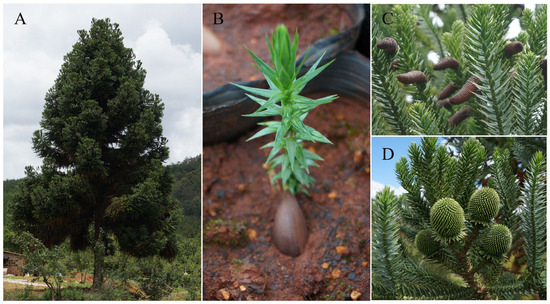
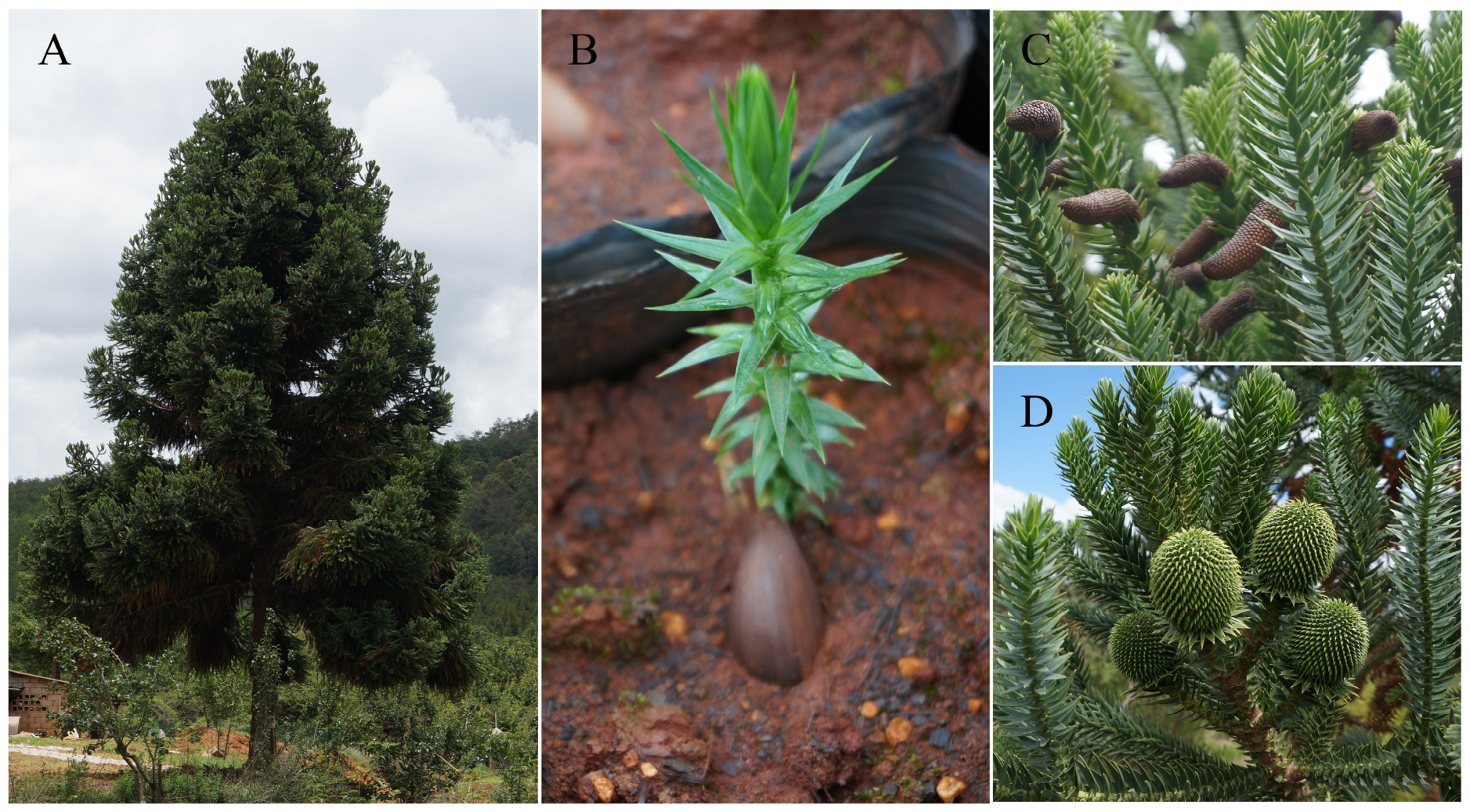
A. angustifolia is a critically endangered tree species that plays vital ecological, economic, and cultural roles within its native range [10,11]. Native to Brazil, Argentina, and other countries, it has also been widely introduced to the United States, Russia, New Zealand, and beyond. It thrives at elevations of 500–2300 m [12]. With outstanding comprehensive utilization value, the seeds of A. angustifolia can be used as herbal medicine and as food for both humans and wildlife [10,13,14,15,16]. Its branches can be developed into bioenergy and its high-quality timber offers great economic value [17,18]. Moreover, the species demonstrates excellent carbon sequestration ability, making it an important natural carbon sink forest tree [19,20], the plant growth morphology is shown in Figure 1. However, the growth and development of this species are jointly constrained by multiple environmental factors, including air humidity, temperature fluctuations, extreme rainfall, soil conditions, and interspecific competition [21,22]. At present, extensive illegal logging, the conversion of agricultural land to industrial use, and severe forest degradation have reduced the forest cover of A. angustifolia to only 12.6% of its original extent, with remaining populations confined to forest fragments [23]. In addition, global warming poses an extra threat to this species. It has been predicted that the suitable habitat area of A. angustifolia will decrease drastically by 77% in the coming decades, posing a fatal threat to the survival of this critically endangered tree species [24].
Figure 1.
Representative plants of A. angustifolia in China, illustrating the typical morphology of the plant: (A) individual plant status; (B) seedling stage; (C) staminate flower; (D) fruit.
Ecological Niche Models (ENM) have been widely used to identify suitable habitats for species [25], predict the impacts of climate change on species distributions [26], assess the invasiveness of non-native species [27], and assist in protected area planning [28], serving as an important tool for ecological restoration and species conservation. Among the known ecological niche models, MaxEnt has a relatively simple principle, strong operability, and high prediction accuracy. It has been applied to predict suitable habitats for various rare and endangered species, potential distributions of invasive species, and invasion regions of pests under climate change [29,30,31,32].
In this study, we collected and filtered extant global records of A. angustifolia and combined them with relevant environmental variables. Using these data, we predicted the current and future potential distribution areas of the species under different climate scenarios. We further evaluated changes in suitable habitats, explored the temporal and spatial dynamics of its distribution pattern, and identified key environmental variables influencing its distribution. This research is of great significance for the conservation and sustainable development of A. angustifolia.
2. Materials and Methods
2.1. Acquisition and Screening of Global Occurrence Data for Araucaria angustifolia
This study collected georeferenced occurrence records of A. angustifolia from three independent data sources: (1) Open-access species distribution records from the Global Biodiversity Information Facility (GBIF; https://www.gbif.org/occurrence/search?occurrenceStatus=PRESENT&q=Araucaria+angustifolia, accessed 21 December 2025), which provided raw occurrence data covering 27 countries across six continents: South America, North America, Africa, Europe, Oceania and Asia; (2) Systematic collation of domestic and international literature related to A. angustifolia via the PubScholar academic retrieval platform. Species distribution coordinates documented in publications were extracted, with corresponding geographic coordinates captured using Google Maps (7.3.6); records containing ambiguous positional information and spatially duplicated redundant entries were eliminated; (3) Field surveys to supplement three artificially introduced occurrence sites in Kunming, Anning and the Gaoligong Mountains of Yunnan Province, China. A total of 1595 raw geospatial occurrence records were retained after integrating data from all three sources.
In this study, we applied equal-area gradient grids of 5 km, 10 km, 15 km and 20 km to perform raster thinning preprocessing on raw species occurrence points. We adopted the global Moran’s I spatial autocorrelation test to quantitatively characterize the spatial clustering bias of occurrence points at each grid scale, and the comparative results across the four gradient scales are presented in Table 1. After thinning with the 20 km grid, only 188 valid occurrence records were retained, with a global Moran’s I index of 0.0368 and a Z-score of 60.02. Although this scale produced the lowest degree of spatial clustering, the coarse grid drastically truncated the species’ actual distribution range and may underestimate its true distribution extent. After comprehensively balancing the spatial autocorrelation correction performance and the integrity of retained distribution information, we ultimately selected the 15 km grid-thinned dataset for subsequent species distribution modeling. This scale can substantially mitigate spatial clustering bias arising from uneven field sampling while preventing the loss of authentic occurrence points, thereby removing the interference of spatial autocorrelation among occurrence points on model predictions [33].
Table 1.
Results of occurrence point spatial thinning and global Moran’s I spatial autocorrelation test under different equal-area grid scales.
2.2. Acquisition and Screening of Environmental Variables
Environmental variables including climate, topography and soil properties were selected for MaxEnt model construction. Nineteen climate variables were obtained from the WorldClim database (https://worldclim.org/), including historical climate data (1970–2000) and future climate datasets averaged over 2041–2060 (representing the 2050 period), 2061–2080 (representing the 2070 period), and 2081–2100 (representing the 2090 period). Future climate data were obtained under two extreme scenarios, SSP126 (low emission) and SSP585 (high emission), from the Scenario Model Intercomparison Project (ScenarioMIP) within CMIP6 [34]. Three topographic variables were derived from the Digital Elevation Model (DEM), downloaded from the Geospatial Data Cloud (https://www.gscloud.cn/). Thirteen soil variables were obtained from HWSD, an open-access soil database developed by the Food and Agriculture Organization of the United Nations (FAO) (https://www.fao.org).
Excessive environmental variables may easily lead to model redundancy and multicollinearity issues [35]. To reduce multicollinearity among environmental variables and mitigate potential model overfitting, the 35 bioclimatic variables were imported into ArcGIS 10.8, and values corresponding to the occurrence records of A. angustifolia were extracted. Pearson correlation analysis was subsequently performed, and only variables with correlation coefficients (|r| < 0.70) were retained for modeling. A total of 14 environmental variables (bio1, bio3, bio5, bio7, bio11, bio12, bio16, bio19, total_n, fao, elev, bsat, aspect, clay) were retained and applied in the subsequent MaxEnt modeling.
2.3. Parameter Tuning Using ENMeval
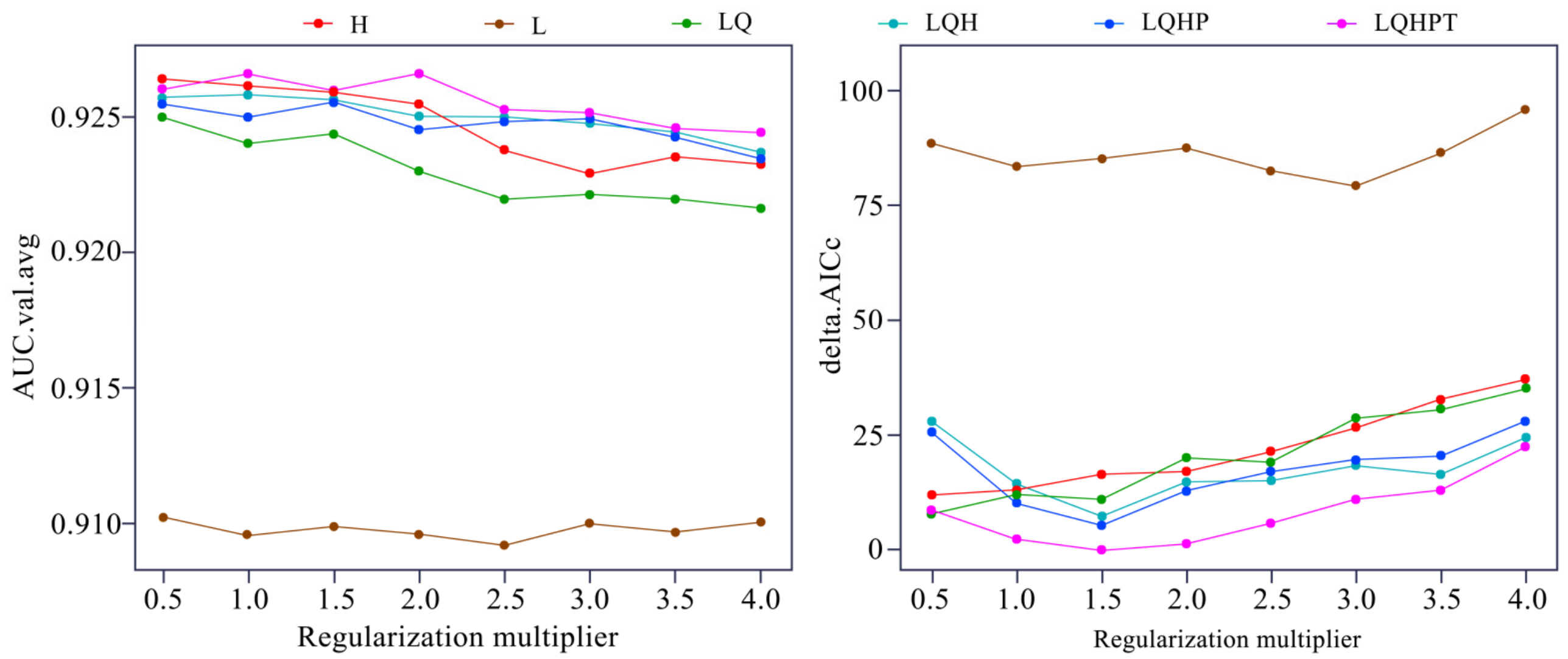
Unoptimized MaxEnt models are prone to predictive bias and can compromise output reliability [36]. In this study, the ENMeval package in R 4.2.3 was used to optimize two core parameters: feature combinations (FC) and regularization multipliers (RM). Six feature combinations consisting of Linear (L), Quadratic (Q), Hinge (H), Product (P), and Threshold (T) were tested, including L, LQ, H, LQH, LQHP, and LQHPT. The RM values ranged from 0.5 to 4 at an increment of 0.5, yielding a total of eight regularization multiplier levels. All 48 parameter combinations were evaluated using the ENMeval package. Model performance was assessed based on the area under the receiver operating characteristic curve (AUC) and the delta of the corrected Akaike Information Criterion (Delta.AICc). A hierarchical parameter-selection strategy was applied: the parameter combination with the minimum global Delta.AICc was chosen to reduce model overfitting. When multiple models exhibited equivalent optimal Delta.AICc values, the mean AUC from ten-fold cross-validation was adopted as the auxiliary criterion for final selection. Within these equivalently optimal models, the combination with the highest average AUC was ultimately selected as the optimal feature set and regularization multiplier [37].
2.4. Prediction Analysis Based on the MaxEnt Model
The ASC raster files generated from MaxEnt predictions were imported into ArcGIS, and the Jenks natural breaks classification method was applied to categorize suitability into four grades: unsuitable habitat (0 < IA ≤ 0.06), low-suitability habitat (0.06 < IA ≤ 0.25), moderate-suitability habitat (0.25 < IA ≤ 0.5), and high-suitability habitat (0.50 < IA ≤ 1). The areas of all habitat grades under different climatic scenarios across various periods were quantified in ArcGIS. ArcGIS visualization functions were then adopted to compare historical and future species distributions and identify the changing trends.
3. Results
3.1. Model Optimization Outcomes and Predictive Accuracy
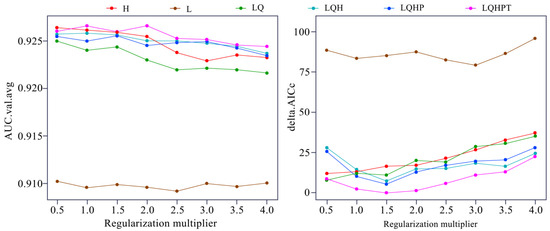
In this parameter optimization procedure, delta.AICc was adopted as the primary evaluation indicator, and AUC served as the auxiliary discriminative metric. The optimal model was obtained with feature class (FC) set to LQHPT and regularization multiplier (RM) of 1.5, which yielded an omission rate of 1.8% and the minimum ΔAICc, the results are presented in Figure 2. In this study, the MaxEnt model with these optimized parameters was used to predict the historical potential suitable habitats of A. angustifolia. After ten replicate model runs, the training AUC ranged from 0.978 to 0.980 with a mean value of 0.979; the test AUC varied between 0.956 and 0.984, averaging 0.971. All AUC values exceeded 0.9, indicating reliable simulation performance for projecting the future suitable distribution of A. angustifolia [36].
Figure 2.
Evaluation metrics calculated by ENMeval for the species distribution model of A. angustifolia: H, Hinger; L, Linear; Q, Quadratic; P, Product; T, Threshold.
3.2. Environmental Variables Affecting the Potential Suitable Distribution of A. angustifolia
The optimized MaxEnt model was employed in this study to analyze the impact of 16 environmental variables on the potential geographical distribution of A. angustifolia, using the contribution rate and jackknife test as evaluation criteria. The 16 environmental variables can be categorized into three groups: climate, soil, and topography, with cumulative contributions of 97.6%, 2.2%, and 0.3%, respectively. It indicates that environmental variables exert the dominant impact on A. angustifolia.
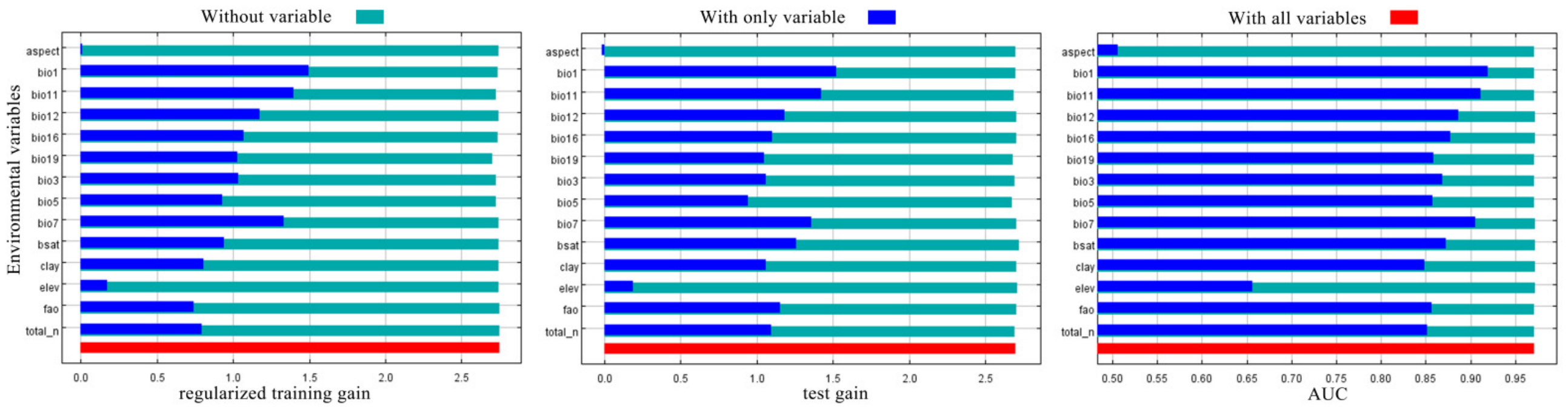
The Jackknife test was used in this study to quantify the explanatory contribution of each environmental variable to the MaxEnt model of A. angustifolia. The importance of variables was comprehensively evaluated based on three indicators: regularized training gain, test gain, and AUC. As shown in Figure 3, the mean annual temperature (bio1), mean temperature of the coldest quarter (bio11), and temperature annual range (bio7) achieved the highest regularized training gain, test gain, and AUC when modeled independently. These three variables were the core climatic factors driving the distribution of A. angustifolia, while annual precipitation (bio12) served as a secondary auxiliary factor. These four variables carry abundant growth-related information and dominate the current distribution of A. angustifolia.
Figure 3.
Jackknife test for the main environmental variables.
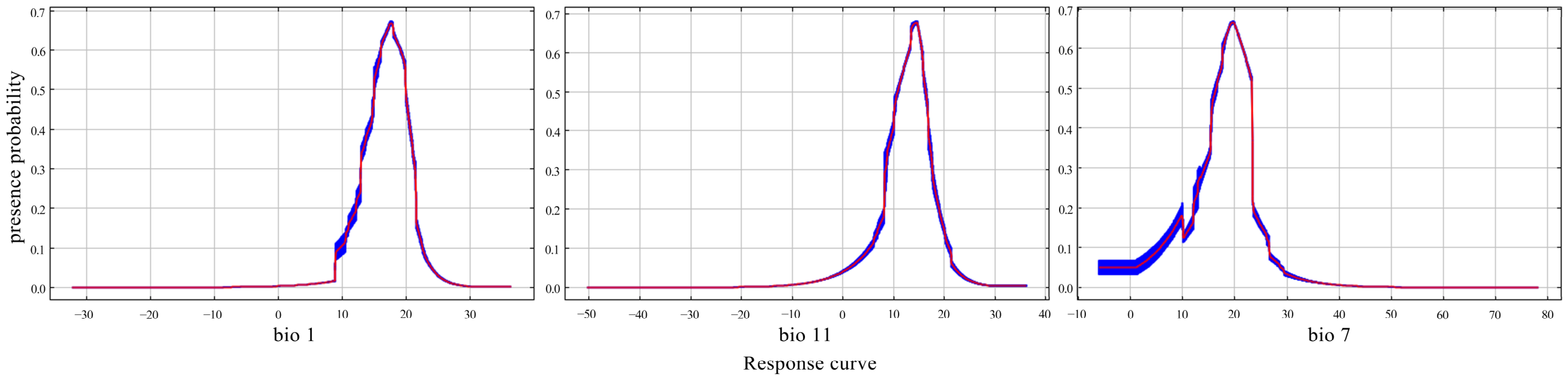
To investigate the relationship between the presence probability of A. angustifolia and three key environmental variables, this study analyzed single-factor response curves of the dominant variables. Threshold values of key environmental factors were determined based on the corresponding curves (Figure 4). Habitats with a presence probability greater than 0.5 were defined as suitable areas for A. angustifolia. The optimal growing conditions for A. angustifolia include a mean annual temperature (bio1) of 15–20 °C, a mean temperature of the coldest quarter (bio11) of 10–17 °C, and an annual temperature range (bio7) of 16–23 °C. The habitat suitability declines sharply when the mean annual temperature falls below 12 °C or exceeds 23 °C, the mean temperature of the coldest quarter drops below 6 °C or rises above 22 °C, or the annual temperature range exceeds 26 °C. These results reveal that temperature is the core climatic driver constraining the potential geographical distribution of A. angustifolia. This species favors subtropical humid mountain climates with mild winters and moderate seasonal temperature fluctuations. Extreme low temperatures, sustained high temperatures, and dramatic seasonal temperature differences substantially reduce its suitable habitat extent.
Figure 4.
Influence curve of main environmental factors on the distribution of A. angustifolia.
3.3. Suitable Habitat Analysis of Araucaria angustifolia in Historical Climate Scenarios
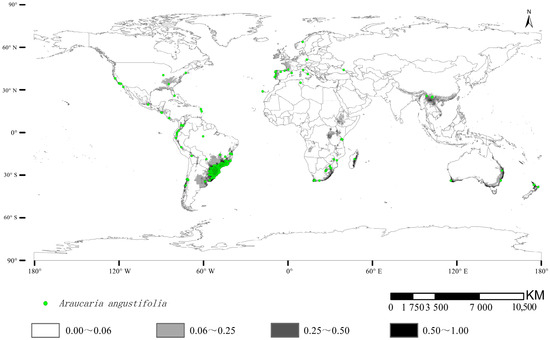
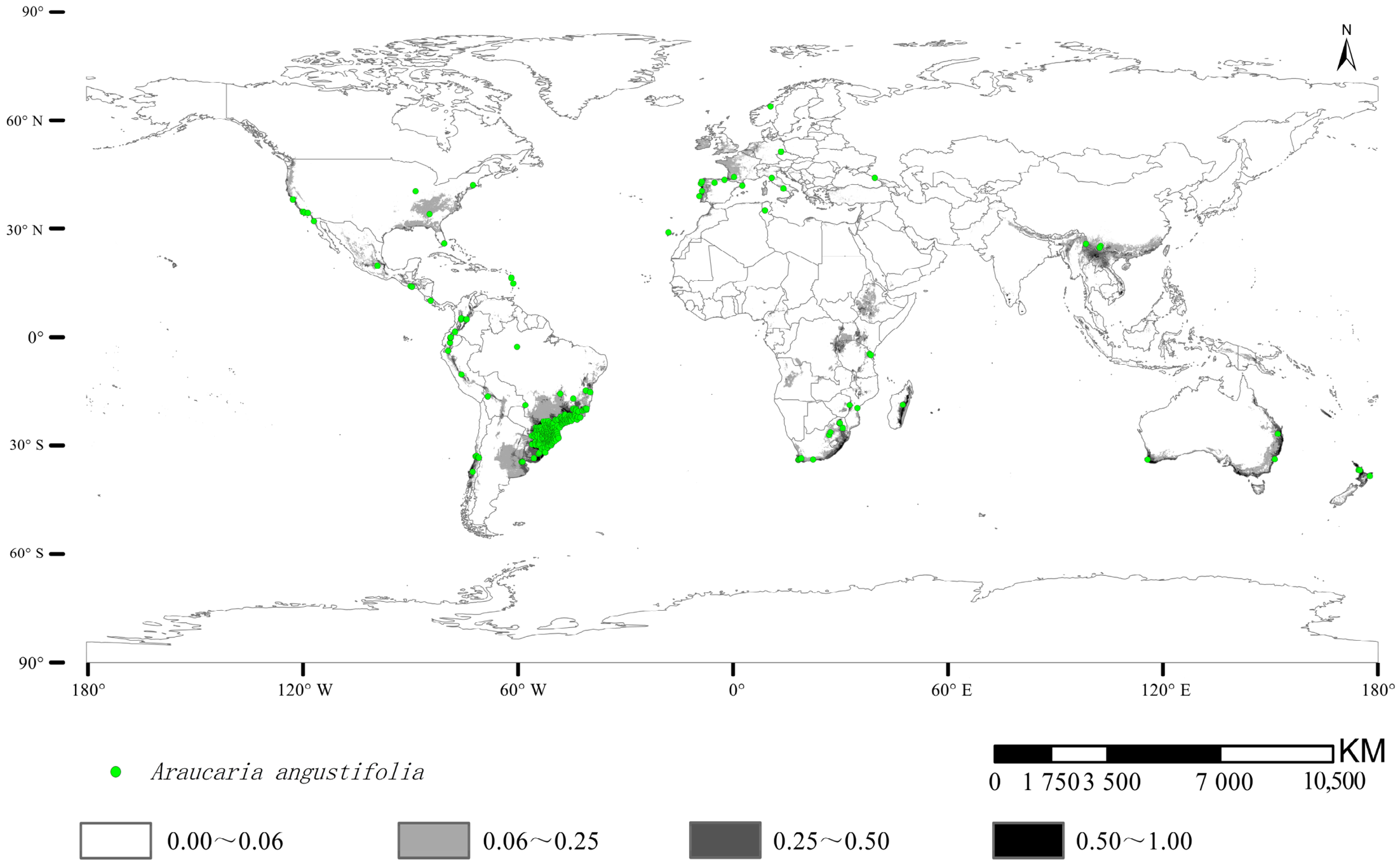
Under historical climatic conditions, the global potential distribution area of A. angustifolia reached 2.86 × 10⁶ km2, accounting for only 1.92% of the global land area. Among these suitable areas, the highly suitable habitat covered 0.95 × 10⁶ km2, and the moderately suitable habitat covered 1.91 × 10⁶ km2. Contiguous high-suitability habitats are mainly distributed in Rio de Janeiro, São Paulo, Minas Gerais, and Alagoas states of Brazil in South America, as well as partial Pacific coastal zones of Uruguay, Chile, and Peru. Scattered high-suitability patches also occur along the southern coasts of Madagascar and South Africa. Contiguous moderate-suitability habitats are concentrated in Argentina, Uruguay, and Brazil. Fragmented moderate-suitability areas are distributed across multiple regions worldwide, including Chile, Peru, Bolivia, Ecuador, Colombia, and Venezuela in South America; Mexico and the United States in North America; South Africa, the Congo, Morocco, Ethiopia, and Kenya in Africa; France and Spain in Europe; China, Myanmar, Vietnam, and Laos in Asia; and Australia and New Zealand in Oceania. As shown in Figure 5, the predicted suitable habitat map of A. angustifolia showed high consistency with historical occurrence records, further verifying the reliability of the MaxEnt modeling results.
Figure 5.
Distribution of suitable habitats for A. angustifolia under historical climate conditions.
3.4. Suitable Habitat Range of A. angustifolia Under Future Climate Scenarios
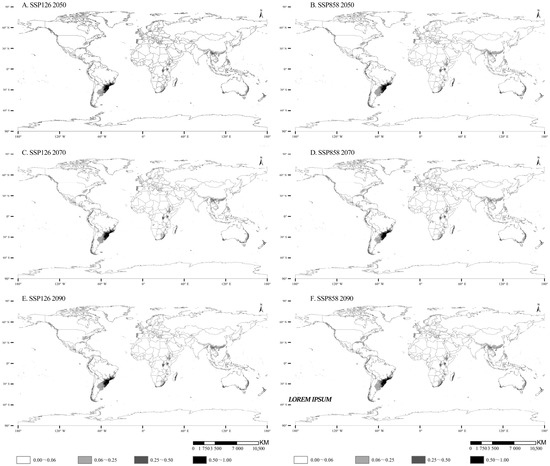
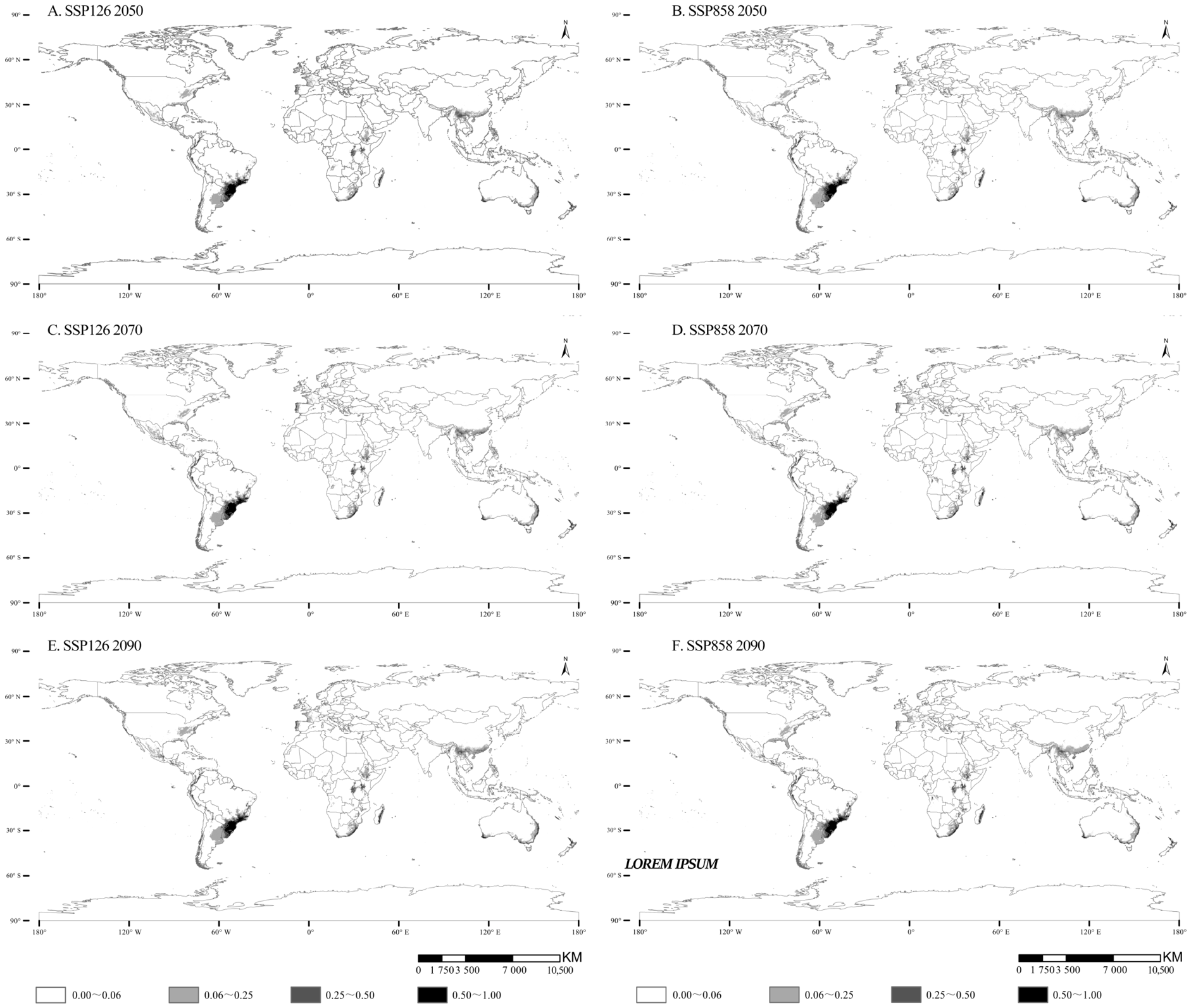
With climate change, species tend to shift their distributions toward regions with more favorable growing conditions. Suitable habitats of A. angustifolia across different periods were compared using ArcGIS to further analyze changes in its global distribution pattern under future climate conditions. Under both emission pathways, the total suitable habitat area in all future periods was smaller than the historical suitable area of 2.86 × 10⁶ km2. This indicates that rising temperatures will trigger an overall contraction of suitable habitats for this species under both low- and high-carbon emission scenarios. Under the high-emission scenario (SSP585), the minimum suitable area of 2.45 × 10⁶ km2 is projected for the 2070s, reflecting substantially more severe habitat loss than the same period under the low-emission scenario (SSP126, 2.55 × 10⁶ km2). This finding demonstrates that extreme warming will accelerate the loss of suitable habitats by the mid-century. As shown in Figure 6, such range contractions were most pronounced in South American regions such as Brazil and Argentina, with the steepest declines predicted for the 2050s and 2070s under low radiative forcing, and for the 2090s under high radiative forcing. Overall, the total suitable habitat of A. angustifolia in South America across all time slices will remain below historical levels throughout the 21st century under either emission pathway. This further reveals that climate change will exert persistent habitat stress on the native South American distribution range of A. angustifolia.
Figure 6.
Distribution of suitable habitats for A. angustifolia under future climate: (A) distribution of suitable habitats in SSP126 2050; (B)distribution of suitable habitats in SSP585 2050; (C) distribution of suitable habitats in SSP126 2070; (D) distribution of suitable habitats in SSP585 2070; (E) distribution of suitable habitats in SSP126 2090; (F) distribution of suitable habitats in SSP585 2090.
Under the two climate emission scenarios (Table 2), the suitable habitat area of A. angustifolia in all regions follows a consistent changing pattern: a sharp decline by the 2050s, followed by a slow rebound by the 2090s. Under the low radiative forcing scenario (SSP126), suitable habitats in Argentina, Chile, Ecuador, Ethiopia and Kenya expand slightly in the 2070s and 2090s compared with the 2050s. Under the high radiative forcing scenario (SSP585), relative to the 2050s, suitable habitat areas in South American regions such as Brazil and Argentina increase moderately in the 2070s, while those in China, Vietnam, Portugal, France and other regions decrease slightly. Meanwhile, the suitable habitats within Madagascar show a northward shifting trend. By the 2090s, suitable habitat areas rise marginally in Brazil, Argentina, Peru, Costa Rica and other territories, whereas suitable zones in Morocco, Australia and other regions contract further to a small extent. Overall, the core suitable habitats of A. angustifolia remain concentrated in traditional dominant areas including southeastern Brazil, Uruguay, Madagascar and the southeastern coastal zone of South Africa, with no large-scale spatial range shift observed across the globe.
Table 2.
Potential suitable area of A. angustifolia under different climate scenarios in the future. Unit: ×106 km2.
4. Discussion
Against the backdrop of global climate change, variations in temperature and precipitation directly affect species’ physiological processes and habitat suitability [38,39]. Our results revealed that mean annual temperature (bio1), mean temperature of the coldest quarter (bio11), and annual temperature range (bio7) exhibited high contribution rates. As the key environmental variables regulating the growth of A. angustifolia, these factors shape the habitat suitability patterns and constitute the primary physiological constraints for this species [40].
This species thrives at a mean annual temperature of 15–20 °C, a mean coldest quarter temperature of 10–17 °C, and an annual temperature range of 16–23 °C. In contrast, extreme temperatures severely restrict its survival. It cannot grow well when the mean annual temperature falls below 12 °C or exceeds 23 °C, the mean temperature of the coldest quarter drops below 6 °C or rises above 22 °C, or the annual temperature range exceeds 26 °C. Accordingly, this species is well adapted to regions with mild temperatures and stable thermal regimes [41].
Furthermore, annual precipitation is another core factor limiting the geographical distribution of A. angustifolia. Its optimal range for growth and reproduction is 1200–2000 mm, while survival becomes difficult when annual precipitation drops below 400 mm or exceeds 2500 mm. This suggests that a stable water supply is indispensable for the species [42], and it cannot tolerate waterlogging [43].
Overall, precipitation and temperature are coupled factors that interact synergistically to jointly determine the growth and distribution of this species [44].
Climate and environmental changes produce striking disparities in the spatial distribution of suitable habitats across plant species. To cope with climatic fluctuations, species evolve unique physiological traits and ecological adaptation strategies. Taxa with strong climatic resilience expand their geographic ranges, whereas those with weak adaptive capacity experience contractions of suitable habitat [45,46,47,48].
The prediction results of this study show that under climate-warming scenarios, the contiguous core suitable habitats of A. angustifolia remain concentrated in South American countries including Brazil, Argentina, Uruguay, Chile and Peru, while only scattered, patchy suitable habitats occur in most other regions such as Madagascar, South Africa, France, China and Vietnam. In addition, the total suitable habitat area of A. angustifolia across all future time slices is markedly smaller than the historical suitable area. This confirms that sustained warming will trigger an overall contraction of the species’ suitable habitats, with the steepest declines recorded in its native core distribution zones in South America, including Brazil and Argentina. These findings demonstrate that climate change will impose long-term persistent habitat pressure on indigenous A. angustifolia populations.
Bergamin R. S. et al. demonstrated that the potential suitable habitats of A. angustifolia will contract drastically under combined pressures of climate change and land-use transformation [42]. Marchioro C. A. et al. projected that under high radiative forcing scenarios, suitable habitats of A. angustifolia within Brazil will decline by approximately 50% or more by 2050 and 2070 [24].
Habitat fragmentation not only characterizes the current spatial distribution pattern of natural A. angustifolia populations, but also represents a major latent ecological risk that accelerates population decline under climate change [49]. To mitigate the above risks of climate-induced habitat loss and fragmentation, systematically developing a connected network of protected areas and implementing targeted native habitat restoration constitute core conservation strategies for sustaining A. angustifolia populations and ensuring their natural regeneration.
In this paper, we optimized the parameters of the MaxEnt model to mitigate errors caused by overfitting. The mean AUC value across ten replicate runs reached 0.979, demonstrating the high credibility of the predictions. Nonetheless, multiple sources of uncertainty should be taken into account when interpreting the results. Firstly, the environmental variables selected in this study were restricted to climate, topography and soil. The exclusion of interspecific competition and human disturbances inevitably impairs model performance and leads to discrepancies between model predictions and field observations [50]. As a timber and ornamental species, A. angustifolia is heavily impacted by human disturbance, and variables related to human activities were not quantified here. Apart from environmental factors, human activities have also profoundly altered the geographical distribution of A. angustifolia [21,51,52]. Future studies may incorporate human disturbance parameters into the MaxEnt model for coupled simulations to further improve the model framework.
Secondly, this study only adopted future climate data under the SSP126 and SSP585 scenarios for prediction. Since emission conditions vary across different Shared Socioeconomic Pathways (SSPs), combined with the inherent uncertainty of Global Climate Models (GCMs), the simulation results are subject to fluctuations [53].
Thirdly, this study was built on presence-only data. The model is prone to errors caused by uneven sampling intensity, spatial autocorrelation, and the occurrence of unoccupied suitable habitats [54,55].
Fourthly, the results of this study only represent the predicted potential distribution of the species derived from the MaxEnt ecological niche model. Predictions may differ if other niche models are adopted, so these outcomes should not be regarded as definitive distribution assessments [56,57].
Despite the aforementioned limitations, prior research has shown that MaxEnt outperforms most other species distribution models in accuracy and stability under the same simulation conditions. Thus, our results are highly reliable and offer scientific guidance for the conservation and sustainable industrial development of A. angustifolia.
5. Conclusions
This study adopted an optimized Maximum Entropy (MaxEnt) model to systematically simulate the global potential distribution patterns of A. angustifolia under historical climatic conditions (1970–2000) and multiple future climate scenarios. The results indicated that mean annual temperature (bio1), mean temperature of the coldest quarter (bio11), and annual temperature range (bio7) constituted the core environmental factors governing the geographical distribution of A. angustifolia, while annual precipitation served as a secondary key regulatory factor. Under historical climatic conditions, the global potential suitable habitats of A. angustifolia were limited in area and characterized by severe spatial fragmentation. Under future climate warming, the suitable habitats of this species worldwide exhibited a consistent dynamic trend: habitat area decreased substantially by 2050 and then rebounded moderately by 2090. Spatially, the core suitable habitats remained stably concentrated in its native South American range, including Brazil, Argentina, Uruguay, Chile, and Peru, with no large-scale geographical range shifts observed. Collectively, A. angustifolia exhibits moderate climatic adaptability, and future climate change will only induce minor localized disturbances to its overall distribution pattern. This study systematically elucidates the mechanisms by which climate change modulates the potential distribution of this critically endangered species. The findings provide robust theoretical foundations and scientific references for habitat protection, germplasm conservation, and future research on A. angustifolia while offering data support for the development of targeted conservation strategies.
Author Contributions
Conceptualization, N.H.; methodology, N.H.; software, N.H. and J.P.; formal analysis, N.H. and J.P.; investigation, N.H., L.H., Z.Z. and L.L.; data curation, N.H.; writing—original draft preparation, N.H.; writing—review and editing, N.H. and J.S.; supervision, N.H., J.P. and J.S.; All authors have read and agreed to the published version of the manuscript.
Funding
This research was funded by the Introduction and Cultivation Science and Technology Demonstration Project of Manglietia Garden, Haidong New Area, Dali, Yunnan Academy of Forestry and Grassland Sciences [Grant No. JSF006-2018].
Data Availability Statement
The original contributions presented in this study are included in the article. Further inquiries can be directed to the corresponding authors.
Acknowledgments
I would like to express my sincere gratitude to Mo Changming from the Araucaria angustifolia Base in Anning for providing the site for our field surveys and photography during this study.
Conflicts of Interest
The authors declare no conflicts of interest.
References
- Shang, S.; Liu, D.; Zhou, Y.; Wu, J.; Lu, T.; Li, W. Prediction of the suitable distribution areas of Arnebia euchroma (Boraginaceae) in China under change climate conditions. Arid Zone Res. 2025, 42, 1628–1639. [Google Scholar] [CrossRef]
- Wang, Z.N.; Yuan, J.S.; Pang, B.; Huang, L. The interpretation and highlights on mitigation of climate change in IPCC AR6 WGIII report. Adv. Clim. Change Res. 2022, 18, 531–537. [Google Scholar] [CrossRef]
- Hamanna, A.; Wang, T.L. Potential effects of climate change on ecosystem and tree species distribution in British Columbia. Ecology 2006, 87, 2773–2786. [Google Scholar] [CrossRef] [Scilit]
- Jochum, G.M.; Mudge, K.W.; Thomas, R.B. Elevated temperatures increase leaf senescence and root secondary metabolite concentrations in the understory herb Panax quinquefolius (Araliaceae). Am. J. Bot. 2007, 94, 819–826. [Google Scholar] [CrossRef] [Scilit] [PubMed]
- Dyderski, M.K.; Paź, S.; Frelich, L.E.; Jagodziński, A.M. How much does climate change threaten European forest tree species distributions? Glob. Change Biol. 2018, 24, 1150–1163. [Google Scholar] [CrossRef] [Scilit] [PubMed]
- Poloczanska, E.S.; Brown, C.J.; Sydeman, W.J.; Kiessling, W.; Schoeman, D.S.; Moore, P.J.; Brander, K.; Bruno, J.F.; Buckley, L.B.; Burrows, M.T.; et al. Global imprint of climate change on marine life. Nat. Clim. Change 2013, 3, 919–925. [Google Scholar] [CrossRef] [Scilit]
- Kanamori, Y.; Nishijima, S.; Misawa, R.; Seto, T.; Narimatsu, Y. Distributional shifts change the biodiversity-ecosystem stability relationship under climate change. BioRxiv 2024. [Google Scholar] [CrossRef] [Scilit]
- Celine, B.; Cleo, B.; Paul, L.; Wilfried, T.; Franck, C. Impacts of climate change on the future of biodiversity. Ecol. Lett. 2012, 15, 365–377. [Google Scholar] [CrossRef] [Scilit] [PubMed]
- Williams, D.W.; Liebhold, A.M. Climate change and the outbreak ranges of two North American bark beetles. Agric. For. Entomol. 2002, 4, 87–99. [Google Scholar] [CrossRef] [Scilit]
- Bogoni, J.A.; Muniz-Tagliari, M.; Peroni, N.; Peres, C.A. Testing the keystone plant resource role of a flagship subtropical tree species (Araucaria angustifolia) in the Brazilian Atlantic Forest. Ecol. Indic. 2020, 118, 106778. [Google Scholar] [CrossRef] [Scilit]
- Tagliari, M.M.; Levis, C.; Flores, B.M.; Blanco, G.D.; Freitas, C.T.; Bogoni, J.A.; Vieilledent, G.; Peroni, N. Collaborative management as a way to enhance araucaria forest resilience. Perspect. Ecol. Conserv. 2021, 19, 131–142. [Google Scholar] [CrossRef] [Scilit]
- Carvalho, P. Espécies Florestais Brasileiras: Recomendações Silviculturais, Potencialidades e Usos da Madeira; EMBRAPA/CNPF: Colombo, Brazil, 1994; Volume 640. [Google Scholar]
- Zamarchi, F.; Vieira, I.C. Determination of paracetamol using a sensor based on green synthesis of silver nanoparticles in plant extract. J. Pharm. Biomed. Anal. 2021, 196, 113912. [Google Scholar] [CrossRef] [Scilit] [PubMed]
- Godoy, R.C.B.d.; Negre, M.d.F.d.O.; Mendes, I.M.; Siqueira, G.L.d.A.d.; Helm, C.V. O Pinhão na Culinária; Embrapa: Brasilia, Brazil, 2013; Volume 1, 138p. [Google Scholar]
- Castrillon, R.G.; Helm, C.V.; Mathias, A.L. Araucaria angustifolia and the pinhão seed: Starch, bioactive compounds and functional activity—A bibliometric review. CiÊNcia Rural. 2023, 53, e20220048. [Google Scholar] [CrossRef] [Scilit]
- Bogoni, J.A.; Peres, C.A.; Ferraz, K.M. Effects of mammal defaunation on natural ecosystem services and human well being throughout the entire Neotropical realm. Ecosyst. Serv. 2020, 45, 101173. [Google Scholar] [CrossRef] [Scilit]
- Ruiz, E.C.Z.; de Abreu Neto, R.; Behling, A.; Guimarães, F.A.R.; Filho, A.F. Bioenergetic use of Araucaria angustifolia branches. Biomass Bioenergy 2021, 153, 106212. [Google Scholar] [CrossRef] [Scilit]
- Dittmann, R.L.; de Souza, J.T.; Talgatti, M.; Baldin, T.; de Menezes, W.M. Stacking methods and lumber quality of Eucalyptus dunnii and Araucaria angustifolia after air drying. Sci. Agrar. Parana. 2017, 16, 260–264. Available online: https://e-revista.unioeste.br/index.php/scientiaagraria/pt_BR/article/view/14024 (accessed on 1 June 2026).
- Sanquetta, C.R.; Wojciechowski, J.; Corte, A.P.D.; Rodrigues, A.L.; Maas, G.C.B. On the use of data mining for estimating carbon storage in the trees. Carbon Balance Manag. 2013, 8, 6. [Google Scholar] [CrossRef] [Scilit] [PubMed]
- Rosenfield, M.F.; Souza, A.F. Forest biomass variation in Southernmost Brazil: The impact of Araucaria trees. Rev. Biol. Trop. 2014, 62, 359–372. Available online: https://www.scielo.sa.cr/scielo.php?script=sci_arttext&pid=S0034-77442014000200025 (accessed on 1 June 2026). [PubMed]
- Brandes, A.F.N.; Albuquerque, R.P.; Lisi, C.S.; Lemos, D.N.; Nicola, L.R.M.; Barros, C.F. The growth responses of Araucaria angustifolia to climate are adjusted both spatially and temporally at its northern distribution limit. For. Ecol. Manag. 2021, 487, 119024. [Google Scholar] [CrossRef] [Scilit]
- Scipioni, M.C.; Seeber, A.; Alvares, C.A.; Schmitt, D.S.; Delben, G.J.; Cysneiros, V.C. Climate-driven tree failures: How extreme rainfall threatens the survival of monumental Araucaria angustifolia trees. Agric. For. Meteorol. 2026, 384, 111168. [Google Scholar] [CrossRef] [Scilit]
- Ribeiro, M.C.; Metzger, J.P.; Martensen, A.C.; Ponzoni, F.J.; Hirota, M.M. The Brazilian Atlantic Forest: How much is left, and how is the remaining forest distributed? Implications for conservation. Biol. Conserv. 2009, 142, 1141–1153. [Google Scholar] [CrossRef] [Scilit]
- Marchioro, C.A.; Santos, K.L.; Siminski, A. Present and future of the critically endangered Araucaria angustifolia due to climate change and habitat loss. For. Int. J. For. Res. 2020, 93, 401–410. [Google Scholar] [CrossRef] [Scilit]
- Li, Q.; Pi, W.; Xu, L.; Mo, C.; Wang, W.; Li, T.; Ma, J. Introduction Trail on Araucaria angustifolia. J. West China For. Sci. 2017, 46, 27–31. [Google Scholar] [CrossRef]
- Guisan, A.; Zimmermann, N.E. Predictive habitat distribution models in ecology. Ecol. Model. 2000, 135, 147–186. [Google Scholar] [CrossRef] [Scilit]
- Pearson, R.G.; Raxworthy, C.J.; Nakamura, M.; Townsend Peterson, A. ORIGINAL ARTICLE: Predicting species distributions from small numbers of occurrence records: A test case using cryptic geckos in Madagascar. J. Biogeogr. 2007, 34, 102–117. [Google Scholar] [CrossRef] [Scilit]
- Jimenez-Valverde, A.; Peterson, A.T.; Soberon, J.; Overton, J.M.; Aragón, P.; Lobo, J.M. Use of niche models in invasive species risk assessments. Biol. Invasions. 2011, 13, 2785–2797. [Google Scholar] [CrossRef] [Scilit]
- Guisan, A.; Tingley, R.; Baumgartner, J.B.; Naujokaitis-Lewis, I.; Sutcliffe, P.R.; Tulloch, A.I.T.; Regan, T.J.; Brotons, L.; McDonald, M.E.; Mantyka, P.C.; et al. Predicting species distributions for conservation decisions. Ecol. Lett. 2013, 16, 1424–1435. [Google Scholar] [CrossRef] [Scilit] [PubMed]
- Chen, S.H.; Cheng, G.Y. Prediction of Potential Suitable Areas of Taxus cuspidata Based on MaxEnt Model. J. Beihua Univ. (Nat. Sci.) 2022, 3, 27–35. [Google Scholar] [CrossRef]
- Wu, R.R.; Liu, M.Z.; Gu, X.; Chang, X.; Guo, L.; Jiang, G.; Qi, R. Prediction of suitable habitat distribution and potential impact of climate change on distribution patterns of Cupressus gigantea. Chin. J. Plant Ecol. 2024, 48, 445–458. [Google Scholar] [CrossRef] [Scilit]
- Wei, J.F.; Cai, B.; Lu, Y.Y.; Zhang, H.F.; Zhao, Q. Prediction of the potential distribution areas of Pseudaulacaspis cockerelli (Hemiptera: Diaspididae) under climate change. Acta Entomol. Sin. 2022, 65, 1498–1511. [Google Scholar] [CrossRef]
- Chevalier, M.; Mod, H.; Broennimann, O.; Di Cola, V.; Schmid, S.; NiculitaHirzel, H.; Pradervand, J.; Schmidt, B.; Ursenbacher, S.; Pellissier, L.; et al. Low spatial autocorrelation in mountain biodiversity data and model residuals. Ecosphere 2021, 12, e03403. [Google Scholar] [CrossRef] [Scilit]
- Alejandra, Z.A.; Vincenzo, P.; Lukáš, G.; Petra, Š.; Florencia, G.; Vítězslav, M. Importance of data selection and filtering in species distribution models: A case study on the Cantabrian brown bear. Ecosphere 2022, 13, e4284. [Google Scholar] [CrossRef] [Scilit]
- Zhang, K.L.; Yao, L.J.; Meng, J.S.; Tao, J. Maxent modeling for predicting the potential geographical distribution of two peony species under climate change. Sci. Total Environ. 2018, 634, 1326–1334. [Google Scholar] [CrossRef] [Scilit] [PubMed]
- Su, H.; Qiang, B.; Zhang, S.N.; Wang, S.J.; Wang, S.Y.; Zhang, K.; De, J. Prediction of Suitable Habitats for Tibetan Medicinal Gentiana Plants of Jieji- and Bangjian-Type Gentianas Based on the MaxEnt Model. Diversity 2025, 17, 857. [Google Scholar] [CrossRef] [Scilit]
- Zhu, G.P.; Qiao, H.J. Effect of the MaxEnt model’s complexity on the prediction of species potential distributions. Biodivers. Sci. 2016, 24, 1189–1196. [Google Scholar] [CrossRef] [Scilit]
- Huang, E.; Chen, Y.; Yu, S. Climate factors drive plant distributions at higher taxonomic scales and larger spatial scales. Front. Ecol. Evol. 2024, 11, 1233936. [Google Scholar] [CrossRef] [Scilit]
- Zhao, Y.; Cao, H.; Xu, W.; Chen, G.; Lian, J.; Du, Y.; Ma, K. Contributions of precipitation and temperature to the large scale geographic distribution of fleshy-fruited plant species: Growth form matters. Sci. Rep. 2018, 8, 17017. [Google Scholar] [CrossRef] [Scilit] [PubMed]
- Araújo, M.B.; Peterson, A.T. Uses and misuses of bioclimatic envelope modeling. Ecology 2012, 93, 1527–1539. [Google Scholar] [CrossRef] [Scilit] [PubMed]
- de Castro, L.E.; Kissmann, C.; Habermann, G. Increased growth of Araucaria angustifolia under warm conditions is unaccompanied by increased photosynthetic performance. Trees 2017, 31, 1355–1365. [Google Scholar] [CrossRef] [Scilit][Green Version]
- Bergamin, R.S.; Debastiani, V.; Joner, D.C.; Lemes, P.; Guimarães, T.; Loyola, R.D.; Müller, S.C. Loss of suitable climatic areas for Araucaria forests over time. Plant. Ecol. Divers. 2019, 12, 115–126. [Google Scholar] [CrossRef] [Scilit]
- Mósena, M.; Dillenburg, L.R. Early growth of Brazilian pine (Araucaria angustifolia [Bertol.] Kunze) in response to soil compaction and drought. Plant Soil 2004, 258, 293–306. [Google Scholar] [CrossRef] [Scilit]
- Muraja, D.O.S.; Klausner, V.; Prestes, A.; da Silva, A.C.; Lemes, C.L. Influence of Climate and Solar Variability on Growth Rings of Araucaria angustifolia in Três Barras National Forest (Brazil). Atmosphere 2025, 16, 287. [Google Scholar] [CrossRef] [Scilit]
- Xiong, Q.L.; He, Y.L.; Deng, F.Y.; Li, T.Y.; Yu, L. Assessment of alpine mean response to climate change in Southwest China based on MaxEnt Model. Acta Ecol. Sin. 2019, 24, 9033–9043. [Google Scholar] [CrossRef] [Scilit]
- Liu, R.; Wang, C.J.; He, J.; Zhang, Z.X. Analysis of Geographical Distribution of Abies in Chian under Climate Change. Bull. Bot. Res. 2018, 38, 37–46. [Google Scholar] [CrossRef]
- Yan, Y.H.; Qin, Y.F.; Zhang, P.Y.; Zhang, Y.; Liu, X.; Li, C.Y.; Xu, S. Predicting distribution pattern and future change of Pinus massoniana in China based on MaxEnt model. Chin. J. Ecol. 2019, 38, 2896–2901. Available online: https://www.cje.net.cn/EN/Y2019/V38/I9/2896 (accessed on 1 June 2026).
- Zhang, X.Q. Geographical Distribution and Climatic Suitability of Typical Eco-Economic Tree Species in Arid Regions of Northwest China; University of Chinese Academy of Sciences: Beijing, China, 2018. [Google Scholar]
- González, A.V.; Gómez-Silva, V.; Ramírez, M.J.; Fontúrbel, F.E. Meta-analysis of the differential effects of habitat fragmentation and degradation on plant genetic diversity. Conserv. Biol. 2020, 34, 711–720. [Google Scholar] [CrossRef] [Scilit] [PubMed]
- Austin, M.P. Spatial prediction of species distribution: An interface between ecological theory and statistical modelling. Ecol. Model. 2002, 157, 101–118. [Google Scholar] [CrossRef] [Scilit]
- Behling, H. South and southeast Brazilian grasslands during Late Quaternary times: A synthesis. Palaeogeogr. Palaeoclimatol. Palaeoecol. 2002, 177, 19–27. [Google Scholar] [CrossRef] [Scilit]
- Lauterjung, M.B.; Bernardi, A.; Montagna, T.; Ribeiro, R.; Costa, N.; Mantovani, A.; Reis, M. Phylogeography of Brazilian pine (Araucaria angustifolia): Integrative evidence for pre-Columbian anthropogenic dispersal. Tree Genet. Genomes 2018, 14, 36. [Google Scholar] [CrossRef] [Scilit]
- Huang, L.; Yao, W.H.; Xiao, X.; Zhang, Y.; Chen, R.; Yang, Y.B.; Li, Z. Predicting Potentially Suitable Habitats and Analyzing the Distribution Patterns of the Rare and Endangered Genus Syndiclis Hook. f. (Lauraceae) in China. Plants 2025, 14, 2268. [Google Scholar] [CrossRef] [Scilit] [PubMed]
- Phillips, S.J.; Dudík, M.; Elith, J.; Graham, C.H.; Lehmann, A.; Leathwick, J.; Ferrier, S. Sample selection bias and presence-only distribution models: Implications for background and pseudo-absence data. Ecol. Appl. 2009, 19, 181–197. [Google Scholar] [CrossRef] [Scilit] [PubMed]
- Keppel, G.; Van Niel, K.P.; Wardell-Johnson, G.W.; Yates, C.J.; Byrne, M.; Mucina, L.; Schut, A.G.; Hopper, S.D.; Franklin, S.E. Refugia: Identifying and understanding safe havens for biodiversity under climate change. Glob. Ecol. Biogeogr. 2012, 21, 393–404. [Google Scholar] [CrossRef] [Scilit]
- Chen, L.D.; Hu, W.; Li, D.Q.; Cheng, D.M.; Zhong, A.W. Prediction of suitable distribution areas of the endangered plant wild Nelumbo nucifera Gaertn. in China. Plant Sci. J. 2019, 37, 731–740. [Google Scholar] [CrossRef]
- Zhang, X.; Feng, X.; Pei, Y.; Wang, R.L.; Zhao, J.P. Potential Distribution of Bactrocera dorsalis Hendel in Sichuan Basin Based on Four Niche Models. Chin. Agric. Sci. Bull. 2024, 40, 80–87. [Google Scholar] [CrossRef]

Disclaimer/Publisher’s Note: The statements, opinions and data contained in all publications are solely those of the individual author(s) and contributor(s) and not of MDPI and/or the editor(s). MDPI and/or the editor(s) disclaim responsibility for any injury to people or property resulting from any ideas, methods, instructions or products referred to in the content. |
© 2026 by the authors. Licensee MDPI, Basel, Switzerland. This article is an open access article distributed under the terms and conditions of the Creative Commons Attribution (CC BY) license.