


Abstract
Rhodolith/maërl beds are biogenic habitats formed by free-living coralline algae, recognized for their ecological importance and global distribution. Along the Argentine coastline, the published literature lacks visual field documentation of rhodolith/maërl beds, despite historical reports of rhodolith-forming species. Here, we present visual records of a rhodolith/maërl bed in the Argentine Beagle Channel, associated with an extensive Macrocystis pyrifera kelp forest (~150 m from shore). Two perpendicular swimming transects allowed confirmation of a minimum spatial extent exceeding 40 × 40 m (>1600 m2). Underwater imagery reveals continuous rhodolith cover over unconsolidated sediments, highlighting a knowledge gap in the regional distribution of these habitats in southern South America.
Rhodolith/maërl beds are biogenic habitats formed by free-living coralline algae and are widely recognized for their ecological importance [1] and broad global distribution [2]. The term rhodolith (rhodo = red; lith = stone) was formally introduced in 1971 by Bosellini & Ginsburg [3] to describe unattached nodules produced by calcareous red algae, encompassing a wide spectrum of morphologies and sizes. The term maërl was documented earlier (in 1867) by Crouan and Crouan [4] as a Breton word referring to unattached, branched coralline algae, whether living or dead, occurring as loose-lying accumulations on the seabed. Although these terms originated in different historical and regional contexts, rhodolith and maërl are the most commonly used names for free-living coralline red algae inhabiting unconsolidated substrates [5].
Rhodolith/maërl beds have been recorded in multiple ocean basins and biogeographic regions worldwide. Their global distribution has been synthesized by Foster [6] and more recently compiled by Riosmena-Rodríguez et al. [2], documenting occurrences across tropical, temperate and polar latitudes in the Atlantic and Pacific Oceans. In South America, available records indicate a clear imbalance in research effort and documented information across regions [7]. Extensive and well-studied rhodolith/maërl beds have been documented along the Brazilian coast in the southwestern Atlantic [8,9], while in the south-eastern Pacific, rhodolith/maërl beds have seldom been reported from Chilean coastal systems [10]. In contrast, while the presence of coralline algal species capable of forming rhodolith/maërl beds has been previously acknowledged for the Argentine coastline [11,12,13], no new reports have been found in the last 25 years and even historical published records lack visual documentation (photo or video) and quantitative descriptions of the spatial extent, structure, and associated biodiversity of large rhodolith/maërl beds.
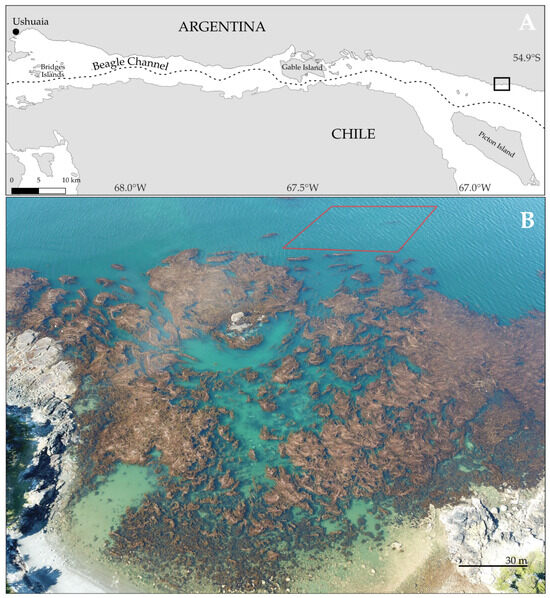
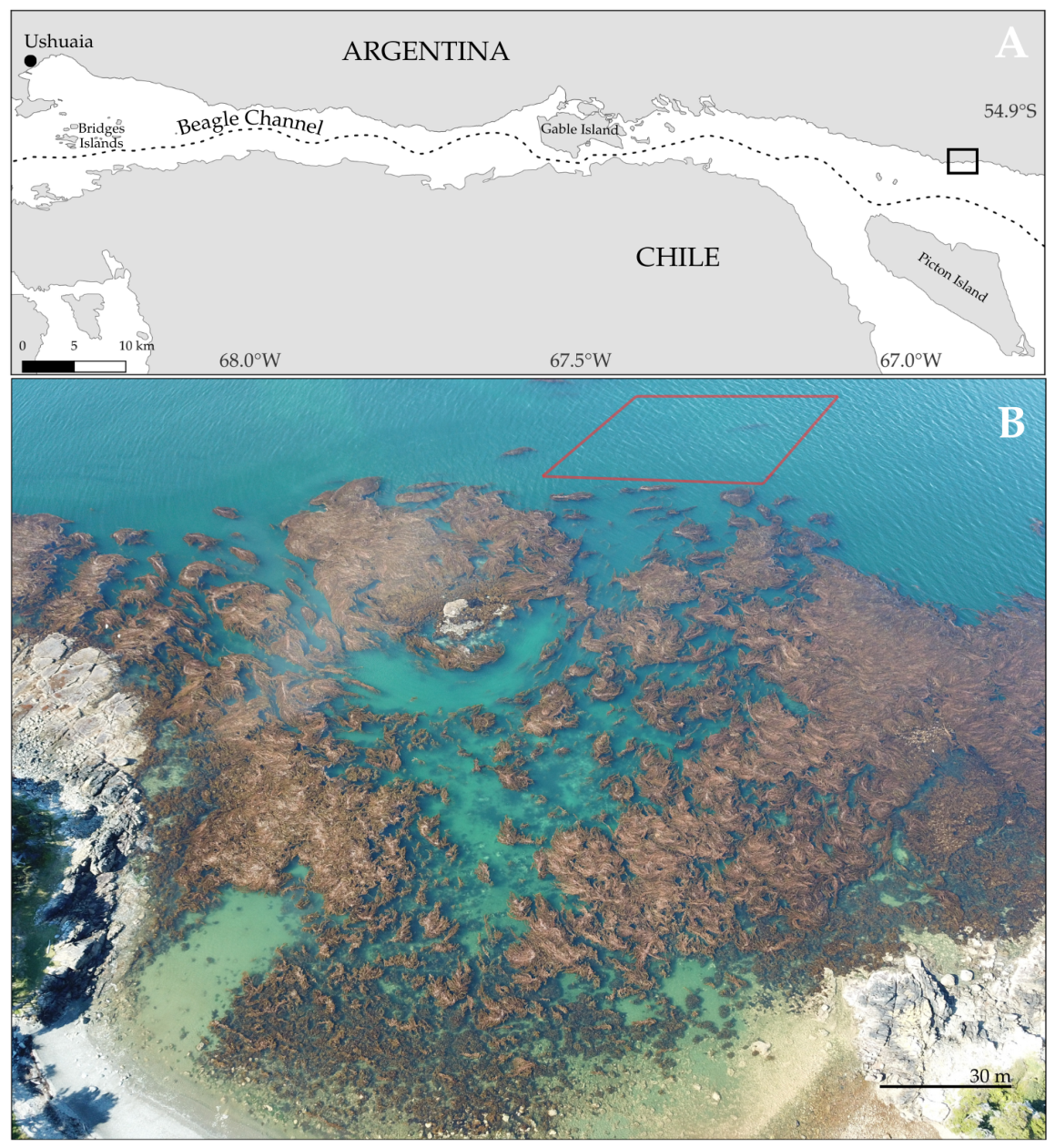
Here we provide a visual record of a rhodolith/maërl bed in Argentina, with the dual aim of confirming its occurrence and establishing a spatial and structural baseline for future monitoring. The bed is located in the Beagle Channel (Onashaga in the Yagán language), Argentina (54°56′32″ S, 66°54′43″ W), approximately 150 m from the coastline, in close association with an extensive Macrocystis pyrifera kelp forest (Figure 1), with juvenile kelp sporophytes incidentally observed growing among the rhodolith nodules during video transects (Supplementary Material S1); no systematic quantification of juvenile density was performed. Surveys were conducted in February 2026 (austral summer) via scuba diving during two separate dives, each covering one perpendicular transect. Distance along each transect was estimated using the fin-kick cycle method, in which the number of complete kick cycles is counted and converted to distance based on individual diver calibration [14]. This approach allowed us to confirm a minimum spatial extent exceeding 40 × 40 m (>1600 m2) traversed continuously during the two perpendicular transects. Underwater imagery was recorded using a Nikon D850 (Nikon Corporation, Tokyo, Japan) camera in an underwater housing and an Insta360 X4 360° (Arashi Vision Inc., Shenzhen, China) camera. One of the transects was partially recorded on video (~3 min, estimated ~30 m); frame extraction at 6 s intervals (n = 25 frames) and manual benthic annotation using Biigle v3.99.1 [15] yielded a mean biotic cover (rhodoliths and epiphytic algae combined) of 91.2% ± 7.8% (range: 58.8–98.5%), with bare sandy sediment accounting for the remainder (Supplementary Material S2). Horizontal visibility exceeded 6 m throughout the surveys and depth remained stable at approximately 7 m. Although no in situ environmental measurements were obtained during the 2026 surveys, data from a nearby subtidal site (1000 m from this study) during February 2024 [16] provide contextual reference: the area is subject to a mixed semi-diurnal tidal regime with a mean range of ~1.1 m [17], water temperature ~10.1–10.5 °C, salinity ~30.3–30.9 PSU, pH 8.20–8.35, and current speeds of 2–15 cm/s.
Figure 1.
Rhodolith/maërl bed adjacent to a Macrocystis pyrifera kelp forest in the Beagle Channel (Onashaga). (A) Map showing the study area; the black square indicates the position of the diving site and the black dashed line indicates the international border between Argentina and Chile. (B) Drone image showing the kelp forest and the extent of the rhodolith/maërl bed with the red square.
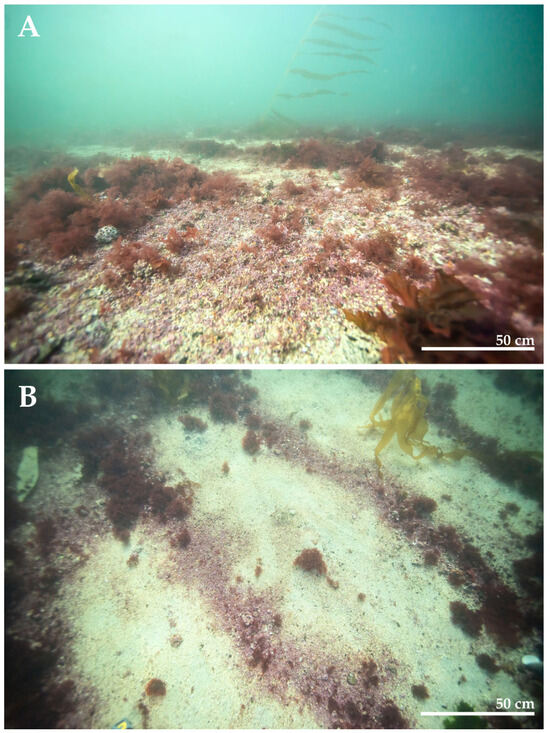
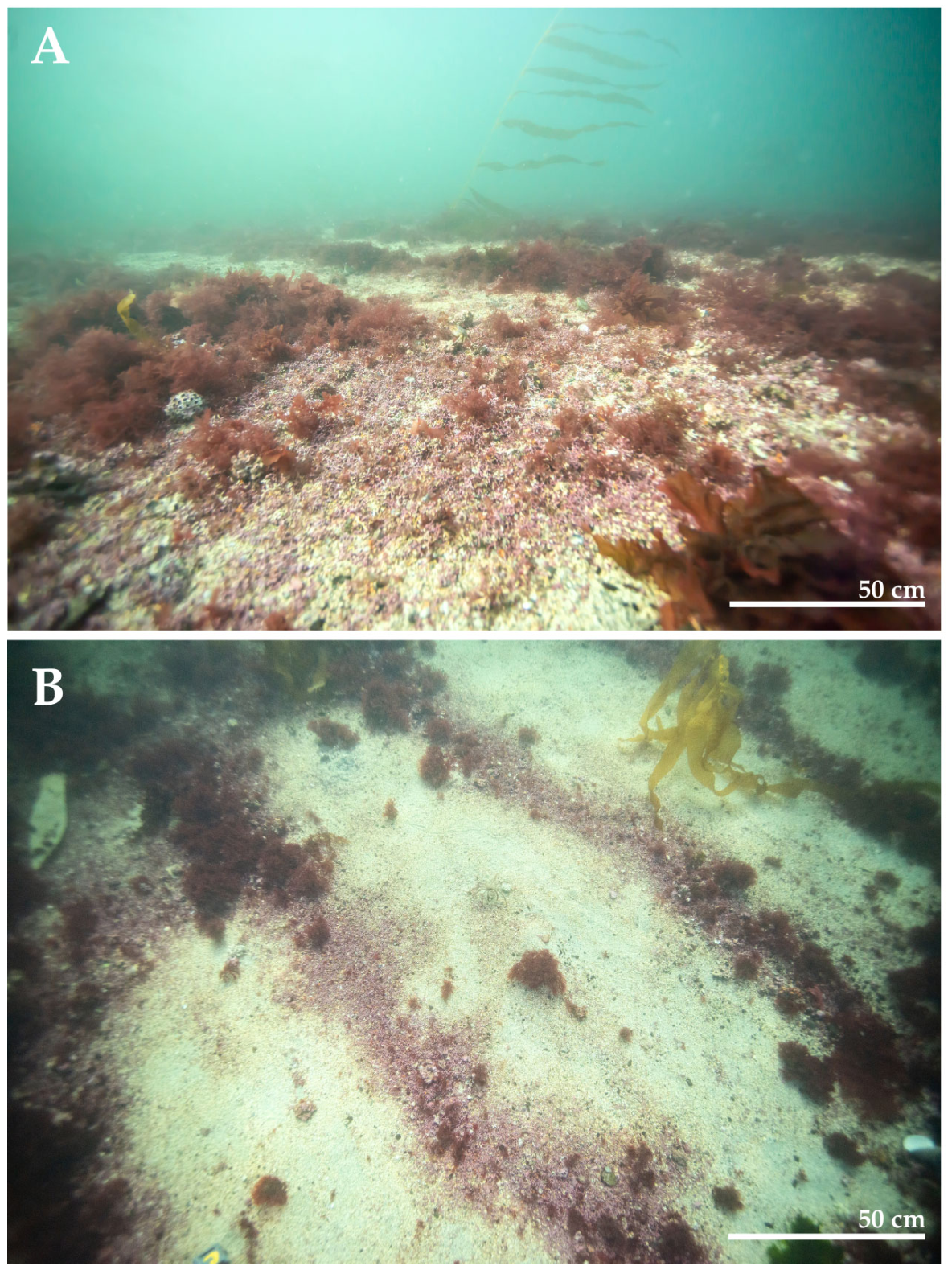
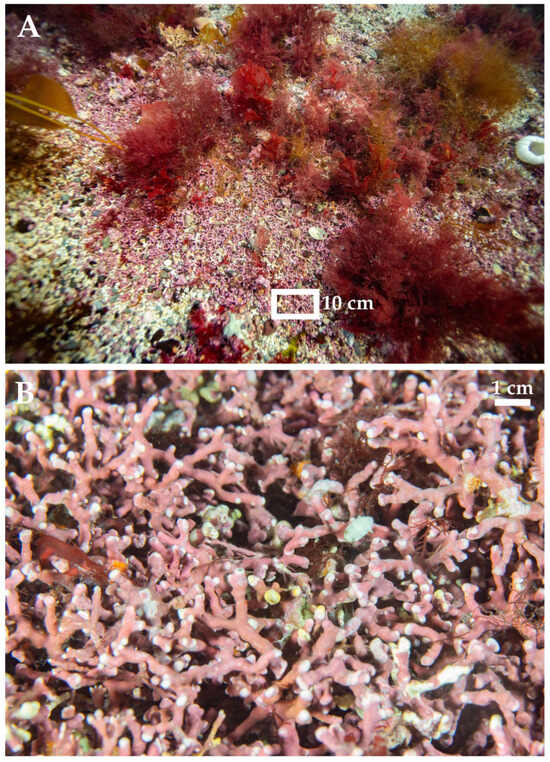
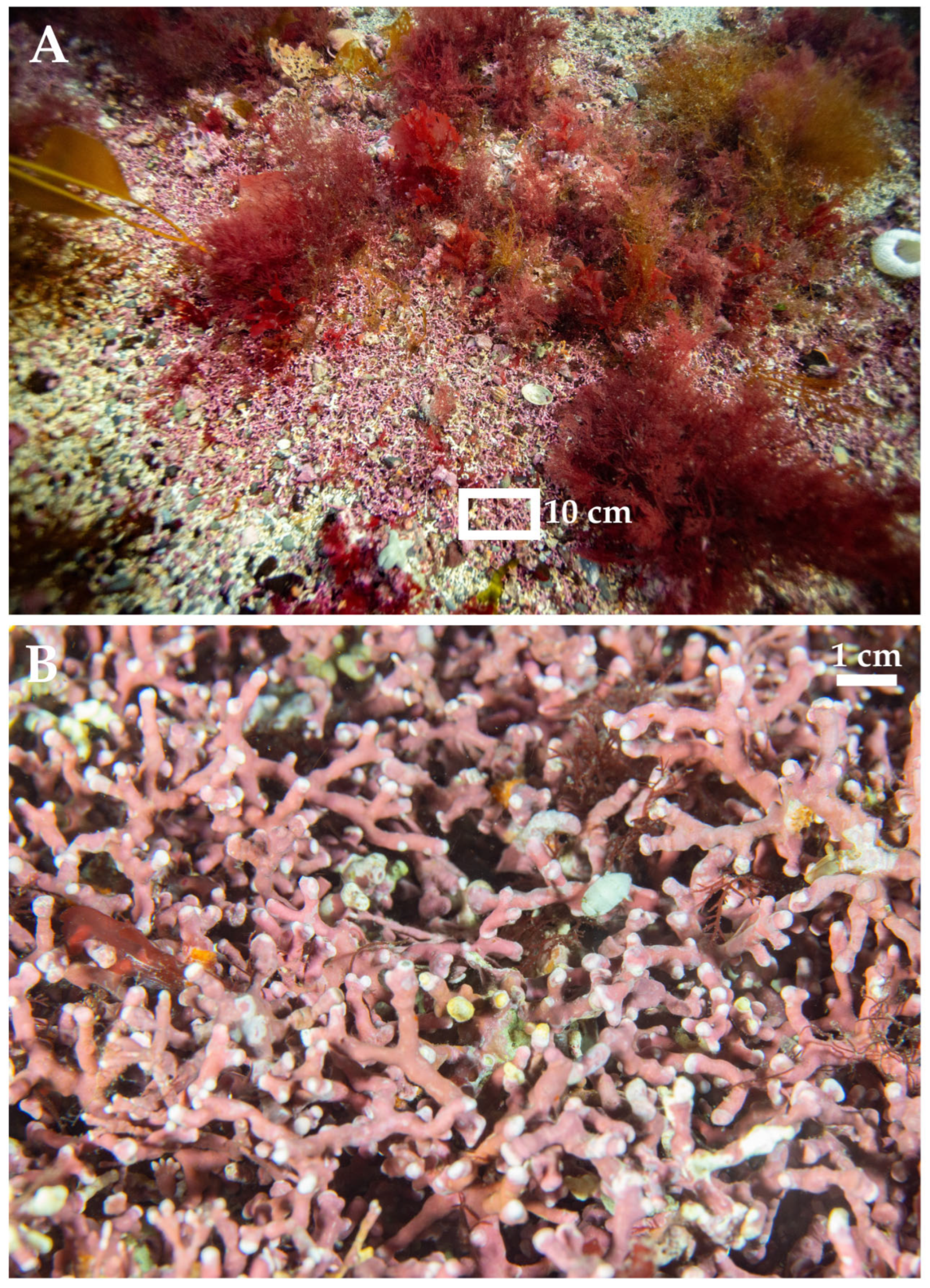
Underwater images show a continuous and relatively homogeneous cover of free-living rhodoliths over large areas of unconsolidated sediment, forming a well-defined rhodolith/maërl bed rather than isolated or patchy nodules (Figure 2A, Supplementary Material S1). In several sectors, rhodoliths were observed arranged in ripple-like accumulations (Figure 2B), indicating strong hydrodynamic forcing and active sediment transport, consistent with the stronger current intensity perceived by divers at the rhodolith bed relative to the shallower near-shore area. A close-up view highlights the branched morphology and three-dimensional structure of individual rhodolith nodules (Figure 3). These unattached nodules correspond to a fruticose growth form [18] and exhibit elongated, multi-axial branching that generates complex three-dimensional frameworks. Filamentous and coarsely branched algae were observed growing on their surfaces, increasing the structural heterogeneity of the habitat (Figure 3). Although visual identification at the genus or species level is not feasible, the main species forming the rhodolith/maërl bed could be morphologically similar to Lithothamnion heterocladum as described by Foslie [19]; however, its identification requires confirmation using complementary morphological and molecular approaches to ensure accurate taxonomic classification. This taxon has been previously reported in the Beagle Channel by the phycologist María Laura Mendoza, who documented the occurrence of rhodolith/maërl beds surrounding Bridges and Gable Islands [11,13]. These studies, however, only refer to the occurrence of rhodolith/maërl beds in general terms and do not provide visual field documentation or quantitative information on the spatial extent of the beds.
Figure 2.
(A) Panoramic underwater view showing the subtidal extent of the rhodolith/maërl bed adjacent to a Macrocystis pyrifera kelp forest. (B) Detail of rhodolith accumulation forming ripple-like structures on sandy sediments, likely shaped by local hydrodynamic conditions.
Figure 3.
Multi-scale view of rhodolith/maërl bed structure. (A) Underwater view of the rhodolith/maërl bed showing free-living nodules and associated macroalgae; the white rectangle indicates the area enlarged in panel (B) (15 × 10 cm). (B) Close-up of rhodolith nodules within the highlighted area, showing branched morphology and three-dimensional structure.
Rhodoliths fulfill key ecological roles in marine ecosystems. By forming extensive beds on soft sediments, they increase seafloor heterogeneity and enhance biodiversity by providing habitat and nursery grounds for numerous organisms, including species of ecological and commercial importance [6,9,20]. This habitat function may persist even after algal death [21]. Furthermore, rhodolith/maërl beds are important calcium carbonate producers and may contribute to long-term carbon storage in coastal ecosystems [22,23]. Nevertheless, despite their ecological significance, rhodolith/maërl beds face multiple threats. They are highly sensitive to global environmental change and particularly vulnerable to ocean acidification, as projected increases in pCO2 and the associated decline in pH are expected to negatively affect marine calcifiers [24,25]. They are also harvested as a source of calcium carbonate for use as a feed additive for dairy cows and as raw material for various industries [26]. However, such commercial exploitation is unsustainable due to their slow growth and extremely low recovery rates [27,28], and no official records of commercial harvesting exist for the Beagle Channel to date. Additional anthropogenic pressures include dredging, aquaculture, coastal pollution, petroleum activities, tourism, and the effects of invasive species [27,29].
At a local scale, the rhodolith/maërl bed documented here presents a valuable opportunity for research due to its density, extent, geographical location, and its coexistence with a M. pyrifera kelp forest, an association that appears to be uncommon based on the authors’ extensive diving experience across the distribution range of M. pyrifera along the Argentine coast. First, its role as an ecosystem engineer [30] remains unexplored. The extent to which this organism structures the local environment and which species may depend on this habitat during adult or early life stages is unknown. Notably, the rhodolith/maërl bed may serve as a reservoir of M. pyrifera gametophytes, as experimental studies have shown that spores of canopy-forming kelps are capable of settling and developing on multiple species of coralline algae, suggesting a bottom-up role for these calcifiers in kelp forest dynamics and recovery [31]. The spatial proximity of these two habitats suggests potential ecological linkages that warrant further investigation. Furthermore, this ecosystem, comprising a rhodolith/maërl bed coexisting with M. pyrifera, may represent an enhanced biodiversity area, where each organism could support distinct species assemblages that complement one another, leading to increased species richness at the landscape level [32]. Testing this hypothesis will require systematic surveys of the associated communities, including invertebrates, mobile fauna, and epiphytic algae, across both habitat types. Second, the Beagle Channel exhibits strong spatial and temporal variability in coastal pH, driven by freshwater inputs from rivers and glacial melt [16,33]. Given its nearshore location, this rhodolith/maërl bed is exposed to such fluctuating conditions, positioning it as a valuable natural system for studying coralline algal responses to present-day pH variability and future ocean acidification scenarios.
Regarding conservation, this site still remains pristine due to its distance from urban centres. The most imminent local threat is the potential expansion of salmon farming. While currently restricted in the Onashaga/Beagle Channel [34], increasing political pressure raises the risk of future aquaculture development. An additional and imminent threat to rhodolith beds located west of Gable Island is the recent expansion of industrial-scale longline mussel farming in the area. Both aquaculture systems (salmon and mussel farming) have been shown to have negative impacts on rhodoliths and their associated communities through the accumulation of fine sediments and organic detritus, which causes burial and declines in rhodolith abundances and subsequent shifts in macrofaunal community structure [35,36,37]. The environmental suitability of these subantarctic waters for aquaculture, combined with ongoing economic pressures, underscores the urgency of documenting and monitoring rhodolith beds as vulnerable habitats. The scarcity of rhodolith/maërl bed records along the Argentine coastline most likely reflects a lack of exploration rather than true absence, particularly at mesophotic depths (>30 m), where rhodolith beds are well documented elsewhere in the South Atlantic [38,39] and have been recorded globally at depths exceeding 150 m [40]. The present record is itself illustrative: the site had been visited by divers previously, yet the rhodolith bed went unreported, demonstrating that even in accessible shallow areas these habitats can be overlooked without targeted benthic surveys. Notably, no existing Argentine marine protected area currently lists rhodolith/maërl beds among its management objectives—including the Natural Protected Area Península Mitre [41], located adjacent to the study site—highlighting the need to systematically map their distribution and communicate findings to the relevant authorities. We hope that the results of this study (images and findings) will stimulate further research and serve as a tool for environmental managers, ultimately contributing to the conservation of this unique habitat.
Supplementary Materials
The following supporting information can be downloaded at: https://www.mdpi.com/article/10.3390/d18070402/s1. The following supporting information is available: Supplementary Material S1, including two underwater videos (Nikon D850 and Insta360 X4), 25 still frames extracted from the transect video, and the raw Biigle annotation report (33275_image_annotation_area_report.xlsx), can be downloaded at https://zenodo.org/records/20560829 (accessed on 20 June 2026). Supplementary Material S2: Video-based benthic cover estimation: methodology, results, and limitations.
Author Contributions
Conceptualization, G.B., M.P.R., M.B., J.K., N.A.M., C.B.P., E.H.O. and C.P.A.; methodology, G.B., M.B., J.K. and M.P.R.; formal analysis, G.B., M.P.R., M.B., J.K., N.A.M., C.B.P., F.G.D. and E.H.O.; investigation, G.B., J.K., M.P.R., M.B., N.A.M., C.B.P., C.P.A., E.H.O., S.R., V.M. and F.G.D.; resources, C.B.P. and G.B.; data curation, G.B.; writing—original draft preparation, G.B.; writing—review and editing, G.B., J.K., M.P.R., M.B., N.A.M., C.B.P., C.P.A., E.H.O., S.R., V.M. and F.G.D.; visualization, G.B.; supervision, M.P.R., F.G.D., M.B. and E.H.O.; project administration, G.B. and C.B.P.; funding acquisition, G.B. and C.B.P. All authors have read and agreed to the published version of the manuscript.
Funding
This research was supported by Mission Blue and the Plum Foundation, through funding granted to the Argentina Hub of Sustainable Ocean Alliance for the project “Kelp Roots: Residency of Coexistence”.
Institutional Review Board Statement
Not applicable.
Data Availability Statement
The data supporting the findings of this study are openly available in the Zenodo repository at https://zenodo.org/records/20560829 (accessed on 20 June 2026).
Acknowledgments
The authors gratefully acknowledge Mission Blue and the Plum Foundation for supporting the project “Kelp Roots: Residency of Coexistence,” an initiative that sought to weave together marine research, situated knowledge, and non-extractive ways of engaging with coastal ecosystems. We thank the Argentina Hub of Sustainable Ocean Alliance for providing the institutional framework that made this work possible from a territorially grounded Latin American perspective, and Fundación de la Tierra for accompanying and supporting the administrative development of the project. We also extend our appreciation to the scientific institutions to which the authors are affiliated—CENPAT-CONICET, CADIC-CONICET, ICPA-UNTDF, IIMYC (CONICET-UNMDP), CIDAPAL, and UTN-FRCH—for sustaining research environments committed to marine science and the strengthening of knowledge sovereignty in the South Atlantic region. We further acknowledge the participants of the Residency of Coexistence held in Ushuaia in February 2026, from which the present study emerged, including all authors of this work, as well as Arantza Cruz, Miguel Ángel Maliqueo, Guillermo Navarro Sanz, Julia Andreasevich, Julia Mensa, Valentina Angela Pinorini, and Lautaro March. The collective exchanges, shared dives, and interdisciplinary encounters that unfolded during the residency later gave rise to the Habitar las Algas movement (https://habitaralgas.com/, accessed on 8 June 2026), whose dialogues, practices, and ways of inhabiting the territory deeply shaped the conceptual and experiential foundations of this research. We also gratefully acknowledge the companies KIMA, Fungus, MERAKI, Santa Flora Fermentos, and Zafrán for supporting the field campaigns through the provision of equipment, food, and essential products, the sailboat Nina for a wonderful sail around Ushuaia Bay, and Mariano Rodríguez (@argentinasubmarina) for his generous support with logistics and diving equipment. Finally, we thank the kelp forests and rhodolith beds of Onashaga for the quiet lessons, wonder, and sense of coexistence revealed to us in every dive.
Conflicts of Interest
The authors declare no conflicts of interest.
References
- Bulleri, F.; Schubert, N.; Hall-Spencer, J.M.; Basso, D.; Burdett, H.L.; Francini-Filho, R.B.; Grall, J.; Horta, P.A.; Kamenos, N.A.; Martin, S.; et al. Positive species interactions structure rhodolith bed communities at a global scale. Biol. Rev. 2025, 100, 428–444. [Google Scholar] [CrossRef] [Scilit] [PubMed]
- Riosmena-Rodríguez, R.; Nelson, W.; Aguirre, J. (Eds.) Rhodolith/Maërl Beds: A Global Perspective; Coastal Research Library; Springer International Publishing: Cham, Switzerland, 2017; Volume 15, ISBN 978-3-319-29313-4. [Google Scholar]
- Bosellini, A.; Ginsburg, R.N. Form and internal structure of recent algal nodules (rhodolites) from Bermuda. J. Geol. 1971, 79, 669–682. [Google Scholar] [CrossRef] [Scilit]
- Crouan, P.L.; Crouan, H.M. Florule du Finistère: Contenant les Descriptions de 360 Espèces Nouvelles de Sporogames, de Nombreuses Observations et Une synonymie des Plantes Cellulaires et Vasculaires qui Croissent Spontanément dans ce Département; Klincksieck: Paris, France, 1867. [Google Scholar]
- Riosmena-Rodríguez, R. Natural history of rhodolith/maërl beds: Their role in near-shore biodiversity and management. In Rhodolith/Maërl Beds: A Global Perspective; Springer: Berlin/Heidelberg, Germany, 2016; pp. 3–26. [Google Scholar]
- Foster, M.S. Rhodoliths: Between rocks and soft places. J. Phycol. 2001, 37, 659–667. [Google Scholar] [CrossRef] [Scilit]
- Rendina, F.; Buonocore, E.; Di Montanara, A.C.; Russo, G.F. The scientific research on rhodolith beds: A review through bibliometric network analysis. Ecol. Inform. 2022, 70, 101738. [Google Scholar] [CrossRef] [Scilit]
- Foster, M.S.; Kamenos, N.A.; Riosmena-Rodriguez, R.; Steller, D.L. Rhodoliths and Rhodolith Beds; Smithsonian Institution Scholarly Press: Washington, DC, USA, 2013. [Google Scholar]
- Amado-Filho, G.M.; Bahia, R.G.; Pereira-Filho, G.H.; Longo, L.L. South Atlantic rhodolith beds: Latitudinal distribution, species composition, structure and ecosystem functions, threats and conservation status. In Rhodolith/Maërl Beds: A Global Perspective; Springer: Berlin/Heidelberg, Germany, 2016; pp. 299–317. [Google Scholar]
- Macaya, E.C.; Riosmena-Rodríguez, R.; Melzer, R.R.; Meyer, R.; Försterra, G.; Häussermann, V. Rhodolith beds in the South-East Pacific. Mar. Biodivers. 2015, 45, 153–154. [Google Scholar] [CrossRef] [Scilit]
- Mendoza, M.L.; Molina, S.; Ventura, P. Flora criptogamica de Tierra del Fuego. Rhodophyta Corallinales 1996, 8, 71. [Google Scholar]
- Mendoza, M.L.; Nizovoy, A. Géneros de Macroalgas Marinas de la Argentina, Fundamentalmente de Tierra del Fuego; Poder Legislativo de la Provincia de Tierra del Fuego, Antártida e Islas del Atlántico Sur, Ed.; Poder Legislativo de la Provincia de Tierra del Fuego, Antártida e Islas del Atlántico Sur: Ushuaia, Argentina, 2000; p. 142. [Google Scholar]
- Mendoza, M.L. State of knowledge of the Corallinales (Rhodophyta) of Tierra del Fuego and the Antarctic Peninsula. Sci. Mar. 1999, 63, 139–144. [Google Scholar] [CrossRef] [Scilit]
- Taylor, L.H. Measuring Underwater Distance. Available online: https://websites.umich.edu/~lpt/measure.htm (accessed on 1 June 2026).
- Langenkämper, D.; Zurowietz, M.; Schoening, T.; Nattkemper, T.W. BIIGLE 2.0—Browsing and annotating large marine image collections. Front. Mar. Sci. 2017, 4, 83. [Google Scholar] [CrossRef] [Scilit]
- Trudnowska, E.; Balazy, P.; Bagur, M.; Kuklinski, P.; Kaminsky, J.; Balazy, K.; Rodriguez, M.; Derwich, Z.; Lovrich, G. The rhythms of environmental conditions, particles dynamics, and barnacle activity captured by underwater imaging in sub-Antarctic kelp forests of the Beagle Channel. Prog. Oceanogr. 2026, 240, 103624. [Google Scholar] [CrossRef] [Scilit]
- Martin, J.; Alonso, G.; Dragani, W.; Meyerjuergens, J.; Giesecke, R.; Cucco, A.; Fenco, H. General Circulation and Tidal Wave Propagation along the Beagle Channel. J. Mar. Syst. 2023, 240, 103889. [Google Scholar] [CrossRef] [Scilit]
- Maneveldt, G.W.; Brodie, J.; Calderon, M.S.; Diaz-Pulido, G.; Gabrielson, P.W.; Kato, A.; Le Gall, L.; Maridakis, C.; Martone, P.T.; Moro, I.; et al. An updated classification of growth forms in nongeniculate coralline algae (Corallinophycidae, Rhodophyta). J. Phycol. 2026, 62, 490–511. [Google Scholar] [CrossRef] [Scilit] [PubMed]
- Foslie, M.H. Antarctic and Subantarctic Corallinaceae; Wissenschaftliche Ergebnisse der Schwedischen Südpolar-Expedition 1901–1903; Lithographisches Institut des Generalstabs: Stockholm, Sweden, 1907; Volume 4. [Google Scholar]
- Gutiérrez, J.L.; Hacker, S.D.; Coombes, M.A.; Wild, C.; Pereira-Filho, G.H.; Palomo, M.G. Marine hard substrate communities. In Marine Biology; CRC Press: Boca Raton, FL, USA, 2022; pp. 232–273. [Google Scholar]
- De Oliveira-Carlos, F.C.; Dos Santos Longo, P.A.; Gutiérrez, J.L.; Santos, C.S.G.; Senna, A.R.; Pereira-Filho, G.H. The rolling stones’ legacy: Rhodoliths retain their habitat function after algal death. Mar. Environ. Res. 2026, 215, 107809. [Google Scholar] [CrossRef] [Scilit] [PubMed]
- Schubert, N.; Tuya, F.; Peña, V.; Horta, P.A.; Salazar, V.W.; Neves, P.; Ribeiro, C.; Otero-Ferrer, F.; Espino, F.; Schoenrock, K.; et al. “Pink power”—The importance of coralline algal beds in the oceanic carbon cycle. Nat. Commun. 2024, 15, 8282. [Google Scholar] [CrossRef] [Scilit] [PubMed]
- Basso, D. Carbonate production by calcareous red algae and global change. Geodiversitas 2012, 34, 13–33. [Google Scholar] [CrossRef] [Scilit]
- Martin, S.; Hall-Spencer, J.M. Effects of ocean warming and acidification on rhodolith/maërl beds. In Rhodolith/Maërl Beds: A Global Perspective; Springer: Berlin/Heidelberg, Germany, 2016; pp. 55–85. [Google Scholar]
- Figuerola, B.; Hancock, A.M.; Bax, N.; Cummings, V.J.; Downey, R.; Griffiths, H.J.; Smith, J.; Stark, J.S. A review and meta-analysis of potential impacts of ocean acidification on marine calcifiers from the Southern Ocean. Front. Mar. Sci. 2021, 8, 584445. [Google Scholar] [CrossRef] [Scilit]
- Garnsworthy, P.C.; Saunders, N.; Goodman, J.R.; O’Connell, S. Effects of calcareous marine algae on performance, rumen fermentation and methane emissions of high-yielding dairy cows. Anim. Feed Sci. Technol. 2025, 325, 116356. [Google Scholar] [CrossRef] [Scilit]
- Grall, J.; Hall-Spencer, J.M. Maerl Bed Conservation: Successes and Failures. Aquat. Conserv. Mar. Freshw. Ecosyst. 2025, 35, e70058. [Google Scholar] [CrossRef] [Scilit]
- Bosence, D.; Wilson, J. Maerl growth, carbonate production rates and accumulation rates in the NE Atlantic. Aquat. Conserv. Mar. Freshw. Ecosyst. 2003, 13, S21–S31. [Google Scholar] [CrossRef] [Scilit]
- Costa, D.D.A.; Dolbeth, M.; Christoffersen, M.L.; Zúñiga-Upegui, P.T.; Venâncio, M.; De Lucena, R.F.P. An Overview of Rhodoliths: Ecological Importance and Conservation Emergency. Life 2023, 13, 1556. [Google Scholar] [CrossRef] [Scilit] [PubMed]
- Jones, C.G.; Lawton, J.H.; Shachak, M. Organisms as ecosystem engineers. In Ecosystem Management: Selected Readings; Springer: Berlin/Heidelberg, Germany, 1994; pp. 130–147. [Google Scholar]
- Twist, B.A.; Mazel, F.; Zaklan Duff, S.; Lemay, M.A.; Pearce, C.M.; Martone, P.T. Kelp and sea urchin settlement mediated by biotic interactions with benthic coralline algal species. J. Phycol. 2024, 60, 363–379. [Google Scholar] [CrossRef] [Scilit] [PubMed]
- Bagur, M.; Gutiérrez, J.L.; Arribas, L.P.; Palomo, M.G. Complementary influences of co-occurring physical ecosystem engineers on species richness: Insights from a Patagonian rocky shore. Biodivers. Conserv. 2016, 25, 2787–2802. [Google Scholar] [CrossRef] [Scilit]
- Giesecke, R.; Martín, J.; Piñones, A.; Höfer, J.; Garcés-Vargas, J.; Flores-Melo, X.; Alarcón, E.; Durrieu de Madron, X.; Bourrin, F.; González, H.E. General hydrography of the Beagle Channel, a subantarctic interoceanic passage at the southern tip of South America. Front. Mar. Sci. 2021, 8, 621822. [Google Scholar] [CrossRef] [Scilit]
- Ley N° 1601, Poder Legislativo, Provincia de Tierra del Fuego, Antártida e Islas del Atlántico Sur. Available online: https://www.legistdf.gob.ar/lp/leyes/Provinciales/LEYP1601.pdf (accessed on 6 February 2026).
- Hall-Spencer, J.; White, N.; Gillespie, E.; Gillham, K.; Foggo, A. Impact of fish farms on maerl beds in strongly tidal areas. Mar. Ecol. Prog. Ser. 2006, 326, 1–9. [Google Scholar] [CrossRef] [Scilit]
- Legrand, E.; Taormina, B.; Grall, J.; Sævik, P.N.; Lelièvre, Y.; Pinsivy, L.; Peña, V.; Husa, V. Salmon farming alters the structure and functioning of Norwegian maerl bed communities. Aquat. Conserv. Mar. Freshw. Ecosyst. 2024, 34, e4142. [Google Scholar] [CrossRef] [Scilit]
- Peña, V.; Bárbara, I. Maërl Community in the North-western Iberian Peninsula: A Review of Floristic Studies and Long-term Changes. Aquat. Conserv. Mar. Freshw. Ecosyst. 2008, 18, 339–366. [Google Scholar]
- Amado-Filho, G.M.; Moura, R.L.; Bastos, A.C.; Francini-Filho, R.B.; Pereira-Filho, G.H.; Bahia, R.G.; Moraes, F.C.; Motta, F.S. Mesophotic Ecosystems of the Unique South Atlantic Atoll Are Composed by Rhodolith Beds and Scattered Consolidated Reefs. Mar. Biodivers. 2016, 46, 933–936. [Google Scholar] [CrossRef] [Scilit]
- Figueiredo, M.A.O.; Coutinho, R.; Villas-Boas, A.B.; Tâmega, F.T.S.; Mariath, R. Deep-Water Rhodolith Productivity and Growth in the Southwestern Atlantic. J. Appl. Phycol. 2012, 24, 487–493. [Google Scholar] [CrossRef] [Scilit]
- Littler, M.M.; Littler, D.S.; Hanisak, M.D. Deep-Water Rhodolith Distribution, Productivity, and Growth History at Sites of Formation and Subsequent Degradation. J. Exp. Mar. Biol. Ecol. 1991, 150, 163–182. [Google Scholar] [CrossRef] [Scilit]
- WCS Área Natural Protegida Costero—Marina Península Mitre. Available online: https://ampargentina.org/areas/peninsula-mitre/ (accessed on 10 June 2026).
Disclaimer/Publisher’s Note: The statements, opinions and data contained in all publications are solely those of the individual author(s) and contributor(s) and not of MDPI and/or the editor(s). MDPI and/or the editor(s) disclaim responsibility for any injury to people or property resulting from any ideas, methods, instructions or products referred to in the content. |
© 2026 by the authors. Licensee MDPI, Basel, Switzerland. This article is an open access article distributed under the terms and conditions of the Creative Commons Attribution (CC BY) license.