


Abstract
Reflectance by yellow to red carotenoid-based plumages in birds with ultraviolet-sensitive (UVS) color vision typically shifts to redder (longer) wavelengths as carotenoid consumption (Dietc) increases. This apparent asymmetric red-shift response implies an overall bias against conceivable shifts to bluer (shorter) wavelengths. However, recent studies among species of Piciformes–Coraciiformes (e.g., woodpeckers, barbets, toucans, bee-eaters, and allies) with violet-sensitive (VS) color vision discovered two kinds of blue shifts between the same plumage and dietary traits. Compared to UVS absolute red shifts (positive slopes at higher Dietc), VS express absolute (negative slopes at higher Dietc for yellow and orange plumages) or relative (zero slope for red plumages) blue shifts. These contrasting patterns for different color vision systems suggest that generalized symmetry concepts of opposite (plumage shift) patterns that maintain invariant (Dietc, perception) processes can be abstracted from physical to biological systems, with positive versus negative responses formalized as “antisymmetries” and relative responses formalized as “broken symmetries”. A subset of VS “true woodpecker” (Picinae) species with known yellow and red plumage-carotenoid chemistries demonstrated similar blue shifts for the main reflectance bands and their independence from phylogeny, sex, and specimen collection year, thus providing key chemical details to further test generalized plumage symmetries. Juxtapositions were facilitated because both yellow and red plumages in true woodpeckers contained comparatively blue- and red-shifted carotenoid types. Despite this parallel, each plumage deployed chemical variations in radically different ways. Yellow plumage contained only chemically defined yellow carotenoids, including intrinsically more red-shifted natives (i.e., hydroxy-xanthophylls) widespread among birds through their diets, and intrinsically more blue-shifted picofulvins (i.e., 7,8-di- and tetra-hydro-carotenoids) probably characteristic of and metabolized by VS birds. Higher absolute and relative (to natives) picofulvin concentrations were significant predictors of absolute blue shifts in yellow plumage reflectance, and were significantly predicted by higher Dietc. Transitivity implied Dietc ⟶ native ⟶ picofulvin ⟶ reflectance, such that picofulvins caused absolute blue shifts at higher Dietc, and natives caused absolute red shifts at lower Dietc. Moreover, opposite trends for picofulvin and native concentrations in feathers were consistent with the proposed endogenous synthesis of picofulvins from natives. Yellow plumages comprised mainly of picofulvins at very low (from very low Dietc from ants and termites) or high (from very high Dietc from fruits) concentrations were especially distinctive for some of these and other interrelationships, suggesting some heterogeneity in yellow pigmentation strategies from dietary idiosyncrasies. Red plumages contained only relatively low concentrations of yellow dietary natives (hydroxy-xanthophylls), but varied widely in the concentration of metabolites of comparatively intermediate (4-oxo-keto-carotenoids) or extreme (4,4′-oxo-keto-carotenoids) redness. However, different red chemistries lacked any corresponding significant relationships with variations in reflectance or Dietc. Variations in reflectance based on chemical compositions were more visible to humans for yellow than red plumage types, setting minimum salience levels for the more discriminating diurnal avian color visions. Therefore, VS yellow plumage chemistries that emphasize deposition of easily obtained (cheaper) dietary natives at low Dietc, and of more deliberately synthesized (costly) picofulvin metabolites at higher Dietc were consistent with several forms of honest signaling in UVS from resource limitations based on Dietc, including through potential costs and benefits and their trade-offs. Conversely, the diverse chemical compositions and costs of red plumages of similar physical reflectance properties, and evidence that intrinsically orange carotenoids intermediate between red and yellow ones were actively excluded from plumage, suggested that true woodpecker reds were under selection for a convergent appearance. In light of true woodpecker biology, sensory bias, and social and aposematic mimicry are likely mechanisms promoting resemblance. These results extend to the chemical level earlier interpretations of opposite shift patterns as antisymmetries of invariant processes and relative shift patterns as broken symmetries of altered processes for VS vis-à-vis UVS carotenoid-based systems.
1. Introduction
Strong trophic connections exist for animal carotenoid pigments that produce many human-visible yellow, orange and red colors [1,2,3,4,5,6,7,8,9] because unlike plants, animals must ultimately obtain carotenoids as parts of their diets [4,7,10,11,12,13]. A remarkably widespread corollary to this constraint is that animal integumentary-carotenoid reflectance components typically shift to redder (longer) wavelengths in concert with increased carotenoid consumption [4,14,15,16,17,18,19,20,21,22], highlighting strong connections among animal carotenoid patterns (red shifts) and processes (diet). However, the apparent prevalence of documented red shifts raises important questions about the ultimate controls on shift patterns because it implies that natural systems favor an inherent shift asymmetry even though variation that encompasses physically opposing red- (longer) and blue- (shorter) shifted wavelengths exists in many biological pigmentation systems [2,23,24]. Indeed, the focus by most animal carotenoid studies on small land birds (Passerida in Passeriformes) with ultraviolet-sensitive (UVS) color vision has raised the possibility that biased sampling of taxonomic groups and sensory systems created an incomplete description of animal carotenoid patterns and processes [18]. The importance of these considerations was suggested by the recent discovery that at higher dietary carotenoid content, the same plumage reflectance components that red-shift among UVS species actually shift to bluer wavelengths among species that possess violet-sensitive (VS) color vision [18,24]. Specifically, the diverse VS Piciformes–Coraciiformes (including woodpeckers, barbets, toucans, bee-eaters, and allies) expressed the usual yellow, orange, and red carotenoid-based plumages, but none of these carotenoids red-shifted at higher levels of dietary carotenoids. Among species for both sexes, rather, yellows and oranges manifested strong absolute blue shifts in reflectance at higher levels of dietary carotenoids (a significant negative slope) whereas reds were blue-shifted at higher levels of dietary carotenoids only relative (a non-significant, near-zero slope) to the UVS absolute red shift (a positive slope).
These additional results suggest that the red shift is part of a more general conception of symmetry patterns and processes governing animal carotenoids and other pigments [18]. Within this broader symmetry framework, the opposite (positive versus negative slope) shift pattern in response to higher dietary carotenoid content can be interpreted as an “antisymmetry” [25], whereas no (zero slope) shift pattern can be interpreted as a “broken” symmetry [26]. These abstract expansions of pattern symmetry are widely applied in mathematics and the physical sciences [27,28] whereas pattern symmetry considerations in biology are traditionally limited to descriptions of mirror-image (e.g., bilateral, radial) morphologies and their dynamic (glide symmetry) extensions [18]. However, the basis of animal coloration in physics and chemistry provides natural homologies for extending biological symmetries to their more generalized definitions. The material bases of antisymmetric and broken symmetric patterns are of special relevance for addressing even broader considerations of “symmetry invariance”, in which the underlying processes remain unchanged despite arbitrarily (including oppositely) patterned responses [27,28]. Although seemingly counterintuitive, conserved processes behind carotenoid-based absolute blue and red shifts are indicated most obviously by their mutual associations with higher dietary carotenoid contents, and through their expression by the main carotenoid-based reflectance band [18]. In addition to these extrinsic factors, the opposite shift patterns also share an intrinsic connection to color vision, as per the blue shifts in violet-sensitive (VS) and red shifts in ultraviolet-sensitive (UVS) systems [18]. This sensory association extends in turn to direct connections with the visual systems through alignments of the diagnostic retinal cone sensitivities of each color vision system with the distinctive absorption (reflection) properties of their respective plumage pigments [2,23,24], implying that the absolute blue and red shifts are invariant in perceptual salience and function. In this way, these blue shifts and red shifts can be considered simply different “viewpoints” of the same phenomena, which are often essential features of process invariance across pattern symmetries [28]. Thus, the particular characteristics of avian plumages (signals) and eyes (receptors) lead to an intuitive conception of generalized symmetry that encompasses integrated communication systems. As such, generalized symmetry-based descriptions of wavelength-based shift patterns in biology expand the conceptual framework for symmetry and carotenoid studies in animals, allow plumage diversity and its causes to be analyzed with a single organizing principle, and suggest parallels with seemingly unrelated physical and chemical systems [18].
This generalized symmetry hypothesis can be readily tested through the physics and chemistry of animal carotenoids, which provide a common currency for analyzing patterns and processes. Indeed, the potential for carotenoid-based process invariance should be aided by the wide-ranging capacities and purposes served by these biomolecules. Hence, following their ingestion, carotenoids can be subject to a range of manipulations and transformations [29,30] in relation to their functions. These various applications relate to virtually all aspects of living, including foraging ecology [4,14,16], visual physiology [31], health [5,32,33] social signaling [4,33], mate choice [34,35] and physical [36,37] and genetic [5] fitness. However, carotenoid-based red shifts in the integument can arise from various physical and chemical processes, including from higher optical densities (concentrations or thicknesses) of yellower to redder carotenoids [1,14,16,17], from metabolic conversion of these same carotenoids [4,5,7], or from interactions between the carotenoids and feather proteins [6,8,9]. These details suggest that shift patterns comprise complex phenotypes, requiring careful consideration of comparability of patterns and processes within and across shift-related phenomena. In this regard, the carotenoids documented among most UVS birds do not provide obvious raw materials for the blue-shift responses to dietary carotenoid levels observed in VS ones [3,7,38]. For example, yellow plumage carotenoids typical of UVS Passerida passerines (mainly various hydroxy- and canary xanthophylls) share very similar physico-optical properties [13] that are red-shifted compared to many VS yellows [2,24]. As such, chemical variation available to UVS appears largely unable to produce the dramatic absolute blue shifts for yellow and orange carotenoids observed in VS. By comparison, UVS and VS groups use many of the same red oxo-keto-carotenoids [4,7,16,21] despite their different red plumage shifts in relationship to dietary carotenoid levels, suggesting an unpreserved (i.e., broken) symmetry in pattern and process [26]. Whether or not the physical and chemical basis of shift patterns are fundamentally the same also relates directly to distinctions in plumage information content, which provides evidence for whether carotenoid-based communication processes are the same for both color vision systems. Unlike for the red shifts, however, the underlying physical and chemical bases for these newly discovered VS blue shifts in avian carotenoids remain poorly understood.
Here I explore the chemical ecology of VS blue shifts with quantitative details on the carotenoids detected in yellow and red plumages, as obtained by [39] for representatives of the VS true woodpecker subclade Picinae (hereafter just “true woodpeckers”). The same species were deliberately made part of the more inclusive plumage studies of VS Piciformes–Coraciiformes reported on earlier [18]. Here the focus is on the chemical properties of the main carotenoid-based reflectance band, which was the physical component found to be most strongly associated with the dietary blue shifts and their subjective appearance (to humans). In my earlier paper, I referred to the general carotenoid compositions reported by [39] to develop qualitative hypotheses for the chemical basis and information content of the various blue-shift patterns. Here I test these hypotheses of interspecific patterns and processes quantitatively through natural experiments based on evidence that true woodpecker plumages contain both comparatively blue- and red-shifted yellow and red plumage carotenoids as possible raw materials for the shift responses. As in most birds, chemically different carotenoids are objectively distinguished by their functional groups on the C40 polyene backbone, which determine their absorption fine structure as related to their appearance [18]. Yellow to orange-yellow plumage carotenoids in true woodpeckers include a variety of common “native” yellow hydroxy-xanthophylls (lutein, zeaxanthin, β-cryptoxanthin) that can be ingested and deposited without recourse to any particular dietary specializations or metabolic alterations. However, true woodpeckers apparently have the ability to synthesize strongly blue-shifted yellow “picofulvins” (7,8-di- and tetra-hydro-carotenoids) through metabolic conversion of these same natives [39]. True woodpeckers also convert an expanded (plus β-carotene) series of native precursors to a corresponding series of red oxo-keto-carotenoids [39] that themselves differ in absorbing at comparatively shorter (4-oxo-keto-carotenoids) or longer (4,4′-oxo-keto-carotenoids) wavelengths. My earlier study [18] predicted that the absolute blue shifts by yellow and orange plumage at higher levels of dietary carotenoids among VS Piciform–Coraciiform species arose from increased deposition of absolute or relative concentrations of picofulvin metabolites compared to dietary natives. Based on these proximate hypotheses for chemical patterns, it was also proposed that VS and UVS color vision systems express invariant signaling processes by using appropriate absolute blue- (VS) or red- (UVS) shifted carotenoid metabolites at higher dietary carotenoid levels to ensure honest signaling of costs and benefits. Red plumage was suggested to break this symmetry of pattern and process through selection for resemblance (saturation, sensory bias, mimicry and aposematism), which predicted convergent red plumage reflectance phenotypes based on different carotenoid chemistries and their costs and benefits. The results of this study confirm and expand on these hypotheses, extending both generalized (antisymmetric patterns and invariant processes) and broken (asymmetric patterns and divergent processes) symmetries in relation to diet and signal information content of carotenoids to the chemical level.
2. Materials and Methods
General details on sampling and methods are provided in [18] and references therein [2,16,23,24]. Some of these details as well as approaches specific to the [39] data are provided below.
2.1. Data Collection
Taxonomic and Plumage Sampling—The thirteen species of true woodpeckers (Picinae) analyzed by [39] were generally representative of the clade because they included taxa from each of the three most diverse tribes [40], excluding only Nesoctitini (one species) and Hemicircini (two species), as indicated (Table 1; Figure 1). Stradi et al. [39] did not specify specimen developmental age, but their plumage descriptions fit those for adults, which were surveyed here. However, two plumages were excluded for other reasons. First, for Leuconotopicus villosus, Stradi et al. [39] assayed “yellow” breast feathers (see Table 1 for taxonomy), which are typically white in this species. Based on the unusual description, their specimen may have been a rare example of yellow adventitious “carotenism” known to occur in L. villosus [41]. As no such yellow L. villosus were available, only the characteristic red plumage, present on the male nape of this species, was included (Table 1). Second, Picus squamatus was excluded entirely because Stradi et al. [39] sampled only disarticulated “wing feathers”, where carotenoids occur mainly in the narrow and rounded yellow shafts that could not be measure accurately with available reflectance-measuring equipment.
Table 1.
Sampling scheme for yellow and red carotenoid-based plumages and patches in true woodpeckers (Picinae) studied by [39] and herein.
Figure 1.
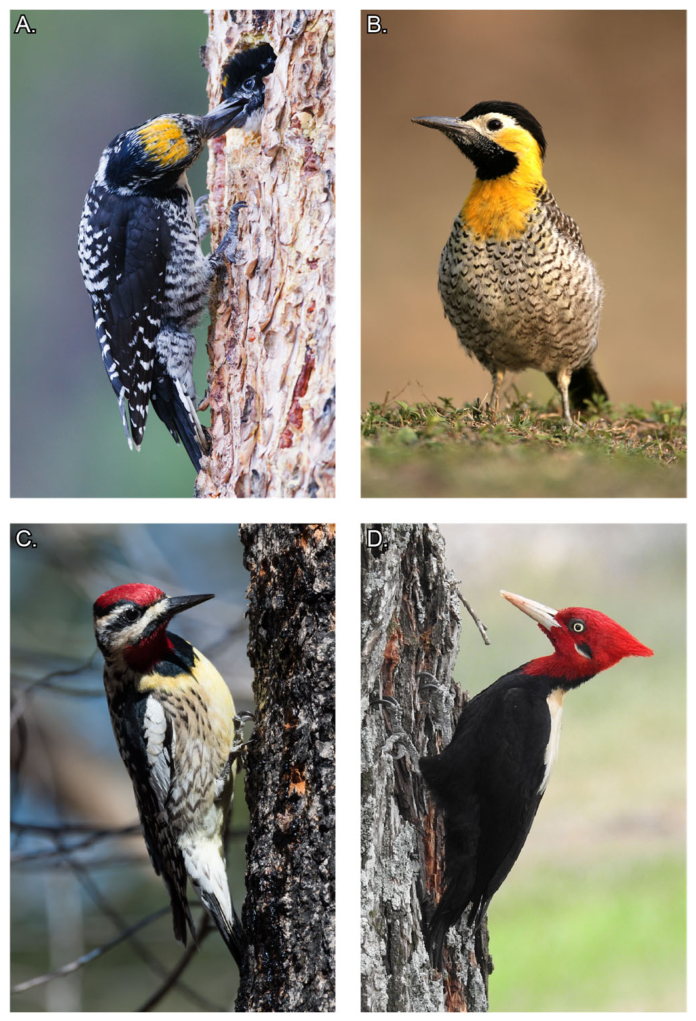
Representative male true woodpeckers (Picinae) from among taxa sampled in the three tribes and selected subclades under study (see Table 1). General classifications, carotenoid-based plumage colors, qualitative dietary carotenoids, and primary foods, are as follows. (A) Melanerpini Clade 1: American Three-toed Woodpecker (Picoides dorsalis), yellow, moderate dietary carotenoids, arthropods. (B) Picini: Campo Flicker (Colaptes campestris), yellow, low dietary carotenoids, small-bodied social insects. (C) Melanerpini Clade 0: Yellow-bellied Sapsucker (Sphyrapicus varius), yellow and red, high dietary carotenoids, arthropods and sap and fruit. (D) Campephilini: Cream-backed Woodpecker (Campephilus leucopogon), red, moderate dietary carotenoids, arthropods. See [18,43] for carotenoid contents of avian foods. Color names based on human not avian perceptions, which undoubtedly differ. Birds are not shown to scale. Shutterstock photo credits: ((A), Asset id: 1869475285) Jukka Jantunen, ((B), Asset id: 159224015) Erni, ((C), Asset id: 270531269) FotoRequest. Cornell Lab of Ornithology|Macaulay Library photo credit: ((D), ML595773901) Maximiliano Sager.
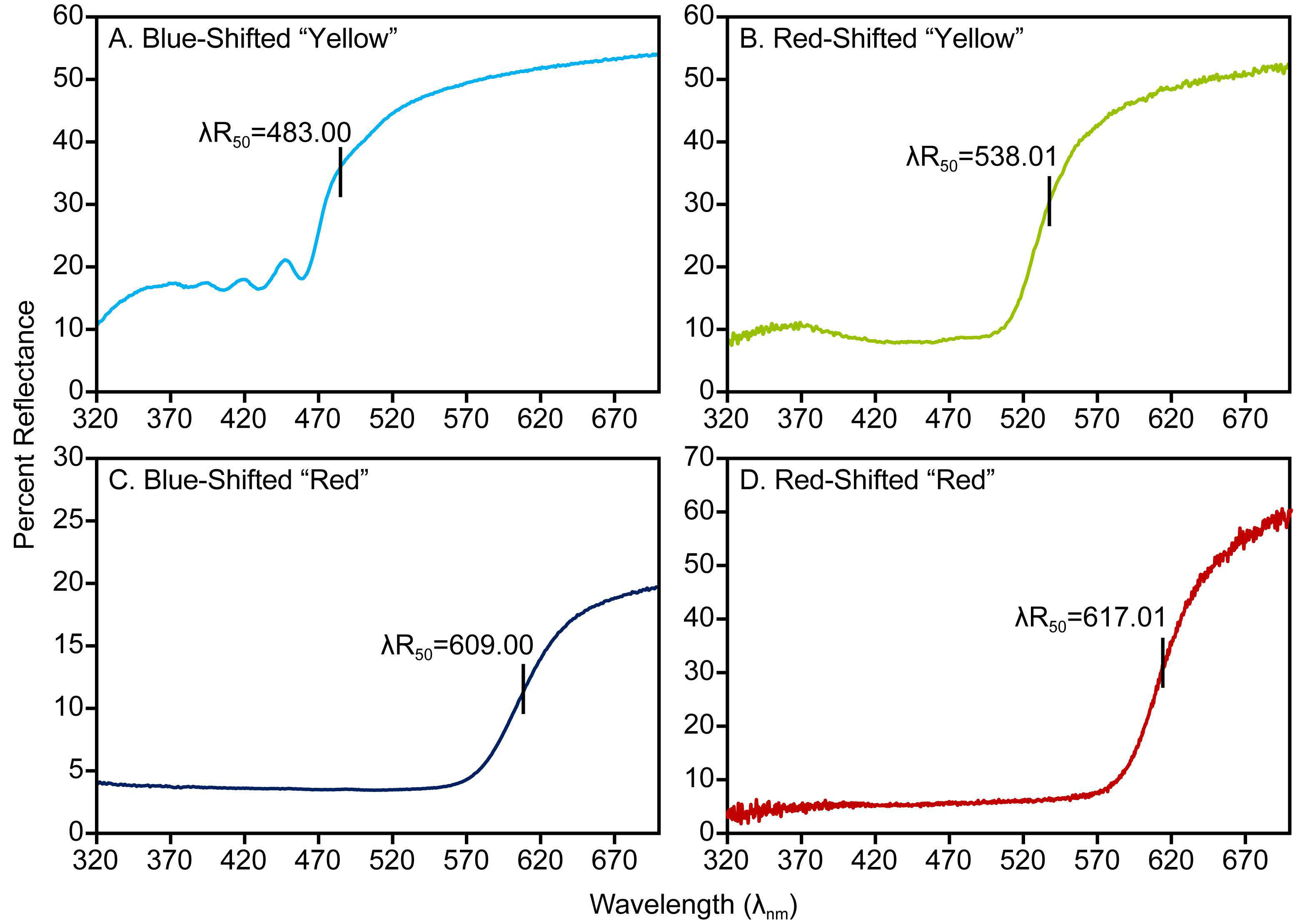
Spectral Features—For the relevant yellow and red plumages of true woodpecker species, all plumage reflectance spectra (relevant wavelength range 320–700 nm) and their quantified features were obtained as part of the previous and more inclusive studies of VS Piciformes–Coraciiformes [18,24] and as detailed further herein (Table S1). Present analyses focused on the wavelength of half-maximal reflectance (λR50; Figure 2) of the main reflectance band, which was the spectral feature most responsive to dietary carotenoid contents among the three such features estimated for the VS Piciform–Coraciiform surveys [18]. Broadly, λR50 estimates the spectral location of the band’s characteristic rapid transition (“cut-off”) from maximum (Rmax) to minimum (Rmin) reflectance (given as a percent compared to a white standard) at progressively shorter wavelengths. More specifically, λR50 estimates the wavelength at which reflectance is half-way between Rmax and Rmin, by the standard formula:
where Rmax and Rmin (see Figure 3 in [18]) are averaged to obtain the 50% percent reflectance value for determining the corresponding λR50 [15,16,17]. This one spectral feature also conveniently summarizes and correlates closely with physical (wavelength), chemical (carotenoid), and perceptual (colorimetric “hue”) blue and red shifts within and between yellow to red carotenoids ([1,18,44,45,46,47]) because λR50 is usually within the visible ranges of birds and humans [18], and because the form and wavelength location of Rmin (as maximum absorption = λmax) are intrinsic characteristic for carotenoid “classes” (broad categories) or “types” (specific molecules) distinguished by their molecular structure (hereafter simply “types”). Moreover, a noticeable gap separates the λR50 values of yellow and red carotenoid-based plumages in true woodpeckers and their relatives [18] even when considering extremes in these plumages (the relatively red-shifted orange-yellows of Colaptes campestris in Figure 1B compared to yellows of other species in Figure 1A,C). Thus, physically yellow and red plumages can be objectively distinguished for analysis.
λR50 = λ[(Rmax + Rmin)/2]
Figure 2.
Representative reflectance spectra generated for yellow (upper panels) and for red (lower panels) carotenoid-based plumages. Vertical bars mark the wavelength of half-maximal reflectance (λR50) used to estimate plumage blue- (to shorter λs) and red- (to longer λs) shifts in relation to Dietc and carotenoid chemistry. Males of three species from Figure 1 are depicted, but rearranged into color-coded horizontal pairs that exemplify comparatively blue- (A,C) and red- (B,D) shifted carotenoids and plumages within yellow (A,B) and red (C,D) categories. Note that blue shifts are stronger for yellows compared to reds both between and within these plumage categories. Color, principal carotenoid chemistry, patch, species, and museum specimen are as follows. (A) Yellow: Blue-shifted picofulvins, breast, Yellow-bellied Sapsucker (Sphyrapicus varius), UWZM 16265; (B) Yellow: Red-shifted natives, breast, Campo Flicker (Colaptes campestris), UWZM 18332. (C) Red: Blue-shifted 4-oxo-keto-carotenoid, crown, Yellow-bellied Sapsucker (Sphyrapicus varius), UWZM 16265; (D) Red: Red-shifted 4,4′-oxo-keto-carotenoid, crown, Cream-backed Woodpecker (Campephilus leucopogon), DMNH 66997. See Table S1 for museum acronyms.
Dietary Carotenoid Content—Continuous, quantitative measures of dietary carotenoid contents were also calculated for all relevant true woodpecker species in [39] as part of the previous study of VS Piciformes–Coraciiformes [18]. Briefly, standardized sources were used first to inventory all food items recorded for each species [18,42] and then to match these items to their carotenoid concentrations listed in Table 1 of [43] and expanded in Table S2 of [18]. A Dietary Carotenoid Content Index (“Dietc”) was then calculated from this information based on two criteria, the rank carotenoid concentrations of each food item (also provided in Table 1 of [43]), and the preference demonstrated for that item (by criteria given in Table 3 of [43]). To obtain Dietc for each species, the rank carotenoid concentrations of its dietary items were weight-averaged across (up to the three) preference categories (details provided in [18]). As such, Dietc provides comparable measures of dietary ecology for statistical analyses across species. Literature sources used to assess foraging data did not distinguish male from female diets, preventing the effects of any inter-sexual dietary differences on plumage variation from being explicitly tested. However, nestling diets were excluded as not directly relevant to and different from (more uniformly animal-based composition) those of adults. Finer demographic distinctions also were not possible.
2.2. Chemistry
Carotenoid Chemistry—For their survey of yellow and red plumages in true woodpeckers, ref. [39] used HPLC (high-performance liquid chromatography) and spectroscopy (UV-vis, mass spectroscopy) to characterize all carotenoids “detectable” above their designated identification threshold (relative concentrations > 2%). They found that carotenoid compositions of human-perceived yellow versus red plumages were qualitatively similar in some respects but very different in others (Table 2). Both yellow and red plumages contained several types of common and intrinsically yellow hydroxy-xanthophylls, with up to a maximum of three types in yellow plumage and up to two of the same types in red plumage. Yellow plumages also contained up to four types of intrinsically yellow so-called “picofulvin” carotenoids (one only at low concentrations), but no detectable concentrations of intrinsically orange-red to red carotenoids. Conversely, red plumages contained up to four intrinsically orange-red to red (hereafter “red”) oxo-keto-carotenoids but no detectable concentrations of the yellow picofulvins. By their intrinsic absorption properties alone, the carotenoid compositions of either yellow or red carotenoid-based plumages contained raw materials for possible physical shift patterns. Thus, among yellow plumages, all four picofulvins were strongly blue-shifted (λmax up to ~70 nm shorter) compared to hydroxy-xanthophylls [39,48]. Among red plumages, all oxo-keto-carotenoids were strongly red-shifted (λmax up to ~50 nm longer) compared to these same hydroxy-xanthophylls (Table 2). In addition, detected sub-components of these red oxo-keto-carotenoids differed among themselves in their red shifts compared to hydroxy-xanthophylls, with 4-oxo-keto-carotenoids (α-doradexanthin) being less red-shifted (λmax up to ~30 nm longer) than the 4,4′-oxo-keto-carotenoids adonirubin, astaxanthin, and canthaxanthin (all with λmax up to ~50 nm longer) both in vitro [49,50] and in vivo [51]. Depending on the reference carotenoid, therefore, both yellow and red plumages contained more and less blue- and red-shifted components.
Table 2.
Carotenoid pigment chemistries and their summary variables for yellow and red plumages in true woodpeckers (Picinae) studied by [39] and herein.
Parallels also exist in the sources, inferred costs or benefits, and development of these different carotenoid pigments, whose nutritional and other qualities relate directly to signal functions and processes. Thus, the intrinsically yellow hydroxy-xanthophylls typically are obtained via the diet, and are such common components of most avian foods that they are generally available to all species, although at different concentrations [7]. True woodpeckers also appear able to modify yellow hydroxy-xanthophylls to produce intrinsically yellow picofulvins and/or red oxo-keto-carotenoids at an additional cost prior to use in plumage pigmentation. In the case of picofulvins, this ability is thought to be the exclusive purview of the birds, as picofulvins appear to be absent from their diets [39]. Red oxo-keto-carotenoids also are typically metabolized by most terrestrial birds, including in true woodpeckers [39], although many marine and some terrestrial birds can also obtain them from specialized food sources [19,51,52]. For land birds such as true woodpeckers, distinguishing all hydroxy-xanthophylls as native types obtained via the diet, and both picofulvins and red oxo-keto-carotenoids as “metabolite” derivatives within the respective yellow and red plumages is therefore appropriate. Additionally, native and metabolite carotenoid proportions are determined during feather growth, but are presumed to be inert when the feather matures. Nevertheless, precursor (native)–product (metabolite) relationships in mature feathers relate to their stoichiometry during the growth phase. Therefore, some developmental dynamics can also be explored with the available data.
Carotenoid Chemistry Variables—Ref. [39] provided both qualitative and quantitative data on carotenoid composition in yellow and red plumages in their true woodpecker survey. Qualitatively, they identified up to 7 carotenoid types per sample (true woodpecker species, sex, or patch) from among 11 total carotenoid types detected across all true woodpecker species they examined (Table 2). Quantitatively, they also provided the absolute total concentration for all carotenoids in each sample (Totalμg/g). However, relative concentrations of each sample’s carotenoid type(s) were represented as histograms in which bar heights were standardized to 100 for the most abundant carotenoid in that sample. To convert each sample’s bar heights to its corresponding concentrations of each carotenoid type, a screen shot of the relevant histogram ([39], arrayed by species in their Figure 4 for red plumage and Figure 5 for yellow plumage) was first digitized with the program GraphClick for Mac [53], which has proven both accurate and precise for quantitative applications [24,54]. The bar height of each carotenoid type was then divided by the sum of all bar heights in the sample to obtain a percent contribution by that particular carotenoid type. Finally, the total carotenoid concentration was multiplied by the percent contribution determined for each carotenoid type to estimate the concentration of each carotenoid type in that sample. In addition, concentrations for carotenoid types were added together for broader carotenoid categories (e.g., yellow versus red, native versus metabolized) of interest. All of these calculations may overestimate slightly the contributions of the identified carotenoids because [39] did not characterize any carotenoids present at ≤2% relative concentrations (here considered undetectable), whose contributions would otherwise be subtracted from the relative contributions by other carotenoid types. However, these inaccuracies are small compared to overall patterns, and are only considered qualitatively.
Explicit chemistries of plumage shifts were assessed by considering the absolute and relative contributions by blue- or red-shifted yellow and red carotenoid types. The specific chemical variables derived from the digitized data are listed in Table 2, and the less intuitive ones are explained in more detail here. The exclusive distributions noted earlier of yellow and red metabolites vis-à-vis yellow and red plumages simplified quantification. Thus, up to high concentrations of yellow natives and putatively metabolized picofulvins, but undetectable oxo-keto-carotenoids, occurred in yellow plumage. Up to low concentrations of yellow natives and consistently high concentrations of putatively metabolized red oxo-keto-carotenoids, but no detectable picofulvins, occurred in red plumage (Table 2). Thus, the relative contributions by blue- (picofulvins in yellow plumage) or red- (oxo-keto-carotenoids in red plumage) shifted metabolites compared to natives were estimated by the formula:
MetaboliteRatio = Metaboliteμg/g/(Metaboliteμg/g + Nativeμg/g)
The concentrations of picofulvin carotenoids in yellow or of oxo-keto-carotenoids in red plumage (Metaboliteμg/g) compared to carotenoids that serve as their precursors (Nativeμg/g) are also implied by this ratio, with the caveat that more complex interrelationships among diet, soft-organ tissue stores, and feather follicles contribute to precursor availability [7]. Additionally, possible blue shifts in red plumage from the (λmax ~20 nm shorter) 4-oxo-keto-carotenoid α-doradexanthin compared to the aggregate for the three different and more red-shifted 4,4′-oxo-keto-carotenoids (Table 2) were estimated by the formula:
Red4Ratio = Red4μg/g/(Red4μg/g + Red4,4′μg/g)
For all formulas, totaling different putatively metabolized carotenoids within each carotenoid-based plumage (different picofulvins among yellows, different oxo-ketos among reds) can be justified by their apparent independent syntheses from different native precursors [39].
2.3. Statistical Treatments
Regression Models—For this study, λR50 was always treated as a dependent, and Dietc always as an independent variable. However, the status of chemical variables as dependent or independent was determined by the hypothesis tested. For example, aspects of carotenoid chemistry can be considered to explain reflectance (λR50), or to be explained by diet (Dietc) or chemistry (precursor–product), and so forth. Moreover, carotenoid type applies to both plumage (reflectance) or pigment (chemistry) components. Therefore, “Yellow” and “Red” can refer to plumage- or pigment-type variables in analyses. From these considerations, a variety of models were constructed to explore the chemical basis of wavelength-based shift patterns for yellow and red plumages and carotenoids in true woodpeckers. Models encompassed independent variables for coding yellow versus red (0–1, two-state dummy variable YR), the focal continuous regressor (Dietc, aspect of chemistry), and the term for two-way interaction between the dummy and continuous variable. Models in which λR50 was the dependent variable added specimen collection year (Year) and its interaction with the plumage dummy variable as controls on possible post-mortem changes in plumage reflectance [17,55,56] and their chemical associations. However, control variable effects were inconsistent and typically minor, and are not commented on further.
In regressions with independent variables that include a categorical dummy variable, a continuous variable, and their interaction term, the coefficient for the continuous variable by itself applies only to the category that was arbitrarily designated as the Reference Category of the dummy variable (Reference Category = 0, else = 1). Therefore, I “probed” the effects of independent variables of interest (Dietc, aspect of chemistry) by alternating the plumage Reference Category (yellow = 0, red = 1 and vice versa) in otherwise identical regression models. This approach gives the dependent variable’s response to the continuous independent variable, including its significance, for each Reference Category in turn. The veracity of this procedure can also be checked by adding the regression coefficient for the continuous independent variable to the regression coefficient of this variable’s interaction with the Non-Reference Category [57,58,59,60], which gives the regression coefficient for the continuous independent variable for the Non-Reference Category [18]. This check is heuristic even when interaction is not significant [59], and should give identical results, providing mutual support for interpretations.
Comparative Evolutionary Models—Extensive prior analyses [18] indicated that plumage carotenoid λR50s for the more inclusive data set of VS Piciformes–Coraciiformes were minimally affected by evolutionary constraints imposed by patterns of relatedness [18]. In particular, evolutionary process models with no or weak historical constraints received stronger and nearly identical support compared to models that incorporated more phylogenetic structure. These prior results justified comparison of the same three “favored” models here, one based on generalized Ordinary Least Squares (OLS) without historical constraints, and two based on Phylogenetic Generalized Least Squares (PGLS) with historical constraints from either tracking of adaptive optima under Ornstein–Uhlenbeck (OU) processes, or from Brownian Motion divergence under Grafen’s (BMGrafen) method. One qualification is that implementation of OU process models for small trees such as for the [39] data can lead to unacceptable Type I (OU model favored) error rates [61]. However, inclusion of OU here allows the same three models favored in the previous study [18] to be re-evaluated for robustness. As before [18], the OU approach assumed the more conventional, single stationary optimum. Moreover, implementation of both OU and BMGrafen also followed previous evidence that parameters estimated from these data (i.e., “BMGrafenE”) gave better fits than assigned values (details in [18]). Thus, initial analyses of the present data applied the three favored models to regressions with the same variable structure, and the one with the best fit among those analyses was then used to explore those specific relationships.
All comparative evolutionary regression analyses were implemented on the R platform [62] using “ape” [63], “nlme” [64] and linked packages. Phylogenetic trees for PGLS analyses were constructed and manipulated in Mesquite (v 3.4; [65]). The consensus phylogeny for the [39] taxa (Figure S1) resolved all interspecific patterns of relatedness, as indicated by the more inclusive phylogeny used in the earlier study of VS Piciformes–Coraciiformes [18]. Intraspecific distinctions between yellow and red plumage, or between different concentrations of the same carotenoid types reported from two patches (Table 1), were represented as terminal dichotomies for those species. As branching topologies were obtained from various sources (references in [18,24]), scaled branch lengths were not uniformly available. However, past analyses on the more inclusive data set gave virtually identical results for unit (length of one) and ultrametric (arbitrarily ultrametricized) branch lengths (for methods see [18]); the latter are preferred here on formal grounds [62].
Statistics for Model Selection—The Likelihood Ratio Test (LRT) was used to distinguish model support with a statistic, assuming a χ2 distribution with 1 degree of freedom. Despite some analytical concerns (see [61]), LRT was considered better than the related Akaike Information Criteria (calculated from the Maximum Log-Likelihood), which can only be compared as a difference. In addition, parameter values estimated from the OU (α) and BMGrafenE (ρ) analyses provided supplementary criteria for choosing among alternative evolutionary process models. The OU parameter values for α indicate the magnitude of the OU process returning a trait back to its long-term mean (adaptive optimum) around which species evolve [61]. Values of α approaching 10 or more are considered large and suggest that the imprint of history has been lost because of strong evolutionary forces returning the trait to its mean [61] whereas values of α approaching 0 suggest processes that approximate historical constraints described by Brownian Motion divergence (trait variance increasing over time). Because α scales to tree height [61], however, the contextualization of α is improved by interpreting its value compared to branch lengths through estimation of the “phylogenetic half-life”, whose values are inversely related to α as:
t1/2 = (ln (2))/α
In this form, small or large values of t1/2 relative to tree height suggest minimal impacts of OU processes either because the return to the optimum is so rapid that the imprint of history is lost (small t1/2), or because the return to the optimum is so slow (including because tree height is so great) that OU processes act relatively weakly (large t1/2). By comparison, moderate values at or near tree height provide for some role of history through oscillatory OU processes [61]. Under BMGrafenE modeling, smaller values for ρ (~0) suggest approximation to OLS-type processes from compression of internodes towards the base of the tree, (star phylogeny), whereas larger values for ρ (~1 or more) indicate Brownian-type or more rapid evolutionary divergence along a structured phylogeny [66]. Therefore, convergence of OU and BMGrafenE on phylogeny-free OLS models can also be assessed by these additional considerations.
Statistical Analyses—The following “averaging” rules were applied when assembling the final data set of true woodpecker species, sexes, and patches, according to the information provided in [39] (Table 1). To obtain the most representative assessments, reflectance spectra were recorded from several locations within general areas of yellow or red plumage when [39] did not indicate more precise landmarks (yellow “bodies” for Picus viridis and Sphyrapicus varius, and red “head” for Campephilus leucopogon; Table 1). Different locations were then averaged after averaging the usual replicates at each location [18]. Additionally, data for both sexes were averaged for the present analysis if [39] pooled them (two species; Table 1). These various approaches as necessarily applied here seemed justified by several observations. First, the literature sources on diet did not distinguish between the sexes, whose λR50 values demonstrated nearly identical responses to Dietc among the more inclusive VS Piciformes–Coraciiformes [18]. Second, reflectance spectra were alike for the regions and sexes that were pooled (Table 1). Finally, qualitative analyses in other true woodpeckers indicate that the sexes use similar carotenoids for similar plumage colors, though sometimes in slightly different ways [38,52,67]. Combining intraspecific replicate measures by these criteria (Table 1; see also above) reduced total sample size [68,69]. However, doing so here is considered conservative, as tests avoid pseudoreplication, multiple independent variables can still be evaluated simultaneously, and the degrees of freedom for phylogeny-based interpretations are more straightforward without polytomies for replicate measures. From these considerations, the final data set comprised eight yellow plumages and ten red plumages (N = 18) from among 12 (Section 2.1. Data Collection) true woodpecker species, which met the minimum informative sample sizes (N ≥ 8) for regression analyses on data with modest variances [68].
Regressions emphasized linear approaches to avoid overfitting more complex models to relatively small sample sizes. Analyses of 0–1 bounded dependent variables (MetaboliteRatio, Red4Ratio) were few and gave results comparable to those for their unbounded (Metaboliteμg/g, Red4μg/g) counterparts. Therefore, alternative methods (e.g., [70]) were not applied for bounded cases. To assess standardized effect sizes for full models, R2 lik values were calculated in the R package “rr2” [71,72,73] and then converted to R2adjusted [18]. In addition, standardized effect sizes between the focal continuous variables were calculated as bivariate Spearman’s rank correlations (rs; PROC CORR; SAS® [74]) to explore the robustness of results to parametric data limitations; partial rs correlations that controlled for the effects of Year were used in models with λR50 as the dependent variable. Standardized effect sizes were evaluated following conventional benchmarks [75] for R2 as small (~0.02), medium (~0.13), or large (~0.26 and above) and for rs as small (~0.10), medium (~0.30), or large (~0.50 and above). The unstandardized regression coefficients (Bs) were also informative effect sizes for structurally comparable models (e.g., different Reference Categories for the same dependent and independent variables).
Prior results for carotenoids generally [76] and for VS Piciformes–Coraciiformes in particular [18,24] made directional predictions for most regression-based hypotheses. The general expectation was that higher absolute and relative concentrations of carotenoids affect λR50 in direct relation to their intrinsic shift rankings. Thus, the rankings for blue shifts would be picofulvins > natives > 4-oxo-keto-carotenoid > 4,4′-oxo-keto-carotenoids and vice versa for red shifts. Moreover, such chemical effects were expected to parallel how yellow but not red carotenoids respond to Dietc. The concentrations of native (precursor) and metabolized (product) carotenoids could be either negatively (inversely by depletion) or positively (directly by availability) related, which suggested two-tailed tests. However, the directionality of tests did not alter the conclusions. Conventional statistical significance (p ≤ 0.05) was applied throughout.
3. Results
3.1. Model Selection
Comparative Evolutionary Models—Tested models are summarized in Table 3 and Table 4 as shorthand equations for the focal continuous dependent and independent variables. Regressions included models that analyzed yellow and red jointly by Reference Category (under “Table 5, Table 6, Table 7 and Table 8” in Table 3 and Table 4) or red alone (under “Table 9” in Table 3 and Table 4). All but one (OU) of these fifty-four models (98.5%) converged on a Maximum Log-Likelihood estimate (Table 3). Likelihoods for corresponding regressions under all three evolutionary process models (OLS, OU, BMGrafenE) were identical (more often for λR50 as the dependent variable) or not significantly different (more often for chemistry as the dependent variable) except that PGLS provided a significantly better fit for the response by Red4Ratio to either Dietc (BMGrafenE) or Nativeμg/g (OU) as independent variables (Table 3). The two models where OLS was not favored (Table 3, bold in Table) were also distinct in obtaining negative α values (Table 4). These deviations suggest that a mean-reversion imprint as under OU-type processes did not apply. The negative α when BMGrafenE was favored by Maximum Log-Likelihood reinforced that model choice. The negative α when OU was favored by Maximum Log-Likelihood was more ambiguous, so OU was retained based on the likelihood results. In choosing among indistinguishable models, OLS was otherwise considered more parsimonious because OU and BMGrafenE models incorporate more parameters.
Table 3.
Maximum Log-Likelihoods (MLs) and Likelihood Ratio Tests (LRTs) of statistical fits for corresponding regressions assessed under Ordinary Least Squares (OLS), and under Phylogenetic Generalized Least Squares (PGLS) by Ornstein–Uhlenbeck (OU) and Brownian Motion (BMGrafenE) evolutionary process models.
Comparative Evolutionary Parameters—Aside from the two negative αs, values for PGLS parameters reinforced OLS as the preferred modeling approach (Table 3 and Table 4, bold in Table). The somewhat bimodal distribution of the OU model parameter α mostly paralleled the Maximum Log-Likelihood patterns. Thus, estimates of α were large (approaching 10) for regressions with λR50 as the dependent variable (except small for λR50 in response to Red4μg/g or Red4Ratio), or small (approaching 0) for chemistries as dependent variables (except large for Totalμg/g in response to Dietc). Disparities among αs could arise from experimental error or evolutionary process (see below) differences between plumage reflectance and chemistry variables. Nevertheless, the different αs indicated that OU processes acted only weakly, either because the imprint of history was lost (large α), or because evolution was better modeled as approximately Brownian (small α). These interpretations were reinforced by t1/2 values uniformly much smaller than the tree height of 6 (shorthand models under “Table 5, Table 6, Table 7 and Table 8”) or 5 (shorthand models under “Table 9”); all t1/2 < 6 or 5, most < 1 (Table 4; Figure S1), consistent with history being obscured by rapid returns to trait optima. Furthermore, small ρ estimates (most << 1) symptomatic of weak historical influences under BMGrafenE were obtained in all cases except the two models (with Red4Ratio as dependent variable) significantly favored by PGLS (Table 3 and Table 4, bold in Table).
Table 4.
Comparison of key parameters for Table 3 regressions assessed under Phylogenetic Generalized Least Squares (PGLS) by Ornstein–Uhlenbeck (OU) and Brownian Motion (BMGrafenE) evolutionary process models.
Model Preferences—Based on these considerations, the true woodpecker subset agreed with earlier evidence [18,24] that historical influences on carotenoid-based plumage were minimal or restricted among VS Piciformes–Coraciiformes, leaving OLS and other non-phylogenetic methods as preferred approaches except for the two cases noted above.
3.2. Dynamic Responses
Responses by λR50 to Dietc—Despite their characteristic ecomorphology (Figure 1), true woodpecker species differ widely in their food preferences along a spectrum from low (small-bodied social insects) to high (fruit) carotenoid contents (Table S2 in [18]), which translates to corresponding variation in Dietc ([18], herein). Yellow and red plumages for the true woodpecker subset replicated the same intriguing responses by λR50 to higher Dietc as observed for the more inclusive VS Piciformes–Coraciiformes survey [18], including the same significant slope differences (YDietcRDietc interaction; Table 5). Yellow plumage λR50s expressed a steep negative slope in relation to higher Dietc (B = −3.8206), which was borderline non-significant for a two-tailed (p = 0.0560) test, but significant for the more appropriate one-tailed (p = 0.0280) test (Table 5). By comparison, red plumage λR50s expressed a shallow, positive relationship to Dietc (B = 0.8988) that was far from significant for either two-tailed (p = 0.7951) or one-tailed (p = 0.3976) tests (Table 5). Probing regression coefficients gave identical patterns (Table 5), and the standardized effect sizes for the full models (R2adjusted) and between the focal continuous dependent and independent variables (rs) strongly supported the relative strengths of the various unstandardized Bs relating λR50 to Dietc within and between yellow and red plumages (Table 5). Therefore, both the true woodpecker and more inclusive VS Piciform–Coraciiform surveys demonstrated a similar absolute blue shift (negative slope) for yellow plumage and a relative blue shift (zero slope) for red plumage at higher Dietc compared to the absolute red shift at higher Dietc typical for UVS [18]. Agreements between taxonomic groups make the true woodpecker subset a suitable proxy for understanding the chemical ecology of these more general VS shift patterns.
Table 5.
Multiple regressions under Ordinary Least Squares (OLS) evolutionary process models testing the responses by the wavelength of half-maximal reflectance (λR50) to Dietc assessed with either yellow or red plumage as the Reference Category.
Responses by λR50 to Chemistry—For yellow plumages, λR50 expressed a significant absolute red-shift (positive slope) in relation to increased Nativeμg/g (native) carotenoids (B = 0.0373, two-tailed p = 0.0049; Table 6, Figure 3A). This shift pattern was expected because optical density increases as concentrations of these comparatively red-shifted yellow carotenoids increase (e.g., [1]). Conversely, yellow plumage λR50 expressed a two-tailed significant and opposite, absolute blue shift (negative slope) in response to increased concentrations of (picofulvin) Metaboliteμg/g (B = −0.0386; p = 0.0375; Table 6, Figure 3B). The combination of these reciprocal trends (MetaboliteRatio) enhanced the overall blue shift (B = −42.4494; two-tailed p = 0032; Table 6, Figure 3C), suggesting that relative concentrations of picofulvins compared to natives were the best gauge for the overall physical response by λR50 in yellow plumage. Consistent with this reciprocity between yellow carotenoid subtypes, λR50 of yellow plumage was only weakly related to Totalμg/g (B = 0.0320, p = 0.1887 or 0.0944 by a two- or one-tailed test, respectively), which did not distinguish among yellow carotenoid chemistries (Table 6, Figure 3D). Thus, the true woodpecker data provided four results consistent with the hypothesis that the strong absolute blue shift by yellow plumage depends on the production and deposition of picofulvins: (1) an absolute red shift tied to natives, (2) an absolute blue shift tied to picofulvins, (3) the primary importance of picofulvin/native ratios, and (4) an only secondary importance of total yellow carotenoids. These mutually reinforcing patterns underscored that specific chemical compositions among seemingly similar carotenoids determined specific shift patterns by λR50 in yellow plumage. Picofulvins were undetectable in red plumage (Table 2), potentially removing the influence of these carotenoids on λR50 shift patterns for red as compared to yellow plumage. Furthermore, red plumage λR50 was only weakly (Nativeμg/g) or not significantly (Metaboliteμg/g, MetaboliteRatio, Totalμg/g) related (by two-tailed tests) to any of the counterpart independent chemical variables also analyzed in yellow plumage (Table 2 and Table 6, Figure 4A–D). Probing regression coefficients gave identical patterns (Table 6), and the standardized effect sizes for the full models (R2adjusted) and between the focal continuous dependent and independent variables (rs) strongly supported the relative strengths of the various unstandardized Bs relating λR50 to chemistry within and between yellow and red plumages (Table 6).
Table 6.
Multiple regressions under Ordinary Least Squares (OLS) evolutionary process models testing the responses by the wavelength of half-maximal reflectance (λR50) to Nativeμg/g or Metaboliteμg/g carotenoids or their combinations (MetaboliteRatio, Totalμg/g) assessed with either yellow or red plumage as the Reference Category.
Figure 3.
Yellow plumage-carotenoid relationships for chemistries (Nativeμg/g, Metaboliteμg/g, MetaboliteRatio, Totalμg/g) as predictors of λR50 (A–D), or as predicted by Dietc (E–H). Note stronger responses when relationships specify natives (Nativeμg/g), absolute (Metaboliteμg/g) or relative (MetaboliteRatio) picofulvins, as compared to total (Totalμg/g) yellow carotenoids. Outlier plumages comprised mainly of picofulvins at low (blue dots) or high (purple dot) concentrations are color-coded differently. Translucent dots help identify data that are on the axes (bisected) and/or are close in value. Each dot diameter n = 1. See Table 1 for sampling scheme, and Table 2 for variable definitions.
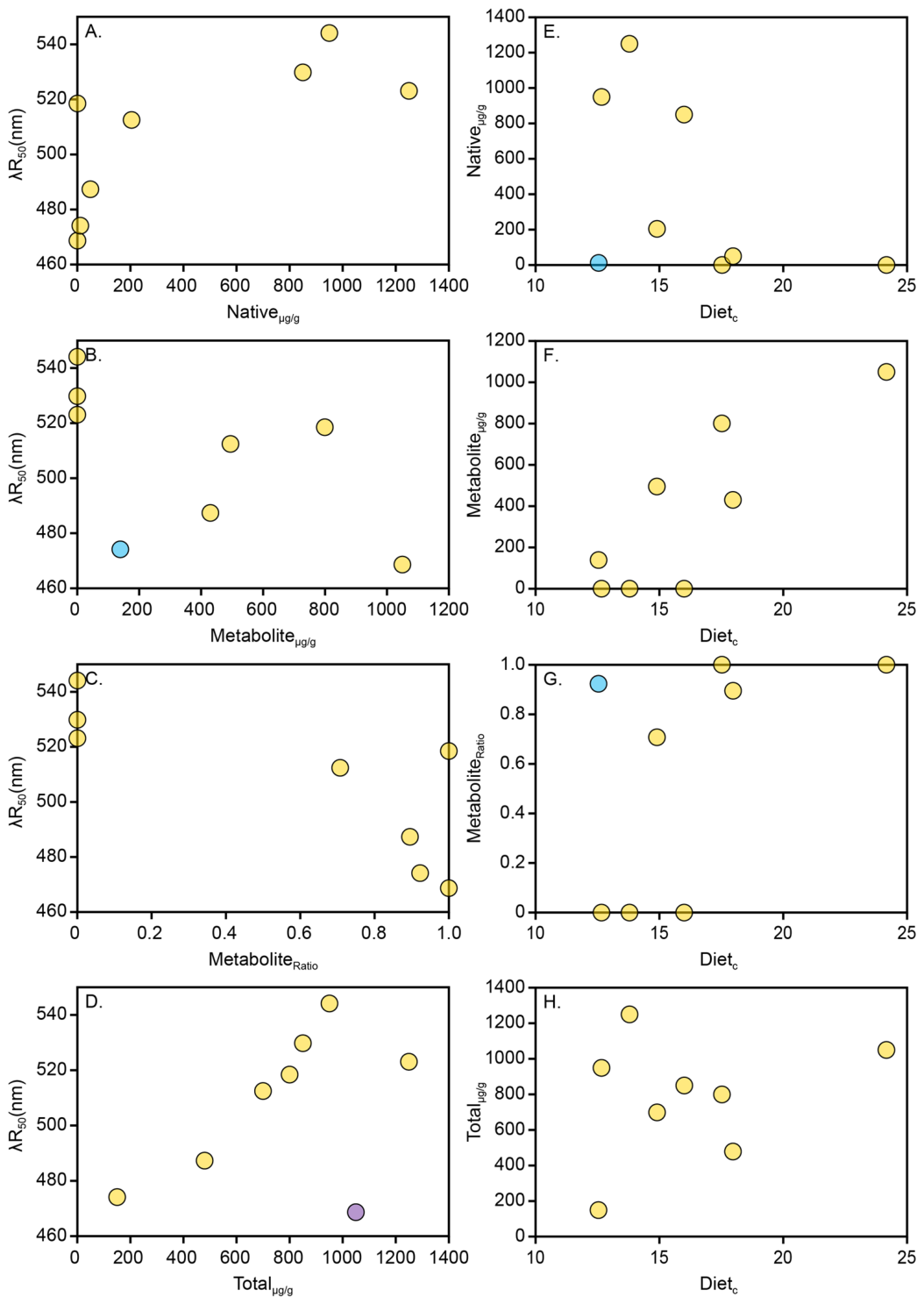
Figure 4.
Red plumage-carotenoid relationships for chemistries (Nativeμg/g, Metaboliteμg/g, MetaboliteRatio, Totalμg/g) as predictors of λR50 (A–D), or as predicted by Dietc (E–H). Note the absence of any strong relationships of red carotenoid chemistries to λR50 or Dietc, and the absence of obvious outliers. Translucent dots help identify data that are on the axes (bisected) and/or are close in value. Each dot diameter n = 1. See Table 1 for sampling scheme, and Table 2 for variable definitions.
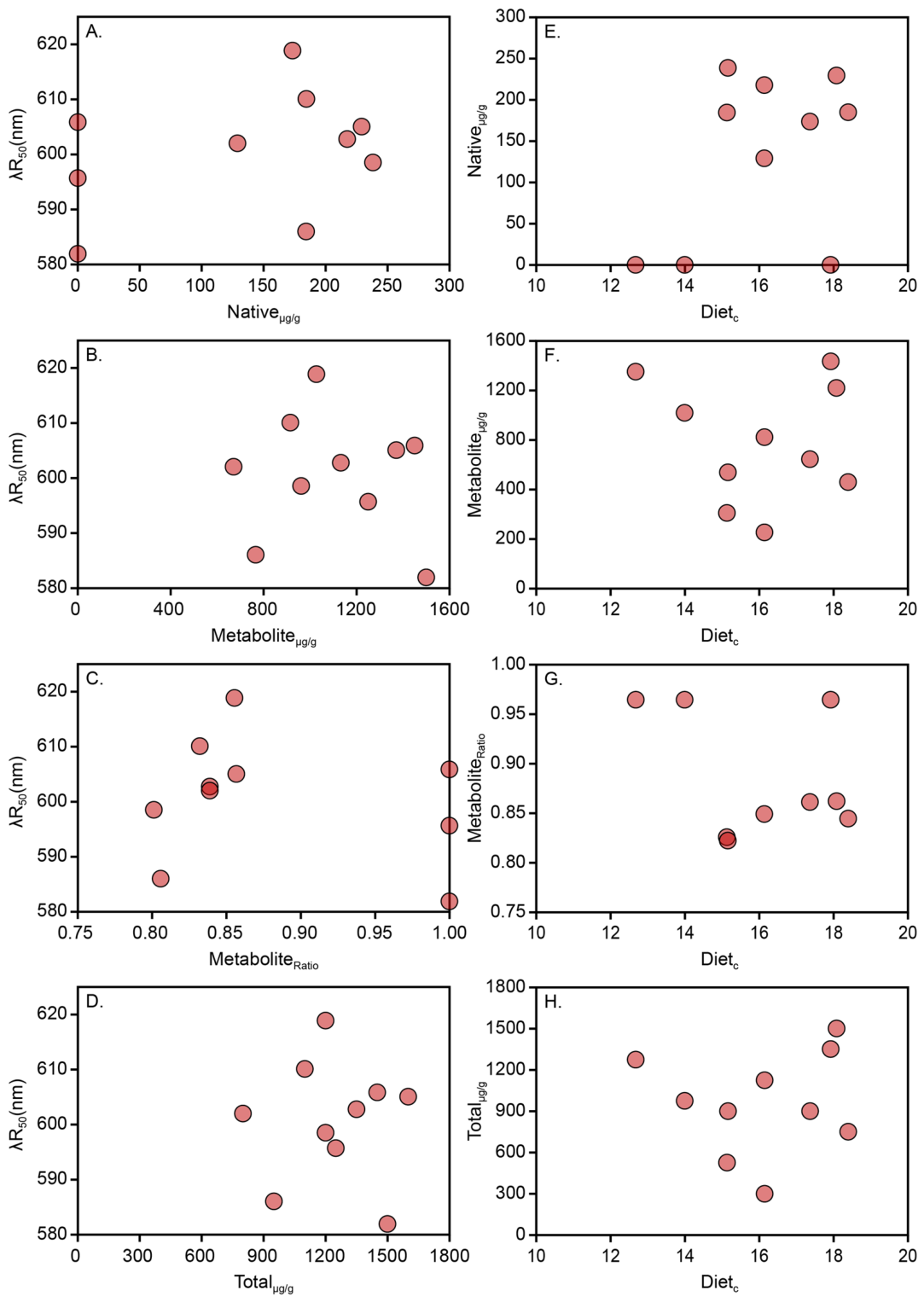
Responses by Chemistry to Dietc—The physical relationships described above for yellow carotenoids (Table 6) predicted that yellow plumage absolute blue shifts at higher Dietc (Table 5) arose from decreased (red-shifted) Nativeμg/g, increased (blue-shifted picofulvin) Metaboliteμg/g, or their combined reciprocal effects via MetaboliteRatio. The data strongly supported all three scenarios (Table 7, Figure 3E–G). Concentrations of natives (Nativeμg/g) decreased with increasing Dietc, (B = −66.2555) which was borderline non-significant for a two-tailed test (p = 0.0592) but significant for the more appropriate one-tailed test (p = 0.0296). In addition, concentrations of picofulvins at higher Dietc increased significantly even by two-tailed tests for both Metaboliteμg/g (B = 88.9421, p = 0.0056) and MetaboliteRatio (B = 0.0649, p = 0.0436) measures (Table 7). The failure of Totalμg/g to respond significantly to Dietc (B = 22.6866, two-tailed p = 0.4682) in yellow plumage (Table 7, Figure 3H) was also consistent with some endogenous control of chemical quantities, as a purely ecophenotypic response otherwise predicts an increase in Totalμg/g at higher Dietc. Thus, the strong responses by yellow plumage λR50 and carotenoid chemistry to Dietc were mutually consistent. The unresponsive red plumage patterns predicted no chemical relationships (Table 5). And indeed, the same statistical models used for yellow plumage failed to reveal any significant responses by red plumage chemistries (Nativeμg/g, Metaboliteμg/g, MetaboliteRatio, Totalμg/g) to Dietc (Table 6 and Table 7, Figure 4E–H). Probing B coefficients gave identical patterns (Table 7), and the standardized effect sizes for the full models (R2adjusted) and between the focal continuous dependent and independent variables (rs) strongly supported the relative strengths of the various unstandardized Bs relating chemistry to Dietc within and between yellow and red plumages (Table 7).
Table 7.
Multiple regressions under Ordinary Least Squares (OLS) evolutionary process models testing the responses by Nativeμg/g or Metaboliteμg/g carotenoids or their combinations (MetaboliteRatio, Totalμg/g) to Dietc assessed with either yellow or red plumage as the Reference Category.
Responses by Product to Precursor Carotenoids—The dynamic hypothesis that birds synthesize yellow picofulvins and red oxo-keto-carotenoids from dietary natives [39] was supported by their inert concentrations in feathers. For yellow plumage, significant two-tailed reciprocal relationships for both Metaboliteμg/g (B = −0.5833, p = 0.0109) and MetaboliteRatio (B = −0.0009, p < 0.0001) measures of picofulvin products in response to putative Nativeμg/g precursors (Table 8; Figure 5A,B) were entirely consistent with depletion of natives by their conversion to picofulvins. The positive (B = 0.4167) and nearly significant two-tailed (p = 0.0548) or significant one-tailed (p = 0.0274) tests for the response by Totalμg/g to Nativeμg/g (Table 8; Figure 5C) further suggested that concentrations of natives drive the total pool of carotenoids destined for deposition or for modification prior to deposition in yellow plumage. Red plumage expressed the same reciprocal relationships for both Metaboliteμg/g and MetaboliteRatio measures of red oxo-keto-carotenoid products in response to Nativeμg/g precursors (Table 8; Figure 5D,E), consistent with considerable earlier evidence that terrestrial birds typically synthesize their red carotenoids from dietary natives [7,39]. However, the uniformly lower quantities and variations in Nativeμg/g in red compared to yellow plumage (Figure 4, Figure 5) probably explained why responses by Metaboliteμg/g or MetaboliteRatio were inconsequential for red oxo-keto-carotenoids compared to yellow picofulvins (Table 8). Red oxo-keto-carotenoid predominance over natives in red plumage was consistent also with the weak response by Totalμg/g to Nativeμg/g (Table 8; Figure 5F).
Table 8.
Multiple regressions under Ordinary Least Squares (OLS) evolutionary process models testing the responses by product carotenoids alone (Metaboliteμg/g) or in combination with natives (MetaboliteRatio, Totalμg/g) to their precursor carotenoids (Nativeμg/g) assessed with either yellow or red plumage as the Reference Category.
Figure 5.
Relationship of product (Metaboliteμg/g, MetaboliteRatio, Totalμg/g) to putative precursor (Nativeμg/g) carotenoids for yellow (A–C) and red (D–F) plumages. Note strong relationships for yellow but not red carotenoids. Outlier plumages comprised mainly of picofulvins at low (blue dot) concentrations are color-coded differently. Translucent dots help identify data that are on the axes (bisected) and/or are close in value. Dot diameters are scaled 1.0:1.5:2.0 for n = 1:2:3. See Table 1 for sampling scheme, and Table 2 for variable definitions.
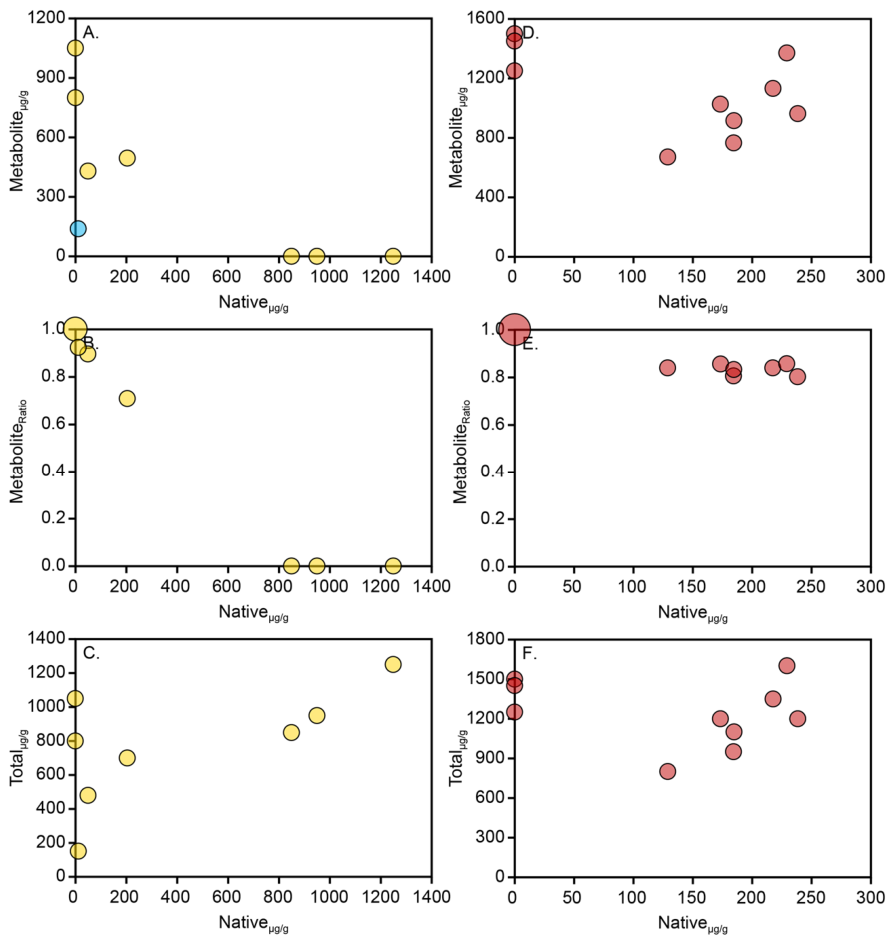
Probing B regression coefficients gave identical patterns (Table 8). However, the standardized effect sizes for the full models (R2adjusted) and between the focal continuous dependent and independent variables (rs) were less consistently aligned with the relative strengths of the various unstandardized Bs for these relationships (Table 8). Despite these qualifications, basic patterns were strongly supported even in notable cases (e.g., rs = −0.97561 for yellow MetaboliteRatio in relation to Nativeμg/g). Thus, natives destined for yellow plumages appeared to be modulated through their conversion to picofulvins whereas natives destined for red plumages seemed to be largely or entirely converted prior to deposition. Alternatively, but less likely, the (precursor–product) patterns for red plumage could also arise if some red carotenoids were ingested and deposited directly by these true woodpeckers, as in some other birds [19,51,52].
Responses to and by Blue-Shifted Carotenoids in Red Plumage—An intrinsic blue-shift potential among red plumages existed because the absorption properties of their constituent carotenoids differ in a regular order from bluest (natives), to intermediate (4-oxo-keto-carotenoids), to reddest (4,4′-oxo-keto-carotenoids). However, no significant relationships for this red plumage chemistry were detected either when λR50 was a dependent variable or Dietc was an independent variable, as assessed in various ways. Widespread unpredictability held whether chemistry was measured in aggregate (Metaboliteμg/g, MetaboliteRatio; Table 6 and Table 7, Figure 4) or in more specific components (Nativeμg/g, Red4μg/g or Red4Ratio; Table 9, Figure 6). Consistent with these conclusions, the standardized effect sizes for the full models (R2adjusted) and between the focal continuous dependent and independent variables (rs) strongly supported the relative strengths of the various unstandardized Bs for these relationships (Table 6, Table 7 and Table 9). These outcomes for red plumage may have arisen in part from canceling effects of carotenoid abundance and strength of blue shift, as the greater comparative blue shifts intrinsic to natives (Δλmax ~ 80 nm) were balanced by their comparative scarcity (~0–250 μg/g) in red plumage whereas the intrinsically less blue-shifted 4-oxo-keto-carotenoids (Δλmax ~ 20 nm) were more abundant (often 500–900 μg/g) in red plumage (Figure 6). Nevertheless, the two-tailed significant positive responses by Red4μg/g (B = 1.6983, p = 0.0257) and Red4Ratio (B = 0.0011, p < 0.0001) to their native (Nativeμg/g) precursors (Table 9; Figure 6) provided a synthetic pathway whereby both of the more blue-shifted (natives, 4-oxo-keto-carotenoids) components could increase relative to redder 4,4′-oxo-keto-carotenoids. Although Nativeμg/g only measured inert precursors already deposited in plumage, the existence of this chemical blue-shift bias globally could facilitate a plumage blue-shift. Failure to observe such effects therefore suggested that extrinsic factors help constrain the blue-shift potential of red plumage.
Table 9.
Regressions under Ordinary Least Squares (OLS) evolutionary process models (except as noted) testing absolute (Red4μg/g) and relative (Red4Ratio) concentrations of blue-shifted 4-oxo-keto-carotenoid (α-doradexanthin) as predictors of λR50 or as predicted by Dietc or Nativeμg/g.
Figure 6.
Oxo-keto-carotenoid shifts from absolute (Red4μg/g) and relative (Red4Ratio) concentrations of the blue-shifted 4-oxo-keto-carotenoid α-doradexanthin, either as predictors of λR50, or as predicted by Dietc or Nativeμg/g. Note the lack of any relationships involving absolute (A,B) to relative (D,E) concentrations of 4-oxo-keto-carotenoids except in response to Nativeμg/g (C,F), and the absence of obvious outliers. Translucent dots help identify data that are on the axes (bisected) and/or are close in value. Dot diameters are scaled 1.0:1.5:2.0 for n = 1:2:3. See Table 1 for sampling scheme, and Table 2 for variable definitions.
Outlier Analyses—Individual data points that were visual outliers to general trends for yellow plumage (blue or purple dots in Figure 3 and Figure 5) could bias regressions conducted on small sample sizes. Nevertheless, their outlier status appeared to have a biological basis, as these points represented the two plumages comprised almost entirely of picofulvins, either at very low (Dryocopus pileatus: blue dots in Figure 3B,E,G and Figure 5A) or very high (Melanerpes candidus: purple dot in Figure 3D) concentrations. These deviations also depended mostly on absolute (Nativeμg/g, Metaboliteμg/g, Totalμg/g) rather than relative (MetaboliteRatio) carotenoid concentrations except that the low concentrations in D. pileatus produced an exceptional (unsaturated) plumage (Figure 7) even for MetaboliteRatio in relation to Dietc (Figure 3G). As expected, implementing parallel full OLS models (Table 6, Table 7 and Table 8) with these singlet outliers removed strengthened (without D. pileatus) or created (without M. candidus) significance (two-tailed) for focal Bs in models with yellow as the Reference Category. Shorthand results without D. pileatus were as follows: Figure 3B, λR50 = Metaboliteμg/g (B = −0.0468, p = 0.0082); Figure 3E, Nativeμg/g = Dietc (B = −97.3910, p = 0.0048); Figure 3G, MetaboliteRatio = Dietc (B = 0.0936, p = 0.0030); Figure 5A, Metaboliteμg/g = Nativeμg/g (B = −0.7102, p = 0.0022). The shorthand result without M. candidus was as follows: Figure 3D, λR50 = Totalμg/g (B = 0.0555, p = 0.0059). These additional analyses suggested that overall picofulvin information content was a composite of relative compared to absolute measures, and of extreme phenotypes that supplement core reciprocal chemistries. Red plumages were not subjected to outlier analyses because their results were more consistently non-significant.
Figure 7.
Visual (A) and spectral (B) characteristics of pale-yellow underwing coverts in male Pileated Woodpecker (Dryocopus pileatus). The blue-shifted spectral location of the main reflectance band (vertical bar for λR50) and the various reflectance minima (absorption maxima for local λmax) are typical for metabolized picofulvins (see Figure 2A), whose predominance in this plumage was verified by chemical analysis [39]. However, the combination of mainly picofulvins at low concentrations appeared to make this particular composition a frequent outlier to otherwise general trends for yellow plumage. The strongly blue-shifted λR50 in conjunction with high and relatively uniform reflectance over the relevant VS–visual range (320–700 nm) is consistent with the unsaturated appearance to humans and possibly, to birds. Cornell Lab of Ornithology|Macaulay Library photo credit: ((A), ML611671290) Tom Murray.
4. Discussion
In true woodpeckers, yellow and red plumages harbor diverse carotenoids that allow in principle for either physical blue or red shifts in response to higher Dietc. The expression of this variation largely independent of phylogeny, sex, and specimen collection year reinforces its potential ecological utility. Nevertheless, the parallel variations in physical reflectance (λR50) and chemistry between yellow and red plumages were not universally linked to Dietc. Rather, at higher Dietc, yellow plumages demonstrated an absolute blue shift (negative slope), red plumages demonstrated a relative blue shift (zero slope), whereas neither plumage demonstrated a significant absolute red shift (positive slope). In a more general context, however, the different outcomes agree that the presence (yellow) or absence (red) of consistent responses by reflectance to Dietc was linked to the presence (yellow) or absence (red) of underlying relationships to physical and chemical processes. In these ways, the chemical compositions of both yellow and red plumages essentially map to how the plumages’ physical reflectance properties relate to Dietc. Material considerations therefore suggest that true woodpeckers use the shared synthetic pathways (native carotenoid precursors) and parallel variations (comparatively blue- or red-shifted carotenoids) associated with yellow and red plumages in radically different ways. Thus, the predictable responses to Dietc by different combinations of natives and picofulvins among yellow plumages (Figure 3) but the unpredictable responses to Dietc by different combinations of natives and red oxo-keto-carotenoids among red plumages (Figure 4 and Figure 6) highlight the distinct chemical ecologies between yellow and red plumages.
The different outcomes for yellow and red plumages are also noteworthy because tuning patterns [24] and behavioral tests [46,47,77] suggest that VS birds can distinguish wavelength differences encompassed by their varied yellow and red carotenoid chemistries [18]. Salience to birds is reinforced by this variation’s visibility even to the less discriminating color vision of humans [18]. Thus, yellow plumages rich in the blue-shifted picofulvins appeared less saturated and more lemon yellow (Figure 1C; Graphical Abstract), whereas those rich in the comparatively red-shifted natives appeared more golden yellow (Figure 1A,B). Red plumages appeared more similar to each other, but those rich in the blue-shifted 4-oxo-keto-carotenoids tended towards crimson (Figure 1C) whereas those rich in the comparatively red-shifted 4,4′-oxo-keto-carotenoids tended towards carmine (Figure 1D). These physical, perceptual, and chemical variations translated to the ecological associations observed in their VS Piciform–Coraciiform relatives [18]. Thus, yellow plumages were more blue-shifted (lemon yellow) in species with higher Dietc (mainly plant-based foods; Figure 1C) and were more red-shifted (golden yellow) in species with lower Dietc (mainly animal-based foods; Figure 1A,B), whereas red plumages showed minimal or contradictory relationships with Dietc (Figure 1C,D). Moreover, spectra recorded from yellow plumages of known chemistries in true woodpeckers (Figure 2A for picofulvins and Figure 2B for natives) were similar in their details to spectra predicted to have the same chemistries in the more inclusive VS Piciformes–Coraciiformes (Figure 3A for picofulvins and Figure 3B for natives, in [18]). Close agreement in ecology and chemistry suggests that true woodpeckers and their VS Piciform–Coraciiform relatives share the same general carotenoid biology. Documented patterns are therefore opposite (yellow) or divergent (red) from expectations under an absolute red shift at higher Dietc. Such consistent results provide a strong basis for using the true woodpecker data to compare the physical and chemical pattern and process symmetries for plumage carotenoids within and between color vision systems.
4.1. Yellow Plumage
Patterns—Further analyses of the [39] data confirm several key expectations [18] for the chemistry of absolute blue shifts by yellow plumage λR50 at higher Dietc in true woodpeckers, and in VS Piciformes–Coraciiformes generally. First, picofulvins and natives were the main carotenoids in yellow plumage (Table 2). Second, greater absolute (Metabolicμg/g) and relative (MetaboliteRatio) concentrations of the blue-shifted picofulvins were directly tied to several relevant ecological relationships, including as predictors of the absolute blue-shift by λR50 (Table 6), and as predicted by higher Dietc (Table 7). Third, reciprocal relationships in feathers between the comparatively blue-shifted picofulvins and the comparatively red-shifted natives (Table 6 and Table 7) were consistent with the proposed synthesis of picofulvins from natives [39]. Indeed, these patterns suggest that true woodpeckers extend some aspects of carotenoid stoichiometry through the deposition phase in yellow plumage to produce the appropriate shift patterns in yellow plumage. Fourth, transitivity applied to relationships for the two main types of yellow carotenoids (Dietc ⟶ native ⟶ picofulvin ⟶ λR50) implies that the strong absolute blue shift by yellow plumage at higher Dietc resulted from greater absolute and relative concentrations of the blue-shifted picofulvins and vice versa for natives. However, yellow carotenoids in red plumage are all (>2% relative concentrations by criteria in [39]) natives. This bias suggests that true woodpeckers actively allocate picofulvins to evoke absolute blue shifts in yellow but not in red plumage. Specificity also implies that the relative blue shift in red plumage results from their mix of natives and red oxo-keto-carotenoids rather than to any canceling effects between strongly blue- (picofulvins) and red- (red oxo-keto-carotenoids) shifted metabolites [18]. In other Piciformes–Coraciiformes, however, orange plumages may combine both picofulvin and red oxo-keto-carotenoid metabolites, consistent with their weaker absolute blue shifts [18]. These patterns suggest that yellow plumage carotenoids in VS emphasize comparatively blue-shifted but not red shifted components at higher Dietc, whereas UVS reverses many of these relationships for yellow and red plumages [1,4,5,21]. Therefore, the results for yellow plumage in true woodpeckers confirm that color vision-associated antisymmetries expressed by λR50 in relation to Dietc are matched by chemical antisymmetries [18].
In the [39] survey, however, two species with low Dietc also expressed mainly picofulvins in parts of their plumage, but only at concentrations much lower than in higher Dietc species (Figure 3). The unsaturated, pale yellow underwing coverts of Dryocopus pileatus (Figure 7) combined low concentrations of picofulvins (~138 μg/g) with minute concentrations of natives (~12 μg/g lutein), whereas the olive-gray back plumage of Colaptes auratus combined low concentrations of picofulvins and natives (~60% picofulvins in 250 μg/g total carotenoids) with appreciable quantities of melanins (disqualifying this patch from statistical analyses of just carotenoids). Despite the distinctive visual appearances and pigment compositions of these plumages, D. pileatus and C. auratus are related (members of Picini, Table 1) and also share a strong dietary preference for small-bodied social insects such as ants and termites [42,78], suggesting both phylogenetic and ecological reasons for picofulvin use at lower Dietc. Indeed, there are substantive reasons why consumption of these social insects could lead specifically to plumages comprised mainly of dilute picofulvins. Overall plumage carotenoid production may be constrained because ants and termites contain among the lowest carotenoid concentrations of any regular avian foods (see Table S2 in [18]), and exploiting them costs trophic specializations. Moreover, secondary compounds in ants (formic acid) and termites (acetic acid) may add novel routes to the production of picofulvins in species that consume these low-Dietc prey. Thus, a proposed avian biochemical capacity to break down (potentially toxic) formic acid by a redox process that produces picofulvins through 7,8-dehydrogenation of natives [39] directly links ant consumption with picofulvin production. Perhaps not coincidentally, therefore, D. pileatus and C. auratus are known to strongly prefer Formicidae [42], the principal ant taxon that produces formic acid. Consumption of termites may also have unusual effects on plumage carotenoids because acetic acid can enhance carotenoid extraction from organic matter during digestion [79], which could increase bioavailability of native precursors for picofulvin synthesis. When not consumed, ants and termites are often rubbed against the plumage to release acids as beneficial sanitizers [42], thereby linking use of particular social insects with other plumage enhancements.
By various means, therefore, the combination of low-carotenoid with high-acid content in ants and termites could facilitate production of plumage signals comprised mainly of picofulvins at seemingly paradoxical low overall carotenoid content in the system. Even with these synergies, however, the ant-termite pathways to picofulvins are not obligate ones within or among species. Thus, yellow plumages comprising natives occur in typical ant-termite consumers either as patches (flight feathers of Colaptes auratus) distinct from those comprising picofulvins (olive-gray back feathers of C. auratus), or as the only yellow plumages (body feathers of Campo Flicker, Colaptes campestris, Figure 1B). Conversely, high concentrations of apparently pure picofulvins can be achieved by frugivores (high Dietc) as in the White Woodpecker, Melanerpes candidus (1050 μg/g; Figure 3 and Figure 5, Graphical Abstract). However, differences in saturation readily distinguish yellow plumages containing mostly picofulvins at either low (unsaturated; Figure 7) or high (saturated; Graphical Abstract) absolute concentrations. Thus, core relationships defined by reciprocity between natives and picofulvins are augmented with extreme (low and high concentration) picofulvin phenotypes to produce a more complex chemical ecology.
The measure of Totalμg/g yellow carotenoids in yellow plumages also provides surprising insights into the chemical basis of the absolute blue shift at higher Dietc. Overall, no significant response by Totalμg/g to Dietc (Table 7 and Figure 3) is consistent with the general reciprocal concentrations of natives and picofulvins across Dietc, suggesting that total carotenoid concentration per se is less important than chemical identity in evoking the absolute blue shift. However, yellow plumage λR50 is moderately (Table 6 and Figure 3) to strongly (see Outlier Analysis) red-shifted with increasing Totalμg/g through their mutual positive relationships to Nativeμg/g (Table 6 and Table 8, Figure 3 and Figure 5). True woodpeckers therefore appear to deposit disproportionately more of the comparatively red-shifted natives at lower Dietc to accentuate the picofulvin-based absolute blue shift at higher Dietc by comparison. Conversely, general avoidance of high concentrations of picofulvins at lower Dietc and of natives at higher Dietc accentuates the overall absolute blue shift at higher Dietc. This evidence suggests that true woodpeckers covary chemistry and concentration of yellow carotenoids in complementary ways that enhance their absolute blue-shift in response to higher Dietc. Notably, the historical stability of true woodpecker blue shifts in yellow plumage (uniformly favored OLS models; Table 3 and Table 4), their endogenous production via picofulvins [18], and their antisymmetric chemistries vis-à-vis UVS [1,17] are all intrinsic links consistent with the hypothesis that such shifts associate with other inherent factors such as VS color vision.
Processes—The deployment of novel picofulvins to evoke the VS blue shift at higher Dietc suggests that divergence in chemical processes is required to maintain antisymmetric shift patterns between VS and UVS. However, broader characteristics suggest an overarching symmetry of process between blue-shifted VS and red-shifted UVS systems at the organismal level. Proximate process invariances are expressed in several ways. Notably, the opposite shift patterns provide congruent indicators of higher (and lower) Dietc [18]. Moreover, both color vision systems emphasize plumages comprising natives at low Dietc, and of shift-appropriate metabolites (VS with picofulvins and UVS with oxo-keto-carotenoids) derived from natives at higher Dietc as one way to reinforce their antisymmetries [18]. The additional energy needed to convert natives to these metabolites in both systems also potentially avoids misleading signals of costs and benefits by imposing additional physiological requirements for signal expression (more metabolites) when carotenoids are otherwise cheatable because they are more readily available at higher Dietc [33,80]. Conversely, both color vision systems appear to treat natives as less costly colorants. Natives appear more economical overall because they are the most abundant carotenoids in the yellow plumages of both true woodpeckers (a nearly significant two-tailed test for the response by Totalμg/g to Nativeμg/g; Table 8, Figure 5), and in various UVS groups [19,81]. Natives in yellow plumage also appear to be more specific honest signals of their lower cost because they occur at higher absolute and relative concentrations than their metabolic derivatives at lower Dietc (Table 7).
Reciprocity between cheaper natives and more costly metabolites in yellow (Figure 5A,B) but not red (Figure 5D,E) plumage within true woodpeckers despite the derivation of the corresponding yellow picofulvins and red oxo-keto-carotenoids from the same native precursors [39] suggests deliberate control of the processes that determine these yellow plumage qualities. Ultimate process invariances are also implied by these proximate biochemical ones in that both VS and UVS plumage carotenoids can provide accurate information in relation to Dietc and any of its potential associations with health, survival, and fitness [33,80] via their respective shift patterns. The uninformativeness of Totalμg/g in relation to Dietc in true woodpeckers further suggests that metabolic conversion of natives to picofulvins transforms a basic ecophenotypy into a heritable response, thereby expanding potential genetic correlations between yellow plumage chemistry and the aforementioned qualities. These considerations strongly suggest that the opposite shift patterns have the same potential as signals, including as honest ones. Consequently, the chemical data for yellow plumage in true woodpeckers are consistent with a variety of resource-based hypotheses linking carotenoid limitations to honest signaling, including ones originating from ecology [14,16,17], availability [33], costs [35,82], benefits [5], and their trade-offs [80].
Despite their honesty potential, a number of novel chemical properties associated with picofulvins may break symmetry invariance connected with Dietc in more subtle ways. The strong blue shifts associated with picofulvins result from their lower conjugation state (fewer resonating carbon-carbon double bonds) compared to the common yellow (e.g., canary xanthophylls) carotenoid metabolites in UVS [51], suggesting different bioactive properties among these yellows. In this regard, the same maximum span by λmax of about 70 nm for true woodpecker yellow carotenoids in vitro [39,49,50] and in vivo (Figure 3A; [18,24]) indicates that the comparatively blue-shifted picofulvins and red-shifted natives retain their basic properties even after deposition in feathers (cf. carotenoid X feather protein interactions). Thus, retention of the lower conjugation state responsible for the blue-shift by plumage picofulvins could impart specific information different from that conveyed by the yellows typical of UVS. Furthermore, evidence suggests that birds must produce their own picofulvins because these carotenoids are absent from their diets [39] whereas red oxo-keto-carotenoids, although usually metabolized, can sometimes be obtained unmodified from birds’ foods [19,51]. Thus, honest links to physiological costs and benefits may be more stringent for picofulvins than for systems utilizing red oxo-keto-carotenoids [80]. The rigor of the picofulvin system may be reinforced because the abundance of different picofulvins appears tied to the abundance of their dietary native precursors. Thus, 7,8-dihydro-lutein is often the most abundant picofulvin in yellow plumage of true woodpeckers [39], and its lutein precursor is typically the most abundant native carotenoid in avian diets [7,32]. These properties should enhance Dietc-based honesty because specific natives and their picofulvin derivatives can then be regulated in direct proportion to the abundance of the various native precursors consumed. These unimpeachable components may help explain the strong reliance on yellow carotenoids for honest signaling in VS.
Whereas picofulvin pigmentation strategies varied with Dietc, all true woodpeckers presumably consume enough of the ubiquitous native yellow carotenoids to emphasize them as plumage colorants under any Dietc. However, evidence that both picofulvin and natives are alternative phenotypes at low Dietc raises additional questions about the relative honesty and adaptive significance of these variations. One possibility is that the different yellow carotenoid strategies are maintained through a balanced “polychromatism” of equal honesty [83] at low dietary carotenoid availability. For example, if the costs or benefits per molecule are higher for metabolized picofulvins than for dietary natives, then those yellow signals pigmented mainly with dilute picofulvins or with concentrated natives may coexist by virtue of their selective equivalence. Another possibility is that certain patches, sexes, or species are constrained to produce one or the other condition because they or their lineage lack the necessary synthetic or depositional pathways (see Picini with yellows from mainly dilute picofulvins). A third consideration is that picofulvins and natives may be distinct adaptations that differ in the costs and benefits they provide to competing life history demands (e.g., honest signals of abilities to gather healthful nutrients versus to process secondary compounds, as expressed between patches, sexes, or species). This divergence is consistent with the physical distinctness of the outlier conditions of yellow plumages comprising mainly very low (blue dots, Figure 3 and Figure 5) or very high (purple dot, Figure 3) picofulvin concentrations. Finally, a sensory bias for strong blue shifts in VS may sometimes favor the picofulvin over the native strategy in (currently) unpredictable ways. Such possibilities need not be mutually exclusive. Interestingly, a parallel polychromatism may also occur for UVS yellows from hydroxy-xanthophyll natives versus (mainly) canary xanthophyll metabolites [13,34]. However, unlike in VS, the native and metabolized yellows in UVS resemble each other closely in their physical reflectance [13,18], allowing yellows to break symmetries between VS and UVS systems. Thus, complex interplays and trade-offs of costs and benefits may affect yellow carotenoids within and between color vision systems.
4.2. Red Plumage
Patterns—Variation in physically red reflectance in true woodpeckers appears more than sufficient to allow for an absolute shift relationship (positive or negative slope) to higher Dietc (Table 6, Figure 4, Figure 5 and Figure 6). The subjective perception of this potential (Figure 1 and associated text) is supported by objective variations in carotenoid composition (Table 2, Table 6, Table 7, Table 8 and Table 9, Figure 4, Figure 5 and Figure 6) that include very different concentrations of three basic components in red plumages, including natives that are intrinsically blue shifted compared to red oxo-keto-carotenoids, and 4-oxo-keto-carotenoids that are intrinsically blue shifted compared to 4,4′-oxo-keto-carotenoids. Moreover, true woodpeckers should have several ways to manipulate this variation. First, as for most terrestrial birds [1,7,51], true woodpeckers probably synthesize most of their red oxo-keto-carotenoids from dietary natives [39], which implies that the birds can control physical and chemical aspects of plumage redness. Second, their metabolized reds (oxo-keto-carotenoids) and yellows (picofulvins) derive from the same native precursors [39], suggesting that starting materials for any shift patterns are no more limiting for red than for yellow plumage. Third, different overall concentrations of dietary natives in red (low only; Figure 4, Figure 5 and Figure 6) versus yellow (low to high; Figure 3 and Figure 5) plumage, along with the undetectability of each plumage’s characteristic metabolites in the other plumage (no picofulvins in red, no oxo-keto-carotenoids in yellow) suggest endogenous regulation of the native/metabolite ratios in the entire system (Table 2). However, the consistency of reds’ non-responses among most variables of red pigmentation (Figure 4, Figure 5 and Figure 6), suggest that the relative blue shifts (of zero slope) at higher Dietc are actively maintained.
The active processes responsible for the different shift responses by red and yellow plumage undoubtedly differ in detail. However, both plumages may share some more passive processes that affect plumage carotenoid composition. Notably, the most abundant red carotenoids are either the comparatively blue-shifted 4-oxo-keto-carotenoid α-doradexanthin or the more red-shifted 4,4′-oxo-keto-carotenoid astaxanthin [39]. Perhaps not coincidentally, these two red oxo-keto-carotenoids are derived from the two native carotenoids that are most abundant in the general diets and plumages of birds, including in true woodpeckers: α-doradexanthin from lutein, and astaxanthin from zeaxanthin [7,32,39]. Conversely, the rarer 4,4′-oxo-keto-carotenoids adonirubin and canthaxanthin [39] ultimately derive from natives (β-cryptoxanthin or the non-xanthophyll β-carotene, respectively) that are typically rarer in general avian diets [7,32,39]. Red-carotenoid abundance patterns also do not seem to depend on the cost of endogenous oxo-keto-carotenoid production [7,39,84], as all three 4,4′-oxo-keto-carotenoids are more expensive (per molecule) to synthesize (C4-ketolation of two β-end rings) than the 4-oxo-keto-carotenoid (C4-ketolation of one β-end ring). Therefore, the predominance of either blue- or red-shifted oxo-keto-carotenoids in true woodpeckers may depend instead on ecological or historical idiosyncrasies not revealed by chemistry alone, including those related to diet [85], pigmentation [86] and behavior [18].
Evidence that true woodpeckers have ample opportunities to manipulate plumage redness through active and passive processes suggests that red’s refractoriness to Dietc is enabled by other chemical factors. Certainly, true woodpecker reds appear constrained in their expression even when compared to known pigmentation strategies for producing redness. Thus, low concentrations of natives in red plumages suggest that true woodpeckers restrict their reds to those created by depositing intrinsically redder 4- and 4,4′-oxo-keto-carotenoids in various combinations rather than by depositing intrinsically yellow carotenoids at higher optical densities (concentrations, structural thicknesses or both; [1,14,16]). In accordance with this more specialized approach to redness, high optical densities of yellows alone or with reds can produce intermediate orange plumage, which could grade into either yellower or redder plumages. However, orange plumages are relatively rare in VS Piciformes–Coraciiformes [18], suggesting a pigmentation strategy that keeps reds physically homogenous among themselves and distinct from yellows. Selective avoidance of orange plumage by true woodpeckers in particular is also consistent with the absence of intrinsically orange carotenoids from the feathers sampled even though these precursors to their red plumage carotenoids must be available to the birds thorough at least two pathways, including (β-carotene)orange ⟶ (echinenone)orange ⟶ (canthaxanthin)red and (β-cryptoxanthin)yellow ⟶ (3-hydroxy-echinenone)orange ⟶ (adonirubin)red [1,9,39,51]. These considerations suggest that the lack of prevalent changes by red plumage λR50 or chemistry in response to Dietc is part of a broader process that constrains longer-wavelength plumages to use intrinsically redder carotenoids that resemble each other in their physical reflectance.
Processes—The lack of a significant response by red plumage to Dietc in true woodpeckers and their VS Piciform–Coraciiform relatives is surprising considering its frequency among UVS birds, and the considerable variation in physical and chemical redness expressed even in this study’s limited survey of true woodpeckers (see Section 4.2. Red, Patterns). Indeed, the statistically non-significant but weakly positive response by red λR50 to higher Dietc (Table 5) repeats a pattern in the more inclusive VS Piciform–Coraciiform sample [18], suggesting the same potential for informative signaling of diet. Thus, true woodpeckers appear to meet basic requirements for honest signaling of costs and benefits through the interaction of resource limitations with plumage phenotypes. However, the similar physical properties (λR50) of red plumage with different chemical compositions (Figure 2C,D, Figure 4, Figure 5 and Figure 6) imply that other factors alter these relationships. These additional influences could include both proximate (physical mechanisms; Bleiweiss in prep.) and ultimate (signal functions) considerations. In either case, the rarity (Table 9) and general weakness (otherwise) of red plumage relationships among λR50, chemistry, and Dietc strongly implicate breaks in both pattern and process symmetry for true woodpecker red as compared to their other carotenoid-based plumages.
Understanding the chemical ecology of red plumage in true woodpeckers is simplified; however, because natives are present in only low concentrations, picofulvins are either absent or undetectable (Table 2, Figure 4, Figure 5 and Figure 6), and oxo-keto-carotenoids are likely to be endogenously produced [7,39,84]. This composition facilitates assessment of generic costs and benefits of red plumage as one way to determine red’s potential for symmetric shift patterns and processes of honest signaling. Dietc-based honesty from the precursor–product dynamics between natives and red oxo-keto-carotenoids predicts that greater availability of natives would increase endogenous production of both 4- and 4,4′-oxo-keto-carotenoids so as to impose a cost or increase a benefit from plumage redness when precursors are more readily available [33]. However, overall oxo-keto-carotenoid production is not predicted by the availability of natives through higher Dietc (Table 7). Red plumage chemistries may further compromise Dietc-based honesty because production of the more expensive and/or beneficial (metabolized, double-ketolated) 4,4′-oxo-keto-carotenoids [5] does not increase at higher Dietc (Table 9). Moreover, positive responses by Red4μg/g and Red4Ratio to Nativeμg/g (Table 9) suggest that some red plumages in true woodpeckers are made deliberately cheaper, as natives are cheapest (dietary) and 4-oxo-ketos next cheapest (metabolized, single-ketolated) among those carotenoids present in these plumages. Red signal costs at odds with appearance, resource availability, and chemistry therefore imply that red plumages in true woodpeckers can cheat some aspects of honest signaling arising from Dietc, providing a strong basis for dishonesty and deception.
Red plumage is such a widespread and important signal in true woodpeckers [18,87,88] that the list of possible reasons why it lacks a prominent response to Dietc is probably as long as those factors responsible for overall true woodpecker plumage diversity [18,89,90]. However, three considerations help identify the more important influences. First, broken pattern and process symmetries imply that at least some critical factors differ from those acting on yellow plumage. Second, these factors must be strong enough to override the latent response to Dietc (Table 5). Finally, chemistry itself suggests some dishonesty/deception among red phenotypes, and hence in signaling itself. Consistent with these properties, redness that is unresponsive to Dietc may arise through selection for resemblance by one or more causes [18], including sensory bias [91,92,93] or honest or dishonest interspecific social or aposematic mimicry directed towards predators or competitors [94,95,96]. Sensory bias is supported in a general way by the unusually widespread occurrence of red plumages in true woodpeckers and their allies compared to other birds [18]. Moreover, the various mimicry processes are compatible with the general biology of true woodpeckers [90,97] and other piciforms [18,98], many of which have strong physiques, are highly aggressive and territorial, and provide evidence for mimicry. Moreover, the diverse chemistries and costs of optically similar (λR50) red plumages, and the active exclusion of intermediate and available orange carotenoids from either yellow or red plumages, are consistent with convergent resemblance functions for red distinct from the divergent honest signaling functions for yellow [95].
In choosing among possible reasons for resemblance, predation effects on red (or yellow) plumage may be mitigated because woodpeckers nest in cavities, which afford them some protection during the especially vulnerable, reproductive phase of their life histories. However, transitions to resemblance uses could be facilitated by the lower variabilities of red compared to yellow plumages (e.g., contrast Figure 3 and Figure 4; see also [18]), a difference that probably arises in part from the greater inherent saturation (absorption) of red carotenoid pigments [18]. Under the right circumstances, this intrinsic constraint on red carotenoids could undermine the reliability of information content beyond a general redness suited to resemblance (see also shared pathway hypothesis; [5]). However, these considerations need to be assessed with complementary studies in groups where plumage red shifts in response to Dietc, which could clarify if low variability in red plumage is a cause or effect of selection for resemblance. Similarly, possible phylogenetic constraints detected in true woodpeckers for some red but not for any yellow plumages and chemistries (Table 3, Table 4 and Table 9) are poorly understood, but add relatedness as yet another possible component favoring resemblance functions for reds. Thus, extrinsic, intrinsic, and historical factors all may influence resemblance and its functions among red plumages.
4.3. Symmetry and Evolution
Novelty—There are surprising relationships that intertwine the chemistries and functions of yellow and red carotenoids in VS true woodpeckers. On the one hand, symmetry invariance between VS and UVS is associated with their common usage of dietary carotenoids as cheap signals and as precursors for more expensive metabolized ones. On the other hand, certain metabolized yellow carotenoids used to maintain opposite shift patterns between color vision systems are rare or absent from the opposing system. Thus, the strongly blue-shifted yellow picofulvin metabolites of VS are rarely reported from UVS birds whereas the common but weakly blue-shifted yellow metabolites (canary xanthophylls among others) of UVS are rarely reported in VS birds [18]. These chemical patterns imply that novel carotenoid synthesis pathways are sometimes an essential requirement to maintain pattern and process symmetry at other levels. In this regard it is notable that broken symmetry occurs between VS and UVS for metabolized carotenoids shared by VS and UVS. The contrasting patterns for different metabolites are counterintuitive because, ceteris paribus, the same carotenoids would be expected to have the same functions between color vision systems, while different carotenoids would be expected to serve different functions. Apparent failure of this view suggests instead that chemical synthetic pathways serve the broader constraints of patterns and processes related to other symmetry imperatives.
Diversity—Accounting for these considerations suggests that some evolutionary details arise from symmetry constraints. Most obviously, the metabolic production of picofulvins highlights that VS birds go through the trouble to manufacture these unusual carotenoids even at an imposed cost. Picofulvin production must therefore be a response to some higher requirement—in this case, to maintain pattern and process symmetry. Given these dynamics, the existence of other unusual plumage pigments such as porphyrins [18] and pterins [99,100] in VS, and psittacofulvins [86] and vitamin A retinoids [101] in UVS elevates these poorly studied chemistries to greater prominence in discussions of how and why plumage pigment specializations evolve. Notably, both porphyrins and pterins can be relatively blue-shifted compared to psittacofulvins and vitamin A retinoids and other carotenoids [18,99], suggesting that pigment diversity also adheres to the general symmetry requirements that govern VS and UVS. As birds from the different color vision systems frequently interact during the course of their daily activities, the imperatives of maintaining general symmetry invariance also make sense in an ecological context.
5. Conclusions
Analysis of plumage carotenoids in true woodpeckers confirms and extends the importance of an expanded conception of symmetry for studies of carotenoid-based plumage and of evolution overall. In general, this framework reveals a surprising integration among dietary ecology, plumage phenotype, color vision, and pigment chemistry. In particular, the results indicate that the expression of generalized symmetries encompasses opposite patterns (absolute blue and red shifts in plumage reflectance) that arise from a chain of invariant processes (indexed responses to dietary ecology ⟶ conversion of natives to shift-specific metabolites at higher Dietc ⟶ honest signaling ⟶ salience from color vision tuning) that extend from the chemical to the organismal level. It remains to be determined, however, if VS chemistries are augmented by other VS blue-shift mechanisms comparable in their diversity and related costs and benefits to those used to produce UVS red shifts (see Section 1). Moreover, larger sample sizes will be needed to more accurately determine and compare the forms of the various response equations within and between VS and UVS, which were modeled here for VS as linear or monotonic because of analytical constraints. These sampling issues also relate to how low-Dietc plumage phenotypes comprised mainly of dilute metabolites fit into more general patterns and processes. Nevertheless, the antisymmetric chemistries that determine absolute blue- versus absolute red shifts are generally process invariant in that they appear to result from a shared gradient in Dietc associated with similar plumage costs and benefits (e.g., dietary or metabolic origin of shift-specific carotenoids, nutrients, and secondary compounds) experienced by species in both color vision systems. In principle, integration of these components can lead to shared higher functions in relation to Dietc (communication and honest signaling, health and physical and reproductive fitness). For red plumage in true woodpeckers, however, ostensible (anti)symmetry breaks down because evolution appears to favor alternative but equally integrated patterns (relative blue shifts) and processes (e.g., resemblance uses). Symmetry and symmetry breaking therefore appear to be complementary aspects of evolutionary change, suggesting that generalized symmetries form a basic axis of adaptive radiation.
Supplementary Materials
The following supporting information can be downloaded at: https://www.mdpi.com/article/10.3390/d18070398/s1, Figure S1: Ultrametric phylogeny and plumage states (Y = yellow, R = red) used for analyses of the true woodpecker (Picinae) data set; Table S1: Excel [102] spreadsheet of museum specimens used to generate reflectance measurements for this study.
Funding
The National Science Foundation (IOS 0741857) and Vilas Life Cycle Program of the University of Wisconsin (133-PRJ45EB, 133-PRJ45EC) provided generous financial support for this work.
Data Availability Statement
The author confirms that the data supporting the findings of this study are available within the article, in the Supplementary Data Files, and in the open data online resource https://birdsoftheworld.org/bow/home (accessed on 28 April 2025). Additional datasets are not readily available as they are part of ongoing studies. Reasonable requests for access should be directed to the author.
Acknowledgments
I thank museums and their curators for the loan of specimens under their care, including the Delaware Museum of Natural History (Jean Woods), the Museum of Comparative Zoology (Jeremiah Trimble), the University of Michigan Museum of Zoology (Janet Hinshaw), and the University of Wisconsin Zoological Museum (Laura A. Monahan, Emily Halverson, Paula Holahan, Kathryn Jones, Dianna K. Krejsa). P. Mathiaparanam (Appleton Ideas Company) provided equipment. Katherine L. Baldwin expertly assisted with the figures. The author thanks two anonymous reviewers for helpful comments on the manuscript.
Conflicts of Interest
The author declares no conflicts of interest.
References
- Andersson, S.; Prager, M.; Johansson, E.I.A. Carotenoid content and reflectance of yellow and red nuptial plumages in widowbirds (Euplectes spp.). Funct. Ecol. 2007, 21, 272–281. [Google Scholar] [CrossRef] [Scilit]
- Bleiweiss, R. Physical alignments between plumage carotenoid spectra and cone sensitivities in ultraviolet-sensitive (UVS) birds (Passerida: Passeriformes). Evol. Biol. 2014, 41, 404–424. [Google Scholar] [CrossRef] [Scilit]
- Brambilla, L.; Canali, G.; Mannucci, E.; Massa, R.; Saino, N.; Stradi, R.; Zerbi, G. Colori In Volo: Il Piumaggio Degli Uccelli Ricerca Scientifica e Cultura Umanistica; Universita degli Studi di Milano: Milan, Italy, 1999. [Google Scholar]
- Hill, G.E. A Red Bird in a Brown Bag: The Function and Evolution of Colorful Plumage in the House Finch; Oxford University Press: Oxford, UK, 2002. [Google Scholar]
- Hill, G.E.; Hood, W.R.; Ge, Z.; Grinter, R.; Greening, C.; Johnson, J.D.; Park, N.R.; Taylor, H.A.; Andreasen, V.A.; Powers, M.J.; et al. Plumage redness signals mitochondrial function in the house finch. Proc. R. Soc. Ser. B Biol. Sci. 2019, 286, 20191354. [Google Scholar] [CrossRef] [Scilit]
- LaFountain, A.M.; Prum, R.O.; Frank, H. Diversity, physiology, and evolution of avian plumage carotenoids and the role of carotenoid-protein interactions in plumage color appearance. Arch. Biochem. Biophys. 2015, 572, 201–212. [Google Scholar] [CrossRef] [Scilit] [PubMed]
- McGraw, K.J. Mechanics of carotenoid-based coloration. In Bird Coloration: Mechanisms and Measurements; Hill, G.E., McGraw, K.J., Eds.; Harvard University Press: Cambridge, MA, USA, 2006; Volume I, pp. 177–242. [Google Scholar]
- Mendes-Pinto, M.M.; LaFountain, A.M.; Stoddard, M.C.; Prum, R.O.; Frank, H.A.; Robert, B. Variation in carotenoid-protein interaction in bird feathers produces novel plumage coloration. J. R. Soc. Interface 2012, 9, 3338–3350. [Google Scholar] [CrossRef] [Scilit]
- Stradi, R.; Celentano, G.; Boles, M.; Mercato, F. Carotenoids in bird plumage: The pattern in a series of red-pigmented Carduelinae. Comp. Biochem. Physiol. Part B 1997, 117, 85–91. [Google Scholar] [CrossRef] [Scilit]
- Endler, J.A. Natural selection on color patterns in Poecilia reticulata. Evolution 1980, 34, 76–91. [Google Scholar] [CrossRef] [Scilit]
- Grether, G.F.; Kolluru, G.R.; Rodd, F.H.; De La Cerda, J.; Shimazaki, K. Carotenoid availability affects the development of a colour-based mate preference and the sensory bias to which it is genetically linked. Proc. R. Soc. Lond. Ser. B 2005, 272, 2181–2188. [Google Scholar] [CrossRef] [Scilit] [PubMed]
- Kodric-Brown, A. Dietary carotenoids and male mating success in the guppy: An environmental component to female choice. Behav. Ecol. Sociobiol. 1989, 25, 393–401. [Google Scholar] [CrossRef] [Scilit]
- McGraw, K.J.; Gregory, A.J. Carotenoid pigments in male American goldfinches: What is the optimal biochemical strategy for becoming colorful? Biol. J. Linn. Soc. 2004, 83, 273–280. [Google Scholar] [CrossRef] [Scilit]
- Bleiweiss, R. Novel chromatic and structural biomarkers of diet in carotenoid-bearing plumage. Proc. Biol. Sci. 2004, 271, 2327–2335. [Google Scholar] [CrossRef] [Scilit]
- Bleiweiss, R. Variation in ultraviolet reflectance by carotenoid-bearing feathers of tanagers (Thraupini: Emberizinae: Passeriformes). Biol. J. Linn. Soc. 2005, 84, 243–257. [Google Scholar] [CrossRef] [Scilit]
- Bleiweiss, R. On the ecological basis of interspecific homoplasy in carotenoid-bearing signals. Evolution 2007, 61, 2861–2878. [Google Scholar] [CrossRef] [Scilit] [PubMed]
- Bleiweiss, R. Phenotypic integration expressed by carotenoid-bearing plumages of tanager-finches (Thraupini, Emberizinae) across the avian visible spectrum. Biol. J. Linn. Soc. 2008, 93, 89–109. [Google Scholar] [CrossRef] [Scilit]
- Bleiweiss, R. Symmetric responses to diet by plumage carotenoids in violet-sensitive piciform–coraciiform birds. Diversity 2025, 17, 379. [Google Scholar] [CrossRef] [Scilit]
- Delhey, K.; Valcu, M.; Dale, J.; Kempenaers, B. The evolution of carotenoid-based plumage colours in passerine birds. J. Anim. Ecol. 2023, 92, 66–77. [Google Scholar] [CrossRef] [Scilit] [PubMed]
- Hill, G.E. Redness as a measure of the production cost of ornamental coloration. Ethol. Ecol. Evol. 1996, 8, 157–175. [Google Scholar] [CrossRef] [Scilit]
- Inouye, C.Y.; Hill, G.E.; Stradi, R.D.; Montgomerie, R. Carotenoid pigments in male house finch plumage in relation to age, subspecies, and ornamental coloration. Auk 2001, 118, 900–915. [Google Scholar] [CrossRef]
- Ninnes, C.E.; Andersson, S. Male receiver bias for red agonistic signalling in a yellow-signalling widowbird: A field experiment. Proc. R. Soc. Lond. Ser. B 2014, 281, 20140971. [Google Scholar] [CrossRef] [Scilit]
- Bleiweiss, R. Extrinsic versus intrinsic control of avian communication based on colorful plumage porphyrins. Evol. Biol. 2015, 42, 483–501. [Google Scholar] [CrossRef] [Scilit]
- Bleiweiss, R. Concerted shifts in absorption maxima of yellow and red plumage carotenoids support specialized tuning of chromatic signals to different visual systems in near-passerine birds. Evol. Biol. 2017, 45, 75–95. [Google Scholar] [CrossRef] [Scilit]
- Padmanabhan, H.; Munro, J.M.; Dabo, I.; Gopalan, V. Antisymmetry: Fundamentals and applications. Annu. Rev. Mater. Res. 2020, 50, 255–281. [Google Scholar] [CrossRef] [Scilit]
- Li, R.; Bowerman, B. Symmetry breaking in biology. Cold Spring Harb. Perspect. Biol. 2010, 2, a003475. [Google Scholar] [CrossRef] [Scilit] [PubMed]
- Dunitz, J.D. Symmetry arguments in chemistry. Proc. Natl. Acad. Sci. USA 1996, 93, 14260–14266. [Google Scholar] [CrossRef] [Scilit] [PubMed]
- Gross, D.J. The role of symmetry in fundamental physics. Proc. Natl. Acad. Sci. USA 1996, 93, 14256–14259. [Google Scholar] [CrossRef] [Scilit]
- Badyev, A.V.; Posner, A.B.; Morrison, E.S.; Higginson, D.M. Cycles of external dependency drive evolution of avian carotenoid networks. Nat. Commun. 2019, 10, 1596. [Google Scholar] [CrossRef] [Scilit]
- Mundy, N.I.; Stapley, J.; Bennison, C.; Tucker, R.; Twyman, H.; Kim, K.W.; Burke, T.; Birkhead, T.R.; Andersson, S.; Slate, J. Red carotenoid coloration in the zebra finch is controlled by a cytochrome P450 gene cluster. Curr. Biol. 2016, 26, 1435–1440. [Google Scholar] [CrossRef] [Scilit]
- Twyman, H.; Valenzuela, N.; Literman, R.; Andersson, S.; Mundy, N.I. Seeing red to being red: Conserved genetic mechanism for red cone oil droplets and co-option for red coloration in birds and turtles. Proc. R. Soc. Ser. B Biol. Sci. 2016, 283, 20161208. [Google Scholar] [CrossRef] [Scilit]
- García-de Blas, E.; Mateo, R.; Alonso-Alvarez, C. Specific carotenoid pigments in the diet and a bit of oxidative stress in the recipe for producing red carotenoid-based signals. PeerJ 2016, 4, e2237. [Google Scholar] [CrossRef] [Scilit]
- Olson, V.A.; Owens, I.P.F. Costly sexual signals: Are carotenoids rare, risky or required? Trends Ecol. Evol. 1999, 13, 510–514. [Google Scholar] [CrossRef] [Scilit]
- Koch, R.E.; McGraw, K.J.; Hill, G.E. Effects of diet on plumage coloration and carotenoid deposition in red and yellow domestic canaries (Serinus canaria). Wilson J. Ornithol. 2016, 128, 328–333. [Google Scholar] [CrossRef] [Scilit]
- Weaver, R.J.; Santos, E.S.A.; Tucker, A.M.; Wilson, A.E.; Hill, G.E. Carotenoid metabolism strengthens the link between feather coloration and individual quality. Nat. Commun. 2018, 9, 73. [Google Scholar] [CrossRef] [Scilit]
- Blount, J.D.; Matheson, S.M. Effects of carotenoid supply on escape flight responses in zebra finches, Taeniopygia guttata. Anim. Behav. 2006, 72, 595–601. [Google Scholar] [CrossRef] [Scilit]
- Metzger, B.J.; Bairlein, F. Fat stores in a migratory bird: A reservoir of carotenoid pigments for times of need? J. Comp. Physiol. B 2011, 181, 269–275. [Google Scholar] [CrossRef] [Scilit]
- Stradi, R. The Colour of Flight: Carotenoids in Bird Plumage; Solei Gruppo Editoriale Informatico: Milan, Italy, 1998. [Google Scholar]
- Stradi, R.; Hudon, J.; Celentano, G.; Pini, E. Carotenoids in bird plumage: The complement of yellow and red pigments in true woodpeckers (Picinae). Comp. Biochem. Physiol. Part B 1998, 120, 223–230. [Google Scholar] [CrossRef] [Scilit]
- Shakya, S.B.; Fuchs, J.; Pons, J.-M.; Sheldon, F.H. Tapping the woodpecker tree for evolutionary insight. Mol. Phylogenetics Evol. 2017, 116, 182–191. [Google Scholar] [CrossRef] [Scilit]
- LeValley, R.; Davis, J.N. Carotenism in the Hairy Woodpecker. West. Birds 2013, 44, 85–87. [Google Scholar]
- Billerman, S.M.; Keeney, B.K.; Rodewald, P.G.; Schulenberg, T.S. (Eds.) Birds of the World; Cornell Laboratory of Ornithology: Ithaca, NY, USA, 2022; Available online: https://birdsoftheworld.org/bow/home (accessed on 28 April 2025).
- Olson, V.A. Estimating nutrient intake in comparative studies of animals: An example using dietary carotenoid content in birds. Oikos 2006, 112, 620–628. [Google Scholar] [CrossRef] [Scilit]
- Liebman, P.A.; Granda, A.M. Super dense carotenoid spectra resolved in single cone oil droplets. Nature 1975, 253, 370–372. [Google Scholar] [CrossRef] [Scilit] [PubMed]
- Pryke, S.R.; Andersson, S.; Lawes, M.J. Sexual selection on multiple handicaps in the red-collared widowbird: Female choice of tail length but not carotenoid display. Evolution 2001, 55, 1452–1463. [Google Scholar] [CrossRef] [Scilit] [PubMed]
- Osorio, D.; Vorobyev, M.; Jones, C.D. Colour vision of domestic chicks. J. Exp. Biol. 1999, 202, 2951–2959. [Google Scholar] [CrossRef] [Scilit]
- Osorio, D.; Jones, C.D.; Vorobyev, M. Accurate memory for colour but not pattern contrast in chicks. Curr. Biol. 1999, 9, 199–202. Available online: http://biomednet.com/elecref/0960982200900199. [CrossRef] [Scilit]
- Prum, R.O.; LaFountain, A.M.; Berg, C.J.; Tauber, M.J.; Frank, H.A. Mechanism of carotenoid coloration in the brightly colored plumages of broadbills (Eurylaimidae). J. Comp. Physiol. Part B 2014, 184, 651–672. [Google Scholar] [CrossRef] [Scilit]
- Britton, G. General carotenoid methods. Methods Enzymol. 1985, 111, 113–149. [Google Scholar] [CrossRef] [Scilit] [PubMed]
- Rodriguez-Amaya, D.B. A Guide to Carotenoid Analysis in Foods; International Life Sciences Institute Press: Washington, DC, USA, 2001. [Google Scholar]
- Chui, K.S.; McGraw, K.J.; Doucet, S.M. Carotenoid-based plumage coloration in golden-crowned kinglets Regulus satrapa: Pigment characterization and relationships with migratory timing and condition. J. Avian Biol. 2011, 42, 309–322. [Google Scholar] [CrossRef] [Scilit]
- Hudon, J.; Driver, R.J.; Rice, N.H.; Lloyd-Evans, T.L.; Craves, J.A.; Shustack, D.P. Diet explains red flight feathers in Yellow-shafted Flickers in eastern North America. Auk 2016, 134, 22–33. [Google Scholar] [CrossRef] [Scilit]
- Arizona Software Inc. GraphClick for Mac v3.0.; Arizona Software Inc.: Glendale, AZ, USA, 2021. [Google Scholar]
- Flower, A.; McKenna, J.W.; Upreti, G. Validity and reliability of GraphClick and DataThief III for data extraction. Behav. Modif. 2016, 40, 396–413. [Google Scholar] [CrossRef] [Scilit] [PubMed]
- Armenta, J.K.; Dunn, P.O.; Whittingham, L.A. Effects of specimen age on plumage color. Auk 2008, 125, 803–808. [Google Scholar] [CrossRef] [Scilit]
- McNett, G.D.; Marchetti, K. Ultraviolet degradation in carotenoid patches: Live versus museum specimens of wood warblers (Parulidae). Auk 2005, 122, 793–802. [Google Scholar] [CrossRef]
- Bauer, D.J.; Curran, P.J. Probing interactions in fixed and multilevel regressions: Inferential and graphical techniques. Multivar. Behav. Res. 2005, 40, 373–400. [Google Scholar] [CrossRef] [Scilit]
- Robinson, C.D.; Tomek, S.; Schumacker, R.E. Tests of moderation effects: Differences in simple slopes versus inter-action terms. Mult. Linear Regres. Viewp. 2013, 39, 16–24. [Google Scholar]
- UCLA; Statistical Consulting Group. Decomposing, Probing, and Plotting Interactions in R. 2021. Available online: https://stats.idre.ucla.edu/r/seminars/interactions-r/#s4a (accessed on 11 November 2021).
- Whisman, M.A.; McClelland, G.H. Designing, testing, and interpreting interactions and moderator effects in family research. J. Fam. Psychol. 2005, 19, 111–120. [Google Scholar] [CrossRef] [Scilit]
- Cooper, N.; Thomas, G.H.; Venditti, C.; Meade, A.; Freckleton, R.P. A cautionary note on the use of Ornstein Uhlenbeck models in macroevolutionary studies. Biol. J. Linn. Soc. 2016, 118, 64–77. [Google Scholar] [CrossRef] [Scilit]
- R Core Team. R: A Language and Environment for Statistical Computing; Version 3.6.1.; R Foundation for Statistical Computing: Vienna, Austria, 2019; Available online: http://www.R-project.org/ (accessed on 7 June 2024).
- Paradis, E.; Schliep, K. ape R package Version 5.0: An environment for modern phylogenetics and evolutionary analyses in R. Bioinformatics 2018, 35, 526–528. [Google Scholar] [CrossRef] [Scilit]
- Pinheiro, J.; Bates, D.; DebRoy, S.; Sarkar, D.; R Core Team. nlme: Linear and Nonlinear Mixed Effects Models; R Package Version 3.1.141; R Foundation for Statistical Computing: Vienna, Austria, 2019. [Google Scholar]
- Maddison, W.P.; Maddison, D.R. Mesquite: A Modular System for Evolutionary Analysis; Version 3.04.; Mesquite Software, Inc.: Austin, TX, USA, 2015. [Google Scholar]
- Grafen, A. The phylogenetic regression. Philos. Trans. R. Soc. Lond. Ser. B 1989, 326, 119–157. [Google Scholar] [CrossRef] [Scilit]
- Hudon, J.; Wiebe, K.L.; Pini, E.; Stradi, R. Plumage pigment differences underlying the yellow-red differentiation in the Northern Flicker (Colaptes auratus). Comp. Biochem. Physiol. Part B Biochem. Mol. Biol. 2015, 183, 1–10. [Google Scholar] [CrossRef] [Scilit]
- Jenkins, D.G.; Quintana-Ascencio, P.F. A solution to minimum sample size for regressions. PLoS ONE 2020, 15, e0229345. [Google Scholar] [CrossRef] [Scilit]
- Tabachnick, B.G.; Fidell, L.S. Using Multivariate Statistics, 5th ed.; Allyn & Bacon/Pearson Education: New York, NY, USA, 2007. [Google Scholar]
- Liu, F.; Kong, Y. zoib: Bayesian Inference for Beta Regression and Zero/One Inflated Beta Regression, R Package Version 1.0; 2014, p. 35. Available online: https://CRAN.R-project.org/package=zoib (accessed on 15 May 2024).
- Ives, A.R. R2s for correlated data: Phylogenetic models, LMMs, and GLMMs. Syst. Biol. 2019, 68, 234–251. [Google Scholar] [CrossRef] [Scilit]
- Ives, A.R.; Li, D. rr2: An R package to calculate R2s for regression models. J. Open Source Softw. 2018, 3, 1028. [Google Scholar] [CrossRef] [Scilit]
- Ives, A.R.; Li, D. rr2, 1.02 (R Package) Version 1.02; R Foundation for Statistical Computing: Vienna, Austria, 2018. [Google Scholar]
- SAS® Institute Inc. SAS Users Guide, Version 9.4, Online Documentation; SAS® Institute Inc.: Cary, NC, USA, 2015; Available online: http://support.sas.com/en/documentation.html (accessed on 7 June 2024).
- Cohen, J. Statistical Power Analysis for the Behavioral Sciences, 2nd ed.; Routledge: New York, NY, USA, 1988; p. 567p. [Google Scholar]
- Andersson, S.; Prager, M. Quantifying colors. In Bird Coloration: Mechanisms and Measurements; Hill, G.E., McGraw, K.J., Eds.; Harvard University Press: Cambridge, MA, USA, 2006; Volume I, pp. 41–89. [Google Scholar]
- Emmerton, J.; Delius, J.D. Wavelength discrimination in the “visible” and ultraviolet spectrum by pigeons. J. Comp. Physiol. Part A 1980, 141, 47–52. [Google Scholar] [CrossRef] [Scilit]
- Short, L.L.; Horne, J.F.M. Toucans, Barbets, and Honeyguides; Oxford University Press: Oxford, UK, 2002; 550p. [Google Scholar]
- Rocha, H.R.; Coelho, M.C.; Gomes, A.M.; Pintado, M.E. Carotenoids Diet: Digestion, gut microbiota modulation, and inflammatory diseases. Nutrients 2023, 15, 2265. [Google Scholar] [CrossRef] [Scilit]
- Koch, R.E.; Hill, G.E. Do carotenoid-based ornaments entail resource trade-offs? An evaluation of theory and data. Funct. Ecol. 2018, 32, 1908–1920. [Google Scholar] [CrossRef] [Scilit]
- Olson, V.A.; Owens, I.P.F. Interspecific variation in the use of carotenoid-based coloration in birds: Diet, life history and phylogeny. J. Evol. Biol. 2005, 18, 1534–1546. [Google Scholar] [CrossRef] [Scilit]
- Baker, R.R.; Parker, G.A. The evolution of colouration in birds. Philos. Trans. R. Soc. Lond. Ser. B 1979, 287, 63–130. [Google Scholar] [CrossRef] [Scilit]
- Andrade, P.; Pinho, C.; Pérez, I.; de Lanuza, G.; Afonso, S.; Brejcha, J.; Rubin, C.-J.; Wallerman, O.; Pereira, P.; Sabatino, S.J.; et al. Regulatory changes in pterin and carotenoid genes underlie balanced color polymorphisms in the wall lizard. Proc. Natl. Acad. Sci. USA 2019, 116, 5633–5642. [Google Scholar] [CrossRef] [Scilit]
- Prager, M.; Andersson, S. Convergent evolution of red carotenoid coloration in widowbirds and bishops (Euplectes spp.). Evolution 2010, 64, 3609–3619. [Google Scholar] [CrossRef] [Scilit]
- Test, F.H. Relation of wing and tail color of the woodpeckers Colaptes auratus and C. cafer to their food. Condor 1969, 71, 206–211. [Google Scholar] [CrossRef] [Scilit]
- Toral, G.M.; Figuerola, J.; Negro, J.J. Multiple ways to become red: Pigment identification in red feathers using spectrometry. Comp. Biochem. Physiol. Part B 2008, 150, 147–152. [Google Scholar] [CrossRef] [Scilit]
- Surmacki, A.; Zduniak, P.; Dylewski, L.; Nowakowska, P.; Myczko, L. No evidence for potential sexual information from a monochromatic carotenoid trait in a dichromatic woodpecker species. J. Ornithol. 2022, 163, 967–975. [Google Scholar] [CrossRef] [Scilit]
- Leniowski, K.; Węgrzyn, E. The carotenoid-based red cap of the middle-spotted woodpecker Dendrocopos medius reflects individual quality and territory size. Ibis 2013, 155, 804–813. [Google Scholar] [CrossRef] [Scilit]
- Grether, G.F. Convergent and divergent selection drive plumage evolution in woodpeckers. Nat. Commun. 2020, 11, 144. [Google Scholar] [CrossRef] [Scilit]
- Miller, E.T.; Leighton, G.M.; Freeman, B.G.; Lees, A.C.; Ligon, R.A. Ecological and geographical overlap drive plumage evolution and mimicry in woodpeckers. Nat. Commun. 2019, 10, 1602. [Google Scholar] [CrossRef] [Scilit]
- Cummings, M.E.; Endler, J.A. 25 years of sensory drive: The evidence and its watery bias. Curr. Zool. 2018, 64, 471–484. [Google Scholar] [CrossRef] [Scilit]
- Fuller, R.C.; Houle, D.; Travis, J. Sensory bias as an explanation for the evolution of mate preferences. Am. Nat. 2005, 166, 437–446. [Google Scholar] [CrossRef] [Scilit]
- Ryan, M.J.; Cummings, M.E. Perceptual biases and mate choice. Annu. Rev. Ecol. Evol. Syst. 2013, 44, 437–459. [Google Scholar] [CrossRef] [Scilit]
- Cody, M.L. Convergent characteristics in sympatric species: A possible relation to interspecific competition and aggression. Condor 1969, 71, 222–239. [Google Scholar] [CrossRef] [Scilit]
- Hedley, E.; Caro, T. Aposematism and mimicry in birds. Ibis 2021, 163, 606–617. [Google Scholar] [CrossRef] [Scilit]
- Prum, R.O.; Samuelson, L. Mimicry cycles, traps, and chains. The coevolution of toucan and kiskadee mimicry. Am. Nat. 2016, 187, 753–764. [Google Scholar] [CrossRef] [Scilit]
- Benz, B.W.; Robbins, M.B.; Zimmer, K.J. Phylogenetic relationships of the Helmeted Woodpecker (Dryocopus galeatus): A case of interspecific mimicry? Auk 2015, 132, 938–950. [Google Scholar] [CrossRef] [Scilit]
- Weckstein, J.D. Molecular phylogenetics of the Ramphastos toucans: Implications for the evolution of morphology, vocalizations, and coloration. Auk 2005, 122, 1191–1209. [Google Scholar] [CrossRef]
- McGraw, K.J.; Toomey, M.B.; Nolan, P.M.; Morehouse, N.I.; Massaro, M.; Jouventin, P. A description of unique fluorescent yellow pigments in penguin feathers. Pigment Cell Res. 2007, 20, 301–304. [Google Scholar] [CrossRef] [Scilit]
- Thomas, D.B.; McGoverin, C.M.; McGraw, K.J.; James, H.F.; Madden, O. Vibrational spectroscopic analyses of unique yellow feather pigments (spheniscins) in penguins. J. R. Soc. Interface 2013, 10, 20121065. [Google Scholar] [CrossRef] [Scilit]
- Galván, I.; Murtada, K.; Jorge, A.; Ríos, Á.; Zougagh, M. Unique evolution of vitamin A as an external pigment in tropical starlings. J. Exp. Biol. 2019, 222, jeb205229. [Google Scholar] [CrossRef] [Scilit]
- Microsoft Corporation. Microsoft Excel, version 16.16.27; Microsoft Corporation: Redmond, WA, USA, 2020.
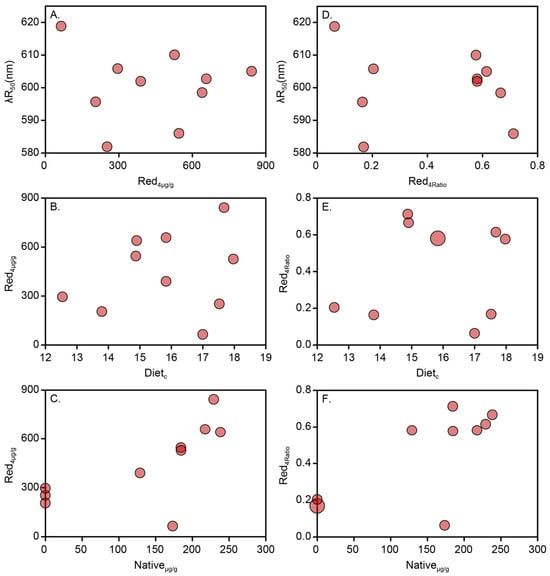
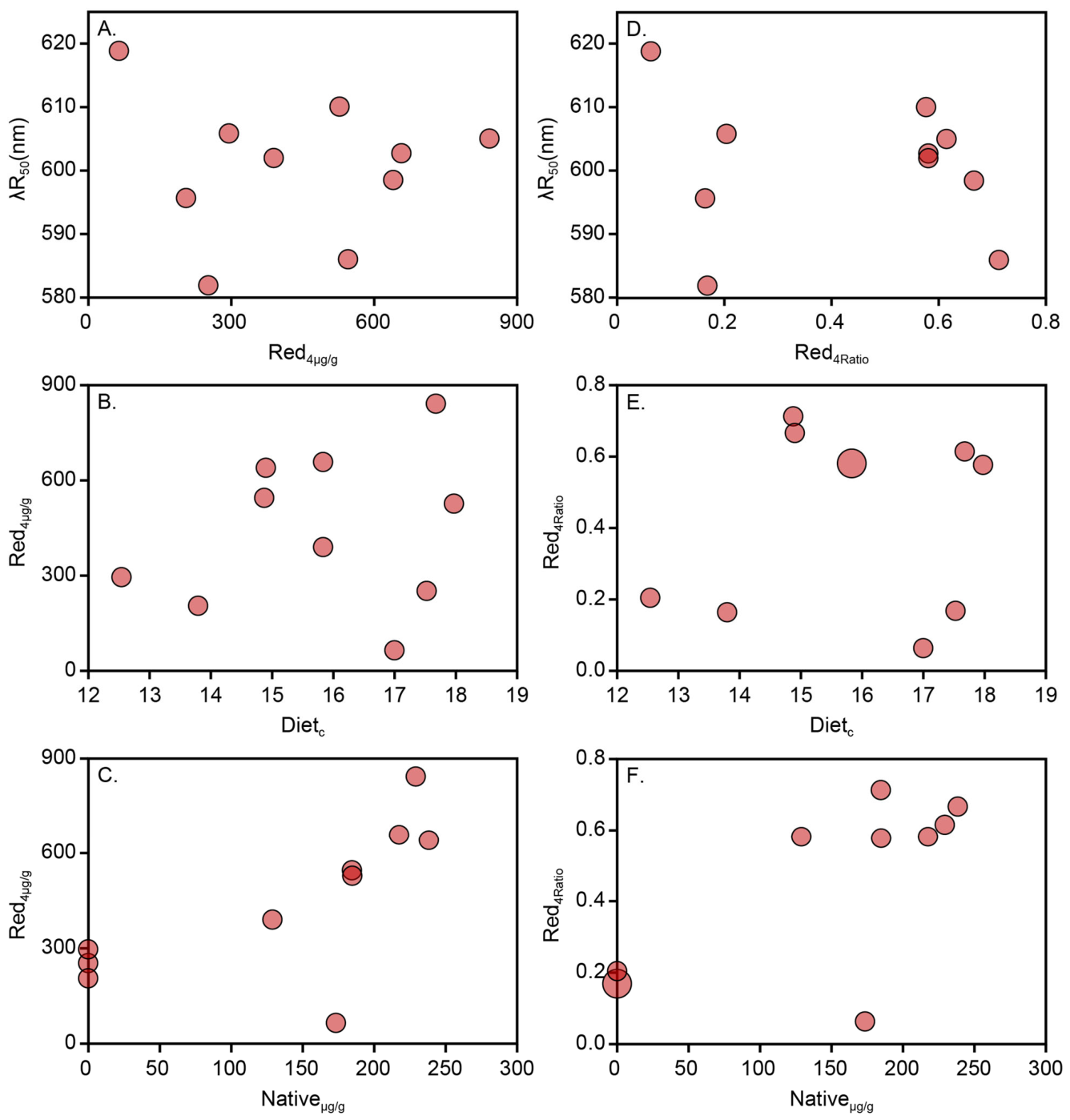
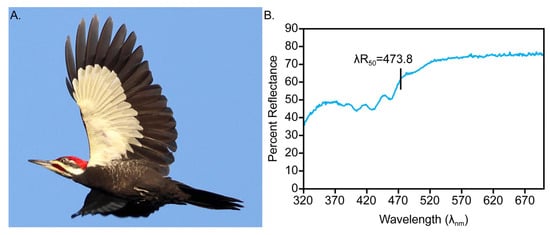
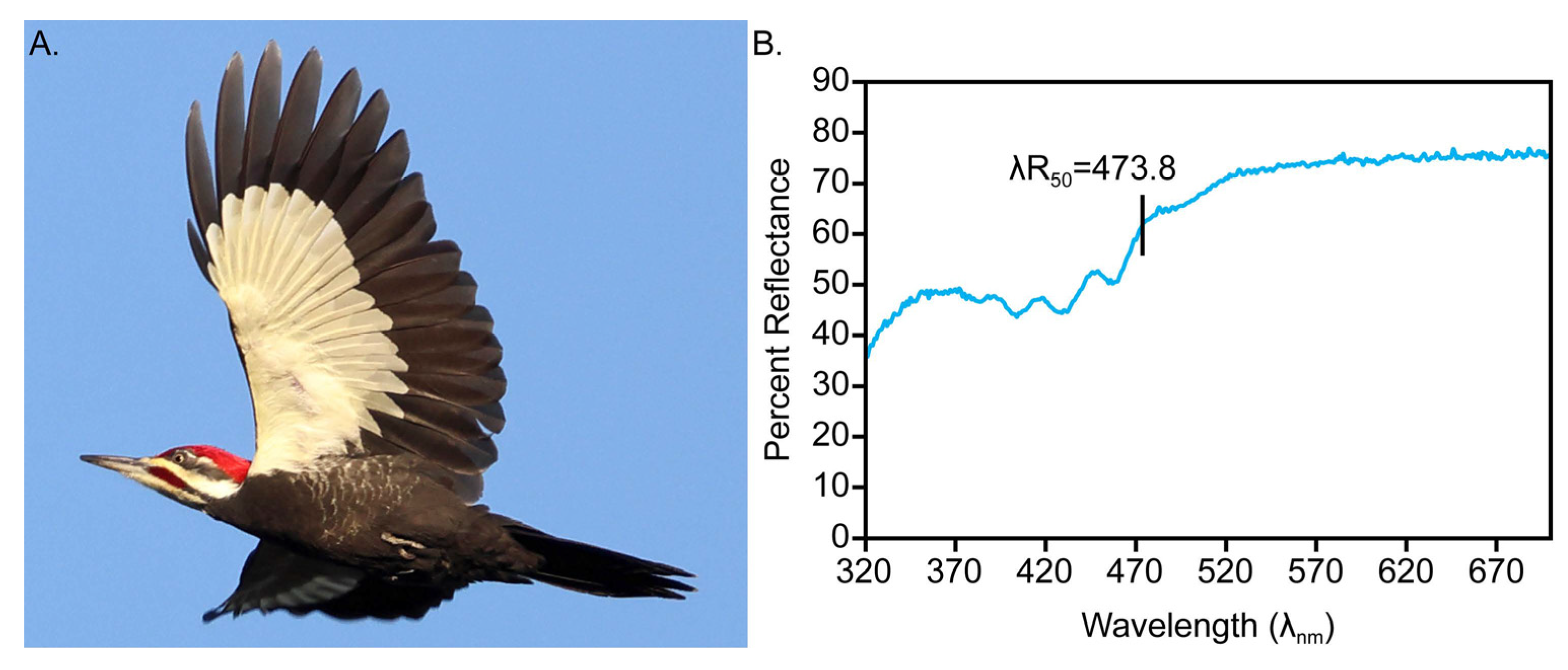

Disclaimer/Publisher’s Note: The statements, opinions and data contained in all publications are solely those of the individual author(s) and contributor(s) and not of MDPI and/or the editor(s). MDPI and/or the editor(s) disclaim responsibility for any injury to people or property resulting from any ideas, methods, instructions or products referred to in the content. |
© 2026 by the author. Licensee MDPI, Basel, Switzerland. This article is an open access article distributed under the terms and conditions of the Creative Commons Attribution (CC BY) license.