


Abstract
Citizen science (CS), meaning the participation of the public in scientific research, is very popular for studying many aspects of biodiversity. Plant diversity on the other hand has not been extensively studied with CS in spite of the critical role of plants in ecosystems. To acquire a clearer picture of this field of research we carried out a comparative bibliometric analysis of articles from 2005 to 2026 on four geographical levels: globally, Europe, Mediterranean and Greece. We used the Biblioshiny web app with data extracted from the Web of Science Core Collection database. Differences in both the quantity and the quality of research were shown, as well as a great degree of lack of plant awareness (LPA). Very little research in this field has been conducted for Greece in spite of its rich plant diversity. Our findings also confirm the existence of bias in the socio-economic background of participants in CS. It is worth noting that plant diversity and CS play a key role in achieving the United Nations SDGs. Consequently, plant-focused CS on a global and regional scale should be further evolved to reverse topic development dissimilarities, combat LPA and support sustainable development. Given the context of Greece, amplifying scientific efforts could further develop botanical knowledge and its applications in a biodiversity hotspot.
1. Introduction
1.1. Ecological Citizen Science and Plant Diversity Loss
Citizen Science (CS), in general, is about the participation of citizens, i.e., non-specialists, in scientific research. Very often its application is aimed at serving different purposes through different approaches within a variety of contexts. It has emerged as a diverse and multi-purpose method within the Open Science approach for gathering large amounts of data on a temporal and spatial scale—which would not be possible with traditional scientific methods [1,2,3]. So far, research has shown that CS can produce data of professional or even better quality with careful and proper project design [4]. CS has gained significant popularity within many scientific domains, including the natural sciences, and is particularly preferred by the environment and ecology domains [5,6]. Such programs can in fact monitor most of the Essential Biodiversity Variables to different degrees over large geographic and taxonomic range and are very suitable for international biodiversity monitoring [7].
There exists a rich tradition of amateur scientists’ contribution to biodiversity research [2,8]. Bibliometric analyses on the contributions of modern-day CS reveal a growing adoption of this approach [9], especially in ornithology [9,10]. The expansion of the field has been greatly benefited by technological advances that have facilitated the wider participation of the public in biodiversity scientific endeavors [2]. The most renowned example of these new advantages would be the establishment of platforms such as iNaturalist (https://www.inaturalist.org, accessed on 30 April 2026) [11], Zooniverse (https://www.zooniverse.org/) [12], eBird (https://ebird.org/home, accessed on 30 April 2026) [13] and Global Biodiversity Information Facility (GBIF; https://www.gbif.org) [7,14], where citizen scientists can easily deposit and interact with biodiversity data.
Biodiversity loss is one of the main concerns of today’s global leaders, environmental scientists, and environmental NGOs, and it is the only planetary boundary was exceeded by far long ago [15]. Indeed, current rates of extinction due to climate crisis are unprecedented; in some cases, estimated to be 1000 times faster than they have been for the last 65 million years [16] and with up to 37% of the world’s species estimated to be possibly extinct by 2050 [17]. As for plant diversity, 45% of flowering plant species is considered to be at risk of extinction and three out of four (specifically 77%) underdescribed plant species could also be under the same risk [18]. Ref. [19] found that plant species described after 1900 are getting extinct two times faster than the plant species described before. In fact, they estimated that plants are now getting extinct 500 times faster than what the background rate used to be.
1.2. Value of Plant Diversity and Lack of Plant Awareness in CS
Nonetheless, plants hold very important value; both for the planet and humanity. Plants essentially form the basis of ecosystems since they provide habitats, and they are the primary producers. Through photosynthesis, not only do they release the necessary for aerobic organisms’ oxygen, but they also capture the vital energy of the sun and bring it into the biosphere. Moreover, their roles encompass soil health and climate regulation, making them indispensable to ecological systems [20,21]. For the plant–soil relationship especially, it is well known that plants play an important role in soil ecosystem functions, in enhancing soil structure and stability and hence reducing soil erosion [22,23]. Plants are responsible for carbon sequestration by assimilating atmospheric CO2 through photosynthesis, translocating carbon below ground via root growth, and enhancing soil organic carbon levels through root exudation, thus improving soil health and ecosystem resilience [24,25]. They also form a significant foundation for biodiversity by providing habitat heterogeneity, varied ecological resources and morphological complexity [26]. From simple food and shelter provision to creating specialized niches and intricate mutualistic relationships, plant diversity is an element without which we cannot imagine life.
Despite their vital role in the life of the planet and the people, plants are often overlooked; this phenomenon has been described as plant blindness or plant awareness disparity or lack of plant awareness (LPA) [27,28,29]. For the rest of this paper this phenomenon will be referred to with the last term. Considering them as just a background for wildlife, people tend to display lack of attention, interest and knowledge about plants and lack of willingness to engage with them. This extends to researchers as well, who are often unable to recognize the value that plants have for planetary health and conservation [30,31].
LPA is evident in biodiversity citizen science too; 83% of projects focus on animals while the percentage that focuses on plans is almost five times smaller (17%) [7] and the corresponding number of publications when it comes to biological invasions is almost three times smaller [32]. The case is the same for the active citizen science programs in the USA and in the EU; in their citizen science programs repositories there are fields of science or primary environmental fields focusing specifically on animals and there is not a single field that directly refers to plant diversity or any of its components [33,34].
1.3. Plant Diversity and Citizen Science in Greece
Greece is a country of the Mediterranean, which constitutes one of the biodiversity hotspots [35], and of Europe, a region where citizen science is well established [36]. The country is well known for its high overall biodiversity [37], which is concentrated in a relatively small area, making it the most important country in Europe in terms of conservation [38,39]. Due to its high plant diversity, Greece is a biodiversity hotspot within the Mediterranean biodiversity hotspot [40,41] with significant ethnobotanical wealth [42,43]. 5987 plant species and 2011 subspecies are found within the borders of the country which are further classified into 1097 genera and 184 families. Endemism percentages are very high; 19.5% (1167) of species and 23.3% (469) of subspecies are located exclusively in Greece [44]. Many of the plant species of Greece are aromatic and medicinal and are extensively used in traditional medicine and Greek cuisine for their therapeutic properties, since they contain significant amounts of polyphenols and exhibit antioxidant and antibacterial activity [45]. Herbal medicines have been used since ancient times to this day and are especially preferred in areas with limited access to pharmaceutical drugs [46].
Nevertheless, citizen science in Greece is not widely adopted so far, notwithstanding the awareness of the term and the practice by public bodies, NGOs and professional scientists that could implement the approach in their work [47]. It is worth mentioning that neither the socio-economic conditions of Greece nor that of the Balkans in general are inductive of the growth of CS [36]. Amid these stark contrasts between a rich nature and a struggling society, a few remarkable biodiversity CS projects have been actualized; Alientoma is an ongoing project for mapping alien insects [48]; “Is this Alien to you? Share it!!!” is a project monitoring invasive marine species [49]; a special toolkit was designed for monitoring urban biodiversity in Thessaloniki [50], the Ornithopolis project employed CS to sensitize the public about avifauna [51]; and during the Erasmus + project CS4ESD students were educated on the importance of plant diversity of the Biosphere Reserve of Mount Olympos via CS [52]. Other significant contributions of CS for Greek biodiversity include the discovery of numerus alien Mollusca species [53] and providing evidence for the recovery of the Mediterranean Monk seal [54]. Continuous efforts whose results have not been published in scientific articles include the examples of NGOs such as iSea, a marine conservation NGO that systematically promotes and employs CS (https://isea.com.gr/get-involved/become-a-citizen-scientist/, accessed on 30 April 2026), and Hellenic ornithological Society, which regularly recruits volunteers for monitoring avifauna (https://ornithologiki.gr/en/our-work/conservation-scientific-research/bird-monitoring, accessed on 30 April 2026). Focusing on plants, Greekflora.gr (https://www.greekflora.gr/en/, accessed on 30 April 2026) is a site addressed to all those—especially non-botanists—who feel wonder and awe at the abundance and richness of Greek flora and wish to learn a little more about it in depth. It is noteworthy that together with botanists there are amateurs that participated in the collective work of “The Red Data Book of Rare and Threatened Plants of Greece” (https://www.hbs.gr/en/publications/red-data-book-greece, accessed on 30 April 2026) and additionally have supported efforts to collect photos of plant taxa for “Flora of Greece web_Vascular Plants of Greece_An annotated catalogue” (https://portal.cybertaxonomy.org/flora-greece/credits, accessed on 30 April 2026). Given the aforementioned examples and the existing literature, it is apparent that most CS projects in Greece are directed mainly towards fauna and rather limited work has been channeled towards plant diversity, in spite of its importance and its influence in the landscape and the historical culture of the country.
In this context, this study aims to paint a clearer picture about the extent of research of plant diversity with citizen science in Greece, to point out existing gaps in scientific efforts and to identify promising directions for future research. We address these goals by comparing between the studies that have been carried out on four different geographic levels: global scale, Europe, Mediterranean and Greece.
2. Materials and Methods
To address our research questions, it was required to assess and analyze cumulative scientific research in a way that would reveal the evolutionary nuances of the field of plant diversity studied with citizen science. Thus, a bibliometric analysis was conducted. This method was chosen since it is ideal not only for handling large volumes of scientific data, but also for pointing out research and knowledge gaps and future evolution directions [55,56].
2.1. Data Collection and Data Screening
The most common databases used to support bibliometric analysis are Scopus and Web of Science [57,58]. To decide which database would be used to extract data from, we performed advanced searches on both Scopus and Web of Science Core Collection (WoSCC) using the same keywords and searching within the fields of title, abstract and keywords. All searches were performed on the 1 March 2026. Scopus search turned in no results for Europe and only 7 for the Mediterranean. WoSCC turned in 1659 results globally, 320 for Europe, 110 for the Mediterranenan and 8 results for Greece. Consequently, since the Scopus database turned in no results for Europe and very few for the Mediterranean, it was decided to analyze the data extracted from the WoSCC database. The WoSCC database was preferred also due to the design of the Biblioshiny app, which was used as our bibliometric analysis tool. WoSCC is one of the databases Biblioshiny was primarily designed for [59,60] and it is very commonly used in bibliometric analyses conducted with Biblioshiny in ecology [61,62] and sustainability [63,64].
In order to gather relevant studies about plant diversity via the method of citizen science, the following combination of keywords was used: (plant OR vegetation OR phyt* OR flora OR tree* OR garden OR flower*) AND (“citizen scien*” OR “community science” OR crowdsourcing). The first group of keywords refers to plant diversity and the second one to citizen science. Selection of keywords that would turn in relevant search results would be the first stage of data screening, following the methodology of [65]. To perform a concise comparison between the CS studies of plant diversity and overall biodiversity of Greece, we developed a third group of keywords to combine with the second one for the respective search on WoSCC: “biodiversity OR species OR ecosystem* OR ecolog* OR habitat OR conservation OR monitoring OR fauna OR mammal OR invertebrate* OR animal* OR reptile OR amphibian* OR plant* OR vegetation OR flora”. This search turned in 65 results after completion of screening.
The second stage of screening included limiting the document types to articles and review articles. Focusing on these types of documents is essential since they better represent the development of research topics over time and offer high-quality and reliable data for analysis due to undergoing rigorous peer review [66]. Following the guidelines of [55], the third step included defining the timespan of publications, which we set from 2005 to 2026. Thus, all of the aforementioned numbers of published articles used for analysis from WoSCC refer to the final number of articles after data screening was completed.
Focusing on geographic regions was also based on keywords. Search results can be filtered by country/territory, but this selection is made based on the addresses field within the metadata of each document. The countries of the declared addresses are not necessarily the countries within which the object of study lies. Therefore, we added the names of countries for each geographic region (global level excluded) in the formation of the queries as follows: AND TS = ([countries’ names with the Boolean operator “OR” between them]). TS is the field tag that refers to “Topic” on Web of Science Core Collection and allows to search for terms within the fields of title, abstract, author keywords, and keywords plus. This method has been used for comparative bibliometric studies between different geographic regions in other studies as well [67,68].
2.2. Bibliometric Analysis
The Biblioshiny 5.0 app was used as the bibliometric analysis tool. It is an online app for non-coders based on the Bibliometrix package for RStudio developed by [60]. RStudio version used was 2026.01.1+403 and R version was 4.5.2. Biblioshiny is suitable for comprehensive bibliometric analysis since the Bibliometrix package, which is the base of the application, is a powerful tool for performing such analyses, with a wide range of analyses and visualization options. The app itself provides a user-friendly and well-organized interface [58]. For the visualization of part of the results MS Excel was used.
Similar to instructions and methodology by [55,58,60], we followed the procedure below:
All of the aforementioned data were extracted from WoSCC in the form of plain text files that included the full record and cited references. For each geographic region, a file was created that included all search results for it. These raw files were imported into the Biblioshiny app. Resolution for exported plots was set at 600 DPI, the highest available. Table for the completeness of metadata, main information, annual scientific production, and countries’ scientific production analyses were conducted automatically by Biblioshiny. Most cited countries’ analysis produced both total citations and average article citations per country. For results visualization, total citations and MS Excel were used.
For most frequent words, wordcloud, thematic maps, and thematic evolution analyses author’s keywords were chosen from the given options for analysis settings, in order to produce results on a common ground that represents the train of thought of the producers of this scientific knowledge.
For the wordcloud, number of words included was set at 50 and ellipticity at 0.8.
For thematic maps, number of words was set at 250, minimum cluster frequency (per thousand docs) at 5, number of labels at 3, label size at 0.3, community repulsion at 0.5, and Louvain as the clustering algorithm, while no lists of terms to remove or synonyms were loaded. For thematic evolution analysis, number of words was set at 250, number of labels (for each cluster) at 3, label size at 0.3, Louvain was set as the clustering algorithm, inclusion index weighted by word co-occurrences as weight index and minimum weight index was set at 0.1, while no lists of terms to remove or synonyms were loaded. Cutting points were defined by the timespan derived from main information about each dataset and by the results of tentative analyses with different cutting points for every 5 to 7 years. For most relevant affiliations analysis, affiliation name disambiguation was chosen.
For all types of collaboration networks (authors, countries and institutions), an automatic layout was chosen, Louvain was selected as the clustering algorithm and association as the normalization method. For graphical parameters, opacity was set at 1 and label size at 2 (with the exception of institutions’ collaboration network for Greece, where label size was set at 0.7), while node shadow was removed. We allowed for 50 nodes per network in order to include enough information while retaining the optical clarity of the figures.
3. Results
3.1. General Information
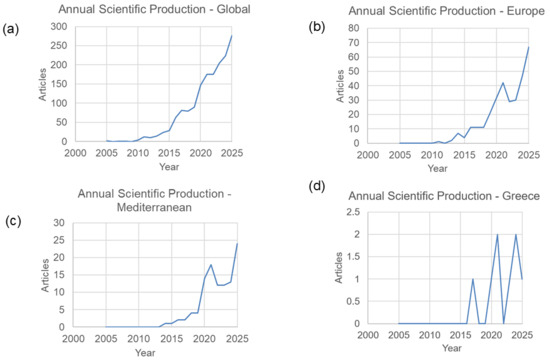
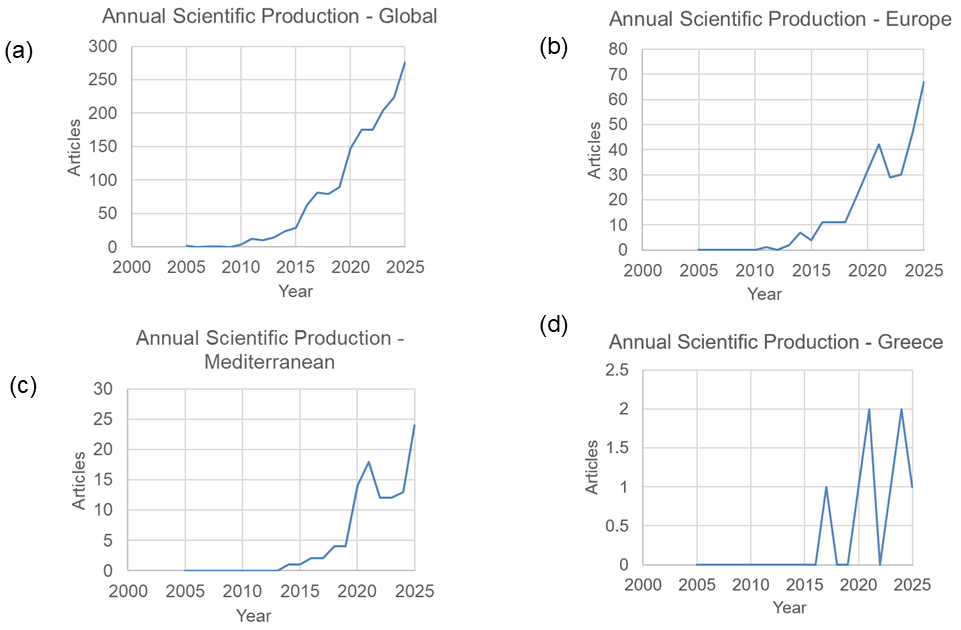
Table 1 presents the main information about the scientific publications downloaded for each geographical region of focus. The number of documents decreases from one larger region to the next smaller one, as well as the year of scientific research initiation becomes increasingly earlier, as seen in Figure 1a–d. The annual growth rate in Greece is the lowest at 0% while the highest is the global at 16.34%. For all geographical regions, the average document age is around 3–4 years and the number of co-authors per document is around six.
Table 1.
Main information about data extracted from the Web of Science database for articles on a global scale, focusing on Europe, the Mediterranean countries and Greece.
Figure 1.
Annual scientific production on a global scale (a), for Europe (b), for the Mediterranean countries (c), and for Greece (d).
The annual scientific production figures (Figure 1a–d) present the course of scientific efforts in the field of plant diversity studied with citizen science as number of articles published per year. Naturally, the maximum number of articles published in one year drops as we shift from a larger geographic region to a smaller one: 276 in 2025 on a global scale, 67 in 2025 for Europe, 24 in 2025 for the Mediterranean and 2 in 2024 for Greece. In all four figures there is a drop in production after the year 2021 due to the COVID-19 pandemic [69], followed by an increase that reached recovery levels in the following years.
3.2. Important Sources and Affiliations Analyses
The most relevant sources for each region of focus (Figures S1–S4) are measured by number of total published articles per source. Journals that stand out due to consistent appearance through figures for different regions and due to number of publications are PLoS ONE, Biological Invasions and Insects.
Similarly, the most relevant affiliations figures (Figures S5–S8) show the total number of documents published by each affiliation. Affiliations that appear consistently are: CENTRE NATIONAL DE LA RECHERCHE SCIENTIFIQUE (CNRS), INRAE, CONSEJO SUPERIOR DE INVESTIGACIONES CIENTIFICAS (CSIC), INSTITUT DE RECHERCHE POUR LE DEVELOPPEMENT (IRD), MUSEUM NATIONAL D’HISTOIRE NATURELLE (MNHN), SORBONNE UNIVERSITE, UNIVERSITE DE MONTPELLIER, CIRAD. However, this is happening partially due to the focus on Europe and the Mediterranean countries as research areas. On a global scale, universities of the USA are by far the most common, as well as Greek universities for Greece.
According to affiliation collaboration networks (Figures S9–S12), the primary institutions that lead the collaboration schemes for the world, Europe and the Mediterranean countries are UNIVERSITY OF CALIFORNIA SYSTEM and CENTRE NATIONAL DE LA RECHERCHE SCIENTIFIQUE (CNRS). In these first sets of figures, it appears that the American and French affiliations play a pivotal role in the development of studying plant diversity with citizen science.
3.3. Country-Level Analyses
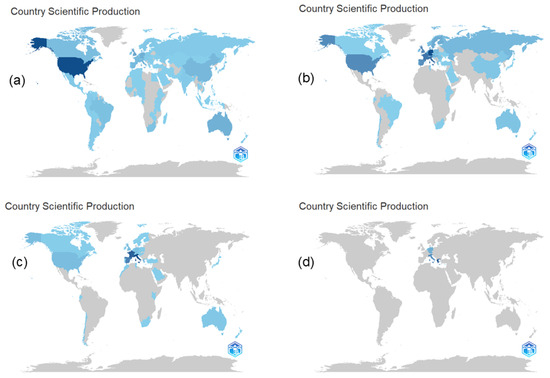
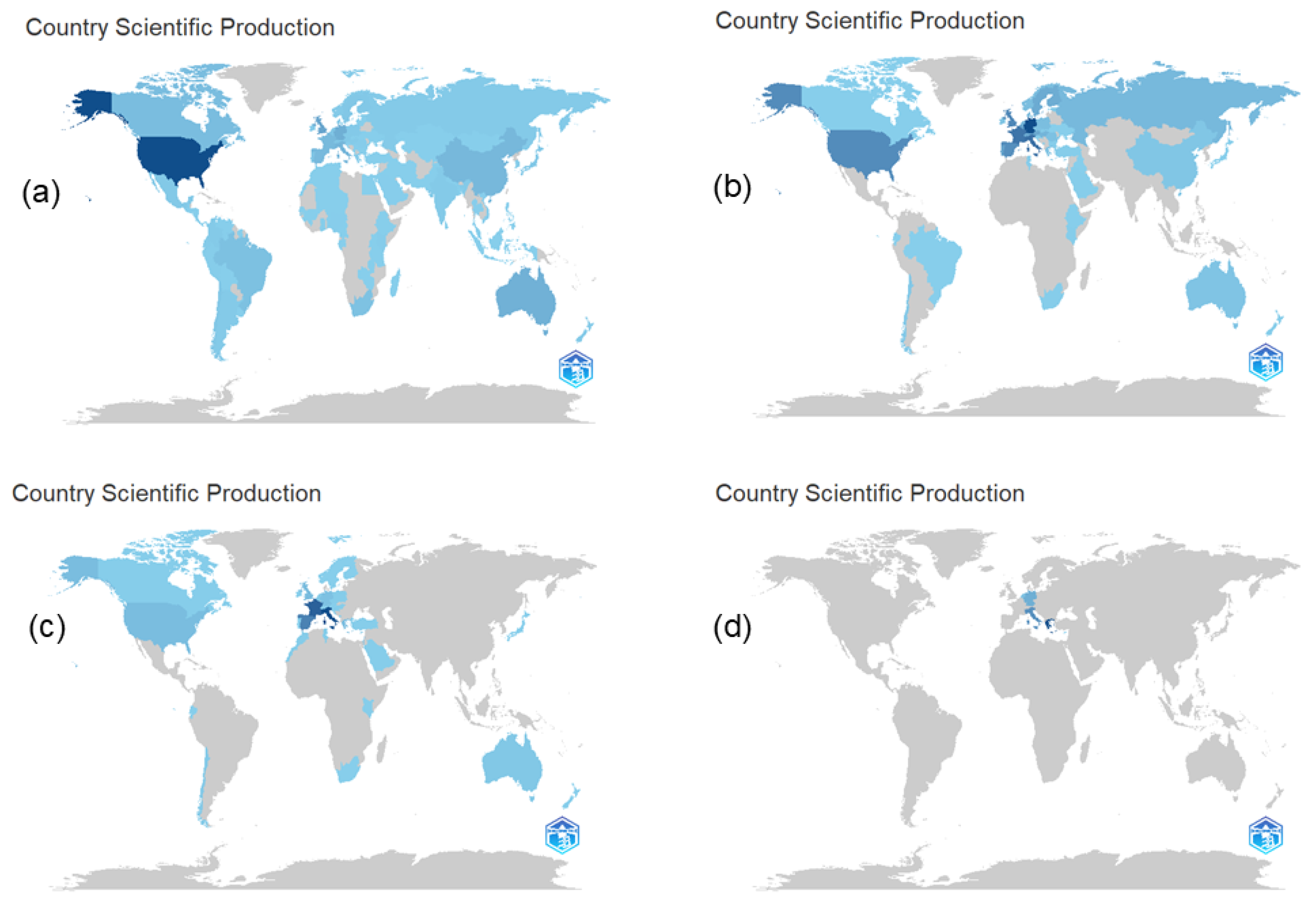
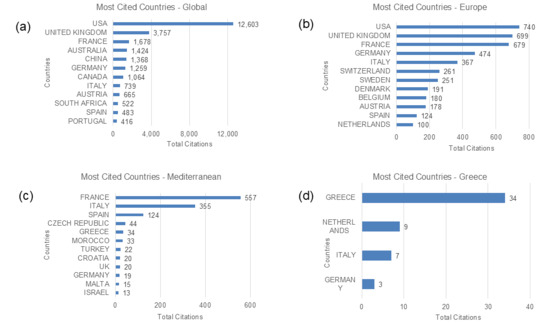
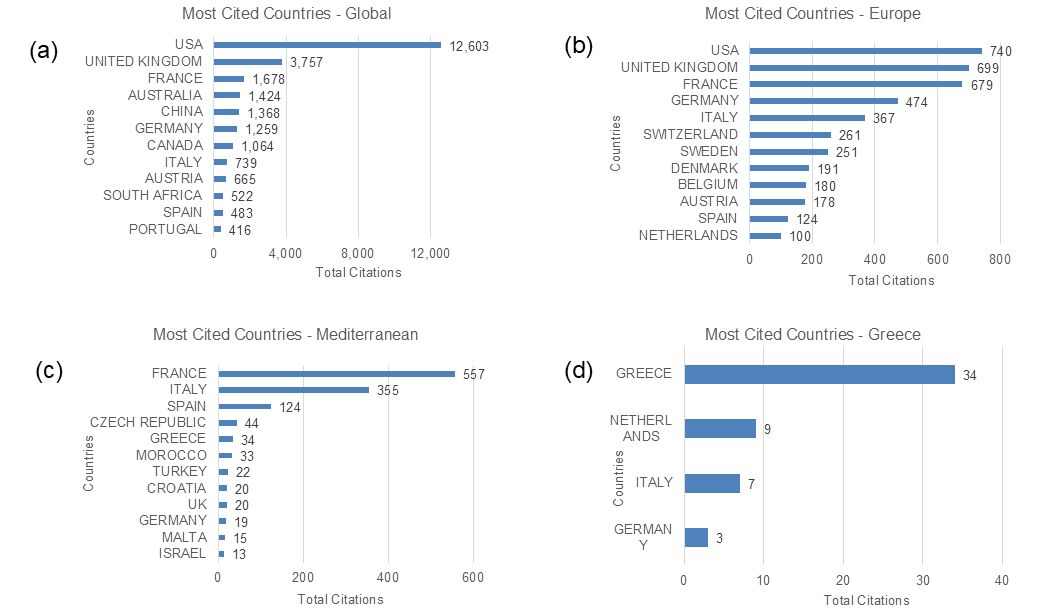
For the country-level analyses, Figure 2a–d present the scientific production of each country; the darker the color the more the published articles. Scientific production is measured as the frequency with which authors from each country contribute to published articles (Tables S1–S4). On a global level, the USA is by far the most productive country (frequency = 1867), with the UK (frequency = 564), Germany (frequency = 432), Australia (frequency = 392), and Italy (frequency = 340) following next. For studies about Europe, the most productive countries are mainly western European ones, namely Germany (frequency = 181), Italy (frequency = 132), France (frequency = 123), UK (frequency = 96), USA (frequency = 90). This pattern is the same for the Mediterranean countries as the western European Mediterranean countries are the most productive ones (Italy with frequency of 130, France with frequency of 109, Spain with frequency of 75). For Greece, most scientific research comes from the country itself (frequency = 14). Most cited countries throughout Figure 3a–d are USA, UK and France. Most cited country for Greece is the country itself.
Figure 2.
Countries’ scientific production (based on frequency) on a global scale (a), for Europe (b), for the Mediterranean countries (c), and for Greece (d). Scientific production increases as the color of the countries darkens.
Figure 3.
Most cited countries (based on number of total citations) on a global scale (a), for Europe (b), for the Mediterranean countries (c), and for Greece (d).
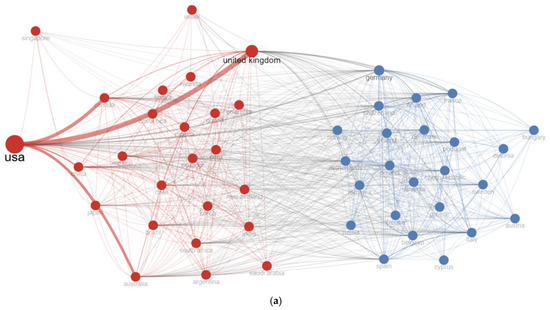
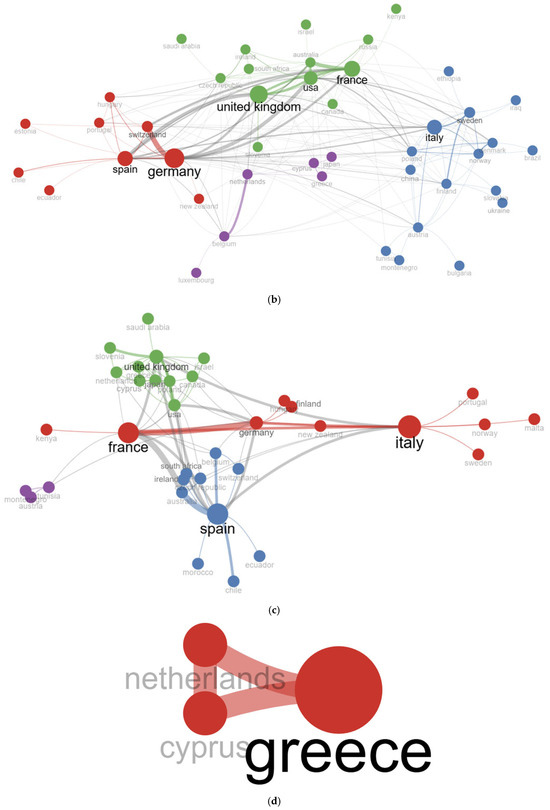
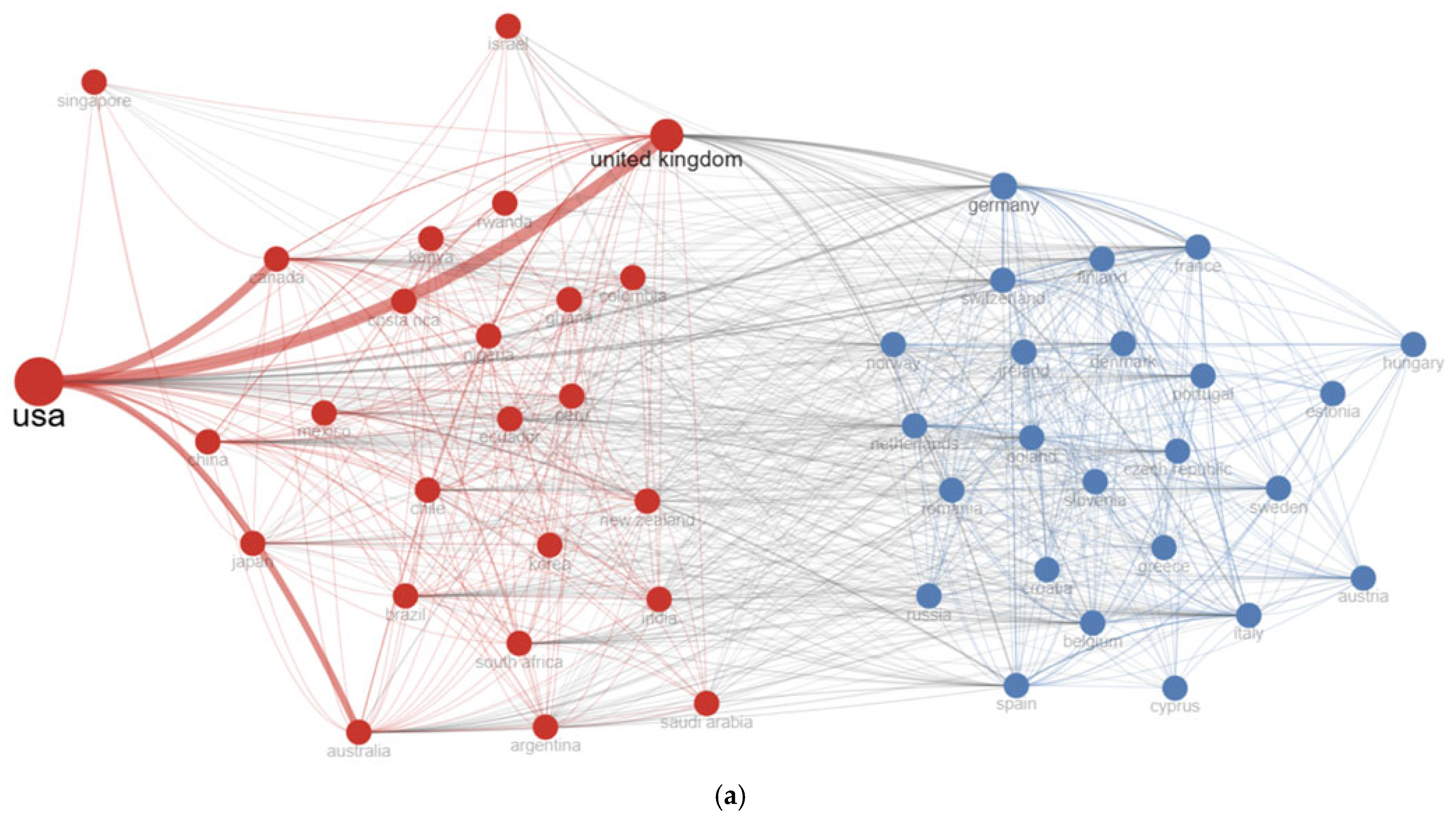
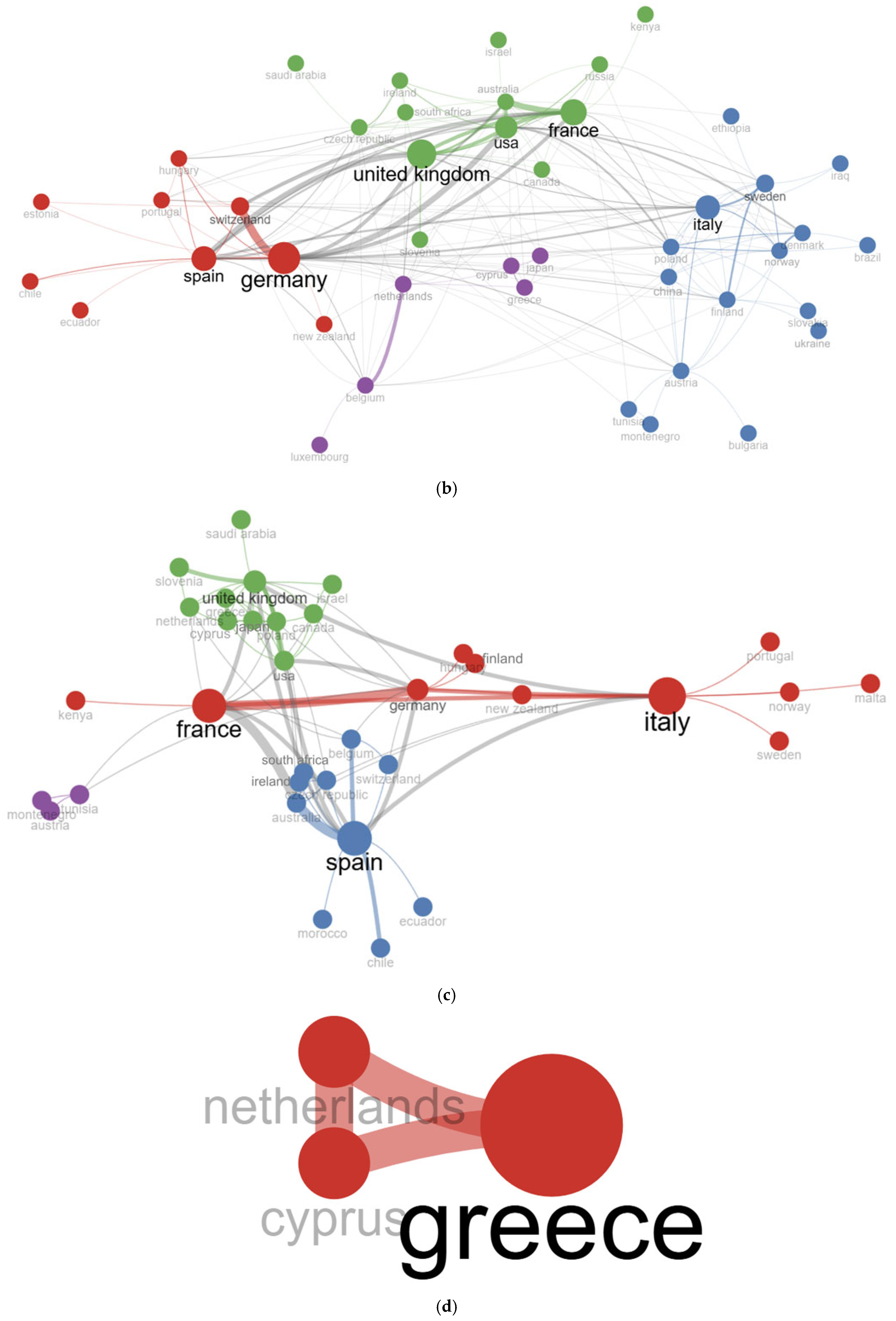
Within the countries’ collaboration networks (Figure 4a–d) Greece appears to have a rather peripheral position, whereas the USA and the UK retain their central position. On the European and Mediterranean level, Germany is once again one of the main countries for scientific efforts in this field when it comes to international collaboration, along with France, Spain, and Italy.
Figure 4.
(a) Countries’ collaboration network on a global scale; (b) countries’ collaboration network for Europe; (c) countries’ collaboration network for the Mediterranean countries; (d) countries’ collaboration network for Greece.
3.4. Authors’ Keywords and Conceptual Analyses Based on Authors’ Keywords
Tables S5–S8, indicate that for all geographic areas the most frequent authors’ keyword is “citizen science” by far. Other popular choices are “biodiversity” and “climate change” while there is a great variety for the rest of the keywords used from one region to another. Keywords referring specifically to plants are rather rare and they often rank low in the lists of top 30 keywords.
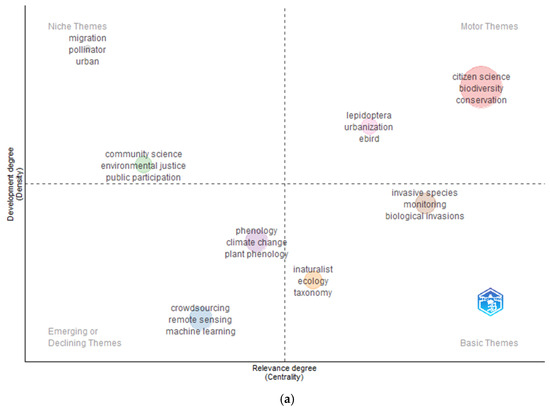
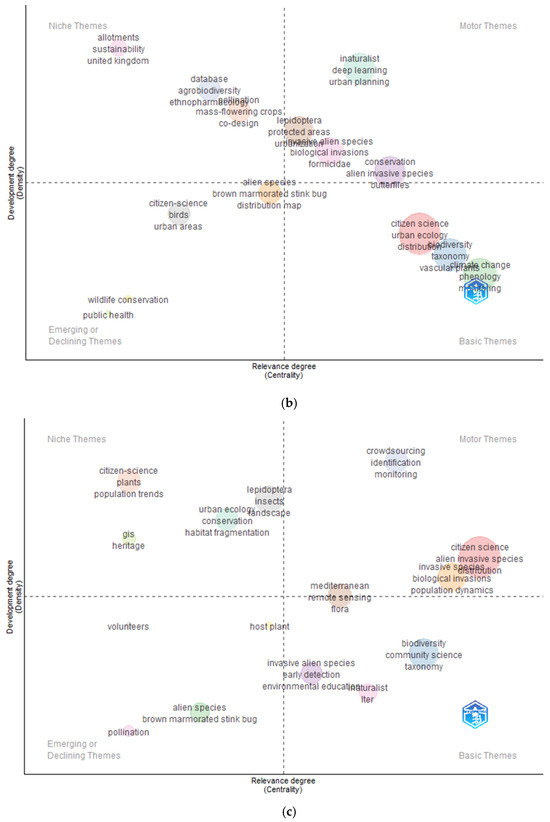
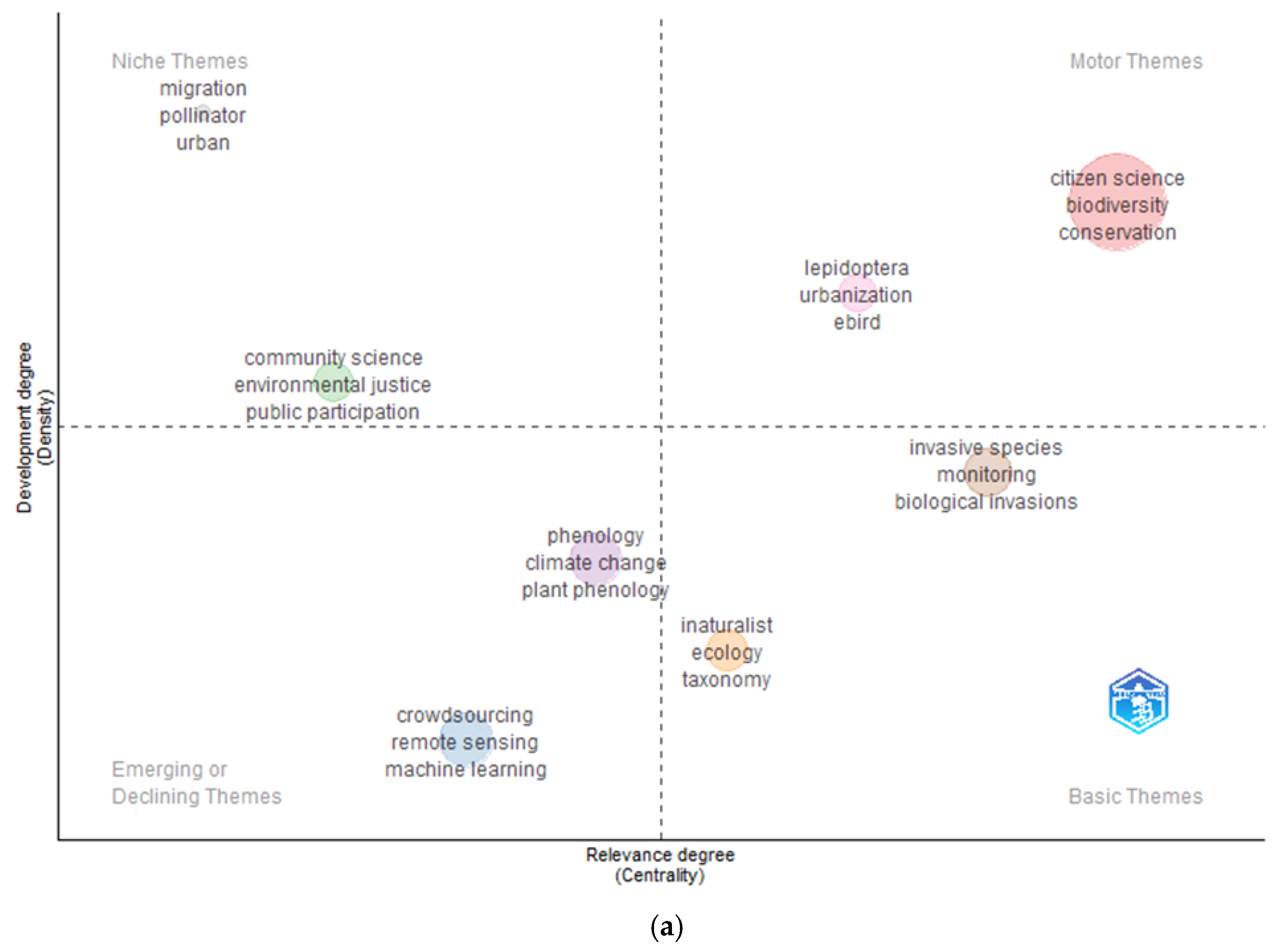
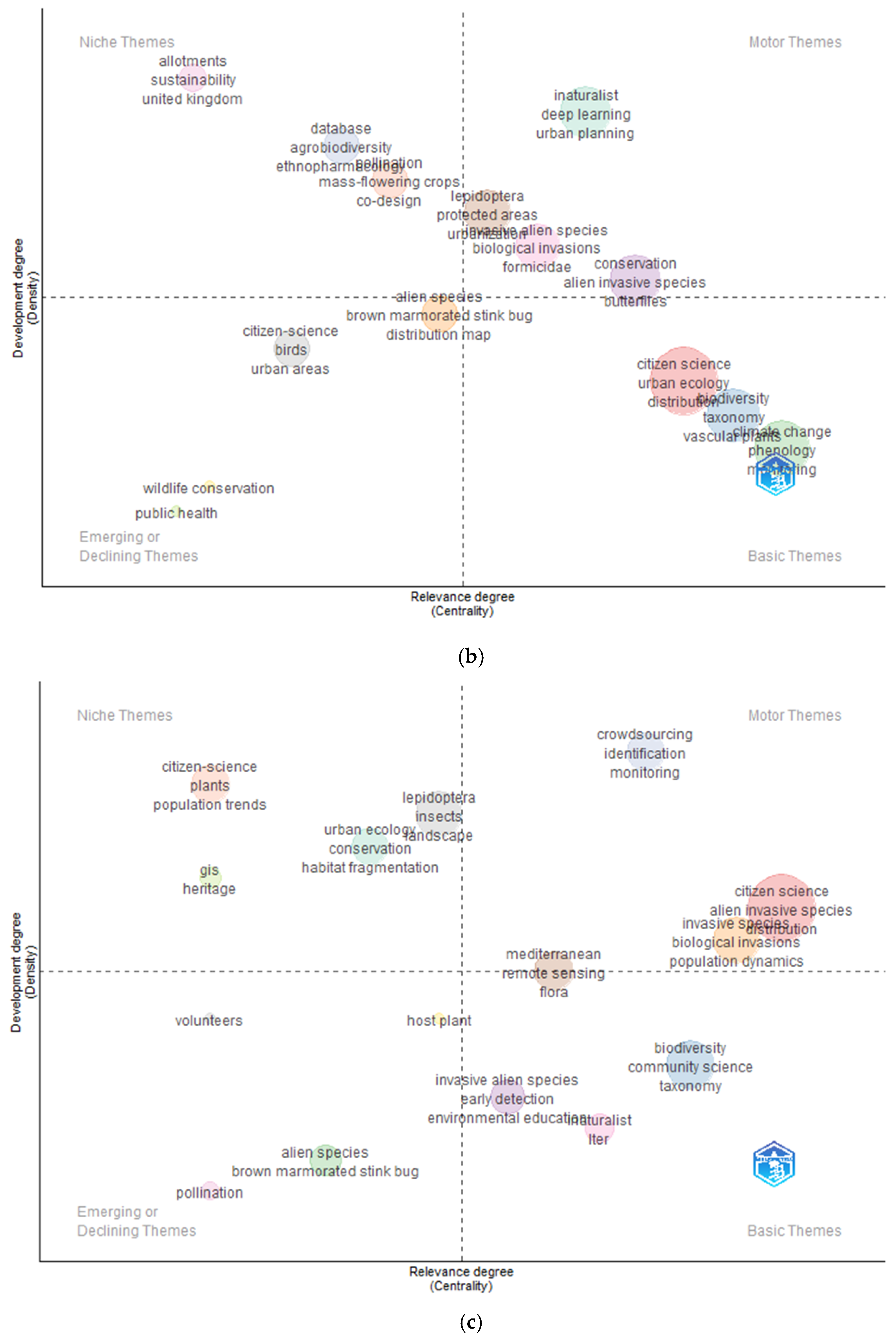
Thematic maps (Figure 5a–c) and thematic evolution analyses (Figures S17–S19) present the conceptual structure of research that studies plant diversity with citizen science, based on authors’ keywords. Neither of these two analyses produced any results for Greece due to the small amount of data. Thematic maps for the world and the Mediterranean countries showcase a similar pattern; few emerging or declining themes and more thematic clusters in the quadrants of relevant themes that are more or less developed for this specific field (motor or basic themes respectively). Whereas for the European countries, there are more thematic clusters and most of them are in the quadrant of the motor themes which translates to scientific efforts for this region being intensive for themes that play a critical role for this field.
Figure 5.
(a) Thematic map based on authors’ keywords on a global scale; (b) thematic map based on authors’ keywords for Europe; (c) thematic map based on authors’ keywords for the Mediterranean countries.
Thematic evolution on a global scale clearly depicts the use of citizen science to study plant diversity from 2010 onwards, with more topics added to the conversation every five years. Such topics are remote sensing, species distribution models, biosecurity and biological invasions. During the 2011–2015 period most of scientific effort revolves around citizen science itself and its popular sub-set, crowdsourcing. The growth pattern is the same for Europe and as for the studies of the Mediterranean countries, they steadily focus on citizen science and invasive alien species as an aspect of biodiversity from 2014 to 2026.
3.5. Concise Analysis of Articles for Overall Biodiversity of Greece Studied with CS
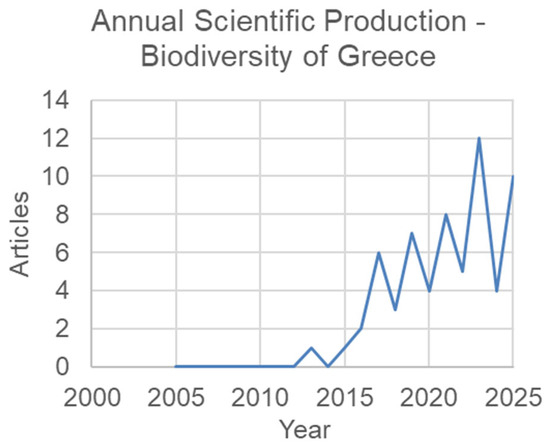
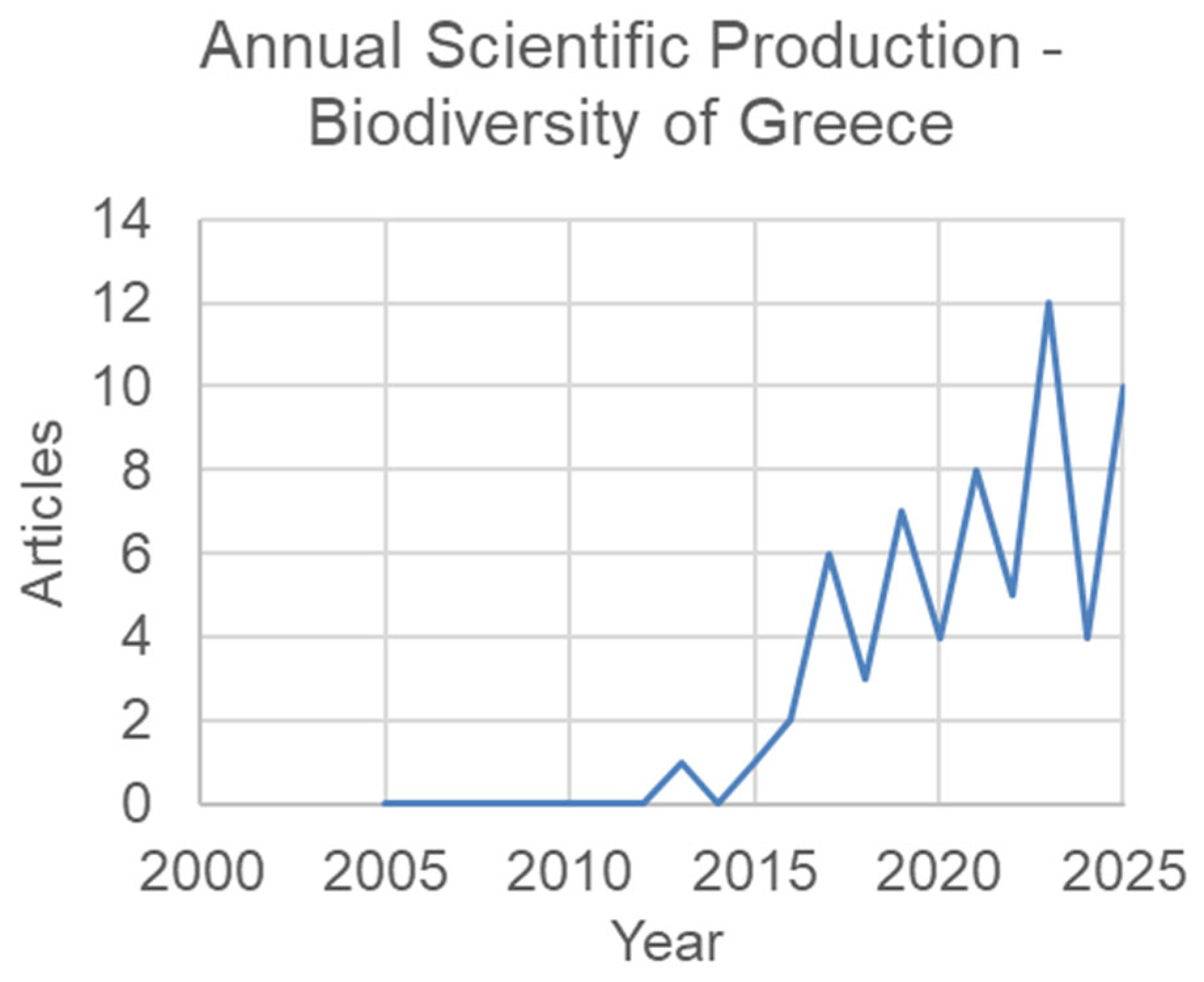
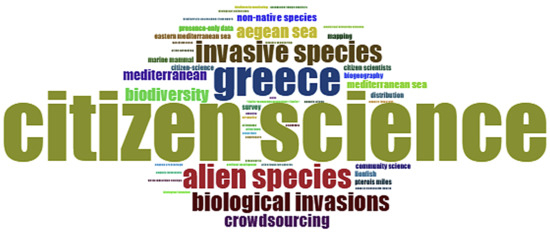
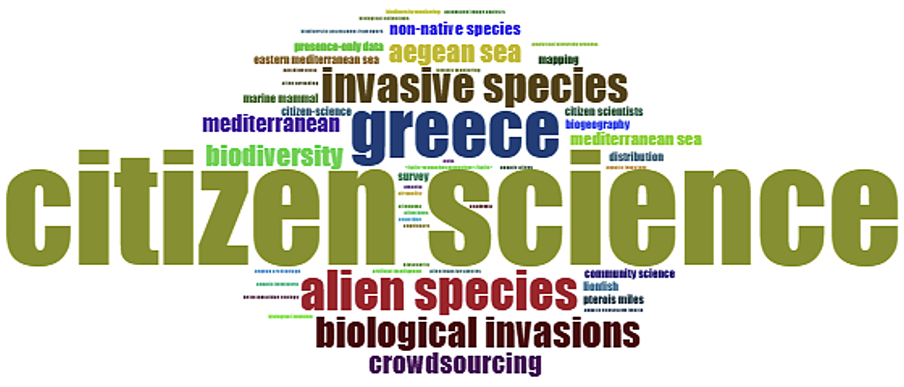
We conducted an additional analysis on data regarding overall biodiversity of Greece using the 65 articles that were eligible for analysis after screening. Based on them, Biblioshiny calculated an annual growth rate of 5.48% for this specific field, document average age at 4.75 years and co-authors per document at 7.11. In the annual scientific production figure (Figure 6), production peaked at 12 articles in 2023, while the prevailing authors’ keywords in the wordcloud (Figure 7) were citizen science, Greece, and keywords related to invasive species. The complete list of keywords can be found in Table S9.
Figure 6.
Annual scientific production for overall biodiversity of Greece studied with CS.
Figure 7.
Wordcloud based on top 50 most frequent authors’ keywords for articles on overall biodiversity of Greece studied with CS.
4. Discussion
4.1. Differences in Quality of Research
Citizen science has been used for ecology and biodiversity research more extensively than in any other scientific domain [11,70,71,72,73,74,75]. Plant diversity is an essential component of biodiversity, and it is inextricably linked to ecosystem state and human well-being [76,77].
Our results reveal that the study of plant diversity with CS is still developing, both globally and regionally (Figure 1a–d and Table 1). Firstly, on a global scale, it is clear that the USA is the leading country in this field, which can be seen in country-level analyses (Figure 2, Figure 3 and Figure 4a) and most relevant affiliation analysis; 7 out of 10 topmost relevant institutions for this research field are located in the USA (Figure S5). Consequently, it is possible that the USA’s scientific production highly affects the global distribution of themes (Figure 5a). However, the second highest out of the annual growth rates for the four different geographic levels comes from the studies about Europe (11.33%). In this region, the field has been studied more widely as is evident from the thematic clusters in Figure 5b, which present increased number, size and diversity. A discrepancy between the US and Europe in terms of the quality of research in this field seems to be therefore indicated. Consequently, there is room for future research on a global scale to study topics that have been developed on a regional level. Such topics are flowering vegetation, ethnobotany, bryophytes, land use and others.
Research concerning the Mediterranean region is smaller in volume than research concerning Europe, as expected. However, it presents topics with increased number and diversity than the research on a global scale, which is probably related to the fact that in this case, European countries are also involved. In particular, the western countries of the European part of the Mediterranean are the ones that play a dominant role, as demonstrated by Figure 2b,c and Figure 3b,c.
4.2. The Case of Greece
In Greece, the study of plant diversity with citizen science has only recently made its appearance. Although the annual growth rate of this specific field is 0%, meaning that evolution of the field is stagnant at the moment, it cannot be taken into account since the analysis is based on a very small sample, and the field is only at the beginning of its growth. Annual scientific output is yet very small and the networks of cooperation between countries and institutions are small and not interconnected. Manual screening of the eight scientific articles regarding plant diversity of Greece was not carried out before the bibliometric analysis in order to examine the data for all of the geographic areas in the same manner and with the same criteria. In addition, the overall grand volume of data did not allow for manual screening for all geographic regions. However, it was carried out afterwards for Greece, as the size of the dataset was not inhibiting, and this country constitutes a special area of focus of this study. It revealed that four of the articles should be excluded since they do not meet all of the search criteria. Unfortunately, this reduces the actual number of articles even further.
Moreover, concise analysis of articles on overall biodiversity of Greece studied with CS shows a sharp difference between the efforts put in animal and plant diversity. When comparing Figure 1d and Figure 6 (annual scientific production), it is apparent that plant diversity studies represent only a fraction of the amount of research on biodiversity. For the wordcloud (Figure 7), top 50 most frequent authors’ keywords (Table S9) were used and none of them refer directly to plants or plant diversity. Therefore, it is evident from an additional point of view that stronger scientific focus should be directed towards plant diversity research with CS to effectively address this gap in Greece.
It is worth noting that citizen science is well known to scientists, NGOs and public bodies who could harness the hidden power of the public to produce knowledge [47]. Given the country’s botanical heritage and the national and international dynamics of citizen science, it is necessary that efforts to study Greek plant diversity with citizen science are amplified. It is to the country’s advantage that neighboring European countries have developed citizen science methodologies and know-how that can be passed on through international scientific cooperation. Moreover, developing CS in Greece could create a feasible paradigm for the Balkans, which constitute a difficult region for this domain to flourish [36,78].
4.3. Lack of Plant Awareness (LPA) in Research with CS
The study of plant diversity with CS does not follow the general known pattern of citizen science development globally; according to Figure 1a, CS is increasingly used for the study of plant diversity since the beginning of the 2000s–2010s. However, biodiversity CS began being widely used about a decade earlier [78]. Furthermore, one of the most surprising findings of our study concerns the most frequent words analysis (based on authors’ keywords). The majority of the top 30 most common authors’ keywords were about topics that are related to plant diversity more or less distantly (for example: phenology, pollinators/pollination, taxonomy, habitat fragmentation and others—Tables S5–S8) but did not refer directly to plants. This happened in spite of using plant-specific keywords when conducting data searches. The aforementioned findings reveal LPA on a surprisingly large scale. It seems that the study of plant diversity with CS is merely a byproduct of biodiversity CS, rather than a separate scientific goal of its own.
4.4. Plants and People: Inherent Bias of CS and One More Way to Achieve the SDGs
In Section 3.3 (country-level analyses) of this paper, it is quite evident that citizen science that studies plant diversity most usually happens in advanced economies. This is no new phenomenon, as since 2013, Haklay [79] has named it “inherent bias in the socio-economic make-up of citizen science”. Systematically, it seems to be that mostly well-educated males with the financial comfort of developed economies tend to be the dominant group of participants in nature-based CS. Indeed, our findings, along with other studies [80,81,82,83,84], further confirm the existence of this bias.
The inherent bias of CS can be proved to be an asset or a liability, depending on the goals and the population target of each CS project. Since it is harder to include minorities, indigenous people and local communities are harder to approach, also for geographical reasons as they live in areas far from major urban centers. It is these populations that could be of interest for ecologists though, as they possess valuable ecological knowledge [85,86]; the inherent bias of CS is preventing them from accessing it.
On the other hand, a sizable portion of people who live in urban settings are easier to include. Urbanization is on the rise, with roughly 70% of the global population expected to live in cities by 2050 [87]. Furthermore, there is a strong spatial bias in CS since observers choose locations to record species themselves [70,88]. Conducting plant CS in cities would thus attract much greater participation. Moreover, it is worth mentioning that both plants and CS can contribute to the United Nations Sustainable Development Goals; plants for their direct or indirect ecosystem services [89,90] and CS for allowing to monitor SDGs indicators effectively and in a more comprehensive way [91,92,93]. Using the aforementioned biases to create more sustainable cities with plant-focused CS could prove to be a fruitful area for new research.
4.5. Strengths and Limitations of This Research
To our knowledge, this is the first study to use comprehensive comparative bibliometric analysis to study the field of CS that is used for plant diversity research. It sheds a new light on the phenomena of lack of plant awareness (which is an obstructive factor) and the inherent bias of citizen science. This paper further amplifies the advocacy for stronger research focus on plant diversity, which is of outmost importance for maintaining high ecosystem functionality [94], for the stability of ecological elements such as predator species richness [95], for healthy soils [96], and eventually for overall biodiversity and the ecosystem services humanity receives from it [97]. Studying plant diversity with CS is essential since CS fundamentally works by combining different perspectives to improve the scientific knowledge produced [98], increases research capacity [99], and it has already been used to educate on plant diversity [100], thus reversing the lack of plant awareness.
However, the demerits of this study are not elusive to us. Due to using the structure of our query as our main screening process to yield relevant publications for our analysis instead of manual screening, it is possible that relevant results that did not include our keywords in the fields of “Title”, “Abstract” and “Author Keywords” did not appear. The opposite did happen, as is evident by the case study of Greece; irrelevant results that included our keywords in these fields appeared. It is also worth mentioning that, while a bibliometric analysis can be revealing for the grand scheme of current things, it cannot replace a thorough literature review which could possibly reveal more, and different, gaps in our knowledge.
Also, we are aware that in this discussion we are providing theoretical solutions to complex practical ventures such as achieving the SDGs and shifting the paradigm for CS in the Balkans. However, it is not the aim of this paper to offer a panacea for the existing gaps in the literature and in scientific efforts, but rather to contribute to the dialog about these matters by providing a new perspective. We deem helpful every effort towards contributing to the mitigation and alleviation of current global crises. It is in the hands of the scientific community, citizen scientists and by extension, humanity, to continue the constructive conversation and resulting praxis towards this collective aim.
5. Conclusions
Plant diversity is an integral element of biodiversity; nonetheless, research about it has been highly hindered by the lack of plant awareness. Citizen science has been broadly used to study biodiversity but not to the same extent for plant diversity. Our findings reveal that the lack of plant awareness in biodiversity research with citizen science is unexpectedly strong and is inhibiting scientific efforts in a time of ecological crisis. This paper builds on the notion that plants are fundamental for the health and function of ecosystems, and perceiving and treating them as a second-class research interest will inevitably lead to ecological and, eventually, societal loss. Supporting, funding and promoting plant-focused citizen science could be an effective means to combat LPA and its undesirable consequences.
This research further points out on the inherent bias of citizen science; CS constitutes an approach to knowledge production primarily undertaken by developed countries and their educated and financially comfortable male urban residents. Therefore, marginalized, remote or indigenous communities are prone to exclusion from such endeavors in spite of their knowledge on, and deep appreciation of, plant diversity [86]. Applying citizen science for plants both in urban areas and in indigenous communities can have a double benefiting outcome; for science in advancing plant diversity knowledge and for the society in supporting a sustainable future. Finding more ways to do so remains a challenge for the future.
Regarding Greece as a case study, our evidence suggests that citizen science has rather recently taken an ascent in plant diversity research and we adopt the perspective that there exists substantial potential for advances in the future. Given the country’s plant diversity and botanical heritage, the development of this field could yield meaningful results and even constitute Greece a paradigm for other similar contexts.
Supplementary Materials
The following supporting information can be downloaded at: https://www.mdpi.com/article/10.3390/d18060321/s1.
Author Contributions
Conceptualization, A.-M.N. and M.P.; methodology, A.-M.N. and M.P.; software, A.-M.N.; validation, A.-M.N. and M.P.; formal analysis, A.-M.N.; investigation, A.-M.N.; resources, A.-M.N.; data curation A.-M.N.; writing—original draft preparation, A.-M.N. and M.P.; writing—review and editing, A.-M.N. and M.P.; visualization, A.-M.N.; supervision, M.P.; project administration, M.P. All authors have read and agreed to the published version of the manuscript.
Funding
This research received no external funding.
Institutional Review Board Statement
Not applicable.
Data Availability Statement
The original contributions presented in this study are included in the article/Supplementary Materials. Further inquiries can be directed to the corresponding author.
Conflicts of Interest
The authors declare no conflicts of interest.
References
- Haklay, M.; Dörler, D.; Heigl, F.; Manzoni, M.; Hecker, S.; Vohland, K. What Is Citizen Science? The Challenges of Definition. In The Science of Citizen Science; Springer International Publishing: Cham, Switzerland, 2021; pp. 13–33. [Google Scholar]
- Turnhout, S.; Ganzevoort, W. Citizen Science and Biodiversity. In Oxford Research Encyclopedia of Environmental Science; Oxford University Press: Oxford, UK, 2023. [Google Scholar]
- Borgström, D.; Canto-Farachala, P.; Hagen, A.L.; Norvoll, R.; Rådmark, L.; Lorenzen, S.B. (Eds.) Handbook of Youth Citizen Social Science: Working with Young People and the Local Community for Social Change; Zenodo: Geneva, Switzerland, 2024. [Google Scholar]
- Kosmala, M.; Wiggins, A.; Swanson, A.; Simmons, B. Assessing Data Quality in Citizen Science. Front. Ecol. Environ. 2016, 14, 551–560. [Google Scholar] [CrossRef] [Scilit]
- Fraisl, D.; Hager, G.; Bedessem, B.; Gold, M.; Hsing, P.-Y.; Danielsen, F.; Hitchcock, C.B.; Hulbert, J.M.; Piera, J.; Spiers, H.; et al. Citizen Science in Environmental and Ecological Sciences. Nat. Rev. Methods Prim. 2022, 2, 64. [Google Scholar] [CrossRef] [Scilit]
- Frigerio, D.; Richter, A.; Per, E.; Pruse, B.; Vohland, K. Citizen Science in the Natural Sciences. In The Science of Citizen Science; Springer International Publishing: Cham, Switzerland, 2021; pp. 79–96. [Google Scholar]
- Chandler, M.; See, L.; Copas, K.; Bonde, A.M.Z.; López, B.C.; Danielsen, F.; Legind, J.K.; Masinde, S.; Miller-Rushing, A.J.; Newman, G.; et al. Contribution of Citizen Science towards International Biodiversity Monitoring. Biol. Conserv. 2017, 213, 280–294. [Google Scholar] [CrossRef] [Scilit]
- Fuccillo Battle, K.; Duhon, A.; Vispo, C.R.; Crimmins, T.M.; Rosenstiel, T.N.; Armstrong-Davies, L.L.; de Rivera, C.E. Citizen Science across Two Centuries Reveals Phenological Change among Plant Species and Functional Groups in the Northeastern US. J. Ecol. 2022, 110, 1757–1774. [Google Scholar] [CrossRef] [Scilit]
- Castagneyrol, B.; Bedessem, B.; Julliard, R. Is Ecology Different When Studied with Citizen Scientists? A Bibliometric Analysis. Ecol. Evol. 2023, 13, e10488. [Google Scholar] [CrossRef] [Scilit]
- Wang, R.; Ma, K. Trends in the Application of Citizen Science in Waterbird Conservation: A Bibliometric Analysis. Animals 2025, 15, 368. [Google Scholar] [CrossRef] [Scilit]
- Aristeidou, M.; Herodotou, C.; Ballard, H.L.; Higgins, L.; Johnson, R.F.; Miller, A.E.; Young, A.N.; Robinson, L.D. How Do Young Community and Citizen Science Volunteers Support Scientific Research on Biodiversity? The Case of INaturalist. Diversity 2021, 13, 318. [Google Scholar] [CrossRef] [Scilit]
- Simpson, R.; Page, K.R.; De Roure, D. Zooniverse: Observing the World’s Largest Citizen Science Platform. In Proceedings of the 23rd International Conference on World Wide Web, 7 April 2014; ACM: New York, NY, USA, 2014; pp. 1049–1054. [Google Scholar]
- Sullivan, B.L.; Aycrigg, J.L.; Barry, J.H.; Bonney, R.E.; Bruns, N.; Cooper, C.B.; Damoulas, T.; Dhondt, A.A.; Dietterich, T.; Farnsworth, A.; et al. The EBird Enterprise: An Integrated Approach to Development and Application of Citizen Science. Biol. Conserv. 2014, 169, 31–40. [Google Scholar] [CrossRef] [Scilit]
- Della Rocca, F.; Musiani, M.; Galaverni, M.; Milanesi, P. Improving Online Citizen Science Platforms for Biodiversity Monitoring. J. Biogeogr. 2024, 51, 2412–2423. [Google Scholar] [CrossRef] [Scilit]
- Rockström, J.; Steffen, W.; Noone, K.; Persson, Å.; Chapin, F.S.; Lambin, E.F.; Lenton, T.M.; Scheffer, M.; Folke, C.; Schellnhuber, H.J.; et al. A Safe Operating Space for Humanity. Nature 2009, 461, 472–475. [Google Scholar] [CrossRef] [Scilit]
- Raven, P.H. Biological Extinction and Climate Change. In Health of People, Health of Planet and Our Responsibility; Springer International Publishing: Cham, Switzerland, 2020; pp. 11–20. [Google Scholar]
- Thomas, C.D.; Cameron, A.; Green, R.E.; Bakkenes, M.; Beaumont, L.J.; Collingham, Y.C.; Erasmus, B.F.N.; De Siqueira, M.F.; Grainger, A.; Hannah, L. Extinction Risk from Climate Change. Nature 2004, 427, 145–148. [Google Scholar] [CrossRef] [Scilit]
- Antonelli, A.; Smith, R.; Fry, C.; Simmonds, M.S.; Kersey, P.J.; Pritchard, H.; Abbo, M.; Acedo, C.; Adams, J.; Ainsworth, A.; et al. State of the World’s Plants and Fungi 2023; Sfumato Foundation: London, UK, 2023. [Google Scholar]
- Humphreys, A.M.; Govaerts, R.; Ficinski, S.Z.; Nic Lughadha, E.; Vorontsova, M.S. Global Dataset Shows Geography and Life Form Predict Modern Plant Extinction and Rediscovery. Nat. Ecol. Evol. 2019, 3, 1043–1047. [Google Scholar] [CrossRef] [Scilit]
- O’Connor, S.; Kenter, J.O. Making Intrinsic Values Work; Integrating Intrinsic Values of the More-than-Human World through the Life Framework of Values. Sustain. Sci. 2019, 14, 1247–1265. [Google Scholar] [CrossRef] [Scilit]
- Fernando, W.G.D. Plants: An International Scientific Open Access Journal to Publish All Facets of Plants, Their Functions and Interactions with the Environment and Other Living Organisms. Plants 2012, 1, 1–5. [Google Scholar] [CrossRef] [Scilit]
- Dahanayake, A.C.; Webb, J.A.; Greet, J.; Brookes, J.D. How Do Plants Reduce Erosion? An Eco Evidence Assessment. Plant Ecol. 2024, 225, 593–604. [Google Scholar] [CrossRef] [Scilit]
- Vezzani, F.M.; Anderson, C.; Meenken, E.; Gillespie, R.; Peterson, M.; Beare, M.H. The Importance of Plants to Development and Maintenance of Soil Structure, Microbial Communities and Ecosystem Functions. Soil. Tillage Res. 2018, 175, 139–149. [Google Scholar] [CrossRef] [Scilit]
- Dasgupta, K.; Mahanty, A. Carbon Sequestration in a Changing Climate: Management Techniques and Strategic Solutions. Asian Res. J. Agric. 2024, 17, 703–713. [Google Scholar] [CrossRef] [Scilit]
- Basher, T.; Akter, F. The Role of Plants in Carbon Sequestration: Mechanisms, Ecosystem Contributions, and Their Impact on Mitigating Climate Change. Aust. Herb. Insight 2022, 5, 1–5. [Google Scholar] [CrossRef] [Scilit]
- Thomsen, M.S.; Altieri, A.H.; Angelini, C.; Bishop, M.J.; Bulleri, F.; Farhan, R.; Frühling, V.M.M.; Gribben, P.E.; Harrison, S.B.; He, Q.; et al. Heterogeneity within and among Co-Occurring Foundation Species Increases Biodiversity. Nat. Commun. 2022, 13, 581. [Google Scholar] [CrossRef] [Scilit] [PubMed]
- Parsley, K.M. Plant Awareness Disparity: A Case for Renaming Plant Blindness. Plants People Planet 2020, 2, 598–601. [Google Scholar] [CrossRef] [Scilit]
- Wandersee, J.H.; Schussler, E.E. Preventing Plant Blindness. Am. Biol. Teach. 1999, 61, 82–86. [Google Scholar] [CrossRef] [Scilit]
- Pany, P.; Meier, F.D.; Dünser, B.; Yanagida, T.; Kiehn, M.; Möller, A. Measuring Students’ Plant Awareness: A Prerequisite for Effective Botany Education. J. Biol. Educ. 2024, 58, 1103–1116. [Google Scholar] [CrossRef] [Scilit]
- Jose, S.B.; Wu, C.; Kamoun, S. Overcoming Plant Blindness in Science, Education, and Society. Plants People Planet 2019, 1, 169–172. [Google Scholar] [CrossRef] [Scilit]
- Balding, M.; Williams, K.J.H. Plant Blindness and the Implications for Plant Conservation. Conserv. Biol. 2016, 30, 1192–1199. [Google Scholar] [CrossRef] [Scilit] [PubMed]
- Encarnação, J.; Teodósio, M.A.; Morais, P. Citizen Science and Biological Invasions: A Review. Front. Environ. Sci. 2021, 8, 602980. [Google Scholar] [CrossRef] [Scilit]
- U.S. General Services Administration Federal Crowdsourcing and Citizen Science Catalog. Available online: https://www.citizenscience.gov/catalog/# (accessed on 27 January 2025).
- European Commission, J.R.C. (JRC). An Inventory of Citizen Science Activities for Environmental Policies. Available online: https://data.europa.eu/89h/jrc-citsci-10004 (accessed on 27 January 2025).
- Perret, J.; Cobelli, O.; Taudière, A.; Andrieu, J.; Aumeeruddy-Thomas, Y.; Ben Souissi, J.; Besnard, G.; Casazza, G.; Crochet, P.-A.; Decaëns, T.; et al. Time to Refine the Geography of Biodiversity Hotspots by Integrating Molecular Data: The Mediterranean Basin as a Case Study. Biol. Conserv. 2023, 284, 110162. [Google Scholar] [CrossRef] [Scilit]
- Vohland, K.; Göbel, C.; Balázs, B.; Butkevičienė, E.; Daskolia, M.; Duží, B.; Hecker, S.; Manzoni, M.; Schade, S. Citizen Science in Europe. In The Science of Citizen Science; Springer International Publishing: Cham, Switzerland, 2021; pp. 35–53. [Google Scholar]
- Demertzis, K.; Iliadis, L. The Impact of Climate Change on Biodiversity: The Ecological Consequences of Invasive Species in Greece; Springer International Publishing: Cham, Switzerland, 2018; pp. 15–38. [Google Scholar]
- Kougioumoutzis, K.; Kokkoris, I.P.; Panitsa, M.; Trigas, P.; Strid, A.; Dimopoulos, P. Plant Diversity Patterns and Conservation Implications under Climate-Change Scenarios in the Mediterranean: The Case of Crete (Aegean, Greece). Diversity 2020, 12, 270. [Google Scholar] [CrossRef] [Scilit]
- Legakis, A.; Constantinidis, T.; Petrakis, P.V. Biodiversity in Greece. In Global Biodiversity; Apple Academic Press: Cambridge, MA, USA, 2018; pp. 71–113. [Google Scholar]
- Kougioumoutzis, K.; Kokkoris, I.P.; Panitsa, M.; Strid, A.; Dimopoulos, P. Extinction Risk Assessment of the Greek Endemic Flora. Biology 2021, 10, 195. [Google Scholar] [CrossRef] [Scilit]
- Kougioumoutzis, K.; Kokkoris, I.; Panitsa, M.; Kallimanis, A.; Strid, A.; Dimopoulos, P. Plant Endemism Centres and Biodiversity Hotspots in Greece. Biology 2021, 10, 72. [Google Scholar] [CrossRef] [Scilit]
- Axiotis, E.; Halabalaki, M.; Skaltsounis, L.A. An Ethnobotanical Study of Medicinal Plants in the Greek Islands of North Aegean Region. Front. Pharmacol. 2018, 9, 409. [Google Scholar] [CrossRef] [Scilit]
- Tsioutsiou, E.E.; Giordani, P.; Hanlidou, E.; Biagi, M.; De Feo, V.; Cornara, L. Ethnobotanical Study of Medicinal Plants Used in Central Macedonia, Greece. Evid.-Based Complement. Altern. Med. 2019, 2019, 4513792. [Google Scholar] [CrossRef] [Scilit]
- Hellenic Botanical Society Hellenic Botanical Society Newsletter Issue Nr. 15 2024B. Available online: https://www.hbs.gr/sites/default/files/newsletter/ebe-newsletter-15-2024b.pdf (accessed on 10 July 2025).
- Tsakni, A.; Chatzilazarou, A.; Tsakali, E.; Tsantes, A.G.; Van Impe, J.; Houhoula, D. Identification of Bioactive Compounds in Plant Extracts of Greek Flora and Their Antimicrobial and Antioxidant Activity. Separations 2023, 10, 373. [Google Scholar] [CrossRef] [Scilit]
- Theodoridis, S.; Drakou, E.G.; Hickler, T.; Thines, M.; Nogues-Bravo, D. Evaluating Natural Medicinal Resources and Their Exposure to Global Change. Lancet Planet. Health 2023, 7, e155–e163. [Google Scholar] [CrossRef] [Scilit]
- Galanos, C.; Vogiatzakis, I.N. Environmental Citizen Science in Greece: Perceptions and Attitudes of Key Actors. Nat. Conserv. 2022, 48, 31–56. [Google Scholar] [CrossRef] [Scilit]
- Kalaentzis, K.; Kazilas, C.; Demetriou, J.; Koutsoukos, E.; Avtzis, D.N.; Georgiadis, C. Alientoma, a Dynamic Database for Alien Insects in Greece and Its Use by Citizen Scientists in Mapping Alien Species. Insects 2021, 12, 1101. [Google Scholar] [CrossRef] [Scilit] [PubMed]
- Giovos, I.; Kleitou, P.; Poursanidis, D.; Batjakas, I.; Bernardi, G.; Crocetta, F.; Doumpas, N.; Kalogirou, S.; Kampouris, T.E.; Keramidas, I.; et al. Citizen-Science for Monitoring Marine Invasions and Stimulating Public Engagement: A Case Project from the Eastern Mediterranean. Biol. Invasions 2019, 21, 3707–3721. [Google Scholar] [CrossRef] [Scilit]
- Georgiadis, C.; Mallinis, G.; Patias, P. Development of a Smart Tool for the Monitoring Urban Biodiversity Using Earth Observation Data, in-Situ Sensors, and Citizen Science in the City of Thessaloniki. In Proceedings of the Ninth International Conference on Remote Sensing and Geoinformation of the Environment (RSCy2023), 21 September 2023; Themistocleous, K., Michaelides, S., Hadjimitsis, D.G., Papadavid, G., Eds.; SPIE: Bellingham, WA, USA, 2023; p. 1. [Google Scholar]
- Georgopoulou, P.; Tzortzakaki, O.; Faulwetter, S.; Giokas, S. “Ornithopolis”: Outreach Activities and Educational Programs to Promote Citizen Awareness and Engagement in Scientific Research for Urban Bird Diversity. In Proceedings of the 12th European Ornithologists’ Union Congress Programme and Abstracts, Cluj-Napoca, Romania, 26–30 August 2019. [Google Scholar]
- Panitsa, M.; Iliopoulou, N.; Petrakis, E. Citizen Science, Plant Species, and Communities’ Diversity and Conservation on a Mediterranean Biosphere Reserve. Sustainability 2021, 13, 9925. [Google Scholar] [CrossRef] [Scilit]
- Crocetta, F.; Gofas, S.; Salas, C.; Tringali, L.; Zenetos, A. Local Ecological Knowledge versus Published Literature: A Review of Non-Indigenous Mollusca in Greek Marine Waters. Aquat. Invasions 2017, 12, 415–434. [Google Scholar] [CrossRef] [Scilit]
- Adamantopoulou, S.; Karamanlidis, A.A.; Dendrinos, P.; Gimenez, O. Citizen Science Indicates Significant Range Recovery and Defines New Conservation Priorities for Earth’s Most Endangered Pinniped in Greece. Anim. Conserv. 2023, 26, 115–125. [Google Scholar] [CrossRef] [Scilit]
- Donthu, N.; Kumar, S.; Mukherjee, D.; Pandey, N.; Lim, W.M. How to Conduct a Bibliometric Analysis: An Overview and Guidelines. J. Bus. Res. 2021, 133, 285–296. [Google Scholar] [CrossRef] [Scilit]
- Passas, I. Bibliometric Analysis: The Main Steps. Encyclopedia 2024, 4, 1014–1025. [Google Scholar] [CrossRef] [Scilit]
- AlRyalat, S.A.S.; Malkawi, L.W.; Momani, S.M. Comparing Bibliometric Analysis Using PubMed, Scopus, and Web of Science Databases. J. Vis. Exp. 2019, 152, e58494. [Google Scholar] [CrossRef] [Scilit]
- Moral-Muñoz, J.A.; Herrera-Viedma, E.; Santisteban-Espejo, A.; Cobo, M.J. Software Tools for Conducting Bibliometric Analysis in Science: An up-to-Date Review. Prof. Inf. 2020, 29, e290103. [Google Scholar] [CrossRef] [Scilit]
- Mondal, H. A Technical Note on Bibliometric Analysis by Biblioshiny and VOSviewer. Indian J. Radiol. Imaging 2026, 36, 167–174. [Google Scholar] [CrossRef] [Scilit]
- Aria, M.; Cuccurullo, C. Bibliometrix: An R-Tool for Comprehensive Science Mapping Analysis. J. Informetr. 2017, 11, 959–975. [Google Scholar] [CrossRef] [Scilit]
- Mert, A.; Tekeş Düdükçü, A.; Acarer, A.; Bayazıt, E. Scientific Trends through Bibliometric Analysis Approach in Hunting and Wildlife Research. J. Sci. Rep.-A 2026, 64, 106–131. [Google Scholar] [CrossRef] [Scilit]
- Candido, H.M.N.; Alvim Carvalho, F. Global Trends in Urban Forests’ Ecosystem Services: A Bibliometric Analysis. Arboric. J. 2025, 1–19. [Google Scholar] [CrossRef] [Scilit]
- Abafe, E.A.; Bahta, Y.T.; Jordaan, H. Exploring Biblioshiny for Historical Assessment of Global Research on Sustainable Use of Water in Agriculture. Sustainability 2022, 14, 10651. [Google Scholar] [CrossRef] [Scilit]
- Sarkar, A.; Wang, H.; Rahman, A.; Memon, W.H.; Qian, L. A Bibliometric Analysis of Sustainable Agriculture: Based on the Web of Science (WOS) Platform. Environ. Sci. Pollut. Res. 2022, 29, 38928–38949. [Google Scholar] [CrossRef] [Scilit]
- Ghorbani, B.D. Bibliometrix: Science Mapping Analysis with R Biblioshiny Based on Web of Science in Applied Linguistics. In A Scientometrics Research Perspective in Applied Linguistics; Springer Nature: Cham, Switzerland, 2024; pp. 197–234. [Google Scholar]
- Hassan, W.; Duarte, A.E. Bibliometric Analysis: A Few Suggestions. Curr. Probl. Cardiol. 2024, 49, 102640. [Google Scholar] [CrossRef] [Scilit]
- Wang, Y.; Xie, Y.; Zhou, R.; Hu, X.; Li, X. A Comparative Bibliometric Analysis of Chinese and Foreign Articles in Environmental Footprint Family (EFF) Research. Environ. Sci. Pollut. Res. 2021, 28, 26280–26293. [Google Scholar] [CrossRef] [Scilit] [PubMed]
- Wu, R.; Xie, Y.; Wang, Y.; Li, Z.; Hou, L. The Comparative Landscape of Chinese and Foreign Articles on the Carbon Footprint Using Bibliometric Analysis. Environ. Sci. Pollut. Res. 2022, 29, 35471–35483. [Google Scholar] [CrossRef] [Scilit]
- Riccaboni, M.; Verginer, L. The Impact of the COVID-19 Pandemic on Scientific Research in the Life Sciences. PLoS ONE 2022, 17, e0263001. [Google Scholar] [CrossRef] [Scilit] [PubMed]
- Johnston, A.; Matechou, E.; Dennis, E.B. Outstanding Challenges and Future Directions for Biodiversity Monitoring Using Citizen Science Data. Methods Ecol. Evol. 2023, 14, 103–116. [Google Scholar] [CrossRef] [Scilit]
- Mesaglio, T.; Callaghan, C.T. An Overview of the History, Current Contributions and Future Outlook of INaturalist in Australia. Wildl. Res. 2021, 48, 289–303. [Google Scholar] [CrossRef] [Scilit]
- Rega-Brodsky, C.C.; Aronson, M.F.J.; Piana, M.R.; Carpenter, E.S.; Hahs, A.K.; Herrera-Montes, A.; Knapp, S.; Kotze, D.J.; Lepczyk, C.A.; Moretti, M.; et al. Urban Biodiversity: State of the Science and Future Directions. Urban Ecosyst. 2022, 25, 1083–1096. [Google Scholar] [CrossRef] [Scilit]
- Koo, K.S.; Oh, J.M.; Park, S.J.; Im, J.Y. Accessing the Accuracy of Citizen Science Data Based on INaturalist Data. Diversity 2022, 14, 316. [Google Scholar] [CrossRef] [Scilit]
- Soteropoulos, D.L.; De Bellis, C.R.; Witsell, T. Citizen Science Contributions to Address Biodiversity Loss and Conservation Planning in a Rapidly Developing Region. Diversity 2021, 13, 255. [Google Scholar] [CrossRef] [Scilit]
- Compagnone, F.; Varricchione, M.; Stanisci, A.; Matteucci, G.; Carranza, M.L. Exploring the Contribution of a Generalist Citizen Science Project for Alien Species Detection and Monitoring in Coastal Areas. A Case Study on the Adriatic of Central Italy. Diversity 2024, 16, 746. [Google Scholar] [CrossRef] [Scilit]
- Southon, G.E.; Jorgensen, A.; Dunnett, N.; Hoyle, H.; Evans, K.L. Perceived Species-Richness in Urban Green Spaces: Cues, Accuracy and Well-Being Impacts. Landsc. Urban Plan. 2018, 172, 1–10. [Google Scholar] [CrossRef] [Scilit]
- Turner-Skoff, J.B.; Cavender, N. The Benefits of Trees for Livable and Sustainable Communities. Plants People Planet 2019, 1, 323–335. [Google Scholar] [CrossRef] [Scilit]
- Vohland, K.; Land-Zandstra, A.; Ceccaroni, L.; Lemmens, R.; Perello, J.; Ponti, M.; Samson, R.; Wagenknecht, K. Editorial: The Science of Citizen Science Evolves. In The Science of Citizen Science; Springer Nature: Cham, Switzerland, 2021. [Google Scholar]
- Haklay, M. Citizen Science and Volunteered Geographic Information: Overview and Typology of Participation. In Crowdsourcing Geographic Knowledge: Volunteered Geographic Information (VGI) in Theory and Practice; Springer: Dordrecht, The Netherlands, 2013; ISBN 9789400745872. [Google Scholar]
- Eichholtzer, A.C.; Driscoll, D.A.; Patrick, R.; Galletta, L.; Lawson, J. The Co-Benefits of Biodiversity Citizen Science for Well-Being and Nature Relatedness. Appl. Psychol. Health Well. Being. 2024, 16, 515–536. [Google Scholar] [CrossRef] [Scilit] [PubMed]
- Evans, C.; Abrams, E.; Reitsma, R.; Roux, K.; Salmonsen, L.; Marra, P.P. The Neighborhood Nestwatch Program: Participant Outcomes of a Citizen-Science Ecological Research Project. Conserv. Biol. 2005, 19, 589–594. [Google Scholar] [CrossRef] [Scilit]
- Pocock, M.J.O.; Tweddle, J.C.; Savage, J.; Robinson, L.D.; Roy, H.E. The Diversity and Evolution of Ecological and Environmental Citizen Science. PLoS ONE 2017, 12, e0172579. [Google Scholar] [CrossRef] [Scilit]
- Requier, F.; Andersson, G.K.S.; Oddi, F.J.; Garibaldi, L.A. Citizen Science in Developing Countries: How to Improve Volunteer Participation. Front. Ecol. Environ. 2020, 1, 101–108. [Google Scholar] [CrossRef] [Scilit]
- Vasiliades, M.A.; Hadjichambis, A.C.; Paraskeva-Hadjichambi, D.; Adamou, A.; Georgiou, Y. A Systematic Literature Review on the Participation Aspects of Environmental and Nature-Based Citizen Science Initiatives. Sustainability 2021, 13, 7457. [Google Scholar] [CrossRef] [Scilit]
- Acheampong, M. “Critical Ecosystems” as a Concept in Political Ecology–Developing a Comprehensive Analytical Framework. J. Polit. Ecol. 2020, 27, 190–212. [Google Scholar] [CrossRef] [Scilit]
- Kimmerer, R.W. Braiding Sweetgrass: Indigenous Wisdom, Scientific Knowledge and the Teachings of Plants; Milkweed Editions: Minneapolis, MN, USA, 2013; ISBN 978-1-57131-335-5. [Google Scholar]
- United Nations. DESA 2018 Revision of World Urbanization Prospects; United Nations News: New York, NY, USA, 2018. [Google Scholar]
- Theobald, E.J.; Ettinger, A.K.; Burgess, H.K.; DeBey, L.B.; Schmidt, N.R.; Froehlich, H.E.; Wagner, C.; HilleRisLambers, J.; Tewksbury, J.; Harsch, M.A.; et al. Global Change and Local Solutions: Tapping the Unrealized Potential of Citizen Science for Biodiversity Research. Biol. Conserv. 2015, 181, 236–244. [Google Scholar] [CrossRef] [Scilit]
- Amprazis, A.; Papadopoulou, P. Plant Blindness: A Faddish Research Interest or a Substantive Impediment to Achieve Sustainable Development Goals? Environ. Educ. Res. 2020, 26, 1065–1087. [Google Scholar] [CrossRef] [Scilit]
- Thomas, H.; Ougham, H.; Sanders, D. Plant Blindness and Sustainability. Int. J. Sustain. High. Educ. 2021, 23, 41–57. [Google Scholar] [CrossRef] [Scilit]
- Criscuolo, L.; L’Astorina, A.; van der Wal, R.; Gray, L.C. Recent Contributions of Citizen Science on Sustainability Policies: A Critical Review. Curr. Opin. Environ. Sci. Health 2023, 31, 100423. [Google Scholar] [CrossRef] [Scilit]
- Fraisl, D.; Campbell, J.; See, L.; Wehn, U.; Wardlaw, J.; Gold, M.; Moorthy, I.; Arias, R.; Piera, J.; Oliver, J.L.; et al. Mapping Citizen Science Contributions to the UN Sustainable Development Goals. Sustain. Sci. 2020, 15, 1735–1751. [Google Scholar] [CrossRef] [Scilit]
- Liu, H.Y.; Ahmed, S.; Passani, A.; Bartonova, A. Understanding the Role of Cities and Citizen Science in Advancing Sustainable Development Goals across Europe: Insights from European Research Framework Projects. Front. Sustain. Cities 2023, 5, 1219768. [Google Scholar] [CrossRef] [Scilit]
- Isbell, F.; Calcagno, V.; Hector, A.; Connolly, J.; Harpole, W.S.; Reich, P.B.; Scherer-Lorenzen, M.; Schmid, B.; Tilman, D.; van Ruijven, J.; et al. High Plant Diversity Is Needed to Maintain Ecosystem Services. Nature 2011, 477, 199–202. [Google Scholar] [CrossRef] [Scilit] [PubMed]
- Haddad, N.M.; Crutsinger, G.M.; Gross, K.; Haarstad, J.; Tilman, D. Plant Diversity and the Stability of Foodwebs. Ecol. Lett. 2011, 14, 42–46. [Google Scholar] [CrossRef] [Scilit]
- Eisenhauer, N.; Milcu, A.; Sabais, A.C.W.; Bessler, H.; Brenner, J.; Engels, C.; Klarner, B.; Maraun, M.; Partsch, S.; Roscher, C.; et al. Plant Diversity Surpasses Plant Functional Groups and Plant Productivity as Driver of Soil Biota in the Long Term. PLoS ONE 2011, 6, e16055. [Google Scholar] [CrossRef] [Scilit]
- Robinson, J.M.; Breed, A.C.; Camargo, A.; Redvers, N.; Breed, M.F. Biodiversity and Human Health: A Scoping Review and Examples of Underrepresented Linkages. Environ. Res. 2024, 246, 118115. [Google Scholar] [CrossRef] [Scilit]
- Jaeger, J.; Masselot, C.; Greshake Tzovaras, B.; Senabre Hidalgo, E.; Haklay, M.; Santolini, M. An Epistemology for Democratic Citizen Science. R. Soc. Open Sci. 2023, 10, 231100. [Google Scholar] [CrossRef] [Scilit]
- Rosner, H. Data on Wings. Sci. Am. 2013, 308, 68–73. [Google Scholar] [CrossRef] [Scilit] [PubMed]
- Echeverria, A.; Ariz, I.; Moreno, J.; Peralta, J.; Gonzalez, E.M. Learning Plant Biodiversity in Nature: The Use of the Citizen–Science Platform INaturalist as a Collaborative Tool in Secondary Education. Sustainability 2021, 13, 735. [Google Scholar] [CrossRef] [Scilit]

Disclaimer/Publisher’s Note: The statements, opinions and data contained in all publications are solely those of the individual author(s) and contributor(s) and not of MDPI and/or the editor(s). MDPI and/or the editor(s) disclaim responsibility for any injury to people or property resulting from any ideas, methods, instructions or products referred to in the content. |
© 2026 by the authors. Licensee MDPI, Basel, Switzerland. This article is an open access article distributed under the terms and conditions of the Creative Commons Attribution (CC BY) license.