


Abstract
Pinus cembroides is among the pine species best adapted to arid and semi-arid ecosystems in the Americas, and its potential distribution is projected to expand under climate change. However, the success of this expansion will depend on belowground processes, particularly the role of soil fungal communities, which in subtropical forests are key for nutrient cycling and plant resilience to environmental stress. Yet their vertical stratification and responses to forest management remain poorly understood, especially in semi-arid systems. Here, we characterized fungal communities from mineral soil and litter associated with P. cembroides across a forest management gradient (mature forests, disturbed stands, and pine plantations) at the southern limit of the species’ distribution. We evaluated the influence of climatic, edaphic, vegetation structure, and microbial activity variables (soil moisture, precipitation, pH, tree density, vegetation cover, temperature and extracellular enzyme activity) on fungal community composition. We found strong vertical stratification between litter and mineral soil. When both substrates were analyzed together as an integrated soil profile, forest condition had no significant effect on alpha diversity; however, substrate-specific analyses revealed higher richness in mineral soil of mature forests compared to disturbed and plantation sites, while litter communities showed no significant differences among conditions. Litter communities were characterized by saprotrophic and endophytic fungi, whereas mineral soil communities were enriched in ectomycorrhizal and other root-associated taxa. Distance-based redundancy analysis indicated that fungal community composition was primarily associated with moisture content, precipitation, pH, tree density, and carbon-degrading enzyme activity. These results highlight the importance of substrate differentiation and environmental gradients in shaping fungal communities in semi-arid pine forests, and provide a baseline for understanding how management and climate change influence soil fungal diversity and ecosystem functioning.
1. Introduction
The soil environment is a complex and heterogeneous matrix that supports diverse plant, animal, and microbial assemblages fundamental to ecosystem functioning [1,2]. Fungi are especially abundant in the uppermost soil horizons, where microclimatic stability and resource availability sustain high metabolic activity [3]. The vertical stratification of soil into litter and mineral layers produces steep physicochemical gradients that partition fungal guilds: saprotrophic taxa dominate the organic horizon, ectomycorrhizal fungi prevail in mineral layers, and plant pathogens occur across both strata [4,5,6,7]. Together, these groups mediate decomposition, nutrient turnover, water regulation, and other services essential for soil fertility and terrestrial productivity.
Global environmental DNA surveys reveal extraordinary fungal richness in mineral soils, often exceeding hundreds of thousands of species hypotheses across ecosystems [8,9]. Soil communities are typically dominated by Ascomycota and Basidiomycota and shaped by climatic stressors, edaphic conditions, and land-use change [10,11,12]. In contrast, fungal assemblages in forest litter remain comparatively understudied, particularly outside temperate Europe [13,14]. Available evidence indicates that litter may harbor similar or even higher richness than mineral soil because of its structural heterogeneity and mixture of endophytic, saprotrophic, and pathogenic taxa [13,15,16].
Pine forests (Pinus spp.) are globally important ecosystems whose mycobiomes have been characterized in several Neotropical species, including P. patula, P. sylvestris, P. montezumae, P. hartwegii, and P. pseudostrobus [17,18,19,20]. For pine-nut–producing taxa, studies exist for P. koraiensis [21] and P. edulis [22,23]. In Pinus cembroides, the species producing the highest-quality pine nuts in North America [24], previous work has focused on the diversity of ectomycorrhizal fungi, using morphotyping and low-depth Sanger sequencing [17] and PacBio sequencing of ectomycorrhizal roots [25]. However, a community-level assessment of fungal assemblages across substrates (litter and mineral soil) and forest management conditions using high-throughput metabarcoding is still missing. P. cembroides occupies ecotonal regions between arid, semiarid, and temperate climates [26,27] and spans from the southwestern United States to central Mexico [28]. It plays key roles in carbon sequestration, groundwater recharge, soil erosion control, and biodiversity refuges [29,30,31], and its seeds represent a growing non-timber forest product [32,33,34]. Under current climate change scenarios, P. cembroides has gained increasing ecological and management relevance. Owing to its wide climatic amplitude, tolerance to drought, and ability to persist on shallow and nutrient-poor soils, the species shows high resilience to hydroclimatic stress across its distribution range. Climate-based niche and growth studies suggest that P. cembroides is likely to maintain or even expand climatically suitable areas under warmer and drier conditions, whereas most moist-adapted pines are projected to contract. These traits position P. cembroides as a key component for climate-adaptive reforestation, assisted migration, and restoration strategies in semi-arid regions of North America [35,36,37].
Despite the ecological and socio-economic importance of P. cembroides, its soil fungal communities remain poorly characterized, particularly at the southern limit of its range and across contrasting forest management regimes. Key knowledge gaps include the vertical stratification of fungi between litter and mineral soil, the response of fungal diversity and functional composition to disturbance and plantation forestry, and the environmental drivers of community turnover across substrates. Addressing these gaps is critical to understanding fungal contributions to ecosystem resilience in semi-arid pine woodlands and for guiding sustainable forest management.
Here, we used ITS2 metabarcoding to characterize fungal communities in mineral soil and litter associated with P. cembroides across a forest management gradient (mature forests, disturbed stands, plantations) at the southern limit of its range. We asked how diversity and community composition vary across substrates and management contexts, and which environmental factors drive this variation. Specifically, we tested (i) differences in richness, evenness, and composition between litter and mineral soil; (ii) the effect of forest condition on diversity and turnover; and (iii) the relative importance of edaphic, climatic, structural, and enzymatic variables. We hypothesized that (H1) litter supports higher richness and more substrate-specific taxa; (H2) managed stands show reduced diversity and altered functional profiles; and (H3) community composition is more strongly linked to local resource and microclimate indicators than to regional climate.
2. Materials and Methods
2.1. Study Sites
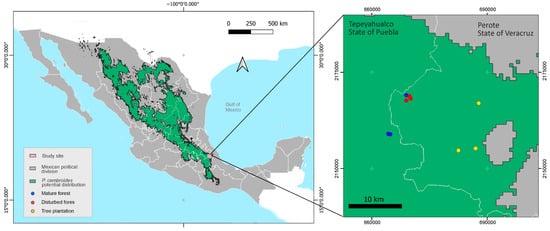
Nine sampling sites were established at the southern limit of the species’ distribution, between the states of Veracruz and Puebla, Mexico. Three forest management conditions were considered: mature forest, disturbed forest, and young P. cembroides plantations. Mature stands (MF1–MF3) were located in Cerro Pizarro (Puebla) and El Frijol Colorado (Veracruz); disturbed forests (DF1–DF3) were also located in El Frijol Colorado; and young plantations (PL1–PL3), approximately 10–34 years old, were situated in San Antonio Tenextepec and San José de los Molinos (Veracruz) (Figure 1). Vegetation in mature and disturbed forests was dominated by P. cembroides, occasionally accompanied by Juniperus flaccida, scattered and rare Quercus spp., Nolina parviflora, Yucca periculosa, Agave spp., and numerous taxa from Asteraceae, Cactaceae, and Poaceae [38]; plantations lacked these accompanying species and were nearly monospecific. Disturbed stands showed clear anthropogenic disturbance (rock extraction, soil removal, reduced understory complexity, vegetation clearing), whereas mature forests had minimal recent disturbance. Climate is temperate semi-arid (mean annual temperature: 11.4–13.1 °C; annual precipitation: 420.3–643.7 mm). Soils are mainly Leptosols, Regosols, and Andosols [39].
Figure 1.
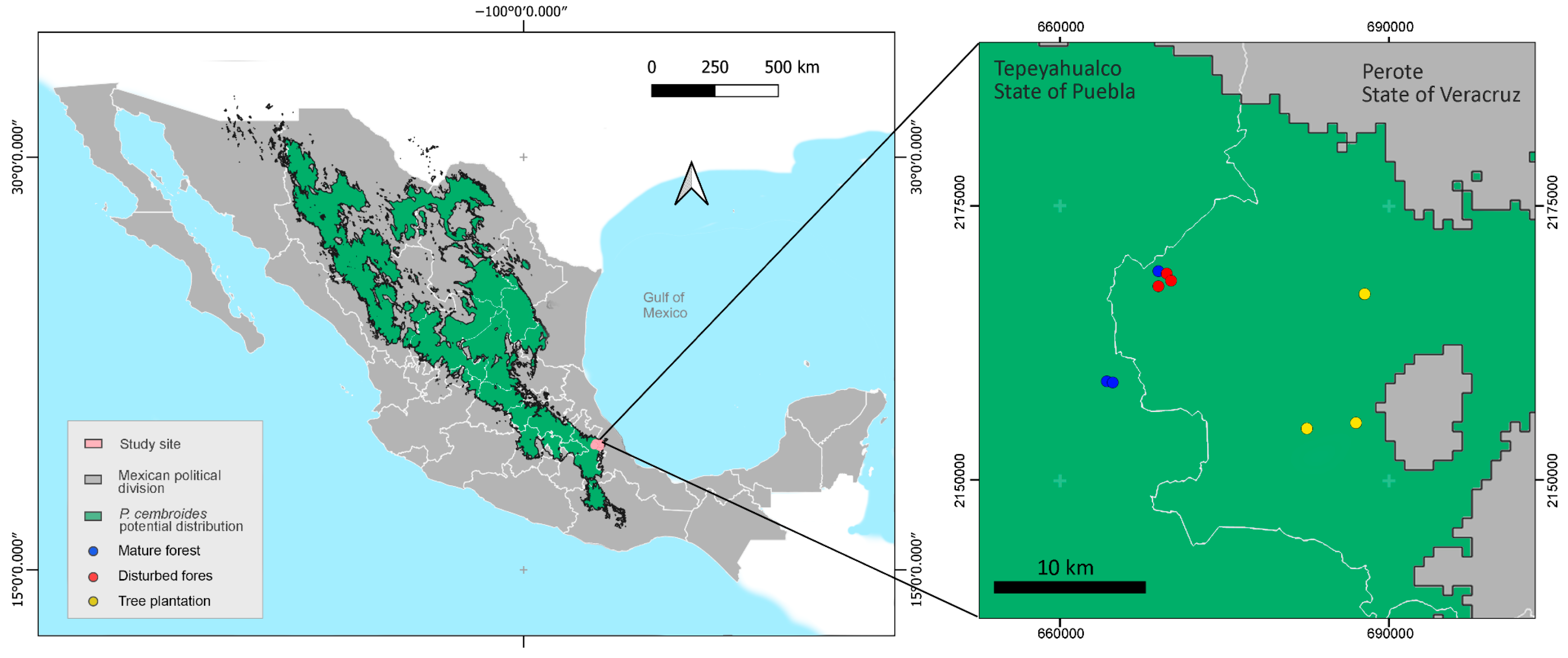
Geographical location of the study area and potential distribution of Pinus cembroides. Panel (left): Potential distribution of P. cembroides across Mexico (green shading) and national political boundaries (gray). The study region in central Puebla–Veracruz is highlighted in pink. Panel (right): Detailed view of the sampling region near Tepeyahualco (Puebla) and Perote (Veracruz), showing the location of sampling sites. Colors represent forest conditions: blue = mature forest, red = disturbed forest, yellow = tree plantation.
2.2. Vegetation-Structure and Climatic Variables
Tree density was measured directly at each sampling point. Canopy cover was quantified by digitizing vegetation polygons using high-resolution Google Earth imagery in QGIS 3.30.1. Species range distribution was obtained from a shapefile of the potential distribution of P. cembroides [40]. Climatic data (mean annual temperature and precipitation) for the period 1980–2009 were extracted from CONABIO bioclimatic layers [41,42].
2.3. Soil and Litter Sampling
Sampling was conducted during the rainy season (September–October 2023). At each of the nine sites, a 50 × 50 m plot was established, with P. cembroides representing >75% of canopy cover. Within each plot, 20 sampling points (≥10 m apart) were selected. At each point, mineral soil was collected using two sterile 5-cm-diameter cores from the top 10 cm (excluding litter), and litter was collected using a 16 × 10 cm PVC ring. This yielded 40 soil cores (20 points × 2 cores) and 20 litter samples per site. Duplicate soil cores were used to capture microscale spatial heterogeneity, whereas a single litter sample per point was considered sufficient due to its more homogeneous structure. Soil cores and litter samples were pooled separately per site into composite samples [9]. From each composite, four soil subsamples (~0.5 kg each) and one litter subsample (~0.3 kg) were collected. Additionally, 5 g of each substrate was preserved in triplicate in RNAlater (Thermo Fisher Scientific, Waltham, MA, USA) for DNA extraction. All subsamples were kept at 4 °C, dehydrated with sterile anhydrous calcium chloride desiccants, and transported to UNAM (Institutes of Biology and Geology) for physicochemical and enzymatic analyses.
2.4. Soil and Litter Analysis
For all samples, moisture content was determined by gravimetric method after oven-drying at 105 °C until constant weight. pH was quantified in a mixture of fresh material (soil or litter) with deionized water (1:10 mass:volume) and measured in a multiparameter Orion Versa Star Pro, Thermo Scientific [43].
Enzymatic activity: The activity of soil exoenzymes related to the acquisition of carbon was determined: ß-glucosidase (ßG; EC 3.2.1.21) and polyphenol oxidase (POX; EC 1.14.18.1); nitrogen acquisition: leucine aminopeptidase (LEU; EC 3.4.11.1); and phosphorus acquisition: phosphomonoesterase (FME; EC 3.1.3.2) through the colorimetric determination of the release of p-nitrophenol at λ 420 nm, except POX, which was quantified based on oxidation of 2,2′-azino-bis(3-ethylbenzothiazoline-6-sulfonic acid) (ABTS) at λ 460 nm [43].
In vitro carbon potential mineralization: Samples were placed in PVC cylinders and capillary-moistened to 60% of field capacity. Cylinders were placed in airtight glass flasks (1 L) with a vial containing 10 mL of 1N NaOH. Samples were incubated in the dark at 25 °C for 15 days. CO2 captured in NaOH traps was quantified by titration with HCl and reported as accumulated CO2 [14].
2.5. DNA Extraction, Amplification, and Sequencing
DNA was extracted from RNAlater-preserved samples using the DNeasy PowerMax Soil Kit (QIAGEN, Germantown, MD, USA) following the manufacturer’s protocol. DNA concentration and purity were assessed with a NanoDrop spectrophotometer (Thermo Fisher Scientific, Waltham, MA, USA). The ITS2 region was amplified using primers ITS3 (GCATCGATGAAGAACGCAGC) and ITS4 (TCCTCCGCTTATTGATATGC) [44]. Negative controls (buffer mix) and a positive control (mock community) were included in the extraction process. Library preparation and quality control were performed at Macrogen Inc. (Seoul, Republic of Korea), including adapter ligation, bead-based purification, qPCR quantification, and fragment size verification. Sequencing was conducted on an Illumina MiSeq platform with a 2 × 300 bp paired-end configuration.
2.6. Bioinformatic Workflow
Raw FASTQ files were processed using PipeCraft2 v1.0 [45] under a VSEARCH-based OTU pipeline [46]. Reads were primer-trimmed, merged (min. 20 bp overlap), quality-filtered (qmin = 20), dereplicated, and cleaned of singletons and chimeras before OTU clustering at 97% similarity. Taxonomy was assigned via BLAST v2.12.0 [47] against UNITE v2024 [48] and functional guilds via FungalTraits v1.3 [49]. Non-fungal OTUs and controls were removed. Once OTUs were taxonomically assigned, they were treated as species hypotheses, as done in UNITE [48].
2.7. Statistical Analyses
All analyses were performed in R v4.4.2 using the packages phyloseq, vegan, betapart, ampvis2, indicspecies, ggplot2, and FSA. Tables containing the species read abundance by site, taxonomic assignments, and sample metadata were merged into a phyloseq object. Samples with zero reads and species with zero total abundance were removed. Sampling completeness was assessed using species accumulation curves (specaccum) and coverage estimation via iNEXT. Samples were rarefied to an even depth of 30,200 reads using rarefy_even_depth without replacement.
Alpha diversity (observed richness, Shannon index, Fisher’s alpha) was calculated from rarefied data. Differences among substrates and forest conditions were tested using Kruskal–Wallis tests followed by Dunn’s post hoc comparisons (p ≤ 0.05). Analyses were conducted separately for soil and litter, as well as on a pooled dataset (soil + litter), to capture substrate-specific and integrated community patterns. Relative abundances were computed per sample, and community composition was summarized at species, genus, and trophic guild levels using tax_glom and FungalTraits annotations. Core taxa were defined as species present in 100% of samples within a given group; prevalence was defined as the proportion of samples in which a given species was detected.
Beta diversity was analyzed using Hellinger-transformed species abundances and Bray–Curtis dissimilarities. Non-metric multidimensional scaling (NMDS) was used to visualize compositional differences. PERMANOVA (adonis2) tested the effects of substrate, forest condition, and their interaction, with homogeneity of multivariate dispersions assessed via betadisper. Hierarchical clustering (Ward’s method) was applied to identify grouping patterns. Beta diversity was partitioned into turnover (βSIM) and nestedness (βSNE) components following Baselga’s framework [50], using beta.pair and beta.multi from the betapart package. Indicator species analysis was performed with multipatt (IndVal.g, 999 permutations) [51,52], IndVal values range from 0 to 1, to indicate stronger associations with a given group.
Environmental drivers were analyzed after standardizing variables (z-score) and removing collinear predictors using variance inflation factors (VIF > 10). Extracellular enzyme activities and CO2 mineralization were treated as ecosystem-level functional proxies rather than direct fungal traits, as these activities can also derive from bacteria, archaea, and plant roots [53].
Distance-based redundancy analysis (db-RDA) was performed on Bray–Curtis distances using capscale. The significance of the global model and individual predictors was tested with 999 permutations. A reduced model including only abiotic predictors yielded qualitatively similar results; therefore, the full model (edaphic, climatic, enzymatic, and vegetation-structure variables) is presented.
3. Results
3.1. Sequencing Output and Dataset Overview
Sequencing generated 3,656,146 raw reads across 18 samples (Table S1). After quality filtering and removal of non-fungal and artifact sequences, the final dataset comprised 1,380,475 fungal reads assigned to 8300 OTUs (hereafter referred to as species; see Methods). Species accumulation and sample coverage curves approached asymptotes for both substrates and forest conditions, indicating adequate sampling completeness (Figure S1).
3.2. Alpha Diversity Across Substrates and Forest Conditions
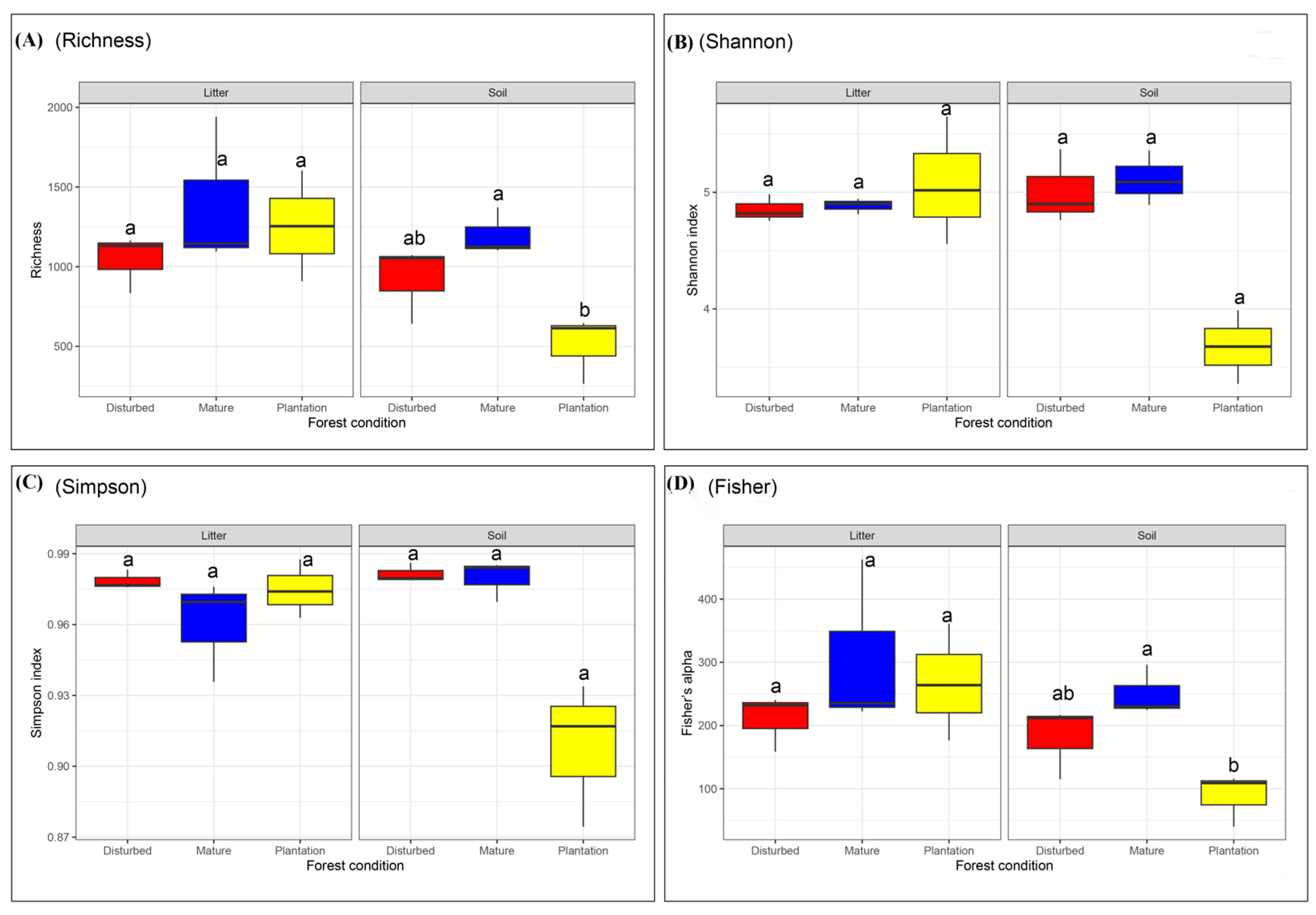
Rarefaction to 30,200 reads per sample retained 7552 species (90.3% of the total). Across all samples, litter consistently showed higher richness than mineral soil, regardless of forest condition (Table S2). When forest conditions were compared using the pooled dataset (substrates combined), no alpha diversity metric differed significantly (Kruskal–Wallis, all p > 0.16).
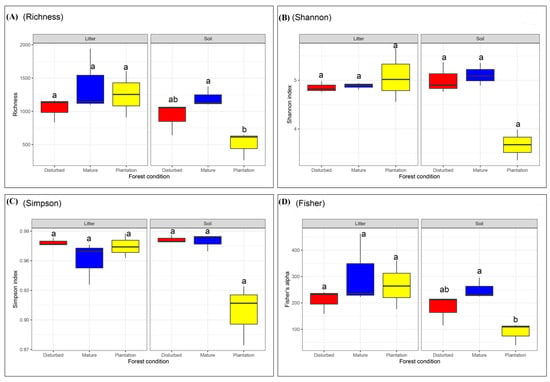
However, when analyzing substrates separately, condition effects were detected only in mineral soil (Figure 2). In mineral soil, richness and Fisher’s alpha varied significantly among conditions (Kruskal–Wallis, p = 0.039), with mature forests showing higher values than disturbed stands and plantations (post hoc, p ≤ 0.05). In litter, no significant effect of forest condition was observed (Kruskal–Wallis, all p > 0.32).
Figure 2.
Alpha diversity metrics across forest conditions and substrates. Panels depict (A) richness, (B) Shannon index, (C) Simpson index, and (D) Fisher’s α for litter and soil samples grouped by forest condition. Different letters indicate significant pairwise differences based on Dunn post hoc tests (adjusted p ≤ 0.05).
3.3. Functional and Taxonomic Composition
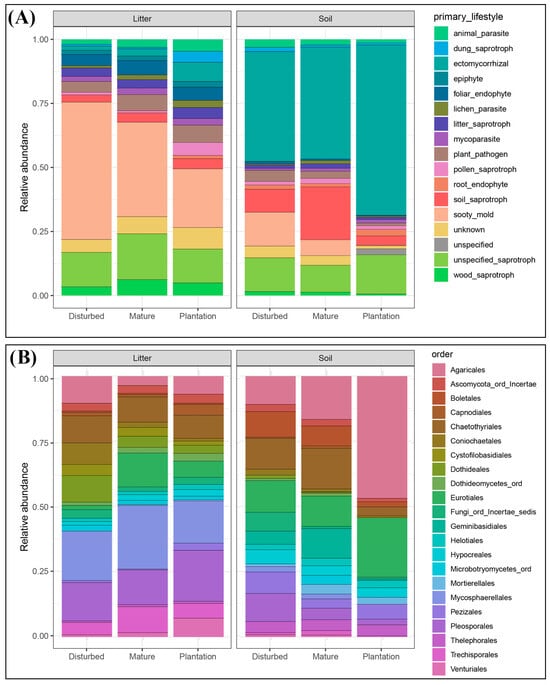
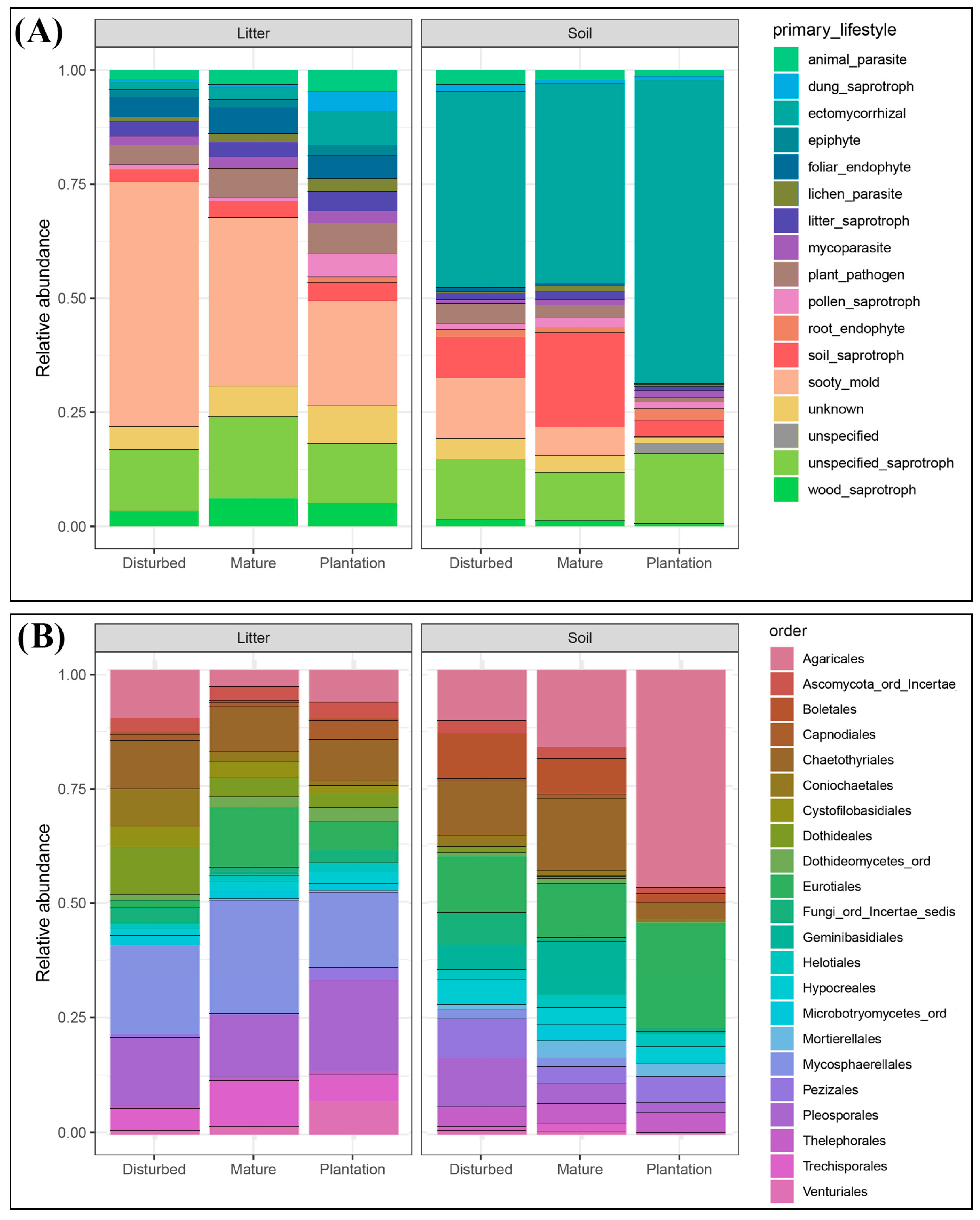
Fungal communities were dominated by a consistent set of functional guilds and taxonomic lineages across all samples (Figure 3). Functional annotation (primary lifestyle) was available for >80% of the total relative abundance. Ectomycorrhizal fungi represented the largest functional group in mineral soil, whereas sooty mold fungi were characteristic of litter samples (Figure 3A). Other abundant guilds included unspecified saprotrophs, soil, wood, and litter saprotrophs, plant pathogens, and foliar endophytes.
Figure 3.
Relative abundance of major fungal guilds ((A) >1% relative abundance) and orders ((B) >5% relative abundance) across forest conditions and substrates.
At the order level, Agaricales, Pleosporales, Chaetothyriales, and Eurotiales accounted for the largest relative abundances, followed by Mycosphaerellales, Hypocreales, and Boletales (Figure 3B). These lineages differed in their relative contributions between substrates. At the genus level, abundant taxa across the entire dataset included Penicillium, an unresolved lineage within Teratosphaeriaceae, the ectomycorrhizal genera Inocybe, Tricholoma, Rhizopogon, and Tomentella, as well as Trechispora, Cladophialophora, Coniochaeta, Geminibasidium, and Knufia. (Figure S2).
3.4. Species Prevalence and Indicator Species Across Substrates and Forest Conditions
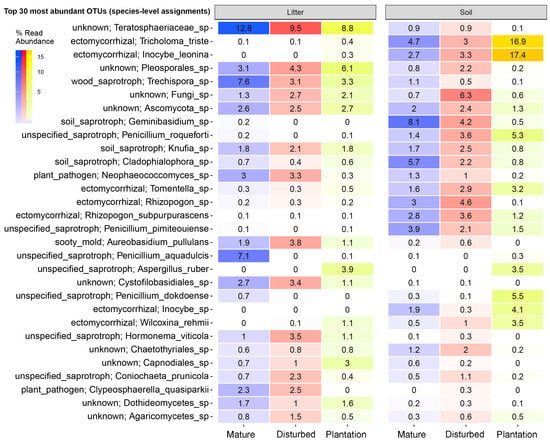
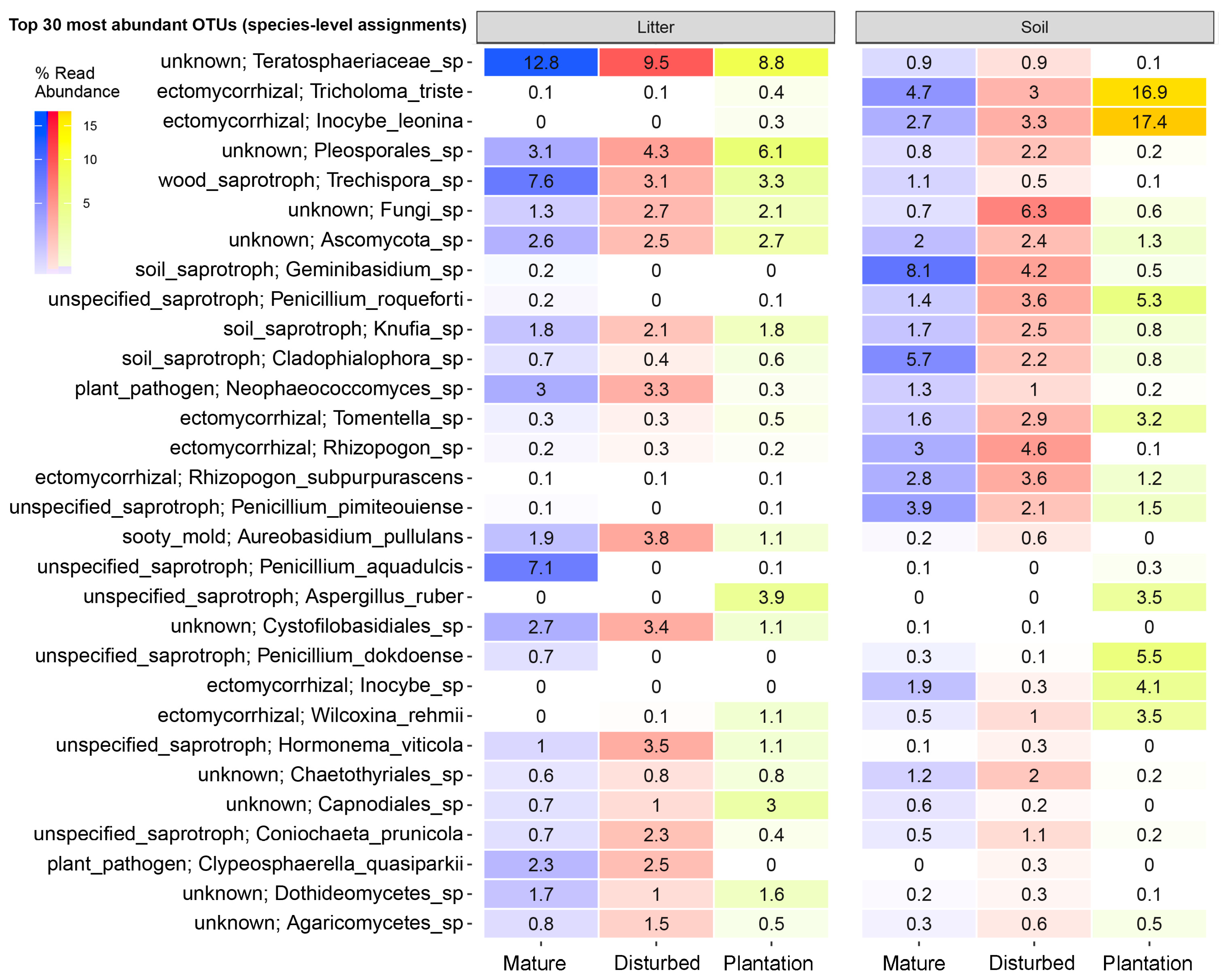
Prevalence patterns differed primarily between substrates (Figure 4). Litter communities contained multiple moderately abundant species, including lineages within Teratosphaeriaceae, Pleosporales, Trechispora, Knufia, Aureobasidium pullulans, and Neophaeococcomyces. In contrast, mineral soil communities exhibited a more uneven abundance structure, where a small number of species concentrated a large proportion of total reads. These prevalent species belonged primarily to ectomycorrhizal fungi, including Inocybe leonina, Tricholoma triste, Rhizopogon sp., Tomentella sp., and Wilcoxina rehmii. Aspergillus ruber was prevalent across plantation sites regardless of substrate. The 30 most prevalent species across the entire dataset, along with their mean relative abundances, are listed in Table S3.
Figure 4.
Heatmap showing the relative abundance of the 30 most abundant species across forest conditions and substrate types. Abundance values are expressed as the percentage of total reads per sample. Color intensity represents relative abundance.
Indicator species analysis revealed marked differences among the six Condition–Substrate combinations. Mature_Soil harbored the highest number of indicator species (153), followed by Plantation_Litter (111), Disturbed_Litter (83), and Mature_Litter (69). Disturbed_Soil showed a moderate number (42), whereas Plantation_Soil had the lowest (14) (Table S4). The top five indicator species further reinforced substrate- and condition-specific assembly patterns (Table 1). Disturbed litter was characterized by indicator species such as Neodactylaria obpyriformis and Hydeomyces desertipleosporoides, whereas disturbed mineral soil included Acrocalymma ampeli and Sarocladium spirale. Mature litter indicators included Rhynchogastrema glucofermentans, Didymocyrtis pini, and Cylindrotorula indica. In contrast, mature forest mineral soil was characterized by Astraeus morganii and Hygrocybe conica. Plantation mineral soil retained fewer indicator species, including Hyaloscypha finlandica, Pachyphlodes thysellii, and Inocybe breviterincarnata, while plantation litter contained Bryostigma dokdoense, Angustimassarina acerina, and Polyscytalum neofecundissimum.
Table 1.
Indicator species analysis (IndVal) showing the top five significant fungal species associated with each Condition–Substrate group. IndVal values and associated p-values indicate the strength and significance of each taxon as an indicator. Only the top five taxa per group are shown.
3.5. Beta Diversity and Community Composition Across Substrates and Forest Conditions
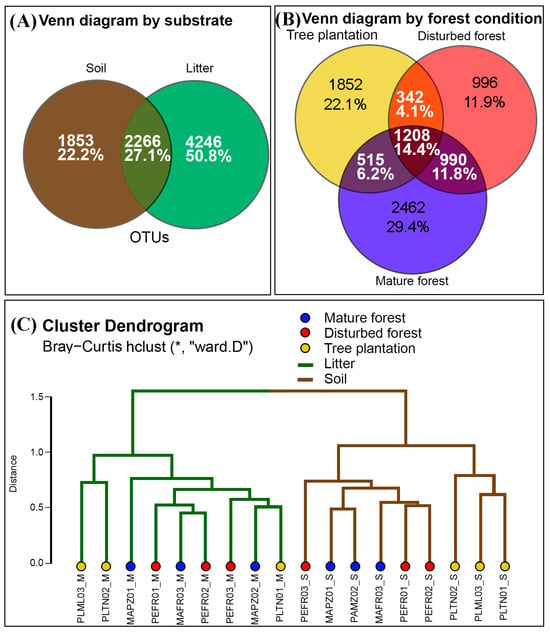
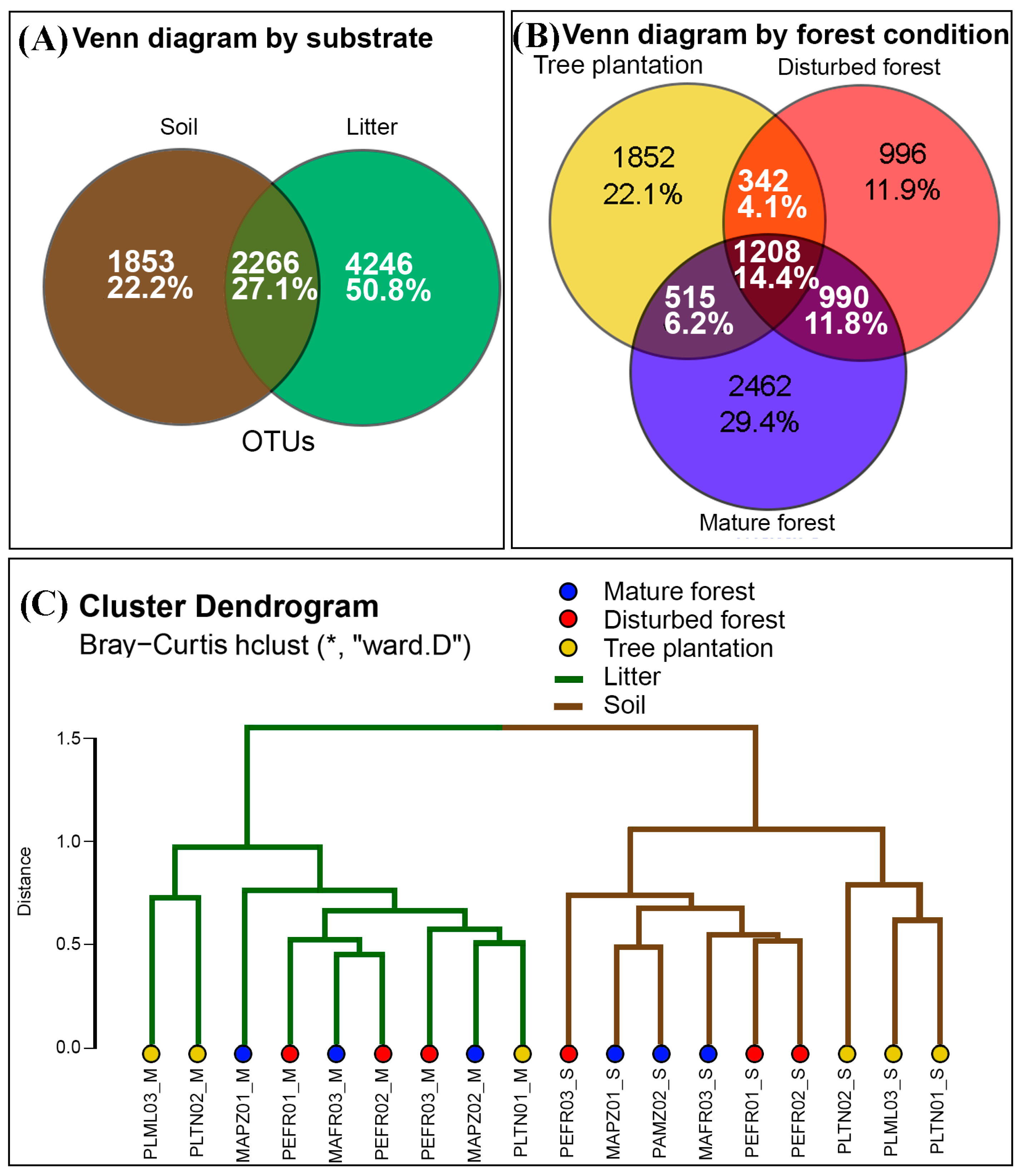
Beta diversity revealed clear differentiation in fungal community composition between substrates, with additional variation among forest conditions (Figure 5). Strong vertical partitioning was observed: 1853 species (22.2%) were exclusive to mineral soil, 4246 species (50.8%) exclusive to litter, and 2266 species (27.1%) shared between both substrates (Figure 5A). Litter thus contained a distinct and more species-rich assemblage than mineral soil, with only a subset of taxa occurring across both layers.
Figure 5.
Patterns of species distribution and community composition similarity. (A) Venn diagram showing shared and unique species between soil and litter. (B) Venn diagram showing shared and unique species among forest conditions (tree plantation, disturbed forest, and mature forest), pooling both substrates. (C) Hierarchical clustering of fungal communities based on Bray–Curtis dissimilarity using Ward’s method, showing relationships among individual samples. Each panel provides a complementary summary of community composition at different levels of aggregation.
Differences among forest conditions were also evident. Mature forests contained the largest number of condition-specific species (2462; 29.4%), followed by plantations (1852; 22.1%) and disturbed forests (996; 11.9%). Only 1208 species (14.4%) were shared across all three conditions, with additional subsets shared pairwise (Figure 5B).
Bray–Curtis hierarchical clustering grouped samples primarily by substrate, forming two main clusters corresponding to soil and litter. Within each substrate, samples were further arranged by forest condition, although separation among conditions was partial in litter (Figure 5C).
PERMANOVA detected significant effects of Substrate (F = 6.18, p = 0.001) and Condition (F = 2.53, p = 0.003) on fungal community composition, whereas their interaction was not significant (p = 0.194), indicating that substrate and forest condition acted independently (Table 2).
Table 2.
Results of PERMANOVA testing the effects of Substrate, Forest Condition, and their interaction on fungal community composition, and tests of multivariate homogeneity of group dispersions (betadisper) for each factor.
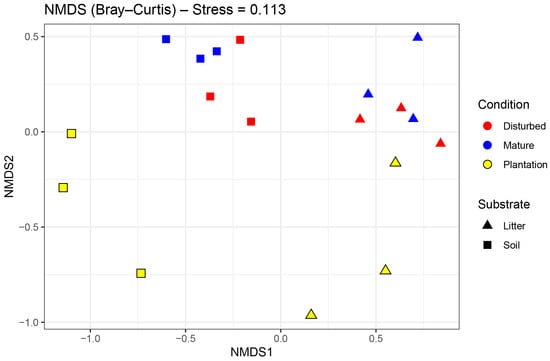
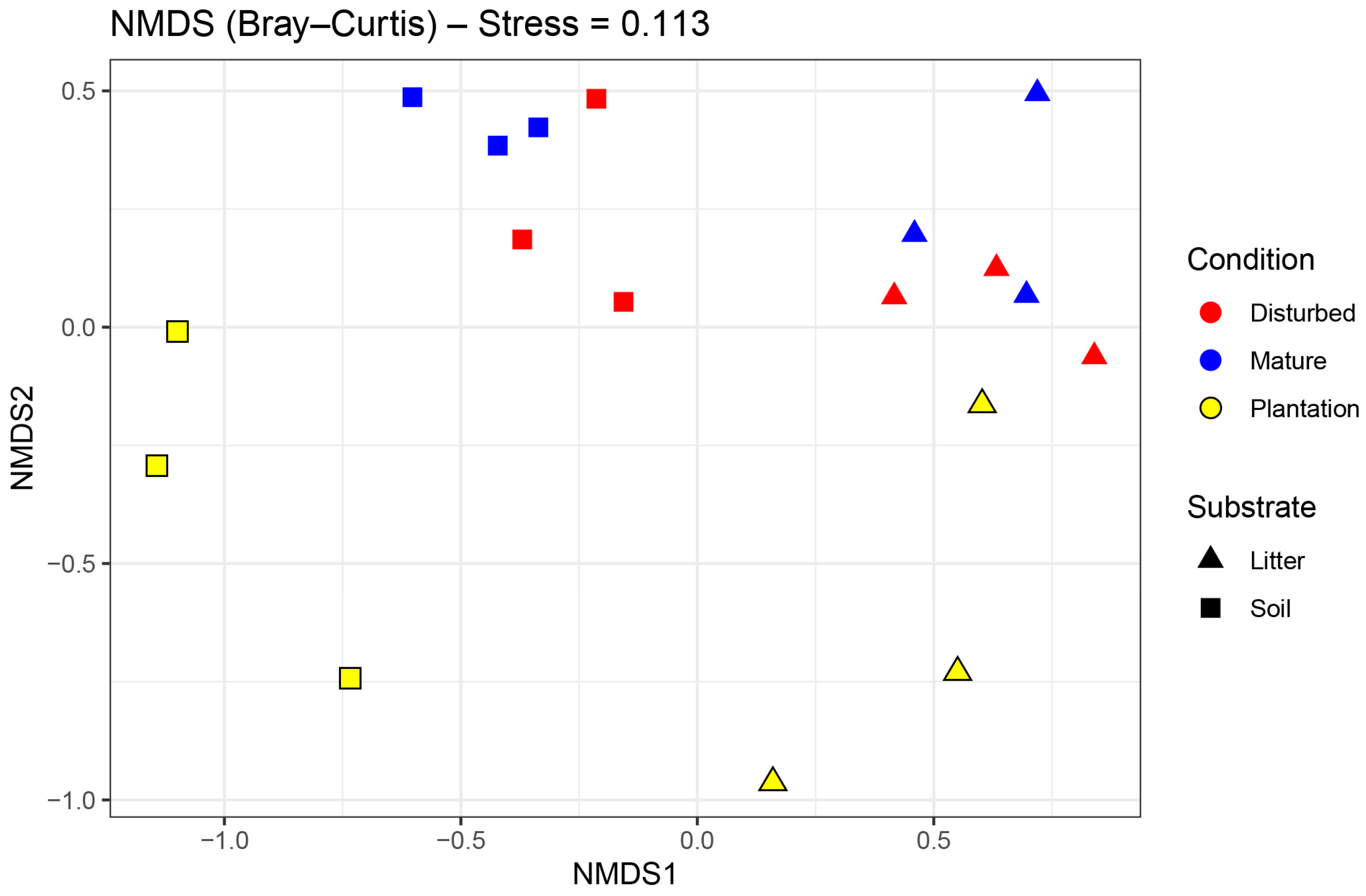
NMDS ordination (stress = 0.113) showed clear separation between soil and litter communities. Communities from mature and disturbed forests overlapped within each substrate, whereas those from plantations showed moderate compositional differences compared to the other conditions (Figure 6).
Figure 6.
NMDS ordination of fungal communities based on Bray–Curtis dissimilarity (stress = 0.113). Symbols denote substrate type and colors represent forest condition.
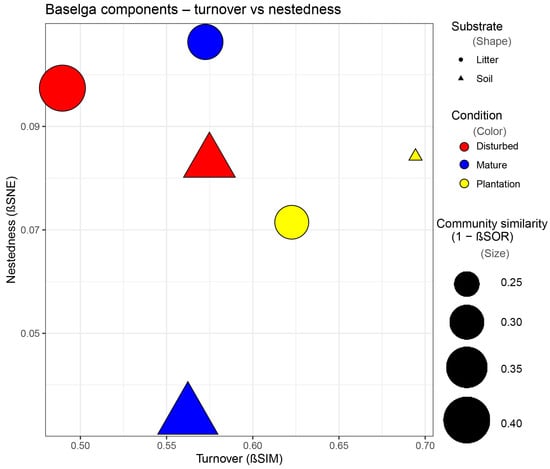
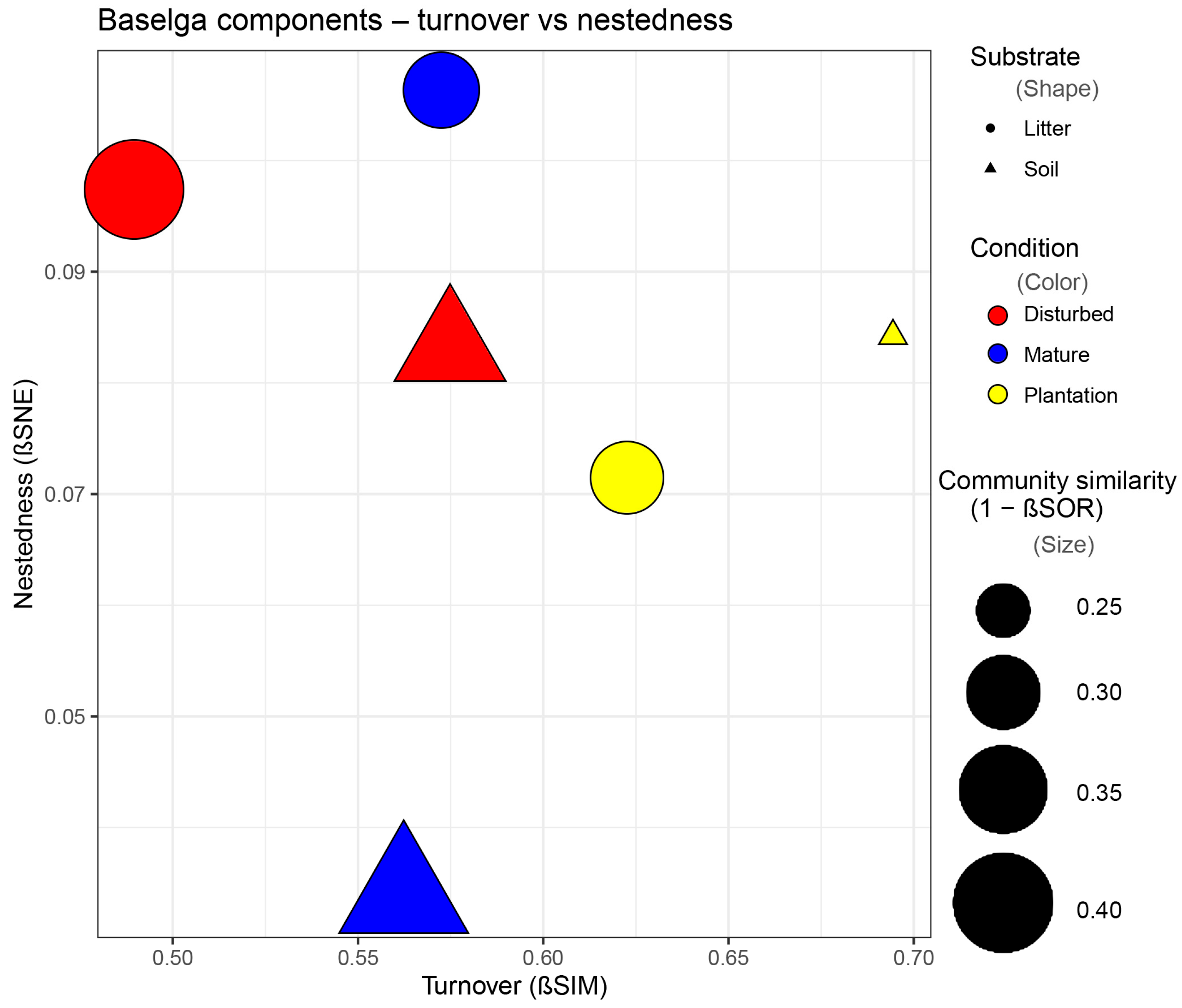
Beta-diversity partitioning revealed high total dissimilarity among samples (βSOR = 0.59–0.78; Figure 7; Table S5). This dissimilarity was primarily driven by turnover (βSIM = 0.49–0.69), indicating that differences among communities were mainly due to species replacement. In contrast, nestedness (βSNE = 0.03–0.11), which reflects differences due to species loss or gain, contributed relatively little. The highest dissimilarity was observed in mineral soil from plantations (βSOR = 0.78), whereas litter from disturbed forests showed the lowest values (βSOR = 0.59).
Figure 7.
Partitioning of beta diversity using Baselga’s framework. Scatterplot of turnover (βSIM) versus nestedness (βSNE) across forest conditions and substrates. Point color indicates forest condition, shape indicates substrate, and circle and triangle sizes represent community similarity (1 − βSOR). Turnover (βSIM) reflects compositional differences due to species replacement, whereas nestedness (βSNE) reflects differences associated with species loss or gain. Thus, positions along the x-axis indicate increasing contribution of species replacement, while positions along the y-axis indicate increasing contribution of nestedness. Larger point sizes indicate higher similarity among communities, while smaller points indicate greater dissimilarity.
3.6. Environmental Variation Across Substrates and Forest Conditions
Although mean values of several environmental variables differed among forest conditions (Figures S3 and S4), none of these differences were statistically significant, likely due to high within-condition variability. In litter, mature sites showed higher pH, CO2 production, and enzyme activities compared to disturbed and plantation sites, but broad ranges and overlap among conditions prevented statistical significance (Figure S3). Similarly, in mineral soil, disturbed sites exhibited the highest pH and enzyme activities, followed by mature and plantation sites, though no significant differences were detected (Figure S4). A complete list of measured environmental variables is provided in Table 3.
Table 3.
Environmental variables measured and obtained across sampling sites. An explanation of the site code nomenclature is provided in the table footnote.
3.7. Associations Between Fungal Community Composition, Environmental Variables, and Microbial Activity
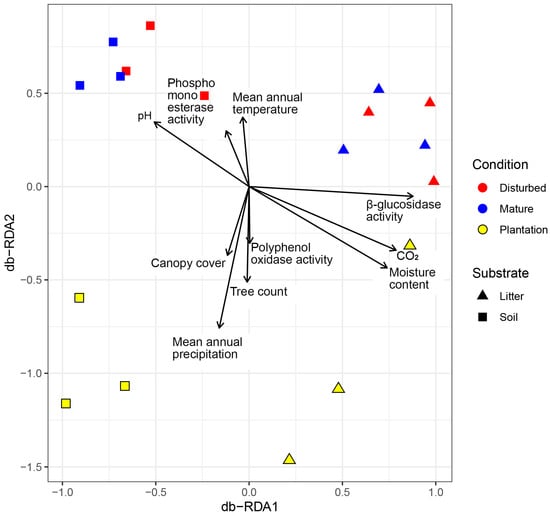
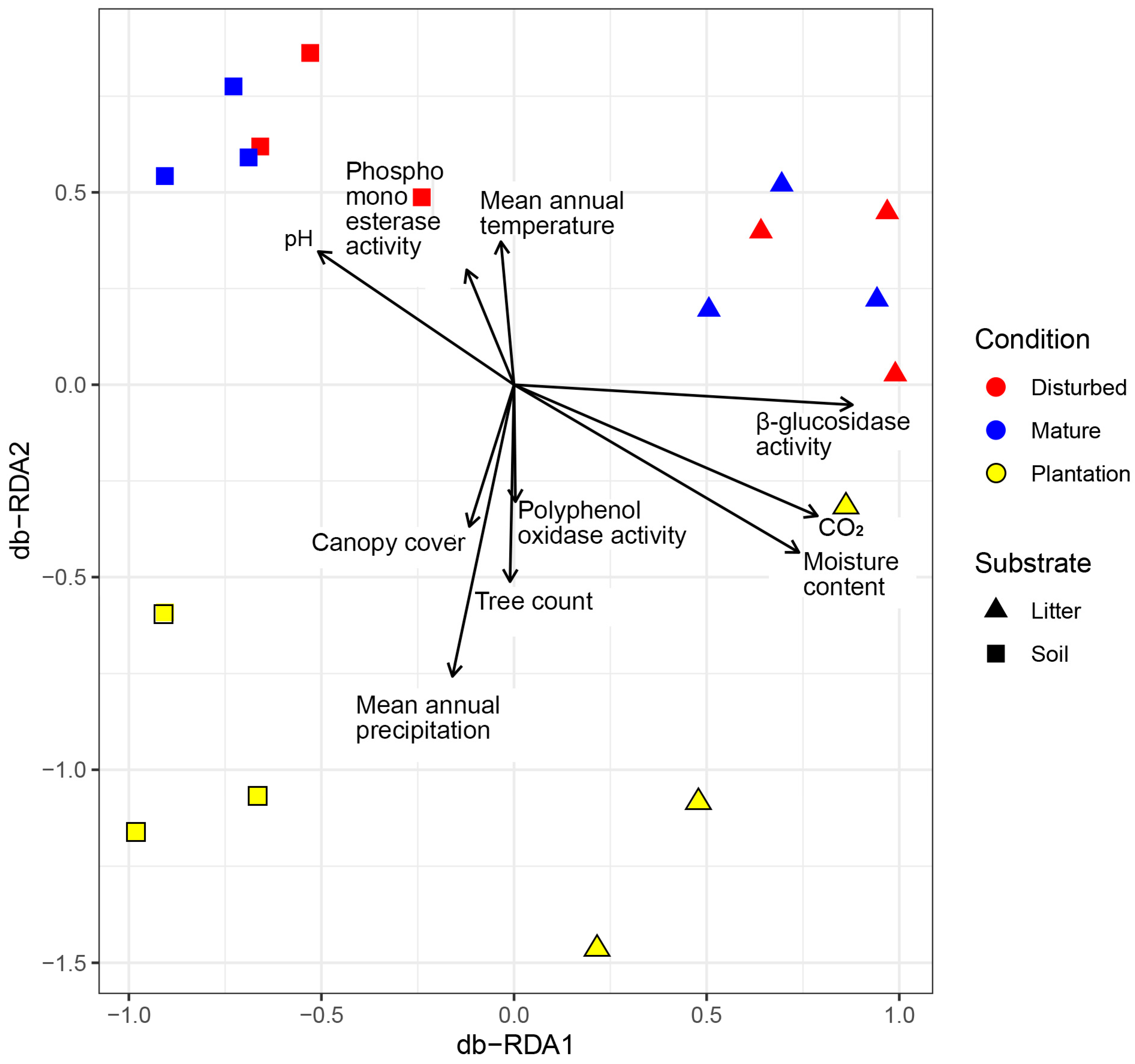
Distance-based redundancy analysis (db-RDA) was used to evaluate associations between fungal community composition and environmental and microbial activity variables. A subset of non-collinear predictors was retained, including tree count, canopy cover, temperature, precipitation, moisture content, pH, CO2 production, β-glucosidase, polyphenol oxidase, and phosphomonoesterase. The global db-RDA model was significant (F = 2.07, p = 0.001) and explained approximately 75% of the constrained variation. Several variables were significantly associated with community composition: moisture content (F = 4.65, p = 0.001), β-glucosidase (F = 2.45, p = 0.007), tree count (F = 2.31, p = 0.011), precipitation (F = 2.20, p = 0.015), CO2 (F = 1.97, p = 0.017), and temperature (F = 1.90, p = 0.036) (Table S6).
An abiotic-only model (excluding enzyme activities) was also significant (F = 1.82, p = 0.001), explaining approximately 56% of the constrained variation. The inclusion of enzyme activities increased the explanatory power and highlighted functional gradients associated with carbon acquisition and microbial respiration.
The db-RDA ordination separated samples primarily by substrate along the first constrained axis (db-RDA1), clearly distinguishing soil from litter communities (Figure 8). This axis was mainly associated with moisture- and activity-related variables, particularly moisture content, CO2, and β-glucosidase, which aligned with soil samples. The second constrained axis (db-RDA2) showed weaker differentiation among forest conditions. Plantation samples tended to separate along this axis, whereas disturbed and mature samples partially overlapped. This secondary gradient was associated with temperature, pH, phosphomonoesterase activity, and vegetation structure (tree count and canopy cover).
Figure 8.
db-RDA ordination showing the relationship between fungal community composition and environmental variables. Vectors represent environmental predictors retained after collinearity filtering. Colors indicate forest condition, and shapes represent substrate type.
Pairwise Spearman correlations between fungal richness and environmental variables varied across Condition-Substrate combinations (Figure S5), with polyphenol oxidase activity showing the greatest overall variation.
4. Discussion
4.1. Vertical Stratification as a Primary Driver of Fungal Community Structure
Across P. cembroides forests, litter and mineral soil function as ecologically distinct fungal habitats. Differences in alpha diversity, dominance structure, guild composition, and patterns of beta diversity confirm the existence of marked vertical stratification, consistent with patterns documented in other forest systems [54,55,56]. This vertical differentiation aligns with the expectation that distinct microhabitats—litter, humus, mineral soil, and fine roots—harbor distinct fungal communities [16].
Litter communities contained several saprotrophic and plant pathogenic fungi, as well as taxa commonly described as endophytes in living tissues. However, we acknowledge that the detection of plant pathogenic fungi in litter does not necessarily imply active infection; culture-independent molecular approaches do not distinguish between living and dead propagules, and some of these taxa may function as facultative saprotrophs or persist as dormant structures in non-living organic matter. In litter, these taxa are likely functioning as saprotrophs associated with the decomposition of senescent plant material, consistent with previous studies showing that some fungal taxa can exhibit multiple ecological roles depending on environmental conditions and life stage. Litter fungal taxa are specialized in degrading cellulose-, hemicellulose-, and polyphenol-rich substrates [12,57]. These communities exhibited high turnover and comparatively low nestedness, indicating that litter assemblages are shaped primarily by species replacement among stands rather than systematic loss of taxa.
In contrast, mineral soil hosted fewer taxa with higher relative abundance, mainly ECM fungi such as Tricholoma triste, Inocybe leonina, Wilcoxina rehmii, Rhizopogon, and Tomentella. The high prevalence of ECM lineages and the detection of 244 ECM species suggest extensive mycelial networks supporting tree survival under extreme environmental conditions, including low nutrient availability, water limitation, and other abiotic stressors [58,59,60].
4.2. Forest Condition Effects Are Substrate-Dependent
Forest condition influenced fungal diversity and composition, but its effects were strongly substrate-dependent. When substrates were pooled, condition differences were obscured. However, when analyzed separately, mineral soil displayed a clear gradient, with mature forests harboring richer and more even fungal communities than disturbed or plantation stands. In contrast, litter showed no significant differences in alpha diversity among conditions, likely reflecting its continuous, dynamic organic inputs [8,12,61,62,63]. Interestingly, one of the few fungi with no substrate effect was Aspergillus ruber widely distributed in the plantation system (Figure 4). Aside from this exception, a pronounced taxonomic decoupling between litter and mineral soil communities is observed. Litter assemblages were composed of saprotrophic and opportunistic taxa such as Trechispora, Aureobasidium pullulans, Pleosporales, and various Penicillium species (e.g., P. roqueforti, P. pimiteouiense, P. aquadulcis), consistent with rapid substrate turnover and the availability of complex organic compounds [61,64]. In contrast, mineral soil communities were characterized by a marked enrichment of ectomycorrhizal taxa, highlighting the central role of mycorrhizal associations under nutrient-limited and water-stressed conditions [65,66]. Importantly, these shifts do not reflect a simple loss of diversity but rather a compositional reorganization.
In disturbed forests, soil removal associated with tepezil (a local, very light, and porous volcanic rock) extraction is associated with alterations in soil structure and resource availability. These changes, together with management practices such as vegetation removal, soil disturbance, livestock activity, and plantation establishment, likely act as environmental filters shaping fungal communities [67,68]. We recognize that these disturbances also affect the litter layer, potentially altering input quality and quantity. In contrast, litter communities appear less sensitive to such changes, likely due to their continuous exposure to surface inputs and atmospheric dispersal, which can partially mitigate local disturbance effects [69].
Differences in vegetation structure further contribute to these patterns. Mature forests support more heterogeneous plant communities and microhabitats, which can enhance fungal diversity. Plantations, by contrast, exhibit greater structural homogeneity and reduced understory complexity, potentially limiting fungal diversity in soil while maintaining saprotrophic richness in litter [70].
4.3. Turnover, Nestedness, and Vertical Decoupling of Assembly Processes
Beta-diversity partitioning revealed substrate-specific assembly mechanisms. Litter communities were characterized by high turnover and low nestedness, indicating that compositional differences among stands are driven primarily by species replacement. This pattern is consistent with niche differentiation driven by substrate heterogeneity, resource availability, and microenvironmental variation, rather than simple species loss [50,71].
In contrast, mineral soil communities were also dominated by turnover but exhibited relatively higher nestedness compared to litter communities, particularly in plantations. This pattern likely reflects the combined effects of environmental filtering and reduced host diversity, where simplified vegetation structure and more homogeneous edaphic conditions promote the selective loss of taxa, resulting in communities that represent subsets of those found in more complex forest conditions [72,73]. At the same time, spatial heterogeneity in soil microenvironments and root-associated interactions promotes species turnover among sites, reflecting differential environmental filtering and niche partitioning rather than nested patterns of taxon loss [74].
These compositional shifts are further supported by indicator species analysis. Disturbed systems were associated with taxa such as Acrocalymma and Sarocladium. The genus Acrocalymma includes dark septate endophytes that can promote plant growth and enhance their defense responses to disturbance-induced stress [75,76]; whereas genus Sarocladium includes plant pathogens and endophytes, which could take advantage of the vulnerability of plants in disturbed sites for their colonization [77]. On the other hand, mature forests showed indicator taxa such as Tomentella and Astraeus, reflecting more stable, host-associated interactions typical of ectomycorrhizal communities [60,65].
Notably, the observed dominance of species turnover over nestedness, together with the significant effects of environmental variables (e.g., soil properties and enzymatic activities), suggests that fungal communities are structured by strong local environmental filtering acting upon a broadly dispersed species pool. This pattern is consistent with the conceptual framework proposed in microbial biogeography, where “everything is everywhere, but the environment selects” [78,79,80]. In this context, community composition may reflect a continuum between widely distributed, generalist taxa and more specialized, habitat-associated taxa, where environmental conditions ultimately determine which fraction of the regional species pool is realized locally.
Together, these results support the existence of vertical decoupling in community assembly processes. Litter communities appear structured by rapid substrate turnover and microsite heterogeneity, whereas mineral soil communities are more strongly influenced by environmental filtering and plant–fungal interactions.
4.4. Environmental Gradients and Enzymatic Activity Shape Fungal Community Structure
Environmental gradients and microbial activities jointly shaped fungal community structure across substrates. Although mean enzymatic activities and microbial respiration (CO2 production) did not differ significantly among forest conditions—likely due to low sample size (n = 3 per condition)—their weight in multivariate models revealed structured associations with community composition, indicating that ecosystem function remains linked to community structure [53,81,82]. We note that enzymatic activity and CO2 production reflect the combined contribution of fungi, bacteria, archaea, and plant roots, as acknowledged in Methods; therefore, these variables are interpreted as ecosystem-level functional proxies rather than exclusive fungal traits.
Litter communities were strongly associated with moisture, precipitation, and carbon-degrading enzymes such as β-glucosidase and polyphenol oxidase, reflecting the abundance of complex organic substrates requiring enzymatic breakdown [12,83]. Leucine aminopeptidase, linked to nitrogen mineralization [84], also aligned with litter communities, suggesting active protein turnover at the organic–mineral interface. In contrast, mineral soil communities were more strongly associated with edaphic conditions such as pH, one of the major determinants of fungal niche differentiation [70], as well as vegetation-related variables including tree density and canopy cover, particularly in plantation systems [85].
Our findings differ from those reported in root-focused studies of P. cembroides [17,25] likely due to both methodological and biogeographical differences. Previous studies relied on root-based sampling and targeted ectomycorrhizal symbionts, whereas our Illumina-based metabarcoding of bulk soil and litter captured the broader mycobiome and rare biosphere [86]. Additionally, our study sites are located at the southeastern limit of the species distribution, within the Cuenca Oriental, a cold arid region with mountain systems that produce unique climatic conditions, promoting relatively stable soil moisture despite overall aridity. These factors likely contribute to differences in both community composition and functional structure.
These differences also reflect a broader biogeographic context. Comparisons with Pinus edulis in the southwestern United States highlight similarities in semi-arid adaptations, including EMF sensitivity to combined drought and warming [23]. More locally, a study in Puebla on Pinus patula under similar silvicultural treatments (liberation cutting, first thinning, second thinning) reported patterns consistent with our findings: alpha diversity followed a trend of first thinning > liberation cutting > second thinning, although differences were not statistically significant, while beta diversity revealed significant shifts in community composition among treatments [87]. Notably, both studies identified similar dominant ECM genera (e.g., Inocybe, Tomentella, Russula), suggesting a core mycobiome associated with Pinus forests in central Mexico. However, while García-Valencia et al., focused on mycorrhizal root tips, our analysis of bulk soil and litter captured a broader spectrum of fungal guilds. In contrast, Pinus hartwegii at the Neotropical treeline harbors a low-diversity ECM community dominated by medium-distance soil foragers adapted to high altitude, cold, nutrient-poor soils [88]. Thus, although these pinyon pines share phylogenetic affinities, local environmental filters—rather than strict biogeographic boundaries—determine fungal community composition.
4.5. Ecological and Biotechnological Implications
Our findings support the existence of a recurrent ectomycorrhizal component embedded within a broader and context-dependent soil and litter mycobiome [57]. This core, composed of recurrent genera such as Tricholoma triste, Inocybe leonina, Rhizopogon, and Tomentella, likely plays a central role in mediating plant–soil interactions and resource acquisition in nutrient-poor and drought-prone environments [89,90]. Beyond their structural importance, ectomycorrhizal fungi play key roles in plant nutrient acquisition and ecosystem function, while other stress-tolerant fungal taxa such as Knufia, Ceratobasidium, and Acrocalymma exhibit multiple ecological strategies, including secondary lifestyles that shift depending on environmental context. For example, Ceratobasidium includes taxa reported as litter saprotrophs, plant pathogens, and orchid-associated mycorrhizal fungi [91,92], whereas Knufia comprises soil saprotrophs and rock-inhabiting fungi [93]. This functional versatility suggests that such taxa may contribute to ecosystem functioning and plant persistence under environmental stress through context-dependent interactions [92,94]. The prevalence of these taxa across sites highlights their potential role in ecosystem stability and their relevance for reforestation and assisted migration in semi-arid regions. However, shifts in ectomycorrhizal community structure and the loss of indicator taxa in disturbed and plantation systems suggest that forest management alters these symbiotic networks, with potential consequences for long-term ecosystem resilience [62].
This study has some limitations that should be acknowledged. First, taxonomic resolution based on ITS metabarcoding does not always allow precise functional assignment, particularly in distinguishing functional variability within ECM fungi. Functional interpretation was based primarily on genus-level assignments using the FungalTraits database, considering only primary lifestyles; however, many fungi exhibit multiple or context-dependent ecological roles, and a proportion of taxa remained unclassified. Therefore, functional inferences should be interpreted with caution. Second, enzymatic activities were measured at the community level and thus reflect combined microbial contributions rather than exclusively fungal processes. Additionally, the spatial scale and sampling design, while robust, may not capture fine-scale heterogeneity within plots. Despite these limitations, the consistency of observed patterns across substrates and environmental gradients supports the robustness of our main conclusions.
5. Conclusions
This study demonstrates that fungal communities associated with Pinus cembroides are strongly vertically stratified, confirming that substrate type exerts a stronger influence on community diversity and composition than forest management. Litter and mineral soil function as ecologically distinct compartments, with high turnover and limited species overlap indicating that species replacement—rather than richness gradients—is the primary driver of community differentiation across horizons. While litter supports diverse and relatively even assemblages dominated by saprotrophic and endophytic taxa, mineral soil is structured by ectomycorrhizal and other root-associated fungi.
Management effects were strongly substrate-dependent and most evident in mineral soil. Rather than indicating a decline of ectomycorrhizal fungi, our results suggest a compositional shift within ectomycorrhizal fungal (EMF) communities across forest conditions. Although certain taxa such as Tricholoma triste and Inocybe leonina increased in relative abundance in plantation soils, this pattern likely reflects a restructuring of EMF assemblages, potentially favoring taxa adapted to altered environmental conditions, rather than a uniform loss of EMF diversity. Despite these compositional shifts, statistically comparable enzymatic activities across forest conditions suggest functional redundancy and a partial decoupling between taxonomic structure and ecosystem functioning, pointing to a degree of short-term resilience in ecosystem processes.
Environmental filtering operated differently across horizons, with moisture, precipitation and microbial carbon-degrading enzyme activity structuring litter communities, and pH, canopy cover, and tree density shaping soil assemblages. This vertical decoupling highlights that above- and belowground fungal compartments may respond independently to environmental change and management interventions.
Taken together, these findings emphasize that fungal community responses to disturbance cannot be generalized across substrates and that vertical stratification is a key axis of ecological organization in forest soils. Recognizing this multidimensional structure is essential for improving monitoring, management, and restoration strategies in semi-arid forest ecosystems.
Finally, this work provides a regional baseline for soil fungal diversity and contributes to broader initiatives such as the Soil Biodiversity Atlas of Mexico [95,96], supporting the development of scalable and integrative frameworks for assessing belowground biodiversity under changing environmental conditions. Future studies integrating multi-kingdom approaches and functional trait frameworks will be essential to fully capture the ecological consequences of this vertical decoupling.
Supplementary Materials
The following supporting information can be downloaded at: https://www.mdpi.com/article/10.3390/d18050269/s1, Table S1. Summary of sequencing reads per sample after quality filtering. The table includes total raw reads, filtered reads, and final reads retained for downstream analyses for each sample. This summary provides an overview of sequencing depth and data retention across all samples. Table S2. Alpha diversity metrics calculated per sample. The table includes richness (Observed OTUs) and diversity indices (e.g., Shannon and Fisher’s alpha) used to characterize fungal community diversity across sites and conditions. Highest value marked in bolds. Table S3. Global prevalence of the most abundant OTUs across all samples. The table lists the top OTUs based on occurrence frequency and abundance, including their prevalence across samples and associated taxonomic assignments when available. Table S4. Indicator species analysis results for all substrate–condition combinations. OTUs significantly associated with specific groups were identified using the IndVal method (multipatt function), including indicator values and statistical significance based on permutation tests. Table S5. Results of the global and marginal permutation tests for the distance-based redundancy analysis (db-RDA). The table shows the overall model significance and the sequential contribution of each environmental variable, including degrees of freedom (Df), sum of squares, F-values, and permutation-based p-values (999 permutations). Significant variables are indicated according to standard significance codes. Table S6. Environmental variable loadings (arrows) for the db-RDA ordination. The table includes the direction and magnitude of each environmental variable used to interpret community structure patterns in the ordination space.
Author Contributions
J.A.J.-R., R.M.-O., R.G.-O. and J.P.-M. conceived the idea; J.A.J.-R. and R.M.-O. field work; J.A.J.-R., B.Á. and B.C.-V. laboratory work; J.A.J.-R. and B.Á. analyses; J.A.J.-R., B.Á., R.M.-O., R.G.-O., B.C.-V. and J.P.-M. review of draft and final manuscript; R.M.-O. and R.G.-O. funding. All authors have read and agreed to the published version of the manuscript.
Funding
Universidad Veracruzana, Dirección General de Investigaciones for SIREI-UV 26065202551 project Estudios Integrales de hongos, con énfasis en especies de los bosques del estado de Veracruz. UNAM, DGAPA, PAPIIT-IV200223 Project Atlas de la Biodiversidad del Suelo de México, herramienta para la investigación, docencia y toma de decisiones.
Institutional Review Board Statement
Not applicable.
Data Availability Statement
The complete analysis pipeline and datasets are publicly available in a GitHub repository: https://github.com/Burn121212/Pinus_cembroides_mycobiome_its2 (accessed on 3 March 2026). The raw sequencing data generated in this study have been deposited in the NCBI Sequence Read Archive under BioProject PRJNA1432919 (submission ID: SUB16080413 SAMN56693740-SAMN56693757) and will be publicly available upon acceptance.
Acknowledgments
We thank Aarón Pulido Ramírez and Dolores Ramírez Peña for their support during field sampling. J.A.J.-R. acknowledges the Secretaría de Ciencia, Humanidades, Tecnología e Innovación (SECIHTI) for the scholarship supporting his master’s studies (843269), and thanks the Laboratorio de Micología Integral (Universidad Veracruzana) and the Instituto de Biología and Instituto de Geología (UNAM) for institutional support. We thank the ejido members for allowing access to the study sites. We thank Miriam Guerrero Jacinto for technical assistance with GIS processing and map preparation. B.Á. acknowledges financial support from SECIHTI (Government of Mexico) through the program Estancias Posdoctorales por México, Convocatoria 2025. We thank Ofelia Beltrán Paz for microbial activity determinations. R.M.-O. received financial support from Universidad Veracruzana, Dirección General de Investigaciones (project SIREI-UV 26065202551). R.G.-O. received financial support from UNAM (DGAPA PAPIIT-IV200223). R.G.-O. also received financial support from the Society for the Protection of Underground Networks (SPUN), SPUN Underground Explorers Program.
Conflicts of Interest
The authors declare no conflicts of interest. The funders had no role in the design of the study; in the collection, analyses, or interpretation of data; in the writing of the manuscript; or in the decision to publish the results.
Abbreviations
The following abbreviations are used in this manuscript:
| OTUs | Operational Taxonomic Units |
| UNAM | National Autonomous University of Mexico |
References
- McBratney, A.B.; Hartemink, A.E. Define Soil. Soil Secur. 2024, 14, 100135. [Google Scholar] [CrossRef] [Scilit]
- Al Shoumik, B.A.; Khan, M.Z. Inclusion of Living Phase to Define Soil. Soil Secur. 2024, 16, 100168. [Google Scholar] [CrossRef] [Scilit]
- Lavelle, P.; Spain, A.V. Soil Ecology; Kluwer Academic Publishers: Dordrecht, The Netherlands, 2001. [Google Scholar]
- Bienes, R. El perfil del suelo: Formación y clasificación. In Técnicas Experimentales e Instrumentales de Análisis en Edafología; Walter, I., Ed.; INIA–INAP: Madrid, Spain, 2009; Volume 2, Available online: https://www.researchgate.net/profile/Ramon-Bienes/publication/235890059_El_perfil_del_suelo_formacion_y_clasificacion/links/00b4951691c61dda6d000000/El-perfil-del-suelo-formacion-y-clasificacion.pdf (accessed on 3 March 2026).
- Mata, G.; Salmones, D. Los Hongos, Silenciosos y Pacientes Degradadores de Materia Orgánica. In El Maravilloso Mundo de los Hongos; Universidad Veracruzana: Xalapa, Mexico, 2007; pp. 109–116. [Google Scholar]
- Smith, S.E.; Read, D.J. Mycorrhizal Symbiosis; Academic Press: Cambridge, MA, USA, 2010. [Google Scholar]
- Tedersoo, L.; Mikryukov, V.; Zizka, A.; Bahram, M.; Hagh-Doust, N.; Anslan, S.; Prylutskyi, O.; Delgado-Baquerizo, M.; Maestre, F.T.; Pärn, J. Global Patterns in Endemicity and Vulnerability of Soil Fungi. Glob. Chang. Biol. 2022, 28, 6696–6710. [Google Scholar] [CrossRef] [Scilit]
- Tedersoo, L.; Bahram, M.; Põlme, S.; Kõljalg, U.; Yorou, N.S.; Wijesundera, R.; Ruiz, L.V.; Vasco-Palacios, A.M.; Thu, P.Q.; Suija, A. Global Diversity and Geography of Soil Fungi. Science 2014, 346, 1256688. [Google Scholar] [CrossRef] [Scilit]
- Tedersoo, L.; Mikryukov, V.; Anslan, S.; Bahram, M.; Khalid, A.N.; Corrales, A.; Agan, A.; Vasco-Palacios, A.-M.; Saitta, A.; Antonelli, A. The Global Soil Mycobiome Consortium Dataset for Boosting Fungal Diversity Research. Fungal Divers. 2021, 111, 573–588. [Google Scholar] [CrossRef] [Scilit]
- Maestre, F.T.; Delgado-Baquerizo, M.; Jeffries, T.C.; Eldridge, D.J.; Ochoa, V.; Gozalo, B.; Quero, J.L.; García-Gómez, M.; Gallardo, A.; Ulrich, W. Increasing Aridity Reduces Soil Microbial Diversity and Abundance in Global Drylands. Proc. Natl. Acad. Sci. USA 2015, 112, 15684–15689. [Google Scholar] [CrossRef] [Scilit]
- Větrovský, T.; Kohout, P.; Kopecký, M.; Machac, A.; Man, M.; Bahnmann, B.D.; Brabcová, V.; Choi, J.; Meszárošová, L.; Human, Z.R. A Meta-Analysis of Global Fungal Distribution Reveals Climate-Driven Patterns. Nat. Commun. 2019, 10, 5142. [Google Scholar] [CrossRef] [Scilit]
- Urbanová, M.; Šnajdr, J.; Baldrian, P. Composition of Fungal and Bacterial Communities in Forest Litter and Soil Is Largely Determined by Dominant Trees. Soil Biol. Biochem. 2015, 84, 53–64. [Google Scholar] [CrossRef] [Scilit]
- Bahnmann, B.; Mašínová, T.; Halvorsen, R.; Davey, M.L.; Sedlak, P.; Tomšovský, M.; Baldrian, P. Effects of Oak, Beech and Spruce on the Distribution and Community Structure of Fungi in Litter and Soils across a Temperate Forest. Soil Biol. Biochem. 2018, 119, 162–173. [Google Scholar]
- Chavez-Vergara, B.; Merino, A.; Vázquez-Marrufo, G.; García-Oliva, F. Organic Matter Dynamics and Microbial Activity During Decomposition of Forest Floor under Two Native Neotropical Oak Species in a Temperate Deciduous Forest in Mexico. Geoderma 2014, 235–236, 133–145. [Google Scholar] [CrossRef] [Scilit]
- Asplund, J.; Kauserud, H.; Ohlson, M.; Nybakken, L. Spruce and Beech as Local Determinants of Forest Fungal Community Structure in Litter, Humus and Mineral Soil. FEMS Microbiol. Ecol. 2019, 95, fiy232. [Google Scholar] [CrossRef] [Scilit]
- Piche-Choquette, S.; Tláskal, V.; Vrška, T.; Jiraska, L.; Větrovský, T.; Baldrian, P. Continuous Microhabitats as Crossroads of Fungal Communities in a Primeval Temperate Forest. Soil Biol. Biochem. 2023, 187, 109187. [Google Scholar]
- Baeza-Guzmán, Y.; Vásquez-Jiménez, M.S.; Morgado-Viveros, E.; Sánchez-Landero, L.A.; Trejo-Aguilar, D. Ectomycorrhizal Fungi Associated with Pinus cembroides subsp. orizabensis, an Endemic Pine in the Arid Zones of the Oriental Basin, Puebla, Mexico. J. Fungi 2025, 11, 677. [Google Scholar] [CrossRef] [Scilit]
- Baeza-Guzman, Y.; Camargo-Ricalde, S.L.; Trejo Aguilar, D.; Montano, N.M. Fungal and Bacterial Communities in a Forest Relict of Pinus pseudostrobus var. coatepecensis. iFor.-Biogeosci. For. 2023, 16, 299. [Google Scholar] [CrossRef] [Scilit]
- Baeza-Guzmán, Y.; Medel-Ortiz, R.; Garibay-Orijel, R. Morphologic and Genetic Characterization of the Ectomycorrhizal Fungi Associated to Pinus hartwegii Forests from Cofre De Perote National Park, Veracruz. Rev. Mex. Biodivers. 2017, 88, 41–48. [Google Scholar]
- Arguelles-Moyao, A.; Garibay-Orijel, R. Ectomycorrhizal Fungal Communities in High Mountain Conifer Forests in Central México and Their Potential Use in the Assisted Migration of Abies religiosa. Mycorrhiza 2018, 28, 509–521. [Google Scholar] [CrossRef] [Scilit]
- Naumova, N.; Kuznetsova, G.; Alikina, T.; Kabilov, M. Cambisol Mycobiome in a Long-Term Field Experiment with Korean Pine as a Sole Edificator: A Case Study. Appl. Microbiol. 2022, 2, 470–480. [Google Scholar] [CrossRef] [Scilit]
- Dean, S.L.; Warnock, D.D.; Litvak, M.E.; Porras-Alfaro, A.; Sinsabaugh, R. Root-Associated Fungal Community Response to Drought-Associated Changes in Vegetation Community. Mycologia 2015, 107, 1089–1104. [Google Scholar] [CrossRef] [Scilit]
- Gehring, C.; Sevanto, S.; Patterson, A.; Ulrich, D.E.; Kuske, C.R. Ectomycorrhizal and Dark Septate Fungal Associations of Pinyon Pine Are Differentially Affected by Experimental Drought and Warming. Front. Plant Sci. 2020, 11, 582574. [Google Scholar] [CrossRef] [Scilit]
- Rocas, A.N.; Torres, M.V.; Sánchez, O.S. Árboles de Veracruz: 100 Especies Para la Reforestación Estratégica; Comisón Organizadora del Estado de Veracruz de Ignacio de la Llave: Xalapa, Mexico, 2010. [Google Scholar]
- Valdés, R.C.; García, F.G.; Renteria, D.F.; Renteria, L.F.; Mendoza, A.B.; Tedersoo, L.; Morales, S.G. Community of Ectomycorrhizae Associated with Mexican Pinyon Pine (Pinus cembroides) in Northeastern Mexico and Its Relationships with Environmental Variables. For. Ecol. Manag. 2025, 598, 123237. [Google Scholar] [CrossRef] [Scilit]
- Robert, M.-F. Aspects Phytogéographiques Et Écologiques Des Forêts De Pinus cembroides: I. Les Forêts De L’est Et Du Nord-Est Du Mexique. Bull. Soc. Bot. Fr. 1977, 124, 197–216. [Google Scholar] [CrossRef] [Scilit]
- Rzedowski, J.; Huerta, L. Vegetación de México; Editorial Limusa México: Ciudad de México, Mexico, 1978; Volume 432. [Google Scholar]
- Manzanares, A.R.; Moya, E.G.; Passini, M.-F. Pinus cembroides sl y Pinus johannis Del Altiplano Mexicano: Una Síntesis. Acta Bot. Gall. 1996, 143, 681–693. [Google Scholar] [CrossRef] [Scilit]
- León-Herrera, L.R.; Contreras-Medina, L.M.; Feregrino-Pérez, A.A.; Cedillo, C.; Soto-Zarazúa, G.M.; Ramos-López, M.A.; Tejeda, S.; Amador-Enríquez, E.; Montoya-Morado, E. Techniques and Methods for Fatty Acid Analysis in Lipidomics: Exploring Pinus cembroides Kernels as a Sustainable Food Resource. Separations 2025, 12, 41. [Google Scholar] [CrossRef] [Scilit]
- Boa, E.R. Wild Edible Fungi: A Global Overview of Their Use and Importance to People; Food and Agriculture Organization of the United Nations (FAO): Rome, Italy, 2004. [Google Scholar]
- Barrera-Zubiaga, E.J.; Granados-Sánchez, D.; Granados-Victorino, R.L.; Luna-Cavazos, M. Characterization of Four Pinyon Pine Forests in the State of Zacatecas, Mexico. Rev. Chapingo Ser. Cienc. For. Ambiente 2018, 24, 275–296. [Google Scholar]
- Narave-Flores, H.V.; Taylor, K. Flora de Veracruz; Volume 98: Pinaceae; Instituto de Ecología, A.C.: Xalapa, Mexico, 1997. [Google Scholar]
- Awan, H.U.M.; Pettenella, D. Pine Nuts: A Review of Recent Sanitary Conditions and Market Development. Forests 2017, 8, 367. [Google Scholar] [CrossRef] [Scilit]
- Castro-Garibay, S.L.; Cruz-Arvizu, O.; Monroy-González, I.; Abarca-Cervantes, A.D.; Cruz-Larios, I.J.; Arguello-Hernández, M. Pinus cembroides, and P. orizabensis Grafts, a Viable Option for Pink Pine Nut Production. New For. 2024, 55, 1787–1799. [Google Scholar] [CrossRef] [Scilit]
- Carlón Allende, T.; Mendoza, M.E.; Villanueva Díaz, J.; Li, Y. Climatic Response of Pinus cembroides Zucc. Radial Growth in Sierra Del Cubo, Guanajuato, Mexico. Trees 2018, 32, 1387–1399. [Google Scholar] [CrossRef] [Scilit]
- Herrera-Soto, G.; González-Cásares, M.; Pompa-García, M.; Camarero, J.J.; Solís-Moreno, R. Growth of Pinus cembroides Zucc. in Response to Hydroclimatic Variability in Four Sites Forming the Species Latitudinal and Longitudinal Distribution Limits. Forests 2018, 9, 440. [Google Scholar] [CrossRef] [Scilit]
- Martinez-Sanchez, J.; Cavazos, T.; Garate-Escamilla, H.; De Luna, M.; Cuellar-Rodriguez, G. Ensemble Modeling of Pinus cembroides Zucc. Distribution under Future Cmip6 Climate Scenarios in Northern Mexico. iFor.-Biogeosci. For. 2026, 19, 1–8. [Google Scholar] [CrossRef] [Scilit]
- Granados Victorino, R.L.; Granados Sánchez, D.; Sánchez-González, A. Caracterización Y Ordenación De Los Bosques De Pino Piñonero (Pinus cembroides subsp. orizabensis) De La Cuenca Oriental (Puebla, Tlaxcala Y Veracruz). Madera y Bosques 2015, 21, 23–43. [Google Scholar] [CrossRef] [Scilit]
- Inegi Inifap, C. Edafología. In Geoportal de la Infraestructura de Datos Espaciales Abiertos; Instituto de Geografía, UNAM: Ciudad de México, Mexico, 2021. [Google Scholar]
- Téllez-Valdés, O.; Silva-Galicia, A.L.; Miguel-Talonia, C.; Suárez-Mota, M. Pinus cembroides (Bishicuri): Distribución Potencial; Comisión Nacional para el Conocimiento y Uso de la Biodiversidad (CONABIO): Ciudad de México, Mexico, 2019. [Google Scholar]
- Cuervo-Robayo, A.P.; Ureta, C.; Gómez-Albores, M.A.; Meneses-Mosquera, A.K.; Téllez-Valdés, O.; Martínez-Meyer, E. Bioclimas, Periodo: 2000 (1980–2009); Comisión Nacional para el Conocimiento y Uso de la Biodiversidad (CONABIO): Ciudad de México, Mexico, 2019. [Google Scholar]
- Cuervo-Robayo, A.P.; Ureta, C.; Gómez-Albores, M.A.; Meneses-Mosquera, A.K.; Téllez-Valdés, O.; Martínez-Meyer, E. One Hundred Years of Climate Change in Mexico. PLoS ONE 2020, 15, e0209808. [Google Scholar] [CrossRef] [Scilit]
- Choreño-Parra, E.M.; Ángeles-Pérez, G.; Villegas-Ríos, M.; Beltrán-Paz, O.; Pérez-Pazos, E.; Quintero-Gradilla, S.; Chávez-Vergara, B. Tree Stratum Alteration Decreases C Use Efficiency and the Stability of Litter Decomposition in a Sacred Fir (Abies religiosa) Forest. Bot. Sci. 2022, 100, 857–876. [Google Scholar] [CrossRef] [Scilit]
- White, T.J.; Bruns, T.; Lee, S.; Taylor, J. Amplification and Direct Sequencing of Fungal Ribosomal Rna Genes for Phylogenetics. In PCR Protocols: A Guide to Methods and Applications; Academic Press: Cambridge, MA, USA, 1990; pp. 315–322. [Google Scholar]
- Anslan, S.; Bahram, M.; Hiiesalu, I.; Tedersoo, L. PipeCraft: Flexible Open-Source Toolkit for Bioinformatics Analysis of Custom High-Throughput Amplicon Sequencing Data. Mol. Ecol. Resour. 2017, 17, e234–e240. [Google Scholar] [CrossRef] [Scilit]
- Rognes, T.; Flouri, T.; Nichols, B.; Quince, C.; Mahé, F. Vsearch: A Versatile Open Source Tool for Metagenomics. PeerJ 2016, 4, e2584. [Google Scholar] [CrossRef] [Scilit]
- Camacho, C.; Coulouris, G.; Avagyan, V.; Ma, N.; Papadopoulos, J.; Bealer, K.; Madden, T.L. Blast+: Architecture and Applications. BMC Bioinform. 2009, 10, 421. [Google Scholar] [CrossRef] [Scilit]
- Abarenkov, K.; Nilsson, R.H.; Larsson, K.-H.; Taylor, A.F.S.; May, T.W.; Frøslev, T.G.; Pawlowska, J.; Lindahl, B.; Põldmaa, K.; Truong, C.; et al. The Unite Database for Molecular Identification and Taxonomic Communication of Fungi and Other Eukaryotes: Sequences, Taxa and Classifications Reconsidered. Nucleic Acids Res. 2023, 52, D791–D797. [Google Scholar] [CrossRef] [Scilit]
- Põlme, S.; Abarenkov, K.; Henrik Nilsson, R.; Lindahl, B.D.; Clemmensen, K.E.; Kauserud, H.; Nguyen, N.; Kjøller, R.; Bates, S.T.; Baldrian, P. Fungaltraits: A User-Friendly Traits Database of Fungi and Fungus-Like Stramenopiles. Fungal Divers. 2020, 105, 1–16. [Google Scholar] [CrossRef] [Scilit]
- Baselga, A.; Orme, C.D.L. Betapart: An R Package for the Study of Beta Diversity. Methods Ecol. Evol. 2012, 3, 808–812. [Google Scholar] [CrossRef] [Scilit]
- De Cáceres, M.; Legendre, P. Associations between Species and Groups of Sites: Indices and Statistical Inference. Ecology 2009, 90, 3566–3574. [Google Scholar] [CrossRef] [Scilit]
- Dufrêne, M.; Legendre, P. Species Assemblages and Indicator Species: The Need for a Flexible Asymmetrical Approach. Ecol. Monogr. 1997, 67, 345–366. [Google Scholar] [CrossRef] [Scilit]
- Burns, R.G.; DeForest, J.L.; Marxsen, J.; Sinsabaugh, R.L.; Stromberger, M.E.; Wallenstein, M.D.; Weintraub, M.N.; Zoppini, A. Soil Enzymes in a Changing Environment: Current Knowledge and Future Directions. Soil Biol. Biochem. 2013, 58, 216–234. [Google Scholar] [CrossRef] [Scilit]
- Lindahl, B.D.; Ihrmark, K.; Boberg, J.; Trumbore, S.E.; Högberg, P.; Stenlid, J.; Finlay, R.D. Spatial Separation of Litter Decomposition and Mycorrhizal Nitrogen Uptake in a Boreal Forest. New Phytol. 2007, 173, 611–620. [Google Scholar] [CrossRef] [Scilit]
- McGuire, K.L.; Fierer, N.; Bateman, C.; Treseder, K.K.; Turner, B.L. Fungal Community Composition in Neotropical Rain Forests: The Influence of Tree Diversity and Precipitation. Microb. Ecol. 2012, 63, 804–812. [Google Scholar] [CrossRef] [Scilit]
- Baldrian, P.; Kolařík, M.; Štursová, M.; Kopecký, J.; Valášková, V.; Větrovský, T.; Žifčáková, L.; Šnajdr, J.; Rídl, J.; Vlček, Č.; et al. Active and Total Microbial Communities in Forest Soil Are Largely Different and Highly Stratified During Decomposition. ISME J. 2011, 6, 248–258. [Google Scholar] [CrossRef] [Scilit]
- Nilsson, R.H.; Anslan, S.; Bahram, M.; Wurzbacher, C.; Baldrian, P.; Tedersoo, L. Mycobiome Diversity: High-Throughput Sequencing and Identification of Fungi. Nat. Rev. Microbiol. 2019, 17, 95–109. [Google Scholar] [CrossRef] [Scilit]
- Treseder, K.K. A Meta-Analysis of Mycorrhizal Responses to Nitrogen, Phosphorus, and Atmospheric CO2 in Field Studies. New Phytol. 2004, 164, 347–355. [Google Scholar] [CrossRef] [Scilit]
- van der Heijden, M.G.A.; Martin, F.M.; Selosse, M.A.; Sanders, I.R. Mycorrhizal Ecology and Evolution: The Past, the Present, and the Future. New Phytol. 2015, 205, 1406–1423. [Google Scholar] [CrossRef] [Scilit]
- Tedersoo, L.; May, T.W.; Smith, M.E. Ectomycorrhizal Lifestyle in Fungi: Global Diversity, Distribution, and Evolution of Phylogenetic Lineages. New Phytol. 2010, 187, 263–275. [Google Scholar] [CrossRef] [Scilit]
- Baldrian, P. Forest Microbiome: Diversity, Complexity and Dynamics. FEMS Microbiol. Rev. 2017, 41, 109–130. [Google Scholar] [CrossRef] [Scilit]
- Allison, S.D.; Martiny, J.B.H. Resistance, Resilience, and Redundancy in Microbial Communities. Proc. Natl. Acad. Sci. USA 2008, 105, 11512–11519. [Google Scholar] [CrossRef] [Scilit]
- Simard, S.W. Response Diversity of Ectomycorrhizas in Forest Succession Following Disturbance. In Mycorrhizas—Functional Processes and Ecological Impact; Azcón-Aguilar, C., Barea, J.M., Gianinazzi, S., Gianinazzi-Pearson, V., Eds.; Springer: Berlin/Heidelberg, Germany, 2009; pp. 187–205. [Google Scholar]
- Voříšková, J.; Baldrian, P. Fungal Community on Decomposing Leaf Litter Undergoes Rapid Successional Changes. ISME J. 2013, 7, 477–486. [Google Scholar] [CrossRef] [Scilit]
- Peay, K.G.; Kennedy, P.G.; Talbot, J.M. Dimensions of Biodiversity in the Earth Mycobiome. Nat. Rev. Microbiol. 2016, 14, 434–447. [Google Scholar] [CrossRef] [Scilit]
- Wang, Y.; Huang, L.; Yuan, J.; Wan, S.; Yang, S.; Yang, Z.; Yang, C.; Shi, X.; Dai, D.; He, X. Enhanced Plant Nutrient Acquisition and Stress Tolerance by Ectomycorrhiza: A Review. Forests 2026, 17, 171. [Google Scholar] [CrossRef] [Scilit]
- Lauber, C.L.; Strickland, M.S.; Bradford, M.A.; Fierer, N. The Influence of Soil Properties on the Structure of Bacterial and Fungal Communities across Land-Use Types. Soil Biol. Biochem. 2008, 40, 2407–2415. [Google Scholar] [CrossRef] [Scilit]
- Jangid, K.; Williams, M.A.; Franzluebbers, A.J.; Schmidt, T.M.; Coleman, D.C.; Whitman, W.B. Land-Use History Has a Stronger Impact on Soil Microbial Community Composition Than Aboveground Vegetation and Soil Properties. Soil Biol. Biochem. 2011, 43, 2184–2193. [Google Scholar] [CrossRef] [Scilit]
- Suseela, V.; Tharayil, N.; Xing, B.; Dukes, J.S. Labile Compounds in Plant Litter Reduce the Sensitivity of Decomposition to Warming and Altered Precipitation. New Phytol. 2013, 200, 122–133. [Google Scholar] [CrossRef] [Scilit]
- Prescott, C.E.; Grayston, S.J. Tree Species Influence on Microbial Communities in Litter and Soil: Current Knowledge and Research Needs. For. Ecol. Manag. 2013, 309, 19–27. [Google Scholar] [CrossRef] [Scilit]
- Chase, J.M. Drought Mediates the Importance of Stochastic Community Assembly. Proc. Natl. Acad. Sci. USA 2007, 104, 17430–17434. [Google Scholar] [CrossRef] [Scilit] [PubMed]
- Legendre, P. Interpreting the Replacement and Richness Difference Components of Beta Diversity. Glob. Ecol. Biogeogr. 2014, 23, 1324–1334. [Google Scholar] [CrossRef] [Scilit]
- Ulrich, W.; Almeida-Neto, M.; Gotelli, N.J. A Consumer’s Guide to Nestedness Analysis. Oikos 2009, 118, 3–17. [Google Scholar] [CrossRef] [Scilit]
- Peay, K.G.; Garbelotto, M.; Bruns, T.D. Evidence of Dispersal Limitation in Soil Microorganisms: Isolation Reduces Species Richness on Mycorrhizal Tree Islands. Ecology 2010, 91, 3631–3640. [Google Scholar] [CrossRef] [Scilit]
- Feng, X.; Jin, Y.; Zhong, Z.; Zheng, Y.; Wu, H. Growth-Promoting Effects of Dark Septate Endophytes Fungus Acrocalymma on Tomato (Solanum lycopersicum). J. Fungi 2025, 11, 510. [Google Scholar] [CrossRef] [Scilit]
- Santos, M.; Cesanelli, I.; Diánez, F.; Sánchez-Montesinos, B.; Moreno-Gavíra, A. Advances in the Role of Dark Septate Endophytes in the Plant Resistance to Abiotic and Biotic Stresses. J. Fungi 2021, 7, 939. [Google Scholar] [CrossRef] [Scilit]
- Zhou, L.; Zhang, Q.-Y.; Wan, Y.; Chen, Y.-L.; Li, D.-W.; Tan, Y.-H.; Sun, H.; Zhu, L.-H. Three Novel Species of Cladosporium and Sarocladium Isolated from Palm Trees. MycoKeys 2025, 123, 29. [Google Scholar] [CrossRef] [Scilit]
- de Wit, R.; Bouvier, T. ‘Everything Is Everywhere, but, the Environment Selects’; What Did Baas Becking and Beijerinck Really Say? Environ. Microbiol. 2006, 8, 755–758. [Google Scholar] [CrossRef] [Scilit]
- Martiny, J.B.H.; Bohannan, B.J.M.; Brown, J.H.; Colwell, R.K.; Fuhrman, J.A.; Green, J.L.; Horner-Devine, M.C.; Kane, M.; Krumins, J.A.; Kuske, C.R.; et al. Microbial Biogeography: Putting Microorganisms on the Map. Nat. Rev. Microbiol. 2006, 4, 102–112. [Google Scholar] [CrossRef] [Scilit] [PubMed]
- Nemergut, D.R.; Schmidt, S.K.; Fukami, T.; O’Neill, S.P.; Bilinski, T.M.; Stanish, L.F.; Knelman, J.E.; Darcy, J.L.; Lynch, R.C.; Wickey, P.; et al. Patterns and Processes of Microbial Community Assembly. Microbiol. Mol. Biol. Rev. 2013, 77, 342–356. [Google Scholar] [CrossRef] [Scilit] [PubMed]
- Banerjee, S.; Walder, F.; Büchi, L.; Meyer, M.; Held, A.Y.; Gattinger, A.; Keller, T.; Charles, R.; van der Heijden, M.G.A. Agricultural Intensification Reduces Microbial Network Complexity and the Abundance of Keystone Taxa in Roots. ISME J. 2019, 13, 1722–1736. [Google Scholar] [CrossRef] [Scilit] [PubMed]
- Louca, S.; Polz, M.F.; Mazel, F.; Albright, M.B.N.; Huber, J.A.; O’Connor, M.I.; Ackermann, M.; Hahn, A.S.; Srivastava, D.S.; Crowe, S.A.; et al. Function and Functional Redundancy in Microbial Systems. Nat. Ecol. Evol. 2018, 2, 936–943. [Google Scholar] [CrossRef] [Scilit]
- de Boer, W.; Folman, L.B.; Summerbell, R.C.; Boddy, L. Living in a Fungal World: Impact of Fungi on Soil Bacterial Niche Development. FEMS Microbiol. Rev. 2005, 29, 795–811. [Google Scholar] [CrossRef] [Scilit]
- Uwituze, S.; Hartman, K.; Powell, J.R.; Lammel, D.R.; de Bruin, S.; Hordijk, C.; Schläpfer, M.; van der Heijden, M.G.A. Long-Term Agricultural Management Alters Soil Microbial Communities and Network Complexity. Soil Biol. Biochem. 2022, 168, 108626. [Google Scholar]
- Gömöryová, E.; Ujházy, K.; Martinák, M.; Gömöry, D. Soil Microbial Community Response to Variation in Vegetation and Abiotic Environment in a Temperate Old-Growth Forest. Appl. Soil Ecol. 2013, 68, 10–19. [Google Scholar] [CrossRef] [Scilit]
- Lynch, M.D.J.; Neufeld, J.D. Ecology and Exploration of the Rare Biosphere. Nat. Rev. Microbiol. 2015, 13, 217–229. [Google Scholar] [CrossRef] [Scilit]
- García-Valencia, L.E.; González-Escobedo, R.; Zamora-Martínez, M.C.; Pérez-García, J.; Garibay-Orijel, R.; García-Campusano, F. Silvicultural Practices Shape Fungal Diversity and Community Composition: Metabarcoding Study in a Pinus Forest in Central Mexico. Forests 2025, 16, 1397. [Google Scholar] [CrossRef] [Scilit]
- Baeza-Guzmán, Y.; Medel-Ortiz, R.; Trejo Aguilar, D.; Garibay-Orijel, R. Medium-Distance Soil Foragers Dominate the Pinus hartwegii Ectomycorrhizal Community at the 3900 m Neotropical Treeline. Symbiosis 2022, 87, 213–222. [Google Scholar] [CrossRef] [Scilit]
- Averill, C.; Turner, B.L.; Finzi, A.C. Mycorrhiza-Mediated Competition between Plants and Decomposers Drives Soil Carbon Storage. Nature 2014, 505, 543–545. [Google Scholar] [CrossRef] [Scilit]
- Brundrett, M.C. Mycorrhizal Associations and Other Means of Nutrition of Vascular Plants: Understanding the Global Diversity of Host Plants by Resolving Conflicting Information and Developing Reliable Means of Diagnosis. Plant Soil. 2009, 320, 37–77. [Google Scholar] [CrossRef] [Scilit]
- Suetsugu, K.; Yagi, R.; Okada, H.; Matsubayashi, J. The Tiny-Leaved Orchid Disperis neilgherrensis Primarily Obtains Carbon from Decaying Litter Via Saprotrophic Ceratobasidium. Mycorrhiza 2025, 35, 9. [Google Scholar] [CrossRef] [Scilit]
- Mosquera-Espinosa, A.T.; Bayman, P.; Prado, G.A.; Gómez-Carabalí, A.; Otero, J.T. The Double Life of Ceratobasidium: Orchid Mycorrhizal Fungi and Their Potential for Biocontrol of Rhizoctonia Solani Sheath Blight of Rice. Mycologia 2013, 105, 141–150. [Google Scholar] [CrossRef] [Scilit]
- Sternhagen, E.C.; Black, K.L.; Hartmann, E.D.L.; Shivega, W.G.; Johnson, P.G.; McGlynn, R.D.; Schmaltz, L.C.; Keller, R.J.A.; Vink, S.N.; Aldrich-Wolfe, L. Contrasting Patterns of Functional Diversity in Coffee Root Fungal Communities Associated with Organic and Conventionally Managed Fields. Appl. Environ. Microbiol. 2020, 86, e00052-00020. [Google Scholar] [CrossRef] [Scilit]
- Rodriguez, R.J.; White, J.F.; Arnold, A.E.; Redman, R.S. Fungal Endophytes: Diversity and Functional Roles. New Phytol. 2009, 182, 314–330. [Google Scholar] [CrossRef] [Scilit]
- Águila, B.; Alvarez-Manjarrez, J.; Tedersoo, L.; Bahram, M.; Escalante, A.E.; Garibay-Orijel, R. Diversity and Distribution of Soil Fungi in Neotropical Mexican Forests. Biotropica 2026, 58, e70190. [Google Scholar] [CrossRef] [Scilit]
- Martínez-Ugalde, E.; Carrasco-Espinosa, K.; Avitia, M.; Águila, B.; Ramírez-Barahona, S.; Garibay-Orijel, R.; Escalante, A.E. First Atlas of Soil Microbial Biodiversity in Mexico: A Biogeographical Approach. Proc. R. Soc. B Biol. Sci. 2025, 292, 20251755. [Google Scholar] [CrossRef] [Scilit] [PubMed]

Disclaimer/Publisher’s Note: The statements, opinions and data contained in all publications are solely those of the individual author(s) and contributor(s) and not of MDPI and/or the editor(s). MDPI and/or the editor(s) disclaim responsibility for any injury to people or property resulting from any ideas, methods, instructions or products referred to in the content. |
© 2026 by the authors. Licensee MDPI, Basel, Switzerland. This article is an open access article distributed under the terms and conditions of the Creative Commons Attribution (CC BY) license.