


Abstract
The Con Dao archipelago hosts the oldest MPA in Vietnam and is recognized as a regional marine biodiversity hotspot. Here, we applied environmental DNA (eDNA) metabarcoding to assess coastal fish diversity across four major habitat types: coral reefs, seagrass beds, mangroves, and a harbour in the Con Dao archipelago. Using MiFish-U 12S primers at eight stations, we detected 282 operational taxonomic units, corresponding to 144 fish taxa. Fish assemblages exhibited strong habitat structuring: community composition differed markedly among habitats, with minimal overlap. Only three species were shared across all habitats. Multivariate analyses confirmed that habitat type, rather than spatial distance among sites, was the primary driver of community differentiation. Mangrove and seagrass supported distinct assemblages that were underrepresented in existing species checklists and MPA management frameworks. Notably, eDNA detected cryptic and non-commercial species overlooked by conventional survey methods. These results substantially expand the known fish diversity of the Con Dao Archipelago and highlight the need to incorporate habitat heterogeneity, particularly non-reef ecosystems, into MPA design and monitoring. Although eDNA metabarcoding is subject to amplification biases and limited taxonomic resolution in reference databases, it offers a powerful complement to traditional surveys for characterizing under-sampled habitats.
1. Introduction
Marine biodiversity is declining worldwide at an unprecedented rate, largely driven by overfishing, habitat degradation, coastal development, and climate change [1,2]. In response, marine protected areas (MPAs) have been increasingly implemented as a key conservation strategy to mitigate biodiversity loss, enhance ecosystem resilience, and facilitate the recovery of exploited fish populations by increasing abundance, restoring size structure, and enhancing reproductive potential [3,4]. Well-designed and effectively managed MPAs have demonstrated clear benefits in terms of increased species richness, biomass, and trophic complexity, particularly when they encompass a diversity of habitats and ensure ecological connectivity among them [5,6].
Located in southern Vietnam, the Con Dao Archipelago (CDA) hosts the oldest marine protected area in the country, established in 1984. This MPA was primarily designed to protect threatened and emblematic megafauna, including dugong (Dugong dugong), finless porpoise (Neophocaena phocaenoides), and green turtle (Chelonia mydas). As seagrass beds constitute critical feeding habitats for dugongs, conservation efforts within the MPA have focused largely on a limited number of seagrass patches. This habitat also functions as important nursery grounds for numerous marine fishes, including reef-associated species targeted by local fisheries, and supports exceptionally high fish densities [7,8,9]. However, despite their ecological and fisheries importance, fish populations are not regulated and monitored within the MPA’s management framework, and fishing activities are still permitted across most habitats [10]. In this context, robust knowledge of marine fish diversity inhabiting the CDA is essential for management purposes, but it remains surprisingly limited. In the past, the checklists based primarily on underwater visual census and fishery-dependent observations have been published, reporting 273 species belonging to 100 genera and 39 families from coral reef habitats [11,12]. Given that more than 1500 marine fish species have been documented along the Vietnamese coastline [13,14,15,16,17], the existing inventories for CDA are almost certainly incomplete. Moreover, although several commercially important families such as Serranidae, Lutjanidae, Nemipteridae, Haemulidae, Scaridae, and Siganidae are reported, their recorded species richness in Con Dao appears disproportionately low compared with their known diversity at the national scale [18,19].
Traditionally, knowledge of local fish diversity in Vietnam has relied heavily on morphological identification of adult fish landed by fishermen. While this approach provides valuable information on exploited stocks, it underrepresents cryptic, rare, nocturnal, or non-commercial species and is biased toward habitats accessible to fishing gears. Recently, fish biodiversity inventories worldwide have been expanded through the collection and DNA barcoding of post-larval and juvenile fishes, particularly reef-associated taxa [20,21,22,23]. Investigations based on early life stages not only improve biodiversity assessments but also provide insights into the ecological functions of habitats, such as their role as nurseries. Fish larvae are often planktonic and abundant, making some species easier to collect at this stage [24]. In the CDA, Pham et al. [25,26,27] provided the first DNA-based assessment of fish diversity using light traps combined with DNA barcoding of larval and post-larval fishes, revealing 163 taxa, including numerous new records for the archipelago and Vietnam. While these studies significantly advanced knowledge of local fish diversity and recruitment dynamics, they were inherently focused on early life stages and seasonal patterns and did not capture the full spectrum of adult and habitat-specific assemblages. Moreover, like traditional capture methods, these DNA-based approaches remain limited to organisms physically captured by sampling gear. More recently, environmental DNA (eDNA) metabarcoding has emerged as a transformative, non-invasive method for biodiversity assessment, enabling the detection of fish communities directly from water samples [28,29,30,31,32]. In marine ecosystems, eDNA surveys have shown strong potential for revealing habitat-associated fish assemblages, detecting rare or elusive species, and rapidly generating comprehensive biodiversity inventories with limited sampling effort [33,34]. Unlike traditional capture-based methods, eDNA is less constrained by gear selectivity and observer bias, making it particularly suitable for assessing fish diversity across heterogeneous coastal habitats. However, eDNA snapshots primarily reflect species presence over short temporal scales and provide limited information on recruitment processes and seasonal dynamics. Integrating eDNA metabarcoding with light-trap surveys therefore offers a powerful and complementary framework to bridge this knowledge gap.
Building upon previous traditional and DNA-based surveys, this study aimed to explore and expand the known marine fish diversity of the CDA by applying eDNA metabarcoding across multiple coastal habitats and directly comparing its outcomes with the results from the estimation of biodiversity using light-traps at the same location [26]. Specifically, we aim to: (i) assess fish species richness and community composition detected by eDNA across coral reefs, seagrass beds, mangroves, and harbour areas within the CDA; and (ii) identify previously undocumented components of fish diversity that were not captured by earlier traditional or larval-based surveys. By highlighting the complementarity between eDNA metabarcoding and larval sampling, this study provides critical insights for improving biodiversity inventories and emphasizes the need to incorporate habitat diversity and connectivity into future MPA design and management in tropical coastal systems.
2. Materials and Methods
2.1. Study Area and Sampling Design
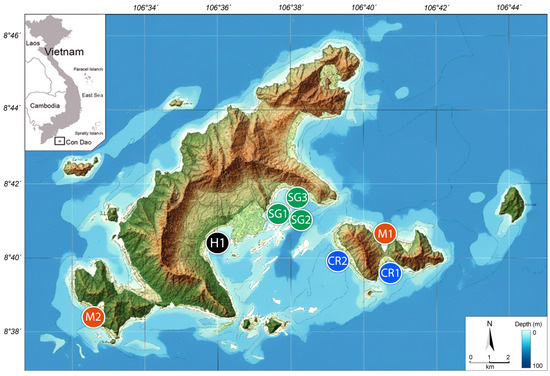
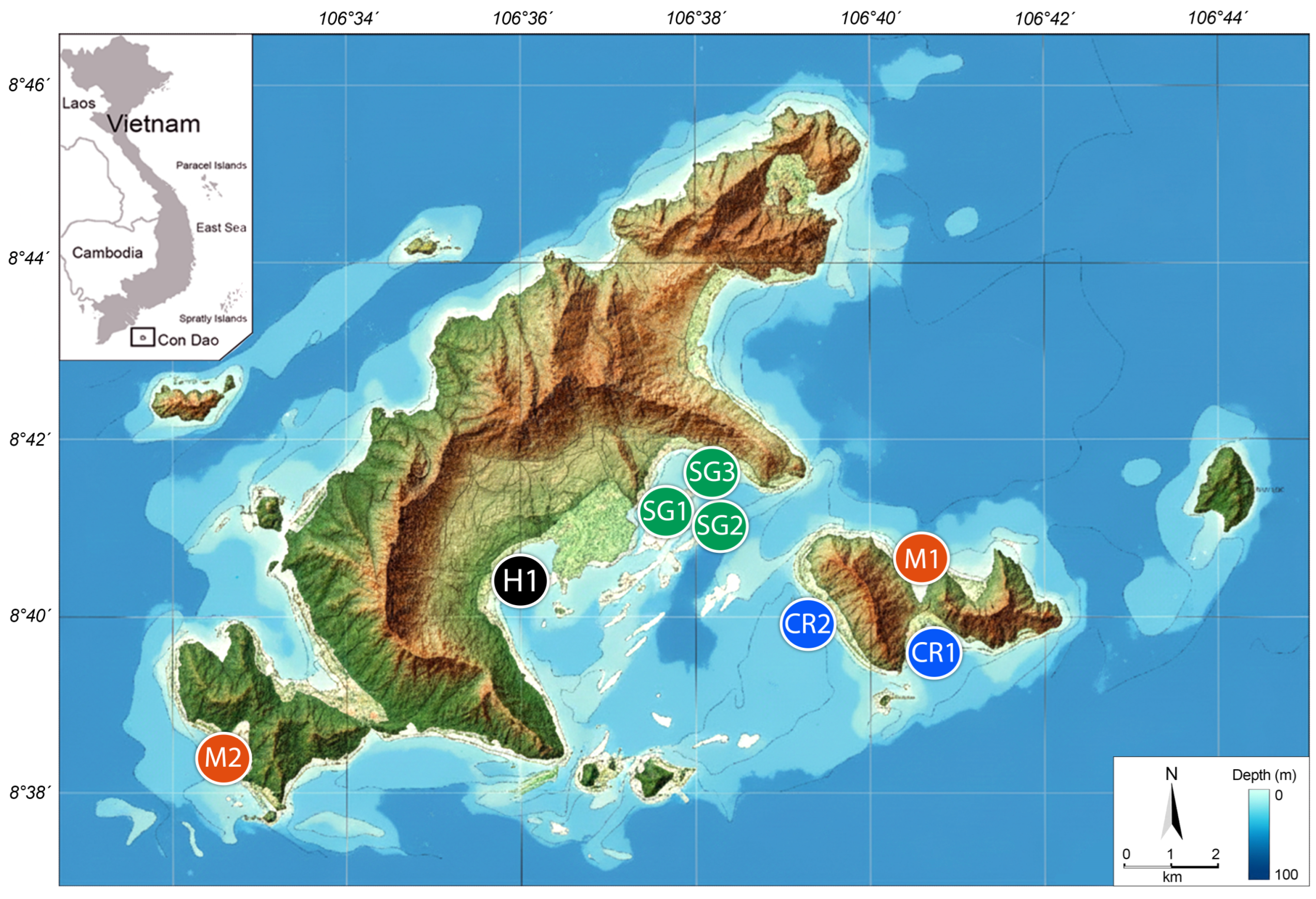
Sampling was conducted in Con Son Bay, CDA, Vietnam, across three major coastal habitat types and one habitat impacted by human activities. Eight sampling sites were selected, including three seagrass beds (SG1: 8°41′22.11″ N, 106°37′48.31″ E; SG2: 8°41′34.64″ N, 106°38′27.47″ E; SG3: 8°41′44.33″ N, 106°38′32.89″ E), two coral reef sites (CR1: 8°39′58.3″ N, 106°40′57.6″ E; CR2: 8°40′09.2″ N, 106°39′51.0″ E), two mangrove sites (M1: 8°40′12.0″ N, 106°40′53.2″ E; M2: 8°38′49.3″ N, 106°33′13.2″ E) and one harbour site (H1: 8°40′38.8″ N, 106°36′26.5″ E). These sites were chosen to represent the main coastal habitats occurring within the Con Dao Marine Protected Area (Figure 1). The sampling was carried out on 14–15 November 2017. At each site, two replicates of water samples were collected, resulting in a total of 16 samples.
Figure 1.
Locations of the eight eDNA-sampling sites among various habitats in the Con Dao Archipelago: seagrass bed (SG1, SG2, SG3: green points), coral reef (CR1, CR2: blue points), mangrove (M1, M2: red points) and harbour (H1: black point).
2.2. Water Collection and Filtration
Water samples were collected and filtered in situ using Sterivex™ filter (Merck KgaA, Darmstadt, Germany) units (0.22 μm pore size) connected to a Vampire sampler pump (BurkleTM, Bad Bellingen, Germany). At each sampling site, a standardized five-step decontamination and sampling protocol was applied:
- The pump and tubing were decontaminated with diluted bleach for 20 s and rinsed with ambient seawater for 30 s.
- The sampling bucket was similarly decontaminated with diluted bleach for 20 s and rinsed thoroughly with ambient seawater.
- Environmental water was collected at approximately 2 m depth and poured into the sampling bucket. Approximately 5 L of water was filtered per sample. Depending on water turbidity, two to five Sterivex filters were required to process each sample.
- After filtration, residual water was removed by pumping air through the Sterivex filters.
- Each filter was filled with RNAlater® (QIAGEN, Hilden, Germany), sealed with sterile caps, labelled, and stored −20 °C until analysis.
2.3. DNA Extraction, Amplification and Sequencing
The DNA experiments were conducted in Masaki Miya’s laboratory. Environmental DNA was extracted from the filter cartridges utilizing a DNeasy Blood and Tissue kit (Qiagen, Hilden, Germany) following the methods established and visualized by Miya et al. [35] with minor modifications. Following centrifugation, the collection tube was discarded, and an aspirator (QIAvac 24 Plus, Qiagen, Hilden, Germany) was employed to eliminate the residual liquid from the cartridge. The filter cartridge underwent lysis facilitated by proteinase K. Before the lysis, PBS (220 μL), proteinase K (20 μL), and buffer AL (200 μL) were mixed and gently pipetted the mixed solution into the cartridge from an inlet port of the filter cartridge. The DNA extract (ca. 900 μL) was collected using the DNeasy Blood and Tissue kit with a final elution volume of 200 μL. DNA extraction was completed in one round. One more premix for the extraction blank (EB) was used to monitor contamination. All DNA extracts were frozen at −20 °C until library preparation. Extracted DNA was further purified using the PowerClean Pro DNA Clean-Up Kit (MO BIO Laboratories, Carlsbad, CA, USA; currently QIAGEN, Hilden, Germany) to remove PCR inhibitors. DNA extracts were pooled when required.
For each sample, purified DNA was amplified in 12 replicate PCR reactions targeting a hypervariable region of the mitochondrial 12S rRNA gene using the MiFish primers, which are specific to fishes [28]. Each PCR run included both negative controls and a positive control consisting of a mock community of known composition. PCR products were purified, verified by gel electrophoresis, and quantified using a Qubit™ High Sensitivity DNA kit (Thermo Fisher Scientific, Waltham, MA, USA) following the manufacturer’s instructions. Indexed PCR products were sequenced across Illumina MiSeq platforms using a MiSeq V2 kit (Illumina, Inc., San Diego, CA, USA) at 12 pM with a 10% PhiX spike-in.
2.4. Bioinformatics and Taxonomic Assignment
Raw sequence data were processed using a customized in-house bioinformatics pipeline including quality filtering, operational taxonomic unit (OTU) clustering, and taxonomic assignment. eDNA metabarcoding was performed using the MiFish assay [28]. Taxonomic assignments for each OTU were determined based on a consensus of three approaches:
(i) Sequence similarity searches against a curated CDA fish reference database [12,25,26,27];
(ii) Sequence similarity searches against the NCBI nucleotide (nt) database (GenBank); and
(iii) PROTAX, a probabilistic taxonomic assignment method providing classifications at species, genus, family, and order levels [36].
Species- and genus-level assignments were automatically accepted when supported by unambiguous reference matches at ≥98.5% and ≥95% sequence similarity, respectively. When equally good matches to multiple species were obtained, Global Biodiversity Information Facility (GBIF) occurrence records were consulted to identify taxa most likely to occur in the Indo-Pacific region, allowing several ambiguous OTUs to be resolved to species level.
OTU tables were filtered to remove low-abundance detections (<0.02% of reads or <10 reads per sample, whichever threshold was higher). Common contaminant sequences, including human DNA and DNA from domestic animals or known feed fishes, were removed. OTUs that could not be confidently assigned to the species level were retained at the genus, family, or order level.
2.5. Data Analysis
All statistical analyses used R version 4.4.3 [37]. The data analyses were carried out using a table compiling the number of reads for all the taxa observed at the eight sampling sites. Sampling adequacy was evaluated using an accumulation curve, constructed by plotting the number of new taxa observed against the number of sampled sites. For each taxon, the number of reads was calculated globally and for each of the four habitats as a proxy of their abundance. The alpha diversity indices (richness, Shannon diversity and Pielou evenness) were computed for each of the four habitats using the “vegan” R package. A Venn diagram was constructed to present the number of taxa shared by the four habitats using the VennDiagram R package v. 1.8.2 [38]. A correspondence analysis (CA) was performed on the contingency table of read counts per site and taxon using the dudi.coa function from the ade4 package v. 1.7-24 [39]). The sites and the taxa were subsequently subjected to hierarchical clustering based on Euclidean distance computed from their coordinates along the first two CA axes, applying the complete linkage aggregation method via the hclust function from the stats package v. 4.6.0 [37].
3. Results
3.1. Overall eDNA Fish Diversity
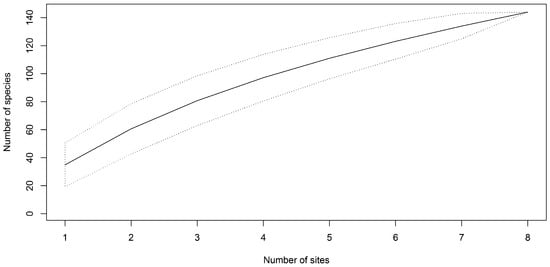
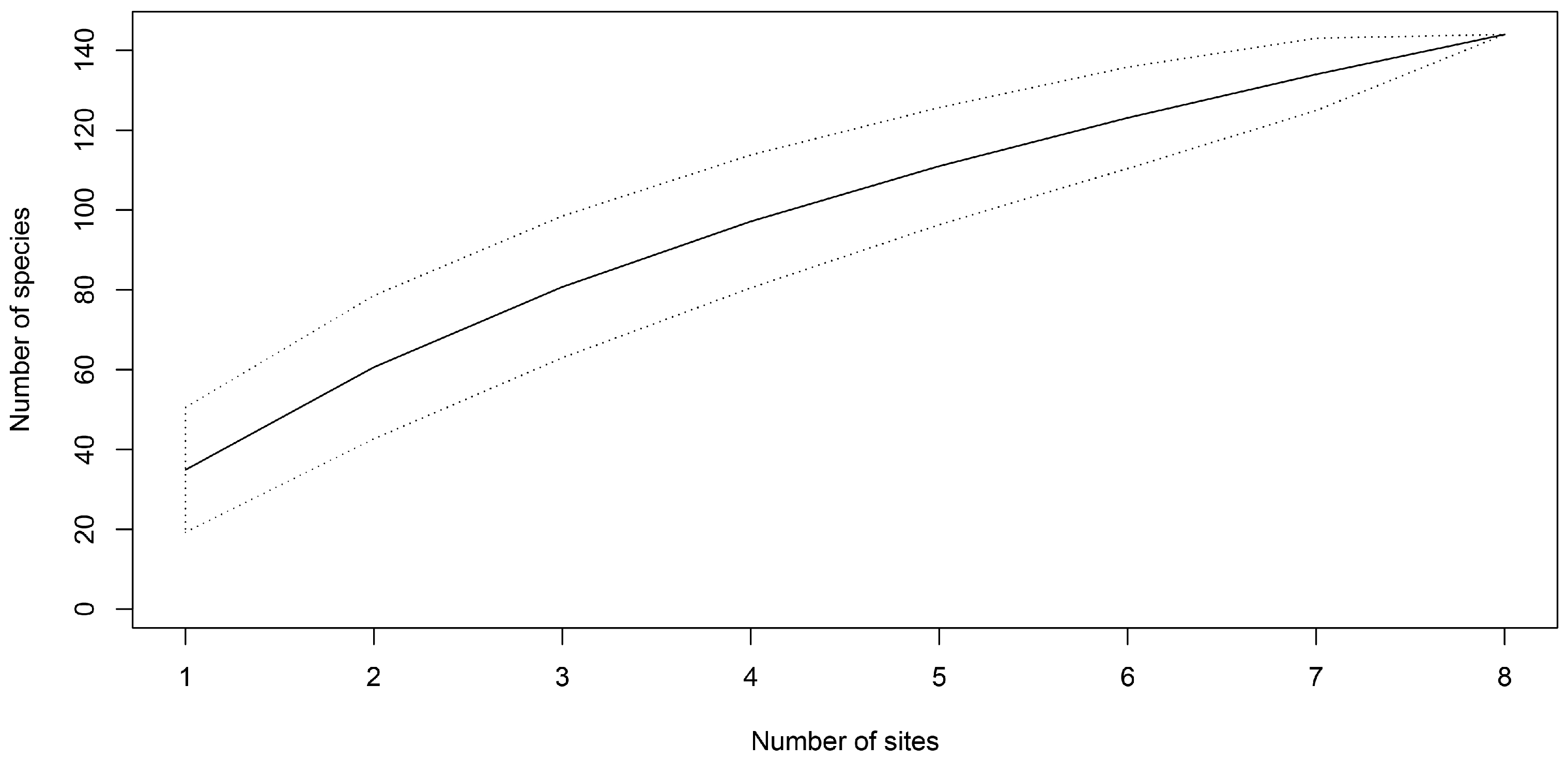
Following rigorous filtering and quality control, a total of 458,879 reads were obtained for the 12S rRNA gene. Of these, 435,854 reads (95%) successfully matched with archived reference sequences based on a species-level similarity threshold of ≥98.5%. Environmental DNA metabarcoding revealed a total of 282 operational taxonomic units (OTUs) across the eight sampling sites in Con Son Bay, corresponding to 246 taxa confidently identified at ≥98.5% sequence similarity and 36 taxa with lower confidence (<98.5%) (Table S1). After consolidation of replicate detections and ambiguous matches, the dataset comprised 144 distinct fish taxa used for downstream community analyses. The global species accumulation curve did not reach an asymptote (Figure 2), indicating that the sampling effort (n = 8) captured only a part of the local fish diversity.
Figure 2.
Species accumulation curve based (±SD, dotted lines) on all environmental DNA sampling sites in the Con Dao Archipelago.
3.2. Taxonomic Composition and Dominant Species
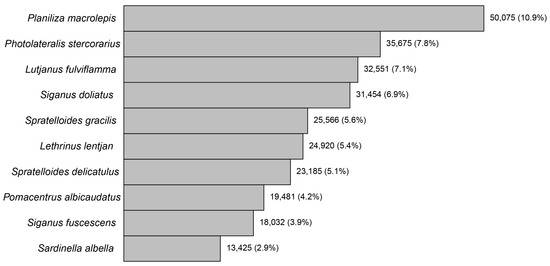
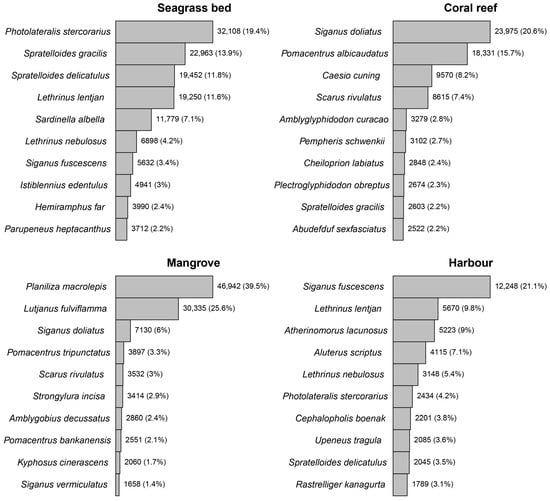
The ten most abundant species accounted for a substantial proportion (59.8%) of total reads, the most abundant being the largescale mullet Planiliza macrolepis (10.9%), the oblong slipmouth Photolateralis stercorarius (7.8%) and the dory snapper Lutjanus fulviflamma (7.1%) (Figure 3). Patterns of relative abundance varied among habitats (Figure 4). Seagrass habitats were dominated by small pelagic and benthopelagic taxa, e.g., the oblong slipmouth Photolateralis stercorarius (19.4%), the round herrings Spratelloides spp. (25.7%) and the pink ear emperor Lethrinus cf. lentjan (11.6%), whereas coral reefs exhibited a more even distribution among reef-associated species, e.g., the barred rabbitfish Siganus doliatus (20.6%), the whitefin damsel Pomacentrus albicaudatus (15.7%), the redbelly yellowtail fusilier Caesio cuning (8.2%) and the rivulated parrotfish Scarus rivulatus (7.4%). Mangrove habitats were characterized by a smaller set of dominant taxa, e.g., the largescale mullet Planiliza macrolepis (39.5%), the dory snapper Lutjanus fulviflamma (25.6%) and the barred rabbitfish Siganus doliatus (6%), while the harbour station displayed a mixture of taxa associated with both natural and anthropogenically influenced habitats, the most abundant being the mottled spinefoot Siganus fuscescens (21.1%).
Figure 3.
Taxa with the highest relative abundance of DNA reads in the Con Dao Archipelago: overall abundance in number of reads for the main species, and percentage of the total number of reads within the whole sample.
Figure 4.
Frequently detected taxa in each of the four habitats of the Con Dao Archipelago: abundance in number of reads and percentage of the number of reads for the main species.
3.3. Diversity Indices
Species richness ranged from 25 species in one of the coral reef sites to 50 species in the harbour site and varied markedly among habitats. Richness in the two coral reef sites was very heterogeneous (35 ± 14.14), while mangrove and seagrass habitats showed comparatively smaller, but stable richness, 32 ± 0.00 and 32 ± 2.65, respectively (Table 1). The Shannon diversity index was the highest in the harbour (H′ = 3.04) and the lowest in mangrove sites (H′ = 1.85 ± 0.03), which also exhibited the lowest evenness (Pielou’s J′ = 0.535 ± 0.007). Seagrass and coral reef sites displayed intermediate Shannon diversity, H’ = 2.43 ± 0.39 and 2.67 ± 0.06, respectively, and relatively high Pielou’s evenness indices, J’ = 0.70 ± 0.11 and 0.77 ± 0.10, respectively.
Table 1.
The abundance (number of reads), richness (number of taxa), Shannon diversity index, and Pielou’s evenness index for the eight sites sampled in the Con Dao Archipelago.
3.4. Shared and Exclusive Species Among Habitats
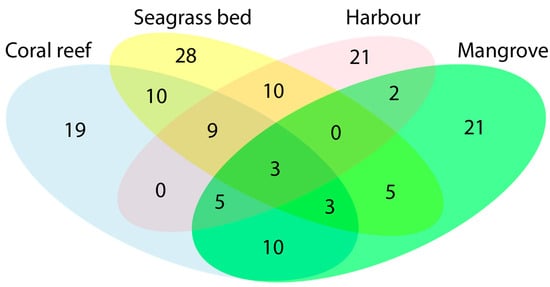
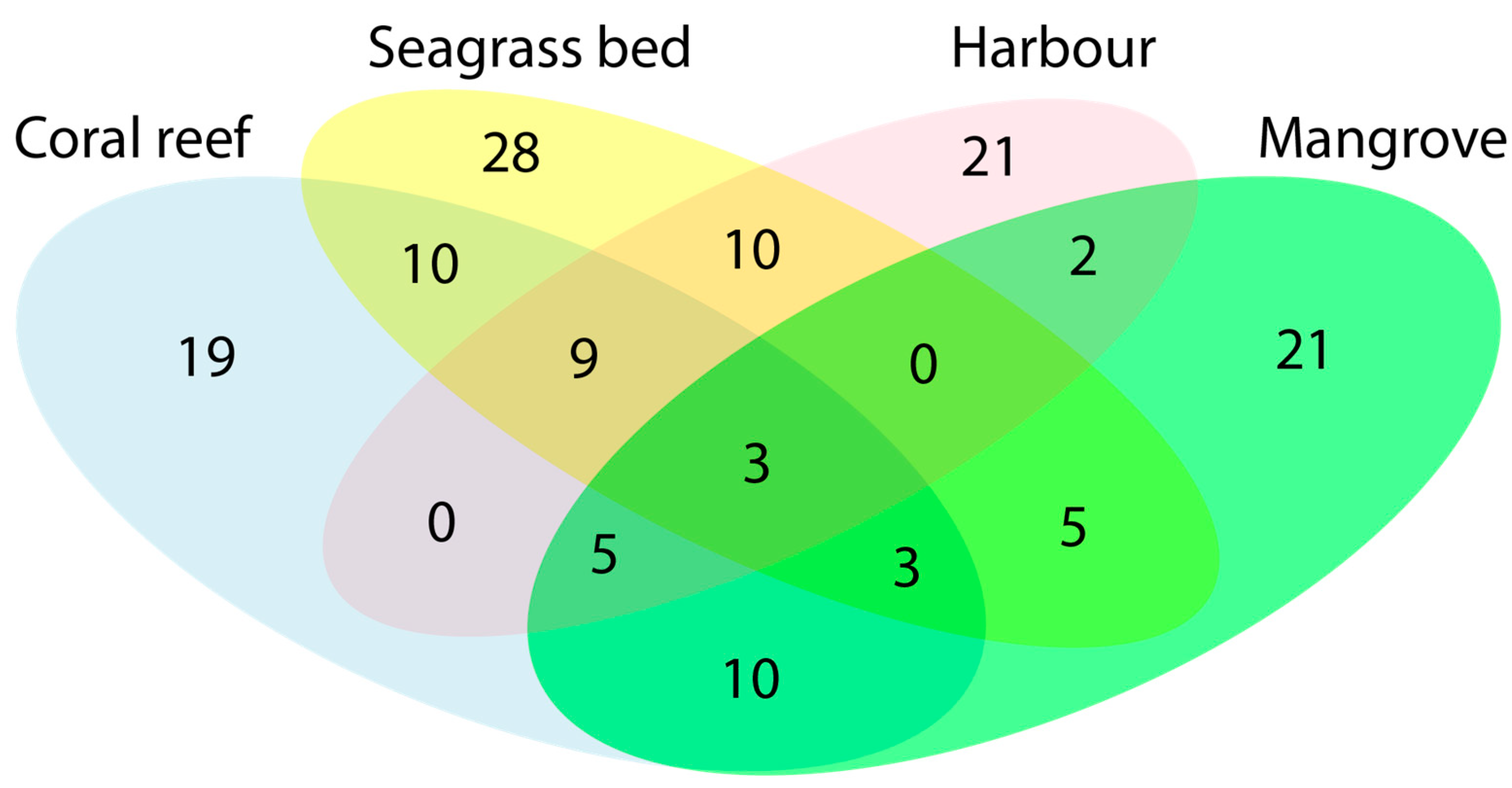
Venn diagram analysis revealed limited overlap in species composition among habitats (Figure 5). Only three species were detected across the four habitats: colourful dottybacks Labracinus sp., blue-barred parrotfish Scarus ghobban, and delicate round herring Spratelloides delicatulus. Most habitats were characterized by a high proportion of unique taxa. For example, among the 59 species detected in coral reef habitats, 19 species (approximately 33%) were exclusive to this habitat. Similarly, between 33% and 50% of the species detected in other habitats were habitat-specific, indicating strong habitat specialization and limited species overlap.
Figure 5.
Venn diagram with the numbers of common fish species within and between the four sampled habitats.
3.5. Multivariate Analyses of Fish Assemblages
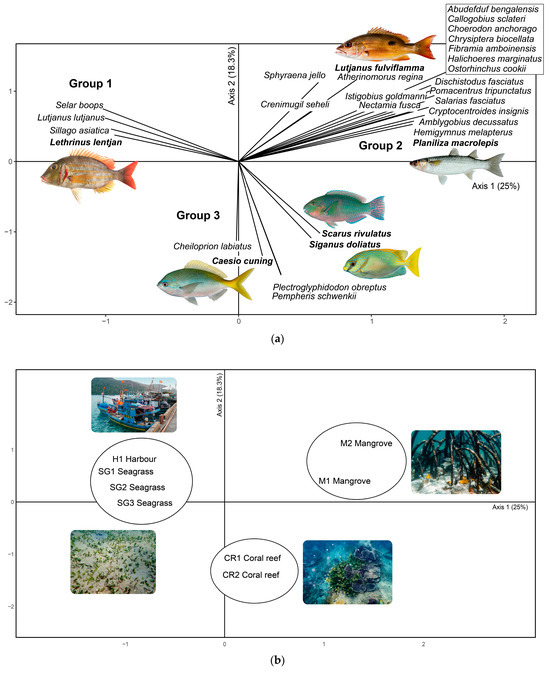
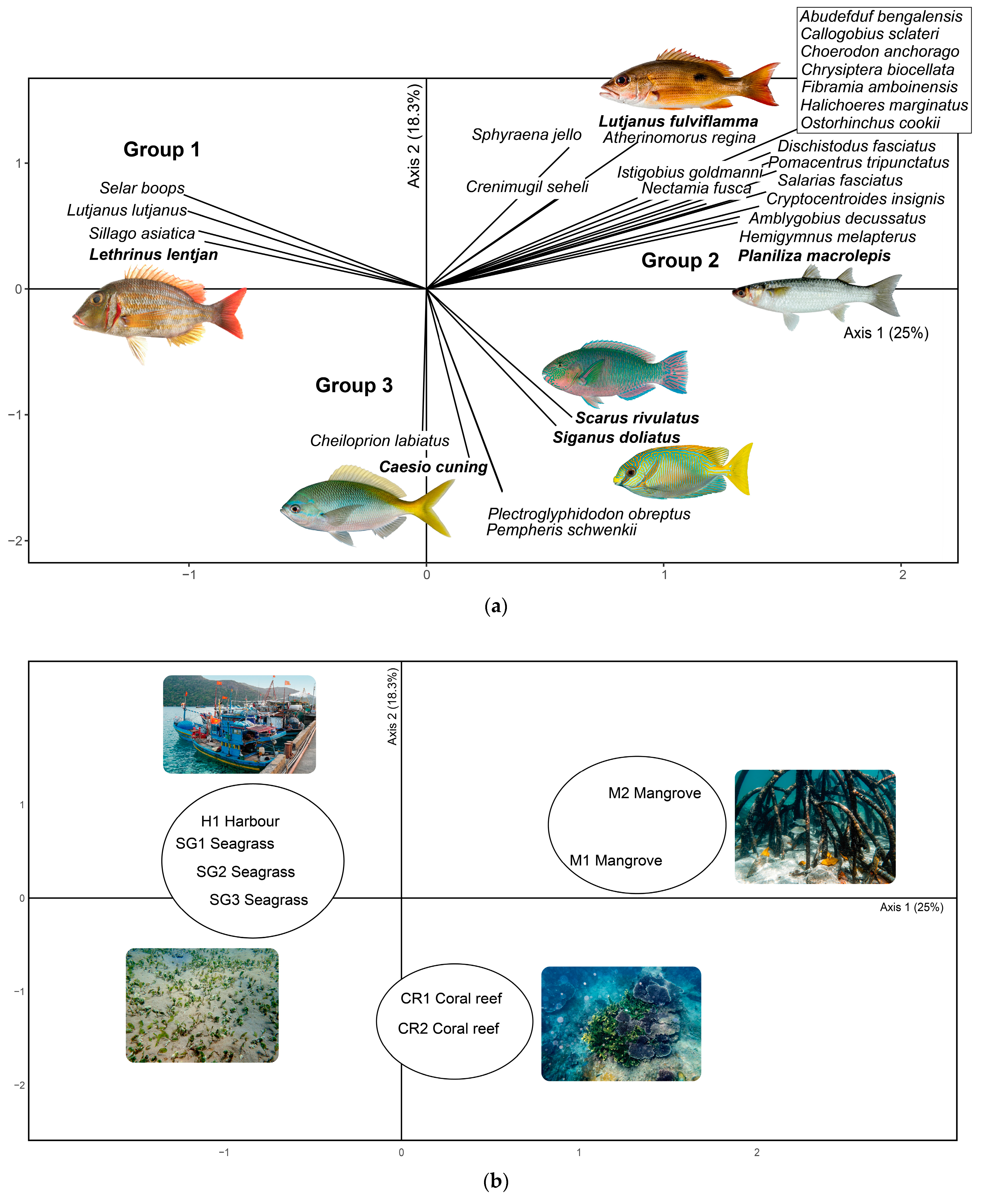
Correspondence analysis (CA) of the site × taxon matrix (144 taxa across eight sites) revealed pronounced differentiation of fish assemblages among habitats (Figure 6). The first two axes, representing 25% and 18.3% of the total information, respectively, clearly separated coral reef, mangrove, and seagrass assemblages. Harbour samples were positioned closer to seagrass sites, indicating greater similarity of species composition between these two habitats. Spatial distance between sites did not explain community similarity. Notably, the two mangrove sites (despite being the most geographically distant) exhibited highly similar fish assemblages, whereas geographically closer sites belonging to different habitats (coral reefs and seagrass beds) were more dissimilar. Clustering of taxa based on their coordinates along the first two CA axes identified three major species groups: Group 1, associated primarily with seagrass beds and the harbour; Group 2, characteristic of mangrove habitats; and Group 3, strongly associated with coral reefs. Although these groups were indicative of habitat affinity, taxa belonging to each group were occasionally detected in other habitats (e.g., the three common species, dottybacks Labracinus sp., blue-barred parrotfish Scarus ghobban, and delicate round herring Spratelloides delicatulus), reflecting ecological connectivity and species mobility. This classification confirms strong habitat-driven structuring of fish communities and reinforces the ecological relevance of the detected assemblages.
Figure 6.
Correspondence Analysis (CA) of the site-taxa table of the number of reads: (a) Projection of the species with combined relative contributions above 0.5 on the first two axes of the CA. These two axes represented 25% and 18.3% of the total variance, respectively. Fish illustrations correspond to species with names in bold, which are those ranked among the 10 most abundant per habitat based on copy number records (see Figure 4); (b) Projection on the same axes of the eight sites, grouped following the three clusters resulting from their Hierarchical Clustering: Group 1 = Seagrass bed + Harbour; Group 2 = Mangrove; Group 3 = Coral reef. These groups are reported on A to highlight corresponding species.
4. Discussion
4.1. Challenges and Limitations of Fish Species Identification Using eDNA Metabarcoding
Environmental DNA metabarcoding is now widely recognized as a powerful, non-invasive tool for assessing marine fish diversity, particularly in species-rich tropical systems where traditional sampling is limited [28,40]. Nevertheless, as with other DNA-based approaches, species identification using eDNA remains constrained by several well-known methodological limitations [41,42]. A key limitation concerns the completeness and accuracy of reference databases [43]. Although the MiFish 12S marker provides robust taxonomic resolution for most teleosts [28,44,45], reliable species-level assignment depends upon the availability of reference sequences for local taxa [46]. In this study, however, 85% of OTUs were assigned to species level (>98.5%), which is relatively high compared to other marine eDNA surveys, particularly in tropical regions [30,34]. The remaining 15% likely reflects incomplete reference coverage rather than methodological failure, consistent with previous studies in Vietnam and the Indo-Pacific region [18,19,26].
A second limitation relates to insufficient genetic divergence among closely related or recently diverged species. Species complexes have been documented in several diverse reef fish families, including Pomacentridae, Siganidae, Mullidae, Apogonidae, and Gobiidae [47,48,49], and short eDNA metabarcoding fragments may, in some cases, lack sufficient resolution to discriminate such taxa. Marker-level comparisons show that discriminatory power varies across primer sets and families: for instance, BIN (Barcode Index Number) discrimination errors were detected in 14 to 19 out of 48 families, depending on the metabarcode considered, with primer set Teleo1 performing least consistently and MiFish and Ac12S showing the lowest error rates [50]. Similarly, interspecific divergence values for some eDNA markers fall below those recovered by COI-based BINs for certain taxonomic groups, indicating that species boundaries established with COI may not always be recoverable with shorter metabarcoding fragments [45]. More generally, no single metabarcode is universally optimal, and marker choice critically influences taxonomic resolution. Finally, eDNA datasets may include low levels of artefacts due to contamination, tag jumping, or PCR errors [42,51,52]. These issues were minimized here through conservative filtering, although such approaches may exclude identification of rare taxa. Overall, these limitations are inherent to current eDNA workflows but do not undermine the robustness of community-level patterns when interpreted cautiously.
4.2. Fish Diversity in the Con Dao Archipelago: New Insights from eDNA
Despite these limitations and a relatively limited sampling effort, the present eDNA survey substantially expands current knowledge of fish diversity in the Con Dao Marine Protected Area. A total of 144 species were detected from only eight sites and four habitat types, with 16 samples. Comparison with previous inventories reveals a striking complementarity among methods. Traditional surveys [12] reported 273 species, while light-trap sampling [26] recovered 163 taxa with 120 identified at species/genus level (Table S1). However, only 13 species were shared among all three approaches, demonstrating remarkably limited overlap of results among methods. The number of species detected so far with the three approaches is 436 (Table S1).
More than half of the eDNA dataset (77 species) consisted of taxa exclusively detected by this method. Furthermore, eDNA recovered 45 families, exceeding both traditional surveys (38 families) and light-trap sampling (33 families), with 11 families uniquely detected by eDNA and absent from all previous inventories (Table S1). This substantial increase in taxonomic breadth highlights the ability of eDNA to detect phylogenetically diverse lineages that may be underrepresented in gear-dependent surveys, including cryptobenthic, nocturnal, pelagic transient, or behaviourally elusive species that are rarely captured in nets or attracted to light traps. The extremely low overlap among the three approaches suggests that existing checklists remain far from exhaustive. Given the high habitat heterogeneity of Con Dao and its biogeographic proximity to the highly diverse Coral Triangle, the detection of 77 previously unrecorded species through a spatially limited eDNA survey strongly suggests that fish diversity in the archipelago has been substantially underestimated.
Despite these strengths, the diversity revealed by eDNA in the present study should be interpreted with caution in light of the limited sampling design. In contrast to previous surveys conducted over extended periods and across multiple sampling events [12,26], the eDNA dataset was obtained during a single sampling campaign with only a few replicates per site (eight sites in total). Such a design does not capture the temporal variability of fish assemblages, particularly in tropical coastal systems where species composition can fluctuate substantially over short time scales due to tidal cycles, diel movements, spawning events, and seasonal recruitment pulses. Consequently, while eDNA proved highly effective in detecting a broad spectrum of taxa, the total diversity reported here is likely still an underestimate of the true fish diversity present in the Con Dao Archipelago. Some rare, low-abundance, or transient species may have been missed due to stochasticity in eDNA distribution and detection, especially given the limited number of replicates. In this context, the comparison with previous inventories based on repeated sampling efforts further highlights that differences in sampling intensity and temporal coverage, in addition to methodological biases, contribute to discrepancies among species lists. Future studies integrating increased replication, seasonal sampling, and multi-year monitoring would therefore be essential to fully resolve fish diversity patterns and improve the robustness of eDNA-based biodiversity assessments in this region.
4.3. Habitat Structuring of Fish Assemblages
Multivariate analyses consistently demonstrated that fish communities differed more among habitats than among geographically close sites (Figure 1 and Figure 6), with coral reefs, mangroves, seagrass beds, and the harbour hosting distinct assemblages. Only three species were shared across all habitats (colourful dottybacks Labracinus sp., blue-barred parrotfish Scarus ghobban, delicate round herring Spratelloides delicatulus). The low number of common species between habitats is consistent with the strong habitat partitioning detected in our analyses, and the three ubiquitous species likely achieve their broad occurrence through fundamentally different ecological strategies. The blue-barred parrotfish, Scarus ghobban, is a well-documented mobile link species that undergoes ontogenetic habitat shifts, with juveniles occupying seagrass beds and adults migrating to coral reefs [53]. This species also exhibits marked dietary flexibility, shifting from micro-invertivory on small crustaceans during early post-settlement to herbivory on algae and epiphytes as individuals grow [54], enabling it to exploit trophic resources across structurally distinct habitats. The delicate round herring, Spratelloides delicatulus, a small pelagic planktivore, forms schools in nearshore waters above various benthic habitats throughout its life cycle, including seagrass beds, coral reefs, and harbour areas [25,55]. Its ubiquity likely reflects a decoupling from benthic habitat structure: as a water-column species, its distribution is driven more by planktonic food availability and hydrographic conditions than by substrate type. Finally, the colourful dottyback, Labracinus sp. (Pseudochromidae), is a small cryptic predator typically associated with crevices and cavities [56]. Its presence across all habitats may be explained by a dependence on three-dimensional microhabitat structure (holes, overhangs, interstices) rather than on any particular macro-habitat type, a requirement that can be met by coral frameworks, mangrove root systems, artificial harbour structures, and seagrass-associated rubble alike. Together, these three species illustrate that habitat generalism in tropical reef-associated fishes can arise from connectivity mediated by ontogenetic habitat specialization, a pelagic lifestyle decoupled from benthic substrates, or microhabitat-driven rather than macro-habitat-driven distributions. These patterns are consistent with the broader finding that habitat niche breadth is a key predictor of species persistence across heterogeneous and disturbed seascapes [57].
Such habitat-driven partitioning is consistent with ecological theory predicting that environmental filtering and structural complexity shape coastal fish assemblages [5,58]. Tropical coastal mosaics typically function as interconnected but ecologically differentiated habitat networks, in which each habitat contributes unique components to regional (gamma) diversity. The high beta diversity observed in CDA therefore reflects habitat specialization and spatial turnover rather than simple sampling artefacts.
Mangrove habitats supported taxonomically distinct assemblages despite being underrepresented in existing MPA zoning in CDA and in biodiversity monitoring programmes. Across the Indo-Pacific region, mangroves are known to host fish communities distinct from adjacent reefs and seagrass beds, and often are dominated by juveniles and estuarine-associated taxa [59,60]. In some regions, they contribute disproportionately to reef fish biomass and recruitment, functioning as critical nurseries that export recruits to adjacent reefs [59]. The detection of numerous mangrove-associated taxa in the present study reinforces the ecological importance of these habitats within the Con Dao seascape.
Seagrass beds exhibited high species richness and shared multiple taxa with the harbour, suggesting ecological connectivity and potential nursery functions. Seagrass habitats are widely recognized as key nursery grounds for reef and coastal fishes, offering shelter and abundant food resources that enhance juvenile survival [8,9]. Their connectivity with coral reefs through ontogenetic habitat shifts has been demonstrated in multiple tropical systems [5,58]. The partial overlap between seagrass and harbour assemblages detected here suggests that anthropogenically modified habitats may partially replicate the ecological functions of adjacent natural environments, possibly through the provision of hard substrates, shelter, and proximity to seagrass-derived food sources, rather than simply hosting a depauperate subset of coastal taxa. The high diversity in the harbour site can probably be related to the presence of different food sources, more than in habitats further from the nearby city.
Coral reefs, as expected, harboured assemblages dominated by reef-associated fish families, yet the limited overlap with mangrove and seagrass communities underscores the ecological complementarity among habitats. This pattern mirrors findings from Coral Triangle systems, where habitat heterogeneity is a primary driver of fish diversity and endemism [61,62].
Taken together, these habitat-level patterns reveal an apparent paradox that warrants explicit consideration: the strong inter-habitat differentiation detected in our multivariate analyses coexists with well-documented ontogenetic connectivity linking mangroves, seagrass beds, and coral reefs in tropical coastal systems. This is not, however, a contradiction. eDNA sampling captures a temporal snapshot of DNA presence at each site rather than the cumulative trajectory of individual movements. Juveniles resident in mangroves or seagrass beds and adults established on coral reefs contribute environmental DNA to their respective habitats at the time of sampling, such that ontogenetic migrants appear as habitat-specific at each life stage rather than as habitat generalists. The strong beta diversity observed across Con Dao habitats is therefore consistent with a system in which functional connectivity operates at the individual level across ontogeny, while fish community composition remains ecologically structured at the habitat level. eDNA metabarcoding is well-suited to reveal this duality through its spatially resolved snapshot of community composition, but cannot track individual movements or assign detections to specific life stages. Confirming the inferred connectivity pathways would require complementary approaches, such as otolith microchemistry or mark-recapture studies.
4.4. Complementarity Between eDNA and Light-Trap-Based Surveys in the CDA
Comparison of fish diversity identified using light trap (LT) sampling [26] and eDNA metabarcoding (present study) in the same area revealed a very limited overlap between the two approaches (Table S1). Only 30 species were shared between the two datasets. This low overlap is particularly striking given that the total number of species detected by each method was similar, with 120 species identified using LT and 144 species detected using eDNA. Despite comparable species richness, the taxonomic breadth differed substantially between the two approaches. Notably, a higher number of families was recovered by eDNA compared to LT sampling. Several families detected by eDNA were entirely absent from the LT species checklist. This discrepancy likely reflects methodological selectivity, as numerous fish species are known not to be attracted to light or to actively avoid illuminated microhabitats. This pattern has been previously documented for families such as Mugilidae, which were detected exclusively by eDNA. In addition, the absence of Carangidae in the LT dataset suggests that species of this family may avoid light-based sampling devices. Overall, the finding emphasizes the greater capacity of eDNA metabarcoding to access a broader spectrum of fish diversity compared to LT sampling under the sampling design applied in this study. The comparison highlights fundamental differences in the ecological components of fish assemblages captured by each method. The low proportion of shared species suggests that the two methods capture partially overlapping biological signals. Although this result clearly demonstrates that eDNA detects a broader taxonomic breadth under the sampling design used here, it does not imply that LT sampling lacks ecological value. Instead, the low overlap between the two approaches highlights their strong complementarity. eDNA metabarcoding captures DNA traces released into the environment by organisms regardless of behaviour, life stage, or activity period [32,63]. It allows rapid and standardized biodiversity assessments across large spatial scales and heterogeneous environments [40,64]. The higher number of families detected by eDNA further supports its ability to provide a more taxonomically comprehensive snapshot of fish communities. This pattern mirrors the results of previous comparative studies showing that eDNA consistently recovers broader taxonomic diversity than gear-dependent approaches, especially in structurally complex tropical ecosystems [40,65].
Differences in spatial coverage likely amplified the contrast between methods. LT sampling in Pham et al. [26] could not be deployed in mangrove habitat due to tidal constraints, whereas eDNA sampling integrated signals across multiple habitats, including mangroves, which are known to harbour distinct fish assemblages [59,60]. In addition, LT surveys target a specific life-stage window (mostly larvae and juveniles), while eDNA integrates signals from multiple life stages; this difference alone can reduce overlap even when both methods are accurate. Excluding mangrove-associated diversity and limiting temporal coverage inevitably constrained the diversity captured by LT surveys.
Despite its broad taxonomic coverage, eDNA metabarcoding also failed to detect several families recorded by light-trap sampling, including Bregmacerotidae, Clupeidae, Chirocentridae, Gobiesocidae, Plesiopidae, Synodontidae, and Trichiuridae. These differences are likely attributable to the limited sampling effort of the present eDNA survey, which relied on only 16 samples collected during a single sampling event. In contrast, LT surveys integrate temporal variability and are particularly effective at capturing episodic larval abundance peaks [25,26,27]. Previous studies have shown that eDNA detection probability increases significantly with replication, sampling across various times and depths, especially for rare or transient taxa [66,67,68].
4.5. Implications for Biodiversity Assessment and MPA Management
The strong habitat specificity observed in fish assemblages suggests that protecting only selected reefs or seagrass patches, as is currently the case in the CDA, can be insufficient to conserve the full spectrum of coastal fish diversity. Mangroves, seagrass beds, transitional habitats, and even modified environments such as harbours appear to contribute distinct components to overall biodiversity and should be considered in MPA zoning and monitoring strategies. However, this conclusion should be interpreted with caution, as the present eDNA dataset is based on limited spatial replication and a single temporal snapshot, which may influence estimates of habitat specificity and community differentiation. The detection of 11 families absent from all previous inventories reinforces the conclusion that current biodiversity baselines are incomplete and likely underestimate the conservation value of non-reef habitats.
The Con Dao MPA was originally designed with a strong focus on charismatic megafauna such as dugongs and sea turtles, and monitoring efforts have historically concentrated on some patches at coral reefs and seagrass beds. Our results demonstrate, however, that non-reef habitats, particularly mangroves, contribute unique and non-redundant components to overall fish biodiversity. Although this result only reflects the situation at a specific point in time based on a single temporal sampling, excluding these habitats from biodiversity assessments would lead to systematic underestimation of regional diversity and potentially misinformed conservation prioritization.
Beyond inventory improvements, the ability of eDNA to rapidly generate high-resolution biodiversity data makes it a particularly suitable tool for adaptive management, especially in MPAs where logistical constraints limit the feasibility of extensive underwater surveys. While eDNA cannot replace traditional methods (it provides no information on abundance, population structure, or individual condition), its integration with light trapping, visual censuses, and fisheries monitoring offers a powerful framework for long-term biodiversity assessment and early detection of community shifts. Integrating habitat-wide eDNA monitoring into long-term MPA management could provide a more ecosystem-based framework aligned with modern biodiversity conservation principles [4,69].
5. Conclusions
eDNA metabarcoding substantially enhanced our understanding of fish diversity in the Con Dao Archipelago by revealing habitat-specific assemblages and previously undocumented components of coastal fish biodiversity. Although challenges related to reference databases, taxonomic resolution, and species complexes persist, these limitations are shared with other molecular and morphological approaches and do not diminish the demonstrated value of eDNA for broad-scale biodiversity assessment. Several priorities emerge for future work: first, the expansion and curation of regional reference libraries, particularly for speciose and taxonomically challenging families; second, combining eDNA with specimen-based barcoding, light-trap surveys, and traditional ecological monitoring will be essential to bridge the gap between molecular detections and verified species occurrences; finally, repeated eDNA sampling across seasons would clarify whether the habitat-specific patterns observed here are temporally stable or reflect seasonal turnover in assemblage composition. Such integrative approaches are particularly critical in biodiversity hotspots like Con Dao, where effective MPA management depends on a comprehensive understanding of fish diversity across all coastal habitats. The management of the CDA MPA should also be revised, taking into account the protection of more habitats, or, even better, a continuum of habitats, without separation.
Supplementary Materials
The following supporting information can be downloaded at: https://www.mdpi.com/article/10.3390/d18050255/s1, Table S1: Fish species recorded in the Con Dao archipelago by Nguyen & Mai [12], Pham et al. [26] and in the present study.
Author Contributions
Conceptualization, methodology, validation, supervision, J.-D.D. and J.P.; software, M.S.; formal analysis, data curation, M.M., J.-D.D., M.S. and H.M.P.; investigation, J.-D.D., J.P. and H.D.H.; visualization, M.S., J.-D.D. and H.M.P.; writing—original draft preparation, H.M.P.; resources, writing—review and editing, H.M.P., J.P., H.D.H., M.S., M.M. and J.-D.D.; project administration, J.-D.D., J.P. and H.D.H.; funding acquisition, J.-D.D., J.P. and M.M. All authors have read and agreed to the published version of the manuscript.
Funding
This research was funded by the MARBEC IRD unit (Montpellier), the IRD SEDES international joint laboratory, and the laboratory of M. Miya at Chiba University.
Institutional Review Board Statement
Not applicable.
Data Availability Statement
The original contributions presented in this study are included in the article/Supplementary Material. Further inquiries can be directed to the corresponding author.
Acknowledgments
The authors wish to thank Ngan Trong Tran at the Lab of Zoology, University of Science (VNUHCM), for her assistance in field sampling, and the management at the Con Dao National Park, who facilitated this study’s conduct in the marine protected areas.
Conflicts of Interest
The authors declare no conflicts of interest.
Abbreviations
The following abbreviations are used in this manuscript:
| eDNA | Environmental DNA |
| MPA | Marine Protected Area |
| CDA | The Con Dao Archipelago |
| OTU | Operational Taxonomic Unit |
| CA | Correspondence Analysis |
| BIN | Barcode Index Number |
| LT | Light Trap |
References
- Jackson, J.B.C.; Kirby, M.X.; Berger, W.H.; Bjorndal, K.A.; Botsford, L.W.; Bourque, B.J.; Bradbury, R.H.; Cooke, R.; Erlandson, J.; Estes, J.A.; et al. Historical Overfishing and the Recent Collapse of Coastal Ecosystems. Science 2001, 293, 629–637. [Google Scholar] [CrossRef] [Scilit] [PubMed]
- Halpern, B.S.; Frazier, M.; Potapenko, J.; Casey, K.S.; Koenig, K.; Longo, C.; Lowndes, J.S.; Rockwood, R.C.; Selig, E.R.; Selkoe, K.A.; et al. Spatial and Temporal Changes in Cumulative Human Impacts on the World’s Ocean. Nat. Commun. 2015, 6, 7615. [Google Scholar] [CrossRef] [Scilit] [PubMed]
- Lester, S.; Halpern, B.; Grorud-Colvert, K.; Lubchenco, J.; Ruttenberg, B.; Gaines, S.; Airamé, S.; Warner, R. Biological Effects within No-Take Marine Reserves: A Global Synthesis. Mar. Ecol. Prog. Ser. 2009, 384, 33–46. [Google Scholar] [CrossRef] [Scilit]
- Edgar, G.J.; Stuart-Smith, R.D.; Willis, T.J.; Kininmonth, S.; Baker, S.C.; Banks, S.; Barrett, N.S.; Becerro, M.A.; Bernard, A.T.F.; Berkhout, J.; et al. Global Conservation Outcomes Depend on Marine Protected Areas with Five Key Features. Nature 2014, 506, 216–220. [Google Scholar] [CrossRef] [Scilit]
- Olds, A.D.; Connolly, R.M.; Pitt, K.A.; Pittman, S.J.; Maxwell, P.S.; Huijbers, C.M.; Moore, B.R.; Albert, S.; Rissik, D.; Babcock, R.C.; et al. Quantifying the Conservation Value of Seascape Connectivity: A Global Synthesis. Glob. Ecol. Biogeogr. 2016, 25, 3–15. [Google Scholar] [CrossRef] [Scilit]
- Magris, R.A.; Andrello, M.; Pressey, R.L.; Mouillot, D.; Dalongeville, A.; Jacobi, M.N.; Manel, S. Biologically Representative and Well-connected Marine Reserves Enhance Biodiversity Persistence in Conservation Planning. Conserv. Lett. 2018, 11, e12439. [Google Scholar] [CrossRef] [Scilit]
- Beck, M.W.; Heck, K.L.; Able, K.W.; Childers, D.L.; Eggleston, D.B.; Gillanders, B.M.; Halpern, B.; Hays, C.G.; Hoshino, K.; Minello, T.J.; et al. The Identification, Conservation, and Management of Estuarine and Marine Nurseries for Fish and Invertebrates: A Better Understanding of the Habitats That Serve as Nurseries for Marine Species and the Factors That Create Site-Specific Variability in Nursery Quality Will Improve Conservation and Management of These Areas. Bioscience 2001, 51, 633–641. [Google Scholar] [CrossRef] [Scilit]
- Heck Hay, K.; Hays, G.; Orth, R. Critical Evaluation of the Nursery Role Hypothesis for Seagrass Meadows. Mar. Ecol. Prog. Ser. 2003, 253, 123–136. [Google Scholar] [CrossRef] [Scilit]
- Unsworth, R.K.F.; Nordlund, L.M.; Cullen-Unsworth, L.C. Seagrass Meadows Support Global Fisheries Production. Conserv. Lett. 2019, 12, e12566. [Google Scholar] [CrossRef] [Scilit]
- Khuu, D.T.; Jones, P.J.S.; Ekins, P. A Governance Analysis of Con Dao National Park, Vietnam. Mar. Policy 2021, 127, 103986. [Google Scholar] [CrossRef] [Scilit]
- Nguyen, H.P.; Nguyen, V.L. Coral Reef Fishes in the Con Dao Archipelago. Vietnam. J. Biol. 1997, 19, 8–15. [Google Scholar]
- Van Nguyen, L.; Mai, D.X. Reef Fish Fauna in the Coastal Waters of Vietnam. Mar. Biodivers. 2020, 50, 100. [Google Scholar] [CrossRef] [Scilit]
- Nguyen, H.P.; Nguyen, N.T. The Checklist of Marine Fishes in Vietnam; Science and Technics Publishing House: Hanoi, Vietnam, 1994; Volume II. [Google Scholar]
- Nguyen, H.P.; Tran, H.L. The Checklist of Marine Fishes in Vietnam; Science and Technics Publishing House: Hanoi, Vietnam, 1994; Volume I. [Google Scholar]
- Nguyen, H.P.; Le, T.P.; Nguyen, N.T.; Nguyen, P.D.; Do, T.N.N.; Nguyen, V.L. The Checklist of Marine Fishes in Vietnam; Science and Technics Publishing House: Hanoi, Vietnam, 1995; Volume III. [Google Scholar]
- Nguyen, H.P.; Nguyen, N.T.; Nguyen, P.D.; Do, T.N.N. The Checklist of Marine Fishes in Vietnam; Science and Technics Publishing House: Hanoi, Vietnam, 1997; Volume IV. [Google Scholar]
- Nguyen, H.P. The Checklist of Marine Fishes in Vietnam; Agriculture Publishing House: Ho Chi Minh, Vietnam, 1999; Volume V. [Google Scholar]
- Durand, J.-D.; Pham, M.H.; Tran, T.T.V.; Hoang, D.H.; Van Vo, Q. Sorting the Wheat from the Chaff: A Review of BINs Associated with Groupers of Vietnam and the Implications for Species Identification from DNA Barcoding. Mar. Biodivers. 2020, 50, 38. [Google Scholar] [CrossRef] [Scilit]
- Thu, P.T.; Huang, W.-C.; Chou, T.-K.; Van Quan, N.; Van Chien, P.; Li, F.; Shao, K.-T.; Liao, T.-Y. DNA Barcoding of Coastal Ray-Finned Fishes in Vietnam. PLoS ONE 2019, 14, e0222631. [Google Scholar] [CrossRef] [Scilit]
- Ayala, D.; Riemann, L.; Munk, P. Species Composition and Diversity of Fish Larvae in the Subtropical Convergence Zone of the Sargasso Sea from Morphology and DNA Barcoding. Fish. Oceanogr. 2016, 25, 85–104. [Google Scholar] [CrossRef] [Scilit]
- Collet, A.; Durand, J.-D.; Desmarais, E.; Cerqueira, F.; Cantinelli, T.; Valade, P.; Ponton, D. DNA Barcoding Post-Larvae Can Improve the Knowledge about Fish Biodiversity: An Example from La Reunion, SW Indian Ocean. Mitochondrial DNA Part A 2018, 29, 905–918. [Google Scholar] [CrossRef] [Scilit]
- Wibowo, A.; Wahlberg, N.; Vasemägi, A. DNA Barcoding of Fish Larvae Reveals Uncharacterised Biodiversity in Tropical Peat Swamps of New Guinea, Indonesia. Mar. Freshw. Res. 2017, 68, 1079–1087. [Google Scholar] [CrossRef] [Scilit]
- Chu, C.; Loh, K.H.; Ng, C.C.; Ooi, A.L.; Konishi, Y.; Huang, S.P.; Chong, V.C. Using DNA Barcodes to Aid the Identification of Larval Fishes in Tropical Estuarine Waters (Malacca Straits, Malaysia). Zool. Stud. 2019, 58, e30. [Google Scholar] [CrossRef] [Scilit]
- Leis, J.M. Are Larvae of Demersal Fishes Plankton or Nekton? Adv. Mar. Biol. 2006, 51, 57–141. [Google Scholar]
- Pham, M.H.; Durand, J.-D.; Le, M.P.; Vo, B.T.T.; Hoang, D.H.; Panfili, J. Importance of Various Marine Coastal Habitats during the Life Cycle of Spratelloides Delicatulus in Con Dao, the Oldest MPA in Vietnam. Aquat. Conserv. 2020, 30, 1626–1637. [Google Scholar] [CrossRef] [Scilit]
- Pham, M.H.; Hoang, D.H.; Panfili, J.; Ponton, D.; Durand, J.-D. Diversity of Fishes Collected with Light Traps in the Oldest Marine Protected Area in Vietnam Revealed by DNA Barcoding. Mar. Biodivers. 2022, 52, 30. [Google Scholar] [CrossRef] [Scilit]
- Pham, M.H.; Panfili, J.; Simier, M.; Sindou, P.; Hoang, D.H.; Durand, J. Spatial and Temporal Diversity of Fish Captured by Light Traps in Various Habitats in Coastal Waters in the Oldest Marine Protected Area in Vietnam and Its Implications for Conservation. Aquat. Conserv. 2024, 34, e4041. [Google Scholar] [CrossRef] [Scilit]
- Miya, M.; Sato, Y.; Fukunaga, T.; Sado, T.; Poulsen, J.Y.; Sato, K.; Minamoto, T.; Yamamoto, S.; Yamanaka, H.; Araki, H.; et al. MiFish, a Set of Universal PCR Primers for Metabarcoding Environmental DNA from Fishes: Detection of More than 230 Subtropical Marine Species. R. Soc. Open Sci. 2015, 2, 150088. [Google Scholar] [CrossRef] [Scilit] [PubMed]
- Valentini, A.; Taberlet, P.; Miaud, C.; Civade, R.; Herder, J.; Thomsen, P.F.; Bellemain, E.; Besnard, A.; Coissac, E.; Boyer, F.; et al. Next-generation Monitoring of Aquatic Biodiversity Using Environmental DNA Metabarcoding. Mol. Ecol. 2016, 25, 929–942. [Google Scholar] [CrossRef] [Scilit] [PubMed]
- Miya, M.; Gotoh, R.O.; Sado, T. MiFish Metabarcoding: A High-Throughput Approach for Simultaneous Detection of Multiple Fish Species from Environmental DNA and Other Samples. Fish. Sci. 2020, 86, 939–970. [Google Scholar] [CrossRef] [Scilit]
- Miya, M. Environmental DNA Metabarcoding: A Novel Method for Biodiversity Monitoring of Marine Fish Communities. Ann. Rev. Mar. Sci. 2022, 14, 161–185. [Google Scholar] [CrossRef] [Scilit]
- Taberlet, P.; Coissac, E.; Hajibabaei, M.; Rieseberg, L.H. Environmental DNA. Mol. Ecol. 2012, 21, 1789–1793. [Google Scholar] [CrossRef] [Scilit]
- Kelly, R.P.; Shelton, A.O.; Gallego, R. Understanding PCR Processes to Draw Meaningful Conclusions from Environmental DNA Studies. Sci. Rep. 2019, 9, 12133. [Google Scholar] [CrossRef] [Scilit]
- Stat, M.; John, J.; DiBattista, J.D.; Newman, S.J.; Bunce, M.; Harvey, E.S. Combined Use of EDNA Metabarcoding and Video Surveillance for the Assessment of Fish Biodiversity. Conserv. Biol. 2019, 33, 196–205. [Google Scholar] [CrossRef] [Scilit]
- Miya, M.; Minamoto, T.; Yamanaka, H.; Oka, S.; Sato, K.; Yamamoto, S.; Sado, T.; Doi, H. Use of a Filter Cartridge for Filtration of Water Samples and Extraction of Environmental DNA. J. Vis. Exp. 2016, 117, e54741. [Google Scholar] [CrossRef] [Scilit]
- Somervuo, P.; Koskela, S.; Pennanen, J.; Henrik Nilsson, R.; Ovaskainen, O. Unbiased probabilistic taxonomic classification for DNA barcoding. Bioinformatics 2016, 32, 2920–2927. [Google Scholar] [CrossRef] [Scilit] [PubMed]
- R Core Team. R: A Language and Environment for Statistical Computing; R Core Team: Vienna, Austria, 2025. [Google Scholar]
- Chen, H.; Boutros, P.C. VennDiagram: A Package for the Generation of Highly-Customizable Venn and Euler Diagrams in R. BMC Bioinform. 2011, 12, 35. [Google Scholar] [CrossRef] [Scilit] [PubMed]
- Dray, S.; Dufour, A.-B. The ade4 Package: Implementing the Duality Diagram for Ecologists. J. Stat. Softw. 2007, 22, 1–20. [Google Scholar] [CrossRef] [Scilit]
- Stat, M.; Huggett, M.J.; Bernasconi, R.; DiBattista, J.D.; Berry, T.E.; Newman, S.J.; Harvey, E.S.; Bunce, M. Ecosystem Biomonitoring with EDNA: Metabarcoding across the Tree of Life in a Tropical Marine Environment. Sci. Rep. 2017, 7, 12240. [Google Scholar] [CrossRef] [Scilit]
- Barnes, M.A.; Turner, C.R. The Ecology of Environmental DNA and Implications for Conservation Genetics. Conserv. Genet. 2016, 17, 1–17. [Google Scholar] [CrossRef] [Scilit]
- Zinger, L.; Bonin, A.; Alsos, I.G.; Bálint, M.; Bik, H.; Boyer, F.; Chariton, A.A.; Creer, S.; Coissac, E.; Deagle, B.E.; et al. DNA Metabarcoding—Need for Robust Experimental Designs to Draw Sound Ecological Conclusions. Mol. Ecol. 2019, 28, 1857–1862. [Google Scholar] [CrossRef] [Scilit]
- Keck, F.; Couton, M.; Altermatt, F. Navigating the Seven Challenges of Taxonomic Reference Databases in Metabarcoding Analyses. Mol. Ecol. Resour. 2023, 23, 742–755. [Google Scholar] [CrossRef] [Scilit]
- Zhang, S.; Zhao, J.; Yao, M. A Comprehensive and Comparative Evaluation of Primers for Metabarcoding EDNA from Fish. Methods Ecol. Evol. 2020, 11, 1609–1625. [Google Scholar] [CrossRef] [Scilit]
- Ruiz, E.; Lamy, T.; Mouillot, D.; Durand, J. Benchmarking the Taxonomic Resolution of Fish EDNA Metabarcodes Against COI Barcodes. Mol. Ecol. Resour. 2026, 26, e70069. [Google Scholar] [CrossRef] [Scilit]
- Bylemans, J.; Gleeson, D.M.; Hardy, C.M.; Furlan, E. Toward an Ecoregion Scale Evaluation of eDNA Metabarcoding Primers: A Case Study for the Freshwater Fish Biodiversity of the Murray–Darling Basin (Australia). Ecol. Evol. 2018, 8, 8697–8712. [Google Scholar] [CrossRef] [Scilit]
- Borsa, P.; Lemer, S.; Aurelle, D. Patterns of Lineage Diversification in Rabbitfishes. Mol. Phylogenet. Evol. 2007, 44, 427–435. [Google Scholar] [CrossRef] [Scilit]
- Mabuchi, K.; Fraser, T.H.; Song, H.; Azuma, Y.; Nishida, M. Revision of the Systematics of the Cardinalfishes (Percomorpha: Apogonidae) Based on Molecular Analyses and Comparative Reevaluation of Morphological Characters. Zootaxa 2014, 3846, 151–203. [Google Scholar] [CrossRef] [Scilit] [PubMed]
- Sorenson, L.; Allen, G.R.; Erdmann, M.V.; Dai, C.-F.; Liu, S.-Y.V. Pleistocene Diversification of the Pomacentrus Coelestis Species Complex (Pisces: Pomacentridae): Historical Biogeography and Species Boundaries. Mar. Biol. 2014, 161, 2495–2507. [Google Scholar] [CrossRef] [Scilit]
- Volanandiana, J.J.A.; Ponton, D.; Ruiz, E.; Fiadanamiarinjato, A.E.M.; Rieuvilleneuve, F.; Raberinary, D.; Collet, A.; Behivoke, F.; Jaonalison, H.; Ranaivomanana, S.; et al. Building a DNA Reference for Madagascar’s Marine Fishes: Expanding the COI Barcode Library and Establishing the First 12S Dataset for EDNA Monitoring. Diversity 2025, 17, 495. [Google Scholar] [CrossRef] [Scilit]
- Schnell, I.B.; Bohmann, K.; Gilbert, M.T.P. Tag Jumps Illuminated—Reducing Sequence-to-sample Misidentifications in Metabarcoding Studies. Mol. Ecol. Resour. 2015, 15, 1289–1303. [Google Scholar] [CrossRef] [Scilit]
- Alberdi, A.; Aizpurua, O.; Gilbert, M.T.P.; Bohmann, K. Scrutinizing Key Steps for Reliable Metabarcoding of Environmental Samples. Methods Ecol. Evol. 2018, 9, 134–147. [Google Scholar] [CrossRef] [Scilit]
- Eggertsen, L.; Goodell, W.; Cordeiro, C.A.M.M.; Mendes, T.C.; Longo, G.O.; Ferreira, C.E.L.; Berkström, C. Seascape Configuration Leads to Spatially Uneven Delivery of Parrotfish Herbivory across a Western Indian Ocean Seascape. Diversity 2020, 12, 434. [Google Scholar] [CrossRef] [Scilit]
- Bellwood, D.R. Ontogenetic Changes in the Diet of Early Post-settlement Scarus Species (Pisces: Scaridae). J. Fish. Biol. 1988, 33, 213–219. [Google Scholar] [CrossRef] [Scilit]
- Wilson, P.T. Observations of Tuna Bait Species and Their Habitats in the Palau Islands; U.S. Department of Commerce: Washington, DC, USA, 1977.
- Gill, A.C. Revision of the Indo-Pacific Dottyback Fish Subfamily Pseudochrominae (Perciformes: Pseudochromidae). In Smithiana Monograph; South African Institute for Aquatic Biodiversity: Grahamstown, South Africa, 2004; Volume 1, pp. 1–213. [Google Scholar]
- Stuart-Smith, R.D.; Mellin, C.; Bates, A.E.; Edgar, G.J. Habitat Loss and Range Shifts Contribute to Ecological Generalization among Reef Fishes. Nat. Ecol. Evol. 2021, 5, 656–662. [Google Scholar] [CrossRef] [Scilit]
- Nagelkerken, I.; Sheaves, M.; Baker, R.; Connolly, R.M. The Seascape Nursery: A Novel Spatial Approach to Identify and Manage Nurseries for Coastal Marine Fauna. Fish Fish. 2015, 16, 362–371. [Google Scholar] [CrossRef] [Scilit]
- Mumby, P.J.; Edwards, A.J.; Ernesto Arias-González, J.; Lindeman, K.C.; Blackwell, P.G.; Gall, A.; Gorczynska, M.I.; Harborne, A.R.; Pescod, C.L.; Renken, H.; et al. Mangroves Enhance the Biomass of Coral Reef Fish Communities in the Caribbean. Nature 2004, 427, 533–536. [Google Scholar] [CrossRef] [Scilit]
- Nagelkerken, I.; Blaber, S.J.M.; Bouillon, S.; Green, P.; Haywood, M.; Kirton, L.G.; Meynecke, J.-O.; Pawlik, J.; Penrose, H.M.; Sasekumar, A.; et al. The Habitat Function of Mangroves for Terrestrial and Marine Fauna: A Review. Aquat. Bot. 2008, 89, 155–185. [Google Scholar] [CrossRef] [Scilit]
- Bellwood, D.R.; Meyer, C.P. Endemism and Evolution in the Coral Triangle: A Call for Clarity. J. Biogeogr. 2009, 36, 2010–2012. [Google Scholar] [CrossRef] [Scilit]
- Hughes, T.P.; Barnes, M.L.; Bellwood, D.R.; Cinner, J.E.; Cumming, G.S.; Jackson, J.B.C.; Kleypas, J.; van de Leemput, I.A.; Lough, J.M.; Morrison, T.H.; et al. Coral Reefs in the Anthropocene. Nature 2017, 546, 82–90. [Google Scholar] [CrossRef] [Scilit] [PubMed]
- Thomsen, P.F.; Willerslev, E. Environmental DNA—An Emerging Tool in Conservation for Monitoring Past and Present Biodiversity. Biol. Conserv. 2015, 183, 4–18. [Google Scholar] [CrossRef] [Scilit]
- Thomsen, P.F.; Kielgast, J.; Iversen, L.L.; Møller, P.R.; Rasmussen, M.; Willerslev, E. Detection of a Diverse Marine Fish Fauna Using Environmental DNA from Seawater Samples. PLoS ONE 2012, 7, e41732. [Google Scholar] [CrossRef] [Scilit]
- Djurhuus, A.; Closek, C.J.; Kelly, R.P.; Pitz, K.J.; Michisaki, R.P.; Starks, H.A.; Walz, K.R.; Andruszkiewicz, E.A.; Olesin, E.; Hubbard, K.; et al. Environmental DNA Reveals Seasonal Shifts and Potential Interactions in a Marine Community. Nat. Commun. 2020, 11, 254. [Google Scholar] [CrossRef] [Scilit]
- Ficetola, G.F.; Pansu, J.; Bonin, A.; Coissac, E.; Giguet-Covex, C.; De Barba, M.; Gielly, L.; Lopes, C.M.; Boyer, F.; Pompanon, F.; et al. Replication levels, false presences and the estimation of the presence/absence from eDNA metabarcoding data. Mol. Ecol. Resour. 2015, 15, 543–556. [Google Scholar] [CrossRef] [Scilit]
- Andruszkiewicz, E.A.; Starks, H.A.; Chavez, F.P.; Sassoubre, L.M.; Block, B.A.; Boehm, A.B. Biomonitoring of marine vertebrates in Monterey Bay using eDNA metabarcoding. PLoS ONE 2017, 12, e0176343. [Google Scholar] [CrossRef] [Scilit]
- Bista, I.; Carvalho, G.R.; Walsh, K.; Seymour, M.; Hajibabaei, M.; Lallias, D.; Christmas, M.; Creer, S. Annual time-series analysis of aqueous eDNA reveals ecologically relevant dynamics of lake ecosystem biodiversity. Nat. Commun. 2017, 8, 14087. [Google Scholar] [CrossRef] [Scilit]
- Sala, E.; Giakoumi, S. No-Take Marine Reserves Are the Most Effective Protected Areas in the Ocean. ICES J. Mar. Sci. 2018, 75, 1166–1168. [Google Scholar] [CrossRef] [Scilit]

Disclaimer/Publisher’s Note: The statements, opinions and data contained in all publications are solely those of the individual author(s) and contributor(s) and not of MDPI and/or the editor(s). MDPI and/or the editor(s) disclaim responsibility for any injury to people or property resulting from any ideas, methods, instructions or products referred to in the content. |
© 2026 by the authors. Licensee MDPI, Basel, Switzerland. This article is an open access article distributed under the terms and conditions of the Creative Commons Attribution (CC BY) license.