


Abstract
Tidal flats are ecologically important coastal ecosystems with significant carbon stocks; however, although taxon-specific carbon assessments have been conducted in other coastal systems, such data remain scarce for Korean tidal flats, where bivalve aquaculture is actively practiced. This study examined the macrobenthic community structure and carbon stock contributions in two tidal flats on the west coast of South Korea (Seosan and Seocheon) through field surveys conducted in May and August 2023. A total of 110 invertebrate species from five phyla were identified. Annelida showed the highest species richness at both sites (47.4–62.3% of total species), whereas Mollusca dominated biomass and carbon stocks. Two-way PERMANOVA confirmed significant differences in community structure between sites (Pseudo-F = 15.376, p < 0.001) and months (Pseudo-F = 9.489, p = 0.001), and a significant site × month interaction (Pseudo-F = 4.800, p = 0.028). Nonparametric ANCOVA revealed that Mollusca exhibited a significantly higher carbon mass conversion rate relative to wet weight than all the other taxa (p < 0.001). Rank abundance curves and principal coordinate analyses indicated that Ruditapes philippinarum accounted for 86.9% of total carbon mass in Seosan, whereas R. philippinarum and Mactra veneriformis together accounted for 73.5% in Seocheon, despite Annelida comprising the majority of species richness. These results indicate that the macrobenthic carbon stocks of Korean tidal flats are disproportionately concentrated in a few dominant calcifying Bivalvia species rather than across the overall community diversity, with implications for coastal ecosystem management.
1. Introduction
Tidal flats are intertidal areas that undergo regular tidal inundation and are typically composed of sand, rock, or muddy substrates [1]. These ecosystems cover approximately 127,921 km2 globally, with the largest proportion (44%) occurring in Asia [2]. Tidal flats are among the most extensive coastal ecosystems. Although they have received relatively little attention compared to other blue carbon habitats such as seagrass beds, mangroves, and salt marshes, their role in the carbon cycle has been increasingly recognized in recent years. Recent studies have highlighted their strong carbon sequestration potential, with a global sequestration rate of 16.6 (9.0–24.3) Tg C year−1 [3]. Reflecting this growing recognition, the Intergovernmental Panel on Climate Change (IPCC) included guidance on tidal flats in the discussions for the 2027 Methodology Report on Carbon Dioxide Removal Technologies/Carbon Capture, Utilization, and Storage (CDR/CCUS) at its 63rd session in 2025 [4]. Unlike vegetated habitats, where carbon is primarily produced in situ, tidal flats depend largely on allochthonous carbon deposited from adjacent ecosystems via riverine flow and hydrodynamic processes [5]. Furthermore, macrobenthic community composition and activity strongly influence carbon and nutrient fluxes in these systems [6].
Macrobenthic fauna in tidal flats play a critical role in regulating carbon and nutrient cycling through feeding, bioturbation, and biodeposition, thereby modifying sediment biogeochemistry [6,7,8]. Among these, filter-feeding Bivalvia create substantial fluxes of particulate carbon and nitrogen to sediments through water filtration and biodeposition activities [9]. They also exhibit distinctive carbon stocks, primarily through calcification, the formation of calcium carbonate shells [10,11]. While soft-bodied taxa such as polychaetes contribute to ecosystem function through bioturbation and nutrient remineralization, calcifying Bivalvia incorporate inorganic carbon into their shell structures through calcification [12,13]. However, the net effect of this process on atmospheric CO2 remains debated, as calcification itself releases CO2 and reduces seawater alkalinity [14,15]. These differences in carbon storage mechanisms among taxonomic groups suggest that areas dominated by Bivalvia in tidal flat ecosystems may have higher macrobenthic carbon stocks.
Beyond calcium carbonate shell formation, Bivalvia contributes to carbon storage through filter-feeding activities that remove particulate organic matter from the water column and biodeposition processes that transfer organic carbon and nutrients to sediments for long-term burial [9,16]. Bivalve aquaculture frequently occurs in tidal flat ecosystems through on-bottom culture and seeding practices [13]. Both wild and cultured Bivalvia populations contribute to macrobenthic carbon pools through biomass accumulation and shell formation, with mariculture operations influencing carbon distribution in both biotic and sedimentary compartments [16]. These findings suggest that areas with managed aquaculture activities can influence macrobenthic carbon stocks in tidal flat ecosystems.
South Korea has extensive tidal flat ecosystems covering approximately 2443 km2 [17] along its western and southern coasts, which provide critical habitats for benthic communities and substantial carbon stocks [18]. These tidal flats support active Bivalvia aquaculture operations with Ruditapes philippinarum (Manila clam) as the most extensively cultivated species [19]. At the study sites, all stations at Seosan were located within licensed R. philippinarum aquaculture areas, whereas Seocheon comprised both aquaculture grounds for multiple bivalve species (R. philippinarum, Mactra veneriformis, Crassostrea gigas, and Corbicula amurensis) and natural habitats. The combination of extensive tidal flat areas, active aquaculture management, and dominant Bivalvia populations makes South Korean tidal flats particularly valuable for examining the relationship between benthic community composition and carbon stocks.
However, while previous studies have documented the influence of benthic community composition on carbon cycling processes in tidal flats [6,7], few have estimated global tidal-flat carbon sequestration rates [1,3]. Quantitative assessments linking specific macrobenthic taxa to carbon stocks have been conducted in other coastal systems [16,20,21], but site-specific, taxon-resolved data on Korean tidal flats with active bivalve aquaculture remain lacking. Given that global tidal flats are estimated to have declined by approximately 16% from 1984 to 2016 [2], an urgent assessment of their carbon stocks is required before further losses occur.
This study, therefore, examined the macrobenthic community structure in two representative tidal flats in South Korea (Seosan and Seocheon) to (1) characterize spatial and temporal variations in community composition, (2) quantify carbon stocks across different macrobenthic taxa, and (3) describe the distribution of carbon stocks across macrobenthic taxa and identify dominant contributors. These findings provide important insights into the relationship between community composition and macrobenthic carbon stocks in tidal flat ecosystems in South Korea.
2. Materials and Methods
2.1. Study Sites and Sample Collection
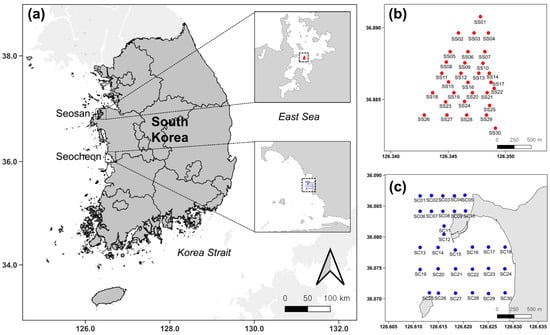
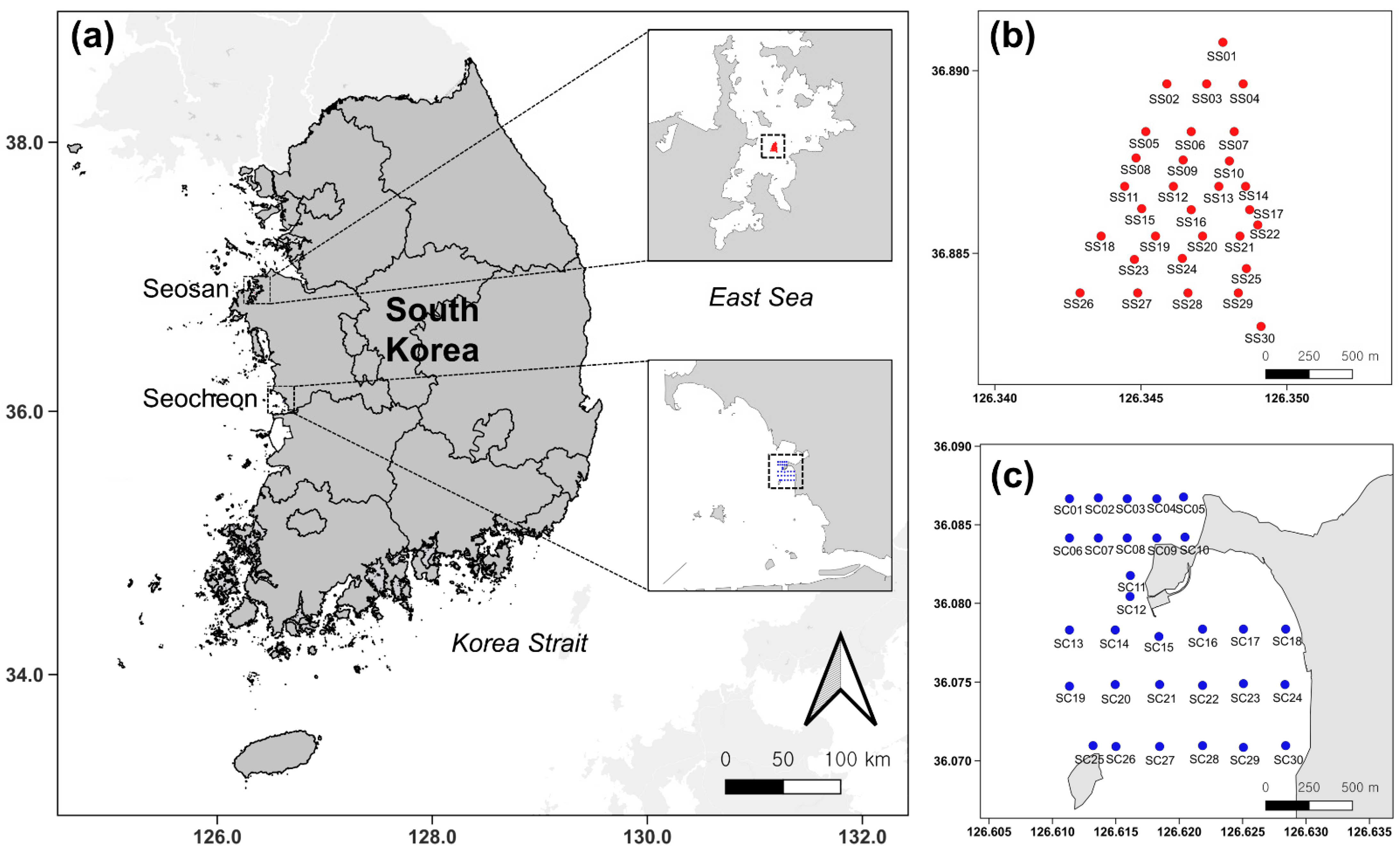
The Seosan tidal flat is located within Garorim Bay, a semi-enclosed macrotidal embayment on the mid-western coast of South Korea [22]. The Seocheon tidal flat is situated in an open coastal setting south of the Geum River estuary. Both sites experience macrotidal conditions with mean tidal ranges of 4–8 m, typical of the Korean west coast [18]. Field surveys were conducted twice at each site, in May and August 2023 (Figure 1). A total of 30 survey points were established at each site (Table S1).
Figure 1.
Map showing the location of two study sites (Seosan and Seocheon) on the west coast of South Korea (a), and an enlarged map showing the 30 stations in Seosan (b) and Seocheon (c). Dashed boxes in (a) indicate the areas enlarged in (b) and (c). Grey areas indicate land, and white areas indicate sea and tidal flats.
The two study sites were selected from representative bivalve aquaculture tidal flats along the central-western coast of Korea. Stations were distributed across each tidal flat to ensure representative spatial coverage of the intertidal zone, including areas with varying aquaculture intensity and sediment characteristics. Macrobenthic invertebrates were collected at each station using a square corer with a sampling area of 0.025 m2. Four replicate samples were collected at each station during the survey period. Sediments were sieved in the field using a 1 mm mesh screen with pump-supplied seawater to separate benthic organisms. Collected organisms were fixed in 10% neutral formalin for subsequent laboratory analysis.
The environmental parameters were measured at each sampling station. The ground temperature was measured using a portable temperature probe (HMM-90, Hanyoung System, Seoul, Republic of Korea). After macrobenthos collection, the temperature and salinity of the pore water formed in the excavated sediment were measured using a multisensor meter (Pro Plus, YSI Inc., Yellow Springs, OH, USA). Surface sediment samples (0–2 cm depth) were collected using acid-washed Teflon (Bel-Art, Wayne, NJ, USA) scoops to minimize contamination, frozen in dry ice (−78 °C) for subsequent grain-size analysis, and transported to the laboratory.
2.2. Laboratory Analysis
The preserved macrobenthic samples were transported to the laboratory and rinsed with fresh water to remove the formalin. Organisms were sorted by taxonomic group and, where possible, identified to the species level using stereomicroscopes and compound microscopes, with reference to the National List of Marine Species [23]. Specimens that could not be confidently identified to the species level were assigned the lowest taxonomic rank. Population density was calculated as the number of individuals per unit area (ind./m2). After identification and enumeration, the organisms were blotted with absorbent paper to remove surface moisture, and the wet weight was measured (accurate to 0.001 g) using an electronic weighing scale (ML503T/00; Mettler Toledo, Greifensee, Switzerland). The samples were then frozen for carbon content analysis.
For carbon analysis, frozen samples were freeze-dried (LP 20, Ilsin Bio Base, Dongducheon, Republic of Korea) and homogenized with a mortar and pestle. In this study, carbon associated with macrobenthos comprises organic carbon in soft tissues and inorganic carbon in calcium carbonate shells, and each fraction was measured separately for Mollusca. The carbon mass of each species was calculated by multiplying the dry weight by taxon-specific carbon conversion factors. These factors were derived from direct elemental analysis of representative specimens from the study sites. Specimens were separated by tissue type (soft tissue and shell for Mollusca), freeze-dried, ground into a fine powder, and acid-treated (to remove carbonates where necessary) before analysis using a CHNS/O elemental analyzer (e.g., vario MICRO cube; Elementar Analysensysteme GmbH, Langenselbold, Germany). The resulting dry weight-to-carbon ratios were 0.3928–0.4246 for bivalve soft tissue and 0.1191–0.3462 for shell. For taxa where direct measurement was not possible due to limited sample availability, conversion factors were applied from published literature [24,25] or based on mean values from the nearest higher taxonomic group (Table S2).
For grain-size analysis, the sediment samples were treated with hydrogen peroxide (H2O2) and hydrochloric acid (HCl) to remove organic matter and carbonates, respectively, and then rinsed with distilled water to remove salts. Samples were then separated into coarse and fine fractions by wet sieving using a 4Φ sieve. The coarse fraction (>4Φ) was analyzed at 1Φ intervals using a shaker, while the fine fraction (<4Φ) was analyzed at 1Φ intervals using an automated particle size analyzer (Mastersizer 2000, Malvern Panalytical, Malvern, UK). Sediment textural parameters were calculated using the graphical method of Folk and Ward [26], and sediment types were classified according to the Folk sediment classification system.
2.3. Statistical Analysis
Ecological indices, including the Shannon diversity index (H′), Pielou’s evenness index (J′), and McNaughton’s dominance index (D), were calculated for each site. Two-way permutational multivariate analysis of variance (PERMANOVA) was performed using the adonis2 function with Bray–Curtis dissimilarity matrices (9999 permutations) to test for differences in community composition between sites, months, and their interactions. Quade’s nonparametric analysis of covariance (ANCOVA) was used to compare carbon mass conversion rates among phyla, with post hoc Dunn tests applying the Bonferroni correction for pairwise comparisons. Principal coordinate analysis (PCoA) was conducted using cmdscale based on Bray–Curtis dissimilarity, with environmental vectors fitted using envfit to visualize the relationships between community composition and environmental variables. Rank abundance curves (RACs) were constructed by ranking species according to their relative carbon mass contributions within each site and month. Distance-based redundancy analysis (dbRDA) was performed on a Bray–Curtis dissimilarity matrix of taxon-specific carbon mass data to evaluate how site and month constrain variation in community-level carbon composition (dbrda function in vegan; 9999 permutations). Pairwise PERMANOVA comparisons were subsequently conducted to decompose the significant interaction term, with Bonferroni correction applied. All analyses were performed in R v4.0.2 [27], using vegan [28] for community ecology analyses and dunn.test [29] packages for post hoc pairwise comparisons, and ggplot2 [30] for data visualization.
3. Results
3.1. Benthic Environmental Factors
The ground and water temperature ranges in Seosan were 20.0–33.4 °C and 22.1–35.6 °C, respectively, and the salinity ranged from 9.8 to 31.4 PSU during the entire survey period. In Seocheon, ground and water temperatures ranged from 15.0–27.2 °C and 15.3–29.2 °C, respectively, and salinity ranged from 14.1–32.3 PSU during the entire survey period. The lowest ground temperature was 15 °C in Seocheon (SC11) in May, whereas the highest was 33.4 °C in Seosan (SS24) in August. Similarly, the lowest water temperature was 15.3 °C in Seocheon (SS28) in May, whereas the highest was 35.6 °C in Seosan (SS24) in August. The lowest salinity was 9.8 PSU in August at Seosan (SS28), whereas the highest salinity was 32.33 PSU in May at Seocheon (SC11; Figure S1).
The grain-size composition revealed distinct characteristics between the two sites. Seosan samples were predominantly clustered in the silty sand (zS) region, with total station contents ranging from 48.0–87.2% sand, 7.5–42.0% silt, and 0.9–4.7% clay. This relatively tight clustering indicates a more homogeneous sediment composition throughout the Seosan tidal flat. In contrast, the Seocheon samples showed a broader distribution, ranging from sand (S) to sandy silt (sZ). The content of total stations ranged from 20.9–98.4% sand, 1.4–68.4% silt, and 0.1–18.9% clay. Specifically, SC06 had a relatively high sand content (98.4%), whereas SC02 and SC09 had a relatively high silt content (68.4% and 63.4%) compared to the sand content (24.2% and 23.4%), indicating a more heterogeneous sediment composition compared to that of Seosan (Figure S2).
3.2. Macrobenthic Community Structure
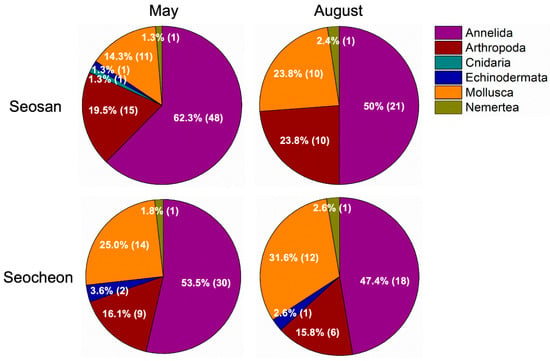
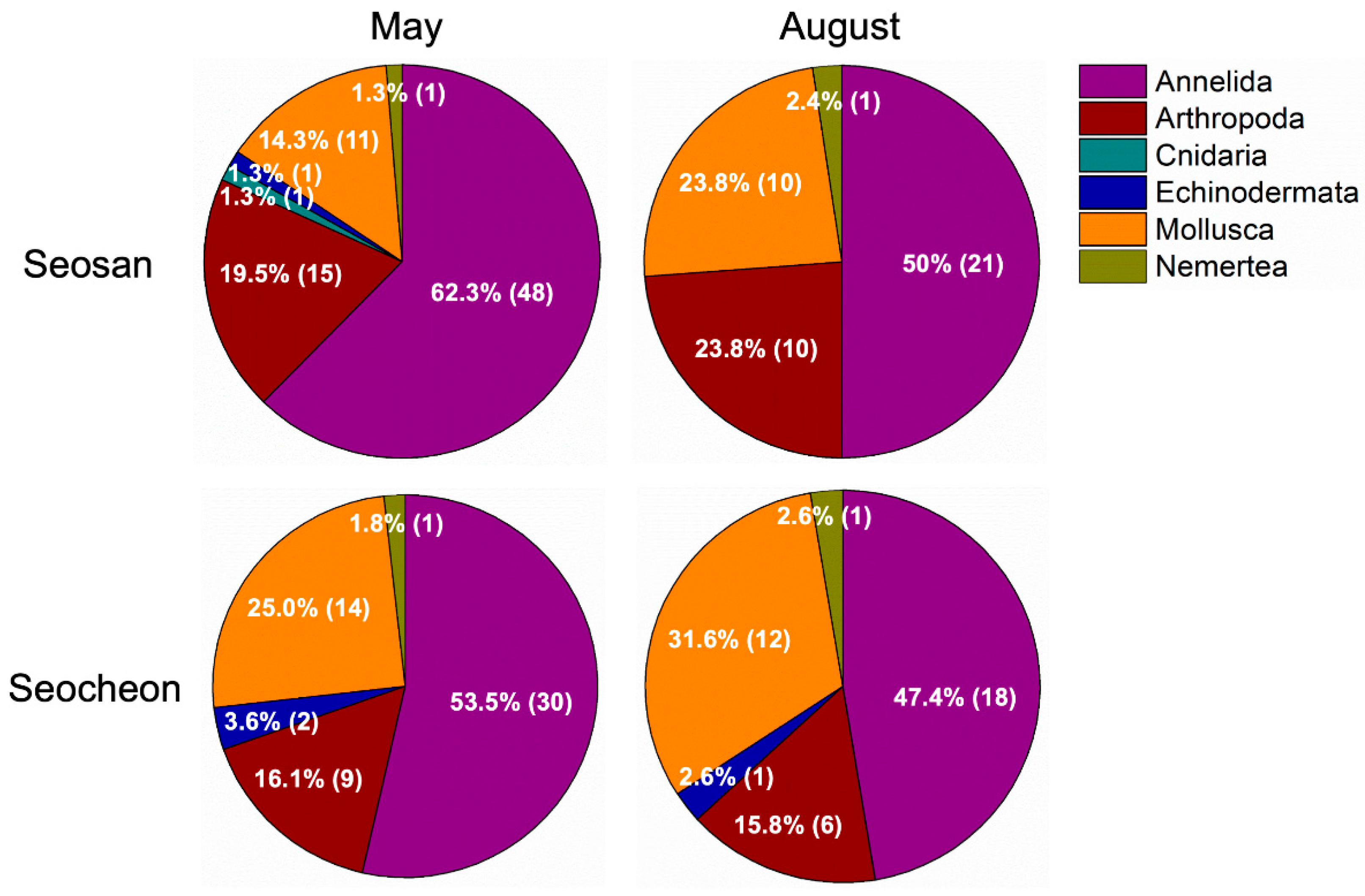
In total, 110 invertebrate species belonging to eight classes and five phyla were observed during the survey period (Table S3). Throughout the study, Annelida showed the highest proportion at both sites, followed by Mollusca and Arthropoda, which were the dominant taxa. Detailed examination of temporal and spatial patterns revealed that Seosan had the highest species richness, with 84 species across six taxa. Annelida was the most abundant with 48 species, followed by Arthropoda (16 species) and Mollusca (11 species). In August, the total number of species decreased to 43, with Annelida (21 species), Mollusca (11 species), and Arthropoda (10 species) being the dominant phyla. In Seocheon, 65 species were observed across six taxa. The number of species decreased from 58 (six taxa) in May to 39 (five taxa) in August.
When examining species composition percentages by site and month, Annelida was dominant, with the highest proportion at both sites. The proportions of Annelida ranged from 47.4% in Seocheon in August (18 species) to 62.3% in Seosan in May (48 species). The second- and third-most dominant taxa differed among sites. At Seosan, Arthropoda showed higher or equal dominance compared to Mollusca, comprising 19.5% of species in May and 23.8% in August. Mollusks at this site represented 14.3% and 23.8% of species in May and August, respectively. In contrast, in Seocheon, Mollusca was more abundant than Arthropoda, accounting for 24.6% of species in May and increasing to 31.6% in August, whereas Arthropoda remained at 15.8% in both months. The remaining taxa (Cnidaria, Echinodermata, and Nemertea) were minor components, each representing less than 3.5% of species composition, with only one or two species observed (Figure 2).
Figure 2.
Pie charts showing the proportions of species counts by taxon in Seocheon and Seosan in May and August 2023.
Ecological indices revealed contrasting patterns between the two sites. Seosan showed higher species richness (84 species) but lower diversity index (H′ = 1.40) and evenness index (J′ = 0.32), with a high dominance index (D = 0.78) indicating strong numerical dominance. In contrast, Seocheon showed lower species richness (63 species) but a substantially higher diversity index (H′ = 2.94) and evenness index (J′ = 0.71), with a correspondingly lower dominance index (D = 0.35), reflecting a more balanced community structure with less pronounced dominance by individual species (Table S4).
3.3. Temporal and Spatial Variation in Community Structure
Two-way PERMANOVA revealed significant differences in macrobenthic community structure across both spatial and temporal scales. The analysis showed highly significant variations between the sites (Pseudo-F = 15.376, p = 0.000), indicating distinct community compositions between the Seosan and Seocheon tidal flats. The temporal variation between May and August was also significant (Pseudo-F = 9.489, p = 0.001), reflecting seasonal changes in the community structure. Additionally, a significant site × month interaction (Pseudo-F = 4.800, p = 0.028) suggested that temporal patterns differed between the two sites, with each location exhibiting unique seasonal responses in community composition (Table 1).
Table 1.
Results of two-way PERMANOVA analysis showing the effects of site, month, and their interaction on community structure.
Distance-based redundancy analysis (dbRDA) confirmed that site and month together explained 25.8% of the total variation in carbon-based community composition (overall model: Pseudo-F = 13.46, p < 0.001), with site as the dominant constraining factor (Pseudo-F = 36.06, p < 0.001; Figure S4). Pairwise PERMANOVA showed significant site differences in both May (Pseudo-F = 41.77, p < 0.001) and August (Pseudo-F = 22.38, p < 0.001), whereas seasonal differences were significant only at Seocheon (p = 0.020) and not at Seosan (p = 1.000; Table S6). The temporal patterns showed distinct seasonal shifts at both sites. Species richness declined from May to August, decreasing from 84 to 43 species in Seosan and from 58 to 39 species in Seocheon, with Annelida showing the most pronounced decrease. In Seosan, R. philippinarum maintained dominance, with its relative abundance increasing from 66.7% to 83.6%. In contrast, Seocheon exhibited more dramatic community shifts, transitioning from 20.8% (H. japonica) to 30.8% (M. veneriformis) dominance.
The spatial differences between the two sites are also pronounced. In Seosan, the difference in the proportions of the first- and second-most dominant species during the study period was 60% in May and 79% in August. In contrast, in Seocheon, the differences between the first and second dominant species were 2.8% and 15.1% in May and August, respectively, indicating that species dominance was relatively less pronounced than in Seosan (Table 2).
Table 2.
First and second dominant benthic macrobenthic species for each region and month (Ind./m2).
3.4. Carbon Stock Contribution
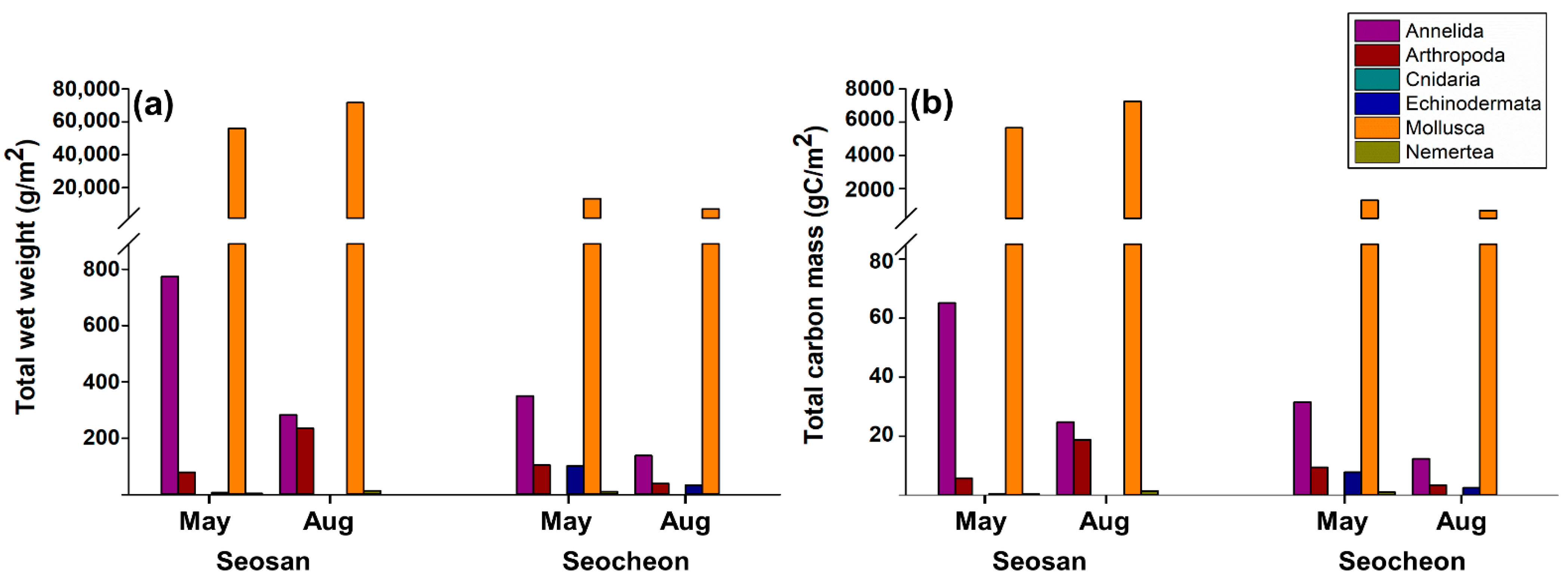
Although Annelida had the highest species richness, Mollusca exhibited a significantly higher biomass. Mollusk wet weight was highest in Seosan (71,564.0 g/m2 in August) and lowest in Seocheon (13,437.8 g/m2 in May). In comparison, Annelida reached a maximum of 774.0 g/m2 (Seosan, May) and Arthropoda 235.7 g/m2 (Seosan, August). Carbon mass followed a similar pattern, with Mollusca ranging from 689.3 gC/m2 (Seocheon, May) to 7256.4 gC/m2 (Seosan, August), while Annelida and Arthropoda reached maximum values of 65.1 and 18.8 gC/m2, respectively (Figure 3).
Figure 3.
Total wet weight (a) and total carbon mass (b) for each phylum in May and August 2023 at Seosan and Seocheon.
ANCOVA revealed significant differences in carbon mass conversion rates between phyla (p < 0.000; Table S5). Post hoc tests confirmed that Bivalvia and Echinodermata had significantly higher wet weight-to-carbon mass ratios than all other taxa (p < 0.001), with no significant differences between the two groups (p = 1.000; Table 3).
Table 3.
Post hoc (Dunn’s test) results of ANCOVA comparing wet weight versus carbon among taxa. Values represent p-values for pairwise comparisons. Bold text indicates significant values (p < 0.05).
The RACs showed steep initial declines, with only the first-ranked species exceeding 1.9 in relative carbon mass, while all others remained below 1.0 (Figure S3). R. philippinarum (Seosan) and M. veneriformis (Seocheon) were consistently dominant during both months. In Seosan, Batillaria cumingii ranked second in both months, while the third place shifted from Cirriformia tentaculata (May) to Reticunassa festiva (August). In Seocheon, the second most abundant species shifted from Umbonium thomasi (May) to Corbicula amurensis (August), whereas Hediste japonica remained in third place. Notably, all the second- and third-ranked species were Bivalvia, except for two Annelida species (Table 4).
Table 4.
Relative carbon contribution ranking of the top three species on the RAC for each site and month.
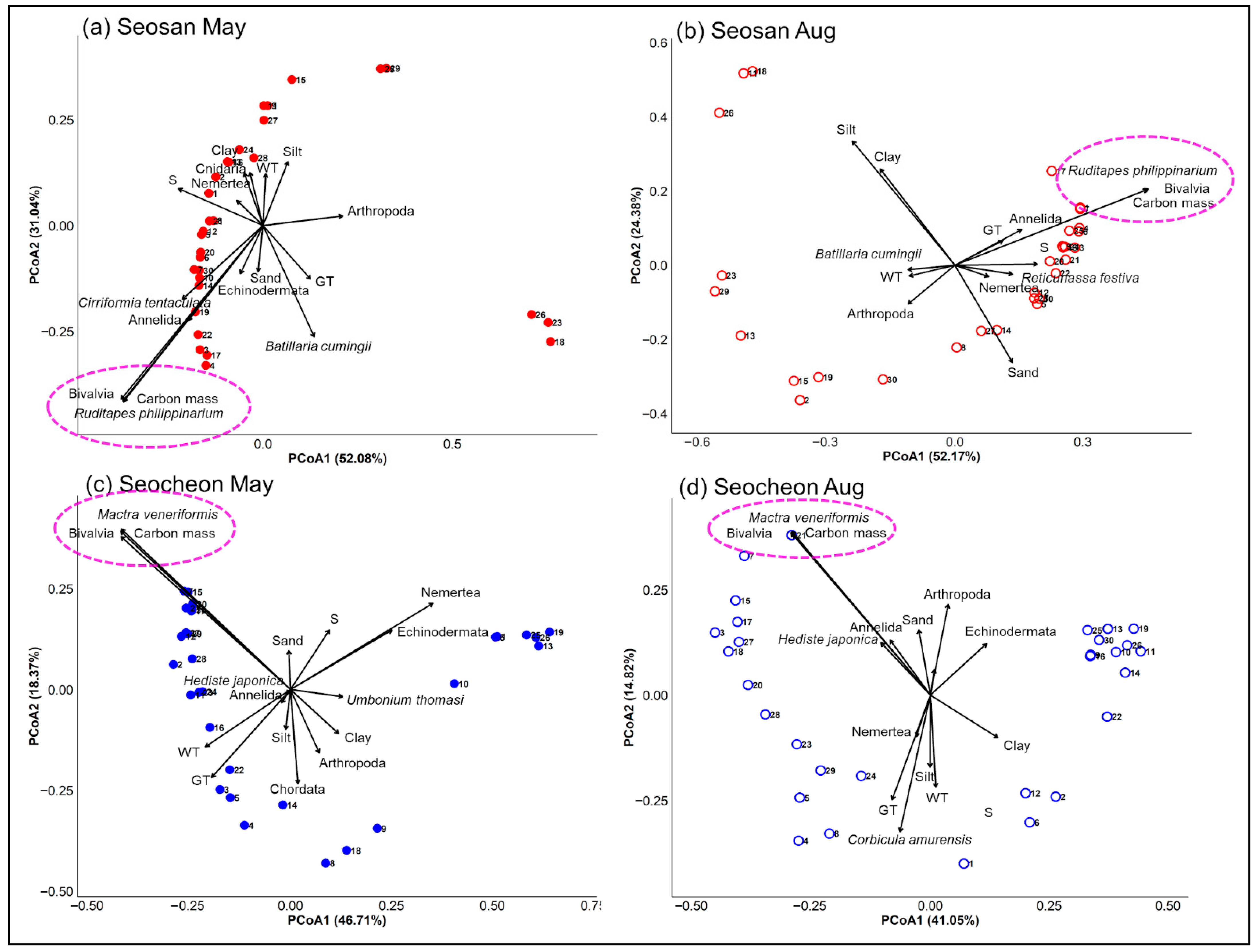
PCoA revealed consistent vector alignment across all sampling periods, with the first-ranked species vectors (R. philippinarum and M. veneriformis), the total Bivalvia biomass vector, and the carbon mass vector closely aligned in this direction (Figure 4). This consistent pattern provides strong evidence that the dominant Bivalvia species disproportionately determine carbon stocks in these tidal flat communities, corroborating the ANCOVA and RAC results.
Figure 4.
PCoA biplots for communities at Seosan and Seocheon in May and August 2023. Seosan—May (a), Seosan–August (b), Seocheon—May (c), Seocheon—August (d). Arrows represent environmental variables (WT: Water temperature, GT: Ground temperature, S: Salinity, CM: Carbon mass), major taxonomic groups, and dominant species from RAC.
4. Discussion
4.1. Community Characteristics in Tidal Flats
The influence of environmental factors, including spatial and temporal variations, ground and water temperatures, salinity, and sediment characteristics, on the formation of macrobenthic communities is important in tidal flat ecosystems [31,32]. In particular, temperature and salinity fluctuations have been shown to affect the distribution and abundance of benthic organisms [33]. In contrast, the sediment composition often determines the settlement and survival of different taxonomic groups [34,35].
The observed dominance patterns can be partially explained by species-specific environmental tolerance. R. philippinarum demonstrates high resistance to temperature and salinity variations [36,37], which corresponds with its dominance at Seosan, where temperature (20.0–33.4 °C) and salinity (9.8–31.4 PSU) showed broader fluctuations. Similarly, M. veneriformis exhibits optimal clearance rates at temperatures up to 20 °C with maximum feeding activity at higher salinities (26–32 PSU) [38]. In contrast, the polychaete Hediste japonica was numerically dominant in Seocheon (20.7% in May), particularly in areas with higher organic matter and more heterogeneous sediment composition, reflecting its broader tolerance for environmental variability and its capacity for deposit feeding [39,40,41]. The more moderate temperature range at Seocheon (15.0–27.2 °C) and relatively stable salinity (14.1–32.3 PSU) appear to favor the establishment of both M. veneriformis and H. japonica. In contrast, the variable conditions at Seosan preferentially support the stress-tolerant R. philippinarum.
Sediment grain size is a primary determinant of Bivalvia distribution in tidal flats as it influences larval settlement, feeding efficiency, and burrowing behavior [42,43]. R. philippinarum exhibits broad adaptability across sediment types, as evidenced by comparable burrowing performance across grain-size compositions [44]. The Seosan tidal flats in this study were a silty-sand (zS) depositional environment, with all points except two showing high sand content exceeding 50%. These environmental conditions resembled the coarser sediment environment in which clam density increased in previous sand-spreading experiments [45], supporting the association of clams with sandy sedimentary environments. In contrast, Seocheon is characterized by a relatively high diversity index (2.94) and a low dominance index (0.35), reflecting a range of patterns, from pure sand (98.4% in SC06) to silt-dominated areas (68.4% in SC02). Polychaetes, such as H. japonica and H. koreanus, dominate because they exhibit greater tolerance to sediment variability and can utilize organic-rich muddy sediments through sediment feeding [46].
Despite these environmental differences, both regions exhibited similar patterns in Annelida species diversity and Bivalvia biomass. Annelida showed the highest species richness at both sites (47.4–62.3% of total species). These results were consistent with those of a previous study in which polychaetes were the most widely distributed species along the entire coast [47]. In our study, Bivalvia (R. philippinarum in Seosan and M. veneriformis in Seocheon) were the most dominant species by wet weight. However, in other studies, these were the second most dominant taxa [47,48]. The prevalence of these Bivalvia species may be attributed to aquaculture activities, particularly the artificial seeding of juvenile clams, rather than purely natural distribution patterns [49].
4.2. Carbon Stocks Associated with Bivalvia
The enhanced carbon stocks of Bivalvia stem primarily from the formation of calcium carbonate shells through calcification processes [13]. Although Bivalvia primarily stores carbon through shell calcification, using dissolved inorganic carbon from seawater, its shells contain substantial inorganic carbon [12]. However, the calcification process releases CO2 and reduces seawater alkalinity; several studies have reported that bivalve aquaculture may act as a net source of CO2 emissions at the ecosystem scale [14,15,50]. Therefore, we emphasize that the values presented in this study reflect current carbon stocks of dynamic carbon pools in living biota, rather than net sequestration or permanent storage, and should be interpreted accordingly. The current carbon stock was statistically confirmed through ANCOVA analysis in this study. Mollusca showed a significantly higher carbon mass conversion rate relative to wet weight than other taxonomic groups, including Annelida and Arthropoda (p < 0.001).
RAC and PCoA revealed a striking pattern of carbon stock concentration among a few dominant Bivalvia species, despite the high species richness of the other taxonomic groups. In Seosan, R. philippinarum alone accounted for 86.9% of the total carbon mass, whereas in Seocheon, R. philippinarum (48.8%) and M. veneriformis (24.7%) together accounted for 73.5% of carbon stocks. The steep initial decline in the RACs, with only the first-ranked species exceeding 1.9 in relative carbon mass and all others remaining below 1.0 (Figure S3), demonstrates this pattern of disproportionate contribution. The PCoA analysis further supported this finding by showing consistent alignment of vectors representing the dominant Bivalvia (R. philippinarum and M. veneriformis), total Bivalvia biomass, and carbon mass across all sampling periods, indicating that these few species functionally dominate carbon stocks despite Annelida showing the highest species richness (47.4–62.3% of total species).
This pattern contrasts with the general functional relationship of biodiversity ecosystems, in which species richness typically correlates with functional performance. Instead, our results align with studies documenting the functional dominance of a few species in ecosystem service provision, where biomass-dominant species disproportionately contribute to carbon cycling, regardless of overall community diversity [49]. R. philippinarum is extensively cultured in Korean tidal flats [51], reflecting both its natural distribution patterns in suitable sediment environments and the influence of aquaculture enhancement through juvenile stocking programs [52]. This functional pattern, in which high species diversity in soft-bodied taxa does not translate to equivalent carbon stocks, suggests that tidal flat macrobenthic carbon stocks are primarily determined by the presence and abundance of calcifying Bivalvia, rather than by overall macrobenthic diversity.
4.3. Implications for Tidal Flat Carbon Assessment
The dominance of R. philippinarum and M. veneriformis in the Seosan and Seocheon tidal flats may be partially attributable to artificial seeding practices commonly employed in these areas [52,53], raising important considerations for integrating carbon stock assessments into bivalve resource management strategies. Both wild and farmed bivalves contribute to macrobenthic carbon pools through biomass and shell accumulation [16], although the magnitude of such contributions varies considerably depending on population density and culture intensity.
The total tidal flat area in Korea is 2443 km2, of which Bivalvia aquaculture farms occupy 434 km2 (17.7%) [53,54]. Juvenile Bivalvia release has been widely implemented in ecosystem restoration and aquaculture. For example, in the Chungcheongnam-do Province (where our study sites, Seosan and Seocheon, are located), approximately 183 million R. philippinarum juveniles were released in 2020 (Korea Fisheries Resources Agency, Seed Release Management System, https://seed.fira.or.kr accessed on 15 September 2024). Recent studies have demonstrated that moderate stocking densities in Bivalvia aquaculture can alter the phytoplankton community toward smaller species with higher carbon densities, thereby increasing the total carbon storage in the water column. Additionally, Bivalvia farming enhances the sedimentation rates of suspended particles and accelerates carbon burial, particularly in shallow, low-energy environments such as tidal flats [55]. Furthermore, bivalve water filtration generates substantial fluxes of particulate carbon and nitrogen into sediments, potentially supporting higher rates of carbon burial [9].
However, excessive stocking densities can lead to localized accumulation of organic matter from pseudofeces and biodeposition, potentially altering sediment biogeochemistry and nutrient cycling in ways that may offset the carbon stock accumulation [56]. When appropriately managed, bivalve aquaculture in tidal flats can provide additional benefits by stabilizing sediment and reducing coastal erosion, thereby protecting existing carbon stocks from physical disturbances [13]. These findings suggest that bivalve-dominated tidal flats in Korea represent notable macrobenthic carbon pools when integrated with sustainable aquaculture management practices [16], although determining whether these pools function as net carbon sinks or sources would require flux and burial measurements beyond the scope of this study. Future management frameworks for tidal flat aquaculture should consider the carbon stocks of Bivalvia, such as R. philippinarum and M. veneriformis, along with production goals when evaluating ecosystem services [57,58]. Nevertheless, this study has a notable limitation—surveys were conducted at only two tidal flat sites in a single year, which limits the generalizability of the findings. Future research should expand the spatial scope to include a broader range of bivalve aquaculture sites across diverse environmental conditions to better characterize the carbon stock potential of Korean tidal flats.
5. Conclusions
Previous studies have estimated the sediment-based carbon stocks in tidal flats; however, taxon-specific contributions from macrobenthic invertebrates remain unknown. This study demonstrates that Bivalvia, particularly R. philippinarum and M. veneriformis, are the dominant drivers of macrobenthic carbon stocks in Korean tidal flats, despite the greater species richness of Annelida. These findings suggest that bivalve aquaculture areas, which cover 17.7% of Korean tidal flats, harbor substantial macrobenthic carbon stocks warranting further investigation. By establishing a taxon-specific framework for carbon stocks assessment, this study provides a methodological basis for informing taxon-specific carbon assessments in tidal flat management. The values reported here characterize current macrobenthic carbon stocks and do not directly address sequestration rates or the net CO2 sink–source status of these tidal flats, which would require flux and burial measurements beyond the scope of this study. Future research should quantify carbon stocks across a broader range of bivalve aquaculture sites to support the integration of shellfish farming into national carbon accounting.
Supplementary Materials
The following supporting information can be downloaded at: https://www.mdpi.com/article/10.3390/d18050254/s1, Table S1: Geographic coordinates of sampling stations at Seosan and Seocheon; Table S2: Carbon conversion factors for macrobenthic invertebrates in the study area Carbon content was calculated by multiplying the dry weight (g) by taxon-specific conversion factors; Table S3: List of macrobenthic species identified at the study sites; Table S4: Ecological indices for each study site Species richness, Shannon's diversity index (H'), Pielou's evenness index (J'), and McNaughton's dominance index (D) were calculated across the entire survey period; Table S5: Results of Quade’s nonparametric ANCOVA comparing carbon mass conversion rates among phyla; Figure S1: Environmental factors in Seosan and Seocheon; Figure S2: Grain size analysis triangle diagrams for Seosan and Seocheon; Figure S3: Rank abundance curves showing the carbon mass contribution of species in Seosan and Seocheon; Table S6. Pairwise PERMANOVA results comparing macrobenthic community composition (Bray–Curtis dissimilarity of carbon mass) between sites within each month and between months within each site (9999 permutations; Bonferroni-corrected p-values); Figure S4. Distance-based redundancy analysis (dbRDA) ordination of macrobenthic community composition based on taxon-specific carbon mass (Bray–Curtis dissimilarity) at Seocheon and Seosan in May and August 2023. Filled circles indicate May, and open circles indicate August. Ellipses represent 95% confidence intervals for each group.
Author Contributions
Conceptualization, S.B. and H.S.K.; formal analysis, S.B.; investigation, C.-H.Y., D.Y., N.J., J.M.K. and H.S.K.; writing—original draft preparation, S.B.; writing—review and editing, C.-H.Y., D.Y., N.J., J.M.K. and H.S.K.; visualization, S.B.; supervision, H.S.K.; project administration, H.S.K.; funding acquisition, H.S.K. All authors have read and agreed to the published version of the manuscript.
Funding
This research was funded by the National Marine Biodiversity Institute of Korea (grant number 2026M00300) and the Korea Institute of Marine Science & Technology Promotion (KIMST) funded by the Ministry of Oceans and Fisheries (MOF), Republic of Korea (grant number KIMST-20220526, “Development of living shoreline technology based on blue carbon science toward climate change adaptation”).
Data Availability Statement
The data presented in this study are available in the article and its Supplementary Materials. Further inquiries can be directed to the corresponding author.
Conflicts of Interest
The authors declare no conflicts of interest.
Abbreviations
The following abbreviations are used in this manuscript:
| PERMANOVA | Permutational Multivariate Analysis of Variance |
| ANCOVA | Analysis of Covariance |
| PCoA | Principal Coordinate Analysis |
| RAC | Rank Abundance Curve |
References
- Chen, Z.L.; Lee, S.Y. Tidal Flats as a Significant Carbon Reservoir in Global Coastal Ecosystems. Front. Mar. Sci. 2022, 9, 900896. [Google Scholar] [CrossRef] [Scilit]
- Murray, N.J.; Phinn, S.R.; DeWitt, M.; Ferrari, R.; Johnston, R.; Lyons, M.B.; Clinton, N.; Thau, D.; Fuller, R.A. The Global Distribution and Trajectory of Tidal Flats. Nature 2019, 565, 222–225. [Google Scholar] [CrossRef] [Scilit] [PubMed]
- Howard, J.; Sutton-Grier, A.E.; Smart, L.S.; Lopes, C.C.; Hamilton, J.; Kleypas, J.; Simpson, S.; McGowan, J.; Pessarrodona, A.; Alleway, H.K.; et al. Blue Carbon Pathways for Climate Mitigation: Known, Emerging and Unlikely. Mar. Polic. 2023, 156, 105788. [Google Scholar] [CrossRef] [Scilit]
- IPCC Decision IPCC-LXIII-6: Scoping of the Methodology Report on Carbon Dioxide Removal Technologies, Carbon Capture Utilization and Storage; Intergovernmental Panel on Climate Change: Lima, Peru, 2025.
- Perillo, G.M.E.; Wolanski, E.; Cahoon, D.R.; Hopkinson, C.S. Coastal Wetlands: An Integrated Ecosystem Approach, 2nd ed.; Elsevier: Amsterdam, The Netherlands, 2019; ISBN 9780444638939. [Google Scholar]
- Smith, C.R.; Austen, M.C.; Boucher, G.; Heip, C.; Hutchings, P.A.; King, G.M.; Koike, I.; Lambshead, P.J.D.; Snelgrove, P. Global Change and Biodiversity Linkages across the SedimentWater Interface. BioScience 2000, 50, 1108–1120. [Google Scholar] [CrossRef] [Scilit]
- Karlson, K.; Hulth, S.; Ringdahl, K.; Rosenberg, R. Experimental Recolonisation of Baltic Sea Reduced Sediments: Survival of Benthic Macrofauna and Effects on Nutrient Cycling. Mar. Ecol. Prog. Ser. 2005, 294, 35–49. [Google Scholar] [CrossRef] [Scilit]
- Stief, P. Stimulation of Microbial Nitrogen Cycling in Aquatic Ecosystems by Benthic Macrofauna: Mechanisms and Environmental Implications. Biogeosciences 2013, 10, 7829–7846. [Google Scholar] [CrossRef] [Scilit]
- Murphy, A.E.; Kolkmeyer, R.; Song, B.; Anderson, I.C.; Bowen, J. Bioreactivity and Microbiome of Biodeposits from Filter-Feeding Bivalves. Microb. Ecol. 2019, 77, 343–357. [Google Scholar] [CrossRef] [Scilit]
- Weiss, I.M.; Tuross, N.; Addadi, L.; Weiner, S. Mollusc Larval Shell Formation: Amorphous Calcium Carbonate Is a Precursor Phase for Aragonite. J. Exp. Zool. 2002, 293, 478–491. [Google Scholar] [CrossRef] [Scilit]
- Thomsen, J.; Ramesh, K.; Sanders, T.; Bleich, M.; Melzner, F. Calcification in a Marginal Sea—Influence of Seawater [Ca2+] and Carbonate Chemistry on Bivalve Shell Formation. Biogeosciences 2018, 15, 1469–1482. [Google Scholar] [CrossRef] [Scilit]
- Zavell, M.D.; Lindahl, O.; Filgueira, R.; Shumway, S.E. An Estimate of Carbon Storage Capabilities from Wild and Cultured Shellfish in the Northwest Atlantic and Their Potential Inclusion in a Carbon Economy. J. Shellfish Res. 2023, 42, 325–342. [Google Scholar] [CrossRef] [Scilit]
- Alleway, H.K.; Gentry, R.R.; Smart, L.; Jones, A.R.; Mackay, J. Managing Bivalve Aquaculture to Enhance Blue Carbon Ecosystems and Carbon Sequestration. Aquat. Conserv. Mar. Freshw. Ecosyst. 2025, 35, e70160. [Google Scholar] [CrossRef] [Scilit]
- Pernet, F.; Dupont, S.; Gattuso, J.; Metian, M.; Gazeau, F. Cracking the Myth: Bivalve Farming Is Not a CO2 Sink. Rev. Aquac. 2025, 17, e12954. [Google Scholar] [CrossRef] [Scilit]
- Fodrie, F.J.; Rodriguez, A.B.; Gittman, R.K.; Grabowski, J.H.; Lindquist, N.; Peterson, C.H.; Piehler, M.F.; Ridge, J.T. Oyster Reefs as Carbon Sources and Sinks. Proc. R. Soc. B Biol. Sci. 2017, 284, 20170891. [Google Scholar] [CrossRef] [Scilit] [PubMed]
- Jansen, H.; van-den-Bogaart, L. Blue Carbon by Marine Bivalves: Perspective of Carbon Sequestration by Cultured and Wild Bivalve Stocks in the Dutch Coastal Areas; Wageningen Marine Research: Den Helder, The Netherlands, 2020. [Google Scholar] [CrossRef] [Scilit]
- KOEM (Korea Marine Environment Management Corporation). Tidal Flat Area Survey; Ministry of Oceans and Fisheries: Sejong, Republic of Korea, 2023; pp. 1–146. [Google Scholar]
- Koh, C.-H.; Khim, J.S. The Korean Tidal Flat of the Yellow Sea: Physical Setting, Ecosystem and Management. Ocean Coast. Manag. 2014, 102, 398–414. [Google Scholar] [CrossRef] [Scilit]
- KMI (Korea Maritime Institute). A Study on the Establishment of a Roadmap for Sustainable Tidal Flat Fishery: Focusing on Shellfish Aquaculture; Korea Maritime Institute: Busan, Republic of Korea, 2017. [Google Scholar]
- Li, Z.; Chen, Y.; Wang, G.; Mu, J.; Sun, Y.; Yu, H.; Xu, J.; Yan, Y.; Luo, S.; Han, F.; et al. Ecological Carrying Capacity and Carbon Sequestration Potential of Bivalve Shellfish in Marine Ranching: A Case Study in Bohai Bay, China. Front. Mar. Sci. 2023, 10, 1174235. [Google Scholar] [CrossRef] [Scilit]
- Rohlfer, E.K.; Villnäs, A.; Gustafsson, C.; Gammal, J.; Kauppi, L.; Attard, K.; Norkko, J.; Norkko, A. Carbon Cycling across Coastal Soft Sediments: The Contribution of Macrofaunal Communities to Seafloor Respiration. Mar. Environ. Res. 2026, 215, 107812. [Google Scholar] [CrossRef] [Scilit]
- Lee, H.J.; Jo, H.R.; Chu, Y.S.; Bahk, K.S. Sediment Transport on Macrotidal Flats in Garolim Bay, West Coast of Korea: Significance of Wind Waves and Asymmetry of Tidal Currents. Cont. Shelf Res. 2004, 24, 821–832. [Google Scholar] [CrossRef] [Scilit]
- MABIK (National Marine Biodiversity Institute of Korea). National List of Marine Species; National Marine Biodiversity Institute of Korea: Seocheon-gun, Republic of Korea, 2023; Volume 2, ISBN 979-11-90903-16-5. [Google Scholar]
- MABIK (National Marine Biodiversity Institute of Korea). Marine Bioresource Conservation and Restoration Research; National Marine Biodiversity Institute of Korea: Seocheon, Republic of Korea, 2024. [Google Scholar]
- MABIK (National Marine Biodiversity Institute of Korea). Blue Carbon: Marine Species as Carbon Sinks; National Marine Biodiversity Institute of Korea: Seocheon, Republic of Korea, 2025; ISBN 979-11-88832-65-1. [Google Scholar]
- Folk, R.L.; Ward, W.C. Brazos River Bar [Texas]; a Study in the Significance of Grain Size Parameters. J. Sediment. Res. 1957, 27, 3–26. [Google Scholar] [CrossRef] [Scilit]
- Rcoreteam R: A Language and Environment for Statistical Computing; R Foundation for Statistical Computing: Vienna, Austria, 2023.
- Oksanen, J.; Blanchet, F.G.; Friendly, M.; Kindt, R.; Legendre, P.; McGlinn, D.; Minchin, P.R.; O’Hara, R.B.; Simpson, G.L.; Solymos, P.; et al. Package ‘Vegan’, Community Ecology Package. 2019. Available online: https://CRAN.R-project.org/package=vegan (accessed on 21 April 2026).
- Dinno, A. Package ‘Dunn.Test’, CRAN Repository. 2017. Available online: https://CRAN.R-project.org/package=dunn.test (accessed on 21 April 2026).
- Wickham, H. Ggplot2, Elegant Graphics for Data Analysis; Springer: Cham, Switzerland, 2009. [Google Scholar] [CrossRef] [Scilit]
- Ge, B.-M.; Bao, Y.-X.; Cheng, H.-Y. Tempo-Spatial Variation of Macrobenthic Communitieson a Tidal Flat of Wenzhou Bay, China. Revista de Biología Marina y Oceanografía 2011, 46, 281–286. [Google Scholar] [CrossRef] [Scilit]
- Dong, S.; Lei, Y.; Li, T.; Jian, Z. Responses of Benthic Foraminifera to Changes of Temperature and Salinity: Results from a Laboratory Culture Experiment. Sci. China Earth Sci. 2019, 62, 459–472. [Google Scholar] [CrossRef] [Scilit]
- Deldicq, N.; Langlet, D.; Delaeter, C.; Beaugrand, G.; Seuront, L.; Bouchet, V.M.P. Effects of Temperature on the Behaviour and Metabolism of an Intertidal Foraminifera and Consequences for Benthic Ecosystem Functioning. Sci. Rep. 2021, 11, 4013. [Google Scholar] [CrossRef] [Scilit] [PubMed]
- Anderson, M.J. Animal-Sediment Relationships Re-Visited: Characterising Species’ Distributions along an Environmental Gradient Using Canonical Analysis and Quantile Regression Splines. J. Exp. Mar. Biol. Ecol. 2008, 366, 16–27. [Google Scholar] [CrossRef] [Scilit]
- Yoon, S.-P.; Jung, R.-H.; Kim, Y.-J.; Kim, S.-G.; Choi, M.-K.; Lee, W.-C.; Oh, H.-T.; Hong, S.-J. Macrobenthic Community Structure Along the Environmental Gradients of Ulsan Bay, Korea. Sea J. Korean Soc. Oceanogr. 2009, 14, 102–117. [Google Scholar] [CrossRef]
- Shin, Y.-K.; Kim, Y.; Chung, E.-Y.; Hur, S.-B. Themperature and Salinity Tolerance of the Manila Clam, Ruditapes Philippinarum. Korean J. Fish. Aquat. Sci. 2020, 33, 213–218. [Google Scholar]
- Kim, S.L.; Kwon, S.H.; Lee, H.-G.; Yu, O.H. Effects of Environmental and Biological Conditions on the Recruitment and Growth of the Manila Clam Ruditapes Philippinarum on the West Coast of Korea. Ocean Sci. J. 2017, 52, 91–101. [Google Scholar] [CrossRef] [Scilit]
- Kang, J.W.; Lee, S.S.; Han, K.N. Clearance Rate and Feeding According to Water Temperature and Salinity Condition in the Surf Clam, Mactra Veneriformis. Korean J. Malacol. 2014, 30, 101–106. [Google Scholar] [CrossRef] [Scilit]
- Liu, Y.; Xian, W.; Sun, S. Metabolism of Polychaete Neanthes Japonica Izuka: Relations to Temperature, Salinity and Body Weight. Chin. J. Oceanol. Limnol. 2009, 27, 356–364. [Google Scholar] [CrossRef] [Scilit]
- Sato, M.; Tsuchiya, M. Reproductive Behavior and Salinity Favorable for Early Development in Two Types of the Brackish-Water Polychaete Neanthes Japonica (Lzuka). Benthos Res. 1987, 1987, 29–42. [Google Scholar] [CrossRef] [Scilit]
- Yoo, J.-W.; Hwang, I.-S.; Hong, J.-S. Inference Models for Tidal Flat Elevation and Sediment Grain Size: A Preliminary Approach on Tidal Flat Macrobenthic Community. Ocean Sci. J. 2007, 42, 69–79. [Google Scholar] [CrossRef] [Scilit]
- Sgro, L.; Mistri, M.; Widdows, J. Impact of the Infaunal Manila Clam, Ruditapes Philippinarum, on Sediment Stability. Hydrobiologia 2005, 550, 175–182. [Google Scholar] [CrossRef] [Scilit]
- Shin, P.K.S.; Ng, A.W.M.; Cheung, R.Y.H. Burrowing Responses of the Short-Neck Clam Ruditapes Philippinarum to Sediment Contaminants. Mar. Pollut. Bull. 2002, 45, 133–139. [Google Scholar] [CrossRef] [Scilit] [PubMed]
- Yoon, S.P.; Song, J.H.; Choi, Y.S.; Park, K.J.; Chung, S.O.; Han, H.K. The Impact of Sand Addition to an Intertidal Area for the Development of the Manila Clam, Ruditapes Philippinarum Habitat on Benthic Community Structure (the Case of Ojjeom Tidal Flat in Gonam-Myeon, Taean-Gun). Korean J. Malacol. 2014, 30, 259–271. [Google Scholar] [CrossRef] [Scilit]
- Oh, S.H.; Choi, J.H.; Son, D.S.; Ma, C.W. Macrobenthos Community on the Intertidal at Garolim Bay in Summer. J. Environ. Biol. 2019, 40, 896–907. [Google Scholar] [CrossRef] [Scilit]
- Khim, J.S.; Lee, C.; Song, S.J.; Bae, H.; Noh, J.; Lee, J.; Kim, H.-G.; Choi, J.-W. Marine Biodiversity in Korea: A Review of Macrozoobenthic Assemblages, Their Distributions, and Long-Term Community Changes from Human Impacts. In Oceanography and Marine Biology; CRC Press: Boca Raton, FL, USA, 2021; ISBN 9781003138846. [Google Scholar]
- Choi, K.-H.; Lee, S.-M.; Lim, S.-M.; Walton, M.; Park, G.-S. Benthic Habitat Quality Change as Measured by Macroinfauna Community in a Tidal Flat on the West Coast of Korea. J. Oceanogr. 2010, 66, 307–317. [Google Scholar] [CrossRef] [Scilit]
- Kim, S.L.; Lee, H.G.; Kang, S.M.; Yu, O.H. The Influence of Manila Clam (Ruditapes Philippinarum) on Macrobenthos Communities in a Korean Tidal Ecosystem. Sustainability 2020, 12, 4205. [Google Scholar] [CrossRef] [Scilit]
- Balvanera, P.; Kremen, C.; Martínez-Ramos, M. Applying Community Structure Analysis to Ecosystem Function: Examples from Pollination and Carbon Storage. Ecol. Appl. 2005, 15, 360–375. [Google Scholar] [CrossRef] [Scilit]
- Filgueira, R.; Byron, C.; Comeau, L.; Costa-Pierce, B.; Cranford, P.; Ferreira, J.; Grant, J.; Guyondet, T.; Jansen, H.; Landry, T.; et al. An Integrated Ecosystem Approach for Assessing the Potential Role of Cultivated Bivalve Shells as Part of the Carbon Trading System. Mar. Ecol. Prog. Ser. 2015, 518, 281–287. [Google Scholar] [CrossRef] [Scilit]
- Lim, H.-S. Growth of the Manila Clam (Ruditapes Philippinarum) Cultured in Gomso Tidal Flat, Korea. Korean J. Malacol. 2016, 32, 189–195. [Google Scholar] [CrossRef] [Scilit]
- Lee, S.-G. Marine Stock Enhancement, Restocking, and Sea Ranching in Korea. In Wildlife Management—Failures, Successes and Prospects; Kideghesho, J.R., Ed.; IntechOpen: London, UK, 2019; ISBN 9781789852912. [Google Scholar]
- MOF (Ministry of Oceans and Fisheries). Statistical Information Report on Coastal Aquaculture Fishing Rights; Ministry of Oceans and Fisheries (in Korean): Sejong, Republic of Korea, 2023; pp. 1–146. [Google Scholar]
- MOF (Ministry of Oceans and Fisheries). Survey Report on Tidal Flat Areas in Korea; Ministry of Oceans and Fisheries (in Korean): Sejong, Republic of Korea, 2023; pp. 1–18. [Google Scholar]
- Song, J.; Wang, Y.; Huang, L.; Peng, Y.; Tan, K.; Tan, K. The Effects of Bivalve Aquaculture on Carbon Storage in the Water Column and Sediment of Aquaculture Areas. Sci. Total Environ. 2024, 937, 173538. [Google Scholar] [CrossRef] [Scilit]
- Burkholder, J.M.; Shumway, S.E. Bivalve Shellfish Aquaculture Eutrophication. In Shellfish Aquaculture and the Environment; Shumway, S.E., Ed.; Wiley-Blackwell: Hoboken, NJ, USA, 2011; pp. 155–215. [Google Scholar]
- de Groot, R.S.; Wilson, M.A.; Boumans, R.M.J. A Typology for the Classification, Description and Valuation of Ecosystem Functions, Goods and Services. Ecol. Econ. 2002, 41, 393–408. [Google Scholar] [CrossRef] [Scilit]
- Gentry, R.R.; Alleway, H.K.; Bishop, M.J.; Gillies, C.L.; Waters, T.; Jones, R. Exploring the Potential for Marine Aquaculture to Contribute to Ecosystem Services. Rev. Aquac. 2020, 12, 499–512. [Google Scholar] [CrossRef] [Scilit]

Disclaimer/Publisher’s Note: The statements, opinions and data contained in all publications are solely those of the individual author(s) and contributor(s) and not of MDPI and/or the editor(s). MDPI and/or the editor(s) disclaim responsibility for any injury to people or property resulting from any ideas, methods, instructions or products referred to in the content. |
© 2026 by the authors. Licensee MDPI, Basel, Switzerland. This article is an open access article distributed under the terms and conditions of the Creative Commons Attribution (CC BY) license.