


Abstract
The Pearl River Estuary (PRE) is highly vulnerable to alien species invasion due to intense anthropogenic activities in southern China. However, the invasion risk of alien aquatic vertebrates in the PRE remains unclear. In this study, 12 environmental DNA (eDNA) samples were collected from the PRE to reveal the composition and distribution of alien aquatic vertebrates using a vertebrate-universal primer set, and to assess their invasion risks using the Aquatic Species Invasiveness Screening Kit (AS-ISK). We identified a total of nine alien aquatic vertebrate species, including one amphibian (Aquarana catesbeiana) and eight fish species (Coptodon zillii, Oreochromis niloticus, Gambusia affinis, Cirrhinus mrigala, Labeo rohita, Pterygoplichthys pardalis, Ictalurus punctatus, and Neosalanx taihuensis). Notably, six of the nine alien species were detected at eight or more sampling sites, indicating their wide distribution in the PRE. Moreover, all nine alien species were classified as high risk based on AS-ISK, suggesting potential damage to local ecosystems and the aquaculture industry. Our study can help inform policy decisions for the prevention and control of alien aquatic vertebrates in the PRE.
1. Introduction
Biological invasion poses severe influences on biodiversity, economy, and public health [1,2,3]. Alien aquatic vertebrates can reduce the diversity and abundance of native aquatic species through predation, competition, hybridization, and pathogen transmission [4,5,6]. For example, the invasion of the American bullfrog (Aquarana catesbeiana) for over a decade has resulted in a 40% reduction in amphibian species across 61 ponds in Cerro Largo Department, Uruguay [7]. Furthermore, once alien aquatic vertebrates have become successfully established in a new habitat, it is nearly impossible to completely eradicate them—examples include red-eared slider (Trachemys scripta elegans), Amazon sailfin catfish (Pterygoplichthys pardalis), and Tilapia (Oreochromis spp.) [8,9,10]. Thus, early detection and invasion risk assessment of alien aquatic vertebrates are crucial for the formulation of effective management strategies.
Traditional methods for the detection of alien species mainly rely on capturing samples and subsequent morphology-based identification, which are often ineffective, tedious, and demand expert knowledge, especially for highly cryptic or low-density species [11,12]. Environmental DNA (eDNA) metabarcoding is a low-cost, high-efficiency detection method. It has been widely used to detect aquatic invasive species, as it is highly effective in detecting low-abundance or rare species [6,13,14,15]. For example, previous studies showed that eDNA exhibits higher sensitivity, detecting 41% more fish species than underwater video-based methods [16] and 37% more than capture-based methods [17]. Similar findings were also reported in other aquatic organisms, such as zooplankton [18], freshwater snails [19], and amphibians [20]. In recent years, multiple universal primer sets (V12S-U, MarVer1, Vert-16S) for vertebrates have been developed with high PCR amplification success rates and robust species discrimination ability [21,22,23]; among these primer sets, V12S-U, targeting mitochondrial 12S, has shown higher amplification success rates and species discrimination ability [23,24]. In our prior work, we utilized this primer set (V12S-U) to evaluate the invasion status of aquatic vertebrates across eight nature reserves in Guangdong Province, identifying a total of 104 aquatic vertebrate species, among which nine were alien species with relatively high sequence abundance [4]. However, in our prior study, the risk of these alien species was only preliminarily evaluated based on relative sequence abundance and was not thoroughly assessed using other comprehensive methods.
A holistic risk assessment of biological invasion is crucial to inform policy decisions for the prevention and control of alien aquatic vertebrates in nature reservoirs and other aquatic resource conservation areas. The Aquatic Species Invasiveness Screening Kit (AS-ISK) is an appropriate tool to effectively assess the invasion risk of alien aquatic vertebrates, as it was designed for alien aquatic species by integrating life history characteristics, introduction history, establishment, dispersal, negative impacts, adaptive ability, and other ecological/biological factors [25,26]. AS-ISK has proven to be robust for invasive risk assessment and has been widely used to assess invasion risk of many alien aquatic species globally [27].
The Pearl River Estuary (PRE), located at the southern part of the Pearl River Basin, is one of the most important fishing grounds and aquatic resource conservation areas in southern China, supporting high biological diversity and fishery productivity [28]. However, decades of intensive anthropogenic activities, including urbanization, overfishing, aquaculture, and the invasion of alien species, have severely impacted the estuary’s fishery resources [29]. As a result, the levels of fishery resource in the PRE have shown a marked decline with smaller body sizes compared to historical levels [30]. Available studies on alien species in the PRE have mainly focused on the detection of alien fishes using eDNA with fish-specific primer sets (MiFish) and have revealed negative impacts of alien fishes on the composition, phylogeny, and functional diversity of native fishes, thus providing evidence for the substantial damage to native ecosystems [31,32]. The red-eared slider, the American bullfrog, and many other notorious non-fish alien aquatic vertebrates were neglected in previous studies, leaving the invasion risks of alien aquatic vertebrates in the PRE unclear.
To fill this gap, we firstly collected eDNA samples from 12 sites in the PRE to investigate the composition of alien aquatic vertebrates using high-throughput sequencing-based eDNA metabarcoding with the vertebrate-universal primer set (V12S-U). We subsequently evaluated the score of both basic risk assessment and climate change assessment for each of these alien aquatic vertebrates using the AS-ISK to reveal the invasion risk of alien aquatic vertebrates in the PRE. Our study can help inform policy decisions for the prevention and control of alien aquatic vertebrates in the PRE, to promote the conservation of the PRE’s aquatic ecosystem.
2. Materials and Methods
2.1. Sample Collection and Filtration
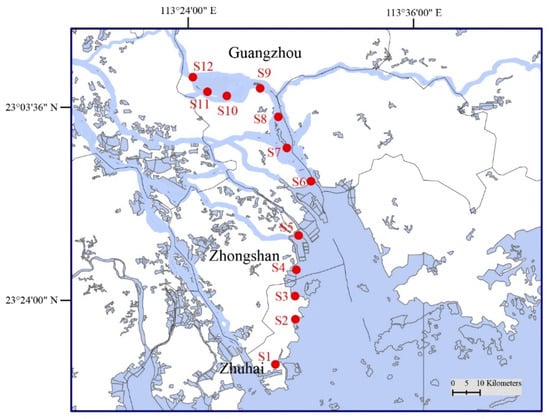
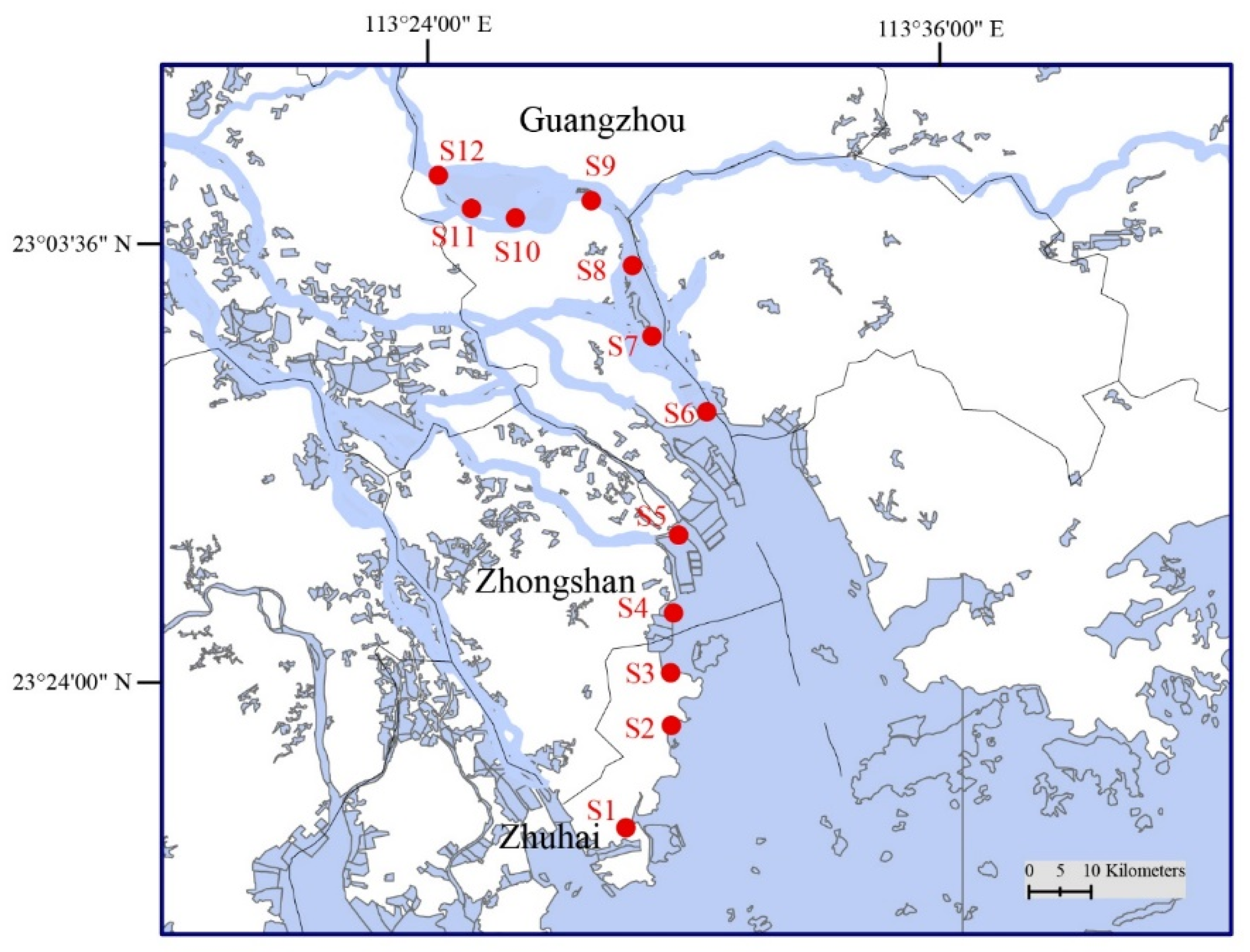
We collected surface water samples about one meter away from the shore at 12 sites (Figure 1) across the PRE in 15 August 2024. At each site, triplicate 500 mL water samples were collected in disposable sterile plastic bottles, pooled, homogenized, preserved at 4 °C, and transported to our laboratory for filtration within 24 h. Water samples were vacuum-filtered through 0.45 μm nitrocellulose filter membranes (Millipore, Burlington, MA, USA), with an equal volume of double-distilled H2O (ddH2O) included as filtration blank. To avoid cross-contamination, the filtering equipment was thoroughly rinsed with 10% sodium hypochlorite and double distilled water before use. The obtained filter membranes were transferred to 2 mL centrifuge tubes and stored frozen at −20 °C for subsequent DNA extraction.
Figure 1.
Sampling sites (S1–S12) in the Pearl River Estuary (PRE).
2.2. DNA Extraction and High Throughput Sequencing
eDNA was extracted from the filter membranes using DNeasy Blood & Tissue Kits (QIAGEN Ltd., West Sussex, UK) following the manufacturer’s instructions with minor modifications. Briefly, the filter membrane was cut into small pieces with sterile scissors in a 2 mL centrifuge tube, followed by adding 360 μL of ATL buffer and 40 μL of proteinase K. The mixture was incubated at 56 °C for 2 h, after which 400 μL of AL buffer and 400 μL of ethanol were added. The new mixture was centrifuged at 6000 rpm for one minute, and the supernatant was transferred to a DNeasy Mini spin column (QIAGEN Ltd., West Sussex, UK), followed by centrifugation at 8000 rpm for one minute. Then, 500 μL of AW1 buffer was added to the DNeasy Mini spin column (where eDNA was retained) and centrifugation was conducted at 8000 rpm for one minute, followed by adding 500 μL of AW2 buffer and centrifugating at 13,000 rpm for one minute. Finally, eDNA was eluted from the air-dried DNeasy Mini spin column by adding 80 μL of AE buffer and centrifugating at 13,000 rpm for three minutes. The quality and concentration of the extracted eDNA were determined using a Nanodrop One spectrophotometer (Nanodrop Technologies, Wilmington, DE, USA).
The vertebrate-universal primer pair V12S-U (Forward primer: GTGCCAGCNRCCGCGGTYANAC; Reverse primer: ATAGTRGGGTATCTAATCCYAGT), targeting a ~208 bp mitochondrial fragment of the 12S ribosomal RNA gene [23], was used to detect alien aquatic vertebrates in the PRE. Each PCR reaction (25 μL) included 12.5 μL of 2 × Taq PCR Master Mix (Cat: B639295, Sangon Biotech, Shanghai, China), 1 μL of each forward and reverse primers (10 pmol/μL), and 1 μL of 5-fold diluted DNA (final concentrations ranging from 10 to 30 ng/μL) to reduce potential PCR inhibition; the remaining volume was supplemented with ddH2O. Triplicate PCR amplifications for each eDNA sample were performed with initial denaturation at 95 °C for 10 min, followed by 35 cycles of denaturation at 95 °C for 30 s, annealing at 53 °C for 30 s, and extension at 72 °C for 30 s, with a final extension at 72 °C for five minutes. The PCR products were verified by 2.0% agarose gel electrophoresis, and no band was detected in the filtration blanks. The triplicate PCR products were pooled and purified using the SanPrep Column PCR Product Purification Kit (Cat: B518141, Sangon Biotech, Shanghai, China). The purified PCR products were used for library construction and subsequent sequenced on the Illumina NovaSeq PE150 platform (Illumina, San Diego, CA, USA).
2.3. Bioinformatics Processing
Raw reads were filtered to remove adapters, low-quality reads (average Phred quality score per read < 30) and shorter reads (<100 bp) using Trimmomatic v0.39 [33]. The obtained paired-end reads were merged into sequences using “--fastq_mergepairs” command with default settings using VSEARCH v 2.27.1 [34]. Primers and redundant sequences were removed from merged sequences using “--fastx_filter” command and “--derep_fulllength” command, respectively. We generated operational taxonomic units (OTUs) using the “--cluster-size” command with 98% similarity and removed chimeric sequences using the “--uchime_ref” command. An OTU table was generated by running the “--usearch_global” command. The rarefaction curve based on OTUs was plotted to assess whether the sequencing data for each sample was sufficient to cover the biodiversity using the R v 4.4.1 packages Vegan [35] and ggplot2 [36]. The sequencing depth threshold is chosen based on the minimum number of high-quality reads among 12 eDNA samples.
The raw reads of each OTU were normalized to reads per million (RPM) in each sample and used as a proxy for relative OTU abundance in subsequent analyses [37]. OTUs were annotated according to the best-hit by searching against the NR database from NCBI using SEED v1.46 [38] with the parameters of e value <10–80, minimum query coverage > 90% and similarity > 98% [39]. OTUs assigned to non-vertebrate species were discarded. Here, aquatic invasive vertebrate species were determined according to “GLOBAL INVASIVE SPECIES DATABASE (https://www.iucngisd.org; accessed on 10 January 2026), FishBase (https://www.fishbase.org; accessed on 8 January 2026), CABI Digital Library (https://www.cabidigitallibrary.org/; accessed on 11 January 2026), as well as peer-reviewed literature retrieved from China National Knowledge Infrastructure (https://www.cnki.net; accessed on 10 January 2026) and Web of Science Core Collection (https://webofscience.clarivate.cn/wos/woscc/smart-search; accessed on 15 January 2026)”.
2.4. Invasion Risk Assessment
The invasion risk of alien aquatic vertebrates in the PRE was assessed using the Aquatic Species Invasiveness Screening Kit (AS-ISK v2, http://www.cefas.co.uk/nns/tools/; accessed on 12 March 2026). The AS-ISK consists of 55 questions grouped into two main sections: the first 49 questions form the basic risk assessment (BRA), covering life history characteristics, biology, ecology, biogeography, and introduction history; the remaining six questions constitute the climate change assessment (CCA), which is designed to evaluate the invasive potential of alien species under current and projected climate scenarios [26]. The score range of the BRA for each species is from −20 to 68, while the score range expands from −32 to 80 (BRA + CCA) for the integrated assessment under climate change. According to the Köppen–Geiger climate classification [40], the PRE is categorized as a temperate climate zone. We determined a threshold of 15.9 for freshwater fishes via receiver operating characteristic (ROC) curve analysis [27]. This threshold was used to distinguish between medium-risk species (scores from 1 to 15.9) and high-risk species (scores > 15.9, ranging up to 68 for BRA and up to 80 for BRA + CCA) [41]. The assessment was performed by the first author, who answered each question based on supporting evidence and assigned the corresponding confidence level (CL) according to those responses. The CL is categorized into four grades (1 = low, 2 = medium, 3 = high, 4 = very high) [26]. Based on the CL assigned to each response, the confidence factor (CF) was calculated using the following formula [27]:
where CLQi denotes the confidence level assigned to the i-th question (Qi), 4 represents the maximum achievable confidence score (i.e., “very high”, as detailed above), and 55 is the total number of questions. Based on the 49 questions included in the BRA and the 6 questions in the CCA, the CLBRA and CLCCA were also calculated, which are derived from the total confidence level (CLtotal) across all 55 questions.
3. Results
3.1. Composition of Aquatic Vertebrates
High-throughput sequencing of 12 eDNA samples produced a total of 11,628,900 raw reads (NCBI BioProject accession number: PRJNA1434103); after quality filtration, we obtained 9,878,826 clean reads (84.95% of raw reads), with an average of 403,778 clean paired reads per sample, ranging from 185,107 to 986,121 clean paired reads (Table 1). After dereplication, OTU clustering, and chimera filtration, we obtained a total of 3694 OTUs. Rarefaction curves for all samples showed clear stabilization, indicating that the sequencing depth was sufficient to capture the biological diversity in each sample (Figure S1). Among the 3694 OTUs, 1006 OTUs were annotated as Chordata (Table S1), and assigned to five classes, 23 orders, 33 families, 56 genera, and 66 species (Table S2). Among these species, we found nine (13.6%) alien aquatic vertebrate species: Oreochromis niloticus, Pterygoplichthys pardalis, Cirrhinus mrigala, Aquarana catesbeiana, Labeo rohita, Ictalurus punctatus, Coptodon zillii, Gambusia affinis, and Neosalanx taihuensis (Table 2).
Table 1.
Summary of sequencing and quality filtration for each sample.
Table 2.
Relative read number (RPM) of alien aquatic vertebrate species.
3.2. Distribution and Relative Read Abundance of Alien Aquatic Vertebrates
eDNA analysis revealed five widely distributed alien aquatic vertebrates (Oreochromis niloticus, C. mrigala, P. pardalis, A. catesbeiana, and L. rohita). Signals of the first three alien aquatic vertebrates were detected across all 12 sampling sites (S1–S12). A. catesbeiana was found at all sampling sites except S2, and L. rohita was detected at all sampling sites except S6 and S12. The remaining four alien aquatic vertebrates were distributed at only few sampling sites. I. punctatus, C. zillii, G. affinis, and N. taihuensis were detected at only five (S1, S3, S7, S10, S11), five (S3, S4, S8, S10, S11), two (S9, S10), and two (S3, S7) sampling sites, respectively (Table 2). Among all 12 sampling sites, the highest number of alien species was detected at S3 (eight species) and S10 (eight species), followed by S7 (seven), S11 (seven), S1 (six), S4 (six), S8 (six), S9 (six), and S5 (five), while the lowest number of alien species was detected at S2 (four), S6 (four), and S12 (four) (Table 2).
The average relative sequence reads (RPM) per alien species was 6523, ranging from 337 for N. taihuensis to 24,413 for O. niloticus. The first three species with the highest read counts were O. niloticus (24,413), P. pardalis (22,770), and C. mrigala (7081). The remaining six alien species had relatively low relative sequence reads with less than 1086, indicating that both O. niloticus and P. pardalis were dominant alien aquatic vertebrates in the PRE. O. niloticus (9200) and P. pardalis (8737) were found with the highest relative sequence reads at S6, and were found with the lowest relative sequence reads at S8 and S9, respectively. The highest relative read counts were observed at S6 (18,038), followed by S11 (16,579). In contrast, the lowest relative read counts were observed at S5 (130) (Table 2).
3.3. Invasion Risk Assessment of Alien Aquatic Vertebrates
The BRA scores of the nine alien aquatic vertebrates ranged from 44 to 57, and their BRA + CCA scores ranged from 56 to 69, both of which exceeded the threshold of 15.9 for freshwater fish in temperate climate zones [27]. The confidence factors ranged from 0.75 to 0.85 for BRA scores, from 0.75 to 1.0 for CCA scores, and from 0.75 to 0.87 for BRA + CCA scores. Ranked by their combined BRA and BRA + CCA scores in ascending order, the species were P. pardalis, A. catesbeiana, C. zillii, O. niloticus, C. mrigala, I. punctatus, L. rohita, N. taihuensis, and G. affinis (Table 3), indicating that all nine alien aquatic vertebrates posed a high invasion risk in the PRE.
Table 3.
Invasion risk assessment of alien aquatic vertebrates in the Pearl River Estuary (PRE) based on the Aquatic Species Invasiveness Screening Kit (AS-ISK).
4. Discussion
In this study, we detected a total of nine alien aquatic vertebrate species in the PRE, including one amphibian species and eight fish species. Among these alien fish species, six species (I. punctatus, C. mrigala, C. zillii, G. affinis, O. niloticus, P. pardalis) have also been detected recently using eDNA with a fish-specific primer set (MiFish) in the Pearl River Basin [42] and subtropical estuaries, including the PRE [31]. Although the remaining two species (L. rohita, N. taihuensis) were not detected by eDNA in previous studies, they were captured with high abundance at several sampling sites using gill nets, fishing hooks, cage nets, and other types of fishing gear in the Pearl River Basin [32,43]. This inconsistency highlights the importance of integrating multiple complementary primer sets to holistically detect species composition using eDNA metabarcoding, given the bias of primers toward specific taxa [44]. A further assessment using the AS-ISK revealed that all nine alien aquatic vertebrates pose a high invasion risk in the PRE. Among the nine alien aquatic vertebrates, the invasion risks of six species (C. zillii, G. affinis, I. punctatus, O. niloticus, P. pardalis, C. mrigala) have been assessed in one previous study, which indicated high invasion risk for the first five species and middle invasion risk for the last species [42]. This comparison suggested high consistency regarding invasion risks of alien aquatic species between different studies in the PRE. Overall, the high invasion risk of these nine alien aquatic vertebrates highlighted potential ecological and economic damage to local ecosystems and the aquaculture industry.
Invasive species are typically characterized by wide distribution and high abundance [45]. Among the nine alien vertebrate species detected in this study, both O. niloticus and P. pardalis exhibit the widest distribution and highest relative abundance, being the dominant species of alien aquatic vertebrates in the PRE. Both dominant species may have had significantly negative impacts on native species in the PRE through predation, competition for food and habitats, and disturbance of benthic ecosystems [9,46]. This is supported by recent studies showing that the presence of O. niloticus and P. pardalis decreased population abundances and reduced the body sizes of native fish species, such as Geophagus brasiliensis [46], Cirrhina molitorella [47], and Ompok bimaculatus [48]. Compared with O. niloticus and P. pardalis, three species (C. mrigala, A. catesbeiana, and L. rohita) are less abundant but more widely distributed, occurring at over 83.3% of sampling sites. These three species were intentionally introduced to China for economic purposes. Aquaculture escape and artificial release served as the primary pathways for their entry into natural water bodies. Growing evidence has demonstrated that they can compete with native species for food and habitats, alter local community structures, reduce local biodiversity, and seriously threaten the stability of native ecosystems [49,50,51]. For example, both C. mrigala and L. rohita exhibit high niche overlap with the native species Cirrhinus molitorella, which consequently lead to population declines of C. molitorella [52]. As a typical opportunistic omnivorous predator, A. catesbeiana preys on any species smaller than its own body size [53]. One previous study conducted in Southwestern China revealed that this species exhibits a stronger predation preference for the endemic frog Babina pleuraden, leading to population declines of this native species [54]. Furthermore, A. catesbeiana invasion has led to a 40% decline in native amphibian populations in Uruguay [7]. Notably, the invasion pathways and ecological impacts of A. catesbeiana in Uruguay are highly consistent with those observed in the present study, indicating that the PRE ecosystem may face similar ecological risks from bullfrog invasion.
It is worth noting that although I. punctatus, C. zillii, G. affinis, and N. taihuensis exhibit low abundance and restricted distribution, the AS-ISK assessment still gives them relatively high invasion risk scores, indicating that current low abundance does not imply low ecological threat. The PRE is an estuarine area strongly affected by anthropogenic disturbances, such as frequent shipping activities and increased coastal aquaculture intensity, which may provide favorable conditions for the dispersal and outbreak of low-abundance alien species [28,49,55]. Therefore, these low-abundance but high-risk species should be prioritized for monitoring, calling for early prevention and control measures to prevent irreversible damage to the PRE ecosystem. The reliability and efficacy of eDNA have been verified in various aquatic bodies by many studies (e.g., [31,56]). However, there are also substantial limitations, such as difficulties to accurately quantify abundance, potential biases due to primers and PCR, and inability to distinguish between live and death [44]. In addition, eDNA is susceptible to contamination during sample collection, transportation, filtration, and PCR amplification. Therefore, it is advisable to set sampling blanks, filtration blanks, and PCR blanks for filtering out potential contamination, and to cross-check the species list with traditional morphology-based methods to avoid overestimating species diversity.
Future studies should prioritize long-term, continuous eDNA monitoring in the PRE to clarify the spatio-temporal dynamics of alien aquatic vertebrates and explore how their population changes respond to environmental factors (e.g., salinity, temperature, human disturbance). For alien aquatic vertebrates with high invasion risk, field investigations and laboratory simulation experiments are needed to reveal their ecological adaptation mechanisms and damage to native ecosystems in the estuarine environment. For alien aquaculture species, it is urgent to strengthen management to prevent escape from aquaculture farms and to prioritize these species based on their risk scores. Science-based artificial releases should be advocated to avoid the release of alien species. Additionally, ecological restoration (e.g., native species reintroduction, habitat improvement) should be implemented in high-risk regions to enhance native ecosystem resistance to alien species invasions.
5. Conclusions
This study employed eDNA metabarcoding to reveal the species composition of alien aquatic vertebrates at 12 sampling sites in the PRE. eDNA analysis detected a total of nine alien aquatic vertebrate species, all of which showed a high invasion risk according to the AS-ISK assessment. Both O. niloticus and P. pardalis, with wide distribution and high abundance, are currently the dominant invasive species in the PRE. C. mrigala, A. catesbeiana, and L. rohita have moderate abundance but wide distribution, with significant dispersal potential. The remaining four species (I. punctatus, C. zillii, G. affinis, and N. taihuensis) have low abundance and restricted distribution but high invasion risk, and their potential threats cannot be ignored. We acknowledge that using eDNA technology to detect alien aquatic vertebrates has certain limitations, including false positives, inability to distinguish between live populations and transient DNA signals, and quantitative limitations. Additional research coupling eDNA with other methods (e.g., eRNA and traditional methods) is needed to gain comprehensive insight into invasion risks in the PRE.
Supplementary Materials
The following supporting information can be downloaded at: https://www.mdpi.com/article/10.3390/d18050252/s1. Figure S1: Rarefaction curve for each sample based on eDNA analysis; Table S1: OTUs assigned as Chordata and relative abundance at each sampling site; Table S2: Chordatas and their relative abundance (reads per million) at each sampling site.
Author Contributions
Conceptualization, Y.W. and Y.G.; methodology, Y.W. and J.Y.; investigation, J.Y. and M.Z.; writing—original draft preparation, Y.W. and J.Y.; writing—review and editing, Y.W. and Y.G.; funding acquisition, Y.W. and Y.G. All authors have read and agreed to the published version of the manuscript.
Funding
This research was funded by the National Natural Science Foundation of China (32371753), the Guangdong Basic and Applied Basic Research Foundation (2024A1515010914), and GDAS’ Project of Science and Technology Development (2022GDASZH-2022010106).
Institutional Review Board Statement
Not applicable.
Data Availability Statement
The original contributions presented in this study are included in the article/Supplementary Material. Further inquiries can be directed to the corresponding author.
Conflicts of Interest
Author Jiangbo Yang was employed by the company Guangzhou CAOMUFAN Ecological Research Co., Ltd. The remaining authors declare that the research was conducted in the absence of any commercial or financial relationships that could be construed as a potential conflict of interest.
References
- Diagne, C.; Leroy, B.; Vaissière, A.C.; Gozlan, R.E.; Roiz, D.; Jaric, I.; Salles, J.M.; Bradshaw, C.J.A.; Courchamp, F. High and rising economic costs of biological invasions worldwide. Nature 2021, 592, 571–576. [Google Scholar] [CrossRef] [Scilit]
- Early, R.; Bradley, B.A.; Dukes, J.S.; Lawler, J.J.; Olden, J.D.; Blumenthal, D.M.; Gonzalez, P.; Grosholz, E.D.; Ibañez, I.; Miller, L.P.; et al. Global threats from invasive alien species in the twenty-first century and national response capacities. Nat. Commun. 2016, 7, 12485. [Google Scholar] [CrossRef] [Scilit]
- Zhu, G.L.; Tang, Y.Y.; Limpanont, Y.; Wu, Z.D.; Li, J.; Lv, Z.Y. Zoonotic parasites carried by invasive alien species in China. Infect. Dis. Poverty 2019, 8, 2. [Google Scholar] [CrossRef] [Scilit]
- Wei, Y.F.; Wu, C.Y.; Zhang, S.S.; Xia, Z.Q.; Gao, Y.C. eDNA analysis reveals high invasion risks in nature reserves in Guangdong Province, China. Front. Mar. Sci. 2024, 11, 1462123. [Google Scholar] [CrossRef] [Scilit]
- Dong, B.; Liu, D. The situation, influence and management methods of alien aquatic organism invasion in China. Period. Ocean Univ. China 2024, 54, 134–144. Available online: https://html.rhhz.net/ZGHYDXXBZRKXB/html/20241011.htm (accessed on 12 March 2026). (In Chinese with English Abstract).
- Wang, L.J.; Wan, F.H.; Qian, W.Q. Research and prospects of environmental DNA (eDNA) for detection of invasive aquatic species in East Asia. Front. Mar. Sci. 2023, 10, 1284953. [Google Scholar] [CrossRef] [Scilit]
- Laufer, G.; Gobel, N.; Alcántara, I.; Kacevas, N.; Cortizas, S. Effects of biological invasions and habitat degradation on amphibian populations in Cerro Largo, Uruguay. Conserv. Biol. 2025, 39, e70107. [Google Scholar] [CrossRef] [Scilit]
- Gong, S.P.; Gao, Y.C.; Duan, H.R.; Ge, Y.; Wei, Y.F. Incorporating physiological data into species distribution models to predict the potential distribution range of the red-eared slider in China. Ecol. Indic. 2023, 154, 110749. [Google Scholar] [CrossRef] [Scilit]
- Orfinger, A.B.; Goodding, D.D. The global invasion of the suckermouth armored catfish genus Pterygoplichthys (Siluriformes: Loricariidae): Annotated list of species, distributional summary, and assessment of impacts. Zool. Stud. 2018, 57, 7. [Google Scholar] [CrossRef] [Scilit]
- Shuai, F.M.; Li, J. Nile Tilapia (Oreochromis niloticus Linnaeus, 1758) invasion caused trophic structure disruptions of fish communities in the south China River-Pearl River. Biology 2022, 11, 1665. [Google Scholar] [CrossRef] [Scilit]
- Harvey, C.T.; Qureshi, S.A.; MacIsaac, H.J. Detection of a colonizing, aquatic, non-indigenous species. Divers. Distrib. 2009, 15, 429–437. [Google Scholar] [CrossRef] [Scilit]
- Çevik, T.; Çevik, N. Environmental DNA (eDNA): A review of ecosystem biodiversity detection and applications. Biodivers. Conserv. 2025, 34, 2999–3035. [Google Scholar] [CrossRef] [Scilit]
- Adrian-Kalchhauser, I.; Burkhardt-Holm, P. An eDNA assay to monitor a globally invasive fish species from flowing freshwater. PLoS ONE 2016, 11, e0147558. [Google Scholar] [CrossRef] [Scilit] [PubMed]
- Xia, Z.Q.; Gu, J.N.; Wen, Y.; Cao, X.K.; Gao, Y.C.; Li, S.G.; Haffner, G.D.; MacIsaac, H.J.; Zhan, A.B. eDNA-based detection reveals invasion risks of a biofouling bivalve in the world’s largest water diversion project. Ecol. Appl. 2024, 34, e2826. [Google Scholar] [CrossRef] [Scilit] [PubMed]
- Xia, Z.Q.; Zhan, A.B.; Gao, Y.C.; Zhang, L.; Haffner, G.D.; MacIsaac, H.J. Early detection of a highly invasive bivalve based on environmental DNA (eDNA). Biol. Invasions 2018, 20, 437–447. [Google Scholar] [CrossRef] [Scilit]
- Mirimin, L.; Desmet, S.; Romero, D.L.; Fernandez, S.F.; Miller, D.L.; Mynott, S.; Brincau, A.G.; Stefanni, S.; Berry, A.; Gaughan, P.; et al. Don’t catch me if you can—Using cabled observatories as multidisciplinary platforms for marine fish community monitoring: An in situ case study combining underwater video and environmental DNA data. Sci. Total Environ. 2021, 773, 145351. [Google Scholar] [CrossRef] [Scilit]
- Trebitz, A.S.; Hoffman, J.C.; Peterson, G.S.; Hatzenbuhler, C.; Pilgrim, E.; Okum, S.; Chadderton, W.L.; Tucker, A.J.; Bogyo, N.; Myers, J.T. Fish composition in a complex freshwater estuary: Environmental DNA metabarcoding versus capture surveys. Trans. Am. Fish. Soc. 2025, 154, 657–674. [Google Scholar] [CrossRef] [Scilit]
- Ji, C.W.; Oh, H.J.; Chang, K.H.; Park, Y.S.; Kwak, I.S. A comparative analyzing of zooplankton community diversity in surface layer water of reservoir via eDNA metabarcoding and microscopy. Diversity 2022, 14, 797. [Google Scholar] [CrossRef] [Scilit]
- Zhou, C.H.; Zhu, C.M.; Cheng, Y.Z.; Lei, Y.; Nan, Y.; Ouyang, S.; Wu, X.P. Exploring freshwater snail diversity and community structure in china’s largest lake using eDNA technology. Ecol. Indic. 2024, 158, 111577. [Google Scholar] [CrossRef] [Scilit]
- Li, W.H.; Hou, X.L.; Zhu, Y.L.; Du, J.C.; Xu, C.X.; Yang, J.Y.; Li, Y.M. eDNA metabarcoding reveals the species-area relationship of amphibians on the Zhoushan archipelago. Animals 2024, 14, 1519. [Google Scholar] [CrossRef] [Scilit]
- Valsecchi, E.; Bylemans, J.; Goodman, S.J.; Lombardi, R.; Carr, I.; Castellano, L.; Galimberti, A.; Galli, P. Novel universal primers for metabarcoding environmental DNA surveys of marine mammals and other marine vertebrates. Environ. DNA 2020, 2, 460–476. [Google Scholar] [CrossRef] [Scilit]
- Vences, M.; Lyra, M.L.; Perl, R.G.B.; Bletz, M.C.; Stankovic, D.; Lopes, C.M.; Jarek, M.; Bhuju, S.; Geffers, R.; Haddad, C.F.B.; et al. Freshwater vertebrate metabarcoding on Illumina platforms using double-indexed primers of the mitochondrial 16S rRNA gene. Conserv. Genet. Resour. 2016, 8, 323–327. [Google Scholar] [CrossRef] [Scilit]
- Wang, Z.C.; Liu, X.L.; Liang, D.; Wang, Q.Y.; Zhang, L.; Zhang, P. VertU: Universal multilocus primer sets for eDNA metabarcoding of vertebrate diversity, evaluated by both artificial and natural cases. Front. Ecol. Evol. 2023, 11, 1164206. [Google Scholar] [CrossRef] [Scilit]
- Wang, Q.Y.; Han, X.S.; Wang, Z.C.; Zheng, K.D.; Dong, Z.Y.; Zhang, P.; Fan, P.F.; Zhang, L. Eurasian otters prefer to prey on religious released non-native fish on the Qinghai-Tibetan Plateau. Curr. Zool. 2023, 70, 472–479. [Google Scholar] [CrossRef] [Scilit]
- Pheloung, P.C.; Williams, P.A.; Halloy, S.R. A weed risk assessment model for use as a biosecurity tool evaluating plant introductions. J. Environ. Manag. 1999, 57, 239–251. [Google Scholar] [CrossRef] [Scilit]
- Copp, G.H.; Vilizzi, L.; Tidbury, H.; Stebbing, P.D.; Tarkan, A.S.; Miossec, L.; Goulletquer, P. Development of a generic decision-support tool for identifying potentially invasive aquatic taxa: AS-ISK. Manag. Biol. Invasion 2016, 7, 343–350. [Google Scholar] [CrossRef] [Scilit]
- Vilizzi, L.; Copp, G.H.; Hill, J.E.; Adamovich, B.; Aislabie, L.; Akin, D.; Al-Faisal, A.J.; Almeida, D.; Azmai, M.N.A.; Bakiu, R.; et al. A global-scale screening of non-native aquatic organisms to identify potentially invasive species under current and future climate conditions. Sci. Total Environ. 2021, 788, 147868. [Google Scholar] [CrossRef] [Scilit]
- Zhou, L.; Wang, G.P.; Kuang, T.X.; Guo, D.L.; Li, G.F. Fish assemblage in the Pearl River Estuary: Spatial-seasonal variation, environmental influence and trends over the past three decades. J. Appl. Ichthyol. 2019, 35, 884–895. [Google Scholar] [CrossRef] [Scilit]
- Mai, Y.Z.; Wang, X.S.; Peng, S.Y.; Tie, H.; Cai, Y.J.; Chen, H.M.; Peng, M.J.; Wang, Y.F.; Li, H.Y.; Zeng, Y.; et al. Supporting evidence for the “Ten-Year Fishing Ban”: Different modes of fishing and pollution induce a fish diversity decline between the Pearl River and its estuary. ACS ES&T Water 2023, 3, 2590–2603. [Google Scholar] [CrossRef] [Scilit]
- Ma, J.J.; Chen, H.G.; Zhang, Z.; Fei, T.; Tang, Z.Z.; Xiong, Q.; Zhang, L.B. Interannual variation of fish communities and their environmental factors in Pearl River Estuary from 2018 to 2023. South China Fish. Sci. 2024, 20, 62–73. [Google Scholar] [CrossRef]
- Chen, W.J.; Wang, J.J.; Zhao, Y.Q.; He, Y.Y.; Chen, J.L.; Dong, C.Y.; Liu, L.; Wang, J.; Zhou, L. Contrasting pollution responses of native and non-native fish communities in anthropogenically disturbed estuaries unveiled by eDNA metabarcoding. J. Hazard. Mater. 2024, 480, 136323. [Google Scholar] [CrossRef] [Scilit]
- Gu, D.E.; Hu, Y.C.; Xu, M.; Wei, H.; Luo, D.; Yang, Y.X.; Yu, F.D.; Mu, X.D. Fish invasion in the river systems of Guangdong Province, South China: Possible indicators of their success. Fish. Manag. Ecol. 2018, 25, 44–53. [Google Scholar] [CrossRef] [Scilit]
- Bolger, A.M.; Lohse, M.; Usadel, B. Trimmomatic: A flexible trimmer for Illumina sequence data. Bioinformatics 2014, 30, 2114–2120. [Google Scholar] [CrossRef] [Scilit] [PubMed]
- Rognes, T.; Flouri, T.; Nichols, B.; Quince, C.; Mahé, F. VSEARCH: A versatile open source tool for metagenomics. PeerJ 2016, 4, e2584. [Google Scholar] [CrossRef] [Scilit]
- Dixon, P. VEGAN, a package of R functions for community ecology. J. Veg. Sci. 2003, 14, 927–930. [Google Scholar] [CrossRef]
- Ginestet, C. ggplot2: Elegant Graphics for Data Analysis. J. R. Stat. Soc. Ser. A-Stat. Soc. 2011, 174, 245. [Google Scholar] [CrossRef] [Scilit]
- Hirai, J.; Yasuike, M.; Fujiwara, A.; Nakamura, Y.; Hamaoka, S.; Katakura, S.; Takano, Y.; Nagai, S. Effects of plankton net characteristics on metagenetic community analysis of metazoan zooplankton in a coastal marine ecosystem. J. Exp. Mar. Biol. Ecol. 2015, 469, 36–43. [Google Scholar] [CrossRef] [Scilit]
- Větrovský, T.; Baldrian, P. Analysis of soil fungal communities by amplicon pyrosequencing: Current approaches to data analysis and the introduction of the pipeline SEED. Biol. Fertil. Soils 2013, 49, 1027–1037. [Google Scholar] [CrossRef] [Scilit]
- Cilleros, K.; Valentini, A.; Allard, L.; Dejean, T.; Etienne, R.; Grenouillet, G.; Iribar, A.; Taberlet, P.; Vigouroux, R.; Brosse, S. Unlocking biodiversity and conservation studies in high-diversity environments using environmental DNA (eDNA): A test with Guianese freshwater fishes. Mol. Ecol. Resour. 2019, 19, 27–46. [Google Scholar] [CrossRef] [Scilit]
- Peel, M.C.; Finlayson, B.L.; McMahon, T.A. Updated world map of the Koppen-Geiger climate classification. Hydrol. Earth Syst. Sci. 2007, 11, 1633–1644. [Google Scholar] [CrossRef] [Scilit]
- Vilizzi, L.; Piria, M.; Copp, G.H. Which calibrated threshold is appropriate for ranking non-native species using scores generated by WRA-type screening toolkits that assess risks under both current and future climate conditions? Manag. Biol. Invasion 2022, 13, 593–608. [Google Scholar] [CrossRef] [Scilit]
- Li, J.; Chen, W.; Li, Y.; He, Y.; Zhao, Y.; Gong, Z.; Li, J.; Zhou, L. Monitoring and invasion risk assessment of exotic fishes in the Pearl River Basin based on environmental DNA metabarcoding technology. J. Fish. China 2026, 50, 029309. [Google Scholar] [CrossRef]
- Gao, T.Y.; Xie, D.; Peng, N.D.; Li, C.; Zhang, S.P.; Luo, J.Z.; Wang, C.H.; Zhao, J. Fish community structure and its relationships with environmental factors in the Beijiang River. Freshw. Fish. 2017, 47, 47–55. [Google Scholar] [CrossRef]
- Shaffer, M.R.; Allan, E.A.; Van Cise, A.M.; Parsons, K.M.; Shelton, A.O.; Kelly, R.P. Observation bias in metabarcoding. Mol. Ecol. Resour. 2025, 25, e14119. [Google Scholar] [CrossRef] [Scilit] [PubMed]
- Fristoe, T.S.; Chytry, M.; Dawson, W.; Essl, F.; Heleno, R.; Kreft, H.; Maurel, N.; Pergl, J.; Pysek, P.; Seebens, H.; et al. Dimensions of invasiveness: Links between local abundance, geographic range size, and habitat breadth in Europe’s alien and native floras. Proc. Natl. Acad. Sci. USA 2021, 118, e2021173118. [Google Scholar] [CrossRef] [Scilit] [PubMed]
- Sanches, F.H.C.; Miyai, C.A.; Costa, T.M.; Christofoletti, R.A.; Volpato, G.L.; Barreto, R.E. Aggressiveness Overcomes Body-Size Effects in Fights Staged between Invasive and Native Fish Species with Overlapping Niches. PLoS ONE 2012, 7, e29746. [Google Scholar] [CrossRef] [Scilit]
- Gu, D.E.; Ma, G.M.; Zhu, Y.J.; Xu, M.; Luo, D.; Li, Y.Y.; Wei, H.; Mu, X.D.; Luo, J.R.; Hu, Y.C. The impacts of invasive Nile tilapia (Oreochromis niloticus) on the fisheries in the main rivers of Guangdong Province, China. Biochem. Syst. Ecol. 2015, 59, 1–7. [Google Scholar] [CrossRef] [Scilit]
- Hussan, A.; Naik, A.T.; Adhikari, S.; Das, A.; Hoque, F.; Sahoo, P.K.; Sundaray, J.K. Invasive Amazon sailfin catfish (Pterygoplichthys pardalis) impacts the survivability and growth of native food fishes in India. Aquat. Living Resour. 2025, 38, 5. [Google Scholar] [CrossRef] [Scilit]
- Tu, W.S.; Li, Y.X.; Du, Y.B.; Ding, J.; Zhang, Q.; Xi, Y.H.; Wang, Y.C.; Han, L.X.; Qi, T.Y.; Zhao, Z.X.; et al. Invasive predator reshapes island trophic network and biogeography. Curr. Biol. 2026, 36, 38–48.e4. [Google Scholar] [CrossRef] [Scilit]
- Zhu, N.B.; Xu, R.P.; Qu, X.L.; Gao, F.Y.; Li, X.A.; Wangkahart, E.; Liu, L.H.; Wu, M.B.; Xu, H.S. Pathogenicity of Elizabethkingia miricola causing mass mortalities of American bullfrog (Aquarana catesbeiana) and its induced host immune response. Microb. Pathog. 2026, 210, 108139. [Google Scholar] [CrossRef] [Scilit]
- Xing, D.C.; Zhu, X.S. Niche overlap between native Cirrhinus molitorella and potential invasive competitors. Environ. Res. 2024, 248, 118407. [Google Scholar] [CrossRef] [Scilit]
- Lawler, S.P.; Dritz, D.; Strange, T.; Holyoak, M. Effects of introduced mosquitofish and bullfrogs on the threatened California red-legged frog. Conserv. Biol. 1999, 13, 613–622. [Google Scholar] [CrossRef] [Scilit]
- Liu, X.; Luo, Y.; Chen, J.X.; Guo, Y.S.; Bai, C.M.; Li, Y.M. Diet and prey selection of the invasive American Bullfrog (Lithobates catesbeianus) in Southwestern China. Asian Herpetol. Res. 2015, 6, 34–44. [Google Scholar] [CrossRef]
- Shang, L.X.; Zhai, X.Y.; Tian, W.; Liu, Y.Y.; Han, Y.C.; Deng, Y.Y.; Hu, Z.X.; Tang, Y.Z. Pseudocochlodinium profundisulcus resting cysts detected in the ballast tank sediment of ships arriving in the ports of china and north america and the implications in the species’ geographic distribution and possible invasion. Int. J. Environ. Res. Public Health 2022, 19, 299. [Google Scholar] [CrossRef] [Scilit] [PubMed]
- Shi, J.; Wang, T.; Li, C.H.; Zhao, J.F.; Kang, Z.P.; Song, X.Y.; Liu, Y. Food web structure and trophic diversity for the fishes of four islands in the Pearl River Estuary, China. Ecol. Indic. 2024, 160, 111916. [Google Scholar] [CrossRef] [Scilit]
- Li, Z.Y.; Jiang, P.W.; Wang, L.X.; Liu, L.; Li, M.; Zou, K.S. A comparison of seasonal composition and structure of fish community between environmental DNA technology and gillnetting in the Pearl River Estuary, China. Ecol. Indic. 2023, 147, 109915. [Google Scholar] [CrossRef] [Scilit]

Disclaimer/Publisher’s Note: The statements, opinions and data contained in all publications are solely those of the individual author(s) and contributor(s) and not of MDPI and/or the editor(s). MDPI and/or the editor(s) disclaim responsibility for any injury to people or property resulting from any ideas, methods, instructions or products referred to in the content. |
© 2026 by the authors. Licensee MDPI, Basel, Switzerland. This article is an open access article distributed under the terms and conditions of the Creative Commons Attribution (CC BY) license.