


Abstract
Historical fungaria serve as critical repositories for documenting fungal diversity and establishing historical baselines, particularly in biodiversity hotspots. This study presents a systematic revision of the mycological collection of Odoardo Beccari, gathered during expeditions to Southeast Asia and Oceania (1865–1878). While part of this collection was examined by Vincenzo Cesati in 1879, a substantial portion remained unstudied at the Natural History Museum, University of Florence, for over 150 years. We conducted a morphological examination (macro- and microscopy) and catalogued 153 fungal specimens. Taxonomic identities were assigned following current nomenclatural standards and cross-referenced with modern databases, including the Checklist of Fungi of Malaysia and the Global Biodiversity Information Facility (GBIF). Of these, 84 specimens were identified to species level and 36 to genus level. The collection also includes four specimens corresponding to material used for the original description of species (type material). Nearly 50% of the taxa collected exclusively in Borneo are absent from modern regional checklists, highlighting significant gaps in current knowledge of mycobiota. GBIF data confirm Beccari as the earliest documented collector of fungal specimens in the rainforests of Sarawak. By documenting taxa not recollected in over a century, this study establishes a crucial historical baseline for fungal diversity in Borneo and provides valuable historical data for Sumatra. All specimen data are now publicly available through GBIF.
1. Introduction
Historical herbaria and fungaria represent invaluable repositories of information, offering unique insights into past ecosystems and providing essential data for understanding biodiversity changes over time [1]. These archives grant access to vast amounts of material that serve as a fundamental resource, providing a collection of specimens that would be impossible for any single researcher to gather in a lifetime [2]. Numerous recent studies emphasize the significance of historical herbarium collections [1,3,4,5], particularly those housed in fungaria, recognizing their importance as verifiable evidence of a neglected organism’s occurrence at a specific location and time [6,7].
The progress of knowledge in natural sciences is largely linked to the lively activity of explorers and scientists between the 16th and 20th centuries. In this era of exploratory fervour, expeditions transitioned from purely colonial endeavours to rigorous scientific journeys, inspired by the legendary voyages of figures such as James Cook (1728–1779), Alexander Von Humboldt (1769–1859), Philip Barker Webb (1773–1854), David Livingstone (1813–1873), Alfred Russell Wallace (1823–1913), Henry Stanley (1841–1904) and Charles Darwin (1809–1892). Within this context, Odoardo Beccari (1843–1920) emerged as a leading figure of Italian scientific culture. A multifaceted naturalist, Beccari’s interests spanned botany, zoology, physical geography, and ethno-anthropology [8].
Between 1865 and 1878, Beccari undertook three major expeditions to Southeast Asia and Oceania, focusing primarily on historical Malaysia, including Borneo, Sumatra, Java, and New Guinea [9]. His first exploration (1865–1868) in the Sarawak region of Borneo led to the publication of “Nelle foreste di Borneo” [10,11], a fundamental scientific text also for its meticulous descriptions of new species. The immense naturalistic materials he repatriated from these regions, including his later explorations of Mount Singalang in Sumatra [12], garnered him international acclaim and led to the publication of over 150 articles and the founding of the journal Malesia [13].
According to Salleh et al. [14], specimens preserved in natural history museums, such as those gathered by Beccari, are crucial for understanding how species diversity and distribution vary across space and time. These records are essential for analyzing fungal diversity patterns and range shifts, serving as “an entirely unique historic record of global fungal diversity” [15].
Considering this, the present study aims to document Beccari’s long-overlooked historical collection of macrofungi through a detailed macro- and microscopic analysis. Beyond providing a taxonomic account of these specimens, this research compares the findings with available regional checklists and integrates data deriving from the Global Biodiversity Information Facility (GBIF). This comparative approach seeks to identify overlooked records and underexplored regions, ultimately highlighting critical gaps in our current biodiversity knowledge of Malaysia and bridging the gap between 19th-century exploration and modern conservation science.
2. Materials and Methods
2.1. The Collections and Herbaria of Odoardo Beccari
Odoardo Beccari’s expeditions yielded tens of thousands of specimens, now distributed across several institutions. While the zoological and ethno-anthropological materials are primarily housed at the “Giacomo Doria” Natural History Museum in Genoa, the bulk of the botanical and mycological heritage is preserved at the Natural History Museum of the University of Florence (FI, Italy) [12].
The Florentine collection is organized into three main units: the Herbarium Beccarianum, also called Malesian Herbarium (FI-HB), the Herbarium Palmarum (FI-HP), and various carpological and xylological appendices. FI-HB alone contains over 16,000 specimens, including the type of Amorphophallus titanum (Becc.) Becc., and remains arranged according to Beccari’s original, albeit outdated, systematic criteria [12]. Three main geographical sub-collections, from Borneo, Papua, and Sumatra, are embedded in it, with additional materials from mainly the Maluku Islands, Sulawesi, and Sri Lanka [12].
Regarding the mycological material, the primary collection from Beccari’s first Borneo expedition was studied and described by Vincenzo Cesati [16]. Most of these vouchers are currently embedded within the Herbarium Cesatianum at the Sapienza University of Rome (RO-HC, Italy) [17]. However, a significant set of “residual” and largely unidentified specimens remained at the University of Florence (FI). This, in some way, forgotten material, which remained mostly devoid of taxonomic revision for 150 years, constitutes the primary object of the present study.
2.2. Taxonomic Revision and Identification
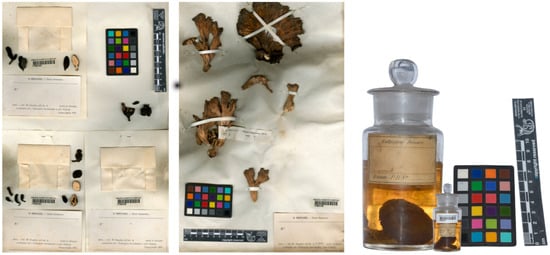
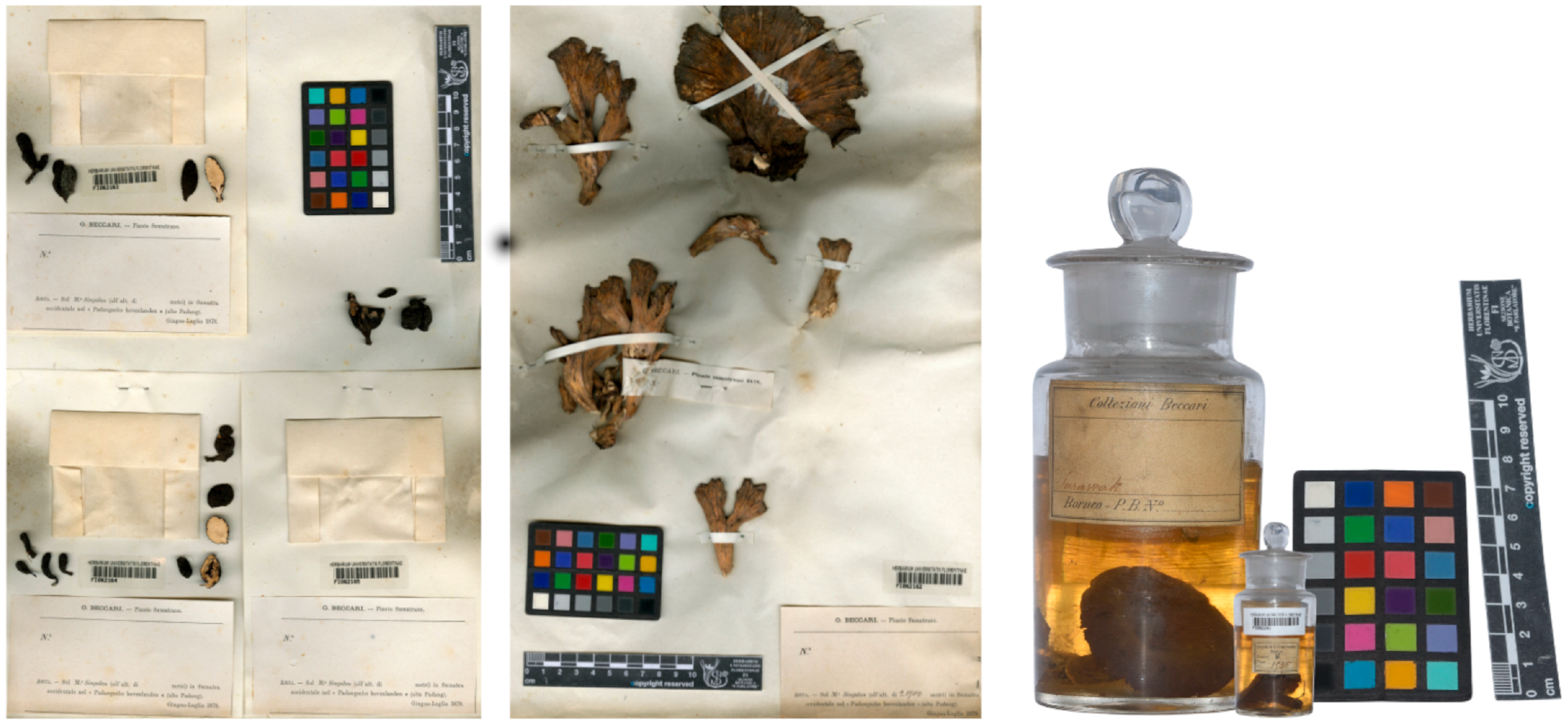
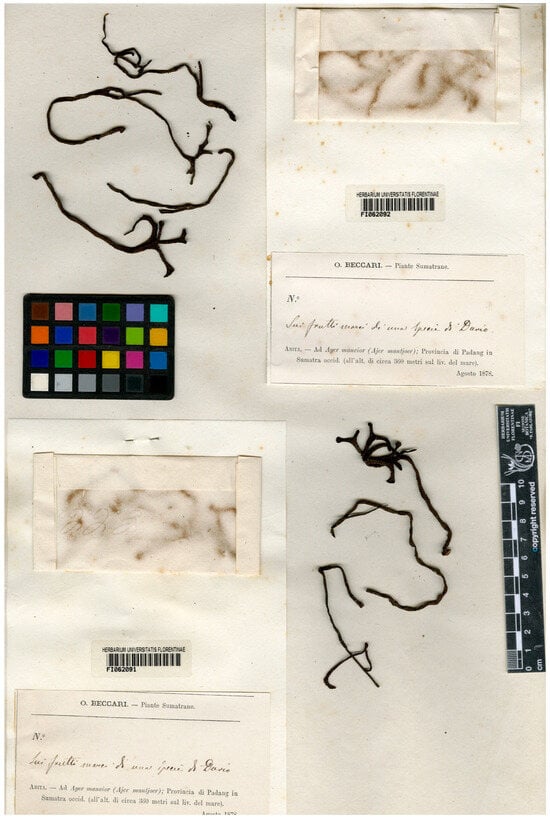
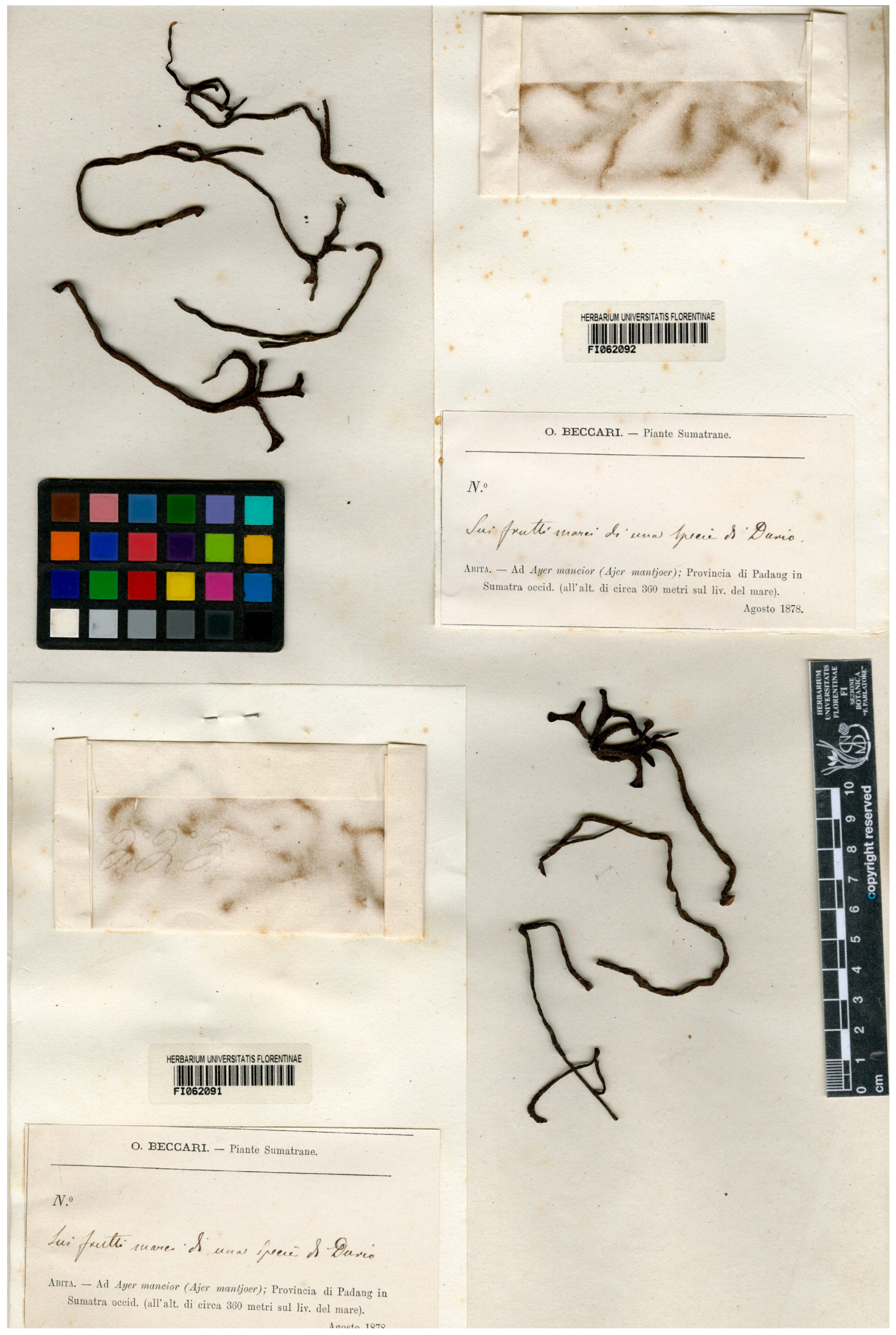
To facilitate analysis, the Beccari mycological collection, including both exsiccata and fluid-preserved specimens (Figure 1), was transferred to the cryptogamic room of the FI Herbarium. As the collection lacked prior taxonomic arrangement, a preliminary macroscopic assessment was conducted to confirm the specimens’ membership in the Kingdom Fungi, to evaluate their conservation status, and to provide an initial broad taxonomic placement. Following this phase, each specimen was assigned a unique identification code and underwent photographic digitization by means of an Epson Expression 10000XL (herbarium sheets from FI-HB) and a D7200 Nikon camera (Tokyo, Japan) with an AF 60 mm f/2.8 D Micro lens (specimens from the ancillary collection, FI-CAR). Digital images were acquired using standardized photographic protocols, including colour calibration scales and metric rulers, to ensure accurate chromatic representation and dimensional estimation during subsequent consultations (Figure 1).
Figure 1.
Overview of the Beccari mycological collection housed at the FI Herbarium, illustrating the two main preservation types: exsiccata (left) and fluid-preserved specimens (right). Representative specimens are shown as digitized using standardized photographic protocols, including specimen identification codes, a colour calibration scale, and a metric ruler.
Microscopic analysis was performed using a Zeiss-Axiostar plus microscope (Göttingen, Germany) to achieve precise taxonomic determination. Due to the age of the material and the presence of significant residual deposits and crystalline structures, all samples (dried and jarred) underwent a preliminary wash in potassium hydroxide (KOH at 5% or 30%). Taxonomic identification was carried out using specialized analytical keys, monographs and online consultation [18,19,20,21,22,23,24,25,26,27,28,29] and nomenclature following the CABI list (www.indexfungorum.org, accessed on 30 January 2026) [30], updated in January 2026. Identifications rely on the morphological analysis of historical specimens. For taxa with broad distributions or recognized species complexes, names are used in a broad sense (sensu lato, s.l.). When the condition of the specimens did not permit precise identification, they were intentionally classified at higher taxonomic levels (such as genus, family, order or phylum) to prevent misinterpretation.
Finally, the taxa identified at the genus and species levels were organized into a systematic and comprehensive database provided as Supplementary Material (Table S1). Data were cross-referenced with fungi checklists for Malaysia (including Borneo, Sarawak and Sabah) [31], whereas no equivalent comparison was conducted for Sumatra due to the absence of comprehensive and up-to-date regional checklists.
The whole specimen dataset is also accessible through GBIF ([32] accessed on 21 April 2026).
2.3. GBIF Data Extraction and Comparative Analysis
To contextualize the historical significance of the collection and identify potential gaps in current knowledge, data on fungal specimens collected in Malaysia and preserved in herbaria worldwide were extracted from the Global Biodiversity Information Facility (GBIF.org, accessed on 25 July 2025, GBIF Occurrence Download https://doi.org/10.15468/dL.kaj8n6; [33]).
The search query was restricted to the Kingdom Fungi and refined using the following filters: preserved specimens, material samples, and human observations, all limited to records with valid geospatial coordinates within Malaysia. The resulting dataset, downloaded in CSV format, was primarily used to further exclude the existence of neglected mycological explorations in the Sarawak region (Malaysian Borneo) prior to Beccari’s first expedition (1865–1868). Furthermore, GBIF records were consulted to cross-reference species missing from modern regional checklists, accounting for overlooked herbarium specimens or field observations recorded by researchers and citizen scientists.
3. Results
3.1. Collection Structure and Preservation Modes
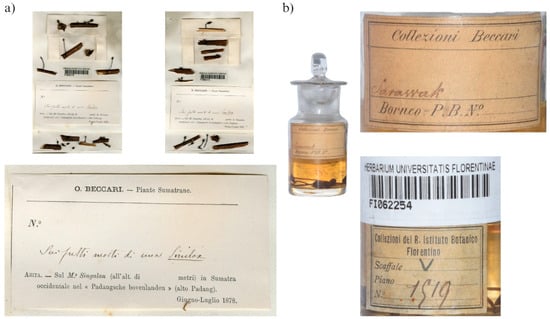
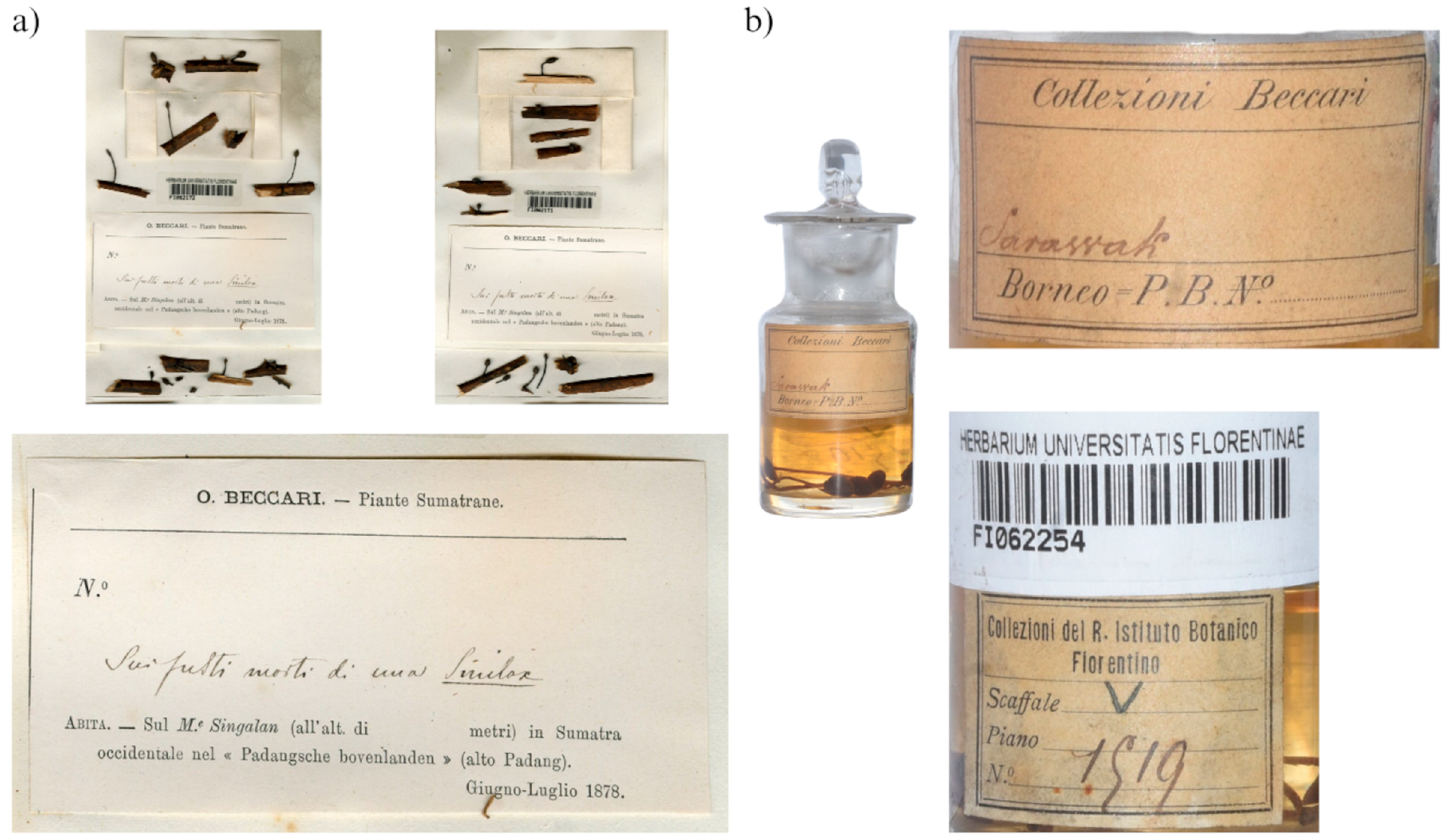
The historical mycological collection of Odoardo Beccari here concerned consists of 201 specimens (including duplicates sensu [34]). The material is organized into two distinct sub-collections. The first comprises 101 exsiccata specimens belonging to the Malesian Herbarium (FI-HB); these are mounted on standard-sized sheets and secured with paper slips and pins. Frequently, multiple specimens of the same species are grouped on a single sheet, while smaller fragments are stored in pinned paper bags. Each is accompanied by a typical collection label detailing the collector, date, locality, and substrate (Figure 2a). The second category consists of 100 specimens held within the ancillary collection (FI-CAR), among which only 4 were dry, and 96 were liquid-preserved; the latter are preserved in alcohol within sealed glass jars, which typically bear two labels: one providing concise collection data and another displaying a historical inventory number from the former Florentine Royal Botanical Institute (Figure 2b).
Figure 2.
Structure of the historical mycological material in the Beccari collection. (a) Exsiccata specimen mounted on a standard herbarium sheet, showing multiple specimens grouped on a single support and smaller fragments stored in pinned paper bags. Inset: Detail of the collection label reporting collector, date, locality, and substrate. (b) Fluid-preserved specimen stored in alcohol in a sealed glass jar. Insets show the two labels typically associated with the specimen: a historical collection label and a later inventory label from the former Florentine Royal Botanical Institute.
3.2. Taxonomic Reappraisal and Nomenclatural Updates of the Collection
Morphological and microscopic analysis revealed that 153 specimens belong to Fungi sensu stricto. The remaining 48 specimens were identified as non-fungal material, including insect galls (25), lichenized fungi (8), and other biological samples (Table 1).
Table 1.
Summary of the Beccari mycological collection. The table lists the total number of specimens examined and the taxonomic entities identified through integrated macro- and microscopic analyses.
A total of 84 specimens were determined at the species level (representing 37 species), while 36 specimens were identified at the genus level (representing 26 genera). For the remaining specimens, due to the bad state of preservation, identification was limited to higher taxonomic ranks: phylum (14 specimens belonging to Basidiomycota, Ascomycota, and Mitosporic fungi), order (3 specimens belonging to Agaricales, Pezizales, Boletales) or family (8 specimens belonging to Boletaceae, Polyporaceae) (Table S1).
Ascomycota are represented by 58 specimens distributed across 14 families, 20 genera and 12 species. Xylariaceae is the most frequent family (17 specimens), primarily Xylaria polymorpha s.l. (Pers.) Grev. Other well-represented groups include Ceratosphaeriaceae (Ceratosphaeria mycophila G. Winter) with nine specimens, Nectriaceae and Cordycipitaceae that are present with four specimens, respectively belonging to the genera Nectria and Cordyceps (Table S1).
Basidiomycota are represented by 95 specimens distributed across 29 families and 38 genera. The Polyporaceae constitutes the most abundant family, with notable taxa including Ganoderma applanatum s.l. (Pers.) Pat and Pilatotrama ljubarskyi (Pilát) Zmitrovich. Physalacriaceae are well-represented, with seven specimens all assigned to Armillaria mellea s.l. (Vahl) P. Kumm and Mycenaceae with five specimens, belonging to Favolaschia minutissima Q.Y. Zhang e YC Dai, Favolaschia pustulosa (Jungh.) Kuntze and Phloemana alba (Bres.) Redhead. Within the Lycoperdaceae, most specimens were identified as Apioperdon pyriforme s.l. (Schaeff.) Vizzini. Furthermore, Bondarzewiaceae and Hymenochaetaceae are represented by four specimens each. Bondarzewiaceae records include Bondarzewia berkeleyi Bondartsev & Singer (two specimens), Heterobasidion insulare s.l. (Murrill) Ryvarden (one specimen), and one specimen assigned to Stecchericium sp. In Hymenochaetaceae, three specimens were identified as Inonotus hastifer Pouzar, while a fourth was determined as Phellinus sp. (Table S1).
The revision also clarified the status of two specimens previously examined during the 20th century. Our macro- and microscopic analyses confirm the placement of one specimen within the genus Cordyceps, consistent with the 2013 determination by R. E. Halling. Conversely, a specimen previously identified as the lichen Thelocarpon luteum var. virescens and later reclassified as a fungus by G. Salisbury in 1954 was found, upon re-examination, to be a lichen.
3.3. Geographic Provenance and Bioregional Distribution
The collection spans a significant portion of the Malay Archipelago, documenting the mycobiota of three primary regions through different preservation methods. The majority of the 153 fungi sensu stricto originate from Sumatra, particularly within the West Sumatra Province (WS), where 61 specimens were gathered from Mount “Singalan” (MS) and 13 from “Ayer Mancior” (AM) in Padang Province; notably, this region (WS) is primarily represented by the dried collection, with only 7 specimens preserved in liquid. In contrast, Borneo (BO) accounts for the bulk of the liquid-preserved material, comprising 63 specimens mostly gathered during Beccari’s inaugural expedition in 1865–1868, while only 1 dried specimen survives from this period in FI. Finally, a minor component of the mycological specimens was sourced from other territories, including four specimens from Bangka Belitung (BB) in the Indonesian Archipelago, collected from J. E Teysmannin, and one specimen from Lautém in Timor Leste (Table S1).
3.4. Comparison with Modern Checklists and GBIF Data
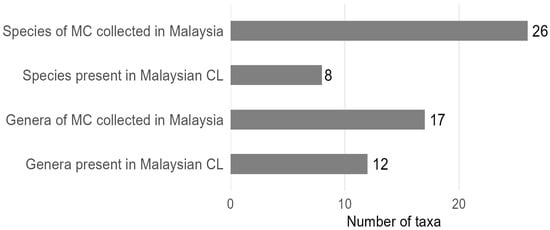
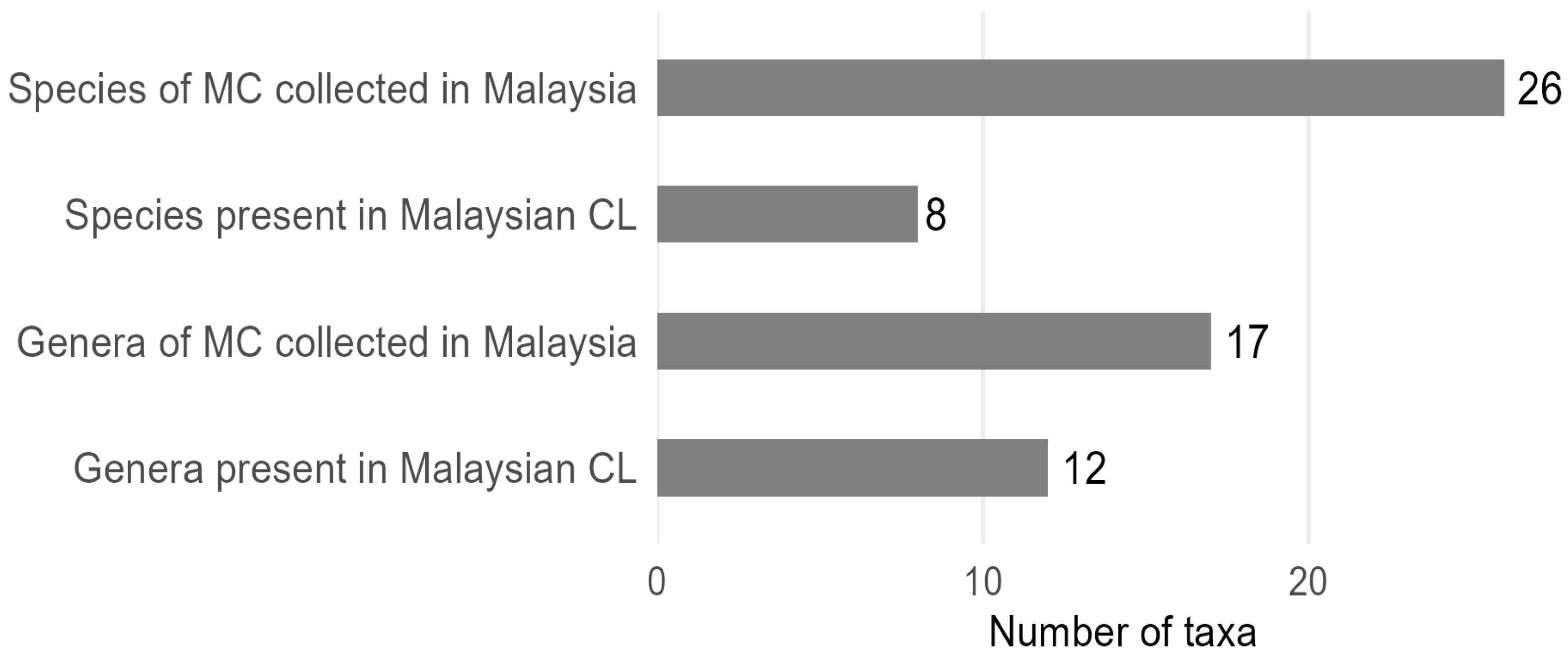
Following the morphological revision, the identified taxa were cross-referenced with the checklist of fungi for Peninsular Malaysia, Sarawak, and Sabah [31] (Table S1). This comparative analysis focused on 26 species and 17 genera (Figure 3).
Figure 3.
Comparative analysis of fungal diversity at the genus and species levels. The graph compares the specimens from Borneo held in the Beccari mycological collection (MC) with the taxa reported in the Malaysian checklist [31].
The results indicate that only eight species (approx. 30%) are currently documented in modern Malaysian records: Bondarzewia berkeleyi, Cladosporium herbarum (Pers.) Link, Favolaschia pustulosa, Flabellophora kinabaluensis Corner, Mutinus borneensis Ces., Trichoderma citrinum (Pers.) Jaklitsch, W. Gams & Voglmayr., Xylaria polymorpha and Rossbeevera mucosa (Petri) T. Lebel, Orihara & N. Maek. At the genus level, for those specimens collected in Borneo, 12 out of 17 are present in contemporary checklists, including genera such as Annulohypoxylon, Aspergillus, Cordyceps, Kretzschmaria, Favolaschia, Marasmius, Stecchericium, and Tremella, among others.
Notably, several taxa represented by more than two specimens in the Beccari collection remain absent from current regional checklists. These include Apioperdon pyriforme s.l., Cotylidia undulata (Fr.) P. Karst., Crucibulum laeve (Huds.) Kambly, Favolaschia minutissima, Omphalotus olearius s.l. Singer and even Arcangeliella beccarii (Petri) Zeller & CW Dodge (Table S1).
Analysis of GBIF data regarding global fungarium holdings further highlights the pioneering nature of this collection. Only five fungal specimens (sensu stricto) appear to have been recorded from Malaysia prior to Beccari’s first expedition (1865–1868), specifically: Dimeromyces spp. recorded by Taxther in 1834, Pycnoporus puniceus (Fr.) Ryvarden (≡Trametes punicea Fr.) recorded by Didrichsen in 1845, Trametes elegans (Spreng.) Fr. recorded by Jagor in 1858, Stereum aterrimum Cooke recorded by Kunstler in 1860 and Anthracothecium spp. recorded by Maingay in 1864. Critically, all these pre-1865 records originate from Peninsular Malaysia and not from Sarawak (Table S1).
4. Discussion
4.1. Taxonomic Significance and Preservation of the Collection
The systematic revision of Odoardo Beccari’s historical collection, comprising 201 specimens, 153 of which were confirmed as Fungi sensu stricto, significantly enhances the scientific value of the mycological holdings at the Natural History Museum of the University of Florence (FI). The successful identification of 120 specimens (77%) at the genus or species level underscores the enduring relevance of 19th-century material for modern biodiversity studies. However, taxonomic determination for the remaining specimens was constrained by various degradation factors related to their 150-year storage history. In several cases, the lack of diagnostic micromorphological features prevented identification beyond higher taxonomic ranks, primarily due to historical pest infestations and, for liquid-preserved material, the precipitation of crystals on fungal tissues.
4.2. Taxonomic Highlights and Ecological Patterns
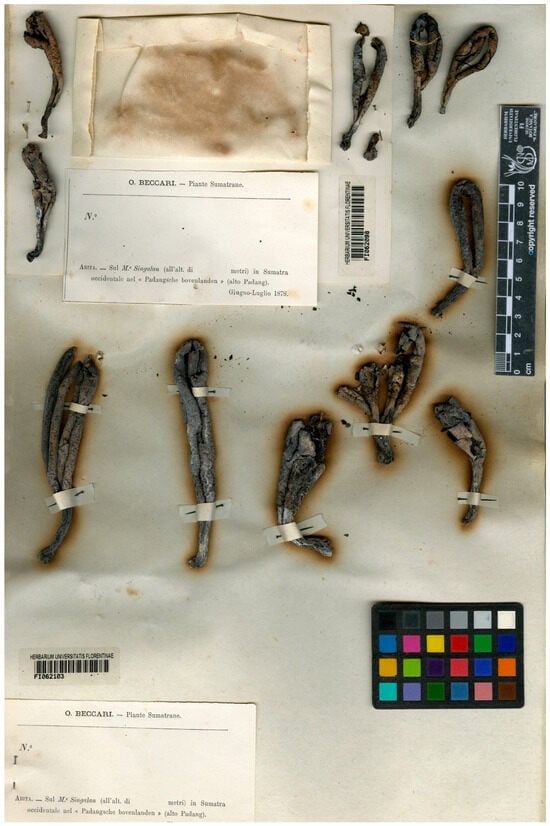
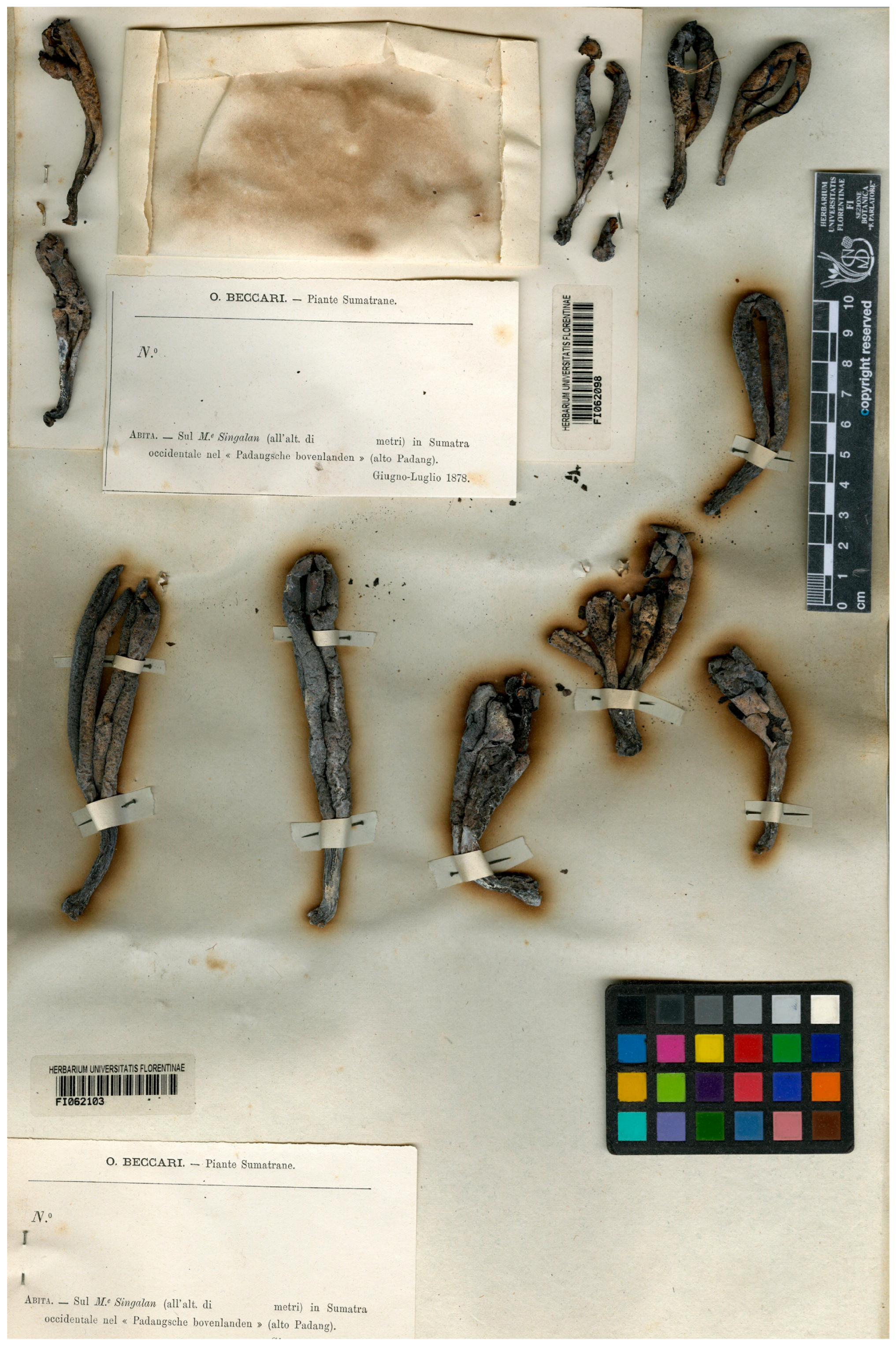
Within the Ascomycota, Xylaria polymorpha s.l. (Figure 4) represents the most abundant taxon in the collection. This saprotrophic species typically colonizes hardwood stumps, most notably Fagus in temperate regions, but also acts as a facultative parasite on damaged living trees, particularly at the base of the trunk. Morphological examination confirmed the presence of smooth, brown, amygdaliform to citriniform ascospores, produced within eight-spored asci and interspersed with filiform paraphyses. While these features align with traditional descriptions (e.g., [35]), the presence of this species in the Malesian region is well-documented in diverse ecological niches. Specifically, it has been reported across Peninsular Malaysia and Borneo on decaying logs, rotting trunks of Neesia spp., fallen Hevea brasiliensis (Willd. Ex A. Juss.) Mull. Arg. (rubber trees), and within primary dipterocarp forests [31].
Figure 4.
Herbarium specimen of Xylaria polymorpha s.l. (Pers.) Grev. The samples are mounted on a standard herbarium sheet and are accompanied by the original label.
The prevalence of Xylaria polymorpha s.l. and related genera, such as primarily Kretzschmaria and Annulohypoxylon, aligns with the dominance of the Xylariales in tropical lignicolous communities. This order constitutes the most speciose group of ascomycetes in Malaysia [31,36], where Xylaria species also hold significant cultural value for indigenous medicinal practices [37]. Similarly, the Hypocreales, represented in the collection by Trichoderma citrinum and Cordyceps, stand alongside Xylariales as the most diverse ascomycete orders in the region [31].
Regarding Basidiomycota, the predominance of Polyporaceae (11 specimens) within the Beccari collection is consistent with the known ecological patterns of Malesian rainforests. Southeast Asia is a recognized centre of diversity for polyporoid fungi [14,38], and in Malaysia specifically, this family represents the most extensively documented group within the Basidiomycota [31,39]. The distinct composition of polypore communities across different altitudinal gradients—where lowland and montane rainforests often host unique assemblages—further underscores the high level of endemism and specialization in these ecosystems [40]. This group continues to be a primary focus of modern mycological research [41]. Recent surveys conducted in Malaysian Borneo and Peninsular Malaysia consistently report Polyporaceae as the most frequently recorded family [37,38,42,43].
This pattern is mirrored in the broader Indonesian Archipelago, with significant records from Bangka Island (Sumatra) and Central Sulawesi [44,45,46], confirming that the taxonomic richness observed in Beccari’s 19th-century material reflects the core mycological structure of the Indo-Malayan tropics. Other significant finds include the specimens of Armillaria mellea s.l. These samples are characterized by the presence of rhizomorphs—specialized, root-like mycelial cords that facilitate the expansion of the fungus through the substrate (Figure 5).
Figure 5.
Herbarium specimens of Armillaria mellea s.l. (Vahl) P. Kumm. represented by its characteristic rhizomorphs.
While traditionally considered a temperate species, Armillaria root is a well-documented and significant pathological phenomenon in Southeast Asia, where several members of the genus cause substantial impact on both natural forests and agricultural plantations [47].
Also, the genus Marasmius remains a key component of the collection. Members of this genus are known to dominate the freshly fallen leaf litter of tropical forests [48]. The taxonomic significance of this group in the region is underscored by the findings of [49], who noted that among 50 Marasmius species collected in various Malaysian forest types, one-third were new to science. Furthermore, according to [31], Marasmiaceae represents the second largest family of the known Basidiomycota in Malaysia.
4.3. Nomenclatural Importance and Rare Records
Among the specimens of the Collection, four are of particular significance, as they correspond to the material used by Petri [50] for the original description of the species and therefore represent type material: Arcangeliella beccarii (Petri) Zeller & C.W.Dodge, Clathrogaster vulvarius Petri (≡Arcangeliella vulvaria (Petri) Zeller & C.W.Dodge), Hymenogaster mucosus Petri (≡Rossbeevera mucosa (Petri) T.Lebel, Orihara & N.Maek.) and Octaviania borneensis Petri. In his publication, Petri also described an additional species based on specimens collected by Beccari in Borneo: Caloderma echinatum Petri (≡Scleroderma echinatum (Petri) Guzmán). However, this material is currently not represented in FI-CAR. It is noteworthy that, for one of these specimens, Beccari himself [10] provided a rare ecological context for describing it as a common “hymenogastreous” species occurring at surface level in flooded forests dominated by Citrus in Sibu (Sarawak). Analysis of GBIF records confirms that fragmented original material of this taxon is also conserved at the Farlow Herbarium (FH) and the New York Botanical Garden (NY) [51,52]. This fragmented preservation of original material reflects the intensive exchange networks established among 19th- and early 20th-century naturalists, a practice that, while ensuring the survival of physical records, often necessitates extensive cross-institutional revision to reconstruct the full mycobiota of under-explored regions.
One of the most significant nomenclatural findings concerns Mutinus borneensis. Until now, modern checklists [31] cited this species based exclusively on the original description by Cesati [16], which was established using a single specimen collected by Beccari in Borneo and currently housed in the Herbarium Cesatianum (RO-HC). The identification of an additional specimen of M. borneensis during this study—preserved in the historical collections of the Natural History Museum of the University of Florence (FI)—represents only the second documented record of this taxon, significantly increasing its known scientific value. Our revision confirmed the presence of several ecologically significant taxa. Among these, the polypores Bondarzewia berkeleyi and Flabellophora kinabaluensis are particularly noteworthy; both species are primarily documented from montane regions of Sabah, based on the historical collections of E.J.H. Corner [31,40].
4.4. Functional Traits and the Assessment of Regional Biodiversity Gaps
Beccari’s field notes [10] further reveal a sophisticated understanding of tropical fungal communities. He documented a wide array of genera, including Agaricus, Amanita, Boletus, Polyporus, Hypoxylon, Xylaria, Tremella, Cordyceps, and Mutinus, many of which were recorded in the vicinity of Mount Matang. Modern mycological surveys in Sarawak and Sabah have confirmed the presence of nearly all these taxa, validating Beccari’s early taxonomic intuition [38,42,53]. Although ectomycorrhizal taxa (e.g., Amanita, Boletus) are known to occur in the forests visited by Beccari, as documented both in his field notes and in modern studies, they are poorly represented or absent in the collection analyzed here. This discrepancy likely reflects the partial nature of the preserved collection available for study, which represents only a subset of the original gatherings, rather than the original diversity of the fungal assemblages encountered in the field.
Notably, Beccari challenged the 19th-century misconception that fungi were scarce in tropical environments. His records, such as the documentation of numerous taxa from different groups during a single short collecting event [10,11], are consistent with patterns reported in contemporary studies of fungal diversity in Sabah and Sarawak forests [41,42,53,54].
Current meta-analyses of high-throughput sequencing (HTS) data confirm that tropical lowland and montane forests host some of the highest fungal diversity globally [55]. The documentation of over 90 agaric species by Beccari during his initial year in Borneo aligns with the high levels of fungal richness characteristic of Southeast Asia, a region recognized as a global centre of systematic fungal diversity [56,57]. These early records provide a significant historical baseline for the Malesian mycobiota, reflecting the extraordinary taxonomic density that still characterizes the area.
Beccari’s detailed descriptions of bioluminescence, which can be attributed to genera like Favolaschia, Armillaria, and Omphalotus, are supported by modern research documenting at least 15 bioluminescent species in the region [43,58].
The absence of modern records for taxa like Apioperdon pyriforme s.l., Cotylidia undulata, and Crucibulum laeve and others underscores the Linnean shortfall in fungal diversity in Southeast Asia. Although C. laeve is absent from contemporary Malaysian checklists, digitized herbarium records accessed via GBIF indicate that a specimen was collected in the region in 1922 by A.D.E. Elmer.
The absence of recent records for some species does not necessarily indicate their actual absence in Malaysian Borneo. Rather, it likely reflects both the limited exploration of the region and the still incomplete knowledge of its fungal diversity, which is widely recognized as poorly documented and far from fully described [31,48,54]. This gap is exacerbated by habitat loss; between 1973 and 2015, approximately 18.7 million hectares of old-growth forest in Borneo were cleared, primarily for selective logging and industrial oil palm plantations [37,59,60]. Remote-sensing analyses based on the Carnegie Landsat Analysis System (CLASlite) reveal extensive forest degradation in Malaysian Borneo, with nearly 80% of Sabah and Sarawak affected by logging or clearing operations since 1990 [61]. Such overexploitation has pervasive effects on fungal communities: studies show that wood-decaying fungal diversity is negatively correlated with forest disturbance due to the reduction in coarse woody debris [56]. Furthermore, the conversion to plantations alters the fungal diversity–productivity relationship and induces significant community shifts, as fungi often demonstrate higher sensitivity to degradation gradients than bacteria [60,62]. In conclusion, it should also be noted that additional records may exist in undigitized herbarium and fungarium collections or in unpublished sources, which remain inaccessible both to this study and to current regional checklists, as also acknowledged by Lee et al. [31].
As regards specimens collected by Beccari in Sumatra, a comparison with an available checklist of Fungi for Indonesia and/or the Island of Sumatra has not been feasible due to the absence of an updated checklist for those territories. According to Putra et al. [63], indeed, only 2273 fungal species had been documented in Indonesia by 2017, representing a mere 0.15% of estimated global diversity. Recent Sumatran studies remain geographically or ecologically restricted, focusing on satellite islands like Bangka [46], mangrove systems [64], or post-mining restoration sites [65].
4.5. Comparative Analysis of 19th-Century Mycological Explorations in Malaysia
From a historical perspective, Beccari’s contribution is unparalleled. While contemporaries like A.R. Wallace explored the same regions (e.g., Mount Matang) under the patronage of James Brooke, they focused almost exclusively on zoology and botany [66], paying negligible attention to fungi [67]. Our analysis of GBIF data confirms that although a few fungal specimens were collected in Peninsular Malaysia prior to 1865 (e.g., by Didrichsen, Maingay, and Kunstler), none originated from Sarawak.
While Cesati’s 1879 publication is traditionally cited as the foundational work for Malaysian mycology [31,54,68], the material analyzed in this study represents its “hidden” and previously overlooked counterpart.
5. Conclusions
The systematic revision of Odoardo Beccari’s historical collection underscores the enduring relevance of 19th-century material for modern biodiversity studies. By successfully identifying 77% of the specimens, this study demonstrates that historical fungaria, despite preservation-related constraints and the physical degradation of specimens over time, remain robust and valuable resources for documenting global fungal heritage. These findings not only enhance the scientific value of the mycological holdings at the Natural History Museum of the University of Florence (FI) but also contribute to improving current knowledge.
Beccari’s expedition, conducted more than 150 years ago, stands as an outstanding milestone in the history of natural sciences. Although he was not the first naturalist to explore Borneo, he was the first to systematically collect mycological samples within its then-untouched rainforests. Beccari approached this task with a pioneering vision, operating at a crucial historical juncture when the foundations of modern mycology were being laid. His work coincided with the era of prominent figures such as M. J. Berkeley (1803–1889), H. A. de Bary (1831–1888), M. C. Cooke (1825–1914), and P. A. Saccardo (1845–1920), who were just beginning to consolidate mycology as an autonomous and rigorous scientific discipline.
The integration of these 19th-century records into modern databases provides a vital historical baseline for a region facing rapid environmental change and catastrophic habitat loss. Making such “ghost data” digitally accessible is an essential step in safeguarding biodiversity, as it offers a unique window into the fungal communities of a lost Borneo. This work establishes a useful basis for future studies, particularly in identifying taxa that may now be locally extinct or overlooked due to the significant Linnean shortfall of fungal diversity in Southeast Asia.
Supplementary Materials
The following supporting information can be downloaded at https://www.mdpi.com/article/10.3390/d18050251/s1, Table S1: Inventory of fungal specimens (Fungi sensu stricto) within the Odoardo Beccari historical collection. Taxa are categorized by Phylum (A: Ascomycota; B: Basidiomycota) and preservation method (j: liquid-preserved in jars; e: dried exsiccata). Genus and species currently documented in the Malaysian checklist [31] are indicated with an asterisk (*). R: region. Geographic abbreviations: AM, Ayer Mancior; BO, Borneo Region; BB, Bangka Belitung; BS, Battu Sankan; IA, Indonesian Archipelago; L, Leutem; MS, Mount Singalan; S, Sarawak; SB, Sungei Bulu; SI, Singalan; WS, Western Sumatra.
Author Contributions
Conceptualization, I.M., E.S., L.C. and C.P.; methodology, E.S., L.C. and C.P.; formal analysis, I.M. and E.S.; investigation, I.M., E.S., L.C. and S.D.N.; data curation, I.M. and L.C.; writing—original draft preparation, I.M. and E.S.; writing—review and editing, I.M., E.S., L.C., R.B. and C.P. All authors have read and agreed to the published version of the manuscript.
Funding
This research was supported by the National Recovery and Resilience Plan (NRRP), Mission 4 Component 2 Investment 1.4 (Project NBFC—National Biodiversity Future Center, code CN_00000033), and Investment 3.1 (Project ITINERIS—Italian Integrated Environmental Research Infrastructures System, code CUP B53C22002150006).
Institutional Review Board Statement
Not applicable.
Data Availability Statement
All the material objects of this study are preserved in the Botanical Section of the Natural History Museum of the University of Florence, Malesian Herbarium (FI-HB) and ancillary collection (FI-CAR). The whole specimen dataset is accessible through GBIF (https://www.gbif.org/dataset/e2d22229-8110-4914-bec5-21953dd192c0); published on 18 March 2026; accessed on 21 April 2026.
Acknowledgments
The authors wish to thank Anna Donatelli, Lorenzo Lastrucci and Chiara Nepi for the valuable assistance provided during the study of the collection.
Conflicts of Interest
The authors declare no conflicts of interest.
References
- Fiaschi, T.; Fanfarillo, E.; Cannucci, S.; Bonini, I.; Grifoni, L.; Loppi, S.; Maccherini, S.; Ravera, S.; Manganelli, G.; Barbato, D.; et al. Biagio Bartalini’s Herbarium: An insight into the flora of Siena and its surroundings (Italy) during the eighteenth century. Rend. Fis. Acc. Lincei 2025, 36, 1029–1041. [Google Scholar] [CrossRef] [Scilit]
- Raffaelli, M. Il Museo di Storia Naturale dell’Università di Firenze—Le Collezioni Botaniche; Firenze University Press: Florence, Italy, 2009; 320p, Available online: https://library.oapen.org/handle/20.500.12657/54863 (accessed on 21 April 2026).
- Stefanaki, A.; Thijsse, G.; Van Uffelen, G.A.; Huijsmans, H.; Van der Meulen, J.M.S.; Van de Wiel, B.M.T.; Guarino, C. The En Tibi herbarium, a 16th century Italian treasure. Bot. J. Linnt. Soc. 2018, 187, 397–427. [Google Scholar] [CrossRef] [Scilit]
- Eckert, I.; Bruneau, A.; Metsger, D.A.; Joly, S.; Dickinson, T.A.; Pollock, L.J. Herbarium collections remain essential in the age of community science. Nat. Commun. 2024, 15, 7586. [Google Scholar] [CrossRef] [Scilit]
- Marín-Rodulfo, M.; Rondinel-Mendoza, K.V.; Martín-Girela, I.; Cañadas, E.M.; Lorite, J. Old meets new: Innovative and evolving uses of herbaria over time as revealed by a literature review. Plants People Planet 2024, 6, 1261–1271. [Google Scholar] [CrossRef] [Scilit]
- Nic Lughadha, E.; Walker, B.E.; Canteiro, C.; Chadburn, H.; Davis, A.P.; Hargreaves, S.; Lucas, E.J.; Schuiteman, A.; Williams, E.; Bachman, S.P.; et al. The use and misuse of herbarium specimens in evaluating plant extinction risks. Philos. Trans. R. Soc. B 2019, 374, 20170402. [Google Scholar] [CrossRef] [Scilit] [PubMed]
- Paton, A.; Antonelli, A.; Carine, M.; Forzza, R.C.; Davies, N.; Demissew, S. Plant and fungal collections: Current status, future perspectives. Plants People Planet 2020, 2, 499–514. [Google Scholar] [CrossRef] [Scilit]
- Cecchi, L.; Lastrucci, L.; Raffaelli, M.; Dell’Olmo, L.; Donatelli, A.; Viciani, D.; Nepi, C. Odoardo Beccari’s Malesian herbarium in Florence: The disclosure of a hidden treasure. 1. Zingiberales. Plant Biosyst. 2022, 156, 776–798. [Google Scholar] [CrossRef] [Scilit]
- Viciani, D.; Dell’Olmo, L.; Cecchi, L.; Nepi, C.; Raffaelli, M.; Donatelli, A.; Lastrucci, L. The amazing travels of a great naturalist to Sarawak (Malaysia): Odoardo Beccari’s wanderings in Borneo, 1865–1868. J. Maps 2021, 17, 95–100. [Google Scholar] [CrossRef] [Scilit]
- Beccari, O. Nelle Foreste di Borneo. Viaggi e Ricerche di un Naturalista; Tipografia Salvatore Landi: Florence, Italy, 1902. [Google Scholar]
- Beccari, O. Nelle Foreste di Borneo. Viaggi e Ricerche di un Naturalista; Clichy Edizioni: Florence, Italy, 2020. [Google Scholar]
- Nepi, C. L’erbario della Malaysia di Odoardo Beccari. In Il Museo di Storia Naturale dell’Università di Firenze, Volume 2: Le Collezioni Botaniche; Raffaelli, M., Ed.; Firenze University Press: Florence, Italy, 2009. [Google Scholar]
- Moggi, G. Storia delle collezioni botaniche del museo. In Il Museo di Storia Naturale dell’Università di Firenze, Volume 2: Le Collezioni Botaniche; Raffaelli, M., Ed.; Firenze University Press: Florence, Italy, 2009. [Google Scholar]
- Salleh, H.; Ghani, Y.; Nelson, S.; Haryanie, M.S.; Yamashita, S. Fungi in Sarawak: Practical use of historical samples in the Fungarium of Forest Department Sarawak. In Proceedings of the Symposium Frontier in Tropical Forest Research: Progress in Joint Projects Between the Forest Department Sarawak and the Japan Research Consortium for Tropical Forests in Sarawak; Forest Department Sarawak (FDS): Sarawak, Malaysia; Japan Research Consortium for Tropical Forests in Sarawak (JRCTS): Sarawak, Malaysia, 2016; pp. 160–164. Available online: http://hdl.handle.net/2433/227121 (accessed on 21 April 2026).
- Andrew, C.; Diez, J.; James, T.Y.; Kauserud, H. Fungarium specimens: A largely untapped source in global change biology and beyond. Philos. Trans. R. Soc. B 2018, 374, 20170392. [Google Scholar] [CrossRef] [Scilit]
- Cesati, V. Mycetum in itinere borneensi lectorum a CL. Odoardo Beccari Atti R. Accad. Sci. Fis. Mat. 1879, 8, 1–28. Available online: https://www.biodiversitylibrary.org/page/47330031 (accessed on 21 April 2026).
- Zucconi, L. Mycological exsiccata from Borneo, collected by Odoardo Beccari, kept in the Herbarium Cesatianum (RO). Cryptogam. Mycol. 1992, 13, 57–64. [Google Scholar] [CrossRef] [Scilit]
- Kühner, R.; Romagnesi, H. Flore Analytique des Champignons Supérieurs (Agarics, Bolets, Chanterelles); Masson et Cie: Paris, France, 1953. [Google Scholar]
- Cappelli, A. Agaricus s.l. Fungi Europaei; Libreria Biella Giovanna: Saronno, Italy, 1984; Volume 1. [Google Scholar]
- Antonín, V.; Noordeloos, M.E. A Monograph of Marasmius, Collybia and Related Genera in Europe. Part 1: Marasmius, Setulipes and Marasmiellus; Libri Botanici 8; IHW-Verlag: Eching, Germany, 1993. [Google Scholar]
- Corner, E.J.H. The Agaric Genera Marasmius, Chaetocalathus, Crinipellis, Heimiomyces, Resupinatus, Xerula and Xerulina in Malesia; Beihefte Nova Hedwigia: Stuttgart, Germany, 1996; Volume 111, pp. 1–175. [Google Scholar]
- Courtecuisse, R.; Duhem, B. Guide des Champignons de France et d’Europe; Delachaux et Niestlé: Lausanne, Switzerland, 1994. [Google Scholar]
- Bernicchia, A. Polyporaceae s.l. Fungi Europaei; Candusso: Alassio, Italy, 2005; Volume 10. [Google Scholar]
- Sarasini, M. Gasteromiceti Epigei; Associazione Micologica Bresadola: Trento, Italy, 2005. [Google Scholar]
- Medardi, G. Atlante Fotografico Degli Ascomiceti d’Italia; Associazione Micologica Bresadola: Trento, Italy, 2006. [Google Scholar]
- Gillen, K.; Laessøe, T.; Kirschner, R.; Piepenbring, M. Favolaschia species (Agaricales, Basidiomycota) from Ecuador and Panama. Nova Hedwigia 2013, 96, 117–165. [Google Scholar] [CrossRef] [Scilit]
- Aronsen, A.; Læssøe, T. The Genus Mycena s. l. Fungi of Northern Europe; Svampetryk: Tilst, Denmark, 2016; Volume 5. [Google Scholar]
- Knudsen, H.; Vesterholt, J. Funga Nordica: Agaricoid, Boletoid, Clavarioid, Cyphelloid and Gastroid Genera; Nordsvamp: Copenhagen, Denmark, 2018. [Google Scholar]
- Laessøe, T.; Petersen, J.H. Fungi of Temperate Europe; Princeton University Press: Princeton, NJ, USA, 2019. [Google Scholar]
- Index Fungorum. 2026. Available online: http://www.indexfungorum.org (accessed on 30 January 2026).
- Lee, S.S.; Alias, S.A.; Jones, E.G.B.; Zainuddin, N.; Chan, H.T. Checklist of Fungi of Malaysia; Research Pamphlet No. 132; Forest Research Institute Malaysia: Kuala Lumpur, Malaysia, 2012.
- Mazza, I.; Salerni, E.; Cecchi, L. Fungi of Odoardo Beccari’s Malesian Herbarium; Università degli Studi di Firenze, Sistema Museale di Ateneo: Florence, Italy, 2026. [Google Scholar] [CrossRef]
- GBIF Occurrence Download. Available online: https://doi.org/10.15468/DL.KAJ8N6 (accessed on 25 July 2025).
- Turland, N.J.; Wiersema, J.H.; Barrie, F.R.; Gandhi, K.N.; Gravendyck, J.; Greuter, W.; Hawksworth, D.L.; Herendeen, P.S.; Klopper, R.R.; Knapp, S.; et al. International Code of Nomenclature for Algae, Fungi, and Plants (Madrid Code); University of Chicago Press: Chicago, IL, USA, 2025; Available online: https://www.iaptglobal.org/_functions/code/madrid (accessed on 18 March 2026).
- Breitenbach, J.; Kränzlin, F. Les Ascomycetes. Fungi of Switzerland; Mykologia: Lucerne, Switzerland, 1981; Volume 1. [Google Scholar]
- Whalley, A.J.S. The xylariaceous way of life. Mycol. Res. 1996, 100, 897–922. [Google Scholar] [CrossRef] [Scilit]
- Foo, F.S.; Saikim, F.H.; Kulip, J.; Sathiya Seelan, J.S. Distribution and ethnomycological knowledge of wild edible mushrooms in Sabah (Northern Borneo), Malaysia. J. Trop. Biol. Conserv. 2018, 15, 203–222. [Google Scholar] [CrossRef] [Scilit]
- Yamashita, S.; Hattori, T.; Lee, S.S.; Okabe, K. Estimating the diversity of wood-decaying polypores in tropical lowland rain forests in Malaysia: The effect of sampling strategy. Biodivers. Conserv. 2015, 24, 393–406. [Google Scholar] [CrossRef] [Scilit]
- Watling, R.; Ginns, J. E.J.H. Corner, 1906–1996. Mycologia 1998, 90, 732–737. [Google Scholar] [CrossRef] [Scilit]
- Hattori, T.; Yamashita, S.; Lee, S.S. Diversity and conservation of wood-inhabiting polypores and other aphyllophoraceous fungi in Malaysia. Biodivers. Conserv. 2012, 21, 2375–2396. [Google Scholar] [CrossRef] [Scilit]
- Dukit, A.; Subari, I.A.A.M.H.; Yi, J.L.; Sathiya Seelan, J.S. Preliminary survey of the macrofungi of Marai Parai—Gurkha Hut, Kota Belud, Sabah. Sabah Parks Res. J. 2024, 14, 87–100. [Google Scholar]
- Paul, V.; Tang, P.L.; Isah, C.; Ajik, M.; Chung, A.Y.C.; Midin, N. A preliminary checklist and notes on macrofungi from the Rainforest Discovery Centre, Sandakan, Sabah. Sepilok Bull. 2020, 28, 1–17. [Google Scholar]
- Ag Ahmadni, A.S.; Shamsul Kamar, N.A.; Amir Hadi, M.; Terhem, R. Assessment of macrofungi diversity in Perlis State Park, Perlis, Malaysia. J. Wildl. Biodivers. 2024, 8, 298–307. [Google Scholar] [CrossRef]
- Yusran, Y.; Erniwati, E.; Wahayuni, D.; Ramadhanil, R.; Khumaidi, A. Diversity of macro fungus across three altitudinal ranges in Lore Lindu National Park, Central Sulawesi, Indonesia and their utilization by local residents. Biodiversitas 2021, 22, 199–210. [Google Scholar] [CrossRef] [Scilit]
- Yusran, Y.; Erniwati, E.; Khumaidi, A.; Pitopang, R.; Rahmawati, R.; Korja, N.I.; Labiro, E.; Rukmi, R.; Muthmainnah, M.; Maksum, H.; et al. Diversity of macro fungus species in several types of land use around Lore Lindu National Park, Central Sulawesi, Indonesia. Int. J. Des. Nat. Ecodyn. 2022, 17, 341–351. [Google Scholar] [CrossRef] [Scilit]
- Widayanti, G.A.; Effendi, Z.; Sari, D.K.; Arifah, N.; Swandi, M.K.; Asyavira, G.C.; Iqbal, M. An annotated checklist of the macrofungi (Fungi: Dikarya) of Pelawan Forest, Bangka Island, Sumatra. Bio Palembanica 2025, 2, 19–26. [Google Scholar] [CrossRef] [Scilit]
- Coetzee, M.P.A.; Wingfield, B.D.; Bloomer, P.; Ridley, G.S.; Wingfield, M.J. Molecular identification and phylogeny of Armillaria isolates from South America and Indo-Malaysia. Mycologia 2003, 95, 285–293. [Google Scholar] [CrossRef] [Scilit]
- Foster, R.; Hartikainen, H.; Hall, A.; Bass, D. Diversity and phylogeny of novel cord-forming fungi from Borneo. Microorganisms 2022, 10, 239. [Google Scholar] [CrossRef] [Scilit]
- Tan, Y.S.; Desjardin, D.E.; Vikineswary, S.; Abdullah, N. Basidiomycota: The genus Marasmius in Peninsular Malaysia. In Malaysian Fungal Diversity; Jones, E.B.G., Hyde, K.D., Vikineswary, S., Eds.; University of Malaya Press: Kuala Lumpur, Malaysia, 2007; pp. 61–73. [Google Scholar]
- Petri, L. Descrizioni di alcuni gasteromiceti di Borneo. Malpighia 1900, 14, 111–139. [Google Scholar]
- Ramirez, J.; Watson, K.; Feder, L.; Gjieli, E.; Sessa, E. The New York Botanical Garden Herbarium (NY); Version 1.78; The New York Botanical Garden: New York, NY, USA, 2024. [Google Scholar] [CrossRef] [Scilit]
- Kennedy, J. Harvard University Herbaria: All Records; Harvard University Herbaria: Cambridge, MA, USA, 2025. [Google Scholar] [CrossRef] [Scilit]
- Kassim, M.H.S.B.; Wasti, I.G.; Subari, I.A.A.M.H.; Ganesan, T.A.; Tang, P.L.; Chong, C.C.; Subramaniam, N.; Seelan, J.S.S. Macrofungi of Sungai Kangkawat Research Station, Imbak Canyon Conservation Area, Sabah, Malaysia. Malayan Nat. J. 2020, 72, 371–388. [Google Scholar]
- Mohamad Bukhori, F.M.M.; Ketol, B.; Razali, K.R.; Azizi Hussain, A.; Rohmon, M.F. Brief documentation of Basidiomycota and Ascomycota diversity in Gunung Gading National Park, Sarawak. J. Sci. Math. Lett. 2020, 8, 37–47. [Google Scholar] [CrossRef] [Scilit]
- Stallman, J.K.; Haelewaters, D.; Koch Bach, R.A.; Brann, M.; Fatemi, S.; Gomez Zapata, P.; Husbands, D.R.; Jumbam, B.; Kaishian, J.P.; Moffitt, A.; et al. The contribution of tropical long-term studies to mycology. IMA Fungus 2024, 15, 35. [Google Scholar] [CrossRef] [Scilit] [PubMed]
- Yamashita, S.; Hattori, T.; Momose, K.; Nakagawa, M.; Aiba, M.; Nakashizuka, T. Effects of forest use on Aphyllophoraceous fungal community structure in Sarawak, Malaysia. Biotropica 2008, 40, 354–362. [Google Scholar] [CrossRef] [Scilit]
- Pegler, D.N. The Agarics of São Paulo, Brazil; Royal Botanic Gardens: Kew, UK, 1997; 168p. [Google Scholar]
- Chew, A.L.C.; Desjardin, D.E.; Tan, Y.S.; Musa, M.Y.; Sabaratnam, V. Bioluminescent fungi from Peninsular Malaysia: A taxonomic and phylogenetic overview. Fungal Divers. 2015, 70, 149–187. [Google Scholar] [CrossRef] [Scilit]
- Gaveau, D.L.A.; Sheil, D.; Husnayaen; Salim, M.A.; Arjasakusuma, S.; Ancrenaz, M.; Pacheco, P.; Meijaard, E. Rapid conversions and avoided deforestation: Examining four decades of industrial plantation expansion in Borneo. Sci. Rep. 2016, 6, 32017. [Google Scholar] [CrossRef] [Scilit]
- Jiang, L.; Ushio, M.; Imai, N.; Sugau, J.; Kitayama, K. Changes of bacterial versus fungal community composition along a forest degradation gradient of logged over tropical rain forests, and their consequences on soil enzyme activities in Malaysian Borneo. Plant Soil 2025, 510, 541–563. [Google Scholar] [CrossRef] [Scilit]
- Bryan, J.E.; Shearman, P.; Asner, G.P.; Knapp, D.E.; Aoro, G.; Lokes, B. Extreme differences in forest degradation in Borneo: Comparing practices in Sarawak, Sabah, and Brunei. PLoS ONE 2013, 8, e69679. [Google Scholar] [CrossRef] [Scilit]
- Robinson, S.J.B.; Elias, D.; Johnson, D.; Both, S.; Riutta, T.; Goodall, T.; Majalap, N.; McNamara, N.P.; Griffiths, R.; Ostle, N. Soil fungal community characteristics and mycelial production across a disturbance gradient in lowland dipterocarp rainforest in Borneo. Front. For. Glob. Change 2020, 3, 64. [Google Scholar] [CrossRef] [Scilit]
- Putra, I.P.; Nurdebyandaru, N.; Amelya, M.P.; Hermawan, R. Review: Current checklist of local names and utilization information of Indonesian wild mushrooms. J. Trop. Biodivers. Biotechnol. 2022, 7, jtbb71407. [Google Scholar] [CrossRef] [Scilit]
- Yunasfi, S.R.L.; Budi, U.; Afifuddin, D.; Vinansia, M.S.; Sephia, S.; Gloury, A.S.; Jon, G.M.P.; Rickson, S.; Ipanna, E.S.; Amanatul, F.; et al. Diversity of fungal species and decomposition of Rhizophora mucronata leaf litter in the Deli Belawan River Estuary, North Sumatra, Indonesia. Biodiversitas 2025, 26, 1631–1640. [Google Scholar] [CrossRef] [Scilit]
- Herman, W.; Iskandar Budi, S.W.; Pulunggono, H.B.; Kurniati Milantara, N. Dynamics of vegetation diversity and arbuscular mycorrhizal fungi in post-coal mining revegetation land in Sawahlunto, West Sumatra, Indonesia. Biodiversitas 2024, 25, 4627–4641. [Google Scholar] [CrossRef] [Scilit]
- Of Cranbrook, E.; Marshall, A.G. Alfred Russel Wallace’s assistants, and other helpers, in the Malay Archipelago 1854–1862. Sarawak Mus. J. 2014, 73, 73–122. [Google Scholar] [CrossRef] [Scilit]
- Goldhor, S. Alfred Russel Wallace: The fungal connection. FUNGI Mag. 2014, 7, 34–36. [Google Scholar]
- Hattori, T. Biogeography of polypores in Malesia, Southeast Asia. Mycoscience 2017, 58, 1–13. [Google Scholar] [CrossRef] [Scilit]

Disclaimer/Publisher’s Note: The statements, opinions and data contained in all publications are solely those of the individual author(s) and contributor(s) and not of MDPI and/or the editor(s). MDPI and/or the editor(s) disclaim responsibility for any injury to people or property resulting from any ideas, methods, instructions or products referred to in the content. |
© 2026 by the authors. Licensee MDPI, Basel, Switzerland. This article is an open access article distributed under the terms and conditions of the Creative Commons Attribution (CC BY) license.