


Abstract
The sea trout Salmo trutta has considerable ecological and economic importance in the Baltic Sea basin. In recent years, the landings of this species from the Main Basin have decreased significantly. Consequently, it is necessary to consider whether this decline has been associated with any changes in the diversity and domination of its parasitofauna. We examined 101 sea trout specimens originating from the southern Baltic Sea basin and its tributary (the Gulf of Gdańsk and the River Reda) collected between 2003 and 2020. The fish were infected with five parasite species: one tapeworm (Eubothrium crassum), one digenean (Brachyphallus crenatus), and three nematodes (Anisakis simplex, Hysterothylacium aduncum, and Raphidascaris acus). Overall parasite prevalence was high (parasites were found in 94.7% of sea trout), with a mean intensity of 37.4 and a range of 1–125 parasites per fish. Eubothrium crassum, a species widely distributed in Europe and North America, clearly dominated the parasite community: a total of 3345 specimens were recorded in 92.6% of fish, with a mean intensity of 38.0 and an intensity range of 1–125 individuals. Correct morpho-anatomical identification was confirmed by molecular methods. The tapeworms were located primarily (96%) in the pyloric caeca. Other parasite species occurred only sporadically. Infection levels increased with both the length and mass of the fish; however, despite the high parasite infection, no deterioration in the host was indicated by Fulton’s condition factor. Comparison of fish originating from the different time periods revealed no changes in their parasitological characteristics, suggesting that parasite–host interactions are unlikely to have contributed to the decline in fish catches.
1. Introduction
The species Salmo trutta Linnaeus, 1758 comprises anadromous (sea trout), resident (brown trout), and lacustrine (lake trout) forms inhabiting the Atlantic, North Sea, and Baltic Sea basins [1,2]. The anadromous form exhibits considerable plasticity in its life cycle, and, depending on the latitude of the river, juveniles spend between one and six years in freshwater, reaching the length of 12–25 cm as a smolt before descending to the sea [1,2]. Because adult fish spawn in the periodically drying streams of Gotland (Baltic Sea), juveniles (parr) are also known to migrate to the sea during the summer before reaching the smolt stage, at sizes as small as 3 cm [3]. Parr migration has also been observed during high autumn flows in the River Imsa (Norway) [4].
Sea trout grow in the marine environment for one month or longer (up to five years) before migrating back to their home river to spawn [1]. In comparison to the Atlantic salmon Salmo salar Linnaeus, 1758, sea trout are generally coastal; however, some specimens from the Vistula River, Bothnian Sea and Bothnian Bay tributaries can migrate hundreds of km in the Baltic Sea [5,6]. Similarly, sea trout that reproduce in tributaries of the English Channel can migrate as far as Dutch or Irish marine waters [7].
Historically, the largest Baltic population of sea trout reproduced in the River Vistula, a tributary of the Gulf of Gdańsk, which forms part of the Main Basin. Owing to habitat loss in the upper catchment and the construction of a hydroelectric power plant in its middle course in 1969, landings declined from 100 tonnes to less than 1% of that value, despite extensive stocking efforts [8,9]. According to the Assessment Working Group on Baltic Salmon and Trout of the International Council for the Exploration of the Sea [9], commercial catches of sea trout in the Baltic Sea reached 96 tonnes in 2024, of which 69% originated from the Main Basin. Most of the fish (92% of 348 tonnes) were also caught by the recreational fishery in this Baltic basin. In the 1990s, total sea trout catches in the Baltic Sea were reported to reach up to 1300 tonnes, declining to 700–800 tonnes at the beginning of the following decade, and most recently, in 2023–2024, combined catches reached 599 and 444 tonnes, respectively.
The anadromous life cycle of sea trout plays an important role in shaping parasitofauna communities and influences the potential for parasite transmission [10,11]. Therefore, the results of the parasitological monitoring provide a valuable insight into fish condition and their role as hosts in the context of parasite circulation in the environment [12]. Previous studies of sea trout parasites from various regions suggest that fixed, recurring elements of typical or specific parasites are present in the host. However, these elements also show local variation, determined by the ability of parasites to complete their life cycles in a given environment [13,14]. During spawning migration from the marine environment to the rivers, the fish feed intensively, which favors the acquisition of parasites from various regions and environments and their subsequent spread to other areas. However, changes in environmental conditions may limit certain parasites that are sensitive to, for example, fluctuations in water parameters such as salinity, temperature or currents [10,15]. To date, research on parasites of sea trout in the Polish Exclusive Economic Zone of the southern Baltic Sea has been fragmentary and limited [16,17,18].
The aim of the present study was to determine the composition of sea trout parasites in the southern Baltic Basin (the Gulf of Gdańsk and its tributary—the River Reda) in the context of the decline in sea trout catches.
2. Materials and Methods
2.1. Sample Collection
Between January 2003 and January 2020, a total of 101 sea trout specimens were collected from the Gulf of Gdańsk and its tributary, the River Reda. Fish originating from the Gulf of Gdańsk were caught by professional commercial fishermen. The sea trout were caught using ≥80 mm mesh gillnets outside the protected period and were supplied dead. Typically, fish were kept frozen until laboratory analysis. However, in 2019–2020, the sea trout specimens were stored under refrigerated conditions within one to three days of being caught, and then examined.
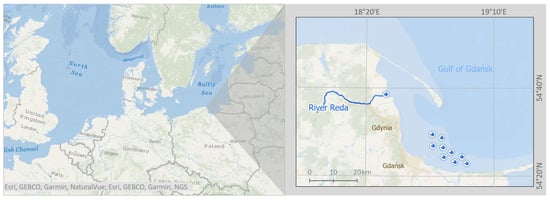
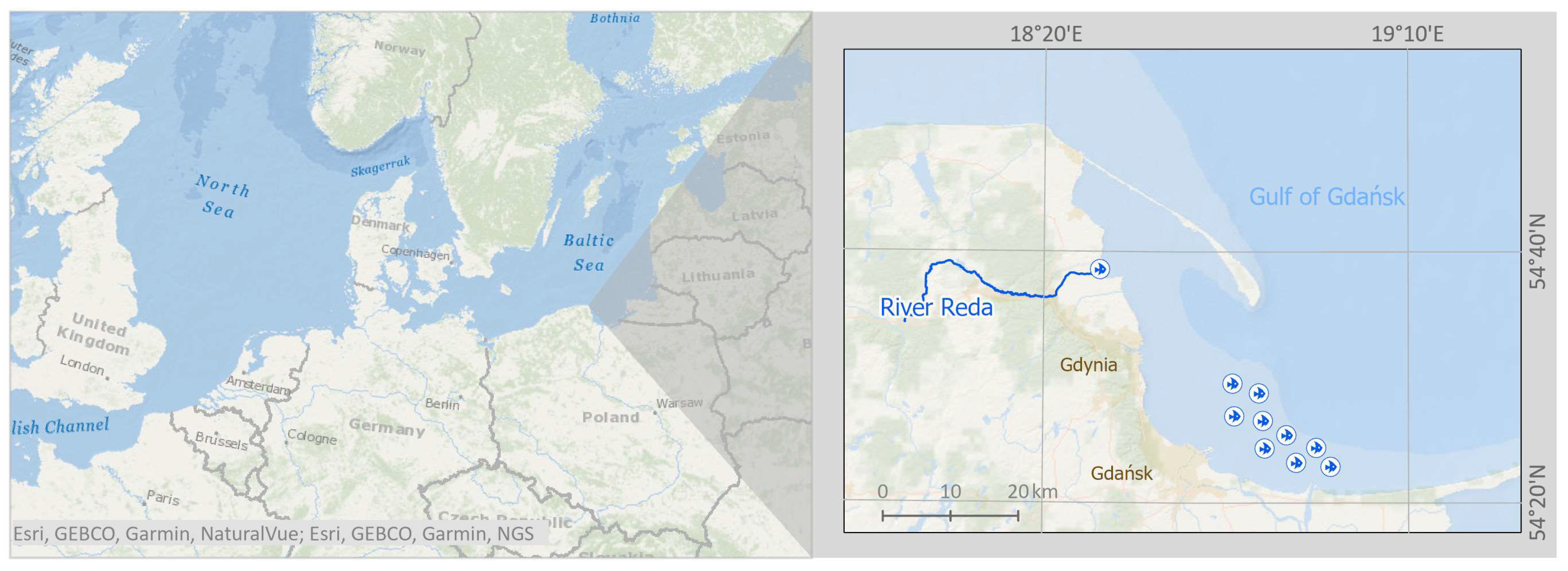
Fish caught in the River Reda were captured in its lower course (approx. 1 km upstream from the river mouth) in the ‘Beka’ Nature Reserve using two oppositely oriented, connected fyke nets with 1 cm mesh [19] (Figure 1, Table 1). Sea trout were collected throughout the year. The fish were humanely euthanized in accordance with the applicable regulations by cranial percussion using a blunt instrument, and the abdominal cavity was injected in situ with 4% formalin to arrest the decomposition process. After the fishing period, which usually lasted 3 days, fish were kept frozen (−20 °C) until further laboratory analysis.
Figure 1.
Location of sea trout Salmo trutta catches in the Gulf of Gdańsk and River Reda.
Table 1.
Total length, mass, sex, and number of sea trout Salmo trutta specimens examined from the Gulf of Gdańsk and the River Reda.
Permission to use fishing gear covering more than half the width of the River Reda was obtained from the Starost of Puck (ROŚ/RŚ-6123/d/1/05, ROŚ-6123/1/06, ROŚ-6123/3/06). The Pomeranian Voivodeship Office issued permission for fishing in the Beka Nature Reserve, including the capture of fish below the minimum legal size and fishing during the closed (protected) season (ŚR/Ś.VII.MZ/66302-164/04, ŚR/Ś.VII.MZ/66302-39/05, ŚR/Ś.VII.MZ/6630-2-3/06, ŚR/Ś.VII.MZ/6630-2-54/06, ŚR/Ś.VII.MZ/6630-2-17/07). The Minister of the Environment issued permission for the fishing of strictly protected fish species (DPOog-4201-02-51/05/al, DPOogiz-4200/V-02/297/06/aj, DLOPiK-op/ogiz-4200/IV-01/11709/06/07aj, DLOPiK-op/ogiz-4200/V-01/11512/07-msz).
In the field, the fish were measured for the total length in mm and weighed to 100 g accuracy. Parasitological analyses were performed exclusively on the digestive tract, gonads, liver, kidney, heart, swim bladder, and visceral fat.
2.2. Parasitological Analysis
The collected parasites were fixed and preserved in 70% ethanol solution, and selected parasite specimens were taken for microscope preparations. Flukes and tapeworms were stained in alcohol-borax carmine, differentiated (i.e., excess pigment rinsed) in acidified ethanol, dehydrated in alcohol series (80, 90, 2 × 99%), cleared in benzyl alcohol, and submerged in Canada balsam. Nematodes were cleared and embedded in polyvinyl lactophenol [20,21]. Transverse sections of the Eubothrium crassum scolex were also performed to visualize the structure of the apical disk (grooves) [22].
The specimens of parasites (wet and microscopic preparation) were deposited in scientific collections within the framework of the Collection of Extant Invertebrates in the Department of Invertebrate Zoology and Parasitology, University of Gdańsk, Poland (UGDIZP).
2.3. Molecular Characteristic of Eubothrium crassum
DNA was extracted with the Genomic Mini Kit (A&A Biotechnology, Poland). The mitochondrial cytochrome c oxidase subunit II gene (cox2 mtDNA) was amplified using the primers PBI-cox1F_PCR (5′-CATTTTGCTGCCGGTCARCAYATGTTYTGRTTTTTTGG-3′) and PBI-cox1R_PCR (5′-CCTTTGTCGATACTGCCAAARTAATGCATDGGRAA-3′) [23]. DNA was amplified using OpiTaq PCR Master Mix (2x) containing 0.1 mM of each dNTP, 1.5 mM of MgCl2, 1.25 U OptiTaq DNA Polymerase and 0.5 mM of each primer. Cycling conditions consist of an initial denaturation at 94 °C for 3 min, followed by 40 cycles of denaturation at 94 °C for 30 s, annealing at 54 °C for 30 s, elongation at 72 °C for 1 min, and a final product extension at 72 °C for 5 min. The amplification products were visualized on a 1% agarose gel using ethidium bromide. Amplicons were purified using exonuclease (EPPiC, A&A Biotechnology, Gdansk, Poland). The PCR products were sequenced at Macrogen (Amsterdam, The Netherlands) using the Sanger sequencing method. The nucleotide sequences were compared with known sequences using the Basic Local Alignment Search Tool (BLAST+ version 2.14) available at http://blast.ncbi.nlm.nih.gov/Blast.cgi (accessed on 27 July 2023).
2.4. Statistical Analysis
To define the level of fish infection, the following main parasitological parameters were measured: prevalence (percentage of hosts infected), mean intensity (mean number of parasites in infected hosts), and intensity range (minimum and maximum number of parasite individuals per host) [24]. In turn, the dominance index (D), which according to Magurran [25] was calculated using the following formula: D = Nmax/N; where Nmax is the number of individuals for the most abundant species and N is the number of individuals of all species.
Comparative statistical analyses and Fulton’s body condition factor were calculated only for the most abundant parasite species—E. crassum. The Fulton’s condition factor (K) was calculated as: K = 100 × W × L−3; where W is the mass (g) and L is the length (cm) [26].
The normality of the data was assessed using the Shapiro–Wilk test. A significance level of p < 0.05 was regarded as statistically significant. Comparisons between years were carried out using the Kruskal–Wallis test, followed by multiple comparison tests. The Mann–Whitney test was employed to compare data between two consecutive samples (localities). Correlations between datasets (number of E. crassum vs. fish length and mass, Fulton’s condition factor) were evaluated using Spearman’s rank correlation coefficient. Statistical analyses were performed using Statistica, version 13.
3. Results
Five parasite species were recorded, including two Platyhelminthes: Brachyphallus crenatus (Rudolphi, 1802) (Digenea: Hemiuridae), E. crassum (Bloch, 1779) (Cestoda: Triaenophoridae), and three Nematoda Anisakis simplex (Rudolphi, 1809) (Anisakidae), Hysterothylacium aduncum (Rudolphi, 1802) (Raphidascarididae), and Raphidascaris acus (Bloch, 1779) (Raphidascarididae) (Tables S1–S5). The overall infection level across all sampling locations was as follows: prevalence 94.7%, mean intensity 37.4, and intensity range 1–125. Very high prevalence and mean intensity of infection were observed in both locations: 92.3% and 38.1 for the Gulf of Gdańsk, and 100% and 36.1 for the River Reda (Table 2).
Table 2.
Prevalence and intensity (mean, range) in the sea trout Salmo trutta from the Gulf of Gdańsk and the River Reda across different years.
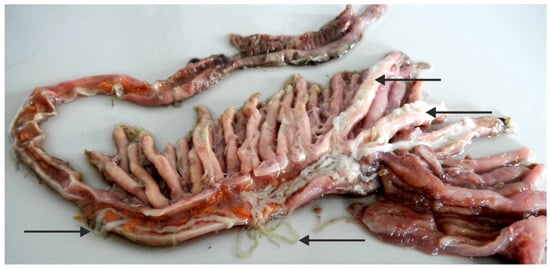
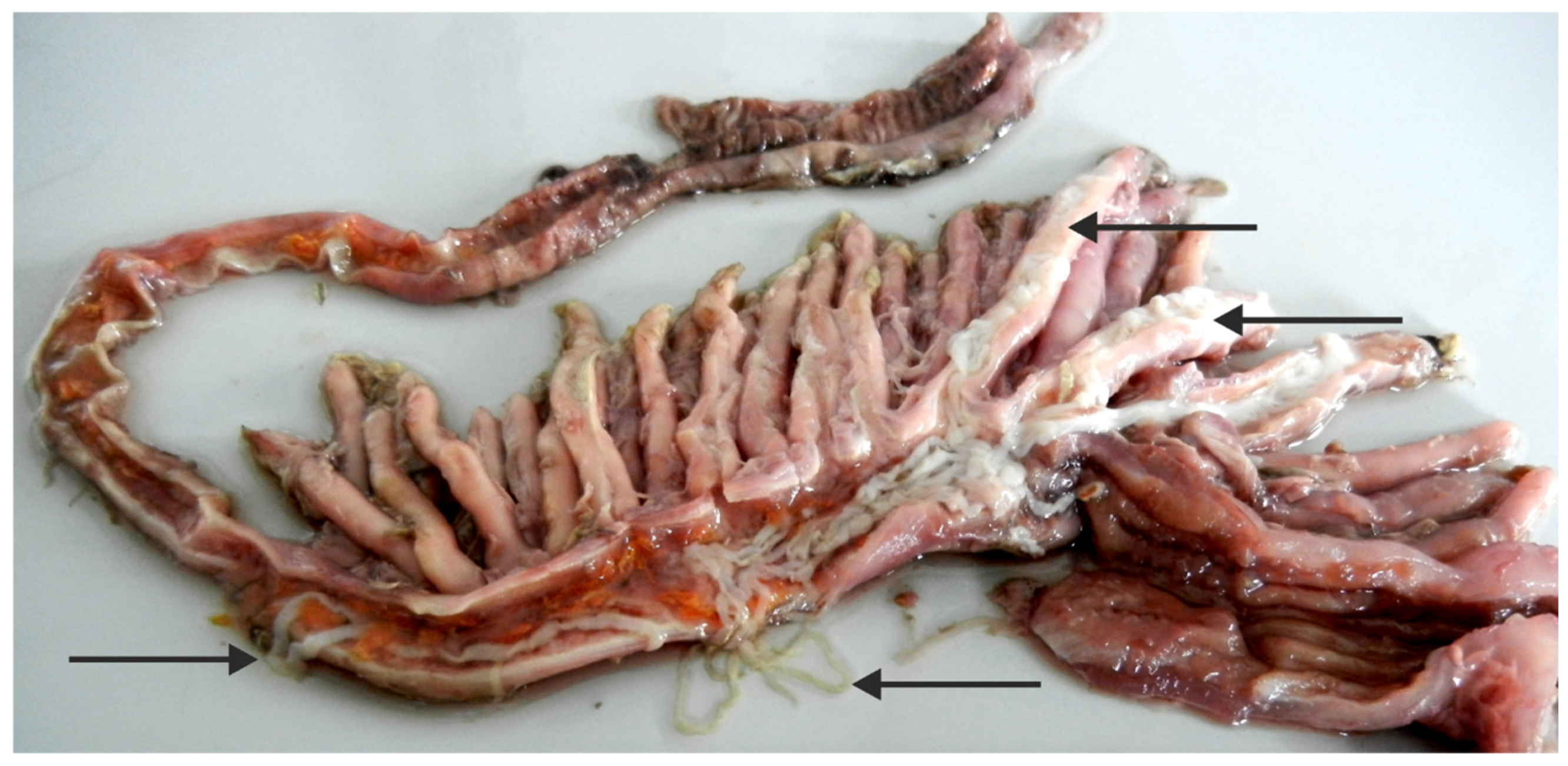
The dominant species in all regions and years was the tapeworm E. crassum (D = 98.5–99.9%, overall D = 99.4%), as determined by molecular analyses. The sequences of the identified E. crassum have been deposited in GenBank (accession numbers OR352556 to OR352564). These tapeworms showed a characteristic distribution within the gastrointestinal tract: 96% of individuals (n = 3219) were found in the pyloric caeca, being attached to the walls of the pyloric processes (Figure 2); the remaining 4% was found in the intestine (n = 126). Other parasite species were found sporadically.
Figure 2.
Eubothrium crassum (as shown by the arrows) in the pyloric caeca and intestine of a sea trout Salmo trutta.
The two regions (the Gulf of Gdańsk and the River Redar) did not differ in the number of E. crassum (p = 0.764) or in Fulton’s condition factor (p = 0.196). No statistically significant difference in the number of tapeworms was observed between the study years (p = 0.058).
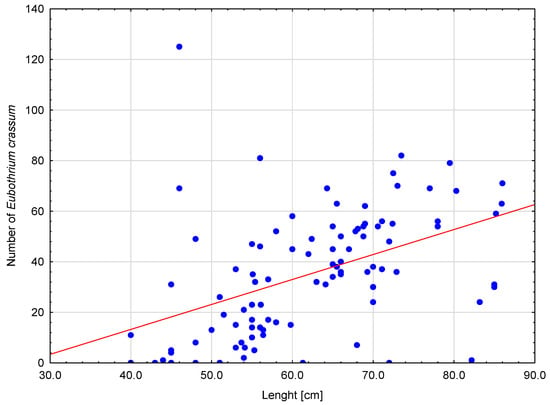
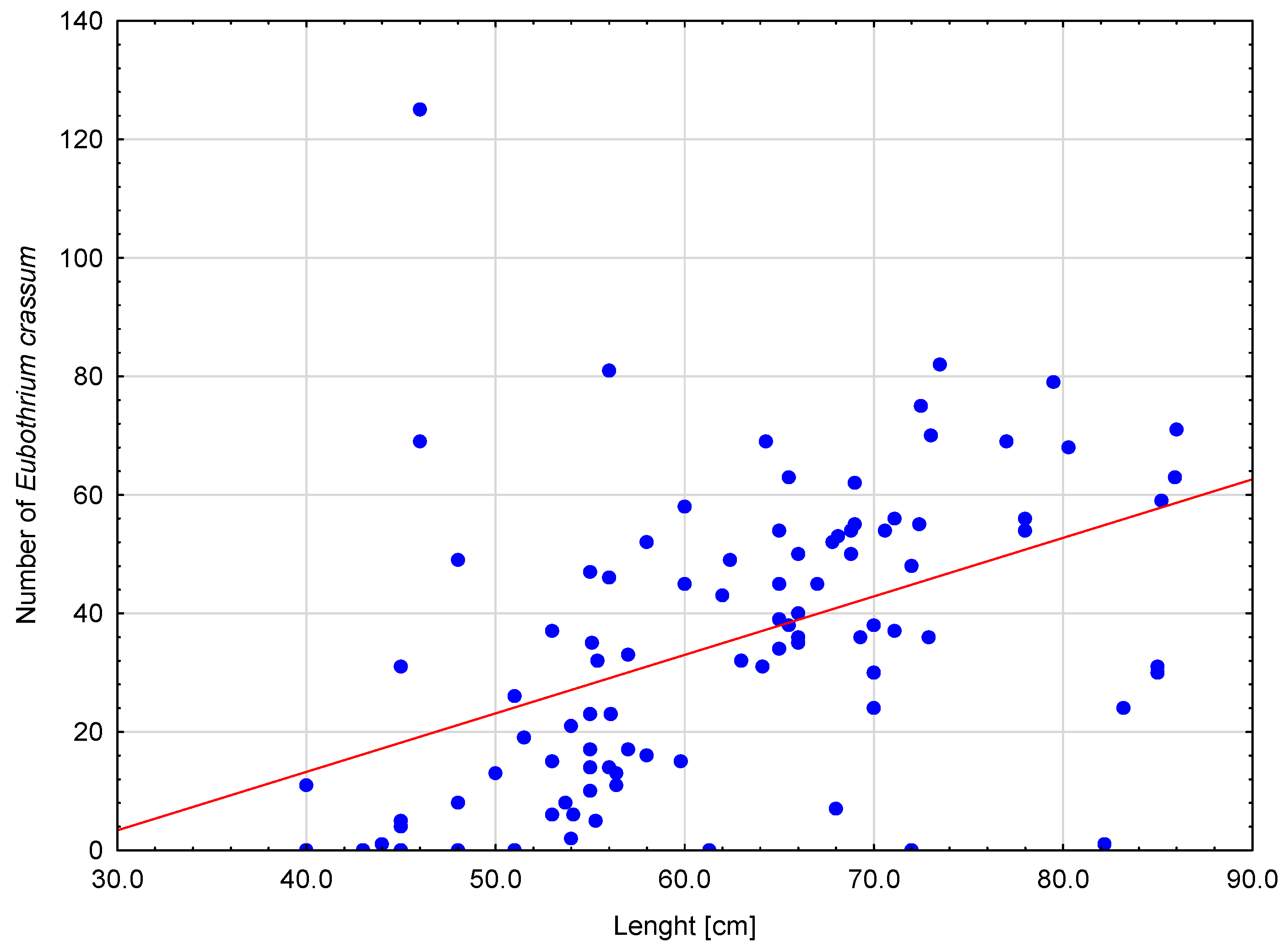
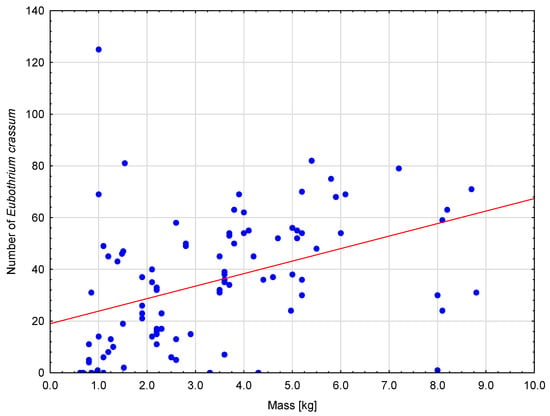
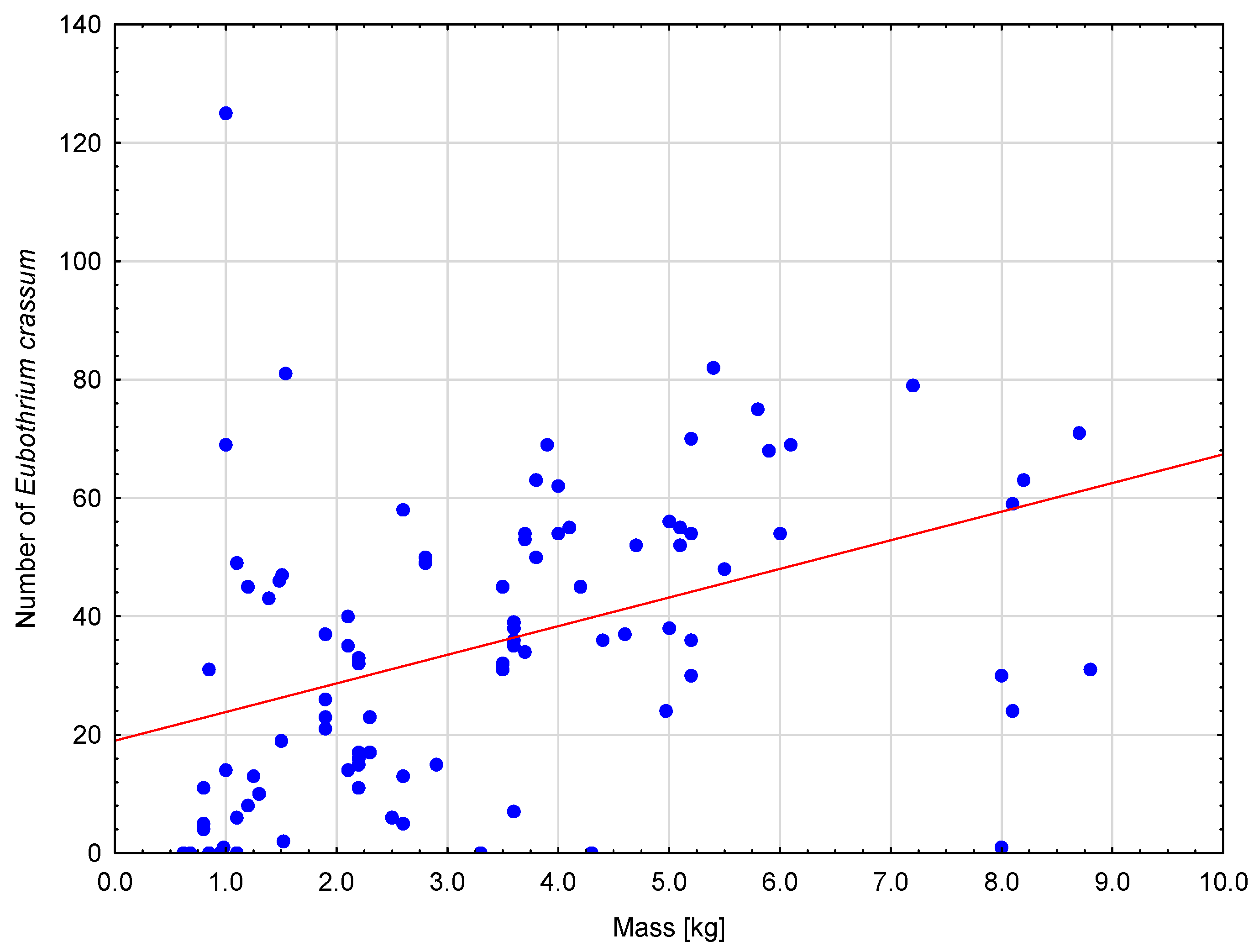
The number of E. crassum increased with the fish length and mass (Spearman’s rank correlation coefficients: rs = 0.55 and 0.53, respectively, p < 0.05). The mean length and mass of the infected fish were 62.6 cm and 3.4 kg respectively (Figure 3 and Figure 4).
Figure 3.
Relationship between Salmo trutta total length and the number of Eubothrium crassum (Spearman’s rank correlation coefficient: rs = 0.55, p < 0.05).
Figure 4.
Relationship between Salmo trutta mass and the number of Eubothrium crassum (Spearman’s rank correlation coefficient: rs = 0.53, p < 0.05).
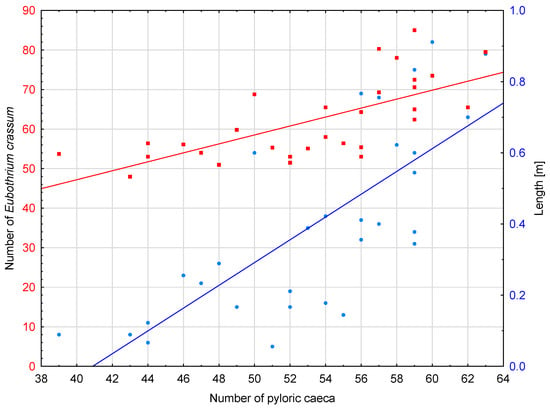
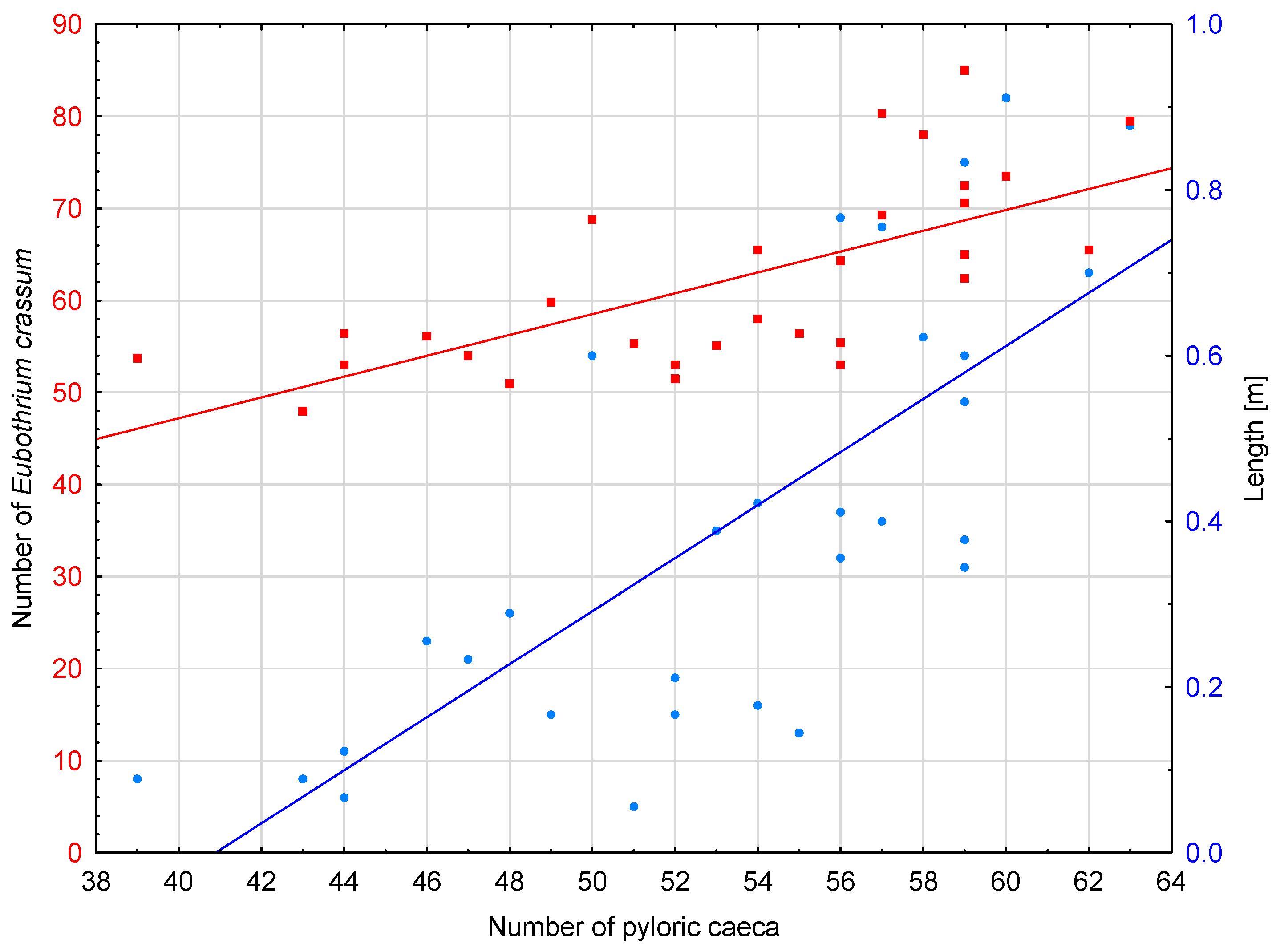
There was also a positive correlation between the number of pyloric caeca of the Salmo trutta and the number of E. crassum (rs = 0.78, p < 0.05) (calculated for fish from the River Reda (Table S6, Figure 5).
Figure 5.
Relationship between the number of pyloric caeca and fish length (Spearman’s rank correlation coefficient: rs = 0.74, p < 0.05) and the number of Eubothrium crassum (Spearman’s rank correlation coefficient: rs = 0.78, p < 0.05.
The mean Fulton’s coefficient for all tested fish was 1.211, with infected fish averaging 1.225 and uninfected fish (n = 5) averaging 1.003. A positive correlation was observed between Fulton’s condition factor and fish length and mass (rs = 0.45 and 0.67, p < 0.05); however, no relationship was noted between the number of parasites and the condition of the fish (rs = 0.18, p > 0.05).
4. Discussion
Any comparative analysis of sea trout parasitofauna from different regions is difficult, as the geographical distribution of the host appears to play a crucial role in shaping its parasitofauna [10,11].
In the sea trout examined in this study, the dominant species was the tapeworm E. crassum, irrespective of location or study period. This parasite, associated with various fishes of the family Salmonidae, is widely distributed across Europe and North America [14,16,18,27,28,29,30,31,32,33]. It is typically the dominant and common parasite in the sea trout (e.g., [14,30,31,32,33]), but often shows lower infection levels in the freshwater residential form—brown trout [34] or may be absent [35,36,37,38]. The tapeworm life cycle typically involves two intermediate hosts (a copepod and a fish, usually a European perch Perca fluviatilis Linnaeus, 1758) and a definitive host, a salmonid fish [39]. In marine conditions, however, the cycle may occur with only a single intermediate host (a copepod) [40,41]; this may contribute to higher infection levels in sea trout. For example, in studies of S. trutta occurring in freshwater Polish lakes, the tapeworm showed a low level of infection (prevalence 6.4%, mean intensity 2.0) [34]. In contrast, the present study revealed that 92.6% of fish (mean intensity 38.0) were infected, with a clear topographic preference: 98% of tapeworms were attached to the walls of the pyloric caeca. This indicates a relationship between the number of pyloric caeca and tapeworm presence. A positive correlation was also observed between fish size (length and mass) and the level of infection.
Parasites are known to exert detrimental effects on their hosts [20,42,43]. In fish, such effects are often evaluated using the Fulton condition factor [26]. In the present study, this factor was analyzed in relation to the dominant and most abundant parasite, the tapeworm E. crassum. Previous studies have reported negative effects of tapeworms from this genus on host condition. For example, Saskvik et al. [32] found a negative correlation between the condition factor of Atlantic salmon and the number of Eubothrium sp. individuals, while Hoffmann et al. [44] observed that E. salvelini (Schrank, 1790) reduced the condition factor of Arctic char Salvelinus alpinus (Linnaeus, 1758). Nevertheless, in the present study, although larger fish tended to harbor higher levels of infection with E. crassum, no correlation was observed between the number of parasites and host condition. Studies on various tapeworm species infecting different hosts have reached similar conclusions. An example is the study by Gjurčevič et al. [45] on adult tapeworms of the genus Triaenophorus (Triaenophoridae) in the northern pike, Esox lucius Linnaeus, 1758, in which no negative effects of these parasites were observed. Thus, while the condition factor is generally expected to decline with increasing parasite abundance [44], particularly for large and prevalent parasites such as E. crassum, our findings suggest that this relationship may be more complex. For example, some tapeworms can cause the death of their hosts, such as Schyzocotyle acheilognathi (Yamaguti, 1934) (Bothriocephalidae), which is considered one of the most dangerous pathogenic cestodes of cyprinid fishes, in particular the cultured common carp Cyprinus carpio Linnaeus, 1758 [46]. However, Pei et al. [47] did not demonstrate a similar effect of this parasite in another host, the grass carp, Ctenopharyngodon idella (Valenciennes in Cuvier and Valenciennes, 1844). The impact of parasites on host condition can therefore vary depending on the host species and its biology. This impact is further complicated by other factors, such as co-occurring pathogens (e.g., viruses, bacteria, and fungi), which are rarely considered in parasitological studies. Furthermore, when multiple parasite species coexist, it is difficult to determine whether only one (e.g., the dominant) species negatively affects the host or whether the effects are synergistic [43].
The tapeworm, E. crassum, was subjected to molecular characterization. The results will be useful for future comparative studies across the host range and across different host species. It may also facilitate tapeworm identification in cases where morpho-anatomical identification is uncertain.
Apart from E. crassum, other parasite species were represented by single individuals and were reported in previous studies, e.g., [10,14,15,16,18,33,48,49]. The fluke B. crenatus has a wide host range, occurring in marine fishes (definitive hosts), mainly from the following families: herrings (Clupeidae), salmonids (Salmonidae), flatfish (Pleuronectidae), sticklebacks (Gasterosteidae), gadids (Gadidae), sturgeons (Acipenseridae), percids (Percidae), pikes (Esocidae), eels (Anguillidae) as well as lampreys (Petromyzontidae) [31,50,51,52]. It has also been recorded in sea trout from various regions of its range [10,14,17,48]. Hysterothylacium aduncum is considered one of the most common nematode species in the North Atlantic region and has a wide host range, including fish [53,54] and appears to be a recurring element of their parasitofauna. Anisakis simplex is similarly common in fish parasite communities [48,55,56]. It was identified in sea trout from the German coastal waters of the Baltic Sea [14] and nematodes from the genus Anisakis have also been found in the Scottish waters of the North Sea [11]. The third nematode identified, R. acus, is widely distributed and has been recorded mainly in freshwater, but also in fish inhabiting waters with low salinity [48,55]. It has also been found in sea trout from other regions and forms [36,48,57], although it occurs relatively rarely compared to other parasites currently found in sea trout.
It should be noted that the sea trout parasitofauna of the southern Baltic Sea contains universal components occurring across the entire host range, and present not only in anadromous individuals but also in residential and lacustrine forms of S. trutta: the tapeworm E. crassum is undoubtedly one such example. Infections with other parasites are more local, reflecting species diversity across different trout habitats. Their composition may depend on regional parasite communities, which are influenced by local environmental factors, including the availability of intermediate and definitive hosts [4,29].
The present study of sea trout from the southern Baltic Sea population reveals low parasite diversity (only five species), yet a generally high infection level (prevalence 94.7%, mean intensity 37.4). According to Unger [14], the reduced species composition results from the migratory form having originated from a resident form, which lost part of its parasite assemblage in the novel brackish environment of the Baltic Sea. Moreover, despite high intensity infection level (caused mainly by E. crassum), an analysis based on Fulton’s factor showed that the presence of parasites had no impact on the condition of the examined fish. The results suggest that parasite–sea trout interactions are unlikely to have contributed to the decline in fish catches. Among the parasite species identified, only A. simplex L3 larvae can pose a zoonotic risk to humans, causing anisakiasis [58,59].
Supplementary Materials
The following supporting information can be downloaded at: https://www.mdpi.com/article/10.3390/d18020078/s1. Table S1. Measurements of Eubothrium crassum (in mm unless otherwise stated); Table S2. Measurements of Brachyphallus crenatus (in mm unless otherwise stated); Table S3. Measurements of Anisakis simplex, L3 (in mm); Table S4. Measurements of Hysterothylacium aduncum, females (in mm unless otherwise stated); Table S5. Measurements of Raphidascaris acus, females (in mm unless otherwise stated); Table S6. Summary of Eubothrium crassum tapeworms recovered from the gastrointestinal tract of sea trout from the River Reda.
Author Contributions
Conceptualization, L.R., J.N.I., M.E.S. and. J.D.; host sampling, L.R., M.E.S. and K.W.; parasitological analysis, L.R., J.D., J.N.I., K.W. and M.O.; writing—original draft preparation, L.R., J.N.I., M.E.S. and J.D.; writing, review and editing, L.R., J.N.I., M.E.S. and J.D. All authors have read and agreed to the published version of the manuscript.
Funding
This research received no external funding. The fish survey in the River Reda was conducted within the framework of the statutory research of the Hel Marine Station, University of Gdańsk.
Institutional Review Board Statement
Approval from the Local Ethics Committee in Gdańsk for Animal Experiments was obtained for the method employed to euthanise the fish (decision No. 16/2006).
Data Availability Statement
The raw data supporting the conclusions of this article will be made available by the authors on request.
Acknowledgments
We would like to thank the volunteers and students for their assistance in the collection of fish from the River Reda (Beka Nature Reserve). We also thank Jessica Marsh for assistance with the English.
Conflicts of Interest
The authors declare no conflicts of interest.
References
- Jonsson, B.; Jonsson, N. Ecology of Atlantic Salmon and Brown Trout. Habitat as a Template for Life Histories; Fish and Fisheries Series 33; Springer: Dordrecht, The Netherlands; Heidelberg, Germany; London, UK; New York, NY, USA, 2011; pp. 1–708. [Google Scholar]
- Schöffmann, J. Trout and Salmon of the Genus Salmo; American Fisheries Society: Bethesda, MD, USA, 2021; pp. 1–303. [Google Scholar]
- Landergren, P. Survival and growth of the sea trout parr in fresh and brackish water. J. Fish Biol. 2001, 58, 591–593. [Google Scholar] [CrossRef]
- Jonsson, B.; Jonsson, N. Migratory timing, marine survival and growth of anadromous brown trout Salmo trutta in the River Imsa, Norway. J. Fish Biol. 2009, 74, 621–638. [Google Scholar] [CrossRef] [Scilit] [PubMed]
- Bartel, R.; Pachur, M.; Bernaś, R. Distribution, migrations, and growth of tagged sea trout released into the Vistula River. Fish. Aquat. Life 2010, 18, 225–237. [Google Scholar] [CrossRef] [Scilit]
- Degerman, E.; Leonardsson, K.; Lundqvist, H. Coastal migrations, temporary use of neighbouring rivers, and growth of sea trout (Salmo trutta) from nine northern Baltic Sea rivers. ICES J. Mar. Sci. 2012, 69, 971–980. [Google Scholar] [CrossRef] [Scilit]
- Artero, C.; Strøm, J.F.; Bennett, G.; Beaumont, W.A.; Lecointre, T.; Cirot, A.; Lamireau, L.; Scott, L.; Beaumont, W.R.C.; Josset, Q.; et al. Diversity of sea trout marine migration routes in the English Channel. Anim. Biotelemetry 2025, 13, 18. [Google Scholar] [CrossRef] [Scilit]
- Dębowski, P. The largest Baltic population of sea trout (Salmo trutta L.): Its decline, restoration attempts, and current status. Fish. Aquat. Life 2018, 26, 81–100. [Google Scholar] [CrossRef] [Scilit]
- ICES. Baltic Salmon and Trout Assessment Working Group (WGBAST). ICES Sci. Rep. 2025, 7, 1–378. [Google Scholar] [CrossRef]
- Buchmann, K. Trematodes and acanthocephalans of Salmo trutta from the Baltic Sea. Bull. Eur. Assoc. Fish Pathol. 1989, 9, 9–10. [Google Scholar]
- Urquhart, K.; Pert, C.C.; Fryer, R.J.; Cook, P.; Weir, S.; Kilburn, R.; McCarthy, U.; Simons, J.; McBeath, S.J.; Matejusova, I.; et al. A survey of pathogens and metazoan parasites on wild sea trout (Salmo trutta) in Scottish waters. ICES J. Mar. Sci. 2010, 67, 444–453. [Google Scholar] [CrossRef] [Scilit]
- Dogiel, V.A.; Petrushevski, G.K.; Polyanski, Y.I. Parasitology of Fishes; T.F.H. Publications: Hong Kong, China, 1970; pp. 1–384. [Google Scholar]
- Marcogliese, D.J. Food webs and the transmission of parasites to marine fish. Parasitology 2002, 124, S83–S99. [Google Scholar] [CrossRef] [Scilit]
- Unger, P.; Palm, H.W. Parasitation of sea trout (Salmo trutta trutta L.) from the spawning ground and German coastal waters off Mecklenburg-Western Pomerania, Baltic Sea. Parasitol. Res. 2016, 115, 165–174. [Google Scholar] [CrossRef] [Scilit]
- Pert, C.C.; Raffell, J.; Urquhart, K.; Weir, S.J.; Kantola, K.M.H.; Bricknell, I.R. The pathogen burden of early returning sea trout (Salmo trutta L.) infected with Lepeophtheirus salmonis (Krøyer, 1837), in the River Shieldaig, Scotland. Bull. Eur. Assoc. Fish Pathol. 2009, 29, 210–216. [Google Scholar]
- Grabda, J. Pasożyty Krągłoustych i Ryb. Katalog Fauny Pasożytniczej Polski; Part 2; Państwowe Wydawnictwo Naukowe: Wrocław, Poland, 1970; pp. 1–304. [Google Scholar]
- Ślusarski, W. Formy ostateczne Digenea z ryb łososiowatych (Salmonidae) dorzecza Wisły i południowego Bałtyku. Acta Parasitol. Pol. 1958, 6, 427–528. [Google Scholar]
- Rolbiecki, L. Rola widłonogów jako żywicieli pośrednich tasiemców u ryb w estuarium Zalewu Wiślanego. In Stawonogi. Pasożyty i Nosiciele; Buczek, A., Błaszak, C., Eds.; KGM: Lublin, Poland, 2001; pp. 135–144. [Google Scholar]
- Skóra, M.E. Różnorodność Gatunkowa Ichtiofauny w Ujściowym Odcinku Redy. Ph.D. Thesis, Uniwersytet Gdański, Gdańsk, Poland, 2015. [Google Scholar]
- Rolbiecki, L. Diversity of metazoan parasite communities in selected fish species from water basins with different degrees of anthropogenic stress. Oceanol. Hydrobiol. Stud. 2010, 39, 3–150. [Google Scholar]
- Rolbiecki, L.; Izdebska, J.N.; Franke, M.; Iliszko, L.; Fryderyk, S. The vector-borne zoonotic nematode Thelazia callipaeda in the Eastern part of Europe, with a clinical case report in a dog in Poland. Pathogens 2021, 10, 55. [Google Scholar] [CrossRef] [Scilit]
- Hanzelová, V.; Scholzc, T.; Gerdeaux, D.; Kuchtad, R. A comparative study of Eubothrium salvelini and E. crissum (Cestoda: Pseudophyllidea) parasites of Arctic charr and brown trout in alpine lakes. Environ. Biol. Fishes 2002, 64, 245–256. [Google Scholar] [CrossRef] [Scilit]
- Scholz, T.; De Chambrier, A.; Kuchta, R.; Littlewood, D.T.; Waeschenbach, A. Macrobothriotaenia ficta (Cestoda: Proteocephalidea), a parasite of sunbeam snake (Xenopeltis unicolor): Example of convergent evolution. Zootaxa 2013, 3640, 485–499. [Google Scholar] [CrossRef] [Scilit]
- Bush, A.O.; Lafferty, K.D.; Lotz, J.M.; Shostak, A.W. Parasitology meets ecology on its own terms: Margolis et al. revisited. J. Parasitol. 1997, 83, 575–583. [Google Scholar] [CrossRef] [Scilit]
- Magurran, A.E. Measuring Biological Diversity; Blackwell: Malden, MA, USA, 2004; pp. 1–17. [Google Scholar]
- Moyle, P.B.; Cech, J.J. Fishes an Introduction to Ichthyology, 5th ed.; Prentice-Hall: London, UK, 2005; pp. 1–726. [Google Scholar]
- Kennedy, C.R. The occurrence of Eubothrium crassum (Cestoda: Pseudophyllidea) in salmon Salmo salar and trout S. trutta of the River Exe. J. Zool. 1969, 157, 1–9. [Google Scholar] [CrossRef] [Scilit]
- Kennedy, C.R. A checklist of British and Irish freshwater fish parasites with notes on their distribution. J. Fish Biol. 1974, 6, 613–644. [Google Scholar] [CrossRef] [Scilit]
- Kennedy, C.R. Establishment, survival and site selection of the cestode Eubothrium crassum in brown trout, Salmo trutta. Parasitology 1996, 112, 347–355. [Google Scholar] [CrossRef] [Scilit]
- Molloy, S.; Holland, C.; Poole, R. Helminth parasites of brown and sea trout Salmo trutta L. from the west coast of Ireland. Biol. Environ. Proc. R. Ir. Acad. 1993, 92B, 137–142. [Google Scholar]
- Setyawan, A.C.; Zuo, S.; Kania, P.W.; Buchmann, K. Endoparasitic helminths in Baltic salmon Salmo salar: Ecological implications. Dis. Aquat. Org. 2019, 135, 193–199. [Google Scholar] [CrossRef] [Scilit] [PubMed]
- Saksvik, M.; Nilsen, F.; Nylund, A.; Berland, B. Effect of marine Eubothrium sp. (Cestoda: Pseudophyllidea) on the growth of Atlantic salmon, Salmo salar L. J. Fish Dis. 2001, 24, 111–119. [Google Scholar] [CrossRef] [Scilit]
- Fahy, E. Feeding, growth and parasites of trout Salmo trutta L. from Mulroy Bay, an Irish Sea lough. In Irish Fisheries Investigations Series A (Freshwater); The Stationery Office: Dublin, Ireland, 1985; Volume 25, pp. 1–13. [Google Scholar]
- Rolbiecki, L.; Ściążko, M.; Schütz, J. Parasitic fauna of the lake brown trout, Salmo trutta lacustris (Salmonidae), a little known endemic fish from Polish waters. Wiad. Parazytol. 2009, 55, 445–450. [Google Scholar] [PubMed]
- Rokicki, J.; Rolbiecki, L.; Ligaszewski, M. Parazytofauna i stan zdrowotny ryb łososiowatych z Tatr. Med. Weter. 1998, 4, 318–320. [Google Scholar]
- Couso-Pérez, S.; Ares-Mazás, E.; Gómez-Couso, H. Gastrointestinal helminths in brown trout (Salmo trutta Linnaeus, 1758) captured in Galician rivers (NW Spain). Parasitol. Int. 2023, 92, 102676. [Google Scholar] [CrossRef] [Scilit]
- Pilecka-Rapacz, M.; Kazlauskiene, N.; Kesminas, V.; Czerniawski, R. Pasożyty jelitowe młodocianych ryb łososiowatych zlewni dolnej Odry i środkowego Niemna. Rocz. Ochr. Śr. 2013, 15, 671–682. [Google Scholar]
- Witkowski, A.; Popiołek, M.; Błachuta, J.; Kusznierz, J.; Kotusz, J. Pstrąg potokowy Salmo trutta m. fario L. z Małego Stawu (Karkonosze, południowo-zachodnia Polska)—Badania biologiczne i parazytologiczne. Opera Corcon. 2008, 45, 151–161. [Google Scholar]
- Saksvik, M.; Nylund, A.; Nilsen, F.; Hodneland, K. Experimental infection of Atlantic salmon (Salmo salar) with marine Eubothrium sp. (Cestoda: Pseudophyllidea): Observations on the life cycle, aspects of development and growth of the parasite. Folia Parasitol. 2001, 48, 118–126. [Google Scholar] [CrossRef] [Scilit]
- Mulcahy, M.F.; Kennedy, C.R. Eubothrium crassum (Bloch) (Cestoda: Pseudophyllidea) in salmon parr. Irish Nat. J. 1970, 16, 312–313. [Google Scholar]
- Wootten, R. Occurrence of Eubothrium crassum (Bloch, 1779) (Cestoda: Pseudophyllidea) in brown trout Salmo trutta L., and rainbow trout S. gairdneri Richardson, 1836, from Hanningfield reservoir. Essex. J. Helminthol. 1972, 46, 327–339. [Google Scholar] [CrossRef] [Scilit]
- Dethlefsen, V. Diseases in North Sea fishes. Helgol. Meeresunters 1984, 37, 353–374. [Google Scholar] [CrossRef] [Scilit]
- Rokicki, J.; Rolbiecki, L.; Skóra, A. Helminth parasites of twaite shad, Alosa fallax (Actinopterygii: Clupeiformes: Clupeidae), from the Southern Baltic Sea. Acta Ichthyol. Piscat. 2009, 39, 7–10. [Google Scholar] [CrossRef] [Scilit]
- Hoffmann, R.; Kennedy, C.R.; Meder, J. Effects of Eubothrium salvelini Schrank, 1790 on arctic charr, Salvelinus alpinus (L.), in an alpine lake. J. Fish Dis. 1986, 9, 153–157. [Google Scholar] [CrossRef] [Scilit]
- Gjurčević, E.; Benko, V.; Matanović, K.; Bandelj, P.; Alesci, A.; Marino, F.; Kužir, S.; Duka, L.; Abbate, J.M. Triaenophorus nodulosus (Cestoda: Bothriocephalidea) in northern pike (Esox lucius) and pumpkinseed (Lepomis gibbosus) from the Mrežnica River: Pathological effects of adult tapeworms and intestinal Immune response. Fishes 2025, 10, 640. [Google Scholar] [CrossRef] [Scilit]
- Scholz, T.; Kuchta, R.; Williams, C. Bothriocephalus acheilognathi . In Fish Parasites. Pathobiology and Protection; Woo, P.T.K., Buchmann, K., Eds.; CABI: Wallingford, UK, 2012; pp. 282–297. [Google Scholar]
- Fu, P.P.; Xiong, F.; Wu, S.G.; Zou, H.; Li, M.; Wang, G.T.; Li, W.L. Effects of Schyzocotyle acheilognathi (Yamaguti, 1934) infection on the intestinal microbiota, growth and immune reactions of grass carp (Ctenopharyngodon idella). PLoS ONE 2022, 17, e0266766. [Google Scholar] [CrossRef] [Scilit]
- Moravec, F. Metazoan Parasites of Salmonid Fishes of Europe; Academia: Prague, Czech Republic, 2004; pp. 367–369. [Google Scholar]
- Pojmańska, T.; Niewiadomska, K.; Okulewicz, A. Pasożytnicze Helminty Polski: Gatunki, Żywiciele, Białe Plamy; Monografie Parazytologiczne 18; Polskie Towarzystwo Parazytologiczne: Warszawa, Poland, 2007; pp. 1–360. [Google Scholar]
- Bauer, O.N. (Ed.) Parazitologičeskie Mnogokletočnye. In Opredeliteľ Parazitov Presnovodnych Ryb Fauny SSSR; Izdatielstvo Nauka: Leningrad, Russia, 1987; Volume 3, pp. 2, 104–105. [Google Scholar]
- Gibson, D.I. Family Hemiuridae Loos, 1899. In Keys to the Trematoda; Gibson, D.I., Jones, A., Bray, R.A., Eds.; CABI Publishing and The Natural History Museum: Wallingford, UK, 2002; Volume 1, pp. 328–329. [Google Scholar]
- Niewiadomska, K. Przywry Trematoda. Część Ogólna; Część Systematyczna—Aspidogastrea, Digenea: Strigeida; Fauna Słodkowodna Polski, 34A; Wydawnictwo Uniwersytet Łódzki: Łódź, Poland, 2010; pp. 301–303. [Google Scholar]
- Klimpel, S.; Rückert, S. Life cycle strategy of Hysterothylacium aduncum to become the most abundant anisakid fish nematode in the North Sea. Parasitol. Res. 2005, 97, 141–149. [Google Scholar] [CrossRef] [Scilit]
- Adroher-Auroux, F.J.; Rocío Benítez-Rodríguez, R. Hysterothylacium aduncum . In Fish Parasites. A Handbook of Protocols for Their Isolation, Culture and Transmission; Sitjà-Bobadilla, A., Bron, J.E., Wiegertjes, G., Piazzon, C., Eds.; European Association of Fish Pathologists (EAFP)/5m Books Series; 5M Books Ltd.: Great Easton, UK, 2021; pp. 311–329. [Google Scholar]
- Moravec, F. Parasitic Nematodes of Freshwater Fishes of Europe; Academia: Prague, Czech Republic, 1994; pp. 127–143, 396–398. [Google Scholar]
- Mattiucci, S.; Cipriani, P.; Levsen, A.; Paoletti, M.; Nascetti, G. Molecular epidemiology of Anisakis and anisakiasis: An ecological and evolutionary road map. Adv. Parasitol. 2018, 99, 93–263. [Google Scholar]
- Dezfuli, B.S.; Giari, L.; De Biaggi, S.; Poulin, R. Associations and interactions among intestinal helminths of the brown trout, Salmo trutta, in northern Italy. J. Helminthol. 2001, 75, 331–336. [Google Scholar] [CrossRef] [Scilit]
- Ishikura, H.; Kikuchi, K. (Eds.) Intestinal Anisakiasis in Japan. Infected Fish, Sero-Immunological Diagnosis, and Prevention; Springer-Verlag: Tokyo, Japan, 1990; pp. 1–268. [Google Scholar]
- Ishikura, H.; Kikuchi, K. (Eds.) Gastric Anisakiasis in Japan. Epidemiology, Diagnosis, Treatment; Springer-Verlag: Tokyo, Japan, 1989; pp. 1–144. [Google Scholar]

Disclaimer/Publisher’s Note: The statements, opinions and data contained in all publications are solely those of the individual author(s) and contributor(s) and not of MDPI and/or the editor(s). MDPI and/or the editor(s) disclaim responsibility for any injury to people or property resulting from any ideas, methods, instructions or products referred to in the content. |
© 2026 by the authors. Licensee MDPI, Basel, Switzerland. This article is an open access article distributed under the terms and conditions of the Creative Commons Attribution (CC BY) license.