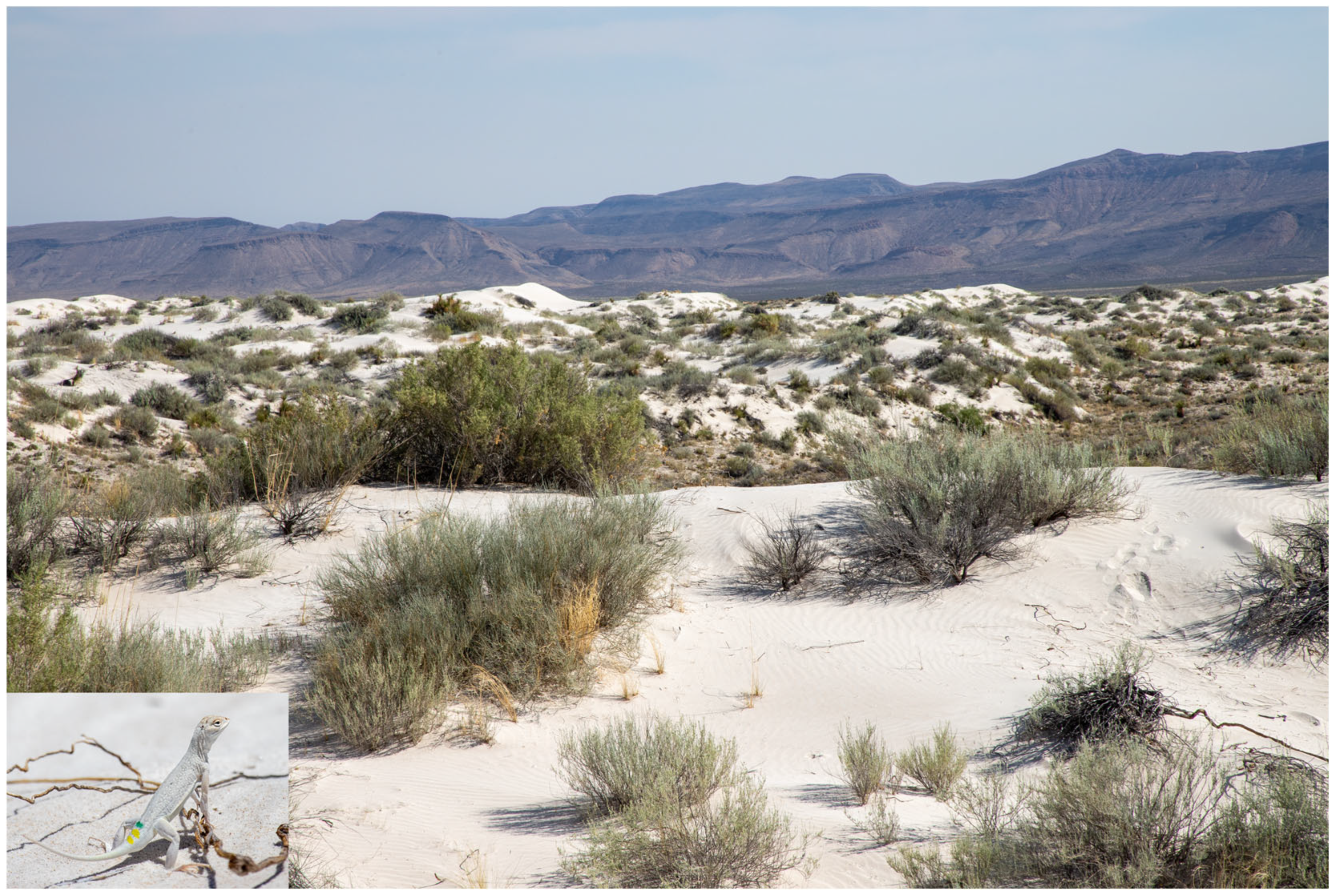

Escape Tactics Used by Blanched Lesser Earless Lizards (Holbrookia maculata)

 , , , , and
Abstract
1. Introduction
2. Materials and Methods
2.1. Escape Analysis
2.2. Habitat Use
3. Results
3.1. Escape Analysis
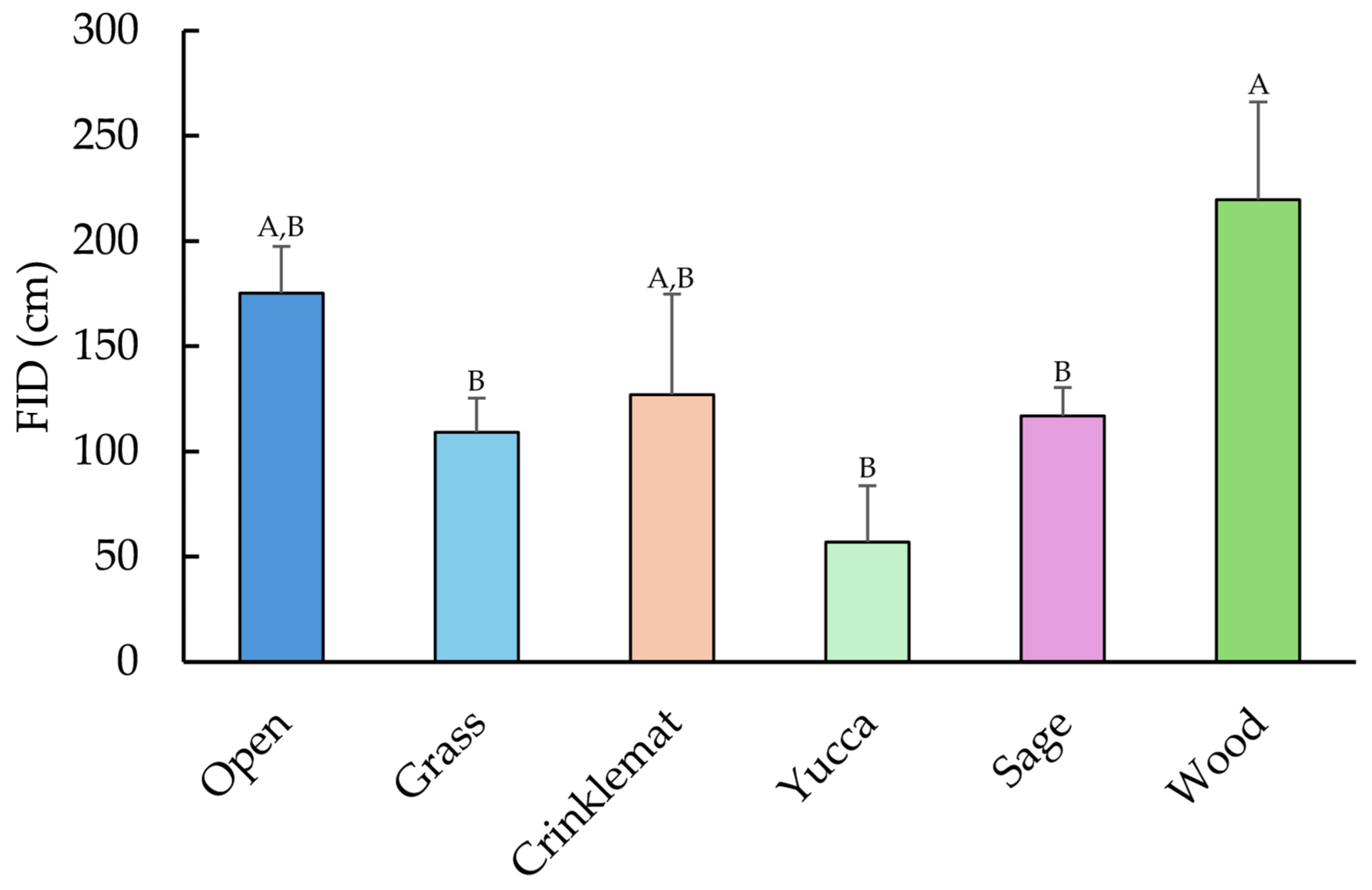
3.1.1. FID
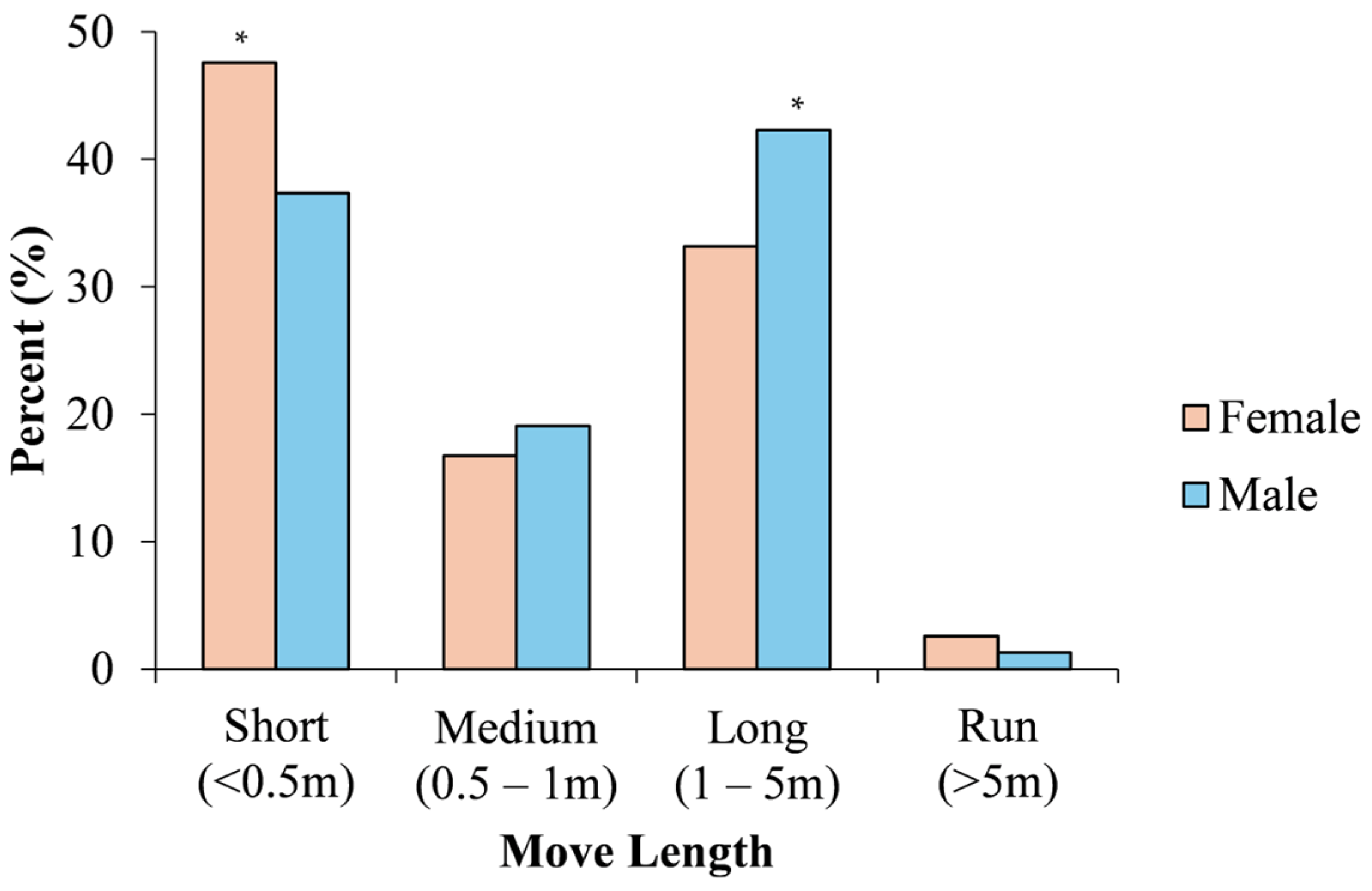
3.1.2. Trial Characteristics
3.2. Vegetation Use
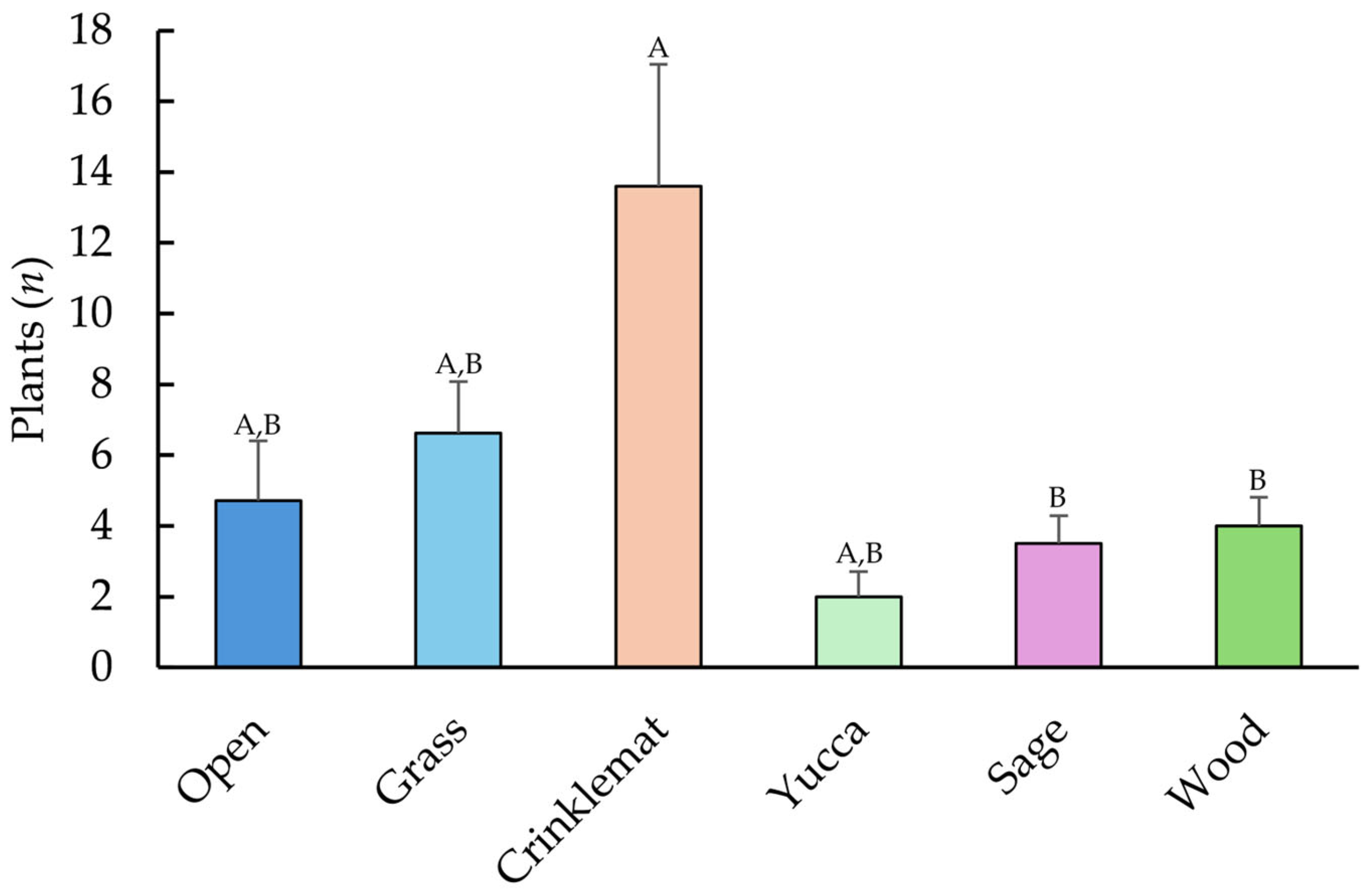
3.2.1. Number of Plants Visited
3.2.2. Sage Use
4. Discussion
Author Contributions
Funding
Institutional Review Board Statement
Data Availability Statement
Acknowledgments
Conflicts of Interest
Abbreviations
| FID | Flight initiation distance: distance between lizard and simulated predator when the lizard initially flees |
| GLM | General linear model |
| GUMO | Guadalupe Mountains National Park, Texas, USA |
| SBDs | Salt Basin Dunes, Texas, USA |
| SD | Start distance: distance between lizard and simulated predator at the beginning of a trial |
| SVL | Snout–vent length: a measure of lizard size (length from anterior edge of the snout to the posterior edge of the cloaca) |
| WSNP | White Sands National Park, New Mexico, USA |
References
- Caro, T. Antipredator Defenses in Birds and Mammals; University of Chicago Press: Chicago, IL, USA, 2005. [Google Scholar]
- Lima, S.L.; Dill, L.M. Behavioral decisions made under the risk of predation: A review and prospectus. Can. J. Zool. 1990, 68, 619–640. [Google Scholar] [CrossRef]
- Ydenberg, R.C.; Dill, L.M. The economics of fleeing from predators. Adv. Study Behav. 1986, 16, 229–249. [Google Scholar]
- Cooper, W.E.; Frederick, W.G. Optimal flight initiation distance. J. Theor. Biol. 2007, 244, 59–67. [Google Scholar] [CrossRef]
- Cooper, W.E., Jr.; Hawlena, D.; Pérez-Mellado, V. Effects of predation risk factors on escape behavior by Balearic lizards (Podarcis lilfordi) in relation to optimal escape theory. Amphib. Reptil. 2009, 30, 99–110. [Google Scholar] [CrossRef]
- Martín, J.; López, P. Nuptial coloration and mate guarding affect escape decisions of male lizards Psammodromus algirus. Ethology 1999, 105, 439–447. [Google Scholar] [CrossRef]
- Cooper, W.E., Jr. Age, sex and escape behavior in the striped plateau lizard (Sceloporus virgatus) and the mountain spiny lizard (S. jarrovii), with a review of age and sex effects on escape by lizards. Behaviour 2011, 148, 1215–1238. [Google Scholar] [CrossRef]
- Martín, J.; López, P. Thermal constraints of refuge use by Schreiber’s green lizards, Lacerta schreiberi. Behaviour 2010, 147, 275–284. [Google Scholar]
- Cooper, W.E., Jr.; Pérez-Mellado, V.; Baird, T.A.; Caldwell, J.P.; Vitt, L.J. Effects of risk, cost, and their interaction on optimal escape by nonrefuging Bonaire whiptail lizards Cnemidophorus murinus. Behav. Ecol. 2003, 14, 288–293. [Google Scholar] [CrossRef]
- Martín, J.; López, P. Wall lizards modulate refuge use through continuous assessment of predation risk level. Ethology 2005, 111, 207–219. [Google Scholar] [CrossRef]
- Braun, C.A.; Baird, T.A.; LeBeau, J.K. Influence of substrate temperature and directness of approach on the escape responses of juvenile collared lizards. Herpetologica 2010, 66, 418–424. [Google Scholar] [CrossRef]
- Kacoliris, F.P.; Guerrero, E.; Molinari, A.; Moyano, B.; Rafael, A. Run to shelter or bury into the sand? Factors affecting escape behavior decisions in Argentinian sand dune lizards (Liolaemus multimaculatus). Herpetol. J. 2009, 19, 213–216. [Google Scholar]
- Chhoumi, O.; Eifler, M.A.; Orton, M.M.; Eifler, D.A.; Selmi, S. Multiple vs. single predator effects: Differing experimental responses by the spotted fringe-fingered lizard (Acanthodactylus maculatus) facing aerial and terrestrial predators. J. Ethol. 2024, 43, 31–38. [Google Scholar] [CrossRef]
- Robertson, J.M.; Hoversten, K.; Gründler, M.; Poorten, T.J.; Hews, D.K.; Rosenblum, E.B. Colonization of novel White Sands habitat is associated with changes in lizard anti-predator behavior. Biol. J. Linn. Soc. 2011, 103, 657–667. [Google Scholar] [CrossRef][Green Version]
- Stankowich, T.; Blumstein, D.T. Fear in animals: A meta-analysis and review of risk assessment. Proc. R. Soc. B 2005, 272, 2627–2634. [Google Scholar] [CrossRef] [PubMed]
- Eifler, D.A.; Eifler, M.A. Escape tactics in the lizard Meroles cuneirostris. Amphib. Reptil. 2014, 35, 383–389. [Google Scholar] [CrossRef]
- Eifler, D.A.; Eifler, M.A.; Garrison, G.E.; Grotbeck, V.L. Escape angles for solitary animals and groups of the lizard Pholidoscelis fuscatus. Ethol. Ecol. Evol. 2022, 35, 125–133. [Google Scholar] [CrossRef]
- Cooper, W.E., Jr. Pursuit deterrence varies with predation risks affecting escape behaviour in the lizard Callisaurus draconoides. Anim. Behav. 2010, 80, 249–256. [Google Scholar] [CrossRef]
- Burger, J.; Gochfield, M.; Murray, B.G. Risk discrimination of eye contact and directness of approach in black iguanas (Ctenosaura similis). J. Comp. Psychol. 1992, 106, 97–101. [Google Scholar] [CrossRef]
- Hemmi, J.M. Predator avoidance in fiddler crabs. 1. Escape decisions in relation to the risk of predation. Anim. Behav. 2005, 69, 603–614. [Google Scholar] [CrossRef]
- Cooper, W.E., Jr. Flight initiation distance decreases during social activity in lizards (Sceloporus virgatus). Behav. Ecol. Sociobiol. 2009, 63, 1765–1771. [Google Scholar] [CrossRef]
- Samia, D.S.M.; Blumstein, D.T.; Stankowich, T.; Cooper, W.E., Jr. Fifty years of chasing lizards: New insights advance optimal escape theory. Biol. Rev. 2016, 91, 349–366. [Google Scholar] [CrossRef]
- Liu, E.F.; Eifler, M.A.; Buchanan, C.A.; Gilbert Smith, S.; Eifler, D.A. Escape by juvenile Little Striped Whiptails (Aspidoscelis inornatus Baird, 1859) in response to predator approach speed (Lacertilia: Teiidae). Herpetol. Notes 2021, 14, 479–483. [Google Scholar]
- Martín, J.; López, P. Influence of habitat structure on the escape tactics of the lizard Psammodromus algirus. Can. J. Zool. 1995, 73, 129–132. [Google Scholar] [CrossRef]
- Forsman, A. Temperature influence on escape behaviour in two species of pygmy grasshoppers. Ecoscience 1999, 6, 35–40. [Google Scholar] [CrossRef]
- Özbilgin, H.; Wardle, C.S. Effect of seasonal temperature changes on the escape behaviour of haddock, Melanogrammus aeglefinus, from the codend. Fish. Res. 2002, 58, 323–331. [Google Scholar] [CrossRef]
- Stankowich, T.; Coss, R.G. Effects of risk assessment, predator behavior, and habitat on escape behavior in Columbian black-tailed deer. Behav. Ecol. 2007, 18, 358–367. [Google Scholar] [CrossRef]
- Nahin, P.J. Chases and Escapes: The Mathematics of Pursuit and Evasion; Princeton University Press: Princeton, NJ, USA, 2007. [Google Scholar]
- Cresswell, W. Escape responses by redshanks, Tringa tetanus, on attack by avian predators. Anim. Behav. 1993, 46, 609–611. [Google Scholar] [CrossRef]
- Edut, S.; Eilam, D. Protean behavior under barn-owl attack: Voles alternate between freezing and fleeing and spiny mice flee in alternating patterns. Behav. Brain Res. 2004, 155, 207–216. [Google Scholar] [CrossRef]
- Martín, J.; López, P. Hiding time in refuge. In Escaping from Predators: An Integrative View of Escape Decisions; Cooper, W.E., Jr., Blumstein, D.T., Eds.; Cambridge University Press: Cambridge, UK, 2015; pp. 227–262. [Google Scholar]
- Cooper, W.E., Jr.; Van Wyk, J.H.; Mouton Le, F.P.; Mouton, N. Incompletely protective refuges: Selection and associated defenses by a lizard, Cordylus cordylus (Squamata: Cordylidae). Ethology 1999, 105, 687–700. [Google Scholar] [CrossRef]
- Kerr, G.; Bull, M.C.; Burzacott, D. Refuge sites used by the scincid lizard Tiliqua rugosa. Austral Ecol. 2003, 28, 152–160. [Google Scholar] [CrossRef]
- Martín, J.; López, P. Ontogenetic variation in antipredator behavior of Iberian rock lizards (Lacerta monticola): Effects of body-size-dependent thermal exchange rates and costs of refuge use. Can. J. Zool. 2003, 81, 1131–1137. [Google Scholar] [CrossRef]
- Martín, J.; López, P. Costs of refuge use affect escape decisions of Iberian rock lizards Lacerta monticola. Ethology 2000, 106, 483–492. [Google Scholar] [CrossRef]
- Cooper, W.E., Jr. Escape by a refuging prey, the broad-headed skink (Eumeces laticeps). J. Can. Zool. 1997, 75, 943–947. [Google Scholar] [CrossRef]
- Eifler, D.A. Egernia cunninghami (Cunningham’s skink): Escape behavior. Herpetol. Rev. 2001, 30, 40. [Google Scholar]
- Stapley, J. Differential avoidance of snake odours by a lizard: Evidence for prioritized avoidance based on risk. Ethology 2003, 109, 785–796. [Google Scholar] [CrossRef]
- Amo, L.; López, P.; Martín, J. Trade-offs in the choice of refuges by common wall lizards: Do thermal costs affect preferences for predator free refuges? Can. J. Zool. 2004, 82, 897–901. [Google Scholar] [CrossRef]
- Rosenblum, E.B.; Burkett, D.; Blaine, R. Common lesser earless lizard: Holbrookia maculata Girard, 1851. In Lizards of the American Southwest; Jones, L.L.C., Lovich, R.E., Eds.; Rio Nuevo Publishers: Tucson, AZ, USA, 2009; pp. 154–157. [Google Scholar]
- Rosenblum, E.B.; Harmon, L.J. Same same but different: Replicated ecological speciation at White Sands. Evolution 2011, 65, 946–960. [Google Scholar] [CrossRef]
- Walkup, D.K.; Leavitt, D.J.; Fitzgerald, L.A. Effects of habitat fragmentation on population structure of dune-dwelling lizards. Ecosphere 2017, 8, 01729. [Google Scholar] [CrossRef]
- Hager, S.B. Microhabitat use and activity patterns of Holbrookia maculata and Sceloporus undulatus at White Sands National Monument, New Mexico. J. Herpetol. 2001, 35, 326–330. [Google Scholar] [CrossRef]
- Hager, S.B. Quantification of body coloration for the lesser earless lizard, Holbrookia maculata: Evidence for interpopulational differences. Southwest. Nat. 2002, 47, 299–307. [Google Scholar] [CrossRef]
- Rosenblum, E.B.; Rompler, H.; Schoneberg, T.; Hoekstra, H.E. Molecular and functional basis of phenotypic convergence in white lizards at White Sands. Proc. Natl. Acad. Sci. USA 2009, 107, 2113–2117. [Google Scholar] [CrossRef] [PubMed]
- Des Roches, S.; Brinkmeyer, M.S.; Harmon, L.J.; Rosenblum, E.B. Ecological release and directional change in White Sands lizard trophic ecomorphology. Evol. Ecol. 2015, 29, 1–16. [Google Scholar] [CrossRef]
- Laurentino, T.G.; Dittmer, D.E.; Grundler, M.R.; Pina-Martins, F.; Haddock, J.; Hibbitts, T.J.; Rosenblum, E.B. Repeated evolution of blanched coloration in a lizard across independent white-sand habitats. Ecol. Evol. 2022, 12, 9555. [Google Scholar] [CrossRef]
- Orton, M.M.; Eifler, M.A.; Utsumi, K.L.; Laurentino, T.G.; Siddiqui, D.; Haddock, J.B.; Quock, R.; Eifler, D.A. Holbrookia maculata space use in the Salt Basin Dunes of the Guadalupe Mountains National Park. Herpetol. Rev. 2024, 55, 7–10. [Google Scholar]
- Des Roches, S.; Torresdal, J.; Morgan, T.W.; Harmon, L.J.; Rosenblum, E.B. Beyond black and white: Divergent behaviour and performance in three rapidly evolving lizard species at White Sands. Biol. J. Linn. Soc. 2014, 111, 169–182. [Google Scholar] [CrossRef][Green Version]
- Des Roches, S.; Robertson, J.M.; Harmon, L.J.; Rosenblum, E.B. Ecological release in White Sands lizards. Ecol. Evol. 2011, 1, 571–578. [Google Scholar] [CrossRef]
- Genoways, H.H.; Baker, R.J.; Cornely, J.E. Mammals of the Guadalupe Mountains National Park, Texas. Mammal. Pap. Univ. Neb. State Mus. 1975, 114, 271–332. [Google Scholar]
- Wagner, E.A.; Zani, P.A. Escape behavior of Side-blotched Lizards (Uta stansburiana) in response to model predators. Can. J. Zool. 2017, 95, 965–973. [Google Scholar] [CrossRef]
- Rodríguez-Prieto, I.; Martín, J.; Fernández-Juricic, E. Habituation to Low-Risk Predators Improves Body Condition in Lizards. Behav. Ecol. Sociobiol. 2010, 64, 1937–1945. [Google Scholar] [CrossRef]
- Domínguez-López, M.E.; Diego-Rasilla, F.J.; Ortega-León, A.M. Effects of sex and microhabitat structure on escape behaviour in the diurnal gecko Gonatodes albogularis. Anim. Biol. 2016, 66, 31–47. [Google Scholar] [CrossRef]
- Cooper, W.E., Jr.; Pérez-Mellado, V. Historical influence of predation pressure on escape by Podarcis lizards in the Balearic Islands. Biol. J. Linn. Soc. 2012, 107, 254–268. [Google Scholar] [CrossRef]
- Yu, M.H.; Ding, G.D.; Gao, G.L.; Sun, B.P.; Zhao, Y.Y.; Wan, L.; Wang, D.Y.; Gui, Z.Y. How the plant temperature links to the air temperature in the desert plant Artemisia ordosica. Sci. Rep. 2015, 5, 12889. [Google Scholar] [CrossRef] [PubMed]
- Wambolt, C.L.; Frisina, M.R.; Knapp, S.J.; Frisina, R.M. Preference of mule deer for big sagebrush taxa. J. Range Manag. 1996, 49, 499–503. [Google Scholar] [CrossRef]
- Biaggini, M.; Berti, R.; Corti, C. Different habitats, different pressures? Analysis of escape behaviour and ectoparasite load in Podarcis sicula (Lacertidae) populations in different agricultural habitats. Amphib. Reptil. 2009, 30, 453–461. [Google Scholar] [CrossRef]
- McBrayer, L.D.; Parker, S.E. Variation in habitat management alters risk aversion behavior in lizards. Behav. Ecol. Sociobiol. 2018, 72, 149. [Google Scholar] [CrossRef]
- Eifler, D.A.; Dittmer, D.E.; Dick, L.; Rowe, B.; Johnson, J.J.; Stanley, D.R.; Eifler, M.A. Differences in habitat use, thermal ecology, and behavior of the semiaquatic lizard Anolis aquaticus at a high- and low-elevation site. Diversity 2025, 17, 673. [Google Scholar] [CrossRef]
- Doherty, T.S.; Fist, C.N.; Driscoll, D.A. Animal movement varies with resource availability, landscape configuration and body size: A conceptual model and empirical example. Landsc. Ecol. 2019, 34, 603–614. [Google Scholar] [CrossRef]
- Morelli, F.; Mikula, P.; Blumstein, D.T.; Díaz, M.; Markó, G.; Jokimäki, J.; Kaisanlahti-Jokimäki, M.; Floigl, K.; Abou Zeid, F.; Siretckaia, A.; et al. Flight initiation distance and refuge in urban birds. Sci. Total Environ. 2022, 842, 156939. [Google Scholar] [CrossRef]
- Tryban, M.E.; Utsumi, K.L.; Olson, C.N.; Yang, J.L.; Reynolds, H.; Eifler, M.A.; Eifler, D.A. Sex-based variation in behavior for the little striped whiptail (Aspidoscelis inornatus). Southwest. Nat. 2024, 68, 112–120. [Google Scholar] [CrossRef]



| Mean ± SE (Range) | |
|---|---|
| Start distance (cm) | 509.3 ± 16.2 (165–755) |
| FID (cm) | 133.2 ± 11.1 (5–385) |
| Trial length (s) | 79.34 ± 4.50 (23–120) |
| Trial moves (n) | 14.80 ± 1.29 (1–39) |
| FID | Trial Length | Number of Moves | Number of Plants | |||||||||
|---|---|---|---|---|---|---|---|---|---|---|---|---|
| Source | F | df | p | F | df | p | F | df | p | F | df | p |
| Start °C | 2.89 | 1.41 | 0.097 | 0.19 | 1.43 | 0.665 | 1.21 | 1.44 | 0.277 | 0.05 | 1.43 | 0.830 |
| Start habitat | 3.44 | 5.41 | 0.011 | 1.59 | 5.43 | 0.183 | 2.11 | 5.44 | 0.083 | 4.60 | 5.43 | 0.002 |
| Sex | 0.11 | 1.41 | 0.742 | 3.01 | 1.43 | 0.090 | 1.89 | 1.44 | 0.176 | 1.12 | 1.43 | 0.295 |
| Experience | 1.09 | 1.41 | 0.302 | 0.12 | 1.43 | 0.729 | 0.36 | 1.44 | 0.552 | 0.10 | 1.43 | 0.751 |
| Trial outcome | -- | -- | -- | 21.96 | 2.43 | <0.0001 | -- | -- | -- | -- | -- | -- |
| Trial length (s) | -- | -- | -- | -- | -- | -- | 87.98 | 1.44 | <0.0001 | 7.28 | 1.43 | 0.010 |
| Start Habitat | FID (cm) | Substrate Temp. (°C) | Vegetation (n) | ||
|---|---|---|---|---|---|
| n | Mean | SE | |||
| Crinklemat | 5 | 127.0A,B | 47.8 | 37.2A,B | 13.6A |
| Grass | 13 | 109.2B | 16.1 | 33.33B | 6.62A,B |
| Open | 7 | 175.3A,B | 22.1 | 37.71A,B | 4.71A,B |
| Wood | 7 | 219.6A | 46.4 | 45.69A | 4.0B |
| Sage | 20 | 116.9B | 13.5 | 32.73B | 3.5B |
| Yucca | 3 | 57.0B | 26.6 | 38.58A,B | 2.0A,B |
| Variable | Mean ± SE | Range |
|---|---|---|
| Length (cm) | 311 ± 18 | (30–1149) |
| Width (cm) | 196 ± 9 | (25–527) |
| Area (length × width) (m2) | 7.8 ± 0.8 | (0.5–60.6) |
| Sage Bush | ||
|---|---|---|
| Move Length | Width | Length |
| Short | 0.15 (p = 0.106) | 0.21 (p = 0.026) |
| Medium | 0.43 (p < 0.001) | 0.31 (p = 0.001) |
| Long | 0.27 (p = 0.004) | 0.35 (p < 0.001) |
Disclaimer/Publisher’s Note: The statements, opinions and data contained in all publications are solely those of the individual author(s) and contributor(s) and not of MDPI and/or the editor(s). MDPI and/or the editor(s) disclaim responsibility for any injury to people or property resulting from any ideas, methods, instructions or products referred to in the content. |
© 2026 by the authors. Licensee MDPI, Basel, Switzerland. This article is an open access article distributed under the terms and conditions of the Creative Commons Attribution (CC BY) license.
Share and Cite
Utsumi, K.L.; Siddiqui, D.; Haddock, J.B.; Orton, M.M.; Laurentino, T.G.; Eifler, M.A.; Eifler, D.A. Escape Tactics Used by Blanched Lesser Earless Lizards (Holbrookia maculata). Diversity 2026, 18, 80. https://doi.org/10.3390/d18020080
Utsumi KL, Siddiqui D, Haddock JB, Orton MM, Laurentino TG, Eifler MA, Eifler DA. Escape Tactics Used by Blanched Lesser Earless Lizards (Holbrookia maculata). Diversity. 2026; 18(2):80. https://doi.org/10.3390/d18020080
Chicago/Turabian StyleUtsumi, Kaera L., Daanya Siddiqui, Janey B. Haddock, Makenna M. Orton, Telma G. Laurentino, Maria A. Eifler, and Douglas A. Eifler. 2026. "Escape Tactics Used by Blanched Lesser Earless Lizards (Holbrookia maculata)" Diversity 18, no. 2: 80. https://doi.org/10.3390/d18020080
APA StyleUtsumi, K. L., Siddiqui, D., Haddock, J. B., Orton, M. M., Laurentino, T. G., Eifler, M. A., & Eifler, D. A. (2026). Escape Tactics Used by Blanched Lesser Earless Lizards (Holbrookia maculata). Diversity, 18(2), 80. https://doi.org/10.3390/d18020080