


Abstract
Agricultural expansion is a major driver of biodiversity loss in tropical regions, yet human-dominated landscapes also hold potential for biodiversity conservation when managed as multifunctional mosaics that retain patches of native vegetation. We assessed how natural and semi-natural habitats contribute to avian diversity in a tropical livestock farm in northern Costa Rica. Over one year, bird assemblages were sampled across three habitat types (live fences, pastures and riparian forest) at La Balsa farm. Using point counts surveyed every month during the year, we recorded 165 bird species, including 20 migratory and 6 species of global conservation concern, and 4 regionally endemic species. Species richness and overall abundance were lower in the riparian forest compared to live fences and pastures, and bird assemblage composition differed markedly among habitats, with the community in the riparian forest exhibiting a distinct assemblage structure. These results indicate that though the riparian forest hosts fewer species and individuals, it harbors a characteristic bird assemblage, highlighting its irreplaceable ecological role in providing habitat to forest-dependent species. Overall, the findings underscore that structurally diverse agricultural mosaics can sustain remarkably high bird diversity when complemented by habitats including native vegetation.
1. Introduction
In recent decades, human settlements have expanded into regions that were once covered by vast forests, resulting in highly fragmented landscapes [1]. Birds have been shown to be one of the groups most affected by habitat loss and fragmentation [2,3]. The disruption of natural habitat continuity has created mosaics where urban areas, farmlands, and natural ecosystems now coexist in proximity [4]. As a result, both humans and wildlife must adapt to this new reality, where interactions between species and people are becoming increasingly frequent [5]. These interactions, as well as the fragmented landscapes present challenges for biodiversity conservation, but they also offer new opportunities for integrated, multifunctional land use [6,7].
Within this scenario, agricultural lands can play a crucial role in conservation efforts if they are tailored to regional contexts and promote connectivity and heterogeneity through semi-natural habitats [8,9]. Far from being purely extractive, farms have the potential to provide habitats, movement corridors, and ecological services that support both cultivated and wild species [10]. When managed sustainably, agricultural farms can contribute to connecting forest fragments, reducing edge effects, and fostering coexistence between rural livelihoods and biodiversity [11]. These outcomes require the adoption of integrative approaches that explicitly incorporate ecological processes alongside social dimensions, thereby accounting for diverse local realities [12]. In this context, farms can contribute to people not only as a source of food, but also as a key component of biodiversity-friendly landscapes [9].
Agricultural lands, when structurally diverse and enriched with native vegetation, can offer birds access to food, shelter, and nesting opportunities that buffer them against the loss of continuous natural habitats, such as forests [13]. Features such as live fences, pastures and riparian forests can create functional habitats that sustain resident species while also aiding migratory birds along their routes [14]. These natural and semi-natural habitats not only enhance survival and reproduction but also facilitate movement between forest patches, thereby maintaining gene flow and ecological resilience in bird populations [15,16]. However, agricultural practices often involve pesticide use, which can negatively affect insectivorous birds by reducing insect prey availability [17]. By integrating biodiversity-supportive practices, farms thus become vital allies in preventing local extinctions and securing long-term bird conservation [9].
Understanding the specific ways in which natural and semi-natural habitats in agricultural landscapes contribute to biodiversity is essential for designing effective conservation strategies [7]. Not all land uses provide equal benefits, and their value may vary according to bird guilds, ecological requirements, or spatial context [18]. For this reason, it is critical to identify which practices most effectively enhance species diversity. Generating this knowledge will allow for informed land management decisions that balance production with conservation goals, ensuring that agricultural lands not only sustain human communities but also actively contribute to preserving avian diversity and ecosystem health [19,20].
While the impacts of agriculture on biodiversity and strategies for mitigating them have been widely studied [21,22], the potential of small-scale farms to sustain diverse bird assemblages has received considerably less attention [23]. To address this gap, we assessed how bird assemblages are structured across space and time within a tropical livestock farm in northern Costa Rica. Specifically, we examined variation in bird species richness and overall abundance across three habitat types (live fence, pasture, and riparian forest) and over seven months (April–October 2024), encompassing the entire rainy season. We also assessed the similarity of bird assemblages among habitats to determine whether each contributes uniquely to the farm’s overall diversity. Through this approach, we evaluated the extent to which different on-farm habitats support avian diversity and provided insights into how biodiversity-friendly farm habitats can enhance conservation value within productive lands.
2. Materials and Methods
2.1. Study Area
We conducted this study at la Balsa farm, located in San Lorenzo, a small town 56 km NW of downtown San Ramón (10°22′ N, 84°31′ W, Alajuela Province, Costa Rica) at an elevation of 160 m above sea level. This area is located within the Huetar North Region (northern Costa Rica) and corresponds to the Tropical Humid Forest life zone [24]. The region is known for its significance in agricultural production, biodiversity conservation, and water resource management, and supports a dynamic mosaic of natural ecosystems and human-altered landscapes [25,26].
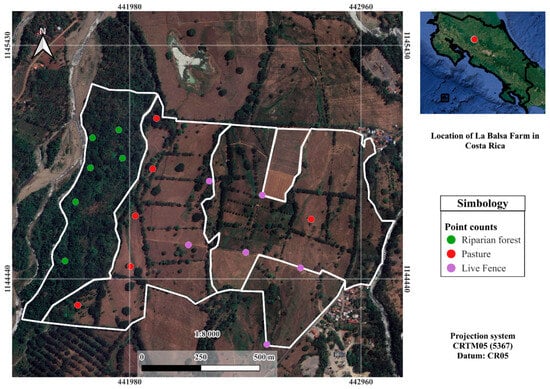
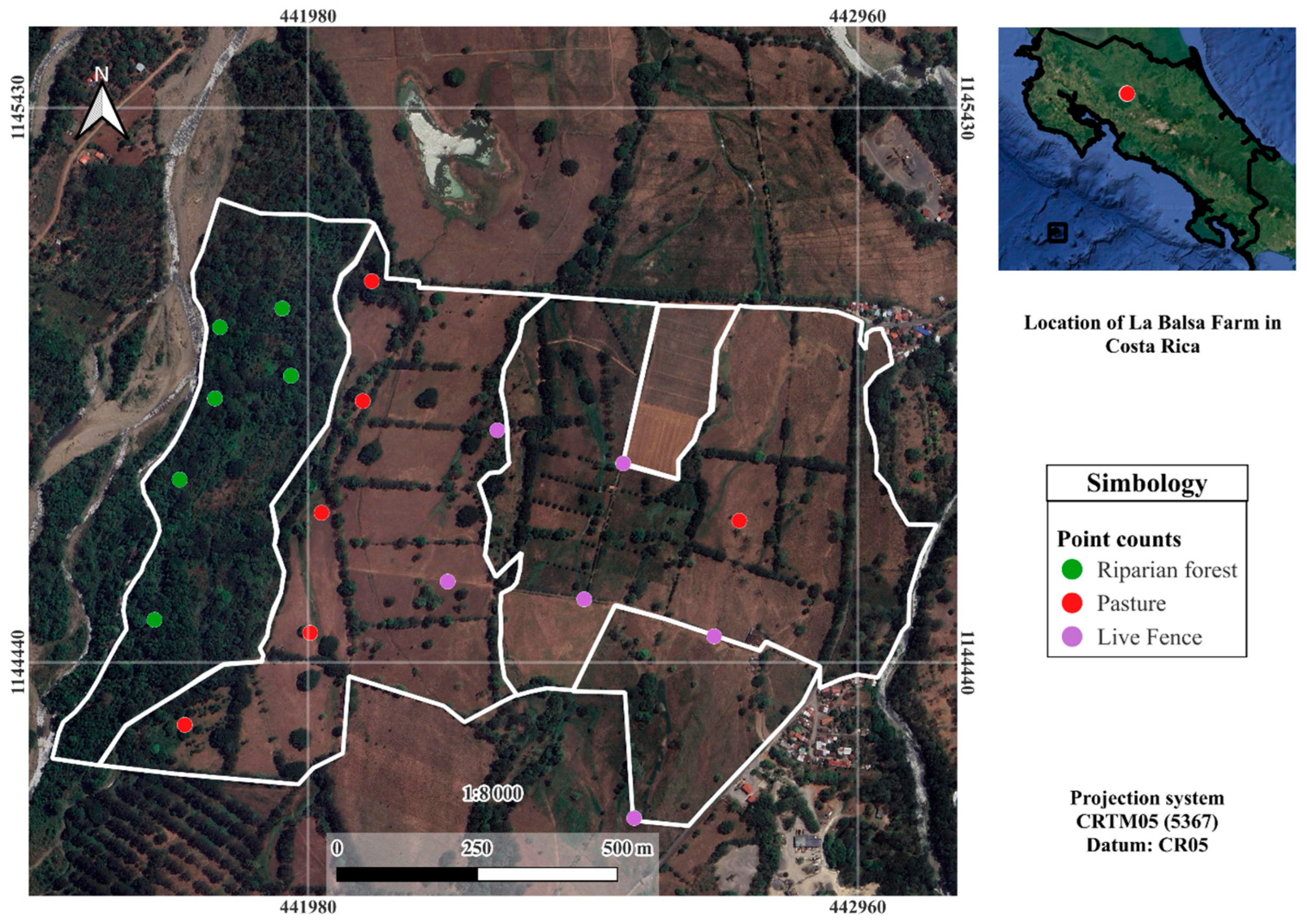
La Balsa farm, owned by the Costa Rica Institute of Technology and administrated by the Agricultural Production Program (PPA), covers a total area of 136 hectares, of which 86 hectares are used for pasture and cattle forage, and 50 hectares are protected forested area (Figure 1). The main productive activity in the farm is livestock production, and to a lesser extent, corn for animal consumption. The average annual precipitation in this area is about 3000 mm, while the mean annual temperature is 26 °C [27]; the dry season extends from late December to early May [28].
Figure 1.
Location of la Balsa farm in northern Costa Rica, showing the distribution of point-counts used to sample birds across three habitats.
Live fences consist of linear arrangements of woody vegetation used to delimit paddocks and property boundaries. In the study area, these structures are typically composed of native or naturalized tree species commonly used in agricultural landscapes of northern Costa Rica, such as poró (Erythrina poeppigiana; Fabaceae), blackwood (Gliricidia sepium; Fabaceae) and naked Indian (Bursera simaruba; Burseraceae). Pastures were characterized by open grass-dominated areas used for cattle grazing, with sparse tree cover, where the vegetation was dominated by Guinea grass (Megathyrsus maximus), with lower representation of Gamalote grass (Paspalum fasciculatum), Tanner grass (Urochloa arrecta) and star grass (Cynodon nlemfuensis). Scattered trees or small clumps of shade trees were occasionally present, but overall vegetation complexity was low. In contrast, the riparian forest corresponded to strips of natural vegetation along the San Lorenzo River. These areas exhibited higher structural complexity, including multiple vegetation strata, greater tree density, and a predominance of native species.
2.2. Data Collection
Fieldwork was conducted from April 2024 to April 2025. During this period, we recorded bird presence and abundance data at 18-point counts across three habitats (six per habitat): live fence, pasture and riparian forest, with a monthly frequency (n = 12 sampling events).
We used a random-start systematic sampling design to locate point counts, whereby an initial point was randomly selected across different sectors of the farm within each habitat to ensure broad spatial coverage and minimize potential bias from unsampled areas. Subsequent points were placed at fixed minimum distances in accessible directions (Figure 1). At each point, we conducted bird observations between 5:30 and 8:00 on two consecutive mornings, covering nine points per day until completing all sampling counts. This approach allowed for sampling within a narrow time window, minimizing potential biases caused by the natural decline in bird activity as the morning progresses [29,30]. Birds were recorded by sight and vocalizations by two experimented observers for 5 min at each point, and all individuals were identified to species level following [31]. In addition, we recorded foraging and breeding behavior to better characterize habitat use by birds. Sampling efforts totaled 216 point counts with 2.665 bird detections over this study.
We defined locally dominant resident bird species as those combining high relative abundance and consistent presence across all 12 monthly sampling periods. This definition captures species that were both numerically prevalent and temporally persistent throughout the year. For migratory birds, the dominant species were defined as those with the highest total number of individuals per monthly sampling. Finally, we compiled the conservation status of recorded bird species from the literature, considering the categories established by the International Union for Conservation of Nature (IUCN), the Convention on International Trade in Endangered Species of Wild Fauna and Flora (CITES), and relevant national wildlife protection laws.
2.3. Data Analysis
To describe the taxonomic diversity of avian assemblages, we calculated species richness (number of bird species) and overall bird abundance (number of individuals across all species) for each habitat and monthly sampling.
Bird sampling in riparian forest could not be conducted during five samplings due to unexpected river flooding that rendered this habitat inaccessible. To ensure comparability across habitats and throughout the year, data from the other two habitats were excluded for those same months. As a result, spatial and temporal comparisons are based primarily on rainy season data. For temporal comparisons, we grouped sampling months into three biologically meaningful periods of the rainy season: early (April–June), mid (July–August), and late (September–October). These periods reflect well-known seasonal differences in Costa Rica, with the early rainy season coinciding with the chick-rearing period of many resident birds, the mid-rainy season overlapping with the Veranillo de San Juan (a short dry spell), and the late rainy season corresponding to the arrival of several migratory species [32,33]. Because the early rainy season included one additional month, we repeated the analyses excluding April to standardize period length; the results did not change, and we therefore retained the full dataset.
To analyze variation in species richness and overall bird abundance across space and time, we fitted two separate generalized linear mixed models (GLMM) using the “glmmTMB” package in R. Because count data exhibited overdispersion, we specified a negative binomial error distribution (nbinom2) with a log link. This error distribution is especially suitable, as the additional dispersion parameter accounts for overdispersed data and improves the accuracy of parameter estimates and statistical inference [34]. In these models, species richness or overall abundance was used as the response variable, with habitat and the subdivided rainy-season period included as fixed effects. To account for non-independence in the data, we included point count and month as random intercepts, representing spatial and temporal random variation, respectively. We also tested the habitat × period interaction, but since it was not significant and did not improve model performance, it was excluded. The final model structure can be expressed as follows:
where birds represent either species richness or overall abundance of bird assemblages; habitat corresponds to live fence, pasture, and riparian forest, and period refers to early, mid, and late phases of the rainy season. Random intercepts for point count and month capture spatial and temporal variability in the data. For each model, we assessed the significance of the fixed effect using type III Wald tests (Anova, “car” package) of the GLMMs. We then compared factor levels of each fixed effect (habitat and period) by obtaining estimated marginal means on the response scale using the “emmeans” package, followed by Tukey-adjusted pairwise comparisons among habitats and periods.
birds ~ habitat + period + (1|point count) + (1|month|)
To assess differences in bird assemblage composition among habitats, we applied a permutational multivariate analysis of variance (PERMANOVA) based on a Bray–Curtis dissimilarity matrix derived from species abundance data collected at each point count. This method tests whether community composition differs among predefined groups by partitioning variation in the dissimilarity matrix and assessing significance with random permutations of the data [35]. This approach is widely used in community ecology because it does not assume multivariate normality and is robust for comparing species assemblages across habitats or environmental gradients [36,37]. We used 999 unrestricted permutations to test the significance of habitats as a predictor of species composition and the adonis2 function from the “vegan” package [38]. Non-metric multidimensional scaling (NMDS) was used to visualize patterns of variation in bird community composition across the three habitats. NMDS is a rank-based ordination method that represents ecological distances, in this case, Bray–Curtis dissimilarities, in a reduced two-dimensional space while preserving the relative ordering of distances among samples. This approach is robust to non-linear relationships and the prevalence of zeros in species abundance data [39].
To further characterize patterns in bird assemblage composition, we quantified beta diversity among habitats using a presence–absence approach and decomposed into its main components following [40]. We constructed habitat × species presence–absence matrices and calculated pairwise Sørensen dissimilarity indices using the beta.pair function implemented in the “betapart” package. Total beta diversity (β_sor) was partitioned into species turnover (β_sim), representing species replacement among habitats, and nestedness-resultant dissimilarity (β_nes), reflecting differences due to ordered species loss or gain. Mean values of β_sor, β_sim, and β_nes were calculated to summarize overall patterns of compositional differentiation among habitats.
We used marginal and conditional R2 as goodness of fit statistics for all mixed models based on the log-normal method, which provides an intuitive measure of model fit on the observed scale and is particularly useful for models using a log link function, such as GLMMs with negative binomial distributions [41]. All statistical analyses were conducted with R statistical software version 4.5.1 [42].
3. Results
We recorded 165 bird species from 44 families and 19 orders across the three habitats (live fence, pasture and riparian forest), of which twenty (12%) were migratory species (Table 1; see Table S1 in Supplementary Materials for complete species list). On average, we recorded 3.9 ± 0.2 individuals/species/month (mean ± S.E.; range 1–52). The most dominant species on the farm (i.e., those with the highest abundances and recorded over all 12 monthly samplings) were, in decreasing order of abundance, Psarocolius montezuma (Icteridae), Ramphocelus passerinii (Thraupidae), Troglodytes aedon (Troglodytidae) and Coragyps atratus (Cathartidae). Among migratory birds (non-breeding species), the most dominant species were, in decreasing order, Piranga olivacea (Cardinalidae), Setophaga pensylvanica (Parulidae), Icterus galbula, and Icterus spurius (Icteridae), with recorded abundance of 5 to 8 individuals/species/month. The percentage of dominant resident species was similar across the three habitats, representing 11–12% of total species richness (Table 1). We recorded 28 bird species engaged in foraging activity or nesting during point-count surveys, with most observations occurring in live fences and pastures (Table 1). Among these, two migratory species, the Chestnut-sided Warbler (Setophaga pensylvanica) and the Spotted Sandpiper (Actitis macularius), were observed foraging.
Table 1.
Summary of bird assemblage metrics across three habitats within La Balsa farm, northern Costa Rica. Richness indicates the total number of species recorded, while Mig, Dom, End, and Cons represent the percentage of migratory, dominant, regionally endemic species, and species with global or national conservation status, respectively, relative to total richness per habitat. Dominant species were defined as those detected in all 12 sampling months. Abun represents mean monthly avian abundance, calculated by first summing the number of individuals across all species within each month and then averaging across all monthly periods. F–R indicates the number of species observed exhibiting feeding or breeding behavior.
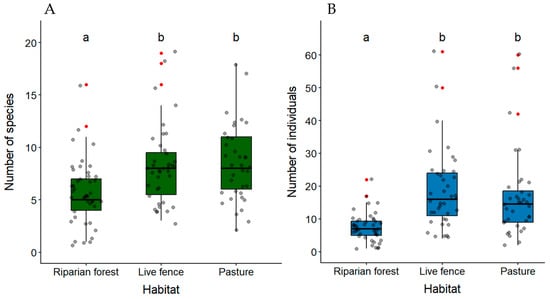
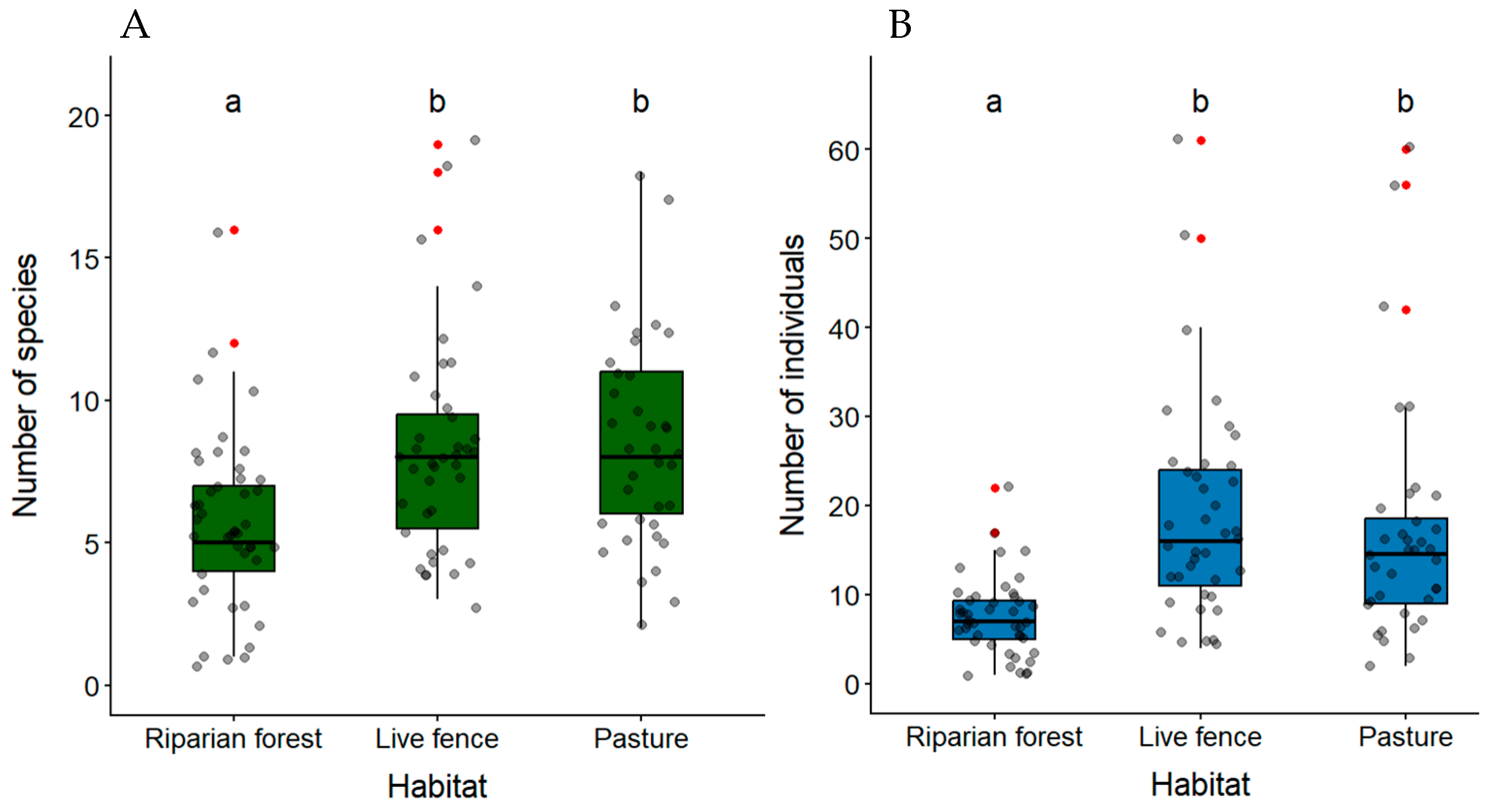
Bird richness varied among habitats (χ2 = 18.31, p < 0.001; Table 1), being lower in riparian forest compared to live fence and pasture, while no difference was found between live fence and pasture (Figure 2A, Table 2). Bird overall abundance showed the same pattern (χ2 = 34.45, p < 0.001), being lower in riparian forest compared to live fence and pasture, while no difference was detected between live fence and pasture (Figure 2B, Table 2).
Figure 2.
(A) Species richness and (B) overall abundance of bird assemblages per monthly sampling across three habitats at La Balsa farm, northern Costa Rica. Dots represent point-count–level observations within a given monthly sampling (total n = 118 point counts), slightly jittered horizontally for better visibility. Mean monthly species richness and abundance, calculated by pooling all point counts within each habitat and month, ranged from 27 to 30 bird species and from 47 to 105 individuals across the three habitats. Horizontal lines within boxes represent medians; boxes indicate the interquartile range (25th–75th percentiles); ends of the vertical lines denote the data range; red circles represent outliers. Different letters indicate significant among-habitat differences (Tukey-adjusted, p < 0.05; see Table 1 for statistics).
Table 2.
Pairwise mean comparisons from generalized linear mixed models analyzing variation in species richness and overall abundance of bird assemblages across three habitats at La Balsa farm, northern Costa Rica, with Tukey’s post hoc contrasts. Shown are ratios of means, z-ratios and p-values; significant results (p < 0.05) are indicated in bold.
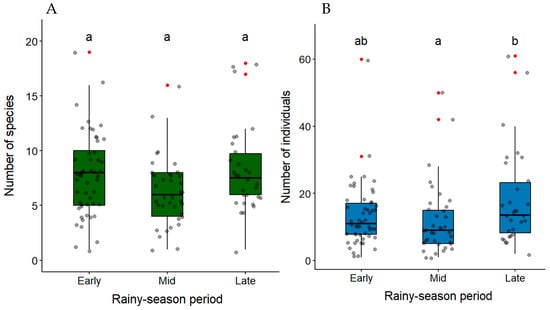
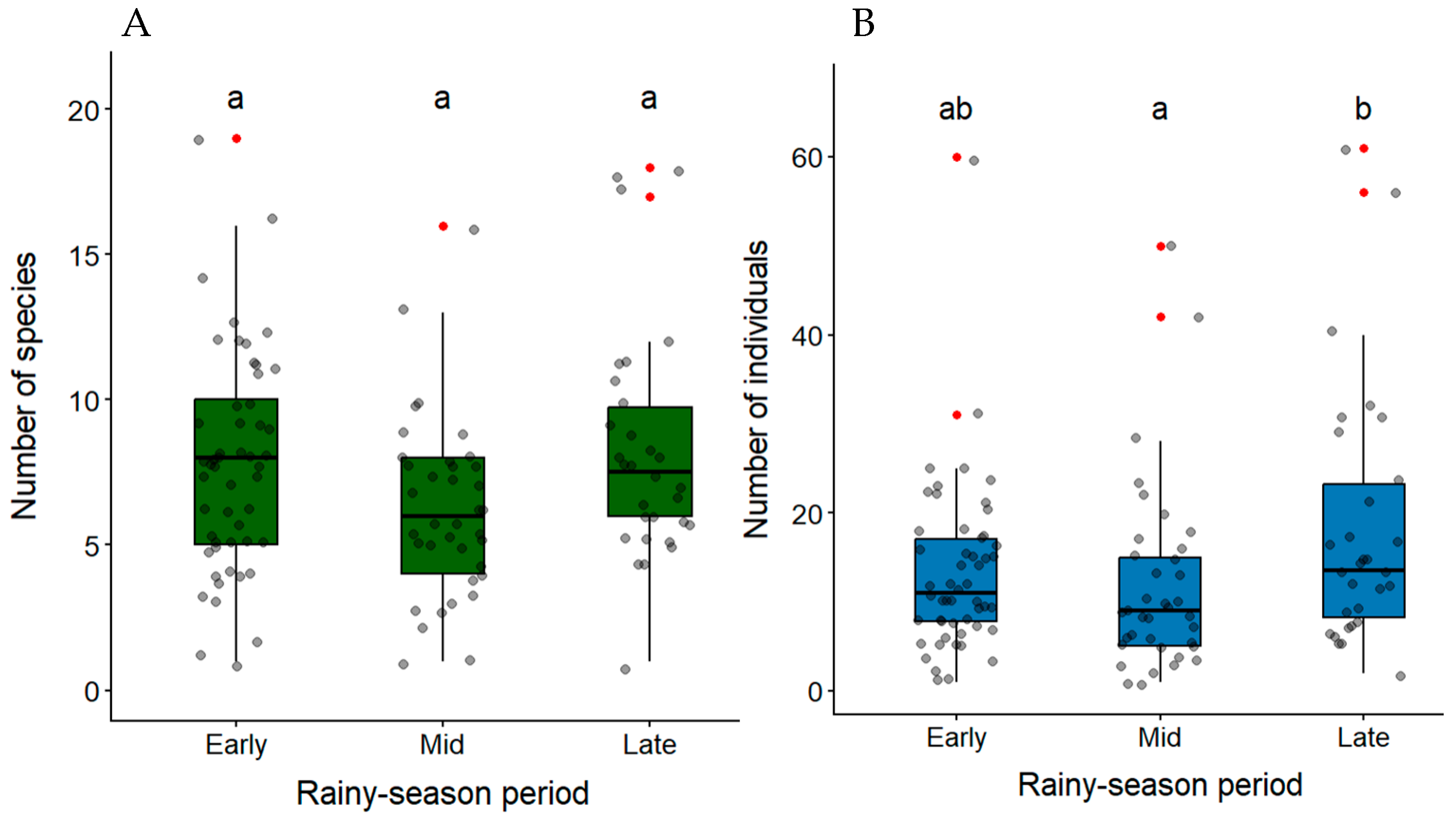
Regarding temporal variation, no differences in species richness were detected among rainy-season periods (χ2 = 5.52, p = 0.063; Figure 3A), whereas overall abundance was higher in the late rainy season (September–October) compared with the mid-rainy season (July–August), (χ2 = 9.29, p = 0.010; Figure 3B). Both models showed adequate explanatory power, with R2m = 0.20 and R2c = 0.22 for the richness’ model and R2m = 0.37 and R2c = 0.43 for the abundance’s model.
Figure 3.
(A) Species richness and (B) overall abundance of bird assemblages across periods within the rainy season (from April to October) at La Balsa farm, northern Costa Rica. Dots represent point-count–level observations within a given monthly sampling (total n = 118 point counts), slightly jittered horizontally for better visibility. Horizontal lines within boxes represent medians; boxes indicate the interquartile range (25th–75th percentiles); ends of the vertical lines denote the data range; red circles represent outliers; and gray dots represent individual point counts (slightly jittered horizontally for better visibility). Different letters indicate significant among-habitat differences.
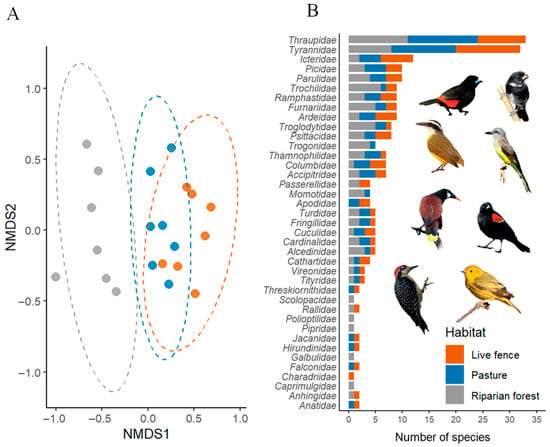
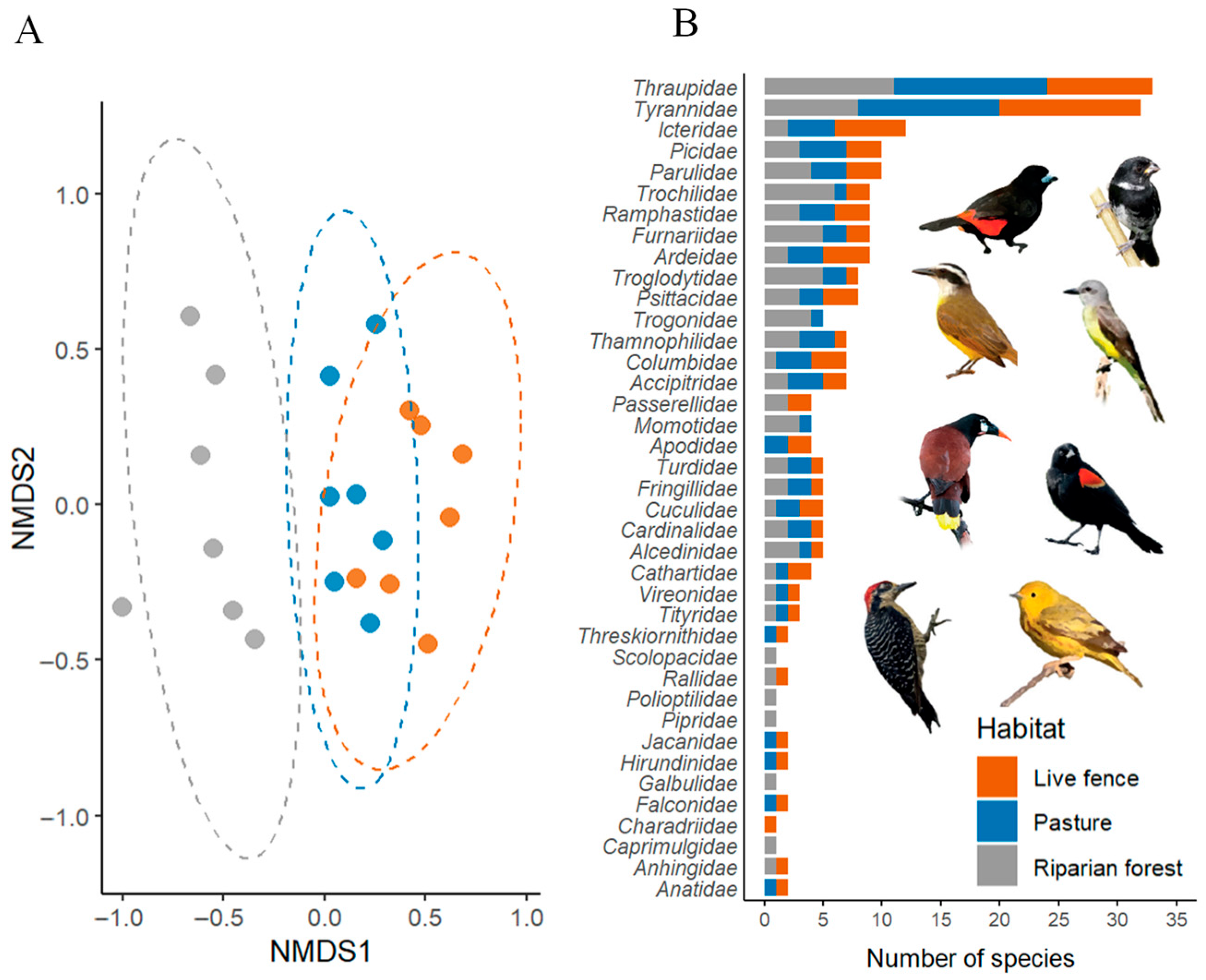
The PERMANOVA analysis based on Bray–Curtis distances revealed differences in bird composition among the three habitats (pseudo-F = 3.38, R2 = 0.27, p = 0.001), which indicates that about 27% of the variation in community structure is explained by habitat type, while the remaining 73% corresponds to within-habitat variation. The NMDS ordination showed a clear separation in bird species of riparian forest from live fences and pastures, reflecting the uniqueness of its assemblage (stress = 0.173; Figure 4A). These results confirm that bird assemblages are structured differently across the three habitat types. Across all three habitats, species from the families Thraupidae and Tyrannidae were the most represented on the farm (Figure 4B). Total beta diversity among habitats was moderate (β_sor = 0.40) with most of this dissimilarity explained by species turnover (β_sim = 0.37), while the nestedness component was very low (β_nes = 0.03).
Figure 4.
Bird assemblage composition across three habitats at La Balsa farm, northern Costa Rica. (A) Non-metric multidimensional scaling (NMDS) ordination based on Bray–Curtis dissimilarities of bird assemblages across three habitats. Points represent assemblage composition per monthly sample, and ellipses indicate 95% confidence intervals around the centroids of each habitat group; colors indicate the three studied habitats and are used consistently across both panels. (B) Number of bird species per family recorded across the three habitats. Bars represent species richness per family. Illustrations correspond to common species from the most abundant families: Ramphocelus passerinii and Sporophila corvina (Thraupidae), Pitangus sulphuratus and Tyrannus melancholicus (Tyrannidae), Psarocolius Montezuma and Agelaius phoeniceus (Icteridae), Melanerpes pucherani (Picidae) and Setophaga petechia (Parulidae). Illustrated by Mauren Monge Chacón.
Out of the 165 species recorded, 14 (8%) have an assessed global or national conservation status or are considered regionally endemic. Among these, six species have a global conservation status according to IUCN criteria, including four resident and two migratory species (Table 1; Table S1 in Supplementary Materials). Among the residents, Electron carinatum (Coraciiformes) is listed as Vulnerable (VU), while Penelope purpurascens (Cracidae), Sturnella magna (Icteridae), and Ramphastos sulfuratus (Ramphastidae) are classified as Near Threatened (NT). The migratory species Setophaga striata (Parulidae) and Contopus cooperi (Tyrannidae) are also listed as NT. Additionally, Ara macao (Psittacidae) is included in CITES Supplementary Materials, meaning that it is considered highly vulnerable to international trade. At the national level, the toucans Ramphastos ambiguus and Ramphastos sulfuratus are classified as Near threatened, the hummingbird Anthracothorax prevostii as Threatened and the macaw Ara macao as Endangered. In addition, four species are considered regionally endemic: Heterospingus rubrifrons (Thraupidae), Cantorchilus thoracicus and Pheugopedius atrogularis (Troglodytidae), and Melanerpes hoffmannii (Picidae), indicating that they have a restricted distribution within Central America.
4. Discussion
In total, we recorded 165 bird species throughout a one-year survey across three habitats at La Balsa farm, including both resident and migratory species, with 8% of the species listed under global or national conservation status or considered regionally endemic. Although species richness and overall abundance were lower in the riparian forest compared to live fences and pastures, bird assemblage in the riparian forest was compositionally distinct, reflecting its unique ecological role within the agricultural mosaic. These differences in avian composition were mainly driven by species turnover rather than nestedness. Altogether, our findings highlight the potential role that small-scale farms can play in sustaining avian diversity in tropical regions and underscore their relevance as valuable components of biodiversity conservation strategies.
Comparisons of bird diversity across agricultural landscapes should be interpreted with caution, as differences in spatial scale, sampling duration, and methodological approaches often reflect the specific aims of each study, thereby limiting the direct comparability of such studies [43]. Nonetheless, some examples may provide useful benchmarks for context. In comparison with other tropical agricultural lands of somewhat similar extent, our record of 165 bird species over one year in a 136-ha farm represents a notably high diversity. For instance, Karp et al. [44] detected 150 bird species in remnant forest patches embedded within productive landscapes in northwestern Costa Rica using intensive point-count sampling, underscoring that well-structured agricultural mosaics can approach forest-level richness. Moreover, diversified farming systems have been shown to sustain or even increase populations of forest-affiliated or insectivorous species over time compared to monocultures [9]. The relatively high species richness in La Balsa farm likely arises from its habitat heterogeneity (riparian corridor + live fences + pastures) creating multiple microhabitats with resource opportunities, which favor both generalist and more specialized species [9,45]. Consistent with this, we recorded 28 bird species engaged in feeding or nesting during point-count surveys, indicating that at least some species actively exploit resources within these semi-natural habitats.
Live fences and pastures, although structurally simpler than riparian forests [46,47], supported higher levels of bird species richness and abundance in our study. These results are consistent with previous research suggesting that semi-natural habitats in agricultural landscapes can effectively provide essential resources for birds, such as nesting substrates, perches, and food sources [48,49]. In particular, live fences may act as ecological steppingstones that facilitate dispersal across fragmented landscapes, thereby complementing the functional role of riparian forests [50]. Moreover, these linear landscape elements align with agroecological practices that promote resilience and multifunctionality in farming systems [51]. It remains an open question whether the lower species richness and abundance observed in the riparian forest reflect conditions related to resource availability that may be influenced by the dynamics of the adjacent river. Since our assessment was conducted within a single farm and did not incorporate landscape-scale attributes (e.g., connectivity, or matrix composition), extending avian surveys to additional properties would help determine whether the observed diversity patterns reflect local conditions or broader trends across agricultural lands.
Despite supporting fewer species and individuals overall, riparian forest was compositionally distinct from pastures and live fences. This pattern is consistent with expectations for habitats with more closed canopies and lower disturbance levels, which primarily harbor forest-dependent species [52,53]. Beta diversity decomposition revealed that most of the compositional dissimilarity was driven by species turnover, i.e., by species replacement rather than by nested loss or gain of species [40]. This indicates that habitats host distinct species assemblage rather than nested subsets, underscoring the irreplaceable role of the riparian forest in maintaining unique assemblages that cannot be substituted by other farmland habitats. Furthermore, riparian corridors are known to act as movement pathways and refuges for forest-associated species, enhancing landscape connectivity [54,55]. Similar turnover-dominated patterns have been reported in recent bird studies across human-modified landscapes [56,57], suggesting that maintaining a mosaic of different habitats is important for sustaining overall bird assemblage diversity and avoiding biotic homogenization.
Temporal variation in overall bird abundance, with a peak in October, suggests a seasonal component potentially associated with migratory dynamics. In Central America, October coincides with the peak of Neotropical–Nearctic migration, when a variety of warblers, orioles, and tanagers, among other birds, pass through the region [58]. Given that only two of the 20 migratory species recorded were observed actively foraging within the farm, we cannot determine whether it functions as a critical stopover site. Nevertheless, the observed temporal pattern is consistent with the seasonal use of agricultural landscapes by migratory birds, as reported in other agroecosystems worldwide [59]. No clear temporal variation in species richness was detected. This may partly reflect the relatively narrow temporal window of our study for comparisons among the farm habitats, which was restricted to the rainy season and therefore, did not capture the more contrasting environmental conditions experienced by birds during dry and wet periods. Longer-term monitoring, extending across multiple years and seasons, will be necessary to evaluate the consistency of farm use by migratory species, and to provide a more comprehensive understanding of temporal variation in resident bird assemblages.
The presence of species with an assessed global or national conservation status, as well as regionally endemic species, emphasizes the conservation value of the studied farm. While agricultural expansion is often framed as a threat to biodiversity, evidence from tropical systems indicates that when designed with habitat heterogeneity, agricultural lands can simultaneously sustain production and biodiversity [60,61]. Our results contribute to this growing body of work by suggesting that a cattle farm with integrated riparian corridor and live fences can act as a reservoir of bird diversity, including species of conservation concern.
From a management perspective, our findings highlight concrete opportunities to enhance the conservation value of agricultural farms. Maintaining and restoring live fences with native tree species can improve structural connectivity and provide key resources for resident and migratory birds, while protecting riparian corridors is essential given their compositionally distinct assemblages [62,63]. Preserving habitat heterogeneity at the farm scale, through a mosaic of pastures, semi-natural linear elements, and forested strips, can therefore maximize species turnover and overall avian diversity [59]. Recent studies show that such low-intensity, biodiversity-friendly practices are compatible with productive agriculture and benefit bird communities in tropical and subtropical systems [9,12,57]. This aligns with global calls for farming systems that integrate ecological processes into agricultural planning [55,56], and will be key in northern Costa Rica to reconciling agricultural productivity with the long-term conservation of bird assemblages and the ecosystem services they provide.
5. Conclusions
Our study demonstrates that a structurally diverse agricultural farm can sustain exceptionally high bird diversity, including migratory species and taxa of conservation concern, underscoring the important role that well-managed agricultural lands can play in supporting biodiversity. Riparian forests, although supporting fewer species and individuals, hosted compositionally distinct assemblages, underscoring their unique and irreplaceable role within the studied farming system. Thus, their conservation and restoration should be prioritized within agricultural lands to ensure the persistence of forest-dependent bird species. The seasonal peak observed in October further suggests that birds use this farm dynamically throughout the year. Future studies should replicate avian sampling across habitat types in multiple farms to more broadly establish the value of integrating them into agricultural management as a practical pathway for enhancing biodiversity within productive landscapes in the Neotropics.
Supplementary Materials
The following supporting information can be downloaded at: https://www.mdpi.com/article/10.3390/d18020063/s1, Table S1. List of bird species recorded in La Balsa farm, northern Costa Rica [64,65].
Author Contributions
Conceptualization, M.A.M.; methodology, M.A.M. and S.B.C.; software, M.A.M.; validation, M.A.M.; formal analysis, M.A.M.; investigation, C.G.H., A.G.V. and C.R.R.; data curation, C.G.H. and A.G.V.; writing—original draft preparation, M.A.M.; writing—review and editing, M.A.M. and S.B.C.; visualization, M.A.M.; supervision, M.A.M.; project administration, M.A.M.; funding acquisition, M.A.M. and L.F.S.J. All authors have read and agreed to the published version of the manuscript.
Funding
This research was funded by the Vice-Rectorate of Research and Extension of the Technological Institute of Costa Rica.
Institutional Review Board Statement
Not applicable.
Data Availability Statement
The original contributions presented in this study are included in the article/Supplementary Material. Further inquiries can be directed to the corresponding author.
Acknowledgments
We thank the Agricultural Production Program of the Instituto Tecnológico de Costa Rica (PPA for its acronym in Spanish) for its support in providing access to the farm and support with logistics.
Conflicts of Interest
The authors declare no conflicts of interest.
Abbreviations
The following abbreviations are used in this manuscript:
| PPA | Agricultural Production Program of the Instituto Tecnológico de Costa Rica |
| IUCN | Union for Conservation of Nature |
| CITES | Convention on International Trade in Endangered Species of Wild Fauna and Flora |
| PERMANOVA | Permutational multivariate analysis of variance |
| NMDS | Non-metric multidimensional scaling |
| NT | Near Threatened |
| VU | Vulnerable |
| GLMM | Generalized linear mixed model |
References
- Curtis, P.G.; Slay, C.M.; Harris, N.L.; Tyukavina, A.; Hansen, M.C. Classifying drivers of global forest loss. Science 2018, 361, 1108–1111. [Google Scholar] [CrossRef] [Scilit]
- Bełcik, M.; Lenda, M.; Amano, T.; Skórka, P. Different response of the taxonomic, phylogenetic and functional diversity of birds to forest fragmentation. Sci. Rep. 2020, 10, 20320. [Google Scholar] [CrossRef] [Scilit]
- Escobar, M.A.H.; Muñoz-Pacheco, C.; Villaseñor, N.R. Antropización del paisaje y diversidad de especies de aves: El caso de los valles-oasis del Desierto de Atacama. Idesia 2022, 40, 49–57. [Google Scholar] [CrossRef] [Scilit]
- Hendershot, J.N.; Smith, J.R.; Anderson, C.B.; Letten, A.D.; Frishkoff, L.O.; Zook, J.R.; Fukami, T.; Daily, G.C. Intensive farming drives long-term shifts in avian community composition. Nature 2020, 579, 393–396. [Google Scholar] [CrossRef] [Scilit]
- Ma, D.; Abrahms, B.; Allgeier, J.; Newbold, T.; Weeks, B.C.; Carter, N.H. Global expansion of human–wildlife overlap in the 21st century. Sci. Adv. 2024, 10, eadp7706. [Google Scholar] [CrossRef] [Scilit]
- Fischer, J.; Lindenmayer, D.B. Landscape modification and habitat fragmentation: A synthesis. Glob. Ecol. Biogeogr. 2007, 16, 265–280. [Google Scholar] [CrossRef] [Scilit]
- Estrada-Carmona, N.; Sanchez, A.C.; Remans, R.; Jones, S.K. Complex agricultural landscapes host more biodiversity than simple ones: A global meta-analysis. Proc. Natl. Acad. Sci. USA 2022, 119, e2203385119. [Google Scholar] [CrossRef] [Scilit] [PubMed]
- Concepción, E.D.; Aneva, I.; Jay, M.; Lukanov, S.; Marsden, K.; Moreno, G.; Oppermann, R.; Pardo, A.; Piskol, S.; Rolo, V.; et al. Optimizing biodiversity gain of European agriculture through regional targeting and adaptive management of conservation tools. Biol. Conserv. 2020, 241, 108384. [Google Scholar] [CrossRef] [Scilit]
- Hendershot, J.N.; Echeverri, A.; Frishkoff, L.; Zook, J.; Fukami, T.; Daily, G.C. Diversified farms bolster forest-bird populations despite ongoing declines in tropical forests. Proc. Natl. Acad. Sci. USA 2023, 120, e2303937120. [Google Scholar] [CrossRef] [Scilit] [PubMed]
- Gonthier, D.J.; Sciligo, A.R.; Karp, D.S.; Lu, A.; Garcia, K.; Juarez, G.; Chiba, T.; Gennet, S.; Kremen, C. Bird services and disservices to strawberry farming in Californian agricultural landscapes. J. Appl. Ecol. 2019, 56, 1948–1959. [Google Scholar] [CrossRef] [Scilit]
- Anderson, C.; Travis, J.M.J.; Palmer, S.C.F.; Crick, H.Q.P.; Lancaster, L.T. Getting lost in the matrix? On how the characteristics and arrangement of linear landscape elements influence ecological connectivity. Landsc. Ecol. 2022, 37, 2503–2517. [Google Scholar] [CrossRef] [Scilit]
- Díaz, M. Dealing with global threats to biodiversity: A pressing but realistic challenge. Front. Conserv. Sci. 2023, 4, 1147470. [Google Scholar] [CrossRef] [Scilit]
- Jungandreas, A.; Roilo, S.; Strauch, M.; Václavík, T.; Volk, M.; Cord, A.F. Response of endangered bird species to land-use changes in an agricultural landscape in Germany. Reg. Environ. Change 2022, 22, 19. [Google Scholar] [CrossRef] [Scilit]
- Maglianesi, M.A. Live fences have greater diversity of bird assemblages than gallery forests in human-modified ecosystems. Ornitol. Neotrop. 2021, 32, 68–74. [Google Scholar] [CrossRef] [Scilit]
- Harvey, C.A.; Komar, O.; Chazdon, R.; Ferguson, B.G.; Finegan, B.; Griffith, D.M.; Martínez-Ramos, M.I.; Morales, H.; Nigh, R.; Soto-Pinto, L.O.; et al. Integrating agricultural landscapes with biodiversity conservation in the Mesoamerican hotspot. Conserv. Biol. 2008, 22, 8–15. [Google Scholar] [CrossRef] [Scilit]
- Tscharntke, T.; Clough, Y.; Wanger, T.C.; Jackson, L.; Motzke, I.; Perfecto, I.; Vandermeer, J.; Whitbread, A. Global food security, biodiversity conservation and the future of agricultural intensification. Biol. Conserv. 2012, 151, 53–59. [Google Scholar] [CrossRef] [Scilit]
- Møller, A.P.; Czeszczewik, D.; Flensted-Jensen, E.; Erritzøe, J.; Krams, I.; Laursen, K.; Liang, W.; Walankiewicz, W. Abundance of insects and aerial insectivorous birds in relation to pesticide and fertilizer use. Avian Res. 2021, 12, 43. [Google Scholar] [CrossRef] [Scilit]
- Bosco, L.; Krauss, J.; Chatzimanolis, S. Relative effects of arable land-use, farming system and agro-ecosystem structure on farmland bird guild densities. Landsc. Ecol. 2024, 39, 299–317. [Google Scholar] [CrossRef] [Scilit]
- Kremen, C.; Merenlender, A.M. Landscapes that work for biodiversity and people. Science 2018, 362, eaau6020. [Google Scholar] [CrossRef] [Scilit] [PubMed]
- Marcelino, S.M.; Gaspar, P.D.; Paço, A.D.; Lima, T.M.; Monteiro, A.; Franco, J.C.; Santos, E.S.; Campos, R.; Lopes, C.M. Agricultural practices for biodiversity enhancement. AgriHum 2024, 6, 67–87. [Google Scholar]
- Sietz, D.; Klimek, S.; Dauber, J. Tailored pathways toward revived farmland biodiversity: A review of farmland biodiversity declines and restoration potential. Commun. Earth Environ. 2022, 3, 9. [Google Scholar]
- Rabeschini, G.; Persson, U.M.; West, C.; Kastner, T. Choosing fit-for-purpose biodiversity impact indicators for agriculture in the Brazilian Cerrado ecoregion. Nat. Commun. 2025, 16, 1799. [Google Scholar] [CrossRef] [Scilit]
- Brofsky, I.R.; King, D.I.; Peters, K. Habitat associations and conservation opportunities for priority birds on small, diversified farms in the northeastern USA. Renew. Agric. Food Syst. 2022, 38, e35. [Google Scholar] [CrossRef] [Scilit]
- Holdridge, L.R. Life Zone Ecology, rev. ed.; Tropical Science Center: San José, Costa Rica, 1967. [Google Scholar]
- Rodríguez Barquero, L.; Benavides Morera, P. Gestión Integral del Agua Versus Desarrollo Local en la Región Huetar Norte de Costa Rica. Master’s Thesis, Instituto Centroamericano de Administración Pública (ICAP), San José, Costa Rica, 2018. [Google Scholar]
- Cortés-Muñoz, G. Characterization and climate adaptation capacity of dairy production systems in two representative livestock regions of Costa Rica: Chorotega and Huetar Norte. Agromeso 2025, 36, 59–70. [Google Scholar]
- Birkel, C.; Correa-Barahona, A.; Martinez-Martinez, M.; Granados-Bolaños, S.; Venegas-Cordero, N.; Gutiérrez-García, K.; Blanco-Ramírez, S.; Quesada-Mora, R.; Solano-Rivera, V.; Mussio-Mora, J.; et al. Headwaters drive streamflow and lowland tracer export in a large-scale humid tropical catchment. Hydrol. Process. 2020, 34, 3824–3841. [Google Scholar] [CrossRef] [Scilit]
- Janzen, D.H. (Ed.) Costa Rican Natural History; University of Chicago Press: Chicago, IL, USA, 1983. [Google Scholar]
- Bibby, C.J.; Burgess, N.D.; Hill, D.A.; Mustoe, S.H. Bird Census Techniques, 2nd ed.; Academic Press: London, UK, 2000. [Google Scholar]
- Esquivel, A.M.; Peris, S. Influence of time of day, duration and number of counts in point count sampling of birds in an Atlantic Forest of Paraguay. Ornitol. Neotrop. 2008, 19, 229–242. [Google Scholar]
- Garrigues, R.; Dean, R. Aves de Costa Rica; Zona Tropical Press: San José, Costa Rica, 2017. [Google Scholar]
- Altman, R.M.; Harari, O.; Moisseeva, N.; Steyn, D. Statistical modelling of the annual rainfall pattern in Guanacaste, Costa Rica: The rainy season is punctuated by a short midsummer drought locally called La Canícula or Veranillo de San Juan. Water 2023, 15, 700. [Google Scholar] [CrossRef] [Scilit]
- Wolfe, J.D.; Johnson, M.D.; Ralph, C.J. Do Birds Select Habitat or Food Resources? Nearctic–Neotropic Migrants in Northeastern Costa Rica. PLoS ONE 2014, 9, e86221. [Google Scholar] [CrossRef] [Scilit]
- Stoklosa, J.; Blakey, R.V.; Hui, F.K.C. An overview of modern applications of negative binomial modelling in ecology and biodiversity. Diversity 2022, 14, 320. [Google Scholar] [CrossRef] [Scilit]
- Anderson, M.J. A new method for non-parametric multivariate analysis of variance. Austral Ecol. 2001, 26, 32–46. [Google Scholar]
- Anderson, M.J.; Walsh, D.C.I. PERMANOVA, ANOSIM, and the Mantel test in the face of heterogeneous dispersions: What null hypothesis are you testing? Ecol. Monogr. 2013, 83, 557–574. [Google Scholar] [CrossRef] [Scilit]
- Clarke, K.R.; Gorley, R.N.; Somerfield, P.J.; Warwick, R.M. Change in Marine Communities: An Approach to Statistical Analysis and Interpretation, 3rd ed.; PRIMER-E: Plymouth, UK, 2014. [Google Scholar]
- Oksanen, J.; Simpson, G.L.; Blanchet, F.G.; Kindt, R.; Legendre, P.; Minchin, P.R.; O’HAra, R.; Solymos, P.; Stevens, M.H.H.; Szoecs, E.; et al. Vegan: Community Ecology Package, Version 2.6-4; R package: Sacramento, CA, USA, 2022.
- Legendre, P.; Legendre, L.F.J. Numerical Ecology, 3rd ed.; Elsevier: Amsterdam, The Netherlands, 2012. [Google Scholar]
- Baselga, A. Partitioning the turnover and nestedness components of beta diversity. Global Ecol. Biogeogr. 2010, 19, 134–143. [Google Scholar] [CrossRef] [Scilit]
- Nakagawa, S.; Johnson, P.C.D.; Schielzeth, H. The coefficient of determination R2 and intra-class correlation coefficient from generalized linear mixed-effects models revisited and expanded. J. R. Soc. Interface 2017, 14, 20170213. [Google Scholar] [CrossRef] [Scilit]
- R Core Team. R: A Language and Environment for Statistical Computing; R Found. Stat. Comput.: Vienna, Austria, 2024. [Google Scholar]
- Guerrero, I.; Duque, D.; Oñate, J.J.; Pärt, T.; Bengtsson, J.; Tscharntke, T.; Liira, J.; Aavik, T.; Emmerson, M.; Berendse, F.; et al. Agricultural intensification affects birds’ trait diversity across scales. Basic Appl. Ecol. 2024, 74, 40–48. [Google Scholar] [CrossRef] [Scilit]
- Karp, D.S.; Echeverri, A.; Zook, J.; Juárez, P.; Ke, A.; Krishnan, J.; Chan, K.M.; Frishkoff, L.O. Remnant forest in Costa Rican working landscapes fosters bird communities that are indistinguishable from protected areas. J. Appl. Ecol. 2019, 56, 1839–1849. [Google Scholar] [CrossRef] [Scilit]
- Nogueira, O.M.A.; Palmeirim, A.F.; Peres, C.A.; dos Santos-Filho, M. Synergistic effects of habitat configuration and land-use intensity shape the structure of bird assemblages in human-modified landscapes across three major Neotropical biomes. Biodivers. Conserv. 2021, 30, 3793–3811. [Google Scholar] [CrossRef] [Scilit]
- Harvey, C.; Villanueva, C.; Villacís, J.; Chacón, M.; Muñoz, D.; López, M.; Ibrahim, M.; Gómez, R.; Taylor, R.; Martinez, J.; et al. Contribution of live fences to the ecological integrity of agricultural landscapes. Agric. Ecosyst. Environ. 2005, 111, 200–230. [Google Scholar] [CrossRef] [Scilit]
- Monge, O.; Dullinger, S.; Fusani, L.; Schulze, C.H. Taxonomic, functional and phylogenetic bird diversity response to coffee farming intensity along an elevational gradient in Costa Rica. Agric. Ecosyst. Environ. 2022, 326, 107801. [Google Scholar] [CrossRef] [Scilit]
- Pulido-Santacruz, P.; Renjifo, L.M. Live fences as tools for biodiversity conservation: A study case with birds and plants. Agrofor. Syst. 2010, 81, 15–30. [Google Scholar] [CrossRef] [Scilit]
- Barragán, F.; Moreno, C.E.; Escobar, F.; Halffter, G.; Navarrete, D.; Huerta, C. Agroforestry systems can provide conservation value for tropical bird assemblages. For. Ecol. Manag. 2019, 433, 93–100. [Google Scholar]
- Harvey, C.A.; Villanueva, C.; Chacón, M. Agroforestry and biodiversity conservation in tropical landscapes. Curr. Opin. Environ. Sustain. 2021, 51, 1–8. [Google Scholar]
- Le Clench, S.; van Bussel, L.G.J.; Lof, M.E.; de Knegt, B.; Szentirmai, I.; Andersen, E. Effects of linear landscape elements on multiple ecosystem services in contrasting agricultural landscapes. Ecosyst. Serv. 2024, 67, 101616. [Google Scholar] [CrossRef] [Scilit]
- Gillies, C.S.; Clair, C.C.S. Riparian corridors enhance movement of a forest specialist bird in fragmented tropical forest. Proc. Natl. Acad. Sci. USA 2008, 105, 19774–19779. [Google Scholar] [CrossRef] [Scilit]
- Morante-Filho, J.C.; Arroyo-Rodríguez, V.; Faria, D. Patterns and predictors of β-diversity in the fragmented Brazilian Atlantic Forest: A multiscale analysis of forest specialist and generalist birds. J. Anim. Ecol. 2015, 84, 1359–1370. [Google Scholar] [CrossRef] [Scilit] [PubMed]
- Leal, I.R.; Lopes, A.V.; Tabarelli, M. Keystone role of riparian vegetation in tropical biodiversity conservation. Biol. Conserv. 2016, 195, 17–23. [Google Scholar]
- Graziano, M.P.; Deguire, A.K.; Surasinghe, T.D. Riparian buffers as a critical landscape feature: Insights for riverscape conservation and policy renovations. Diversity 2022, 14, 172. [Google Scholar] [CrossRef] [Scilit]
- García-Navas, V.; Martínez-Núñez, C.; Tarifa, R.; Molina-Pardo, J.L.; Valera, F.; Salido, T.; Camacho, F.M.; Rey, P.J. Partitioning beta diversity to untangle mechanisms underlying the assembly of bird communities in Mediterranean olive groves. Divers. Distrib. 2021, 27, 2315–2328. [Google Scholar] [CrossRef] [Scilit]
- Ramos-Mosquera, V.; López-Delgado, E.; Losada-Prado, S.; Moreno-Palacios, M. Análisis multitemporal de la biodiversidad aviar en el Centro Universitario Regional del Norte (Tolima, Colombia). Rev. Biol. Trop. 2024, 72, e58133. [Google Scholar] [CrossRef] [Scilit]
- Gutiérrez-Carrillo, D.A.; Mateus-Aguilar, B.; Gómez, C.; Cadena, C.D. Records from neotropical non-breeding grounds reveal shifts in bird migration phenology over six decades. Curr. Biol. 2024, 34, 1–7. [Google Scholar] [CrossRef] [Scilit] [PubMed]
- Blount, J.D.; Horns, J.J.; Kittelberger, K.D.; Neate-Clegg, M.H.C.; Şekercioğlu, Ç.H. Avian use of agricultural areas as migration stopover sites: A review of crop management practices and ecological correlates. Front. Ecol. Evol. 2021, 9, 650641. [Google Scholar] [CrossRef] [Scilit]
- Velásquez-Trujillo, V.; Betancurt-Grisales, J.F.; Vargas-Daza, A.M.; Lara, C.E.; Rivera-Páez, F.A.; Fontúrbel, F.E.; Castaño-Villa, G.J. Bird functional diversity in agroecosystems and secondary forests of the tropical Andes. Diversity 2021, 13, 493. [Google Scholar] [CrossRef] [Scilit]
- George, M.A.; Santos, M.J. Effects of tree cover and crop diversity on biodiversity and food security in tropical agricultural landscapes. Landsc. Ecol. 2025, 40, 156. [Google Scholar] [CrossRef] [Scilit]
- FAO. The State of the World’s Biodiversity for Food and Agriculture; Commission on Genetic Resources for Food and Agriculture Assessments; FAO: Rome, Italy, 2019. [Google Scholar]
- Grass, I.; Loos, J.; Baensch, S.; Batáry, P.; Librán-Embid, F.; Ficiciyan, A.; Klaus, F.; Riechers, M.; Rosa, J.; Tiede, J.; et al. Land-sharing/sparing connectivity landscapes for ecosystem services and biodiversity conservation. People Nat. 2021, 3, 262–283. [Google Scholar] [CrossRef] [Scilit]
- Garrigues, R.; Camacho-Varela, P.; Corrales, J.; Jiménez, R.; O’Donnell, P.; Rodríguez, D. Lista Oficial de las Aves de Costa Rica 2024–2025—Actualización Noviembre 2025; Comité de Especies Raras y Registros Ornitológicos de Costa Rica (Comité Científico); Asociación Ornitológica de Costa Rica: San José, Costa Rica, 2025. [Google Scholar]
- Vaughan, C. Conservación de la lapa roja (Ara macao) con manejo in situ en el Pacífico Central de Costa Rica. Rev. Cienc. Ambient. 2019, 53, 166–188. [Google Scholar] [CrossRef] [Scilit]

Disclaimer/Publisher’s Note: The statements, opinions and data contained in all publications are solely those of the individual author(s) and contributor(s) and not of MDPI and/or the editor(s). MDPI and/or the editor(s) disclaim responsibility for any injury to people or property resulting from any ideas, methods, instructions or products referred to in the content. |
© 2026 by the authors. Licensee MDPI, Basel, Switzerland. This article is an open access article distributed under the terms and conditions of the Creative Commons Attribution (CC BY) license.