


Abstract
Coral reefs in Djibouti, located at the biogeographic junction of the Red Sea and the Indian Ocean, remain among the least studied in the region despite increasing climate-driven pressures. This study provides the first scientific documentation of a large-scale bleaching event in Djibouti following the extreme thermal anomaly of 2023. Benthic surveys conducted across 16 sites in Moucha–Maskali Islands, Arta, Tadjourah, and Obock revealed bleaching at all sites, with the highest levels recorded at Ras Bir (23.4%) and Sable Blanc (24.1%), predominantly affecting thermally susceptible such as Acropora and Pocillopora. More thermally tolerant massive corals, particularly Porites, Favia, and Platygyra, exhibited limited bleaching and dominated healthier sites such as Arta. Satellite-derived sea surface temperature (SST) and Degree Heating Week (DHW) data confirmed record-breaking heat stress in 2023, with SST peaking at 35.2 °C and DHW reaching 13.87 °C·week−1—the highest recorded. The pronounced spatial variability in bleaching reflects the combined influence of thermal stress, sedimentation, water quality, and reef geomorphology. Although mortality remained moderate, the findings indicate rising vulnerability of Djibouti’s reefs and underscore the urgent need for continuous monitoring, targeted management interventions, and mitigation of local stressors to enhance resilience in the region.
1. Introduction
Coral reefs are vital ecosystems, providing tremendous ecological functions and benefits to marine ecosystems and human societies [1,2]. In addition to their ecological significance, coral reefs play a geological role by buffering coastlines against erosion and a socioeconomic role by supporting income-generating activities, such as tourism and fisheries, for local communities. Coral colonies form a strong symbiotic relationship with Symbiodiniaceae, which supply corals with essential nutrients that support their growth and metabolic functions [3,4,5]. This symbiosis is vital, enabling coral reefs to thrive and serve as critical habitats that sustain the biodiversity of numerous marine species [6,7]. The breakdown of the coral-Symbiodiniaceae symbiosis, during which the host coral loses a large proportion of its microalgae cells, caused by sea surface warming induced by climate change and the severity of temperature anomalies, leads to massive coral reef bleaching and death [8,9,10]. Furthermore, reefs are affected by increasing coastal development, land-use changes, and ecological changes associated with the overexploitation of reef resources and marine pollution [11,12,13,14]. Many coral species globally already live close to their upper thermal tolerance limits, and thus a 1–2 °C rise in seawater temperature over a prolonged period can lead to coral mass bleaching and habitat degradation [3,15,16]. Climate change is projected to further increase the frequency and intensity of marine heatwaves worldwide, thereby reducing the prevalence of healthy coral reef ecosystems [17]. Recent climate projections indicate that extreme thermal anomalies are likely to become more frequent in the north-western Indian Ocean region, including the Gulf of Aden, potentially disrupting coral recovery processes across multiple life stages and reef morphologies [18,19,20,21].
The north-western Indian Ocean, encompassing the Gulf of Aden, represents a biogeographically complex and environmentally dynamic region [22]. Coral reef development in this area reflects strong gradients in temperature, circulation patterns, and productivity, resulting in marked spatial variability in reef structure and resilience. While coral reefs of the Red Sea have been extensively studied and are recognized for their high biodiversity and endemism [23,24,25,26,27,28], substantially fewer data are available for adjacent regions of the Gulf of Aden [29,30]. Djibouti occupies a unique biogeographical position at the interface between the Red Sea and the Gulf of Aden [29]. Located at the confluence of three biogeographic regions, Djibouti hosts a unique coral reef community characterized by high species diversity. This includes an unusual combination of biota from warm tropical waters of the Indian Ocean and Red Sea, alongside elements from cooler-water habitats of the Somali and Arabian Sea regions an ecological assemblage found in very few locations globally [31,32,33,34]. Djibouti city is located on the southern coast of the Gulf of Tadjourah, with the coral reefs of the Moucha–Maskali islands to the north and Arta and Goubet al kharab in the far west of the gulf [34]. The southern part of the Red Sea extends from Ras Bir to the southwest of Bab el-Mandeb, where many kilometers of coral reef are located [32,34].
Djibouti hosts a rich biological diversity, including diverse fish, algae, sponges, and corals. The Djibouti national monograph on biodiversity [35] lists 167 species of corals, predominantly belonging to the taxa Acropora, Echinopora, and Porites. The reefs are generally fringing in type and relatively well-developed throughout the country’s territorial waters [35,36].
Considering the intensity of maritime traffic in the Bab Al-Mandab Strait in Djibouti waters, oil pollution (discharge of oil, diesel, ballast water due to insufficiency of reception facilities waste) and plastic waste degrade the seabed and pose a long-term threat. to the health of the coral reef ecosystems. Moreover, the cumulative impacts from human activities such as coastal urbanization, seawater desalination, agricultural, and tourism resources are putting more pressure on these fragile ecosystems [27,37].
Despite the ecological importance and unique biogeographical character of Djibouti’s coral reefs, the scientific literature lacks baseline data on their thermal tolerance, bleaching thresholds, and spatial variability in response to climatic stresses. Regional studies conducted in the central and northern Red Sea have revealed substantial differences in coral resilience linked to local adaptation, symbiont diversity, and long-term thermal regimes [38,39,40,41,42]. However, the southern Red Sea–Gulf of Aden transition zone, including Djibouti, remains largely understudied. This knowledge gap limits a comprehensive assessment of reef vulnerability in the southern Red Sea–Gulf of Aden transition zone and limits the possibility of comparing bleaching trajectories in the Red Sea region and hindering regional conservation planning. Establishing an initial scientific database on the occurrence and severity of bleaching in Djibouti is therefore essential for understanding its position within the broader regional resilience gradient and for informing national management strategies.
Although long term, systematic coral reef monitoring has been largely absent in Djibouti, several earlier studies provide valuable baseline information on reef condition prior to the 2023 bleaching event. Regional assessments conducted under the PERSGA framework reported relatively healthy fringing reefs in the Gulf of Tadjourah around the year 2000, with live hard coral cover ranging from approximately 12% at southern Maskali to over 60% off Sable Blanc, and an overall mean of about 36% [34]. These studies also noted localized degradation at some sites, particularly around Maskali Island, where increased algal cover, rubble from eroded branching corals, and coral mortality were attributed to the 1998 bleaching event and outbreaks of crown of thorns starfish. More recently, Cowburn et al. [33] documented healthy and diverse coral assemblages at several Djiboutian reef sites in the Gulf of Tadjourah, suggesting relatively low levels of chronic anthropogenic disturbance compared to those in neighboring seas. Together, these observations indicate that, prior to 2023, many coral reefs in Djibouti maintained moderate to high live coral cover, providing an important reference point against which the magnitude and spatial variability of the 2023 bleaching event can be evaluated.
2. Materials and Methods
The condition of coral communities was assessed using the linear intercept transect (LIT) method, a standardized approach widely used for monitoring coral reefs worldwide [43]. This method combines rapid assessment techniques with detailed studies.
The LIT (Line Intercept Transect) method begins with a general reconnaissance of the site, during which observers quickly assess the reef profile to identify study areas. We then used floating buoys as visual markers to mark these areas for later analysis. Next, a fixed-length measuring tape (transect line) was deployed along the reef substrate, where reef organisms grow. At each marked point along the tape, we recorded the benthic category (such as live hard coral, bleached coral, dead coral, algae, rubble, or sand) directly beneath the tape. Divers then calculated the coverage rate of each benthic component by dividing the length of tape intercepted by each category by the total length of the transect. This method provides quantitative estimates of benthic coverage, enabling reliable comparisons across sites and monitoring periods.
2.1. Study Area
Surveys were conducted from 7 to 12 October 2023, following the summer season, at four locations within the coastal zone of Djibouti (Figure 1). These locations included Moucha–Maskali Island (sites 1–8), Arta (sites 9–10), Tadjourah (sites 11–14), and Obock (sites 15–16). To ensure representative coverage of the main reef habitats of Djibouti, the selected sites were targeted and covered a gradient of environmental conditions, including sheltered lagoons, fringing reefs, exposed reef slopes, and areas influenced by sediment input or coastal activity. Site selection also considered depth profiles, currents, underwater visibility, logistical accessibility, and historical coral abundance data to maximize comparability between regions.
Before the final transects were deployed, each study site underwent a preliminary underwater reconnaissance by the same team. Based on these observations, we deliberately chose transect locations that represent the overall reef condition at each site. We avoided areas of exceptionally high or low coral cover. Transects were positioned along reef slopes or reef flat edges where hard corals were present and accessible at the target depth (3 to 10 m). We avoided highly heterogeneous substrates or areas dominated exclusively by sand or rubble. This targeted, standardized placement strategy was adopted to maximize comparability across sites. It ensured that transects captured ecologically significant variations in coral cover and bleaching intensity within Djibouti’s reef systems.
Figure 1.
Map of the study area showing the location of surveyed reef sites in Djibouti. Including Moucha–Maskali Islands, Arta, Tadjourah, and Obock. Site numbers correspond to those used in Table 1.
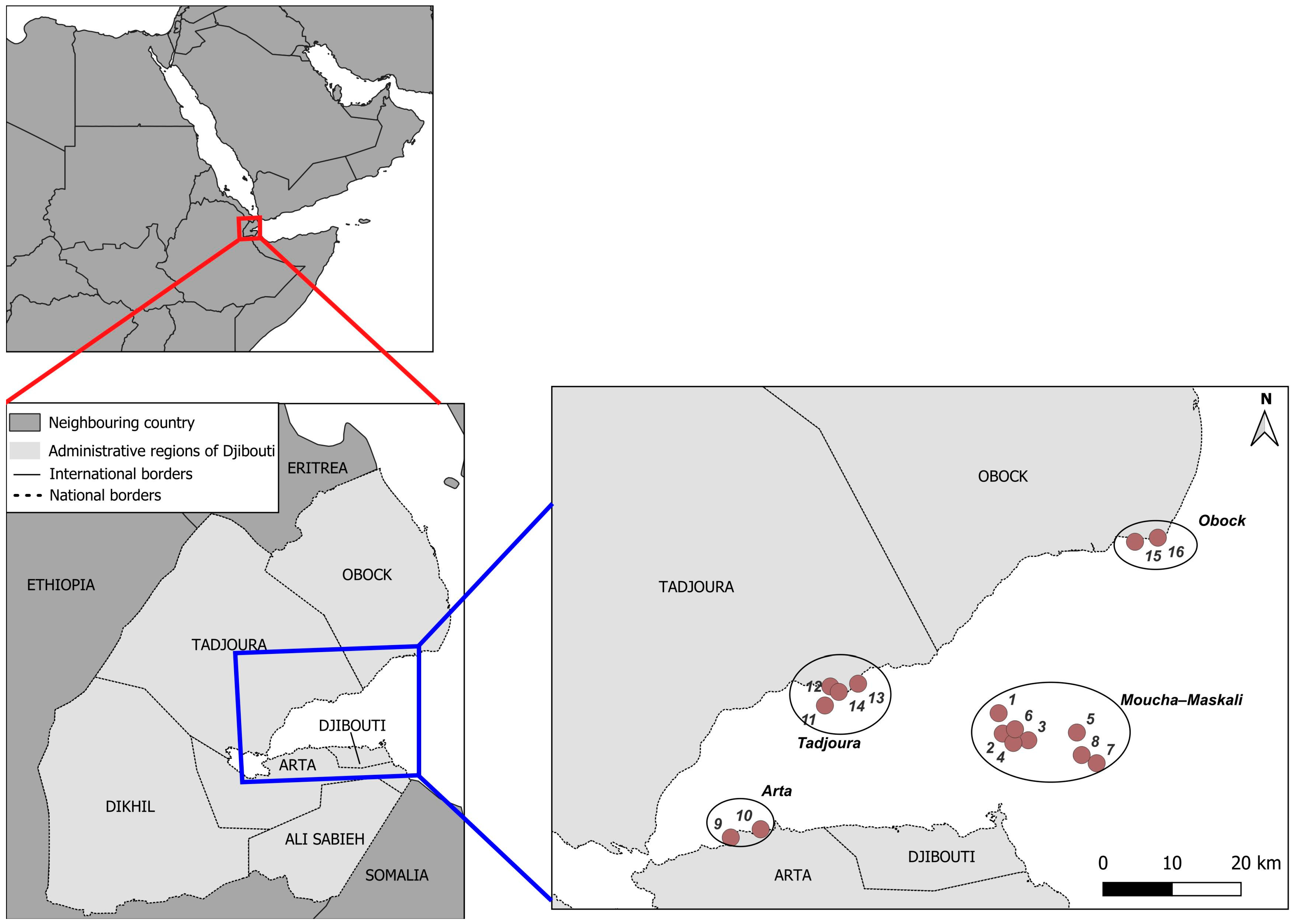
Table 1.
Environmental characteristics, bleaching severity, and thermal stress metrics at surveyed coral reef sites in Djibouti during the 2023 bleaching event.
2.2. Measurement Methodology
The primary method used linear transects marked by 100 m ribbons, subdivided into four 20 m segments. Sampling was conducted every 0.5 m along each transect at depths of 3–10 m, depending on the study site. Transects ran along reef slopes to collect quantitative data on substrate types and coral cover. The starting point of each transect was marked with a stake. The ribbon was then unrolled to its opposite end. Images enabled precise characterization of benthic community composition and structure. Visual documentation included substrate types, such as live corals, dead corals, bleached corals, sand, rocks, rubble, indicator algae, and sponges. This documentation facilitated subsequent data analysis [44].
Coral colonies were classified as 100% bleached if they appeared entirely pure white. Colonies were subdivided into four states: recently dead, heavily bleached, lightly bleached with pale coloration, and unbleached (healthy). The length of bleached coral colonies and other subcategories within the transect was measured, and colony numbers were counted. The percentage coverage for each category was calculated as (intercepted length/transect length) × 100. All colonies were identified to species or genus level according to Wallace (1999) [45] and Veron (2000) [46], using digital underwater photographs. Along each transect, coral colonies were identified to genus level based on general macromorphological features [47], following English, S., Wilkinson, C., and Baker, V. (1997). To minimize observational bias, the same two trained divers surveyed all transects following standardized protocols. Photographs were taken with fixed-focal-length underwater cameras using identical lighting settings. This ensured consistent color evaluations during bleaching assessments, matching the taxonomy of Djibouti’s coral reefs [48]. Environmental parameters, including depth, visibility, and approximate current strength, were recorded at each transect. This contextualized local habitat variability.
High-resolution underwater photographs were systematically collected along each transect. This supported benthic classification and bleaching assessment. Fixed-focal-length underwater digital cameras minimized distortion. ISO, aperture, and white balance settings were identical on all dives. Standardized artificial lighting, using strobes or video lights, ensured color fidelity. This aided reliable visual discrimination among healthy, pale, and fully bleached corals. Images were captured at regular intervals for in situ verification and post-dive analysis of benthic categories and bleaching status. This photographic documentation provided a lasting visual record of reef condition. It supported genus-level identification using established references for Djibouti’s corals.
2.3. Statistical Analysis
All collected data were compiled and analyzed using Coral Point Count software, CPCe [49] and mean values of live coral cover and bleaching incidence were calculated per transect and per site. Spatial variability in bleaching intensity among sites was assessed using a one-way analysis of variance (ANOVA) when data met normality (Shapiro–Wilk test) and homogeneity of variance (Levene’s test) assumptions. When these assumptions were violated, a non-parametric Kruskal–Wallis test was applied. Post hoc multiple comparisons between sites were conducted using Tukey’s Honest Significant Difference (HSD) test following ANOVA, or Dunn’s test with Bonferroni correction following Kruskal–Wallis tests. Sea surface temperature (SST) and Degree Heating Week (DHW) data from the NOAA Coral Reef Watch 5 km product (1998–2025) were extracted and averaged monthly to correlate thermal anomalies with observed bleaching patterns. The study data were processed and analyzed using R (version 4.4.1). Categorical variables (Zone, Site) were coded as factors, while quantitative variables corresponding to the different substrate categories (hard corals, soft corals, bleached corals, algae, rocks, rubble, sand, mud, sponges, and other substrates) were converted to numerical values to ensure the consistency of the dataset. The data were then restructured into a long (“tidy”) format using the tidyverse (version 2.0.0) package to facilitate graphical visualization.
A stacked bar chart was generated with ggplot2 to represent the proportion (%) of each substrate category per site, using a specific color palette to distinguish the substrate types. The percentage cover for each category was estimated using the following formula: percent cover = (length intercepted by the category/transect length) × 100; and the following categories were considered: not bleached (healthy reef), mildly bleached (<15%), moderately bleached (15–50%), strongly bleached (50–80%), severely bleached (>80%). Sites were grouped into three geographic sectors based on their location. Sites were grouped into three geographic sectors based on their location. For each sector and coral cover class, the mean total coral cover and its standard error were calculated. Statistical differences in total coral cover among sectors were first assessed using a one-way analysis of variance (ANOVA) when normality and homoscedasticity assumptions were met. Post hoc multiple comparisons were then performed using Tukey’s Honest Significant Difference (HSD) test. When these assumptions were not satisfied, a non-parametric Kruskal–Wallis test was applied, followed by Dunn’s multiple comparison test with Bonferroni correction. All statistical analyses and graphical outputs were conducted in R (version 4.4.1; R Core Team), using the ggpubr (version 0.6.0) package (function stat_compare_means) to implement and visualize the multiple-comparison tests. Comparisons between sectors were performed using multiple comparison statistical tests (stat_compare_means, package ggpubr) to assess the significance of observed differences in coral cover.
3. Results
3.1. Coral Cover and Bleaching
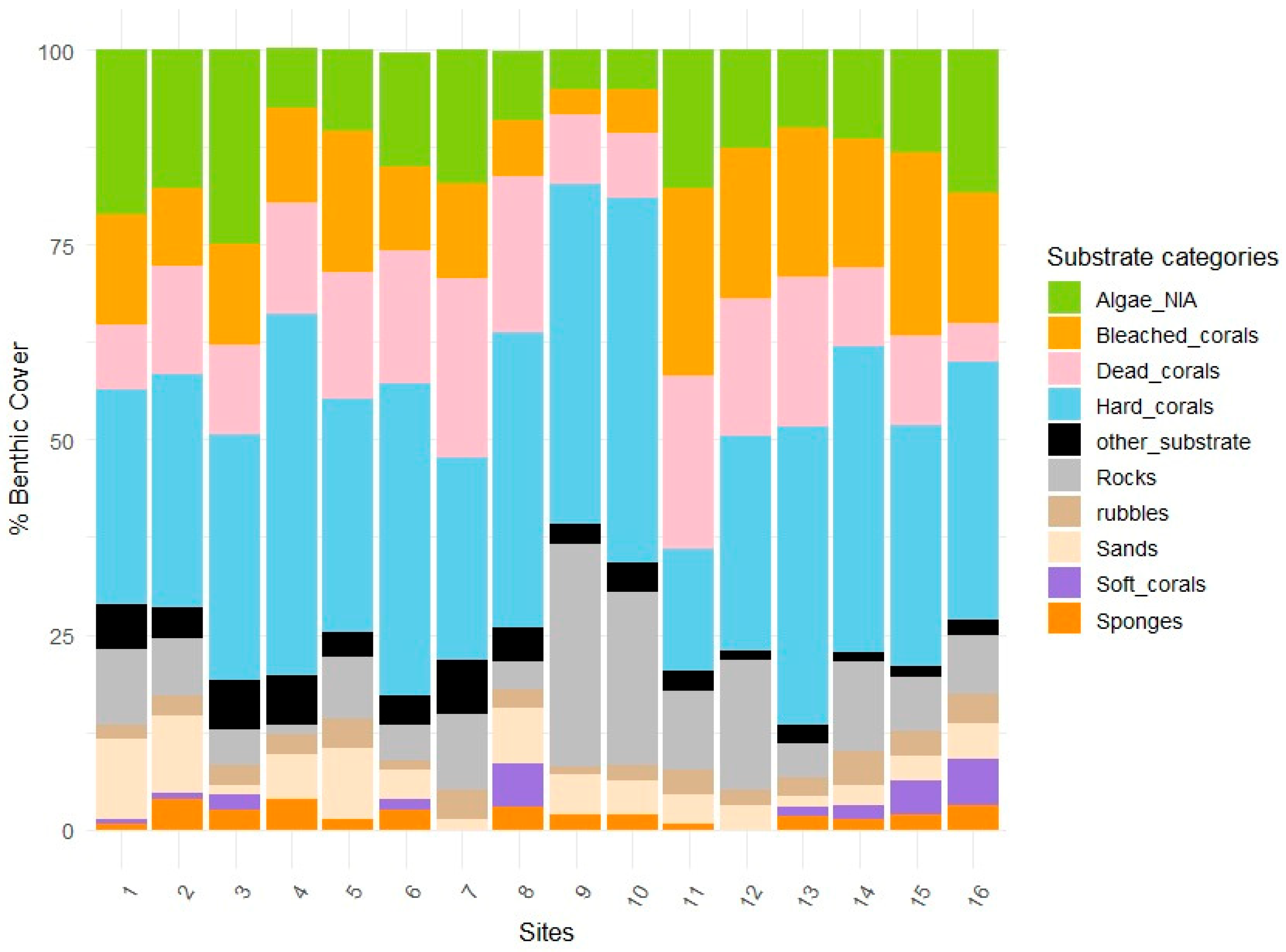
The coral reefs off the coast of Djibouti experienced a bleaching event affecting all sites studied. However, differences in bleaching severity and live hard corals ratios were notable between sites. Overall, the surveyed sites comprised fringing coral reefs and coral communities on rocky slopes, with hard corals predominantly represented by massive and branching forms. Arta exhibited the highest live hard coral cover (46.8%), accompanied by a substantial proportion of rocky substrate (22.2%). In comparison, the Moucha–Maskali Islands showed variable live hard coral cover ranging from 26.1% (Buoy Coué) to 46.3% (Aquarium), depending on site-specific conditions (Figure 2). Moreover, the lowest hard coral cover site was recorded at Sable Blanc within the Tadjourah fringing reef (15.8%), followed by Banc de Dankali (26.1%) in Moucha–Maskali, Sable Blanc (27.4%) in Tadjourah, and Canion (27.6%) in Moucha–Maskali. Notably, the low hard coral cover at Sable Blanc was associated with the highest bleaching ratio (24.1%), as well as elevated proportions of dead coral (22.2%) and algae cover ratio (17.7%). In addition, Ras Bir and Sable Blanc, both characterized by shallow reefs dominated by Porites spp., exhibited rock structures corresponding to ancient Porites colonies. The second-highest bleaching coral ratio (23.4%) was observed at Ras Bir (site 15) in Obock (Figure 2).
Figure 2.
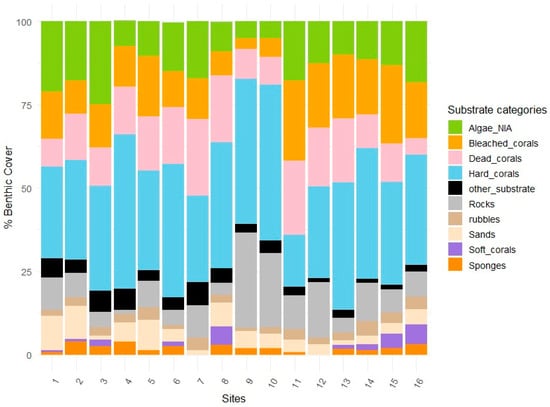
Proportional benthic cover by substrate category at each surveyed site.
In contrast, coral communities at Arta, with the lowest bleaching rate of 5.7%, were dominated by massive coral genera such as Porites, Favites, and Platygyra (Figure 2). The mean coral cover differed significantly among geographic sectors (ANOVA, p < 0.05), with the Moucha–Maskali Islands showing the highest overall live coral cover, and Tadjourah the lowest. Bleaching prevalence was negatively correlated with massive coral dominance (Pearson r = –0.62) and positively correlated with thermal stress metrics (peak SST: r = 0.74; DHW: r = 0.81). Branching genera (Acropora and Pocillopora) accounted for more than 70% of all heavily bleached or fully bleached colonies recorded across all sites, underscoring their high sensitivity to thermal stress during the 2023 event. In addition to variation in coral cover, the size–frequency distribution of bleached colonies showed a marked shift toward smaller colony sizes at high-impact sites such as Tadjourah and Ras Bir.
Environmental and thermal parameters are summarized in Table 1. Depth, visibility, and current strength were estimated in situ during surveys, and photographs are provided in the Supplementary Materials. DHW and SST values were derived from NOAA Coral Reef Watch (5 km product) 1998–2025.
3.2. Sea Surface Temperatures (SSTs) and DHW
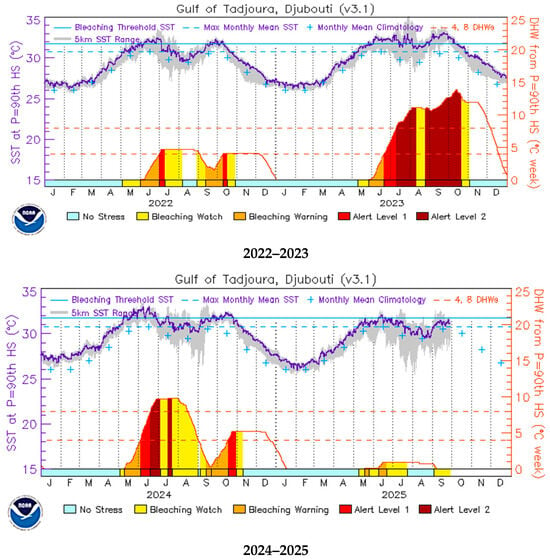
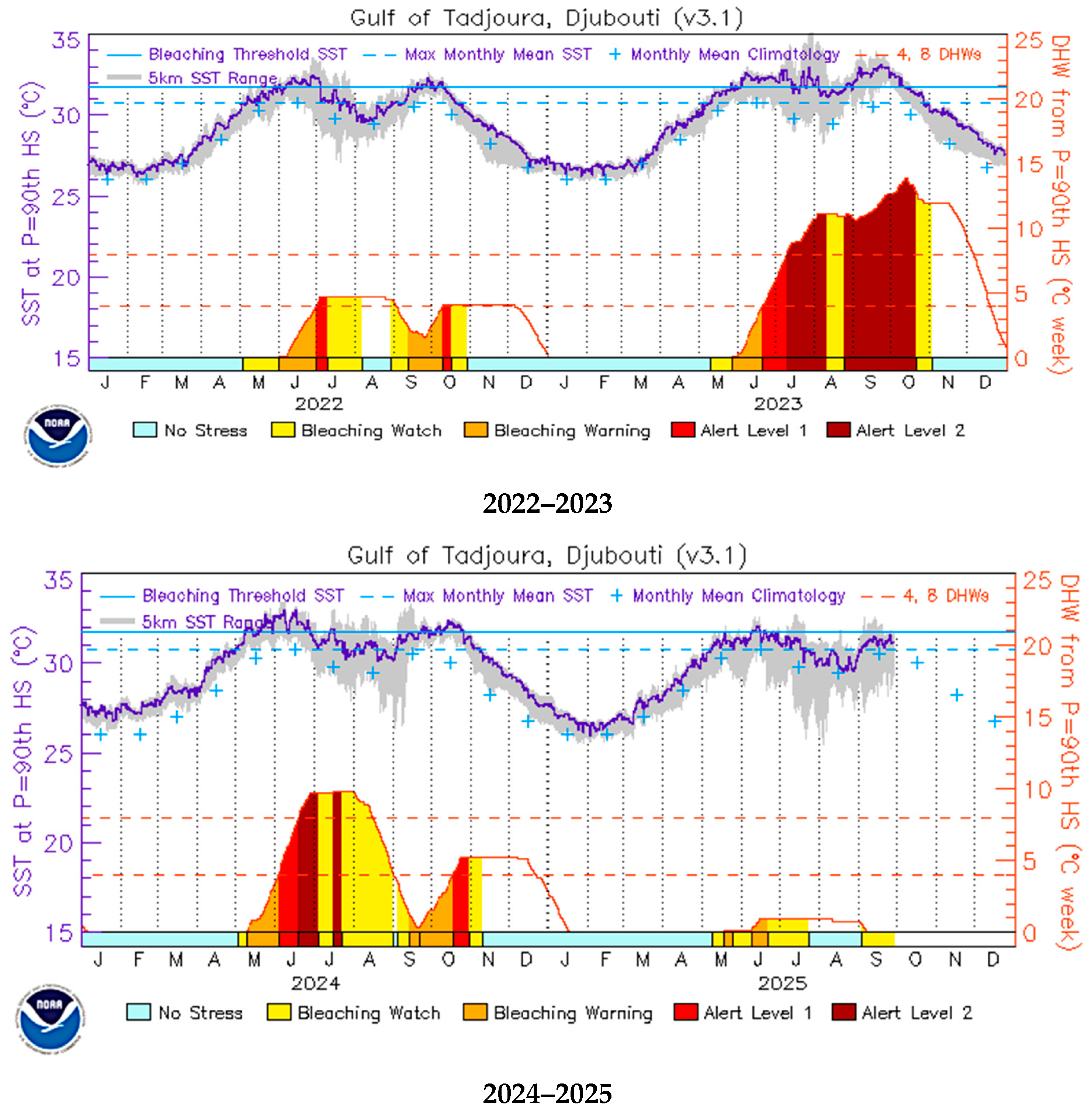
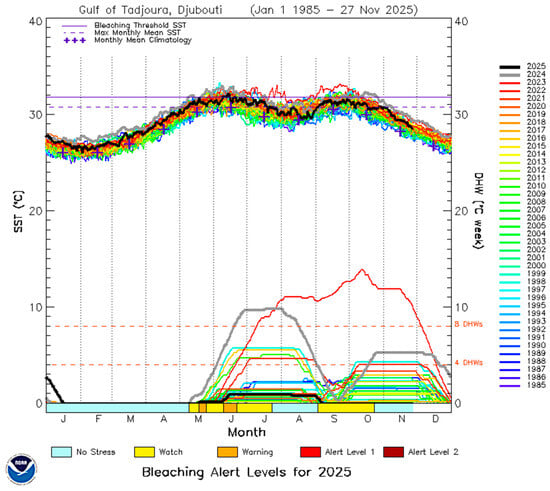
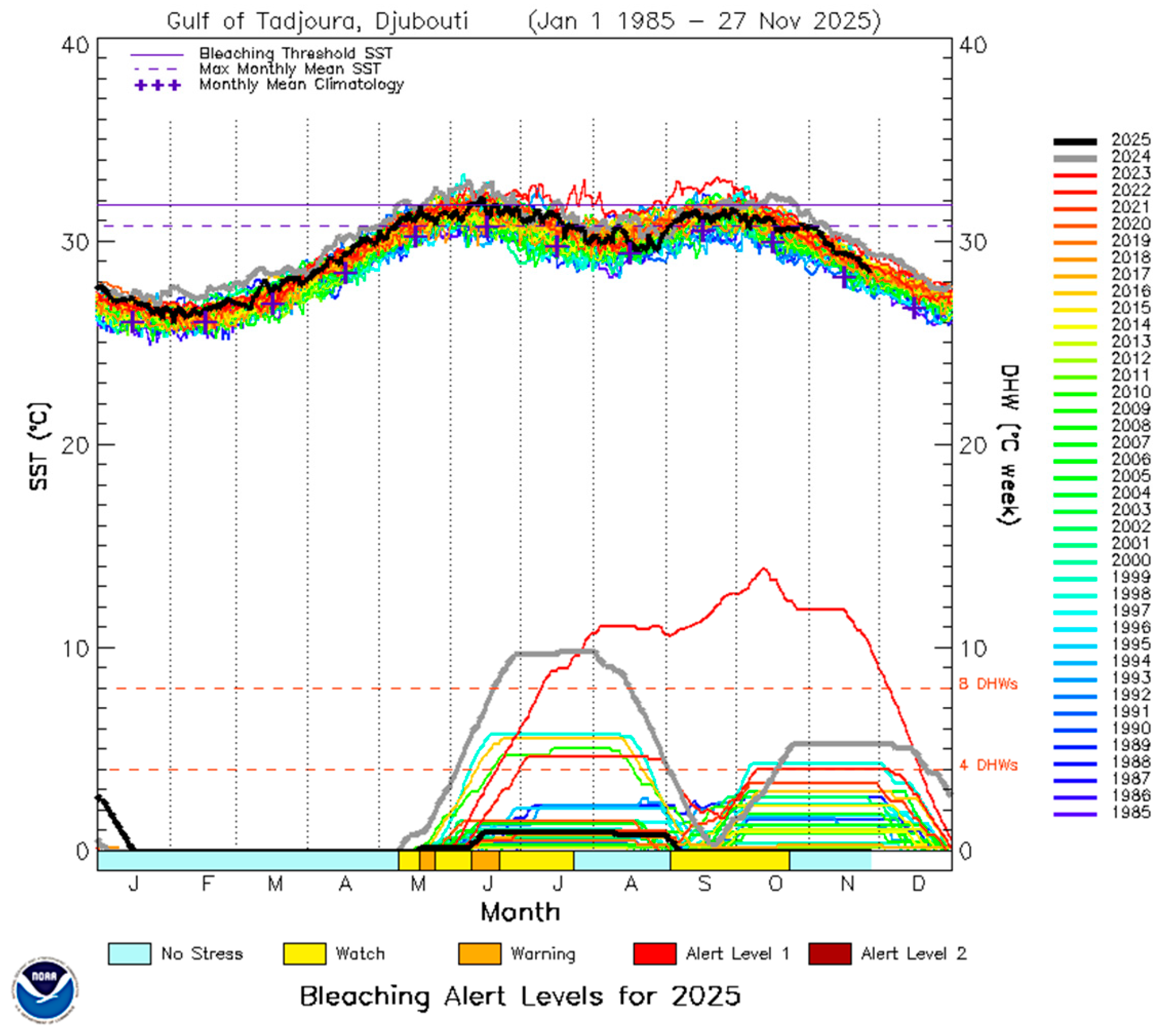
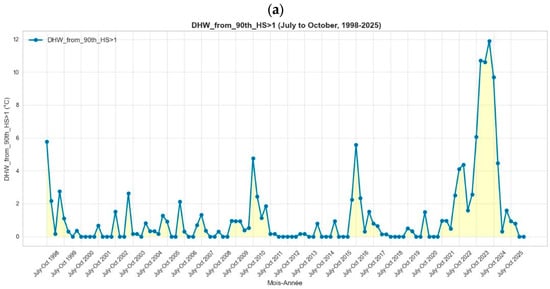
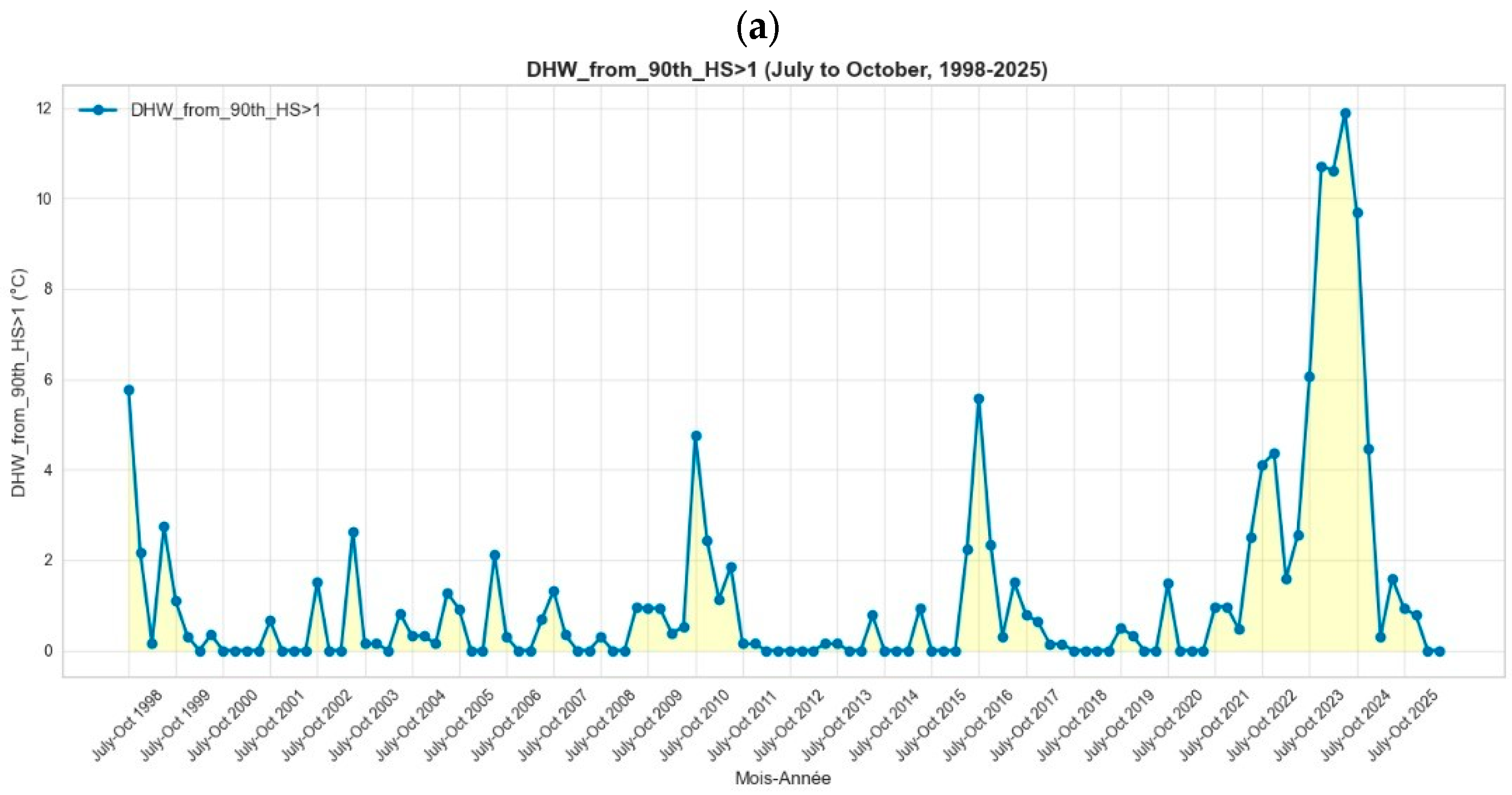
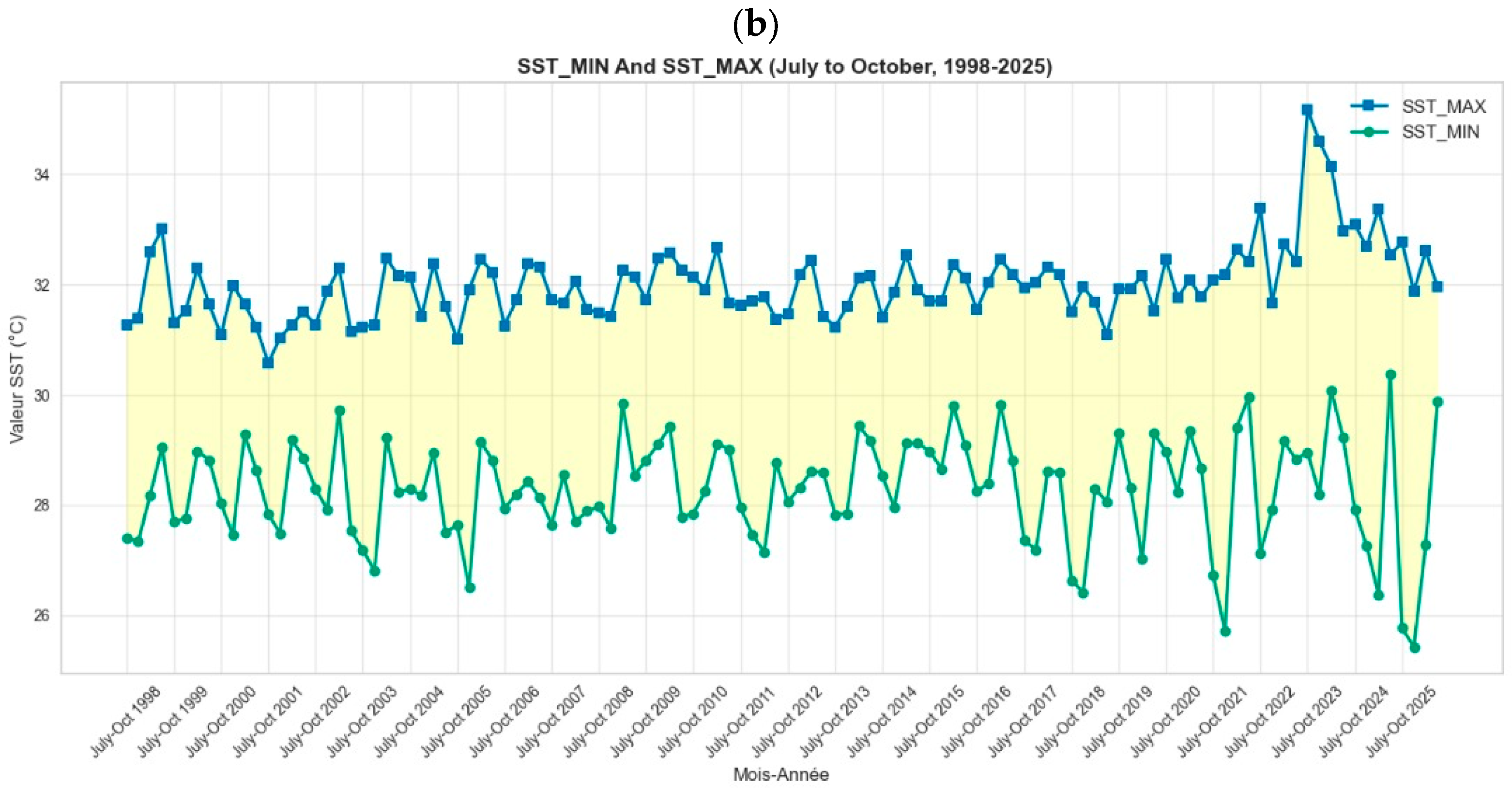
As shown in the temperature/year diagram in (Figure 3, Figure 4 and Figure 5), the sea surface temperature (SST) recorded in the study areas exhibits seasonal and interannual variations. The temperature trend between 2022 and 2024 shows a gradual increase, with a maximum peak in September–October 2023 (34 °C). Although a decrease was observed during the same period in December 2024, temperatures remained lower in 2022 (Figure 3), reflecting lower exposure to heat stress than in 2023. The average annual minimum temperature was approximately 26 °C (January–February), while the maximum was approximately 32 °C in June and July, giving an annual amplitude of 5 °C (Figure 3). The year 2023 recorded the highest summer temperature (max = 35.18 °C) and the lowest temperature (min = 26 °C) (Figure 3). The thermal profile observed at all the studied sites shows a strong similarity with a maximum temperature of 34 °C at all sites. The sea surface temperature was highest in September in the north, at Obock, while to the south of Djibouti at the Moucha–Maskali Islands, the water temperature was 32 °C. The interannual variation in the maximum SST (TSM max * 2.450) is similar at all sites, at 1.16 °C. The higher sea surface temperature (SST) in 2023 (max. = 35.18 °C) compared to 2022 (max. = 32.74 °C) indicates a significant difference in the thermal regimes. The maximum degree heating weeks (DHW) recorded in 2023 (13.87 °C·week−1), which was substantially higher than the value observed in 2022 (4.66 °C·week−1), indicating a much higher intensity of heat stress in 2023. By comparison, the 2024 event exhibited a maximum degree heating weeks (DHW) of 9.68 °C·week−1, corresponding to moderate thermal stress; however, this value remaining above the critical threshold associated for coral bleaching. (Figure 4). Examining the degree heating weeks (DHW) time series for the period of 1985–2025 reveals that October 2023 recorded the highest values in nearly three decades. On average, the entire Gulf of Tadjourah reached a mean degree heating weeks (DHW) of 13.8 °C week−1 in October 2023. In Arta, where the climate remains slightly more temperate, the bleaching threshold was lower. In contrast, Ras Bir experienced the most significant thermal stress, with 13.87 °C·week−1 in 2023, compared to only 3.5 in Ras Bir (Obock) and Sable Blanc in Tadjourah in 2022.
Figure 3.
Monthly sea surface temperature (SST) patterns in Djibouti for 2022-2023, and 2024-2025, derived from NOAA Coral Reef Watch data.
Figure 4.
Long-term sea surface temperature (SST) dynamics (C) and variations of degree heating weeks (DHWs, C week) in the Gulf of Tadjourah, retrieved from NOAA time series database.
Figure 5.
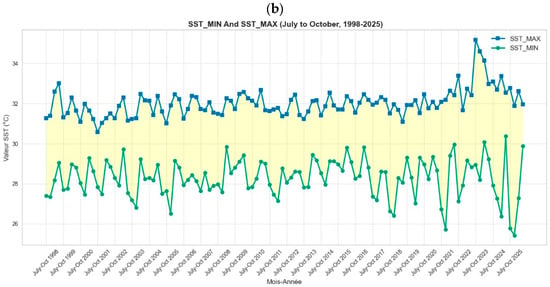
(a,b): Time series of (a) Degree Heating Week (DHW), and (b) Sea Surface Temperature (SST) anomalies during the period (July–October) from 1998 to 2025 in the Gulf of Tadjourah, Djibouti.
Thermal stress indicators were strongly aligned with bleaching intensity across sites: bleaching percentage showed a significant positive correlation with both peak SST (r = 0.74) and DHW (r = 0.81). Sites experiencing degree heating weeks (DHW) values above 8 °C·week−1 consistently exhibited moderate to severe bleaching, whereas sites remaining below 6 °C·week−1 showed limited bleaching. Long-term climatological comparisons revealed that 2023 exceeded the historical Maximum Monthly Mean (MMM) by 1.3–1.6 °C across all sites, surpassing the established bleaching threshold for the region. The SST anomaly of September–October 2023 represented the strongest thermal deviation recorded since the early 1990s, confirming that the bleaching event coincided with an exceptional and unprecedented heat episode.
Sea surface temperature–degree heating weeks (SST–DHW) alignment across the study region (Figure 4 and Figure 5) indicates that the bleaching observed during the survey period coincided with the rapid accumulation of thermal stress between late August and early October 2023. The steep rise in degree heating weeks (DHW) values during this window reflects a sustained exposure to temperatures above the regional MMM, explaining the uniform bleaching trends observed across geographically distant sites such as Obock and Moucha–Maskali. This temporal synchronization strengthens the conclusion that the 2023 bleaching episode was primarily thermally driven rather than caused by local disturbances.
Notably, the long-term sea surface temperature (SST) time series (Figure 5) indicates a progressive upward shift in late-summer temperature peaks over the past decade, suggesting that the 2023 event is part of a broader warming trajectory rather than an isolated anomaly.
The daily average, calculated over the period from 1 January 1985, to the present, is represented using a color code (see legend to the right of the graph). The curves in the lower part illustrate the dynamics of thermal stress accumulation (Degree Heating Week, DHW). Finally, the rectangular colored bars indicate the different coral bleaching alert levels in the study area. Data are from NOAA.
4. Discussion
4.1. Spatial Variability and Coral Species Sensitivity
The coral reefs of Djibouti exhibited apparent spatial heterogeneity in bleaching intensity and biological cover across the studied sites. The most affected locations were Ras Bir (Obock) and Sable Blanc (Tadjourah), both showing bleaching rates exceeding 23%. At the same time, Arta and the Moucha–Maskali Islands displayed lower bleaching levels but higher live coral cover. The observed dominance of branching taxa (Acropora and Pocillopora) among heavily bleached colonies is consistent with numerous studies showing that branching corals are generally more susceptible to thermal stress due to their high surface-area-to-volume ratios and limited tissue thickness [33,50]. In contrast, massive corals such as Porites, Favia, and Platygyra often exhibit greater resistance to bleaching, potentially due to enhanced energy reserves, thicker tissues, and more stable symbiotic associations [50,51]. Similar patterns of differential bleaching susceptibility related to coral morphology and life history traits have been widely reported across the Red Sea and other tropical reef systems [3,17,21,50]. Importantly, the predominance of branching corals in the most impacted zones does not indicate enhanced thermal tolerance. Rather, it reflects the pre-disturbance community structure of these reefs, which were originally dominated by Acropora and Pocillopora taxa prior to the 2023 heatwave. Consequently, their prevalence among bleached colonies results from their initial abundance combined with high thermal sensitivity and partial post-bleaching persistence of skeletal structures. In contrast, massive corals, although more resistant, were less abundant at these sites before the bleaching event, explaining their lower proportional representation. Field observations revealed that Acropora and Pocillopora colonies were the most sensitive taxa, exhibiting complete bleaching in shallow areas exposed to high irradiance and fluctuating temperatures. These genera are widely recognized as early indicators of thermal stress in coral reef systems [50,52]. In contrast, Porites and Platygyra colonies demonstrated remarkable resistance, with limited bleaching even under elevated thermal conditions. Their massive growth forms and thicker tissues may confer physiological advantages such as enhanced heat dissipation and energy storage [52,53]. Spatial differences between sites, such as the relatively preserved reefs of Arta and the degraded areas of Obock and Tadjourah, are likely linked to multiple local factors: water temperature, light penetration, sediment influx, proximity to wadi outflows, and local water quality. These stressors may act synergistically with thermal anomalies to determine bleaching severity. In addition, water turbidity may have played a moderating role in bleaching severity at certain sites. Increased concentrations of suspended particles can reduce light penetration and attenuate ultraviolet radiation, thereby limiting photo-oxidative stress on coral tissues during thermal anomalies. In turbid environments, this shading effect may partially mitigate bleaching intensity despite elevated sea surface temperatures. Similar buffering effects of turbidity on thermal stress have been reported in other sediment-influenced reef systems [54,55,56]. Such spatial patterns have been documented in the neighboring Red Sea and the western Indian Ocean [57].
In addition to taxonomic differences, local hydrodynamics appear to play a critical role in shaping bleaching patterns across sites. Sheltered zones with limited water circulation, such as shallow bays in Tadjourah, may have experienced prolonged thermal retention, amplifying heat stress and promoting algal accumulation. In contrast, more exposed sites in Arta likely benefited from higher water flow, which can enhance heat dissipation and reduce the duration of thermal anomalies. These microhabitat effects highlight the importance of fine-scale environmental variability when interpreting bleaching severity across heterogeneous reef systems.
Furthermore, the marked difference in bleaching susceptibility between branching and massive taxa aligns with functional trait frameworks that identify tissue thickness, skeletal density, and symbiont clade composition as key determinants of heat tolerance. Sites dominated by thermally sensitive genera tended to exhibit higher bleaching levels, indicating that pre-bleaching community composition influenced bleaching severity. In addition, the size–frequency distribution of bleached colonies showed a marked shift toward smaller colony sizes at high-impact sites such as Tadjourah and Ras Bir. This pattern suggests recent mortality or partial tissue loss among larger colonies, which are typically more vulnerable to prolonged thermal stress. Sites dominated by massive taxa displayed more stable size structures, supporting the interpretation that morphological traits played a significant role in thermal resistance during the 2023 event.
This indicates that future community trajectories will be strongly shaped by shifts in functional composition if warming trends persist [51,58]. The spatial visualization of benthic composition (Figure 2) clearly highlights the strong contrast between the Moucha–Maskali Islands, where live coral cover exceeded 40% at several transects, and the sediment-influenced sites of Tadjourah, where live coral cover declined to 15.8%.
4.2. Thermal Stress Patterns and Comparison with Regional and Global Bleaching
Satellite data and in situ observations confirm that the 2023 bleaching event coincided with record-breaking sea surface temperatures (SSTs) and Degree Heating Weeks (DHW) values in Djibouti’s coastal waters. The SST reached up to 35.2 °C, surpassing the climatological summer maximum by approximately 1.16 °C, while DHW peaked at 12.1 °C·week−1—the highest value recorded in the past two decades. According to NOAA Coral Reef Watch criteria, bleaching typically begins when DHW exceeds 4 °C·week−1, and widespread mortality occurs beyond 8 °C·week−1 [59]. The 2023 event, therefore, represents an extreme thermal stress episode consistent with a Level 3 Bleaching Alert. These results align with global observations linking mass bleaching to elevated SST anomalies, particularly during El Niño years [3,60]. The thermal anomalies of 2023–2024 were comparable to those that triggered massive bleaching in 2015–2016 across the Indo-Pacific and Red Sea [27,61].
In the southern Red Sea–Gulf of Aden transition zone, where mean summer SSTs already reach 30–32 °C, corals appear to live close to their upper thermal limits [18,62]. Consequently, even a slight increase of 0.5–1.5 °C above the local climatological maximum can induce severe bleaching (the “bleaching rule”) [3]. Interestingly, while northern Red Sea reefs have demonstrated partial resistance to bleaching, possibly due to local thermal adaptation and genetic resilience [20,28], southern Red Sea–Gulf of Aden transition zone reefs, including those of Djibouti, remain highly vulnerable. The pronounced heat anomalies recorded in October 2023 (DHW ≈ 13.8 °C·week−1 across the Gulf of Tadjourah) confirm this vulnerability. This thermal event corresponds to the first large-scale bleaching episode observed in Djibouti in over 20 years. The concurrence between bleaching intensity and accumulated thermal stress suggests that the 2023 event exceeded the adaptive capacity of several key coral taxa. This pattern can be compared with the unprecedented bleaching episode that occurred in southern Vietnam during the latest global coral bleaching event of 2023–2024. In spite of the thermal acclimation found in some branching and table acroporid resulting from previous SST anomalies, this latest bleaching episode exceeded the total accumulated adaptive capacity of corals [63]. The strong temporal match between DHW spikes and the peak bleaching period indicates that thermal pressure, rather than local anthropogenic factors alone, was the dominant driver of the event. However, the disproportionately high bleaching observed at sediment-influenced sites implies that chronic local stressors may have lowered coral thermal tolerance thresholds, making certain reefs more susceptible than predicted using only SST and DHW metrics. Such cumulative warming increases the likelihood of recurrent bleaching events and reduces recovery windows, which aligns with global patterns reported for other regions experiencing chronic heat stress [64,65].
The extreme thermal conditions observed in 2023 also surpass the predicted return intervals for severe bleaching events in the southern Red Sea–Gulf of Aden transition zone, suggesting that the region may be entering a new thermal regime characterized by chronic heat accumulation. Such a regime reduces the probability of full ecological recovery between events, potentially pushing reefs toward repeated stress cycles that favor opportunistic or stress-tolerant species. This represents a significant departure from historical patterns in Djibouti, where major bleaching has been infrequent or undocumented [66].
4.3. Implications and Resilience of Djibouti’s Coral Reefs
The bleaching and mortality rates estimated during this study (20–30% and 5–25%, respectively) are lower than those reported from other Red Sea, Indian Ocean regions and the Caribbean, where up to 70–90% of corals were lost in 2023–2024. Nevertheless, the patterns observed in Djibouti reflect an increasing trend in frequency and intensity of bleaching events, consistent with global climate projections [16]. The relative persistence of massive coral species, particularly Porites, suggests some degree of thermal tolerance or acclimatization within Djibouti’s reefs. This could indicate potential for local adaptation, possibly driven by exposure to fluctuating temperatures and turbidity near the coast. Such adaptive traits have been observed in thermally resilient coral populations in the central Red Sea [18,27].
However, chronic exposure to heat stress, combined with anthropogenic pressures such as sedimentation, oil pollution, and coastal development, may reduce the resilience of these reefs in the long term. Local management actions are urgently needed, such as limiting pollution near Tadjourah and Obock, protecting less impacted sites like Arta and Moucha–Maskali, and establishing a national coral monitoring program. The unique biogeographic position of Djibouti, at the crossroads of the Red Sea and Indian Ocean, makes its coral reefs particularly valuable for understanding thermal adaptation gradients and resilience thresholds in marginal reef systems. In these Indian Ocean reefs, low regional connectivity and high local larval retention may promote local thermal tolerance while limiting the diffusion of these adaptive traits to more climate-stressed reefs in the Indian Ocean [67]. Continued monitoring, combined with molecular and physiological studies of coral symbionts, will be essential to assess the capacity of these reefs to recover from recurring bleaching events under future climate scenarios. Although some massive coral species exhibited resilience during the 2023 event, their long-term persistence remains uncertain given the predicted increase in thermal anomalies along the Red Sea basin. Repeated sub-lethal bleaching events can erode coral energy reserves, reduce reproductive output, and weaken calcification rates, potentially leading to delayed mortality or shifts in competitive dynamics within coral assemblages. Without targeted conservation measures, these pressures may gradually transform Djibouti’s coral communities toward lower-complexity, stress-tolerant species, reducing habitat suitability for reef-dependent fauna and altering key ecosystem functions.
Given the spatially uneven distribution of bleaching impacts and the persistence of certain tolerant taxa, Djibouti’s reefs may contain micro-refugia that could serve as important reservoirs for regional reef recovery. Identifying and protecting these zones will be crucial to maintaining ecosystem function under accelerating climate stress. However, if thermal resilience assessments are not integrated into national marine spatial planning, the natural buffering capacity provided by these refugia may erode rapidly in the face of intensifying human pressures.
This study is limited by the absence of long-term in situ temperature loggers, the relatively small number of surveyed sites, and a lack of physiological measurements of coral stress.
5. Conclusions
Building on previous studies of Djiboutian coral reefs, including Cowburn et al. [33], this study provides a quantitative assessment of the 2023 bleaching event and documents the vulnerability of local reefs to unprecedented thermal stress. The findings emphasize the importance of continuous reef monitoring, regional cooperation, and adaptive management strategies to enhance reef resilience and safeguard marine biodiversity in the southern Red Sea–Gulf of Aden transition zone.
In addition, the clear spatial differences in bleaching severity across sites highlight the need to incorporate local environmental conditions, such as sedimentation, hydrodynamics, and coastal development pressures, into national conservation planning. Establishing long-term temperature baselines, expanding the number of monitored sites, and integrating genetic and physiological assessments of dominant coral taxa will be crucial for identifying potential refugia and understanding the adaptive capacity of Djibouti’s reef systems.
Together, these actions will provide a scientific foundation for protecting one of the most biogeographically unique coral reef assemblages in the Red Sea.
Moreover, the 2023 bleaching event in the Djiboutian reef provides a critical baseline against which future thermal anomalies and ecological responses can be evaluated, offering the first quantitative reference point for long-term reef health trajectories in Djibouti. As regional ocean warming continues to accelerate, integrating ecological monitoring with high-resolution thermal forecasting and early warning systems will be essential to mitigate biodiversity loss. Strengthening collaboration with Red Sea nations and establishing standardized cross-border monitoring protocols will further enhance the capacity to assess large-scale bleaching dynamics and support evidence-based conservation strategies in this rapidly changing marine environment.
Supplementary Materials
The following supporting information can be downloaded at: https://www.mdpi.com/article/10.3390/d18020117/s1.
Author Contributions
Conceptualization: D.G.A., T.A. and B.G.; Methodology: D.G.A., T.A., B.G. and O.S.S.; Formal analysis: T.A., B.G., O.A.G. and O.S.S.; Investigation: D.G.A., B.G., I.S.A. and A.H.A.; Data curation: B.G., O.A.G., M.N., A.H.A. and O.S.S.; Writing—original draft: D.G.A., T.A. and B.G.; Writing—review & editing: All authors; Visualization: B.G., O.A.G., M.N. and O.S.S.; Supervision: D.G.A. and B.G.; Project administration: D.G.A. and A.H.A. All authors have read and agreed to the published version of the manuscript.
Funding
This research received no external funding. The authors did not receive any specific grant from funding agencies in the public, commercial, or not-for-profit sectors.
Data Availability Statement
The original contributions presented in this study are included in the article/Supplementary Materials. Further inquiries can be directed to the corresponding author.
Acknowledgments
We gratefully acknowledge the Ministry of the Environment and Sustainable Development of the Republic of Djibouti and the University of Djibouti for their logistical support and facilitation of the fieldwork. We also thank Idriss Ismael Nour for his valuable assistance during the field surveys. We are grateful to the local dive teams and boat operators for their support and to the colleagues who provided constructive comments that helped improve the manuscript.
Conflicts of Interest
The authors declare no conflicts of interest.
Abbreviations
| DHW | Degree Heating Week |
| SST | Sea surface temperature |
| CERD | Centre d’Etudes et de Recherche de Djibouti |
| NOAA | National Oceanic and Atmospheric Administration |
| MMM | Maximum Monthly Mean |
References
- Bravo, H.; Cannicci, S.; Huyghe, F.; Leermakers, M.; Sheikh, M.A.; Kochzius, M. Ecological health of coral reefs in Zanzibar. Reg. Stud. Mar. Sci. 2021, 48, 102014. [Google Scholar] [CrossRef] [Scilit]
- Hodgson, G. A global assessment of human effects on coral reefs. Mar. Pollut. Bull. 1999, 38, 345–355. [Google Scholar] [CrossRef] [Scilit]
- Hoegh-Guldberg, O. Climate change, coral bleaching and the future of the world’s coral reefs. Mar. Freshw. Res. 1999, 50, 839–866. [Google Scholar] [CrossRef] [Scilit]
- Starzak, D.E.; Quinnell, R.G.; Nitschke, M.R.; Davy, S.K. The influence of symbiont type on photosynthetic carbon flux in a model cnidarian-dinoflagellate symbiosis. Mar. Biol. 2014, 161, 711–724. [Google Scholar] [CrossRef] [Scilit]
- Davies, S.W.; Gamache, M.H.; Howe-Kerr, L.I.; Kriefall, N.G.; Baker, A.C.; Banaszak, A.T.; Bay, L.K.; Bellantuono, A.J.; Bhattacharya, D.; Chan, C.X. Building consensus around the assessment and interpretation of Symbiodiniaceae diversity. PeerJ 2023, 11, e15023. [Google Scholar] [CrossRef] [Scilit]
- Sawall, Y.; Al-Sofyani, A. Biology of Red Sea corals: Metabolism, reproduction, acclimatization, and adaptation. In The Red Sea: The Formation, Morphology, Oceanography and Environment of a Young Ocean Basin; Springer: Berlin/Heidelberg, Germany, 2015; pp. 487–509. [Google Scholar]
- Ziegler, M.; Arif, C.; Voolstra, C.R. Symbiodiniaceae Diversity in Red Sea Coral Reefs & Coral Bleaching. In Coral Reefs of the World; Springer: Cham, Switzerland, 2019; pp. 69–89. [Google Scholar] [CrossRef] [Scilit]
- Hoegh-Guldberg, O.; Mumby, P.J.; Hooten, A.J.; Steneck, R.S.; Greenfield, P.; Gomez, E.; Harvell, C.D.; Sale, P.F.; Edwards, A.J.; Caldeira, K.; et al. Coral reefs under rapid climate change and ocean acidification. Science 2007, 318, 1737–1742. [Google Scholar] [CrossRef] [Scilit]
- Smith, H.; Epstein, H.; Torda, G. The molecular basis of differential morphology and bleaching thresholds in two morphs of the coral Pocillopora acuta. Sci. Rep. 2017, 7, 10066. [Google Scholar] [CrossRef] [Scilit]
- Bellwood, D.R.; Hughes, T.P.; Folke, C.; Nyström, M. Confronting the coral reef crisis. Nature 2004, 429, 827–833. [Google Scholar] [CrossRef] [Scilit]
- Claar, D.C.; Szostek, L.; McDevitt-Irwin, J.M.; Schanze, J.J.; Baum, J.K. Global patterns and impacts of El Niño events on coral reefs: A meta-analysis. PLoS ONE 2018, 13, e0190957. [Google Scholar] [CrossRef] [Scilit]
- Stuart-Smith, R.D.; Brown, C.J.; Ceccarelli, D.M.; Edgar, G.J. Ecosystem restructuring along the Great Barrier Reef following mass coral bleaching. Nature 2018, 560, 92–96. [Google Scholar] [CrossRef] [Scilit]
- McClanahan, T.R.; Obura, D. Sedimentation effects on shallow coral communities in Kenya. J. Exp. Mar. Biol. Ecol. 1997, 209, 103–122. [Google Scholar] [CrossRef] [Scilit]
- Erftemeijer, P.L.; Riegl, B.; Hoeksema, B.W.; Todd, P.A. Environmental impacts of dredging and other sediment disturbances on corals: A review. Mar. Pollut. Bull. 2012, 64, 1737–1765. [Google Scholar] [CrossRef] [Scilit] [PubMed]
- Hoegh-Guldberg, O. The impact of climate change on coral reef ecosystems. In Coral Reefs: An Ecosystem in Transition; Springer: Dordrecht, The Netherlands, 2010; pp. 391–403. [Google Scholar]
- Baker, A.C.; Starger, C.J.; McClanahan, T.R.; Glynn, P.W. Corals’ adaptive response to climate change: Shifting to new algal symbionts may safeguard devastated reefs from extinction. Nature 2004, 430, 741. [Google Scholar] [CrossRef] [Scilit]
- Hughes, T.P.; Kerry, J.T.; Baird, A.H.; Connolly, S.R.; Dietzel, A.; Eakin, C.M.; Heron, S.F.; Hoey, A.S.; Hoogenboom, M.O.; Liu, G.; et al. Global warming transforms coral reef assemblages. Nature 2018, 556, 492–496. [Google Scholar] [CrossRef] [Scilit]
- Lough, J.M.; Anderson, K.D.; Hughes, T.P. Increasing thermal stress for tropical coral reefs: 1871–2017. Sci. Rep. 2018, 8, 1–8. [Google Scholar] [CrossRef] [Scilit]
- Osman, E.O.; Smith, D.J.; Ziegler, M.; Kürten, B.; Conrad, C.; El-Haddad, K.M.; Voolstra, C.R.; Suggett, D.J. Thermal refugia against coral bleaching throughout the northern Red Sea. Glob. Change Biol. 2018, 24, e474–e484. [Google Scholar] [CrossRef] [Scilit]
- Genevier, L.G.; Jamil, T.; Raitsos, D.E.; Krokos, G.; Hoteit, I. Marine heatwaves reveal coral reef zones susceptible to bleaching in the Red Sea. Glob. Change Biol. 2019, 25, 2338–2351. [Google Scholar] [CrossRef] [Scilit]
- Baker, A.C.; Glynn, P.W.; Riegl, B. Climate change and coral reef bleaching: An ecological assessment of long-term impacts, recovery trends and future outlook. Estuar. Coast. Shelf Sci. 2008, 80, 435–471. [Google Scholar] [CrossRef] [Scilit]
- Benzoni, F.; Bianchi, C.N.; Morri, C. Coral communities of the northwestern Gulf of Aden (Yemen): Variation in framework building related to environmental factors and biotic conditions. Coral Reefs 2003, 22, 475–484. [Google Scholar] [CrossRef] [Scilit]
- Ormond, R.F.G.; Edwards, A.J. Red Sea fishes. Red Sea 1987, 7, 251. [Google Scholar]
- Kotb, M.; Abdulaziz, M.A.L.E.K.; Al-Agwan, Z.; Alshaikh, K.H.A.L.I.D.; Al-Yami, H.; Banajah, A.; Devantier, L.; Eisinger, S.; Eltayen, M.; Hassan, M. Status of coral reefs in the Red Sea and Gulf of Aden in 2004. Status Coral Reefs World 2004, 70, 137–139. [Google Scholar]
- Berumen, M.L.; Hoey, A.S.; Bass, W.H.; Bouwmeester, J.; Catania, D.; Cochran, J.E.M.; Khalil, M.T.; Miyake, S.; Mughal, M.R.; Spaet, J.L.Y.; et al. The status of coral reef ecology research in the Red Sea. Coral Reefs 2013, 32, 737–748. [Google Scholar] [CrossRef] [Scilit]
- DiBattista, J.D.; Roberts, M.B.; Bouwmeester, J.; Bowen, B.W.; Coker, D.J.; Lozano-Cortés, D.F.; Choat, J.H.; Gaither, M.R.; Hobbs, J.A.; Khalil, M.T.; et al. A review of contemporary patterns of endemism for shallow water reef fauna in the Red Sea. J. Biogeogr. 2016, 43, 423–439. [Google Scholar] [CrossRef] [Scilit]
- Abdelhamid, S.; Reinicke, G.B.; Klaus, R.; Höhn, J.; Saad, O.S.; Grenzdörffer, G. Red Sea Coral Reef Monitoring Site in Sudan after 39 Years Reveals Stagnant Reef Growth, Continuity and Change. Diversity 2024, 16, 379. [Google Scholar] [CrossRef] [Scilit]
- Fine, M.; Cinar, M.; Voolstra, C.; Safa, A.; Rinkevich, B.; Laffoley, D.; Hilmi, N.; Allemand, D. Coral reefs of the Red Sea—Challenges and potential solutions. Reg. Stud. Mar. Sci. 2019, 25, 100498. [Google Scholar] [CrossRef] [Scilit]
- Pilcher, N.; Abdi, N.D. The Status of Coral Reefs in Djibouti; PERSGA Technical Reports; PERSGA: Jeddah, Saudi Arabia, 2000. [Google Scholar]
- Obura, D.; Djama, N. Coral reef survey in Djibouti post bleaching. In Proceedings of the International Workshop on the Extent and Impact of Coral Bleaching in the Arabian Region; Tatwany, H., Ed.; National Commission for Wildlife Conservation and Development: Riyadh, Saudi Arabia, 2000. [Google Scholar]
- Youssouf, M.O.; Memery, L.; Carton, X. Statistical analysis of sea surface temperature and chlorophyll-a concentration patterns in the Gulf of Tadjourah (Djibouti). J. Mar. Sci. Res. Dev. 2016, 6, 1–9. [Google Scholar]
- Klaus, R. Coral reefs and communities of the central and southern Red Sea (Sudan, Eritrea, Djibouti, and Yemen). In The Red Sea: The Formation, Morphology, Oceanography and Environment of a Young Ocean Basin; Springer: Berlin/Heidelberg, Germany, 2015; pp. 409–451. [Google Scholar]
- Cowburn, B.; Samoilys, M.A.; Osuka, K.; Klaus, R.; Newman, C.; Gudka, M.; Obura, D. Healthy and diverse coral reefs in Djibouti–A resilient reef system or few anthropogenic threats? Mar. Pollut. Bull. 2019, 148, 182–193. [Google Scholar] [CrossRef] [Scilit]
- Kotb, M.M.A.; Hanafy, M.H.; Rirache, H.; Matsumura, S.; Al-Sofyani, A.A.; Ahmed, A.G.; Bawazir, G.; Al-Horani, F.A. Status of coral reefs in the Red Sea and Gulf of Aden region. In Status of Coral Reefs of the World; Global Coral Reef Monitoring Network: Townsville, QLD, Australia, 2008; pp. 67–78. [Google Scholar]
- Government of Djibouti. National Monograph of the Biological Diversity of Djibouti; Directorate of the Environment, MHUEAT: Djibouti City, Djibouti, 2000.
- Nour, M.; Stiger-Pouvreau, V.; Daher, A.; Connan, S.; Ali, A.; Marchand, L.; Waeles, M.; Petek, S. Nutritional Value and Antioxidant Potential of Djiboutian Abundant Seaweeds, With Their Food Applications in Doughnut and Tartare. Food Sci. Nutr. 2025, 13, e70956. [Google Scholar] [CrossRef] [Scilit]
- Rasul, N.M.A.; Stewart, I.C.F.; Vine, P.; Nawab, Z.A. Oceanographic and Biological Aspects of the Red Sea; Springer Oceanography: Berlin/Heidelberg, Germany, 2019. [Google Scholar] [CrossRef] [Scilit]
- Leujak, W.; Ormond, R.F.G. Comparative accuracy and efficiency of six coral community survey methods. J. Exp. Mar. Biol. Ecol. 2007, 351, 168–187. [Google Scholar] [CrossRef] [Scilit]
- Dosoky, M.Y.A. Coral bleaching occurrence along the egyptian coast of the red sea during the summer heat stress period, 2020. Egypt. J. Aquat. Biol. Fish. 2021, 25, 17–37. [Google Scholar] [CrossRef] [Scilit]
- LaJeunesse, T.C.; Wham, D.C.; Pettay, D.T.; Parkinson, J.E.; Keshavmurthy, S.; Chen, C.A. Ecologically differentiated stress-tolerant endosymbionts in the dinoflagellate genus Symbiodinium (Dinophyceae) Clade D are different species. Phycologia 2014, 53, 305–319. [Google Scholar] [CrossRef] [Scilit]
- Ali, M.E.; Elhag, E.A. Coral diversity and similarity along Sudanese Red Sea Fringing reef. Int. J. Adv. Res. 2016, 4, 720–727. [Google Scholar] [CrossRef] [Scilit] [PubMed]
- Kochman, N.-R.; Fine, M. Gulf of Aqaba as a thermal refuge: Insights from four years of intensifying marine heatwaves. Sci. Total Environ. 2025, 1000, 180463. [Google Scholar] [CrossRef] [Scilit] [PubMed]
- Obura, D.; Grimsditch, G. Resilience Assessment of Coral Reefs: Assessment Protocol for Coral Reefs, Focusing on Coral Bleaching and Thermal Stress; IUCN: Gland, Switzerland, 2009; p. 70. [Google Scholar]
- Obura, D.O. Can differential bleaching and mortality among coral species offer useful indicators for assessment and management of reefs under stress? Bull. Mar. Sci. 2001, 69, 421–442. [Google Scholar]
- Wallace, C.C. Staghorn Corals of the World: A Revision of the Coral Genus ACROPORA (Scleractinia; Astrocoeniina; Acroporidae) Worldwide, with Emphasis on Morphology, Phylogeny and Biogeography; CSIRO Publishing: Clayton, Australia, 1999. [Google Scholar]
- Veron, J.E.N.; Stafford-Smith, M. Corals of the World AUSTRALIAN Institute of Marine Science; CCR Old Ptv Ltd.: Townsville, Australia, 2000. [Google Scholar]
- English, S.; Wilkinson, C.; Baker, V. Survey Manual for Tropical Marine Resources; Australian Institute of Marine Sciences: Townsville, Australia, 1997; pp. 34–48. [Google Scholar]
- Lips, B.; Roux, J.M. Flore Et Faune Invertébrée Marines de Djibouti; Centre d’Etudes et de Recherche de Djibouti (CERD): Djibouti City, Djibouti, 2022. [Google Scholar]
- Kohler, K.E.; Gill, S.M. Coral Point Count with Excel extensions (CPCe): A Visual Basic program for the determination of coral and substrate coverage using random point count methodology. Comput. Geosci. 2006, 32, 1259–1269. [Google Scholar] [CrossRef] [Scilit]
- Pratchett, M.S.; McCowan, D.; Maynard, J.A.; Heron, S.F. Changes in bleaching susceptibility among corals subject to ocean warming and recurrent bleaching in Moorea, French Polynesia. PLoS ONE 2013, 8, e70443. [Google Scholar] [CrossRef] [Scilit]
- Jain, T.; Buapet, P.; Ying, L.; Yucharoen, M. Differing responses of three scleractinian corals from Phuket Coast in the Andaman Sea to experimental warming and hypoxia. J. Mar. Sci. Eng. 2023, 11, 403. [Google Scholar] [CrossRef] [Scilit]
- Gonzalez, K.; Daraghmeh, N.; Lozano-Cortés, D.; Benzoni, F.; Berumen, M.L.; Carvalho, S. Differential spatio-temporal responses of Red Sea coral reef benthic communities to a mass bleaching event. Sci. Rep. 2024, 14, 24229. [Google Scholar] [CrossRef] [Scilit]
- Douglas, A.E. Coral bleaching––how and why? Mar. Pollut. Bull. 2003, 46, 385–392. [Google Scholar] [CrossRef] [Scilit]
- Sully, S.; van Woesik, R. Turbid reefs moderate coral bleaching under climate-related temperature stress. Glob. Change Biol. 2020, 26, 1367–1373. [Google Scholar] [CrossRef] [Scilit]
- Zweifler, A.; O’leary, M.; Morgan, K.; Browne, N.K. Turbid coral reefs: Past, present and future—A review. Diversity 2021, 13, 251. [Google Scholar] [CrossRef] [Scilit]
- Carlson, R.R.; Li, J.; Crowder, L.B.; Asner, G.P. Large-scale effects of turbidity on coral bleaching in the Hawaiian islands. Front. Mar. Sci. 2022, 9, 969472. [Google Scholar] [CrossRef] [Scilit]
- Banc-Prandi, G.; Evensen, N.R.; Barshis, D.J.; Perna, G.; Moussa Omar, Y.; Fine, M. Assessment of temperature optimum signatures of corals at both latitudinal extremes of the Red Sea. Conserv. Physiol. 2022, 10, coac002. [Google Scholar] [CrossRef] [Scilit] [PubMed]
- Lenz, E.A.; Bartlett, L.A.; Stathakopoulos, A.; Kuffner, I.B. Physiological differences in bleaching response of the coral Porites astreoides along the Florida Keys reef tract during high-temperature stress. Front. Mar. Sci. 2021, 8, 615795. [Google Scholar] [CrossRef] [Scilit]
- Liu, G.; Strong, A.E.; Skirving, W.; Arzayus, L.F. Overview of NOAA coral reef watch program’s near-real time satellite global coral bleaching monitoring activities. In Proceedings of the 10th international coral reef symposium, Okinawa, Japan, 28 June–2 July 2006; Volume 1793, pp. 1783–1793. [Google Scholar]
- Eakin, C.M.; Lough, J.M.; Heron, S.F.; Liu, G. Climate variability and change: Monitoring data and evidence for increased coral bleaching stress. In Coral Bleaching: Patterns, Processes, Causes and Consequences; Springer International Publishing: Cham, Switzerland, 2018; pp. 51–84. [Google Scholar]
- Cheng, L.; Abraham, J.; Trenberth, K.E.; Boyer, T.; Mann, M.E.; Zhu, J.; Wang, F.; Yu, F.; Locarnini, R.; Fasullo, J.; et al. New record ocean temperatures and related climate indicators in 2023. Adv. Atmos. Sci. 2024, 41, 1068–1082. [Google Scholar] [CrossRef] [Scilit]
- Eladawy, A.; Nakamura, T.; Shaltout, M.; Mohammed, A.; Nadaoka, K.; Fox, M.D.; Osman, E.O. Appraisal of coral bleaching thresholds and thermal projections for the northern Red Sea refugia. Front. Mar. Sci. 2022, 9, 938454. [Google Scholar] [CrossRef] [Scilit]
- Tkachenko, K.S.; Dung, V.V.; Ha, V.T.; Phong, H.H. Unprecedented coral bleaching in Southern Vietnam in 2024: The only hope for thermal refuges? Coral Reefs 2025, 44, 881–894. [Google Scholar] [CrossRef] [Scilit]
- Reimer, J.D.; Peixoto, R.S.; Davies, S.W.; Traylor-Knowles, N.; Short, M.L.; Cabral-Tena, R.A.; Burt, J.A.; Pessoa, I.; Banaszak, A.T.; Winters, R.S.; et al. The fourth global coral bleaching event: Where do we go from here? Coral Reefs 2024, 43, 1121–1125. [Google Scholar] [CrossRef] [Scilit]
- Emslie, M.J.; Ceccarelli, D.M.; Logan, M.; Blandford, M.I.; Bray, P.; Campili, A.R.; Cantin, N.; Choukroun, S.; Cole, A.; Jonker, M.J.; et al. Anthropogenic climate change causes substantial loss of coral on the northern Great Barrier Reef during the 2024 bleaching event. Coral Reefs 2025, 1–17. [Google Scholar] [CrossRef] [Scilit]
- Souter, D.; Planes, S.; Wicquart, J.; Logan, M.; Obura, D.; Staub, F. Status of Coral Reefs of the World: 2020: Summary for Policymakers; GCRMN: Townsville, Australia, 2021. [Google Scholar]
- Claereboudt, M.R.; Bruss, G. Short distances dominate connectivity patterns of coral communities in the North-West Arabian Sea. Front. Mar. Sci. 2025, 11, 1494563. [Google Scholar] [CrossRef] [Scilit]
Disclaimer/Publisher’s Note: The statements, opinions and data contained in all publications are solely those of the individual author(s) and contributor(s) and not of MDPI and/or the editor(s). MDPI and/or the editor(s) disclaim responsibility for any injury to people or property resulting from any ideas, methods, instructions or products referred to in the content. |
© 2026 by the authors. Licensee MDPI, Basel, Switzerland. This article is an open access article distributed under the terms and conditions of the Creative Commons Attribution (CC BY) license.