


Abstract
Although the central focus of ecology has long been the relationship between biodiversity and ecosystem functioning, this relationship has rarely been explored in species-poor communities such as salt marshes, which have the potential to shed new light on this debate. We conducted two microcosm experiments, each testing a different environmental variable (salinity or disturbance) and its interaction with the plant community’s richness and species composition, using all possible combinations of the three sedge species found in the pioneer plant community in the Yangtze River Estuary. The relationships between diversity and productivity were weak and non-significant, possibly due to intense competition among the sedges. Species composition played a more important role in determining productivity. Moreover, biodiversity effects were found to be environment-dependent. Salinity stress increased the selection effect, while disturbance tended to increase both selection and complementarity effects. Interestingly, the correlation between biodiversity and stability was non-linear and presented different patterns in the salinity and disturbance experiments. Our results show that species-poor systems with low functional group diversity may exhibit weak relationships between biodiversity and ecosystem functioning during the establishment phase under controlled experimental conditions. In this ecosystem, species richness rarely impacted biomass, which was instead primarily driven by species composition and environmental conditions.
1. Introduction
The relationship between biodiversity and ecosystem functioning (BEF), affecting outcomes such as productivity, temporal and spatial stability, and nutrient cycling, has long been a central topic for ecologists [1,2,3]. Over the past few decades, the global loss of native species has led to growing interest in the potential consequences of this loss [4]. Much experimental work in artificially assembled plant communities [5] as well as in natural ecosystems [6] has revealed generally positive effects of biodiversity on primary productivity and other components of ecosystem functioning, but this may not be the general pattern [7]. Instead, non-positive relationships have also been documented. Theory and experiments indicate that increasing biodiversity does not necessarily enhance ecosystem processes and can yield neutral or even negative effects when strong competition or dominance by a few species limits complementarity [8]. Especially in natural systems, relationships between productivity and biodiversity are often weak or context-dependent [9]. Recent syntheses suggest that the effects of biodiversity on ecosystem functioning may peak at intermediate levels of environmental stresses, following a unimodal rather than linear pattern [10].
Despite extensive studies, the mechanisms underlying biodiversity effects are still unclear [11,12]. Early empirical work demonstrated that biodiversity itself was the primary driving force of ecosystem functioning [13,14,15], which is consistent with niche theory (i.e., ecological processes are promoted by coexisting species with differentiated niches) [16,17]. However, other researchers argue that species composition plays a much more important role than the number of species [18,19]. Both complementarity (niche partitioning or facilitation) and positive selection effects (disproportionate effects of productive species) have been considered to drive the increase in community productivity with increasing species or functional group diversity [20,21,22]. Many researchers have tried to separate these two components of net biodiversity effects following Loreau & Hector [23] to understand the underlying mechanisms of species diversity effects on primary production, but the results are mixed [21,24,25]. Biodiversity has been shown to both increase and decrease different components of ecosystem functioning depending on environmental context and interaction structure [26]. These findings highlight that BEF relationships are highly contingent on ecological setting, species traits, and external stressors.
Ecosystem stability is another aspect of ecosystem functioning affected by species richness; however, neither theoretical studies [27,28,29] nor empirical work [30,31] has reached consensus on the relationship between biodiversity and stability, as stability is multidimensional and scale-dependent [29,32,33]. The insurance hypothesis [14,34] is often used to explain the decreased variability (i.e., increased stability) of aggregate community properties with increasing species richness. The underlying mechanism has been attributed to compensatory growth, in which one species within a functional group increases in abundance as another in the same functional group decreases or disappears [35,36], and functional redundancy may also improve community resilience to disturbances [37,38]. On the other hand, a negative correlation between biodiversity and stability can be caused by a reduced complementarity effect following perturbation [39] or by different species responding similarly to environmental fluctuations [40,41]. Despite these advances, most BEF studies have focused on species-rich systems or communities spanning multiple functional groups, whereas far less is known about how BEF relationships operate in species-poor communities composed of closely related taxa under strong environmental stresses.
The lack of a general pattern of the biodiversity and ecosystem functioning (BEF) relationship may largely be caused by the influence of environmental factors [1,3]. In terrestrial grasslands, the relationship between species richness and production is regulated by resources (CO2 or nutrients) and soil heterogeneity [42,43]. Other environmental conditions, such as drought and temperature, may also influence the effects of richness on community productivity, hence affecting the relationship between biodiversity and stability [44,45,46].
Biodiversity effects on community production have been intensively studied in both artificial and natural systems in recent years, but relatively few studies have evaluated its variation along environmental gradients [47,48,49]. To our knowledge, empirical studies that jointly test how physical stress and disturbance interact to shape the form of biodiversity and ecosystem functioning relationships remain limited, especially those with standardized designs across gradients [25,50]. Furthermore, most studies have considered ecosystems with a large number of plant species belonging to different functional groups [51]. The BEF relationships in relatively species-poor ecosystems remain unclear, especially when the plant communities consist of several closely related species within the same functional group [3,52].
Salt marshes in coastal areas are very productive and provide various ecosystem services [53]. However, many plants are not adapted to this intertidal environment and the communities are usually dominated by only a few species. As physically stressful habitats, salt marshes are shaped by steep environmental gradients (e.g., periodic inundation and salinity) and are often characterized by relatively low plant species diversity [54]. In the Yangtze River Estuary, pioneer salt-marsh communities are dominated by sedge meadows with only a few native species, such as Scirpus mariqueter and S. triqueter [55]. These species-poor systems therefore provide a valuable test case for BEF theory because they allow the richness effect to be examined within a narrow functional and phylogenetic scope, where functional redundancy and competition among close relatives may constrain biodiversity effects. Hence, the relationships between biodiversity and ecosystem functioning in these systems may show patterns that differ from those of well-studied terrestrial grasslands. In this study, we conducted two microcosm experiments at the Coastal Ecosystems Research Station of Yangtze River Estuary to examine the effects of species richness, species composition and environmental factors (salt stress and disturbance regimes) on productivity and stability of artificially assembled marsh plant communities. Our aims are to address the following questions: (1) What is the general pattern of biodiversity and ecosystem functioning (BEF) relationships in a species-poor saltmarsh system? (2) Are these BEF relationships primarily driven by selection effects or complementarity effects in this system? (3) How are the BEF relationships mediated by salinity stress and disturbance regimes?
2. Materials and Methods
2.1. Study System
Salt marshes in the Yangtze River Estuary show a zonal pattern, with sedge meadows dominating the seaward parts and grass communities thriving in the high marsh [56,57,58]. Dongtan, located in the easternmost part of Chongming Island, north of Shanghai City, is the biggest marsh system in this region and is considered one of the most important stop-over sites for migratory birds along the East Asian–Australasian Flyway [59,60]. The pioneer sedge community in Dongtan consists of three morphologically similar clonal species (Scirpus mariqueter, Scirpus triqueter and Carex scabrifolia) that form a monoculture or mixture in different areas, depending mainly on salinity and grazing pressure. These species represent the dominant and subordinate components of a typical species-poor saltmarsh community in the Yangtze River Estuary.
2.2. Target Species
Scirpus mariqueter is a perennial rhizomatous, corm-forming sedge mainly distributed in the salt marshes from the Yangtze River Estuary to Hangzhou Bay; it is a pioneer species that dominates the low to middle intertidal zone and tolerates relatively high salinity and sedimentation rate [61,62]. Scirpus triqueter, a widely distributed sedge that occupies the lowest vegetation zone of the mud flats and creek sides, is a pioneer species forming relatively pure, single-species stands. In Dongtan, it occupies intermediate positions along the elevation and salinity gradients and is frequently found in mixed stands with S. mariqueter. Carex scabrifolia is also a perennial rhizomatous sedge that grows on beaches, in coastal wetlands, and across brackish riversides, fields and roadsides [61,63]. In the Yangtze River Estuary and Hangzhou Bay salt marshes, Carex scabrifolia is a subordinate species that occurs sporadically in disturbance-generated patches at the landward edge of sedge meadows or in bare areas of the high marsh [61,64].
These three species differ in their stress tolerance, growth strategies, and competitive abilities, yet they share similar clonal growth forms. Their natural co-occurrence, functional differentiation, and restricted species pool make them an ideal model system for examining the biodiversity and ecosystem functioning (BEF) relationship in a species-poor saltmarsh community.
2.3. Experimental Design and Stress Treatments
We randomly collected ramets of S. mariqueter, S. triqueter and C. scabrifolia from the intertidal zone of the Dongtan salt marsh in late April in their pure stands. Ramets of similar size (~10 cm in height) were selected as the material for common-garden growth experiments. Two common-garden experiments were conducted with a shared control (8 g/L NaCl, unmanipulated). The first salinity experiment manipulated salinity at three levels, 0 g/L, 8 g/L, and 16 g/L NaCl, representing low-, intermediate- and high-salinity conditions in the study system. The second disturbance experiment manipulated physical disturbance at a constant salinity of 8 g/L NaCl and included four treatments (unmanipulated control, accretion, clipping, and accretion + clipping) (Table 1). Species richness (number of plant species in a pot) was set at 1, 2, and 3, with all possible combinations of the 3 sedge plants S. mariqueter, S. triqueter, and C. scabrifolia. All the treatments were replicated 4 times, for a total of 168 pots (6 treatments × 7 species combinations × 4 replicates). The total density in each pot was set to 6 ramets per pot following a replacement design. Each pot was 20 cm (diameter) × 25 cm (height) in size, with several drainage holes at the bottom. Washed sand with 4 g of Osmocote slow-release fertilizer (N/P/K 14:14:14, the Scotts Company) was added to each pot. All pots were placed in 1.2 × 1.2 × 0.8 m concrete pools (each containing 7 pots of all species combinations, randomly assigned to a certain salinity or disturbance treatment), and the water level was kept at the sediment surface.
Table 1.
Summary of experimental design and stress treatments applied in two common-garden experiments.
The three salinity levels were chosen to span the natural range experienced by pioneer sedge communities in the Yangtze River Estuary, from near-freshwater conditions following river discharge (0 g/L), through typical brackish marsh conditions (≈8 g/L), to high-salinity episodes associated with tidal intrusion and evaporation on exposed flats (≈16 g/L; [61]) (Table 1). The conductivity of water in each pool was checked weekly using a handheld conductivity meter (Mettler Toledo, FE30). When deviations from target levels were detected, salinity was adjusted by adding NaCl solution to ensure that treatments remained within ±0.5 g/L of their nominal concentrations throughout the experiment.
Disturbance treatments were designed to simulate two dominant physical processes in the Dongtan marsh. Clipping mimics biomass removal due to herbivory and trampling from waterbirds and livestock, while sediment accretion represents episodic burial caused by tidal sedimentation and storm-driven deposition, which are frequent in this rapidly prograding deltaic system [56]. These simplified manipulations capture the directional effects of grazing and burial on plant performance and competitive hierarchies, while allowing for controlled comparison across diversity treatments. Disturbance treatments were applied every three weeks between late May and mid-August, for a total of five times (Table 1). During each accretion treatment, sand was added until the sediment surface was elevated by 1 cm. The average accretion rate of 5 cm/growing season was representative of that in the area where ramets were collected. The sediment surface of accretion pots was initially 5 cm lower, so the sand volume in each pot was equal at the end of the experiment. During each clipping treatment, all the plants were clipped to a height of 10 cm to simulate grazing by cattle, which was common in the intertidal marshes of Dongtan.
The experiment was conducted from late April to mid-October. All the ramets were transplanted into pots on 24 April (initial planting) and individuals that died within two weeks were replaced in early May. After a freshwater acclimation period of 28 days to enhance survivorship and relieve transplant shock, salinity and disturbance treatments were initiated on 22 May. Water levels and salinity were adjusted simultaneously throughout the growing season. Every month, all water in the pools was replaced and the pots were rotated randomly to avoid placement effects. On 12 October, about 2 months after the last accretion and clipping treatments, all plants were harvested and separated by species into aboveground and belowground parts. All harvested plant material was oven-dried at 80 °C to a constant weight.
2.4. Data Analysis
The relationships between community biomass, root:shoot ratio, and species richness in each treatment were analyzed via linear regression. We evaluated how species richness, species composition, and salinity (or disturbance) treatment influenced plant community biomass using three-way nested ANOVA, with species composition nested within species richness. In these analyses, richness terms were tested against the appropriate composition terms to separate the role of species richness from that of species composition; all other terms (salinity, disturbance, species composition, salinity × species composition and disturbance × species composition) were tested against the error term [65]. To more clearly demonstrate the impact of different species compositions, we performed one-way ANOVA on the community biomass in each treatment.
We used an additive partitioning equation to calculate the net biodiversity effect and its component complementarity effect and selection effect [22]. Then, these effects were analyzed via three-way nested ANOVA following the same procedure as biomass data.
The coefficient of variation (CV) was calculated as the standard deviation of community biomass divided by the mean and can be used to assess the plant community’s stability [66]. We calculated the CV of community biomass across replicates of each composition within a given treatment and richness level in our experiment [67,68]. CV data were analyzed via two-way ANOVA to identify the effects of salinity (or disturbance) treatment and species richness [69]. We also calculated the CV for each composition across all replicates within and among treatments at a certain richness level to evaluate variability in an imaginary heterogeneous environment [67,68].
Response ratios (RRs) of community biomass and root/shoot ratio were calculated as follows:
where xt is the value of parameter x in treatment t, and xc represents the value of parameter x in the control treatment.
RRxt = ln(xt/xc)
Prior to statistical analyses, all data sets were examined for normality and homogeneity of variance using Shapiro–Wilk and Levene’s tests, respectively. When these assumptions were not met, the data were transformed to improve normality and homogeneity of variance. Specifically, in the one-way ANOVA, original biomass data in 16 g/L NaCl and accretion treatments were log-transformed. In the three-way nested ANOVA, community biomass in the disturbance experiment was log-transformed. The values of net biodiversity effect, complementarity effect, and selection effect were square root transformed while preserving their original positive or negative signs [70,71]. For all ANOVA models, when significant treatment effects were detected, post hoc comparisons among levels were performed using Tukey’s HSD tests. All statistical analyses were carried out using STATISTICA 13.5 (TIBCO Software, San Ramon, CA, USA).
3. Results
3.1. Effects of Species Richness and Species Composition on Community Parameter
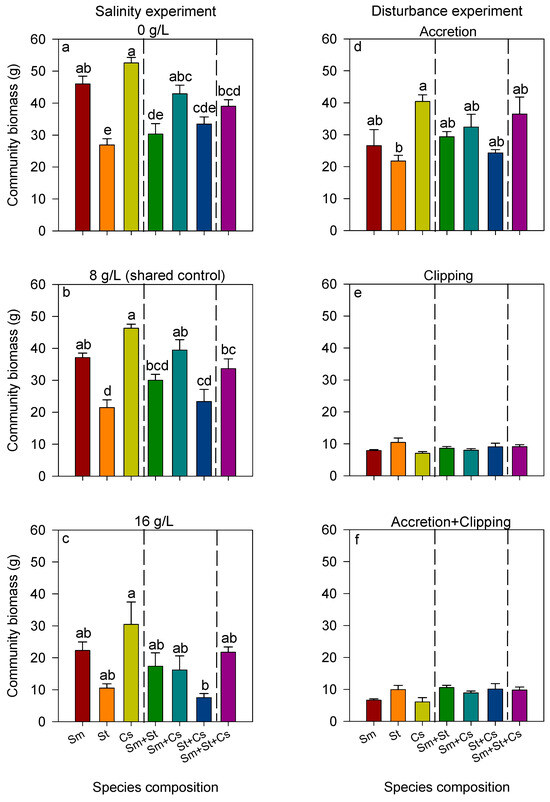
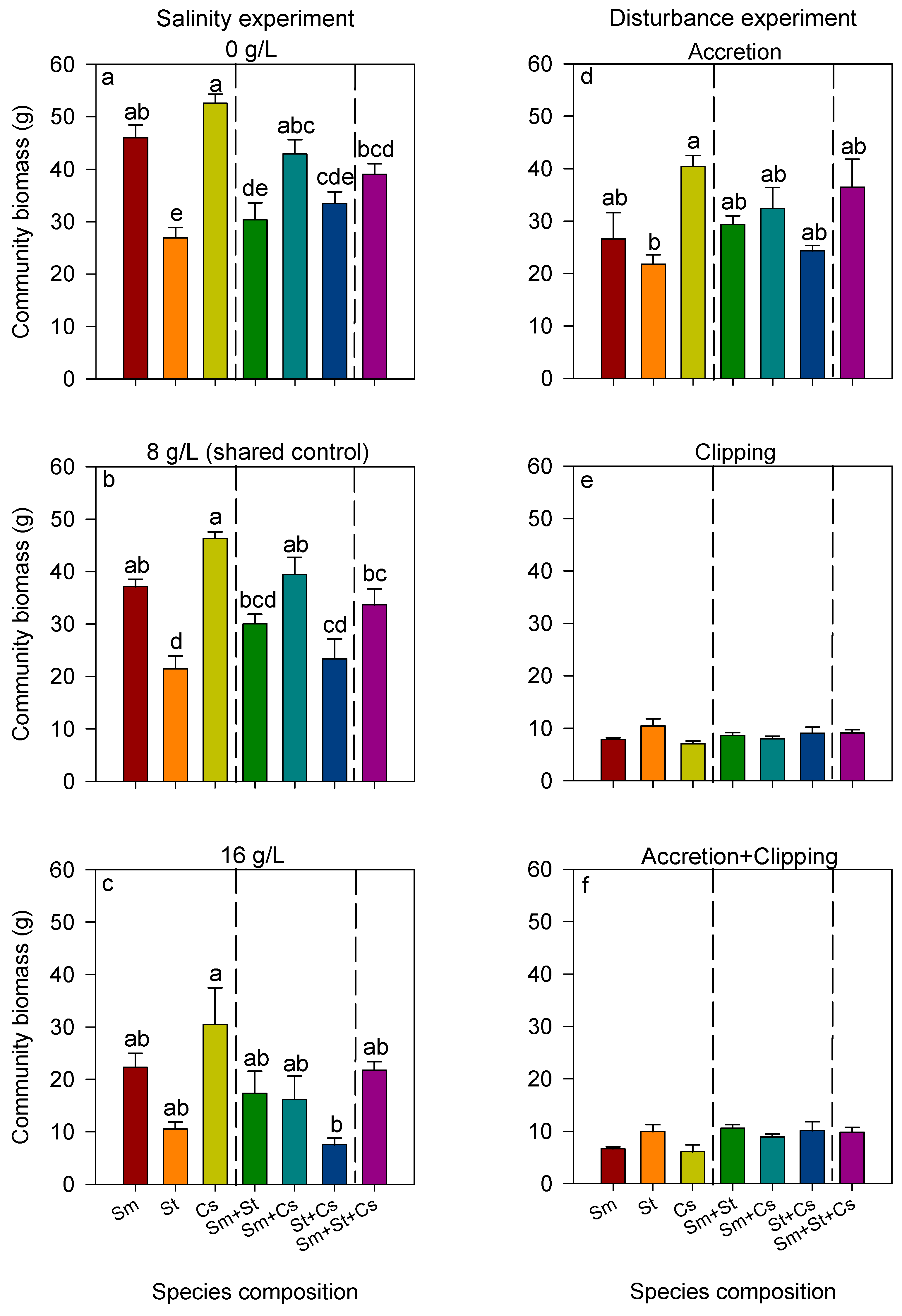
None of the relationships between community parameters (aboveground biomass, belowground biomass, total biomass, and root:shoot ratio) and species richness were significant in the salinity experiment (all p > 0.05, Figure A1a–d), whereas significant positive correlations were found between belowground biomass, total biomass, and species richness in the accretion + clipping treatment in the disturbance experiment (both p < 0.05) (Figure A1f,g). Species composition played a more important role in determining community productivity than richness. In the salinity experiment, community biomass significantly decreased with an increase in salinity, irrespective of community richness (Table 2, Figure 1a–c). Among different species compositions, Scirpus triqueter had the lowest biomass in monoculture and, among two-species mixtures, S. mariqueter + C. scabrifolia had higher biomass than S. triqueter + C. scabrifolia (Figure 1a–c).
Table 2.
The results of three-way nested ANOVA showing the effects of salinity (or disturbance), species richness and species composition (nested in species richness) on community biomass in the salinity experiment and the disturbance experiment.
Figure 1.
Community biomass of different species richness (number of species) and species composition in the salinity experiment (a–c) and the disturbance experiment (d–f). Note that the two experiments share the same control of 8 g/L and unmanipulated treatment (b). Error bars are standard errors. The vertical dashed lines serve as separators between different levels of species richness. Different lowercase letters denote significant differences (Tukey’s HSD test) among different species compositions. Sm: Scirpus mariqueter, St: Scirpus triqueter, Cs: Carex scabrifolia.
In the disturbance experiment, community biomass was significantly affected both by disturbance and by its interaction with species composition (Table 2). Compared with the control and accretion treatments, clipping and accretion + clipping reduced total biomass by approximately 70–80% (Figure 1b,d–f), and the strength of species composition effects on productivity varied among disturbance treatments. In monoculture, in terms of biomass, Scirpus triqueter transitioned from being the most unproductive species in the control and accretion treatments (Figure 1b,d) to being the most productive one in the clipping and accretion + clipping treatments (Figure 1e,f). Similarly, among two-species mixtures, Scirpus mariqueter + Carex scabrifolia biomass was the highest in the control and accretion treatments (Figure 1b,d), but the rank reversed in the clipping and accretion + clipping treatments (Figure 1e,f).
3.2. Partition of Biodiversity Effect
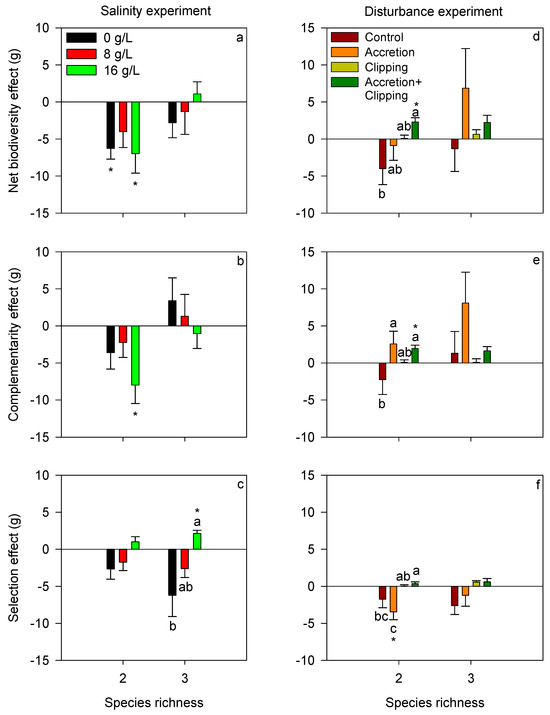
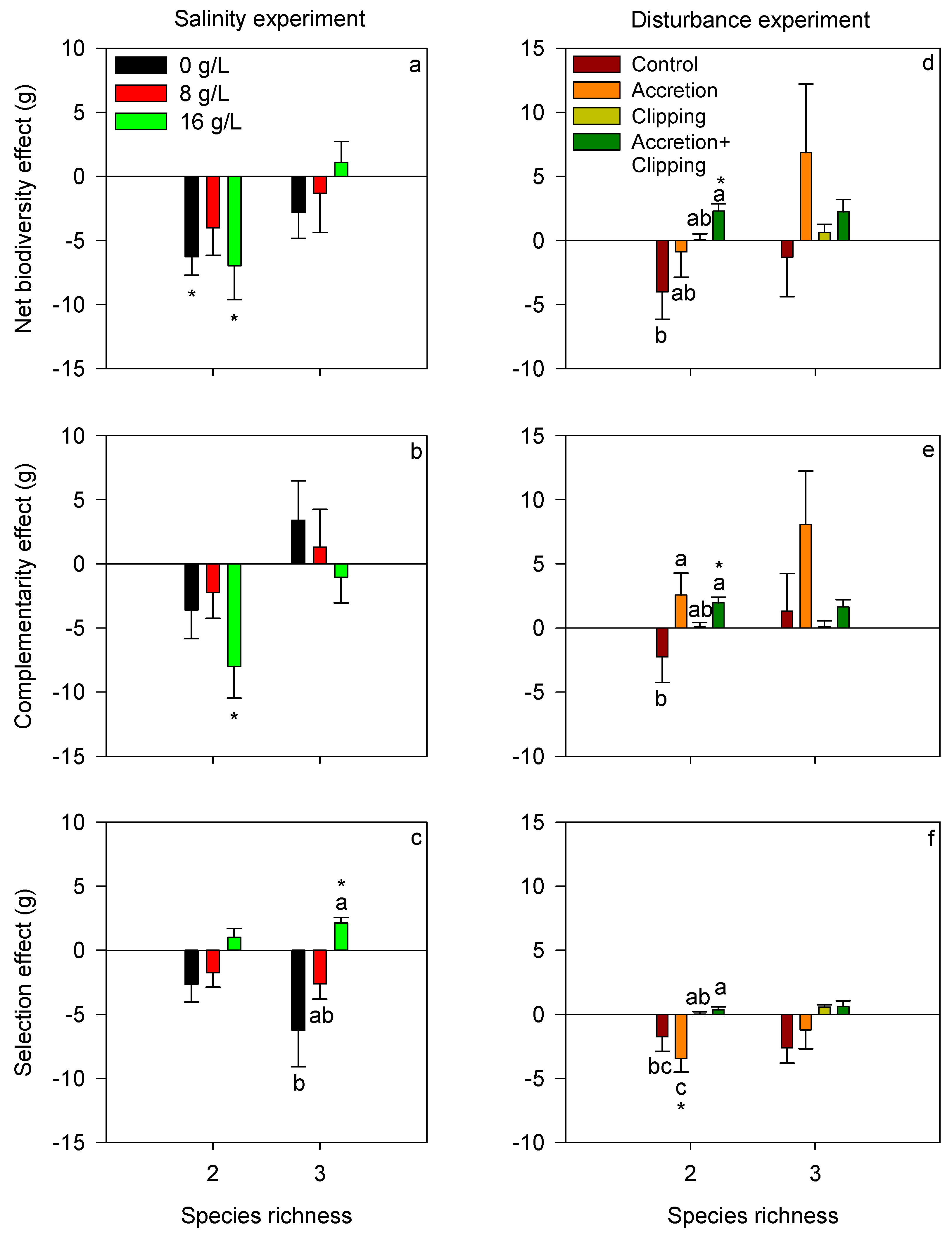
Salinity (or disturbance) treatment, species richness, and species composition differentially affected the net biodiversity effect and its component complementarity effect and selection effect. In the salinity experiment, the net biodiversity effect was significantly influenced by species composition only, and the selection effect was significantly affected by salinity and species composition (Table 3). Both net biodiversity effect and complementarity effect were negative in two-species mixtures and became neutral in the three-species mixture (Figure 2a,b). The selection effect changed little at different species richness levels but increased significantly with increasing salinity (Figure 2c).
Table 3.
The results of the three-way nested ANOVA showing the effects of treatment (salinity or disturbance), species richness and species composition (nested in species richness) on the net biodiversity effect and its component complementarity effect and selection effect.
Figure 2.
The net biodiversity effect and its component complementarity effect and selection effect at different species richness (number of species) levels in the salinity experiment (a–c) and the disturbance experiment (d–f). Different lowercase letters denote significant differences (Tukey’s HSD test) among different salinity or disturbance treatments at a given species richness level. Error bars are standard errors. Asterisk indicates a significant difference from zero (t test, p < 0.05).
In the disturbance experiment, the net biodiversity effect was significantly influenced by disturbance, species composition, and their interaction; the complementarity effect was significantly affected by disturbance only; and the selection effect was significantly affected by disturbance and the interaction between disturbance and species composition (Table 3). Richness had no significant effects, and disturbance generally positive effects on the net biodiversity effect and the composite complementarity effect and selection effect (Figure 2d–f).
3.3. Effects of Species Richness on Community Stability
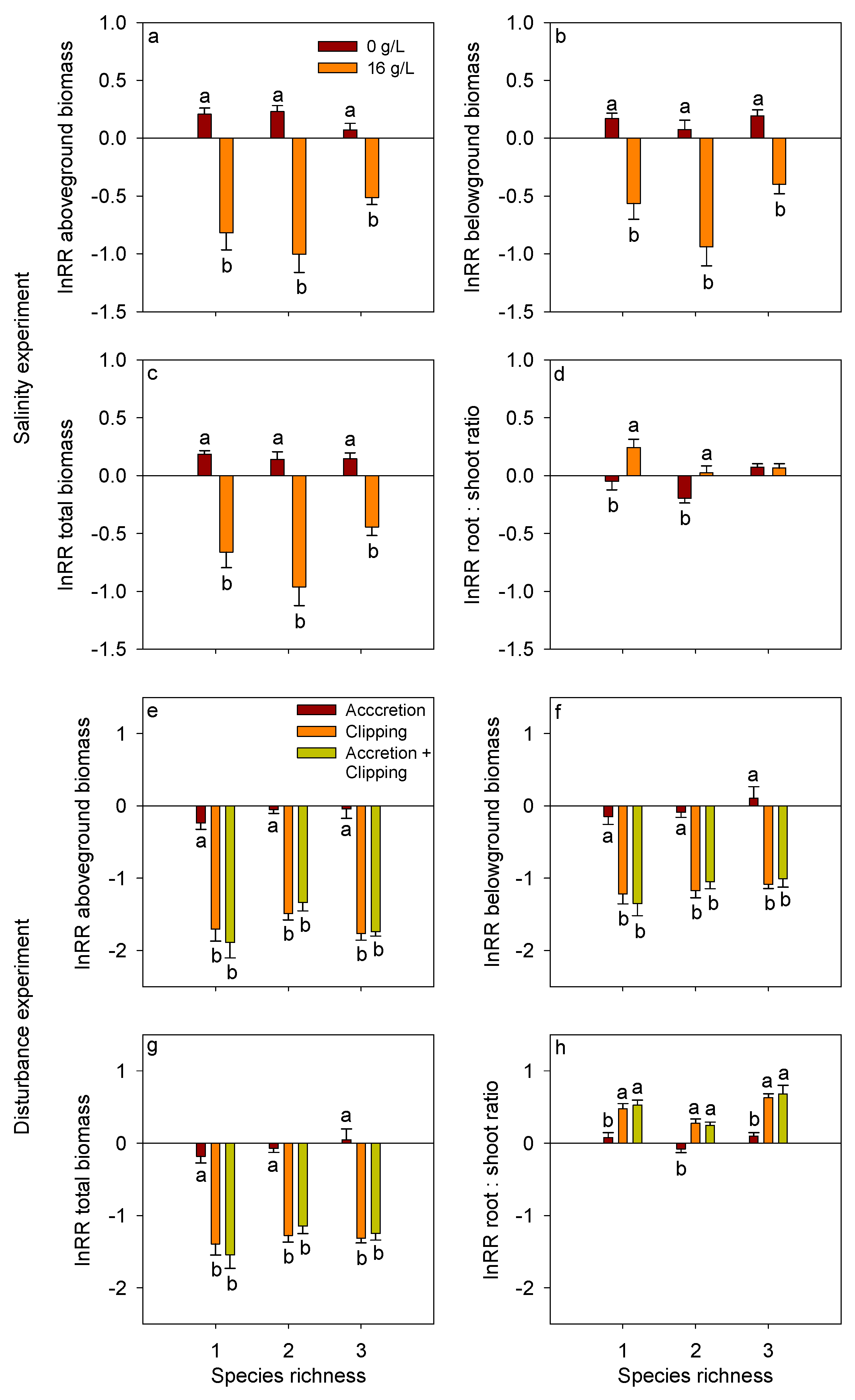
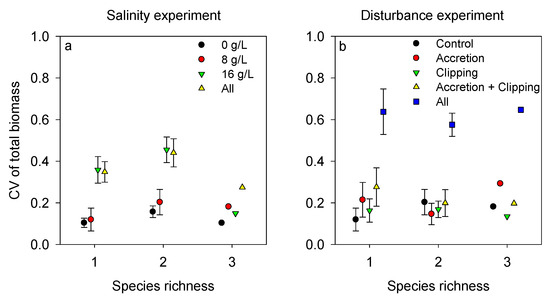
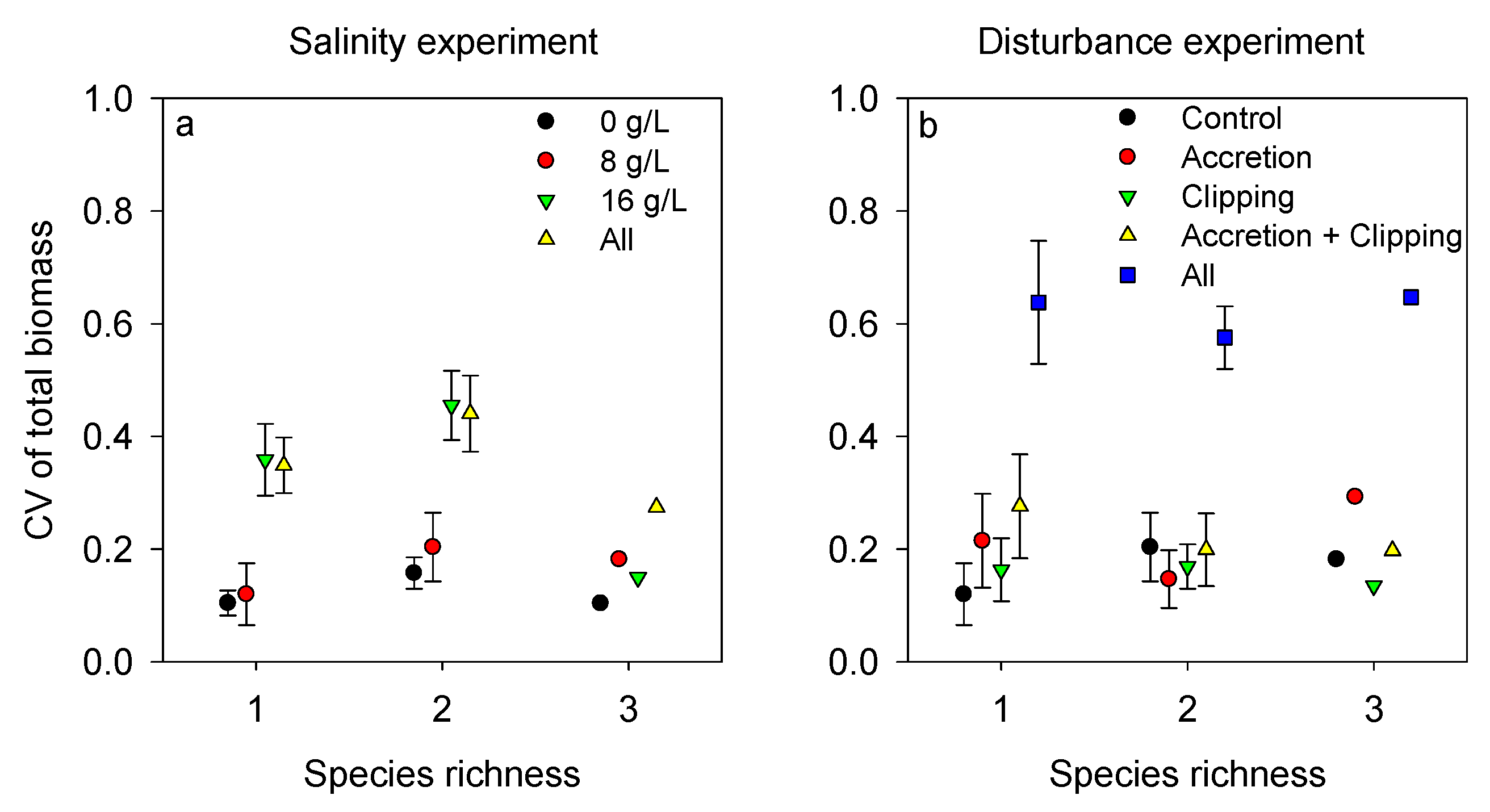
In the salinity experiment, the stability of total biomass (indicated by coefficient of variation) was significantly affected by salinity only (Table 4). Community biomass was the most viable at a salinity of 16 g/L, but the difference was small in the most diverse community (Figure 3a). A positive effect of species richness on community stability was found only in the harshest condition (16 g/L), but not in other low-salinity treatments (Figure 3a). In contrast, the response ratio (RR) ranges (maximum minus minimum mean RR among treatments) of all community parameters were consistently the smallest in three-species mixtures, indicating the strongest resistance in the most diverse communities (Figure A2a–d).
Table 4.
The results of the two-way ANOVA showing the effects of treatment (salinity or disturbance) and species richness on coefficient of variation (CV) of community biomass.
Figure 3.
Coefficient of variation (CV) of community biomass at different species richness (number of species) levels in the salinity experiment (a) and the disturbance experiment (b). Error bars are standard errors. All: across all treatments.
In the disturbance experiment, the stability of community productivity did not differ significantly among disturbance treatments, species composition, or species richness levels (Table 4, Figure 3b). However, community stability across all disturbance treatments was much higher than those in certain treatments (Figure 3b). The response ratio (RR) ranges (maximum minus minimum mean RR among treatments) showed no clear monotonic trend with species richness (Figure A2).
4. Discussion
Biodiversity experiments usually use a large species pool containing various kinds of plant species, and species richness is often entangled with functional group diversity. Our study, however, used three taxonomically related sedge species within the same functional group and examined the richness effect at a much finer scale. This represents the actual diversity level in sedge communities in the Yangtze River Estuary and allows us to better understand the species-specific interactions underlying diversity effects.
The two microcosm experiments in this study indicated that, within a functional group, richness effects on productivity were rare and, when present, depended on the environmental context. Species composition, rather than species richness, determined community productivity. When looking at the components of the net diversity effect, salinity stress increased the selection effect, but reduced the complementarity effect, while disturbance treatments tended to increase both. Interestingly, community stability first decreased and then increased with increasing richness in the salinity experiment but had the opposite pattern in the disturbance experiment.
4.1. Diversity Effects on Community Productivity
Biodiversity and ecosystem functioning (BEF) relationships have been studied extensively in grasslands and marine algal communities [72,73,74]. Contrary to most diversity manipulation experiments [14,21,39], our study detected no significant relationships between biodiversity and productivity under any salinity or disturbance treatment. Salt marshes are quite different from the well-studied grasslands in the BEF literature, which contain only a few phylogenetically related species within the same functional group and a high diversity of functional types. Our results therefore likely reflect the intrinsic properties of species-poor saltmarsh systems rather than artifacts of the experimental design. In such communities, species pools are naturally small and dominated by closely related taxa with similar growth forms and resource-use strategies. This constrains functional differentiation and limits the scope for niche partitioning. Similar weak or context-dependent BEF relationships have been reported in other saltmarsh restoration and field experiments [75,76], suggesting that reduced biodiversity effects may be a general feature of coastal wetlands under strong environmental stress rather than a consequence of microcosm conditions.
Breaking down the net biodiversity effect into its component effects provides a clearer perspective on the underlying mechanism of biodiversity and productivity relationships [20,77]. As predicted by the competition-relatedness hypothesis, closely related species may compete more intensely, reducing complementarity and weakening biodiversity–productivity relationships. In species-poor systems dominated by closely related taxa, interspecific interactions may resemble intraspecific competition, potentially leading to high niche overlap and limited opportunities for resource partitioning. Under such conditions, adding species primarily increases competitive pressure rather than functional complementarity. This mechanism is consistent with experimental evidence showing that communities composed of phylogenetically or functionally similar species exhibit weaker overyielding and lower complementarity than communities spanning broader trait space [16,78,79]. In our study, the net biodiversity effect and complementarity effect were negative in two-species mixtures in the salinity experiment, suggesting intense interference rather than niche partitioning among these ecologically identical sedge plants [80]. These negative responses weakened when a third species was added to the mixture, perhaps through the indirect interactions among them [81]. The reduced role of the complementarity effect is thought to be one of the main reasons for non-positive biodiversity–productivity relationships in natural communities [9]. However, weak richness–function relationships do not imply weak biodiversity effects overall. Instead, biodiversity effects could vary markedly among species compositions within the same richness level [82,83] (Table A1), highlighting strong composition dependence due to the variable success of these sedge plants in heterogeneous environments [84]. Similar responses were also shown in other grassland greenhouse studies [85,86].
4.2. The Role of Environmental Conditions
Environmental conditions including resource availability, stress, and disturbance, can interact with the biotic attributes of the plant community to influence ecosystem functioning [3,72,87]. Consistent with previous theoretical studies [3,42,88], we found that the net diversity effect and its component effects were environment-dependent. The selection effect became more important with increasing salinity, with the diversity-productivity relationship becoming less negative under saline conditions [3,89]. This is consistent with a probabilistic sampling mechanism: as species richness increases, the likelihood that a stress-tolerant and productive species is included in the community also rises. Under harsh conditions, community biomass becomes increasingly determined by the performance of a few tolerant dominants, amplifying the contribution of selection relative to complementarity. This pattern has been widely documented in BEF experiments across stress gradients, where environmental filtering enhances the dominance of particular species and strengthens selection effects [22,42,89]. In freshwater, the competitive dominant species (S. triqueter) had relatively low biomass, leading to a negative selection effect. At high salinity, however, the community was dominated by productive species (S. mariqueter and C. scabrifolia) and exhibited a positive selection effect (Table A1). In contrast, the complementarity effect decreased with increasing salinity. High salinity imposes strong physiological constraints on plant performance, including osmotic stress and ion toxicity, which could reduce growth rates and narrow the range of viable functional strategies of these marsh plants [90]. Under such harsh conditions, species might be filtered toward a small subset of stress-tolerant traits, increasing niche overlap among co-occurring taxa. As a result, opportunities for resource partitioning and facilitative interactions diminish, leading to reduced complementarity [91]. Similar stress-induced contraction of the niche space and weakened biodiversity effects have been reported in other BEF experiments along environmental gradients [25,89].
In our study, disturbance treatments tended to increase (though not significantly) the net biodiversity effect, complementarity effect and selection effect, which is inconsistent with the results of previous studies [88,92]. Disturbance may create transient spatial and resource heterogeneity by removing biomass and altering sediment structure, thereby opening niches for differential species responses. In our experiment, burial and clipping likely generated microhabitat variation in light availability, sediment depth, and competitive hierarchies. Species differed in their tolerance to burial and their regrowth capacity following clipping, which may have promoted functional differentiation and facilitation among neighbors [93,94]. Specifically, a positive complementary effect was observed mainly in accretion and accretion + clipping treatments (Table A1). This may be caused by a release from burial due to the enhanced height growth of these sedge plants when grown in mixtures. The negative selection effect became positive in both two-species and three-species mixtures when plants were clipped, as the dominant S. triqueter was more tolerant to clipping treatment than the other species [61]. Such disturbance-mediated complementarity has also been observed in other plant systems, where biomass removal or sediment dynamics enhance niche partitioning and positive interactions [40,77].
4.3. Diversity Effects on Community Stability
The controversy around the biodiversity and stability relationship comes from conflicting evidence of both positive and negative patterns. This is perhaps because the response to disturbance of an ecosystem depends on the form of the diversity-productivity relationship in the control treatment [29,95,96]. No significant linear relationship was found between the stability of community biomass and species richness in our study. In the salinity experiment, the coefficient of variation (CV) of community biomass was much higher in saline (16 g/L NaCl) than in freshwater and brackish treatments, as plants may have high variation in performance in a harsh environment [97,98]. But in the most diverse community (three-species mixture), the CV of productivity was maintained at a relative low level (i.e., high stability), even in the harshest environment (16 g/L NaCl), which may be due to differing responses of these three sedges to salinity treatment. Disturbance, however, did not influence the CV of community productivity.
The non-linear richness–stability pattern along the salinity gradient suggests a shift between competing mechanisms. At low richness, adding species may initially enhance competitive asymmetry and demographic variability, increasing the CV. Beyond a threshold, however, additional species may introduce diversity of responses to salinity stress, allowing for asynchronous performance among taxa and dampening community-level fluctuations. Similar context-dependent or hump-shaped stability patterns have been reported in other BEF studies [26,41,87], reflecting a balance between competitive amplification and statistical averaging effects. The CV of community biomass was much higher when calculated across all disturbance treatments at all species richness levels, indicating that accretion and clipping treatments had stronger effects than other factors on productivity. These findings suggest that when looking at a much finer scale along the richness gradient, strong relationship between diversity and ecosystem functioning can disappear; such a relationship might also be observed in other ecosystems with only a few closely related species, such as deserts.
The coefficient of variation (CV) is widely used as an index of community variability and has often been interpreted as a proxy for temporal stability (μ/σ; [99]). However, in the present study, biomass was measured at a single end-of-season harvest, so the CV reflects relative variability among replicate communities under the same treatment rather than true temporal stability. Therefore, our CV-based results should be interpreted as a measure of relative variability among replicate communities under the same treatment, rather than as a complete assessment of stability.
To complement the CV, we additionally evaluated resistance to stress and disturbance using the magnitude of response ratios (RRs) of community parameters across treatments (Figure A2). Under salinity stress, RR ranges were markedly reduced in the most diverse communities, exhibiting the strongest resistance to salinity. This qualitative pattern is consistent with the CV results showing that richness-related stabilization emerged mainly under the harshest salinity condition. In contrast, among disturbance treatments, RR ranges did not decrease monotonically with richness, and allocation responses (root/shoot ratio) were sometimes most variable at higher richness, suggesting that resistance to disturbance was more strongly driven by disturbance type and species composition or trait differences than by richness per se in this species-poor system.
More comprehensive stability metrics (such as temporal stability based on repeated measurements over time, and resistance or resilience quantified from pre- and post-disturbance trajectories) would require longer-term monitoring and higher-frequency sampling than were possible in the present single-season microcosm experiment. Future studies combining multi-season time series and disturbance recovery measurements in the field or larger mesocosms could better evaluate these complementary dimensions of stability, as highlighted in previous BEF stability research [100,101].
4.4. Limitations
It should be acknowledged that our experiment was conducted over a single growing season, which may be insufficient for perennial, rhizomatous plants to fully establish competitive hierarchies and long-term interaction networks. In clonal marsh plants, diversity effects may strengthen over multiple seasons as belowground structures develop and feedbacks accumulate. Therefore, the weak diversity effects observed here likely reflect early-stage community dynamics rather than equilibrium outcomes. In addition, the microcosm setting and limited pot size may constrain lateral spread and spatial segregation, potentially underestimating niche differentiation that would emerge under field conditions. These limitations should be considered when extrapolating our results to natural salt marshes. Although we interpreted changes in complementarity and selection effects in terms of competition, stress tolerance, and niche overlap, we did not directly measure resource depletion (e.g., soil nutrients, light interception) or detailed functional traits at the individual level. Our inferences are therefore based on community-level responses, including above- and belowground biomass allocation, root/shoot ratios, and resistance metrics (Figure A1 and Figure A2), which provide indirect but informative evidence of underlying interaction mechanisms. Future studies combining BEF experiments with direct measurements of resource use and plant functional traits will be essential to rigorously test these mechanistic pathways.
5. Conclusions
Through a common-garden experiment conducted over a single growing season, we found that biodiversity–ecosystem functioning relationships were generally weak and highly context-dependent during the establishment phase of a species-poor saltmarsh community. Community stability showed a non-linear pattern with increasing species richness. These results suggest that in species-poor ecosystems like salt marshes, ecosystem functioning might be shaped more by which species are present than by how many species occur.
Author Contributions
Conceptualization, C.-H.W.; Data curation, C.-H.W.; Formal analysis, P.-S.J. and C.-H.W.; Methodology, P.-S.J. and C.-H.W.; Project administration, C.-H.W.; Software, P.-S.J. and C.-H.W.; Supervision, C.-H.W.; Writing—original draft, P.-S.J. and C.-H.W.; Writing—review and editing, P.-S.J. All authors have read and agreed to the published version of the manuscript.
Funding
This research was funded by the National Natural Science Foundation of China (grant number 31100317, 31870405).
Institutional Review Board Statement
Not applicable.
Data Availability Statement
The original contributions presented in this study are included in the article. Further inquiries can be directed to the corresponding author.
Acknowledgments
We thank the Shanghai Chongming Dongtan National Nature Reserve for providing convenience in ramets collection.
Conflicts of Interest
The authors declare no conflicts of interest.
Appendix A
Table A1.
Net biodiversity effect and its component complementarity effect and selection effect in all species combinations of two-species mixture and three-species mixture in salinity experiment and disturbance experiment (mean ± SE).
Figure A1.
Community aboveground biomass (a,e), belowground biomass (b,f), total biomass (c,g) and root/shoot ratio (d,h) at different species richness (number of species) levels in the salinity experiment and the disturbance experiment. The lines in different colors represent linear regression curves under different treatments. Dashed line: p > 0.05; solid line (the yellow line in Figure A1f,g): p < 0.05.
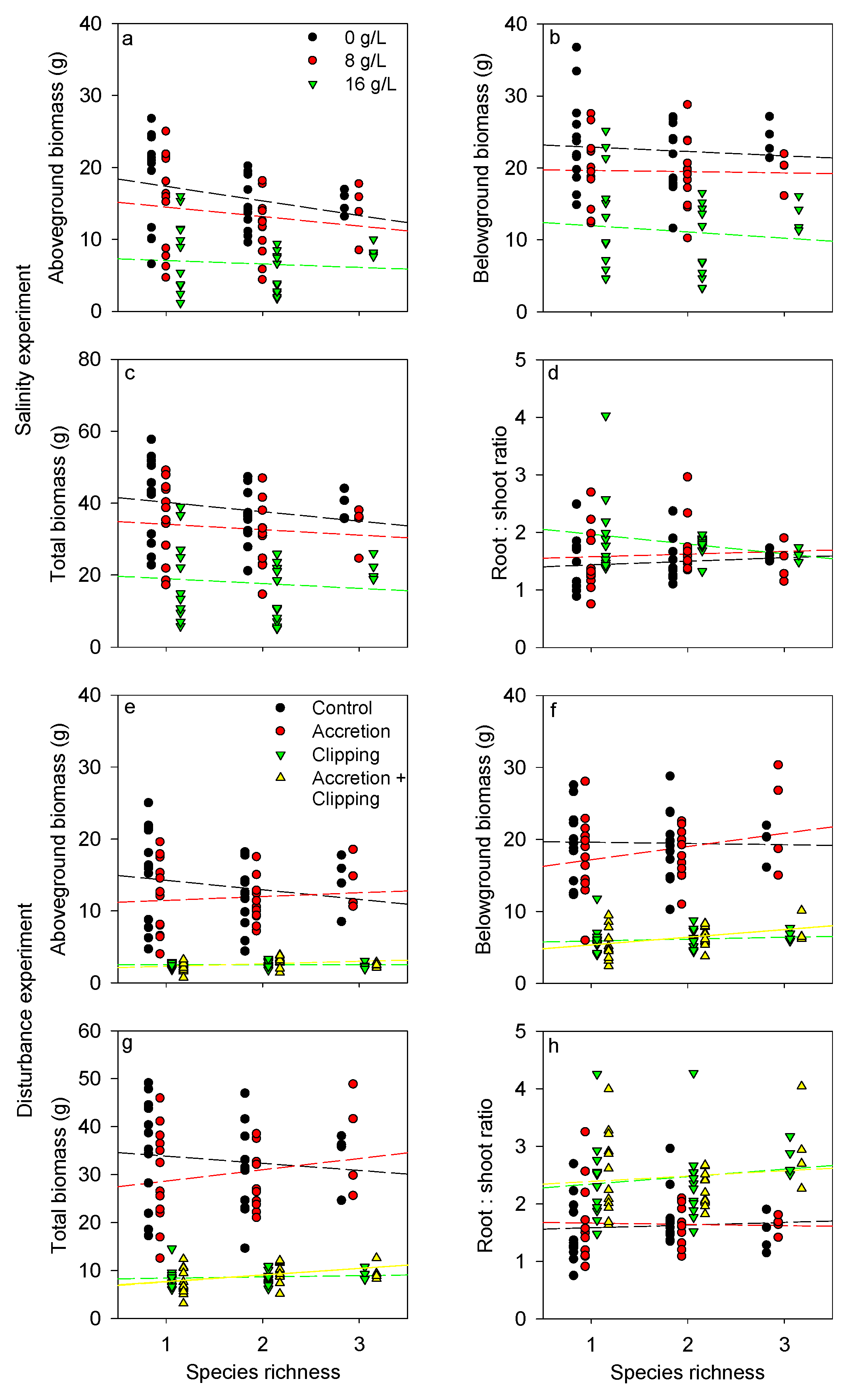
Figure A2.
Community response ratio (ln (Treatment/Control)) of aboveground biomass (a,e), belowground biomass (b,f), total biomass (c,g), and root/shoot ratio (d,h) at different species richness (number of species) levels in the salinity experiment and the disturbance experiment. Different lowercase letters denote significant differences (Tukey’s HSD test) among different salinity or disturbance treatments at a given species richness level. Error bars are standard errors.
References
- Van Der Plas, F. Biodiversity and Ecosystem Functioning in Naturally Assembled Communities. Biol. Rev. 2019, 94, 1220–1245. [Google Scholar] [CrossRef] [Scilit] [PubMed]
- Hou, J.; Feng, H.; Wu, M. Incorporating Effect Factors into the Relationship between Biodiversity and Ecosystem Functioning (BEF). Diversity 2022, 14, 274. [Google Scholar] [CrossRef] [Scilit]
- Hong, P.; Schmid, B.; De Laender, F.; Eisenhauer, N.; Zhang, X.; Chen, H.; Wang, S. Biodiversity Promotes Ecosystem Functioning Despite Environmental Change. Ecol. Lett. 2022, 25, 555–569. [Google Scholar] [CrossRef] [Scilit]
- DÃ-az, S.; Settele, J.; Brondízio, E.S.; Ngo, H.T.; Agard, J.; Arneth, A.; Zayas, C.N. Pervasive Human-Driven Decline of Life on Earth Points to the Need for Transformative Change. Science 2019, 366, eaax3100. [Google Scholar] [CrossRef] [Scilit]
- Gamfeldt, L.; Lefcheck, J.S.; Byrnes, J.E.; Cardinale, B.J.; Duffy, J.E.; Griffin, J.N. Marine Biodiversity and Ecosystem Functioning: What’s Known and What’s Next? Oikos 2015, 124, 252–265. [Google Scholar] [CrossRef] [Scilit]
- Duffy, J.E.; Godwin, C.M.; Cardinale, B.J. Biodiversity Effects in the Wild Are Common and as Strong as Key Drivers of Productivity. Nature 2017, 549, 261–264. [Google Scholar] [CrossRef] [Scilit] [PubMed]
- Dee, L.E.; Ferraro, P.J.; Severen, C.N.; Kimmel, K.A.; Borer, E.T.; Byrnes, J.E.; Loreau, M. Clarifying the Effect of Biodiversity on Productivity in Natural Ecosystems with Longitudinal Data and Methods for Causal Inference. Nat. Commun. 2023, 14, 2607. [Google Scholar] [CrossRef] [Scilit]
- Loreau, M. Biodiversity and ecosystem functioning: A mechanistic model. Proc. Natl. Acad. Sci. USA 1998, 95, 5632–5636. [Google Scholar] [CrossRef] [Scilit]
- Adler, P.B.; Seabloom, E.W.; Borer, E.T.; Hillebrand, H.; Hautier, Y.; Hector, A.; Harpole, W.S.; O’hAlloran, L.R.; Grace, J.B.; Anderson, T.M.; et al. Productivity is a poor predictor of plant species richness. Science 2011, 333, 1750–1753. [Google Scholar] [CrossRef] [Scilit]
- Baert, J.M.; Eisenhauer, N.; Janssen, C.R.; De Laender, F. Biodiversity Effects on Ecosystem Functioning Respond Unimodally to Environmental Stress. Ecol. Lett. 2018, 21, 1191–1199. [Google Scholar] [CrossRef] [Scilit]
- Duncan, C.; Thompson, J.R.; Pettorelli, N. The Quest for a Mechanistic Understanding of Biodiversity-Ecosystem Services Relationships. Proc. R. Soc. B Biol. Sci. 2015, 282, 20151348. [Google Scholar] [CrossRef] [Scilit]
- Grace, J.B.; Anderson, T.M.; Seabloom, E.W.; Borer, E.T.; Adler, P.B.; Harpole, W.S.; Smith, M.D. Integrative Modelling Reveals Mechanisms Linking Productivity and Plant Species Richness. Nature 2016, 529, 390–393. [Google Scholar] [CrossRef] [Scilit]
- Naeem, S.; Thompson, L.J.; Lawler, S.P.; Lawton, J.H.; Woodfin, R.M. Declining Biodiversity Can Alter the Performance of Ecosystems. Nature 1994, 368, 734–737. [Google Scholar] [CrossRef] [Scilit]
- Tilman, D.; Wedin, D.; Knops, J. Productivity and Sustainability Influenced by Biodiversity in Grassland Ecosystems. Nature 1996, 379, 718–720. [Google Scholar] [CrossRef] [Scilit]
- Wagg, C.; Roscher, C.; Weigelt, A.; Vogel, A.; Ebeling, A.; De Luca, E.; Schmid, B. Biodiversity-Stability Relationships Strengthen Over Time in a Long-Term Grassland Experiment. Nat. Commun. 2022, 13, 7752. [Google Scholar] [CrossRef] [Scilit] [PubMed]
- Turnbull, L.A.; Isbell, F.; Purves, D.W.; Loreau, M.; Hector, A. Understanding the Value of Plant Diversity for Ecosystem Functioning Through Niche Theory. Proc. R. Soc. B Biol. Sci. 2016, 283, 20160536. [Google Scholar] [CrossRef] [Scilit]
- Godoy, O.; Gómez-Aparicio, L.; Matías, L.; Pérez-Ramos, I.M.; Allan, E. An Excess of Niche Differences Maximizes Ecosystem Functioning. Nat. Commun. 2020, 11, 4180. [Google Scholar] [CrossRef] [Scilit]
- Baeten, L.; Bruelheide, H.; van Der Plas, F.; Kambach, S.; Ratcliffe, S.; Jucker, T.; Scherer-Lorenzen, M. Identifying the Tree Species Compositions That Maximize Ecosystem Functioning in European Forests. J. Appl. Ecol. 2019, 56, 733–744. [Google Scholar] [CrossRef] [Scilit]
- Carrick, P.J.; Forsythe, K.J. The Species Composition-Ecosystem Function Relationship: A Global Meta-analysis Using Data from Intact and Recovering Ecosystems. PLoS ONE 2020, 15, e0236550. [Google Scholar] [CrossRef] [Scilit]
- Tilman, D.; Lehman, C.L.; Thomson, K.T. Plant diversity and ecosystem productivity: Theoretical considerations. Proc. Natl. Acad. Sci. USA 1997, 94, 1857–1861. [Google Scholar] [CrossRef] [Scilit]
- Zheng, L.; Barry, K.E.; Guerrero-Ramírez, N.R.; Craven, D.; Reich, P.B.; Verheyen, K.; Hautier, Y. Effects of Plant Diversity on Productivity Strengthen Over Time Due to Trait-Dependent Shifts in Species Overyielding. Nat. Commun. 2024, 15, 2078. [Google Scholar] [CrossRef] [Scilit] [PubMed]
- Chen, C.; Xiao, W.; Chen, H.Y. Meta-analysis Reveals Global Variations in Plant Diversity Effects on Productivity. Nature 2025, 638, 435–440. [Google Scholar] [CrossRef] [Scilit]
- Loreau, M.; Hector, A. Partitioning selection and complementarity in biodiversity experiments. Nature 2001, 412, 72–76. [Google Scholar] [CrossRef] [Scilit]
- Clark, A.T.; Barry, K.E.; Roscher, C.; Buchmann, T.; Loreau, M.; Harpole, W.S. How to Estimate Complementarity and Selection Effects from an Incomplete Sample of Species. Methods Ecol. Evol. 2019, 10, 2141–2152. [Google Scholar] [CrossRef] [Scilit]
- Barry, K.E.; Mommer, L.; van Ruijven, J.; Wirth, C.; Wright, A.J.; Bai, Y.; Weigelt, A. The Future of Complementarity: Disentangling Causes from Consequences. Trends Ecol. Evol. 2019, 34, 167–180. [Google Scholar] [CrossRef] [Scilit]
- Pennekamp, F.; Pontarp, M.; Tabi, A.; Altermatt, F.; Alther, R.; Choffat, Y.; Fronhofer, E.A.; Ganesanandamoorthy, P.; Garnier, A.; Griffiths, J.I.; et al. Biodiversity increases and decreases ecosystem stability. Nat. Ecol. Evol. 2018, 2, 419–425. [Google Scholar] [CrossRef] [Scilit]
- MacArthur, R.H. Fluctuations of Animal Populations and a Measure of Community Stability. Ecology 1955, 36, 533–536. [Google Scholar] [CrossRef] [Scilit]
- May, R.M. Stability and Complexity in Model Ecosystems; Princeton University: Princeton, NJ, USA, 1972. [Google Scholar]
- Wisnoski, N.I.; Andrade, R.; Castorani, M.C.; Catano, C.P.; Compagnoni, A.; Lamy, T.; Sokol, E.R. Diversity-Stability Relationships Across Organism Groups and Ecosystem Types Become Decoupled Across Spatial Scales. Ecology 2023, 104, e4136. [Google Scholar] [CrossRef] [Scilit]
- Pennekamp, F.; Pontarp, M.; Tabi, A.; Altermatt, F.; Alther, R.; Choffat, Y.; Petchey, O.L. Biodiversity Increases and Decreases Ecosystem Stability. Nature 2018, 563, 109–112. [Google Scholar] [CrossRef] [Scilit] [PubMed]
- Hossain, M.L.; Li, J.; Hoffmann, S.; Beierkuhnlein, C. Biodiversity Showed Positive Effects on Resistance but Mixed Effects on Resilience to Climatic Extremes in a Long-Term Grassland Experiment. Sci. Total Environ. 2022, 827, 154322. [Google Scholar] [CrossRef] [Scilit]
- Correia, A.M.; Lopes, L.F. Revisiting biodiversity and ecosystem functioning through the lens of complex adaptive systems. Diversity 2023, 15, 895. [Google Scholar] [CrossRef] [Scilit]
- Zeng, G.; Ye, M.; Li, M.; Chen, W.; He, Q.; Pan, X.; Zhang, X.; Che, J.; Qian, J.; Lv, Y. The Relationships between Plant Community Stability and Diversity across Different Grassland Types and Their Association with Environmental Factors in the Habahe Forest Area, Xinjiang. Diversity 2024, 16, 499. [Google Scholar] [CrossRef] [Scilit]
- Yachi, S.; Loreau, M. Biodiversity and Ecosystem Productivity in a Fluctuating Environment: The Insurance Hypothesis. Proc. Natl. Acad. Sci. USA 1999, 96, 1463–1468. [Google Scholar] [CrossRef] [Scilit]
- Sundstrom, S.M.; Angeler, D.G.; Barichievy, C.; Eason, T.; Garmestani, A.; Gunderson, L.; Allen, C.R. The Distribution and Role of Functional Abundance in Cross-Scale Resilience. Ecology 2018, 99, 2421–2432. [Google Scholar] [CrossRef] [Scilit] [PubMed]
- Biggs, C.R.; Yeager, L.A.; Bolser, D.G.; Bonsell, C.; Dichiera, A.M.; Hou, Z.; Erisman, B.E. Does Functional Redundancy Affect Ecological Stability and Resilience? A Review and Meta-Analysis. Ecosphere 2020, 11, e03184. [Google Scholar] [CrossRef] [Scilit]
- Pillar, V.D.; Blanco, C.C.; Muller, S.C.; Sosinski, E.E.; Joner, F.; Duarte, L.D.S. Functional Redundancy and Stability in Plant Communities. J. Veg. Sci. 2013, 24, 963–974. [Google Scholar] [CrossRef] [Scilit]
- Mangan, S.; Bulmer, R.H.; Greenfield, B.L.; Hailes, S.F.; Carter, K.; Hewitt, J.E.; Lohrer, A.M. Resilience and Species Accumulation across Seafloor Habitat Transitions in a Northern New Zealand Harbour. Diversity 2022, 14, 998. [Google Scholar] [CrossRef] [Scilit]
- Craven, D.; Isbell, F.; Manning, P.; Connolly, J.; Bruelheide, H.; Ebeling, A.; Eisenhauer, N. Plant Diversity Effects on Grassland Productivity Are Robust to Both Nutrient Enrichment and Drought. Philos. Trans. R. Soc. B Biol. Sci. 2016, 371, 20150277. [Google Scholar] [CrossRef] [Scilit] [PubMed]
- Wright, A.J.; Ebeling, A.; De Kroon, H.; Roscher, C.; Weigelt, A.; Buchmann, N.; Eisenhauer, N. Flooding Disturbances Increase Resource Availability and Productivity but Reduce Stability in Diverse Plant Communities. Nat. Commun. 2015, 6, 6092. [Google Scholar] [CrossRef] [Scilit]
- Valencia, E.; De Bello, F.; Galland, T.; Adler, P.B.; Lepš, J.; E-Vojtkó, A.; Götzenberger, L. Synchrony Matters More Than Species Richness in Plant Community Stability at a Global Scale. Proc. Natl. Acad. Sci. USA 2020, 117, 24345–24351. [Google Scholar] [CrossRef] [Scilit]
- Huang, M.; Reich, P.B.; Wang, S.; Feng, Y.; Hong, P.; Barry, K.E.; Hautier, Y. Nitrogen and CO2 Enrichment Interact to Decrease Biodiversity Impact on Complementarity and Selection Effects. Nat. Commun. 2025, 16, 7445. [Google Scholar] [CrossRef] [Scilit]
- Xue, W.; Rillig, M.C.; Yu, M.F.; Hu, J.N.; Huang, L.; Yu, F.H. Soil Nutrient Heterogeneity Alters Productivity and Diversity of Experimental Plant Communities Under Multiple Global Change Factors. Oikos 2023, 2023, e10189. [Google Scholar] [CrossRef] [Scilit]
- Kreyling, J.; Dengler, J.; Walter, J.; Velev, N.; Ugurlu, E.; Sopotlieva, D.; Jentsch, A. Species Richness Effects on Grassland Recovery from Drought Depend on Community Productivity in a Multisite Experiment. Ecol. Lett. 2017, 20, 1405–1413. [Google Scholar] [CrossRef] [Scilit]
- Rios, J.; Dibbell, M.; Flores, E.; Kneitel, J.M. Beyond the Hydro-Regime: Differential Regulation of Plant Functional Groups in Seasonal Ponds. Diversity 2023, 15, 832. [Google Scholar] [CrossRef] [Scilit]
- Shao, J.; Zhou, X.; van Groenigen, K.J.; Zhou, G.; Zhou, H.; Zhou, L.; Thakur, M.P. Warming Effects on Grassland Productivity Depend on Plant Diversity. Glob. Ecol. Biogeogr. 2022, 31, 588–598. [Google Scholar] [CrossRef] [Scilit]
- Weisser, W.W.; Roscher, C.; Meyer, S.T.; Ebeling, A.; Luo, G.; Allan, E.; Eisenhauer, N. Biodiversity Effects on Ecosystem Functioning in a 15-Year Grassland Experiment: Patterns, Mechanisms, and Open Questions. Basic Appl. Ecol. 2017, 23, 1–73. [Google Scholar] [CrossRef] [Scilit]
- Gonzalez, A.; Germain, R.M.; Srivastava, D.S.; Filotas, E.; Dee, L.E.; Gravel, D.; Loreau, M. Scaling-Up Biodiversity-Ecosystem Functioning Research. Ecol. Lett. 2020, 23, 757–776. [Google Scholar] [CrossRef] [Scilit]
- Zhang, M.; Delgado-Baquerizo, M.; Li, G.; Isbell, F.; Wang, Y.; Hautier, Y.; Wang, L. Experimental Impacts of Grazing on Grassland Biodiversity and Function Are Explained by Aridity. Nat. Commun. 2023, 14, 5040. [Google Scholar] [CrossRef] [Scilit] [PubMed]
- Bricca, A.; Tardella, F.M.; Tolu, F.; Goia, I.; Ferrara, A.; Catorci, A. Disentangling the Effects of Disturbance from Those of Dominant Tall Grass Features in Driving the Functional Variation of Restored Grassland in a Sub-Mediterranean Context. Diversity 2020, 12, 11. [Google Scholar] [CrossRef] [Scilit]
- Klaus, V.H.; Whittingham, M.J.; Báldi, A.; Eggers, S.; Francksen, R.M.; Hiron, M.; Buchmann, N. Do Biodiversity-Ecosystem Functioning Experiments Inform Stakeholders How to Simultaneously Conserve Biodiversity and Increase Ecosystem Service Provisioning in Grasslands? Biol. Conserv. 2020, 245, 108552. [Google Scholar] [CrossRef] [Scilit]
- Vogel, A.; Manning, P.; Cadotte, M.W.; Cowles, J.; Isbell, F.; Jousset, A.L.; Wagg, C. Lost in Trait Space: Species-Poor Communities Are Inflexible in Properties That Drive Ecosystem Functioning. Adv. Ecol. Res. 2019, 61, 91–131. [Google Scholar]
- Liu, Z.; Fagherazzi, S.; He, Q.; Gourgue, O.; Bai, J.; Liu, X.; Cui, B. A Global Meta-analysis on the Drivers of Salt Marsh Planting Success and Implications for Ecosystem Services. Nat. Commun. 2024, 15, 3643. [Google Scholar] [CrossRef] [Scilit] [PubMed]
- Pennings, S.C.; Bertness, M.D. Salt Marsh Communities. In Marine Community Ecology; Bertness, M.D., Gaines, S.D., Hay, M.E., Eds.; Sinauer Associates: Sunderland, MA, USA, 2001; pp. 289–316. [Google Scholar]
- Wang, D.; Chen, Z.; Xu, S. Methane emission from Yangtze estuarine wetland, China. J. Geophys. Res. Biogeosci. 2009, 114, G02011. [Google Scholar] [CrossRef] [Scilit]
- Yang, S.L.; Luo, X.; Temmerman, S.; Kirwan, M.; Bouma, T.; Xu, K.; Gao, S. Role of Delta-Front Erosion in Sustaining Salt Marshes Under Sea-Level Rise and Fluvial Sediment Decline. Limnol. Oceanogr. 2020, 65, 1990–2009. [Google Scholar] [CrossRef] [Scilit]
- Jia, J.; Zhao, X.; Jia, P.; Zhang, X.; Li, D.; Liu, Y.; Huang, L. Ecophysiological Responses of Phragmites australis Populations to a Tidal Flat Gradient in the Yangtze River Estuary, China. Front. Plant Sci. 2024, 15, 1326345. [Google Scholar] [CrossRef] [Scilit]
- Jiang, C.; Li, X.Z.; Xue, L.M.; Yan, Z.Z.; Liang, X.; Chen, X.C. Pioneer Salt Marsh Species Scirpus mariqueter Disperses Quicker in Summer with Seed Contribution from Current and Last Year. Estuar. Coast. Shelf Sci. 2022, 264, 107682. [Google Scholar] [CrossRef] [Scilit]
- Sun, Y.; Fan, D.; Du, Y.; Li, B. Anthropogenic Forcing on the Coevolution of Tidal Creeks and Vegetation in the Dongtan Wetland, Changjiang Estuary. Remote Sens. 2025, 17, 1692. [Google Scholar] [CrossRef] [Scilit]
- Li, B.; Yuan, X.; Chen, M.; Bo, S.; Xia, L.; Guo, Y.; Zhao, S.; Ma, Z.; Wang, T. How to strive for balance of coastal wind energy development with waterbird conservation in the important coastal wetlands, a case study in the Chongming Islands of East China. J. Clean. Prod 2020, 263, 121547. [Google Scholar] [CrossRef] [Scilit]
- Wang, C.H.; Li, B. Salinity and Disturbance Mediate Direct and Indirect Plant-Plant Interactions in an Assembled Marsh Community. Oecologia 2016, 182, 139–152. [Google Scholar] [CrossRef] [Scilit] [PubMed]
- Liu, B.; Chen, Y.; Cai, T.; Li, Y.; Sun, L. Estimating Waves and Currents at the Saltmarsh Edge Using Acoustic Doppler Velocimeter Data. Front. Mar. Sci. 2021, 8, 708116. [Google Scholar] [CrossRef] [Scilit]
- Zhan, Y.; Aarninkhof, S.G.; Wang, Z.; Zhou, Y. Monitoring the Monthly Expansion Pattern of Pioneer Vegetation in Tidal Flats Using a Terrestrial Laser Scanner. J. Coast. Res. 2022, 38, 538–547. [Google Scholar] [CrossRef] [Scilit]
- Tang, Y.N.; Ma, J.; Xu, J.X.; Wu, W.B.; Wang, Y.C.; Guo, H.Q. Assessing the Impacts of Tidal Creeks on the Spatial Patterns of Coastal Salt Marsh Vegetation and Its Aboveground Biomass. Remote Sens. 2022, 14, 1839. [Google Scholar] [CrossRef] [Scilit]
- Schmid, B.; Baruffol, M.; Wang, Z.; Niklaus, P.A. A Guide to Analyzing Biodiversity Experiments. J. Plant Ecol. 2017, 10, 91–110. [Google Scholar] [CrossRef] [Scilit]
- Magrach, A.; Montoya, D. Stability in plant-pollinator communities across organizational levels: Present, gaps, and future. AoB Plants 2024, 16, plae026. [Google Scholar] [CrossRef] [Scilit]
- Daleo, P.; Alberti, J.; Chaneton, E.J.; Iribarne, O.; Tognetti, P.M.; Bakker, J.D.; Hautier, Y. Environmental Heterogeneity Modulates the Effect of Plant Diversity on the Spatial Variability of Grassland Biomass. Nat. Commun. 2023, 14, 1809. [Google Scholar] [CrossRef] [Scilit] [PubMed]
- Wang, Y.; Cadotte, M.W.; Chen, Y.; Fraser, L.H.; Zhang, Y.; Huang, F.; Loreau, M. Global Evidence of Positive Biodiversity Effects on Spatial Ecosystem Stability in Natural Grasslands. Nat. Commun. 2019, 10, 3207. [Google Scholar] [CrossRef] [Scilit]
- Radchuk, V.; Laender, F.D.; Cabral, J.S.; Boulangeat, I.; Crawford, M.; Bohn, F.; Kramer-Schadt, S. The Dimensionality of Stability Depends on Disturbance Type. Ecol. Lett. 2019, 22, 674–684. [Google Scholar] [CrossRef] [Scilit]
- Harrison, X.A.; Donaldson, L.; Correa-Cano, M.E.; Evans, J.; Fisher, D.N.; Goodwin, C.E.; Inger, R. A Brief Introduction to Mixed Effects Modelling and Multi-Model Inference in Ecology. PeerJ 2018, 6, e4794. [Google Scholar] [CrossRef] [Scilit]
- Schmid, B.; Schmitz, M.; Rzanny, M.; Scherer-Lorenzen, M.; Mwangi, P.N.; Weisser, W.W.; Flynn, D.F. Removing Subordinate Species in a Biodiversity Experiment to Mimic Observational Field Studies. Grassl. Res. 2022, 1, 53–62. [Google Scholar] [CrossRef] [Scilit]
- Jochum, M.; Fischer, M.; Isbell, F.; Roscher, C.; van der Plas, F.; Boch, S.; Manning, P. The Results of Biodiversity-Ecosystem Functioning Experiments Are Realistic. Nat. Ecol. Evol. 2020, 4, 1485–1494. [Google Scholar] [CrossRef] [Scilit]
- Ramus, A.P.; Lefcheck, J.S.; Long, Z.T. Foundational Biodiversity Effects Propagate Through Coastal Food Webs Via Multiple Pathways. Ecology 2022, 103, e3796. [Google Scholar] [CrossRef] [Scilit]
- Crosby, S.C.; Hudson, D.M.; Hughes, A.R.; Bartholet, A.; Burns, K.T.; Donato, M.K.; Susarchick, J. Structure and Function of Restored and Natural Salt Marshes: Implications for Ecosystem Resilience and Adaptive Potential. Estuaries Coasts 2024, 47, 1561–1578. [Google Scholar] [CrossRef] [Scilit]
- Fitzgerald, M.; Gonzalez, K.; Funk, J.L.; Whitcraft, C.R.; Allen, B.J. Recovering Ecosystem Functions in a Restored Salt Marsh by Leveraging Positive Effects of Biodiversity. Ecosphere 2021, 12, e03664. [Google Scholar] [CrossRef] [Scilit]
- Shikuzawa, J.; Watson, E.B.; Tanner, K.; Wilburn, B.; Fork, S.K.; Larson, S.; Wasson, K. Ecosystem Functions of Plant Diversity: Comparisons from a Large-Scale Marsh Restoration Experiment in California, USA. Ecosphere 2024, 15, e4742. [Google Scholar] [CrossRef] [Scilit]
- Wright, A.J.; Barry, K.E.; Lortie, C.J.; Callaway, R.M. Biodiversity and Ecosystem Functioning: Have Our Experiments and Indices Been Underestimating the Role of Facilitation? J. Ecol. 2021, 109, 1962–1968. [Google Scholar] [CrossRef] [Scilit]
- Wagg, C.; Ebeling, A.; Roscher, C.; Ravenek, J.; Bachmann, D.; Eisenhauer, N.; Mommer, L.; Buchmann, N.; Hillebrand, H.; Schmid, B.; et al. Functional trait dissimilarity drives both species complementarity and competitive disparity. Funct. Ecol. 2017, 31, 2320–2329. [Google Scholar] [CrossRef] [Scilit]
- Godoy, O.; Kraft, N.J.B.; Levine, J.M. Phylogenetic relatedness and the determinants of competitive outcomes. Ecol. Lett. 2014, 17, 836–844. [Google Scholar] [CrossRef] [Scilit] [PubMed]
- Tao, J.; Nock, C.A.; Searle, E.B.; Huang, S.; Man, R.; Yang, H.; Zheng, J. Partitioning Changes in Ecosystem Productivity by Effects of Species Interactions in Biodiversity Experiments. eLife 2025, 13, RP98073. [Google Scholar] [CrossRef] [Scilit]
- Kleinhesselink, A.R.; Kraft, N.J.; Pacala, S.W.; Levine, J.M. Detecting and Interpreting Higher-Order Interactions in Ecological Communities. Ecol. Lett. 2022, 25, 1604–1617. [Google Scholar] [CrossRef] [Scilit]
- Ladouceur, E.; Blowes, S.A.; Chase, J.M.; Clark, A.T.; Garbowski, M.; Alberti, J.; Harpole, W.S. Linking Changes in Species Composition and Biomass in a Globally Distributed Grassland Experiment. Ecol. Lett. 2022, 25, 2699–2710. [Google Scholar] [CrossRef] [Scilit]
- Lisner, A.; Konečná, M.; Blažek, P.; Lepš, J. Community Biomass Is Driven by Dominants and Their Characteristics-The Insight from a Field Biodiversity Experiment with Realistic Species Loss Scenario. J. Ecol. 2023, 111, 240–250. [Google Scholar] [CrossRef] [Scilit]
- Hinzke, T.; Tanneberger, F.; Aggenbach, C.; Bog, M.; Dahlke, S.; Knorr, K.H.; Kreyling, J. Response Patterns of Fen Sedges to a Nutrient Gradient Indicate Both Geographic Origin-Specific Genotypic Differences and Phenotypic Plasticity. Wetlands 2022, 42, 113. [Google Scholar] [CrossRef] [Scilit]
- Roscher, C.; Karlowsky, S.; Milcu, A.; Gessler, A.; Bachmann, D.; Jesch, A.; Gleixner, G. Functional Composition Has Stronger Impact Than Species Richness on Carbon Gain and Allocation in Experimental Grasslands. PLoS ONE 2019, 14, e0204715. [Google Scholar] [CrossRef] [Scilit]
- Jiang, M.; Yang, X.; Wang, T.; Xu, Y.; Dong, K.; He, L.; Gao, Y. A Direct Comparison of the Effects and Mechanisms Between Species Richness and Genotype Richness in a Dominant Species on Multiple Ecosystem Functions. Ecol. Evol. 2021, 11, 14125–14134. [Google Scholar] [CrossRef] [Scilit]
- Eisenhauer, N.; Mueller, K.; Ebeling, A.; Gleixner, G.; Huang, Y.; Madaj, A.M.; Isbell, F. The Multiple-Mechanisms Hypothesis of Biodiversity-Stability Relationships. Basic Appl. Ecol. 2024, 79, 153–166. [Google Scholar] [CrossRef] [Scilit]
- Hou, Y.; Li, X.; Hu, Y.; Lu, X.; Ma, Y.; Li, W.; Wang, C. Drought weakens the positive effect of plant diversity on community biomass. J. Plant Ecol. 2024, 17, rtae059. [Google Scholar] [CrossRef] [Scilit]
- Baert, J.M.; Janssen, C.R.; Sabbe, K.; De Laender, F. Per Capita Interactions and Stress Tolerance Drive Stress-Induced Changes in Biodiversity Effects on Ecosystem Functions. Nat. Commun. 2016, 7, 12486. [Google Scholar] [CrossRef] [Scilit]
- Zhang, Q.; Qiu, S.; Li, X.; Xu, X.; Zhu, Y.; Cui, X.; Li, B. Genetic Diversity Matters for Restoration of a Threatened Saltmarsh Plant in Harsh Environments. J. Ecol. 2024, 112, 2223–2236. [Google Scholar] [CrossRef] [Scilit]
- Tanner, K.E.; Wasson, K.; Parker, I.M. Competition Rather Than Facilitation Affects Plant Performance Across an Abiotic Stress Gradient in a Restored California Salt Marsh. Restor. Ecol. 2023, 31, e13746. [Google Scholar] [CrossRef] [Scilit]
- Liu, H.; Xu, J.; Qi, X.; Xu, X.; Wu, J.; Li, B.; Nie, M. Wetland Productivity and Stability Increase More with Average Plant Size Than with Plant Functional Diversity. Nat. Commun. 2025, 16, 10778. [Google Scholar] [CrossRef] [Scilit]
- Zhang, Z.; Hautier, Y.; Bao, T.; Yang, J.; Qing, H.; Liu, Z.; Zhang, G. Species Richness and Asynchrony Maintain the Stability of Primary Productivity Against Seasonal Climatic Variability. Front. Plant Sci. 2022, 13, 1014049. [Google Scholar] [CrossRef] [Scilit]
- Zhao, L.; Wang, S.; Shen, R.; Gong, Y.; Wang, C.; Hong, P.; Reuman, D.C. Biodiversity Stabilizes Plant Communities Through Statistical-Averaging Effects Rather Than Compensatory Dynamics. Nat. Commun. 2022, 13, 7804. [Google Scholar] [CrossRef] [Scilit]
- García-Palacios, P.; Gross, N.; Gaitán, J.; Maestre, F.T. Climate Mediates the Biodiversity-Ecosystem Stability Relationship Globally. Proc. Natl. Acad. Sci. USA 2018, 115, 8400–8405. [Google Scholar] [CrossRef] [Scilit]
- Ónodi, G.; Kröel-Dulay, G.; Botta-Dukát, Z.; Kertész, M. Disturbance Reshapes the Productivity-Diversity Relationship. J. Veg. Sci. 2021, 32, e13030. [Google Scholar] [CrossRef] [Scilit]
- Niu, K.; Zhang, S.; Lechowicz, M.J. Harsh Environmental Regimes Increase the Functional Significance of Intraspecific Variation in Plant Communities. Funct. Ecol. 2020, 34, 1666–1677. [Google Scholar] [CrossRef] [Scilit]
- De Battisti, D.; Fowler, M.S.; Jenkins, S.R.; Skov, M.W.; Rossi, M.; Bouma, T.J.; Griffin, J.N. Intraspecific Root Trait Variability Along Environmental Gradients Affects Salt Marsh Resistance to Lateral Erosion. Front. Ecol. Evol. 2019, 7, 150. [Google Scholar] [CrossRef] [Scilit]
- Tilman, D. The Ecological Consequences of Changes in Biodiversity: A Search for General Principles. Ecology 1999, 80, 1455–1474. [Google Scholar] [CrossRef] [Scilit]
- Boyer, K.E.; Kertesz, J.S.; Bruno, J.F. Biodiversity effects on productivity and stability of marine macroalgal communities: The role of environmental context. Oikos 2009, 118, 1062–1072. [Google Scholar] [CrossRef] [Scilit]
- Thibaut, L.M.; Connolly, S.R. Understanding diversity-stability relationships: Towards a unified model of portfolio effects. Ecol. Lett. 2013, 16, 140–150. [Google Scholar] [CrossRef] [Scilit]

Disclaimer/Publisher’s Note: The statements, opinions and data contained in all publications are solely those of the individual author(s) and contributor(s) and not of MDPI and/or the editor(s). MDPI and/or the editor(s) disclaim responsibility for any injury to people or property resulting from any ideas, methods, instructions or products referred to in the content. |
© 2026 by the authors. Licensee MDPI, Basel, Switzerland. This article is an open access article distributed under the terms and conditions of the Creative Commons Attribution (CC BY) license.