Article

Optimal Community Composition of Pinus yunnanensis in Different Vegetation Types

1
Institute of Eastern-Himalaya Biodiversity Research, Dali University, Dali 671003, China
2
Center for Interdisciplinary Sciences, Dali University, Dali 671003, China
3
School of Life Sciences, Yunnan University, Kunming 650504, China
*
Author to whom correspondence should be addressed.
These authors contributed equally to this work.
Diversity 2026, 18(2), 107; https://doi.org/10.3390/d18020107
Submission received: 15 December 2025 / Revised: 5 February 2026 / Accepted: 5 February 2026 / Published: 8 February 2026
(This article belongs to the Special Issue Forest Management and Biodiversity Conservation—2nd Edition)

Abstract

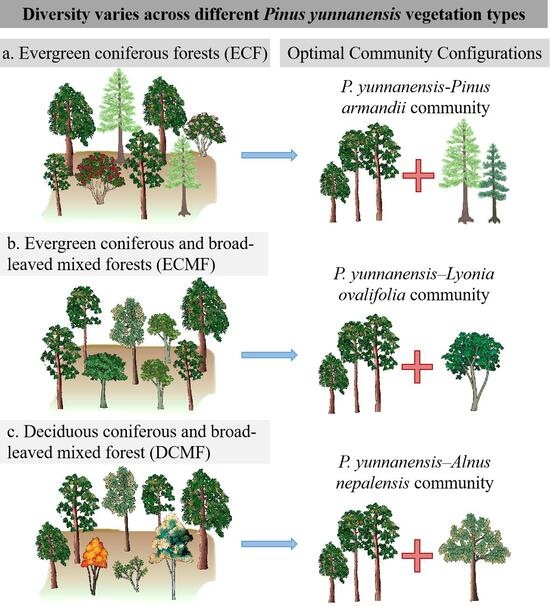
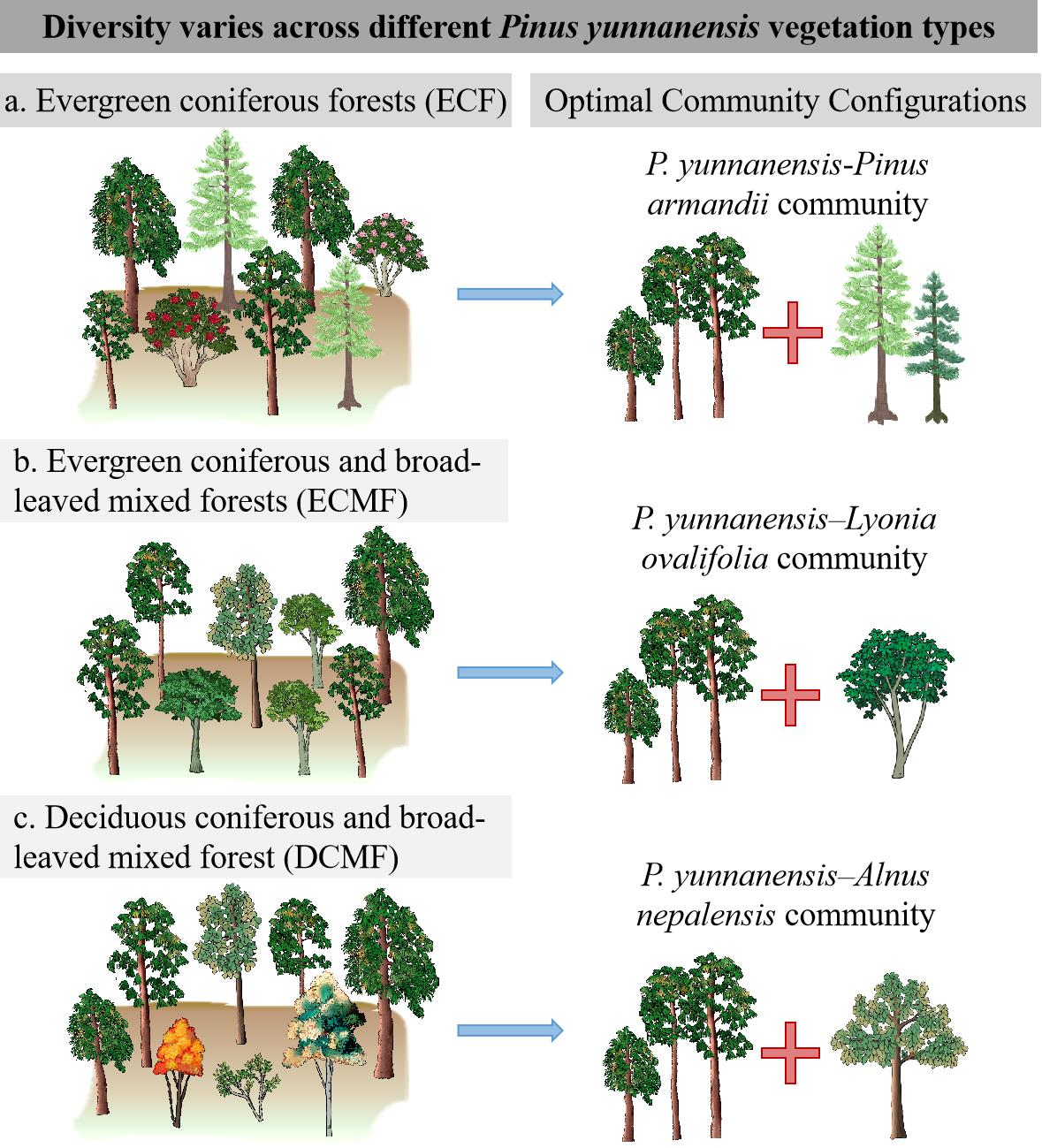
Pinus yunnanensis, an endemic tree species in southwest China, is regarded as a suitable candidate for afforestation. However, long-term disturbances have led to forest degradation and structural simplification. This study evaluated taxonomic and phylogenetic alpha (α) and beta (β) diversity across three P. yunnanensis vegetation types: evergreen coniferous forests (ECFs), evergreen coniferous and broad-leaved mixed forests (ECMFs), and deciduous and coniferous broad-leaved mixed forests (DCMFs), aiming to identify their optimal ecological configurations. A total of 120 vascular plant species from 33 families and 55 genera were recorded, with Ericaceae, Fagaceae, Pinaceae, and Adoxaceae as the co-dominant families. In the tree layer, species richness was significantly higher in DCMFs than in ECFs (p < 0.05), likely due to improved winter light availability resulting from seasonal canopy shedding. Both ECMFs and DCMFs supported significantly higher phylogenetic α diversity than ECFs, indicating a broader evolutionary history and potentially greater functional resilience. In contrast, taxonomic β diversity was lower in ECFs, suggesting a more homogeneous species composition dominated by closely related shrubs. Among the vegetation types, the P. yunnanensisPinus armandii community in ECFs showed the highest species richness and a stable microenvironment, making it particularly suitable for ecological restoration at high altitudes. Within ECMFs, the P. yunnanensisLyonia ovalifolia community appeared to be the most optimal, potentially reducing competition and promoting species coexistence through resource complementarity. In DCMFs, the P. yunnanensisAlnus nepalensis community, with its strong nitrogen-fixing capacity, emerged as the preferred configuration for restoring degraded forests at lower elevations. These findings suggest that future vegetation restoration projects centered on P. yunnanensis should adopt tailored combinations of vegetation types based on specific environmental conditions.

Graphical Abstract

1. Introduction

Pinus yunnanensis is a native tree species and a key pioneer for afforestation in southwestern China. It is primarily distributed across elevations ranging from 700 to 3000 m, covering an area exceeding 4 million hectares in both natural and plantation forests [1,2]. These ecosystems provide essential services, including timber production and biodiversity conservation [3,4]. However, extensive deforestation for timber harvesting and seeds, coupled with recurrent disturbances such as wildfires and pest outbreaks, has resulted in widespread forest degradation [1,5]. This shift toward secondary forests and monoculture plantations has triggered multifaceted degradation, characterized by biodiversity loss, productivity decline, and reduced ecosystem stability [5,6,7].
Substantial evidence indicates that P. yunnanensis monocultures are particularly vulnerable to biotic (e.g., pest infestations) and abiotic (e.g., fire) disturbances [3,6]. In contrast, mixed-species stands often exhibit stronger ecosystem multifunctionality and resilience, supported by enhanced biodiversity-ecosystem functioning (BEF) relationships that lead to greater productivity and service provision [8,9,10,11,12]. Specifically, mixed forests can achieve improved BEF outcomes, thereby boosting both productivity and ecosystem services [13]. Plantations combining P. yunnanensis with compatible species have shown potential to mitigate ecological degradation by increasing stand productivity and resilience [14,15,16]. Moreover, such mixed stands may improve disturbance resistance and promote forest recovery through complementary species interactions [11,17]. Natural forest communities generally outperform plantations in maintaining biodiversity and enhancing ecosystem services, especially those related to long-term sustainability [13]. Thus, incorporating species compositions from natural forests into restoration-oriented mixed communities could provide a theoretical foundation for addressing challenges in forest recovery [18].
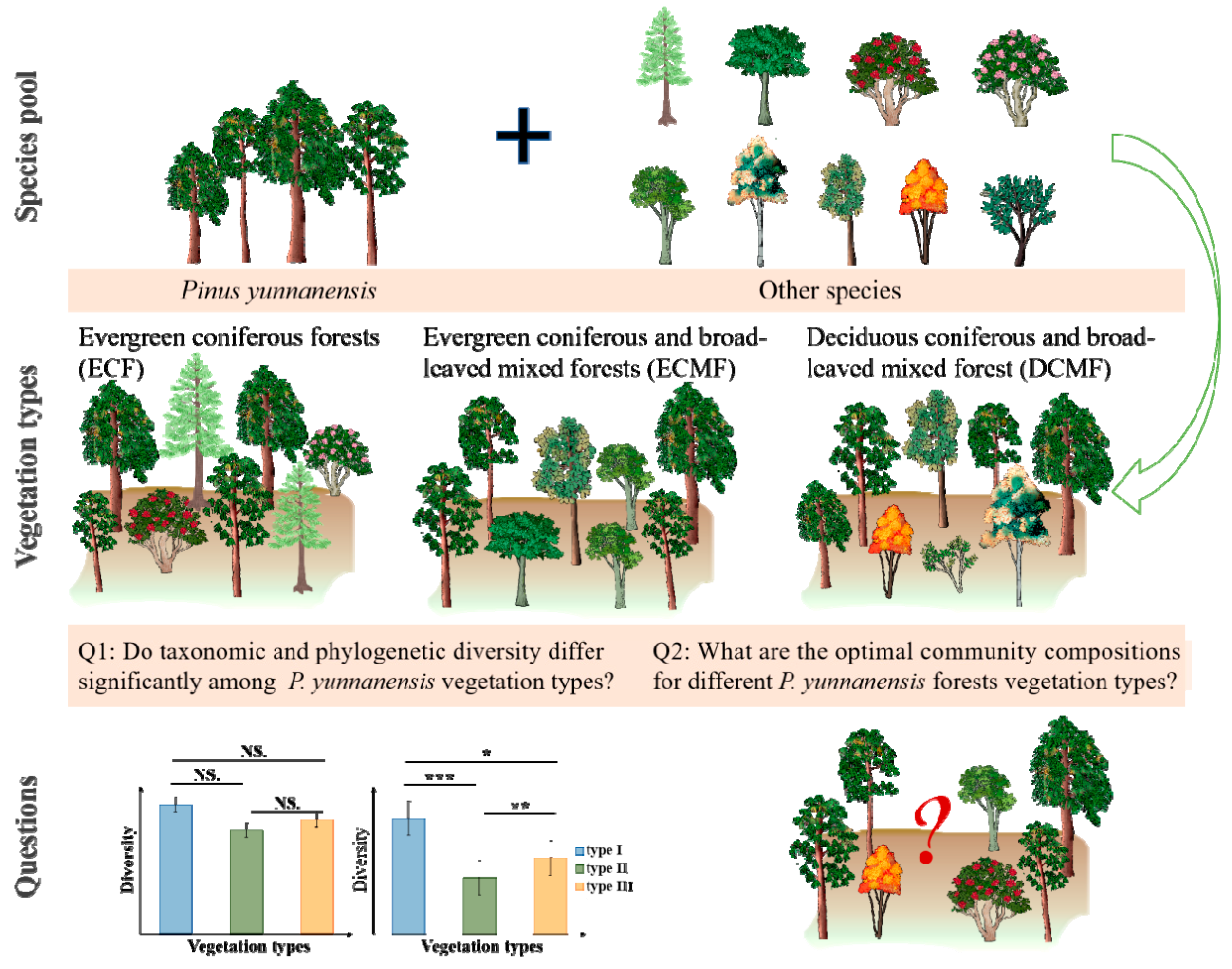
We used a combined taxonomic and phylogenetic diversity approach to explore how forest community composition and structure differ across distinct P. yunnanensis vegetation types. This study was conducted in the extensive, well-preserved natural forests of P. yunnanensis in the Yunlong Tianchi National Nature Reserve in southwestern China, which provides an ideal natural laboratory [4]. To fulfill this objective, our research addresses two key questions (Figure 1): (1) Do taxonomic and phylogenetic α and β diversity differ significantly among three P. yunnanensis vegetation types? (2) What are the optimal community compositions for different P. yunnanensis vegetation types?

2. Materials and Methods

2.1. Study Area

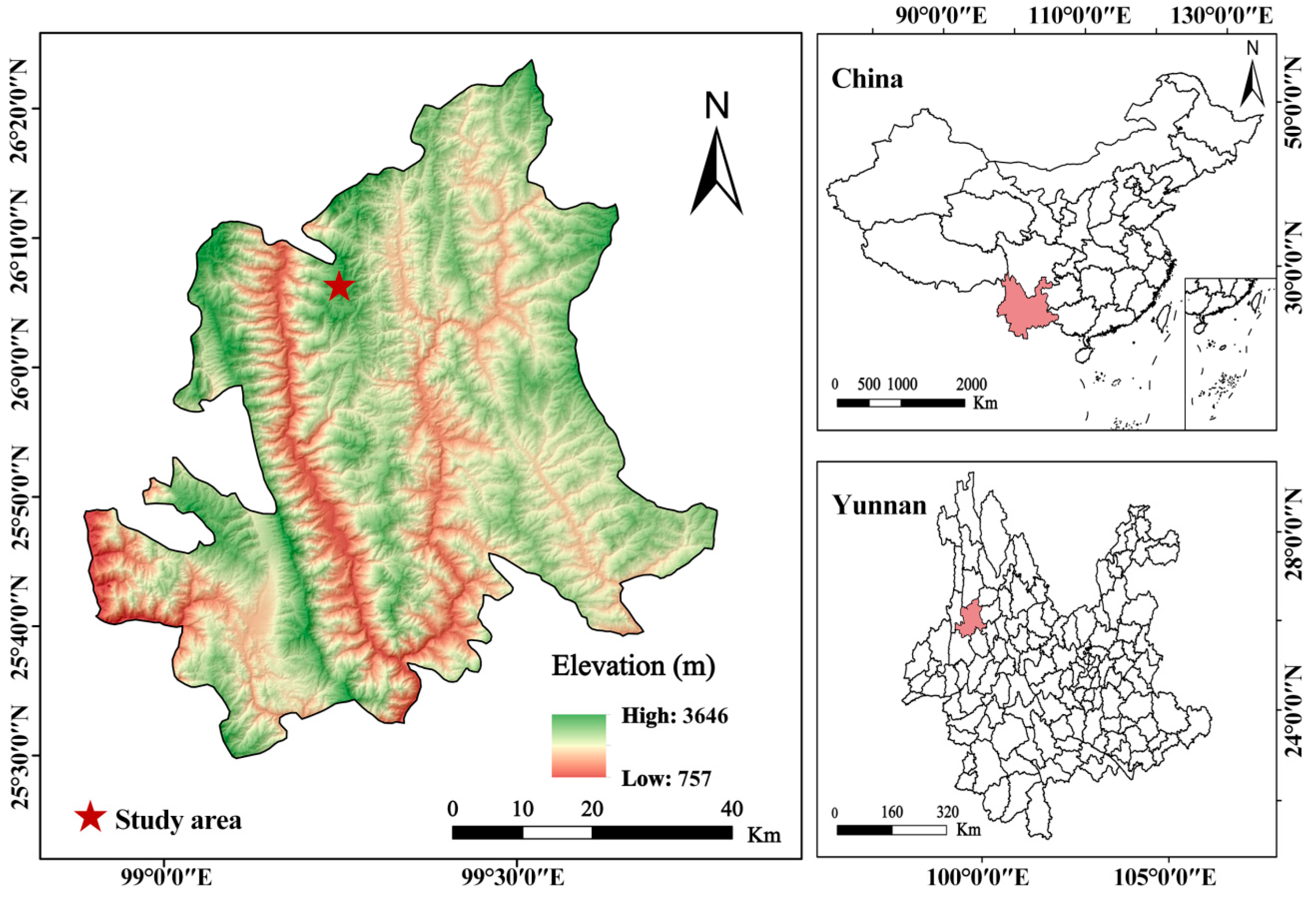
The study was located in the Yunlong Tianchi National Nature Reserve (25°49′48′′–26°14′16′′ N, 99°11′36′′–99°20′34′′ E) in Yunnan Province, China (Figure 2). This reserve lies within the Hengduan Mountain longitudinal range-valley system, with an altitude of 2100.0–3638.9 m. The average annual temperature ranges from 4.9 °C and 17.7 °C [19], and annual precipitation ranges from 750.0 to 1400.0 mm, with nearly 90% falling during the rainy season. The predominant soil types are red and brown [4]. The reserve serves as a crucial natural germplasm resource bank for P. yunnanensis, comprising 58.08% of the total tree population, covering an area of 7818.4 hectares, predominantly in the form of monocultures. This extensive pure forest coverage underscores the reserve’ significant ecological and conservation value [20].

2.2. Data Collection

The study utilized cumulative data on Pinus yunnanensis communities, sourced from successive surveys and reports of the Yunlong Tianchi National Nature Reserve published up to and including the year 2022 [20,21]. Relevant information was extracted using search terms such as ‘Yunlong Tianchi and P. yunnanensis’, ‘P. yunnanensis community’, and ‘P. yunnanensis AND community composition’ from multiple platforms, including the China National Knowledge Infrastructure (CNKI) (https://www.cnki.net/, accessed on 12 October 2024), Wanfang Data (https://wanfangdata.com.cn/, accessed on 16 October 2024), CQVIP (http://www.cqvip.com/, accessed on 20 October 2024), and Web of Science (http://apps.webofknowledge.com/, accessed on 21 October 2024). Botanical names were standardized according to the Flora of China (http://www.iplant.cn/foc/, accessed on 18 January 2026), and duplicate records were removed.
Based on relative dominance (≥50%, calculated from density, frequency, and basal area), P. yunnanensis was defined as the dominant species in the community. The eighteen P. yunnanensis communities were classified into three vegetation types based on species composition: evergreen coniferous forests (ECFs), evergreen coniferous and broad-leaved mixed forest s(ECMFs), and deciduous coniferous and broad-leaved mixed forests (DCMFs) (Table S1). These three vegetation types were distinguished according to the following criteria:
1. ECFs: Dominated by P. yunnanensis (≥50% dominance) with minimal broadleaved species (≤10% dominance).
2. ECMFs: Dominated by P. yunnanensis (≥50% dominance) with significant co-dominance from evergreen broadleaved species (e.g., Lithocarpus spp., 10–40% dominance).
3. DCMFs: Dominated by P. yunnanensis (≥50% dominance) with substantial co-dominance from deciduous broadleaved species (e.g., Quercus spp., 10–40% dominance).

2.3. Data Analysis

To address the first question, we analyzed taxonomic and phylogenetic diversities across the three vegetation types, focusing on alpha (α) and beta (β) diversity levels within the tree and shrub layers. We utilized a combination of updated, corrected, and expanded branches of spermatophyte and fern phylogeny embedded in the vascular giant tree GBOTB.extended.tre (which includes 74,533 species and all families of living vascular plants) from the package V.PhyloMaker2 version 0.1.0 to measure phylogenetic diversity (Figure S1) [22].
The taxonomic α diversity was measured by the community species richness index:
D = S
where S is the number of species.
Phylogenetic α diversity was quantified using Faith’s phylogenetic diversity (PD) index [23], which is defined as the sum of the length of the phylogenetic branches represented by a group of co-occurring species.
Taxonomic β diversity was measured by the Jaccard similarity index:
C j = c ÷ a + b c
where a and b are the number of species in each of the two samples, and c is the number of species common to the two samples.
Phylogenetic β diversity was quantified using beta. Mean Pairwise Distance (MPD). MPD measures overall phylogenetic dissimilarity by calculating the average phylogenetic distance between all species pairs across communities [24]. The formula is as follows:
M P D = 1 2 × i = 1 n a d i b ¯ + j = 1 n b d j a ¯
where min (dd) and d represent the minimum and mean branch lengths, respectively, between a species in one sample and all species in another. i (or j) denotes the focal species during traversal computation, while a (or b) indicates the total species number in community a (or b) [25]. PD and the MPD index were calculated using the R packages “picante” version 1.8.2 and “vegan” version 2.7.2 [26].
We used the normal distribution (Shapiro–Wilk tests, p > 0.05) to verify the homogeneity of variance (Levene’s test, p > 0.05). One-way ANOVA followed by least significant difference (LSD) multiple comparisons was used to assess statistically significant differences in diversity indices across vegetation types. For cases of non-homogeneous variance, the Games-Howell post hoc test was used. Finally, a raincloud plot was generated using the R package “ggplot2” version 4.0.0. All statistical data analyses were performed using R program 4.5.1 (R Core Team, Vienna, Austria).
To address the second question, the UpSet method (visualize the intersection and union relationships among multiple sets) was employed to identify the optimal recovery community compositional characteristics within each of the three vegetation types. These optimized communities are characterized by (1) higher species diversity, (2) significant species overlap with adjacent communities, and (3) distinctive species unique to each community.

3. Results

3.1. The Community Composition Characteristics of Three Vegetation Types in Pinus yunnanensis Forests

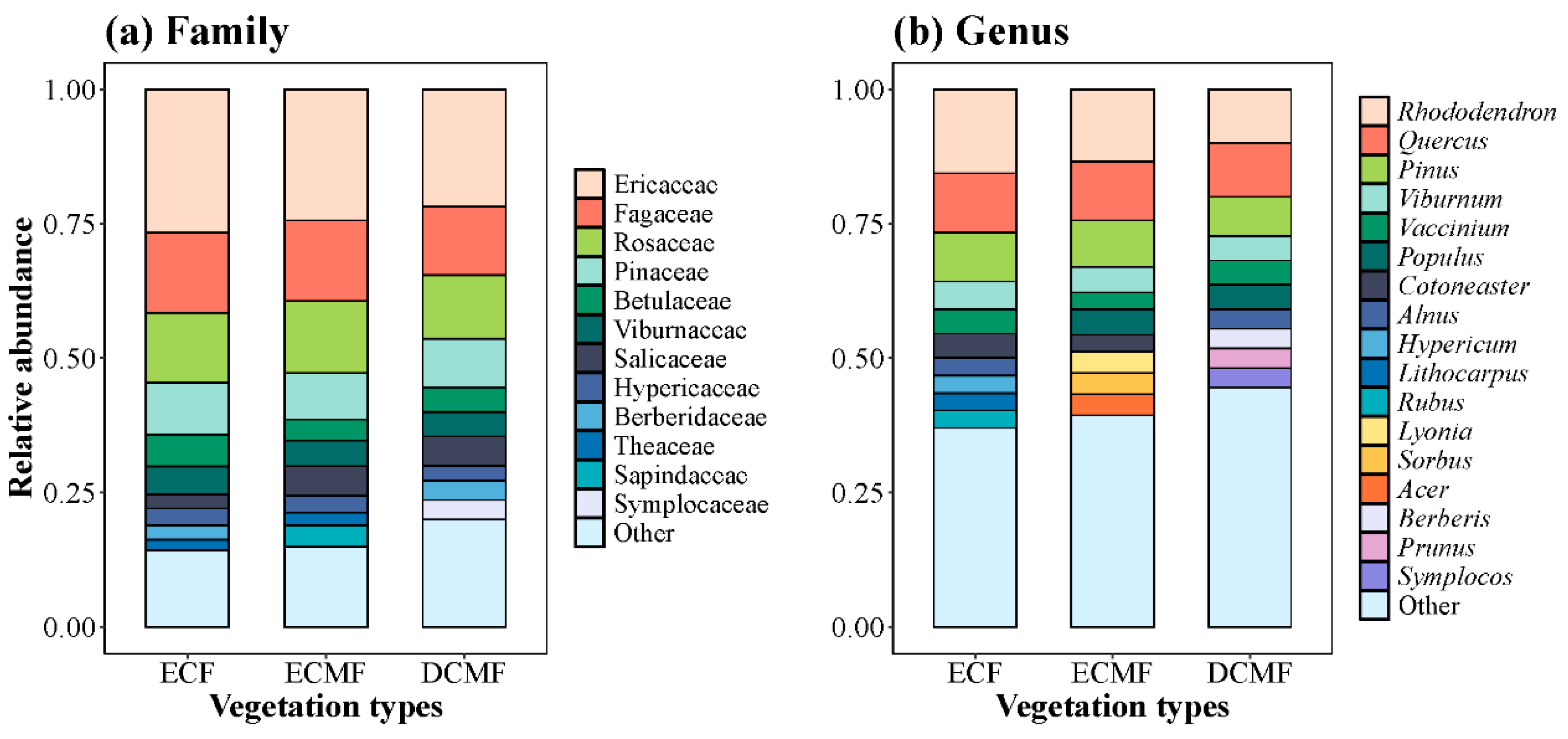
A total of 120 vascular plant species, belonging to 56 genera within 33 families, were documented across the total community (ECFs + ECMFs + DCMFs) (Tables S2 and S3). Specifically, the ECFs contained 85 species (25 families, 42 genera), the ECMFs harbored 68 species (21 families, 39 genera), and the DCMFs included 65 species (24 families, 38 genera). Among the three vegetation types, Ericaceae was the dominant family, accounting for 26.6%, 24.4%, and 21.8% of the communities, respectively (Figure 3a); Rhododendron was the dominant genus, accounting for 15.6%, 13.4%, and 10.0%, respectively (Figure 3b).

3.2. Alpha and Beta Diversity of Three Pinus yunnanensis Vegetation Types

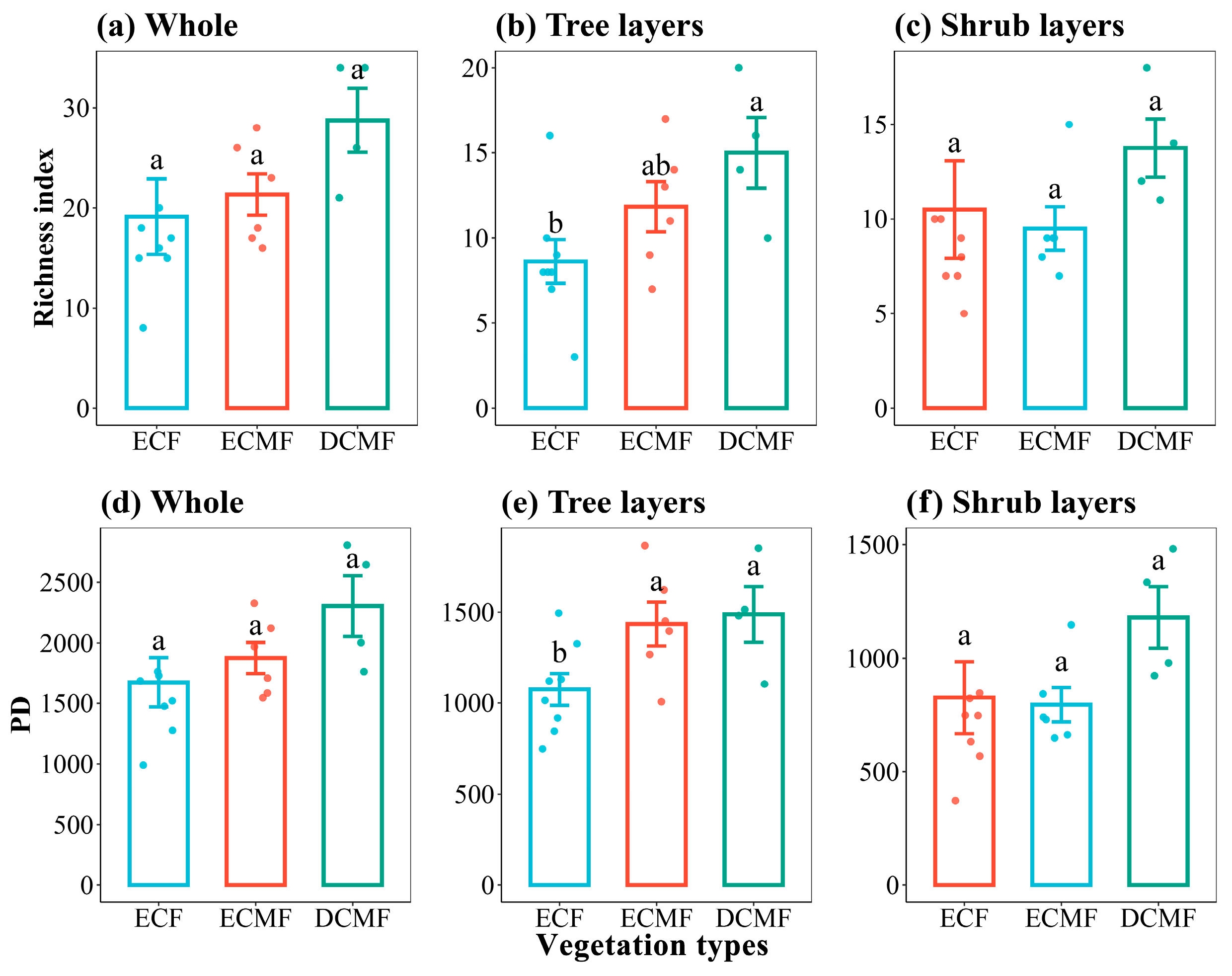
Taxonomic and phylogenetic α diversity were analyzed across three P. yunnanensis vegetation types. Specifically, no significant differences in richness index were observed among the three vegetation types in the whole community (encompassing both the tree and shrub layers) and the shrub layer (p > 0.05) (Figure 4a,c). In contrast, in the tree layer, the DCMFs exhibited a significantly greater richness index compared to the ECFs (p < 0.05) (Figure 4b). Regarding PD, no significant differences were detected among the three vegetation types in the whole community and shrub layer (p > 0.05) (Figure 4d,f). However, in the tree layer, both ECMFs and DCMFs had significantly higher PD than the ECFs (p < 0.05) (Figure 4e).
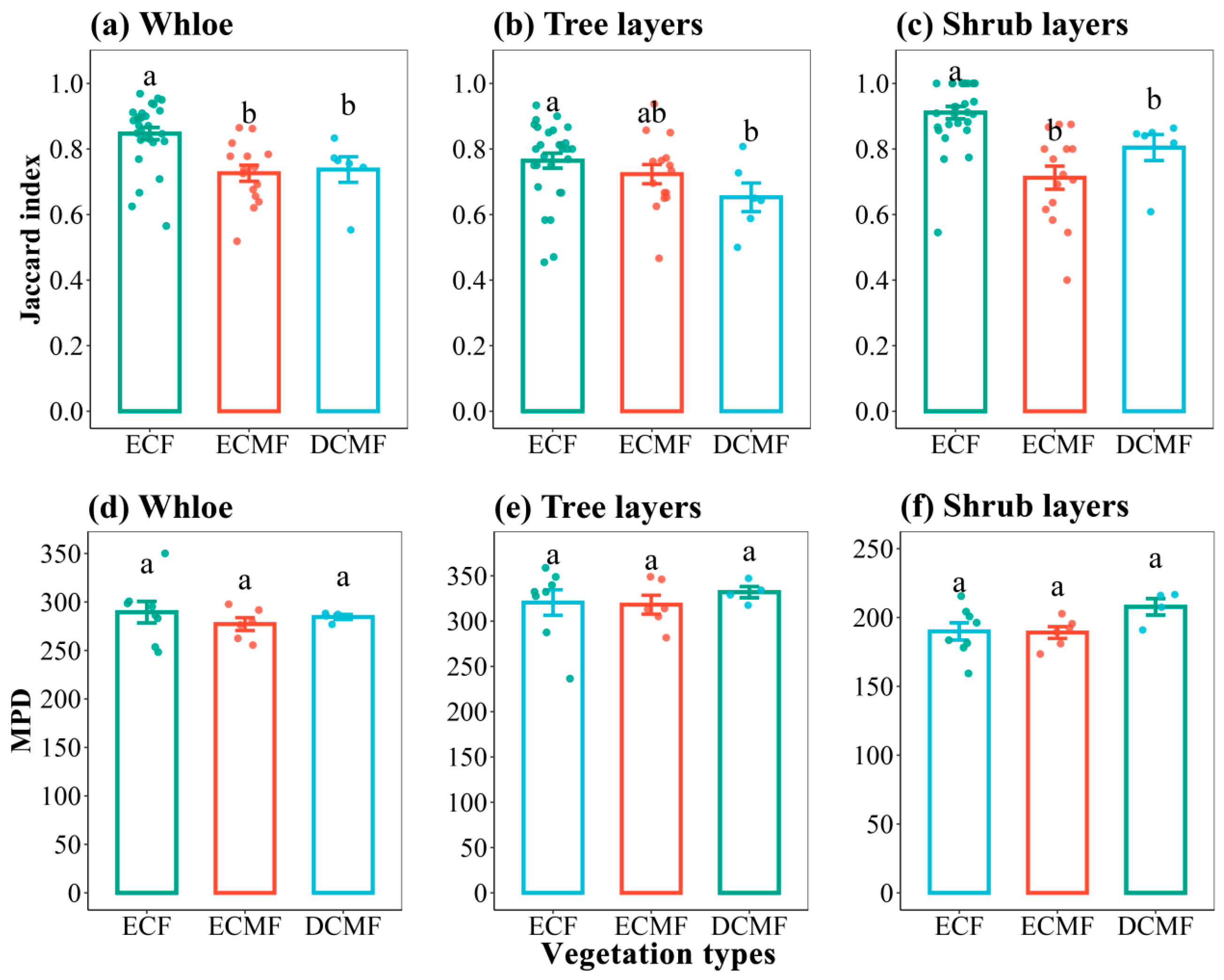
We further examined the taxonomic and phylogenetic β diversity across different vegetation types of P. yunnanensis. In the whole community and the shrub layer, the Jaccard index of ECFs was significantly higher than that of the ECMFs and DCMFs (p < 0.05) (Figure 5a,c). In the tree layer, the ECFs also exhibited a significantly higher Jaccard index compared to the DCMFs (p < 0.05) (Figure 5b). However, no significant differences in the MPD index were detected among the three vegetation types in the whole community, tree layer, and shrub layer (p > 0.05) (Figure 5d–f).

3.3. Optimal Community Configurations in Three Pinus yunnanensis Vegetation Types

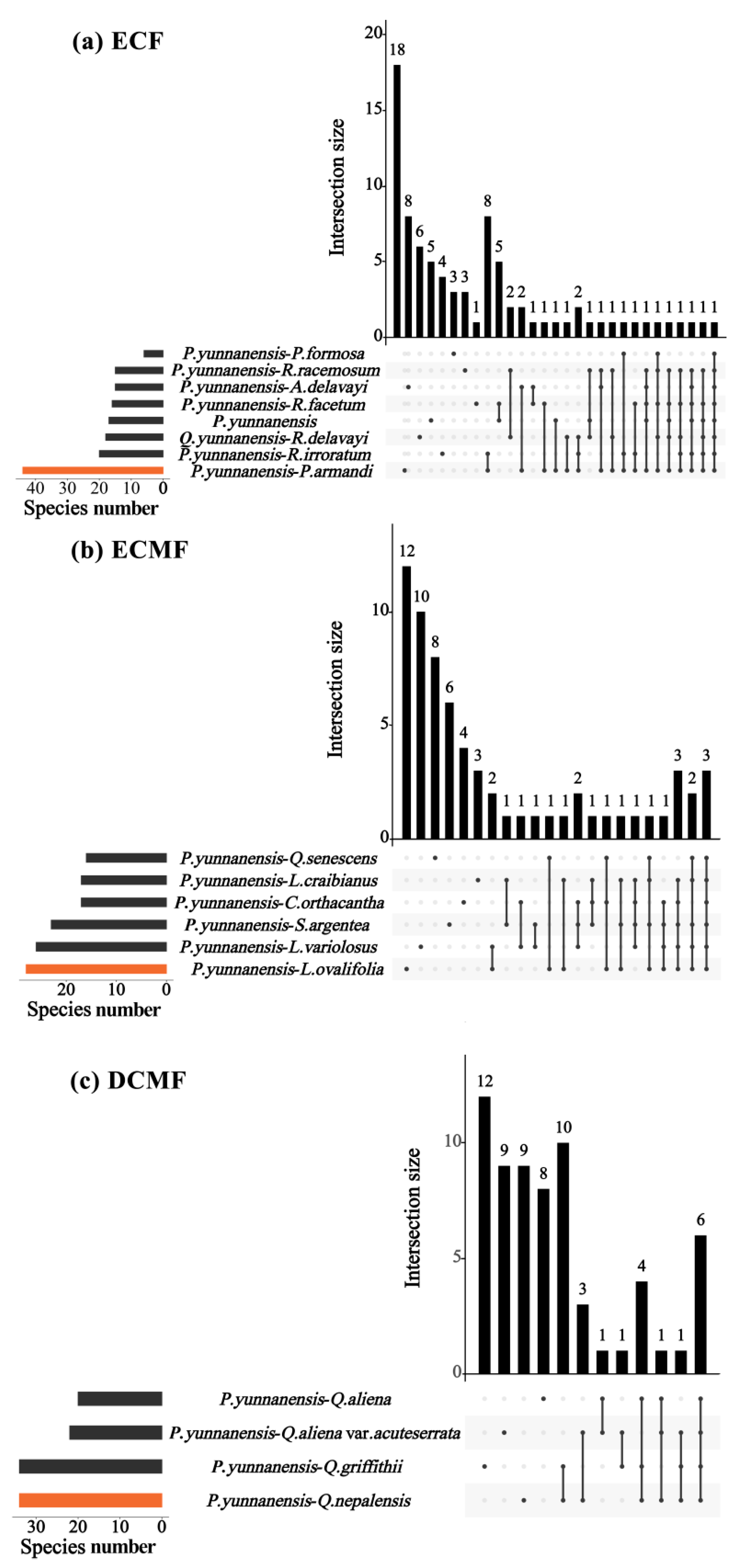
Based on the Venn diagram, we conducted a comparative analysis of species composition across three P. yunnanensis vegetation types. The results indicated that in the ECFs, P. yunnanensis was the sole common species among the eight communities, with a relatively high proportion of unique species. Specifically, the P. yunnanensisPinus armandii community showed both the highest species number and the most extensive species overlap with other communities. This suggests that it could serve as an optimal reference community for ECF restoration (Figure 6a). This community is primarily composed of shade-tolerant species, such as those from the genera Lyonia, Viburnum, and Lonicera (Table 1). In the ECMFs, the six communities shared three core species (P. yunnanensis, Viburnum cylindricum, and Quercus griffithii) while maintaining comparable species number levels. Among them, the P. yunnanensisLyonia ovalifolia community had relatively high species intersections with other communities. Consequently, these communities are considered potential optimal configurations for ECMFs (Figure 6b) and are predominantly composed of evergreen species, such as those from the genera Quercus, Daphne papyracea, and Vaccinium mandarinorum (Table 1). In the DCMFs, the four communities shared six common species (P. yunnanensis, P. armandii, Alnus nepalensis, V. cylindricum, Q. griffithii, and Populus adenopoda). Notably, the P. yunnanensisA. nepalensis community showed relatively high species overlaps with other communities. Thus, these communities represent candidates for potential optimal configurations for the DCMFs (Figure 6c). Their composition is predominantly deciduous species, including species from the genus Quercus, Rosaceae, and Ericaceae families (Table 1).

4. Discussion

In this study, we utilized an integrated taxonomic and phylogenetic framework to analyze species diversity and community structure across three P. yunnanensis vegetation types within a well-preserved nature reserve. A total of 120 species from 33 families and 55 genera were recorded. Among the three vegetation types, Rhododendron, Quercus, Pinus, and Viburnum, as co-dominant genera, contribute to community stability through various ecological interaction mechanisms. For instance, Ward [27] demonstrated that enhanced symbiosis between ericoid mycorrhizal (ErM) shrubs, such as Ericaceae species, and arbuscular mycorrhizal (AM) trees, including Quercus (Fagaceae) and V. foetidum (Viburnum), can suppress microbial activity and increase the accumulation of particulate organic matter in the topsoil, thereby influencing carbon and nitrogen stocks in forest soils. Additionally, pine and oak species exhibit complementary responses to drought and fire, such as through stratified utilization of soil water [28]. Besides these shared dominant genera, each vegetation type displayed distinct genus-level characteristics: ECFs were characterized by shade-tolerant species like Cotoneaster and Rubus; ECMFs showed relatively higher richness of genera such as Acer and Lyonia; while DCMFs contained a high proportion of deciduous species like Alnus and Berberis. These dominant families and genera thus played an irreplaceable role in maintaining the structure and function of P. yunnanensis communities.
This study reveals notable differences in both taxonomic and phylogenetic α diversity among P. yunnanensis communities (Figure 4). In the tree layer, species richness was significantly higher in DCMFs than in ECFs (p < 0.05); this is likely due to seasonal canopy shedding that enhances winter light availability and spring soil moisture [29,30], creating favorable conditions for understory plant diversity [31]. And by diverse litter inputs that accelerate decomposition and nutrient cycling compared to pure coniferous stands [32,33,34]. Furthermore, deciduous canopies promote greater spatial heterogeneity and understory species survival compared to evergreen canopies [35]. Importantly, PD was also significantly higher in ECMFs and DCMFs than in ECFs (p < 0.05), indicating a broader representation of evolutionary lineages and potentially greater functional trait variation in mixed forests [36,37]. This aligns with growing evidence that PD provides unique insights into community assembly and evolutionary dimensions of community assembly not fully reflected by species richness alone [38,39,40]. Thus, the elevated PD observed here may reflect not only greater biodiversity but also enhanced functional redundancy and adaptive capacity in mixed P. yunnanensis forests, supporting the link between phylogenetic diversity and long-term ecosystem stability [38,41,42,43]. The lack of significant differences in species richness and PD across the whole community and shrub layer suggests a degree of functional and taxonomic convergence at the understory level, potentially driven by similar micro-environmental filters or biotic interactions beneath the canopy. However, we note that the relationship between PD and ecosystem function is context-dependent [44], underscoring the importance of integrating both taxonomic and phylogenetic perspectives to fully understand diversity-function relationships across different forest types [45].
In terms of β diversity, the Jaccard index was significantly higher in ECFs than in ECMFs and DCMFs (Figure 5), indicating greater compositional homogeneity among the ECF community. The ECF community, particularly in the shrub layer, is strongly dominated by closely related Rhododendron species. In contrast, both ECMFs and DCMFs encompass a broader mix of evergreen and deciduous woody species. These additional species often belong to more distantly related lineages, introducing greater diversity into the community [36,37], it also reduces the potential for species substitution across different plots [46]. Furthermore, the dense canopy in ECMFs and DCMFs strongly limits light penetration, intensifying competition and driving pronounced niche differentiation [31,47,48]. In contrast, the non-significant differences in phylogenetic β diversity across all vegetation types (Figure 5) suggest that despite taxonomic differences, the average evolutionary relatedness between species within local communities is similar. This may indicate that a consistent, deep phylogenetic filter (e.g., related to regional flora or broad climatic tolerances) operates across the landscape, while finer-scale taxonomic composition is shaped by more recent ecological and stochastic processes.
P. yunnanensis forests are often favored for their high productivity and low management costs, yet their simplified composition can lead to survival challenges and ecological degradation [16,49]. Numerous studies have demonstrated that a high level of community diversity can enhance the functionality and services of ecosystems [13,14,40]. In this study, we used UpSet plots to identify optimal community configurations for the three main P. yunnanensis vegetation types, each exhibiting distinct ecological advantages. Specifically, within ECFs, the P. yunnanensisP. armandii community was identified as optimal due to its high species richness. Both P. yunnanensis and P. armandii are highly adaptable species, and their presence may enhance the community’s resilience to environmental changes [50,51]. The abundant fruit and seed resources provided by pines attract various birds and rodents, indirectly facilitating seed dispersal and regeneration of other plants—a key process for maintaining forest health [52]. P. armandii is typically distributed at higher elevations and in harsh high-altitude environments; combining P. yunnanensis with P. armandii and shade-tolerant shrubs such as Lyonia, Viburnum, and Lonicera can improve ecosystem stability and resilience during restoration efforts. For the ECMFs, the optimal configuration was the P. yunnanensisLyonia ovalifolia community. As a dominant tree, P. yunnanensis may exhibit complementary resource use with understory species like L. ovalifolia and L. variolosus in terms of light, water, and nutrients, thereby reducing interspecific competition and promoting coexistence. When combined with evergreen species such as Quercus, D. papyracea, and V. mandarinorum, this community type may aid the recovery of functionally unstable or disturbed P. yunnanensis forests. The DCMF configuration, the P. yunnanensisA. nepalensis community, was considered optimal due to its relatively high species intersection with other communities, particularly in low-altitude and relatively mild environments. Deciduous groups (e.g., Quercus, Rosaceae, and Ericaceae) enhance diversity through niche differentiation (e.g., vertical root stratification) and seasonal resource partitioning [29]. Moreover, the nitrogen-fixing capacity of A. nepalensis likely supplies substantial nitrogen to co-occurring species [53], which is vital for ecosystem nutrient cycling and productivity. In summary, identifying optimal community configurations across different P. yunnanensis vegetation types is essential for forest management and biodiversity conservation. These findings not only aid in optimizing forest structure and enhancing ecosystem services but also provide a scientific basis for future ecological restoration and conservation initiatives. Further research should focus on elucidating the ecological mechanisms and long-term dynamics associated with these optimal community assemblages. However, our inferences about assembly processes are indirect, based on diversity patterns. Future work incorporating null model analyses of phylogenetic and functional trait structure would more directly test these mechanisms. Additionally, our study is spatially confined to one reserve. Replicating this approach across the wider distribution of P. yunnanensis forests would test the generality of these optimal configurations and help disentangle the effects of local environment versus historical contingency.

5. Conclusions

In response to rising demands for forest products and ecosystem services [16], the trend of expanding forest cover is particularly pronounced in developing nations [54]. Research suggests that the ecological advantages of restoring natural forests surpass those obtained through intensive, large-scale afforestation. Restoration efforts yield superior conservation, restoration, and application values, emphasizing the importance of natural forest ecosystems [13]. This study systematically elucidates the community diversity patterns and optimal configuration schemes of three vegetation types in P. yunnanensis natural forests. The findings indicate that distinct vegetation types maintain community stability through unique species combinations and functional complementarity, holding significant implications for ecosystem services and forest restoration. Conducted in a biodiversity hotspot region, our analysis highlights integrated taxonomic and phylogenetic diversity in species selection for mixed forest. By integrating these dimensions of diversity, the study proposes a comprehensive afforestation strategy that emphasizes ecological balance, biodiversity conservation, and the development of resilient forest ecosystems.

Supplementary Materials

The following supporting information can be downloaded at: https://www.mdpi.com/article/10.3390/d18020107/s1, Table S1. Community composition across three Pinus yunnanensis vegetation types; Table S2. Species composition of the tree layer across three Pinus yunnanensis vegetation types; Table S3. Species composition of the shrub layer across three Pinus yunnanensis vegetation types; Figure S1. Phylogenetic tree of tree layers and shrub layers across three Pinus yunnanensis vegetation types. (a) is a phylogenetic tree of species in the tree layer and (b) is a phylogenetic tree of species in the shrub layer.

Author Contributions

Conceptualization, W.L. and C.Z.; methodology, W.L. and J.W.; formal analysis, W.L. and J.W.; investigation, M.C. and P.L.; data curation, W.L.; writing—original draft preparation, W.L. and J.W.; writing—review and editing, J.W. and C.Z.; visualization, J.W.; supervision, J.W.; project administration, C.Z. All authors have read and agreed to the published version of the manuscript.

Funding

This study was funded by the National Natural Science Foundation of China (Grant/Award Number: 32160268).

Institutional Review Board Statement

Not applicable.

Data Availability Statement

The original contributions presented in this study are included in the article/Supplementary Materials. Further inquiries can be directed to the corresponding author.

Conflicts of Interest

The authors declare no conflicts of interest.

Abbreviations

The following abbreviations are used in this manuscript:
ECFsEvergreen coniferous forests
ECMFsEvergreen coniferous and broad-leaved mixed forests
DCMFsDeciduous and coniferous broad-leaved mixed forests
α diversityalpha diversity
β diversitybeta diversity
PDPhylogenetic diversity
MPDMean Pairwise Distance
BEFBiodiversity-ecosystem functioning
ErMEricoid mycorrhizal
AMArbuscular mycorrhizal

References

  1. Jin, Z.Z.; Peng, J. Pinus yunnanensis; Yunnan Science and Technology Press: Kunming, China, 2004; ISBN 7541619566. [Google Scholar]
  2. Xu, Y.L.; Woeste, K.; Cai, N.H.; Kang, X.Y.; Li, G.Q.; Chen, S.; Duah, A. Variation in needle and cone traits in natural populations of Pinus yunnanensis. J. For. Res. 2016, 27, 41–49. [Google Scholar] [CrossRef]
  3. Liang, C.; Liu, L.; Zhang, Z.X.; Ze, S.Z.; Ji, M.; Li, Z.B.; Yu, J.D.; Yang, B.; Zhao, N. Do mixed Pinus yunnanensis plantations improve soil’s physicochemical properties and enzyme activities? Diversity 2022, 14, 214. [Google Scholar] [CrossRef]
  4. Tang, C.Q.; Shen, L.Q.; Han, P.B.; Huang, D.S.; Li, S.F.; Li, Y.F.; Song, K.; Zhang, Z.Y.; Yin, L.Y.; Yin, R.H.; et al. Forest characteristics, population structure and growth trends of Pinus yunnanensis in Tianchi National Nature Reserve of Yunnan, southwestern China. Veg. Classif. Surv. 2020, 1, 7–20. [Google Scholar] [CrossRef]
  5. Su, W.H.; Si, H.M.; Zhang, H.H.; Zhang, G.F.; Zhou, R.; Guo, X.R.; Yang, Q. Comparison of fire adaptation traits among four common pine species in southwest China. Acta Ecol. Sin. 2023, 43, 1064–1072. [Google Scholar] [CrossRef]
  6. Huang, X.B. Stoichiometry of Pinus yunnanensis Natural Secondary Fores. In Doctor of Science; Chinese Academy of Forestry: Beijing, China, 2017. [Google Scholar]
  7. Huang, X.B.; Li, S.F.; Su, J.R.; Liu, W.D.; Lang, X.D. The relationship between species richness and ecosystem multifunctionality in the Pinus yunnanensis natural secondary forest. Biodivers. Sci. 2017, 25, 1182–1191. [Google Scholar] [CrossRef]
  8. Cavender-Bares, J.; Kozak, K.H.; Fine, P.V.; Kembel, S.W. The merging of community ecology and phylogenetic biology. Ecol. Lett. 2009, 12, 693–715. [Google Scholar] [CrossRef] [PubMed]
  9. DelRío, M.; Löf, M.; Bravo-Oviedo, A.; Jactel, H. Understanding the complexity of mixed forest functioning and management: Advances and perspectives. For. Ecol. Manag. 2021, 489, 119138. [Google Scholar] [CrossRef]
  10. Dedrick, S.; Spiecker, H.; Orazio, C.; Tome, M.; Martinez de Arano, I. Plantation or Conversion—The Debate! EFI Discussion Paper No. 13; European Forest Institute: Joensuu, Finland, 2007; ISBN 9789535453164. [Google Scholar]
  11. Jactel, H.; Brockerhoff, E.G. Tree diversity reduces herbivory by forest insects. Ecol. Lett. 2007, 10, 835–848. [Google Scholar] [CrossRef] [PubMed]
  12. Feng, Y.H.; Schmid, B.; Loreau, M.; Forrester, D.I.; Fei, S.; Zhu, J.X.; Tang, Z.Y.; Zhu, J.L.; Hong, P.B.; Ji, C.J.; et al. Multispecies forest plantations outyield monocultures across a broad range of conditions. Science 2022, 376, 865–868. [Google Scholar] [CrossRef] [PubMed]
  13. Liang, J.J.; Crowther, T.W.; Picard, N.; Wiser, S.; Zhou, M.; Alberti, G.; Schulze, E.-D.; McGuire, A.D.; Bozzato, F.; Pretzsch, H.; et al. Positive biodiversity-productivity relationship predominant in global forests. Science 2016, 354, aaf8957. [Google Scholar] [CrossRef] [PubMed]
  14. Omidipour, R.; Tahmasebi, P.; Faizabadi, M.F.; Faramarzi, M.; Ebrahimi, A. Does β diversity predict ecosystem productivity better than species diversity? Ecol. Indic. 2021, 122, 107212. [Google Scholar] [CrossRef]
  15. Hua, F.Y.; Bruijnzeel, L.A.; Meli, P.; Martin, P.A.; Zhang, J.; Nakagawa, S.; Miao, X.R.; Wang, W.Y.; McEvoy, C.; Peña-Arancibia, J.L.; et al. The biodiversity and ecosystem service contributions and trade-offs of forest restoration approaches. Science 2022, 376, 839–844. [Google Scholar] [CrossRef] [PubMed]
  16. Aerts, R.; Honnay, O. Forest restoration, biodiversity and ecosystem functioning. BMC Ecol. 2011, 11, 29. [Google Scholar] [CrossRef] [PubMed]
  17. Zhu, H.L.; Zhang, J.L.; Cheuk, M.L.; Hau, B.C.H.; Fischer, G.A.; Gale, S.W. Monoculture plantations impede forest recovery: Evidence from the regeneration of lowland subtropical forest in Hong Kong. Front. For. Glob. Change 2023, 6, 1098666. [Google Scholar] [CrossRef]
  18. Liu, C.L.C.; Kuchma, O.; Krutovsky, K.V. Mixed-species versus monocultures in plantation forestry: Development, benefits, ecosystem services and perspectives for the future. Glob. Ecol. Conserv. 2018, 15, e00419. [Google Scholar] [CrossRef]
  19. Rothe, A.; Binkley, D. Nutritional interactions in mixed species forests: A synthesis. Can. J. For. Res. 2001, 31, 1855–1870. [Google Scholar] [CrossRef]
  20. Wang, Y.; Shangguan, Z.P. Formation mechanisms and remediation techniques for low-efficiency artificial shelter forests on the Chinese Loess Plateau. J. Arid Land 2022, 14, 837–848. [Google Scholar] [CrossRef]
  21. Zhang, J.T.; Pan, Z.L.; Tian, Y.H.; Hou, J.L.; Peng, M.C.; Duan, H.X.; Li, Y.F.; Li, Y.P. Age structure and dynamics of Pinus yunnanensis population in Yunlong Tianchi Nature Reserve. Acta Ecol. Sin. 2022, 42, 9091–9099. [Google Scholar] [CrossRef]
  22. Zhang, S.X.; Dong, L.B. Report on the Comprehensive Scientific Investigation of Yunnan Yunlong Tianchi National Nature Reserve; Yunnan Science and Technology Press: Kunming, China, 2022; ISBN 9787558747618. [Google Scholar]
  23. Hua, C.L. Yunnan Yunlong Tianchi National Nature Reserve; Yunnan Science and Technology Press: Kunming, China, 2013; pp. 70–76. ISBN 9787541673405. [Google Scholar]
  24. Jin, Y.; Qian, H.V. PhyloMaker2: An updated and enlarged R package that can generate very large phylogenies for vascular plants. Plant Divers. 2022, 44, 335–339. [Google Scholar] [CrossRef] [PubMed]
  25. Faith, D.P. Conservation evaluation and phylogenetic diversity. Biol. Conserv. 1992, 61, 1–10. [Google Scholar] [CrossRef]
  26. Webb, C.O.; Ackerly, D.D.; Kembel, S.W. Phylocom: Software for the analysis of phylogenetic community structure and trait evolution. Bioinformatics 2008, 24, 2098–2100. [Google Scholar] [CrossRef] [PubMed]
  27. Xu, L.; Liu, M.X.; Mu, R.L.; Zhang, G.J.; Yu, R.X.; Li, L. Phylogenetic structure and diversity pattern of plant community in alpine meadow. China Environ. Sci. 2021, 41, 1387–1397. [Google Scholar] [CrossRef]
  28. Yue, J.; Li, R. Phylogenetic relatedness of woody angiosperm assemblages and its environmental determinants along a subtropical elevational gradient in China. Plant Divers. 2020, 43, 111–116. [Google Scholar] [CrossRef] [PubMed]
  29. Ward, E.B.; Polussa, A.; Bradford, M.A. Depth-dependent effects of ericoid mycorrhizal shrubs on soil carbon and nitrogen pools are accentuated under arbuscular mycorrhizal trees. Glob. Change Biol. 2023, 29, 5924–5940. [Google Scholar] [CrossRef] [PubMed]
  30. Bello, J.; Hasselquist, N.J.; Vallet, P.; Kahmen, A.; Perot, T.; Korboulewsky, N. Complementary water uptake depth of Quercus petraea and Pinus sylvestris in mixed stands during an extreme drought. Plant Soil 2019, 437, 93–115. [Google Scholar] [CrossRef]
  31. Simonin, K.; Kolb, T.E.; Montes-Helu, M.; Koch, G.W. The influence of thinning on components of stand water balance in a ponderosa pine forest stand during and after extreme drought. Agric. For. Meteorol. 2007, 143, 266–276. [Google Scholar] [CrossRef]
  32. Kang, X.R.; Li, X.G.; Zhang, H.D.; Liu, X.Q.; Chen, G.C. Community stability characteristics of Cunninghamia lanceolata plantations under different mixed measures. Chin. J. Ecol. 2020, 39, 2912–2920. [Google Scholar] [CrossRef]
  33. Mestre, L.; Toro Manríquez, M.; Soler, R.; Huertas Herrera, A.; Martínez Pastur, G.J.; Lencinas, M. The influence of canopy-layer composition on understory plant diversity in southern temperate forests. For. Ecosyst. 2017, 4, 6. [Google Scholar] [CrossRef]
  34. Huo, H.; Feng, Q.; Su, Y.H. The influences of canopy species and topographic variables on understory species diversity and composition in coniferous forests. Sci. World J. 2014, 2014, 252489. [Google Scholar] [CrossRef] [PubMed]
  35. Tian, X.J.; Takeda, H. Decomposition process of leaf litter in a coniferous forest. In Environmental Forest Science; Springer: Berlin/Heidelberg, Germany, 1998; Volume 54, pp. 223–230. [Google Scholar] [CrossRef]
  36. Růžek, M.; Tahovská, K.; Guggenberger, G.; Oulehle, F. Litter decomposition in European coniferous and broadleaf forests under experimentally elevated acidity and nitrogen addition. Plant Soil 2021, 463, 471–485. [Google Scholar] [CrossRef]
  37. Denny, C.K.; Nielsen, S.E. Spatial heterogeneity of the forest canopy scales with the heterogeneity of an understory shrub based on fractal analysis. Forests 2017, 8, 146. [Google Scholar] [CrossRef]
  38. Cai, N.H.; Li, G.Q.; Lu, Y.C. Discuss on the approaching-nature forestry management of Pinus yunnanensis pure forests. J. Northeast For. Univ. 2006, 21, 85–88+120. [Google Scholar]
  39. Zavaleta, E.S.; Pasari, J.R.; Hulvey, K.B.; Tilman, G.D. Sustaining multiple ecosystem functions in grassland communities requires higher biodiversity. Proc. Natl. Acad. Sci. USA 2010, 107, 1443–1446. [Google Scholar] [CrossRef] [PubMed]
  40. Ernst, A.R.; Barak, R.S.; Hipp, A.L.; Kramer, A.T.; Marx, H.E.; Larkin, D.J. The invasion paradox dissolves when using phylogenetic and temporal perspectives. J. Ecol. 2021, 110, 443–456. [Google Scholar] [CrossRef]
  41. Swenson, N.G.; Erickson, D.L.; Mi, X.C.; Bourg, N.A.; Forero-Montaña, J.; Ge, X.J.; Howe, R.; Lake, J.K.; Liu, X.; Ma, K.; et al. Phylogenetic and functional alpha and beta diversity in temperate and tropical tree communities. Ecology 2012, 93, S112––S125. [Google Scholar] [CrossRef]
  42. Tilman, D.; Isbell, F.; Cowles, J.M. Biodiversity and Ecosystem Functioning. Annu. Rev. Ecol. Evol. Syst. 2014, 45, 471–493. [Google Scholar] [CrossRef]
  43. Li, Z.Y.; Ye, X.Z.; Wang, S.P. Ecosystem stability and its relationship with biodiversity. Chin. J. Plant Ecol. 2021, 45, 1127–1139. [Google Scholar] [CrossRef]
  44. Cadotte, M.W.; Dinnage, R.; Tilman, D. Phylogenetic diversity promotes ecosystem stability. Ecology 2012, 93, S223–S233. [Google Scholar] [CrossRef]
  45. Venail, P.; Gross, K.; Oakley, T.H.; Narwani, A.; Allan, E.; Flombaum, P.; Isbell, F.; Joshi, J.; Peter, B.R.; Tilman, D.; et al. Species richness, but not phylogenetic diversity, influences community biomass production and temporal stability in a re-examination of 16 grassland biodiversity studies. Funct. Ecol. 2015, 29, 615–626. [Google Scholar] [CrossRef]
  46. Pompa-García, M.; Camarero, J.J.; Valeriano, C.; Vivar-Vivar, E.D. Variable growth responses of four tree species to climate and drought in a Madrean pine-oak forest. For. Ecosyst. 2025, 12, 2197–5620. [Google Scholar] [CrossRef]
  47. Feng, Y.; Comes, H.P.; Qiu, Y.X. Phylogenomic insights into the temporalspatial divergence history, evolution of leaf habit and hybridization in Stachyurus (Stachyuraceae). Mol. Phylogenet. Evol. 2020, 150, 106878. [Google Scholar] [CrossRef] [PubMed]
  48. Webb, C.O. Exploring the phylogenetic structure of ecological communities: An example for rain forest trees. Am. Nat. 2000, 156, 145–155. [Google Scholar] [CrossRef] [PubMed]
  49. Xu, Y.Z.; Liu, J.M.; Wan, D.; Liu, M.T.; Jiang, M.X. Effects of canopy structure and topography on seedling species diversity in an evergreen and deciduous broad-leaved mixed forest. Plant Sci. J. 2020, 38, 733–742. [Google Scholar] [CrossRef]
  50. Wang, Y.Q.; Cai, Y.R.; Zeng, H.C.; Xu, M.F.; Su, Z.Y. Composition and diversity of understory plant species in sub-tropical forests under different canopy openness. J. Northwest A F Univ. Nat. Sci. Ed. 2016, 44, 64–72. [Google Scholar]
  51. Kelty, M.J. The role of species mixtures in plantation forestry. For. Ecol. Manag. 2006, 233, 195–204. [Google Scholar] [CrossRef]
  52. Vander Wall, S.B. Seed Dispersal in Pines (Pinus). Bot. Rev. 2023, 89, 275–307. [Google Scholar] [CrossRef]
  53. He, B.; Li, Q.; Liu, Y. Community Characteristics and Species Diversity of Pinus armandii in Caohai National Nature Reserve. CA JST 2020, 28, 44–52. [Google Scholar] [CrossRef]
  54. Brockerhoff, E.G.; Jactel, H.; Parrotta, J.A.; Ferraz, S.F. Role of eucalypt and other planted forests in biodiversity conservation and the provision of biodiversity-related ecosystem services. For. Ecol. Manag. 2013, 301, 43–50. [Google Scholar] [CrossRef]
Figure 1. Conceptual hypothesis diagram illustrating species composition, diversity differences, and optimal community configuration across three Pinus yunnanensis vegetation types. Note: * indicates a significant difference, ** indicates a highly significant difference, *** indicates an extremely significant difference, and NS indicates no significant difference.
Diversity 18 00107 g001
Figure 2. The location of the study site is shown with a red star in the Yunlong Tianchi National Nature Reserve. In the map at the top right, the location of Yunnan Province within China (red area); in the map at the bottom right, the location of Yunlong County within Yunnan Province (red area).
Diversity 18 00107 g002
Figure 3. The relative abundance of families and genera across three Pinus yunnanensis vegetation types. (a) the relative abundance of families; (b) the relative abundance of genera.
Diversity 18 00107 g003
Figure 4. Comparative analysis of taxonomic and phylogenetic α diversity across three Pinus yunnanensis vegetation types by life form. (ac) taxonomic α diversity; (df) phylogenetic α diversity. Note: different letters in the figure indicate significant differences between mean values, p < 0.05.
Diversity 18 00107 g004
Figure 5. Comparative analysis of taxonomic and phylogenetic β diversity across three Pinus yunnanensis vegetation types by life form. (ac) taxonomic β diversity; (df) phylogenetic β diversity. Note: different letters in the figure indicate significant differences between mean values, p < 0.05.
Diversity 18 00107 g005
Figure 6. UpSet plot analysis of species number across three Pinus yunnanensis vegetation types. The vertical histogram shows the species number of different intersections, and the horizontal bar plot shows the size of the corresponding sets of grid cells. (a) UpSet plot analysis of ECFs; (b) UpSet plot analysis of ECMFs; (c) UpSet plot analysis of DCMFs.
Diversity 18 00107 g006
Table 1. Species composition in optimal community configurations across three Pinus yunnanensis vegetation types.
Core SpeciesOther Main Species
ECFs
(P. yunnanensisP. armandii)
Pinus yunnanensisLithocarpus variolosus
Sorbus vilmorinii
Viburnum foetidum
Lonicera ligustrina
ECMFs
(P. yunnanensisL. ovalifolia)
Pinus yunnanensis
Pinus armandii
Alnus nepalensis
Vibunum cylindricum
Quercus griffithii
Populus adenopoda
Quercus aliena var. acuteserrata
Daphne papyracea
Rhododendron racemosum
Vaccinium mandarinorum
DCMFs
(P. yunnanensisA. nepalensis)
Pinus yunnanensis
Alnus nepalensis
Quercus griffithii
Populus adenopoda
Cotoneaster acuminatus
Berberis diaphana
Heptapleurum shweliense
Coriaria napalensis
Disclaimer/Publisher’s Note: The statements, opinions and data contained in all publications are solely those of the individual author(s) and contributor(s) and not of MDPI and/or the editor(s). MDPI and/or the editor(s) disclaim responsibility for any injury to people or property resulting from any ideas, methods, instructions or products referred to in the content.