


Abstract
Documenting underexplored local fruit germplasms is essential for biodiversity conservation and establishing baseline records of genetic resources naturally persisting in dryland environments. This study presents a baseline morpho-pomological and stage-dependent phytochemical characterization of ‘Adıyaman Keten İnciri’ (Ficus carica L.), an autochthonous fig landrace naturally growing under rainfed semi-arid conditions surrounding the Ancient City of Perre in Adıyaman, Türkiye. Pomological evaluations revealed remarkable fruit dimensions and weight, characterized by a fully filled internal cavity and structural skin thickness that enhance mechanical resistance during handling. Phytochemical profiling via High-Performance Liquid Chromatography (HPLC) demonstrated significant maturity-dependent metabolic transitions. Unripe green fruits accumulated higher levels of total phenolics, total anthocyanins, antioxidant activity, and individual bioactive compounds such as myricetin. Conversely, fruit maturation triggered a marked accumulation of primary sugars (predominantly glucose and fructose) and organic acids (mainly malic acid), alongside increased levels of catechin and pelargonidin-3-glucoside. Furthermore, while local field observations indicate main-crop fruit production in orchards without systematic caprification, controlled pollinator-exclusion (bagging) trials and long-term yield monitoring remain necessary to formally validate its parthenocarpic capacity and agronomic stability. Overall, while future controlled stress experiments are required to elucidate specific physiological stress-tolerance mechanisms, ‘Adıyaman Keten İnciri’ represents a valuable local genetic asset for in situ germplasm conservation and baseline breeding evaluations.
1. Introduction
Fig (Ficus carica L.), belonging to the mulberry family (Moraceae), is a deciduous tree species and one of the oldest and most characteristic cultivated fruit crops of the Mediterranean basin [1,2]. Botanically, its historical roots trace back to the ancient Caria settlement in the Aegean region, and it has been revered in human history as a sacred symbol of abundance and fertility [2]. Turkey lies at the intersection of the fig’s center of origin and diversity, hosting an extraordinary genetic richness of wild forms and local fig germplasm [3,4]. These diverse wild and cultivated fig populations are widely distributed across the Mediterranean, Aegean, and Southeast Anatolia regions of Turkey [4].
For the sustainability of agriculture and biodiversity conservation, the preservation of local cultivars and landraces is of critical importance [5]. These genetic resources, selected by farmers over centuries and adapted to their local ecologies, harbor valuable adaptation mechanisms such as resistance to diseases, pests, and shifting climatic conditions within their genetic makeup [5]. However, commercial concerns, modern monoculture practices, and the proliferation of a few standard commercial cultivars (such as ‘Sarılop’ for drying or ‘Bursa Siyahı’ for fresh export) lead to genetic erosion and the extinction of these priceless local genotypes [5,6,7]. Hence, the morphological and phytochemical characterization and conservation of these local germplasms are vital for the future of breeding programs [8].
Although fig trees are known for their relative drought tolerance, abiotic stress factors in arid and semi-arid regions severely limit fruit yield and quality [9]. Particularly, increased water stress and soil salinity due to climate change reduce photosynthetic capacity, impair nutrient translocation from roots to shoots, and cause extensive defoliation, leading to massive economic losses [10,11]. Under salt and drought stress, the excessive accumulation of reactive oxygen species (ROS) triggers oxidative stress in plants. Consequently, identifying genotypes capable of surviving in arid and semi-arid lands while exhibiting high ecological adaptability carries profound scientific significance [9].
Regarding pollination biology, figs are classified based on their requirement for the pollinator wasp (Blastophaga psenes L.) to set fruit [3]. While Smyrna-type figs (e.g., ‘Sarılop’ and ‘Bursa Siyahı’) strictly require pollination (caprification) to set the second (summer) crop, persistent (parthenocarpic) genotypes can mature fruit without pollination [5,12]. Abiotic climatic stress factors, such as hot winds, extreme temperatures, or fluctuations in the wasp population, negatively impact caprification success and female fig productivity [4]. This scenario highlights the interest in local genotypes with potential persistent fruiting habits, which may reduce dependency on caprification under fluctuating semi-arid conditions, though experimental verification via controlled bagging remains required [3,12].
Fruit maturation stages (unripe and ripe phases) directly shape the phytochemical composition and antioxidant defense systems of the fruit [13]. Plants heavily synthesize secondary metabolites such as phenolic compounds and anthocyanins to prevent oxidative damage induced by surrounding abiotic stresses [14,15]. In particular, the extremely high total phenolic content and 2,2-diphenyl-1-picrylhydrazyl (DPPH) radical scavenging activity recorded at the unripe green stage serve as a biochemical shield against the intense solar radiation and drought that the plant experiences during its development [14,16]. As maturation progresses, primary metabolites (glucose and fructose) accumulate rapidly, while organic acids (citric and malic acids) and antioxidant phenolics undergo stage-dependent regulation [3,15].
The Southeast Anatolia region represents one of the primary centers of fig (Ficus carica L.) biodiversity in Turkey [4], where traditional agroecosystems act as vital in situ repositories for autochthonous crop diversity [17]. Having undergone centuries of natural and farmer-mediated selection under harsh edaphoclimatic conditions, local landraces in this region possess unique genetic architectures crucial for climate-resilient agriculture [18]. Among these, ‘Adıyaman Keten İnciri’—a landrace naturally adapted to the semi-arid micro-ecology surrounding the Ancient City of Perre in Adıyaman—was specifically selected for study due to its outstanding pomological traits (large fruit size ~80.3 g, light yellow-green skin, attractive flesh) and high fresh market appeal. Crucially, local growers traditionally observe main-crop fruit production in this landrace without intentional caprification; however, rigorous bagging experiments and multi-season yield quantification remain essential to scientifically establish its parthenocarpic habit and agronomic performance [5,9,18]. Despite these exceptional agronomic, commercial, and biological attributes, there is an absolute lack of scientific literature documenting the germplasm identity, morpho-pomological traits, and stage-dependent metabolite dynamics of this autochthonous landrace. The primary objective of this study was therefore to establish a documented baseline profile for ‘Adıyaman Keten İnciri’ (ADY-PER-01) under natural rainfed semi-arid field conditions, providing essential baseline data for its germplasm documentation, in situ/ex situ conservation, and future breeding evaluations [9]. In doing so, an undercharacterized autochthonous landrace is documented to establish an initial scientific baseline for its germplasm preservation, providing a foundation for future comparative multi-location trials and breeding evaluations.
2. Materials and Methods
2.1. Plant Material and Study Area
Plant material evaluated in this study consists of ‘Adıyaman Keten İnciri’, an unchar-acterized autochthonous landrace (synonymously referred to herein as a local genotype) traditionally maintained in situ by local growers surrounding the Ancient City of Perre (Adıyaman province, Türkiye; 37°47′ N, 38°18′ E; altitude 670 m a.s.l.). To ensure local inventory traceability for this initial baseline survey, the sampled material was assigned the local accession code ADY-PER-01. It should be noted that this internal designation provides baseline field traceability but does not establish molecular genetic distinctiveness, which warrants future SSR/SNP marker analyses. Currently, this germplasm lacks formal commercial registration or genebank inclusion, making this study its baseline documentation for future ex situ conservation. The recognition of ADY-PER-01 as a persistent (parthenocarpic) fig type is based on historical local agronomic observations and the absence of any caprification practices in existing orchards in the Perre region, where regular main crop yields are harvested in orchards without male caprifig trees or caprification practices. However, direct experimental exclusion of pollinators via controlled bagging was not performed in this baseline survey and remains a subject for future validation. The study site experiences a semi-arid Mediterranean-transitional climate characterized by hot, dry summers and cool, rainy winters. During the sampling period (June–August), average monthly maximum temperatures ranged between 28 °C and 38 °C, with negligible summer precipitation (<15 mm total), reflecting rainfed dryland field conditions. Soil at the sampling location is characterized as deep, well-drained clay-loam. In situ sampling was chronologically conducted from three tagged, healthy, mature (approximately 25–30 years old), own-rooted, and fully bearing independent trees (n = 3 biological replicates) growing under identical rainfed field conditions across two distinct maturity stages: green unripe (late July) and fully ripe (late August). These sampled trees represent vegetatively propagated, independent biological units of the same local landrace clone (‘Adıyaman Keten İnciri’, ADY-PER-01) maintained in traditional local orchards. For leaf morpholo-gical evaluations, eight fully expanded leaves were randomly harvested from four cardinal canopy orientations per tree, yielding a total of 24 leaves (3 trees × 8 leaves = 24). For pomological characterization, ten representative fruits per tree were harvested at each maturity stage, providing a total of 30 fruits per stage (3 trees × 10 fruits = 30). For phytochemical extraction, harvested fruits from each individual tree were peeled and thoroughly homogenized to construct one representative pooled biological sample per tree (3 independent biological samples). Chromatographic and spectrophotometric assays were executed in triplicate (3 technical replicates) for each biological sample. Fruit sampling was conducted chronologically from the exact same tagged trees across two distinct maturity stages: green unripe (late July) and fully ripe (late August). Fruit samples were harvested from different directions and uniform branches of the tree at two distinct maturation stages: (1) the unripe (green) stage, characterized by semifirm, preharvest greenish fruits, and (2) the tree-ripe stage, optimal for fresh consumption. In accordance with the established literature, fruits at the tree-ripe stage were selected when they were soft but not overripe, as visually estimated by their peel color, with their firmness verified using slight finger pressure [19,20]. Immediately after hand-harvesting early in the morning, undamaged fruit samples were placed into portable insulated cold boxes (4 °C) in the field to suppress post-harvest respiration and enzymatic degradation. All samples were transported to the laboratory within 90 min of harvest, where they were rapidly cleaned, surface-dried, snap-frozen in liquid nitrogen, and stored at −18 °C until phytochemical extraction and HPLC analysis [13].
2.2. Morphological and Pomological Characterization
Morphological and pomological traits were evaluated in accordance with the international standard descriptors established by the International Plant Genetic Resources Institute (IPGRI), the International Centre for Advanced Mediterranean Agronomic Studies (CIHEAM), and the International Union for the Protection of New Varieties of Plants (UPOV) for fig [3,21]. To determine leaf morphology, mature leaves were collected from the middle nodes of shoots during the active vegetative growth phase to measure petiole length, leaf blade width, leaf blade length, and lobe number [4,21]. For pomological and physical quality evaluations, average fruit weight (g), fruit width (mm), fruit length (mm), fruit neck length (cm), skin thickness (mm), and ostiolum width (mm) were measured using a digital caliper and a precision scale. External skin color and internal flesh color were recorded in terms of CIELAB (L*, a*, b*) color coordinates using a Konica Minolta CR-300 Chroma Meter (Konica Minolta, Inc., Tokyo, Japan).
2.3. Total Phenolic Content and DPPH Antioxidant Activity Analyses
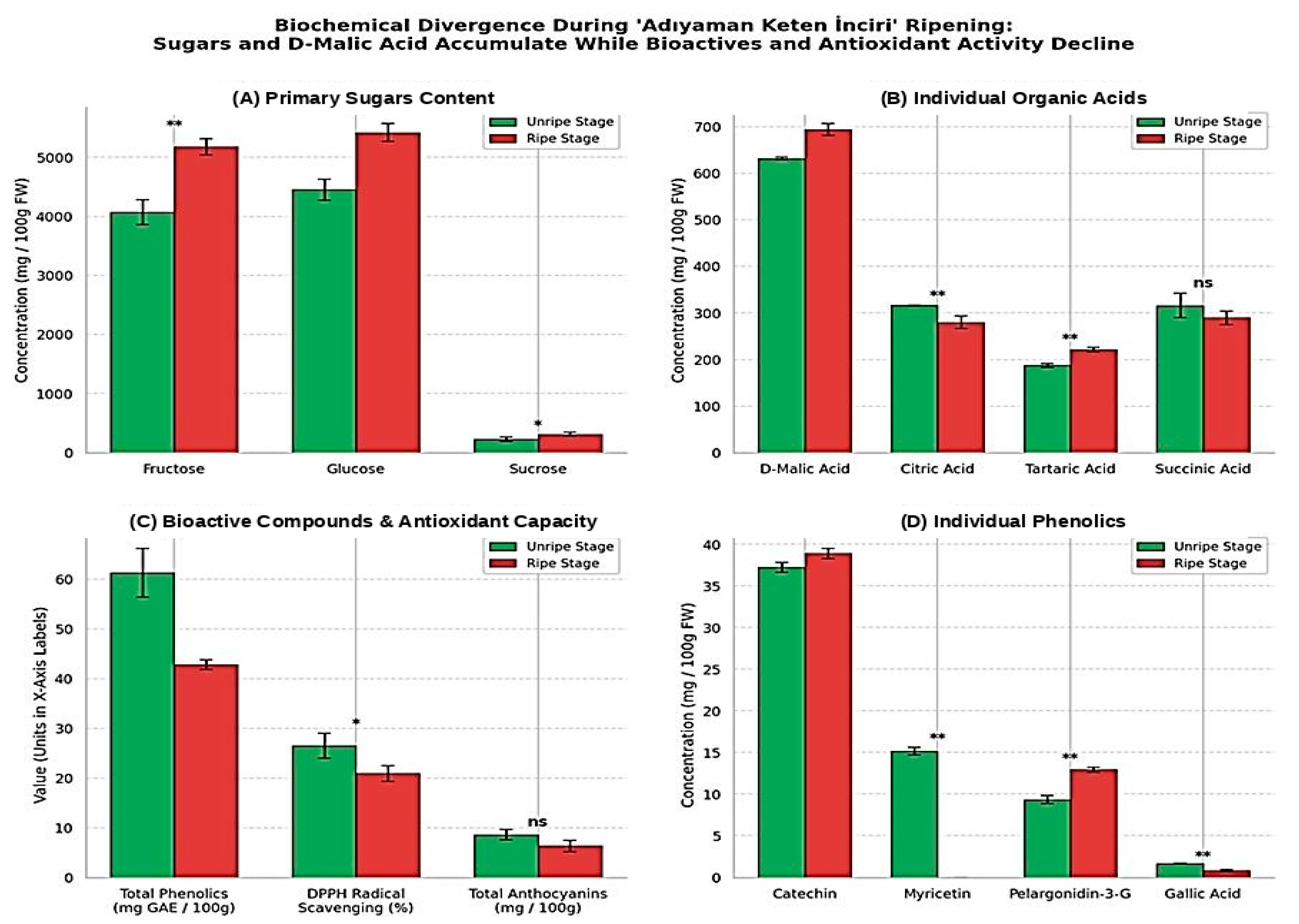
Total phenolic content (TPC) was determined via the Folin–Ciocalteu colorimetric method [22] using an extract concentration of 0.1 g/mL in 80% acidic methanol (99:1 methanol: HCl, v/v). Absorbance was read at 765 nm against a blank using a UV-Vis spectrophotometer (Shimadzu UV-1800, Shimadzu Corporation, Kyoto, Japan), and results were quantified using a gallic acid standard calibration curve (y = 0.0027x + 0.012, R2 = 0.9989) and expressed as mg Gallic Acid Equivalents per 100 g fresh weight (mg GAE/100 g FW). Total anthocyanin content (TAC) was quantified using the pH-differential method [23,24]. Extracts were diluted in 0.025 M KCl buffer (pH 1.0) and 0.4 M CH4COONa buffer (pH 4.5). Absorbance was recorded at 520 nm and 700 nm. TAC was calculated using the molar extinction coefficient (28,840 L.mol−1.cm−1) and molecular weight (595.5 g/mol) of cyanidin-3-rutinoside and expressed as mg cyanidin-3-rutinoside equivalents per 100 g FW. Antioxidant capacity was determined using the 2,2-diphenyl-1-picrylhydrazyl (DPPH) radical scavenging assay [25]. A 37.5 µL aliquot of fruit extract (0.1 g/mL) was reacted with 1.9 mL of 0.1 mM DPPH in 95% methanol. After 30 min dark incubation at room temperature, absorbance was measured at 517 nm against a methanol blank. Radical scavenging activity was evaluated using the 2,2-diphenyl-1-picrylhydrazyl (DPPH) assay. The percentage of DPPH free radical inhibition was calculated using the equation: DPPH Inhibition (%) = [(Acontrol − Asample)/Acontrol] × 100, where Acontrol is the absorbance of the DPPH solution without extract and Asample is the absorbance of the sample reaction mixture at 517 nm. To ensure full mathematical consistency across the text, analytical results are presented as percentage inhibition (DPPH % inhibition) in Figure 1C.
Figure 1.
Comparative profiles of primary sugars (A), organic acids (B), total phenolic content and DPPH radical scavenging activity (C), and individual phenolic compounds (D) of ‘Adıyaman Keten İnciri’ fig fruit during unripe (green) and fully ripe maturity stages. Statistically significant differences between green unripe and fully ripe maturity stages were determined using a paired Student’s t-test (df = 2). Asterisks indicate statistical significance (* p ≤ 0.05, ** p ≤ 0.01) and ‘ns’ indicates non-significance (p > 0.05) based on the paired t-test.
2.4. Determination of Sugar Components by HPLC
Primary sugars (sucrose, glucose, fructose, and xylose) were extracted according to Miron and Schaffer (1991) with minor modifications [26]. Briefly, 1.0 g of homogenized fruit tissue was extracted with 10 mL of 80% aqueous ethanol (v/v) under sonication at 60 °C for 30 min, followed by centrifugation at 10,000× g for 10 min at 4 °C. The supernatant was filtered through a 0.45 µm nylon syringe filter directly into HPLC vials. Qualitative and quantitative analyses were executed using a Shimadzu LC-20A Prominence HPLC system (Shimadzu Corporation, Kyoto, Japan) equipped with a Refractive Index Detector (RID-20A) and an Aminex HPX-87C carbohydrate column (300 mm × 7.8 mm, 9 µm; Bio-Rad, Hercules, CA, USA) maintained at 80 °C. Isocratic elution was performed using HPLC-grade Milli-Q ultrapure water as the mobile phase at a flow rate of 0.6 mL/min, with an injection volume of 20 µL and a total run time of 20 min. Individual sugars were identified by comparing retention times with authentic reference standards. Quantitative evaluation was performed using external 5-point linear calibration curves (R2 ≥ 0.9991) established across 0.1–10.0 mg/mL. Method limits of detection (LOD) and quantification (LOQ) ranged from 0.02 to 0.05 mg/mL and 0.06 to 0.15 mg/mL, respectively, with mean recovery rates exceeding 96.5%. All extractions and chromatographic measurements were performed in technical triplicates for each biological sample. The concentrations of individual sugars (fructose, glucose, sucrose, and xylose) were calculated using calibration curves of standard solutions and expressed as mg per 100 g of fresh weight. These specific sugar components were selected for analysis as they represent the benchmark primary metabolites that govern fruit sweetness and ripening dynamics in Ficus carica L. germplasms [26,27,28].
2.5. Determination of Organic Acid Profiles by HPLC
Organic acids (oxalic, citric, tartaric, malic, and succinic acids) were extracted and quantified using an ion-exclusion HPLC method [29]. Briefly, 1.0 g of fruit pulp was homogenized in 5 mL of 0.005 M H2SO4, sonicated for 15 min, and centrifuged at 10,000× g for 15 min at 4 °C. The supernatant was filtered through a 0.45 µm PVDF membrane. Chromatographic separation was achieved on a Transgenomic Coregel-87H column (300 mm × 7.8 mm, 9 µm) held at 40 °C using a Shimadzu LC-20A system equipped with a SPD-20A UV/VIS detector set at 210 nm. Isocratic elution was performed using 0.005 M H2SO4 (pH 2.2) as the mobile phase at a flow rate of 0.8 mL/min, with an injection volume of 20 µL and a run time of 25 min. Organic acids were identified by retention time comparison against high-purity analytical standards (Sigma-Aldrich, Darmstadt, Germany; purity ≥ 99.0%). Linear calibration curves (R2 ≥ 0.9993) were constructed between 0.05 and 5.0 mg/mL. Method LOD and LOQ ranged from 0.01 to 0.04 mg/mL and 0.03 to 0.12 mg/mL, respectively, with mean recovery percentages between 95.8% and 102.4%. The targeted organic acids (citric, malic, tartaric, succinic, and oxalic acids) were chosen as standard biochemical markers responsible for fruit acidity and organic acid sugar balance in figs [24,30,31].
2.6. Determination of Individual Phenolic Compounds by HPLC
Individual phenolic compounds and flavonoids were analyzed according to Nakilcioğlu (2013) [32]. Samples (1.0 g) were extracted in 10 mL of acetone/water (1:4, v/v) containing 0.1% trifluoroacetic acid (TFA), centrifuged, and filtered through 0.45 µm PVDF membrane filters. Separations were executed on an Inertsil ODS-3 C18 column (250 mm × 4.6 mm, 5 µm) at 40 °C using a Shimadzu LC-20A HPLC-DAD system. Binary gradient elution consisted of 2% acetic acid in ultrapure water (Solvent A) and 100% methanol (Solvent B) at a flow rate of 1.0 mL/min and an injection volume of 20 µL. The gradient program was: 0–10 min, 5–50% B; 10–15 min, 50–70% B; 15–20 min, 70–100% B; 20–25 min, re-equilibration at 5% B. Detection wavelengths were set at 280 nm for gallic acid and catechin, 360 nm for flavonols (myricetin), and 520 nm for anthocyanin pigments (pelargonidin-3-glucoside). Compound identification was based on retention time and UV-Vis spectral matching with reference standards (Sigma-Aldrich and Extrasynthese, Genay, France; purity ≥ 98.0%). External calibration curves (R2 ≥0.9990) established linearity across 0.5–100 mg/L. Method LOD and LOQ ranged from 0.05 to 0.25 mg/L and 0.15 to 0.80 mg/L, respectively, with recoveries between 96.2% and 101.8%.
2.7. Total Soluble Solids (TSS) and Total Flavonoid Content (TFC)
Total Soluble Solids (TSS) content of the fruit juice was determined at 20 °C using a digital temperature-compensated refractometer (Atago PAL-1, Tokyo, Japan). The refractometer was calibrated with distilled water prior to measurements, and results were expressed as °Brix.
Total Flavonoid Content (TFC) was measured using the aluminum chloride colorimetric assay according to Zare et al. [33]. Briefly, 0.5 mL of fruit extract was mixed with 1.5 mL of 95% ethanol, 0.1 mL of 10% aluminum chloride (AlCl3), 0.1 mL of 1 M potassium acetate, and 2.8 mL of distilled water. After incubation at room temperature for 30 min, absorbance was measured at 415 nm using a UV-Vis spectrophotometer (Shimadzu UV-1800). TFC was calculated using a rutin standard calibration curve (y = 0.0042x + 0.0081, R2 = 0.9985) and expressed as mg Rutin Equivalents per 100 g fresh weight (mg RE/100 g FW).
2.8. Statistical Analyses
For chromatographic and spectrophotometric assays executed in technical triplicates, technical replicate values were first averaged to yield a single mean value per biological unit (tagged tree, n = 3) prior to statistical testing. To evaluate maturity-dependent variations across the exact same biological units chronologically sampled over time, a paired Student’s t-test was executed (n = 3 tagged trees; paired differences degrees of freedom df = n − 1 = 2). Normality of paired differences was evaluated using the Shapiro–Wilk test (p > 0.05). All p-values and significance levels (* p ≤ 0.05 and ** p ≤ 0.01, and ns = non-significant) reported across tables and figures were explicitly calculated against Student’s t-distribution with df = 2. All statistical calculations, assumption diagnostics, and principal component graphics were executed using JMP Pro 14 software (SAS Institute Inc., Cary, NC, USA) and SPSS Statistics for Windows, Version 26.0 (IBM Corp., Armonk, NY, USA).
3. Results
3.1. Morpho-Pomological and Physical Attributes
Evaluation of ‘Adıyaman Keten İnciri’ fruits revealed outstanding pomological and physical attributes suitable for the fresh consumption market (Table 1). The fruits were characterized by an impressive average fruit weight of 80.30 g, accompanied by a fruit length of 48.94 mm and width of 56.83 mm. The ostiolum width was recorded at 5.25 ± 2.10 mm. Skin thickness averaged 1.32 ± 0.28 mm, while the internal fruit cavity was classified as very small to non-existent (Table 2).
Table 1.
Leaf and shoot morphological characteristics of ‘Adıyaman Keten İnciri’ genotype.
Table 2.
Fruit descriptor and pomological characteristics of ‘Adıyaman Keten İnciri’ genotype.
Leaf morphological characterization showed that ‘Adıyaman Keten İnciri’ trees predominantly feature 5-lobed leaves with a calcarate base shape and medium-depth sinuses (Table 2). Leaf blade dimensions averaged 194.20 mm in length and 212.40 mm in width, supported by a petiole length of 7.71 mm and thickness of 3.45 mm.
3.2. Stage-Dependent Primary Sugars and Organic Acids Dynamics
The selection and profiling of these defined sugars, organic acids, and phenolic constituents align with preceding metabolomic characterizations conducted on various local and commercial fig cultivars across Mediterranean and Anatolian regions, such as ‘Sarılop’, ‘Bursa Siyahı’, ‘Taounate’, and ‘Dottato’ [24,27,29,34,35]. Across these cultivars, fructose and glucose consistently constitute the predominant sugar fraction, whereas malic and citric acids represent the main organic acid indicators determining fruit maturity and taste dynamics [28,36].
3.2.1. Primary Sugars Dynamics
Fruit maturation triggered a substantial accumulation of primary sugars, with fructose and glucose identified as the predominant sugar fractions (Table 3; Figure 1A). Fructose levels expanded by over 27%, rising from 4069.16 mg/100 g at the green unripe stage to 5180.39 mg/100 g at full maturity. Similarly, glucose content increased by 21.7%, reaching peak concentration (5417.37 mg/100 g) in fully ripe fruits. Sucrose represented a minor sugar fraction, exhibiting a modest upward trend from 229.83 to 310.92 mg/100 g, whereas xylose concentrations declined non-significantly during ripening.
Table 3.
Stage-dependent primary sugars and organic acids profile of ‘Adıyaman Keten İnciri’ fruit.
3.2.2. Organic Acids Dynamics
Ripening exerted contrasting effects on individual organic acid fractions (Table 3; Figure 1B). Malic acid was identified as the predominant organic acid across both maturation stages, accumulating significantly (+9.87%) from 631.57 mg/100 g in green unripe fruits to 693.97 mg/100 g at full ripeness. Conversely, citric acid represented the second most abundant fraction and underwent a marked reduction of 11.5%, decreasing from 316.42 mg/100 g in green fruits to 279.92 mg/100 g at full ripeness. Tartaric acid also displayed a significant upward trajectory, increasing from 187.29 to 221.54 mg/100 g upon reaching full maturity, while oxalic acid remained below detectable limits across both sampling stages.
3.3. Bioactive Compounds, Phenolic Profile, and Antioxidant Capacity
The transition from unripe to ripe stage was accompanied by a pronounced decline in overall bioactive capacity (Table 4). Total phenolic content decreased substantially from 61.33 ± 4.89 mg GAE/100 g in unripe green fruits to 42.76 ± 0.97 mg GAE/100 g in fully ripe fruits, parallelled by a decline in DPPH radical scavenging activity (from 26.48 ± 2.52% to 20.90 ± 1.60%). Among individual phenolics, myricetin experienced the most drastic depletion during maturation. In contrast, specific bioactive compounds exhibited stage-dependent synthesis; most notably, catechin and pelargonidin-3-glucoside levels increased significantly as fruits reached full ripeness and skin/flesh coloration developed. Fruit maturation induced a sharp increase in Total Soluble Solids, escalating significantly (p < 0.001) from 10.20 ± 0.45 °Brix in green unripe fruits to 21.50 ± 0.82 °Brix at full maturity (Table 4), representing a 110.78% increase driven by primary sugar accumulation. Conversely, Total Flavonoid Content (TFC) exhibited a marked maturity-dependent decline, decreasing by 50.11% from 48.35 ± 1.85 mg RE/100 g FW in unripe fruits to 24.12 ± 1.10 mg RE/100 g FW in fully ripe fruits (p < 0.001), mirroring the overall decline observed in total phenolics and antioxidant capacity.
Table 4.
Stage-dependent bioactive compounds and individual phenolics of ‘Adıyaman Keten İnciri’ fruit.
4. Discussion
4.1. Morphological and Shoot Evaluation in Terms of Adaptation and Diversity
The shoot morphology and leaf attributes of the local ‘Adıyaman Keten İnciri’ genotype were compared with the rich literature network in the project to understand its survival and productivity strategies in the semi-arid transition climate of the Adıyaman-Perre ecosystem. The genotype’s petiole length (7.71 ± 2.06 cm) and thickness (3.45 ± 0.61 mm) are in close agreement with the average values of standard commercial cultivars [4]. The petiole length (7.71 ± 2.06 cm) and thickness (3.45 ± 0.61 mm) recorded for ‘Adıyaman Keten İnciri’ provide baseline morphometric data for this landrace. While robust petiole dimensions are conventionally hypothesized in the botanical literature to provide structural support for the leaf lamina under field conditions, mechanical wind-resistance assays were not performed in this study and warrant future engineering evaluations. Similarly, while leaf pubescence was visually recorded as sparsely hairy, whether this epidermal hairiness influences insect pest preference or transpirational water loss remains a literature-based hypothesis that requires direct entomological and physiological testing. The leaf lobe count, ranging predominantly between 5 and 7, is consistent with typical pentalobate and septalobate foliar morphologies reported in Mediterranean and Near Eastern germplasms [37]. The leaf area of our genotype was determined as 199.00 ± 9.14 cm2, which is significantly smaller than the leaf areas reported for standard Turkish cultivars (ranging between 221.25 cm2 and 283.82 cm2) and wild Hyrcanian National Park figs (463 cm2) [38]. In arid and semi-arid ecosystems, restricting the transpirational surface by reducing leaf blade area represents one of the most vital morphological ecological adaptability mechanisms in plants [9]. The leaf area characterized in ‘Adıyaman Keten İnciri’ (199.00 ± 20.92 cm2) provides baseline morphometric data for future physiological studies investigating transpirational dynamics and canopy microclimate interactions under dryland conditions. Indeed, leaf morphological plasticity, including leaf area reduction, represents a crucial water-conserving strategy in Ficus carica under semi-arid conditions [39]. While standard commercial cultivars in Turkey generally exhibit larger foliar structures ranging from 204 to 278 cm2 [5], the exceptionally restricted leaf blade area of ‘Adıyaman Keten İnciri’ (199.00 cm2) minimizes the boundary layer resistance and reduces transpirational water loss. Further physiological evaluations under controlled environments are required to assess whether this leaf morphology correlates with stomatal regulation or turgor maintenance [40]. While leaf shape and lobation are genetically stable varietal characteristics, leaf dimensions are strongly shaped by edaphoclimatic factors and water availability [39,40]. Furthermore, as highlighted in the literature, while ‘Adıyaman Keten İnciri’ is genetically uniform as a vegetatively propagated landrace clone, it exhibits noticeable within-variety phenotypic variation across different micro-environments, which is largely attributed to epigenetic regulation and environmental interactions rather than genetic polymorphism. Colorimetric parameters of the adaxial (L* = 37.58) and abaxial (L* = 47.93) leaf surfaces establish the objective foliar color profile of this landrace. Whether these color differences reflect underlying trichome density or anatomical adaptations remains a hypothesis to be verified through microscopic anatomical studies [39].
4.2. Comparative Analysis of Fruit Physical Traits and Quality Attributes
The most striking pomological finding distinguishing ‘Adıyaman Keten İnciri’ from other commercial cultivars is its average fresh fruit weight of 80.30 ± 9.51 g (Table 2). This value is nearly twofold higher than the average weights of premium fresh cultivars like ‘Bursa Siyahı’ (38.14 g–63.40 g) and drying standards like ‘Sarılop’ (41.04 g–57.25 g) reported in the literature [4,41]. Given that wild fig taxa exhibit fruit weights of only 2.04 g to 3.87 g, the extraordinary fruit size of ‘Keten İnciri’ highlights its highly efficient sink-source translocation capacity and cell expansion ability under the semi-arid ecological conditions of the Perre region [39]. This morpho-pomological superiority provides immense commercial value to the genotype for the premium fresh fig market [2]. The fruit ostiolum (eye) width, recorded at 5.25 ± 2.10 mm (Table 2), is comparable to that of the local ‘Abbas’ genotype (7.62 mm) [4]. A wide ostiolum is a major drawback as it allows easy entry of pathogens and pests, leading to internal fruit rot (endosepsis) [40]. According to local grower observations in the Perre region, ‘Adıyaman Keten İnciri’ produces regular main-crop fruits in orchards lacking male caprifig trees, suggesting a potential persistent (parthenocarpic) fruiting habit. In Mediterranean and transitional semi-arid ecosystems, heatwaves or fluctuations in Blastophaga psenes pollinator populations can disrupt caprification in Smyrna-type figs [3,42]. While persistent fruiting habits are traditionally hypothesized to reduce dependency on pollinator wasps [5,12], controlled pollinator-exclusion (bagging) trials, multi-season fruit-set evaluations, and quantitative yield monitoring were not conducted in this baseline survey and remain strictly necessary to scientifically confirm its parthenocarpic capacity and yield stability. To effectively harness ‘Adıyaman Keten İnciri’ as a valuable genetic resource, specific breeding and conservation strategies should be implemented: (i) ex situ conservation in national fig germplasm repositories to preserve its unique allele combinations; (ii) rigorous clonal selection combined with controlled abiotic stress screening (e.g., regulated deficit irrigation and heat stress profiling) to evaluate its rootstock or scion potential; (iii) genomic characterization using high-throughput molecular markers (e.g., SSRs and SNPs) to identify candidate genes linked to high phenolic biosynthesis and semi-arid adaptability; and (iv) parental integration into targeted cross-breeding programs aimed at combining the high bioactive profile and stress resilience of this local genotype with the market-desirable fruit traits of commercial cultivars like ‘Sarılop’ and ‘Bursa Siyahı’ [14,24,39]. The ostiolum width recorded at 5.25 ± 2.10 mm and skin thickness of 1.32 ± 0.28 mm provide baseline physical descriptor data for this landrace. While a narrow ostiolum and thicker peel are conventionally hypothesized in the literature to be associated with reduced susceptibility to ostiolar splitting or pest entry, direct mechanical compression tests, postharvest storage evaluations, and pathogen challenge assays were not executed in this baseline study and represent important subjects for future validation. The bright yellow-green skin color (L* = 63.02) delivers aesthetic value, while the deep red-pink internal pulp color (a* = 16.18) satisfies premium fresh market standards [2,4].
4.3. Stage-Dependent Primary Sugars and Organic Acids Regulation
The highly significant (p ≤ 0.01) accumulation of glucose, fructose, and sucrose in Keten İnciri fruits during ripening is typical of fig fruit ripening physiology (Table 3). The fructose (5180.39 mg/100 g) and glucose (5417.37 mg/100 g) levels in fully ripe fruits confirm that these monosaccharides are the dominant fractions of total soluble solids [13,41]. Glucose contents range between 1.21–6.13 g/100 g and fructose contents between 1.91–4.65 g/100 g in fresh figs, indicating that the sugar accumulation values of Keten İnciri fall perfectly within these standard reference ranges [43]. A sharp rise in invertase enzyme activity during softening accelerates sucrose hydrolysis, directly triggering glucose and fructose accumulation [36]. TSS content of ‘Adıyaman Keten İnciri’ represents a key quality attribute that determines its commercial value. Our TSS findings align closely with the observations of Özeker and İsfandiyaroğlu [44] and Uzun and Yarılgaç [45], who reported TSS ranges of 15.8% to 29.8% across various Turkish fig cultivars under typical Mediterranean conditions. Furthermore, the variability in TSS is highly genotype-dependent, as supported by Marcotuli et al. [46], who recorded a wide range of soluble solids (19.1 to 24.7 °Brix) among different Italian cultivars, and Hssaini et al. [47], who noted extreme variations (8–48%) in Mediterranean fig germplasms. In terms of organic acid profiles, a highly unique deviation from the standard literature was observed. Citric acid is widely accepted as the dominant organic acid in standard fig cultivars [13]. Citric acid levels are several times higher than malic acid in standard fig extracts [48]. In contrast to many commercial fig cultivars where citric acid is reported as the predominant organic acid, ‘Adıyaman Keten İnciri’ exhibits a clear dominance of malic acid (693.97 mg/100 g in ripe fruits) over citric acid (279.92 mg/100 g), representing a distinct organic acid profile under semi-arid conditions (Table 3). This finding highlights a highly unique genotypic chemotaxonomic fingerprint that governs its specific flavor balance. In a similar study, Hssaini et al. [24], found that malic acid was more dominant than citric acid in some Moroccan fig varieties. Malic acid continues to accumulate during ripening due to specific metabolic regulations of the TCA cycle [36]. The decline in citric acid, on the other hand, is associated with its consumption as a respiratory substrate during ripening-associated respiration. This balanced sugar-to-acid ratio provides the fruit with excellent eating quality [5].
4.4. Antioxidant Systems and Bioactive Metabolites in Relation to Abiotic Stress Tolerance
The highly significant (p ≤ 0.01) declines in Total Phenolic Content (TPC) and DPPH radical scavenging activity during ripening are in agreement with the literature on fig maturation physiology [49,50]. Total Phenolic Content (TPC) dropped from 61.33 ± 4.89 mg GAE/100 g in unripe fruits to 42.76 ± 0.97 mg GAE/100 g in fully ripe fruits, parallel to a decline in DPPH radical scavenging activity from 26.48% ± 2.52% to 20.90% ± 1.60% (Table 4; Figure 1C) [49]. This drop is associated with the polymerization of phenolic into insoluble compounds, the dilution effect from increased fruit volume, and the active degradation of polyphenols by polyphenol oxidase (PPO) during the climacteric ripening phase [49,50]. Indeed, such genotype-dependent declines in phenolic density during fruit maturation, particularly under the pressure of semi-arid environmental conditions where secondary metabolite biosynthesis is not sustained at later stages, have also been well-documented in other Mediterranean woody crops [51]. The biochemical status and antioxidant capacity of ‘Adıyaman Keten İnciri’ during maturation are strongly correlated with its genetic makeup and environmental adaptation. Our findings regarding the reduction in TPC during ripening are consistent with the studies of Ara et al. [52] and Wojdylo et al. [27], who established that total phenolics undergo significant decline due to enzymatic oxidation and dilution effects in ripe fruits. Additionally, the stable total flavonoid content (TFC) and individual anthocyanin dynamics are in agreement with Hssaini et al. [24] and Zahid et al. [53], reflecting the physiological resilience of local genotypes in maintaining bioactive stability under dry rainfed conditions. Nevertheless, the exceptionally high TPC and DPPH activity in unripe green fruits serve as a critical physiological protective barrier—a biochemical shield—against the high solar radiation, extreme temperature, and severe water deficits experienced in semi-arid ecosystems [16,53]. These early-stage polyphenols neutralize reactive oxygen species (ROS), preventing oxidative stress, lipid peroxidation, and subsequent membrane damage in plant tissues under stressful rainfed conditions [49,53]. These defensive biochemical systems underscore the physiological plasticity of local genotypes in deploying antioxidant enzymes and phenolics to neutralize environmental stress-induced reactive oxygen species [54]. The HPLC-DAD individual phenolic profile explains this stage-dependent defense in detail [49,53]. Gallic acid content decreased by half (from 1.68 ± 0.04 mg/100 g to 0.78 ± 0.13 mg/100 g), which is consistent with the overall decline in TPC and antioxidant capacity [49]. Myricetin, a strong antioxidant flavonol present at high levels in green unripe fruits (15.17 ± 0.44 mg/100 g), fell below the limit of detection (n.d.) at full ripeness (Table 4; Figure 1D) [53].
This non-detection in mature fruits indicates that myricetin levels decrease below chromatographic detection limits during ripening, likely reflecting its early-stage role as an antioxidant scavenger [53,55]. The total degradation of myricetin suggests its active deployment as an antioxidant scavenger during early growth phases to cope with environmental stresses, followed by a metabolic down-regulation of flavonol-specific biosynthetic pathways, specifically chalcone synthase (CHS) and flavonol synthase (FLS), during the final ripening stage [55]. Catechin, the most dominant individual phenolic, remained stable and increased slightly during ripening (from 37.23 ± 0.59 to 38.90 ± 0.63 mg/100 g, LSD = 1.38, p ≤ 0.05), highlighting the genotype’s high capacity to maintain active flavan-3-ol synthesis even at advanced ripeness, which preserves the health-promoting functional properties and eating quality of the fruit [49,53]. Finally, pelargonidin-3-glucoside increased significantly (p ≤ 0.01) from 9.34 ± 0.47 mg/100 g to 12.95 ± 0.29 mg/100 g (Table 4; Figure 1D) [53,56]. This accumulation directly correlates with the redness value (a* = 16.18) of the internal pulp (Table 2) [56]. Pelargonidin-3-glucoside is the primary anthocyanin responsible for the attractive strawberry red-pink pulp color of Keten İnciri, synthesized through the up-regulation of the shikimic acid and anthocyanin biosynthetic pathways during cell expansion and pigmentation of the pulp [53,56].
It must be emphasized as a foundational limitation of this baseline study that evaluations were conducted on in situ trees at a single location (n = 3 biological replicates) during a single growing season without molecular marker fingerprinting (SSR/SNP), multi-location sampling, or direct comparison with reference commercial cultivars. Consequently, the small sample size inherently limits statistical power, and these findings represent an essential baseline inventory rather than population-wide ecological or genetic generalizations. Furthermore, while seasonal climatic averages and orchard management conditions (rainfed dryland, clay-loam soil, 25–30-year-old own-rooted trees without artificial inputs) are documented in Section 2.1, continuous high-resolution micro-meteorological logging (such as daily vapor pressure deficit and soil water potential) was not performed during the sampling period, representing another limitation inherent to baseline field surveys. While long-term persistence and productivity in the water-limited Perre eco-habitat suggest strong ecological adaptability, confirming specific physiological drought-tolerance mechanisms will require future controlled pot and field experiments evaluating leaf water potential, gas exchange parameters, and oxidative stress markers across contrasting genotypes. Additionally, while ‘Adıyaman Keten İnciri’ was characterized morpho-pomologically and phytochemically, its distinct genetic identity relies strictly on phenotypic descriptors and local germplasm inventory (ADY-PER-01); future studies incorporating microsatellite (SSR) or SNP markers are required to confirm its genetic uniqueness and resolve potential homonymy/synonymy. It must be re-emphasized as a key limitation of this baseline survey that controlled pollinator-exclusion (bagging) experiments were not executed, nor were physiological stress parameters (such as leaf water potential or stomatal conductance) or quantitative multi-year yield data measured. Consequently, regional field observations regarding persistent fruiting and drought survival provide a foundation for future controlled trials rather than definitive evidence of proven parthenocarpy or physiological drought tolerance.
Finally, the broader applicability and scientific scope of the present study must be interpreted within the context of its baseline nature. As a single-location, single-season characterization of a single local accession (ADY-PER-01), these findings provide an indispensable baseline dataset but do not by themselves demonstrate population-level climate resilience or broad ecological adaptation. To build upon this foundational work, future research should focus on: (i) expanding germplasm surveys across multiple orchards and growing seasons to quantify intra-landrace phenotypic variation; (ii) conducting direct comparative trials alongside well-known commercial reference cultivars (e.g., ‘Bursa Siyahı’ and ‘Sarılop’); (iii) executing SSR/SNP molecular marker fingerprinting to confirm genetic uniqueness and resolve potential homonymy; and (iv) performing controlled physiological and biochemical stress experiments under greenhouse/field conditions.
5. Conclusions
This study provides a comprehensive morpho-pomological and stage-dependent biochemical characterization of the local ‘Adıyaman Keten İnciri’ genotype naturally adapted to a semi-arid transitional ecosystem. The landrace exhibits outstanding pomological traits including exceptional fruit weight and dimensions that highlight its high commercial viability for the premium fresh fig market. The internal cavity structure and skin thickness were pomologically characterized according to standardized IPGRI descriptor criteria. Phytochemical profiling reveals a marked stage-dependent transition where green unripe fruits accumulate higher levels of total phenolics, total anthocyanins, antioxidant capacity, and myricetin, whereas mature fruits are characterized by a dominant accumulation of glucose, fructose, and malic acid along with elevated catechin and pelargonidin-3-glucoside levels. Furthermore, the persistent fruiting habit observed under rainfed field conditions provides a baseline foundation for future controlled pollination-exclusion trials required to quantify its true parthenocarpic potential and yield performance. Overall, this study provides the first documented baseline accession record for ‘Adıyaman Keten İnciri’ (ADY-PER-01) based on phenotypic and biochemical descriptors, providing a foundation for future molecular fingerprinting and ex situ germplasm preservation.
Funding
This research received no external funding.
Institutional Review Board Statement
Not applicable.
Data Availability Statement
All raw datasets and statistical outputs analyzed during this study are included within the main text of the article. Additional data support is available from the corresponding author upon reasonable request.
Acknowledgments
During the preparation of this manuscript, the author used Google NotebookLM (version 2026) for text organization, generating graphics, interpreting data, English academic translation, and MDPI Diversity formatting guidelines. The author has fully reviewed and edited the final outputs and take absolute responsibility for the scientific content of this publication.
Conflicts of Interest
The author declares no conflicts of interest.
Abbreviations
The following abbreviations are used in this manuscript:
| TPC | Total Phenolic Content |
| TFC | Total Flavonoid Content |
| DPPH | 2,2-diphenyl-1-picrylhydrazyl |
| HPLC | High-Performance Liquid Chromatography |
| HPLC-DAD | High-Performance Liquid Chromatography with Diode-Array Detection |
| TSS | Total Soluble Solids |
| PPO | Polyphenol Oxidase |
| CHS | Chalcone Synthase |
| FLS | Flavonol Synthase |
| ROS | Reactive Oxygen Species |
| TCA | Tricarboxylic Acid Cycle |
| GAE | Gallic Acid Equivalents |
| CE | Catechin Equivalent |
| QE | Quercetin Equivalent |
| FW | Fresh Weight |
| DW | Dry Weight |
| LSD | Least Significant Difference |
| SD | Standard Deviation |
| ns | Non-Significant |
| CIE | Commission Internationale de l’Éclairage |
| (L) | *Lightness |
| (a) | *Redness/Greenness |
| (b) | *Yellowness/Blueness |
| (C) | *Chroma |
| (h\circ) | Hue Angle |
References
- Abbasi, S.; Mirsoleimani, A.; Jafari, M. Diversity of phenolic compounds, antioxidant capacity, and mineral element content in four fig cultivars (Ficus carica L.) and their correlation with the rooting of hardwood cuttings. Arid. Land Res. Manag. 2024, 38, 606–623. [Google Scholar] [CrossRef] [Scilit]
- Yiyici, İ.H. The Usage of the Nutritional Minerals of the Soil of Some Fig Varieties and Different Origins Grown in Şanlıurfa. Master’s Thesis, Graduate School of Natural and Applied Sciences, Department of Horticulture, Harran University, Şanlıurfa, Turkey, 2021. [Google Scholar]
- Caliskan, O.; Polat, A.A.; Celikkol, P.; Bakir, M. Molecular characterization of autochthonous Turkish fig accessions. Span. J. Agric. Res. 2012, 10, 130–140. [Google Scholar] [CrossRef] [Scilit]
- Aydın, A. Determination of the Development of Some Fig Varieties and Fruit Quality Properties Under the Ecological Conditions of Kahramanmaraş. Master’s Thesis, University of Kahramanmaraş Sutcu Imam Institute for Graduate Studies in Science and Technology, Department of Hortıculture, Kahramanmaraş, Turkey, 2019. [Google Scholar]
- Simsek, E.; Kılıç, D.; Caliskan, O. Phenotypic variation of fig genotypes (Ficus carica L.) in the Eastern Mediterranean of Turkey. Genetika 2020, 52, 957–972. [Google Scholar] [CrossRef] [Scilit]
- Ayar, A.; Seferoğlu, H.G. Investigations on Yield and Dried Fruit Quality of Sarilop Fig Clones for Further Registration. In Current Studies on Fruit Science; Pakyürek, M., Ed.; Institution of Economic Development and Social Researches Publications: Ankara, Türkiye, 2021; pp. 39–72. [Google Scholar]
- Özkul, M.; Nikpeyma, Y.; Özen, M. Effects of different pruning intensities on growth and fruit quality in Sarılop fig varieties. J. Agric. Fac. Ege Univ. 2022, 59, 249–263. [Google Scholar] [CrossRef] [Scilit]
- Kuden, A.B. Genetic resources of temperate zone fruits in Turkey. In VI International Symposium on Temperate Fruit Growing in the Tropics and Subtropics; International Society for Horticultural Science: Korbeek-Lo, Belgium, 2000; Volume 565, pp. 33–37. [Google Scholar]
- Keskin, K. Determination of Salt Stress Tolerance in Some Fig Varieties and Genotypes. Master’s Thesis, Cukurova University Institute of Natural and Applied Sciences, Adana, Turkey, 2024. [Google Scholar]
- Pakyürek, M.; Dumanoğlu, H. Effects of saline stress on in vitro seed germination and seedling growth of some Turkish fig cultivars (Ficus carica L.). Appl. Ecol. Environ. Res. 2019, 17, 13485–13492. [Google Scholar] [CrossRef] [Scilit]
- Aktürk, H. Grafted Plant Propagation in the Fig (Ficus carica L.) Cv. Bursa Siyahi. Master’s Thesis, Bursa Uludağ University Graduate School of Natural and Applied Sciences, Department of Horticulture, Bursa, Türkiye, 2022. [Google Scholar]
- Rosianskey, Y.; Dahan, Y.; Yadav, S.; Freiman, Z.E.; Milo-Cochavi, S.; Flaishman, M.A. Chlorophyll metabolism in pollinated vs. parthenocarpic fig fruits throughout development and ripening. Planta 2016, 244, 491–504. [Google Scholar] [CrossRef] [Scilit] [PubMed]
- Sertkaya, M.; Guclu, G.; Buyukkurt, O.K.; Kelebek, H.; Selli, S. GC-MS-Olfactometric screening of potent aroma compounds in pulps and peels of two popular Turkish fig (Ficus carica L.) cultivars by application of aroma extract dilution analysis. Food Anal. Methods 2021, 14, 2357–2366. [Google Scholar] [CrossRef] [Scilit]
- Çalişkan, O.; Polat, A.A. Phytochemical and antioxidant properties of selected fig (Ficus carica L.) accessions from the eastern Mediterranean region of Turkey. Sci. Hortic. 2011, 128, 473–478. [Google Scholar] [CrossRef] [Scilit]
- Kösoğlu, İ.; Konak, R.; Yamaner, Ç.; Tan, N. Determination of phytochemicals of Turkish fig genetic resources. Acta Sci. Pol. Hortorum Cultus 2022, 21, 67–78. [Google Scholar] [CrossRef] [Scilit]
- Ammar, S.; Contreras, M.D.M.; Belguith-Hadrich, O.; Bouaziz, M.; Segura-Carretero, A. New insights into the qualitative phenolic profile of Ficus carica L. fruits and leaves from Tunisia using ultra-high-performance liquid chromatography coupled to quadrupole-time-of-flight mass spectrometry and their antioxidant activity. RSC Adv. 2015, 5, 20035–20050. [Google Scholar] [CrossRef] [Scilit]
- Ayar, A.; Belge, A.; Özen, M.; Şahin, B.; Karacaoğlan, Ç. Studies on genetic diversity of caprifig: Caprifig genetic resources (Ficus carica var. caprificus L.) conservation and characterization project. Biol. Divers. Conserv. 2023, 16, 192–202. [Google Scholar] [CrossRef] [Scilit]
- Swarup, S.; Cargill, E.J.; Crosby, K.; Flagel, L.; Kniskern, J.; Glenn, K.C. Genetic diversity is indispensable for plant breeding to improve crops. Crop Sci. 2021, 61, 839–852. [Google Scholar] [CrossRef] [Scilit]
- Flaishman, M.A.; Rodov, V.; Stover, E. The fig: Botany, horticulture, and breeding. Hort. Rev. 2008, 34, 113–196. [Google Scholar] [CrossRef] [Scilit]
- Karantzi, A.D.; Kafkaletou, M.; Christopoulos, M.V.; Tsantili, E. Peel colour and flesh phenolic compounds at ripening stages in pollinated commercial varieties of fig (Ficus carica L.) fruit grown in Southern Europe. J. Food Meas. Charact. 2021, 15, 2049–2063. [Google Scholar] [CrossRef] [Scilit]
- IPGRI. Descriptors for Fig. International Plant Genetic Resources Institute, Rome, Italy, and International Centre for Advanced Mediterranean Agronomic Studies; IPGRI and CIHEAM: Paris, France, 2003. [Google Scholar]
- Singleton, V.L.; Orthofer, R.; Lamuela-Raventós, R.M. Analysis of total phenols and other oxidation substrates and antioxidants by means of folin-ciocalteu reagent. Methods Enzymol. 1999, 299, 152–178. [Google Scholar] [CrossRef] [Scilit]
- Chen, M.H.; McClung, A.M.; Bergman, C.J. Phenolic content, anthocyanins and antiradical capacity of diverse purple bran rice genotypes as compared to other bran colors. J. Cereal Sci. 2017, 77, 110–119. [Google Scholar] [CrossRef] [Scilit]
- Hssaini, L.; Charafi, J.; Razouk, R.; Hernández, F.; Fauconnier, M.L.; Ennahli, S.; Hanine, H. Assessment of Morphological Traits and Fruit Metabolites in Eleven Fig Varieties (Ficus carica L.). Int. J. Fruit Sci. 2020, 20, 8–28. [Google Scholar] [CrossRef] [Scilit]
- Brand-Williams, W.; Cuvelier, M.E.; Berset, C. Use of a free radical method to evaluate antioxidant activity. LWT-Food Sci. Technol. 1995, 28, 25–30. [Google Scholar] [CrossRef] [Scilit]
- Miron, D.; Schaffer, A.A. Sucrose phosphate synthase, sucrose synthase, and invertase activities in developing fruit of Lycopersicon esculentum Mill. and the sucrose accumulating Lycopersicon hirsutum Humb. and Bonpl. Plant Physiol. 1991, 95, 623–627. [Google Scholar] [CrossRef] [Scilit] [PubMed]
- Wojdyło, A.; Nowicka, P.; Carbonell-Barrachina, Á.A.; Hernández, F. Phenolic compounds, antioxidant and antidiabetic activity of different cultivars of Ficus carica L. fruits. J. Funct. Foods 2016, 25, 421–432. [Google Scholar] [CrossRef] [Scilit]
- Sandhu, A.K.; Islam, M.; Edirisinghe, I.; Burton-Freeman, B. Phytochemical composition and health benefits of figs (fresh and dried): A review of literature from 2000 to 2022. Nutrients 2023, 15, 2623. [Google Scholar] [CrossRef] [Scilit] [PubMed]
- Gundesli, M.A.; Ugur, R.; Urün, I.; Ercisli, S.; Kafkas, N.E.; Ilhan, G.; Velibor Spalevic, V.; Riaz Ullah, R.; Bari, A. Evaluation of the total phenolic content, sugar, organic acid, volatile compounds and antioxidant capacities of fig (Ficus carica L.) genotypes selected from the Mediterranean region of Türkiye. Hortic. Sci. 2024, 51, 111–126. [Google Scholar] [CrossRef] [Scilit]
- Bozan, B.; Başer, K.H.C.; Kara, S. Quantitative determination of naphthaquinones of Arnebia densiflora (Nordm.) Ledeb. by an improved high-performance liquid chromatographic method. J. Chromatogr. A 1997, 782, 133–136. [Google Scholar] [CrossRef] [Scilit]
- Melgarejo, P.; Hernandez, F.C.A.; Martinez, J.J.; Sánchez, J.; Salazar, D.M. Organic acids and sugars from first and second crop fig juices. In II International Symposium on Fig. Acta Hortic. 2001, 605, 237–239. [Google Scholar] [CrossRef] [Scilit]
- Nakilcioğlu, E.; Hıșıl, Y. Research on the phenolic compounds in sarilop (Ficus carica L.) fig variety. Gıda 2013, 38, 267–274. [Google Scholar]
- Zare, H.; Jalili, H. Comparison of dried ‘Sabz’ fig (Ficus carica cv. Sabz) harvesting, drying, disinfection, and storage methods. Int. J. Fruit Sci. 2020, 20, S1741–S1750. [Google Scholar] [CrossRef] [Scilit]
- Veberic, R.; Colaric, M.; Stampar, F. Phenolic acids and flavonoids of fig fruit (Ficus carica L.) in the northern Mediterranean region. Food Chem. 2008, 106, 153–157. [Google Scholar] [CrossRef] [Scilit]
- Slatnar, A.; Klancar, U.; Stampar, F.; Veberic, R. Effect of drying of figs (Ficus carica L.) on the contents of sugars, organic acids, and phenolic compounds. J. Agric. Food Chem. 2011, 59, 11696–11702. [Google Scholar] [CrossRef] [Scilit] [PubMed]
- Sedaghat, S.; Rahemi, M. Enzyme Activity Regarding Sugar and Organic Acid Changes during Developmental Stages in Rainfed Fig (Ficus carica L. cv Sabz). Int. J. Fruit Sci. 2018, 18, 14–28. [Google Scholar] [CrossRef] [Scilit]
- Barakat, H.; Draie, R. Morphological characterization of fig species (Ficus carica L.) widespread in northwestern Syria. Migr. Lett. 2023, 20, 277–304. [Google Scholar]
- Qurbanova, Q.; Babayeva, S.; Rahimov, H.; Abbasov, M. First characterization of the Hyrcanian population of Ficus carica L. (syn. Ficus hyrcana Grossh.): A wild fig in Azerbaijan. Genet. Resour. Crop Evol. 2025, 72, 5115–5126. [Google Scholar] [CrossRef] [Scilit]
- Khadivi, A.; Mirheidari, F.; Saeidifar, A.; Moradi, Y.; Tunç, Y. Morphological variation of Ficus johannis subsp. afghanistanica (Warb.) Browicz in Sistan-va-Baluchestan province, Iran. BMC Plant Biol. 2025, 25, 24. [Google Scholar] [CrossRef] [Scilit] [PubMed]
- Zhou, N.N.; Qiao, F. Botanical characteristics and ecological adaptability of fig (Ficus carica L.). Int. J. Hortic. 2024, 14, 368–380. [Google Scholar] [CrossRef] [Scilit]
- Polat, A.A.; Çalışkan, O. Fruit characteristics of table fig (Ficus carica) cultivars in subtropical climate conditions of Mediterranean region. N. Z. J. Crop Hortic. Sci. 2008, 36, 107–115. [Google Scholar] [CrossRef] [Scilit]
- Ahi Koşar, D.; Ertürk, Ü. Assessing the Impact of Genotype-Specific Caprifig Fruit Storage on the Pollination Efficacy and Fruit Quality of “Bursa Siyahı” Cultivar: A Multivariate Analysis Approach. Agronomy 2024, 14, 958. [Google Scholar] [CrossRef] [Scilit]
- Aljane, F.; Ferchichi, A. Assessment of genetic diversity of Tunisian fig (Ficus carica L.) cultivars using morphological and chemical characters. Acta Bot. Gall. 2010, 157, 171–182. [Google Scholar] [CrossRef] [Scilit]
- Özeker, E.; Isfendiyaroglu, M. Evaluation of table fig cultivars in Cesme Peninsula. In I International Symposium on Fig; International Society for Horticultural Science (ISHS): Leuven, Belgium, 1997; Volume 480, pp. 55–60. [Google Scholar] [CrossRef] [Scilit]
- Uzun, S.; Yarilgaç, T. Germencik (Aydın) ilçesinde yetiştirilen Sarılop incirlerinde (Ficus carica L.) klon seleksiyonu. Uluslar. Tarım VE Yaban Hayatı Bilim. Derg. 2021, 7, 1–8. [Google Scholar] [CrossRef] [Scilit]
- Marcotuli, I.; Mazzeo, A.; Colasuonno, P.; Terzano, R.; Nigro, D.; Porfido, C.; Tarantino, A.; Cigliano, R.A.; Sanseverino, W.; Gadaleta, A.; et al. Fruit development in Ficus carica L.: Morphological and genetic approaches to fig buds for an evolution from monoecy toward dioecy. Front. Plant Sci. 2020, 11, 1208. [Google Scholar] [CrossRef] [Scilit] [PubMed]
- Hssaini, L.; Hanine, H.; Razouk, R.; Ennahli, S.; Mekaoui, A.; Guirrou, I.; Charafi, J. Diversity Screening of Fig (Ficus carica L.) Germplasm through Integration of Morpho-agronomic and Biochemical Traits. Int. J. Fruit Sci. 2019, 20, 939–958. [Google Scholar] [CrossRef] [Scilit]
- Badgujar, S.B.; Patel, V.V.; Bandivdekar, A.H.; Mahajan, R.T. Traditional uses, phytochemistry and pharmacology of Ficus carica: A review. Pharm. Biol. 2014, 52, 1487–1503. [Google Scholar] [CrossRef] [Scilit] [PubMed]
- Gündeşli, M.A.; Kafkas, N.E.; Güney, M.; Ercişli, S. Determination of phytochemicals from fresh fruits of fig (Ficus carica L.) at different maturity stages. Acta Sci. Pol. Hortorum Cultus 2021, 20, 73–81. [Google Scholar] [CrossRef] [Scilit]
- Kamiloglu, S.; Capanoglu, E. Polyphenol content in figs (Ficus carica L.): Effect of sun-drying. Int. J. Food Prop. 2015, 18, 521–535. [Google Scholar] [CrossRef] [Scilit]
- Cetinkaya, H.; Ozkaya, R.; Kesen, S. Valorization of olive leaves and oil: Role of cultivar and harvest time in determining phenolic and fatty acid profiles. J. Food Compos. Anal. 2025, 148, 108521. [Google Scholar] [CrossRef] [Scilit]
- Ara, R.; Kamal Uddin Khan, S.A.; Adhikary, S.K.; Fazlay Rabby, M.; Shawkat, S. Potentials of Teen (Ficus carica) as a Fruit Crop in Coastal Bangladesh. In Transforming Coastal Zone for Sustainable Food and Income Security; Lama, T., Burman, D., Mandal, U.K., Sarangi, S.K., Sen, H., Eds.; Springer: Cham, Switzerland, 2022. [Google Scholar] [CrossRef] [Scilit]
- Zahid, G.; Kelebek, H.; Küden, A.; Shimira, F.; Aka Kaçar, Y. Assessment of phenolic composition, sugars, and antioxidant capacity in Turkish fig (Ficus carica L.) cultivars. Turk. J. Agric. For. 2025, 49, 485–500. [Google Scholar] [CrossRef] [Scilit]
- Demir, S.; Cetinkaya, H. Effects of saline conditions on polyphenol and protein content and photosynthetic response of different olive (Olea europaea L.) cultivars. Appl. Ecol. Environ. Res. 2020, 18, 2599. [Google Scholar] [CrossRef] [Scilit]
- Wang, Y.; Liu, X.; Chen, S.; Wang, Q.; Jin, B.; Wang, L. Functions, accumulation, and biosynthesis of important secondary metabolites in the fig tree (Ficus carica). Front. Plant Sci. 2024, 15, 1397874. [Google Scholar] [CrossRef] [Scilit] [PubMed]
- Boukhalfa, F.; Mostapha, B.B.; Medouni, S.; Madani, K. Effect of temperature and drying method on the phenolic profile of four varieties of figs (Ficus carica). J. Food Meas. Charact. 2025, 19, 6354–6365. [Google Scholar] [CrossRef] [Scilit]

Disclaimer/Publisher’s Note: The statements, opinions and data contained in all publications are solely those of the individual author(s) and contributor(s) and not of MDPI and/or the editor(s). MDPI and/or the editor(s) disclaim responsibility for any injury to people or property resulting from any ideas, methods, instructions or products referred to in the content. |
© 2026 by the author. Licensee MDPI, Basel, Switzerland. This article is an open access article distributed under the terms and conditions of the Creative Commons Attribution (CC BY) license.