


Abstract
Ant diversity and community structure in Greek olive orchards are under-researched, with only one study conducted to date, despite the extensive area occupied by olive orchards and their agronomic, ecological, and socioeconomic importance. In this study, we provide the first data on both ant assemblages and functional groups in Greek olive orchards. The study was designed to capture variation in ant diversity associated with management systems (MS) and agroecological zones (AZ). Ants were collected monthly for two consecutive years, using pitfall traps from 16 olive orchards, eight of which implemented Green Infrastructure (GI). A total of 32 ant species belonging to 12 genera and seven functional groups were recorded. Opportunists (OPP) and Generalised Myrmicinae (GM) were the dominant functional groups. Organic green-infrastructure-enhanced orchards had statistically significantly higher exponential Shannon diversity than conventional orchards, whereas ant worker captures, species richness, sample-based γ-diversity, species composition, and the proportions of major functional groups did not differ between management systems. Agroecological zone significantly affected ant worker captures and species composition, with higher captures recorded in hilly than in plain olive orchards. In contrast, sample-based γ-diversity, species richness and effective Shannon diversity did not differ between zones. Strong interannual variation was observed, with both ant worker captures and species richness being significantly higher in the second sampling year, while effective Shannon diversity remained stable between years. Overall, olive orchards support diverse and functionally complex ant communities, including both widespread and endemic species. These findings highlight the dual role of olive orchards as productive agricultural systems and reservoirs of biodiversity. The adoption of Green Infrastructure, together with low-intensity management and the maintenance of habitat heterogeneity, could further enhance the role of olive orchards in supporting biodiversity and ecological processes across the landscape.
1. Introduction
Olive orchards represent one of the most characteristic and widespread agroecosystems in the Mediterranean Basin, shaping both landscape and rural economies, and supporting the livelihoods of over 500 million inhabitants [1,2]. Greece is among the leading olive-producing countries, and Crete is one of its most important olive-growing regions, accounting for around 40% of the country’s olive orchard area and production [3]. Beyond their economic significance, olive orchards constitute anthropogenic habitats that can support considerable arthropod diversity, thereby contributing to regional biodiversity and ecosystem functioning [4,5,6,7]. As a major driver of land use in the Mediterranean region, olive production has increasingly adopted industrialised practices, reflecting the broader trend of agricultural intensification [5]. This shift has contributed to a marked loss of flora and fauna biodiversity within olive orchard agroecosystems, as well as to additional environmental impacts [8].
Green Infrastructure (GI) has been proposed as an effective management strategy to enhance habitat heterogeneity and promote biodiversity, and support the provision of agroecosystem services [9,10,11]. In olive orchard agroecosystems, GI refers to a planned network of natural and semi-natural landscape elements—such as trees, shrubs, and aromatic plants; herbaceous vegetation; hedgerows; stone and wooden (brush-pile) refugia; and ponds—integrated within and around olive orchards. These elements, combined with agroecological and sustainable farming practices, support biodiversity, enhance the provision of agroecosystem services, and reduce habitat fragmentation [12].
Among the arthropod taxa associated with olive orchards, ants (Formicidae) are particularly important due to their ecological dominance and multifunctional role within agroecosystems. Several studies have shown that ants constitute one of the most abundant arthropod groups in olive orchard agroecosystems [4,6,7,13]. Understanding ant communities in agroecosystems is crucial for biodiversity conservation and the maintenance of ecosystem functioning [14,15].
Ants provide a wide range of agroecological services, including improving soil porosity, fertility, and overall soil health, as well as contributing to pollination in some cases [16]. Ants are also recognised as important natural biological control agents in olive orchards [16,17,18,19,20,21,22]. Several studies have demonstrated that they contribute to the suppression of agricultural pests, including the olive fruit fly (Bactrocera oleae), by preying on vulnerable life stages present in the soil [23,24,25,26]. Similar observations have been reported in Californian olive orchards, where ants were identified as the most abundant predators of olive fruit fly pupae [27]. Ants are omnivorous, acting both as predators and as collectors of sugar-rich secretions produced by insects [28,29]. Notably, Tapinoma nigerrimum (Nylander, 1856) is a generalist predator that preys on various olive pests, including the olive moth (Prays oleae) and the olive fruit fly (Bactrocera oleae) during the pupal stage [18,21,30]. Moreover, Crematogaster scutellaris (Olivier, 1792) has been identified as an effective natural enemy of Otiorhynchus weevils and the olive leaf miner Dasineura oleae [20]. Furthermore, ants can contribute to seed dispersal in terrestrial ecosystems, including olive orchards, particularly by dispersing the seeds of herbaceous plants and ground-cover species. This process can enhance floristic diversity and ecological stability in these agroecosystems [31,32].
The ant assemblages in Mediterranean olive orchards, particularly those in Spain, Portugal, and Italy, have been studied extensively with a focus on biological control and the effects of management practices [6,17,19,21,33,34]. Studies from other Mediterranean regions further underline the importance of understanding ant assemblages in olive orchards. For example, a recent study conducted in Algeria explored species richness and the functional structure of ant communities, providing a comparative context for Mediterranean agroecosystems [35]. In Greece, olive orchards have been the subject of numerous entomological studies, primarily focusing on economically important pests, such as the olive fruit fly, as well as beneficial arthropods and the effects of orchard management on arthropod communities [4,5,7,36,37,38,39,40,41,42,43,44,45,46,47]. However, only one study has investigated ants in Greek olive orchards, examining just two orchards over a limited sampling period, and identifying ants only to the genus level [48]. This limited evidence highlights the need for comprehensive assessments of ant diversity, community structure, and functional groups in Greek olive orchards.
Comprehensive faunistic surveys provide an essential baseline for documenting species diversity and community composition, supporting subsequent ecological, biogeographical, and conservation research [49].
Furthermore, to the best of our knowledge, no published study has investigated ant communities in olive orchards managed under Green Infrastructure (GI). This represents an important research gap given the alignment of GI-based management with the objectives of the European Union Common Agricultural Policy (CAP), the European Green Deal, the Farm to Fork Strategy, the Biodiversity Strategy for 2030, and the Soil Strategy for 2030.
Crete’s landscape is strongly shaped by olive cultivation, with approximately 25% of the island’s area covered by olive orchards [50]. More specifically, olive orchard agroecosystems in Crete comprise a mosaic of abandoned, organic, intensive, and traditional management systems (MSs), distributed across plain and hilly agroecological zones (AZs). However, the effects of management practices and agroecological conditions on ant diversity in Cretan olive orchards remain poorly understood. To address this knowledge gap, we investigated ant diversity and assemblage patterns in Cretan olive orchards using data collected during a two-year pitfall-trapping survey across different MSs, AZs, and sampling years. The aim of the study was to investigate the effects of management system (MS) and agroecological zone (AZ) on ant diversity in olive orchards. Specifically, we tested the hypothesis that ant assemblages differ between olive orchards with different management and agroecological conditions, and that organically managed orchards implementing Green Infrastructure would support greater ant diversity than conventional orchards.
2. Materials and Methods
2.1. Study Area and Orchard Selection
The study area was located in two agroecological zones (hilly and plain) within the western Messara Valley (35.037705° N, 24.833940° E), approximately 40 km south of Heraklion, Crete, Greece, in a representative olive-growing region in southern Crete [43].
The selected olive orchards represented a broad elevational gradient, ranging from 51 to 261 m above sea level, encompassing both plain and hilly agroecological zones. The zones differ in elevation, terrain, abiotic factors (soil type and fertility, rainfall, temperature, and humidity) and biotic communities (fauna and flora), while management intensity also varies among olive orchards within and between zones. Cultivation in the hilly zone is considered less suitable for intensive farming practices and inputs due to the limitations posed by the terrain and pedoclimatic conditions [43,51,52].
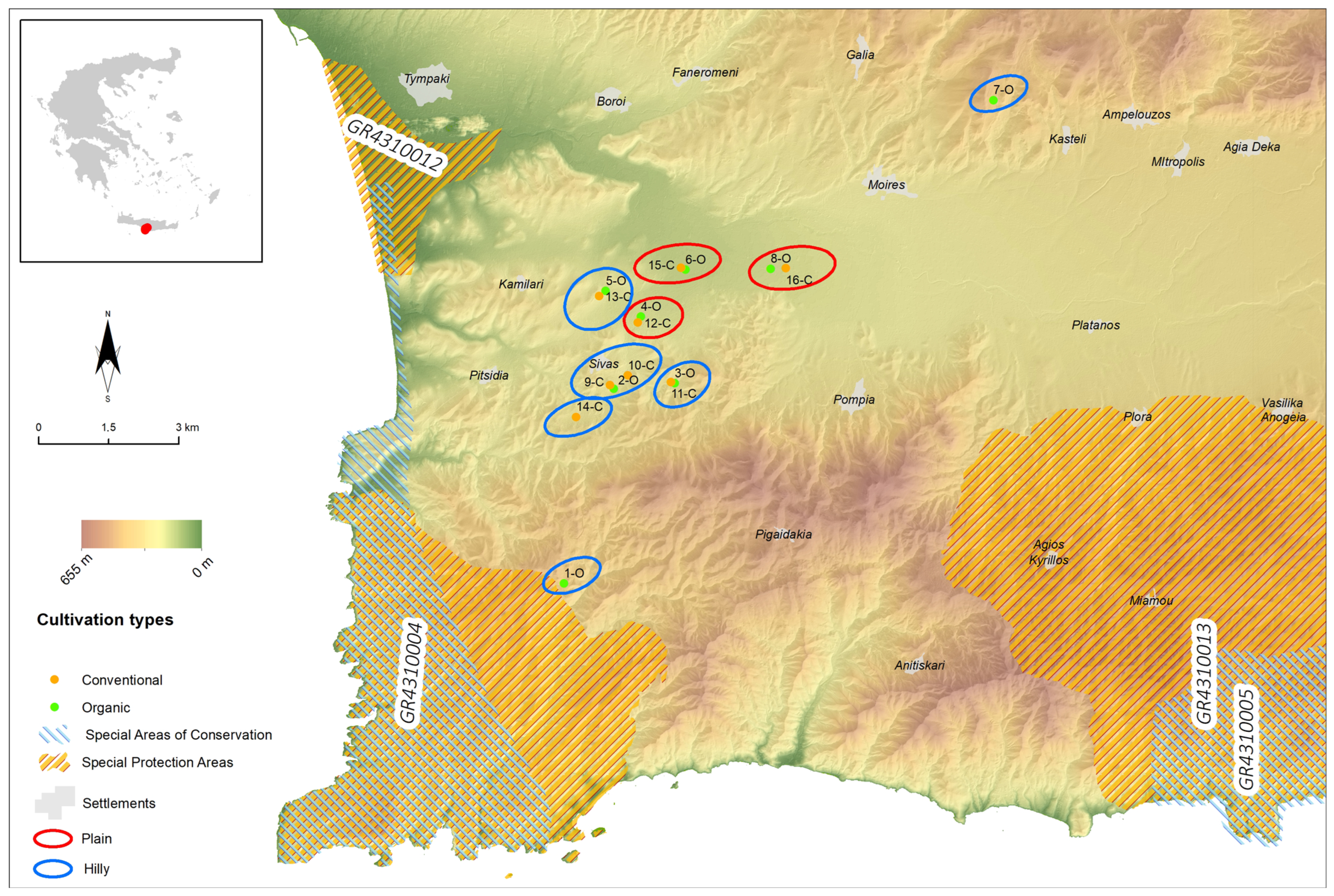
The survey was conducted in 16 selected olive orchards, eight of which implemented Green Infrastructure (GI) and complied with organic standards in accordance with European Union (EU) legislation (Regulation (EU) 2018/848) [53]. The remaining eight orchards followed the EU Common Agricultural Policy (CAP) framework for conventional farming. The organic orchards implementing Green Infrastructure incorporated both GI elements and agroecological management practices. For clarity, the selected olive orchards were assigned unique identification codes, with the letter “O” indicating organically managed orchards implementing Green Infrastructure (GI) and “C” indicating conventionally managed orchards. The orchards 4-O, 6-O, 8-O, 12-C, 15-C, and 16-C were located in the plain agroecological zone, whereas orchards 1-O, 2-O, 3-O, 5-O, 7-O, 9-C, 10-C, 11-C, 13-C, and 14-C were located in the hilly agroecological zone (Figure 1). Furthermore, the olive orchards were situated adjacent to Natura 2000 sites, including both Special Areas of Conservation (SACs) and Special Protection Areas (SPAs), and therefore they may provide important semi-natural habitats within the surrounding landscape.
Figure 1.
Geographical distribution of the 16 surveyed olive orchards in western Messara, Crete, Greece. The dots indicate the surveyed orchards. Ellipses represent the distinct locations of the surveyed olive orchards, and the agroecological zones are visualised by differentiation of ellipse colour.
The selected orchards ranged in size from 0.17 to 1.00 ha (mean: 0.53 ha), consistent with the small-scale structure of olive farming in Greece [54]. The total sampling area across all surveyed olive orchards was 8.0 ha. Orchards were selected following discussions with local stakeholders and on the basis of previous research carried out in the area [4,5,42,43,45,51,55,56]. The average distance between neighbouring orchards in each location was 150 m, and the minimum distance between orchard locations was 1 km. The average tree planting density was 7 × 7 m, corresponding to an average density of 204 trees ha−1.
The surveyed olive orchards were characterised by a herbaceous understory layer dominated by Oxalis pes-caprae and Capparis spinosa, with additional species belonging to the families Poaceae, Asteraceae, and Fabaceae [57]. The vegetation exhibited clear seasonal variation in both composition and species richness. During spring (wet season), mean species richness was 35 species per orchard, with Oxalis pes-caprae and grass species such as Cynodon dactylon and Avena spp. as the dominant taxa. During the dry season, mean species richness decreased to 10 species per orchard, and the vegetation was mainly composed of drought-tolerant species, including Capparis spinosa, Cynodon dactylon, Oloptum miliaceum, and Setaria verticillata. Ground vegetation height also varied seasonally and with orchard management practices. During the wet season, herbaceous vegetation was generally well developed, reaching approximately 20–40 cm in height. In contrast, during the dry season, vegetation height was typically reduced to around 10 cm due to seasonal drought and soil-cover management practices (e.g., mowing or tillage). Ground vegetation cover therefore varied among orchards in association with the management practices applied by individual farmers.
This research was conducted within the framework of the LIFE IGIC project “Improvement of Green Infrastructure in agroecosystems: reconnecting natural areas by countering habitat fragmentation (LIFE16 NAT/GR/000575)” [12].
2.2. Ant Sampling and Identification
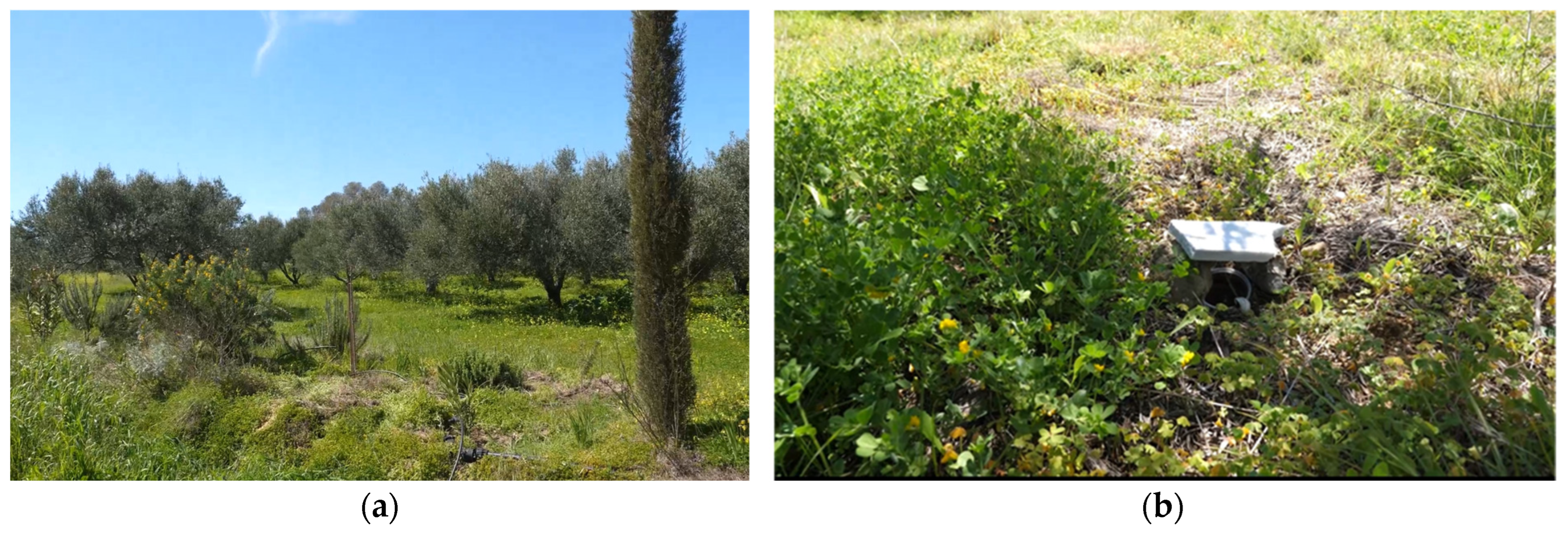
Ant specimens were collected monthly using pitfall traps over a two-year period (March 2023–February 2025). Within the 16 sampling orchards, permanent monitoring stations were randomly established at a density of 10 stations per hectare, with a minimum of five stations per orchard. Each sampling station consisted of one pitfall trap (Figure 2). Traps were installed beneath the canopy of olive trees to obtain a representative sample of ground-dwelling ants, following the methodology used in previous studies [4,6,7]. The distance between traps within each orchard ranged from 25 to 50 m, depending on orchard size [58]. The traps were colourless plastic containers measuring 9 cm in diameter and 12 cm in height, covered with a protective roof (stone tile), filled with propylene glycol, and installed flush with the soil surface with minimal terrain disturbance. Protective roofs were used to reduce the removal of captured specimens by predators and to prevent flooding during rainfall. Each pitfall trap remained at the same sampling station and was replaced with a new trap monthly throughout the study period. In total, 24 surveys were conducted. The samples were transported to the laboratory and sieved to remove debris and inorganic materials.
Figure 2.
(a) Olive orchard with Green Infrastructure (GI); (b) pitfall trap used for ant sampling © LOVAPS Lab, HMU.
Specimens were identified using a stereomicroscope (Olympus DSX1000 digital microscope) (Olympus Corporation, Tokyo, Japan) based on morphological characteristics and following the identification keys of Borowiec and Salata [59,60,61,62]. Ant specimens were collected and identified by the research team, with species-level identification performed by A.L.
To characterise the functional diversity of ants in olive orchard agroecosystems, species were assigned to functional groups according to the classification system developed by Hoffmann and Andersen [63]. Each species was assigned to the functional group associated with its genus in the published classification. The functional-group classification proposed by Hoffmann and Andersen has been widely applied in ecological studies of ant communities as a framework for analysing community structure and responses to environmental disturbance and facilitating comparisons among studies [64,65,66,67]. No new functional group assignments were developed in the present study.
2.3. Data Analysis
Data collected during each survey were organised and analysed using Microsoft Excel (Microsoft Office). Descriptive statistics were used to calculate species richness and relative abundance for each orchard, as well as total species abundance for each management system and agroecological zone.
Species frequency was calculated using Equation (1):
Species Frequency (%) = (Number of olive orchards in which a taxon occurred/Total number of olive orchards surveyed) × 100
Relative species abundance was calculated using Equation (2):
Relative species abundance = (Number of individuals of a taxon/Total number of ant individuals) × 100
Total abundance was calculated for each management system (MS) and agroecological zone (AZ) using Equations (3) and (4), respectively:
Total abundance of each MS = Number of individuals recorded in each management system (organic/GI, conventional)
Total abundance of each AZ = Number of individuals recorded in each agroecological zone (hilly, plain)
Different analytical units and levels of data aggregation were used according to the ecological response variable. For ant worker captures and species richness, the analytical unit was the individual pitfall-trap at each monthly sampling-occasion (month x year) level. Because the same traps were sampled repeatedly throughout the study, these observations represented repeated measurements over time, with trap identity nested within orchard identity accounted for in the statistical models. For effective Shannon diversity, exp(H′), all valid trap samples collected during the 24 monthly sampling occasions were pooled within each orchard to obtain one cumulative species-abundance vector per orchard; therefore, the orchard was the analytical unit. Exponential Shannon diversity, exp(H′), was evaluated cumulatively at the orchard level, as follows:
where pi is the relative abundance of species i, and S is the total number of species in the assemblage. Unlike Shannon entropy (H′), exp(H′) is expressed as the effective number of equally abundant species. For sample-based γ-diversity, each valid pitfall-trap sample at each monthly sampling occasion was treated as an incidence sampling unit, with worker counts converted to species presence/absence. For species composition, all valid trap samples and monthly sampling occasions were pooled within each orchard to obtain one cumulative species presence/absence assemblage; therefore, the orchard was the analytical unit.
Ant worker captures were analysed using negative-binomial generalised linear mixed models (NB2 GLMMs), while species richness was analysed using generalised Poisson GLMMs, both with a log link. For comparisons between management systems and agroecological zones, the corresponding explanatory variables and sampling occasion were included as fixed effects. Sampling occasion was defined by the 24 monthly sampling occasions spanning the study period. Orchard identity and trap identity nested within orchard were included as random intercepts to account for the hierarchical and repeated-measures structure of the data. Sampling-year effects were analysed using year and month as fixed effects with the same random-effects structure. Pairwise contrasts were expressed as response ratios with 95% confidence intervals.
Effective Shannon diversity was expressed as exp(H′), corresponding to the Hill number of order q = 1. All valid monthly trap samples were pooled within each orchard to obtain one cumulative species-abundance vector per orchard, from which exp(H′) was calculated. For management-system and agroecological-zone comparisons, exp(H′) values were compared using independent-samples Student’s t-tests. For sampling-year comparisons, cumulative species-abundance vectors were calculated separately for each orchard and year, and the resulting paired exp(H′) values were compared using a Wilcoxon signed-rank test.
The proportional representation of major functional groups of ants was analysed using beta-binomial GLMMs with a logit link. Analyses were restricted to non-empty pitfall-trap samples. For each functional group, the responses were formulated as the number of workers belonging to that given group versus the number of workers belonging to all other functional groups in the same sample. Management system and sampling occasion were included as fixed effects, while orchard identity and trap identity nested within orchard identity were included as random intercepts. Contrasts were expressed as odds ratios with 95% confidence intervals.
Sample-based γ-diversity was compared between organic and conventional management systems and between hilly and plain agroecological zones using iNEXT. Each valid pitfall-trap sample at each sampling occasion represented an incidence sampling unit, and worker counts were converted to species incidence (presence/absence). Completely missing trap samples that were lost or damaged were excluded from the analysis.
Species composition was analysed at the orchard level. All valid trap samples and monthly sampling occasions were pooled within each orchard, and species records were converted to presence/absence. Jaccard dissimilarities were calculated and used for two-dimensional non-metric multidimensional scaling NMDS ordination to visualise differences in species composition. Separate PERMANOVA analyses were conducted to test the effects of management system and agroecological zone, using 9999 permutations. Homogeneity of multivariate dispersion was evaluated using PERMDISP to determine whether differences detected by PERMANOVA could be attributable to differences in within-group dispersion.
All statistical analyses were performed in R (R Core Team, Vienna, Austria; version 4.6.0), using the packages glmmTMB, vegan, emmeans, DHARMa, and iNEXT, and statistical significance was accepted at p < 0.05.
3. Results
A total of 32 species belonging to 12 genera were recorded in the 16 olive orchards (Table 1, Figure 2). Functional-group composition was dominated by Opportunists (OPP) and Generalised Myrmicinae (GM), which together accounted for the largest proportion of total ant abundance. Subordinate Camponotini (SC), Dominant Dolichoderinae (DD), and Hot Climate Specialists (HCS) were also frequently recorded and showed intermediate levels of abundance. In contrast, cryptic species (CRY) and Cold Climate Specialists (CCS) were represented by fewer species and lower abundances and occurred in fewer of the surveyed orchards.
Table 1.
Occurrence, total abundance, relative abundance, frequency, and functional groups of ant species recorded across the 16 olive orchards.
3.1. Taxonomic and Ecological Remarks
3.1.1. Subfamily Myrmicinae
Genus Aphaenogaster Mayr, 1853
Aphaenogaster simonellii (Emery, 1894)—native species: The most common species recorded in olive orchards. It nests in the soil under the canopies of olive trees. Workers forage individually on the ground, among herbaceous vegetation, and at the bases of trees and shrubs. Workers were observed accumulating olive petals around their nests. It is an opportunistic species that feeds on dead and live arthropods and seeds [68].
Aphaenogaster rugosoferruginea Forel, 1889—endemic species: A diurnal species associated with shaded habitats, such as limestone gorges and deciduous forests [60]. Small numbers of workers were recorded primarily in plain olive orchards (Table 1).
Aphaenogaster subterraneoides (Emery, 1881)—native species: A cryptic species that is considered to be nocturnally active and strongly associated with forest habitats across a wide altitudinal range, from 7 to 1120 m [60]. Small numbers of workers were recorded in 11 of the 16 olive orchards (Table 1). Notably, the species reached its highest abundance in olive orchards during winter.
Genus Cardiocondyla Emery, 1869
Cardiocondyla dalmatica (Soudek, 1925)—native species: A strongly thermophilous species associated with sandy and gravel beaches and pine forests, mainly at low altitudes from 0 to 258 m [60]. According to Seifert [69], C. dalmatica is largely zoophagous and visits nectaries. It behaves submissively and cryptically compared to other ant species. Small numbers of workers were recorded in five olive orchards in Messara Valley (Table 1).
Genus Chalepoxenus Menozzi, 1923
Chalepoxenus muellerianus (Finzi, 1922)—native species: In Crete, it was previously recorded as Temnothorax muellerianus [61,62]. It is a social parasite that retains a worker caste. In Crete, it has been recorded from nests of various Temnothorax species, including T. exilis and T. recedens [60,61]. This species was recorded in eight olive orchards in Messara Valley (Table 1).
Genus Crematogaster Lund, 1831
Crematogaster sordidula (Nylander, 1849)—native species: A thermophilous species that is strongly associated with olive trees, nesting in the soil or under stones [60].
Crematogaster ionia complex—native species: A thermophilous species with an arboreal lifestyle that is strongly associated with trees and shrubs across a variety of habitats. It nests in the wood of decaying trees and shrubs. Workers are generalist omnivores and exhibit aggressive behaviour when trunks and branches are disturbed by potential predators or observers [60,70]. It is very common in olive orchard agroecosystems and nests inside the trunks of olive trees with decaying cores.
Genus Messor Forel, 1890
Messor wasmanni (Krausse, 1910)—native species: A harvester ant species that is very common in open habitats, both natural and anthropogenic. It nests directly in the soil [60]. In olive orchards, nests are highly conspicuous, as workers clear vegetation surrounding the entrance and create radial foraging trails extending from the nest entrance to the feeding areas.
Messor mcarthuri (Steiner et al., 2018)—native species: A common species in olive orchard agroecosystems, avoiding anthropogenically disturbed habitats, such as urban areas and tourist resorts, and showing a preference for xerothermic environments [60]. Workers are primarily active during the early morning and evening hours. Colonies construct large nests, typically surrounded by sparse plant debris at the nest entrance.
Genus Monomorium Mayr, 1855
Monomorium creticum (Emery, 1895)—endemic species: A thermophilous species [61]. It was one of the most abundant species, and was found in all olive orchards in the Messara Valley (Table 1).
Monomorium bicolor (Emery, 1877)—exotic species: A highly xerothermophilous species strongly associated with regions characterised by intensive tourism activity [60]. This species was recorded in four olive orchards in the Messara Valley, with the highest abundance recorded in plain orchard 12-C.
Genus Pheidole Westwood, 1839
Pheidole pallidula complex—native species: A highly thermophilous species associated with both natural and anthropogenic environments [61]. It is one of the most common ant species in Greece and was also among the most common and abundant species recorded in the olive orchards of the Messara Valley (Table 1).
Genus Solenopsis Westwood, 1840
Solenopsis cf. santschii (Forel, 1905)—native species: A cryptic and rare, highly thermophilous species that nests under stones [60,61]. Small numbers of workers were recorded in three olive orchards in the Messara Valley (Table 1).
Genus Strumigenys Smith, F., 1860
Strumigenys membranifera (Emery, 1869)—exotic species: A cryptic species and specialised predator that feeds on soft-bodied arthropods, such as Collembola. A strongly synanthropic ant, it is almost always recorded in degraded and anthropogenic environments [60]. The species reproduces asexually through thelytokous parthenogenesis [71]. This is the first record of both workers and alate queens of S. membranifera from olive orchards agroecosystems in the Messara Valley [72].
Genus Temnothorax Mayr, 1861
Temnothorax exilis (Emery, 1869)—native species: A xerothermophilous species strongly associated with phrygana habitats in Crete [62]. Small numbers of workers were recorded in four of the 16 olive orchards in the Messara Valley (Table 1).
Genus Tetramorium Mayr, 1855
Tetramorium hippocratis (Agosti & Collingwood, 1987)—native species: An opportunistic species that is very common in olive orchard agroecosystems. It prefers open and arid habitats and constructs its nests in dry, sandy soil [61].
Tetramorium kephalosi (Borowiec & Salata, 2017)—native species: A very common polymorphic species associated with phrygana [61].
Tetramorium punctatum (Santschi, 1927)—native species: A common species in olive orchards. It is associated with open and arid environments, particularly phrygana habitats [61].
Genus Trichomyrmex Mayr, 1865
Trichomyrmex perplexus (Radchenko, 1997)—native species: A highly thermophilous species that thrives in open oak woodlands, seashores with phrygana, pastures, and urban parks [60]. In the Messara Valley, it was recorded only in hilly olive orchards adjacent to natural areas dominated by phrygana and macchia. Additional pitfall traps established in the adjacent natural areas also recorded high abundances of this species.
3.1.2. Subfamily Formicinae
Genus Camponotus Mayr, 1861
Camponotus baldaccii (Emery, 1908)—native species: A highly thermophilous species that is often observed in pastures with phrygana, limestone gorges, and pine forests, but also forages in tourist resorts and villages on fig trees in search of honeydew-producing aphids and coccids [59]. It was one of the most common species recorded in the olive orchards of the Messara Valley. It foraged both on the ground and on olive trees.
Camponotus kiesenwetteri (Roger, 1859)—native species: A thermophilous species strongly associated with pine forests [59]. In the present study, it was a common species recorded in olive orchard agroecosystems and was mainly observed foraging on olive trees.
Camponotus lateralis (Olivier, 1792)—native species: An arboreal species that was recorded in several olive orchards in the Messara Valley. This species is strongly associated with a variety of natural habitats, including coniferous forests, deciduous trees, and shrubs [59].
Camponotus gestroi (Emery, 1878)—native species: A thermophilous species associated with various Mediterranean habitats [59]. In the olive orchards of the Messara Valley, it was observed foraging on olive tree branches and on the flowers of spontaneous vegetation.
Camponotus candiotes (Emery, 1894)—native species: A thermophilous species with an arboreal lifestyle [59]. Foraging workers were observed on the trunks and branches of olive trees.
Genus Lasius Fabricius, 1804
Lasius creticus (Seifert, 2020)—native species: A thermophilous species associated with deciduous forests, typically occurring in stream valleys [59,61].
Genus Lepisiota Santschi, 1926
Lepisiota nigra (Dalla Torre, 1893)—native species: A thermophilous species that is very common in olive orchard agroecosystems [59]. In the present study, it was observed foraging in high numbers on the flowers of Capparis spinosa in olive orchard agroecosystems in the Messara Valley.
Lepisiota frauenfeldi (Mayr, 1855)—native species: It is a very common species associated with open and dry habitats [61]. At the beginning of the survey, workers were mistakenly identified as young workers of L. nigra, because their cuticle had not yet fully sclerotised. L.frauenfeldi was subsequently identified in two orchards; however, reliable abundance and frequency data could not be provided across all olive orchards.
Genus Plagiolepis Mayr, 1861
Plagiolepis pallescens (Forel, 1889)—native species: A thermophilous species that is very abundant in olive orchard agroecosystems [59]. In the present study, it was observed nesting under stones and artificial structures, such as pitfall traps. It was also commonly observed foraging on olive tree trunks.
Plagiolepis pygmaea (Latreille, 1798)—native species: A thermophilous species that is very abundant in olive orchard agroecosystems [59]. In the present study, it was observed nesting under stones and was also commonly observed foraging on the olive trees.
3.1.3. Subfamily Dolichoderinae
Genus Tapinoma Foerster, 1850
Tapinoma simrothi (Krausse, 1911)—native species: A small to moderately polymorphic, highly thermophilous species that prefers sun-exposed habitats [59]. In the Messara Valley, this species was recorded in high numbers in hilly olive orchards (Table 1).
3.1.4. Subfamily Ponerinae
Genus Cryptopone Emery, 1893
Cryptopone ochracea (Mayr, 1855)—native species: A cryptic species [63]. In Messara, only four alate queens were recorded in a single olive orchard characterised by rocky terrain.
Genus Hypoponera Santschi, 1938
Hypoponera eduardi (Forel, 1894)—native species: A cryptic ground-dwelling species [63]. It was recorded in four olive orchards in the Messara Valley (Table 1).
3.2. Effects of Management System, Agroecological Zone and Sampling Year on Ant Worker Captures and Diversity
Management system did not significantly affect ant worker captures (response ratio = 1.087, 95% CI: 0.749–1.579, and p = 0.660) and species richness (response ratio = 1.047, 95% CI: 0.903–1.213, and p = 0.546). In contrast, the effective Shannon diversity index [exp(H′)] was statistically significantly higher in organic (5.553 ± 0.253) than in conventional orchards (4.615 ± 0.332; Student’s t-test: t = 2.249, p = 0.041).
The agroecological zone had a statistically significant effect on ant worker captures, with higher captures in hilly than in plain orchards (response ratio = 1.517, 95% CI: 1.091–2.110, p = 0.013). In contrast, species richness did not differ significantly between hilly and plain orchards (response ratio = 1.110, 95% CI: 0.960–1.284, p = 0.159). Similarly, the effective Shannon diversity [exp(H’)] did not differ between hilly (5.074 ± 0.231) and plain orchards (5.102 ± 0.530; Student’s t-test: t = −0.055, p = 0.957).
Significant differences between sampling years were detected for both ant worker captures and species richness. Worker captures were approximately twice as high in Year 2 as in Year 1 (response ratio = 2.00, 95% CI: 1.83–2.20, and p < 0.0001), while species richness was higher in Year 2 (response ratio = 1.21, 95% CI: 1.16–1.26, and p < 0.0001). However, the effective Shannon diversity [exp(H′)] did not differ significantly between years, with values of 4.738 ± 0.280 in Year 1 and 5.021 ± 0.235 in Year 2 (Wilcoxon signed-rank test: V = 94, p = 0.187) (Table 2).
Table 2.
The effect of management system, agroecological zone, and sampling year on ant worker captures, species richness, and effective Shannon diversity [exp(H’)].
3.3. Gamma Diversity and Species Composition
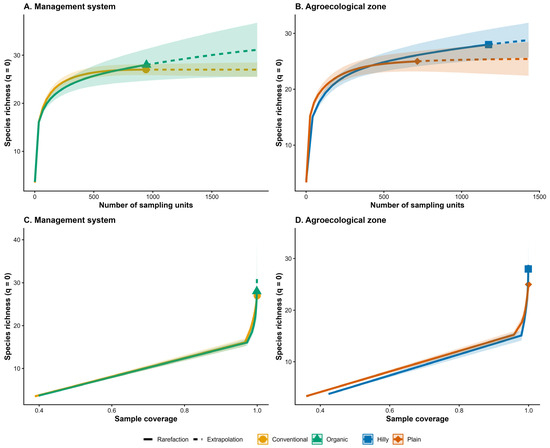
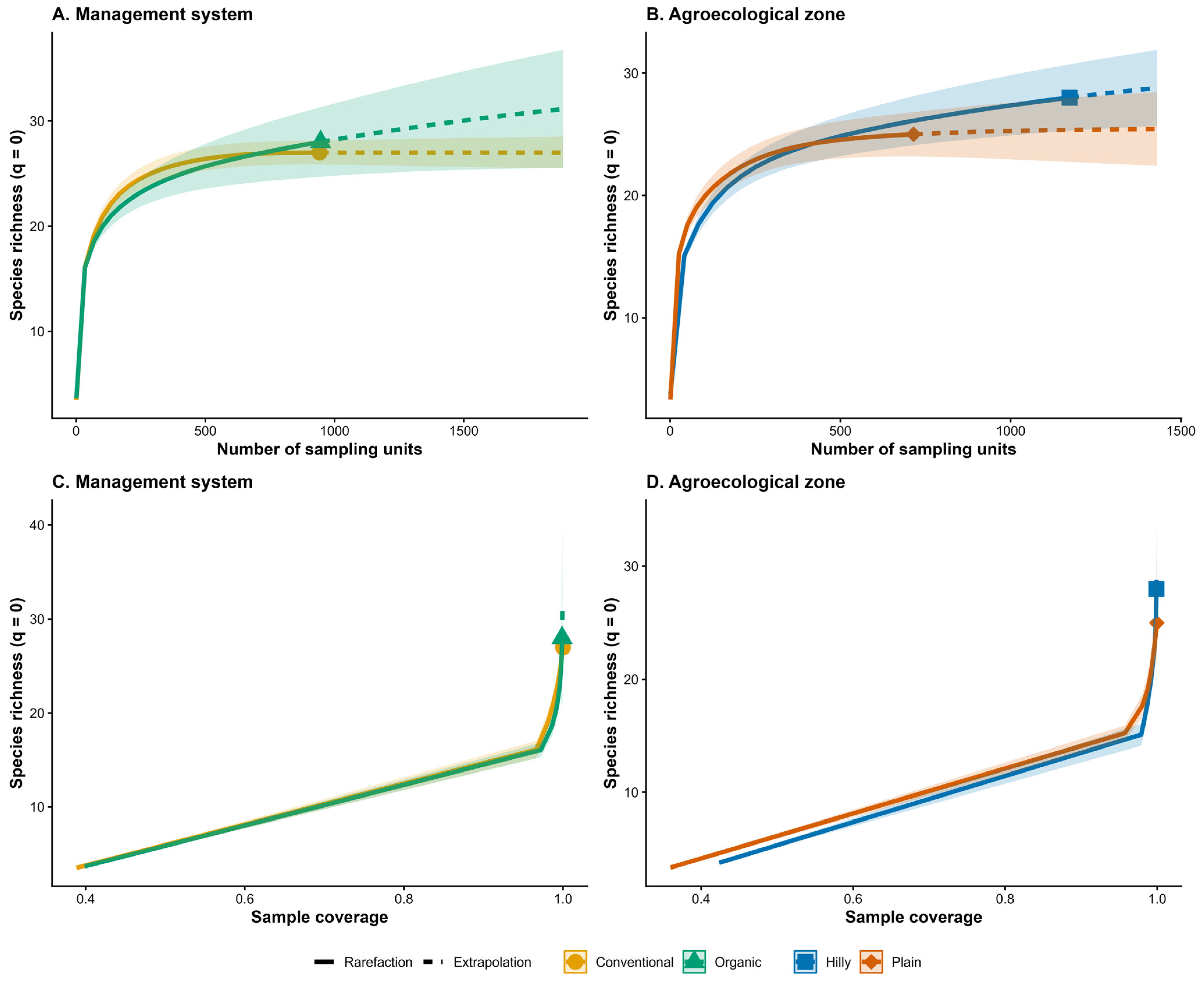
Sample-based rarefaction and extrapolation showed broadly similar γ-diversity between organic and conventional orchards and between agroecological zones (Figure 3). Species accumulation curves converged towards similar levels of species richness and showed substantial overlap in their 95% confidence intervals. Likewise, coverage-based rarefaction and extrapolation showed substantial overlap between organic and conventional orchards and between hilly and plain orchards, particularly at high sample coverage, providing no clear evidence of differences in ant species richness associated with either management system or agroecological zone.
Figure 3.
Sample-size- and coverage-based rarefaction and extrapolation of ant γ-diversity (species richness; q = 0) according to management system and agroecological zone. Panels (A,B) show sample-size-based rarefaction and extrapolation for management system and agroecological zone, respectively, whereas panels (C,D) show the corresponding coverage-based curves. Solid and dashed lines represent rarefaction and extrapolation, respectively, and shaded areas indicate 95% confidence intervals. Each sampling unit corresponds to one valid pitfall-trap sample at one monthly sampling occasion.
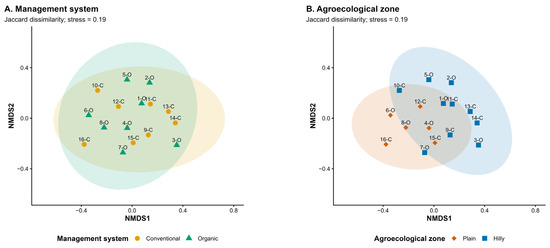
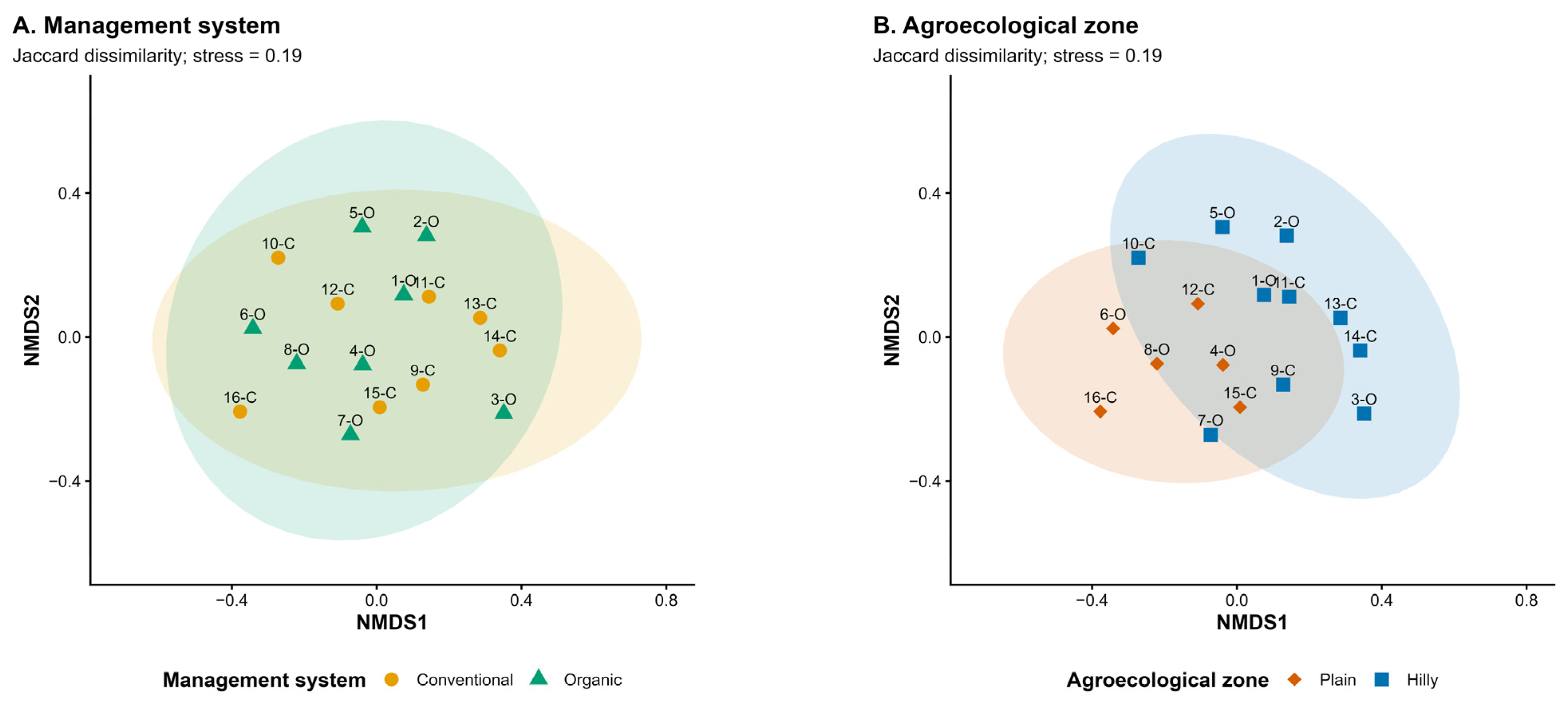
Ant species composition did not differ significantly between organic and conventional orchards (PERMANOVA: pseudo-F = 0.724, R2 = 0.049, and p = 0.706). Management systems accounted for 4.9% of the variation in species composition. Consistent with this result, the NMDS ordination showed extensive overlap between management systems (Figure 4; stress = 0.19). Multivariate dispersion did not differ between management systems (PERMDISP: F = 0.165, p = 0.691), indicating comparable within-group dispersion.
Figure 4.
Non-metric multidimensional scaling (NMDS) ordination of ant species composition in olive orchard agroecosystems according to (A). Management system and (B). Agroecological zone.
In contrast, ant species composition differed statistically significantly between agroecological zones (PERMANOVA: pseudo-F = 2.491, R2 = 0.151, and p = 0.009), with agroecological zone accounting for approximately 15% of the variation in species composition. Multivariate dispersion did not differ significantly between plain and hilly orchards (PERMDISP: F = 1.319, p = 0.286), indicating that the detected compositional difference was not attributable to unequal within-group dispersion. The two-dimensional non-metric multidimensional scaling (NMDS) ordination (stress = 0.190) illustrated the compositional patterns among orchards (Figure 4).
3.4. Functional-Group Responses to Management System
The relative representation of the major ant functional groups did not differ significantly between organic and conventional orchards. The estimated proportion of Opportunists (OPP) was 54.3% in organic and 53.6% in conventional orchards, with no significant effect of management system (OR = 1.028, 95% CI: 0.546–1.933, and p = 0.932). Similarly, the estimated proportion of Generalised Myrmicinae (GM) was 24.6% in organic and 25.2% in conventional orchards, with no significant difference between management systems (OR = 0.970, 95% CI: 0.403–2.332, and p = 0.945).
4. Discussion
We present the first species-level account of ant communities in Greek olive orchard agroecosystems, based on a comprehensive survey conducted in the Messara Valley, Crete. To our knowledge, this is the first published study to provide a species- and functional-group-level assessment of ant communities in Greek olive orchards. Comprehensive studies of the ant fauna of Crete [61,62,73,74] have shown that ants occur across a wide range of habitats; however, no previous survey has specifically examined ant communities in olive orchards at this spatial and temporal scale, either elsewhere in Greece or within the present study area.
The present study provides the first quantitative comparison of ant assemblages in organic and conventional olive orchards in Crete based on a two-year survey. Although total ant worker captures and species richness did not differ significantly between management systems, Green-Infrastructure (GI)-enhanced organic orchards had statistically significantly higher effective Shannon diversity than conventional orchards. These results suggest that the higher effective Shannon diversity was more likely related to differences in the relative abundance of species than to species richness. This pattern is consistent with properties of effective Shannon diversity, exp(H′), which incorporates both species richness and the relative abundance of species and is therefore more sensitive to changes in community structure [75].
Importantly, the additional analyses of sample-based γ-diversity (species richness) and species composition support this interpretation while providing a broader perspective on the effects of management systems. Sample-based rarefaction and extrapolation revealed broadly similar sample-based γ-diversity between organic and conventional orchards, with substantial overlap in the 95% confidence intervals, indicating no clear management-related difference in ant species richness between the two orchard management systems. Likewise, species composition did not differ significantly between management systems. Thus, organic and conventional orchards supported broadly similar levels of species richness and taxonomic composition, while differing in effective Shannon diversity. Taken together, these results suggest that the difference detected in effective Shannon diversity, exp(H′), was not primarily associated with differences in species richness or overall composition, but more likely reflected differences in relative abundances and dominance structure. Such contrasting responses among biodiversity components are consistent with previous studies showing that management systems can modify the taxonomic and functional structure of ant communities rather than simply increasing the number of species [76,77,78,79].
Agroecological zones showed a different pattern from that observed for management systems. Ant worker captures were significantly higher in hilly than in plain orchards, whereas neither species richness nor effective Shannon diversity differed significantly between agroecological zones. The sample-based γ-diversity analyses, including sample-size and coverage-based rarefaction and extrapolation, did not provide clear evidence of a substantial difference in overall species richness between hilly and plain orchards. However, despite their similar richness, the two agroecological zones supported significantly different species assemblages. Thus, the effect of agroecological zone appears to involve changes in species identity and assemblage structure rather than simply an increase or decrease in the total number of species. Similar compositional responses of ant communities to environmental and elevational gradients have been reported in other Mediterranean ecosystems, where elevation, vegetation structure, and associated environmental conditions have been identified as important drivers of ant assemblage composition [80,81].
A comparable pattern has been reported for soil arthropod communities in Cretan olive orchards. Species richness did not differ between agroecological zones, whereas Shannon diversity was higher in hilly orchards during spring, and functional arthropod abundance also tended to be higher in hilly sites [56]. Furthermore, Gkisakis et al. [42] suggested that climatic conditions, soil management, and landscape characteristics explained a greater proportion of the variation in arthropod communities than agroecological zone (AZ) itself. This finding indicates that topography may act as a surrogate for broader environmental gradients rather than as a direct driver of biodiversity patterns.
Temporal comparisons revealed a marked increase in total ant worker captures during the second sampling year, and species richness was also higher in the second year. In contrast, effective Shannon diversity remained relatively stable between years. These findings suggest that, in Mediterranean arthropod communities, interannual variation often reflects changes in abundance and activity and, in some cases, species richness without producing a corresponding change in the effective diversity. However, community composition may still shift in response to climatic conditions, disturbance, and sampling scale [82].
Our survey recorded 32 ant species occurring in olive orchard agroecosystems, with species richness ranging from 10 to 20 taxa per orchard (mean = 16.5). This represents approximately 30% of the 108 species currently recorded in Crete [59,60,61,72,83,84,85,86] and about 10% of the approximately 329 ant species and subspecies known in Greece [73,87,88,89,90,91,92]. The species with the highest abundance and widest distribution across all surveyed olive orchards were Aphaenogaster simonellii (Emery, 1894), Pheidole pallidula complex, and the endemic Monomorium creticum (Emery, 1895). High abundance and frequency of occurrence were also recorded for species such as Camponotus baldaccii (Emery, 1908), Tapinoma simrothi (Krausse, 1911), Lepisiota nigra (Dalla Torre, 1893), and Messor wasmanni (Krausse, 1910). Species of the genera Tetramorium and Plagiolepis were common across all the surveyed orchards. The presence of species associated with open habitats such as phrygana, as well as forests, and other natural habitats, such as Aphaenogaster subterraneoides (Emery, 1881), Hypoponera eduardi (Forel, 1894) [59,60], and Temnothorax exilis (Emery, 1869) [62], suggests that GI-enhanced olive orchards may contribute to ecological connectivity between adjacent protected natural areas and the wider agricultural landscape. Because pitfall traps primarily sample ground-dwelling ants, strictly arboreal species may be underrepresented; therefore, the present results mainly reflect the ground-active component of the ant community.
Comparison with previous studies from Mediterranean olive-growing regions suggests that the ant assemblages recorded in the present study are broadly representative of those associated with Mediterranean olive agroecosystems. Previous studies conducted in Spain, Italy, Portugal, and Algeria have reported between 11 and 58 ant species, depending on the number of orchards surveyed, the sampling duration, and the collection methods employed [6,21,22,30,33,35,79,93,94,95,96]. However, these comparisons should be interpreted cautiously because published studies differ considerably in sampling duration, sampling effort, the number of orchards surveyed, and collection methods.
In terms of functional groups, although pitfall trapping tends to overrepresent the activity density of highly active functional groups such as Opportunists (OPP) and Generalised Myrmicinae (GM), because species with higher surface activity are more likely to be captured [97], the predominance of these groups should be interpreted with caution. The presence of cryptic species (CRY) and Cold Climate Specialists (CCS) may indicate the availability of less disturbed or relatively stable habitats. As noted by Andersen [98], these specialised groups are highly sensitive to soil disturbance; thus, their persistence in olive orchards may reflect the presence of stable microhabitats or areas subjected to less intensive management within the olive orchard agroecosystem. The proportion of the major functional groups did not differ between organic and conventional orchards, with no management effect detected for either Opportunists or Generalised Myrmicinae. Nevertheless, the predominance of Opportunists (OPP) and Generalised Myrmicinae (GM) observed in the present study is consistent with previous reports from Mediterranean olive agroecosystems [35,94], suggesting that Cretan olive orchards support ant communities with a functional structure similar to that described elsewhere in the Mediterranean Basin.
Finally, two exotic ant species, Monomorium bicolor (Emery, 1877) of Afrotropical origin and Strumigenys membranifera (Emery, 1869) of Sub-Saharan African origin, were recorded in the surveyed olive orchards. Both species have previously been recorded in Greece and are included in the updated checklist of alien ants established in the country [99,100]. M. bicolor is primarily associated with warm, xerothermic, and anthropogenically disturbed habitats, whereas S. membranifera is a cosmopolitan alien species typically associated with anthropogenic environments. Their occurrence in olive orchards indicates that these species can occur within olive orchard agroecosystems in Crete and highlights the potential for such habitats to support their persistence and potentially facilitate their spread.
5. Conclusions
Our study provides the first comprehensive species-level assessment of ant assemblages in olive orchards in the Messara Valley, Crete, establishing an important baseline for understanding ant diversity and community structure in Greek olive orchard agroecosystems. A total of 32 ant species were recorded, demonstrating that Cretan olive orchards support a diverse ant fauna, including both widespread Mediterranean taxa and species endemic to Crete.
Organic management was associated with significantly higher effective Shannon diversity than conventional management, whereas species richness and ant worker captures did not differ significantly between management systems. This difference in effective diversity was not accompanied by detectable differences in sample-based γ-diversity, species presence–absence composition, or the relative proportions of the major functional groups analysed, suggesting that organic and conventional orchards supported broadly similar ant assemblages while differing in the distribution of individuals among species. Agroecological zone was associated with differences in ant worker captures, which were higher in hilly orchards, but had no significant effect on species richness, effective Shannon diversity, or sample-based γ-diversity. In contrast, agroecological zone had a significant effect on ant species composition, indicating that differences between hilly and plain orchards were primarily associated with assemblage composition rather than overall species richness. Interannual variation significantly affected ant worker captures and species richness, with both increasing in the second sampling year, whereas effective Shannon diversity remained stable.
The presence of multiple functional groups, together with the consistent occurrence of species associated with natural habitats, indicates that olive orchard agroecosystems support a broad range of ecological strategies. Importantly, the occurrence of species associated with both open and forest habitats suggests that olive orchards implementing Green Infrastructure may contribute to ecological connectivity between adjacent Natura 2000 sites and the wider agricultural landscape. These findings highlight the dual role of olive orchards as both productive agricultural systems and habitats that support arthropod diversity, including diverse ant communities.
Overall, our findings suggest that promoting Green Infrastructure through the establishment of GI elements, the adoption of agroecological farming practices, low-intensity management, reduced synthetic chemical inputs, and the maintenance of habitat heterogeneity could strengthen the contribution of olive orchard agroecosystems to biodiversity conservation at the landscape scale in Crete and across the Mediterranean Basin.
Author Contributions
Conceptualization, A.M.L., D.K. and E.M.K.; methodology, A.M.L. and E.M.K.; software, A.M.L.; validation, A.M.L. and E.M.K.; formal analysis, A.M.L. and I.E.Z.; investigation, A.M.L., I.A.C. and I.E.Z.; resources, A.M.L., I.A.C., I.E.Z., D.K. and E.M.K.; data curation, A.M.L., I.A.C. and I.E.Z.; writing—original draft preparation, A.M.L., I.A.C., I.E.Z. and D.K. and E.M.K.; writing—review and editing, A.M.L., I.A.C., I.E.Z., D.K. and E.M.K.; visualisation, A.M.L. and I.E.Z.; supervision, E.M.K.; project administration, A.M.L. and E.M.K.; funding acquisition, E.M.K. All authors have read and agreed to the published version of the manuscript.
Funding
This research was funded by the European Union LIFE+ Nature and Biodiversity project: Improvement of green infrastructure (GI) in agroecosystems: reconnecting natural areas by countering habitat fragmentation (LIFE IGIC) (Grant number: LIFE16 NAT/GR/000575).
Institutional Review Board Statement
Not applicable.
Data Availability Statement
Data will be made available by the corresponding author upon reasonable request. The data form part of a larger dataset that is currently undergoing analysis and has not yet been published.
Acknowledgments
We thank the olive growers for granting access to their olive orchards for ant surveys. AML, DK, IZ, IAC, and EMK also thank Dimitris Poursanidis (IACM-FORTH) for designing Figure 1 and Christos Georgiadis (National and Kapodistrian University of Athens, Greece) for his contribution to the identification of specimens. We are grateful to the anonymous reviewers for their valuable and constructive comments on a previous version of this manuscript.
Conflicts of Interest
The authors declare no conflicts of interest. The funders had no role in the design of the study; in the collection, analysis, or interpretation of data; in the writing of the manuscript; or in the decision to publish the results.
Abbreviations
The following abbreviations are used in this manuscript:
| GI | Green infrastructure |
| EU | European Union |
| CAP | Common Agricultural Policy |
| MS | Management system |
| AZ | Agroecological zone |
| ND | No data available |
| O | Organic |
| C | Conventional |
| CRY | Cryptic species |
| CCS | Cold climate specialists |
| DD | Dominant Dolichoderinae |
| GM | Generalised Myrmicinae |
| HCS | Hot climate specialists |
| OPP | Opportunists |
| SC | Subordinate Camponotini |
| LOVAPS Lab | Laboratory of Olive, Vine & Agroecological Production Systems |
| HMU | Hellenic Mediterranean University |
References
- Loumou, A.; Giourga, C. Olive Groves: “The Life and Identity of the Mediterranean’’. Agric. Hum. Values 2003, 20, 87–95. [Google Scholar] [CrossRef] [Scilit]
- Abate, F.; Canitano, G.; Capasso, S.; Carotenuto, S.; Cruciani, S.; Di Filippo, F.; Forte, L.; Mirto, A.P.M.; Ricci, M.; Rossi, A. WeMed 2024. Society, Economy, and Environment in the MediterraneanWeMed 2024. Società, Economia e Ambiente nel Mediterraneo; National Research Council—Institute for Mediterranean Studies (CNR-ISMed): Naples, Italy, 2024. [Google Scholar]
- International Olive Council. World Market of Olive Oil and Table Olives—Data From December 2024; International Olive Council: Madrid, Spain, 2024. [Google Scholar]
- Gkisakis, V.; Volakakis, N.; Kollaros, D.; Bàrberi, P.; Kabourakis, E.M. Soil Arthropod Community in the Olive Agroecosystem: Determined by Environment and Farming Practices in Different Management Systems and Agroecological Zones. Agric. Ecosyst. Environ. 2016, 218, 178–189. [Google Scholar] [CrossRef] [Scilit]
- Gkisakis, V.D.; Bàrberi, P.; Kabourakis, E.M. Olive Canopy Arthropods under Organic, Integrated, and Conventional Management. The Effect of Farming Practices, Climate and Landscape. Agroecol. Sustain. Food Syst. 2018, 42, 843–858. [Google Scholar] [CrossRef] [Scilit]
- Gonçalves, M.F.; Pereira, J.A. Abundance and Diversity of Soil Arthropods in the Olive Grove Ecosystem. J. Insect Sci. 2012, 12, 20. [Google Scholar] [CrossRef] [Scilit]
- Stavrianakis, G.; Sentas, E.; Tscheulin, T.; Kizos, T. Does Biodiversity Affect Olive Fly Populations? Evidence from Different Understorey Treatments. Discov. Conserv. 2024, 1, 3. [Google Scholar] [CrossRef] [Scilit]
- Allen, H.D.; Randall, R.E.; Amable, G.S.; Devereux, B.J. The Impact of Changing Olive Cultivation Practices on the Ground Flora of Olive Groves in the Messara and Psiloritis Regions, Crete, Greece. Land Degrad. Dev. 2006, 17, 249–273. [Google Scholar] [CrossRef] [Scilit]
- European Commission. Communication from the Commission to the European Parliament, the Council, the European Economic and Social Committee and the Committee of the Regions: Green Infrastructure (GI)—Enhancing Europe’s Natural Capital; European Commission: Brussels, Belgium, 2013. [Google Scholar]
- Ogwu, M.C.; Kosoe, E.A. Integrating Green Infrastructure into Sustainable Agriculture to Enhance Soil Health, Biodiversity, and Microclimate Resilience. Sustainability 2025, 17, 3838. [Google Scholar] [CrossRef] [Scilit]
- Tzoulas, K.; Korpela, K.; Venn, S.; Yli-Pelkonen, V.; Kaźmierczak, A.; Niemela, J.; James, P. Promoting Ecosystem and Human Health in Urban Areas Using Green Infrastructure: A Literature Review. Landsc. Urban Plan. 2007, 81, 167–178. [Google Scholar] [CrossRef] [Scilit]
- Life IGIC. Available online: https://www.lifeigic.eu/en/ (accessed on 3 June 2026).
- Jerez-Valle, C.; García, P.A.; Campos, M.; Pascual, F. A Simple Bioindication Method to Discriminate Olive Orchard Management Types Using the Soil Arthropod Fauna. Appl. Soil Ecol. 2014, 76, 42–51. [Google Scholar] [CrossRef] [Scilit]
- Ng, K.; Nowrouzi, S.; Staunton, K.M.; Barton, P.; Driscoll, D.A. Ant Community Responses to Farmland Use and Revegetation in a Fragmented Agricultural Landscape. Agric. Ecosyst. Environ. 2021, 311, 107316. [Google Scholar] [CrossRef] [Scilit]
- Castellarini, F.; Cuezzo, F.; Luna Toledo, E.; Buffa, L.; Orecchia, E.; Visintín, A. Local and Landscape Drivers of Ground-Dwelling Ant Diversity in Agroecosystems of Dry Chaco. Agric. Ecosyst. Environ. 2024, 367, 108955. [Google Scholar] [CrossRef] [Scilit]
- Way, M.J.; Khoo, K.C. Role of Ants in Pest Management. Annu. Rev. Entomol. 1992, 37, 479–503. [Google Scholar] [CrossRef]
- Álvarez, H.A.; Clemente-Orta, G.; Ruano, F. Ants and Predators Cope with Pest Pressures by Interacting with the Surrounding Vegetation at Low Spatial Scales. J. Appl. Entomol. 2024, 148, 1187–1197. [Google Scholar] [CrossRef] [Scilit]
- Álvarez, H.A.; García-García, A.; Sandoval, P.; Martín-Blázquez, R.; Seifert, B.; Tinaut, A.; Ruano, F. Elucidating the Trophic Role of Tapinoma Ibericum (Hymenoptera: Formicidae) as a Potential Predator of Olive Pests. J. Appl. Entomol. 2023, 147, 667–675. [Google Scholar] [CrossRef] [Scilit]
- Álvarez, H.A.; Jiménez-Muñoz, R.; Morente, M.; Campos, M.; Ruano, F. Ground Cover Presence in Organic Olive Orchards Affects the Interaction of Natural Enemies against Prays Oleae, Promoting an Effective Egg Predation. Agric. Ecosyst. Environ. 2021, 315, 107441. [Google Scholar] [CrossRef] [Scilit]
- Giannetti, D.; Schifani, E.; Saccomano, M.; Grasso, D.A. Introducing 3D-Printed Oak Galls as Artificial Nests for Arboreal Ants, with First Results on Leaf Damage Reduction on Olive Trees. Myrmecol. News 2024, 34, 173–180. [Google Scholar] [CrossRef]
- Martínez-Núñez, C.; Rey, P.J.; Salido, T.; Manzaneda, A.J.; Camacho, F.M.; Isla, J. Ant Community Potential for Pest Control in Olive Groves: Management and Landscape Effects. Agric. Ecosyst. Environ. 2021, 305, 107185. [Google Scholar] [CrossRef] [Scilit]
- Morris, T.I.; Symondson, W.O.C.; Kidd, N.a.C.; Campos, M. The Effect of Different Ant Species on the Olive Moth, Prays Oleae (Bern.), in Spanish Olive Orchard. J. Appl. Entomol. 2002, 126, 224–230. [Google Scholar] [CrossRef] [Scilit]
- Dinis, A.M.; Pereira, J.A.; Pimenta, M.C.; Oliveira, J.; Benhadi-Marín, J.; Santos, S.A.P. Suppression of Bactrocera Oleae (Diptera: Tephritidae) Pupae by Soil Arthropods in the Olive Grove. J. Appl. Entomol. 2016, 140, 677–687. [Google Scholar] [CrossRef] [Scilit]
- Campolo, O.; Palmeri, V.; Malacrinò, A.; Laudani, F.; Castracani, C.; Mori, A.; Grasso, D.A. Interaction between Ants and the Mediterranean Fruit Fly: New Insights for Biological Control. Biol. Control 2015, 90, 120–127. [Google Scholar] [CrossRef] [Scilit]
- Urbaneja, A.; Marí, F.G.; Tortosa, D.; Navarro, C.; Vanaclocha, P.; Bargues, L.; Castañera, P. Influence of Ground Predators on the Survival of the Mediterranean Fruit Fly Pupae, Ceratitis Capitata, in Spanish Citrus Orchards. BioControl 2006, 51, 611–626. [Google Scholar] [CrossRef] [Scilit]
- Ortega, M.; Sánchez-Ramos, I.; González-Núñez, M.; Pascual, S. Time Course Study of Bactrocera Oleae ( D Iptera: T Ephritidae) Pupae Predation in Soil: The Effect of Landscape Structure and Soil Condition. Agric. For. Entomol. 2018, 20, 201–207. [Google Scholar] [CrossRef] [Scilit]
- Orsini, M.M.; Daane, K.M.; Sime, K.R.; Nelson, E.H. Mortality of Olive Fruit Fly Pupae in California. Biocontrol Sci. Technol. 2007, 17, 797–807. [Google Scholar] [CrossRef] [Scilit]
- Ottonetti, L.; Tucci, L.; Chelazzi, G.; Santini, G. Stable Isotopes Analysis to Assess the Trophic Role of Ants in a Mediterranean Agroecosystem. Agric. For. Entomol. 2008, 10, 29–36. [Google Scholar] [CrossRef] [Scilit]
- Frizzi, F.; Masoni, A.; Ottonetti, L.; Tucci, L.; Santini, G. Resource-Dependent Mutual Association with Sap-Feeders and a High Predation Rate in the Ant Crematogaster Scutellaris: Help or Harm in Olive Pest Control? BioControl 2020, 65, 601–611. [Google Scholar] [CrossRef] [Scilit]
- Redolfi, I.; Tinaut, A.; Pascual, F.; Campos, M. Qualitative Aspects of Myrmecocenosis (Hym., Formicidae) in Olive Orchards with Different Agricultural Management in Spain. J. Appl. Entomol. 1999, 123, 621–627. [Google Scholar] [CrossRef] [Scilit]
- Brown, G.; Scherber, C.; Ramos, P.; Ebrahim, E.K. The Effects of Harvester Ant (Messor Ebeninus Forel) Nests on Vegetation and Soil Properties in a Desert Dwarf Shrub Community in North-Eastern Arabia. Flora-Morphol. Distrib. Funct. Ecol. Plants 2012, 207, 503–511. [Google Scholar] [CrossRef] [Scilit]
- De Almeida, T.; Blight, O.; Mesléard, F.; Bulot, A.; Provost, E.; Dutoit, T. Harvester Ants as Ecological Engineers for Mediterranean Grassland Restoration: Impacts on Soil and Vegetation. Biol. Conserv. 2020, 245, 108547. [Google Scholar] [CrossRef] [Scilit]
- García-Navas, V.; Martínez-Núñez, C.; Tarifa, R.; Manzaneda, A.J.; Valera, F.; Salido, T.; Camacho, F.M.; Isla, J.; Rey, P.J. Agricultural Extensification Enhances Functional Diversity but Not Phylogenetic Diversity in Mediterranean Olive Groves: A Case Study with Ant and Bird Communities. Agric. Ecosyst. Environ. 2022, 324, 107708. [Google Scholar] [CrossRef] [Scilit]
- Pereira, J.A.; Bento, A.; Cabanas, J.E.; Torres, L.M.; Herz, A.; Hassan, S.A. Ants as Predators of the Egg Parasitoid Trichogramma Cacoeciae (Hymenoptera: Trichogrammatidae) Applied for Biological Control of the Olive Moth, Prays Oleae (Lepidoptera: Plutellidae) in Portugal. Biocontrol Sci. Technol. 2004, 14, 653–664. [Google Scholar] [CrossRef] [Scilit]
- Hamecha, L.; Barech, G.; Ahmed, D.A.; Khaldi, M.; Schifani, E.; Blatrix, R.; Cagniant, H. Estimating the Taxonomic Richness and Functional Structure of Ant Communities in Olive Groves of Kabylia, Algeria. Afr. J. Ecol. 2025, 63, e70106. [Google Scholar] [CrossRef] [Scilit]
- Stavrianakis, G.; Sentas, E.; Stattegger, S.R.; Tscheulin, T.; Kizos, T. Effect of Olive Grove’s Understorey Management on Arthropod Diversity. Agroecol. Sustain. Food Syst. 2024, 48, 1115–1138. [Google Scholar] [CrossRef] [Scilit]
- Alissandrakis, E.; Psirofonia, P.; Kavallieratos, N.G.; Stanković, S.S.; Žikić, V. Parasitic Wasps Related to Prays Oleae (Bernard, 1788) (Lepidoptera, Praydidae) in Olive Orchards in Greece. ZooKeys 2018, 773, 143–154. [Google Scholar] [CrossRef] [Scilit]
- Theodorou, D.; Koufakis, I.; Thanou, Z.; Kalaitzaki, A.; Chaldeou, E.; Afentoulis, D.; Tsagkarakis, A. Management System Affects the Occurrence, Diversity and Seasonal Fluctuation of Auchenorrhyncha, Potential Vectors of Xylella Fastidiosa, in the Olive Agroecosystem. Bull. Insect. 2021, 74, 27–40. [Google Scholar]
- Tsagkarakis, A.E.; Afentoulis, D.G.; Matared, M.; Thanou, Z.N.; Stamatakou, G.D.; Kalaitzaki, A.P.; Tzobanoglou, D.K.; Goumas, D.; Trantas, E.; Zarboutis, I.; et al. Identification and Seasonal Abundance of Auchenorrhyncha With a Focus on Potential Insect Vectors of Xylella Fastidiosa in Olive Orchards in Three Regions of Greece. J. Econ. Entomol. 2018, 111, 2536–2545. [Google Scholar] [CrossRef] [Scilit]
- Potts, S.G.; Petanidou, T.; Roberts, S.; O’Toole, C.; Hulbert, A.; Willmer, P. Plant-Pollinator Biodiversity and Pollination Services in a Complex Mediterranean Landscape. Biol. Conserv. 2006, 129, 519–529. [Google Scholar] [CrossRef] [Scilit]
- Stavrianakis, G.; Stattegger, S.R.; Sentas, E.; Tsamakda, A.; Grumic, I.; Tscheulin, T.; Kizos, A. Understorey Biodiversity Management in Olive Groves for Integrated Management of Olive Tree Natural Enemies. Entomol. Hell. 2023, 32, 17–24. [Google Scholar] [CrossRef] [Scilit]
- Gkisakis, V.D.; Kollaros, D.; Bàrberi, P.; Livieratos, I.C.; Kabourakis, E.M. Soil Arthropod Diversity in Organic, Integrated, and Conventional Olive Orchards and Different Agroecological Zones in Crete, Greece. Agroecol. Sustain. Food Syst. 2015, 39, 276–294. [Google Scholar] [CrossRef] [Scilit]
- Gkisakis, V.D.; Volakakis, N.G.; Kabourakis, E.M. Agroecological Zones as an Important Driver of Canopy Arthropod Community in Olive Agroecosystems. Biol. Control 2020, 149, 104319. [Google Scholar] [CrossRef] [Scilit]
- Karamaouna, F.; Kati, V.; Volakakis, N.; Varikou, K.; Garantonakis, N.; Economou, L.; Birouraki, A.; Markellou, E.; Liberopoulou, S.; Edwards, M. Ground Cover Management with Mixtures of Flowering Plants to Enhance Insect Pollinators and Natural Enemies of Pests in Olive Groves. Agric. Ecosyst. Environ. 2019, 274, 76–89. [Google Scholar] [CrossRef] [Scilit]
- Volakakis, N.G.; Eyre, M.D.; Kabourakis, E.M. Olive Fly Bactrocera Oleae (Diptera, Tephritidae) Activity and Fruit Infestation Under Mass Trapping in an Organic Table Olive Orchard in Crete, Greece. J. Sustain. Agric. 2012, 36, 683–698. [Google Scholar] [CrossRef] [Scilit]
- Volakakis, N.; Kabourakis, E.; Rempelos, L.; Kiritsakis, A.; Leifert, C. Effect of Different Cover Crops, Mass-Trapping Systems and Environmental Factors on Invertebrate Activity in Table Olive Orchards—Results from Field Experiments in Crete, Greece. Agronomy 2022, 12, 2576. [Google Scholar] [CrossRef] [Scilit]
- Angelioudakis, T.; Koliopoulos, G.; Stathakis, T. Effect of Cover Cropping on the Abundance, Community Composition and Functional Diversity of Ground-Dwelling Arthropods in a Mediterranean Olive Grove. Diversity 2025, 17, 621. [Google Scholar] [CrossRef] [Scilit]
- Michail, I.; Tsahatsanis, P.; Kontele, Β.; Karagianni, I.; Kolokitha, K.; Benista, G.; Gkisakis, V. Effect of Farming System on Ant Assemblages and Ground Cover Fauna in Greek Olive Groves. AGROFOR Int. J. 2024, 9, 58–67. [Google Scholar]
- Valdecasas, A.G.; Camacho, A.I. Conservation to the Rescue of Taxonomy. Biodivers. Conserv. 2003, 12, 1113–1117. [Google Scholar] [CrossRef] [Scilit]
- Patsios, S.I.; Kontogiannopoulos, K.N.; Banias, G.F. Environmental Impact Assessment in Agri-Production. In Bio-Economy and Agri-Production; Elsevier: Amsterdam, The Netherlands, 2021; pp. 83–116. [Google Scholar]
- Kabourakis, E. Prototyping and Dissemination of Ecological Olive Production Systems: A Methodology for Designing and a First Step Towards Validation and Dissemination of Prototype Ecological Olive Production Systems (EOPS) in Crete. Ph.D. Thesis, Wageningen Agricultural Universit, Wageningen, The Netherlands, 1996. [Google Scholar]
- Metzidakis, I.; Martinez-Vilela, A.; Castro Nieto, G.; Basso, B. Intensive Olive Orchards on Sloping Land: Good Water and Pest Management Are Essential. J. Environ. Manag. 2008, 89, 120–128. [Google Scholar] [CrossRef] [Scilit]
- European Union. Regulation (EU) 2018/848 of the European Parliament and of the Council of 30 May 2018 on Organic Production and Labelling of Organic Products and Repealing Council Regulation (EC) No 834/2007. Off. J. Eur. Union 2018, 150, 54. [Google Scholar]
- Chartzoulakis, K. A Historical and Social Insight of Olive Groves and Landscapes in Greece. In The Olive Landscapes of the Mediterranean; Muñoz-Rojas, J., García-Ruiz, R., Eds.; Landscape Series; Springer Nature: Cham, Switzerland, 2024; Volume 36, pp. 209–221. [Google Scholar]
- Kabourakis, E. Code of Practices for Ecological Olive Production Systems in Crete. Olivæ 1999, 77, 35–55. [Google Scholar]
- Gkisakis, V.D.; Kollaros, D.; Kabourakis, E.M. Soil Arthropod Biodiversity in Plain and Hilly Olive Orchard Agroecosystems, in Crete, Greece. Entomol. Hell. 2014, 23, 18–28. [Google Scholar] [CrossRef] [Scilit]
- Zografakis, I.E.; Avramakis, E.; Loulakis, A.M.; Chasourakis, I.A.; Vrachnakis, T.; Kollaros, D.; Kabourakis, E.M. Diversity of Vascular Flora in Organic and Conventional Olive Orchards in Crete, Greece. Diversity 2026, 18, 444. [Google Scholar] [CrossRef] [Scilit]
- Miliczky, E.R.; Horton, D.R. Densities of Beneficial Arthropods within Pear and Apple Orchards Affected by Distance from Adjacent Native Habitat and Association of Natural Enemies with Extra-Orchard Host Plants. Biol. Control 2005, 33, 249–259. [Google Scholar] [CrossRef] [Scilit]
- Borowiec, L.; Salata, S. A Monographic Review of Ants of Greece (Hymenoptera: Formicidae) Vol. 1. Introduction and Review of All Subfamilies Except the Subfamily Myrmicinae. Part 1: Text; Natural History Monographs of the Upper Silesian Museum; Upper Silesian Museum: Bytom, Poland, 2022. [Google Scholar]
- Borowiec, L.; Salata, S. A Monographic Review of Ants of Greece (Hymenoptera: Formicidae) Vol. 2. Review of the Subfamily Myrmicinae Except the Genera Temnothorax and Tetramorium Part 2: Plates; Natural History Monographs of the Upper Silesian Museum; Upper Silesian Museum: Bytom, Poland, 2025. [Google Scholar]
- Salata, S.; Borowiec, L.; Trichas, A. Review of Ants (Hymenoptera: Formicidae) of Crete, with Keys to Species Determination and Zoogeographical Remarks; Monographs of the Upper Silesian Museum; Upper Silesian Museum: Bytom, Poland, 2020. [Google Scholar]
- Salata, S.; Borowiec, L.; Trichas, A. Taxonomic Revision of the Cretan Fauna of the Genus Temnothorax Mayr, 1861 (Hymenoptera: Formicidae), with Notes on the Endemism of Ant Fauna of Crete. Ann. Zool. 2018, 68, 769–808. [Google Scholar] [CrossRef] [Scilit]
- Hoffmann, B.D.; Andersen, A.N. Patterns of European Ant Communities Reveal a Functionally Coherent Holarctic Fauna. Diversity 2023, 15, 341. [Google Scholar] [CrossRef] [Scilit]
- Hoffmann, B.D.; Andersen, A.N. Responses of Ants to Disturbance in Australia, with Particular Reference to Functional Groups. Austral Ecol. 2003, 28, 444–464. [Google Scholar] [CrossRef]
- Andersen, A.N.; Hoffmann, B.D.; Müller, W.J.; Griffiths, A.D. Using Ants as Bioindicators in Land Management: Simplifying Assessment of Ant Community Responses. J. Appl. Ecol. 2002, 39, 8–17. [Google Scholar] [CrossRef] [Scilit]
- Ellison, A. Out of Oz: Opportunities and Challenges for Using Ants (Hymenoptera: Formicidae) as Biological Indicators in North-Temperate Cold Biomes. Myrmecol. News 2012, 17, 105–119. [Google Scholar]
- Gómez, C.; Abril, S. Selective Logging in Public Pine Forests of the Central Iberian Peninsula: Effects of the Recovery Process on Ant Assemblages. For. Ecol. Manag. 2011, 262, 1061–1066. [Google Scholar] [CrossRef] [Scilit]
- Boer, P. Revision of the European Ants of the Aphaenogaster Testaceopilosa-Group (Hymenoptera: Formicidae). Tijdschr. Entomol. 2013, 156, 57–93. [Google Scholar] [CrossRef] [Scilit]
- Seifert, B. A Revision of the Palaearctic Species of the Ant Genus Cardiocondyla Emery 1869 (Hymenoptera: Formicidae). Zootaxa 2023, 5274, 1–64. [Google Scholar] [CrossRef] [Scilit]
- Karaman, M. New Data of the Genus Crematogaster Lund, 1831 (Hymenoptera: Formicidae) in Crna Gora (Montenegro), Part I: Crematogaster Scutellaris Group of Species. Turk. Entomoloji Derg. 2010, 34, 419–434. [Google Scholar]
- Ito, F.; Touyama, Y.; Gotoh, A.; Kitahiro, S.; Billen, J. Thelytokous Parthenogenesis by Queens in the Dacetine Ant Pyramica Membranifera (Hymenoptera: Formicidae). Naturwissenschaften 2010, 97, 725–728. [Google Scholar] [CrossRef] [Scilit]
- Loulakis, A.; Georgiadis, C.; Kollaros, D.; Demetriou, J.; Chasourakis, I.; Zografakis, I.; Kabourakis, E. Faunistic Updates on Greek Ants: First Record of Strumigenys Membranifera (Emery, 1869) from Crete and Strumigenys Baudueri (Emery, 1875) from Andros. Biodivers. Data J. 2026, 14, e183362. [Google Scholar] [CrossRef] [Scilit]
- Borowiec, L.; Salata, S. Ants of Greece—Checklist, Comments and New Faunistic Data (Hymenoptera: Formicidae). Genus 2012, 23, 461–563. [Google Scholar]
- Salata, S.; Borowiec, L. A New Species of the Ant Genus Lasius Fabricius, 1804 from Crete (Hymenoptera, Formicidae). ZooKeys 2018, 789, 139–159. [Google Scholar] [CrossRef] [Scilit]
- Morris, E.K.; Caruso, T.; Buscot, F.; Fischer, M.; Hancock, C.; Maier, T.S.; Meiners, T.; Müller, C.; Obermaier, E.; Prati, D.; et al. Choosing and Using Diversity Indices: Insights for Ecological Applications from the German Biodiversity Exploratories. Ecol. Evol. 2014, 4, 3514–3524. [Google Scholar] [CrossRef] [Scilit]
- Masoni, A.; Frizzi, F.; Brühl, C.; Zocchi, N.; Palchetti, E.; Chelazzi, G.; Santini, G. Management Matters: A Comparison of Ant Assemblages in Organic and Conventional Vineyards. Agric. Ecosyst. Environ. 2017, 246, 175–183. [Google Scholar] [CrossRef] [Scilit]
- Holdefer, D.R.; Lutinski, J.A.; Garcia, F.R.M. Does Organic Management of Agroecosystems Contribute to the Maintenance of the Richness of Ants? SCA 2017, 38, 3455. [Google Scholar] [CrossRef] [Scilit][Green Version]
- Carvalho, J.S.; Henriquez, J.M.O.; Pino, B.S.D.; Lutinski, J.A.; Lima, A.C.R.D.; Garcia, F.R.M. What Is the Influence of Agroecological and Conventional Crops under Ant Assemblages? An. Acad. Bras. Ciênc. 2021, 93, e20201821. [Google Scholar] [CrossRef] [Scilit]
- Hevia, V.; Ortega, J.; Azcárate, F.M.; López, C.A.; González, J.A. Exploring the Effect of Soil Management Intensity on Taxonomic and Functional Diversity of Ants in Mediterranean Olive Groves. Agric. For. Entomol. 2019, 21, 109–118. [Google Scholar] [CrossRef] [Scilit]
- Flores, O.; Seoane, J.; Hevia, V.; Azcárate, F.M. Spatial Patterns of Species Richness and Nestedness in Ant Assemblages along an Elevational Gradient in a Mediterranean Mountain Range. PLoS ONE 2018, 13, e0204787. [Google Scholar] [CrossRef] [Scilit]
- Blatrix, R.; Lebas, C.; Galkowski, C.; Wegnez, P.; Pimenta, R.; Morichon, D. Vegetation Cover and Elevation Drive Diversity and Composition of Ant Communities (Hymenoptera: Formicidae) in a Mediterranean Ecosystem. Myrmecol. News 2016, 22, 119–127. [Google Scholar] [CrossRef]
- Santorufo, L.; Van Gestel, C.A.M.; Maisto, G. Sampling Season Affects Conclusions on Soil Arthropod Community Structure Responses to Metal Pollution in Mediterranean Urban Soils. Geoderma 2014, 226–227, 47–53. [Google Scholar] [CrossRef] [Scilit]
- Borowiec, L.; Lapeva-Gjonova, A.; Salata, S. Second Record of Monomorium Exiguum Forel, 1894 (Hymenoptera: Formicidae) from Europe. Ann. Up. Silesian Mus. Bytom Entomol. 2023, 32, 1–6. [Google Scholar] [CrossRef]
- Schifani, E.; Georgiadis, C.; Menchetti, M. Cardiocondyla Obscurior, a New Alien Ant in Crete (Hymenoptera, Formicidae). Biogeogr.–J. Integr. Biogeogr. 2024, 39, a033. [Google Scholar] [CrossRef] [Scilit]
- Demetriou, J.; Georgiadis, C.; Salata, S.; Koutsoukos, E.; Borowiec, L.; Triantis, K.A. Notes on the Ant Biodiversity, Ecology and Biogeography (Hymenoptera: Formicidae) of Astypalaia Island (SE Aegean). J. Nat. Hist. 2025, 59, 1807–1823. [Google Scholar] [CrossRef] [Scilit]
- García, F. First Record for Camponotus Vagus (Hymenoptera: Formicidae) in Crete, Greece. Entomol. Hell. 2025, 34, 137–141. [Google Scholar] [CrossRef] [Scilit]
- Borowiec, L.; Salata, S. Ants of the Peloponnese, Greece (Hymenoptera: Formicidae). Pol. J. Entomol. 2017, 86, 193–236. [Google Scholar] [CrossRef] [Scilit][Green Version]
- Borowiec, L.; Salata, S. New Records of Ants (Hymenoptera: Formicidae) From Epirus, Greece. Acta Entomol. Silesiana 2018, 26, 1–22. [Google Scholar] [CrossRef]
- Borowiec, L.; Salata, S. Ants from Thessaly, Greece (Hymenoptera: Formicidae). Pol. J. Entomol. 2018, 87, 217–248. [Google Scholar] [CrossRef] [Scilit]
- Borowiec, L.; Salata, S. Notes On Ants (Hymenoptera: Formicidae) Of Zakynthos Island, Greece. Ann. Up. Silesian Mus. Bytom Entomol. 2018, 27, 1–13. [Google Scholar] [CrossRef]
- Borowiec, L.; Salata, S. Notes On Ants (Hymenoptera: Formicidae) Of The Euboea Island, Central Greece. Ann. Up. Silesian Mus. Bytom Entomol. 2018, 27, 1–15. [Google Scholar] [CrossRef]
- Bračko, G.; Kiran, K.; Karaman, C.; Salata, S.; Borowiec, L. Survey of the Ants (Hymenoptera: Formicidae) of the Greek Thrace. Biodivers. Data J. 2016, 4, e7945. [Google Scholar] [CrossRef] [Scilit]
- Campos, M.; Fernández, L.; Ruano, F.; Cotes, B.; Cárdenas, M.; Castro, J. Short Term Response of Ants to the Removal of Ground Cover in Organic Olive Orchards. Eur. J. Entomol. 2011, 108, 417–423. [Google Scholar] [CrossRef] [Scilit]
- Frizzi, F.; Tucci, L.; Ottonetti, L.; Masoni, A.; Santini, G. Day-Night and Inter-Habitat Variations in Ant Assemblages in a Mosaic Agroforestry Landscape. Land 2021, 10, 179. [Google Scholar] [CrossRef] [Scilit]
- Santini, G.; Tucci, L.; Ottonetti, L.; Frizzi, F. Competition Trade-Offs in the Organisation of a Mediterranean Ant Assemblage. Ecol. Entomol. 2007, 32, 319–326. [Google Scholar] [CrossRef] [Scilit]
- González-Zamora, J.E.; Gamero-Monge, J.M.; Pérez-de La Luz, R. Ant Community Is Not Influenced by the Addition of Olive Mill Pomace Compost in Two Different Olive Crop Managements. Insects 2023, 14, 783. [Google Scholar] [CrossRef] [Scilit]
- Mahon, M.B.; Campbell, K.U.; Crist, T.O. Effectiveness of Winkler Litter Extraction and Pitfall Traps in Sampling Ant Communities and Functional Groups in a Temperate Forest. Environ. Entomol. 2017, 46, 470–479. [Google Scholar] [CrossRef] [Scilit]
- Andersen, A.N. A Classification of Australian Ant Communities, Based on Functional Groups Which Parallel Plant Life-Forms in Relation to Stress and Disturbance. J. Biogeogr. 1995, 22, 15–29. [Google Scholar] [CrossRef] [Scilit]
- Salata, S.; Georgiadis, C.; Borowiec, L. Invasive Ant Species (Hymenoptera: Formicidae) of Greece and Cyprus. North-West. J. Zool. 2019, 1, 13–23. [Google Scholar]
- Demetriou, J.; Georgiadis, C.; Koutsoukos, E.; Borowiec, L.; Salata, S. Alien Ants (Hymenoptera, Formicidae) on a Quest to Conquer Greece: A Review Including an Updated Species Checklist and Guidance for Future Research. NeoBiota 2023, 86, 81–122. [Google Scholar] [CrossRef] [Scilit]

Disclaimer/Publisher’s Note: The statements, opinions and data contained in all publications are solely those of the individual author(s) and contributor(s) and not of MDPI and/or the editor(s). MDPI and/or the editor(s) disclaim responsibility for any injury to people or property resulting from any ideas, methods, instructions or products referred to in the content. |
© 2026 by the authors. Licensee MDPI, Basel, Switzerland. This article is an open access article distributed under the terms and conditions of the Creative Commons Attribution (CC BY) license.