

You are currently viewing a new version of our website. To view the old version click .

Diversity, Volume 17, Issue 2

February 2025 - 65 articles

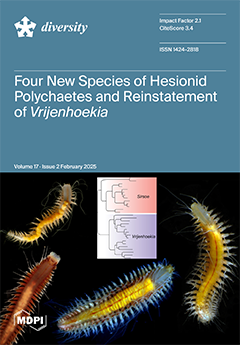
Cover Story: Hesionid polychaetes are well known at hydrothermal vents, methane seeps, and unusual habitats such as whale falls. In 1985, Sirsoe grasslei was the first hesionid to be named from a hydrothermal vent. Vrijenhoekia was erected in 2008 for a closely related species from a whale fall. Further species of Sirsoe and Vrijenhoekia were described in the following decade and the genera were recovered as reciprocally monophyletic with DNA data. However, Sirsoe was made a senior synonym of Vrijenhoekia when 10 further new species from the clade were named from off the coast of Brazil. To further evaluate the status of Sirsoe and Vrijenhoekia, we present the first DNA data for the type species of Sirsoe, S. grasslei. Our results allow the reinstatement of Vrijenhoekia and emended diagnoses for Sirsoe and Vrijenhoekia. Four new species, three in Sirsoe and one in Vrijenhoekia, are also described. View this paper
  • Issues are regarded as officially published after their release is announced to the table of contents alert mailing list .
  • You may sign up for email alerts to receive table of contents of newly released issues.
  • PDF is the official format for papers published in both, html and pdf forms. To view the papers in pdf format, click on the "PDF Full-text" link, and use the free Adobe Reader to open them.

Articles (65)

  • Article
  • Open Access
926 Views
17 Pages

Impacts of Climate Change on Suitable Habitat Areas of Larix chinensis in the Qinling Mountains, Shaanxi Province, China

  • Ruixiong Deng,
  • Xin Chen,
  • Kaitong Xiao,
  • Ciai Yu,
  • Qiang Zhang,
  • Hang Ning,
  • Lin Wu and
  • Qiang Xiao

19 February 2025

Larix chinensis Mill., the sole tree species that can form pure forests at the timberline of the Qinling Mountains, plays a crucial role in maintaining the stability of high-altitude ecosystems. Owing to its special habitat requirements and fragmente...

  • Article
  • Open Access
1,578 Views
18 Pages

Swin-Panda: Behavior Recognition for Giant Pandas Based on Local Fine-Grained and Spatiotemporal Displacement Features

  • Xinyu Yi,
  • Han Su,
  • Peng Min,
  • Mengnan He,
  • Yimin Han,
  • Gai Luo,
  • Pengcheng Wu,
  • Qingyue Min,
  • Rong Hou and
  • Peng Chen

19 February 2025

The giant panda, a rare and iconic species endemic to China, has attracted significant attention from both domestic and international researchers due to its crucial ecological role, unique cultural value, and distinct evolutionary history. While subs...

  • Article
  • Open Access
3 Citations
11,031 Views
14 Pages

19 February 2025

The nine-banded armadillo (Dasypus novemcinctus: hereafter armadillo) was first recorded in the United States (U.S.) in the state of Texas in 1849 and has been expanding its range northward and eastward since then. With the widespread adoption of par...

  • Article
  • Open Access
4 Citations
3,830 Views
18 Pages

17 February 2025

Environmental DNA from bulk materials can be analyzed to gain an understanding of the bacterial, fungal, plant, and/or arthropod communities present. DNA metabarcoding is widely used to characterize these biological communities, by amplifying “...

  • Review
  • Open Access
6 Citations
4,615 Views
44 Pages

Nuclear Phylogenomics of Angiosperms and Evolutionary Implications

  • Lin Zhang,
  • Chien-Hsun Huang,
  • Guojin Zhang,
  • Caifei Zhang,
  • Yiyong Zhao,
  • Jie Huang,
  • Jing Guo,
  • Lin Cheng,
  • Taikui Zhang and
  • Hong Ma

17 February 2025

Angiosperms are the largest group of land plants with ~375,000 species, which are classified into ~416 families and ~13,000 genera; they exhibit tremendous morphological and physiological diversities and are important members of diverse terrestrial a...

  • Article
  • Open Access
1,016 Views
14 Pages

16 February 2025

Dynamic changes in diurnal light and temperature are a natural phenomenon, particularly pronounced in arid environments. However, it remains unclear whether the coupling of diurnal light and temperature fluctuations contributes to the capability and...

  • Article
  • Open Access
1 Citations
1,333 Views
16 Pages

Status and Life History Traits of Simpsonaias ambigua (Salamander Mussel) in Ontario, Canada

  • Isabel Porto-Hannes,
  • Kelly A. McNichols-O’Rourke,
  • Mandy P. Gibson and
  • Todd J. Morris

15 February 2025

Simpsonaias ambigua (Salamander Mussel) is a freshwater mussel of the Family Unionidae endemic to North America, and it is considered endangered across most of its range. This species is unique among the Unionidae, because it uses the salamander, Nec...

  • Article
  • Open Access
974 Views
7 Pages

15 February 2025

The great desert skink (Liopholis kintorei, locally known as tjakuṟa) occupies burrow systems in arid regions of central Australia. Most burrow systems remain occupied for an average of 4, and up to 10, years by the same related individuals. Th...

  • Article
  • Open Access
1,050 Views
11 Pages

14 February 2025

The taxonomic position of the green alga Capsosiphon fulvescens was first reported from Northern Europe and has since been reported from all over the world, including Korea. In Korea, C. fulvescens has been used as an essential edible economic alga f...

  • Article
  • Open Access
2,181 Views
15 Pages

14 February 2025

Marine protected areas (MPAs) are an important tool for conserving biodiversity and ensuring the sustainable use of marine ecosystem services. This study examines the extent of MPAs in the Adriatic-Ionian region (EUSAIR). The analysis focuses on nati...

of 7

Get Alerted

Add your email address to receive forthcoming issues of this journal.

XFacebookLinkedIn
Diversity - ISSN 1424-2818