


Abstract
This study investigates the rational design of a dinuclear zinc(II) coordination polymer, (C36H34Br2N8O4S2Zn2), to explore how halogen substitution and ligand choice modulate structural architecture, contributing to the development of functional coordination polymers with tailored properties. The complex was synthesized from a bromo-substituted semicarbazone Schiff base ligand (L1) and a rigid bipyridine linker (L2) under solvothermal conditions, and its structure was elucidated using single-crystal X-ray diffraction (SCXRD), complemented by characterization via powder X-ray diffraction (PXRD), thermogravimetric analysis (TGA), and infrared (IR) spectroscopy. Crystallographic analysis reveals that the complex crystallizes in the triclinic space group P-1, forming discrete dinuclear units where each Zn(II) center adopts a distorted square–pyramidal geometry; these units are extended into one-dimensional chains by bridging L2 ligands and further assembled into a three-dimensional supramolecular network through hydrogen-bonding interactions. PXRD confirms the high phase purity of the bulk material, TGA indicates notable thermal stability up to 130 °C, and IR spectroscopy validates the coordination modes and hydrogen-bonding network. This work elucidates the critical role of the bromo substituent and rigid ancillary ligands in modulating the solid-state structure of the zinc(II) complex. The revealed structure-directing principles provide a valuable reference for the rational design of functional coordination polymers.
1. Introduction
Over the past few decades, coordination polymers (CPs) and metal–organic frameworks (MOFs) have emerged as a captivating class of hybrid materials [1]. Their unique nature lies in the self-assembly of metal ions and organic linkers, endowing them with highly tunable architectures. These materials have shown great potential in a wide spectrum of applications, including gas storage [2,3,4], separation [5,6], catalysis [7,8], and sensing [9,10,11]. The significance of CPs and MOFs not only lies in their practical uses but also in the opportunities they offer for fundamental research in understanding the interactions between metal ions and organic molecules [12,13,14].
Among various metal centers used in the construction of CPs and MOFs, Zn(II) ions have attracted particular attention [15,16,17]. The d10 electronic configuration of Zn(II) ions offers several distinct advantages. Firstly, the zero-crystal field stabilization energy provides structural flexibility, allowing Zn(II) ions to adapt to diverse coordination geometries. This flexibility is crucial for the formation of different types of coordination polymers with various topologies. Secondly, the absence of quenching d-d transitions makes Zn(II) ions ideal candidates for constructing highly luminescent materials when combined with conjugated ligands. Luminescent coordination polymers have potential applications in optoelectronic devices, sensors, and bioimaging. Thirdly, Zn(II) compounds are relatively low-cost and low-toxicity, which is beneficial for practical applications, especially in areas where large-scale production and environmental safety are important considerations.
The choice of organic ligands is equally critical in the design and synthesis of coordination polymers. Schiff bases, especially thiosemicarbazone derivatives, are excellent chelating ligands [18,19,20]. Their facile synthesis makes them readily accessible for researchers. They possess versatile coordination modes, which can form stable complexes with various metal ions. The inherent N-H and C=O/S groups in Schiff bases also facilitate the formation of supramolecular networks through hydrogen bonding. These hydrogen-bonding interactions not only enhance the structural stability of the coordination polymers but also play a crucial role in determining the overall architecture and properties of the materials.
A powerful strategy to fine-tune the properties of CPs is post-synthetic modification or the pre-design of ligands with specific functional groups. Halogen substitution has emerged as a highly effective approach in this regard. Halogen atoms (X=F, Cl, Br, I) can introduce steric bulk, which can influence the molecular conformation and packing of the coordination polymers. Moreover, halogen atoms exert significant electronic effects, which can affect intermolecular interactions such as halogen bonding. These interactions can have a profound impact on the macroscopic thermal and optical properties of the materials. However, despite the potential of halogen substitution, systematic studies that quantitatively correlate the halogen identity with precise structural parameters (such as bond lengths) and the resulting material properties remain relatively scarce, particularly for Zn(II) systems.
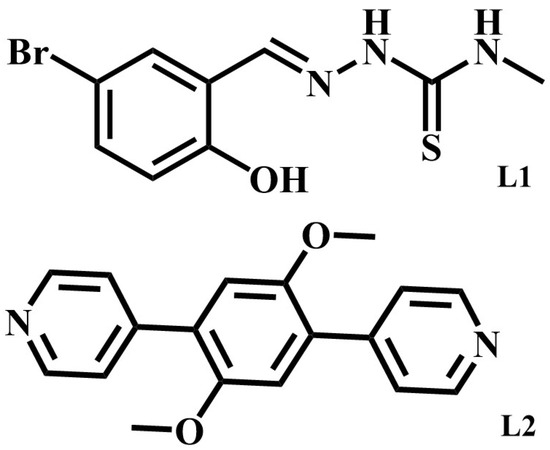
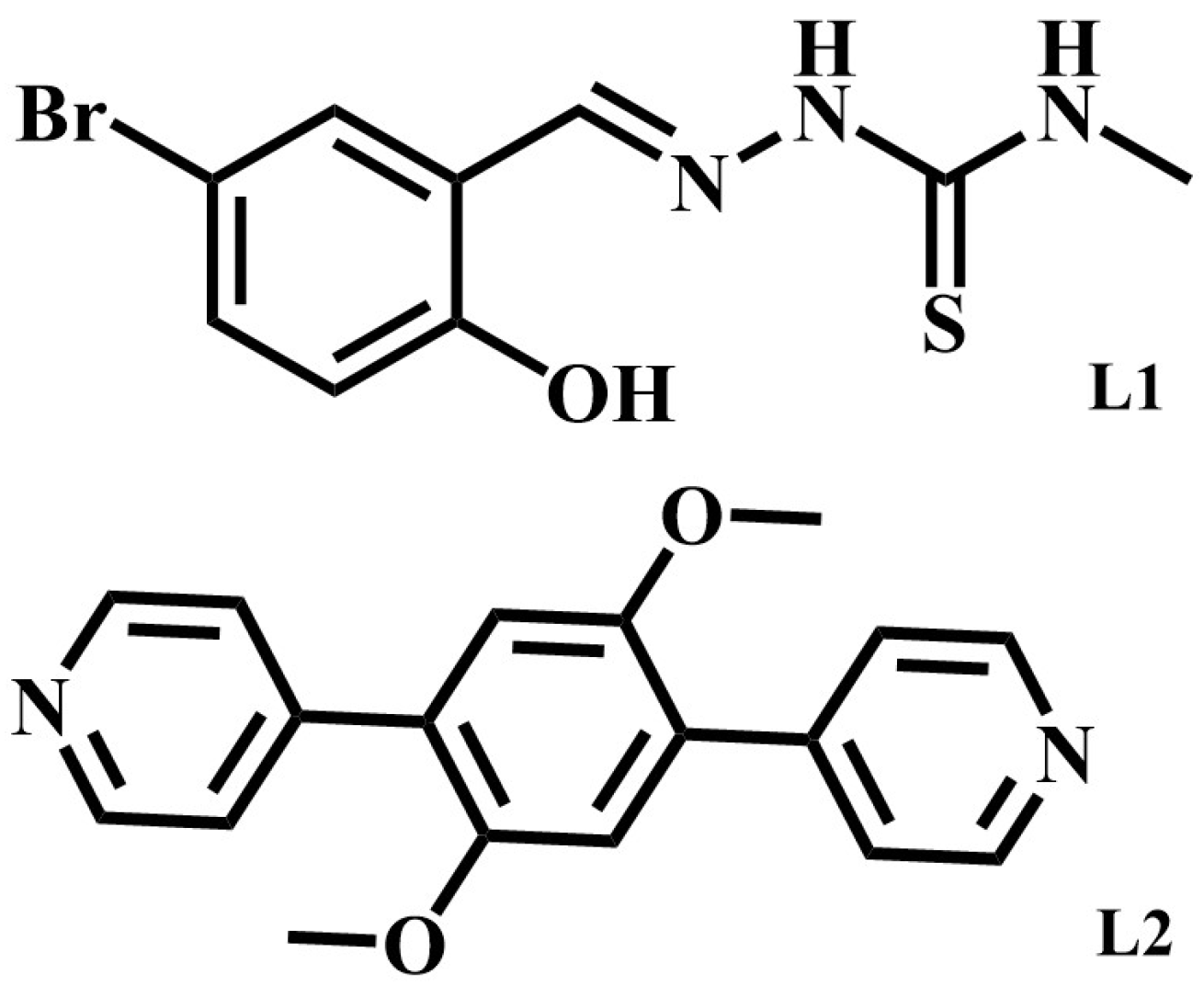
In this study, we focus on the synthesis and detailed characterization of a zinc(II) coordination (C36H34Br2N8O4S2Zn2). This complex is derived from a bromo-substituted semicarbazone Schiff base ligand (2(3bromo-5-hydroxybenzylidene)-N-methylhydrazine-1-carbothioamide, L1) and a rigid bipyridine linker (4,4′-(2,5-dimethoxy-1,4-phenylene)dipyridine, L2) (Figure 1). By using a solvothermal method, we aim to precisely control the reaction conditions and obtain a well-defined coordination polymer. We will systematically investigate its structure and properties using multiple techniques, including single-crystal X-ray diffraction (SCXRD), powder X-ray diffraction (PXRD), thermogravimetric analysis (TGA), and infrared (IR) spectroscopy. Through the comprehensive characterization of this specific bromo-substituted complex, we aim to establish a foundational understanding of its structural features. This work serves as a starting point for future systematic studies on the influence of halogen substitution, providing a reference case for the rational design of functional coordination polymers.
Figure 1.
Chemical structures of the organic ligands L1 and L2.
2. Results
2.1. Crystal Structure Analysis
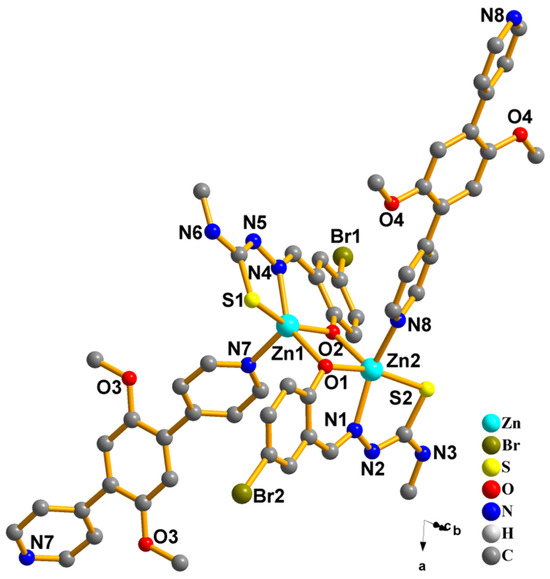
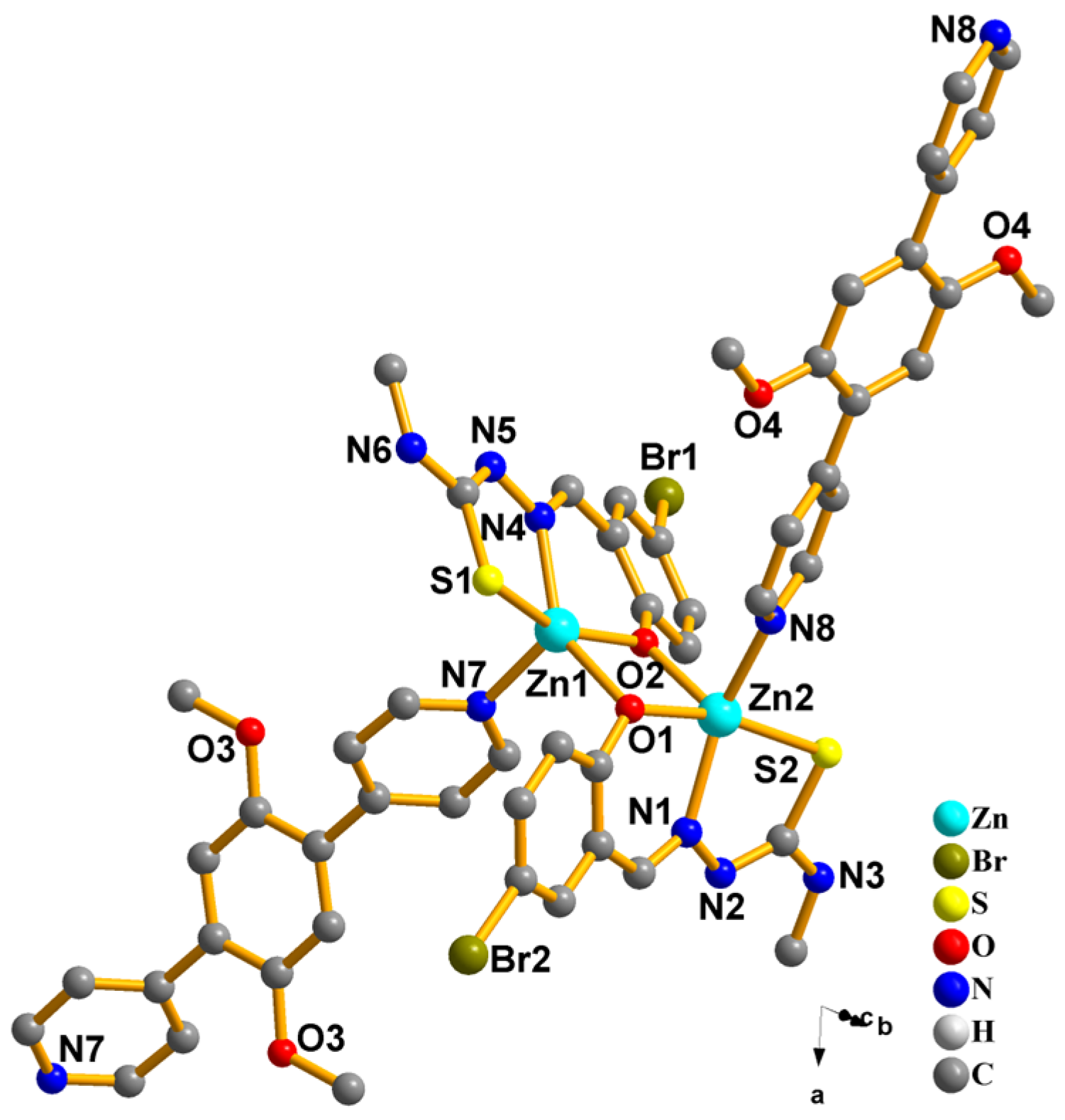
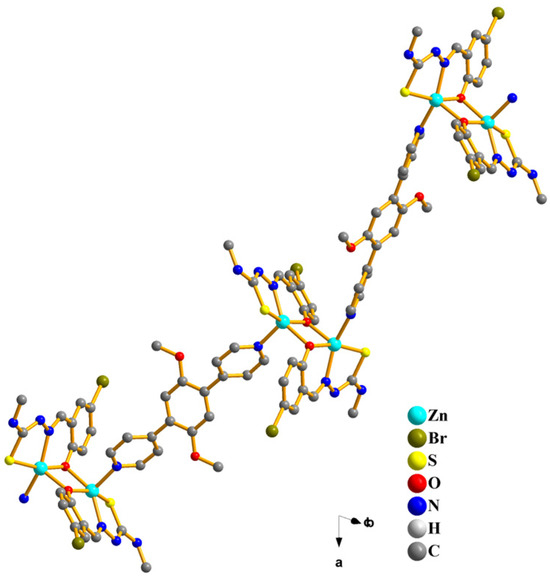
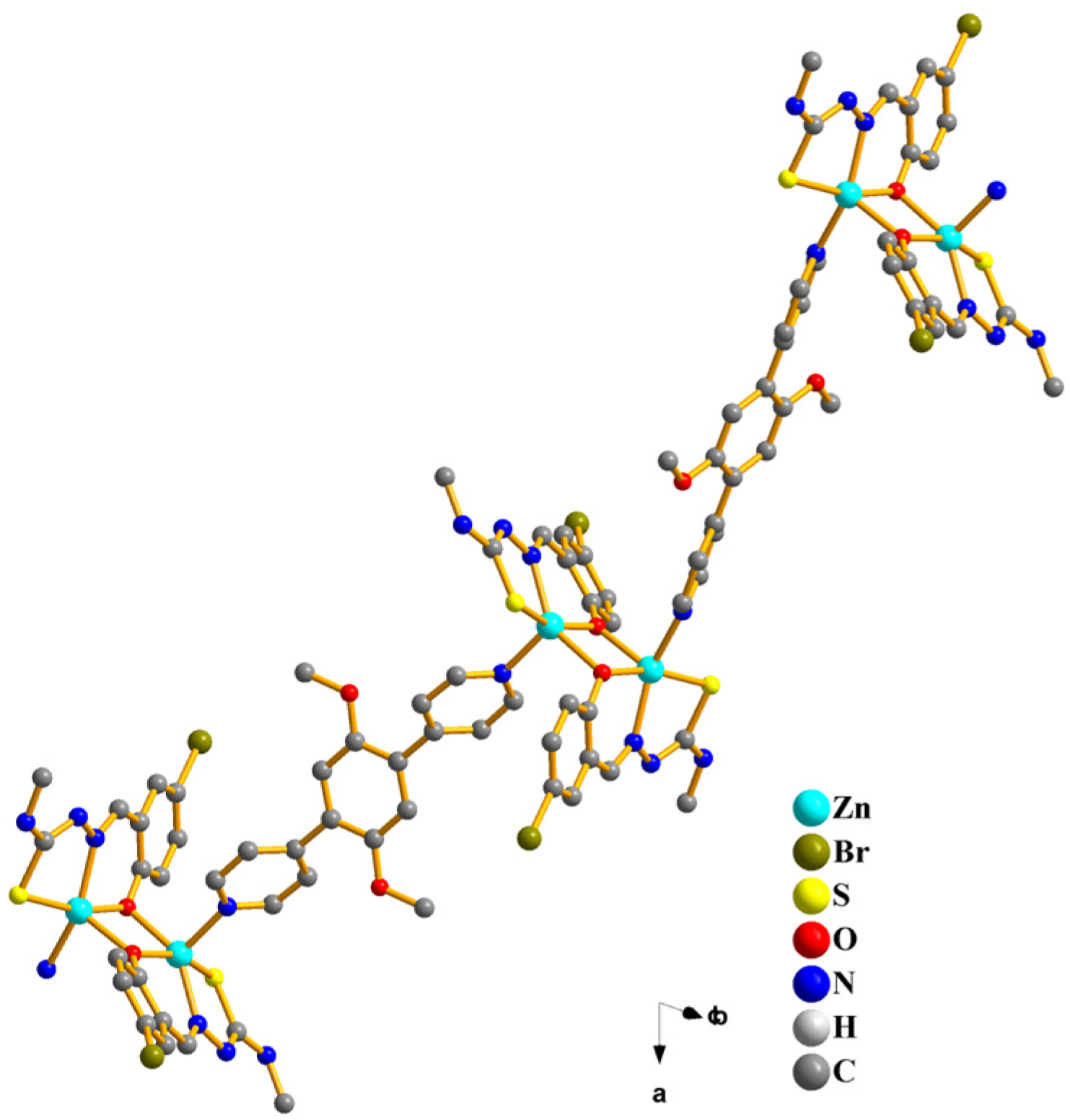
Single-crystal X-ray diffraction analysis reveals that complex 1 crystallizes in the triclinic space group P-1, with one discrete dinuclear unit in the asymmetric unit. The unit cell parameters are summarized in Table S1. The crystal structure is composed of a dinuclear zinc(II) core, where the two Zn(II) centers (Zn1 and Zn2) are bridged by two phenolate oxygen atoms (O1 and O2) derived from the deprotonated Schiff base ligands L1. Each Zn(II) ion is pentacoordinate, adopting a distorted square–pyramidal geometry. The coordination sphere for Zn1 consists of S1 and N4 from one L1 ligand, N7 from the L2 linker, and both bridging oxygen atoms O1 and O2. Similarly, Zn2 is coordinated by S2 and N1 from another L1 ligand, N8 from L2, and both O1 and O2. The degree of distortion from an ideal square pyramid was quantified using the τ5 parameter. The calculated values of τ5(Zn1) = 0.185 and τ5(Zn2) = 0.159 confirm the square–pyramidal geometry with moderate distortion (Figure 2).
Figure 2.
Single-crystal structure of complex 1.
As listed in Table S2, the Zn-O bond lengths fall in the range of 2.044(2)–2.080(2) Å, while the Zn-N bonds involving the pyridyl groups of L2 are slightly longer, at 2.087(3)–2.108(3) Å. The Zn-S bond distances are 2.3332(8) and 2.3401(8) Å, consistent with typical Zn-S (thioamide) coordination. The coordination geometry around each Zn center is significantly distorted, as indicated by the bond angles around Zn1 and Zn2. For instance, the O1-Zn1-O2 angle is 79.07(8)°, while the S1-Zn1-O1 and S1-Zn1-O2 angles are 100.31(6)° and 159.59(6)°, respectively. The N4-Zn1-N7 angle is 108.47(10)°, further confirming distorted square–pyramidal geometry as quantified by the τ5 parameters.
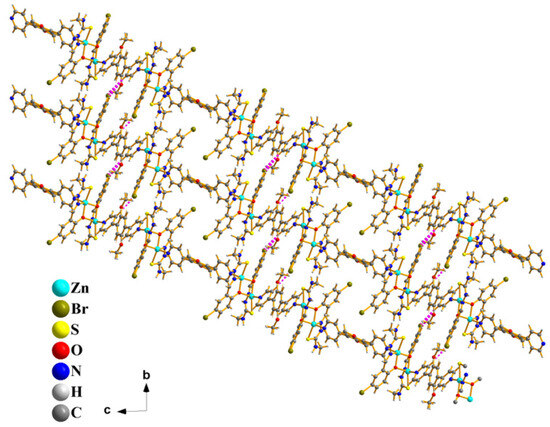
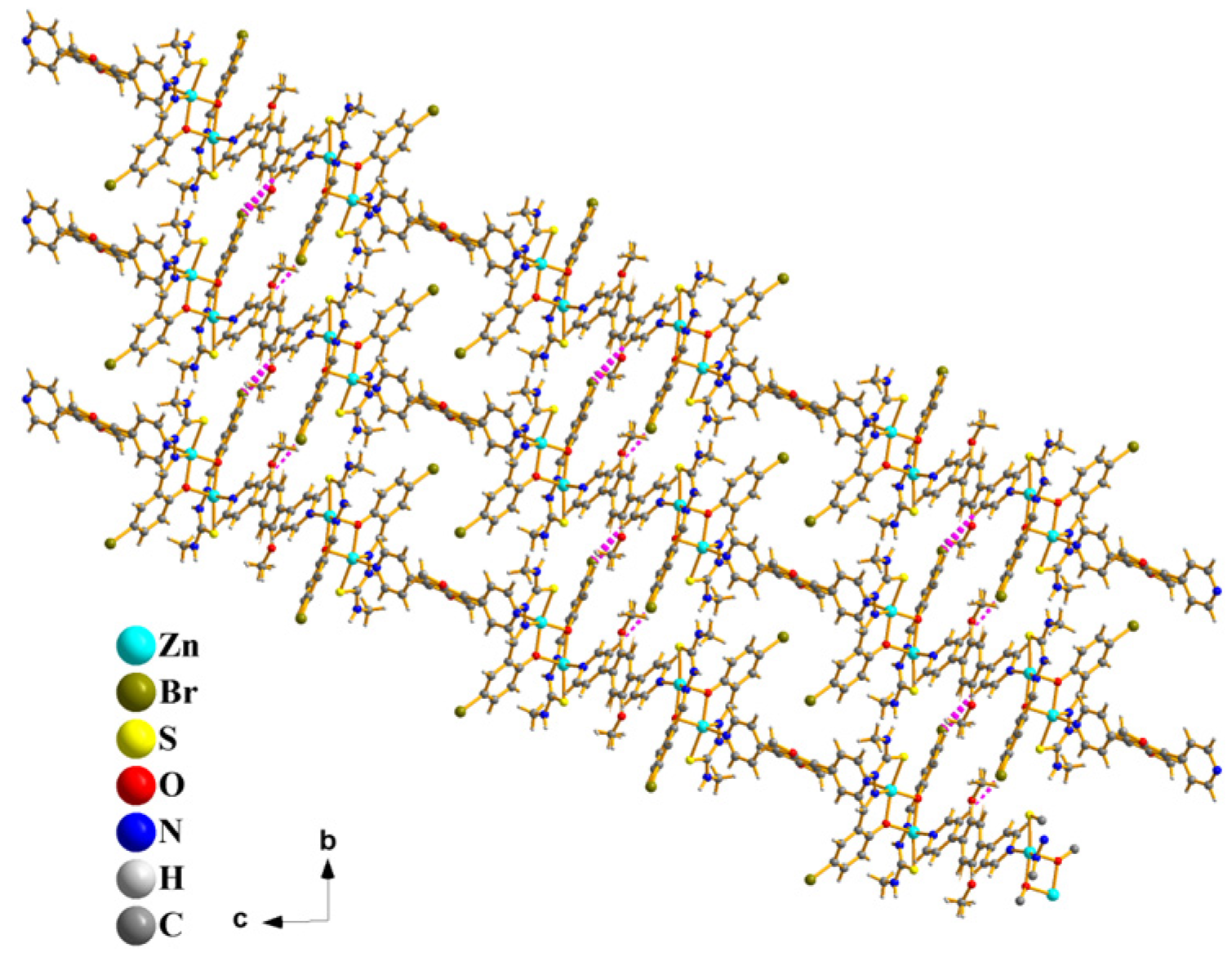
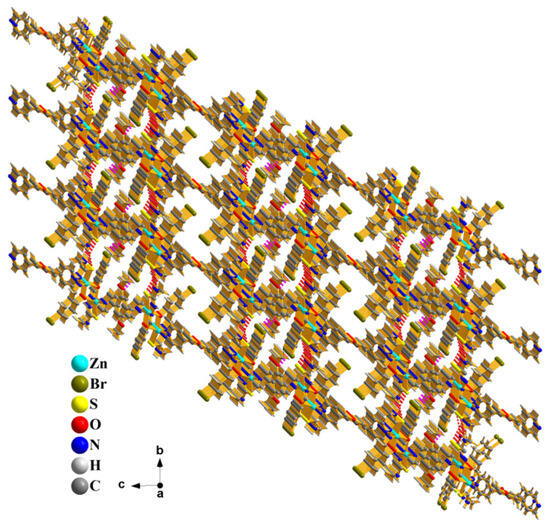
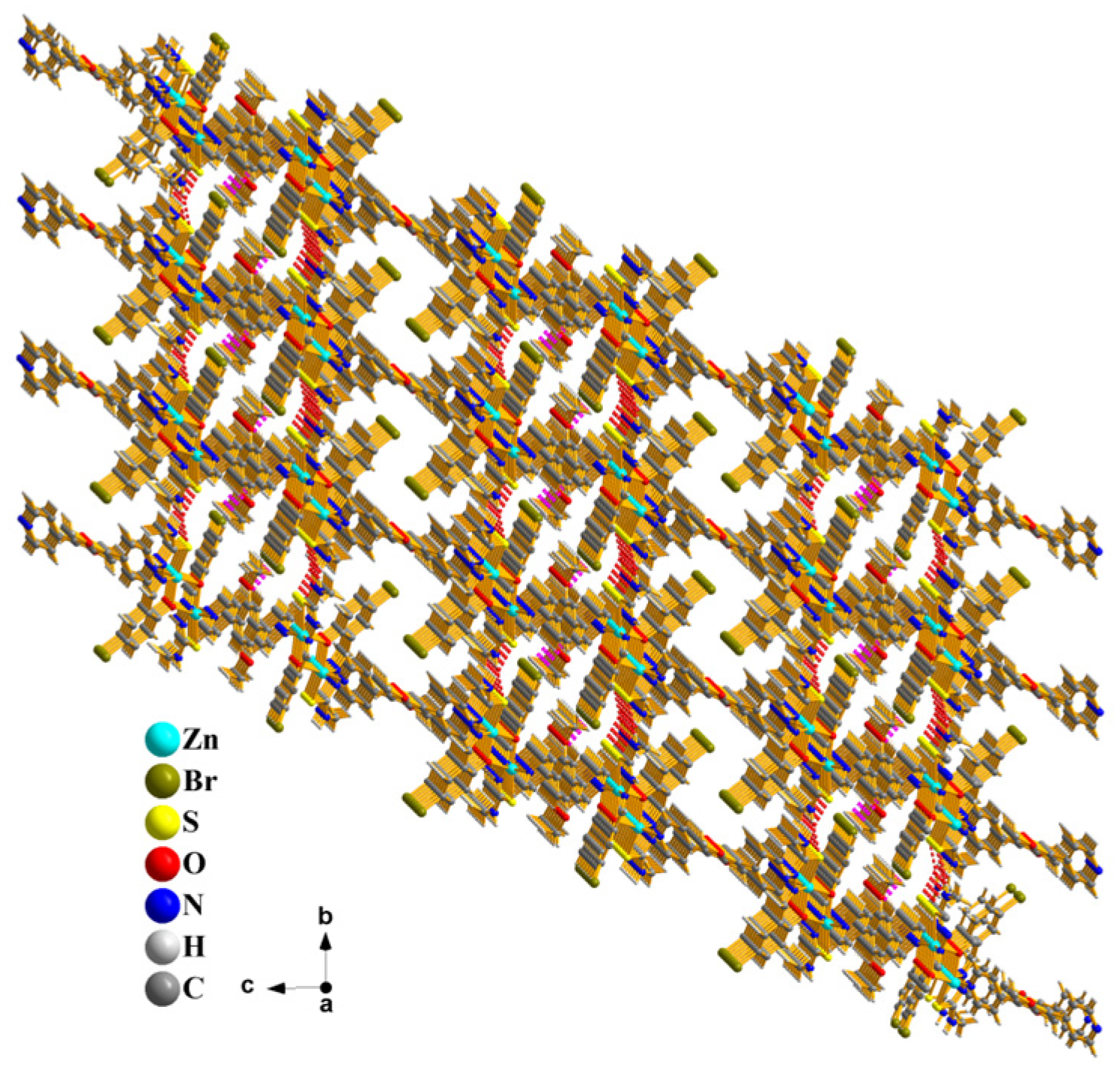
The dinuclear units are extended into a one-dimensional (1D) chain via the rigid L2 ligands (Figure 3), which bridge adjacent Zn centers through Zn-N(pyridyl) bonds. These chains are further connected into a two-dimensional (2D) supramolecular layer through intermolecular hydrogen bonding (C29-H29···Br2 distance = 3.745(4) Å, angle = 157°) (Figure 4). Finally, a three-dimensional (3D) supramolecular framework is constructed through additional, weaker intermolecular interactions between adjacent 2D layers, as depicted in Figure 5. The combination of robust N-H···S hydrogen bonds (N3-H3···S1 and N6-H6···S2, with D···A distances of 3.495(3) Å and 3.594(3) Å, respectively), and other weaker interactions effectively consolidate the overall crystal packing, contributing to the stability of the solid-state structure.
Figure 3.
Crystal structure of the one-dimensional supramolecular chain.
Figure 4.
Two-dimensional supramolecular layer.
Figure 5.
The packing diagram of complex 1.
2.2. Powder X-Ray Diffraction (PXRD) Patterns
The phase purity and crystallinity of the bulk-synthesized zinc complex 1 were confirmed by powder X-ray diffraction (PXRD) analysis at room temperature. The experimental PXRD pattern of the complex was compared with the pattern simulated from its single-crystal X-ray diffraction data. As shown in Figure S1, the experimental pattern exhibits excellent agreement with the simulated one in terms of peak positions, and the general profiles match well, confirming the high phase purity of the bulk sample. This consistency indicates that the single-crystal structure is representative of the bulk material. The sharp and well-defined Bragg reflections observed throughout the pattern further demonstrate the high crystallinity of the material.
2.3. Thermogravimetric Analysis (TGA)
The thermal stability of zinc complex 1 was investigated by thermogravimetric analysis (TGA) under a nitrogen atmosphere at a heating rate of 10 °C min−1. As shown in the TGA curve (Figure S2), the complex exhibits considerable stability, with no significant mass loss observed below approximately 130 °C. The onset of framework decomposition occurs at this temperature, initiating a rapid mass loss step. This is followed by a continuous and pronounced decomposition process that persists up to approximately 1000 °C, corresponding to the progressive collapse of the coordination framework and concomitant pyrolysis of the organic ligands. The residual mass at 1000 °C is approximately 40% of the initial mass. However, the continuous mass loss without reaching a clear plateau suggests that the thermal decomposition is not complete at this temperature, and the residue does not represent a final, thermally stable phase under these conditions.
2.4. Infrared Analysis (IR)
The infrared (IR) spectrum of complex 1 is presented in Figure S3. The spectral features are fully consistent with the formation of the target coordination complex, as corroborated by single-crystal X-ray diffraction analysis. A strong, broad absorption band centered at approximately 3350 cm−1 is observed, which is assigned to the ν(N-H) stretching vibration [21,22]. The significant broadening of this band strongly suggests the involvement of the N–H group in extensive hydrogen-bonding interactions within the solid-state structure. This spectroscopic evidence aligns well with the hydrogen-bonding parameters derived from the crystallographic data of complex 1.
In the region characteristic of double-bond stretching vibrations, a distinct and sharp band at 1606 cm−1 is evident. This band is attributed to the ν(C=N) stretching mode of the imine group within the coordinated Schiff base ligand (L1) [23]. Its position confirms the successful coordination of the ligand via the imine nitrogen, as the coordination typically causes a shift compared to the free ligand. Furthermore, the spectrum confirms the presence of the halogen substituent. A characteristic absorption band at 620 cm−1 is clearly visible and is assigned to the ν(C-Br) stretching vibration [24]. The position of this band follows the established trend where heavier halogen atoms result in lower vibrational frequencies, confirming the incorporation of bromine into the complex structure designed in ligand L1. In conclusion, the IR spectroscopic data for complex 1 are in excellent agreement with its molecular structure determined by X-ray crystallography.
3. Materials and Methods
3.1. Synthesis of 1
A mixture of 2-(3-bromo-5-hydroxybenzylidene)-N-methylhydrazine-1-carbothioamide (L1, 0.02 mmol), 4,4′-(2,5-dimethoxy-1,4-phenylene)dipyridine (L2, 0.03 mmol), and ZnSO4 (0.02 mmol) was dissolved in a solvent system comprising isopropanol (3 mL) and methanol (2 mL). Dimethylamine aqueous solution (2.5 μL) was then added. The resulting mixture was stirred thoroughly at room temperature and subsequently subjected to ultrasonication (Gongyi Yuhua Instrument Co., Ltd., Gongyi, China) for 15 min to ensure complete mixing. The reaction vessel was transferred to an electric heating blast drying oven (Shanghai Yiheng Scientific Instrument Co., Ltd., Shanghai, China) and heated at 85 °C for 3 days. After cooling to room temperature, yellow crystals were obtained, yielding 71% based on Zn.
3.2. Materials and Measurements
Reagents and solvents employed were commercially available and not purified further. The reagents and solvents employed were used as received without further purification. Powder X-ray diffraction (PXRD) was recorded on a Rigaku D/Max-2500 (Rigaku Corporation, Tokyo, Japan) diffractometer at 40 kV, 100 mA with a Cu-target tube (Rigaku Corporation, Tokyo, Japan) and a graphite monochromator (Rigaku Corporation, Tokyo, Japan) in the range of 5–60°. Thermogravimetric analysis (TGA) was carried out on a Rigaku standard TG-DTA analyzer (Rigaku Corporation, Tokyo, Japan) in a N2 atmosphere with a heating rate of 10 °C/min from ambient temperature to 800 °C using an empty Al2O3 crucible as the reference. Single-crystal X-ray diffraction data of the complex were measured on a Rigaku XtaLAB MM007 CCD (Rigaku Corporation, Tokyo, Japan) diffractometer with Mo Kα radiation by ω scan mode. The crystallographic data and structure refinement of the complex are listed in Table S1. Selected bond lengths and angles are given in Table S2. Hydrogen bond geometries in the crystal structures are given in Table S3.
4. Conclusions
This study successfully demonstrates the synthesis and comprehensive characterization of a novel dinuclear zinc(II) coordination polymer 1, constructed from a bromo-substituted semicarbazone Schiff base ligand (L1) and a rigid bipyridine linker (L2). Single-crystal X-ray diffraction analysis provides an unambiguous elucidation of the molecular and supramolecular architecture. The complex crystallizes in the triclinic space group P-1, featuring a dinuclear core where each Zn(II) ion adopts a distorted square–pyramidal coordination geometry, as quantified by τ5 parameters. These dinuclear units are extended into a one-dimensional (1D) chain via the bridging L2 ligand. Crucially, the structure is further consolidated into a three-dimensional (3D) supramolecular framework through specific intermolecular hydrogen-bonding interactions.
The high phase purity and crystallinity of the bulk material are confirmed by the excellent agreement between the experimental and simulated PXRD patterns. TGA reveals considerable thermal stability with the onset of decomposition around 130 °C, leading to a residual mass of approximately 40% at 1000 °C. Furthermore, IR spectroscopy provides supportive evidence for the molecular structure, showing characteristic bands such as the ν(C=N) stretch at 1606 cm−1 and the ν(C–Br) vibration at 692 cm−1. The broad band around 3350 cm−1 suggests hydrogen bonding. These spectroscopic features are consistent with the presence of the ligands in the complex and align well with the supramolecular interactions and ligand incorporation revealed by the crystallographic data.
In summary, this work not only presents a well-characterized zinc(II) complex but also highlights the effectiveness of a multi-technique approach in modern coordination chemistry research. Specifically regarding the influence of halogen substitution, the crystallographic analysis of this bromo-functionalized complex shows that the bromo substituent participates in intermolecular C–H···Br interactions, contributing to the stabilization and extension of the overall three-dimensional supramolecular architecture. The insights gained into the structural features and assembly driven by the specific bromo-substitution in this complex offer a valuable reference for the design of similar systems. It is important to note that a general understanding of halogen substitution effects requires comparative studies across different halogens. Therefore, future investigations will focus on extending this strategy to other halogen variants (F, Cl, and I) to synthesize a series of analogues, enabling a systematic exploration of the halogen effects on the structural, photophysical, and electrochemical properties of such materials. This will pave the way for their potential applications in sensing or optoelectronics.
Supplementary Materials
The following supporting information is available online. Table S1: Crystal data and structure refinement parameters for 1; Table S2: Selected bond lengths (Å) and bond angles (°) for 1; Table S3: Hydrogen bond geometries in the crystal structures for 1; Figure S1: PXRD curve of 1; Figure S2: TGA curve of 1; Figure S3: IR spectra of 1. Crystallographic data. CCDC 2525664 contains the supplementary crystallographic data for 1. These data can be obtained free of charge via http://www.ccdc.cam.ac.uk/conts/retrieving.html (accessed on 26 January2026), or from the Cambridge Crystallographic Data Centre, 12 Union Road, Cambridge CB2 1EZ, UK; fax: +44-1223-336-033; or e-mail: deposit@ccdc.cam.ac.uk.
Author Contributions
Conceptualization, J.W.; methodology, C.W.; investigation, C.W.; data curation, Y.Z.; writing—original draft preparation, C.W.; writing—review and editing, J.W., A.A.R., and S.K.O.; funding acquisition, J.W. and S.K.O. All authors have read and agreed to the published version of the manuscript.
Funding
Jin-Hua Wang thanks DeZhou University for the Scientific Research Allowance (2021xjrc203). Additionally, this work was supported by the Young Scientist Foundation of Shandong Province (ZR2022QB087). The authors are grateful for the financial support of this research from the Ministry of Higher Education (MOHE) via the Fundamental Research Grant Scheme (FRGS)—FRGS/1/2020/STG04/UNIKL/02/2.
Data Availability Statement
The data supporting the findings of this study are available within the article and its Supplementary Materials.
Conflicts of Interest
The authors declare no conflicts of interest.
References
- Kitagawa, S.; Kitaura, R.; Noro, S.-I. Functional Porous Coordination Polymers. Angew. Chem. Int. Ed. 2004, 43, 2334–2375. [Google Scholar] [CrossRef] [Scilit] [PubMed]
- DeSantis, D.; Mason, J.A.; James, B.D.; Houchins, C.; Long, J.R.; Veenstra, M. Techno-economic Analysis of Metal–Organic Frameworks for Hydrogen and Natural Gas Storage. Energy Fuels 2017, 31, 2024–2032. [Google Scholar] [CrossRef] [Scilit]
- Roy, S.; Chakraborty, A.; Maji, T.K. Lanthanide–organic frameworks for gas storage and as magneto-luminescent materials. Coord. Chem. Rev. 2014, 273–274, 139–164. [Google Scholar] [CrossRef] [Scilit]
- Mason, J.A.; Veenstra, M.; Long, J.R. Evaluating metal–organic frameworks for natural gas storage. Chem. Sci. 2014, 5, 32–51. [Google Scholar] [CrossRef] [Scilit]
- Li, L.; Zhao, S.; Huang, H.; Dong, M.; Liang, J.; Li, H.; Hao, J.; Zhao, E.; Gu, X. Advanced Soft Porous Organic Crystal with Multiple Gas-Induced Single-Crystal-to-Single-Crystal Transformations for Highly Selective Separation of Propylene and Propane. Adv. Sci. 2024, 11, 2303057. [Google Scholar] [CrossRef] [Scilit]
- Li, J.-J.; Wang, C.-C.; Fu, H.-F.; Cui, J.-R.; Xu, P.; Guo, J.; Li, J.-R. High-performance adsorption and separation of anionic dyes in water using a chemically stable graphene-like metal-organic framework. Dalton Trans. 2017, 46, 10197–10201. [Google Scholar] [CrossRef] [Scilit]
- Medvedev, A.G.; Grishanov, D.A.; Mikhaylov, A.A.; Churakov, A.V.; Tripol’skaya, T.A.; Ottenbacher, R.V.; Bryliakov, K.P.; Shames, A.I.; Lev, O.; Prikhodchenko, P.V. Triphenyllead Hydroperoxide: A 1D Coordination Peroxo Polymer, Single-Crystal-to-Single-Crystal Disproportionation to a Superoxo/Hydroxo Complex, and Application in Catalysis. Inorg. Chem. 2022, 61, 8193–8205. [Google Scholar] [CrossRef] [Scilit]
- Liu, X.; Manzur, C.; Novoa, N.; Celedón, S.; Carrillo, D.; Hamon, J.R. Multidentate unsymmetrically-substituted Schiff bases and their metal complexes: Synthesis, functional materials properties, and applications to catalysis. Coord. Chem. Rev. 2018, 357, 144–172. [Google Scholar] [CrossRef] [Scilit]
- Wang, Y.; Wu, D.; Li, Y.; Lu, S.; Zhu, X.; Jian, N.; Hao, X.-Q. Emerging fluorescent supramolecular metal-organic cages: Structural chemistry and fluorescent sensing applications. Coord. Chem. Rev. 2026, 548, 217188. [Google Scholar] [CrossRef] [Scilit]
- Niranjan, R.; Prasad, G.D.; Arockiaraj, M.; Rajeshkumar, V.; Mahadevegowda, S.H. Novel coumarin-Schiff base derived electronically distinct fluorescent probes: Synthesis and comparative investigations of their unique selective sensing properties with Cu2+ and Cu+ ions. J. Mol. Struct. 2025, 1321, 139929. [Google Scholar] [CrossRef] [Scilit]
- Chen, Z.-Y.; Wang, J.-J.; Cao, C.; Zheng, T.-F.; Peng, Y.; Wen, H.-R.; Liu, S.-J. Benzothiadiazole Tetracarboxylate-Based HoIII Metal-Organic Frameworks with Reversible Single-Crystal-to-Single-Crystal Transformations, Good Stabilities, and Fluorescence Sensing for Amino Acids in Aqueous Solutions. Cryst. Growth Des. 2025, 25, 3742–3748. [Google Scholar] [CrossRef] [Scilit]
- Wang, J.H.; Li, Z.Y.; Yamashita, M.; Bu, X.H. Recent progress on cyano-bridged transition-metal-based single-molecule magnets and single-chain magnets. Coord. Chem. Rev. 2021, 428, 213617. [Google Scholar] [CrossRef] [Scilit]
- Wang, J.H.; Wang, C.C.; Liu, D.X.; Wang, J.H.; Zhao, H.X.; Tang, T.; Tian, X.T.; Hu, H.; Zhang, D.S. Synthesis and characterization of a novel antiferromagnetic cobalt(II) chain complex. Inorg. Chem. Commun. 2023, 150, 110492. [Google Scholar] [CrossRef] [Scilit]
- Wang, C.C.; Wang, J.H.; Wang, G.; Li, C.W.; Wang, L.L.; Ong, S.K. Solvothermal synthesis of tetranuclear Zinc(II) schiff base complexes: Halogen-driven structural modulation and selective antifungal and antibacterial properties against gram-positive and gram-negative bacteria. J. Mol. Struct. 2026, 1350, 144059. [Google Scholar] [CrossRef] [Scilit]
- Heydari, N.; Bikas, R.; Lis, T. Structural studies and Hirshfeld surface analysis of a cyanido-bridged Zn(II) coordination polymer. J. Mol. Struct. 2026, 1353, 144805. [Google Scholar] [CrossRef] [Scilit]
- Zhang, C.; Li, Z.Y.; Wang, L.F.; Wu, D.Q.; Chen, Y.; Zhai, B. Structures and Luminescence Properties of Two Zn(II) Coordination Polymers Based on Rigid-Flexible Coligands. Z. Anorg. Allg. Chem. 2025, 651, e202500115. [Google Scholar] [CrossRef] [Scilit]
- Wang, Y.F.; Wang, Y.K.; Luo, X.; Zhao, T.Y.; Wang, L.Y. Crystal Structures and Luminescence Properties of Two Zn(II) Coordination Polymers Based on 3-(1H-Pyrazol-4-yl)-5-(pyridin-2-yl)-1,2,4-triazole and Polycarboxylic Acid Ligands. Russ. J. Inorg. Chem. 2025, 70, 1020–1027. [Google Scholar] [CrossRef] [Scilit]
- Rezaie, M.-A.; Khojastehnezhad, A.; Shiri, A. Post-synthetic modification of Zr-based metal organic framework by schiff base zinc complex for catalytic applications in a click reaction. Sci. Rep. 2024, 14, 24644. [Google Scholar] [CrossRef] [Scilit]
- Gishan, M.; Middya, P.; Drew, M.G.B.; Frontera, A.; Chattopadhyay, S. Synthesis, structural characterization, and theoretical analysis of novel zinc(ii) schiff base complexes with halogen and hydrogen bonding interactions. RSC Adv. 2024, 14, 30896–30911. [Google Scholar] [CrossRef] [Scilit]
- Reddy, G.N.; Losetty, V.; Yadav, C.H. Synthesis of novel Schiff base metal complexes and their spectroscopic characterization, biological activity and molecular docking investigation. J. Mol. Struct. 2023, 1282, 135161. [Google Scholar] [CrossRef] [Scilit]
- SMassoud, S.; Mautner, F.A.; Vicente, R.; Gallo, A.A.; Ducasse, E. Dinuclear and polynuclear bridged azido-nickel(II) complexes: Synthesis, structure determination, and magnetic properties. Eur. J. Inorg. Chem. 2007, 2007, 1091–1102. [Google Scholar] [CrossRef] [Scilit]
- Sarkar, P.; Mukherjee, C. A non-innocent pincer H3LONS ligand and its corresponding octahedral low-spin Fe(III) complex formation via ligand-centric homolytic S-S bond scission. Dalton Trans. 2018, 47, 13337–13341. [Google Scholar] [CrossRef] [Scilit]
- Alorini, T.A.; Al-Hakimi, A.N.; Saeed, S.E.-S.; Alhamzi, E.H.L.; Albadri, A.E.A.E. Synthesis, characterization, and anticancer activity of some metal complexes with a new Schiff base ligand. Arab. J. Chem. 2022, 15, 103559. [Google Scholar] [CrossRef] [Scilit]
- Howsaui, H.B.; Basaleh, A.S.; Abdellattif, M.H.; Hassan, W.M.I.; Hussien, M.A. Synthesis, Structural Investigations, Molecular Docking, and Anticancer Activity of Some Novel Schiff Bases and Their Uranyl Complexes. Biomolecules 2021, 11, 1138. [Google Scholar] [CrossRef] [Scilit] [PubMed]
Disclaimer/Publisher’s Note: The statements, opinions and data contained in all publications are solely those of the individual author(s) and contributor(s) and not of MDPI and/or the editor(s). MDPI and/or the editor(s) disclaim responsibility for any injury to people or property resulting from any ideas, methods, instructions or products referred to in the content. |
© 2026 by the authors. Licensee MDPI, Basel, Switzerland. This article is an open access article distributed under the terms and conditions of the Creative Commons Attribution (CC BY) license.