Communication

Synthesis of 6,7-Dihydro-5H-pyrrolo[3,4-b]pyridin-5-one Derivatives

1
State Key Laboratory of Natural Product Chemistry, College of Chemistry and Chemical Engineering, Lanzhou University, Lanzhou 730000, China
2
Henan Technical Institute of Applied Technology, Zhengzhou 450001, China
3
Key Laboratory of Advanced Pharmaceutical Technology, School of Pharmaceutical Sciences, Ministry of Education of China, Zhengzhou University, Zhengzhou 450001, China
4
Department of Pharmaceutical Chemistry, School of Pharmacy, University of Health and Allied Sciences, Ho PMB 31, Ghana
5
Pingyuan Laboratory, Zhengzhou University, Zhengzhou 450001, China
*
Authors to whom correspondence should be addressed.
Molbank 2026, 2026(2), M2146; https://doi.org/10.3390/M2146
Submission received: 11 February 2026 / Revised: 4 March 2026 / Accepted: 6 March 2026 / Published: 10 March 2026
(This article belongs to the Section Organic Synthesis and Biosynthesis)

Abstract

Owing to their distinctive physicochemical features, their structural analogues of benzene ring bioisosteres, and their strong affinity for biomacromolecules, pyridine derivatives function both as core structural scaffolds in pharmacologically active compounds and as versatile elements for optimizing key drug-like properties, such as water solubility, membrane permeability, and metabolic stability. In this study, we synthesized five pyridine-fused heterocyclic compounds using common synthetic intermediates as precursors.

1. Introduction

According to related literature reports [1,2,3], over the 11-year period from 2013 to 2023, approximately 82% of newly approved small-molecule drugs contained at least one nitrogen-containing heterocycle. This highlights the essential role of these structures in regulating drug activity, target affinity, and metabolic stability. It is worth noting that the structural complexity of these scaffolds has increased: drugs containing two different nitrogen heterocycles account for 33% of approved drugs, while drugs containing three or four rings account for 23% and 8%, respectively. In addition, the use of fused nitrogen heterocyclic compounds (such as indole, quinoline and purine analogues) has increased significantly, as these compounds have higher molecular rigidity, stronger binding selectivity and better drug-like properties [4,5]. These statistical trends indicate a shift in drug design toward molecules with nitrogen-containing heterocyclic structures, confirming the significant role of nitrogen-containing heterocycles in drug molecule design.
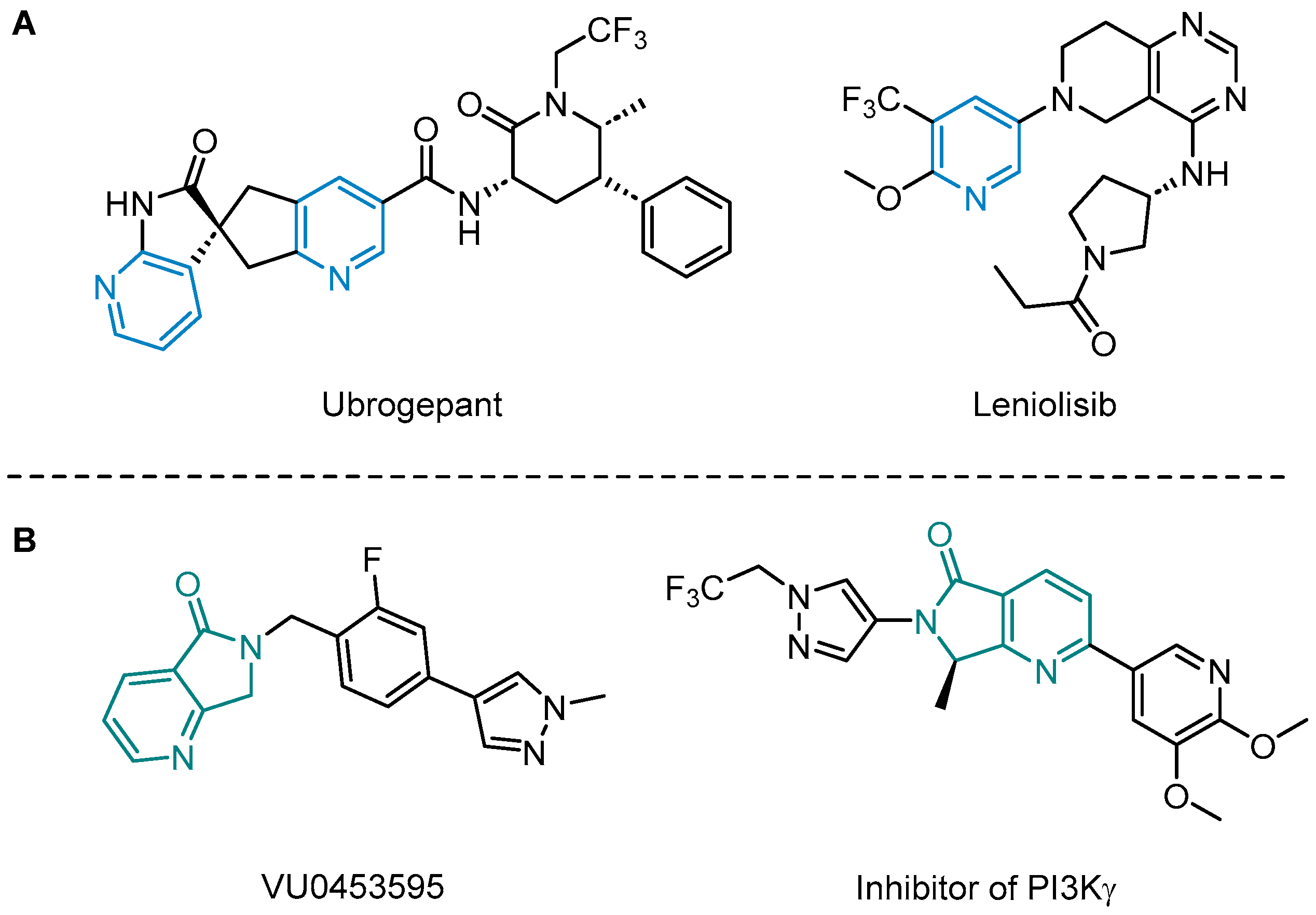
Among various nitrogen-containing heterocyclic compounds, pyridine is the most commonly used, especially polysubstituted derivatives, which offer extensive opportunities for finetuning electronic properties, steric properties, and solubility. For example, Ubrogepant (Figure 1A), which was approved by the FDA in 2019 [6], is a selective, orally bioavailable calcitonin gene-related peptide (CGRP) receptor antagonist that blocks the binding of CGRP to its receptor. CGRP is a key neuropeptide involved in neurogenic inflammation and pain transmission during migraine attacks. By blocking this interaction, Ubrogepant can prevent a chain reaction of persistent headache symptoms. Leniolisib [7] was approved in March 2023 and is the first therapy for the treatment of activated PI3Kδ syndrome (APDS). This small molecule contains four nitrogen-containing heterocycles: pyridine, piperidine, pyrrolidine, and pyrimidine. In addition to approved drugs, many highly active pyridine compounds are also being studied. For example, VU0453595 (Figure 1B) is a highly selective positive allosteric modulator (PAM) of the muscarinic acetylcholine receptor (mAChR) M1 subtype, which has played a key role in the study of neuropsychiatric disorders, particularly schizophrenia and cognitive impairment [8,9,10]. In addition, the azaisoindolinones skeleton is also an inhibitor of phosphoinositide 3-kinase γ (PI3Kγ) (Figure 1B) and has shown efficacy in an experimental autoimmune encephalomyelitis (EAE) mouse model [11]. These advances demonstrate that the rational design and efficient synthesis of nitrogen-rich polysubstituted pyridine derivatives represent a promising and rapidly developing field in medicinal chemistry, with profound implications for the development of next-generation drugs for treating a wide range of diseases.
In this work, we employed the traditional strategy [12,13] of Zn powder reduction followed by alkylation to synthesize four different substituted pyridine-fused compounds, 3a, 3b, 3c, and 3d, each containing two nitrogen atoms from the intermediate 2. Furthermore, we adopted the anhydride–imid reduction method to synthesize a multi-substituted pyridine-fused compound 6. Compared with novel synthesis methods such as hydrosilylation catalytic [14], hydrogen reduction [15], and electrochemical reduction [16], this method is simpler in terms of the reagents, catalysts, and experimental apparatus used.

2. Results and Discussion

Initially, we adopted the synthetic method from the literature [13], where pyridine-2,3-dicarboxylic acid was condensed with benzylamine, and the target compound was obtained through a one-step reduction with zinc powder. However, during the zinc powder reduction process, we found that the reaction time was very long (48 h), and it was difficult to completely react the starting materials (Scheme 1). Moreover, the reaction produced regioisomers, and this isomer was difficult to separate by column chromatography, which hindered our activity tests. More importantly, this route always started with pyridine dicarboxylic acid, which was not conducive to the divergent synthesis of this class of compounds. To improve synthetic efficiency and structural diversity, we explored the use of a common intermediate that can be easily converted into a series of substituted analogues in a one-step reaction.
Therefore, based on literature reports, commercially available compound 1 was employed as the starting material for the synthesis of the key intermediate 2 [12]. In the subsequent alkylation step, initially, due to the poor solubility of compound 2, we attempted this alkylation using the more readily available bromide as the alkylating agent in DMF [17,18]; however, the reaction resulted in a complex mixture. To address this, we heated a mixture of compound 2 and THF to 50 °C, followed by the portion-wise addition of 60% sodium hydride (NaH). After reacting at this temperature for 20 min, the corresponding bromide was added dropwise, and the reaction was continued for 2 h to finally obtain the target products 3a3d (Scheme 2).
Since the synthesis of analogues of compound 6 was not considered in this work, for the synthesis of compound 6, we started with commercially available dicarboxylic acid [13] compound 4 and obtained compound 5 in nearly quantitative yield. Subsequently, in acetic acid, compound 5 reacted with zinc powder at room temperature for 2 h, then the temperature was raised to 120 °C and the reaction was continued for 24 h, and ultimately yielding the trisubstituted pyridine derivative 6 (Scheme 3).

3. Materials and Methods

3.1. Chemicals and Instrumentation

Unless otherwise specified, all reagents used were of analytical grade. The key reagents included 5H-pyrrolo[3,4-b]pyridine-5,7(6H)-dione, zinc, acetic anhydride, NaBH4, NaH (60%), acetic acid, 1-(bromomethyl)naphthalene, 1-(bromomethyl)-3,5-dimethylbenzene, 1-(bromomethyl)-3,5-di-tert-butylbenzene, 1-(bromomethyl)-3,5-difluorobenzene, 5-ethylpyridine-2,3-dicarboxylic acid, and benzylamine. The main instruments used for the characterization and analysis of the compounds were as follows: Thermostatic heating magnetic stirrer (Model DF-101S) (Shanghai, China), manufactured by Shanghai Yukang Science and Education Instrument Equipment Co, Ltd. Rotary evaporator (Model N-1100V), obtained from EYELA (Tokyo Rika Kikai Co., Ltd., Tokyo, Japan). Chemical diaphragm pump (Model MZ 2C NT), product of Vacuubrand GmbH, Wertheim, Germany. Vacuum drying oven (Model DZF-6020) (Gongyi, China), supplied by Gongyi Jinghua Instrument Co., Ltd. Circulating water vacuum pump (Model SHZ-D (III)) (Zhengzhou, China), produced by Zhengzhou Yuxiang Instrument Equipment Co., Ltd. Electronic balance (Model ME203E), from Mettler Toledo, Zurich, Switzerland. 1H NMR and 13C NMR spectra were recorded in CDCl3 solution on Bruker AVANCEIII 400 MHz, Bruker AVANCEIII HD 400 MHz or Bruker AVANCE NEO 600 MHz instruments (Karlsruhe, Germany). Chemical shifts (δ) were reported in ppm relative to residual solvent peak or tetramethylsilane as internal standard (CDCl3: 7.26 ppm for 1H NMR, 77.0 ppm for 13C NMR. Multiplicity and qualifier abbreviations are as follows: s = singlet, d = doublet, t = triplet, q = quartets, dd = doublet of doublets, ddd = doublet of doublet of doublets, dddd = doublet of doublet of doublet of doublets, dt = doublet of triplets, dq = doublet of quartets, ddq = doublet of doublet of quartets, td = triplet of doublets, qd = quartet of doublets, m = multiplet. High-resolution mass spectral analysis (HRMS) data were measured on a Bruker ApexII mass spectrometer (Rheinstetten, Germany) using the ESI technique.

3.2. 6,7-Dihydro-5H-pyrrolo[3,4-b]pyridin-5-one (2)

NaBH4 (3.8 g, 1.5 equiv.) was added portion-wise to a solution of 5H-pyrrolo[3,4-b]pyridine-5,7(6H)-dione (10.0 g, 67.6 mmol) in MeOH/CHCl3 (1:1, 670 mL) at −20 °C. After 30 min, the mixture was acidified with 3 M HCl to pH 3, and 10 min later basified with 2 M NaOH to pH 9. The reaction was then allowed to warm to room temperature, and the solvents were removed under reduced pressure. The residue was recrystallized from water (100 mL per 80.0 mmol of substrate at 80 °C) to give a white solid (7.2 g, 63%), which was used directly in the next step without further purification.
To a solution of the above-mentioned products (3.2 g, 21.3 mmol, 1.0 equiv.) in acetic acid (80 mL) was added zinc (5.6 g, 85.0 mmol, 4.0 equiv.). The suspension was heated under reflux for 24 h. After cooling to room temperature, the mixture was filtered through a pad of Celite. The filtrate was concentrated, the residue was dissolved in dichloromethane, and then calcium chloride was added. The suspension was filtered and concentrated, and the residue was purified by column chromatography. The residue was first eluted with EtOAc and then with EtOAc/MeOH (95:5), to give compound 2 as a white solid (0.9 g, 31%). Rf = 0.1 (ethyl acetate). 1H NMR (400 MHz, CDCl3) δ 8.77 (dd, J = 4.8, 1.6 Hz, 1H), 8.16 (dd, J = 7.8, 1.6 Hz, 1H), 7.5 7.34 (dd, J = 7.8, 4.8 Hz, 2H), 4.55 (s, 2H). 13C NMR (101 MHz, CDCl3) δ 169.8, 164.1, 153.0, 132.1, 125.8, 123.1, 47.5.

3.3. 6-(Naphthalen-1-ylmethyl)-6,7-dihydro-5H-pyrrolo[3,4-b]pyridin-5-one (3a)

Compound 2 (268.0 mg, 2.0 mmol, 1.0 equiv.) was placed in a 100 mL round-bottomed flask, and then 50 mL of THF was added. The mixture was heated to 50 °C until completely dissolved. Then, NaH (60% mineral oil dispersion, 120.0 mg, 3.0 mmol, 1.5 equiv.) was added in two portions, and the mixture was stirred for 20 min. Then, 1-(bromomethyl)naphthalene (2.4 mmol, 528.0 mg, 1.2 equiv.) was added dropwise. After 2 h of reaction, the mixture was cooled to room temperature, quenched with saturated aqueous NH4Cl solution, extracted with ethyl acetate, dried over Na2SO4, concentrated under reduced pressure, and purified by column chromatography to obtain the target product 3a as a pale yellow solid (246 mg, 45%). Rf = 0.8 (ethyl acetate). 1H NMR (400 MHz, CDCl3) δ 8.70 (dd, J = 5.0, 1.8 Hz, 1H), 8.18 (dd, J = 7.8, 1.6 Hz, 1H), 7.86–7.75 (m, 4H), 7.54–7.37 (m, 4H), 5.00 (s, 2H), 4.37 (s, 2H). 13C NMR (101 MHz, CDCl3) δ 166.9, 162.2, 152.6, 134.0, 133.4, 132.9, 132.0, 128.9, 127.8, 127.8, 127.1, 126.5, 126.4, 126.2, 126.0, 123.3, 51.1, 46.5. HRMS (m/z, ESI): Calcd. For C18H14N2ONa+ [M + Na]+: 297.0998; found: 297.0997. m.p.: 101–102 °C.

3.4. 6-(3,5-Dimethylbenzyl)-6,7-dihydro-5H-pyrrolo[3,4-b]pyridin-5-one (3b)

Compound 2 (268.0 mg, 2.0 mmol, 1.0 equiv.) was placed in a 100 mL round-bottomed flask, and then 50 mL of THF was added. The mixture was heated to 50 °C until completely dissolved. Then, NaH (60% mineral oil dispersion, 120.0 mg, 3.0 mmol, 1.5 equiv.) was added in two portions, and the mixture was stirred for 20 min. Then, 1-(bromomethyl)-3,5-dimethylbenzene (2.4 mmol, 475.0 mg, 1.2 equiv.) was added dropwise. After 2 h of reaction, the mixture was cooled to room temperature, quenched with saturated aqueous NH4Cl solution, extracted with ethyl acetate, dried over Na2SO4, concentrated under reduced pressure, and purified by column chromatography to obtain the target product 3b as a pale yellow solid (277 mg, 55%). Rf = 0.6 (ethyl acetate).1H NMR (400 MHz, CDCl3) δ 8.70 (dd, J = 5.0, 1.6 Hz, 1H), 8.15 (dd, J = 7.7, 1.7 Hz, 1H), 7.40 (dd, J = 7.7, 5.0 Hz, 1H), 6.92 (s, 3H), 4.75 (s, 2H), 4.33 (s, 2H), 2.29 (s, 6H). 13C NMR (101 MHz, CDCl3) δ 166.6, 162.2, 152.4, 138.5, 136.3, 131.9, 129.5, 126.5, 126.0, 123.1, 51.0, 46.2, 21.2. HRMS (m/z, ESI): C16H16N2ONa+ [M + Na]+: 275.1155; found: 275.1158. m.p.: 90–91 °C.

3.5. 6-(3,5-Difluorobenzyl)-6,7-dihydro-5H-pyrrolo[3,4-b]pyridin-5-one (3c)

Compound 2 (268.0 mg, 2.0 mmol, 1.0 equiv.) was placed in a 100 mL round-bottomed flask, and then 50 mL of THF was added. The mixture was heated to 50 °C until completely dissolved. Then, NaH (60% mineral oil dispersion, 120.0 mg, 3.0 mmol, 1.5 equiv.) was added in two portions, and the mixture was stirred for 20 min. Then, 1-(bromomethyl)-3,5-difluorobenzene (2.4 mmol, 494.0 mg, 1.2 equiv.) was added dropwise. After 2 h of reaction, the mixture was cooled to room temperature, quenched with saturated aqueous NH4Cl solution, extracted with ethyl acetate, dried over Na2SO4, concentrated under reduced pressure, and purified by column chromatography to obtain the target product 3c as a pale yellow solid (218 mg, 42% yield). (218 mg, 42% yield). Rf = 0.6 (ethyl acetate).1H NMR (400 MHz, CDCl3) δ 8.73 (dd, J = 5.0, 1.8 Hz, 1H), 8.15 (dd, J = 7.8, 1.6 Hz, 1H), 7.42 (dd, J = 7.8, 5.0 Hz, 1H), 6.89–6.79 (m, 2H), 6.77–6.69 (m, 1H), 4.80 (s, 2H), 4.37 (s, 2H). 13C NMR (101 MHz, CDCl3) δ 166.9, 164.6, 164.5, 162.1, 162.0, 161.9, 152.8, 140.6, 140.5, 140.4, 132.1, 125.9, 123.3, 110.9, 110.8, 110.7, 110.6, 103.6, 103.4, 103.1, 51.1, 45.6. 19F NMR (376 MHz, CDCl3) δ −108.7. HRMS (m/z, ESI): C14H10F2N2ONa+ [M + Na]+: 283.0653; found: 283.0651. m.p.: 115–116 °C.

3.6. 6-(3,5-di-tert-Butylbenzyl)-6,7-dihydro-5H-pyrrolo[3,4-b]pyridin-5-one (3d)

Compound 2 (268.0 mg, 2.0 mmol, 1.0 equiv.) was placed in a 100 mL round-bottomed flask, and then 50 mL of THF was added. The mixture was heated to 50 °C until completely dissolved. Then, NaH (60% mineral oil dispersion, 120.0 mg, 3.0 mmol, 1.5 equiv.) was added in two portions, and the mixture was stirred for 20 min. Then, 1-(bromomethyl)-3,5-di-tert-butylbenzene (2.4 mmol, 677.0 mg, 1.2 equiv.) was added dropwise. After 2 h of reaction, the mixture was cooled to room temperature, quenched with saturated aqueous NH4Cl solution, extracted with ethyl acetate, dried over Na2SO4, concentrated under reduced pressure, and purified by column chromatography to obtain the target product 3d as a pale yellow solid (255 mg, 38% yield). 1H NMR (400 MHz, CDCl3) δ 8.69 (dd, J = 5.0, 1.6 Hz, 1H), 8.15 (dd, J = 7.7, 1.6 Hz, 1H), 7.43–7.33 (m, 2H), 7.16 (d, J = 1.8 Hz, 2H), 4.81 (s, 2H), 4.35 (s, 2H), 1.30 (s, 18H). 13C NMR (101 MHz, CDCl3) δ 166.5, 162.2, 152.3, 151.5, 135.4, 131.9, 126.5, 123.1, 122.6, 121.9, 51.1, 46.9, 34.8, 31.4. HRMS (m/z, ESI): C22H29N2O+ [M + H]+: 337.2274; found: 337.2272. m.p.: 157–158 °C.

3.7. 6-Benzyl-3-ethyl-5H-pyrrolo[3,4-b]pyridine-5,7(6H)-dione (5)

5-Ethylpyridine-2,3-dicarboxylic acid (3.0 g, 15.3 mmol, 1.0 equiv.) and acetic anhydride (2.5 g, 24.5 mmol, 1.6 equiv.) were heated at 115 °C for 2 h. After cooling to 80 °C, acetic acid is removed under reduced pressure. The residue was then dissolved in CH2Cl2 (50 mL), cooled to 0 °C, and benzylamine (2.0 g, 18.4 mmol, 1.2 equiv.) was added dropwise. The mixture was then stirred at 45 °C for 1 h. After cooling to room temperature, the solvent was removed by rotary evaporation. Acetic anhydride (2.5 g, 24.5 mmol, 1.6 equiv.) was added to the reaction mixture, and then stirred at 115 °C for 5 h. A precipitate formed upon cooling to room temperature; the precipitate was collected by filtration, washed twice with ethanol (10 mL), and dried at 70 °C to give a greyish-white solid 5 (3.8 g), with a yield of 95%. 1H NMR (400 MHz, CDCl3) δ 8.78 (d, J = 2.2 Hz, 1H), 7.97 (d, J = 2.0 Hz, 1H), 7.48–7.40 (m, 2H), 7.34–7.24 (m, 3H), 4.89 (s, 2H), 2.83 (q, J = 7.6 Hz, 2H), 1.32 (t, J = 7.6 Hz, 3H). 13C NMR (101 MHz, CDCl3) δ 166.1, 166.1, 155.1, 149.4, 144.5, 135.9, 130.1, 128.7, 128.6, 127.9, 127.4, 41.7, 26.5, 15.0. HRMS (m/z, ESI): C16H14N2O2Na+ [M + Na]+: 289.0747; found: 289.0746. m.p.: 107–108 °C.

3.8. 6-Benzyl-3-ethyl-6,7-dihydro-5H-pyrrolo[3,4-b]pyridin-5-one (6)

Compound 5 (2.7 g, 10.0 mmol, 1.0 equiv.) was dissolved in acetic acid (50 mL), and zinc powder (6.5 g, 100 mmol, 10 equiv.) was added. The mixture was stirred at room temperature for 2 h, then heated to 120 °C and maintained for 24 h. After cooling to room temperature, solid residue was removed by filtration, and the filtrate was concentrated under reduced pressure. The crude product was purified by column chromatography to obtain a white solid 6 (1.1 g) in a yield of 45%. Rf = 0.6 (ethyl acetate). 1H NMR (600 MHz, CDCl3) δ 8.54 (d, J = 2.2 Hz, 1H), 7.99 (d, J = 2.2 Hz, 1H), 7.37–7.25 (m, 5H), 4.83 (s, 2H), 4.30 (s, 2H), 2.76 (q, J = 7.6 Hz, 2H), 1.29 (t, J = 7.6 Hz, 3H). 13C NMR (151 MHz, CDCl3) δ 166.9, 159.6, 152.5, 139.2, 136.5, 130.8, 128.8, 128.1, 127.7, 126.1, 50.7, 46.2, 26.0, 15.3. HRMS (m/z, ESI): C16H16N2ONa+ [M + Na]+: 275.1155; found: 275.1162. m.p.: 117–118 °C.

4. Conclusions

In summary, five pyridine-fused ring compounds were successfully synthesized, including four disubstituted pyridine derivatives and one trisubstituted pyridine derivative. All compounds’ structures were confirmed using 1H NMR, 13C NMR, and high-resolution mass spectrometry (HRMS) (See Supplementary Materials for details). Future research will focus on determining the biological roles of these molecules, providing an experimental basis for their future applications.

Supplementary Materials

The following supporting information can be downloaded online. 1H NMR spectrum and 13C NMR spectrum of compound 3a, 3b, 3c, 3d, 5 and 6.

Author Contributions

Conceptualization, Y.-Y.L.; Software, C.D.K.A.; investigation, Z.-H.L.; Formal Analysis, M.A.-W.; Data Curation, X.-Y.H. and Z.-H.L.; writing—original draft preparation, Y.-Y.L.; writing—review and editing, E.Z. and Y.-H.Z.; supervision, E.Z. All authors have read and agreed to the published version of the manuscript.

Funding

This work was supported by the Department of Science and Technology of Henan Province (No. 252102311218) and the Open Grant from the Pingyuan Laboratory (2023PY-OP-0103).

Data Availability Statement

The data are contained within this article and the Supplementary Materials.

Conflicts of Interest

The authors declare no conflicts of interest.

References

  1. Vitaku, E.; Smith, D.T.; Njardarson, J.T. Analysis of the structural diversity, substitution patterns, and frequency of nitrogen heterocycles among U.S. FDA approved pharmaceuticals. J. Med. Chem. 2014, 57, 10257–10274. [Google Scholar] [CrossRef] [PubMed]
  2. Das, P.; Delost, M.D.; Qureshi, M.H.; Smith, D.T.; Njardarson, J.T. A survey of the structures of US FDA approved combination drugs. J. Med. Chem. 2019, 62, 4265–4311. [Google Scholar] [CrossRef] [PubMed]
  3. Marshall, C.M.; Federice, J.G.; Bell, C.N.; Cox, P.B.; Njardarson, J.T. An update on the nitrogen heterocycle compositions and properties of U.S. FDA-approved pharmaceuticals (2013–2023). J. Med. Chem. 2024, 67, 11622–11655. [Google Scholar] [CrossRef] [PubMed]
  4. Cai, H.; Tu, Y.-Q.; Niu, Q.; Xie, W.-P.; Wang, B.; Lu, K.; Li, Z.-H.; Zhang, F.-M.; Zhang, X.-M. CCC pincer Ru complex-catalyzed C–H vinylation/6π-E-cyclization of aldimines for constructing 4H-pyrido[1,2-a]pyrimidines. Chem. Sci. 2024, 15, 16216–16221. [Google Scholar] [CrossRef] [PubMed]
  5. Tian, J.-R.; Qiao, Y.-H.; Zhuang, Q.-B.; Fan, R.; Li, Z.; Zhang, X.-M.; Zhang, F.-M.; Tu, Y.-Q. Organo-cation catalyzed enantioselective α-hydroxylation of pyridinone-fused lactones: Asymmetric synthesis of SN-38 and irinotecan. Chem. Commun. 2024, 60, 9954–9957. [Google Scholar] [CrossRef]
  6. Goadsby, P.J.; Ailani, J.; Dodick, D.W.; Starling, A.J.; Liu, C.; Liu, Y.; Yu, S.Y.; Smith, J.H.; Brand-Schieber, E.; Trugman, J.M. Ubrogepant for the treatment of migraine prodromal symptoms: An exploratory analysis from the randomized phase 3 PRODROME trial. Nat. Med. 2025, 31, 2179–2185. [Google Scholar] [CrossRef] [PubMed]
  7. Hoegenauer, K.; Soldermann, N.; Zécri, F.; Strang, R.S.; Graveleau, N.; Wolf, R.M.; Cooke, N.G.; Smith, A.B.; Hollingworth, G.J.; Blanz, J.; et al. Discovery of CDZ173 (Leniolisib), fepresenting a structurally novel class of PI3K delta-selective inhibitors. ACS Med. Chem. Lett. 2017, 8, 975–980. [Google Scholar] [CrossRef] [PubMed]
  8. Ghoshal, A.; Rook, J.M.; Dickerson, J.W.; Roop, G.N.; Morrison, R.D.; Jalan-Sakrikar, N.; Lamsal, A.; Noetzel, M.J.; Poslusney, M.S.; Wood, M.R.; et al. Potentiation of M1 muscarinic receptor reverses plasticity deficits and negative and cognitive symptoms in a schizophrenia mouse model. Neuropsychopharmacology 2016, 41, 598–610. [Google Scholar] [CrossRef] [PubMed]
  9. Moran, S.P.; Dickerson, J.W.; Cho, H.P.; Xiang, Z.; Maksymetz, J.; Remke, D.H.; Lv, X.; Doyle, C.A.; Rajan, D.H.; Niswender, C.M.; et al. M1-positive allosteric modulators lacking agonist activity provide the optimal profile for enhancing cognition. Neuropsychopharmacology 2018, 43, 1763–1771. [Google Scholar] [CrossRef] [PubMed]
  10. Dwomoh, L.; Tejeda, G.S.; Tobin, A.B. Targeting the M1 muscarinic acetylcholine receptor in Alzheimer’s disease. Neuronal Signal. 2022, 6, NS20210004. [Google Scholar] [CrossRef] [PubMed]
  11. Come, J.H.; Collier, P.N.; Henderson, J.A.; Pierce, A.C.; Davies, R.J.; Le Tiran, A.; O’Dowd, H.; Bandarage, U.K.; Cao, J.; Deininger, D.; et al. Design and synthesis of a novel series of orally bioavailable, CNS-penetrant, isoform selective phosphoinositide 3-kinase γ (PI3Kγ) inhibitors with potential for the treatment of multiple sclerosis (MS). J. Med. Chem. 2018, 61, 5245–5256. [Google Scholar] [CrossRef] [PubMed]
  12. Galli, U.; Mesenzani, O.; Coppo, C.; Sorba, G.; Canonico, P.L.; Tron, G.C.; Genazzani, A.A. Identification of a sirtuin 3 inhibitor that displays selectivity over sirtuin 1 and 2. Eur. J. Med. Chem. 2012, 55, 58–66. [Google Scholar] [CrossRef] [PubMed]
  13. Mikhail, K.; Dmitry, V.K.; Tatiana, D.T.; Vladimir, V.K.; Olga, U.; Vladislav, Z.P. Practical outcome of azaphthalimide reduction with Zn/AcOH at various temperatures. Lett. Org. Chem. 2006, 3, 379–383. [Google Scholar] [CrossRef]
  14. Ding, G.; Li, C.; Shen, Y.; Lu, B.; Zhang, Z.; Xie, X. Potassium hydroxide-catalyzed chemoselective reduction of cyclic imides with hydrosilanes: Synthesis of ω-hydroxylactams and lactams. Adv. Synth. Catal. 2016, 358, 1241−1250. [Google Scholar] [CrossRef]
  15. Lluna-Galán, C.; Izquierdo-Aranda, L.; de la Iglesia-Gómez, P.; Béchet, C.; Vidal-Puyuelo, P.; Arango-Daza, J.C.; Adam, R.; Cabrero-Antonino, J.R. Synthesis of azaisoindolinones by heterogeneous catalyzed regioselective hydrodeoxygenation of N-heteroaromatic phthalimides. ACS Sustain. Chem. Eng. 2025, 13, 12328–12336. [Google Scholar] [CrossRef] [PubMed]
  16. Bai, Y.; Shi, L.; Zheng, L.; Ning, S.; Che, X.; Zhang, Z.; Xiang, J. Electroselective and controlled reduction of cyclic imides to hydroxylactams and lactams. Org. Lett. 2021, 23, 2298–2302. [Google Scholar] [CrossRef] [PubMed]
  17. Lindsley, C.W.; Conn, P.J.; Wood, M.R.; Hopkins, C.R.; Melancon, B.J.; Poslusney, M.S.; Engers, D.W. Substituted 2-(4-heterocyclylbenzyl)isoindolin-1-one Analogs as Positive Allosteric Modulators of the Muscarinic Acetylcholine Receptor m1. Patent WO2013063549A1, 28 October 2012. [Google Scholar]
  18. Hu, J.-T.; Chen, J.-Y.; Liu, F.; Zhao, L.-L.; He, B.-L.; Chen, H.; Zha, X.-C.; Zhou, R.-B.; Zhang, J.; Wang, J.-W.; et al. Tricyclic Heterocycle Compounds as Iap Antagonists. Patent WO2023169569A1, 10 March 2023. [Google Scholar]
Figure 1. (A) Drugs containing multi-substituted pyridine structures; (B) the active molecules of the azaisoindolinone framework.
Molbank 2026 m2146 g001
Scheme 1. The initial route attempt.
Molbank 2026 m2146 sch001
Scheme 2. Synthesis of compounds 3a, 3b, 3c, and 3d.
Molbank 2026 m2146 sch002
Scheme 3. Synthesis of compound 6.
Molbank 2026 m2146 sch003
Disclaimer/Publisher’s Note: The statements, opinions and data contained in all publications are solely those of the individual author(s) and contributor(s) and not of MDPI and/or the editor(s). MDPI and/or the editor(s) disclaim responsibility for any injury to people or property resulting from any ideas, methods, instructions or products referred to in the content.