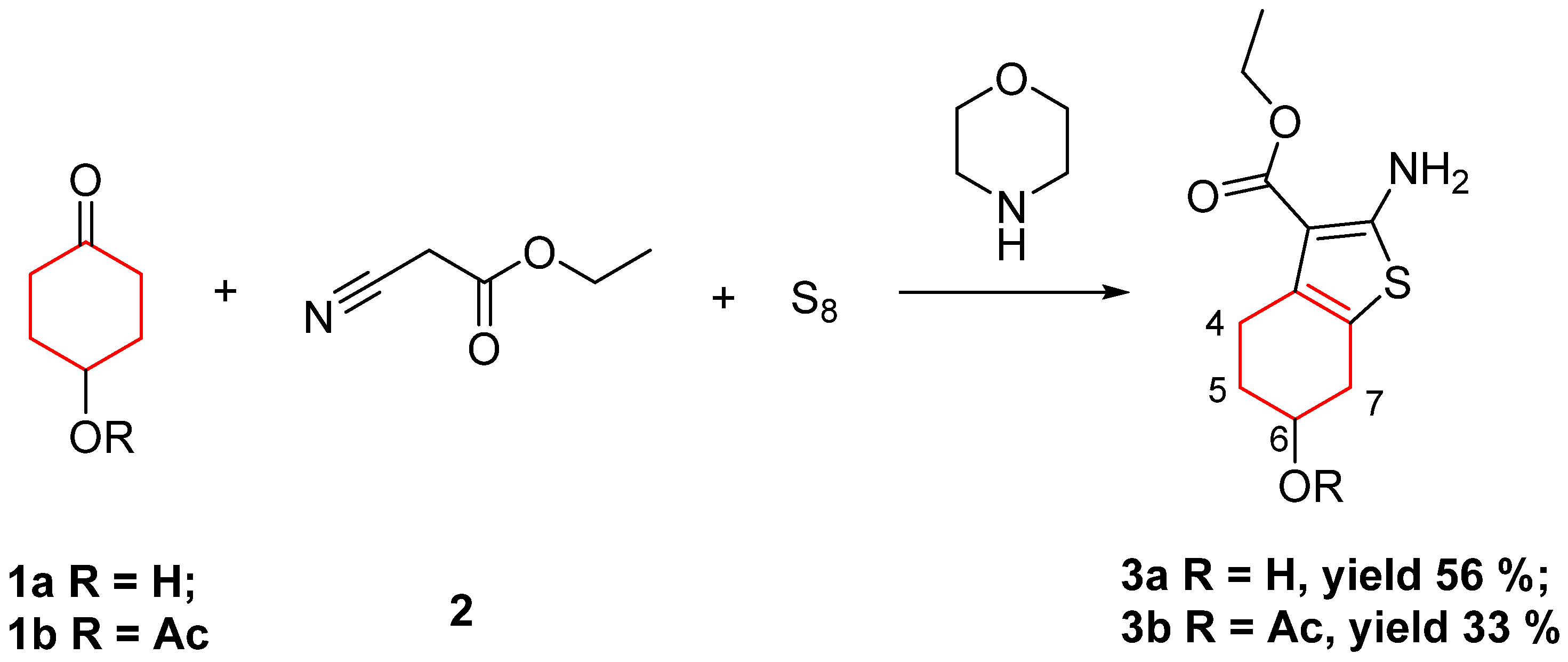

Synthesis of Ethyl 2-Amino-6-hydroxy-4,5,6,7-tetrahydro-1-benzothiophene-3-carboxylate and Ethyl 6-(Acetyloxy)-2-amino-4,5,6,7-tetrahydro-1-benzothiophene-3-carboxylate
 , ,
, ,  ,
,
Abstract
1. Introduction
2. Results and Discussion
3. Materials and Methods
Supplementary Materials
Author Contributions
Funding
Data Availability Statement
Acknowledgments
Conflicts of Interest
References
- Gewald, K.J. Heterocyclen aus CH-aciden nitrilen. IV. Addition von Schwefelkohlenstoff an Alkyliden Malonitrile. J. Prakt. Chem. 1966, 31, 205–213. [Google Scholar] [CrossRef]
- Sharma, J.; Champagne, P.A. Mechanisms of the Gewald synthesis of 2-aminothiophenes from elemental sulfur. J. Org. Chem. 2024, 89, 9609–9619. [Google Scholar] [CrossRef] [PubMed]
- Sultan, S.; Tawfik, S.S.; Selim, K.B.; Nasr, M.N.A. Design, Synthesis and molecular docking of new thieno[2,3-d]pyrimidin-4-one derivatives as dual EGFR and FGFR Inhibitors. Drug Dev. Res. 2025, 86, e70061. [Google Scholar] [CrossRef] [PubMed]
- Abdel-Rahman, S.A.; Nada, H.; Gabr, M.T. First-in-class dual inhibitors of MASTL and Aurora A kinase: Discovery of selective cyclohexa[b]thiophenes with potent anticancer activity. Eur. J. Med. Chem. 2025, 5, 117729. [Google Scholar] [CrossRef]
- Akhtar, A.; Chaudhari, T.Y.; Inam, A. Design and Synthesis of Tetrahydrobenzo[4,5]Thieno[2,3-d]Pyrimidine-Sulfonamide Derivatives Using p-Phenylenediamine as a Linker. Synthesis 2025, 57, 2880–2892. [Google Scholar] [CrossRef]
- Mohamed, M.F.A.; Soliman, A.M.; Alshazly, O.; Nafady, A.; Soomro, R.A. Design, synthesis, molecular docking, and antibacterial activity of novel amide-linked tetrahydrobenzothienopyrimidinone derivatives as potential DNA gyrase and topoisomerase IV inhibitors. Med. Chem. Res. 2025, 34, 172–182. [Google Scholar] [CrossRef]
- Chandrakanth, M.; Mishra, S.; Gayathri, K.; Katreddy, R.R.; Ranganathan, S.; Arya, G.A.; Gondru, R.; Rajasekaran, S.; Banothu, J. Fused thiophene—Benzimidazole conjugates targeting EGFR: Design, synthesis, anticancer evaluation and their mechanistic insights. Eur. J. Med. Chem. 2026, 303, 118435. [Google Scholar] [CrossRef] [PubMed]
- da Cruz, R.M.D.; Zelli, R.; Benshain, S.; da Cruz, R.M.D.; Siqueira-Júnior, J.P.; Décout, J.L.; Mingeot-Leclercq, M.P.; Mendonça-Junior, F.J.B. Synthesis and Evaluation of 2-Aminothiophene Derivatives as Staphylococcus aureus Efflux Pump Inhibitors. Chem. Med. Chem. 2020, 15, 716–725. [Google Scholar] [CrossRef] [PubMed]
- Magoulas, G.E.; Kalopetridou, L.; Ćirić, A.; Kritsi, E.; Kouka, P.; Zoumpoulakis, P.; Chondrogianni, N.; Soković, M.; Prousis, K.C.; Calogeropoulou, T. Synthesis, biological evaluation and QSAR studies of new thieno[2,3-d]pyrimidin-4(3H)-one derivatives as antimicrobial and antifungal agents. Bioorg. Chem. 2021, 106, 104509. [Google Scholar] [CrossRef]
- Mak, K.K.; Shiming, Z.; Epemolu, O.; Dinkova-Kostova, A.T.; Wells, G.; Gazaryan, I.G.; Sakirolla, R.; Mohd, Z.; Pichika, M.R. Synthesis and Anti-Inflammatory Activity of 2-Amino-4,5,6,7-tetrahydrobenzo[b]thiophene-Derived NRF2 Activators. ChemistryOpen 2022, 11, e202200181. [Google Scholar] [CrossRef]
- Abdelkhalek, A.S.; Kothayer, H.; Rezq, S.; Orabi, K.Y.; Romero, D.G.; El-Sabbagh, O.I. Synthesis of new multitarget-directed ligands containing thienopyrimidine nucleus for inhibition of 15-lipoxygenase, cyclooxygenases, and pro-inflammatory cytokines. Eur. J. Med. Chem. 2023, 256, 115443. [Google Scholar] [CrossRef]
- Elsayed, S.; Abdelkhalek, A.S.; Rezq, S.; Abu Kull, M.E.; Romero, D.G.; Kothayer, H. Magic shotgun approach to anti-inflammatory pharmacotherapy: Synthesis of novel thienopyrimidine monomers/heterodimer as dual COX-2 and 15-LOX inhibitors endowed with potent antioxidant activity. Eur. J. Med. Chem. 2023, 260, 115724. [Google Scholar] [CrossRef]
- Islam, F.; Doshi, A.; Robles, A.J.; Quadery, T.M.; Zhang, X.; Zhou, X.; Hamel, E.; Mooberry, S.L.; Gangjee, A. Design, Synthesis, and Biological Evaluation of 5,6,7,8-Tetrahydrobenzo[4,5]thieno[2,3-d]pyrimidines as Microtubule Targeting Agents. Molecules 2022, 27, 321. [Google Scholar] [CrossRef] [PubMed]
- Pal, K.; Raza, M.K.; Legac, J.; Ataur Rahman, M.; Manzoor, S.; Rosenthal, P.J.; Hoda, N. Design, synthesis, crystal structure and anti-plasmodial evaluation of tetrahydrobenzo[4,5]thieno[2,3-d]pyrimidine derivatives. RSC Med. Chem. 2021, 12, 970–981. [Google Scholar] [CrossRef] [PubMed]
- Eissa, K.I.; Kamel, M.M.; Mohamed, L.W.; Galal, M.A.; Kassab, A.E. Design, synthesis, and biological evaluation of thienopyrimidine and thienotriazine derivatives as multitarget anti-Alzheimer agents. Drug Dev. Res. 2022, 83, 1394–1407. [Google Scholar] [CrossRef] [PubMed]
- Eissa, K.I.; Kamel, M.M.; Mohamed, L.W.; Doghish, A.S.; Alnajjar, R.; Al-Karmalawy, A.A.; Kassab, A.E. Design, synthesis, and biological evaluation of thienopyrimidine derivatives as multifunctional agents against Alzheimer’s disease. Drug Dev. Res. 2023, 84, 937–961. [Google Scholar] [CrossRef]
- He, T.; Edwards, T.C.; Majima, R.; Jung, E.; Kankanala, J.; Xie, J.; Geraghty, R.J.; Wang, Z. Repurposing N-hydroxy thienopyrimidine-2,4-diones (HtPD) as inhibitors of human cytomegalovirus pUL89 endonuclease: Synthesis and biological characterization. Bioorg. Chem. 2022, 129, 106198. [Google Scholar] [CrossRef] [PubMed]
- Wang, K.M.; Ge, Y.X.; Zhang, J.; Chen, Y.T.; Zhang, N.Y.; Gu, J.S.; Fang, L.; Zhang, X.L.; Zhang, J.; Jiang, C.S. New cycloalkyl[b]thiophenylnicotinamide-based α-glucosidase inhibitors as promising anti-diabetic agents: Synthesis, in silico study, in vitro and in vivo evaluations. Bioorg. Med. Chem. Lett. 2023, 79, 129069. [Google Scholar] [CrossRef]
- Pal, K.; Raza, M.K.; Legac, J.; Rahman, A.; Manzoor, S.; Bhattacharjee, S.; Rosenthal, P.J.; Hoda, N. Identification, in-vitro anti-plasmodial assessment and docking studies of series of tetrahydrobenzothieno[2,3-d]pyrimidine-acetamide molecular hybrids as potential antimalarial agents. Eur. J. Med. Chem. 2023, 248, 115055. [Google Scholar] [CrossRef] [PubMed]
- Everett, J.A. Use of oral antidiabetic agents during breastfeeding. J. Hum. Lact. 1997, 13, 319–321. [Google Scholar] [CrossRef]
- Christophersen, P.; Dyhring, T. The shortcoming of using glibenclamide in exploratory clinical headache provocation studies. Cephalalgia 2023, 43, 3331024231219475. [Google Scholar] [CrossRef] [PubMed]
- Chen, H.; Lin, Y.; Zhao, Z.; Lin, T.; Lin, Q.; Chen, X.; Wu, W.; Zeng, G.; Wu, S.; Liu, N.; et al. Efficacy and safety of venlafaxine hydrochloride combined with tandospirone citrate for patients with vascular depression accompanied by somatic symptoms: An open-labeled randomized control trial. CNS Neurosci. Ther. 2024, 30, e14650. [Google Scholar] [CrossRef] [PubMed]
- Gibuła-Tarłowska, E.; Wiszniewska, A.; Turyk, M.; Szymczyk, P.; Kotlińska, J.H.; Kędzierska, E. Ketamine—From an Anesthetic to a Psychiatric Drug: Mechanisms of Action, Clinical Applications and Potential Risks. Molecules 2025, 30, 2824. [Google Scholar] [CrossRef] [PubMed]
- Rusciano, D. Molecular Mechanisms and Therapeutic Potential of Gabapentin with a Focus on Topical Formulations to Treat Ocular Surface Diseases. Pharmaceuticals 2024, 17, 623. [Google Scholar] [CrossRef]
- Blanco, J.R.; Ochoa-Callejero, L. Off-label use of maraviroc in clinical practice. Expert Rev. Anti Infect. Ther. 2016, 14, 5–8. [Google Scholar] [CrossRef]
- Javed, A.; Arthur, H.; Curtis, L.; Hansen, L.; Pappa, S. Practical Guidance on the Use of Lurasidone for the Treatment of Adults with Schizophrenia. Neurol. Ther. 2019, 8, 215–230. [Google Scholar] [CrossRef]
- Tseng, E.; Fate, G.D.; Walker, G.S.; Goosen, T.C.; Obach, R.S. Biosynthesis and Identification of Metabolites of Maraviroc and Their Use in Experiments to Delineate the Relative Contributions of Cytochrome P4503A4 versus 3A5. Drug Metab. Dispos. 2018, 46, 493–502. [Google Scholar] [CrossRef]
- El-Haj, B.M.; Ahmed, S.B.M.; Garawi, M.A.; Ali, H.S. Linking Aromatic Hydroxy Metabolic Functionalization of Drug Molecules to Structure and Pharmacologic Activity. Molecules 2018, 23, 2119. [Google Scholar] [CrossRef] [PubMed]
- El-Haj, B.M.; Ahmed, S.B.M. Metabolic-Hydroxy and Carboxy Functionalization of Alkyl Moieties in Drug Molecules: Prediction of Structure Influence and Pharmacologic Activity. Molecules 2020, 25, 1937. [Google Scholar] [CrossRef] [PubMed]
- Enders, J.; Strickland, E.C.; McIntire, G.L. Determination of the relative prevalence of lurasidone metabolites in urine using untargeted HRMS. Spectrosc. Suppl. 2019, 17, 8–15. [Google Scholar]
- Dopheide, J.A. Paliperidone: An improvement over risperidone? Am. J. Health Syst. Pharm. 2008, 65, 401. [Google Scholar] [CrossRef] [PubMed]
- Hodkinson, A.; Heneghan, C.; Mahtani, K.R.; Kontopantelis, E.; Panagioti, M. Benefits and harms of Risperidone and Paliperidone for treatment of patients with schizophrenia or bipolar disorder: A meta-analysis involving individual participant data and clinical study reports. BMC Med. 2021, 19, 195. [Google Scholar] [CrossRef] [PubMed]
- Corena-McLeod, M. Comparative Pharmacology of Risperidone and Paliperidone. Drugs in R&D 2015, 15, 163–174. [Google Scholar] [CrossRef]
- Tost, M.; González-Rodríguez, A.; Aguayo, R.; Álvarez, A.; Montalvo, I.; Barbero, J.D.; Gabernet, R.; Izquierdo, E.; Merodio, I.; Monreal, J.A.; et al. Switching from risperidone to paliperidone palmitate in schizophrenia: Changes in social functioning and cognitive performance. Prog. Neuropsychopharmacol. Biol. Psychiatry 2023, 120, 110619. [Google Scholar] [CrossRef]
- Morris, M.T.; Tarpada, S.P. Long-Acting Injectable Paliperidone Palmitate: A Review of Efficacy and Safety. Psychopharmacol. Bull. 2017, 47, 42–52. [Google Scholar] [CrossRef]
- Xie, H.X.; Zhang, J.; Li, Y.; Zhang, J.H.; Liu, S.K.; Zhang, J.; Zheng, H.; Hao, G.Z.; Zhu, K.K.; Jiang, C.S. Novel tetrahydrobenzo[b]thiophen-2-yl)urea derivatives as novel α-glucosidase inhibitors: Synthesis, kinetics study, molecular docking, and in vivo anti-hyperglycemic evaluation. Bioorg. Chem. 2021, 115, 105236. [Google Scholar] [CrossRef]
- Feroci, M.; Casadei, M.A.; Orsini, M.; Palombi, L.; Inesi, A. Cyanomethyl anion/carbon dioxide system: An electrogenerated carboxylating reagent. Synthesis of carbamates under mild and safe conditions. J. Org. Chem. 2003, 68, 1548–1551. [Google Scholar] [CrossRef] [PubMed]
- Kleinpeter, E.; Heydenreich, M.; Koch, A.; Linker, T. Synthesis and NMR spectroscopic conformational analysis of esters of 4-hydroxy-cyclohexanone—The more polar the molecule the more stable the axial conformer. Tetrahedron 2012, 68, 2363–2373. [Google Scholar] [CrossRef]
- Tian, Y.; Chen, Z.; Liu, S.; Wu, F.; Cao, W.; Pang, D.W.; Xiong, H. “Dual-Key-and-Lock” NIR-II NSCyanines Enable High-Contrast Activatable Phototheranostics in Extrahepatic Diseases. Angew. Chem. Int. Ed. Engl. 2023, 62, e202309768. [Google Scholar] [CrossRef] [PubMed]


Disclaimer/Publisher’s Note: The statements, opinions and data contained in all publications are solely those of the individual author(s) and contributor(s) and not of MDPI and/or the editor(s). MDPI and/or the editor(s) disclaim responsibility for any injury to people or property resulting from any ideas, methods, instructions or products referred to in the content. |
© 2026 by the authors. Licensee MDPI, Basel, Switzerland. This article is an open access article distributed under the terms and conditions of the Creative Commons Attribution (CC BY) license.
Share and Cite
Myshastyi, A.Y.; Vlasov, S.V.; Severina, H.I.; Yakovenko, G.G.; Khairulin, A.R. Synthesis of Ethyl 2-Amino-6-hydroxy-4,5,6,7-tetrahydro-1-benzothiophene-3-carboxylate and Ethyl 6-(Acetyloxy)-2-amino-4,5,6,7-tetrahydro-1-benzothiophene-3-carboxylate. Molbank 2026, 2026, M2144. https://doi.org/10.3390/M2144
Myshastyi AY, Vlasov SV, Severina HI, Yakovenko GG, Khairulin AR. Synthesis of Ethyl 2-Amino-6-hydroxy-4,5,6,7-tetrahydro-1-benzothiophene-3-carboxylate and Ethyl 6-(Acetyloxy)-2-amino-4,5,6,7-tetrahydro-1-benzothiophene-3-carboxylate. Molbank. 2026; 2026(2):M2144. https://doi.org/10.3390/M2144
Chicago/Turabian StyleMyshastyi, Andrii Yu., Sergiy V. Vlasov, Hanna I. Severina, Georgiy G. Yakovenko, and Andrii R. Khairulin. 2026. "Synthesis of Ethyl 2-Amino-6-hydroxy-4,5,6,7-tetrahydro-1-benzothiophene-3-carboxylate and Ethyl 6-(Acetyloxy)-2-amino-4,5,6,7-tetrahydro-1-benzothiophene-3-carboxylate" Molbank 2026, no. 2: M2144. https://doi.org/10.3390/M2144
APA StyleMyshastyi, A. Y., Vlasov, S. V., Severina, H. I., Yakovenko, G. G., & Khairulin, A. R. (2026). Synthesis of Ethyl 2-Amino-6-hydroxy-4,5,6,7-tetrahydro-1-benzothiophene-3-carboxylate and Ethyl 6-(Acetyloxy)-2-amino-4,5,6,7-tetrahydro-1-benzothiophene-3-carboxylate. Molbank, 2026(2), M2144. https://doi.org/10.3390/M2144
 Display in JSmol Viewer