


Abstract
Here, we synthesized 2,3,4,6-tetra(9H-carbazol-9-yl)benzonitrile (4CzHPN) via visible-light-driven photocatalytic monodecyanation using the versatile metal-free catalyst 4CzIPN. Characterized by NMR, IR, X-ray diffraction, and DFT calculations, it features a 3.49 eV HOMO-LUMO gap and shows blue-shifted absorption/emission, emerging as a promising advanced metal-free photoredox catalyst.
1. Introduction
The burgeoning field of photoredox catalysis, propelled by advancements in radical chemistry, has transformed synthetic methodology in recent years [1,2,3]. However, a fundamental challenge lies in the photophysical properties of numerous organic substrates: their primary absorption bands typically lie in the ultraviolet region, making direct activation by visible light inefficient [4,5,6,7]. Visible-light photoredox catalysts surmount this limitation by absorbing visible photons to reach excited states that can engage in productive single-electron transfer (SET) processes with substrates [8]. Among the wide variety of catalysts developed, metal-free organic photoredox catalysts have attracted substantial attention because of their sustainability, tunability, and cost-effectiveness [9,10,11,12]. A landmark accomplishment in this domain was the report by Adachi and co-workers in 2012 on a series of carbazole-substituted dicyanobenzene (CDCB) compounds [13]. Among them, 1,2,3,5-tetrakis(carbazol-9-yl)-4,6-dicyanobenzene (4CzIPN) emerged as an especially versatile molecule [14,15,16,17,18,19,20]. The core structure of 4CzIPN is a dicyanobenzene substituted with four carbazole units. The two cyano groups (−CN) act as strong electron-withdrawing groups, which can lower the lowest unoccupied molecular orbital (LUMO) energy level through the conjugation effect [21]. Meanwhile, the carbazole units, as electron-donating groups, determine the highest occupied molecular orbital (HOMO) energy level. This structure with separated electron-donating and electron-withdrawing groups is the key to its application as a thermally activated delayed fluorescence (TADF) material, which is characterized by a high photoluminescence quantum yield and a long-lived excited state [22,23,24,25]. In its application in organic light-emitting diodes (OLEDs), 4CzIPN has since become a cornerstone catalyst in organic synthesis. Its remarkable ability to promote challenging transformations, including C–C and C–X bond formations, under mild, visible-light-driven conditions highlights its usefulness [26,27,28,29,30].
Building upon the success of 4CzIPN, this study focuses on strategic structural modification to customize its photophysical and redox properties. We report a novel catalytic decyanation strategy applied to 4CzIPN, which allows for the highly selective removal of a single cyano group under mild conditions. This targeted modification successfully produced a new compound, 2,3,4,6-tetra(9H-carbazol-9-yl)benzonitrile (4CzHPN), designed as an advanced metal-free photoredox catalyst. This transformation represents a significant structural change, replacing one electron-withdrawing dicyano moiety with a less electron-deficient benzonitrile group, potentially adjusting frontier molecular orbital energies and redox potentials. The structure of the newly synthesized 4CzHPN was unambiguously confirmed through comprehensive characterization, including nuclear magnetic resonance (NMR) spectroscopy, infrared (IR) spectroscopy, and single-crystal X-ray diffraction analysis. To elucidate its photophysical behavior, UV-Vis absorption and fluorescence emission spectroscopy were conducted. Furthermore, to gain deeper insights into the electronic structure, stability, and physicochemical properties of 4CzHPN and to rationalize experimental observations, density functional theory (DFT) calculations were performed. These computations focused on key parameters such as molecular electrostatic potentials (ESP) and the energies of HOMO and LUMO.
2. Results
2.1. Synthesis of 4CzHPN
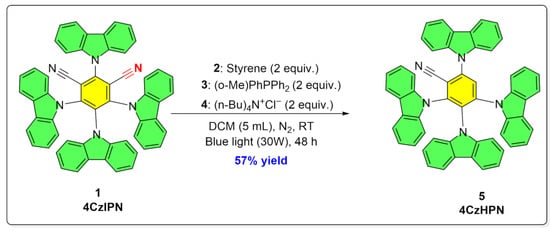
While conducting research on the functionalization reactions of olefins through photocatalysis, we accidentally discovered the formation of product 4CzHPN 5 (Scheme 1). Firstly, in a nitrogen atmosphere, stir styrene 2, diphenyl(o-methylbenzyl)phosphine 3, and tetra-n-butylammonium chloride 4 in a mixed solvent of acetonitrile and water. Then, add the raw material 4CzIPN 1. Under 30W blue-light irradiation for 48 h, a decyanation reaction occurs, resulting in a pale-yellow solid powder, 4CzHPN, with an 57% yield.
Scheme 1.
Photocatalytic decyanation synthesis of 4CzHPN.
To verify the mechanism of the reaction process, controlled experiments were conducted (Table S1). It was found that the reaction could not proceed without the presence of light, the phosphine reagent 3, and n-butyl ammonium chloride 4. Currently, our speculation is that the reaction mechanism involves the initiation of the electron-transfer chain by the phosphine reagent, the extension of the reaction chain by styrene, and the promotion of protonation by water, thereby achieving high selectivity in the removal of the monocyanide group. Further verification of the mechanism is still required for the next step [31].
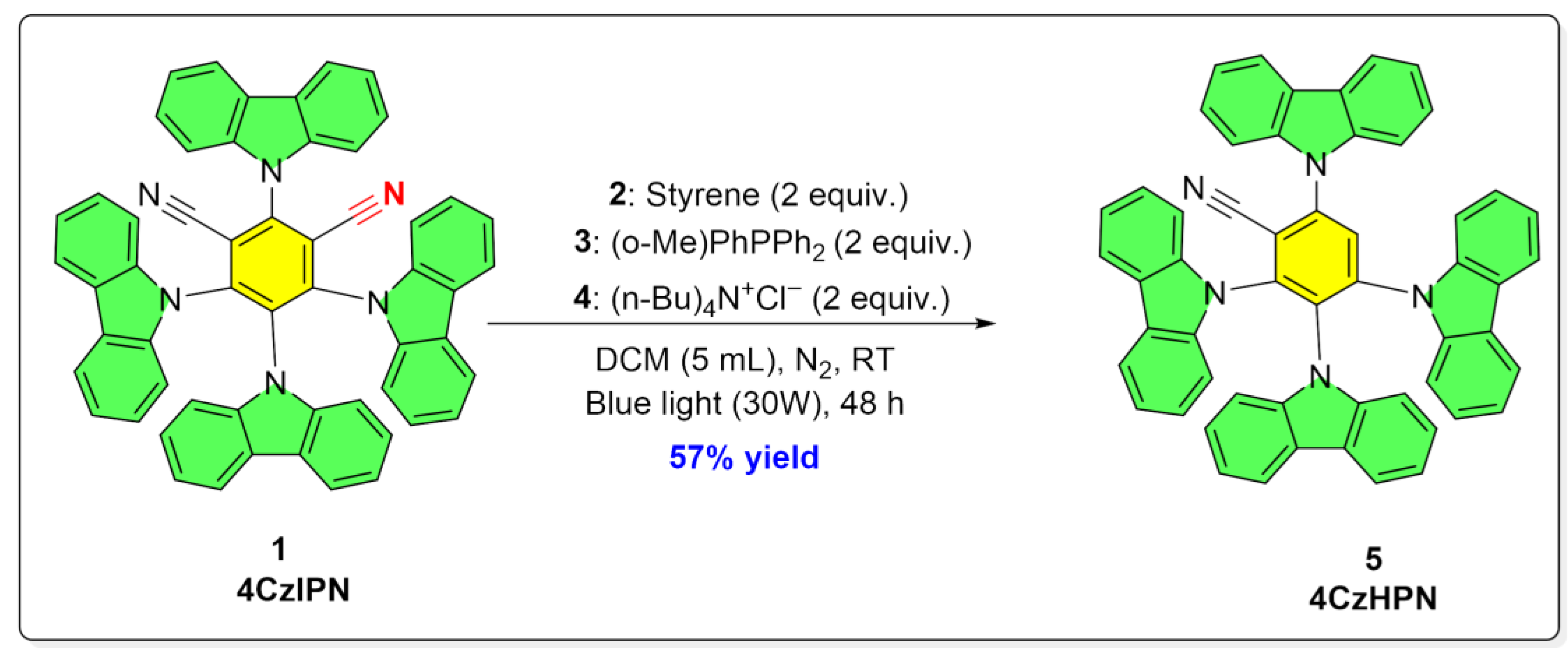
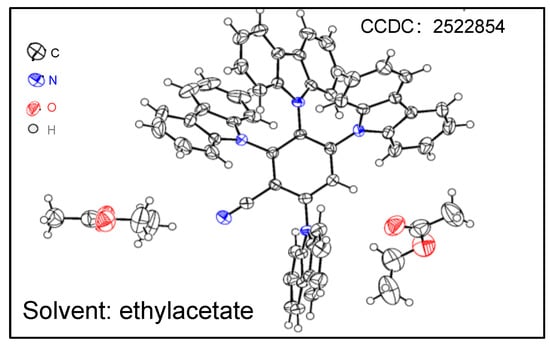
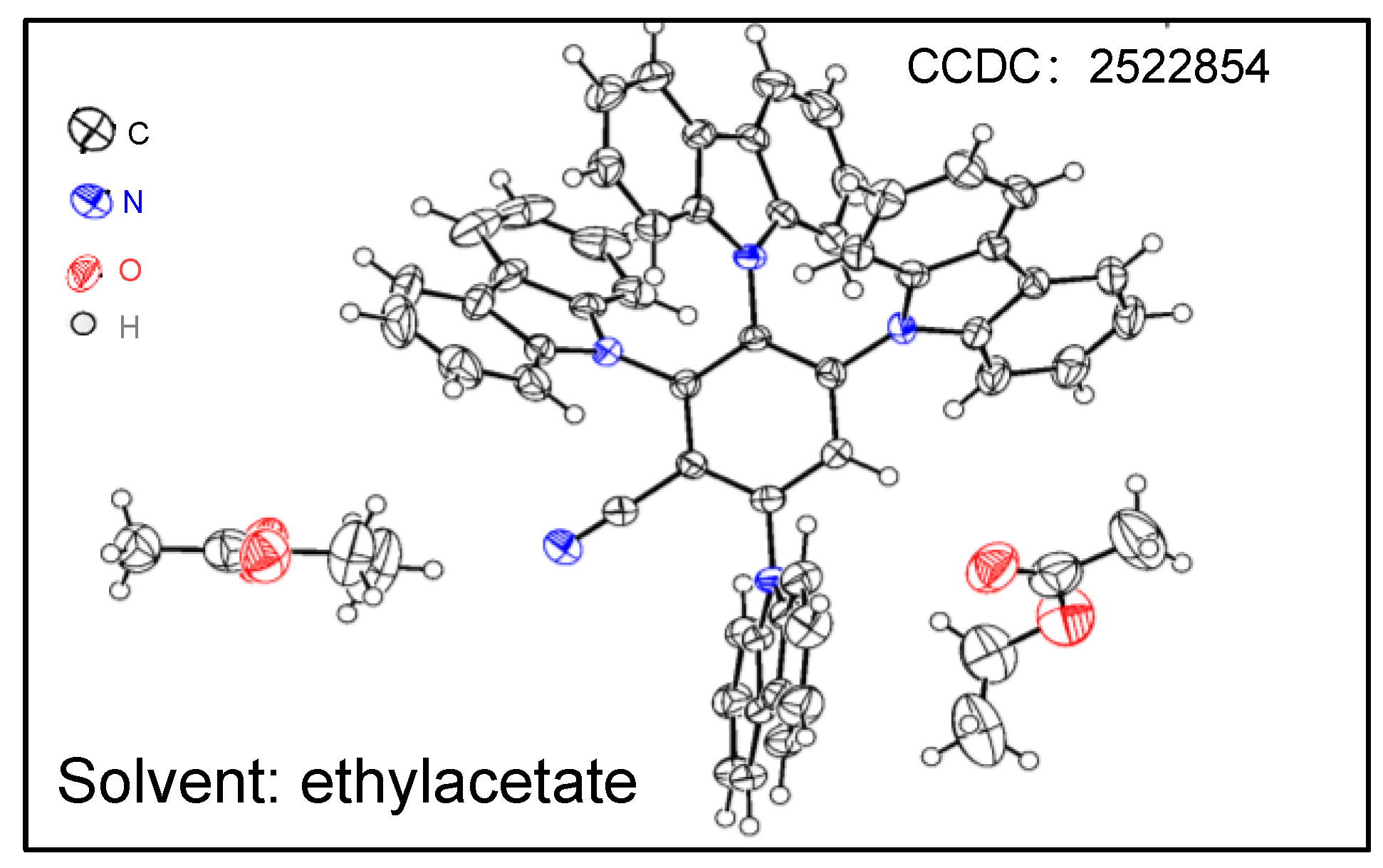
The structure of 4CzHPN 5 was comprehensively characterized using FT-IR, 1H NMR, and 13C NMR spectroscopies and verified through single-crystal X-ray diffraction (Figure 1). As illustrated in Figure S1, the 1H NMR spectrum analysis reveals that the product 4CzHPN is formed when one cyano group on the parent benzene ring of 4CzIPN is substituted by a hydrogen atom, and this substituent hydrogen appears as a characteristic singlet in the spectrum. Influenced by the inductive electron-withdrawing effect of the adjacent nitrogen atom, the electron cloud density around this hydrogen atom decreases, causing the chemical shift to move downfield, specifically at 7.45 ppm. 13C NMR analysis further confirms the occurrence of the substitution reaction (Figure S2): the carbon signal at the aforementioned hydrogen-substituted site is located at approximately 110.1 ppm, while the carbon signal of the unsubstituted cyano group appears at 114.0 ppm. The distinct difference in chemical shifts between these two reflects the regulatory effect of the substitution modification on the electron cloud environment of the carbon nucleus. Fourier transform infrared spectroscopy (FT-IR) test results indicate that the characteristic stretching vibration peak of the cyano group (−CN) is located at 2235 cm−1, which is consistent with the typical infrared absorption characteristics of the cyano functional group (Figure S4). Simultaneously, multiple characteristic vibration absorption peaks of aromatic C–H bonds can be observed in the fingerprint region, which closely match the aromatic ring skeleton features in the molecular structure. To accurately analyze the three-dimensional spatial conformation and intramolecular interaction mechanism of 4CzHPN, we performed single-crystal cultivation using ethyl acetate as the solvent and successfully obtained high-quality single crystals suitable for X-ray diffraction analysis, with its spatial configuration shown in Figure 2. Single-crystal structure analysis results show that three adjacent carbazole rings within the molecule are closely stacked through π-π conjugation, forming a stable intramolecular stacking structure. This weak interaction not only fixes the molecular conformation but also significantly enhances the overall structural stability of 4CzHPN.
Figure 1.
Key characteristic data of 4CzHPN.
Figure 2.
Single-crystal x-ray diffraction maps of 4CzHPN (CCDC: 2522854).
2.2. Electrostatic Potential, X-Ray Single Crystal Diffraction Analysis, and HOMO-LUMO Energy of 4CzHPN
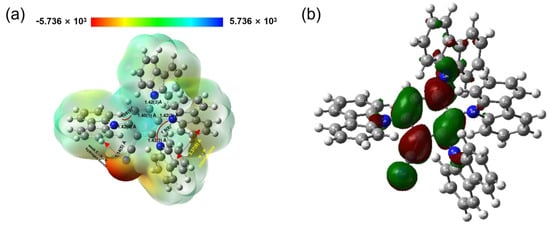
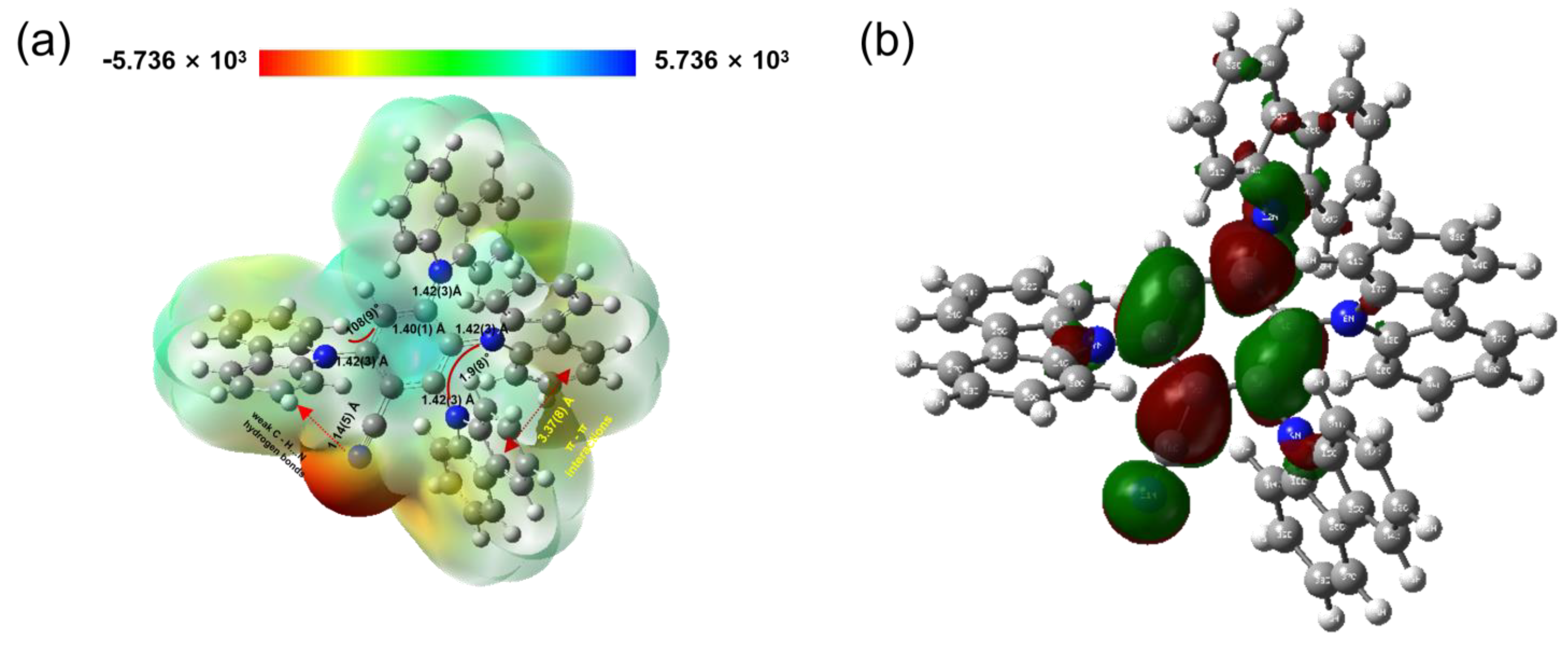
Computational studies of 4CzHPN were carried out using Gaussian 09. Geometry optimization was performed using the DFT method at the 6–311++G (d, p)/B3LYP basis set. 3D plots of the electrostatic potential map are used to identify reactive centers such as electrophilic and nucleophilic sites. As shown in Figure 3a, the electron cloud of 4CzHPN is highly concentrated in the cyano-group region. This region forms a local electron-rich area due to the lone-pair electrons of the nitrogen atom, which can serve as the reaction site for electrophilic reagents. In contrast, the carbazole group presents an electron-deficient environment, making it suitable as the reaction site for nucleophilic substitution reactions [32].
Figure 3.
(a) Electrostatic potential maps of 4CzHPN (5); (b) HOMO-LUMO maps of 4CzHPN (5).
Through X-ray single crystal diffraction analysis, the core benzene ring of 4CzHPN is slightly distorted from planarity. The C–C bond lengths on the ring are approximately 1.40(1) Å, the C≡N bond length of the cyanide group is 1.14(5) Å, and the C–N bond length connecting the carbazole ring and the core benzene ring is 1.42(3) Å. The dihedral angle between the core benzene ring and the adjacent carbazole ring ranges from 109(8)° to 119(8)°. This conformation restricts the degree of intramolecular conjugation. In the crystal packing, there are layered π-π interactions between molecules, with a stacking distance of 3.37(8) Å, and there are also weak C–H···N hydrogen bonds. These intermolecular interactions ensure the stability of the crystal.
Furthermore, the properties of the HOMO and LUMO of 4CzHPN are more significant. The HOMO-LUMO surfaces have been studied in the gas phase. Figure 3b depicts the change in the electron’s energy level from HOMO to LUMO. The brown and green areas in the figure correspond to molecular orbitals with diametrically opposed phases. The positive phase of the molecule is depicted in green, and the negative phase in brown. In the plane that spans the entire 4CzHPN system, the LUMO and HOMO are localized. The energy band gap of the molecule is 3.4901 eV [∆E = ELUMO − EHOMO], and the frontier molecular orbital energies, ELUMO and EHOMO, are −2.0837 and −5.5738 eV, respectively.
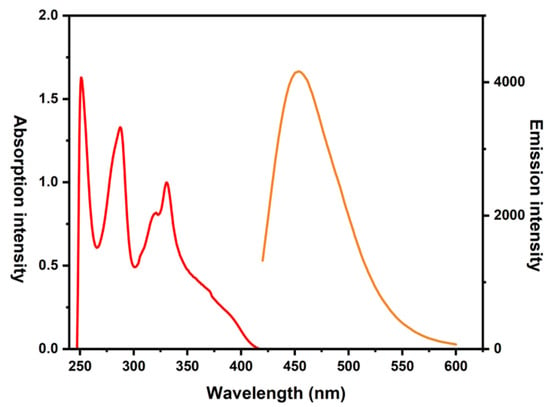
When a cyano group is replaced by a hydrogen atom to form 4CzHPN, the electron-withdrawing conjugate effect of a single cyano group is significantly weaker than that of two cyano groups. This results in a reduced degree of overall charge separation in the molecule and a shift in the electron cloud distribution toward the carbazole unit (Figure 4). The absorption wavelength corresponds to the vertical transition of electrons from the HOMO to the LUMO. For 4CzHPN, λabs = 287 nm (corresponding energy ~4.32 eV), which is much shorter than that of 4CzIPN (~380 nm, ~3.26 eV). This indicates a significant increase in the HOMO-LUMO energy gap. The reason for this is that the absence of the cyano group leads to an elevation of the LUMO energy level (the lowering effect caused by the strong electron-withdrawing group disappears), while the HOMO energy level is primarily dominated by the electron-donating characteristics of the carbazole unit, with minimal change. Consequently, the energy of photons required for the transition increases. The emission wavelength corresponds to the process of excited-state electrons relaxing from the LUMO back to the HOMO. The λem of 4CzHPN is 452 nm (~2.74 eV), which undergoes a blue shift compared to that of 4CzIPN (~520 nm, ~2.38 eV). On one hand, due to the increased ground-state energy gap, the energy of the emitted photons increases. On the other hand, the molecular rigidity of the single cyano group structure is slightly reduced, leading to a decrease in non-radiative loss during the excited-state relaxation process, thereby making the emitted photons closer to the energy of the vertical transition. Therefore, the core reason for the blue shifts in both absorption and emission wavelengths when one cyano group in 4CzIPN is replaced by hydrogen to form 4CzHPN is the disappearance of the strong electron-withdrawing conjugate effect of the cyano group. This causes an elevation of the molecular LUMO energy level, an increase in the HOMO-LUMO energy gap, and a weakening of the π-conjugation system’s electron delocalization, ultimately altering the energy requirements for electronic transitions and the behavior of excited-state relaxation [33].
Figure 4.
Ultraviolet absorption (red line) and fluorescence emission (yellow line) spectra of 4CzHPN.
3. Experiment Section
3.1. Material and Methods
All reactions were conducted under inert atmospheres using standard techniques, unless specified otherwise. All reagents and materials were obtained commercially and utilized without further purification, unless stated otherwise. Solvents were maintained in super-dry, anhydrous conditions with a minimum purity of 99.9%. Column chromatography was performed using silica gel (Merck, 200–300 mesh, Chengdu, China), and thin-layer chromatography (TLC) was carried out on silica gel GF254 plates, employing a mixture of petroleum ether (PE) and ethyl acetate (EA) as the developing solvent. Products were purified via column chromatography using silica gel (200–300 mesh, Chengdu, China). Thin-layer chromatography (TLC) separations were conducted on silica gel GF254 plates with a solvent mixture of petroleum ether (PE) and ethyl acetate (EA), and the plates were visualized using UV light. Nuclear magnetic resonance (NMR) spectra, including 1H (400 MHz), and 13C (101 MHz), were recorded on a Bruker AMX 400 NMR spectrometer (Berlin, Germany), with tetramethylsilane (TMS) as the internal standard in CDCl3 solutions. Chemical shifts for 1H NMR were reported relative to TMS at 0.00 ppm, residual CHCl3 at 7.26 ppm. The following abbreviations were used to denote signal characteristics: δ = chemical shift, J = coupling constant, s = singlet, brs = broad singlet, d = doublet, t = triplet, q = quartet, dd = doublet of doublets, dt = doublet of triplets, m = multiplet. Melting points were obtained on a Yanaco M500 melting point apparatus (Kyoto, Japan) and are corrected.
3.2. Preparation of 4CzHPN
All manipulations were performed under a nitrogen atmosphere using standard Schlenk techniques. A dried 25 mL reaction tube equipped with a magnetic stir bar was charged sequentially with diphenyl(o-tolyl)phosphine (110.5 mg, 0.40 mmol), 4CzIPN (158 mg, 0.20 mmol), and tetrabutylammonium chloride (111 mg, 0.40 mmol). The vessel was purged with nitrogen gas (3 cycles) to ensure an oxygen-free environment. A separate solution of styrene (42 mg, 0.40 mmol) in anhydrous dichloromethane (DCM) (5 mL) was prepared under nitrogen and transferred via syringe into the reaction tube. The mixture was sealed and irradiated under constant stirring at ambient temperature (25 ± 2 °C) using a 30 W blue LED light source (λmax = 455 nm) for 48 h. Reaction progress was monitored by thin-layer chromatography (TLC; silica gel 60 F254, hexane/ethyl acetate 4:1 v/v) at 12 h intervals.
Upon completion, the reaction was quenched by adding saturated aqueous NaCl solution (3 mL). The mixture was extracted with DCM (3 × 10 mL), and the combined organic phases were dried over anhydrous sodium sulfate (Na2SO4, 2 g) for 15 min. After filtration to remove the desiccant, the filtrate was concentrated under reduced pressure using a rotary evaporator (35 °C, 200 mbar). The crude product was purified by flash column chromatography on silica gel (230–400 mesh) using a gradient elution of petroleum ether/ethyl acetate (20:1 v/v to 10:1 v/v). Fractions containing the target compound were identified by TLC, combined, and evaporated to afford 4CzHPN as a pale-yellow solid powder (87.5 mg, 0.114 mmol).
Yield 57%, m.p. 298–300 °C, TLC (cyclohexane 80%/ethylacetate 20%) Rf = 0.45; FT-IR (ATR, cm−1): 2995 (C-H), 2235 (CN), 1360 (N–C); 1H NMR (400 MHz, CDCl3) δ 8.18–8.06 (m, 2H, H44 and H32), 7.71–7.48 (m, 7H, H38–41 and H45–47), 7.45 (d, J = 8.0 Hz, 1H, H50), 7.40–7.18 (m, 7H, H26–29 and H33–35), 7.18–7.10 (m, 2H, H20 and H8), 7.05–6.93 (m, 8H, H14–17, H21–23, and H5), 6.88 (t, J = 9.1 Hz, 2H, H2 and H11), 6.71 (dt, J = 15.1, 7.4 Hz, 2H, H3 and H10), 6.64–6.52 (m, 2H, H4 and H9). 13C NMR (101 MHz, CDCl3) δ 142.6 (C49), 142.29 (C51), 142.26 (C53), 141.9 (C1), 141.7 (C12), 140.7 (C13), 140.5 (C25), 140.2 (C36), 139.1 (C37), 139.0 (C48), 138.9 (C24), 138.7 (C10), 138.1 (C15), 137.8 (C22), 136.2 (C27), 132.8 (C34), 130.2 (C39), 128.7 (C46), 128.3 (C5), 127.0 (C8), 126.8 (C17), 125.9 (C20), 125.7 (C29), 125.6 (C32), 125.6 (C41), 124.8 (C44), 124.6 (C6), 124.4 (C7), 124.3 (C18), 124.2 (C19), 124.1 (C30), 123.81 (C31), 123.78 (C42), 123.7 (C43), 121.8 (C52), 121.5 (C2), 121.3 (C11), 121.2 (C14), 121.1 (C23), 120.9 (C26), 120.6 (C35), 120.4 (C38), 120.39 (C40), 120.35 (C4), 120.3 (C9), 119.7 (C16), 119.5 (C21), 114.0 (C55), 113.1 (C28), 110.2 (C33), 110.1 (C50), 109.9 (C45), 109.8 (C47), 109.7 (C3), 109.3 (C54). HRMS (ESI) calcd. For ([C55H33N5] + H) + m/z 764.2809, found 764.2809.
3.3. X-Ray Crystal Structure Data
CCDC 2,522,854 contains the supplementary crystallographic data for this paper. These data can be obtained free of charge via http://www.ccdc.cam.ac.uk/conts/retrieving.html, accessed on 14 January 2026 (or from the CCDC, 12 Union Road, Cambridge CB2 1EZ, UK; Fax: +44-1223-336033; E-mail: deposit@ccdc.cam.ac.uk). Figure S5 (See Supplementary Materials) provides the data collection, crystal data and refined structural information.
4. Conclusions
In summary, we developed a mild photocatalytic decyanation route to synthesize the novel compound 2,3,4,6-tetra(9H-carbazol-9-yl)benzonitrile (4CzHPN) via a one-pot sequential strategy under 30W blue-light irradiation. The target product was obtained as a pale-yellow solid powder with a 57% yield. Its structure was comprehensively identified by 1H NMR, 13C NMR, and FT-IR spectroscopies and then unambiguously confirmed by single-crystal X-ray diffraction analysis. Furthermore, we mapped the molecular electrostatic potential (ESP) to clarify the distribution of reactive sites and calculated the frontier molecular orbital (HOMO-LUMO) energy gap of 3.4901 eV based on DFT.
Supplementary Materials
The following supporting information is available online. Figure S1: 1H NMR Spectrum of Compound 5; Figure S2: 13C NMR Spectrum of Compound 5; Figure S3: HRMS spectrum of Compound 5; Figure S4: FT-IR spectrum of Compound 5; Figure S5: Single - crystal Data collection of compound 5; Table S1: Control experiments.
Author Contributions
Conceptualization, approach, writing and original draft research, X-ray crystallography experiments and structural analyses, Q.-Q.W.; investigation, writing, review and editing, Z.-C.F. All authors have read and agreed to the published version of the manuscript.
Funding
This work received no external funding support.
Data Availability Statement
The original contributions presented in this study are included in the article/Supplementary Material. Further inquiries can be directed to the corresponding author.
Acknowledgments
We acknowledge the assistance of Shiyanjia Lab (www.shiyanjia.com, accessed on 10 January 2026) for X-ray crystallographic structure tests.
Conflicts of Interest
The authors declare no conflicts of interest.
References
- Goddard, J.P.; Ollivier, C.; Fensterbank, L. Photoredox catalysis for the generation of carbon centered radicals. Acc. Chem. Res. 2016, 49, 1924–1936. [Google Scholar] [CrossRef] [Scilit]
- Matsui, J.K.; Lang, S.B.; Heitz, D.R.; Molander, G.A. Photoredox-mediated routes to radicals: The value of catalytic radical generation in synthetic methods development. ACS Catal. 2017, 7, 2563–2575. [Google Scholar] [CrossRef] [Scilit]
- Bell, J.D.; Murphy, J.A. Recent advances in visible light-activated radical coupling reactions triggered by (i) ruthenium,(ii) iridium and (iii) organic photoredox agents. Chem. Soc. Rev. 2021, 50, 9540–9685. [Google Scholar] [CrossRef] [Scilit]
- Pitre, S.P.; Overman, L.E. Strategic use of visible-light photoredox catalysis in natural product synthesis. Chem. Rev. 2021, 122, 1717–1751. [Google Scholar] [CrossRef] [Scilit]
- Lang, X.; Zhao, J.; Chen, X. Cooperative photoredox catalysis. Chem. Soc. Rev. 2016, 45, 3026–3038. [Google Scholar] [CrossRef] [Scilit]
- Hossain, A.; Bhattacharyya, A.; Reiser, O. Copper’s rapid ascent in visible-light photoredox catalysis. Science 2019, 364, eaav9713. [Google Scholar] [CrossRef] [Scilit] [PubMed]
- Prier, C.K.; Rankic, D.A.; MacMillan, D.W. Visible light photoredox catalysis with transition metal complexes: Applications in organic synthesis. Chem. Rev. 2013, 113, 5322–5363. [Google Scholar] [CrossRef] [Scilit]
- Cabanero, D.C.; Rovis, T. Low-energy photoredox catalysis. Nat. Rev. Chem. 2025, 9, 28–45. [Google Scholar] [CrossRef] [Scilit] [PubMed]
- Shaw, M.H.; Twilton, J.; MacMillan, D.W. Photoredox catalysis in organic chemistry. J. Org. Chem. 2016, 81, 6898–6926. [Google Scholar] [CrossRef] [Scilit] [PubMed]
- Patel, G.; Patel, A.R.; Banerjee, S. Sustainability of visible light-driven organic transformations-A review. Curr. Org. Chem. 2023, 27, 166–189. [Google Scholar] [CrossRef] [Scilit]
- Rahman, M.Z.; Kibria, M.G.; Mullins, C.B. Metal-free photocatalysts for hydrogen evolution. Chem. Soc. Rev. 2020, 49, 1887–1931. [Google Scholar] [CrossRef] [Scilit]
- Luo, K.; Yang, W.C.; Wu, L. Photoredox catalysis in organophosphorus chemistry. Asian J. Org. Chem. 2017, 6, 350–367. [Google Scholar] [CrossRef] [Scilit]
- Uoyama, H.; Goushi, K.; Shizu, K.; Nomura, H.; Adachi, C. Highly efficient organic light-emitting diodes from delayed fluorescence. Nature 2012, 492, 234–238. [Google Scholar] [CrossRef] [Scilit] [PubMed]
- Shang, T.Y.; Lu, L.H.; Cao, Z.; Liu, Y.; He, W.M.; Yu, B. Recent advances of 1,2,3,5-tetrakis (carbazol-9-yl)-4,6-dicyanobenzene (4CzIPN) in photocatalytic transformations. Chem. Commun. 2019, 55, 5408–5419. [Google Scholar] [CrossRef] [Scilit] [PubMed]
- Mohamadpour, F. Synthesis of polyfunctionalized dihydro-2-oxypyrroles catalyzed by 1,2,3,5-tetrakis (carbazol-9-yl)-4,6-dicyanobenzene (4CzIPN) as a novel donor-acceptor fluorophore. Sci. Rep. 2022, 12, 16911. [Google Scholar] [CrossRef] [Scilit]
- Zhu, S.S.; Zuo, L.; Liu, Y.; Yu, B. 1,2,3,5-Tetrakis (carbazol-9-yl)-4,6-dicyanobenzene (4CzIPN)-based porous organic polymers for visible-light-driven organic transformations in water under aerobic oxidation. Green Chem. 2022, 24, 8725–8732. [Google Scholar] [CrossRef] [Scilit]
- Garima, K.; Srivastava, V.; Singh, P.P.; Singh, P.K. Recent Advancement of 1,2,3,5-Tetrakis (Carbazol-9-yl)-4,6-Dicyanobenzene (4-CzIPN) in Photocatalyzed Synthesis of Heterocyclic Compounds. ChemistrySelect 2025, 10, e202501134. [Google Scholar] [CrossRef] [Scilit]
- Uppuluru, A.; Annamalai, P.; Padala, K. Recent advances in 4CzIPN-mediated functionalizations with acyl precursors: Single and dual photocatalytic systems. Chem. Comm. 2025, 61, 3601–3635. [Google Scholar] [CrossRef] [Scilit]
- Fang, Y.; Xue, Y.; Chao, D. Organic Thermally Activated Delayed Fluorescence (TADF) Compound as The Photosensitizer in CO2 Photoreduction: Taking 4CzIPN as An Example. Asian J. Org. Chem. 2025, 14, e202500256. [Google Scholar] [CrossRef] [Scilit]
- Saritha, R.; Annes, S.B.; Ramesh, S. Metal-free, regioselective, visible light activation of 4CzIPN for the arylation of 2 H-indazole derivatives. RSC Adv. 2021, 11, 14079–14084. [Google Scholar] [CrossRef] [Scilit]
- Mohamadpour, F. Carbazole-based photocatalyst (4CzIPN) as a novel donor-acceptor (DA) fluorophore catalyzed gram-scale 2-amino-4H-chromene scaffolds photosynthesis via a proton-coupled electron transfer (PCET) process. J. Taiwan Inst. Chem. Eng. 2023, 144, 104699. [Google Scholar] [CrossRef] [Scilit]
- Bryden, M.A.; Zysman-Colman, E. Organic thermally activated delayed fluorescence (TADF) compounds used in photocatalysis. Chem. Soc. Rev. 2021, 50, 7587–7680. [Google Scholar] [CrossRef] [Scilit]
- Chen, X.K.; Kim, D.; Brédas, J.L. Thermally activated delayed fluorescence (TADF) path toward efficient electroluminescence in purely organic materials: Molecular level insight. Acc. Chem. Res. 2018, 51, 2215–2224. [Google Scholar] [CrossRef] [Scilit] [PubMed]
- Tao, Y.; Yuan, K.; Chen, T.; Xu, P.; Li, H.; Chen, R.; Huang, W. Thermally activated delayed fluorescence materials towards the breakthrough of organoelectronics. Adv. Mater. 2014, 26, 7931–7958. [Google Scholar] [CrossRef] [Scilit]
- Yang, Z.; Mao, Z.; Xie, Z.; Zhang, Y.; Liu, S.; Zhao, J.; Aldred, M.P. Recent advances in organic thermally activated delayed fluorescence materials. Chem. Soc. Rev. 2017, 46, 915–1016. [Google Scholar] [CrossRef] [Scilit]
- Singh, P.P.; Singh, P.K.; Srivastava, V. Visible light metallaphotoredox catalysis in the late-stage functionalization of pharmaceutically potent compounds. Org. Chem. Front. 2023, 10, 216–236. [Google Scholar] [CrossRef] [Scilit]
- Jung, J.; Saito, S. Recent advances in light-driven carbon–carbon bond formation via carbon dioxide activation. Synthesis 2021, 53, 3263–3278. [Google Scholar] [CrossRef] [Scilit]
- Demertzidou, V.P.; Skolia, E.; Kokotos, C.G. Thioxanthone: A Benchmark Photocatalyst for Organic Synthesis. ChemCatChem 2025, 17, e00760. [Google Scholar] [CrossRef] [Scilit]
- Tripathy, A.R.; Bisoyi, A.; Poolamanna, R.; Panuganti, A.; Yatham, V.R. Photoinduced ligated boryl radical-mediated functionalization of organic halides. Adv. Synth. Catal. 2025, 367, e70094. [Google Scholar] [CrossRef] [Scilit]
- He, X.; Qiu, L.Q.; Wang, W.J.; Chen, K.H.; He, L.N. Photocarboxylation with CO2: An appealing and sustainable strategy for CO2 fixation. Green Chem. 2020, 22, 7301–7320. [Google Scholar] [CrossRef] [Scilit]
- Paul, N.; Patra, T.; Maiti, D. Recent developments in hydrodecyanation and decyanative functionalization reactions. Asian J. Org. Chem. 2022, 11, e202100591. [Google Scholar] [CrossRef] [Scilit]
- Mokhi, L.; Chkirate, K.; Zhang, X.; Driowya, M.; Bougrin, K. (3-(4-Chlorophenyl)-4,5-dihydroisoxazol-5-yl) methyl Benzenesulfonate. Molbank 2023, 2023, M1732. [Google Scholar] [CrossRef] [Scilit]
- Frîncu, A.M.; Căta, L.; Bălăceanu, D.; Grosu, I.; Crișan, A.P.; Terec, A. Synthesis of 2-(2-((5″-(4-Cyanophenyl)-3,4′,4″-trioctyl[2,2′:5′,2″-terthiophen]-5-yl) methylene)-3-oxo-2,3-dihydro-1H-inden-1-ylidene) malononitrile. Molbank 2025, 2025, M2038. [Google Scholar] [CrossRef] [Scilit]
Disclaimer/Publisher’s Note: The statements, opinions and data contained in all publications are solely those of the individual author(s) and contributor(s) and not of MDPI and/or the editor(s). MDPI and/or the editor(s) disclaim responsibility for any injury to people or property resulting from any ideas, methods, instructions or products referred to in the content. |
© 2026 by the authors. Licensee MDPI, Basel, Switzerland. This article is an open access article distributed under the terms and conditions of the Creative Commons Attribution (CC BY) license.