


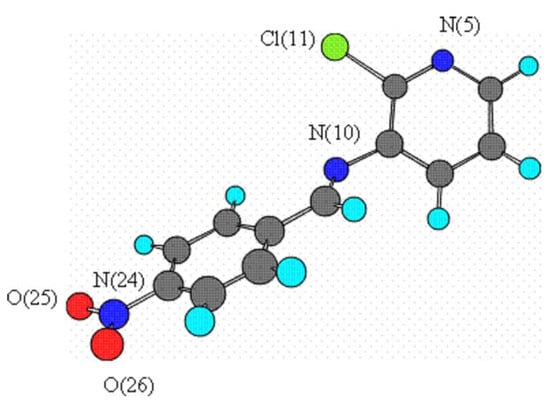
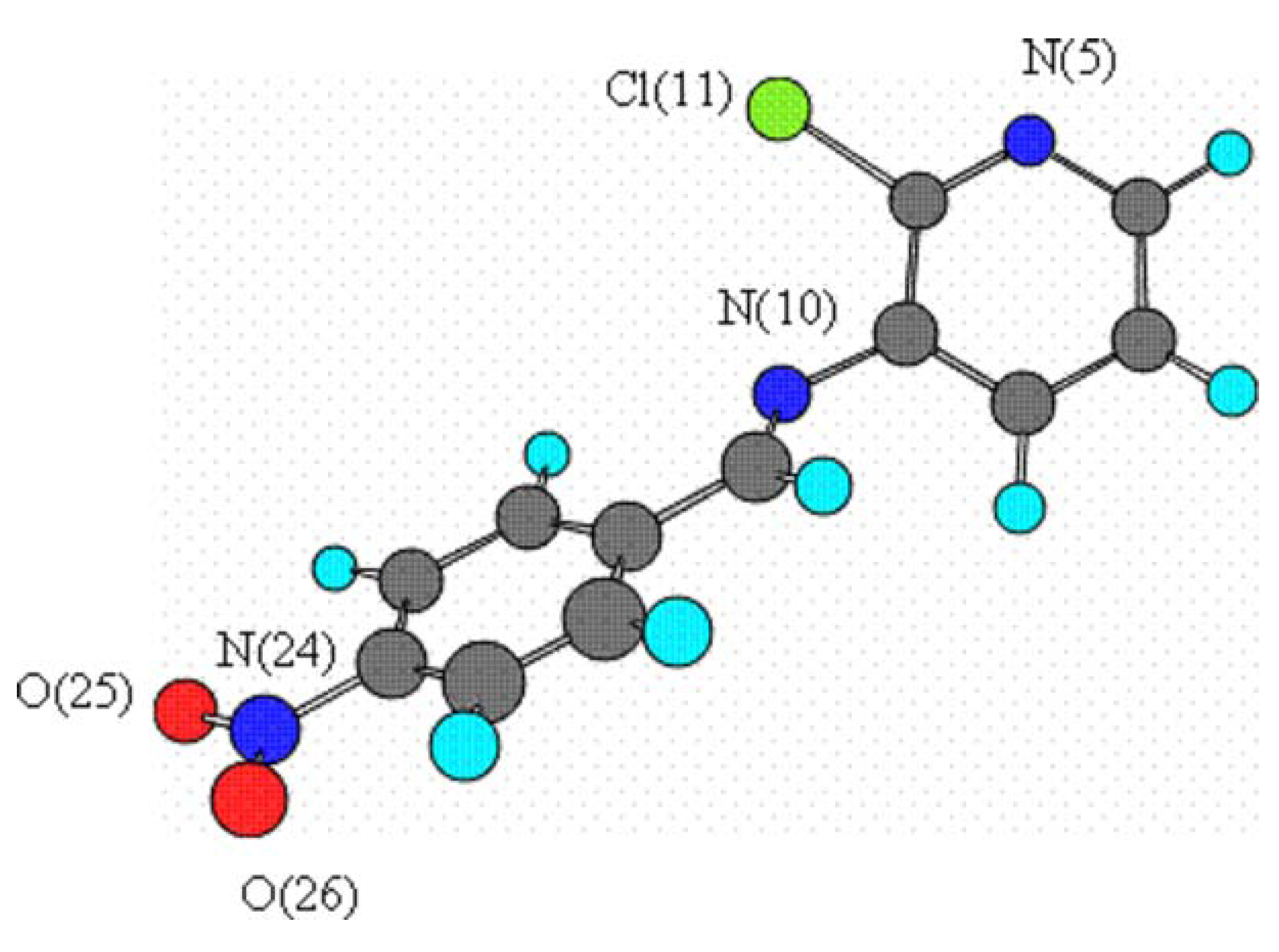
Schiff bases are reported to show a variety of biological activities such as antibacterial [1,2,3], antifungal [4,5], anticancer [6,7] and herbicidal [8] activities . Pyridinium compounds have biological activities [9] such as antifungal [10] and antibacterial [10,11] activities. The presence of a chloro moiety in different types of compounds causes them to exhibit pesticidal activity8. Based on these facts , we synthesized 2-chloro pyridin-3-yl–(4-nitrobenzylidene) amine 3. According to ab initio calculations at the HF/6-31G (d,p) level, Schiff base 3 at dihedral angel of 42.9 o is about 15.70 kj/mol more stable than the coplanar pyridine and nitrophenyl rings (Figure 1). The titled compound was tested against S. aureus, B. subtilis, K. pneumonia and P. aeruginosa by the disk diffiusion method and was not active at the level of 200 μg/disk.
Figure 1 : The minimum energy conformation of Schiff base 3.

A mixture of 3-amino-2-chloropyridine 1(1.28 g, 10.00 mmol), 4-nitrobenzaldehyde 2 (1.51 g, 10.00 mmol) and anhydrous magnesium sulfate (4.00 g) in dry dichloromethane (40.00 mL) was stirred at room temperature for four hours. The suspension was filtered and washed with dichloromethane.The solvent was evaporated under reduced pressure and Schiff base 3 was formed as a yellow solidwhich was recrystalized from warm ethanol (2.23 g , 85% ).
m.p.146-148 oC.
IR (KBr) (cm-1): 1340.40 and 1517.90 (NO2), 1600.0 (N=CH), 1633.60 (C=N pyridine ring) .
1H-NMR (CDCl3) (250 MHz)δ(ppm): 7.23-8.38 (m , 7 H, Ar-H), 8.54 (s, 1H, CH=N).
13C- NMR (CDCl3) (62.90 MHz)δ(ppm): 123.65-147.18 (2 ph), 161.41 (CH=N).
MS (m/z, %): 261 (M +, 64.90), 149 (NO2Ph-C=N, 36.00 ), 126(C5H3NClN, 15.00 ), 112 (C5H3NCl, 34.00), 92( C5H3N2, 29.00 ), 77 ( C5H3N, 31.20), 53 (N=CH-CH=CH, 35.00), 51 (N=C-C=CH, 100.00).
Supplementary materials
Supplementary File 1Supplementary File 2Supplementary File 3Acknowledgment
The authors thank the Shiraz University Research Council for financial support (Grant No. 81-SC-1495-C191).
References
- Shaikh kabeer, A.; Baseer, M.A.; Mote, N.A. Asian J. Chem. 2001, 13(2), 496–500.
- Pandeya, S.N.; Sriram, D.; Nath, G.; De Clercq, E. Il Farmaco 1999, 54, 624–628.
- El-masry, Afaf.H.; Fahmy, H.H.; Ali Abdelwahed, S.H. Molecules 2000, 5, 1429–1438.
- More, P.G.; Bhalvankar, R.B.; Pattar, S.C. J. Indian Chem. Soc. 2001, 78, 474–475.
- Singh, W.M.; Dash, B.C. Pesticides 1998, 22(11), 33–37.
- Desai, S.B.; Desai, P.B.; Desai, K.R. Heterocycl. Commun. 2001, 7(1), 83–90.
- Phatak, P.; Jolly, V.S.; Sharma, K.P. Orient. J. Chem. 2000, 16(3), 493–494.
- Samadhiya, S.; Halve, A. Orient. J. Chem. 2001, 17(1), 119–122.
- Sepcic, Kristina. J. Toxicol. , Toxin Rev. 2000, 19(2), 136–160.
- Sliwa, W.; Mianowska, B. Heterocycles 1989, 29(3), 557–595.
- Druta, I.; Dinica, R.; Bacu, E.; Anderi, M. Chem. Abstr. 2000, 132, 205326b.
- Sample Availability : Available from MDPI.
© 2004 MDPI. All rights reserved.