


Abstract
Organoselenium chemistry has undergone remarkable development over the past five decades, evolving from its initial association with high toxicity into a field with pivotal contributions to materials science, organic synthesis, catalysis, and Medicinal Chemistry. Among the diverse biological activities displayed by organoselenium compounds, their redox behaviour is particularly compelling, as many of these molecules act as efficient mimetics of the antioxidant enzyme glutathione peroxidase (GPx). In this work, we investigated the GPx-like activity of a series of N,N′-diaryl selenoureas toward the depletion of H2O2 and cumene hydroperoxide (CumOOH) as model ROS. Their reactivity was correlated with the electronic nature of the aryl substituents using a Hammett-type analysis, revealing a strong dependence of the reaction rate on remote electronic perturbations within the aromatic ring. Combined UV and NMR studies provided mechanistic evidence supporting a catalytic cycle in which selenoureas, operating at sub-stoichiometric loadings (1 mol%) and using a thiol as a cofactor-like molecule, can be used to efficiently scavenge ROS with half-lives of only a few minutes (~10–60 min). Furthermore, these selenoureas exhibited potent antiproliferative activity across several human solid tumour cell lines. Overall, these results offer mechanistic insight into the ROS-eliminating pathways of selenoureas and highlight their potential as chemopreventive or anticancer agents.
1. Introduction
Selenium, discovered in 1817 by the Swedish chemist Jöns Jacob Berzelius [1], was long regarded primarily as a toxic element [2]. Its association with poisoning episodes in humans and livestock constrained scientific interest for more than a century [3]. Historical records even describe symptoms consistent with selenium intoxication during Marco Polo’s travels through Western China in the 13th century, and some authors have speculated that selenium-rich plants (seleniferous or Se-accumulating species) may have contributed to the defeat of Lieutenant Colonel Custer at the Battle of the Little Bighorn by poisoning cavalry horses [4].
This long-standing perception underwent a profound transformation in the 1970s, when selenium was identified as an essential component of key enzymes, now known as selenoproteins, in which it is incorporated as the amino acid selenocysteine [5]. This discovery marked a turning point in our understanding the biological relevance of selenium. Over 20 selenoproteins [6] have been identified, including glutathione peroxidases (GPx) [7], thioredoxin reductases (TrxR) [8], and iodothyronine deiodinases (DIO) [9], all of which are central regulators of redox homeostasis, intracellular signalling pathways, and thyroid hormone metabolism [10]. Selenium is an essential trace micronutrient [11], and its deficiency is associated with severe pathologies [12].
In parallel with these discoveries, interest in organoselenium chemistry has grown exponentially [13]. Although there are numerous sulphur-containing compounds exhibiting valuable biological properties [14], selenium displays distinctive physicochemical properties, like greater nucleophilicity, higher polarizability, and an increased propensity for oxidation [15,16] providing unique reactivity profiles. Organoselenium chemistry has expanded substantially, and the principles of Green Chemistry have been successfully incorporated to develop environmentally friendly methods for synthesizing selenium-containing compounds [17]. Mechanochemical approaches [18], solvent-free protocols [19], flow chemistry [20], ultrasound-mediated, visible-light-mediated or electrochemically mediated reactions [21] have all contributed to this progress.
These advances have enabled the preparation of a wide array of useful synthetic building blocks [22], mimetics of natural compounds, like selenosugars [13,23], catalysts [24], and functional derivatives applicable in Materials Science [25,26], and very prominently, in the design of bioactive molecules [27]. A vast arsenal of organoselenium compounds has shown potential therapeutic relevance against numerous diseases and disorders [28,29], including cancer [30,31,32,33,34,35,36], Alzheimer’s disease [37,38,39], epilepsy [40], inflammatory diseases [41], microbial infections [42,43,44,45,46], lysosomal storage disorders [47], or osteoporosis [48], among others.
Among their various attributes, perhaps the most compelling property of organoselenium compounds is their pronounced redox activity. Their capacity to scavenge Reactive Oxygen/Nitrogen Species (ROS/RNS, respectively), including free radicals, peroxides, and hydroperoxides has become a particularly active research area, as these redox processes underlie many of the observed biological effects [49].
In this manuscript, we present an in-depth analysis of the antioxidant properties of N,N′-diaryl selenoureas, focusing on their ability to function as efficient GPx mimetics and proposing a tentative mechanistic pathway for their redox activity.
2. Results and Discussion
2.1. Design of Bioactive Molecules
Among the diverse biological activities exhibited by organoselenium compounds, their ability to modulate and deplete excessive ROS levels stands out as particularly noteworthy. The controlled reduction in overproduced reactive species can profoundly influence the management of numerous disorders and diseases, while also positioning Se-containing molecules as promising chemopreventive agents [50]. Despite this potential, the mechanisms by which seleno-compounds interact with reactive species such as ROS and RNS remain only partially understood. Gaining deeper mechanistic insight into these interactions is essential for the rational design of more potent and selective bioactive molecules.
Within this chemical family, selenoureas—selenium-based isosteres of ureas and thioureas—represent a particularly intriguing class [36,51].
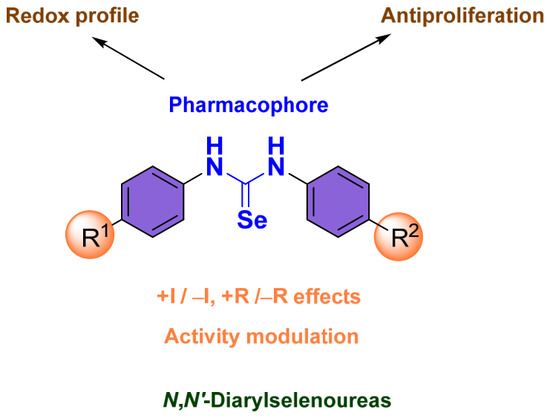
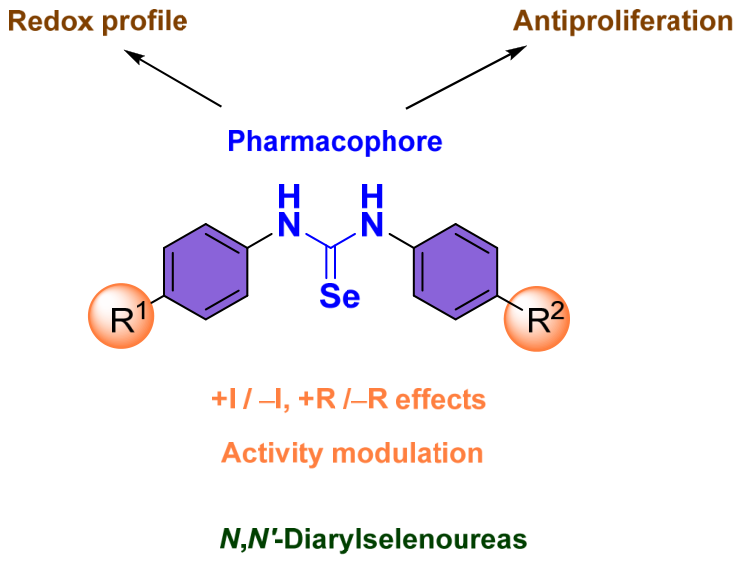
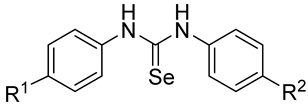
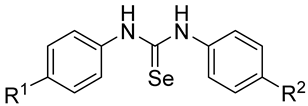
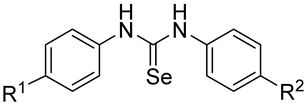
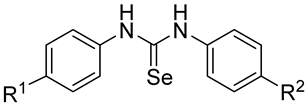
Herein, we explore a simple prototype: N,N′-diaryl selenoureas (Figure 1). Our aim was to gain mechanistic insight into their ROS-eliminating behaviour, in particular, peroxides and alkyl peroxides. We hypothesized that introducing substituents with distinct stereoelectronic characteristics could fine-tune the antioxidant response of these selenoureas and provide valuable evidence regarding their underlying mode of action.
Figure 1.
General structure of N,N′-diaryl selenoureas designed as prototypes for studying the antioxidant properties of the selenoureido motif.
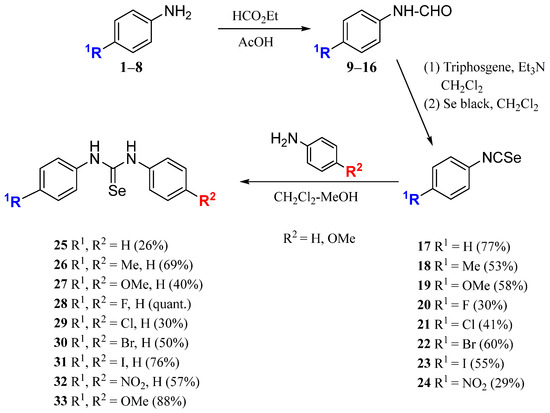
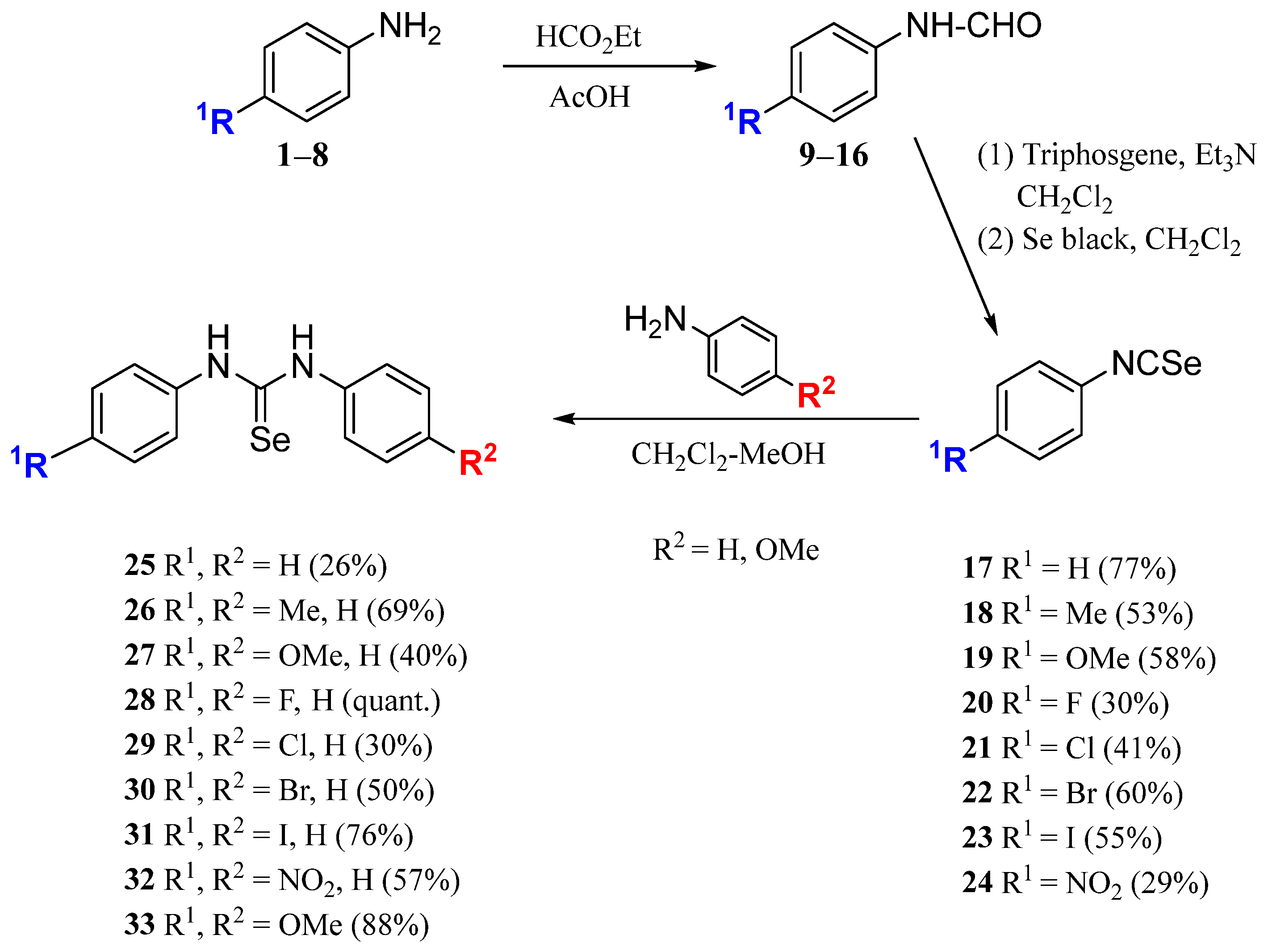
The synthetic strategy relied on coupling aryl isoselenocyanates [52] with aromatic amines. To better quantify the electronic influence of the substituents, one aromatic ring was kept unsubstituted, while the other incorporated para-substituents with distinct electron-donating or electron-withdrawing effects. As a more versatile approach, we initially attempted the direct coupling of aniline isoselenocyanate with various p-substituted anilines. However, these reactions resulted either in no detectable progress or in the formation of complex mixtures of side products.
We therefore adopted an alternative and more reliable route: the individual preparation of each aniline-derived isoselenocyanate (compounds 17–24, Scheme 1). These intermediates were generated through N-formylation of anilines 1–8 using ethyl formate, followed by triphosgene-mediated dehydration to the corresponding transient isocyanates, which were subsequently reacted with elemental selenium black to afford the isoselenocyanates (Scheme 1). Final coupling with aniline afforded selenoureas 25–32. Using the same protocol, the symmetrical p-dimethoxy-substituted selenourea 33 was also successfully obtained. N,N′-Difenil selenourea 25 was previously used [53] by some of us for the selective detection of anions through the formation of mono- and bi-coordinated adducts, acting as molecular logic gates.
Scheme 1.
Preparation of N,N′-diaryl selenoureas 25–33 from commercially available anilines.
The synthesis of 25–33 typically proceeded to completion within minutes, and the products could be isolated in high purity simply by filtration from the reaction medium. Attempts to purify the materials by column chromatography led to significant decomposition, confirming that direct isolation was the most suitable workup procedure.
1H-NMR spectroscopy revealed that the NH protons appear markedly deshielded (δ = 9–11 ppm), consistent with the strong local anisotropic effects generated by the flanking aromatic rings and the electron-withdrawing nature of the selone group, which induces partial positive charge on the nitrogen atoms. In addition, selenoureas exhibit an enhanced hydrogen-bond-donor capacity compared to ureas and thioureas, enabling strong interactions with the solvent (DMSO-d6), which further contributes to the observed downfield shifts.
In the 13C-NMR spectra, the selone carbon resonates within a narrow range of 178–181 ppm, in line with the highly polarized C=Se bond. 77Se is the only NMR active isotope in NMR (7.63% isotopic abundance), endowed with a much higher sensitivity towards structural changes than 1H and 13C [54]. Indeed, 77Se-NMR spectroscopy proved to be substantially more sensitive to subtle structural variations, even distinguishing between conformers more efficiently than 1H and 13C spectroscopy, or reaction intermediates [55]. 77Se spectroscopy exhibits a large chemical shift range [56] (~3000 ppm), so it has become a highly valuable tool in structural studies. Exceptionally high chemical shifts have been recorded for sterically hindered selenoaldehydes and ketones (~2400 ppm), whereas a highly negative chemical shift was found for O=C=Se (−447 ppm) [55]. In selenoureas, extensive n→π* back-donation from the nitrogen atoms to the C=Se bond significantly stabilizes the partial double-bond character, resulting in unusually low 77Se chemical shifts (150–245 ppm) [55]. These reported values are in agreement with the chemical shifts found for selenoureas 25–33, which exhibited resonances spanning 260–331 ppm (Table 1).
Table 1.
Hammett constants and 77Se chemical shifts for selenoureas 25–33.
Notably, the 77Se chemical shifts exhibit a clear and systematic response to the electron-donating or electron-withdrawing nature of the para-substituents, despite the selenium atom being separated by a seven-bond distance. This remarkable long-range sensitivity underscores the exceptional efficiency of electronic transmission across the selenoureido framework.
Correlations between Hammett constants and spectroscopic parameters—particularly 1H and 13C chemical shifts—have been documented in the literature [57]. When such correlations arise, they indicate that substituent-induced variations in chemical shift are electronic in origin and therefore dependent on the donor/acceptor character of the substituents. Within the framework of linear free-energy relationships, these effects can be described by Equation (1):
δ = ρσ + δ0
Equation (1). Correlation between chemical shifts (δ) and Hammett constants (σ).
Here, ρ represents the sensitivity of the nucleus to electronic perturbations, and δ0 corresponds to the chemical shift of the unsubstituted aryl fragment.
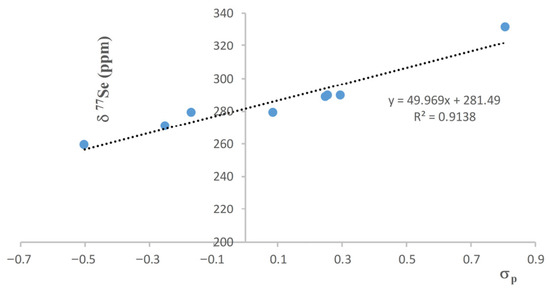
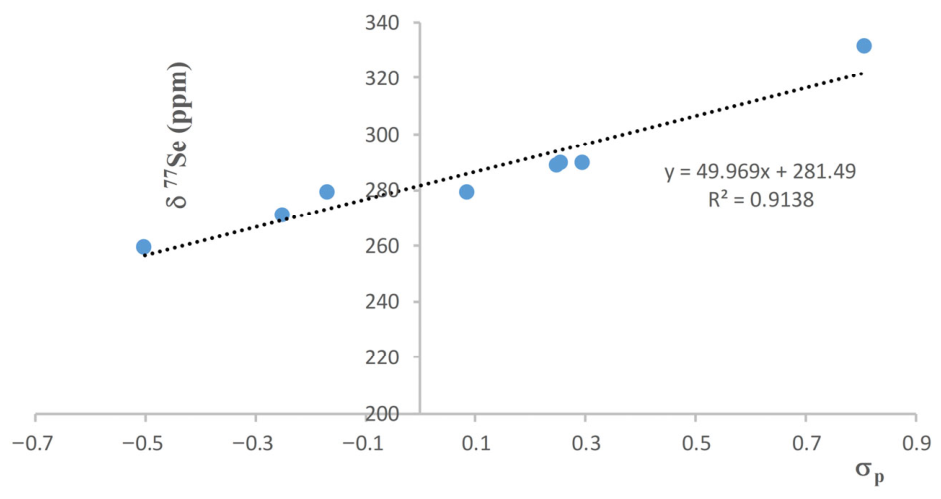
Figure 2 displays the plot of 77Se chemical shifts vs. the Hammett constants of para-substituents for selenoureas 25–33. The overall Hammett constants for the p-substitution were used, expressed as a linear combination of inductive and resonance effects (σp = σI + σR) [58]. An excellent linear correlation was obtained. Although 77Se has been used in this kind of analysis for O/Se-aryl selenocarbamates [59], our results constitute the first report of a Hammett-type correlation involving 77Se chemical shifts in N,N-diaryl selenoureas.
Figure 2.
Plot correlating 77Se chemical shifts of selenoureas 25–33 with Hammett constants.
2.2. Investigation of the Mechanistic Aspects of GPx-like Properties
Hydrogen peroxide is a strong non-radical oxidant generated in cells through both enzymatic and non-enzymatic pathways. Non-enzymatic production primarily arises from electron leakage during mitochondrial aerobic respiration, whereas the enzymatic route is dominated by the action of superoxide dismutases (SOD1, SOD2, and SOD3), which rapidly convert superoxide (O2•−) into H2O2. In parallel, alkyl hydroperoxides (ROOH) are formed predominantly through the oxidative degradation of membrane phospholipids during lipid peroxidation.
To maintain redox homeostasis, cells rely on an intricate antioxidant network, within which glutathione peroxidases (GPx) constitute a central defensive element. GPx enzymes protect against the deleterious effects of H2O2 and alkyl hydroperoxides by catalyzing their reduction to water and the corresponding alcohols, respectively. This process proceeds through a highly efficient catalytic cycle enabled by the presence of a selenocysteine residue at the active site [60]. During catalysis, the selenol group is oxidised to the selenenic acid intermediate (GPx–SeOH). Subsequent reactions with reduced glutathione (GSH), which acts as a sacrificial cofactor, regenerate the active selenol form, thereby restoring the catalytic activity of the enzyme [60].
Several families of organoselenium compounds, like selenides and selenoxides have been reported to exhibit GPx-like activity [61], enabling them to scavenge peroxide-type reactive oxygen species. Among them, ebselen (2-phenyl-1,2-benzisoselenazol-3(2H)-one) and its analogues constitute the most extensively studied class [62]. Even, some organotellurium exhibited GPx-mimicry properties [63]. However, in N,N′-diaryl selenoureas, the precise mechanistic pathways operating, and the influence of their structural features on GPx-like behaviour, remain poorly understood.
GPx mimicry by selenoureas 25–33 was evaluated using two complementary methodologies. In the first approach, the selenoureas were employed in catalytic amounts (1 mol% relative to the cofactor) in the presence of an excess of the ROS and PhSH as the cofactor, following the procedure originally described by Mugesh and co-workers [64]. The reaction progress was monitored by UV spectroscopy by tracing the increase in absorbance at 305 nm, corresponding to the formation of the oxidised form of PhSH, (PhS)2. As ROS models, we selected H2O2, the most relevant intracellular pro-oxidant species [65], and CumOOH, a representative mimic of natural alkyl hydroperoxides [66]. Table 2 and Table 3 summarize the reaction rates obtained from UV monitoring for selenoureas 25–33, alongside the uncatalysed background reaction, as well as the corresponding half-reaction times (t1/2), using pro-oxidant concentrations of 10.4 mM (Table 2) and 41.6 mM (Table 3).
Table 2.
GPx-like activity of selenoureas 25–33 (PhSH method) a.
Table 3.
GPx-like activity of selenoureas 25–33 (PhSH method) for high ROS concentrations a.
The data clearly demonstrate that N,N′-diaryl selenoureas 25–33 act as highly efficient GPx mimetics, producing substantial rate enhancements relative to the uncatalysed process. A pronounced dependence on the electronic nature of the para-substituents was also observed. The most active peroxide and hydroperoxide scavengers under both sets of conditions were selenoureas 27 and 33, bearing one or two OMe groups, respectively, which provided up to 32- and 34-fold rate accelerations (334.8 and 354 µM min−1 vs. 10.5 µM min−1, Table 3).
Analysis of the data enabled the establishment of clear structure–activity relationships. Selenoureas containing electron-donating substituents at the para position, such as derivatives 26 (Me, moderate +I effect), 27 (OMe, strong +R effect), and especially 33 (two OMe groups), displayed substantially enhanced reaction rates. Conversely, compounds bearing electron-withdrawing groups (28–32) showed markedly lower activity, particularly nitro-substituted 32, which exhibits strong –I and –R effects. In all cases, the selenoureas were more effective at scavenging H2O2 than cumene hydroperoxide, although substituent-dependent trends were preserved.
These results suggest that the rate-determining step of ROS reduction by selenoureas involves the development of partial positive charge. This hypothesis was further examined through a correlation analysis between the reaction rates of selenoureas 25–33 and the electronic properties of their para-substituents, quantified by Hammett σp parameters.
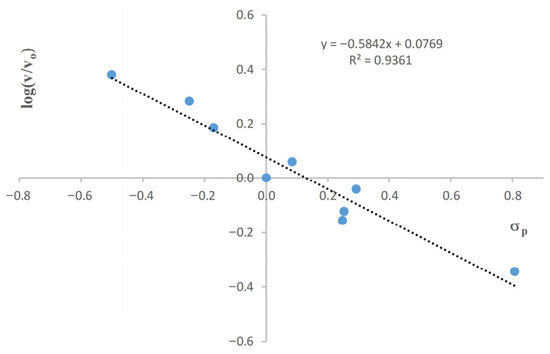
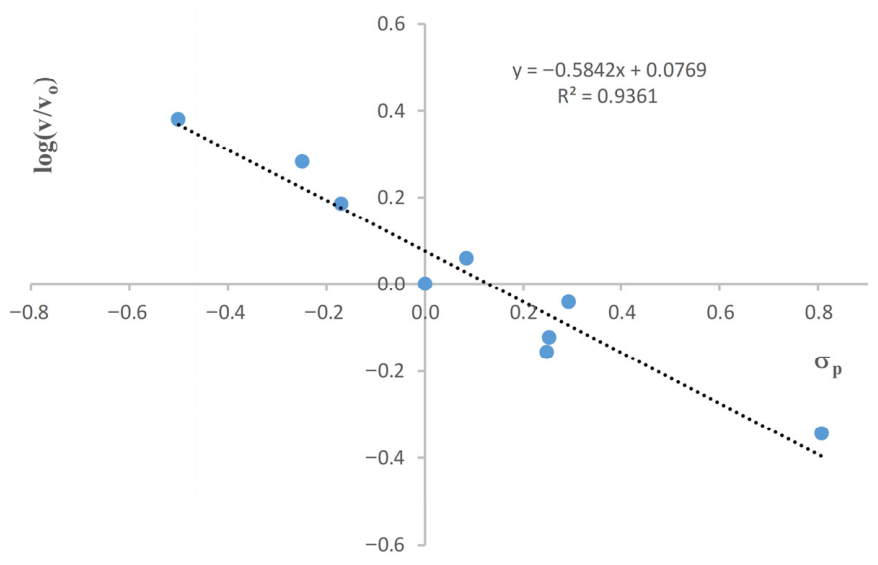
Compound 25, lacking substituents, was used as the reference. Such physicochemical correlations provide valuable insights into reaction mechanisms. For this purpose, log(v/v0) was plotted against σp; Figure 3 depicts such plot for [H2O2] = 10.4 mM, as a representative example. A negative slope was obtained (ρ = −0.5842), consistent with accumulation of positive charge in the rate-determining step. The magnitude of the slope indicates that the charge is unlikely to be located on the vicinal positions or on the aromatic rings, where more pronounced slopes would be expected, but rather on the selenium atom itself. Electron-donating groups, whether through +I or +R effects, stabilize this developing positive charge, thus increasing the reaction rate. Furthermore, the strong correlations observed confirm the high sensitivity of the selenium centre to electronic perturbations transmitted from a relatively distant position on the molecule. Similar results were observed for the other three conditions obtained from Table 2 and Table 3.
Figure 3.
Hammett plot for the GPx-like activity of selenoureas 25–33 in the scavenging of H2O2. [ROS] = 10.4 mM; [Cat] = 1 mol%.
We further examined the mechanism underlying the GPx-like of N,N′-diaryl selenoureas activity using NMR spectroscopy. Attempts to monitor the reaction by 77Se-NMR were unsuccessful because of the low natural abundance of this isotope relative to 1H requires long acquisition times, which in turn led to catalyst decomposition under the reaction conditions. Consequently, we monitored the reaction progress by 1H-NMR spectroscopy, by applying slight modifications to the original methodology developed by Iwaoka and Kumakura [67]. In this approach, sub-stoichiometric amounts of the catalyst were treated with an excess of H2O2 and dithiothreitol (DTTred), used as a cofactor surrogate. The conversion of DTTred into its oxidised form (DTTox) was followed by the disappearance of the signals at δ = 2.63 and 3.67 ppm (DTTred) and by the emergence of new signals at δ = 2.87, 3.03, and 3.49 ppm (DTTox).
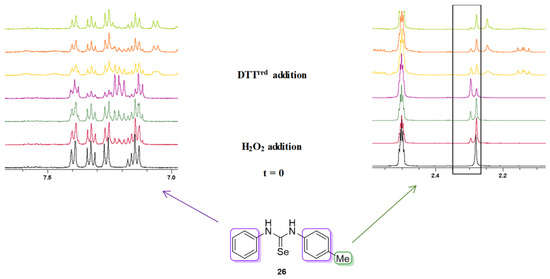
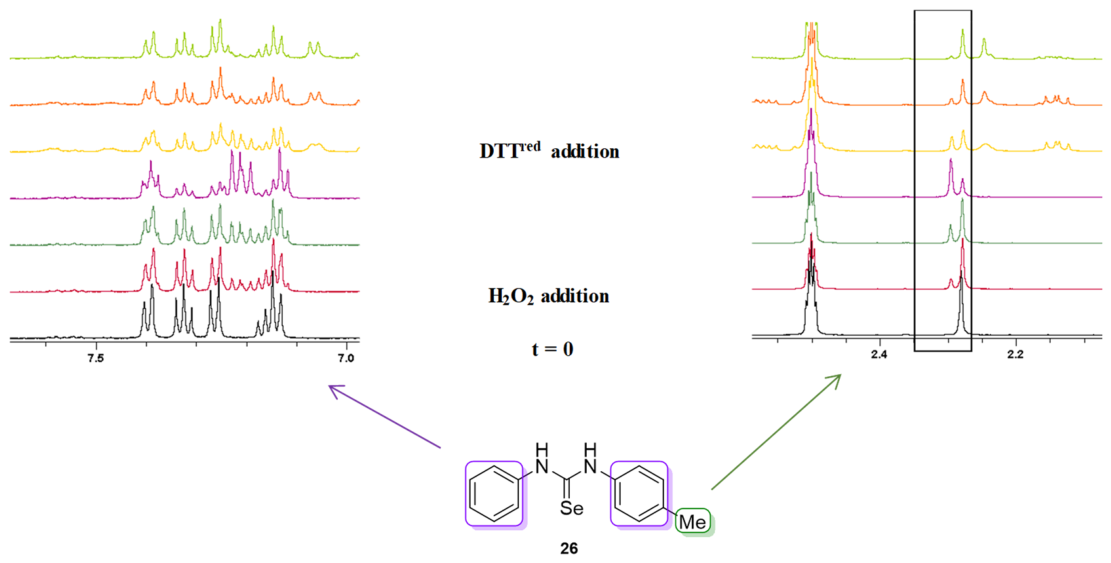
Figure 4 shows the evolution of the reaction using selenourea 26 (p-tolyl, 1.61 µmol) as a model catalyst. Upon addition of H2O2 (176 µmol) to the selenourea solution in CD3OD (0.6 mL), a decrease in the intensity of the original Me signal and its gradual shift to a slightly deshielded position were observed, accompanied by the appearance of new signals in the aromatic region. Remarkably, after subsequent addition of DTTred (161 µmol) to the reaction mixture, the original selenourea signals were restored, consistent with a catalytic cycle involving the selenium atom.
Figure 4.
1H-NMR monitoring of the GPx-like activity of selenourea 26.
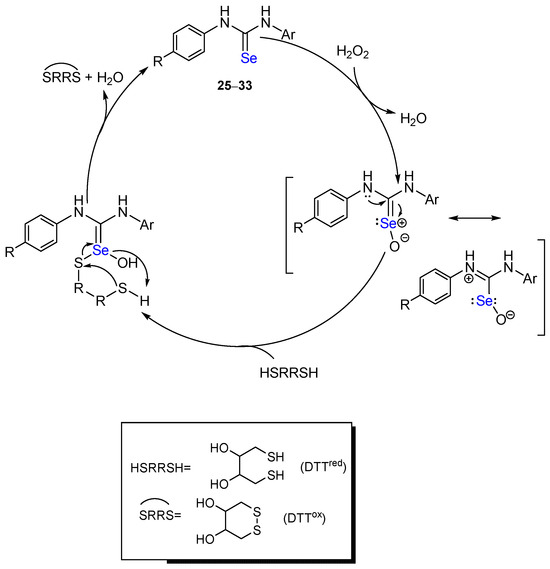
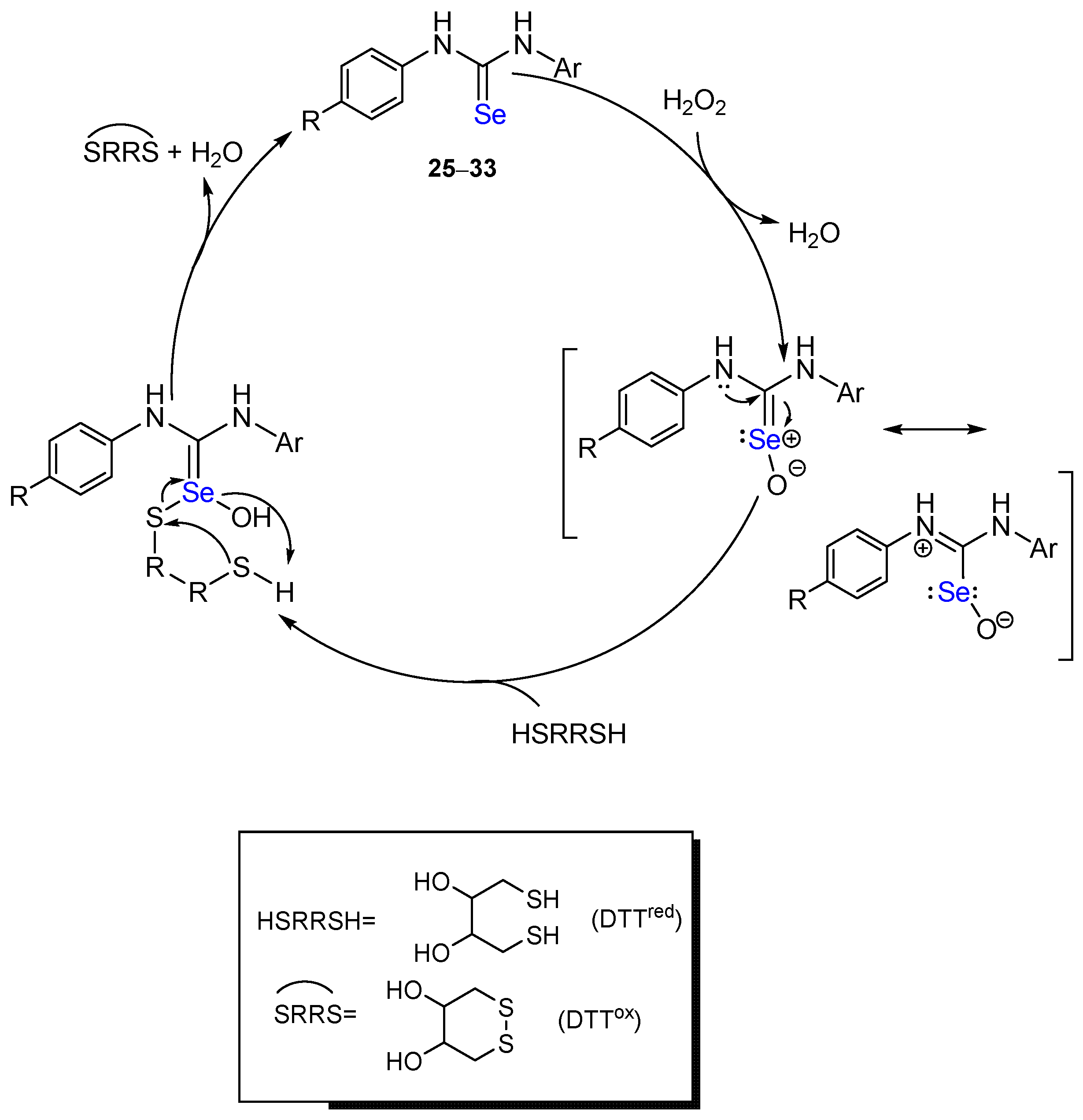
With all these data in hand, we propose the catalytic cycle depicted in Scheme 2 to account for the GPx-like activity of N,N′-diaryl selenoureas. The first step, identified as the rate-determining step of the process, involves the oxidation of the selenoureido moiety to generate a selenoxide-type intermediate. This intermediate bears a delocalized partial positive charge distributed between the selenium and nitrogen atoms. Such electronic distribution explains why electron-donating substituents on the aryl ring, through either inductive or resonance effects, enhance the reaction rate by stabilizing the transient selenoxide intermediate. Although we could not detect the presence of the selenoxide intermediate by spectroscopic methods, this hypothesis is in agreement with reported two-electron oxidation of selenoureas [68]. In the absence of a thiol cofactor, the transient selenoxide was reported to evolve to selenium nanoparticles.
Scheme 2.
Proposed mechanism for the activity of selenoureas 25–33 as GPx mimetics, using DTTred as a cofactor.
Subsequently, this intermediate reacts with the thiol cofactor (PhSH in the UV assay or DTTred in the NMR experiments) to afford a selenyl–sulfide adduct. Incorporation of a second equivalent of thiol then regenerates the parent selenourea, thereby closing the catalytic cycle. As a consequence, sub-stoichiometric amounts of the catalyst are sufficient to efficiently deplete ROS, reaching t1/2 values of only a few minutes.
2.3. Antiproliferative Properties
Selenoureas 25–33 were evaluated in vitro for their antiproliferative properties against a panel of six human tumour cell lines: A549 (non-small cell lung), HBL-100 (breast), HeLa (cervix), SW1573 (non-small cell lung), and the multidrug resistant cell lines T-47D (breast) and WiDr (colon). 5-Fluorouracil (5-FU) and cisplatin (CDDP) were included as reference drugs. All experiments were conducted following our implementation of the screening protocol of the US National Cancer Institute (NCI) [69], and results are summarized in Table 4.
Table 4.
Antiproliferative properties (GI50, µM) for N,N′-diaryl selenoureas 25–33.
The antiproliferative evaluation of selenoureas 25–33 revealed low-micromolar activities across several human cancer cell lines, positioning these compounds as potent examples of small-molecule organoselenium antiproliferative agents. Comparable activity ranges have been described for selenoureas derived from natural compounds [36], and other selenium-based chemotypes such as selenocyanate conjugates [31], or ebselen analogues [70], yet many of these require structural complexity or multitarget mechanisms to achieve low-micromolar potencies. In contrast, the N,N′-diaryl selenoureas examined here display similar or superior GI50 values while maintaining a structurally minimal scaffold, highlighting their favourable activity-to-complexity ratio.
The SAR trends observed for this series also resonate with prior studies in organoselenium Medicinal Chemistry, where halogenated derivatives often enhance lipophilicity and metabolic stability [71,72]. Notably, compounds 29 (p-Cl) and 31 (p-I) exhibited consistently high potency across nearly all tested lines, including multidrug-resistant models. On the contrary, the nitro derivative 32 exhibited impaired antiproliferative activity.
Conversely, it is important to highlight that the most potent GPx-mimetic selenoureas (27 and 33) do not necessarily translate into the most potent antiproliferative agents in all cancer cell lines, underscoring the multifaceted and context-dependent relationship between redox modulation and cancer cell viability. This divergence aligns with the growing recognition that selenium compounds may exert either protective or cytotoxic effects depending on the antioxidant nature, type of tumour, dosage, or genetics.
There is also high heterogeneity on how the tumour is affected: redox homeostasis, metabolism, immune response, or epigenetics [73]. There are examples in which antioxidants exhibit anticancer properties but there are also reports for depleting the high levels of glutathione, which in combination with photodynamic therapy might constitute another alternative in anticancer research [74].
Overall, the antiproliferative findings presented in this work expand the chemical space of bioactive organoselenium compounds and identify diaryl selenoureas as promising leads for further development. Their combination of tunable redox properties, robust GPx-like catalysis, and significant antiproliferative activity suggests that these derivatives may serve as multifunctional agents capable of modulating oxidative stress or triggering ROS-related cell death pathways. Future studies will focus on elucidating their intracellular mode of action, evaluating their selectivity to determine their translational potential.
3. Materials and Methods
3.1. Chemistry
3.1.1. General Methods
TLC (thin-layer chromatography) was performed using aluminium-coated sheets (Merck 60 F254, Darmstadt, Germany), 0.25 mm width. Each eluent is indicated in the experimental procedures. Spots were visualized by UV light (λ = 254 nm) and by charring with 10% ethanolic vanillin containing 1% H2SO4 or with 5% ethanolic phosphomolybdic acid. Column chromatography purifications were performed using silica gel stationary phase (Merck 60, particle size 40–63 μm), eluting by gravity or with mild pressure. Eluents are indicated in each case. NMR spectra were acquired in the Centro de Investigación, Tecnología e Innovación de la Universidad de Sevilla (CITIUS), using Bruker Avance III 300 and 500 spectrometers (300.1 MHz and 500 MHz for 1H; 75.5 and 125.7 MHz, respectively, for 13C) (Billerica, Massachusetts, USA), and DMSO-d6 as solvent (VWR Chemicals, Radnor, PA, USA). Chemical shifts (δ) are expressed in ppm, and coupling constants (J) are expressed in Hz. Residual signals from the solvent were used as internal references [75] for the calibration (2.50 ppm for 1H and 39.5 ppm for 13C). 1H, 13C and 77Se NMR spectra are provided in the Supporting Information file (Figures S1–S24). Mass spectra were registered using a Qexactive spectrometer using Electrospray Ionization (ESI). Sample injection (MeOH as solvent) was performed using UHPLC without column (50 μL and acquisition for 3 min at 0.200 mL/min). Acquisition was carried out with full scan at 60,000 resolution. Capillary temperature was 350 °C and the source voltage, 3.5 kV. Spectra were registered under positive mode and calibrated using the Pierce™ LTQ Velos ESI Positive Ion Calibration Solution (ThermoFisher Scientific, Waltham, MA, USA).
3.1.2. General Procedure for the Preparation of Selenoureas 25–33
To a solution of the corresponding isoselenocyanate (0.28 mmol) in a 1.5:1 CH2Cl2–MeOH mixture (5 mL), aniline (26 µL, 0.28 mmol, 1.0 equiv.) or p-anisidine (32.8 µL, 0.28 mmol, 1.0 equiv., for 33), was added and stirred at room temperature for 5 min. The reaction was then stirred at 40 °C for other 5 min. The reaction medium was then cooled, filtered and washed with cyclohexane, or separated by centrifugation.
N-(p-methylphenyl)-N′-phenyl-selenourea (26). p-Tolyl isoselenocyanate (18) (55.0 mg, 0.28 mmol) was used. The precipitate was filtered and washed with cyclohexane, yielding 26 as a reddish solid. Yield: 55.9 mg (69%); m.p.: 175 °C; RF 0.59 (20:1 cyclohexane–EtOAc); 1H-NMR (500 MHz, DMSO-d6) δ: 10.05 (s, 1H, NH), 10.02 (s, 1H, NH), 7.39 (m, 2H, H-3′, H-5′), 7.33 (m, 2H, H-3, H-5), 7.26 (m, 2H, H-2′, H-6′), 7.15 (m, 3H, H-2, H-4, H-6), 2.28 (s, 3H, CH3) ppm; 13C-NMR (125.7 MHz, DMSO-d6) δ: 178.5 (CSe), 139.7 (C-1), 137.1 (C-1′), 134.5 (C-4′), 129.0 (C-3′, C5′), 128.5 (C-3, C-5), 125.1 (C-4), 124.8 (C-2, C-6), 124.7 (C-2′, C-6′), 20.6 (CH3) ppm; 77Se-NMR (95 MHz, DMSO-d6) δ: 279.4 ppm; HRESIMS m/z calcd. for C14H15N280Se [M+H]+: 291.0395, found 291.0397.
N-(p-Methoxyphenyl)-N′-phenyl-selenourea (27). p-Methoxyphenyl isoselenocyanate (19) (59.4 mg, 0.28 mmol) was used. The precipitate was filtered and washed with cyclohexane, yielding 27 as a white solid. Yield: 34.2 mg (40%); m.p.: 160 °C; RF 0.39 (20:1 cyclohexane–EtOAc); 1H-NMR (500 MHz, DMSO-d6) δ: 9.95 (m, 2H, 2 NH), 7.41 (m, 2H, Ar-H), 7.35 (m, 2H, Ar-H), 7.28 (m, 2H, Ar-H), 7.16 (m, 1H, Ar-H), 6.9 (m, 2H, Ar-H), 3.75 (s, 3H, OCH3) ppm; 13C-NMR (125.7 MHz, DMSO-d6) δ: 178.6 (CSe), 157.0 (C-4′), 139.7, 132.4 (C-1, C-1′), 128.5 (x2) (Ar-C), 126.8 (x2) (Ar-C), 125.1 (Ar-C), 124.8 (x2) (Ar-C), 113.8 (x2) (Ar-C), 55.3 (OCH3) ppm; 77Se-NMR (95 MHz, DMSO-d6) δ: 271.7 ppm; HRESIMS m/z calcd. for C14H15N2O80Se [M+H]+: 307.0344, found 307.0343.
N-(p-Fluorophenyl)-N′-phenyl-selenourea (28). p-Fluorophenyl isoselenocyanate (20) (56.0 mg, 0.28 mmol) was used. The precipitate was filtered and washed with cyclohexane, yielding 28 as a pinkish-white solid. Yield: 82.1 mg (quant.); m.p.: 145 °C; RF 0.61 (20:1 cyclohexane–EtOAc). 1H-NMR (500 MHz, DMSO-d6) δ: 10.14 (s, 1H, NH), 10.06 (s, 1H, NH), 7.39 (m, 4H, Ar-H), 7.34 (m, 2H, Ar-H), 7.17 (m, 3H, Ar-H) ppm; 13C-NMR (125.7 MHz, DMSO-d6) δ: 179.5 (CSe), 160.1 (d, 1JC,F = 244 Hz, C-4′,), 140.0 (C-1), 136.6 (brd, 4JC,F = 1.7 Hz, C-1′), 129.1 (x2) (Ar-C), 127.8 (x2) (Ar-C), 127.8 (d, 3JC,F = 8.4 Hz, C-6′/C-2′), 125.8 (Ar-C), 125.3 (x2) (Ar-C), 115.6 (2JC,F = 22.6 Hz, C-5′/C-3′) ppm; 77Se-NMR (95 MHz, DMSO-d6) δ: 279.5 ppm; HRESIMS m/z calcd. for C13H12FN280Se [M+H]+: 295.0144, found 295.0145.
N-(p-Chlorophenyl)-N′-phenylselenourea (29). p-Chlorophenyl isoselenocyanate (21) (60.6 mg, 0.28 mmol) was used. The precipitate was filtered and washed with cyclohexane, yielding 29 as a pinkish-white solid. Yield: 26.0 mg (30%); m.p.: 170 °C; RF 0.60 (20:1 cyclohexane–EtOAc). 1H-NMR (500 MHz, DMSO-d6) δ: 10.19 (s, 1H, NH), 10.10 (s, 1H, NH), 7.45–7.32 (m, 8H, Ar-H), 7.18 (m, 1H, Ar-H) ppm; 13C-NMR (125.7 MHz, DMSO-d6) δ: 178.8 (CSe), 139.4, 138.7 (C-1, C-1′), 129.1 (Ar-C), 128.5 (x2) (Ar-C), 128.2 (x2) (Ar-C), 126.4 (x2) (Ar-C), 125.2 (Ar-C), 124.5 (x2) (Ar-C)ppm; 77Se-NMR (95 MHz, DMSO-d6) δ: 288.9 ppm; HRESIMS m/z calcd. for C13H12ClN280Se [M+H]+: 310.9849, found 310.9847.
N-Bromophenyl-N′-phenylselenourea (30). p-Bromophenyl isoselenocyanate (22) (73.1 mg, 0.28 mmol) was used. The precipitate was filtered and washed with cyclohexane, yielding 30 as a white solid. Yield: 32.9 mg (50%); m.p.: 175 °C; RF 0.62 (20:1 cyclohexane–EtOAc); 1H-NMR (500 MHz, DMSO-d6) δ: 10.25 (s, 1H, NH), 10.14 (s, 1H, NH), 7.51 (m, 2H, Ar-H), 7.36 (m, 6H, Ar-H), 7.18 (m, 1H, Ar-H) ppm; 13C-NMR (125.7 MHz, DMSO-d6) δ: 178.8 (CSe), 139.5, 139.2 (C-1, C-1′), 131.3 (x2) (Ar-C), 128.6 (x2) (Ar-C), 126.8 (x2) (Ar-C), 125.3 (Ar-C), 124.6 (x2) (Ar-C), 117.4 (Ar-C) ppm; 77Se-NMR (95 MHz, DMSO-d6) δ: 290.1 ppm; HRESIMS m/z calcd. for C13H1179BrN2Na80Se [M+Na]+: 376.9163, found 376.9154; HRESIMS m/z calcd. for C13H1181BrN2Na80Se [M+Na]+: 378.9143, found 378.9140.
N-(p-Iodophenyl)-N′-phenylselenourea (31). p-Iodophenyl isoselenocyanate (23) (86.2 mg, 0.28 mmol) was used. The precipitate was filtered and washed with cyclohexane, yielding 31 as a pinkish-white solid. Yield: 85.4 mg (76%); m.p.: 177 °C; RF 0.70 (20:1 cyclohexane–EtOAc); 1H-NMR (500 MHz, DMSO-d6) δ: 10.25 (s, 1H, NH), 10.15 (s, 1H, NH), 7.67 (m, 2H, Ar-H), 7.36 (m, 4H, Ar-H), 7.20 (m, 3H, Ar-H) ppm; 13C-NMR (125.7 MHz, DMSO-d6) δ: 178.7 (CSe), 139.7, 139.5 (C-1, C-1′), 137.2 (x2) (Ar-C), 128.6 (x2) (Ar-C), 126.9 (x2) (Ar-C), 125.3 (Ar-C), 124.6 (x2) (Ar-C), 89.6 (C-4) ppm; 77Se-NMR (95 MHz, DMSO-d6) δ: 290.1 ppm; HRESIMS m/z calcd. for C13H12IN280Se [M+H]+: 402.9205, found 402.9199.
N-(p-Nitrophenyl)-N′-phenyl-selenourea (32). p-Nitrophenyl isoselenocyanate (24) (63.6 mg, 0.28 mmol) was used. The precipitate was separated by centrifugation, yielding 32 as a yellow solid. Yield: 51.1 mg (57%); m.p.: 157 °C; RF 0.21 (20:1 cyclohexane–EtOAc); 1H-NMR (500 MHz, DMSO-d6) δ: 10.71 (s, 1H, NH), 10.60 (s, 1H, NH), 8.19 (m, 2H, Ar-H), 7.75 (m, 2H, Ar-H), 7.42 (m, 2H, Ar-H), 7.37 (m, 2H, Ar-H), 7.21 (m, 1H, Ar-H) ppm; 13C-NMR (125.7 MHz, DMSO-d6) δ: 179.3 (CSe), 146.3 (Ar-C), 142.9 (Ar-C), 139.3 (Ar-C), 128.7 (x2) (Ar-C), 125.6 (x2) (Ar-C), 124.4 (x2) (Ar-C), 124.2 (x2) (Ar-C), 123.0 (x2) (Ar-C) ppm; 77Se-NMR (95 MHz, DMSO-d6) δ: 331.5 ppm; HRESIMS m/z calcd. for C13H12N3O280Se [M+H]+: 322.0089, found 322.0087.
N,N′-Bis(p-methoxyphenyl)selenourea (33). p-Methoxyphenyl isoselenocyanate (19) (59.4 mg, 0.28 mmol) and p-anisidine (32.8 µL, 0.28 mmol, 1.0 equiv.) were used. The precipitate was filtered and washed with cyclohexane, yielding 33 as a light violet solid. Yield: 82.8 mg (88%); m.p.: 186–189 °C; RF 0.22 (20:1 cyclohexane–EtOAc); 1H-NMR (500 MHz, DMSO-d6) δ: 9.75 (s, 2H, 2NH), 7.24 (m, 4H, H-3, H-5, H-3′, H-5′), 6.89 (m, 8H, H-2, H-6, H-2′, H-6′), 3.74 (s, 6H, 2OCH3) ppm; 13C-NMR (125.7 MHz, DMSO-d6) δ: 178.7 (CSe), 157.0 (C-4, C-4′), 132.5 (C-1, C-1′), 126.9 (x4) (Ar-C), 113.7 (x4) (Ar-C), 55.2 (2OCH3) ppm; 77Se-NMR (95 MHz, DMSO-d6) δ: 259.7 ppm; HRESIMS m/z calcd. for C15H17N2O280Se [M+H]+: 337.0450, found 337.0447; HRESIMS m/z calcd. for C15H16N2NaO280Se [M+Na]+: 359.0269, found 359.0264.
3.2. Antioxidant Assays
3.2.1. GPx-like Activity by UV Spectroscopy
The procedure originally reported by Mugesh and co-workers [64] was followed. Methanolic solutions of PhSH, ROS (H2O2 or CumOOH) and selenoureas were initially fixed at 10.0, 10.4/41.6 and 0.1 mM, respectively. Increase in absorbance values was monitored at 305 nm for 180 s, in the presence and in the absence (background reaction) of the organoselenium catalyst. Abs. (v) vs. t (s) was plotted and the velocity (slope of the plot) was obtained after correction with the background reaction. For (PhSe)2, the reported molar extinction coefficient was used (ε = 1.24 × 10³ M−1 cm−1).
3.2.2. GPx-like Activity by NMR Spectroscopy
The procedure originally reported by Iwaoka and Kumakura [67] was followed. DTTred (25 mg, 0.16 mmol) and the corresponding selenoureas (1.61 µmol, 1 mol%) were dissolved in CD3OD (0.6 mL). Reaction was initiated by addition of 30% H2O2 (18 µL, 0.18 mmol) and disappearance of CH protons of DTTred (δ = 2.63, 3.68 ppm), and appearance of CH protons of the cyclic disulfide DTTox (δ = 2.87, 3.03, 3.51 ppm) was monitored. Velocity can be quantified by calculating the relative integral of DTTred/DTTox over time.
3.3. Antiproliferative Activity
3.3.1. Cell Lines and Culture
The same conditions as previously reported were used [69]. The human cancer cell lines A549, HBL-100, and T-47D, as well as HeLa, were provided by Dr. Raimundo Freire (Hospital Universitario de Canarias, Tenerife, Canary Islands). The lung cancer cell lines SW1573 and WiDr were provided by Prof. G. J. Peters (VU University Medical Center, Amsterdam, The Netherlands). Cells were grown in RPMI-1640 medium containing 5% fetal bovine serum (FBS), 2 mM l-glutamine, 100 U/mL of penicillin G, and 0.1 mg/mL of streptomycin at 37 °C in a 95% humidified atmosphere of 5% CO2. Cells were maintained in culture in 60 mm cell culture dishes in growth medium (10 mL) and passaged twice weekly.
3.3.2. Antiproliferative Tests
The same conditions as previously reported were used [69,76]. The antiproliferative activity of compounds was tested using our implementation of the protocol of the National Cancer Institute (NCI) of the USA. The following seeding densities (cells per well) were used: 2500 (A549, HBL-100, HeLa, and SW1573) and 5000 (T-47D and WiDr). Stock solutions of inhibitors (40 mM) were prepared in pure DMSO (400 times the maximum test concentration). For each test compound, the cells were exposed for a period of 48 h to serial decimal dilutions in cell culture medium of the test compounds (0.001–100 μM). For each product, GI50 values were calculated according to the NCI formulas (n = 3; data are expressed as mean ± SD).
4. Conclusions
This work demonstrates that N,N′-diaryl selenoureas constitute a highly versatile class of redox-active small molecules capable of efficiently mimicking the catalytic behaviour of glutathione peroxidase (GPx) for scavenging peroxides. Through the combined use of kinetic assays, NMR monitoring, and Hammett-type analyses, we established that their reactivity towards H2O2 and cumene hydroperoxide is strongly dictated by the electronic nature of the para-substituents. The excellent linear free-energy correlations obtained reveal an exceptional long-range electronic communication across the selenoureido framework, despite the seven-bond separation between the substituent and the selenium centre.
The mechanistic data support a catalytic cycle initiated by the oxidation of the selenoureido moiety to a transient selenoxide-like species in which a partial positive charge develops on selenium. This step, identified as rate-determining, is significantly accelerated by electron-donating substituents that stabilise the emerging positive charge, whereas electron-withdrawing groups exert the opposite effect. The restoration of the initial selenourea upon reaction with a thiol cofactor, as observed in NMR experiments, confirms the operation of a robust Se(II)/Se(IV) redox cycle analogous to that operating in natural GPx, but with the key advantage of tunability through rational electronic modulation.
From a biological standpoint, several members of this family exhibited low-micromolar antiproliferative activity across a diverse panel of human tumour cell lines, outperforming reference anticancer drugs in some of the selected models, including multidrug-resistant lines. This dual behaviour, potent catalytic antioxidant activity and significant antiproliferative effects, highlights diaryl selenoureas as promising multifunctional scaffolds. The divergence observed between GPx-like efficiency and antiproliferative potency across the series also underscores the nuanced and context-dependent role of redox modulation in cancer biology, suggesting that fine-tuning the electronic profile of these compounds could selectively bias them towards antioxidant, pro-oxidant, or cytotoxic outcomes.
Overall, this study not only expands the mechanistic understanding of selenoureas as GPx mimics but also provides a rational framework for their further optimisation. Their straightforward synthesis, strong and predictable electronic responsiveness, and favourable biological profiles position these compounds as valuable platforms for the development of next-generation catalytic antioxidants and potential anticancer agents. Future efforts should include identification and characterization of reactive intermediates, evaluation of stability and redox behaviour under physiological conditions, and in vivo validation to fully assess their therapeutic potential.
Supplementary Materials
The following supporting information can be downloaded at https://www.mdpi.com/article/10.3390/ijms27083574/s1.
Author Contributions
Conceptualization, Ó.L. and J.G.F.-B.; data analysis, P.B., Ó.L., A.P. and J.M.P.; synthesis and characterization: P.B. and C.I.P.-L.; biological/kinetic assays: P.B., Ó.L., A.P. and J.M.P.; writing—original draft preparation, Ó.L.; writing—review and editing, J.M.P., J.G.F.-B. and Ó.L.; supervision: J.M.P., J.G.F.-B. and Ó.L.; funding acquisition, J.M.P., J.G.F.-B. and Ó.L. All authors have read and agreed to the published version of the manuscript.
Funding
P.B., C.P-L., Ó.L. and J.G.F.-B., A.P. and J.M.P. thank the Spanish Government (Projects PID2023-147401OB-I00 and PID2021-123059OB-I00, respectively, funded by MCIN/AEI/10.13039/501100011033/FEDER, UE) for financial support. J.G.F.-B. and Ó.L. also thank Junta de Andalucía (FQM134).
Institutional Review Board Statement
Not applicable.
Informed Consent Statement
Not applicable.
Data Availability Statement
The original contributions presented in this study are included in the article/Supplementary Material. Further inquiries can be directed to the corresponding authors.
Acknowledgments
P.B. thanks the European Union (NextGenerationEU) and the Ministerio de Universidades of Spain for the award of a Grant Margarita Salas grant. A.P. thanks the EU Social Fund (FSE) and the Canary Islands ACIISI for a predoctoral grant TESIS2020010055. We would also like to thank the Servicio de Resonancia Magnética Nuclear, and the Servicio de Espectrometría de Masas, CITIUS (University of Seville), for the performance of NMR and MS experiments.
Conflicts of Interest
The authors declare no conflicts of interest.
Abbreviations
The following abbreviations are used in this manuscript:
| Brd | Broad doublet |
| calcd. | Calculated |
| CDDP | cis-Diamminedichloroplatinum(II), Cisplatin |
| CumOOH | Cumene hydroperoxide |
| D | Doublet |
| DIO | Iodothyronine deiodinases |
| DTTox | Oxidised dithiothreitol |
| DTTred | Reduced dithiothreitol |
| equiv. | Equivalents |
| ESI | Electrospray ionization |
| GI50 | Concentration causing 50% growth inhibition |
| GSH | Glutathione (reduced form) |
| GPx | Glutathione peroxidase |
| HRESIMS | High-resolution electrospray ionization mass spectrometry |
| M | Multiplet |
| m.p. | Melting point |
| NCI | National Cancer Institute (USA) |
| ROS | Reactive oxygen species |
| RNS | Reactive nitrogen species |
| S | Singlet |
| SOD1/2/3 | Superoxide dismutases |
| TLC | Thin-layer chromatography |
References
- Sun, Y.; Wang, Z.; Gong, P.; Yao, W.; Ba, Q.; Wang, H. Review on the health-promoting effect of adequate selenium status. Front. Nutr. 2023, 10, 1136458. [Google Scholar] [CrossRef] [Scilit]
- Hadrup, N.; Ravn-Haren, G. Acute human toxicity and mortality after selenium ingestion: A review. J. Trace Elem. Med. Biol. 2020, 58, 126435. [Google Scholar] [CrossRef] [Scilit]
- Madabeni, A.Ç.; Bortoli, M.; Nogara, P.A.; Ribaudo, G.; Tiezza, M.D.; Flohé, L.; Rocha, J.B.T.; Orian, L. 50 Years of organoselenium chemistry, biochemistry and reactivity: Mechanistic understanding, successful and controversial stories. Chem. Eur. J. 2024, 30, e202403003. [Google Scholar] [CrossRef] [Scilit]
- Tsuji, P.A.; Santesmasses, D.; Lee, B.J.; Gladyshev, V.N.; Hatfield, D.L. Historical roles of selenium and selenoproteins in health and development: The Good, the bad and the ugly. Int. J. Mol. Sci. 2022, 23, 5. [Google Scholar] [CrossRef] [Scilit] [PubMed]
- Xia, C.; Wu, Y.; Zhang, H.; Qin, L.; Hu, Y.; Fu, C. Selenoproteins: Minute yet vital players governing cellular fate. Genes Dis. 2026, 13, 101938. [Google Scholar] [CrossRef] [Scilit]
- Prasad, B.; Akanksha, A.; Kaur, P.S.; Gupta, S. Understanding selenoproteins: Structural insights, biological functions and transformative applications in therapeutics. Process Biochem. 2025, 150, 148–160. [Google Scholar] [CrossRef] [Scilit]
- Handy, D.E.; Loscalzo, J. The role of glutathione peroxidase-1 in health and disease. Free Radic. Biol. Med. 2022, 188, 146–161. [Google Scholar] [CrossRef] [Scilit] [PubMed]
- Bjørklund, G.; Zou, L.; Wang, J.; Chasapis, C.T.; Peana, M. Thioredoxin reductase as a pharmacological target. Pharmacol. Res. 2021, 174, 105854. [Google Scholar] [CrossRef] [Scilit] [PubMed]
- Bano, I.; Hassan, M.F.; Kieliszek, M. A comprehensive review of selenium as a key regulator in thyroid health. Biol. Trace Elem. Res. 2025, 203, 6466–6480. [Google Scholar] [CrossRef] [Scilit]
- Papp, L.V.; Lu, J.; Holmgren, A.; Khanna, K.K. From selenium to selenoproteins: Synthesis, identity, and their role in human health. Antioxid. Redox Signal. 2007, 9, 775–806. [Google Scholar] [CrossRef] [Scilit] [PubMed]
- Zeng, H. Selenium as an Essential Micronutrient: Roles in Cell Cycle and Apoptosis. Molecules 2009, 14, 1263–1278. [Google Scholar] [CrossRef] [Scilit] [PubMed]
- Phiri, F.P.; Ander, E.L.; Bailey, E.H.; Chilima, B.; Chilimba, A.D.C.; Gondwe, J.; Joy, E.J.M.; Kalimbira, A.A.; Kumssa, D.B.; Lark, R.M.; et al. The risk of selenium deficiency in Malawi is large and varies over multiple spatial scales. Sci. Rep. 2019, 9, 6566. [Google Scholar] [CrossRef] [Scilit]
- Martínez-Pascual, R.; Valera-Zaragoza, M.; Fernández-Bolaños, J.G.; López, Ó. Exploring the Chemistry and applications of thio-, seleno-, and tellurosugars. Molecules 2025, 30, 2053. [Google Scholar] [CrossRef] [Scilit]
- He, H.; Ma, Y.; Huang, H.; Huang, C.; Chen, Z.; Chen, D.; Gu, Y.; Wang, X.; Chen, J. A comprehensive understanding about the pharmacological effect of diallyl disulfide other than its anti-carcinogenic activities. Eur. J. Pharmacol. 2021, 893, 173803. [Google Scholar] [CrossRef] [Scilit] [PubMed]
- Sonego, J.M.; de Diego, S.I.; Szajnman, S.H.; Gallo-Rodriguez, C.; Rodriguez, J.B. Organoselenium compounds: Chemistry and applications in organic synthesis. Chem. Eur. J. 2023, 29, e202300030. [Google Scholar] [CrossRef] [Scilit] [PubMed]
- Anghinoni, J.M.; Birmann, P.T.; da Rocha, M.J.; Gomes, C.S.; Davies, M.J.; Brüning, C.A.; Savegnago, L.; Lenardão, E.J. Recent advances in the synthesis and antioxidant activity of low molecular mass organoselenium molecules. Molecules 2023, 28, 7349. [Google Scholar] [CrossRef] [Scilit]
- Azeredo, J.B.; Penteado, F.; Nascimento, V.; Sancineto, L.; Braga, A.L.; Lenardao, E.J.; Santi, C. “Green is the color”: An update on ecofriendly aspects of organoselenium chemistry. Molecules 2022, 27, 1597. [Google Scholar] [CrossRef] [Scilit] [PubMed]
- Chen, S.; Fan, C.; Xu, Z.; Pei, M.; Wang, J.; Zhang, J.; Zhang, Y.; Li, J.; Lu, J.; Peng, C.; et al. Mechanochemical synthesis of organoselenium compounds. Nat. Commun. 2024, 15, 769. [Google Scholar] [CrossRef] [Scilit] [PubMed]
- Dutta, S.; Saha, A.; Ranu, B.C. Solvent free synthesis of organoselenides under green conditions. New J. Chem. 2022, 46, 21489–21518. [Google Scholar] [CrossRef] [Scilit]
- Sancineto, L.; Scimmi, C.; Rosati, O.; Santi, C. Flow chemistry: A green opportunity for organochalcogen chemistry. Curr. Opin. Green Sustain. Chem. 2023, 39, 100725. [Google Scholar] [CrossRef] [Scilit]
- Penteado, F.; Peglow, T.J.; Silva, M.S.; Perin, G.; Lenardão, E.J. Greening the synthesis of selenium-containing heterocycles: Recent efforts and advances. Curr. Opin. Green Sustain. Chem. 2020, 26, 100372. [Google Scholar] [CrossRef] [Scilit]
- Purohit, S.; Rana, R.; Tyagi, A.; Bahuguna, A.; Oswal, P.; Anshika; Kumar, A. Organosulphur and organoselenium compounds as ligands for catalytic systems in the Sonogashira coupling. Org. Biomol. Chem. 2024, 22, 6215–6245. [Google Scholar] [CrossRef] [Scilit] [PubMed]
- Mangiavacchi, F.; Coelho Dias, I.F.; Di Lorenzo, I.; Grzes, P.; Palomba, M.; Rosati, O.; Bagnoli, L.; Marini, F.; Santi, C.; Lenardao, E.J.; et al. Sweet selenium: Synthesis and properties of selenium-containing sugars and derivatives. Pharmaceuticals 2020, 13, 211. [Google Scholar] [CrossRef] [Scilit]
- Qu, P.; Liu, G.-Q. Recent progress in the organoselenium-catalyzed difunctionalization of alkenes. Org. Biomol. Chem. 2025, 23, 1552–1568. [Google Scholar] [CrossRef] [Scilit] [PubMed]
- Khan, A. An update on selenium-containing polymers and introduction to polyselenonium salts. Eur. Polym. J. 2026, 242, 114450. [Google Scholar] [CrossRef] [Scilit]
- Sanz del Olmo, N.; San Jacinto García, J.; Yin, Y.; Zhao, Y.; Hassan, M.; Malkoch, M. Responsive organoselenium dendritic polymers: From monodisperse dendrimers to self-assembled micelles for advanced therapeutic applications. J. Am. Chem. Soc. 2025, 147, 18626–18636. [Google Scholar] [CrossRef] [Scilit] [PubMed]
- Mamgain, R.; Mishra, G.; Kriti, S.; Singh, F.V. Organoselenium compounds beyond antioxidants. Future Med. Chem. 2024, 16, 2663–2685. [Google Scholar] [CrossRef] [Scilit]
- Gallo-Rodriguez, C.; Rodriguez, J.B. Organoselenium compounds in Medicinal Chemistry. ChemMedChem 2024, 19, e202400063. [Google Scholar] [CrossRef] [Scilit]
- Chuai, H.; Zhang, S.-Q.; Bai, H.; Li, J.; Wang, Y.; Sun, J.; Wen, E.; Zhang, J.; Xin, M. Small molecule selenium-containing compounds: Recent development and therapeutic applications. Eur. J. Med. Chem. 2021, 223, 113621. [Google Scholar] [CrossRef] [Scilit] [PubMed]
- Moran-Serradilla, C.; Sanmartin, C.; Raza, A.; Singh, A.; Aliaga, C.; Plano, D.; Sharma, A.K. Synthesis and characterization of novel phenyl carboxamide-selenium analogs: Identification of a potent DHODH inhibitor as a potential anticancer agent. Eur. J. Med. Chem. 2026, 301, 118193. [Google Scholar] [CrossRef] [Scilit]
- Meza-Ireta, S.A.; Romero-Hernández, L.L.; Begines, P.; Giouvannuzi, S.; Puerta, A.; González-Bakker, A.; Romero-Franco, A.; Huertas, P.; Nocentini, A.; Vega-Báez, J.L.; et al. Harnessing coumarin-thio(seleno)cyanate conjugates: Potent in vivo antiproliferative agents targeting carbonic anhydrases. J. Enzyme Inhib. Med. Chem. 2025, 40, 2578183. [Google Scholar] [CrossRef] [Scilit] [PubMed]
- Pal, N.; Kesarwani, R.; Mandal, T.K.; Bhabak, K.P. Organoselenocyanate-conjugated NBDHEX derivatives as potent anti-cancer agents for the treatment of breast cancer via ROS-regulated signaling pathways. ACS Appl. Bio Mater. 2025, 8, 11293–11311. [Google Scholar] [CrossRef] [Scilit] [PubMed]
- Pal, N.; Banerjee, K.; Sarkar, S.; Mandal, T.K.; Bhabak, K.P. Synthesis of thiazolidinedione- and triazole-linked organoselenocyanates and evaluation of anticancer activities against breast cancer with mechanistic investigations. Chem. Eur. J. 2025, 31, e202403026. [Google Scholar] [CrossRef] [Scilit]
- Ashraf, R.; Khalid, Z.; Qin, Q.-P.; Iqbal, M.A.; Taskin-Tok, T.; Bayil, İ.; Quah, C.K.; Daud, N.A.M.; Alqahtany, F.Z.; Amin, M.A.; et al. Synthesis of N-heterocyclic carbene-selenium complexes modulating apoptosis and autophagy in cancer cells: Probing the interactions with biomolecules and enzymes. Bioorg. Chem. 2025, 160, 108435. [Google Scholar] [CrossRef] [Scilit]
- Roldán-Peña, J.M.; Puerta, A.; Dinić, J.; Jovanović Stojanov, S.; González-Bakker, A.; Hicke, F.J.; Mishra, A.; Piyasaengthong, A.; Maya, I.; Walton, J.W.; et al. Biotinylated selenocyanates: Potent and selective cytostatic agents. Bioorg. Chem. 2023, 133, 106410. [Google Scholar] [CrossRef] [Scilit]
- Lagunes, I.; Begines, P.; Silva, A.; Galán, A.R.; Puerta, A.; Fernandes, M.X.; Maya, I.; Fernández-Bolaños, J.G.; López, Ó.; Padrón, J.M. Selenocoumarins as new multitarget antiproliferative agents: Synthesis, biological evaluation and in silico calculations. Eur. J. Med. Chem. 2019, 179, 493–501. [Google Scholar] [CrossRef] [Scilit] [PubMed]
- Gomes, L.S.; Schuler, M.C.G.M.; Giannini, G.B.; Zapp, E.; de Oliveira, A.S.; Nascimento, V. Multifunctional carvacrol-based organoselenium hybrids as anticholinesterase and antioxidant candidates for Alzheimer’s therapy. Bioorg. Med. Chem. 2026, 132, 118447. [Google Scholar] [CrossRef] [Scilit]
- Velueta-Viveros, M.; Martínez-Bailén, M.; Puerta, A.; Romero-Hernández, L.L.; Křen, V.; Merino-Montiel, P.; Montiel-Smith, S.; Fernandes, M.X.; Moreno-Vargas, A.J.; Padrón, J.M.; et al. Carbohydrate-derived bicyclic selenazolines as new dual inhibitors (cholinesterases/OGA) against Alzheimer’s disease. Bioorg. Chem. 2022, 127, 105983. [Google Scholar] [CrossRef] [Scilit]
- Roldán-Peña, J.M.; Alejandre-Ramos, D.; López, Ó.; Maya, I.; Lagunes, I.; Padrón, J.M.; Peña-Altamira, L.E.; Bartolini, M.; Monti, B.; Bolognesi, M.L.; et al. New tacrine dimers with antioxidant linkers as dual drugs: Anti-Alzheimer’s and antiproliferative agents. Eur. J. Med. Chem. 2017, 138, 761–773. [Google Scholar] [CrossRef] [Scilit]
- Dong, W.; Pang, L.; Li, Y.; Zhang, K.; Zhou, H.; Liu, Z.; Zhao, Y.; Mao, X. Amphiphilic ebselen conjugate suppresses tripartite motif-containing 21-glutathione peroxidase 4 axis-dependent neuronal ferroptosis and ameliorates epilepsy. ACS Nano 2026, 20, 4722–4740. [Google Scholar] [CrossRef] [Scilit]
- Chen, L.; Pang, W.; Luo, X.; Li, T.; Ju, Q.; Yang, Z.; He, X.; Li, X.; Ge, Y.; Bi, X. Protective effect of a novel nonsteroidal organoselenium compound SLL-1-43 on ulcerative colitis through down-regulating NOX2 signaling pathway in vitro and in vivo. Phytomedicine 2025, 143, 156899. [Google Scholar] [CrossRef] [Scilit] [PubMed]
- Fabbian, S.; Fabi, S.; Schwarz, L.; Preto, G.; Schiavinato, C.; Salata, C.; Crocetti, L.; Battistutta, R.; Gatto, B.; Sosic, A. Insights into the complexity of SARS-CoV-2 Mpro inhibition: Ebselen and its derivatives impair dimerisation of the enzyme. J. Enzyme Inhib. Med. Chem. 2026, 41, 2604232/1–2604232/14. [Google Scholar] [CrossRef] [Scilit]
- Morán-Serradilla, C.; Pastor, Y.; Raza, A.; Singh, A.; Sanmartín, C.; Sharma, A.K.; Plano, D. Development of novel seleno-ciprofloxacin derivatives: An X in the antibiotic treasure map. Bioorg. Chem. 2025, 163, 108645. [Google Scholar] [CrossRef] [Scilit]
- Friberg, L.I.M.; Blanchfield, J.T.; Blaskovich, M.A.T. Organoselenium compounds as a promising source of novel antimicrobial agents. J. Med. Chem. 2025, 68, 25729–25753. [Google Scholar] [CrossRef] [Scilit]
- Jha, R.K.; Chhavi; Jaiswal, S.; Parganiha, D.; Choudhary, V.; Saxena, D.; Maitra, R.; Singh, S.; Chopra, S.; Kumar, S. Design, synthesis and antibacterial activities of multi-functional C2-functionalized 1,4-naphthoquinonyl organoseleniums. Chem. Asian J. 2025, 20, e202401054. [Google Scholar] [CrossRef] [Scilit] [PubMed]
- Ibáñez-Escribano, A.; Fonseca-Berzal, C.; Martínez-Montiel, M.; Álvarez-Márquez, M.; Gómez-Núñez, M.; Lacueva-Arnedo, M.; Espinosa-Buitrago, T.; Martín-Pérez, T.; Escario, J.A.; Merino-Montiel, P.; et al. Thio- and selenosemicarbazones as antiprotozoal agents against Trypanosoma cruzi and Trichomonas vaginalis. J. Enzyme Inhib. Med. Chem. 2022, 37, 781–791. [Google Scholar] [CrossRef] [Scilit]
- Pratesi, D.; Clemente, F.; Matassini, C.; Falliano, S.; Morrone, A.; Sodano, R.; Paoli, P.; Goti, A.; Fernández-Bolaños, J.G.; López, Ó.; et al. Selenoureido-N-alkyl-3,4,5-trihydroxypiperidines: Probing their dual-target role in Gaucher disease. Bioorg. Med. Chem. 2026, 132, 118453. [Google Scholar] [CrossRef] [Scilit] [PubMed]
- Yi, L.; Ping, Y.; Ye, X.; Wang, S.; Wu, Y.; Zhou, L.; Song, X.; Chen, H.; Li, B.; Mao, Y.; et al. A novel RANKL-targeted selenyl quinolinamide alleviates ovariectomy-induced bone loss through inhibiting ROS, MAPK and NF-κB signaling pathways. Eur. J. Med. Chem. 2026, 305, 118533. [Google Scholar] [CrossRef] [Scilit]
- Singh, B.G.; Kunwar, A. Redox reactions of organoselenium compounds: Implication in their biological activity. Free Radic. Res. 2021, 55, 873–886. [Google Scholar] [CrossRef] [Scilit] [PubMed]
- Naithani, R. Organoselenium compounds in cancer chemoprevention. Mini-Rev. Med. Chem. 2008, 8, 657–668. [Google Scholar] [CrossRef] [Scilit] [PubMed]
- Calvo-Martín, G.; Plano, D.; Encío, I.; Sanmartín, C. Novel N,N′-disubstituted selenoureas as potential antioxidant and cytotoxic agents. Antioxidants 2021, 10, 777. [Google Scholar] [CrossRef] [Scilit] [PubMed]
- López, Ó.; Maza, S.; Ulgar, V.; Maya, I.; Fernández-Bolaños, J.G. Synthesis of sugar-derived isoselenocyanates, selenoureas, and selenazoles. Tetrahedron 2009, 65, 2556–2566. [Google Scholar] [CrossRef] [Scilit]
- Casula, A.; Begines, P.; Bettoschi, A.; Fernandez-Bolaños, J.G.; Isaia, F.; Lippolis, V.; López, Ó.; Picci, G.; Scorciapino, M.A.; Caltagirone, C. Selenoureas for anion binding as molecular logic gates. Chem. Commun. 2017, 53, 11869–11872. [Google Scholar] [CrossRef] [Scilit] [PubMed]
- Silva, M.S.; Alves, D.; Hartwig, D.; Jacob, R.G.; Perin, G.; Lenardão, E.J. Selenium-NMR spectroscopy in organic synthesis: From structural characterization toward new investigations. Asian J. Org. Chem. 2021, 10, 91–128. [Google Scholar] [CrossRef] [Scilit]
- Duddeck, H. 77Se NMR spectroscopy and its applications in Chemistry. Ann. Rep. NMR Spectrosc. 2004, 52, 105–166. [Google Scholar]
- Bartz, R.H.; dos Santos Hellwig, P.; Perin, G.; Iarocz, L.E.B.; Madabeni, A.; Orian, L.; Santos Silva, M. Solvent effect on the 77Se NMR chemical shifts of diphenyl diselenides. New J. Chem. 2024, 48, 2971–2978. [Google Scholar] [CrossRef] [Scilit]
- Valentić, N.V.; Vitnik, Z.; Kozhushkov, S.I.; de Meijere, A.; Ušćumlić, G.S.; Juranić, I.O. Linear free energy relationships of the 1H and 13C NMR chemical shifts of 3-methylene-2-substituted-1,4-pentadienes. J. Mol. Struct. 2005, 744–747, 901–908. [Google Scholar] [CrossRef] [Scilit]
- Soroka, J.A.; Tomasik, P. Orthogonal substituent constants. Part I. Separation of Hammett substituent constants into inductive and resonance components. Bull. Soc. Chim. Belg. 1991, 100, 597–611. [Google Scholar]
- Sørensen, A.; Rasmussen, B.; Pittelkow, M. 77Se NMR spectroscopy as a sensitive probe for Hammett σ constants. J. Org. Chem. 2015, 80, 3852–3857. [Google Scholar] [CrossRef] [Scilit] [PubMed]
- Brigelius-Flohé, R.; Maiorino, M. Glutathione peroxidases. Biochim. Biophys. Acta 2013, 1830, 3289–3303. [Google Scholar] [CrossRef] [Scilit]
- Nascimento, V.; Alberto, E.E.; Tondo, D.W.; Dambrowski, D.; Detty, M.R.; Nome, F.; Braga, A.L. GPx-like activity of selenides and selenoxides: Experimental evidence for the involvement of hydroxy perhydroxy selenane as the active species. J. Am. Chem. Soc. 2012, 134, 138–141. [Google Scholar] [CrossRef] [Scilit]
- Barbosa, N.V.; Nogueira, C.W.; Nogara, P.A.; de Bem, A.F.; Aschner, M.; Rocha, J.B.T. Organoselenium compounds as mimics of selenoproteins and thiol modifier agents. Metallomics 2017, 9, 1703–1734. [Google Scholar] [CrossRef] [Scilit] [PubMed]
- Kheirabadi, R.; Izadyar, M. Computational modeling of the kinetics and mechanism of tellurium-based glutathione peroxidase mimic. Int. J. Quantum Chem. 2020, 120, e26201. [Google Scholar] [CrossRef] [Scilit]
- Mugesh, G.; Panda, A.; Singh, H.B.; Punekar, N.S.; Butcher, R.J. Glutathione peroxidase-like antioxidant activity of diaryl diselenides: A mechanistic study. J. Am. Chem. Soc. 2001, 123, 839–850. [Google Scholar] [CrossRef] [Scilit]
- Andrés, C.M.C.; Pérez de la Lastra, J.M.; Juan, C.A.; Plou, F.J.; Pérez-Lebeña, E. Chemistry of hydrogen peroxide formation and elimination in mammalian cells, and its role in various pathologies. Stresses 2022, 2, 256–274. [Google Scholar] [CrossRef] [Scilit]
- Shvedova, A.A.; Kisin, E.R.; Murray, A.R.; Kommineni, C.; Castranova, V.; Mason, R.P.; Kadiiska, M.B.; Gunther, M.R. Antioxidant balance and free radical generation in vitamin E-deficient mice after dermal exposure to cumene hydroperoxide. Chem. Res. Toxicol. 2002, 15, 1451–1459. [Google Scholar] [CrossRef] [Scilit] [PubMed]
- Iwaoka, M.; Kumakura, F. Applications of water-soluble selenides and selenoxides to protein chemistry. Phosphorus Sulphur Silicon Relat. Elem. 2008, 183, 1009–1017. [Google Scholar] [CrossRef] [Scilit]
- Mishra, B.; Hassan, P.A.; Priyadarsini, K.I.; Mohan, H. Reactions of biological oxidants with selenourea: Formation of redox active nanoselenium. J. Phys. Chem. B 2005, 109, 12718–12723. [Google Scholar] [CrossRef] [Scilit]
- Fuentes-Aguilar, A.; González-Bakker, A.; Jovanović, M.; Jovanović Stojanov, S.; Puerta, A.; Gargano, A.; Dinić, J.; Vega-Báez, J.L.; Merino-Montiel, P.; Montiel-Smith, S.; et al. Coumarins-lipophilic cations conjugates: Efficient mitocans targeting carbonic anhydrases. Bioorg. Chem. 2024, 145, 107168. [Google Scholar] [CrossRef] [Scilit]
- Zhong, M.; Bi, Y.; Zhang, J.; Li, S.; Nie, Y.; He, X.; Li, L. Synthesis, anticancer activity and molecular modeling of new NSAIDs-Ebselen derivatives as potential TrxR1 inhibitor. Results Chem. 2025, 18, 102802. [Google Scholar] [CrossRef] [Scilit]
- Shool, M.T.; Rudbari, H.A.; Gil-Antón, T.; Cuevas-Vicario, J.V.; García, B.; Busto, N.; Moini, N.; Blacque, O. The effect of halogenation of salicylaldehyde on the antiproliferative activities of {Δ/Λ-[Ru(bpy)2(X,Y-sal)]BF4} complexes. Dalton Trans. 2022, 51, 7658–7672. [Google Scholar] [CrossRef] [Scilit] [PubMed]
- Latham, J.; Brandenburger, E.; Shepherd, S.A.; Menon, B.R.K.; Micklefield, J. Development of halogenase enzymes for use in synthesis. Chem. Rev. 2018, 118, 232–269. [Google Scholar] [CrossRef] [Scilit]
- Schmidt, S.; Qiao, X.; Bergö, M.O. Effects of antioxidants on cancer progression. EMBO Mol. Med. 2025, 17, 1896–1901. [Google Scholar] [CrossRef] [Scilit] [PubMed]
- Gong, B.; Zhang, Q.; Chen, J.; Qu, Y.; Luo, X.; Wang, W.; Zheng, X. Recent advances in glutathione depletion-enhanced porphyrin-based nMOFs for photodynamic therapy. Pharmaceutics 2025, 17, 244. [Google Scholar] [CrossRef] [Scilit] [PubMed]
- Fulmer, G.R.; Miller, A.J.M.; Sherden, N.H.; Gottlieb, H.E.; Nudelman, A.; Stoltz, B.M.; Bercaw, J.E.; Goldberg, K.I. NMR Chemical shifts of trace impurities: Common laboratory solvents, organics, and gases in deuterated solvents relevant to the organometallic chemist. Organometallics 2010, 29, 2176–2179. [Google Scholar] [CrossRef] [Scilit]
- Puerta, A.; González-Bakker, A.; Romanos, E.; Aguilar Domínguez, I.; Martínez-Montiel, M.; Merino-Montiel, P.; Herrera, R.P.; Gimeno, M.C.; Fernández-Bolaños, J.G.; López, Ó.; et al. Multimodal antiproliferative effects of oleanolic acid mitocans: In vitro and in vivo studies. Biochem. Pharmacol. 2025, 234, 116807. [Google Scholar] [CrossRef] [Scilit] [PubMed]

Disclaimer/Publisher’s Note: The statements, opinions and data contained in all publications are solely those of the individual author(s) and contributor(s) and not of MDPI and/or the editor(s). MDPI and/or the editor(s) disclaim responsibility for any injury to people or property resulting from any ideas, methods, instructions or products referred to in the content. |
© 2026 by the authors. Licensee MDPI, Basel, Switzerland. This article is an open access article distributed under the terms and conditions of the Creative Commons Attribution (CC BY) license.