


Abstract
Plant adaptation to changing environmental conditions requires the coordination of molecular and physiological processes across diverse tissues and organs. This coordination is based on the transmission of long-distance signals that trigger systemic responses. Among them, systemic changes in photosynthetic activity play a critical role in determining plant productivity and stress tolerance. However, the impact of environmental factors on systemic photosynthetic responses remains insufficiently understood. For plants, light intensity is a primary environmental factor that exhibits substantial fluctuations under natural conditions. This study investigates the influence of light intensity on long-distance signal-induced systemic photosynthetic responses in the second mature leaf of wheat. Local stimuli, specifically gradual heating (to 60 °C) and mechanical wounding to a 1 cm segment at the tip, induced the propagation of a variation potential (VP), which subsequently triggered a systemic photosynthetic response. This systemic response was multiphasic, comprising fast and long inactivation phases. Under low-light conditions, photosynthetic responses were significantly suppressed for both stimuli. Low light had the most pronounced effect on the long phase, the formation of which is linked to stomatal conductance limitations. Consistently, the VP-induced changes in stomatal conductance were also suppressed under low light. A Ca2+ channel blocker suppressed photosynthetic responses regardless of light intensity, with a stronger effect on the fast phase. Taken together, these results suggest that the effect of low light on systemic photosynthetic responses is determined by both modifications in the pre-stimulation state of the plant and a direct impact on the mechanisms underlying VP-induced response formation.
1. Introduction
Being sessile organisms, plants have evolved a complex system for sensing numerous environmental factors and adapting to them. Long-distance signals play an important role in coordinating and integrating physiological responses to different factors that act at the same time. Plants use several types of long-distance signals: chemical, hydraulic and electrical [1,2,3,4,5]. Local stimuli induce the propagation of a variation potential (VP), which is a complex long-distance signal that combines these signal types [6,7]. VP is a transient depolarization induced cooperatively by chemical and hydraulic waves. The parameters of VP can depend on the nature and strength of the inducing stimulus [2,6,8,9]. Long-distance signals, including VP, have been shown to cause a range of changes in systemic tissues that are not directly exposed to the stimulus, particularly affecting photosynthetic activity [2,7,8].
Photosynthetic responses to various stimuli are extensively studied [10,11,12], given that photosynthetic efficiency determines both plant productivity and stress tolerance [8,13,14]. For example, changes in the activity of photosynthesis induced by long-distance signals in response to local heating and an increase in light intensity have been shown to enhance drought tolerance [15]. Similarly, burning-induced long-distance signals and the accompanying photosynthetic responses increased tolerance to high temperature [16]. These studies show a direct correlation between the amplitude of the photosynthetic response and plant tolerance to stressors [15,16].
Fully understanding the physiological significance of photosynthetic responses requires a detailed analysis of their temporal characteristics. Many studies have demonstrated that the temporal dynamics of the photosynthetic response involve several successive phases in various plant species [10,11,17]. In our previous studies, the dynamics of the photosynthetic response in wheat, a major crop, were analyzed in detail [12,18]. The photosynthetic response primarily consists of fast and long inactivation phases, which develop over several minutes and tens of minutes, respectively [12]. Possible mechanisms of induction and formation of the multiphasic responses are also being studied. Propagation of VP causes shifts in the concentrations of signaling messengers, in particular Ca2+ and protons, in the cells of unstimulated tissues [3,5,9,19]. The changes in signaling messengers induce the fast phase of the response [12]. At the same time, shifts in Ca2+ concentration and pH can lead to increases in phytohormone content, primarily jasmonates (JAs) [5,19,20]. In turn, the increase in phytohormone levels causes stomatal closure [21,22,23]. The resulting decrease in CO2 availability gives rise to the long phase of the response [12,24].
It should be noted that the parameters of the photosynthetic responses depend on the type of inducing local stimulus [18]. Rapidly increasing stimuli trigger responses characterized by a pronounced fast phase, whereas upon exposure to slowly increasing stimuli, the long phase prevails [12,18]. Such features underscore the divergent adaptation strategies employed by plants in response to rapidly and slowly increasing stimuli [18].
Pre-existing stress conditions can also affect both long-distance signals and the photosynthetic responses induced by them. Severe drought decreased the amplitudes of VP, as well as photosynthetic and gas-exchange responses [15,25], whereas mild drought increased the amplitudes of both signals and responses [15,26]. Chronic irradiation has also been shown to stimulate long-distance signals and the photosynthetic response [26]. However, the effect of light intensity on long-distance signals and on subsequent photosynthetic responses remains far from clear.
Under natural conditions, light intensity can fluctuate several-fold within a short time, for example due to cloud cover or transient canopy shading induced by wind [27,28,29,30]. Changes in light intensity alone profoundly influence the activity of photosynthesis. This has been shown for both steady illumination of different intensities [30,31,32,33] and fluctuating light, which is closer to natural conditions [28,29].
Elucidating the influence of light intensity on systemic photosynthetic responses is of considerable fundamental significance for understanding plant perception of the environment. The practical importance of this issue lies in the possible use of this knowledge to develop technologies for targeted enhancement of stress tolerance based on the activation of plant signaling systems [15,16].
Thus, the aim of the present study was to determine the effect of light intensity on the long-distance signal-induced systemic photosynthetic responses in wheat plants, and the mechanisms underlying this effect.
2. Results
2.1. Effects of Low Light on Long-Distance Signal-Induced Photosynthetic Responses
To determine how light intensity affects long-distance signals and the systemic photosynthetic responses they induce, the parameters of VP and systemic changes in photosynthetic activity were compared under control and low light intensities maintained throughout the measurement period. The intensity of control light was the same as during plant growth. The low light level used to simulate cloudy conditions or dusk was set to half the intensity of the control light. Gradual heating and mechanical wounding were used as local stimuli, both being typical of natural conditions yet differing in the features of the systemic responses they elicit and the mechanisms of response induction [12].
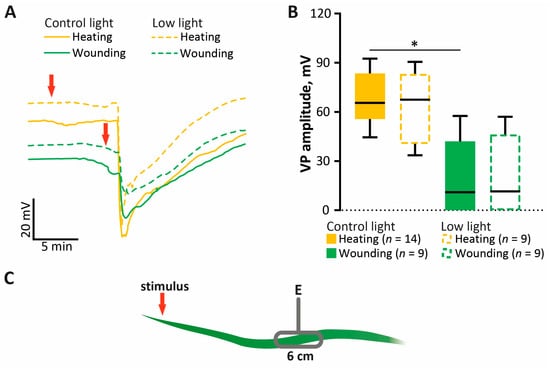
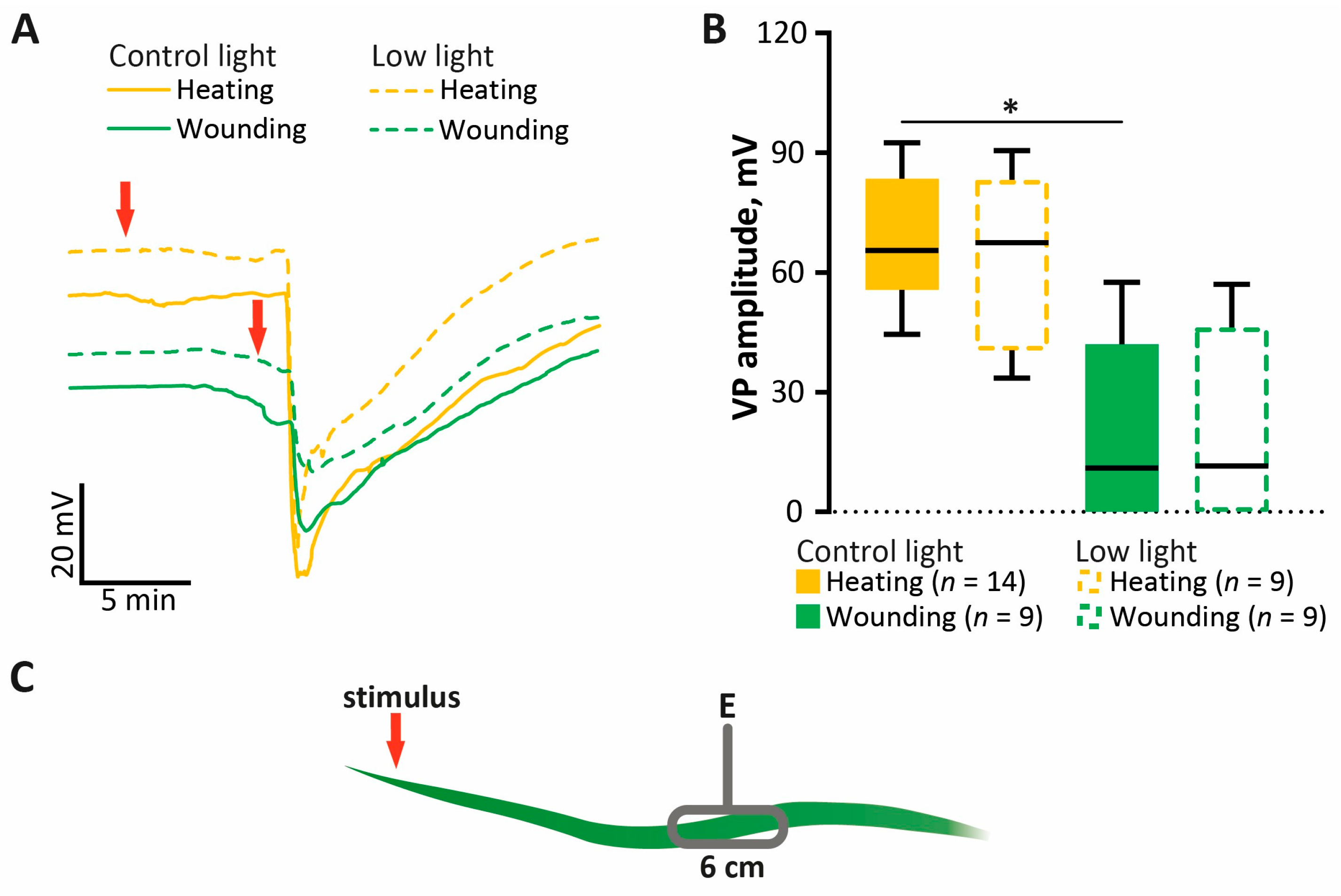
Heating and wounding caused propagation of VP, a wave of transient depolarization (Figure 1A). Upon heating, the VP had a high amplitude. Upon wounding, VP had a lower amplitude (Figure 1B). Under low light, the amplitudes of heating- and wounding-induced VPs were not statistically significantly different from those under control light (Figure 1B). The identified differences in VP parameters between the stimuli persisted at low light intensity. The dynamics of VP under control and low light are presented in the Supplementary Materials (Figure S1).
Figure 1.
Variation potential (VP) induced by local stimuli in wheat. (A) Averaged VP traces under control (solid) and low (dashed) light conditions. The arrow indicates the moment of wounding or the start of heating a leaf tip. (B) VP amplitude under control (solid) and low (dashed) light conditions. The box plot extends from the 25th to 75th percentiles, where the horizontal line represents the median and the whiskers represent the minimum and maximum values. The number of replicates (n) is indicated in the plot legend. * indicates statistically significant differences between stimuli based on the Mann–Whitney U test (p < 0.05). (C) Schematic representation of the experimental design for monitoring surface potential changes. VPs were recorded at a distance of 6 cm from the stimulation area. E: surface electrode.
VP induced systemic changes in the activity of photosynthesis, recorded as changes in the effective quantum yield of photochemical reactions of photosystem II (ΦPSII) and non-photochemical fluorescence quenching (NPQ). For both stimuli, VP propagation caused multiphasic photosynthetic responses in systemic tissues, characterized by a transient decrease in ΦPSII and an increase in NPQ. Averaged dynamics (Figure S1) and examples of individual recordings (Figure S2) are provided in the Supplementary Materials.
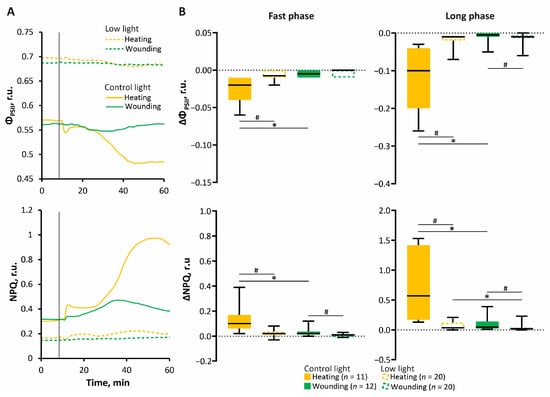
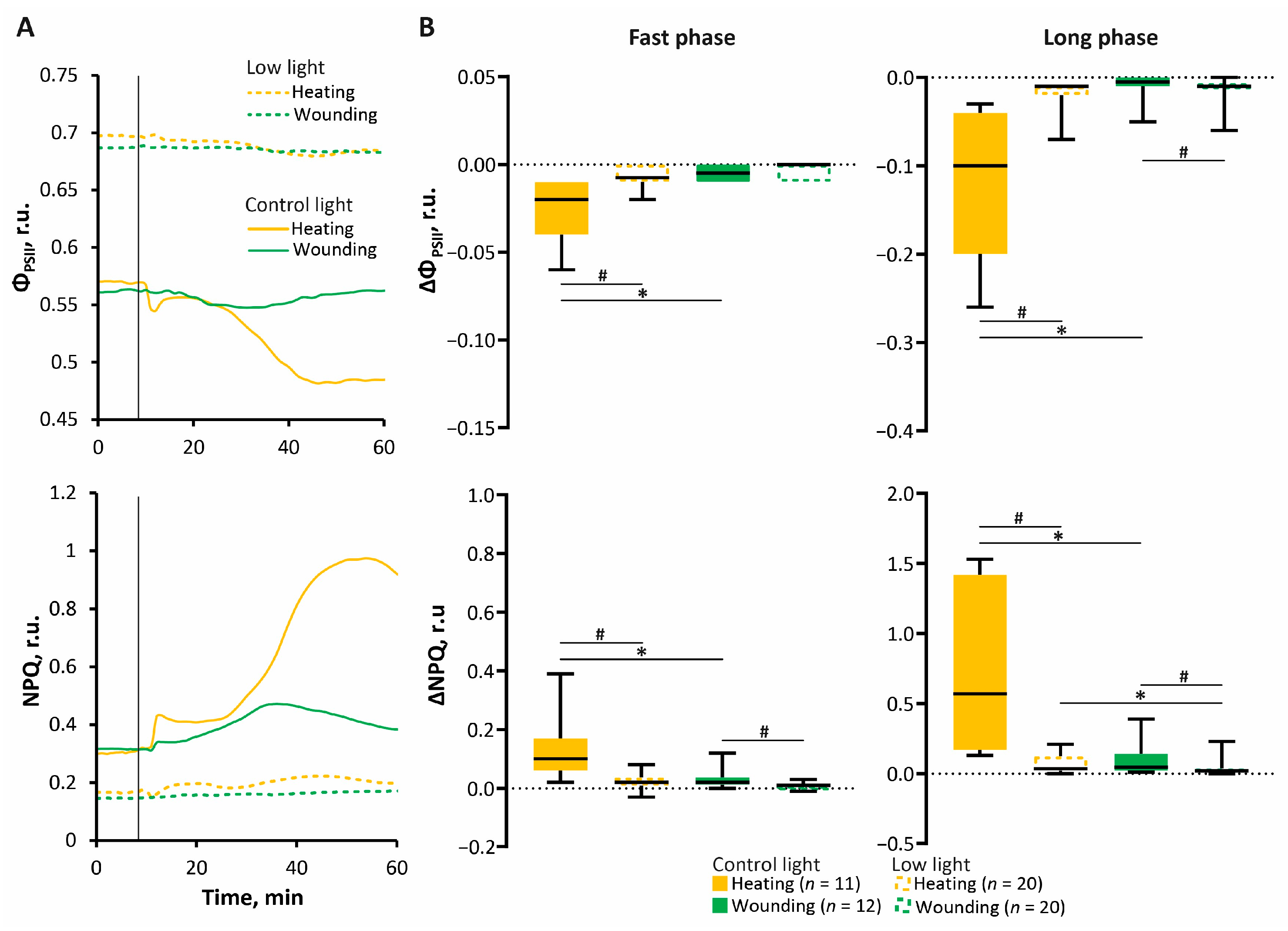
The initial activation phase of photosynthesis was followed by fast and long phases of inactivation of photosynthesis (Figure 2A). Stimulus-specific differences were manifested in the amplitude of the response phases. Consistent with the pattern observed for signal amplitudes, systemic photosynthetic responses induced by heating exhibited higher amplitudes compared to those induced by wounding (Figure 2B). No differences were found in the amplitude of the initial photosynthetic activation (Figure S3). The dynamics of the responses agree well with those previously reported for wheat [12,18]. The reproducibility of the results across independent experimental replicates confirms the reliability of our findings. The amplitudes of the photosynthetic response phases, as well as the basal (pre-stimulation) levels of photosynthetic activity, were used as quantitative parameters to evaluate the effect of low light on systemic responses.
Figure 2.
The effect of light conditions on systemic photosynthetic responses in wheat plants. (A) Averaged systemic photosynthetic responses induced by local heating or wounding under control (solid) and low (dashed) light conditions. The vertical black line indicates the moment of VP propagation. (B) Amplitudes of the fast and long phases of photosynthetic inactivation in wheat under control (solid) and low (dashed) light conditions. Box plot extends from the 25th to 75th percentiles, where the horizontal line represents the median and the whiskers represent the minimum and maximum values. The number of replicates (n) is indicated in the plot legend. Photosynthetic responses were observed at a distance of 6 cm from the stimulation area. * indicates statistically significant differences between stimuli; # indicates statistically significant differences between different light conditions within a single stimulus based on the Mann–Whitney U test (p < 0.05). ΦPSII, effective quantum yield of photochemical reactions of photosystem II; NPQ, non-photochemical fluorescence quenching.
Low light changed the basal level of photosynthetic activity relative to the control. Under low light, NPQ was 0.17, compared with 0.3 under control light, and ΦPSII was 0.69, compared with 0.59. Such changes, corresponding to a higher ΦPSII and a lower NPQ, are characteristic of a non-stressful decrease in light intensity [29,34].
In contrast to VP, photosynthetic responses were affected by low light intensity. The amplitudes of the fast and long phases were significantly reduced (Figure 2B). It is worth noting that the long phase was suppressed to a greater extent. Notably, the effect of light intensity was closely similar for both stimuli, showing no distinct variations.
In a separate small series of experiments (Figure S4), the effects of other light levels were additionally tested. It was found that in the series control light—¾ of control—½ of control—¼ of control, there is a decrease in the photosynthesis response induced by a local stimulus. This suggests that the detected effect (Figure 2) belongs to a general pattern of suppression of the systemic photosynthesis response under shading. However, establishing quantitative relationships between the parameters of the photosynthesis response and the degree of reduction in light intensity requires further experiments.
Thus, under low-light conditions, no significant changes in the long-distance signal amplitudes were observed, whereas the systemic photosynthetic responses induced by this signal were substantially suppressed, with the long inactivation phase being preferentially attenuated. According to published data, stomatal conductance (gS) limitations underlie the formation of a long phase of photosynthetic responses [21]. Long-distance signal-induced changes in gS under control and low light conditions were further investigated.
2.2. Effects of Low Light on Long-Distance Signal-Induced Stomatal Conductance Responses
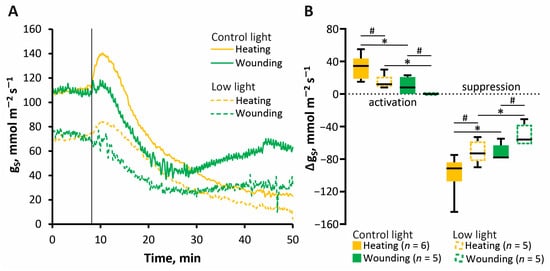
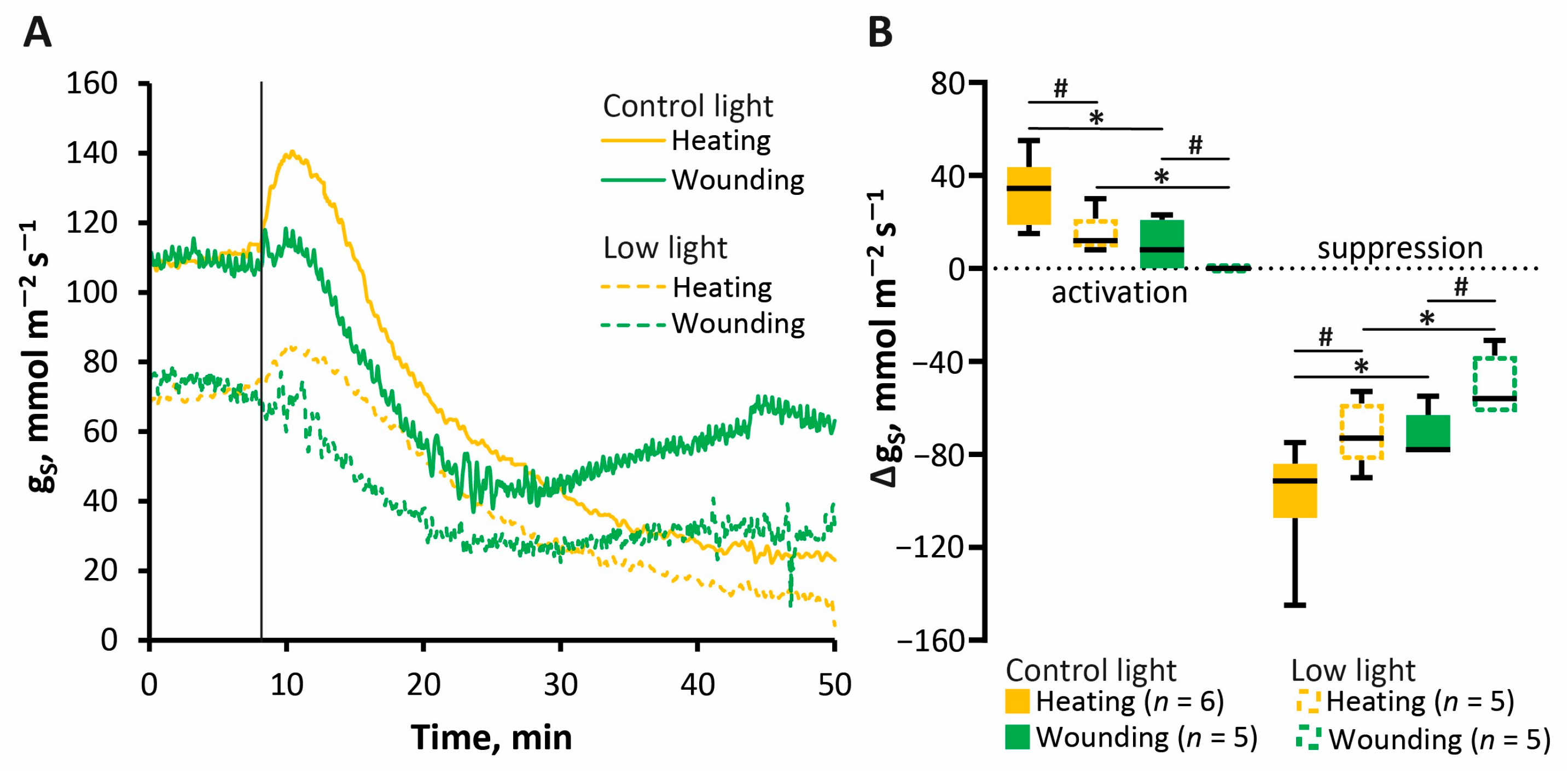
The effect of low light on VP-induced systemic responses was also examined by measuring gS along with the photosynthetic response parameters described above. VP-induced gS responses under control light were characterized by an initial increase in gS (activation phase), beginning simultaneously with the VP arrival and lasting several minutes. After reaching a maximum, gS decreased over tens of minutes (suppression phase) (Figure 3A). The amplitudes of the activation and suppression phases of systemic gS responses were higher upon heating than upon wounding (Figure 3B). Examples of individual records are provided in the Supplementary Materials (Figure S2).
Figure 3.
The effect of light conditions on systemic stomatal conductance responses in wheat plants. (A) Averaged stomatal conductance responses induced by local heating or wounding under control (solid) and low (dashed) light conditions. The vertical black line indicates the moment of VP propagation. (B) Amplitudes of stomatal conductance changes. Stomatal conductance was observed at a distance of 6 cm from the stimulation area. Box plot extends from the 25th to 75th percentiles, where the horizontal line represents the median and the whiskers represent the minimum and maximum values. The number of replicates (n) is indicated in the plot legend. * indicates statistically significant differences between stimuli; # indicates statistically significant differences between different light conditions within a single stimulus based on the Mann–Whitney U test (p < 0.05).
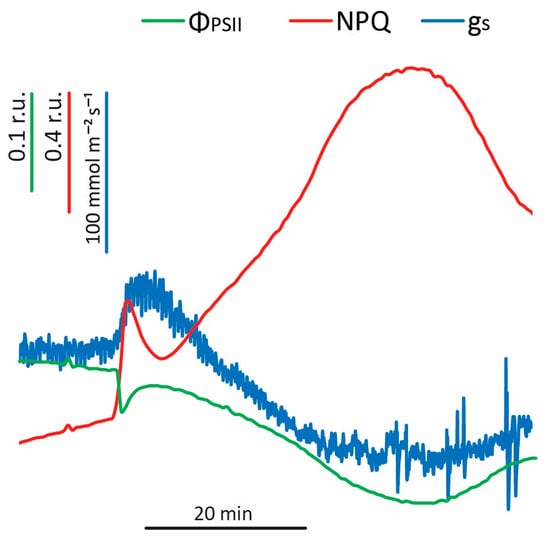
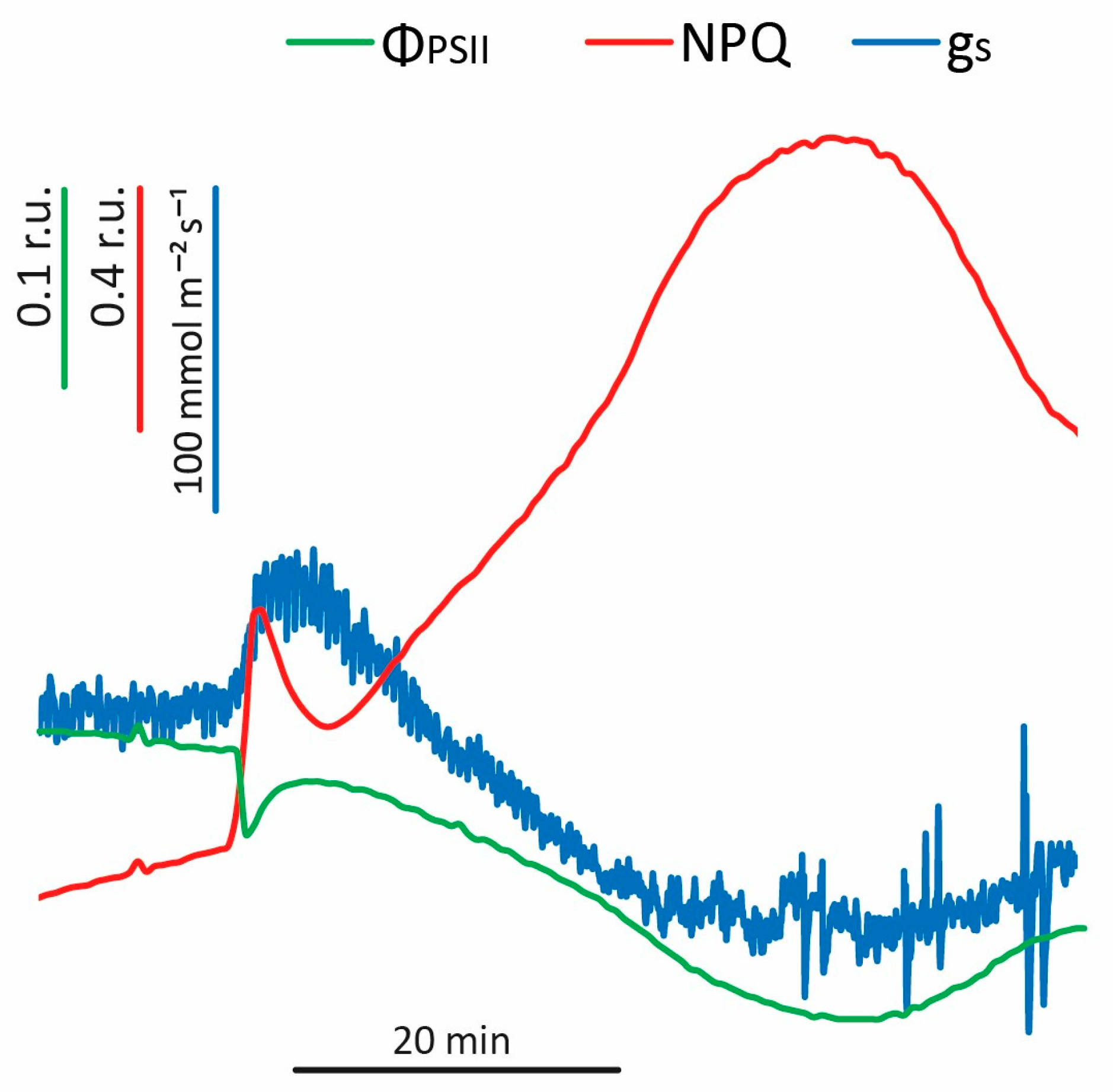
Comparison of gS and photosynthetic activity dynamics revealed that the initial increase in photosynthetic activity and the fast inactivation phase were accompanied by an initial increase in gS, whereas the formation of the long inactivation phase coincided with a decrease in gS (Figure 4).
Figure 4.
Representative recordings of changes in parameters of systemic photosynthetic responses and stomatal conductance induced by gradual heating under control light conditions. ΦPSII, effective quantum yield of photochemical reactions of photosystem II; NPQ, non-photochemical fluorescence quenching; gS, stomatal conductance.
Investigation of low light intensity effects on gS revealed that shading slightly reduced basal gS compared to control, and also suppressed systemic gS responses. The attenuation of the initial increase in gS was more pronounced upon wounding, with this early rise being almost abolished (Figure 3). The mean amplitude of the suppression phase of systemic gS responses was reduced by 35%, and the extent of this reduction did not differ between the stimuli.
2.3. Effect of LaCl3, a Ca2+-Channel Blocker, on Long-Distance Signal-Induced Systemic Photosynthetic Responses Under Control and Low Light
Previous studies have shown that Ca2+ plays an important role in the formation of systemic photosynthetic responses [12]. Inhibitor analysis using the plasma membrane Ca2+-permeable channel blocker LaCl3 was therefore performed to identify the mechanisms underlying the different phases of systemic photosynthetic responses under control and low light. Due to the low penetration of treatment solutions through the wheat leaf epidermis, the effect of LaCl3 was studied using detached leaves as a model system. The parameters of VPs and systemic photosynthetic responses did not differ between whole plants and detached leaves (Figure S5), consistent with previous results [12]. Heating was chosen as a stimulus because the small amplitudes of the wound-induced responses precluded reliable analysis under low-light conditions.
Upon LaCl3 treatment, a slight tendency toward lower basal gS was observed under both control and low-light conditions. Similarly, there was also a tendency toward lower basal ΦPSII and higher basal NPQ.
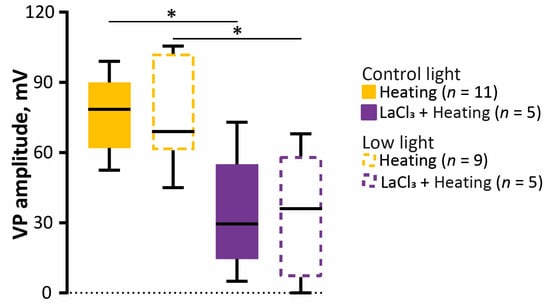
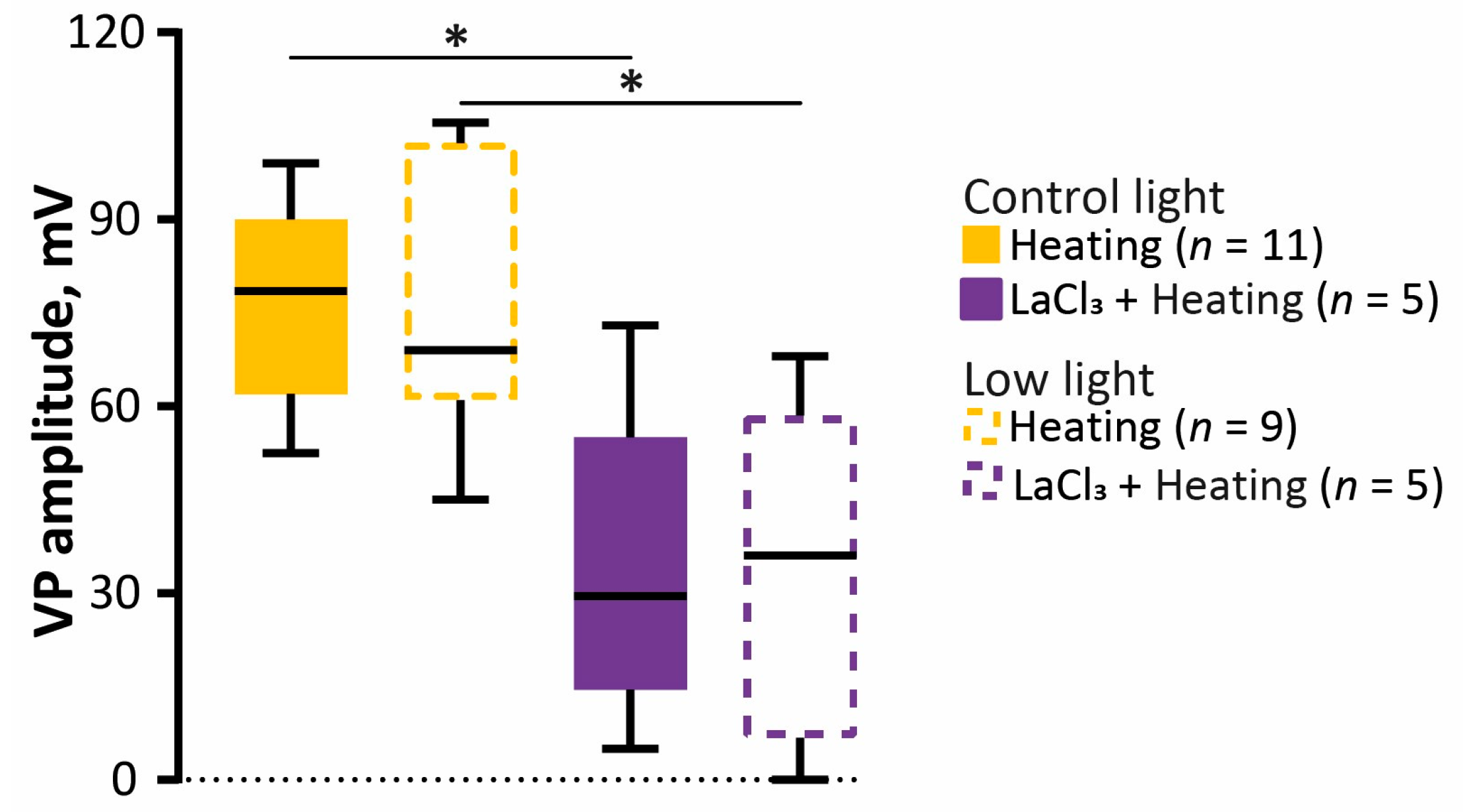
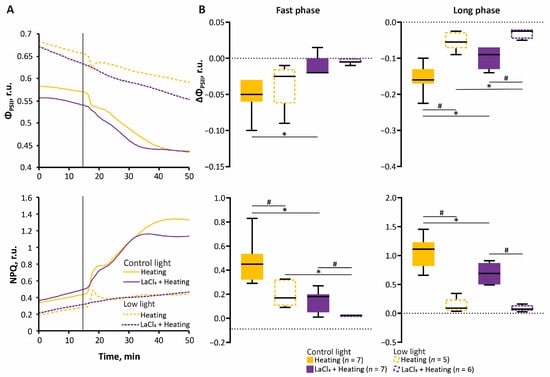
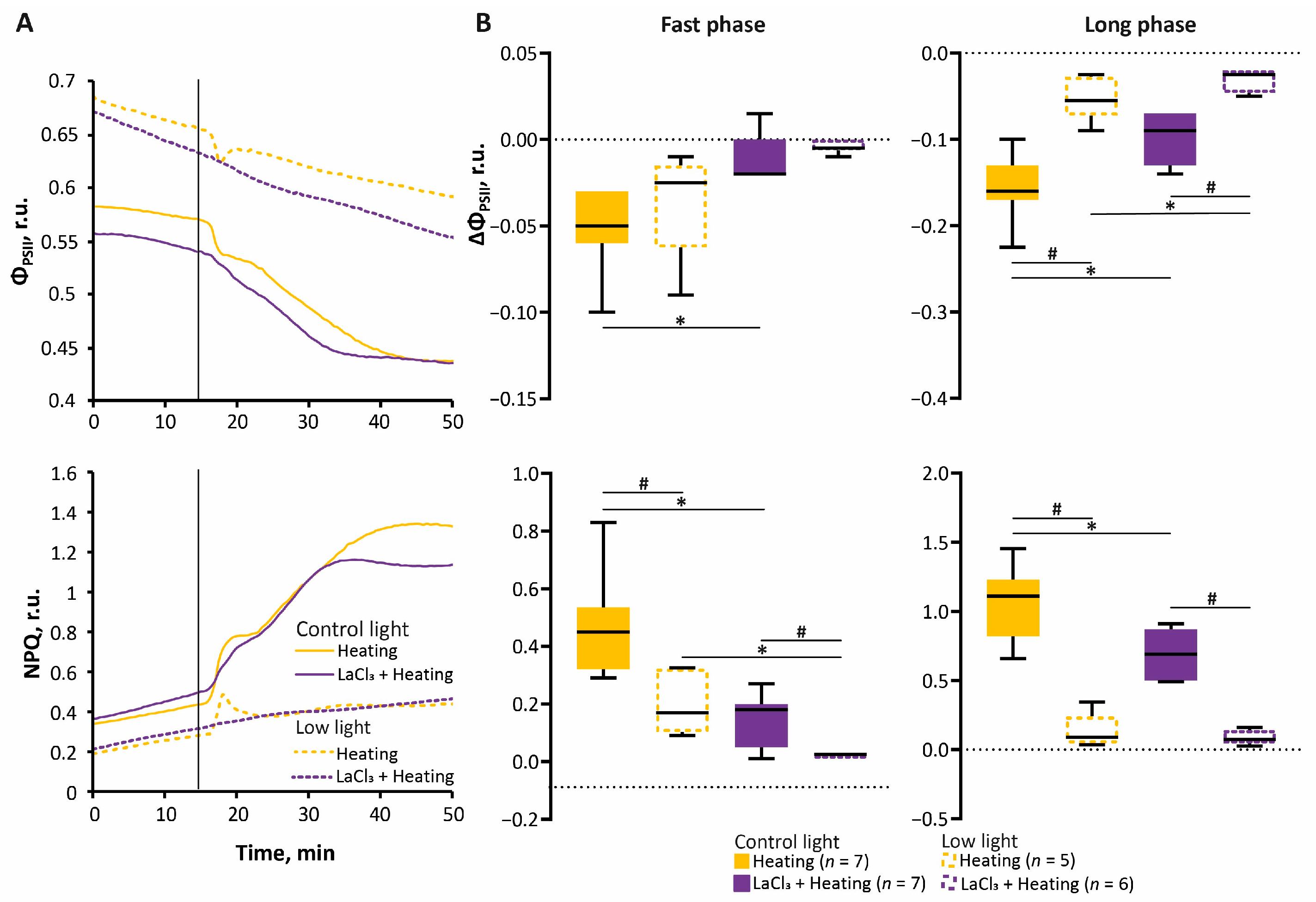
Treatment with LaCl3 reduced the VP amplitude, and the extent of this reduction was independent of light intensity (Figure 5). LaCl3 treatment also decreased the amplitude of systemic photosynthetic responses, with the fast phase being suppressed to a greater extent than the long phase (Figure 6). This effect was observed under both control and low-light conditions. Examples of individual records are provided in the Supplementary Materials (Figure S6).
Figure 5.
Amplitude of VP induced by local heating at control (solid) and low (dashed) light conditions in untreated and LaCl3-treated detached wheat leaves. VP was recorded at a distance of 6 cm from the stimulation area. Box plot extends from the 25th to 75th percentiles, where the horizontal line represents the median and the whiskers represent the minimum and maximum values. The number of replicates (n) is indicated in the plot legend. * indicates statistically significant differences between treated and untreated plants based on the Mann–Whitney U test (p < 0.05).
Figure 6.
The effect of LaCl3 on the systemic photosynthetic responses induced by local stimuli. (A) Averaged photosynthetic responses induced by local heating under control (solid) and low (dashed) light conditions. The vertical black line indicates the moment of VP propagation. (B) Amplitudes of the fast and long phases of photosynthetic inactivation. Box plot extends from the 25th to 75th percentiles, where the horizontal line represents the median and the whiskers represent the minimum and maximum values. The number of replicates (n) is indicated in the plot legend. Photosynthetic responses were observed at a distance of 6 cm from the stimulation area. * indicates statistically significant differences between treated and untreated leaves; # indicates statistically significant differences between different light conditions within the same group based on the Mann–Whitney U test (p < 0.05). ΦPSII, effective quantum yield of photochemical reactions of photosystem II; NPQ, non-photochemical fluorescence quenching.
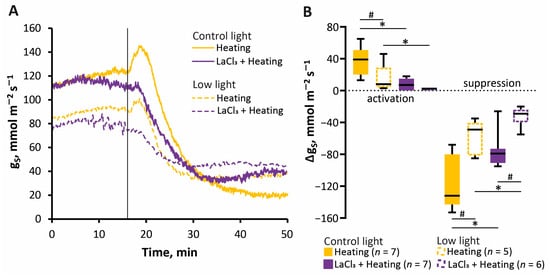
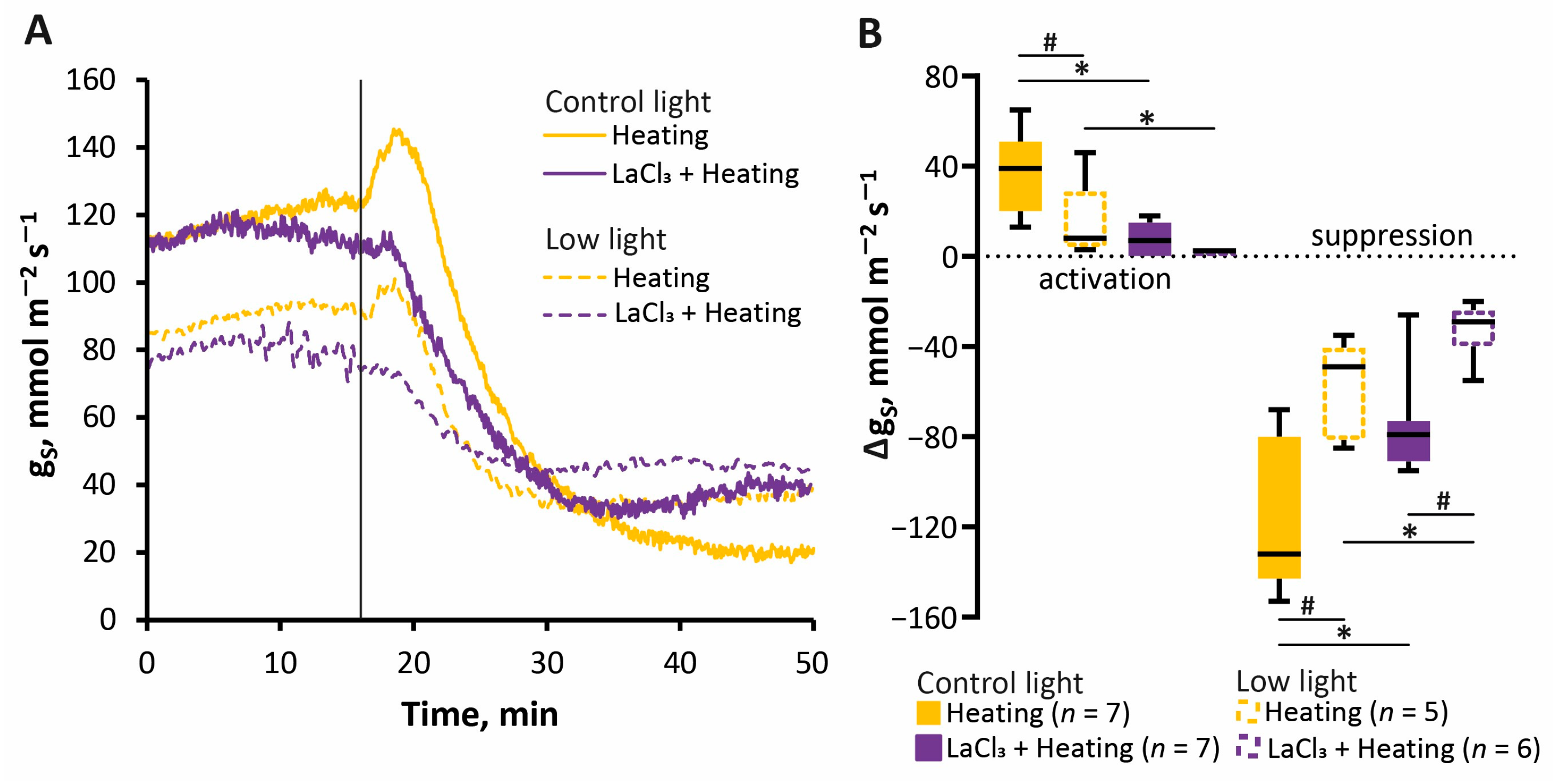
In addition to its effects on photosynthetic responses, LaCl3 also modulated systemic gS responses, significantly suppressing the amplitudes of both the initial increase and the decrease in gS regardless of light intensity (Figure 7 and Figure S6).
Figure 7.
The effect of LaCl3 on the systemic stomatal conductance responses induced by local stimuli. (A) Averaged stomatal conductance responses induced by local heating under control (solid) and low (dashed) light conditions. The vertical black line indicates the moment of VP propagation. (B) Amplitudes of stomatal conductance changes. Stomatal conductance was observed at a distance of 6 cm from the stimulation area. Box plot extends from the 25th to 75th percentiles, where the horizontal line represents the median and the whiskers represent the minimum and maximum values. The number of replicates (n) is indicated in the plot legend. Photosynthetic responses were observed at a distance of 6 cm from the stimulation area. * indicates statistically significant differences between treated and untreated leaves; # indicates statistically significant differences between different light conditions within the same group based on the Mann–Whitney U test (p < 0.05).
Taken together, these findings indicate that the inhibitory effect of LaCl3 was independent of light intensity, characterized by a more pronounced suppression of the fast phase of systemic photosynthetic responses relative to the long phase, alongside a significant attenuation of both VPs and systemic gS responses.
3. Discussion
3.1. Long-Distance Signal-Induced Systemic Photosynthetic Responses
The results of the present study show a strong inhibitory effect of low light intensity on local stimulus-induced systemic photosynthetic responses in wheat. This effect was consistently observed for both stimuli, namely gradual heating and mechanical wounding. Analysis of the molecular mechanisms by which light intensity affects photosynthetic responses requires the mechanisms of response formation to be considered first.
According to the results of previous studies [12,18], confirmed by the present study (Figure 2), the VP-induced systemic photosynthetic response in wheat is multiphasic. It comprises a low-amplitude initial activation and two phases of inactivation, fast and long. Based on the most likely mechanisms of their induction, the response phases can be classified into gS-dependent (limited by CO2 supply) and gS-independent phases [12,35]. The initial photosynthetic activation may result from hydropassive opening of the stomata caused by the propagation of the hydraulic signal, which is one of the VP components [11,18]. The fast phase of inactivation is not mediated by stomatal limitations, because it develops while gS is increasing (Figure 4). A direct effect of VP-associated cytosolic Ca2+ level increases on the activity of light-dependent photosynthetic reactions is a likely mechanism underlying the fast phase [12,36]. The long phase is likely substantially mediated by JA-induced stomatal closure, which reduces CO2 availability [37,38,39]. Non-stomatal factors, such as mesophyll conductance, photochemical electron transport, and biochemical limitations [40,41], can also underlie the long phase of systemic photosynthetic responses.
Low-light-induced changes in systemic photosynthetic responses may be due to the influence of light intensity on both their induction and formation, as well as on pre-stimulation photosynthetic activity. The sequence of events from the local stimulus to the systemic response is as follows: action of the external local stimulus and its perception by receptors; induction of the signal in the stimulation zone; propagation of the long-distance signal into unstimulated tissues; induction of the systemic response by the signal; and formation of the systemic photosynthetic response. Potential mechanisms by which light intensity affects photosynthetic responses are considered below in this order.
3.2. Effects of Low Light on Long-Distance Signal
A change in light intensity is an effective inducer of electrical signals in plants [42,43]. Electrical signals are generated in response to both an increase and a decrease in light intensity in higher plants [43,44] and in mosses [42]. Changes in light intensity can also modify signals induced by other stimuli. In sunflower, a decrease in light intensity reduced the amplitude of VP induced by root excision [45]. The present results showed no significant effect of light intensity on the parameters of stimulus-induced VP (Figure 1). The variations between our findings and the published data may be due to species specificity, the nature of the stimulus, or leaf age. Differences in parameters of VPs recorded under bright and room light were observed by Stahlberg et al., 2005 [45] only in the youngest leaves, whereas the present experiments were performed on mature leaves. In any case, the independence of long-distance signal parameters from light intensity (Figure 1) suggests that the stages of stimulus perception, induction and transmission of the signal are unlikely to be involved in mediating the observed effects of low light on systemic photosynthetic responses. The absence of pronounced effects of light intensity on the long-distance signal indicates that the changes in systemic responses are related to basal activity of photosynthesis or directly to the induction and formation of the response.
3.3. Effects of Low Light on the Basal Levels of Photosynthetic Activity
Light intensity is known to be a strong modulator of the activity of photosynthesis [28,32,46]. A light intensity lower than the control leads to higher ΦPSII and lower NPQ [30,31], as well as lower gS [28,29]. The direction and magnitude of the shift in basal photosynthetic activity and gS induced by low light intensity agree well with data reported for wheat by other authors [28,47]. The lower basal NPQ under shading (Figure 2A) indicates that the photosynthetic apparatus was not under stress in these conditions [29,34]. When a decrease in light intensity is stressful, NPQ increases [31].
It can be suggested that light-intensity-dependent basal photosynthetic activity underlies the low-light-induced changes in systemic photosynthetic responses. The amplitude of the systemic response, defined as the difference between the maximum value of the recorded parameter and its basal level, can change if either of these values shifts. In this study, the observed shifts in basal levels of ΦPSII and NPQ expand the range within which the response develops. The decrease in amplitude was due to lower maximum values of the parameters. This implies that changes in basal ΦPSII and NPQ levels are not determining factors in suppressing the photosynthetic response under low light. Nevertheless, such a mechanistic interpretation does not rule out the influence of basal photosynthetic activity on the stimulus-induced response.
This influence could operate through regulatory mechanisms of light-dependent reactions that are shared by photosynthetic responses to both changes in light intensity and long-distance signals. Changes in pH are among the most likely of these shared mechanisms. Changes in pH are important for both the light-dependent regulation of photosynthetic activity and the formation of signal-induced photosynthetic responses [35,48,49,50]. An increase in light intensity acidifies the lumen and alkalizes the stroma, generating a proton gradient (ΔpH) across the thylakoid membranes [49,51]. Energy-dependent quenching (qE), the main component of NPQ, depends directly on ΔpH [48,49,50]. Another NPQ component, qZ, depends on the accumulation of zeaxanthin in the light [48,50]. Zeaxanthin formation is catalyzed by violaxanthin de-epoxidase, which is activated by acidification of the lumen [48,50]. Lumenal pH also controls the regulatory protein PsbS, cytochrome b6f, fructose-l,6-bisphosphatase/sedoheptulose-1,7-bisphosphatase and other components central to the regulation of photosynthetic activity [49,52,53]. At a lower light intensity, acidification of the lumen and alkalization of the stroma are weaker, and ΔpH is smaller. Under low light, lumen acidification is further weakened by higher ATP synthase activity and lower cyclic electron transport [54].
3.4. Effects of Low Light on the Formation of Systemic Photosynthetic Responses
Acidification of the lumen is also one of the mechanisms that form VP-induced systemic photosynthetic responses. As noted above, the long-distance signal induces a limitation of CO2 supply and thereby suppresses the dark stages of photosynthesis [35]. Consumption of ATP and NADPH then decreases, ATP synthase is inactivated, and the lumen acidifies [55]. Under low light, the signal-induced shifts may fail to reach the lumenal pH thresholds required for a full photoprotective response, which would decrease the photosynthetic response. The pH before stimulation, which itself depends on light intensity, may therefore cause the changes in signal-induced systemic photosynthetic responses.
Another pathway of modulating systemic photosynthetic responses involves the effect of light intensity directly on the mechanisms of their signal-mediated induction. As noted above, the phases of the photosynthetic response appear to be either dependent on CO2 supply or independent of it [12,35]. The long phase of photosynthetic inactivation is likely CO2-dependent, supported by the consistent kinetics of gS and chlorophyll fluorescence parameters (Figure 4). Low light intensity had a stronger effect on the amplitude of this phase (Figure 2), which may be explained by a smaller amplitude of the decrease in gS. Under low light, the amplitude of the decrease in gS was indeed reduced, together with the amplitudes of the ΦPSII and NPQ responses (Figure 3). The mechanism of long-distance signal-induced reduction in gS is an increase in hormone levels, primarily JAs [21,22,23,24]. Under shading, the changes in JA levels may be insufficient for complete stomatal closure, because JA production depends on light intensity [56]. It is worth noting that the temporal coincidence of changes in gS and chlorophyll fluorescence parameters supports a strong association, but does not rule out contributions of alternative pathways such as mesophyll conductance and photochemical electron transport [40,41].
A further mechanism by which the long-distance signal induces the systemic photosynthetic response is probably a direct effect of Ca2+ on the light-dependent reactions. VP propagation leads to changes in cytosolic Ca2+ levels in systemic tissues [3,5,9,19]. Ca2+ affects the light-dependent reactions by regulating PsbS, the electron transport chain, the assembly and disassembly of photosystem II, and other processes [52,57]. Development of the fast phase of inactivation during an increase in gS (Figure 6) indicates that this phase is independent of CO2 supply limitations, being primarily mediated by the direct effect of Ca2+ on light-dependent reactions. The strong suppression of the fast phase of photosynthetic inactivation after LaCl3 treatment (Figure 6) supports the role of Ca2+ in its induction. Ca2+ probably also contributes to induction of the long phase of photosynthetic inactivation and the changes in gS, because LaCl3 treatment reduced the amplitudes of these responses (Figure 7).
The suppression of systemic photosynthetic responses by LaCl3 is likely due to a LaCl3-induced reduction in signal amplitudes (Figure 5). The relationship between response and signal parameters has been previously reported [58]. Pretreatment with LaCl3 suppressed photosynthetic responses to a similar extent under both control and low-light conditions (Figure 6). This indicates that the light intensity does not substantially affect the Ca2+-mediated processes. The suppression of photosynthetic responses under low light therefore appears to be driven primarily by other, Ca2+-independent mechanisms, which are most likely related to the pH-dependent photosynthetic limitations discussed above and changes in hormone production.
4. Materials and Methods
4.1. Plant Material and Growth Conditions
Wheat (Triticum aestivum L.) plants were used in this study. Seeds of the Daria cultivar were purchased from the Gavrish LLC (Moscow, Russia). Seeds of wheat were pre-germinated in the dark at 23 °C for 72 h, after which nine seedlings per pot were transplanted into 7 cm square pots filled with sand as the substrate (Figure S7). Plants were watered once every 3 days (70 mL per pot) and cultivated in a growth room at 23 °C and 50–55% relative humidity under a 16 h/8 h light/dark cycle, with a light intensity of 280 µmol m−2 s−1. For all measurements, 15–21-day-old plants were used. Due to the low permeability of the wheat leaf epidermis to chemical compounds, experiments with inhibitors were performed using detached wheat leaves. The second mature leaf, 17 cm in length, was cut from plants and incubated in a standard solution (1 mM KCl, 0.5 mM CaCl2, and 0.1 mM NaCl) [12] for 17 h. Chemical components of a standard solution were purchased from ALDOSA (Moscow, Russia).
4.2. Local Stimulation
Local stimulation was performed using two types of stimuli: gradual heating in a water-filled cuvette to 60 °C for 6–7 min and mechanical wounding by crushing with a plastic cylinder. Both stimuli were applied to a 1 cm segment at the tip of the second mature leaf. Prior to the experiments, plants were acclimated in the recording room for 1 h at 23 °C [12,17].
4.3. Extracellular Recordings of Electrical Signals
Surface potential changes were recorded using Ag+/AgCl macroelectrodes EVL-1M3 (Gomel Plant of Measuring Devices, Gomel, Belarus) filled with 3 M KCl and connected to a high-impedance amplifier IPL-113 (Semico, Novosibirsk, Russia). Three measuring electrodes were placed on the leaf at 3 cm intervals, with the first electrode 3 cm from the stimulation area, as shown in the Results figures. The contact between the measuring electrodes and the leaf was established using cotton threads moistened with the standard solution. Surface potential recordings were acquired at 1 Hz.
4.4. Photosynthetic Activity Measurements
Changes in photosynthetic activity were monitored using Pulse-Amplitude-Modulation (PAM) fluorometry. Open FluorCam FC 800-O/1010 fluorometer (Photon Systems Instruments, Drásov, Czech Republic) was used to measure the dynamics of the effective quantum yield of photochemical reactions of photosystem II (ΦPSII) and non-photochemical fluorescence quenching (NPQ) (Figure S8).
Wheat leaves were placed in the measurement system and adapted to the experimental conditions for 60 min. F0 and Fm were determined after 15 min of dark adaptation, after which actinic light illumination with a 617 nm wavelength and a photon flux density of 280 µmol m−2 s−1 was turned on for 15 min. Saturating pulses (4000 µmol m−2 s−1 cold white light, 6500 K) were then turned on. Under low light conditions, the actinic light intensity was reduced to 140 (½ of control) µmol m−2 s−1. In an additional series of experiments (Figure S4), the intensity of the actinic light was also 210 (¾ of control) and 70 (¼ of control) µmol m−2 s−1.
4.5. Stomatal Conductance Measurements
An infrared gas analyzer GFS-3000 (Heinz Walz GmbH, Effeltrich, Germany) and Dual-PAM gas-exchange Cuvette 3010-Dual common measuring head (Heinz Walz GmbH, Effeltrich, Germany) were used for measurements of gS (Figure S9), which was automatically calculated by GFS-Win software (version 3.82) (Heinz Walz GmbH, Effeltrich, Germany). The CO2 concentration in the measuring cuvette was 360 ppm, at 23 °C and about 70% relative humidity. Blue actinic light at 460 nm and 280 µmol m−2 s−1 was used in the experiments. Under low light conditions, the actinic light intensity was reduced to 140 µmol m−2 s−1. The measuring cuvette was placed on the leaf at a distance of 6 cm from the stimulation site. gS recordings were acquired at 1 Hz.
4.6. Inhibitor Studies
To investigate the mechanisms underlying systemic photosynthetic responses induced by local stimuli, inhibitor analysis was performed using LaCl3 (2 mM), a Ca2+-permeable channel blocker (Sigma-Aldrich, St. Louis, MO, USA). The LaCl3 concentration was selected based on preliminary experiments (Figure S10) to minimize its effects on photosynthetic parameters at rest. The treatment solutions, prepared in the standard solution, were applied to detached wheat leaves by vacuum infiltration. The cut edge of the detached leaf was submerged in the solution, followed by a single 5 min vacuum infiltration cycle at 70 kPa in a vacuum desiccator. Control leaves were subjected to the same procedure using the standard solution. All experiments were performed 90 min after infiltration.
4.7. Statistical Analysis
Experiments involving each type of stimulus were performed in at least 3 independent replicates, each conducted on a separate plant. The results are presented as box plots or mean ± SEM, averaged recordings, and representative recordings from individual measurements. Normality of the distribution was assessed using the Shapiro–Wilk test. Since the distribution of some of the data deviated from normality, the Mann–Whitney test was used to evaluate statistical significance in pairwise comparisons. The level of statistical significance was set at p < 0.05. Statistical analyses were performed using Microsoft Excel (Microsoft Corporation, Redmond, WA, USA) and GraphPad Prism version 6.07 (GraphPad Software, San Diego, CA, USA).
5. Conclusions
The results show that a decrease in light intensity has a considerable effect on photosynthetic responses. Differences in the VP-induced pH shifts are the probable cause of this modification at low light intensity. Changes in gS also contribute. The molecular mechanisms by which the long-distance signal induces the response are not yet fully resolved and require further study. It will be necessary to establish whether changes in JA production contribute to systemic photosynthetic responses in a manner that depends on light intensity, and to identify the targets of the Ca2+ signal that participate in induction of photosynthetic responses under different light conditions. Mechanisms of response modification associated with changes in gene expression also remain to be studied. Addressing these questions would provide a comprehensive understanding of how light intensity modulates systemic photosynthetic responses and how they contribute to plant stress tolerance.
Supplementary Materials
The following supporting information can be downloaded at https://www.mdpi.com/article/10.3390/ijms272310777/s1.
Author Contributions
Conceptualization, M.M. and V.V.; methodology, M.M. and V.V.; validation, M.M.; formal analysis, M.M.; investigation, M.M.; resources, M.L. and V.V.; data curation, M.M.; writing—original draft preparation, M.M.; writing—review and editing, M.M., M.L. and V.V.; visualization, D.K.; supervision, V.V.; project administration, V.V.; funding acquisition, V.V. All authors have read and agreed to the published version of the manuscript.
Funding
The research was funded by the Russian Science Foundation (project No. 22-14-00388-P).
Institutional Review Board Statement
Not applicable.
Informed Consent Statement
Not applicable.
Data Availability Statement
The original contributions presented in this study are included in the article/Supplementary Materials. Further inquiries can be directed to the corresponding author.
Conflicts of Interest
The authors declare no conflicts of interest.
Abbreviations
The following abbreviations are used in this manuscript:
| VP | Variation potential |
| JAs | Jasmonates |
| ΦPSII | Effective quantum yield of photochemical reactions of photosystem II |
| NPQ | Non-photochemical fluorescence quenching |
| qE | Energy-dependent quenching |
| qZ | Zeaxanthin-dependent quenching |
| ΔpH | Proton gradient |
| gS | Stomatal conductance |
References
- Choi, W.-G.; Hilleary, R.; Swanson, S.J.; Kim, S.-H.; Gilroy, S. Rapid, Long-Distance Electrical and Calcium Signaling in Plants. Annu. Rev. Plant Biol. 2016, 67, 287–307. [Google Scholar] [CrossRef] [Scilit]
- Huber, A.E.; Bauerle, T.L. Long-Distance Plant Signaling Pathways in Response to Multiple Stressors: The Gap in Knowledge. J. Exp. Bot. 2016, 67, 2063–2079. [Google Scholar] [CrossRef] [Scilit]
- Li, R.; Yang, Y.; Lou, H.; Wang, W.; Yan, J.; Xie, D.; Shan, X. Electrical and Calcium Signaling in Plant Systemic Defense: From Local Wounds to Global Responses. New Phytol. 2025, 247, 1633–1642. [Google Scholar] [CrossRef] [Scilit]
- Takahashi, F.; Shinozaki, K. Long-Distance Signaling in Plant Stress Response. Curr. Opin. Plant Biol. 2019, 47, 106–111. [Google Scholar] [CrossRef] [Scilit]
- Johns, S.; Hagihara, T.; Toyota, M.; Gilroy, S. The Fast and the Furious: Rapid Long-Range Signaling in Plants. Plant Physiol. 2021, 185, 694–706. [Google Scholar] [CrossRef] [Scilit]
- Barbosa-Caro, J.C.; Wudick, M.M. Revisiting Plant Electric Signaling: Challenging an Old Phenomenon with Novel Discoveries. Curr. Opin. Plant Biol. 2024, 79, 102528. [Google Scholar] [CrossRef] [Scilit]
- Mudrilov, M.; Ladeynova, M.; Grinberg, M.; Balalaeva, I.; Vodeneev, V. Electrical Signaling of Plants under Abiotic Stressors: Transmission of Stimulus-Specific Information. Int. J. Mol. Sci. 2021, 22, 10715. [Google Scholar] [CrossRef] [Scilit]
- Szechyńska-Hebda, M.; Lewandowska, M.; Karpiński, S. Electrical Signaling, Photosynthesis and Systemic Acquired Acclimation. Front. Physiol. 2017, 8, 684. [Google Scholar] [CrossRef] [Scilit]
- Lee, K.; Seo, P.J. Wound-Induced Systemic Responses and Their Coordination by Electrical Signals. Front. Plant Sci. 2022, 13, 880680. [Google Scholar] [CrossRef] [Scilit]
- Białasek, M.; Górecka, M.; Mittler, R.; Karpiński, S. Evidence for the Involvement of Electrical, Calcium and ROS Signaling in the Systemic Regulation of Non-Photochemical Quenching and Photosynthesis. Plant Cell Physiol. 2017, 58, 207–215. [Google Scholar] [CrossRef] [Scilit]
- Kaiser, H.; Grams, T.E.E. Rapid Hydropassive Opening and Subsequent Active Stomatal Closure Follow Heat-Induced Electrical Signals in Mimosa pudica. J. Exp. Bot. 2006, 57, 2087–2092. [Google Scholar] [CrossRef] [Scilit]
- Mudrilov, M.; Ladeynova, M.; Pirogova, P.; Kuznetsova, D.; Obydennova, S.; Vodeneev, V. Mechanisms of Induction of Stimulus-Specific Systemic Responses of Photosynthesis in Wheat Plants. Int. J. Mol. Sci. 2026, 27, 401. [Google Scholar] [CrossRef] [Scilit]
- Sukhova, E.; Sukhov, V. Electrical Signals, Plant Tolerance to Actions of Stressors, and Programmed Cell Death: Is Interaction Possible? Plants 2021, 10, 1704. [Google Scholar] [CrossRef] [Scilit]
- Walker, B.J.; Schroeder, W.L. Understanding Plant Resilience by Putting Photosynthesis and Photorespiration in the Metabolic Context. Planta 2026, 263, 94. [Google Scholar] [CrossRef] [Scilit]
- Yudina, L.; Popova, A.; Zolin, Y.; Grebneva, K.; Sukhova, E.; Sukhov, V. Local Action of Moderate Heating and Illumination Induces Electrical Signals, Suppresses Photosynthetic Light Reactions, and Increases Drought Tolerance in Wheat Plants. Plants 2024, 13, 1173. [Google Scholar] [CrossRef] [Scilit]
- Sukhov, V.; Gaspirovich, V.; Mysyagin, S.; Vodeneev, V. High-Temperature Tolerance of Photosynthesis Can Be Linked to Local Electrical Responses in Leaves of Pea. Front. Physiol. 2017, 8, 763. [Google Scholar] [CrossRef] [Scilit]
- Vodeneev, V.; Mudrilov, M.; Akinchits, E.; Balalaeva, I.; Sukhov, V. Parameters of Electrical Signals and Photosynthetic Responses Induced by Them in Pea Seedlings Depend on the Nature of Stimulus. Funct. Plant Biol. 2018, 45, 160–170. [Google Scholar] [CrossRef] [Scilit]
- Mudrilov, M.; Ladeynova, M.; Berezina, E.; Grinberg, M.; Brilkina, A.; Sukhov, V.; Vodeneev, V. Mechanisms of Specific Systemic Response in Wheat Plants under Different Locally Acting Heat Stimuli. J. Plant Physiol. 2021, 258–259, 153377. [Google Scholar] [CrossRef] [Scilit]
- Farmer, E.E.; Gao, Y.; Lenzoni, G.; Wolfender, J.; Wu, Q. Wound- and Mechanostimulated Electrical Signals Control Hormone Responses. New Phytol. 2020, 227, 1037–1050. [Google Scholar] [CrossRef] [Scilit]
- Ladeynova, M.; Kuznetsova, D.; Mudrilov, M.; Vodeneev, V. Integration of Electrical Signals and Phytohormones in the Control of Systemic Response. Int. J. Mol. Sci. 2023, 24, 847. [Google Scholar] [CrossRef] [Scilit]
- Fraudentali, I.; Pedalino, C.; Tavladoraki, P.; Angelini, R.; Cona, A. A New Player in Jasmonate-Mediated Stomatal Closure: The Arabidopsis thaliana Copper Amine Oxidase β. Cells 2021, 10, 3399. [Google Scholar] [CrossRef] [Scilit]
- Das, S.; Shil, S.; Rime, J.; Alice, A.K.; Yumkhaibam, T.; Mounika, V.; Singh, A.P.; Kundu, M.; Lalhmangaihzuali, H.; Hazarika, T.K.; et al. Phytohormonal Signaling in Plant Resilience: Advances and Strategies for Enhancing Abiotic Stress Tolerance. J. Plant Growth Regul. 2025, 105, 329–360. [Google Scholar] [CrossRef] [Scilit]
- Müller, M.; Munné-Bosch, S. Hormonal Impact on Photosynthesis and Photoprotection in Plants. Plant Physiol. 2021, 185, 1500–1522. [Google Scholar] [CrossRef] [Scilit]
- Kuznetsova, D.; Vodeneev, V.; Ladeynova, M. Jasmonoyl-L-Isoleucine Induces Systemic Photosynthetic Responses to Local Heat Stress by Contributing to Abscisic Acid Accumulation. Plants 2026, 15, 1732. [Google Scholar] [CrossRef] [Scilit]
- Yudina, L.; Gromova, E.; Grinberg, M.; Popova, A.; Sukhova, E.; Sukhov, V. Influence of Burning-Induced Electrical Signals on Photosynthesis in Pea Can Be Modified by Soil Water Shortage. Plants 2022, 11, 534. [Google Scholar] [CrossRef] [Scilit]
- Grinberg, M.A.; Gudkov, S.V.; Balalaeva, I.V.; Gromova, E.; Sinitsyna, Y.; Sukhov, V.; Vodeneev, V. Effect of Chronic β-Radiation on Long-Distance Electrical Signals in Wheat and Their Role in Adaptation to Heat Stress. Environ. Exp. Bot. 2021, 184, 104378. [Google Scholar] [CrossRef] [Scilit]
- Salter, W.T.; Merchant, A.M.; Richards, R.A.; Trethowan, R.; Buckley, T.N. Rate of Photosynthetic Induction in Fluctuating Light Varies Widely among Genotypes of Wheat. J. Exp. Bot. 2019, 70, 2787–2796. [Google Scholar] [CrossRef] [Scilit]
- Taylor, S.H.; Long, S.P. Slow Induction of Photosynthesis on Shade to Sun Transitions in Wheat May Cost at Least 21% of Productivity. Philos. Trans. R. Soc. B 2017, 372, 20160543. [Google Scholar] [CrossRef] [Scilit]
- Vialet-Chabrand, S.; Matthews, J.S.A.; Simkin, A.J.; Raines, C.A.; Lawson, T. Importance of Fluctuations in Light on Plant Photosynthetic Acclimation. Plant Physiol. 2017, 173, 2163–2179. [Google Scholar] [CrossRef] [Scilit]
- Zivcak, M.; Brestic, M.; Kalaji, H.M.; Govindjee, N. Photosynthetic Responses of Sun- and Shade-Grown Barley Leaves to High Light: Is the Lower PSII Connectivity in Shade Leaves Associated with Protection against Excess of Light? Photosynth. Res. 2014, 119, 339–354. [Google Scholar] [CrossRef] [Scilit]
- Shao, Q.; Wang, H.; Guo, H.; Zhou, A.; Huang, Y.; Sun, Y.; Li, M. Effects of Shade Treatments on Photosynthetic Characteristics, Chloroplast Ultrastructure, and Physiology of Anoectochilus roxburghii. PLoS ONE 2014, 9, e85996. [Google Scholar] [CrossRef] [Scilit]
- Wang, R.; Ma, J.; Huang, R.; Wang, Y.; Jiang, Y.; Ling, Y.; Yang, J.; Liang, H.; Liu, X.; Liao, N. The Effects of Shading on the Photosynthetic Performance of Endangered Plant Horsfieldia hainanensis Seedlings. Forests 2023, 15, 3. [Google Scholar] [CrossRef] [Scilit]
- Zhu, H.; Li, X.; Zhai, W.; Liu, Y.; Gao, Q.; Liu, J.; Ren, L.; Chen, H.; Zhu, Y. Effects of Low Light on Photosynthetic Properties, Antioxidant Enzyme Activity, and Anthocyanin Accumulation in Purple Pak-Choi (Brassica campestris ssp. Chinensis Makino). PLoS ONE 2017, 12, e0179305. [Google Scholar] [CrossRef] [Scilit]
- Li, H.; Jiang, D.; Wollenweber, B.; Dai, T.; Cao, W. Effects of Shading on Morphology, Physiology and Grain Yield of Winter Wheat. Eur. J. Agron. 2010, 33, 267–275. [Google Scholar] [CrossRef] [Scilit]
- Sukhov, V.; Sukhova, E.; Vodeneev, V. Long-Distance Electrical Signals as a Link between the Local Action of Stressors and the Systemic Physiological Responses in Higher Plants. Prog. Biophys. Mol. Biol. 2019, 146, 63–84. [Google Scholar] [CrossRef] [Scilit]
- Sukhov, V.; Sherstneva, O.; Surova, L.; Katicheva, L.; Vodeneev, V. Proton Cellular Influx as a Probable Mechanism of Variation Potential Influence on Photosynthesis in Pea. Plant Cell Environ. 2014, 37, 2532–2541. [Google Scholar] [CrossRef] [Scilit]
- Meza-Canales, I.D.; Meldau, S.; Zavala, J.A.; Baldwin, I.T. Herbivore Perception Decreases Photosynthetic Carbon Assimilation and Reduces Stomatal Conductance by Engaging 12-oxo-phytodienoic Acid, Mitogen-activated Protein Kinase 4 and Cytokinin Perception. Plant Cell Environ. 2017, 40, 1039–1056. [Google Scholar] [CrossRef] [Scilit]
- Kuznetsova, D.V.; Vodeneev, V.A.; Ladeynova, M.M. Interplay between Electrical Signals and Jasmonate Coordinates Systemic Photosynthetic Responses. Plant Physiol. Biochem. 2025, 229, 110611. [Google Scholar] [CrossRef] [Scilit]
- Lin, Y.; Tong, L.; Song, X.; Zhao, Y.; Liu, Y.; Lin, L.; Zeng, R.; Song, Y.; Chen, D. Jasmonate-Mediated Systemic Signaling Triggered by Local Herbivory Coordinates Systemic Stomatal Closure in Tomato (Solanum lycopersicum L.). Plant Cell Environ. 2026, 49, 2548–2562. [Google Scholar] [CrossRef] [Scilit]
- Sukhov, V.S.; Gaspirovich, V.V.; Gromova, E.N.; Ladeynova, M.M.; Sinitsyna, Y.V.; Berezina, E.V.; Akinchits, E.K.; Vodeneev, V.A. Decrease of Mesophyll Conductance to CO2 Is a Possible Mechanism of Abscisic Acid Influence on Photosynthesis in Seedlings of Pea and Wheat. Biochem. Suppl. Ser. A 2017, 11, 237–247. [Google Scholar] [CrossRef] [Scilit]
- Hu, C.; Thomas, H.R.; Wei, C.; Wu, S.; Zhu, C.; Zhou, Y.; Foyer, C.H.; Yu, J. Herbivory-Triggered JA Signaling Suppresses Photosynthesis by Inducing Photoinhibition in Tomato. Plant Commun. 2025, 6, 101237. [Google Scholar] [CrossRef] [Scilit]
- Kupisz, K.; Dziubińska, H.; Trębacz, K. Generation of Action Potential-Type Changes in Response to Darkening and Illumination as Indication of the Plasma Membrane Proton Pump Status in Marchantia polymorpha. Acta Physiol. Plant. 2017, 39, 82. [Google Scholar] [CrossRef] [Scilit]
- Li, J.; Yue, Y.; Wang, Z.; Zhou, Q.; Fan, L.; Chai, Z.; Song, C.; Dong, H.; Yan, S.; Gao, X.; et al. Illumination/Darkness-Induced Changes in Leaf Surface Potential Linked With Kinetics of Ion Fluxes. Front. Plant Sci. 2019, 10, 1407. [Google Scholar] [CrossRef] [Scilit]
- Chatterjee, S.K.; Ghosh, S.; Das, S.; Manzella, V.; Vitaletti, A.; Masi, E.; Santopolo, L.; Mancuso, S.; Maharatna, K. Forward and Inverse Modelling Approaches for Prediction of Light Stimulus from Electrophysiological Response in Plants. Measurement 2014, 53, 101–116. [Google Scholar] [CrossRef] [Scilit]
- Stahlberg, R.; Cleland, R.E.; Van Volkenburgh, E. Decrement and Amplification of Slow Wave Potentials during Their Propagation in Helianthus annuus L. Shoots. Planta 2005, 220, 550–558. [Google Scholar] [CrossRef] [Scilit]
- Hu, Y.; Javed, H.H.; Liu, L.; Liu, Y.; Yang, X.; Xu, F.; Liu, Y.; Peng, X.; Wu, Y. Impact of Low Light on Photosynthetic Characteristics, Antioxidant Activity, and Yield of Brassica napus L. Agronomy 2025, 15, 214. [Google Scholar] [CrossRef] [Scilit]
- Grieco, M.; Roustan, V.; Dermendjiev, G.; Rantala, S.; Jain, A.; Leonardelli, M.; Neumann, K.; Berger, V.; Engelmeier, D.; Bachmann, G.; et al. Adjustment of Photosynthetic Activity to Drought and Fluctuating Light in Wheat. Plant Cell Environ. 2020, 43, 1484–1500. [Google Scholar] [CrossRef] [Scilit]
- Van Amerongen, H.; Croce, R. Nonphotochemical Quenching in Plants: Mechanisms and Mysteries. Plant Cell 2025, 37, koaf240. [Google Scholar] [CrossRef] [Scilit]
- Trinh, M.D.L.; Masuda, S. Chloroplast pH Homeostasis for the Regulation of Photosynthesis. Front. Plant Sci. 2022, 13, 919896. [Google Scholar] [CrossRef] [Scilit]
- Ramakers, L.A.I.; Harbinson, J.; Wientjes, E.; Van Amerongen, H. Unravelling the Different Components of Nonphotochemical Quenching Using a Novel Analytical Pipeline. New Phytol. 2025, 245, 625–636. [Google Scholar] [CrossRef] [Scilit]
- Tikhonov, A.N.; Agafonov, R.V.; Grigor’ev, I.A.; Kirilyuk, I.A.; Ptushenko, V.V.; Trubitsin, B.V. Spin-Probes Designed for Measuring the Intrathylakoid pH in Chloroplasts. Biochim. Biophys. Acta (BBA)-Bioenerg. 2008, 1777, 285–294. [Google Scholar] [CrossRef] [Scilit]
- Wang, Q.; Yang, S.; Wan, S.; Li, X. The Significance of Calcium in Photosynthesis. Int. J. Mol. Sci. 2019, 20, 1353. [Google Scholar] [CrossRef] [Scilit]
- Krishnan-Schmieden, M.; Konold, P.E.; Kennis, J.T.M.; Pandit, A. The Molecular pH-Response Mechanism of the Plant Light-Stress Sensor PsbS. Nat. Commun. 2021, 12, 2291. [Google Scholar] [CrossRef] [Scilit]
- Huang, W.; Cai, Y.-F.; Wang, J.-H.; Zhang, S.-B. Chloroplastic ATP Synthase Plays an Important Role in the Regulation of Proton Motive Force in Fluctuating Light. J. Plant Physiol. 2018, 226, 40–47. [Google Scholar] [CrossRef] [Scilit]
- Kohzuma, K.; Dal Bosco, C.; Meurer, J.; Kramer, D.M. Light- and Metabolism-Related Regulation of the Chloroplast ATP Synthase Has Distinct Mechanisms and Functions. J. Biol. Chem. 2013, 288, 13156–13163. [Google Scholar] [CrossRef] [Scilit]
- Yi, R.; Yan, J.; Xie, D. Light Promotes Jasmonate Biosynthesis to Regulate Photomorphogenesis in Arabidopsis. Sci. China Life Sci. 2020, 63, 943–952. [Google Scholar] [CrossRef] [Scilit]
- Wei, Y.; Zhang, T.; Yao, T.; Wang, Z.; Che, Y.; Zhang, H. The Impact of Ca2+ on the Protective Mechanisms of the Photosystem under Drought Stress. J. Plant Interact. 2025, 20, 2458083. [Google Scholar] [CrossRef] [Scilit]
- Lenzoni, G.; Liu, J.; Knight, M.R. Predicting Plant Immunity Gene Expression by Identifying the Decoding Mechanism of Calcium Signatures. New Phytol. 2018, 217, 1598–1609. [Google Scholar] [CrossRef] [Scilit]
Disclaimer/Publisher’s Note: The statements, opinions and data contained in all publications are solely those of the individual author(s) and contributor(s) and not of MDPI and/or the editor(s). MDPI and/or the editor(s) disclaim responsibility for any injury to people or property resulting from any ideas, methods, instructions or products referred to in the content. |
© 2026 by the authors. Licensee MDPI, Basel, Switzerland. This article is an open access article distributed under the terms and conditions of the Creative Commons Attribution (CC BY) license.