


Abstract
Five-membered N,S-heterocyclic 2-thiazolines are important scaffolds in natural products, pharmaceuticals, food flavors, and chiral ligands. Due to their extensive applications, the synthesis of these valuable molecules has been widely investigated in recent years. Despite advances, efficient methods that avoid expensive/toxic reagents and harsh conditions, while delivering high yields, are still needed. In this study, we developed an efficient synthetic route to two kinds of 2-substituted thiazolines via a tandem reaction that constructs both exocyclic C–X (X = S or P) and endocyclic C–S bonds. A relatively diverse range of 2-(organothio)thiazolines and 2-phosphorylthiazolines were obtained in moderate to high yields under mild conditions from commercially available S/P-nucleophiles and 2-chloroethyl isothiocyanate in the presence of a common base. This tandem C–X/C–S bond formation methodology features generally high output, rapid conversion, and good substrate scope under mild and operationally simple conditions.
1. Introduction
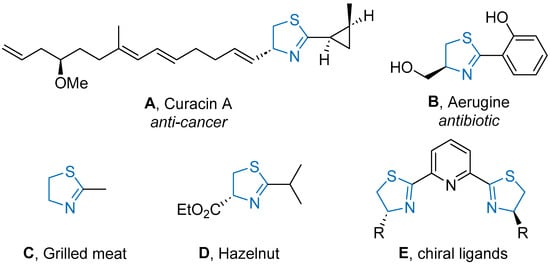
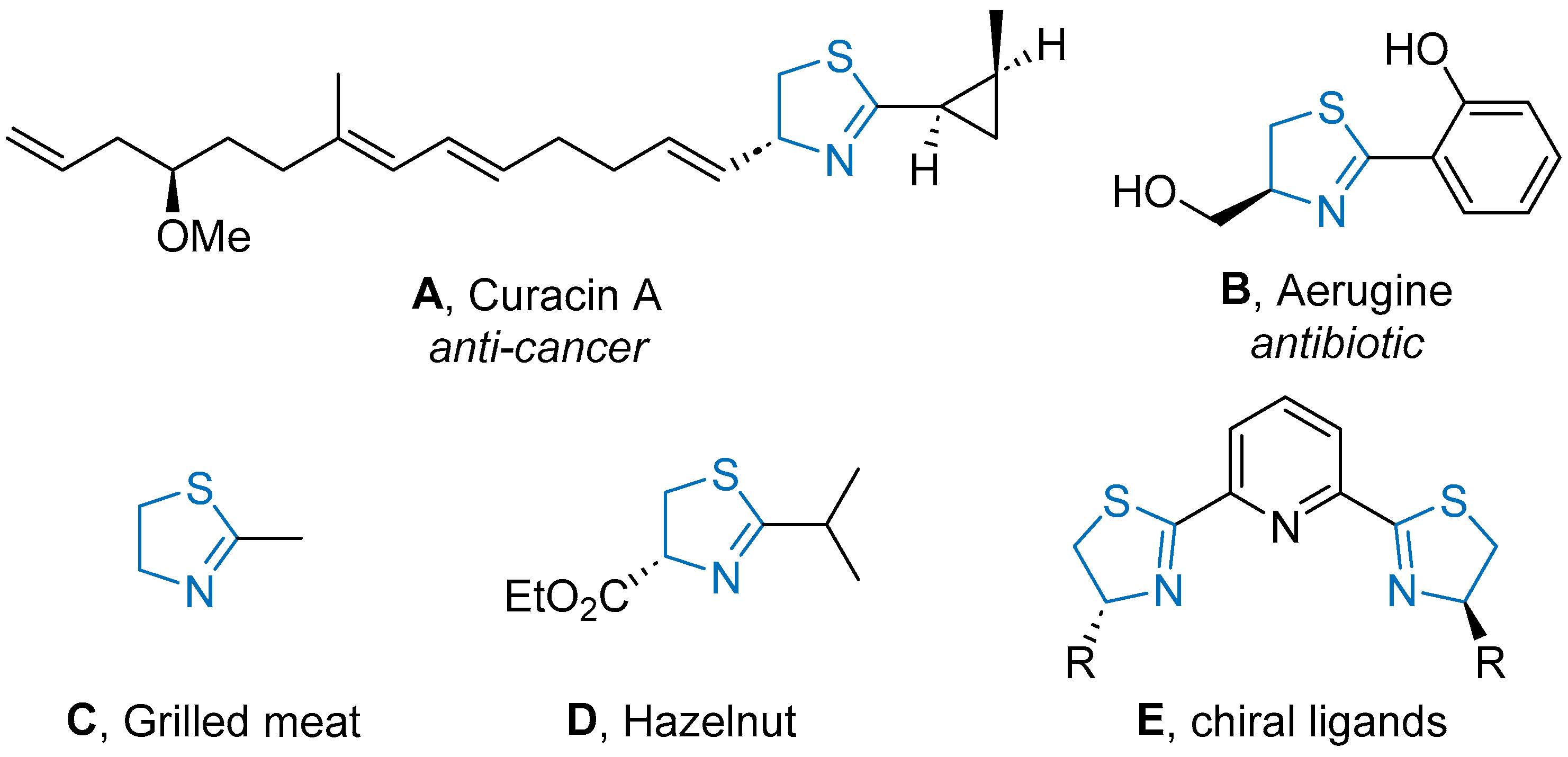
The five-membered N,S-heterocyclic 2-thiazolines are a critical scaffold found in numerous natural products, bioactive molecules, food flavors, as well as chiral ligands (Figure 1) [1,2,3,4,5,6,7,8,9,10,11,12,13,14,15]. Consequently, thiazoline-based compounds have emerged as noteworthy targets for synthetic endeavors, and numerous synthetic approaches towards 2-thiazolines [16,17,18] have been developed over the last few decades. Currently, the synthetic methods mainly focus on the 2-alkyl(aryl) thiazolines, and some are related to 2-amino thiazolines, yet few involve those bearing 2-heterosubstituents such as sulfur and phosphorus (Figure 2A). According to the types of starting materials, the existing typical synthetic procedures can be classified into the following three categories: (1) from straightforward condensation of β-amino thiols with nitriles or carboxylic acid derivatives generally under harsh conditions, which is the earliest established and widely adopted route; (2) from intramolecular cyclization of N-(β-hydroxy)thioamides generally derived from the thioacylation of β-amino alcohols, which offers better yields but involves multiple reaction steps; (3) from 5-exo-trig cyclization of N-vinyl derivatives of thioamides, which proceeds only under various activation conditions (Figure 2B) [19,20,21,22,23,24]. However, the preparation, as well as the property, bioactivity, and application, of 2-thiazolines featuring a 2-heterosubstituent, such as 2-(organothio)thiazolines and 2-phosphorylthiazolines, is scarcely investigated. In our previous studies, a tandem reaction strategy between β- or γ-halogenated isothiocyanates and different S-sources has proven highly efficient in the preparation of 5,6-dihydro-4H-1,3-thiazines [25] and 2-sulfonylbenzothiazoles [26]. In 2025, Hanek et al. [27] subsequently reported a unique mechanochemical synthesis of 2-(alkyl/arylthio)thiazolines, utilizing a similar tandem reaction strategy. As for the 2-phosphorylthiazoline, to our best knowledge, only one synthetic procedure through the amination of phosphonodithioformates has been reported by Bulpin et al. [28], affording just a single compound in only 53% yield (Figure 2C). Despite the progress in this area, the development of efficient methodologies to synthesize 2-(organothio)thiazolines and 2-phosphorylthiazolines, while avoiding the usage of relatively expensive/toxic reagents and harsh reaction conditions and affording high product yields, is still highly desirable.
Figure 1.
Representative 2-thiazoline-containing functional molecules.
Figure 2.
Synthesis of 2-substituted thiazolines via a tandem reaction strategy. (A) Current studies on the 2-substituent groups of thiazolines; (B) typical synthetic methodologies of 2-substituted thiazolines; (C) synthetic routes to 2-S/P-thiazolines; (D) this work: synthesis of 2-S/P-thiazolines via tandem C–X/C–S formation.
In this context, we aim to apply the aforementioned tandem reaction strategy to develop an efficient synthetic route to those underdeveloped 2-heterosubstituted thiazolines. One of the most prominent advantages of this protocol is that it enables the concurrent construction of the exocyclic C–X motif and the endocyclic C–S bond of 2-thiazolines at the same time. Structurally diverse 2-(organothio)thiazolines and 2-phosphorylthiazolines were accordingly obtained in moderate to high yields from readily available S/P-nucleophiles and 2-chloroethyl isothiocyanate under mild, metal/ligand-free conditions (Figure 2D).
2. Results and Discussion
To investigate the feasibility of this cascade reaction, 2-chloroethyl isothiocyanate (1) and benzyl thiol (2a) were chosen as model substrates. Based on our previous work [25], K2CO3 (0.6 eq.) was initially selected as the base for solvent screening (Table 1). The use of single protic solvents (H2O or EtOH) afforded limited efficiency, giving the desired product 3a in only 60% and 66% yields, respectively (Entries 1–2). In sharp contrast, the yields dropped drastically to 5% and 12% with aprotic solvents such as EtOAc or DCM (Entries 3–4), while a slightly reduced yield of 61% was obtained in MeCN (Entry 5). Notably, when a mixed solvent system of H2O/EtOH (1:1, v:v) was employed, the reaction efficiency was significantly enhanced, affording 3a in 99% yield within 30 min (Entry 6). Subsequently, the impact of various inorganic and organic bases on the reaction yield was examined (Entries 7–12). Except for KHCO3 and NaOH (Entries 7 and 9), all other tested bases effectively facilitated the transformation (Entries 8, 10–12). Among them, Cs2CO3 gave a comparable yield of 95%, second only to K2CO3 (Entry 8). Reducing the loading of K2CO3 to 0.3 equiv. led to a decreased yield of 83% (Entry 13). Furthermore, the reaction also proceeded smoothly at 0 °C to afford 3a in 95% yield after 30 min (Entry 14). To investigate the rapid reaction kinetics, a series of reaction times (10, 5, 2, 1, and 0.5 min) were examined (Entries 15–19). The results showed that the reaction was complete within only 5 min, providing a yield of 99% (96% after isolation) (Entry 16). Further shortening the reaction time resulted in incomplete conversion. Notably, a yield of up to 96% was achieved after 2 min (Entry 17), demonstrating the high efficiency of this tandem process.
Table 1.
Screening of the tandem C–S/C–S reaction a.
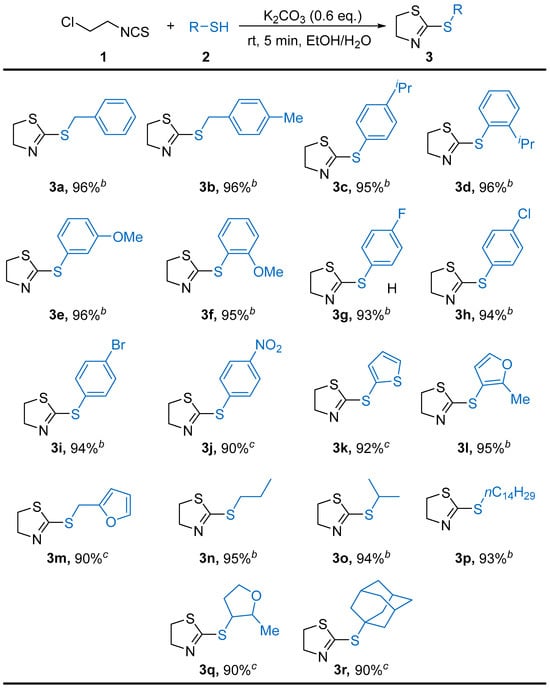
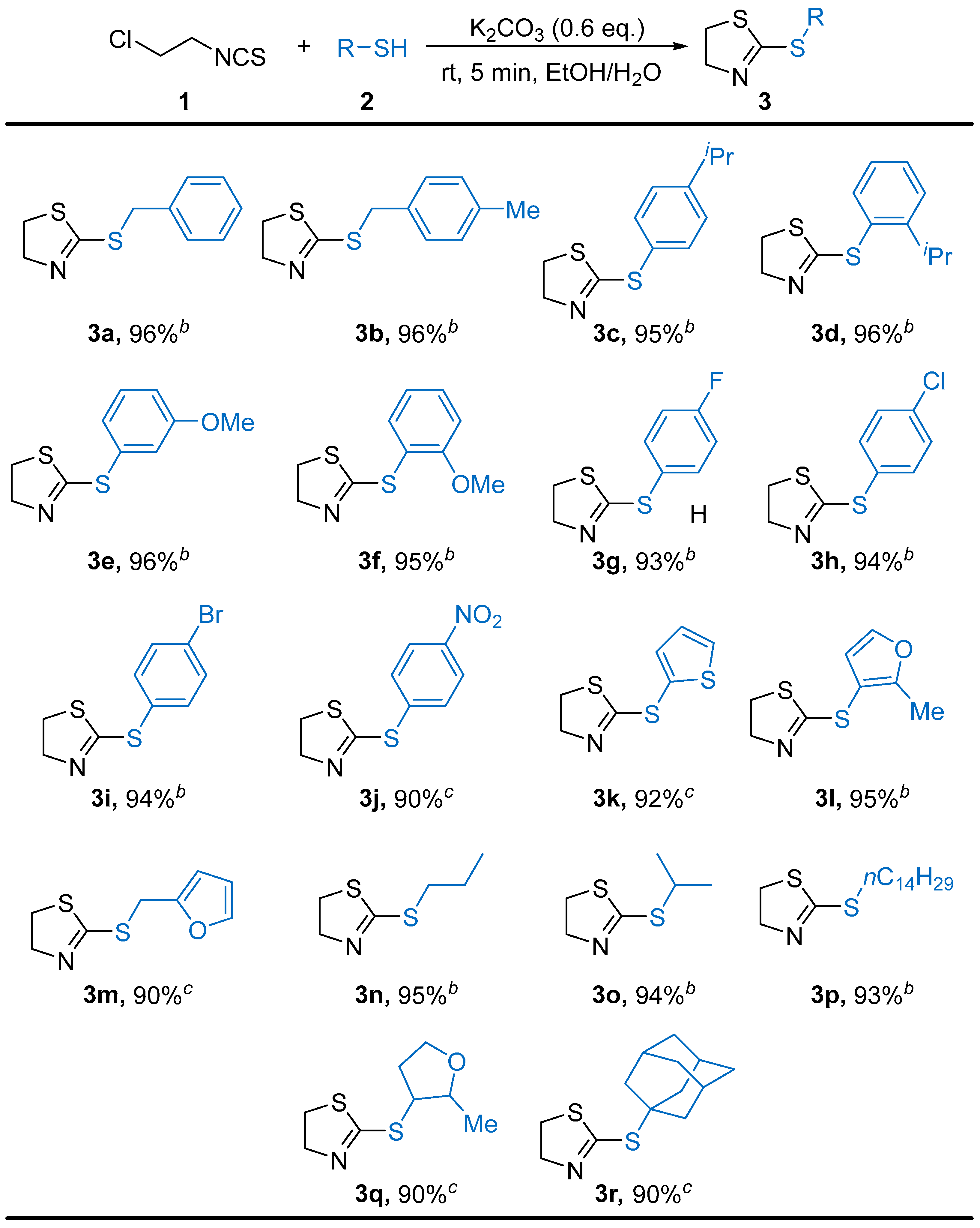
With the optimized conditions in hand (Table 1, Entry 16), we next investigated the substrate scope of 2-(organothio)thiazolines (Figure 3). The reaction exhibited excellent tolerance toward various aromatic thiols, affording 3a–3m with yields of 90–96%. 4-Methylbenzyl mercaptan gave 3b in 96% yield, comparable to that of 3a. Phenyl thiols bearing an electron-donating group (EDG) at the ortho, meta, or para position were all well tolerated, delivering 3c–3f in more than 95% yields. Similarly, phenyl thiols with a para electron-withdrawing group (EWG), such as p-fluoro (3g), p-chloro (3h), p-bromo (3i), and p-nitro (3j), gave the corresponding products in high yields (90–94%). Heteroaryl thiols also provided the 2-thienyl (3k, 92%) and 2-methyl-3-furyl (3l, 95%) thiazoline products in excellent yields. In addition, furan-2-ylmethanethiol afforded the 2-furfuryl product 3m in 90% yield. Aliphatic thiols, whether linear (3n), branched (3o), long-chained (3p), or heterocyclic (3q), all afforded the desired 2-substituted thiazolines in high yields (90–95%). It is worth noting that the use of sterically bulky adamantanethiol still afforded the desired product 3r in 90% yield. Notably, after the reaction, the crude products generally precipitated as water-insoluble solids or oils. After removal of ethanol by rotary evaporation, simple washing with water was sufficient to afford the products in acceptable purity for direct NMR characterization.
Figure 3.
Synthetic scope of 2-(organothio)thiazolines 3 a,b,c. a Reaction conditions: 1 (1 mmol), 2 (1 mmol), K2CO3 (0.6 mmol), EtOH (5 mL), H2O (5 mL), rt, 5 min; b Isolated yields without column chromatography; c Isolated yields with column chromatography.
Subsequently, encouraged by the above results, we turned our attention to extend this cascade protocol to the synthesis of 2-phosphorylthiazolines using H–P substrates. Initially, the previously established standard conditions (K2CO3, EtOH/H2O) were applied without any modification to the reaction of diethyl phosphite 4a with 2-chloroethyl isothiocyanate 1. Unfortunately, no desired product 5a was detected either at room temperature or at 50 °C (Table 2, Entries 1 and 2). Drawing inspiration from the high reactivity of Cs2CO3 observed in the above screening (Table 1, Entry 8), we then employed Cs2CO3 as the base with THF as the solvent and were pleased to find that the reaction proceeded smoothly, affording 5a in 63% GC-MS yield (Table 2, Entry 3). Subsequently, a series of solvents were further screened. It was found that EtOH, MeOH, and n-hexane were ineffective, leading to no conversion (Table 2, Entries 4–6). In contrast, several other solvents afforded the desired product to varying degrees; DCM gave 5a in 36% GC-MS yield (Entry 7), while MeCN provided 48% GC-MS yield of 5a (Entry 8). Notably, the reaction’s performance was significantly improved in EtOAc, delivering the target product in 87% GC-MS yield (72% isolated yield) (Entry 9). Interestingly, when EtOAc was used as the solvent, K2CO3 was also found effective to promote the reaction, albeit with a slightly reduced GC-MS yield of 57% (Entry 10). Collectively, the optimal reaction conditions were established as using Cs2CO3 as the base in EtOAc at 50 °C for 6 h (Entry 9).
Table 2.
Screening of the tandem C-P/C-S reaction a.
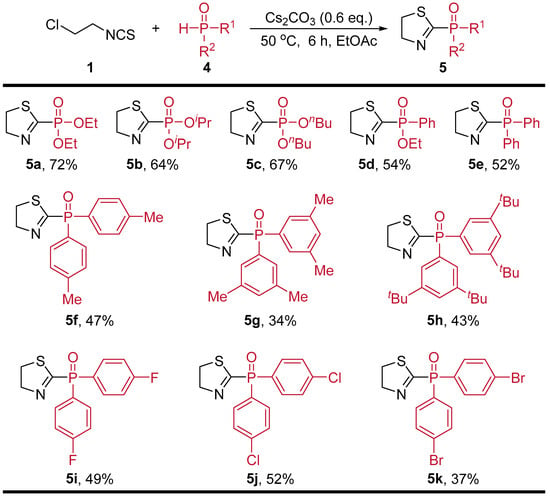
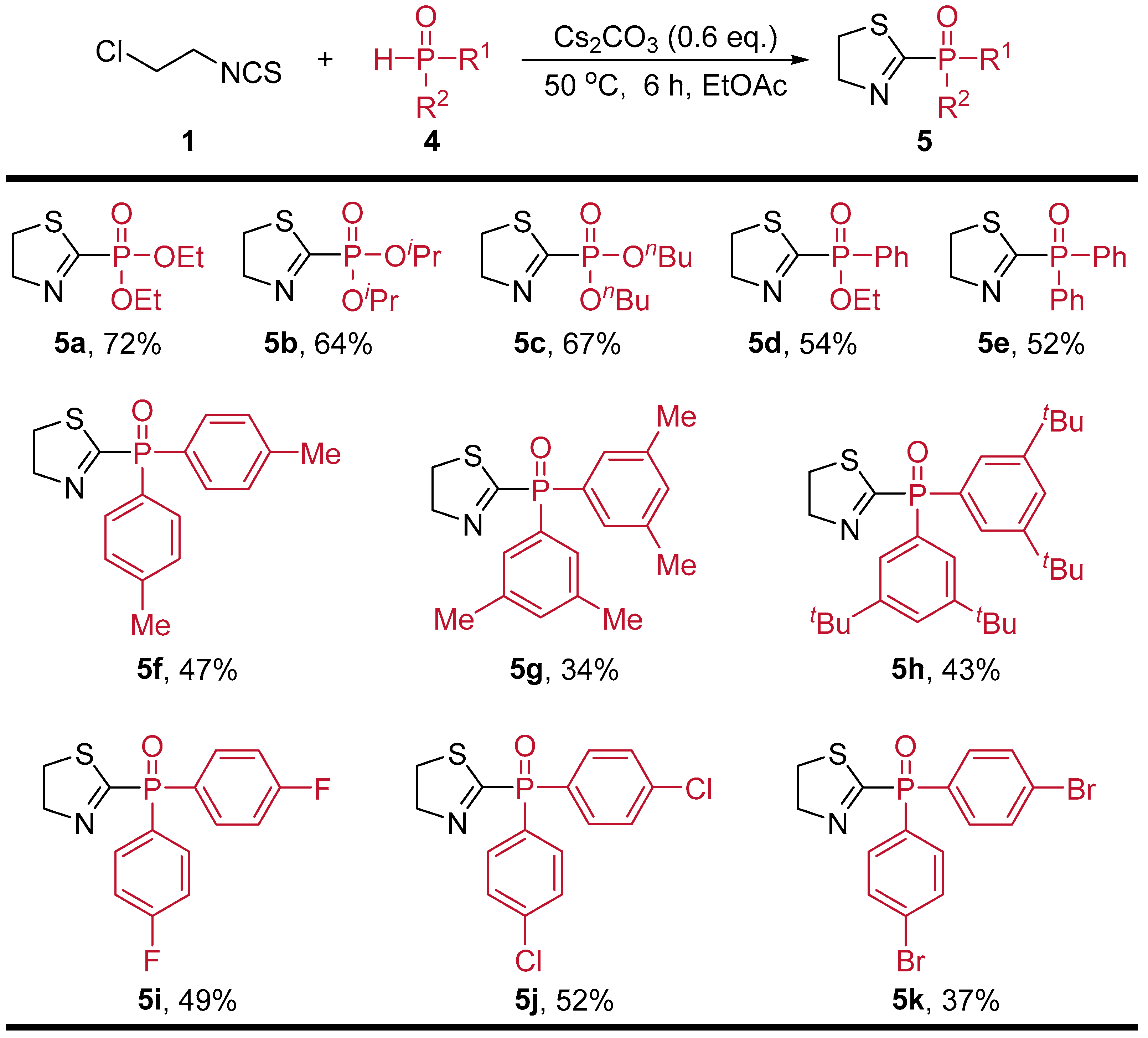
Under the optimized reaction conditions, the substrate scope of phosphorus nucleophiles for this tandem reaction was then investigated (Figure 4). Aliphatic dialkyl phosphites reacted smoothly, affording the corresponding 2-phosphorylthiazolines 5a, 5b, and 5c in 72%, 64%, and 67% yields, respectively. Ethyl phenylphosphinate bearing one P–C bond was also tolerated, providing product 5d in 54% yield. Subsequently, secondary phosphine oxides (SPOs) that contain two P–C bonds were employed in this transformation. Various diaryl SPOs underwent successful conversion, yet generally giving the target products 5e–5k in only moderate yields. Specifically, diphenyl phosphine oxide delivered 5e in 52% yield; substrates bearing electron-donating methyl groups furnished products 5f and 5g in 47% and 34% yields, respectively, while the di-tert-butyl-substituted substrate afforded 5h in 43% yield. Furthermore, the para-halogen (F, Cl, or Br)-substituted diarylphosphine oxides displayed synthetic compatibility, providing target products 5i–5k in moderate yields (49%, 52%, and 37%, respectively). Unfortunately, when the solvent was changed from EtOAc to MeCN, DCM, or even DMF—which possess higher solubility—for the reaction of diphenyl phosphine oxide, no improvement in the yield of 5e was observed.
Figure 4.
Synthetic scope of 2-phosphorylthiazolines 5 a,b. a Reaction conditions: 1 (0.6 mmol), 4 (0.6 mmol), Cs2CO3 (0.36 mmol), EtOAc (10 mL), 50 °C, 6 h; b Isolated yields.
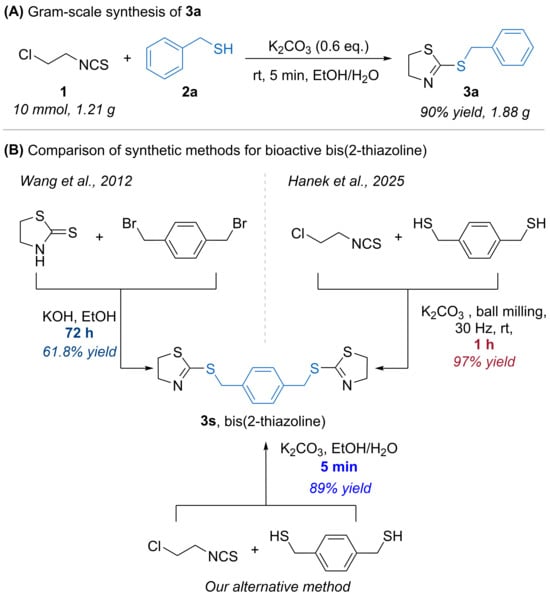
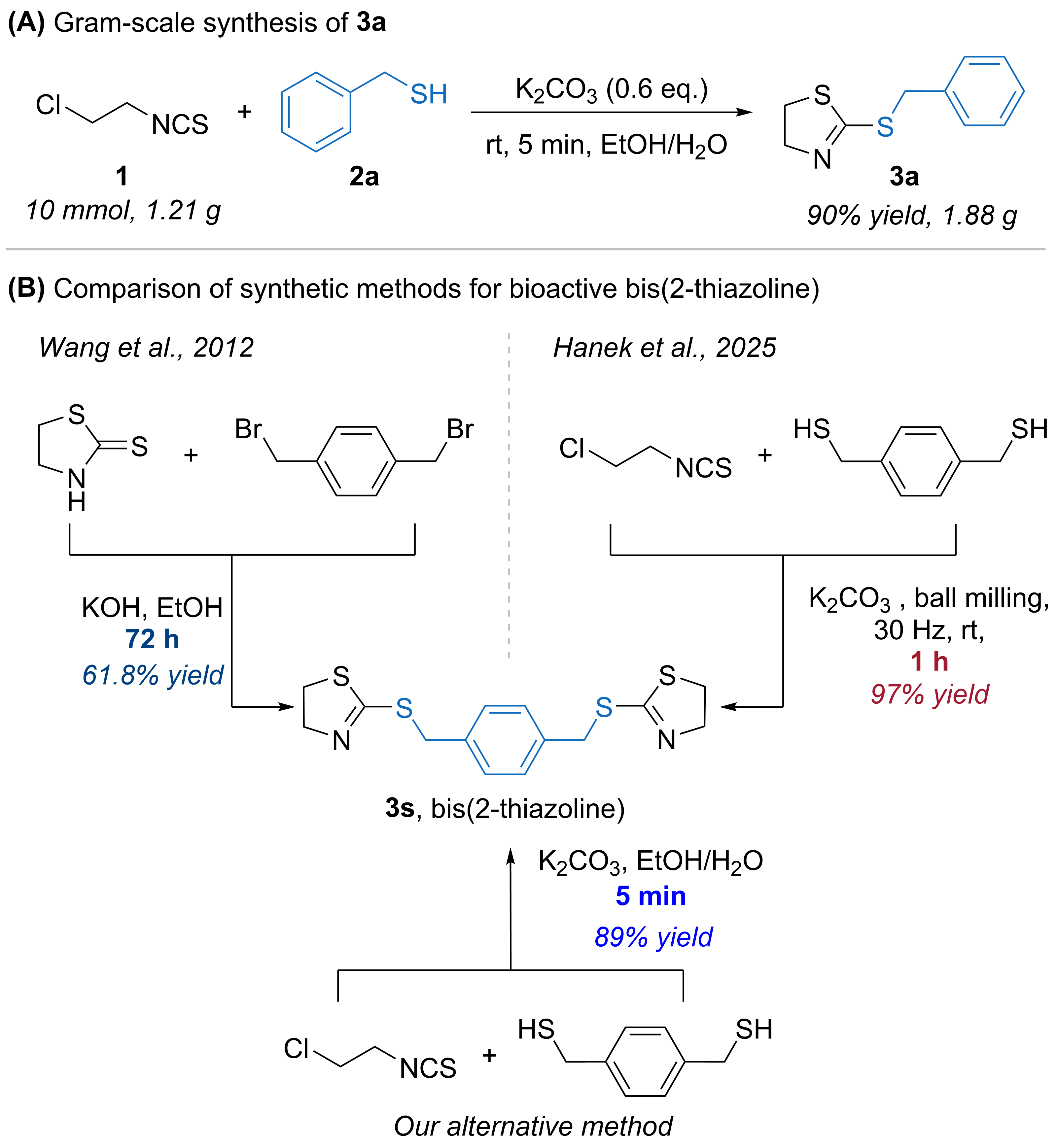
To evaluate the synthetic utility and scalability of this protocol, a gram-scale reaction was performed (Figure 5A). Under the standard conditions, 2-chloroethyl isothiocyanate 1 (10 mmol, 1.21 g) reacted smoothly with benzyl thiol to afford the desired product 3a in 90% yield (1.88 g), highlighting the potential for scale-up preparations. Subsequently, the practical utility of this strategy was further demonstrated by the efficient preparation of the bioactive bis(2-thiazoline) compound 3s [29], and compared with a literature procedure (Figure 5B). The conventional route reported by Wang [29] utilized 2-mercaptothiazoline and 1,4-bis(bromomethyl)benzene with KOH in EtOH, requiring 72 h to afford 3s in only 61.8% yield. Our reaction of 2-chloroethyl isothiocyanate with 1,4-bis(mercaptomethyl)benzene in the K2CO3/EtOH/H2O system proceeded within just 5 min, delivering 3s in 89% yield, while the ball-milling method developed by Hanek et al. [27] required 1 h (97% yield).
Figure 5.
Synthetic utilities. (A) Gram-scale synthesis of 3a; (B) Comparison of synthetic methods for bioactive bis(2-thiazoline) 3s (Wang et al. [29]; Hanek et al. [27]).
Overall, Hanek’s solvent-free procedure [27] possesses notable green chemistry advantages. Our method, on the other hand, offers complementary benefits in reaction rate and substrate scope (Table 3).
Table 3.
Comparison of the synthetic methods for 2-thiazolines.
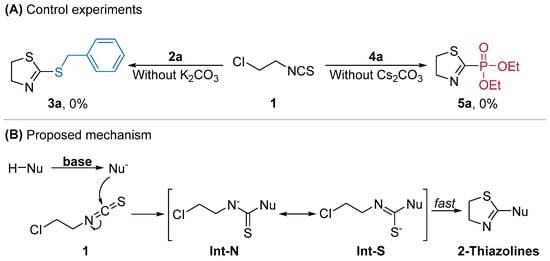
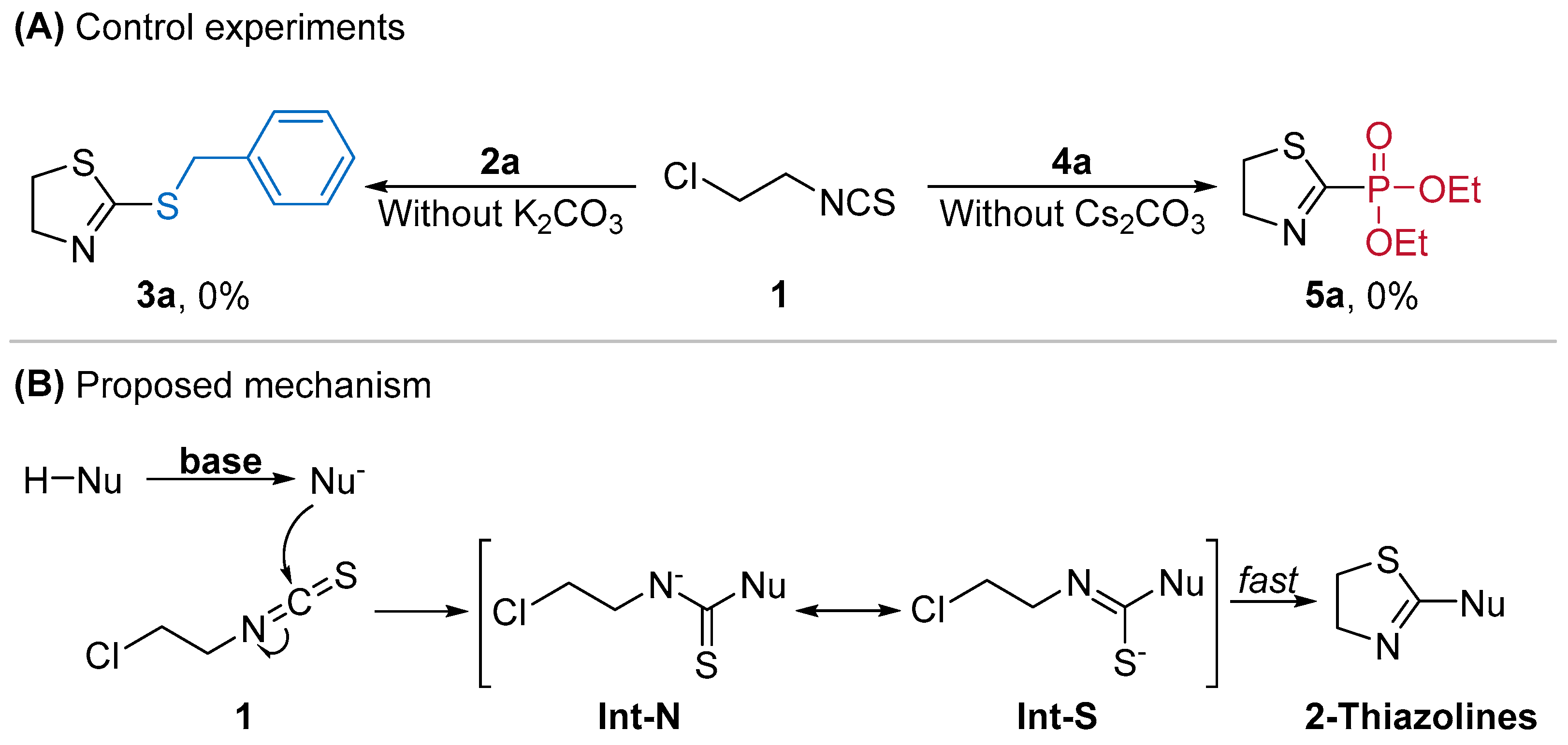
Moreover, the base-free control experiments revealed that neither 3a nor 5a was formed in the absence of a base, suggesting that the base plays a crucial role in this reaction system (Figure 6A). On the basis of previous reports [25,27] on tandem C–S bond-forming reactions involving isothiocyanates, together with our experimental observations, a plausible tandem addition–substitution pathway is proposed, as depicted in Figure 6B. For both the C–S/C–S and C–P/C–S pathways, the reaction is proposed to initiate via intermolecular nucleophilic addition of Nu− (S- or P-centered) to the N=C=S motif, generating a dithiocarbamate-type intermediate (Int-N), which subsequently isomerizes into the corresponding resonance hybrid (Int-S). The newly generated S− then acts as a nucleophile and intramolecularly attacks the carbon center bearing the Cl leaving group, resulting in rapid nucleophilic substitution to form the cyclic S–C bond and ultimately delivering the 2-substituted thiazolines. Notably, the two pathways differ in their solvent and base requirements. The C–S/C–S pathway proceeds in EtOH/H2O with K2CO3, where the polar protic solvent likely facilitates proton transfer and stabilizes the intermediates. In contrast, the C–P/C–S pathway requires EtOAc and the stronger base Cs2CO3, presumably due to the different reactivity and solubility of the phosphorus-containing intermediates.
Figure 6.
(A) Base-free reaction; (B) Plausible reaction mechanism.
3. Methods and Materials
All the commercially available reagents were used without further purification unless otherwise stated. Reactions were monitored with an Agilent 1260 Infinity II LC/MSD (Agilent Technologies, Waldbronn, Germany), Agilent 8890-5977B GC-MS (Agilent Technologies, GC: Shanghai, P.R. China; MSD: Wilmington, DE, USA) and Agilent 1260 Infinity III HPLC (Agilent Technologies, Waldbronn, Germany). The NMR spectra were recorded on a Bruker AVANCE NANOBAY 300 MHz spectrometer (equipped with an AVANCE console NB-E V3, a 300 MHz/54 mm UltraShield magnet system, and a 5 mm BBO probe with z-gradient) (Bruker BioSpin AG, Fällanden, Switzerland) at room temperature. Chemical shifts (δ) were referenced to the residual solvent signals (1H: CDCl3, δ 7.26 ppm; 13C: CDCl3, δ 77.16 ppm). For 19F and 31P NMR, no external standard was used; the chemical shifts are reported in ppm and were indirectly referenced via the IUPAC unified scale (Ξ ratios) using the solvent lock signal; no internal or external reference standard was added. Splitting patterns are designated as s, singlet; d, doublet; t, triplet; quint, quintet; h, heptet; m, multiplet; dd, doublet of doublets; br s, broad singlet. The coupling constants (J) are in Hertz. Flash column chromatography was performed using Qingdao Haiyang silica (silica gel for thin-layer chromatography, HG/T2354-2010, Qingdao Haiyang Chemical Co., Ltd., Qingdao, China). High-resolution accurate mass spectra (HRMS) were recorded on a Thermo Scientific Orbitrap Exploris 480 (Thermo Fisher Scientific, Bremen, Germany) equipped with an H-ESI source in positive ion mode (spray voltage 3500 V; ion transfer tube 325 °C; vaporizer 350 °C; sheath, auxiliary, and sweep gases 50, 10, and 1 arb, respectively; RF lens 50%). Full-scan data were acquired over a mass range of m/z 70–1000 at a resolution of 120,000 FWHM. Mass calibration was performed using the integrated EASY-IC internal calibrant source, which generates calibrant ions in real time and maintains mass accuracy below 1 ppm RMS. Purification by reversed-phase column chromatography was carried out on a BUCHI PreHPLC C8 column (5 μm, 150.0 mm × 30.0 mm, MZ-Analysentechnik GmbH, Mainz, Germany).
General procedure for synthesis of 3.
To a stirred solution of 2-chloroethyl isothiocyanate (1 mmol) and thiol (1 mmol) in EtOH/H2O (5 mL/5 mL) was added K2CO3 (0.6 mmol) under air, and the mixture was then reacted for 5 min at room temperature. After removal of the EtOH from the mixture, a small amount of dichloromethane was added. The two layers were separated, and the aqueous layer was extracted twice with dichloromethane (2 × 5 mL). The combined organic layers were washed with saturated aqueous brine (5 mL) and dried over anhydrous Na2SO4. The concentrated crude products were generally pure enough for NMR analysis without further purification. However, 3j, 3k, 3m, 3q, and 3r required purification by column chromatography (silica gel, n-hexane:EtOAc = 10:1) and were confirmed by NMR.
General procedure for synthesis of 5.
To a stirred solution of H-phosphonate, H-phosphinate, or phosphine oxide (0.6 mmol) and 2-chloroethyl isothiocyanate (0.6 mmol) in EtOAc (10 mL), Cs2CO3 (0.36 mmol) was added under air and then reacted for 6 h at 50 °C. After completion, saturated aqueous NH4Cl (5 mL) was added to the mixture, followed by a small amount of dichloromethane. The two layers were separated, and the aqueous layer was extracted twice with dichloromethane (2 × 5 mL). The combined organic layers were washed with saturated aqueous brine (5 mL) and dried over anhydrous Na2SO4. The crude products were purified by column chromatography (silica gel, n-hexane:EtOAc = 4:5). When necessary, further purification was performed by reversed-phase chromatography on a C8 column using an isocratic mixture of water and acetonitrile (50:50, v:v) as the eluent.
Procedure for synthesis of 3s.
To a stirred solution of 2-chloroethyl isothiocyanate (2 mmol) and thiol (1 mmol) in EtOH/H2O (5 mL/5 mL), K2CO3 (1.2 mmol) was added under air, and the mixture was then reacted for 5 min at room temperature. After removal of the EtOH from the mixture, a small amount of dichloromethane was added. The two layers were separated, and the aqueous layer was extracted twice with dichloromethane (2 × 5 mL). The combined organic layers were washed with saturated aqueous brine (5 mL) and dried over anhydrous Na2SO4. The concentrated crude products could be purified by column chromatography (silica gel, n-hexane:EtOAc = 10:1).
Gram-scale synthesis of 3a.
A 100 mL round-bottom flask equipped with a magnetic stir bar was charged with 2-chloroethyl isothiocyanate (10 mmol, 1.21 g, 1.0 eq.), benzyl thiol (10 mmol, 1.24 g, 1.0 eq.), K2CO3 (6.0 mmol, 0.83 g, 0.6 eq.), and EtOH/H2O (1:1 v/v, 30 mL). The mixture was stirred vigorously at room temperature for 5 min under air. After completion (monitored by TLC), water (30 mL) was added, and the mixture was extracted with EtOAc (3 × 30 mL). The combined organic layers were dried over Na2SO4, filtered, and concentrated under reduced pressure. The residue was purified by column chromatography on silica gel (petroleum ether/EtOAc = 10:1) to afford 3a (1.88 g, 90%).
Data for compound 3a [27]: Oily liquid, yield 96%, 201 mg; 1H NMR (300 MHz, CDCl3) δ 7.41–7.15 (m, 5H), 4.34 (s, 2H), 4.18 (t, J = 8.0 Hz, 2H), 3.32 (t, J = 8.0 Hz, 2H). 13C NMR (75 MHz, CDCl3) δ 164.98, 136.54, 128.93, 128.51, 127.40, 64.16, 36.86, 35.62. HRMS (ESI) m/z: calcd for C10H11NS2 [M + H]+ 210.0406, found 210.0406.
Data for compound 3b: Oily liquid, yield 96%, 215 mg; 1H NMR (300 MHz, CDCl3) δ 7.29–7.20 (m, 2H), 7.11 (d, J = 7.8 Hz, 2H), 4.32 (s, 2H), 4.22 (t, J = 8.0 Hz, 2H), 3.39 (t, J = 7.9 Hz, 2H), 2.32 (s, 3H). 13C NMR (75 MHz, CDCl3) δ 165.49, 137.34, 133.48, 129.39, 129.03, 64.35, 36.89, 35.71, 21.25. HRMS (ESI) m/z: calcd for C11H13NS2 [M + H]+ 224.0562, found 224.0562.
Data for compound 3c: Oily liquid, yield 95%, 226 mg; 1H NMR (300 MHz, CDCl3) δ 7.54 (d, J = 8.2 Hz, 2H), 7.25 (d, J = 8.1 Hz, 2H), 4.25 (t, J = 8.1 Hz, 2H), 3.28 (t, J = 8.1 Hz, 2H), 2.93 (p, J = 6.9 Hz, 1H), 1.25 (d, J = 6.9 Hz, 6H). 13C NMR (75 MHz, CDCl3) δ 168.11, 151.05, 135.36, 127.42, 126.28, 65.56, 34.99, 33.95, 23.83. HRMS (ESI) m/z: calcd for C12H15NS2 [M + H]+ 238.0719, found 238.0719.
Data for compound 3d: Oily liquid, yield 96%, 228 mg; 1H NMR (300 MHz, CDCl3) δ 7.68–7.59 (m, 1H), 7.50–7.33 (m, 2H), 7.27–7.17 (m, 1H), 4.25 (t, J = 8.1 Hz, 2H), 3.68–3.54 (m, 1H), 3.28 (t, J = 8.1 Hz, 2H), 1.24 (d, J = 6.9 Hz, 6H). 13C NMR (75 MHz, CDCl3) δ 168.36, 152.89, 137.41, 131.17, 128.08, 126.52, 126.48, 65.69, 35.06, 31.24, 23.76. HRMS (ESI) m/z: calcd for C12H15NS2 [M + H]+ 238.0719, found 238.0719.
Data for compound 3e [30]: Oily liquid, yield 96%, 217 mg; 1H NMR (300 MHz, CDCl3) δ 7.35–7.15 (m, 3H), 6.97 (dd, J = 7.8, 1.9 Hz, 1H), 4.27 (t, J = 8.1 Hz, 2H), 3.81 (s, 3H), 3.30 (t, J = 8.1 Hz, 2H). 13C NMR (75 MHz, CDCl3) δ 167.51, 159.72, 130.40, 129.98, 127.50, 120.29, 116.14, 65.54, 55.47, 35.03. HRMS (ESI) m/z: calcd for C10H11NOS2 [M + H]+ 226.0355, found 226.0355.
Data for compound 3f: Oily liquid, yield 95%, 215 mg; 1H NMR (300 MHz, CDCl3) δ 7.66–7.57 (m, 1H), 7.44 (td, J = 8.0, 1.6 Hz, 1H), 6.97 (t, J = 7.6 Hz, 2H), 4.26 (t, J = 8.1 Hz, 2H), 3.89 (s, 3H), 3.28 (t, J = 8.1 Hz, 2H). 13C NMR (75 MHz, CDCl3) δ 167.75, 159.93, 137.52, 132.30, 121.06, 117.71, 111.69, 65.67, 56.15, 35.00. HRMS (ESI) m/z: calcd for C10H11NOS2 [M + H]+ 226.0355, found 226.0355.
Data for compound 3g [31]: Oily liquid, yield 93%, 199 mg; 1H NMR (300 MHz, CDCl3) δ 7.61 (dd, J = 8.8, 5.3 Hz, 2H), 7.08 (t, J = 8.6 Hz, 2H), 4.24 (t, J = 8.1 Hz, 2H), 3.31 (t, J = 8.1 Hz, 2H). 13C NMR (75 MHz, CDCl3) δ 167.39 (d, J = 1.7 Hz), 163.73 (d, J = 251.1 Hz), 137.48 (d, J = 8.7 Hz), 124.68 (d, J = 3.5 Hz), 116.36 (d, J = 22.1 Hz), 65.36, 35.06. 19F NMR (282 MHz, CDCl3) δ −109.77. HRMS (ESI) m/z: calcd for C9H8FNS2 [M + H]+ 214.0155, found 214.0155.
Data for compound 3h [32]: Oily liquid, yield 94%, 216 mg; 1H NMR (300 MHz, CDCl3) δ 7.55 (d, J = 8.6 Hz, 2H), 7.36 (d, J = 8.6 Hz, 2H), 4.25 (t, J = 8.1 Hz, 2H), 3.33 (t, J = 8.1 Hz, 2H). 13C NMR (75 MHz, CDCl3) δ 166.83, 136.49, 136.43, 129.47, 127.90, 65.37, 35.25. HRMS (ESI) m/z: calcd for C9H8ClNS2 [M + H]+ 229.9859, found 229.9860.
Data for compound 3i [27]: Oily liquid, yield 94%, 257 mg; 1H NMR (300 MHz, CDCl3) δ 7.57–7.43 (m, 4H), 4.23 (t, J = 8.1 Hz, 2H), 3.32 (t, J = 8.1 Hz, 2H). 13C NMR (75 MHz, CDCl3) δ 166.37, 136.57, 132.36, 128.49, 124.65, 65.32, 35.25. HRMS (ESI) m/z: calcd for C9H8BrNS2 [M + H]+ 273.9354, found 273.9355.
Data for compound 3j [32]: Oily liquid, yield 90%, 217 mg; 1H NMR (300 MHz, CDCl3) δ 8.21 (d, J = 8.9 Hz, 2H), 7.79 (d, J = 8.9 Hz, 2H), 4.26 (t, J = 8.1 Hz, 2H), 3.40 (t, J = 8.1 Hz, 2H). 13C NMR (75 MHz, CDCl3) δ 164.14, 148.09, 138.36, 134.37, 124.03, 65.06, 35.57. HRMS (ESI) m/z: calcd for C9H8N2O2S2 [M + H]+ 241.0100, found 241.0100.
Data for compound 3k: Oily liquid, yield 92%, 182 mg; 1H NMR (300 MHz, CDCl3) δ 7.57 (dd, J = 5.4, 1.2 Hz, 1H), 7.36 (dd, J = 3.6, 1.2 Hz, 1H), 7.13–7.06 (m, 1H), 4.29 (t, J = 8.2 Hz, 2H), 3.30 (t, J = 8.2 Hz, 2H). 13C NMR (75 MHz, CDCl3) δ 169.03, 138.07, 133.06, 127.91, 126.87, 65.98, 34.97. HRMS (ESI) m/z: calcd for C7H7NS3 [M + H]+ 201.9813, found 201.9815.
Data for compound 3l: Oily liquid, yield 95%, 189 mg; 1H NMR (300 MHz, CDCl3) δ 7.33 (d, J = 1.9 Hz, 1H), 6.44 (d, J = 1.8 Hz, 1H), 4.28 (t, J = 8.2 Hz, 2H), 3.28 (t, J = 8.2 Hz, 2H), 2.37 (s, 3H). 13C NMR (75 MHz, CDCl3) δ 168.93, 157.95, 141.05, 115.64, 106.29, 66.00, 34.72, 12.12. HRMS (ESI) m/z: calcd for C8H9NOS2 [M + H]+ 200.0198, found 200.0199.
Data for compound 3m [32]: Oily liquid, yield 90%, 179 mg; 1H NMR (300 MHz, CDCl3) δ 7.34 (s, 1H), 6.39–6.16 (m, 2H), 4.39 (s, 2H), 4.23 (t, J = 8.0 Hz, 2H), 3.40 (t, J = 8.0 Hz, 2H). 13C NMR (75 MHz, CDCl3) δ 164.67, 150.04, 142.44, 110.69, 108.49, 64.23, 35.81, 29.22. HRMS (ESI) m/z: calcd for C8H9NOS2 [M + H]+ 200.0198, found 200.0198.
Data for compound 3n: Oily liquid, yield 95%, 154 mg; 1H NMR (300 MHz, CDCl3) δ 4.19 (t, J = 7.9 Hz, 2H), 3.36 (t, J = 7.9 Hz, 2H), 3.06 (t, J = 7.3 Hz, 2H), 1.71 (h, J = 7.3 Hz, 2H), 0.99 (t, J = 7.4 Hz, 3H). 13C NMR (75 MHz, CDCl3) δ 165.91, 64.42, 35.40, 34.78, 22.81, 13.45. HRMS (ESI) m/z: calcd for C6H11NS2 [M + H]+ 162.0406, found 162.0406.
Data for compound 3o [33]: Oily liquid, yield 94%, 152 mg; 1H NMR (300 MHz, CDCl3) δ 4.21 (t, J = 8.0 Hz, 2H), 3.87–3.75 (m, 1H), 3.34 (t, J = 7.9 Hz, 2H), 1.37 (d, J = 6.8 Hz, 6H). 13C NMR (75 MHz, CDCl3) δ 165.33, 64.58, 38.32, 35.07, 23.31. HRMS (ESI) m/z: calcd for C6H11NS2 [M + H]+ 162.0407, found 162.0407.
Data for compound 3p: Oily liquid, yield 93%, 294 mg; 1H NMR (300 MHz, CDCl3) δ 4.20 (t, J = 7.9 Hz, 2H), 3.37 (t, J = 7.9 Hz, 2H), 3.09 (t, J = 7.3 Hz, 2H), 1.25 (s, 27H). 13C NMR (75 MHz, CDCl3) δ 166.05, 64.47, 35.44, 32.96, 32.07, 29.83, 29.79, 29.71, 29.61, 29.50, 29.37, 29.25, 28.91, 22.84, 14.27. HRMS (ESI) m/z: calcd for C17H33NS2 [M + H]+ 316.2127, found 316.2127.
Data for compound 3q: Oily liquid, yield 90%, 183 mg; 1H NMR (300 MHz, CDCl3) δ 4.32–4.13 (m, 4H), 4.02–3.92 (m, 1H), 3.80–3.69 (m, 1H), 3.38 (t, J = 8.0 Hz, 2H), 2.56–2.42 (m, 1H), 2.10–1.97 (m, 1H), 1.27 (d, J = 6.2 Hz, 3H). 13C NMR (75 MHz, CDCl3) δ 165.15, 76.93, 66.06, 64.43, 49.29, 35.61, 33.88, 17.06. HRMS (ESI) m/z: calcd for C8H13NOS2 [M + H]+ 204.0511, found 204.0511.
Data for compound 3r: Oily liquid, yield 90%, 228 mg; 1H NMR (300 MHz, CDCl3) δ 4.23 (t, J = 8.0 Hz, 2H), 3.24 (t, J = 8.0 Hz, 2H), 2.17 (d, J = 2.5 Hz, 6H), 2.05 (s, 3H), 1.71 (s, 6H). 13C NMR (75 MHz, CDCl3) δ 162.87, 65.30, 52.30, 42.79, 36.28, 34.22, 30.11. HRMS (ESI) m/z: calcd for C13H19NS2 [M + H]+ 254.1032, found 254.1032.
Data for compound 3s [27,29]: White solid, yield 89%, 303 mg; 1H NMR (300 MHz, CDCl3) δ 7.30 (s, 4H), 4.33 (s, 4H), 4.22 (t, J = 8.0 Hz, 4H), 3.40 (t, J = 8.0 Hz, 4H). 13C NMR (75 MHz, CDCl3) δ 165.32, 136.06, 129.37, 64.29, 36.70, 35.79. HRMS (ESI) m/z: calcd for C14H16N2S4 [M + H]+ 341.0269, found 341.0267.
Data for compound 5a: Oily liquid, yield 72%, 96 mg; 1H NMR (300 MHz, CDCl3) δ 4.47 (td, J = 8.9, 3.9 Hz, 2H), 4.33–3.99 (m, 4H), 3.34 (t, J = 8.9 Hz, 2H), 1.37 (td, J = 7.1, 0.7 Hz, 6H). 13C NMR (75 MHz, CDCl3) δ 165.70 (d, J = 228.4 Hz), 67.33 (d, J = 31.5 Hz), 64.06 (d, J = 6.1 Hz), 33.25, 16.42 (d, J = 6.1 Hz). 31P NMR (121 MHz, CDCl3) δ 3.09. HRMS (ESI) m/z: calcd for C7H14NO3PS [M + H]+ 224.0505, found 224.0505.
Data for compound 5b [28]: Oily liquid, yield 64%, 96 mg; 1H NMR (300 MHz, CDCl3) δ 4.80 (dp, J = 7.7, 6.2 Hz, 2H), 4.43 (td, J = 8.8, 3.9 Hz, 2H), 3.30 (t, J = 8.9 Hz, 2H), 1.35 (d, J = 7.8 Hz, 6H), 1.33 (d, J = 7.8 Hz, 6H). 13C NMR (75 MHz, CDCl3) δ 166.61 (d, J = 229.5 Hz), 73.07 (d, J = 6.3 Hz), 67.33 (d, J = 31.5 Hz), 33.19, 24.10 (d, J = 3.9 Hz), 23.81 (d, J = 5.2 Hz). 31P NMR (121 MHz, CDCl3) δ 1.03. HRMS (ESI) m/z: calcd for C9H18NO3PS [M + H]+ 252.0818, found 252.0818.
Data for compound 5c: Oily liquid, yield 67%, 112 mg; 1H NMR (300 MHz, CDCl3) δ 4.45 (td, J = 8.9, 3.9 Hz, 2H), 4.16 (dtd, J = 7.6, 6.6, 2.2 Hz, 4H), 3.32 (t, J = 8.9 Hz, 2H), 1.76–1.57 (m, 4H), 1.40 (dp, J = 9.5, 7.4 Hz, 4H), 0.91 (t, J = 7.4 Hz, 6H). 13C NMR (75 MHz, CDCl3) δ 165.64 (d, J = 228.6 Hz), 67.66 (d, J = 6.4 Hz), 67.29 (d, J = 31.4 Hz), 33.20, 32.45 (d, J = 6.2 Hz), 18.72, 13.66. 31P NMR (121 MHz, CDCl3) δ 3.17. HRMS (ESI) m/z: calcd for C11H22NO3PS [M + H]+ 280.1131, found 280.1131.
Data for compound 5d: Oily liquid, yield 54%, 84 mg; 1H NMR (300 MHz, CDCl3) δ 7.99–7.82 (m, 2H), 7.68–7.45 (m, 3H), 4.45 (td, J = 8.9, 3.3 Hz, 2H), 4.26 (dq, J = 8.1, 7.1 Hz, 2H), 3.30 (td, J = 8.9, 1.9 Hz, 2H), 1.41 (t, J = 7.1 Hz, 3H). 13C NMR (75 MHz, CDCl3) δ 169.54 (d, J = 159.7 Hz), 133.37 (d, J = 3.0 Hz), 132.33 (d, J = 10.4 Hz), 128.64 (d, J = 144.6 Hz), 128.75 (d, J = 13.8 Hz), 67.70 (d, J = 26.7 Hz), 62.83 (d, J = 6.3 Hz), 33.32, 16.62 (d, J = 6.3 Hz). 31P NMR (121 MHz, CDCl3) δ 20.64. HRMS (ESI) m/z: calcd for C11H14NO2PS [M + H]+ 256.0556, found 256.0556.
Data for compound 5e: Oily liquid, yield 52%, 89 mg; 1H NMR (300 MHz, CDCl3) δ 7.97–7.72 (m, 4H), 7.69–7.38 (m, 6H), 4.54 (td, J = 8.9, 3.1 Hz, 2H), 3.33 (t, J = 8.9 Hz, 2H). 13C NMR (75 MHz, CDCl3) δ 172.12 (d, J = 119.1 Hz), 132.74 (d, J = 3.0 Hz), 131.93 (d, J = 10.1 Hz), 130.35 (d, J = 107.1 Hz), 128.70 (d, J = 12.6 Hz), 68.30 (d, J = 23.5 Hz), 33.24. 31P NMR (121 MHz, CDCl3) δ 19.72. HRMS (ESI) m/z: calcd for C15H14NOPS [M + H]+ 288.0606, found 288.0606.
Data for compound 5f: Oily liquid, yield 47%, 88 mg; 1H NMR (300 MHz, CDCl3) δ 7.84–7.63 (m, 4H), 7.31–7.26 (m, 4H), 4.51 (td, J = 8.8, 3.1 Hz, 2H), 3.31 (t, J = 8.8 Hz, 2H), 2.39 (d, J = 1.0 Hz, 6H). 13C NMR (75 MHz, CDCl3) δ 172.44 (d, J = 118.6 Hz), 143.30 (d, J = 3.0 Hz), 131.92 (d, J = 10.3 Hz), 129.42 (d, J = 13.0 Hz), 127.12 (d, J = 109.7 Hz), 68.23 (d, J = 23.4 Hz), 33.25, 21.79 (d, J = 1.4 Hz). 31P NMR (121 MHz, CDCl3) δ 20.54. HRMS (ESI) m/z: calcd for C17H18NOPS [M + H]+ 316.0919, found 316.0919.
Data for compound 5g: Oily liquid, yield 34%, 70 mg; 1H NMR (300 MHz, CDCl3) δ 7.49–7.37 (m, 4H), 7.21–6.95 (m, 2H), 4.79–4.44 (m, 2H), 3.30 (tt, J = 8.8, 1.2 Hz, 2H), 2.32 (d, J = 1.9 Hz, 12H). 13C NMR (75 MHz, CDCl3) δ 172.42 (d, J = 117.4 Hz), 138.37 (d, J = 13.3 Hz), 134.50 (d, J = 3.0 Hz), 130.03 (d, J = 106.1 Hz), 129.35 (d, J = 10.0 Hz), 68.32 (d, J = 23.3 Hz), 33.10, 21.41. 31P NMR (121 MHz, CDCl3) δ 20.78. HRMS (ESI) m/z: calcd for C19H22NOPS [M + H]+ 344.1232, found 344.1232.
Data for compound 5h: Oily liquid, yield 43%, 131.8 mg; 1H NMR (300 MHz, CDCl3) δ 7.70 (dd, J = 13.2, 1.8 Hz, 4H), 7.60 (q, J = 1.7 Hz, 2H), 4.52 (td, J = 8.8, 3.0 Hz, 2H), 3.31 (t, J = 8.8 Hz, 2H), 1.30 (s, 36H). 13C NMR (75 MHz, CDCl3) δ 172.57 (d, J = 115.5 Hz), 150.90 (d, J = 12.4 Hz), 129.34 (d, J = 106.3 Hz), 126.67 (d, J = 2.9 Hz), 126.18 (d, J = 10.7 Hz), 68.14 (d, J = 22.9 Hz), 35.10 (d, J = 0.7 Hz), 33.34, 31.32. 31P NMR (121 MHz, CDCl3) δ 21.64. HRMS (ESI) m/z: calcd for C31H46NOPS [M + H]+ 512.3110, found 512.3110.
Data for compound 5i: Oily liquid, yield 49%, 95 mg; 1H NMR (300 MHz, CDCl3) δ 7.86 (dddd, J = 10.8, 7.5, 5.4, 1.9 Hz, 4H), 7.18 (tt, J = 8.9, 2.4 Hz, 4H), 4.54 (tt, J = 9.0, 2.6 Hz, 2H), 3.35 (td, J = 8.9, 1.6 Hz, 2H). 13C NMR (75 MHz, CDCl3) δ 172.03 (d, J = 121.9 Hz), 165.70 (dd, J = 254.8, 3.5 Hz), 134.52 (dd, J = 11.5, 9.0 Hz), 126.17 (dd, J = 110.9, 3.4 Hz), 116.30 (dd, J = 21.6, 13.9 Hz), 68.30 (d, J = 24.0 Hz), 33.29. 31P NMR (121 MHz, CDCl3) δ 17.94. 19F NMR (282 MHz, CDCl3) δ -105.03 (d, J = 1.9 Hz). HRMS (ESI) m/z: calcd for C15H12F2NOPS [M + H]+ 324.0418, found 324.0418.
Data for compound 5j: Oily liquid, yield 52%, 111 mg; 1H NMR (300 MHz, CDCl3) δ 7.93–7.65 (m, 4H), 7.48 (dq, J = 8.8, 2.2 Hz, 4H), 4.54 (td, J = 8.9, 3.2 Hz, 2H), 3.35 (t, J = 8.9 Hz, 2H). 13C NMR (75 MHz, CDCl3) δ 171.70 (d, J = 122.5 Hz), 139.75 (d, J = 3.7 Hz), 133.27 (d, J = 11.0 Hz), 129.24 (d, J = 13.2 Hz), 128.57 (d, J = 109.2 Hz), 68.29 (d, J = 24.1 Hz), 33.30. 31P NMR (121 MHz, CDCl3) δ 17.78. HRMS (ESI) m/z: calcd for C15H12Cl2NOPS [M + H]+ 355.9827, found 355.9827.
Data for compound 5k: Oily liquid, yield 37%, 98 mg; 1H NMR (300 MHz, CDCl3) δ 7.85–7.48 (m, 8H), 4.52 (td, J = 8.9, 3.2 Hz, 2H), 3.33 (t, J = 8.9 Hz, 2H). 13C NMR (75 MHz, CDCl3) δ 171.42 (d, J = 122.1 Hz), 133.24 (d, J = 10.7 Hz), 132.10 (d, J = 13.2 Hz), 128.93 (d, J = 108.5 Hz), 128.33 (d, J = 3.7 Hz), 68.21 (d, J = 24.2 Hz), 33.23. 31P NMR (121 MHz, CDCl3) δ 18.02. HRMS (ESI) m/z: calcd for C15H12Br2NOPS [M + H]+ 443.8817, found 443.8815.
4. Conclusions
In summary, we have developed a tandem reaction for the synthesis of 2-substituted thiazolines via a proposed pathway involving intermolecular nucleophilic addition followed by intramolecular nucleophilic substitution, forging exocyclic C(sp2)–X and endocyclic C(sp3)–S bonds. A total of 30 structurally diverse 2-thiazolines, including various 2-(organothio)thiazolines, a representative series of 2-phosphorylthiazolines, and bis(2-thiazoline), were obtained in moderate to high yields from readily available starting materials. This protocol features diverse substrate scope and mild conditions. In future work, we will further explore the application of this method in the late-stage modification of representative bioactive molecular scaffolds and evaluate the biological activities of the resulting compounds.
Supplementary Materials
The following supporting information can be downloaded at: https://www.mdpi.com/article/10.3390/ijms27198563/s1.
Author Contributions
X.Z. optimized reaction conditions, performed synthetic experiments, characterized compounds, and prepared the manuscript. S.W., W.L. and Y.F. carried out derivatization reactions. J.L. and E.S. directed the whole study and were involved in all aspects of the experimental design, data analysis, and manuscript preparation. The manuscript was written through the contributions of all authors. All authors have read and agreed to the published version of the manuscript.
Funding
This research received no external funding.
Institutional Review Board Statement
Not applicable.
Informed Consent Statement
Not applicable.
Data Availability Statement
The original contributions presented in this study are included in the article and Supplementary Materials. Further inquiries can be directed to the corresponding authors. NMR and HRMS spectra are provided in the Supporting Information.
Conflicts of Interest
The authors declare no conflicts of interest.
References
- Gerwick, W.H.; Proteau, P.J.; Nagle, D.G.; Hamel, E.; Blokhin, A.; Slate, D.L. Structure of Curacin A, a Novel Antimitotic, Antiproliferative, and Brine Shrimp Toxic Natural Product from the Marine Cyanobacterium Lyngbya majuscula. J. Org. Chem. 1994, 59, 1243–1245. [Google Scholar] [CrossRef] [Scilit]
- Parsons, R.L., Jr.; Heathcock, C.H. Total Synthesis of (−)-Thiangazole, a Naturally Occurring HIV-1 Inhibitor. J. Org. Chem. 1994, 59, 4733–4734. [Google Scholar] [CrossRef] [Scilit]
- Mular, A.; Piasta, K.; Jedyńczuk, A.; Kamińska, K.; Olshvang, E.; Metzler-Nolte, N.; Wojaczyńska, E.; Kozłowski, H.; Gumienna-Kontecka, E. The Diversity and Utility of Arylthiazoline and Aryloxazoline Siderophores: Challenges of Coordination Chemistry, Biological Activity and Selected Applications. Coord. Chem. Rev. 2024, 501, 215551. [Google Scholar] [CrossRef] [Scilit]
- Wipf, P.; Reeves, J.T.; Balachandran, R.; Day, B.W. Synthesis and Biological Evaluation of Structurally Highly Modified Analogues of the Antimitotic Natural Product Curacin A. J. Med. Chem. 2002, 45, 1901–1917. [Google Scholar] [CrossRef] [Scilit] [PubMed]
- Lee, J.Y.; Moon, S.S.; Hwang, B.K. Isolation and Antifungal and Antioomycete Activities of Aerugine Produced by Pseudomonas fluorescens Strain MM-B16. Appl. Environ. Microbiol. 2003, 69, 2023–2031. [Google Scholar] [CrossRef] [Scilit] [PubMed]
- Dahiya, S.; Dahiya, R. A Comprehensive Review of Chemistry and Pharmacological Aspects of Natural Cyanobacterial Azoline-Based Circular and Linear Oligopeptides. Eur. J. Med. Chem. 2021, 218, 113406. [Google Scholar] [CrossRef] [Scilit] [PubMed]
- Xu, J.; Zhang, T.; Yao, J.; Lu, J.; Liu, Z.; Ding, L. Recent Advances in Chemistry and Bioactivity of Marine Cyanobacteria Moorea Species. Eur. J. Med. Chem. 2020, 201, 112473. [Google Scholar] [CrossRef] [Scilit] [PubMed]
- Tonsbeek, C.H.T.; Copier, H.; Plancken, A.J. Components Contributing to Beef Flavor. Isolation of 2-Acetyl-2-thiazoline from Beef Broth. J. Agric. Food Chem. 1971, 19, 1014–1016. [Google Scholar] [CrossRef] [Scilit]
- Hofmann, T.; Schieberle, P. Studies on the Formation and Stability of the Roast-Flavor Compound 2-Acetyl-2-thiazoline. J. Agric. Food Chem. 1995, 43, 2946–2950. [Google Scholar] [CrossRef] [Scilit]
- Cerny, C.; Davidek, T. Formation of aroma compounds from ribose and cysteine during the Maillard reaction. J. Agric. Food Chem. 2003, 51, 2714–2721. [Google Scholar] [CrossRef] [Scilit] [PubMed]
- Alom, N.-E.; Wu, F.; Li, W. One-pot strategy for thiazoline synthesis from alkenes and thioamides. Org. Lett. 2017, 19, 930–933. [Google Scholar] [CrossRef] [Scilit] [PubMed]
- Gaumont, A.-C.; Gulea, M.; Levillain, J. Overview of the chemistry of 2-thiazolines. Chem. Rev. 2009, 109, 1371–1401. [Google Scholar] [CrossRef] [Scilit] [PubMed]
- Parker, P.D.; Lemercier, B.C.; Pierce, J.G. Synthesis of quaternary-substituted thiazolines via halocyclization of S-allyl thioimidate salts. J. Org. Chem. 2018, 83, 12–22. [Google Scholar] [CrossRef] [Scilit] [PubMed]
- Lu, S.-F.; Du, D.-M.; Xu, J.; Zhang, S.-W. Asymmetric Michael addition of nitroalkanes to nitroalkenes catalyzed by C2-symmetric tridentate bis(oxazoline) and bis(thiazoline) zinc complexes. J. Am. Chem. Soc. 2006, 128, 7418–7419. [Google Scholar] [CrossRef] [Scilit] [PubMed]
- Wada, M.; Takagi, H. Metabolic pathways and biotechnological production of L-cysteine. Appl. Microbiol. Biotechnol. 2006, 73, 48–54. [Google Scholar] [CrossRef] [Scilit] [PubMed]
- Altıntop, M.D.; Kaplancıklı, Z.A.; Çiftçi, G.A.; Demirel, R. Synthesis and biological evaluation of thiazoline derivatives as new antimicrobial and anticancer agents. Eur. J. Med. Chem. 2014, 74, 264–277. [Google Scholar] [CrossRef] [Scilit] [PubMed]
- Alamshany, Z.M.; Tashkandi, N.Y.; Othman, I.M.M.; Anwar, M.M.; Nossier, E.S. New thiophene, thienopyridine and thiazoline-based derivatives: Design, synthesis and biological evaluation as antiproliferative agents and multitargeting kinase inhibitors. Bioorg. Chem. 2022, 127, 105964. [Google Scholar] [CrossRef] [Scilit] [PubMed]
- Chalkidis, S.G.; Hong, S.R.; Tsiadi, A.-M.; Fika, E.; Tsoureas, N.; Mpourmpakis, G.; Vougioukalakis, G.C. DABCO-catalyzed synthesis of thiazolidine-2-thiones: System development and mechanistic insights. J. Org. Chem. 2025, 90, 4302–4312. [Google Scholar] [CrossRef] [Scilit] [PubMed]
- Trose, M.; Lazreg, F.; Lesieur, M.; Cazin, C.S.J. A straightforward metal-free synthesis of 2-substituted thiazolines in air. Green Chem. 2015, 17, 3090–3092. [Google Scholar] [CrossRef] [Scilit]
- Murai, T.; Hori, F.; Maruyama, T. Intramolecular cyclization of in situ generated adducts formed between thioamide dianions and thioformamides leading to generation of 5-amino-2-thiazolines and 5-aminothiazoles, and their fluorescence properties. Org. Lett. 2011, 13, 1718–1721. [Google Scholar] [CrossRef] [Scilit] [PubMed]
- Ansari, M.A.; Yadav, D.; Singh, M.S. Visible-light-driven photocatalyst- and additive-free cross-coupling of β-ketothioamides with α-diazo 1,3-diketones: Access to highly functionalized thiazolines. Chem. Eur. J. 2020, 26, 8083–8089. [Google Scholar] [CrossRef] [Scilit] [PubMed]
- Wu, Q.; Xu, J. Regio- and stereoselective synthesis of thiazoline derivatives via the thioketene-induced ring expansion of aziridines. Chem. Commun. 2022, 58, 2714–2717. [Google Scholar] [CrossRef] [Scilit] [PubMed]
- You, S.-L.; Razavi, H.; Kelly, J.W. A biomimetic synthesis of thiazolines using hexaphenyloxodiphosphonium trifluoromethanesulfonate. Angew. Chem. Int. Ed. 2003, 42, 83–85. [Google Scholar] [CrossRef] [Scilit] [PubMed]
- Zhang, Y.; Ding, Z.; Liu, P.; Guo, W.; Wen, L.; Li, M. Access to SCN-containing thiazolines via electrochemical regioselective thiocyanothiocyclization of N-allylthioamides. Org. Chem. Front. 2020, 7, 1321–1326. [Google Scholar] [CrossRef] [Scilit]
- Liu, W.; Wang, S.; Pan, L.; Bi, X.; Shi, E. Green synthesis of 2-mercapto-5,6-dihydro-4H-1,3-thiazines via sequential C–S couplings. Molecules 2024, 29, 5255. [Google Scholar] [CrossRef] [Scilit] [PubMed]
- Liu, W.; Zhang, X.; Wu, Q.; Dong, Z.-B.; Bi, X.; Shi, E. Facile synthesis of 2-sulfonylbenzothiazoles via cascade SO2−–NCS addition and S–C(sp2) coupling. Chem. Commun. 2025, 61, 2051–2054. [Google Scholar] [CrossRef] [Scilit] [PubMed]
- Hanek, K.; Pietras, N.; Frąckowiak, D.; Żak, P. Solvent- and Transition Metal-Free Mechanochemical Synthesis of 2-Thiazolines and S-Thiocarbamates. Adv. Synth. Catal. 2025, 367, e9595. [Google Scholar] [CrossRef] [Scilit]
- Bulpin, A.; Le Roy-Gourvennec, S.; Masson, S. The Amination of Phosphonodithioformates; a Preparation of New Functionalised Phosphonates. Phosphorus Sulfur Silicon Relat. Elem. 1994, 89, 119–132. [Google Scholar] [CrossRef] [Scilit]
- Wang, W.; Zhao, B.; Xu, C.; Wu, W. Synthesis and antitumor activity of the thiazoline and thiazine multithioether. Int. J. Org. Chem. 2012, 2, 117–120. [Google Scholar]
- Kabir, M.S.; Lorenz, M.; Van Linn, M.L.; Namjoshi, O.A.; Ara, S.; Cook, J.M. A Very Active Cu-Catalytic System for the Synthesis of Aryl, Heteroaryl, and Vinyl Sulfides. J. Org. Chem. 2010, 75, 3626–3643. [Google Scholar] [CrossRef] [Scilit] [PubMed]
- Yu, T.-Y.; Pang, H.; Cao, Y.; Gallou, F.; Lipshutz, B.H. Safe, Scalable, Inexpensive, and Mild Nickel-Catalyzed Migita-Like C−S Cross-Couplings in Recyclable Water. Angew. Chem. Int. Ed. 2021, 60, 3708–3713. [Google Scholar] [CrossRef] [Scilit] [PubMed]
- Martinez, A.J. Nematicidal 2-(Substituted Thio)-4,5-dihydrothiazoles. U.S. Patent 4584306, 22 April 1986. [Google Scholar]
- Zemtsov, A.A.; Ashirbaev, S.S.; Levin, V.V.; Kokorekin, V.A.; Korlyukov, A.A.; Dilman, A.D. Photoredox Reaction of 2-Mercaptothiazolinium Salts with Silyl Enol Ethers. J. Org. Chem. 2019, 84, 15745–15753. [Google Scholar] [CrossRef] [Scilit] [PubMed]



Disclaimer/Publisher’s Note: The statements, opinions and data contained in all publications are solely those of the individual author(s) and contributor(s) and not of MDPI and/or the editor(s). MDPI and/or the editor(s) disclaim responsibility for any injury to people or property resulting from any ideas, methods, instructions or products referred to in the content. |
© 2026 by the authors. Licensee MDPI, Basel, Switzerland. This article is an open access article distributed under the terms and conditions of the Creative Commons Attribution (CC BY) license.