


Abstract
Common wheat breeding programs prioritize the development of high grain protein content (GPC) varieties, as GPC influences milling efficiency and end-use quality. However, the molecular basis of protein and gluten accumulation in wheat grains remains insufficiently understood, particularly regarding genetic differences between spring and winter types. We analyzed 170 winter wheat varieties from diverse domestic and international breeding programs cultivated in the European part of Russia over two growing seasons. Genome-wide association study identified 26 markers linked to GPC and 23 to gluten content (p < 0.001), with the strongest associations on chromosomes 4A and 2D. Variation in NAM-A1 also significantly affected GPC: varieties with the NAM-A1d allele showed lower protein content than NAM-A1a/c carriers (p < 0.01). We combined associations identified here with our previous GWAS results for GPC in spring wheat and further compared them with 17 additional studies including both spring and winter varieties. This analysis highlighted loci on chromosomes 3DL, 5AL, and 6AS (confirmed in at least two previous studies) for marker-assisted selection to improve grain quality. The distribution of loci showed no clear distinction between spring and winter wheat, suggesting that, despite environmental and developmental differences, the genetic basis of protein accumulation is largely shared.
1. Introduction
Grain protein content (GPC) and gluten concentration in wheat are crucial traits influencing nutritional value and baking properties. Wheat protein is one of the main sources of energy and nutrients for the human diet. These traits also play a key role in processing quality, providing texture, elasticity and extensibility of dough (dependent on gluten quantity and quality) [1].
GPC refers to the accumulation of nitrogenous compounds, primarily storage proteins including albumins, globulins, gliadins, and glutenins within the wheat grain during development [2]. This quantitative trait is controlled by multiple genes and significantly influenced by environmental factors such as nitrogen availability in the soil, temperature, moisture, and sunlight during critical growth stages, especially grain filling [3,4]. Therefore, improving GPC through breeding and management is challenging due to its complex genetic control, significant environmental influence, and often inverse relationship with grain yield [5].
Both genetic mapping studies using biparental populations and genome-wide association studies (GWAS) have identified numerous Quantitative Trait Loci (QTLs) associated with GPC across all wheat chromosomes [5,6,7]. GPC is governed by genes involved in various metabolic pathways, including storage protein synthesis, nitrogen uptake, assimilation, transport, and grain development. The major components of grain protein are gluten storage proteins (gliadins and glutenins), which constitute 70–80% of the total grain protein [8]. Genes encoding these proteins are primarily located on the short arms of homoeologous group 1 chromosomes (1A, 1B, 1D) for high-molecular-weight (HMW) and low-molecular-weight (LMW) glutenin subunits, and on the short arms of group 6 chromosomes (6A, 6B, 6D) for gliadins [9,10]. Genes encoding transporters (e.g., nitrate transporters, ammonium transporters), enzymes involved in nitrogen assimilation (e.g., nitrate reductase, nitrite reductase, glutamine synthetase), and genes controlling nitrogen remobilization from vegetative tissues to the developing grain play a crucial role [11,12].
It is well established that grain protein content (GPC) in wheat is negatively correlated with yield, a relationship influenced by both genetic and environmental factors. Among the key environmental factors are nitrogen deficiency in the soil, insufficient nitrogen uptake during plant development, and low remobilization of nitrogen from vegetative tissues to the grain [13,14]. A particularly well-studied and important locus for increasing GPC in wheat is Gpc-B1 (NAM-B1), located on chromosome 6B [15]. This gene, originating from Triticum dicoccoides, encodes a NAC transcription factor (NAM-B1) that accelerates senescence and nutrient remobilization from leaves to developing grains, thereby enhancing GPC [16]. Introgression of functional NAM-B1 into modern wheat varieties has been associated with increased protein and micronutrient content, but it is rarely used due to its substantial negative impact on yield [16,17]. However, the reduction in thousand-grain weight is compensated by increases in other yield components, such as the number of grains per spike and productive tillering, resulting in no overall yield penalty [18]. Two other genes, NAM-A1 and NAM-D1, have been mapped to chromosomes 6A and 6D, respectively, with NAM-A1 presumed to perform a similar function to NAM-B1 [19,20]. The effect of NAM-A1 on yield and its components has not been thoroughly studied; however, results obtained from introgression lines of bread wheat and Russian cultivars carrying different NAM-A1 alleles indicate no significant differences in grain weight per spike or thousand-grain weight [21,22].
On average, winter wheat tends to have lower GPC compared to spring wheat [23,24]. This difference is not solely genetic but is a complex interplay of genetic potential, growth cycle, environmental conditions, and historical breeding priorities. Winter wheat is sown in autumn, overwinters, and is harvested in summer. This longer growth cycle, particularly the extended vegetative phase, allows for greater biomass accumulation and often higher yield potential compared to spring wheat, which is sown and harvested within a single spring-to-summer season [25,26]. While winter wheat can take up nitrogen both in the autumn and spring, the remobilization of this nitrogen to the grain can be less concentrated or efficient relative to the larger biomass and starch accumulation, leading to a dilution effect [12,26,27]. Spring wheat, with its shorter, more intense growth period, often has a greater proportion of nitrogen uptake occurring closer to the anthesis stage and during grain-filling period, potentially leading to higher GPC [28,29].
The aims of this study were (1) to perform a genome-wide association study (GWAS) to map MTAs and identify genes involved in the accumulation of protein and gluten in winter wheat grain; and (2) to conduct a comparative analysis of the genetic control of protein and gluten content in common wheat with different growth habits (spring/winter).
2. Results
2.1. Evaluation of Grain Protein and Gluten Content
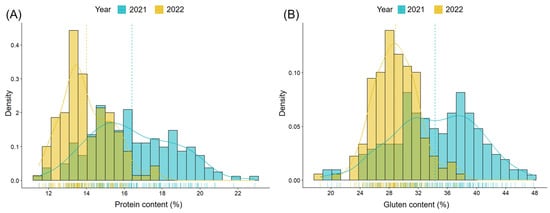
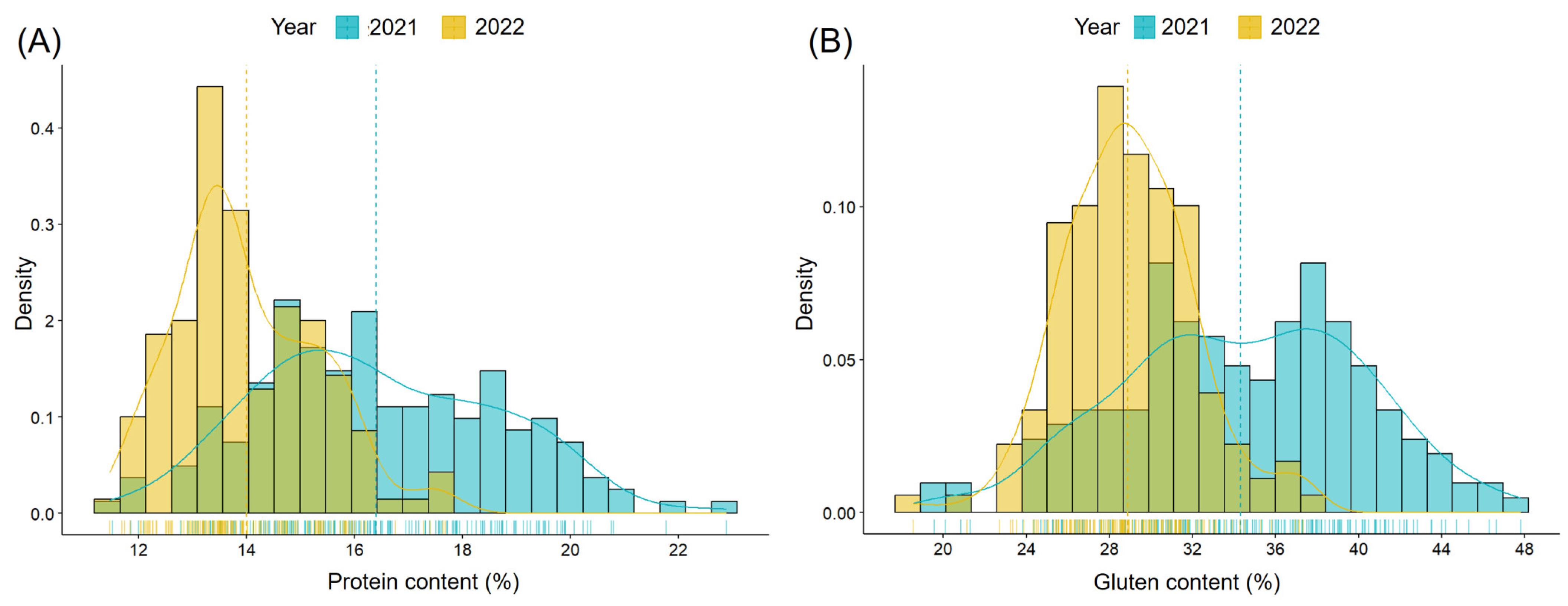
Grain protein content in 2021 ranged from 11.52% to 22.89%, and in 2022 from 11.47% to 17.68% (Figure 1, Table S1). Gluten content (GC) in 2021 ranged from 19.55% to 47.82%, and in 2022 from 18.54% to 37.33% (Figure 1, Table S1). On average, both protein and gluten content were lower in 2022 compared to 2021. Additionally, the variability of both traits was lower in 2022 than in 2021. In all cases, trait distributions were approximately normal, though in 2021 they were more flattened for both traits.
Figure 1.
Distribution of winter wheat varieties grown in 2021 and 2022 by grain protein content ((A), blue for 2021; yellow for 2022) and gluten content ((B), blue for 2021; yellow for 2022). The green color represents the overlap of the two distributions. The vertical dashed lines indicate the mean values for each year, and the solid colored lines represent the corresponding density plots.
ANOVA revealed that both GPC and GC differed significantly (p-value < 0.0001) among genotypes, environmental conditions, and genotype × environment interactions (Table S2). GPC and GC were significantly correlated (r2 = 0.92, p-value < 0.0001) (Figure S1), both on average and in each year individually. The correlation coefficient was slightly lower in 2022 (r2 = 0.76, p-value < 0.0001) than in 2021 (r2 = 0.92, p-value < 0.0001). The heritability of the studied traits was high both for protein (0.80) and for gluten (0.69) content, which suggests a substantial genetic contribution to the variation in these traits.
Grain protein content above 15% in common wheat is indicative of high quality according to interstate standard GOST 9353-2016 [30]. In 2021, the highest protein content was observed in the varieties Mikhaylovka (20%) and Eritrospermum 59 (21%). The lowest value was recorded for the variety Tau (10%). A high gluten content (>28%) was observed in 129 varieties, with the highest value found in Eritrospermum 59 (44%) and the lowest (18%) in the varieties Tau and Rifey.
In 2022, 35 of the studied varieties exceeded the 15% threshold for protein content. The highest protein content was recorded in the variety Donka (17.7%), and the lowest in Soraja (11.5%). Analysis of gluten content in 2022 showed that 41 varieties had a high level (>35%). The highest value was observed in the variety Banatka (39.0%), while the lowest was found in Shatilovskaya (18.5%).
2.2. Allelic Diversity of the NAM-A1 Gene and Its Effect on Grain Protein and Gluten Content
In a collection of winter bread wheat varieties, the allelic diversity of NAM-B1 and NAM-A1 genes—known to influence grain protein content—was investigated.
Currently, three variants of the NAM-B1 gene are known: a functional wild-type allele (rarely found in modern varieties); a non-functional allele caused by a single-nucleotide insertion in exon 1; a complete gene deletion (~200 kb in length). Analysis showed that all varieties in the studied panel carried the same non-functional NAM-B1 allele.
The distribution of NAM-A1 alleles among the winter wheat varieties is presented in Figure S2. The most common allele was NAM-A1c (71% of varieties), followed by NAM-A1d (16%), while the rarest was NAM-A1a (7%). The NAM-A1b allele (corresponding to haplotype C/DEL) was not detected in this panel.
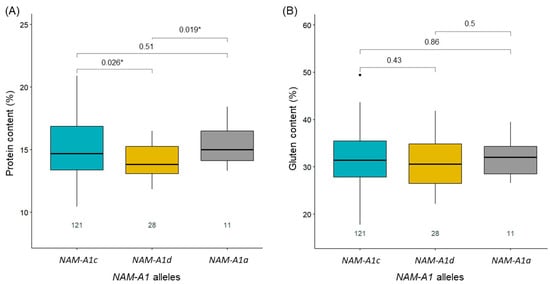
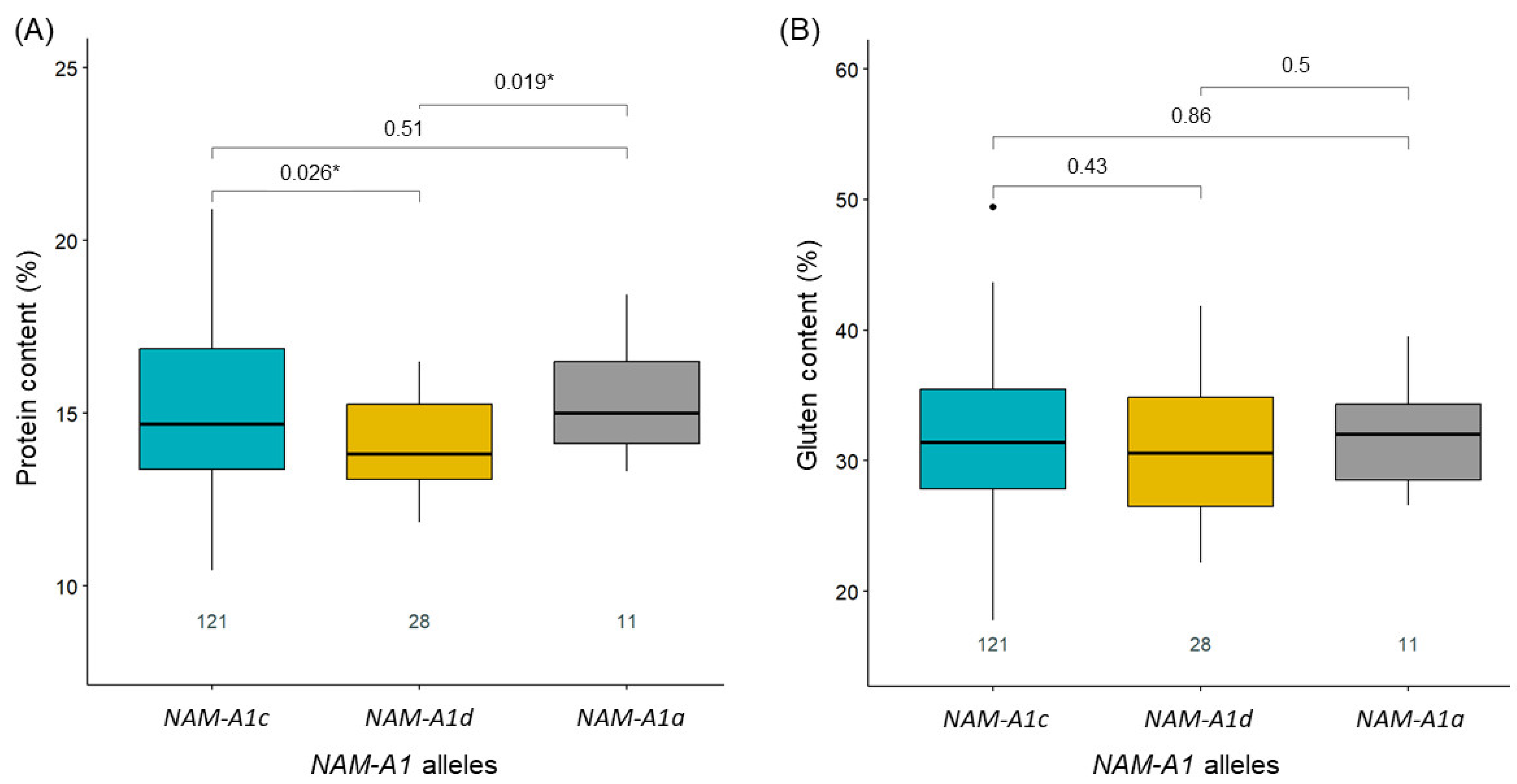
Grain protein content was significantly higher (p < 0.05) in varieties carrying the NAM-A1a and NAM-A1c alleles compared to those with NAM-A1d (Figure 2, Table S3). However, no significant association was observed between NAM-A1 alleles and gluten content (Figure 2, Table S3).
Figure 2.
Boxplots showing grain protein content (A) and gluten content (B) in winter common wheat varieties depending on the NAM-A1 allele. The significance level indicated by * corresponds to p-values < 0.05. The horizontal line inside each box represents the median value. Numbers at the bottom indicate the number of genotypes in each group. Blue color corresponds to NAM-A1c allele, yellow to NAM-A1d allele and grey to NAM-A1a allele. The black dots represent outliers in the box plot.
2.3. Genome-Wide Association Study for Grain Protein and Gluten Content in Winter Wheat
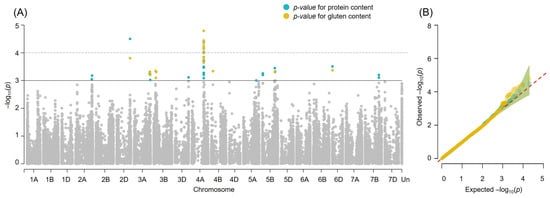
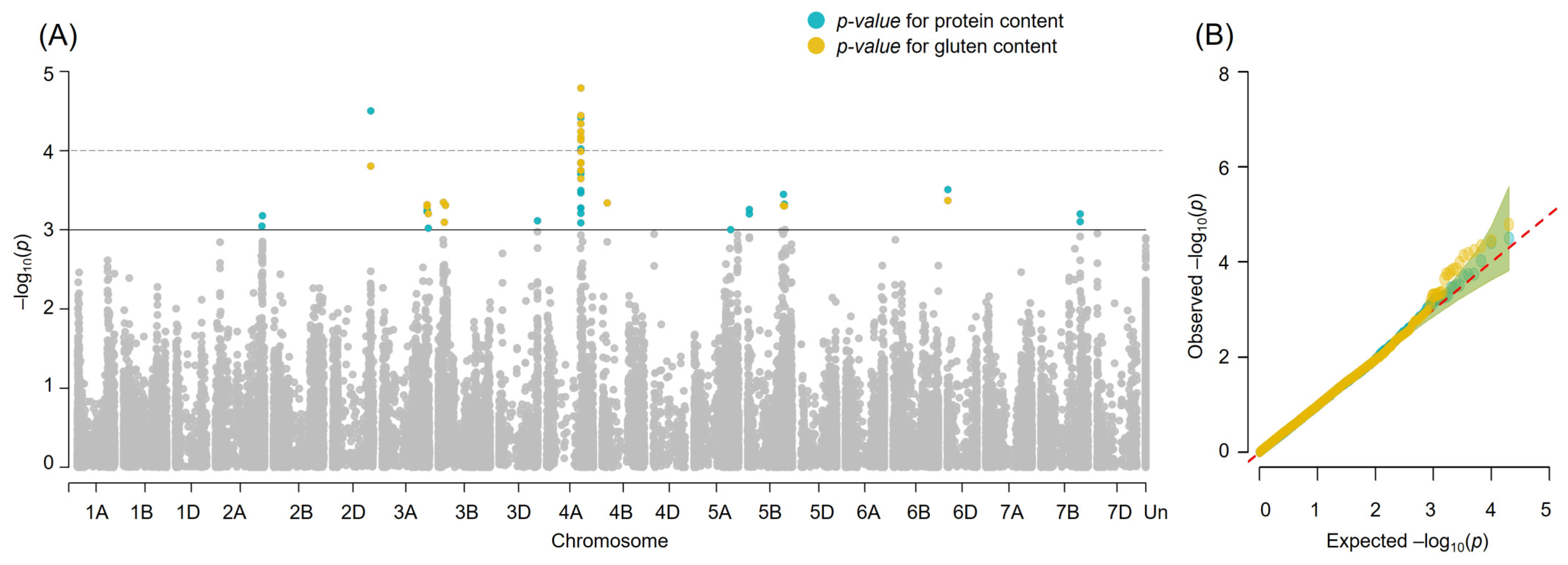
A genome-wide association study (GWAS) using a mixed linear model (MLM) identified 26 SNP markers significantly associated with grain protein content (p < 0.001) and 23 markers significantly associated with gluten content (p < 0.001). These markers were distributed across chromosomes 2A, 2D, 3A, 3B, 4A, 4B, 5A, 5B, 6D, and 7B (Figure 3, Table 1). Most of the identified markers were significantly associated with both traits—protein and gluten content. The estimated effects of individual markers ranged from −0.96% to +1.21% for protein content and from −2.54% to +3.29% for gluten content.
Figure 3.
Summary of Genome-Wide Association Study (GWAS) Results for Grain Protein and Gluten Content in Winter Bread Wheat. Blue points indicate SNPs associated with grain protein and yellow those associated with gluten contents. (A) Manhattan plot based on the MLM model. The horizontal solid line indicates the threshold of significance p < 0.001. The horizontal dashed line indicates the threshold of significance p < 0.0001. The grey dots represent markers below the significance threshold; (B) Quantile–quantile (QQ) plots showing observed versus expected −log10 (p) values. X-axis: expected −log10 (p) values. Y-axis: observed −log10 (p) values. The red dotted line represents the standard expected relationship among markers, and the different colored shaded areas indicate the 95% confidence interval for the QQ plot under the null hypothesis.
Table 1.
SNP markers associated with grain protein and gluten content in winter wheat varieties, identified using a linear mixed model accounting for population structure and kinship matrix. The most significant markers are shown in bold. * Effector alleles are shown in bold.
The most significant locus associated with both traits is located on chromosome 4A, including 11 significant markers for grain protein content and 12 for gluten content (Table 1), spanning a 1.440.917 bp interval. Within this region, 13 genes are located. Expression pattern analysis revealed that the gene TraesCS4A02G235900 is specifically expressed in the grain from the hard dough stage through senescence. This gene encodes serpin domain-containing protein.
The second most significant GPC-associated locus is located on chromosome 2D and is marked by Excalibur_c44325_339, which falls within the coding region of the gene TraesCS2D02G517200. This gene encodes a glycerol kinase and is primarily expressed after flowering in the flag leaf, the fifth leaf, and the flag leaf sheath.
2.4. Candidate Genes for Loci Supported by Three or More Studies
Three high-confidence loci associated with grain protein content were identified. In addition to being detected in the present study, these loci were consistently reported in at least two independent investigations, confirming their reliability. The loci were mapped to the long arms of chromosomes 3D and 5A, and to the short arm of chromosome 6A, highlighting their potential relevance in the genetic control of protein accumulation in wheat grain. Five genes were identified on chromosome 3D, one on 5A, and nine on 6A. Their list, along with functional descriptions, is presented in Table 2.
Table 2.
List of candidate genes for grain protein content and their functional description, extracted from the most stable genomic loci detected in three or more independent studies.
3. Discussion
This study evaluated a diverse collection of common wheat (Triticum aestivum L.) varieties, consisting of 170 winter wheat varieties from various regions of the world, the majority of which were developed via Russian breeding programs. According to the interstate standard GOST 9353-2016, which defines wheat quality classes in the Russian Federation, grain protein contents (GPCs) of 15% or higher are classified as high-class wheat. Therefore, this threshold was used in our study to identify high-protein genotypes. This threshold was met by 69 varieties included in the present study, based on the average values of this trait over two years of field trials. Among the studied genotypes, several cultivars demonstrated consistently high grain protein content (GPC) across both years of field testing. These include Donka (originating from the Rostov region), Staritsinskaya (Tomsk region), and Banatka (Stavropol region). These cultivars can be recommended as promising donors of favorable alleles for improving grain protein content in future wheat breeding programs.
Previous studies have reported a broad range of heritability estimates for grain protein content, reflecting the strong dependence of this trait on both population structure and environmental conditions. While most reports highlight a pronounced and significant influence of the environment, GPC heritability is generally moderate to high, thereby supporting the applicability of genomic prediction and selection [5,7]. In our study, the broad-sense heritability of GPC was estimated at 0.80, which aligns with previous reports for winter wheat. For instance, heritability estimates in European winter wheat collections [31] and Chinese winter wheat collections [32] were similarly high, ranging from 0.72 to 0.93.
The NAM-A1 gene has been implicated in the regulation of grain protein content, leaf senescence, and the duration of grain maturation [19,33,34,35]. Varieties carrying NAM-A1a generally exhibit the highest GPC, those with NAM-A1c display intermediate levels, and those with NAM-A1d the lowest [35]. Our results are consistent with these findings: the highest protein content was observed in varieties carrying the NAM-A1a allele, whereas the lowest values were associated with NAM-A1d. Notably, the NAM-A1a allele, despite its association with increased grain protein content, was relatively uncommon in our panel, being present in only 6% of the varieties.
3.1. Comparative Analysis of Loci Associated with Grain Protein Content in Winter and Spring Wheat
In this study, using GWAS, we identified 26 markers significantly associated (p-value < 0.001) with grain protein content and 23 markers significantly associated (p-value < 0.001) with gluten content. These markers were located on chromosomes 2A, 2D, 3A, 3B, 4A, 4B, 5A, 5B, 6D, and 7B.
To compare the obtained data with previously reported markers and loci primarily associated with grain protein content, we summarized information from 15 publications describing GWAS or QTL analyses conducted in spring wheat [36,37,38,39,40] and winter wheat [31,32,41,42,43,44,45,46,47,48], two studies on grain protein content in T. durum [49,50], and our two previous studies on spring wheat [21,51] (Table S4). Additionally, well-known genes such as NAM-1, NAM-2, gliadins and glutenins were included.
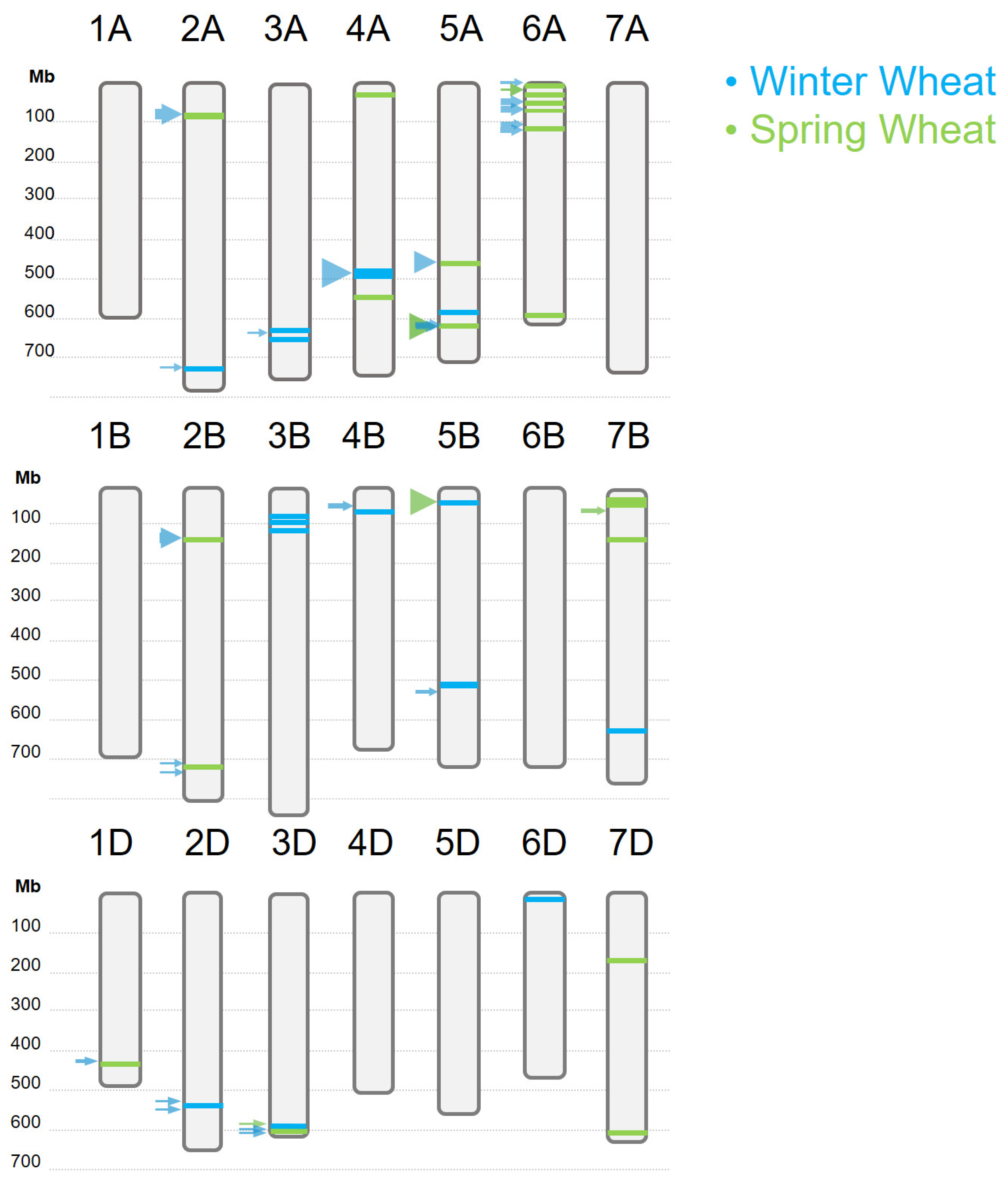
In total, 639 marker–trait associations (MTAs) were incorporated into the analysis, including those identified in the present study (Table S5). Table S6 and Figure 4 present the markers from our studies (the current work on winter wheat and two earlier studies on spring wheat) that overlap with, or are located in close proximity to, previously reported MTAs for grain protein content.
Figure 4.
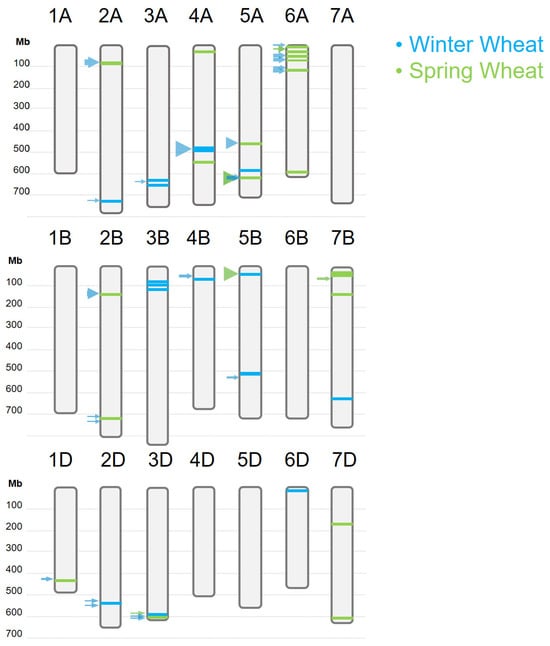
MTAs and QTLs identified in the present study in winter wheat, as well as in our previous studies on spring wheat [21,51], are shown as bars along the chromosomes. Arrows beside the chromosomes indicate the nearest or overlapping MTAs and QTLs reported by other authors. Arrow size corresponds to the number of underlying markers (the more markers, the larger the arrow). The green lines and arrows correspond to spring wheat loci, and the blue lines and arrows corre-spond to winter wheat.
On the long arm of chromosome 2A, three loci previously described in winter wheat were localized between two MTAs identified in our study. Two of these loci were reported by Voss-Fels et al. [45] and one by Geyer and Mohler [46]. On the long arm of chromosome 2D, two SNPs detected by Yang et al. [32], also in winter wheat, flanked the marker Excalibur_c44325_339 identified in the present study. It should be noted that the loci on the long arms of chromosomes 2A and 2D were syntenic (Figure S3).
On chromosome 3A, an SNP previously reported by Kartseva et al. [47] as associated with grain protein content in winter wheat was located between two closely positioned MTAs identified in this study. On the short arm of chromosome 3B, the locus identified here, consisting of three SNPs, was positioned between two loci previously reported in winter wheat [44,45].
On the long arm of chromosome 3D, the marker Excalibur_c17654_1090 identified in the present study in winter wheat was located near the TA015516-0532, which we previously reported as associated with gluten content in a spring wheat panel [51]. Between these two markers, two additional loci described in winter wheat were found [41,47]. Furthermore, immediately downstream of Excalibur_c17654_1090, another locus was reported by [45], also in winter wheat.
The locus on chromosome 4A (RefSeq v1.1: 544 177 849–545 618 766), consisting of 12 SNPs, overlapped with a locus previously identified in a population of RILs derived from a cross between two T. durum varieties, Duilio and Avonlea [49]. In that study, Marcotuli et al. did not specify whether these varieties were winter or spring types. However, Basso et al. reported autumn sowing of Duilio in September, suggesting that the studied population likely represented a winter growth habit [52]. The locus on chromosome 5BS also overlapped with a locus previously identified in a durum population of doubled haploid (DH) lines derived from the cross between Pelissier and Strongfield [50]. The growth habit of the parental varieties was not specified in that publication either; however, according to the Canadian variety registration database [53], Strongfield is a spring type, and therefore we infer that this population most likely represented a spring growth habit. Among genes within this locus on 4A we identified TraesCS4A02G235900 (encodes serpin domain-containing protein), which is specifically expressed in the grain from the hard dough stage through senescence. The serpin gene family plays an essential role in cereal grain development and quality. Early studies identified over 20 serpin genes in barley, wheat, rye, and oats, following the discovery of a barley grain serpin functioning both as a storage protein during grain filling and as a major source of lysine, an essential amino acid [54,55]. In wheat, at least six serpins exhibiting inhibitory activity toward chymotrypsin- and cathepsin-like proteases have been characterized [56]. These serpins are thought to protect grain storage proteins from degradation by endogenous or exogenous proteases, particularly those targeting proline- and glutamine-rich substrates such as prolamins and glutenin subunits, which are crucial for grain nitrogen content and bread-making quality [56,57,58].
On the short arm of chromosome 4B, the SNP Kukri_c48199_102 identified in this study was located adjacent to a locus reported by Voss-Fels et al. [45] in winter wheat. On chromosome 5B, two loci were identified in our study, one on the short arm and one on the long arm. The markers AX-110033497 and wsnp_Ex_c8962_14947544 on the short arm overlapped with a locus previously reported in T. durum by Ruan et al. [50]. On the long arm, the SNPs RAC875_rep_c102342_470 and TA001138-0446 were located between two loci previously identified in winter wheat [45,46]. It is also worth noting the SNP AX-94647124 (RefSeq v1.1: 9 358 293) on chromosome 6D, which was located in proximity to NAM-D1 (TRAESCS6D02G096300, RefSeq v1.1: 60 486 167).
Thus, the majority of the MTAs identified in this study overlapped with or were located in close proximity to previously reported MTAs or QTLs. In particular, the MTAs on chromosomes 2A, 2D, 3A, 3B, 4B, and 5BL corresponded to loci that had also been reported in winter wheat. The only locus previously identified in spring wheat that was located near one of the loci detected in the present study on winter wheat was on the long arm of chromosome 3D. This locus, also reported in our earlier work, was associated with grain gluten content [51].
When comparing the MTAs previously identified in our studies on a collection of spring wheat varieties [21,51] with loci reported in the literature, no similar pattern was observed; in contrast to winter wheat, the majority of loci identified in spring wheat did not correspond to loci reported in wheat of the same growth habit.
Most of the MTAs were located on the short arm of chromosome 6A. Four of these MTAs either mapped close to previously reported loci—for example, QGpc.icg-6A.1 (Tdurum_contig63703_1143 and wsnp_Ra_c3996_7334169) was located immediately downstream of SNP AX-95186193 identified by Krishnappa et al. [43]—or overlapped with known loci, such as BS00065076_51, which fell within the locus described by Mahjourimajd et al. [38] and delimited by markers Kukri_c42078_708 and Kukri_c11106_292. Similarly, QGpc.icg-6A.2 (Kukri_rep_c68344_627 and wsnp_CAP7_c1839_908011) overlapped with a locus defined by JD_c8888_741 and Kukri_c22149_276 and reported by Voss-Fels et al., while QGpc.icg-6A.3 (tplb0032i10_420 and BobWhite_c20782_697) intersected with two loci also described by Voss-Fels et al. [45]. Except for the locus described by Mahjourimajd et al. [38] between Kukri_c42078_708 and Kukri_c11106_292, which corresponded to our previous findings in spring wheat [21], the remaining loci were identified in winter wheat.
The MTAs for gluten content identified in a collection of spring wheat varieties and introgression lines with substitutions and translocations from species of tribe Triticeae (T. durum, T. dicoccum, T. dicoccoides, T. timopheevii) also overlapped with loci previously reported in both spring and winter wheat. For example, the SNP on chromosome 1D (wsnp_Ex_c35886_43950102), the three-SNP locus on the short arm of chromosome 2A (wsnp_BE498730A_Ta_2_2, Tdurum_contig45580_1717, Excalibur_c21269_176), the SNPs on chromosome 2B (RAC875_c14105_66 and RFL_Contig3016_1091), and the SNP on chromosome 5A (wsnp_Ex_c4921_8764106) were located within or close to loci reported in winter wheat [42,45]. The SNP RAC875_rep_c112818_307 on chromosome 5A was part of three previously described loci, one identified in winter wheat and two in spring wheat [38,45]. In addition, the locus on the short arm of chromosome 7B was located near a locus reported in spring wheat [40].
A comparative analysis of loci identified in winter and spring wheat revealed largely overlapping genomic regions, suggesting that the genetic control of grain protein content is broadly shared between varieties of this two growth habits. However, quantitative differences in allelic effects or gene expression were not statistically evaluated in this study due to the limited availability of comparable published data. Most GWAS and QTL studies do not specify genes within associated loci or provide expression data, and comprehensive transcriptomic datasets across developmental stages and tissues are still scarce. Therefore, direct comparisons of allelic effects or gene expression patterns between winter and spring genotypes are currently not feasible.
3.2. Candidate Genes for Stable Loci
To identify candidate genes potentially associated with grain protein content, we selected three loci with high confidence that, in addition to our work, were reported in at least two other studies. These loci were located on the long arms of chromosomes 3D and 5A and on the short arm of chromosome 6A. Since genes influencing grain protein content are predominantly expressed in the upper and flag leaves after flowering or directly in the developing grain [17,59], candidate genes were chosen based on preferential expression in these tissues. In total, five genes from chromosome 3D, one gene from chromosome 5A, and nine genes from chromosome 6A were identified (Table 2). All of these genes are poorly characterized, and only preliminary bioinformatic annotations are currently available, making it difficult at this stage to predict the mechanisms through which they may contribute to the regulation of grain protein content in common wheat.
Since no direct effect of the identified candidate genes on grain protein content was established, we further explored their potential functional associations using the KnetMiner platform. Through this analysis, we identified the following relationships: TraesCS6A02G103300 was associated with Vp1-3A (TraesCS3A02G417300), TraesCS6A02G130300 with Vp1-3D (TraesCS3D02G412800), and TraesCS6A02G132700 with Vp1-3B (TraesCS3B02G452200).
The Vp1 genes in wheat are well known for their association with pre-harvest sprouting resistance [60]. In addition, they have been linked to seed maturation processes, which may involve the accumulation of various storage compounds in the grain [61]. In maize, D. McCarty et al. (1991) demonstrated that Vp1 plays a central role in coordinating multiple developmental pathways during seed formation [62]. Moreover, Vp1 was shown to be essential for scutellum development and for the transfer of proteins from the endosperm to the embryo [63]. In vp1 mutant embryos, scutellum cells are misshapen and contain significantly less cellular material, disrupting normal protein accumulation. Evidence also indicates that Vp1 transactivates genes involved in sulfur assimilation and nutrient metabolism, thereby directly influencing grain protein content [63].
Another interesting relationship revealed by KnetMiner involves the gene TraesCS3D02G538000, which appears to be indirectly associated with starch content in the endosperm through NAC019-3A. The NAC019-3A gene regulates starch synthesis in the wheat endosperm [64]. As previously reported, starch content in wheat grains inversely affects protein concentration due to a dilution effect, whereby increased starch accumulation leads to a proportional decrease in protein percentage [65]. Hao et al. (2022) empirically confirmed this relationship, showing that an increase in starch content was accompanied by a simultaneous decrease in grain protein content [66]. Similarly, Zib et al. (2025) further substantiated this pattern, noting that grain protein and starch concentrations exhibit opposite trends during grain development [67]. Overall, the evidence supports a robust and consistent dilution effect, suggesting that TraesCS3D02G538000 may influence grain protein content indirectly—by modulating its ratio to starch accumulation rather than through direct regulation of protein synthesis.
4. Materials and Methods
4.1. Plant Material
The plant material used in this study was a collection of winter common wheat (Triticum aestivum L.) varieties provided by the N.I. Vavilov All-Russian Institute of Plant Genetic Resources. This collection consisted of 170 wheat varieties from various regions of the world, including 96 varieties developed through Russian breeding programs. A detailed description of the collection has been published previously [68]. To assess protein and gluten content, the collection samples were grown in a randomized block design with two replicates on 1 m2 plots in 2021 and 2022 in the Oryol Region (52°51′ N, 36°26′ E). The data of temperature and precipitation for the two environments are presented in Supplementary Table S7. The soil type is dark gray forest, heavy loam. The humus content is 4.71%, which corresponds to a medium level. The soil is moderately acidic (pHHCl–4.9). The contents of available phosphorus and potassium are 225.8 mg/kg (high) and 112.2 mg/kg (medium), respectively.
4.2. Evaluation of Protein and Gluten Content
Protein and gluten content in the grain was measured using an OmegAnaLyzer G (Bruins Instruments, Munich, Germany) infrared grain analyzer (730–1100 nm). To determine the percentage of protein and gluten, whole grain samples were placed in a sliding cuvette with a volume of 10 g; the measurement time was 30 s. Each variety was measured in triplicate, with grain replaced between replicates. Moisture content was also measured using the OmegAnaLyzer G (Bruins Instruments, Munich, Germany), which allowed for subsequent recalculation of the values on a dry weight basis (Table S1).
4.3. DNA Extraction
Genomic DNA was extracted using a modified sodium bisulfite protocol as described by [69]. DNA samples intended for SNP genotyping were purified with the Bio-Silica DNA Purification Kit (Bio-Silica, Novosibirsk, Russia) according to the manufacturer’s instructions. The purified DNA was quantified using the Qubit™ dsDNA BR Assay Kit (Thermo Fisher Scientific, Waltham, MA, USA) on a Qubit™ 4 Fluorometer (Thermo Fisher Scientific).
4.4. Analysis of NAM-1 Genes Alleles
To determine the alleles of the NAM-B1 gene in the panel of winter wheat varieties, primers described by Yang et al., 2018 [70] were used: NAMB1MYF (5′-CCCCGGGCTAGGTACAAAGGT-3′), NAMB1MYR (5′-AATTTGCGGCGCTTGATAAAG-3′), and NAMB1R2 (5′-GGGACTACCACAAACTGCAACAG-3′). To assess the allelic variation in the NAM-A1 gene, published KASP markers were used [34]. All PCR primers were synthesized at LGC Genomics (Hoddesdon, UK). Each reaction mixture consisted of a final volume of 10 µL containing 5 µL template DNA (100–150 ng), 5 µL V4.0 2 × Mastermix (LGC, BiosearchTechnologies, Hoddesdon, UK), 0.14 µL primermix (12 µM each allele-specific primer and 30 µM common primer). The PCR reaction was performed on a QuantStudio™ 5 real-time PCR system (Thermo Fisher Scientific, Foster City, CA, USA) under the following cycling conditions: denaturation at 94 °C for 15 min; 10 cycles of 94 °C for 20 s and touchdown starting at 62 °C for 1 min (decreased by 0.6 °C per cycle); and 26 cycles of amplification (94 °C for 20 s; 57 °C for 1 min). Data analysis was performed automatically by QuantStudio™ Real-Time PCR Software v1.3 (Applied Biosystems, Foster City, CA, USA).
4.5. Statistical Analysis
Analysis of variance (ANOVA) was performed using the R function aov. A two-way ANOVA was conducted to evaluate the significance of differences among genotypes and environments, with genotypes treated as a fixed effect and environments and replications as random effects. Spearman’s correlation coefficients (r2) were calculated with the R function cor. The Shapiro–Wilk test was used to assess the normality of trait distributions. To estimate trait heritability, a linear model with all effects considered as random was fitted using the R package lme4 (version 1.1-37) [71]. Broad-sense heritability (H2) was then calculated using the standard formula for heritability estimation (“standard” broad-sense heritability method) as described by Holland, Nyquist & Cervantes-Martínez [72]. The broad-sense heritability (H2) across all environments was estimated using the following formula:
where , , represent the genotypic, genotype-by-environment interaction, and residual (error) variances, respectively. and denote the number of environments and the number of replications within each environment, respectively.
4.6. Genome-Wide Association Study (GWAS)
High-throughput SNP genotyping was performed using the Illumina Infinium platform (Illumina Wheat 25K SNP chip, which contains 24145 SNP markers in total) at TraitGenetics GmbH (Gatersleben, Germany). A total of 20,008 polymorphic SNP markers were selected for further analysis after filtering based on minor allele frequency (MAF > 0.1) and a minimum call rate of 90% across the population.
Genome-wide association analysis was conducted using the GAPIT3 R package (version 3.5) [73]. For each trait, several statistical models were tested: the Mixed Linear Model (MLM) and the Compressed Mixed Linear Model (CMLM), both of which accounted for population structure (PCA) and kinship matrix (calculated using the “VanRaden” method), as well as the BLINK and FarmCPU models. The best-fitting model was selected based on quantile–quantile (QQ) plots. Manhattan and QQ plots were generated using the R package CMplot (version 4.5.1) [74].
The chromosomal positions of SNPs and genes within the associated loci were identified using the RefSeq v1.1 wheat genome assembly available through the GrainGenes genome browser [75].
4.7. Candidate Genes
Gene expression patterns for candidate loci were evaluated using the expVIP database [76] to select those predominantly expressed in grain as well as in flag and fifth leaves after anthesis. Functional annotation of genes was performed using the Persephone genome browser [77]. Potential links to phenotypes were determined using KnetMiner [78].
4.8. Comparison with Previously Published Data
Data were compiled from 17 publications (Table S4) in which markers were either reported with their physical positions on the RefSeq map or could be aligned to the reference genome through available sequences or positional information in databases or other studies.
5. Conclusions
Thus, a comparative analysis of the data we obtained in this and a previous study and presented in the literature on the genetic control of protein and gluten content in wheat grains indicated that genetic loci and associated molecular markers did not significantly differ between spring and winter wheat. The identification of specific markers associated with protein content largely depended on the particular sample set. Despite differences in growing conditions and the mechanisms of protein accumulation during development and maturation, we proposed that the genetic mechanisms determining grain protein content in common wheat do not depend on wheat growth habit. Based on these findings, we propose that breeding programs may benefit from transferring high-GPC alleles and loci identified in spring wheat into winter backgrounds. This approach would combine the favorable protein alleles of spring types with the adaptive and yield-related traits of winter types. Our future research will focus on integrating yield-related traits with grain protein and gluten content to identify genotypes combining high yield potential with superior grain quality.
Supplementary Materials
The following supporting information can be downloaded at: https://www.mdpi.com/article/10.3390/ijms262211159/s1.
Author Contributions
Conceptualization, E.A.S., I.N.L. and A.A.K.; methodology, A.A.K.; formal analysis, A.V.F. and A.A.K.; investigation, A.A.K.; resources, E.A.S.; data curation, I.N.L.; writing—original draft preparation, A.A.K.; writing—review and editing, A.A.K., I.N.L. and E.A.S.; visualization, A.A.K.; supervision, E.A.S.; funding acquisition, E.A.S. All authors have read and agreed to the published version of the manuscript.
Funding
The study is supported by the RSCF (Russian Science Foundation) project No. 21-76-30003-Π, https://www.rscf.ru/project/21-76-30003/(accessed on 1 October 2025).
Institutional Review Board Statement
Not applicable.
Informed Consent Statement
Not applicable.
Data Availability Statement
All the data presented in this study are included in the manuscript and Supplementary Materials.
Acknowledgments
The multiplication of the plant material was conducted in the Laboratory of Artificial Plant Growth of ICG SB RAS within the budgetary project FWNR-2022-0017.
Conflicts of Interest
The authors declare no conflicts of interest.
Abbreviations
The following abbreviations are used in this manuscript:
| GPC | Grain protein content |
| GC | Gluten content |
| GWAS | Genome-wide association studies |
| QTLs | Quantitative Trait Loci |
| MTAs | Marker–trait associations |
| SNP | Single-nucleotide polymorphism |
| MLM | Mixed Linear Model |
| PCA | Principal component analysis |
References
- Garg, M.; Singh, H.; Kaur, H.; Dhaliwal, H.S. Genetic Control of High Protein Content and Its Association with Bread-Making Quality in Wheat. J. Plant Nutr. 2006, 29, 1357–1369. [Google Scholar] [CrossRef] [Scilit]
- Barneix, A.J. Physiology and Biochemistry of Source-Regulated Protein Accumulation in the Wheat Grain. J. Plant Physiol. 2007, 164, 581–590. [Google Scholar] [CrossRef] [Scilit]
- Wang, Y.; Peng, Y.; Lin, J.; Wang, L.; Jia, Z.; Zhang, R. Optimal Nitrogen Management to Achieve High Wheat Grain Yield, Grain Protein Content, and Water Productivity: A Meta-Analysis. Agric. Water Manag. 2023, 290, 108587. [Google Scholar] [CrossRef] [Scilit]
- Sułek, A.; Cacak-Pietrzak, G.; Różewicz, M.; Nieróbca, A.; Grabiński, J.; Studnicki, M.; Sujka, K.; Dziki, D. Effect of Production Technology Intensity on the Grain Yield, Protein Content and Amino Acid Profile in Common and Durum Wheat Grain. Plants 2023, 12, 364. [Google Scholar] [CrossRef] [Scilit] [PubMed]
- Paina, C.; Gregersen, P.L. Recent Advances in the Genetics Underlying Wheat Grain Protein Content and Grain Protein Deviation in Hexaploid Wheat. Plant Biol. 2023, 25, 661–670. [Google Scholar] [CrossRef] [Scilit]
- Prasad, M.; Kumar, N.; Kulwal, P.L.; Röder, M.S.; Balyan, H.S.; Dhaliwal, H.S.; Gupta, P.K. QTL Analysis for Grain Protein Content Using SSR Markers and Validation Studies Using NILs in Bread Wheat. Theor. Appl. Genet. 2003, 106, 659–667. [Google Scholar] [CrossRef] [Scilit] [PubMed]
- Kumar, A.; Jain, S.; Elias, E.M.; Ibrahim, M.; Sharma, L.K. An Overview of QTL Identification and Marker-Assisted Selection for Grain Protein Content in Wheat. In Eco-Friendly Agro-Biological Techniques for Enhancing Crop Productivity; Springer: Singapore, 2018; pp. 245–274. [Google Scholar]
- Shewry, P. Exploring the Structure and Functionality of Wheat Gluten Proteins. Biotechnol. Biotechnol. Equip. 1992, 6, 5–10. [Google Scholar] [CrossRef] [Scilit]
- Asri, N.; Rostami-Nejad, M.; Anderson, R.P.; Rostami, K. The Gluten Gene: Unlocking the Understanding of Gluten Sensitivity and Intolerance. Appl. Clin. Genet. 2021, 14, 37–50. [Google Scholar] [CrossRef] [Scilit]
- Giménez, M.J.; Gil-Humanes, J.; Ozuna, C.V.; Barro, F. Wheat Varieties Suitable for Celiac Patients. In Celiac Disease and Non-Celiac Gluten Sensitivity; OmniaScience: Barcelona, Spain, 2014; pp. 461–475. [Google Scholar]
- Teng, W.; He, X.; Tong, Y. Genetic Control of Efficient Nitrogen Use for High Yield and Grain Protein Concentration in Wheat: A Review. Plants 2022, 11, 492. [Google Scholar] [CrossRef] [Scilit] [PubMed]
- Zhao, Y.; Islam, S.; Alhabbar, Z.; Zhang, J.; O’Hara, G.; Anwar, M.; Ma, W. Current Progress and Future Prospect of Wheat Genetics Research towards an Enhanced Nitrogen Use Efficiency. Plants 2023, 12, 1753. [Google Scholar] [CrossRef] [Scilit]
- Giordano, N.; Sadras, V.O.; Lollato, R.P. Late-Season Nitrogen Application Increases Grain Protein Concentration and Is Neutral for Yield in Wheat. A Global Meta-Analysis. Field Crops Res. 2023, 290, 108740. [Google Scholar] [CrossRef] [Scilit]
- An, H.; Han, J.; He, Q.; Zhu, Y.; Wu, P.; Wang, Y.; Gao, Z.; Du, T.; Xue, J. Influence of Nitrogen Application Rate on Wheat Grain Protein Content and Composition in China: A Meta-Analysis. Agronomy 2024, 14, 1164. [Google Scholar] [CrossRef] [Scilit]
- Uauy, C.; Brevis, J.C.; Dubcovsky, J. The High Grain Protein Content Gene Gpc-B1 Accelerates Senescence and Has Pleiotropic Effects on Protein Content in Wheat. J. Exp. Bot. 2006, 57, 2785–2794. [Google Scholar] [CrossRef] [Scilit]
- Uauy, C.; Distelfeld, A.; Fahima, T.; Blechl, A.; Dubcovsky, J. A NAC Gene Regulating Senescence Improves Grain Protein, Zinc, and Iron Content in Wheat. Science 2006, 314, 1298–1301. [Google Scholar] [CrossRef] [Scilit]
- Borrill, P.G.M. The NAM-B1 Transcription Factor and the Control of Grain Composition in Wheat; University of East Anglia: Norwich, UK, 2014. [Google Scholar]
- Tabbita, F.; Pearce, S.; Barneix, A.J. Breeding for Increased Grain Protein and Micronutrient Content in Wheat: Ten Years of the GPC-B1 Gene. J. Cereal Sci. 2017, 73, 183–191. [Google Scholar] [CrossRef] [Scilit]
- Harrington, S.A.; Overend, L.E.; Cobo, N.; Borrill, P.; Uauy, C. Conserved Residues in the Wheat (Triticum Aestivum) NAM-A1 NAC Domain Are Required for Protein Binding and When Mutated Lead to Delayed Peduncle and Flag Leaf Senescence. BMC Plant Biol. 2019, 19, 407. [Google Scholar] [CrossRef] [Scilit]
- Chapman, E.A.; Orford, S.; Lage, J.; Griffiths, S. Delaying or Delivering: Identification of Novel NAM-1 Alleles That Delay Senescence to Extend Wheat Grain Fill Duration. J. Exp. Bot. 2021, 72, 7710–7728. [Google Scholar] [CrossRef] [Scilit]
- Leonova, I.N.; Kiseleva, A.A.; Berezhnaya, A.A.; Stasyuk, A.I.; Likhenko, I.E.; Salina, E.A. Identification of QTLs for Grain Protein Content in Russian Spring Wheat Varieties. Plants 2022, 11, 437. [Google Scholar] [CrossRef] [Scilit] [PubMed]
- Orlovskaya, O.A.; Vakula, S.I.; Yatsevich, K.K.; Khotyleva, L.V.; Kilchevsky, A.V. Effect of NAM-1 Genes on the Protein Content in Grain and Productivity Indices in Common Wheat Lines with Foreign Genetic Material Introgressions in the Conditions of Belarus. Vavilov J. Genet. Breed. 2023, 27, 197–206. [Google Scholar] [CrossRef] [Scilit] [PubMed]
- Koppel, R.; Ingver, A. A Comparison of the Yield and Quality Traits of Winter and Spring Wheat. Latv. J. Agron. 2008, 11, 83–89. [Google Scholar]
- Spink, J.H.; Semere, T.; Sparkes, D.L.; Whaley, J.M.; Foulkes, M.J.; Clare, R.W.; Scott, R.K. Effect of Sowing Date on the Optimum Plant Density of Winter Wheat. Ann. Appl. Biol. 2000, 137, 179–188. [Google Scholar] [CrossRef] [Scilit]
- Bogard, M.; Allard, V.; Brancourt-Hulmel, M.; Heumez, E.; Machet, J.-M.; Jeuffroy, M.-H.; Gate, P.; Martre, P.; Le Gouis, J. Deviation from the Grain Protein Concentration–Grain Yield Negative Relationship Is Highly Correlated to Post-Anthesis N Uptake in Winter Wheat. J. Exp. Bot. 2010, 61, 4303–4312. [Google Scholar] [CrossRef] [Scilit]
- Pask, A.J.D.; Sylvester-Bradley, R.; Jamieson, P.D.; Foulkes, M.J. Quantifying How Winter Wheat Crops Accumulate and Use Nitrogen Reserves during Growth. Field Crops Res. 2012, 126, 104–118. [Google Scholar] [CrossRef] [Scilit]
- Bogard, M.; Jourdan, M.; Allard, V.; Martre, P.; Perretant, M.R.; Ravel, C.; Heumez, E.; Orford, S.; Snape, J.; Griffiths, S.; et al. Anthesis Date Mainly Explained Correlations between Post-Anthesis Leaf Senescence, Grain Yield, and Grain Protein Concentration in a Winter Wheat Population Segregating for Flowering Time QTLs. J. Exp. Bot. 2011, 62, 3621–3636. [Google Scholar] [CrossRef] [Scilit]
- Malhi, S.S.; Johnston, A.M.; Schoenau, J.J.; Wang, Z.L.; Vera, C.L. Seasonal Biomass Accumulation and Nutrient Uptake of Wheat, Barley and Oat on a Black Chernozem Soil in Saskatchewan. Can. J. Plant Sci. 2006, 86, 1005–1014. [Google Scholar] [CrossRef] [Scilit]
- Mangin, A.; Brûlé-Babel, A.; Flaten, D.; Wiersma, J.; Lawley, Y. Maximizing Spring Wheat Productivity in the Eastern Canadian Prairies II. Grain Nitrogen, Grain Protein, and Nitrogen Use. Agron. J. 2022, 114, 2389–2406. [Google Scholar] [CrossRef] [Scilit]
- GOST 9353-2016; Interstate Council for Standardization Metrology and Certification (ISC). Standardinform Federal State Unitary Enterprise (FSUE): Moscow, Russia, 2016; p. 15.
- Muqaddasi, Q.H.; Brassac, J.; Ebmeyer, E.; Kollers, S.; Korzun, V.; Argillier, O.; Stiewe, G.; Plieske, J.; Ganal, M.W.; Röder, M.S. Prospects of GWAS and Predictive Breeding for European Winter Wheat ’ s Grain Protein Content, Grain Starch Content, and Grain Hardness. Sci. Rep. 2020, 10, 12541. [Google Scholar] [CrossRef] [Scilit] [PubMed]
- Yang, Y.; Chai, Y.; Zhang, X.; Lu, S.; Zhao, Z.; Wei, D.; Chen, L.; Hu, Y.-G. Multi-Locus GWAS of Quality Traits in Bread Wheat: Mining More Candidate Genes and Possible Regulatory Network. Front. Plant Sci. 2020, 11, 1091. [Google Scholar] [CrossRef] [Scilit]
- Avni, R.; Zhao, R.; Pearce, S.; Jun, Y.; Uauy, C.; Tabbita, F.; Fahima, T.; Slade, A.; Dubcovsky, J.; Distelfeld, A. Functional Characterization of GPC-1 Genes in Hexaploid Wheat. Planta 2014, 239, 313–324. [Google Scholar] [CrossRef] [Scilit]
- Cormier, F.; Throude, M.; Ravel, C.; Gouis, J.; Leveugle, M.; Lafarge, S.; Exbrayat, F.; Duranton, N.; Praud, S. Detection of NAM-A1 Natural Variants in Bread Wheat Reveals Differences in Haplotype Distribution between a Worldwide Core Collection and European Elite Germplasm. Agronomy 2015, 5, 143–151. [Google Scholar] [CrossRef] [Scilit]
- Alhabbar, Z.; Islam, S.; Yang, R.; Diepeveen, D.; Anwar, M.; Balotf, S.; Sultana, N.; Maddern, R.; She, M.; Zhang, J.; et al. Associations of NAM-A1 Alleles with the Onset of Senescence and Nitrogen Use Efficiency under Western Australian Conditions. Euphytica 2018, 214, 180. [Google Scholar] [CrossRef] [Scilit]
- Pu, Z.; Ye, X.; Li, Y.; Shi, B.; Guo, Z.; Dai, S.; Ma, J.; Liu, Z.; Jiang, Y.; Li, W.; et al. Identification and Validation of Novel Loci Associated with Wheat Quality through a Genome-Wide Association Study. J. Integr. Agric. 2022, 21, 3131–3147. [Google Scholar] [CrossRef] [Scilit]
- Juliana, P.; Poland, J.; Huerta-Espino, J.; Shrestha, S.; Crossa, J.; Crespo-Herrera, L.; Toledo, F.H.; Govindan, V.; Mondal, S.; Kumar, U.; et al. Improving Grain Yield, Stress Resilience and Quality of Bread Wheat Using Large-Scale Genomics. Nat. Genet. 2019, 51, 1530–1539. [Google Scholar] [CrossRef] [Scilit] [PubMed]
- Mahjourimajd, S.; Taylor, J.; Rengel, Z.; Khabaz-saberi, H. The Genetic Control of Grain Protein Content under Variable Nitrogen Supply in an Australian Wheat Mapping Population. PLoS ONE 2016, 11, e0159371. [Google Scholar] [CrossRef] [Scilit]
- Aleliunas, A.; Gorash, A.; Armoniene, R.; Tamm, I.; Ingver, A. Genome-Wide Association Study Reveals 18 QTL for Major Agronomic Traits in a Nordic—Baltic Spring Wheat Germplasm. Front. Plant Sci. 2024, 15, 1393170. [Google Scholar] [CrossRef] [Scilit]
- Zhang, J.; She, M.; Yang, R.; Jiang, Y.; Qin, Y.; Zhai, S.; Balotf, S.; Zhao, Y.; Anwar, M.; Alhabbar, Z.; et al. Yield-Related QTL Clusters and the Potential Candidate Genes in Two Wheat DH Populations. Int. J. Mol. Sci. 2021, 22, 11934. [Google Scholar] [CrossRef] [Scilit]
- Lou, H.; Zhang, R.; Liu, Y.; Guo, D.; Zhai, S.; Chen, A.; Zhang, Y.; Xie, C.; You, M.; Peng, H.; et al. Genome-Wide Association Study of Six Quality-Related Traits in Common Wheat (Triticum Aestivum L.) under Two Sowing Conditions. Theor. Appl. Genet. 2021, 134, 399–418. [Google Scholar] [CrossRef] [Scilit]
- Thorwarth, P.; Liu, G.; Ebmeyer, E.; Schacht, J.; Schachschneider, R.; Kazman, E.; Christoph, J.; Tobias, R.; Carl, W.; Horst, F. Dissecting the Genetics Underlying the Relationship between Protein Content and Grain Yield in a Large Hybrid Wheat Population. Theor. Appl. Genet. 2019, 132, 489–500. [Google Scholar] [CrossRef] [Scilit]
- Krishnappa, G.; Khan, H.; Krishna, H.; Devate, N.B.; Kumar, S.; Mishra, C.N.; Parkash, O.; Kumar, S.; Kumar, M.; Mamrutha, H.M.; et al. Genome-Wide Association Study for Grain Protein, Thousand Kernel Weight, and Normalized Difference Vegetation Index in Bread Wheat (Triticum aestivum L.). Genes 2023, 14, 637. [Google Scholar] [CrossRef] [Scilit]
- Tian, Y.; Liu, P.; Kong, D.; Nie, Y.; Xu, H.; Han, X. Genome-Wide Association Analysis and KASP Markers Development for Protein Quality Traits in Winter Wheat. BMC Plant Biol. 2025, 25, 149. [Google Scholar] [CrossRef] [Scilit]
- Voss-Fels, K.P.; Stahl, A.; Wittkop, B.; Lichthardt, C.; Nagler, S.; Rose, T.; Chen, T.; Zetzsche, H.; Seddig, S.; Majid Baig, M.; et al. Breeding Improves Wheat Productivity under Contrasting Agrochemical Input Levels. Nat. Plants 2019, 5, 706–714. [Google Scholar] [CrossRef] [Scilit] [PubMed]
- Geyer, M.; Mohler, V.; Hartl, L. Genetics of the Inverse Relationship between Grain Yield and Grain Protein Content in Common Wheat. Plants 2022, 11, 2146. [Google Scholar] [CrossRef] [Scilit] [PubMed]
- Kartseva, T.; Alqudah, A.M.; Aleksandrov, V.; Alomari, D.Z.; Doneva, D.; Arif, M.A.R.; Börner, A.; Misheva, S. Nutritional Genomic Approach for Improving Grain Protein Content in Wheat. Foods 2023, 12, 1399. [Google Scholar] [CrossRef] [Scilit]
- Kartseva, T.; Aleksandrov, V.; Alqudah, A.M.; Arif, M.A.R.; Kocheva, K.; Doneva, D.; Prokopova, K.; Börner, A.; Misheva, S. GWAS in a Collection of Bulgarian Old and Modern Bread Wheat Accessions Uncovers Novel Genomic Loci for Grain Protein Content and Thousand Kernel Weight. Plants 2024, 13, 1084. [Google Scholar] [CrossRef] [Scilit]
- Marcotuli, I.; Gadaleta, A.; Mangini, G.; Signorile, A.M.; Zacheo, S.A.; Blanco, A.; Simeone, R.; Colasuonno, P. Development of a High-Density SNP-Based Linkage Map and Detection of QTL for β-Glucans, Protein Content, Grain Yield per Spike and Heading Time in Durum Wheat. Int. J. Mol. Sci. 2017, 18, 1329. [Google Scholar] [CrossRef] [Scilit]
- Ruan, Y.; Yu, B.; Knox, R.E.; Zhang, W.; Singh, A.K. Conditional Mapping Identified Quantitative Trait Loci for Grain Protein Concentration Expressing Independently of Grain Yield in Canadian Durum Wheat. Front. Plant Sci. 2021, 12, 642955. [Google Scholar] [CrossRef] [Scilit]
- Leonova, I.N.; Kiseleva, A.A.; Berezhnaya, A.A.; Orlovskaya, O.A.; Salina, E.A. Novel Genetic Loci from Triticum Timopheevii Associated with Gluten Content Revealed by GWAS in Wheat Breeding Lines. Int. J. Mol. Sci. 2023, 24, 13304. [Google Scholar] [CrossRef] [Scilit]
- Basso, B.; Cammarano, D.; Fiorentino, C.; Ritchie, J.T. Wheat Yield Response to Spatially Variable Nitrogen Fertilizer in Mediterranean Environment. Eur. J. Agron. 2013, 51, 65–70. [Google Scholar] [CrossRef] [Scilit]
- Canadian Food Inspection Agency. Available online: https://active.inspection.gc.ca/ (accessed on 10 September 2025).
- Hejgaard, J.; Rasmussen, S.K.; Brandt, A.; Svendsen, I. Sequence Homology between Barley Endosperm Protein Z and Protease Inhibitors of the α 1-antitrypsin Family. FEBS Lett. 1985, 180, 89–94. [Google Scholar] [CrossRef] [Scilit]
- Roberts, T.H.; Hejgaard, J. Serpins in Plants and Green Algae. Funct. Integr. Genom. 2008, 8, 1–27. [Google Scholar] [CrossRef] [Scilit]
- Østergaard, H.; Rasmussen, S.K.; Roberts, T.H.; Hejgaard, J. Inhibitory Serpins from Wheat Grain with Reactive Centers Resembling Glutamine-Rich Repeats of Prolamin Storage Proteins. J. Biol. Chem. 2000, 275, 33272–33279. [Google Scholar] [CrossRef] [Scilit]
- Bonnot, T.; Bancel, E.; Chambon, C.; Boudet, J.; Branlard, G.; Martre, P. Changes in the Nuclear Proteome of Developing Wheat (Triticum Aestivum L.) Grain. Front. Plant Sci. 2015, 6, 905. [Google Scholar] [CrossRef] [Scilit]
- Benbow, H.R.; Jermiin, L.S.; Doohan, F.M. Serpins: Genome-Wide Characterisation and Expression Analysis of the Serine Protease Inhibitor Family in Triticum Aestivum. G3 Genes|Genomes|Genet. 2019, 9, 2709–2722. [Google Scholar] [CrossRef] [Scilit]
- Zhong, Y.; Xu, D.; Hebelstrup, K.H.; Yang, D.; Cai, J.; Wang, X.; Zhou, Q.; Cao, W.; Dai, T.; Jiang, D. Nitrogen Topdressing Timing Modifies Free Amino Acids Profiles and Storage Protein Gene Expression in Wheat Grain. BMC Plant Biol. 2018, 18, 353. [Google Scholar] [CrossRef] [Scilit]
- Utsugi, S.; Nakamura, S.; Noda, K.; Maekawa, M. Structural and Functional Properties of Viviparous1 Genes in Dormant Wheat. Genes Genet. Syst. 2008, 83, 153–166. [Google Scholar] [CrossRef] [Scilit]
- Vetch, J.M.; Stougaard, R.N.; Martin, J.M.; Giroux, M.J. Review: Revealing the Genetic Mechanisms of Pre-Harvest Sprouting in Hexaploid Wheat (Triticum Aestivum L.). Plant Sci. 2019, 281, 180–185. [Google Scholar] [CrossRef] [Scilit] [PubMed]
- McCarty, D.R.; Carson, C.B. The Molecular Genetics of Seed Maturation in Maize. Physiol. Plant. 1991, 81, 267–272. [Google Scholar] [CrossRef] [Scilit]
- Zheng, X.; Li, Q.; Li, C.; An, D.; Xiao, Q.; Wang, W.; Wu, Y. Intra-Kernel Reallocation of Proteins in Maize Depends on VP1-Mediated Scutellum Development and Nutrient Assimilation. Plant Cell 2019, 31, 2613–2635. [Google Scholar] [CrossRef] [Scilit] [PubMed]
- Liu, Y.; Hou, J.; Wang, X.; Li, T.; Majeed, U.; Hao, C.; Zhang, X. The NAC Transcription Factor NAC019-A1 Is a Negative Regulator of Starch Synthesis in Wheat Developing Endosperm. J. Exp. Bot. 2020, 71, 5794–5807. [Google Scholar] [CrossRef] [Scilit]
- Jenner, C.; Ugalde, T.; Aspinall, D. The Physiology of Starch and Protein Deposition in the Endosperm of Wheat. Funct. Plant Biol. 1991, 18, 211. [Google Scholar] [CrossRef] [Scilit]
- Hao, R.; Noor, H.; Wang, P.; Sun, M.; Noor, F.; Ullah, S.; Gao, Z. Combined Effects of Starch Sucrose Content and Planting Density on Grain Protein Content of Winter Wheat (Triticum Aestivum L.). J. Food Nutr. Res. 2022, 10, 321–331. [Google Scholar] [CrossRef] [Scilit]
- Zib, B.; Ji, W.; Ye, T.; Tian, J.; Liu, B.; Tang, L.; Cao, W.; Xiao, L.; Liu, L.; Zhu, Y. Impact of Nitrogen and Irrigation on the Dynamic Pattern of Protein and Starch Concentration in the Developing Grains of Winter Wheat. J. Sci. Food Agric. 2025, 105, 8001–8013. [Google Scholar] [CrossRef] [Scilit] [PubMed]
- Shcherban, A.B.; Kuvaeva, D.D.; Mitrofanova, O.P.; Khverenets, S.E.; Pryanishnikov, A.I.; Salina, E.A. Targeting the B1 Gene and Analysis of Its Polymorphism Associated with Awned/Awnless Trait in Russian Germplasm Collections of Common Wheat. Plants 2021, 10, 2285. [Google Scholar] [CrossRef] [Scilit] [PubMed]
- Plaschke, J.; Ganal, M.W.; Riider, M.S. Detection of Genetic Diversity in Closely Related Bread Wheat Using MicrosatelUte Markers. Theor. Appl. Genet. 1995, 91, 1001–1007. [Google Scholar] [CrossRef] [Scilit]
- Yang, R.; Juhasz, A.; Zhang, Y.; Chen, X.; Zhang, Y.; She, M.; Zhang, J.; Maddern, R.; Edwards, I.; Diepeveen, D.; et al. Molecular Characterisation of the NAM-1 Genes in Bread Wheat in Australia. Crop Pasture Sci. 2018, 69, 1173. [Google Scholar] [CrossRef] [Scilit]
- Bates, D.; Maechler, M.; Bolker, B.; Walker, S.; Christensen, R.H.B.; Singmann, H.; Dai, B.; Scheipl, F.; Grothendieck, G.; Green, P.; et al. Package ‘Lme4’: Linear Mixed-Effects Models Using “Eigen” and S4, Version 1.1-37. 2020. Available online: https://cran.r-project.org/web/packages/lme4/index.html (accessed on 1 October 2025).
- Holland, J.B.; Nyquist, W.E.; Cervantes-Martínez, C.T. Estimating and Interpreting Heritability for Plant Breeding: An Update. In Plant Breeding Reviews; John Wiley and Sons: Hoboken, NJ, USA, 2003; pp. 9–112. [Google Scholar]
- Wang, J.; Zhang, Z. GAPIT Version 3: Boosting Power and Accuracy for Genomic Association and Prediction. Genom. Proteom. Bioinform. 2021, 19, 629–640. [Google Scholar] [CrossRef] [Scilit]
- Yin, L.L. CMplot: Circle Manhattan Plot 2023. Available online: https://github.com/YinLiLin/CMplot (accessed on 1 October 2025).
- Yao, E.; Blake, V.C.; Cooper, L.; Wight, C.P.; Michel, S.; Cagirici, H.B.; Lazo, G.R.; Birkett, C.L.; Waring, D.J.; Jannink, J.-L.; et al. GrainGenes: A Data-Rich Repository for Small Grains Genetics and Genomics. Database 2022, 2022, baac034. [Google Scholar] [CrossRef] [Scilit]
- Borrill, P.; Ramirez-Gonzalez, R.; Uauy, C. ExpVIP: A Customizable RNA-Seq Data Analysis and Visualization Platform. Plant Physiol. 2016, 170, 2172–2186. [Google Scholar] [CrossRef] [Scilit]
- Persephone. Available online: https://web.persephonesoft.com/ (accessed on 10 September 2025).
- Hassani-Pak, K.; Singh, A.; Brandizi, M.; Hearnshaw, J.; Parsons, J.D.; Amberkar, S.; Phillips, A.L.; Doonan, J.H.; Rawlings, C. KnetMiner: A Comprehensive Approach for Supporting Evidence-based Gene Discovery and Complex Trait Analysis across Species. Plant Biotechnol. J. 2021, 19, 1670–1678. [Google Scholar] [CrossRef] [Scilit]

Disclaimer/Publisher’s Note: The statements, opinions and data contained in all publications are solely those of the individual author(s) and contributor(s) and not of MDPI and/or the editor(s). MDPI and/or the editor(s) disclaim responsibility for any injury to people or property resulting from any ideas, methods, instructions or products referred to in the content. |
© 2025 by the authors. Licensee MDPI, Basel, Switzerland. This article is an open access article distributed under the terms and conditions of the Creative Commons Attribution (CC BY) license (https://creativecommons.org/licenses/by/4.0/).