Review

The Pathophysiological, Genetic, and Hormonal Changes in Preeclampsia: A Systematic Review of the Molecular Mechanisms


by
Yi-Ting Chiang
1,
Kok-Min Seow
2,3 and
Kuo-Hu Chen
4,5,*
1
Department of Medical Education, Taipei Tzu-Chi Hospital, The Buddhist Tzu-Chi Medical Foundation, Taipei 231, Taiwan
2
Department of Obstetrics and Gynecology, Shin Kong Wu Ho-Su Memorial Hospital, Taipei 111, Taiwan
3
Department of Obstetrics and Gynecology, National Yang-Ming Chiao-Tung University, Taipei 112, Taiwan
4
Department of Obstetrics and Gynecology, Taipei Tzu-Chi Hospital, The Buddhist Tzu-Chi Medical Foundation, Taipei 231, Taiwan
5
School of Medicine, Tzu-Chi University, Hualien 970, Taiwan
*
Author to whom correspondence should be addressed.
Int. J. Mol. Sci. 2024, 25(8), 4532; https://doi.org/10.3390/ijms25084532
Submission received: 19 March 2024 / Revised: 12 April 2024 / Accepted: 18 April 2024 / Published: 20 April 2024
(This article belongs to the Special Issue Recent Molecular Research on Preeclampsia)

Abstract

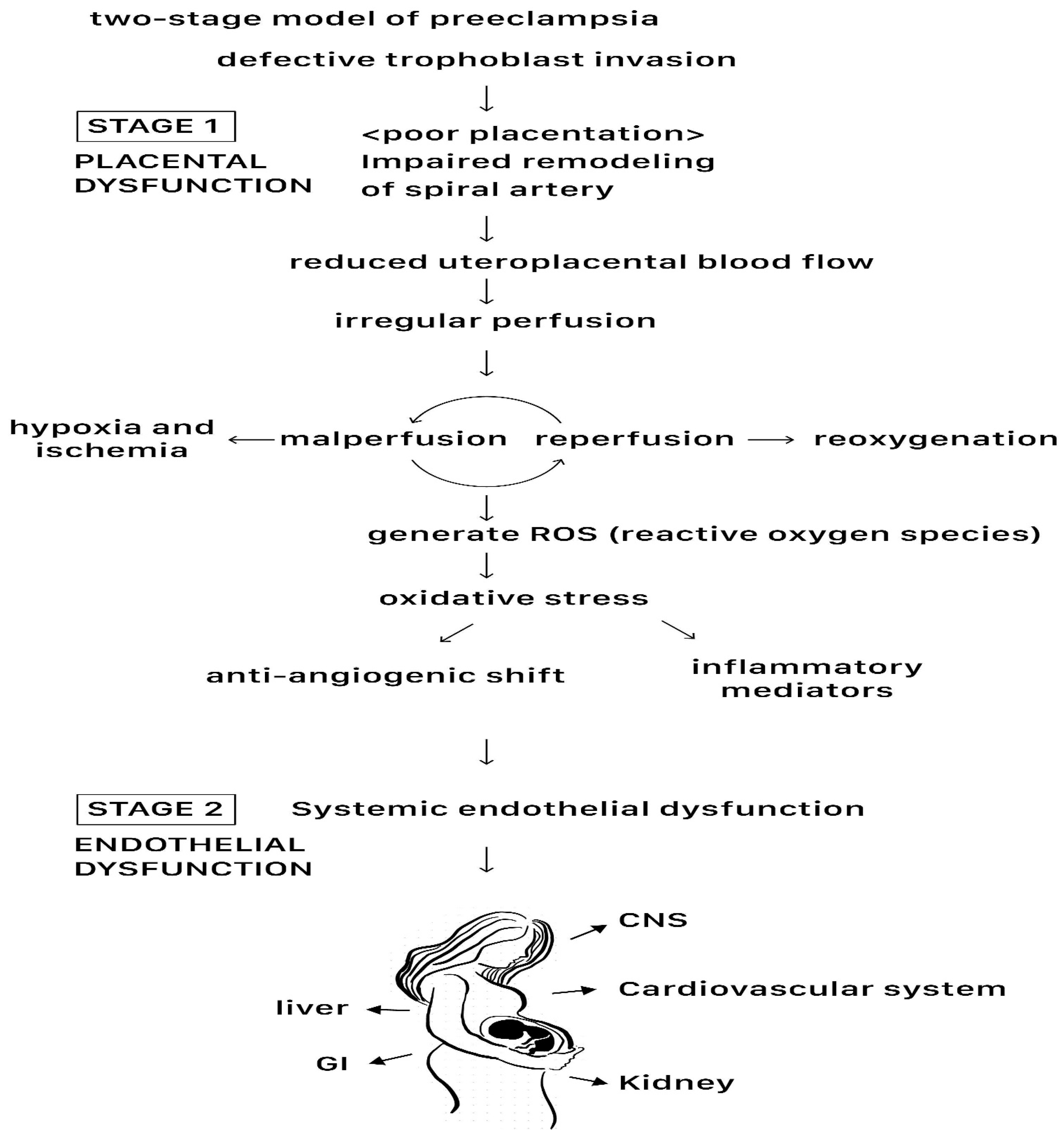
Preeclampsia, a serious complication of pregnancy, involves intricate molecular and cellular mechanisms. Fetal microchimerism, where fetal cells persist within maternal tissues and in circulation, acts as a mechanistic link between placental dysfunction and maternal complications in the two-stage model of preeclampsia. Hormones, complements, and cytokines play pivotal roles in the pathophysiology, influencing immune responses, arterial remodeling, and endothelial function. Also, soluble HLA-G, involved in maternal–fetal immune tolerance, is reduced in preeclampsia. Hypoxia-inducible factor 1-alpha (Hif-α) dysregulation leads to placental abnormalities and preeclampsia-like symptoms. Alterations in matrix metalloproteinases (MMPs), endothelins (ETs), chemokines, and cytokines contribute to defective trophoblast invasion, endothelial dysfunction, and inflammation. Preeclampsia’s genetic complexity includes circRNAs, miRNAs, and lncRNAs. CircRNA_06354 is linked to early-onset preeclampsia by influencing trophoblast invasion via the hsa-miR-92a-3p/VEGF-A pathway. The dysregulation of C19MC, especially miR-519d and miR-517-5p, affects trophoblast function. Additionally, lncRNAs like IGFBP1 and EGFR-AS1, along with protein-coding genes, impact trophoblast regulation and angiogenesis, influencing both preeclampsia and fetal growth. Besides aberrations in CD31+ cells, other potential biomarkers such as MMPs, soluble HLA-G, and hCG hold promise for predicting preeclampsia and its complications. Therapeutic interventions targeting factors such as peroxisome PPAR-γ and endothelin receptors show potential in mitigating preeclampsia-related complications. In conclusion, preeclampsia is a complex disorder with a multifactorial etiology and pathogenesis. Fetal microchimerism, hormones, complements, and cytokines contribute to placental and endothelial dysfunction with inflammation. Identifying novel biomarkers and therapeutic targets offers promise for early diagnosis and effective management, ultimately reducing maternal and fetal morbidity and mortality. However, further research is warranted to translate these findings into clinical practice and enhance outcomes for at-risk women.
Keywords: preeclampsia; VEGF; PlGF; sFlt-1; hormones; genetics preeclampsia; VEGF; PlGF; sFlt-1; hormones; genetics