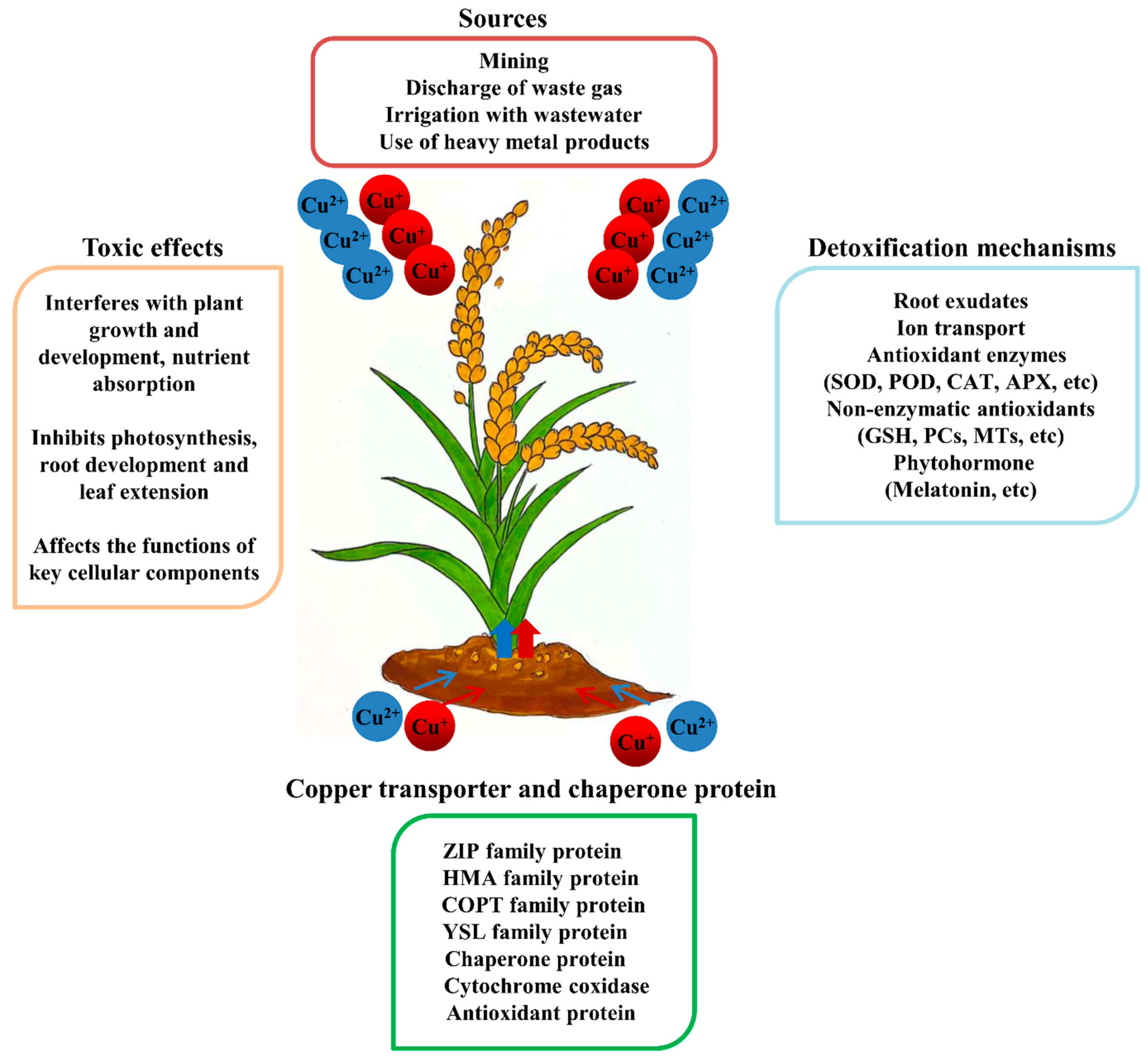
Physiological and Molecular Mechanisms of Plant Responses to Copper Stress



Abstract
1. Introduction
2. The Biological Functions of Copper
3. Cu Toxicity
3.1. Soil Contamination
3.2. Root Damage
3.3. Nutrient Deficiency
3.4. Inhibition of Photosynthesis
4. Absorption and Transport of Copper in Plants
4.1. Copper Transporters
4.1.1. Heavy Metal ATPases
4.1.2. Copper Transporter Proteins (COPTs)
4.1.3. ZIP
4.1.4. YSL Proteins
4.1.5. Natural Resistance-Associated Macrophage Proteins (NRAMPs)
4.2. Copper Chaperones
5. Mechanisms of Copper Detoxification and Tolerance in Plants
5.1. Root Exudates
5.2. Ion Transport
5.3. Antioxidative Enzymes
5.4. Non-Enzymatic Antioxidants
5.4.1. Glutathione
5.4.2. Phytochelatins (PCs)
5.4.3. Metallothioneins (MTs)
5.4.4. Melatonin
6. Conclusions and Future Perspective
Author Contributions
Funding
Institutional Review Board Statement
Informed Consent Statement
Data Availability Statement
Conflicts of Interest
References
- Nazir, F.; Hussain, A.; Fariduddin, Q. Hydrogen peroxide modulate photosynthesis and antioxidant systems in tomato (Solanum lycopersicum L.) plants under copper stress. Chemosphere 2019, 230, 544–558. [Google Scholar] [CrossRef] [Scilit] [PubMed]
- Leng, X.; Mu, Q.; Wang, X.; Li, X.; Zhu, X.; Shangguan, L.; Fang, J. Transporters, chaperones, and P-type ATPases controlling grapevine copper homeostasis. Funct. Integr. Genom. 2015, 15, 673–684. [Google Scholar] [CrossRef] [Scilit] [PubMed]
- Zhang, D.; Liu, X.; Ma, J.; Yang, H.; Zhang, W.; Li, C. Genotypic differences and glutathione metabolism response in wheat exposed to copper. Environ. Exp. Bot. 2019, 157, 250–259. [Google Scholar] [CrossRef] [Scilit]
- Gong, Q.; Li, Z.H.; Wang, L.; Zhou, J.Y.; Kang, Q.; Niu, D.D. Gibberellic acid application on biomass, oxidative stress response, and photosynthesis in spinach (Spinacia oleracea L.) seedlings under copper stress. Environ. Sci. Pollut. Res. Int. 2021, 28, 53594–53604. [Google Scholar] [CrossRef] [Scilit] [PubMed]
- Marschner, H. Mineral Nutrition of Higher Plants; Academic Press: London, UK, 1995. [Google Scholar]
- Epstein, E.; Bloom, A.J. Mineral Nutrition of Plants: Principles and Perspectives, 2nd ed.; Sinauer Associates, Inc.: Sunderland, MA, USA, 2005. [Google Scholar]
- Ruiter, H.J. Suspected copper deficiency in radiata pine. Plant Soil 1969, 31, 197–200. [Google Scholar] [CrossRef] [Scilit]
- Burkhead, J.L.; Gogolin Reynolds, K.A.; Abdel-Ghany, S.E.; Cohu, C.M.; Pilon, M. Copper homeostasis. New Phytol. 2009, 182, 799–816. [Google Scholar] [CrossRef] [Scilit]
- Barr, R.; Crane, F.L. Organization of electron transport in photosystem II of spinach chloroplasts according to chelator inhibition sites. Plant Physiol. 1976, 57, 450–453. [Google Scholar] [CrossRef] [Scilit]
- Lightbody, J.J.; Krogmann, D.W. Isolation and properties of plastocyanin from Anabaenavariabilis. Biochim. Biophys. Acta 1967, 131, 508–515. [Google Scholar] [CrossRef] [Scilit]
- Festa, R.A.; Thiele, D.J. Copper: An essential metal in biology. Curr. Biol. 2011, 21, R877–R883. [Google Scholar] [CrossRef] [Scilit]
- Rodrıguez, F.I.; Esch, J.J.; Hall, A.E.; Binder, B.M.; Schaller, G.E.; Bleecker, A.B. A copper cofactor for the ethylene receptor ETR1 from Arabidopsis. Science 1999, 283, 996–998. [Google Scholar] [CrossRef] [Scilit]
- Choi, M.; Davidson, V.L. Cupredoxins-a study of how proteins may evolve to use metals for bioenergetic processes. Metallomics 2011, 3, 140–151. [Google Scholar] [CrossRef] [Scilit] [PubMed]
- Møller, S.G.; McPherson, M.J. Developmental expression and biochemical analysis of the Arabidopsis atao1 gene encoding an H2O2-generating diamine oxidase. Plant J. 1998, 13, 781–791. [Google Scholar] [CrossRef] [Scilit] [PubMed]
- Adrees, M.; Ali, S.; Rizwan, M.; Ibrahim, M.; Abbas, F.; Farid, M.; Zia-Ur-Rehman, M.; Irshad, M.K.; Bharwana, S.A. The effect of excess copper on growth and physiology of important food crops: A review. Environ. Sci. Pollut. Res. Int. 2015, 22, 8148–8162. [Google Scholar] [CrossRef] [Scilit] [PubMed]
- Azeez, M.O.; Adesanwo, O.O.; Adepetu, J.A. Effect of Copper (Cu) application on soil available nutrients and uptake. Acad. J. 2015, 10, 359–364. [Google Scholar]
- Yruela, I. Copper in plants: Acquisition, transport and interactions. Funct. Plant Biol. 2009, 36, 409–430. [Google Scholar] [CrossRef] [Scilit]
- Marques, D.M.; Da Silva, A.B.; Mantovani, J.R.; Magalhães, P.C.; De Souza, T.C. Root morphology and leaf gas exchange in Peltophorum dubium (Spreng.) Taub. (Caesalpinioideae) exposed to copper-induced toxicity. S. Afr. J. Bot. 2019, 121, 186–192. [Google Scholar] [CrossRef] [Scilit]
- Park, S.; Back, K. Melatonin promotes seminal root elongation and root growth in transgenic rice after germination. J. Pineal Res. 2012, 53, 385–389. [Google Scholar] [CrossRef] [Scilit]
- Cui, Y.; Wang, M.; Yin, X.; Xu, G.; Song, S.; Li, M.; Liu, K.; Xia, X. OsMSR3, a small heat shock protein, confers enhanced tolerance to copper stress in Arabidopsis thaliana. Int. J. Mol. Sci. 2019, 20, 6096. [Google Scholar] [CrossRef] [Scilit]
- Batool, R.; Hameed, M.; Ashraf, M.; Ahmad, M.S.A.; Fatima, S. Physio-Anatomical Responses of Plants to Heavy Metals; Springer: Dordrecht, The Netherlands, 2015; pp. 79–96. [Google Scholar]
- Baldi, E.; Miotto, A.; Ceretta, C.A.; Brunetto, G.; Muzzi, E.; Sorrenti, G.; Quartieri, M.; Toselli, M. Soil application of P can mitigate the copper toxicity in grapevine: Physiological implications. Sci. Hortic. 2018, 238, 400–407. [Google Scholar] [CrossRef] [Scilit]
- Hippler, F.W.R.; Mattos, D., Jr.; Boaretto, R.M.; Williams, L.E. Copper excess reduces nitrate uptake by Arabidopsis roots with specific effects on gene expression. J. Plant Physiol. 2018, 228, 158–165. [Google Scholar] [CrossRef] [Scilit]
- Hippler, F.W.R.; Cipriano, D.O.; Boaretto, R.M.; Quaggio, J.A.; Gaziola, S.A.; Azevedo, R.A.; Mattos, D., Jr. Citrus rootstocks regulate the nutritional status and antioxidant system of trees under copper stress. Environ. Exp. Bot. 2016, 130, 42–52. [Google Scholar] [CrossRef] [Scilit]
- Hong, J.; Rico, C.M.; Zhao, L.; Adeleye, A.S.; Keller, A.A.; Peralta-Videa, J.R.; Gardea-Torresdey, J.L. Toxic effects of copper-based nanoparticles or compounds to lettuce (Lactuca sativa) and alfalfa (Medicago sativa). Environ. Sci. Process. Impacts 2015, 17, 177–185. [Google Scholar] [CrossRef] [Scilit]
- Roy, S.K.; Cho, S.W.; Kwon, S.J.; Kamal, A.H.M.; Lee, D.G.; Sarker, K.; Lee, M.S.; Xin, Z.; Woo, S.H. Proteome characterization of copper stress responses in the roots of sorghum. Biometals Int. J. Role Met. Ions Biol. Biochem. Med. 2017, 30, 765–785. [Google Scholar] [CrossRef] [Scilit]
- Vassilev, A.; Lidon, F.; Ramalho, J.C.; do Céu Matos, M.; da Graca, M. Effects of excess Cu on growth and photosynthesis of barley plants. Implication with a screening test for Cu tolerance. J. Cent. Eur. Agric. 2003, 4, 225–236. [Google Scholar]
- González-Mendoza, D.; Gil, F.E.; Escoboza-Garcia, F.; Santamaría, J.M.; Zapata-Perez, O. Copper Stress on Photosynthesis of Black Mangle (Avicennia germinans). An. Acad. Bras. De Cienc. 2013, 85, 665–670. [Google Scholar] [CrossRef] [Scilit]
- Hossain, M.S.; Abdelrahman, M.; Tran, C.D.; Nguyen, K.H.; Chu, H.D.; Watanabe, Y.; Hasanuzzaman, M.; Mohsin, S.M.; Fujita, M.; Tran, L.S.P. Insights into acetate-mediated copper homeostasis and antioxidant defense in lentil under excessive copper stress. Environ. Pollut. 2020, 258, 113544. [Google Scholar] [CrossRef] [Scilit]
- Panou-Filotheou, H.; Bosabalidis, A.M.; Karataglis, S. Effects of Copper Toxicity on Leaves of Oregano (Origanum vulgare subsp. hirtum). Ann. Bot. 2001, 88, 207–214. [Google Scholar] [CrossRef] [Scilit]
- Cambrollé, J.; García, J.L.; Figueroa, M.E.; Cantos, M. Evaluating wild grapevine tolerance to copper toxicity. Chemosphere 2015, 120, 171–178. [Google Scholar] [CrossRef] [Scilit]
- Xu, Q.; Qiu, H.; Chu, W.; Fu, Y.; Cai, S.; Min, H.; Sha, S. Copper ultrastructural localization, subcellular distribution, and phytotoxicity in Hydrilla verticillata (L.f.) Royle. Environ. Sci. Pollut. Res. Int. 2013, 20, 8672–8679. [Google Scholar] [CrossRef] [Scilit]
- Yamaji, N.; Ma, J.F. The node, a hub for mineral nutrient distribution in graminaceous plants. Trends Plant Sci. 2014, 19, 556–563. [Google Scholar] [CrossRef] [Scilit]
- Sasaki, A.; Yamaji, N.; Ma, J.F. Transporters involved in mineral nutrient uptake in rice. J. Exp. Bot. 2016, 67, 3645–3653. [Google Scholar] [CrossRef] [Scilit] [PubMed]
- Colangelo, E.P.; Guerinot, M.L. Put the metal to the petal: Metal uptake and transport throughout plants. Curr. Opin. Plant Biol. 2006, 9, 322–330. [Google Scholar] [CrossRef] [Scilit]
- Ghazaryan, K.; Movsesyan, H.; Ghazaryan, N.; Watts, B.A. Copper phytoremediation potential of wild plant species growing in the mine polluted areas of Armenia. Environ. Pollut. 2019, 249, 491–501. [Google Scholar] [CrossRef] [Scilit]
- Sanz, A.; Pike, S.; Khan, M.A.; Carrió-Seguí, À.; Mendoza-Cózatl, D.G.; Peñarrubia, L.; Gassmann, W. Copper uptake mechanism of Arabidopsis thaliana high-affinity COPT transporters. Protoplasma 2018, 256, 161–170. [Google Scholar] [CrossRef] [Scilit] [PubMed]
- Senovilla, M.; Abreu, I.; Abreu, I.; Senovilla, M.; Castro-Rodríguez, R.; Abreu, I.; Escudero, V.; Kryvoruchko, I.; Udvardi, M.K.; Imperial, J.; et al. Medicago truncatula copper transporter 1 (MtCOPT1) delivers copper for symbiotic nitrogen fixation. New Phytol. 2018, 218, 696–709. [Google Scholar] [CrossRef] [Scilit] [PubMed]
- Garcia-Molina, A.; Andrés-Colás, N.; Perea-García, A.; Neumann, U.; Dodani, S.C.; Huijser, P.; Penarrubia, L.; Puig, S. The Arabidopsis COPT6 Transport Protein Functions In Copper Distribution Under Copper-Deficient Conditions. Plant Cell Physiol. 2013, 54, 1378–1390. [Google Scholar] [CrossRef] [Scilit] [PubMed]
- Boutigny, S.; Sautron, E.; Finazzi, G.; Rivasseau, C.; Frelet-Barrand, A.; Pilon, M.; Rolland, N.; Seigneurin-Berny, D. HMA1 and PAA1, two chloroplast-envelope PIB-ATPases, play distinct roles in chloroplast copper homeostasis. J. Exp. Bot. 2014, 65, 1529–1540. [Google Scholar] [CrossRef] [Scilit]
- Andrés-Colás, N.; Sancenón, V.; Rodríguez-Navarro, S.; Mayo, S.; Thiele, D.J.; Ecker, J.R.; Puig, S. The Arabidopsis heavy metal P-type ATPase HMA5 interacts with metallochaperones and functions in copper detoxification of roots. Plant J. 2006, 45, 225–236. [Google Scholar] [CrossRef] [Scilit]
- Catty, P.; Boutigny, S.; Miras, R.; Joyard, J.; Rolland, N.; Seigneurin-Berny, D. Biochemical characterization of AtHMA6/PAA1, a chloroplast envelope Cu(I)-ATPase. J. Biol. Chem. 2011, 286, 36188–36197. [Google Scholar] [CrossRef] [Scilit]
- Himelblau, E.; Amasino, R.M. Nutrients mobilized from leaves of Arabidopsis thaliana during leaf senescence. J. Plant Physiol. 2001, 158, 1317–1323. [Google Scholar] [CrossRef] [Scilit]
- Gayomba, S.R.; Jung, H.I.; Yan, J.; Danku, J.; Rutzke, M.A.; Bernal, M.; Krämer, U.; Kochian, L.V.; Salt, D.E.; Vatamaniuk, O.K. The CTR/COPT-dependent copper uptake and SPL7-dependent copper deficiency responses are required for basal cadmium tolerance in A. thaliana. Metallomics 2013, 5, 1262–1275. [Google Scholar] [CrossRef] [Scilit] [PubMed]
- Waters, B.M.; Chu, H.H.; Didonato, R.J.; Roberts, L.A.; Eisley, R.B.; Lahner, B.; Salt, D.E.; Walker, E.L. Mutations in arabidopsis yellow stripe-like1 and yellow stripe-like3 reveal their roles in metal ion homeostasis and loading of metal ions in seeds. Plant Physiol. 2006, 141, 1446–1458. [Google Scholar] [CrossRef] [Scilit] [PubMed]
- DiDonato, R.J., Jr.; Roberts, L.A.; Sanderson, T.; Eisley, R.B.; Walker, E.L. Arabidopsis yellow stripe-like2 (YSL2): A metal-regulated gene encoding a plasma membrane transporter of nicotianamine-metal complexes. Plant J. 2004, 39, 403–414. [Google Scholar] [CrossRef] [Scilit]
- Guerinot, M.L. The ZIP family of metal transporters. Biochim. Biophys. Acta (BBA)-Biomembr. 2000, 1465, 190–198. [Google Scholar] [CrossRef] [Scilit]
- Carrió-Seguí, À.; Romero, P.; Curie, C.; Mari, S.; Peñarrubia, L. Copper transporter COPT5 participates in the crosstalk between vacuolar copper and iron pools mobilisation. Sci. Rep. 2019, 9, 4648. [Google Scholar] [CrossRef] [Scilit]
- Perea-García, A.; Garcia-Molina, A.; Andrés-Colás, N.; Vera-Sirera, F.; Pérez-Amador, M.A.; Puig, S.; Peñarrubia, L. Arabidopsis copper transport protein COPT2 participates in the cross talk between iron deficiency responses and low-phosphate signaling. Plant Physiol. 2013, 162, 180–194. [Google Scholar] [CrossRef] [Scilit]
- Lee, S.; Kim, Y.Y.; Lee, Y.; An, G. Rice P1B-type heavy-metal ATPase, OsHMA9, is a metal efflux protein. Plant Physiol. 2007, 145, 831–842. [Google Scholar] [CrossRef] [Scilit]
- Zheng, L.; Yamaji, N.; Yokosho, K.; Ma, J.F. YSL16 Is a phloem-localized transporter of the copper-nicotianamine Complex that is responsible for copper distribution in rice. Plant Cell 2012, 24, 3767–3782. [Google Scholar] [CrossRef] [Scilit]
- Martins, V.; Bassil, E.; Hanana, M.; Blumwald, E.; Gerós, H. Copper homeostasis in grapevine: Functional characterization of the Vitis vinifera copper transporter 1. Planta 2014, 240, 91–101. [Google Scholar] [CrossRef] [Scilit]
- Martins, V.; Hanana, M.; Blumwald, E.; Gerós, H. Copper transport and compartmentation in grape cells. Plant Cell Physiol. 2012, 53, 1866–1880. [Google Scholar] [CrossRef] [Scilit]
- Li, H.; Fan, R.; Li, L.; Wei, B.; Li, G.; Gu, L.; Wang, X.; Zhang, X. Identification and characterization of a novel copper transporter gene family TaCT1 in common wheat. Plant Cell Environ. 2014, 37, 1561–1573. [Google Scholar] [CrossRef] [Scilit] [PubMed]
- Billard, V.; Ourry, A.; Maillard, A.; Garnica, M.; Coquet, L.; Jouenne, T.; Cruz, F.; Garcia-Mina, J.M.; Yvin, J.C.; Etienne, P. Copper-deficiency in brassica napus induces copper remobilization, molybdenum accumulation and modification of the expression of chloroplastic proteins. PLoS ONE 2017, 9, e109889. [Google Scholar] [CrossRef] [Scilit] [PubMed]
- Bernal, M.; Testillano, P.S.; Alfonso, M.; del Carmen Risueño, M.; Picorel, R.; Yruela, I. Identification and subcellular localization of the soybean copper P1B-ATPase GmHMA8 transporter. J. Struct. Biol. 2007, 158, 46–58. [Google Scholar] [CrossRef] [Scilit] [PubMed]
- Mikkelsen, M.D.; Pedas, P.; Schiller, M.; Vincze, E.; Mills, R.F.; Borg, S.; Møller, A.; Schjoerring, J.K.; Williams, L.E.; Baekgaard, L.; et al. Barley HvHMA1 is a heavy metal pump involved in mobilizing organellar Zn and Cu and plays a role in metal loading into grains. PLoS ONE 2012, 7, e49027. [Google Scholar] [CrossRef] [Scilit]
- Araki, R.; Murata, J.; Murata, Y. A novel barley yellow stripe 1-like transporter (HvYSL2) localized to the root endodermis transports metal-phytosiderophore complexes. Plant Cell Physiol. 2011, 52, 1931–1940. [Google Scholar] [CrossRef] [Scilit]
- Dai, J.; Wang, N.; Xiong, H.; Qiu, W.; Nakanishi, H.; Kobayashi, T.; Nishizawa, N.K.; Zuo, Y. The Yellow Stripe-Like (YSL) Gene Functions in Internal Copper Transport in Peanut. Genes 2018, 9, 635. [Google Scholar] [CrossRef] [Scilit]
- Palmgren, M.G.; Nissen, P. P-type ATPases. Annu. Rev. Biophys. 2011, 40, 243–266. [Google Scholar] [CrossRef] [Scilit]
- Omasits, U.; Ahrens, C.H.; Müller, S.; Wollscheid, B. Protter: Interactive protein feature visualization and integration with experimental proteomic data. Bioinformatics 2014, 30, 884–886. [Google Scholar] [CrossRef] [Scilit]
- Møller, J.V.; Olesen, C.; Winther, A.M.L.; Nissen, P. What can be learned about the function of a single protein from its various X-ray structures: The example of the sarcoplasmic calcium pump. Methods Mol. Biol. 2010, 654, 119–140. [Google Scholar]
- Blaby-Haas, C.E.; Padilla-Benavides, T.; Stübe, R.; Argüello, J.M.; Merchant, S.S. Evolution of a plant-specific copper chaperone family for chloroplast copper homeostasis. Proc. Natl. Acad. Sci. USA 2014, 111, 5480–5487. [Google Scholar] [CrossRef] [Scilit]
- Hussain, D.; Haydon, M.J.; Wang, Y.; Wong, E.; Sherson, S.M.; Young, J.; Camakaris, J.; Harper, J.F.; Cobbett, C.S. P-type ATPase heavy metal transporters with roles in essential zinc homeostasis in Arabidopsis. Plant Cell 2004, 16, 1327–1339. [Google Scholar] [CrossRef] [Scilit] [PubMed]
- Seigneurin-Berny, D.; Gravot, A.; Auroy, P.; Mazard, C.; Kraut, A.; Finazzi, G.; Grunwald, D.; Rappaport, F.; Vavasseur, A.; Joyard, J.; et al. HMA1, a new Cu-ATPase of the chloroplast envelope, is essential for growth under adverse light conditions. J. Biol. Chem. 2006, 281, 2882–2892. [Google Scholar] [CrossRef] [Scilit]
- Moreno, I.; Norambuena, L.; Maturana, D.; Toro, M.; Vergara, C.; Orellana, A.; Zurita-Silva, A.; Ordenes, V.R. AtHMA1 is a thapsigargin-sensitive Ca2+/Heavy metal pump. J. Biol. Chem. 2008, 283, 9633–9641. [Google Scholar] [CrossRef] [Scilit]
- Li, J.; Liang, H.; Yan, M.; Chen, L.; Zhang, H.; Liu, J.; Wang, S.; Jin, Z. Arbuscular mycorrhiza fungi facilitate rapid adaptation of Elsholtzia splendens to copper. Sci. Total Environ. 2017, 599–600, 1462–1468. [Google Scholar] [CrossRef] [Scilit] [PubMed]
- del Pozo, T.; Cambiazo, V.; González, M. Gene expression profiling analysis of copper homeostasis in Arabidopsis thaliana. Biochem. Biophys. Res. Commun. 2010, 393, 248–252. [Google Scholar] [CrossRef] [Scilit]
- Woeste, K.E.; Kieber, J.J. Strong loss-of-function mutation in RAN1 results in constitutive activation of the ethylene response pathway as well as a rosette-lethal phenotype. Plant Cell 2000, 12, 443–455. [Google Scholar] [CrossRef] [Scilit] [PubMed]
- Migocka, M.; Posyniak, E.; Maciaszczyk-Dziubinska, E.; Papierniak, A.; Kosieradzaka, A. Functional and Biochemical Characterization of Cucumber Genes Encoding Two Copper ATPases CsHMA5.1 and CsHMA5.2. J. Biol. Chem. 2015, 290, 15717–15729. [Google Scholar] [CrossRef] [Scilit]
- Jung, H.I.; Gayomba, S.R.; Rutzke, M.A.; Craft, E.; Kochian, L.V.; Vatamaniuk, O.K. COPT6 is a plasma membrane transporter that functions in copper homeostasis in arabidopsis and is a novel target of SQUAMOSA promoter-binding protein-like 7. J. Biol. Chem. 2012, 287, 33252–33267. [Google Scholar] [CrossRef] [Scilit]
- Sancenón, V.; Puig, S.; Mira, H.; Thiele, D.J.; Peñarrubia, L. Identification of a copper transporter family in Arabidopsis thaliana. Plant Mol. Biol. 2003, 51, 577–587. [Google Scholar] [CrossRef] [Scilit]
- Ana, R.M.; Nuria, A.C.; Charlotte, P.; Rodrigo-Moreno, A.; Andrés-Colás, N.; Poschenrieder, C.; Gunsé, B.; Peñarrubia, L.; Shabala, S. Calcium- and potassium-permeable plasma membrane transporters are activated by copper in Arabidopsis root tips: Linking copper transport with cytosolic hydroxyl radical production. Plant Cell Environ. 2013, 36, 844–855. [Google Scholar]
- Garcia, L.; Welchen, E.; Gonzalez, D.H. Mitochondria and copper homeostasis in plants. Mitochondrion 2014, 19, 269–274. [Google Scholar] [CrossRef] [Scilit] [PubMed]
- Bock, K.W.; Honys, D.; Ward, J.M.; Padmanaban, S.; Nawrocki, E.P.; Hirschi, K.D.; Twell, D.; Sze, H. Integrating membrane transport with male gametophyte development and function through transcriptomics. Plant Physiol. 2006, 140, 1151–1168. [Google Scholar] [CrossRef] [Scilit]
- Andrés-Colás, N.; Carrió-Seguí, A.; Abdel-Ghany, S.E.; Pilon, M.; Peñarrubia, L. Expression of the intracellular COPT3-mediated Cu transport is temporally regulated by the TCP16 transcription factor. Front. Plant Sci. 2018, 9, 910. [Google Scholar] [CrossRef] [Scilit] [PubMed]
- Klaumann, S.; Nickolaus, S.D.; Fürst, S.H.; Starck, S.; Schneider, S.; Neuhaus, H.E.; Trentmann, O. The tonoplast copper transporter COPT5 acts as an exporter and is required for interorgan allocation of copper in Arabidopsis thaliana. New Phytol. 2011, 192, 393–404. [Google Scholar] [CrossRef] [Scilit] [PubMed]
- Garcia-Molina, A.; Andrés-Colás, N.; Perea-García, A.; del Valle-Tascón, S.; Peñarrubia, L.; Puig, S. The intracellular Arabidopsis COPT5 transport protein is required for photosynthetic electron transport under severe copper deficiency. Plant J. 2011, 65, 848–860. [Google Scholar] [CrossRef] [Scilit] [PubMed]
- Carrió-Seguí, A.; Garcia-Molina, A.; Sanz, A.; Penarrubia, L. Defective copper transport in the copt5 mutant affects cadmium tolerance. Plant Cell Physiol. 2015, 56, 442–454. [Google Scholar] [CrossRef] [Scilit]
- Milner, M.J.; Seamon, J.; Craft, E.; Kochian, L.V. Transport properties of members of the ZIP family in plants and their role in Zn and Mn homeostasis. J. Exp. Bot. 2013, 64, 369–381. [Google Scholar] [CrossRef] [Scilit]
- Liu, X.S.; Feng, S.J.; Zhang, B.Q.; Wang, M.Q.; Cao, H.W.; Rono, J.K.; Chen, X.; Yang, Z.M. OsZIP1 functions as a metal efflux transporter limiting excess zinc, copper and cadmium accumulation in rice. BMC Plant Biol. 2019, 19, 283. [Google Scholar] [CrossRef] [Scilit]
- Chen, C.C.; Chen, Y.Y.; Tang, I.C.; Liang, H.M.; Lai, C.C.; Chiou, J.M.; Yeh, K.C. Arabidopsis SUMO E3 ligase SIZ1 is involved in excess copper tolerance. Plant Physiol. 2011, 156, 2225–2234. [Google Scholar] [CrossRef] [Scilit]
- Zhang, C.; Lu, W.; Yang, Y.; Shen, Z.; Ma, J.F.; Zheng, L. OsYSL16 is required for preferential Cu distribution to floral rrgans in rice. Plant Cell Physiol. 2018, 59, 2039–2051. [Google Scholar] [CrossRef] [Scilit]
- Guo, J.; Green, B.R.; Maldonado, M.T. Sequence analysis and gene expression of potential components of copper transport and homeostasis in thalassiosira pseudonana. Protist 2015, 166, 58–77. [Google Scholar] [CrossRef] [Scilit] [PubMed]
- Li, Y.H.; Yu, L.L.; Li, C.Y.; Zhang, M.M.; Zhang, X.Q.; Fang, Y.X.; Xue, D.W. Genome-wide identification of barley NRAMP and gene expression analysis under heavy metal stress. Biotechnol. Bull. 2022, 38, 103–111. [Google Scholar] [CrossRef]
- Chou, M.; Sun, Y.; Yang, J.; Wang, Y.; Li, Y.; Yuan, G.; Zhang, D.; Wang, J.; Wei, G. Comprehensive analysis of phenotype, microstructure and global transcriptional profiling to unravel the effect of excess copper on the symbiosis between nitrogen-fixing bacteria and Medicago lupulina. Sci. Total Environ. 2019, 656, 1346–1357. [Google Scholar] [CrossRef] [Scilit] [PubMed]
- Palumaa, P. Copper chaperones. The concept of conformational control in the metabolism of copper. FEBS Lett. 2013, 587, 1902–1910. [Google Scholar] [CrossRef] [Scilit]
- O’Halloran, T.V.; Culotta, V.C. Metallochaperones, an Intracellular Shuttle Service for Metal Ions. J. Biol. Chem. 2000, 275, 25057–25060. [Google Scholar] [CrossRef] [Scilit]
- Mira, H.; Martínez-García, F.; Peñarrubia, L. Evidence for the plant-specific intercellular transport of the Arabidopsis copper chaperone CCH. Plant J. 2001, 25, 521–528. [Google Scholar] [CrossRef] [Scilit]
- Chu, C.C.; Lee, W.C.; Guo, W.Y.; Pan, S.M.; Chen, L.J.; Li, H.M.; Jinn, T.L. A Copper Chaperone for Superoxide Dismutase That Confers Three Types of Copper/Zinc Superoxide Dismutase Activity in Arabidopsis. Plant Physiol. 2005, 139, 425–436. [Google Scholar] [CrossRef] [Scilit]
- Puig, S.; Mira, H.; Dorcey, E.; Sancenon, V.; Andrés-Colás, N.; Garcia-Molina, A.; Burkhead, J.L.; Gogolin, K.A.; Abdel-Ghany, S.E.; Thiele, D.J.; et al. Higher plants possess two different types of ATX1-like copper chaperones. Biochem. Biophys. Res. Commun. 2007, 354, 385–390. [Google Scholar] [CrossRef] [Scilit]
- Shin, L.J.; Lo, J.C.; Yeh, K.C. Copper Chaperone Antioxidant Protein1 Is Essential for Copper Homeostasis. Plant Physiol. 2012, 159, 1099–1110. [Google Scholar] [CrossRef] [Scilit]
- Shin, L.J.; Yeh, K.C. Overexpression of Arabidopsis ATX1 retards plant growth under severe copper deficiency. Plant Signal. Behav. 2012, 7, 1082–1083. [Google Scholar] [CrossRef] [Scilit]
- Attallah, C.V.; Welchen, E.; Gonzalez, D.H. The promoters of Arabidopsis thaliana genes AtCOX17-1 and-2, encoding a copper chaperone involved in cytochrome c oxidase biogenesis, are preferentially active in roots and anthers and induced by biotic and abiotic stress. Physiol. Plant. 2007, 129, 123–134. [Google Scholar] [CrossRef] [Scilit]
- Peñarrubia, L.; Romero, P.; Carrió-Seguí, A.; Andrés-Bordería, A.; Moreno, J.; Sanz, A. Temporal aspects of copper homeostasis and its crosstalk with hormones. Front. Plant Sci. 2015, 6, 255. [Google Scholar] [CrossRef] [Scilit] [PubMed]
- Kapoor, D.; Singh, S.; Kumar, V.; Romero, R.; Prasad, R.; Singh, J. Antioxidant enzymes regulation in plants in reference to reactive oxygen species (ROS) and reactive nitrogen species (RNS). Plant Gene 2019, 19, 100182. [Google Scholar] [CrossRef] [Scilit]
- Zhang, N.; Xue, C.; Wang, K.; Fang, Z. Efficient oxidative degradation of fluconazole by a heterogeneous Fenton process with Cu-V bimetallic catalysts. Chem. Eng. J. 2020, 380, 122516. [Google Scholar] [CrossRef] [Scilit]
- Liu, J.; Wen, X.S.; Lang, A.D. Progress in components and effects of plant root exudates. Food Drug 2007, 9, 63–65. [Google Scholar]
- Lyubenova, L.; Kuhn, A.J.; Höltkemeier, A.; Schröder, P. Root exudation pattern of Typha latifolia L. plants after copper exposure. Plant Soil 2013, 370, 187–195. [Google Scholar] [CrossRef] [Scilit]
- Jin, H.J.; Wang, H.X. Plant absorption and tolerance mechanism to heavy metal cadmium: Research progress. Chin. Agric. Sci. Bull. 2019, 35, 52–57. [Google Scholar]
- Yadav, P.; Kaur, R.; Kanwar, M.K.; Sharma, A.; Verma, V.; Sirhindi, G.; Bhardwaj, R. Castasterone confers copper stress tolerance by regulating antioxidant enzyme responses, antioxidants, and amino acid balance in B. juncea seedlings. Ecotoxicol. Environ. Saf. 2018, 147, 725–734. [Google Scholar] [CrossRef] [Scilit]
- Zhu, K.Z. Preliminary Study on β-aminobutyric Acid Induce Tobacco against Copper, Cadmium Stress; University of Science and Technology of China: Hefei, China, 2014. [Google Scholar]
- Migocka, M.; Malas, K. Plant responses to copper: Molecular and regulatory mechanisms of copper uptake, distribution and accumulation in plants. In Plant Micronutrient Use Efficiency; Academic Press: Cambridge, MA, USA, 2018; pp. 71–86. [Google Scholar]
- Printz, B.; Lutts, S.; Hausman, J.F.; Sergeant, K. Copper trafficking in plants and its implication on cell wall dynamics. Front. Plant Sci. 2016, 7, 601. [Google Scholar] [CrossRef] [Scilit]
- Wang, Z.; Chen, M.; Yang, Y.; Fang, X.; Liu, Z.; Wang, L.; Ge, M.; Zhang, C.; Fang, J.; Shangguan, L. Effects of copper stress on plant growth and advances in the mechanisms of plant tolerance research. J. Plant Nutr. Fertil. 2021, 27, 1849–1863. [Google Scholar]
- Gong, Q.; Wang, L.; Dai, T.; Zhou, J.; Kang, Q.; Chen, H.; Li, K.; Li, Z. Effects of copper on the growth, antioxidant enzymes and photosynthesis of spinach seedlings. Ecotoxicol. Environ. Saf. 2019, 171, 771–780. [Google Scholar] [CrossRef] [Scilit]
- Shahid, M.; Pourrut, B.; Dumat, C.; Nadeem, M.; Aslam, M.; Pinelli, E. Heavy-metal-induced reactive oxygen species: Phytotoxicity and physicochemical changes in plants. Rev Environ Contam Toxicol. 2014, 232, 1–44. [Google Scholar]
- Tan, J.J. EDDS Alleviates the Effects of Excessive Copper on the Physiology Biochemistry and Epigenetics of Rice; Wuhan University: Wuhan, China, 2014. [Google Scholar]
- Ogunkunle, C.O.; Jimoh, M.A.; Asogwa, N.T.; Viswanathan, K.; Vishwakarma, V.; Fatoba, P.O. Effects of manufactured nano-copper on copper uptake, bioaccumulation and enzyme activities in cowpea grown on soil substrate. Ecotoxicol Environ. Saf. 2018, 155, 86–93. [Google Scholar] [CrossRef] [Scilit] [PubMed]
- Saleem, M.H.; Kamran, M.; Zhou, Y.; Parveen, A.; Rehman, M.; Ahmar, S.; Malik, Z.; Mustafa, A.; Anjum, R.M.A.; Wang, B.; et al. Appraising growth, oxidative stress and copper phytoextraction potential of flax (Linum usitatissimum L.) grown in soil differentially spiked with copper. J. Environ. Manag. 2020, 257, 109994. [Google Scholar] [CrossRef] [Scilit] [PubMed]
- Younis, M.E.; Tourky, S.M.N.; Elsharkawy, S.E.A. Symptomatic parameters of oxidative stress and antioxidant defense system in Phaseolus vulgaris L. in response to copper or cadmium stress. S. Afr. J. Bot. 2018, 117, 207–214. [Google Scholar] [CrossRef] [Scilit]
- Noctor, G.; Mhamdi, A.; Chaouch, S.; Han, Y.I.; Neukermans, J.; Marquez-Garcia, B.; Queval, G.; Foyer, C.H. Glutathione in plants: An integrated overview. Plant Cell Environ. 2012, 35, 454–484. [Google Scholar] [CrossRef] [Scilit] [PubMed]
- Conte, S.S.; Chu, H.H.; Chan-Rodriguez, D.; Punshon, T.; Vasques, K.A.; Salt, D.E.; Walker, E.L. Arabidopsis thaliana Yellow Stripe1-Like4 and Yellow Stripe1-Like6 localize to internal cellular membranes and are involved in metal ion homeostasis. Front. Plant 2013, 4, 283. [Google Scholar] [CrossRef] [Scilit]
- Mostofa, M.G.; Seraj, Z.I.; Fujita, M. Exogenous sodium nitroprusside and glutathione alleviate copper toxicity by reducing copper uptake and oxidative damage in rice (Oryza sativa L.) seedlings. Protoplasma 2014, 251, 1373–1386. [Google Scholar] [CrossRef] [Scilit] [PubMed]
- Zlobin, I.E.; Kartashov, A.V.; Shpakovski, G.V. Different roles of glutathione in copper and zinc chelation in Brassica napus roots. Plant Physiol. Biochem. 2017, 118, 333–341. [Google Scholar] [CrossRef] [Scilit] [PubMed]
- Thounaojam, T.C.; Panda, P.; Mazumdar, P.; Kumar, D.; Sharma, G.D.; Sahoo, L.; Sanjib, P. Excess copper induced oxidative stress and response of antioxidants in rice. Plant Physiol. Biochem. 2012, 53, 33–39. [Google Scholar] [CrossRef] [Scilit]
- Rauser, W.E. Structure and function of metal chelators produced by plants: The case for organic acids, amino acids, phytin, and metallothioneins. Cell Biochem. Biophys. 1999, 31, 19–48. [Google Scholar] [CrossRef] [Scilit] [PubMed]
- Carrasco-Gil, S.; Alvarez-Fernández, A.; Sobrino-Plata, J.; Millán, R.; Carpena-Ruiz, R.O.; Leduc, D.L.; Andrews, J.C.; Abadía, J.; Hernández, L.E. Complexation of Hg with phytochelatins is important for plant Hg tolerance. Plant Cell Environ. 2011, 34, 778–791. [Google Scholar] [CrossRef] [Scilit]
- Navarrete, A.; González, A.; Gómez, M.; Contreras, R.A.; Díaz, P.; Lobos, G.; Brown, M.T.; Sáez, C.A.; Moenne, A. Copper excess detoxification is mediated by a coordinated and complementary induction of glutathione, phytochelatins and metallothioneins in the green seaweed Ulva compress. Plant Physiol. Biochem. 2019, 135, 423–431. [Google Scholar] [CrossRef] [Scilit] [PubMed]
- Liu, J.; Shi, X.; Qian, M.; Zheng, L.; Lian, C.; Xia, Y.; Shen, Z. Copper-induced hydrogen peroxide upregulation of a metallothionein gene, OsMT2c, from Oryza sativa L. confers copper tolerance in Arabidopsis thaliana. J. Hazard. Mater. 2015, 294, 99–108. [Google Scholar] [CrossRef] [Scilit] [PubMed]
- Liu, J. Study on the Function of Metallothionein OsMT2c Induced by Copper in Rice; Nanjing Agricultural University: Nanjing, China, 2015. [Google Scholar]
- Paredes, S.D.; Korkmaz, A.; Manchester, L.C.; Tan, D.X.; Reiter, R.J. Phytomelatonin: A review. J. Exp. Bot. 2009, 60, 57–69. [Google Scholar] [CrossRef] [Scilit] [PubMed]
- Cao, Y.Y.; Qi, C.D.; Li, S.; Wang, Z.; Wang, X.; Wang, J.; Ren, S.; Li, X.; Zhang, N.; Guo, Y.D. Melatonin Alleviates Copper Toxicity via Improving Copper Sequestration and ROS Scavenging in Cucumber. Plant Cell Physiol. 2019, 60, 562–574. [Google Scholar] [CrossRef] [Scilit] [PubMed]
- Zhao, X.; Xia, H.; Xie, Y.; Li, M.; Wang, Y.; Liang, D. Oxidation resistance of exogenous melatonin on leaves of kiwifruit seedlings under copper stress. In 2017 2nd International Conference on Civil, Transportation and Environmental Engineering (ICCTE 2017); Advances in Engineering Research; Atlantis Press: Amsterdam, The Netherlands, 2017; pp. 216–219. [Google Scholar]


| Species | Gene | Pattern of Expression | Subcellular Localization | References |
|---|---|---|---|---|
| Arabidopsis (Arabidopsis thaliana) | AtCOPT1 | Most tissues, roots, and reproductive tissues | Plasma membranes | [37,38] |
| AtCOPT2 | Most tissues and roots | Plasma membranes | [38,39] | |
| AtCOPT3 | Reproductive tissues | Plasma membranes | [37] | |
| AtCOPT5 | Most tissues, roots, and reproductive tissues | Vacuoles | [39] | |
| AtCOPT6 | Reproductive tissues, xylem, and phloem vascular tissues | Plasma membranes | [39] | |
| AtHMA1 | Green tissues | Chloroplast envelopes | [40] | |
| AtHMA5 | Roots and flowers | Plasma membranes | [41] | |
| AtHMA6 | Roots and shoots | Chloroplasts | [42] | |
| AtHMA7 | Roots and flowers | Endoplasmic reticulum | [43] | |
| AtHMA8 | Aboveground | Thylakoid membranes | [44] | |
| AtYSL1 | Most tissues and roots | Plasma membranes | [45] | |
| AtYSL2 | Most tissues, roots, and stems | Plasma membranes, vessels | [46] | |
| AtYSL3 | Young leaves, roots, and stems | Plasma membranes | [46] | |
| AtZIP2 | Roots | Cell membranes | [47] | |
| AtZIP4 | Roots | —— | [47] | |
| Rice (Oryza sativa) | OsCOPT1 | Most tissues, roots, and stems | Plasma membranes | [48] |
| OsCOPT2 | Most tissues and roots | Plasma membranes | [49] | |
| OsHMA5 | Xylem of vascular bundles at the nodes, pedicels, and petioles | Plasma membranes | [41] | |
| OsHMA9 | Xylem and phloem vascular tissue | Plasma membranes | [50] | |
| OsYSL16 | Phloem and vascular tissue of the roots, stems, and leaves | Plasma membranes | [51] | |
| Medicago (Medicago truncatula) | MtCOPT1 | Roots | Plasma membranes | [38] |
| MtCOPT3 | Nodules | —— | [38] | |
| MtCOPT4 | Roots | —— | [38] | |
| MtCOPT5 | Roots | —— | [38] | |
| MtCOPT8 | Root, xylem, and phloem vascular tissues | —— | [38] | |
| Grape (Vitis vinifera) | VvCTr1 | Xylem and phloem vascular tissue, leaves, and roots | Vacuole membranes | [52] |
| VvCTr2 | —— | —— | [53] | |
| VvCTr8 | —— | —— | [53] | |
| Wheat (Triticum aestivum) | TaCT1 | Xylem and phloem vascular tissue, roots, and grains | Golgi apparatus | [54] |
| Rape (Brassica napus) | BnHMA1 | Leaves | —— | [55] |
| BnCOPT2 | Roots | —— | [55] | |
| Soybean (Glycine max) | GmHMA8 | Leaves | Thylakoid membranes | [56] |
| Barley (Hordeum vulgare) | HvHMA1 | Leaves and seeds | Chloroplast envelopes | [57] |
| HvYSL2 | Stems, young leaves, and root endodermis | —— | [58] | |
| Peanut (Arachis hypogaea) | AhYSL3.1 | Roots, stems, young leaves, and old leaves | Plasma membranes | [59] |
| AhYSL3.2 | Roots, stems, young leaves, and old leaves | —— | [59] |
Publisher’s Note: MDPI stays neutral with regard to jurisdictional claims in published maps and institutional affiliations. |
© 2022 by the authors. Licensee MDPI, Basel, Switzerland. This article is an open access article distributed under the terms and conditions of the Creative Commons Attribution (CC BY) license (https://creativecommons.org/licenses/by/4.0/).
Share and Cite
Chen, G.; Li, J.; Han, H.; Du, R.; Wang, X. Physiological and Molecular Mechanisms of Plant Responses to Copper Stress. Int. J. Mol. Sci. 2022, 23, 12950. https://doi.org/10.3390/ijms232112950
Chen G, Li J, Han H, Du R, Wang X. Physiological and Molecular Mechanisms of Plant Responses to Copper Stress. International Journal of Molecular Sciences. 2022; 23(21):12950. https://doi.org/10.3390/ijms232112950
Chicago/Turabian StyleChen, Guang, Jia Li, Huimin Han, Ruiying Du, and Xu Wang. 2022. "Physiological and Molecular Mechanisms of Plant Responses to Copper Stress" International Journal of Molecular Sciences 23, no. 21: 12950. https://doi.org/10.3390/ijms232112950
APA StyleChen, G., Li, J., Han, H., Du, R., & Wang, X. (2022). Physiological and Molecular Mechanisms of Plant Responses to Copper Stress. International Journal of Molecular Sciences, 23(21), 12950. https://doi.org/10.3390/ijms232112950