You are currently viewing a new version of our website. To view the old version click .

International Journal of Molecular Sciences, Volume 20, Issue 9

May-1 2019 - 316 articles

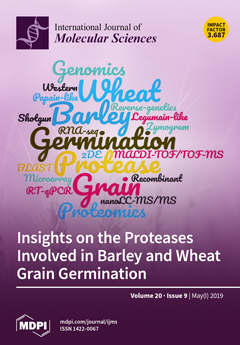
Cover Story: Seed storage proteins must be hydrolyzed by proteases to facilitate the delivery of amino acids essential for embryo growth and development. This review focuses on the current implications of proteases in the germination of two cereal species, barley and wheat, for which the establishment of processes of proteolytic control during the germination process has considerable economic value. Emphasis is placed on recent attempts to increase our understanding the proteases involved in barley and wheat seed germination by means of novel genomic and proteomic technologies. View this paper
  • Issues are regarded as officially published after their release is announced to the table of contents alert mailing list .
  • You may sign up for email alerts to receive table of contents of newly released issues.
  • PDF is the official format for papers published in both, html and pdf forms. To view the papers in pdf format, click on the "PDF Full-text" link, and use the free Adobe Reader to open them.

Articles (316)

  • Article
  • Open Access
12 Citations
3,975 Views
9 Pages

Niemann-Pick Type A Disease: Behavior of Neutral Sphingomyelinase and Vitamin D Receptor

  • Carmela Conte,
  • Cataldo Arcuri,
  • Samuela Cataldi,
  • Carmen Mecca,
  • Michela Codini,
  • Maria Rachele Ceccarini,
  • Federica Filomena Patria,
  • Tommaso Beccari and
  • Elisabetta Albi

Sphingomyelinase (SMase) is responsible for the breakdown of sphingomyelin (SM) with production of ceramide. The absence of acid sphingomyelinase (aSMase) causes abnormal synapse formation in Niemann-Pick type A (NPA) disease. Because high levels of...

  • Review
  • Open Access
61 Citations
8,528 Views
21 Pages

Glycation of Plant Proteins: Regulatory Roles and Interplay with Sugar Signalling?

  • Julia Shumilina,
  • Alena Kusnetsova,
  • Alexander Tsarev,
  • Henry C. Janse van Rensburg,
  • Sergei Medvedev,
  • Vadim Demidchik,
  • Wim Van den Ende and
  • Andrej Frolov

Glycation can be defined as an array of non-enzymatic post-translational modifications of proteins formed by their interaction with reducing carbohydrates and carbonyl products of their degradation. Initial steps of this process rely on reducing suga...

  • Article
  • Open Access
12 Citations
4,410 Views
11 Pages

25-Hydroxyvitamin D Inhibits Hepatitis C Virus Production in Hepatocellular Carcinoma Cell Line by a Vitamin D Receptor-Independent Mechanism

  • Amiram Ravid,
  • Noa Rapaport,
  • Assaf Issachar,
  • Arie Erman,
  • Larisa Bachmetov,
  • Ran Tur-Kaspa and
  • Romy Zemel

Previously, we have reported that the active vitamin D metabolite, calcitriol and vitamin D3 (cholecalciferol), both remarkably inhibit hepatitis C virus production. The mechanism by which vitamin D3 exerts its effect is puzzling due to the low level...

  • Article
  • Open Access
26 Citations
6,368 Views
19 Pages

A Robust Model for Circadian Redox Oscillations

  • Marta del Olmo,
  • Achim Kramer and
  • Hanspeter Herzel

The circadian clock is an endogenous oscillator that controls daily rhythms in metabolism, physiology, and behavior. Although the timekeeping components differ among species, a common design principle is a transcription-translation negative feedback...

  • Article
  • Open Access
37 Citations
11,124 Views
18 Pages

Hepatoprotective Effect of Kombucha Tea in Rodent Model of Nonalcoholic Fatty Liver Disease/Nonalcoholic Steatohepatitis

  • Chanbin Lee,
  • Jieun Kim,
  • Sihyung Wang,
  • Sumi Sung,
  • Namgyu Kim,
  • Hyun-Hee Lee,
  • Young-Su Seo and
  • Youngmi Jung

Kombucha tea (KT) has emerged as a substance that protects the liver from damage; however, its mechanisms of action on the fatty liver remain unclear. Therefore, we investigated the potential role of KT and its underlying mechanisms on nonalcoholic f...

  • Article
  • Open Access
48 Citations
6,074 Views
18 Pages

Interaction of Mycotoxin Alternariol with Serum Albumin

  • Eszter Fliszár-Nyúl,
  • Beáta Lemli,
  • Sándor Kunsági-Máté,
  • Luca Dellafiora,
  • Chiara Dall’Asta,
  • Gabriele Cruciani,
  • Gábor Pethő and
  • Miklós Poór

Alternariol (AOH) is a mycotoxin produced by Alternaria species. In vitro studies suggest the genotoxic, mutagenic, and endocrine disruptor effects of AOH, and an increased incidence of esophageal cancer has been reported related to higher AOH exposu...

  • Review
  • Open Access
31 Citations
8,017 Views
16 Pages

Role of Cyclin-Dependent Kinase Inhibitors in Endometrial Cancer

  • Gaia Giannone,
  • Valentina Tuninetti,
  • Eleonora Ghisoni,
  • Sofia Genta,
  • Giulia Scotto,
  • Gloria Mittica and
  • Giorgio Valabrega

Endometrial Cancer (EC) is an important cause of death in women worldwide. Despite early diagnosis and optimal treatment of localized disease, relapsed patients have few therapeutic options because after first line therapy, currently no standard of c...

  • Article
  • Open Access
24 Citations
4,816 Views
14 Pages

Indole-Based Hydrazones Containing A Sulfonamide Moiety as Selective Inhibitors of Tumor-Associated Human Carbonic Anhydrase Isoforms IX and XII

  • Kübra Demir-Yazıcı,
  • Silvia Bua,
  • Nurgül Mutlu Akgüneş,
  • Atilla Akdemir,
  • Claudiu T. Supuran and
  • Özlen Güzel-Akdemir

Novel sulfonamidoindole-based hydrazones with a 2-(hydrazinocarbonyl)-3-phenyl-1H-indole-5-sulfonamide scaffold were synthesized and tested in enzyme inhibition assays against the tumor-associated carbonic anhydrase isoforms, hCA IX and XII, and the...

  • Editorial
  • Open Access
20 Citations
6,105 Views
5 Pages

Connecting West and East

  • Ming Zhang,
  • Mohamed Moalin and
  • Guido R.M.M. Haenen

Despite their similarities, Western medicine and Eastern medicine are very different because they are built on different fundamentals. The general idea has arisen that we will benefit by connecting Western and Eastern medicine. First, both the merits...

  • Review
  • Open Access
23 Citations
6,671 Views
17 Pages

Hsp70s use ATP to generate forces that disassemble protein complexes and aggregates, and that translocate proteins into organelles. Entropic pulling has been proposed as a novel mechanism, distinct from the more familiar power-stroke and Brownian rat...

of 32

Get Alerted

Add your email address to receive forthcoming issues of this journal.

XFacebookLinkedIn
Int. J. Mol. Sci. - ISSN 1422-0067