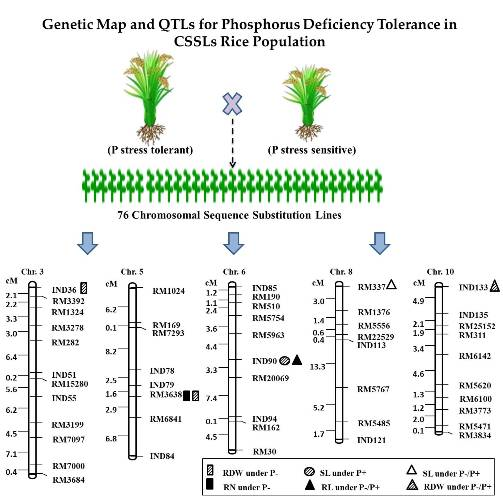
Genomic Regions Analysis of Seedling Root Traits and Their Regulation in Responses to Phosphorus Deficiency Tolerance in CSSL Population of Elite Super Hybrid Rice

 and
and Abstract
Share and Cite
Anis, G.B.; Zhang, Y.; Wang, H.; Li, Z.; Wu, W.; Sun, L.; Riaz, A.; Cao, L.; Cheng, S. Genomic Regions Analysis of Seedling Root Traits and Their Regulation in Responses to Phosphorus Deficiency Tolerance in CSSL Population of Elite Super Hybrid Rice. Int. J. Mol. Sci. 2018, 19, 1460. https://doi.org/10.3390/ijms19051460
Anis GB, Zhang Y, Wang H, Li Z, Wu W, Sun L, Riaz A, Cao L, Cheng S. Genomic Regions Analysis of Seedling Root Traits and Their Regulation in Responses to Phosphorus Deficiency Tolerance in CSSL Population of Elite Super Hybrid Rice. International Journal of Molecular Sciences. 2018; 19(5):1460. https://doi.org/10.3390/ijms19051460
Chicago/Turabian StyleAnis, Galal Bakr, Yingxin Zhang, Huimin Wang, Zihe Li, Weixun Wu, Lianping Sun, Aamir Riaz, Liyong Cao, and Shihua Cheng. 2018. "Genomic Regions Analysis of Seedling Root Traits and Their Regulation in Responses to Phosphorus Deficiency Tolerance in CSSL Population of Elite Super Hybrid Rice" International Journal of Molecular Sciences 19, no. 5: 1460. https://doi.org/10.3390/ijms19051460
APA StyleAnis, G. B., Zhang, Y., Wang, H., Li, Z., Wu, W., Sun, L., Riaz, A., Cao, L., & Cheng, S. (2018). Genomic Regions Analysis of Seedling Root Traits and Their Regulation in Responses to Phosphorus Deficiency Tolerance in CSSL Population of Elite Super Hybrid Rice. International Journal of Molecular Sciences, 19(5), 1460. https://doi.org/10.3390/ijms19051460