


Abstract
Numerous specific age-related morbidities have been correlated with low intake and serum levels of tocopherols and tocotrienols. We performed a review in order to evaluate the extant evidence regarding: (1) the association between intake and serum levels of tocopherols and tocotrienols and age-related pathologies (osteoporosis, sarcopenia and cognitive impairment); and (2) the optimum diet therapy or supplementation with tocopherols and tocotrienols for the treatment of these abnormalities. This review included 51 eligible studies. The recent literature underlines that, given the detrimental effect of low intake and serum levels of tocopherols and tocotrienols on bone, muscle mass, and cognitive function, a change in the lifestyle must be the cornerstone in the prevention of these specific age-related pathologies related to vitamin E-deficient status. The optimum diet therapy in the elderly for avoiding vitamin E deficiency and its negative correlates, such as high inflammation and oxidation, must aim at achieving specific nutritional goals. These goals must be reached through: accession of the elderly subjects to specific personalized dietary programs aimed at achieving and/or maintaining body weight (avoid malnutrition); increase their intake of food rich in vitamin E, such as derivatives of oily seeds (in particular wheat germ oil), olive oil, hazelnuts, walnuts, almonds, and cereals rich in vitamin E (such as specific rice cultivar rich in tocotrienols) or take vitamin E supplements. In this case, vitamin E can be correctly used in a personalized way either for the outcome from the pathology or to achieve healthy aging and longevity without any adverse effects.
1. Introduction
Suboptimal micronutrient intake for particular vitamins and between these, vitamin E is common in older adults [1] due to both acute conditions and chronic diseases very frequent in the elderly population.
Various factors contribute to this nutritional deficiency in aging with subsequent chronic inflammation, immune response impaired, and increased antioxidant activity. Among them, malnutrition and the intestinal malabsorption are the more common causes of an inadequate vitamin and nutritional support in elderly [2].
Numerous studies showed that inadequate vitamin E intake was highly prevalent in the free living American elderly population, with only 8%–11% of men and 2%–8% of women meeting the estimated average requirement (EAR) for vitamin E from foods alone in the 1994–1996 Continuing Survey of Food Intakes by Individuals (CSFII) [3] and the 2001–2002 National Health and Nutrition Examination Survey (NHANES) [4]. Moreover, the same results have been shown in a representative sample of Puerto Rican and Dominican free living elders and neighborhood-matched non-Hispanic white elders living in Massachusetts: most (94% and 95%, respectively) did not meet the EAR for vitamin E from food alone and fewer than 10% of subjects in both groups had plasma α-tocopherol concentrations <16 mmol/L in both sex [4].
In addition, further studies conducted over the last 10 years in the United States have shown that the percentage of the population over the age of 71 years eating levels below the EAR is equal to 75% for vitamin E [5].
Finally, a clear decreasing trend with age was observed for intake and serum vitamin E and for the α-tocopherol/cholesterol ratio in a group of institutionalized older populations [6] and in hospitalized elderly patients [7]. In the study by Granado-Lorencio, it has been demonstrated that high levels of C-Reactive Protein (CRP) and ferritin, two significant markers of inflammation, were associated with lower serum levels of vitamin E. Consequently, in hospitalized subjects, an inadequate nutritional status and a high inflammation milieu were associated with a higher prevalence of vitamin E deficiency (up to 15%).
Even the National Dietary Survey 2008–2009, which involved more than 4000 elderly people in Brazil, has shown that the prevalence of inadequate intake of several micronutrients, including vitamin E, reaches about 80% in both sexes [8]. However, this deficiency in vitamin E intake can be corrected by improving the diet of the subjects: in healthy elderly residents in the community a more balanced diet (including a good supply of fruit and vegetables) has led to an increase in the share of vitamins [9].
Intake of α-tocopherol below 12 mg/d has been shown to relate to a risk of hydrogen peroxide-induced hemolysis [10], and there is evidence of association with several major chronic diseases, including Alzheimer’s disease, diabetes, cancer, and cardiovascular disease [11,12,13,14].
On the other hand, the presence of good circulating levels of vitamin E in centenarians coupled with satisfactory antioxidant activity and immune response [15], clearly testify the relevance of vitamin E in the economy of the immune and antioxidant performances required to achieve healthy aging and longevity.
Free radicals and oxidative stress have been recognized as important factors in the biology of aging and in many age-associated degenerative diseases [16]. A time-dependent shift in the antioxidant/pro-oxidant balance, which leads to higher free radical generation, increased in oxidative stress and dysregulation of cellular function, is the basis for the free radical theory of aging [17].
Vitamin E is considered the major chain-breaking antioxidant in plasma, in cell membranes and in tissues [18], capable of reacting directly with chain-carrying radicals and consequently interrupt the oxidative chain reactions [19,20]. Tocopherol serves as a peroxyl radical scavenger that protects polyunsaturated fatty acids in membranes and lipoproteins [21]. Apart from its antioxidant property, vitamin E has been reported to also enhance immune response [22] and to modulate DNA repair systems [23] and signal transduction pathways [24].
Given this background, the aim of the present narrative review is to evaluate the till-now evidence regarding: (1) the association between intake and serum levels of tocopherols and tocotrienols and specific age-related pathologies (osteoporosis, sarcopenia, and cognitive decline); and (2) the optimum diet therapy or supplementation with tocopherols and tocotrienols for the treatment of these abnormalities.
2. Methods
The present systematic review was performed following the steps by Egger et al. as follows [25]: (1) configuration of a working group: three operators skilled in clinical nutrition, of whom one acting as a methodological operator and two participating as clinical operators; (2) formulation of the revision question on the basis of considerations made in the abstract: “the state of the art on metabolic and nutritional correlates (osteoporosis, sarcopenia, cognitive decline) of vitamin E deficiency in elderly and their nutritional treatment”; (3) identification of relevant studies: A research strategy was planned, on PubMed (Public MedIine run by the National Center of Biotechnology Information (NCBI) of the National Library of Medicine of Bathesda (USA)), as follows: (a) definition of the key words (vitamin E, tocopherols, tocotrienols, osteoporosis, bone mass, sarcopenia, muscle mass, Alzheimer’s disease, and mild cognitive impairment), allowing the definition of the interest field of the documents to be searched, grouped in inverted commas (“…”) and used separately or in combination; (b) use of: the boolean (a data type with only two possible values: true or false) AND operator, that allows the establishments of logical relations among concepts; (c) research modalities: advanced search; (d) limits: time limits: papers published in the last 20 years; humans; languages: English; and (e) manual search performed by the senior researchers experienced in clinical nutrition through the revision of reviews and individual articles on vitamin E and specific age-related pathologies (osteoporosis, bone mineral density, sarcopenia, muscle mass, Alzheimer’s disease, mild cognitive impairment, cognitive performance) in the elderly published in journals qualified in the Index Medicus; and (4) analysis and presentation of the outcomes: the data extrapolated from the revised studies were collocated in tables; in particular, for each study we specified: the author and year of publication of the study, study characteristics (type of study, subjects studied, primary end-point), and the main results of the study. The analysis was carried out in the form of a narrative review of the reports. Table 1 summarizes the methodology of the review. At the beginning of each section, the keywords considered and the kind of studies chosen has been reported. Suitable for the systematic review were human studies of any design, which considered the elderly (over 65 years) and the evaluation of food/supplement intake and/or blood levels of congeners of vitamin E. In vitro or animal studies are given in the paper only if useful to better explain a result in humans, but are not considered in the tables. Figure 1 shows the flow diagram of the narrative review.
Figure 1.
Flow diagram of narrative review of literature.
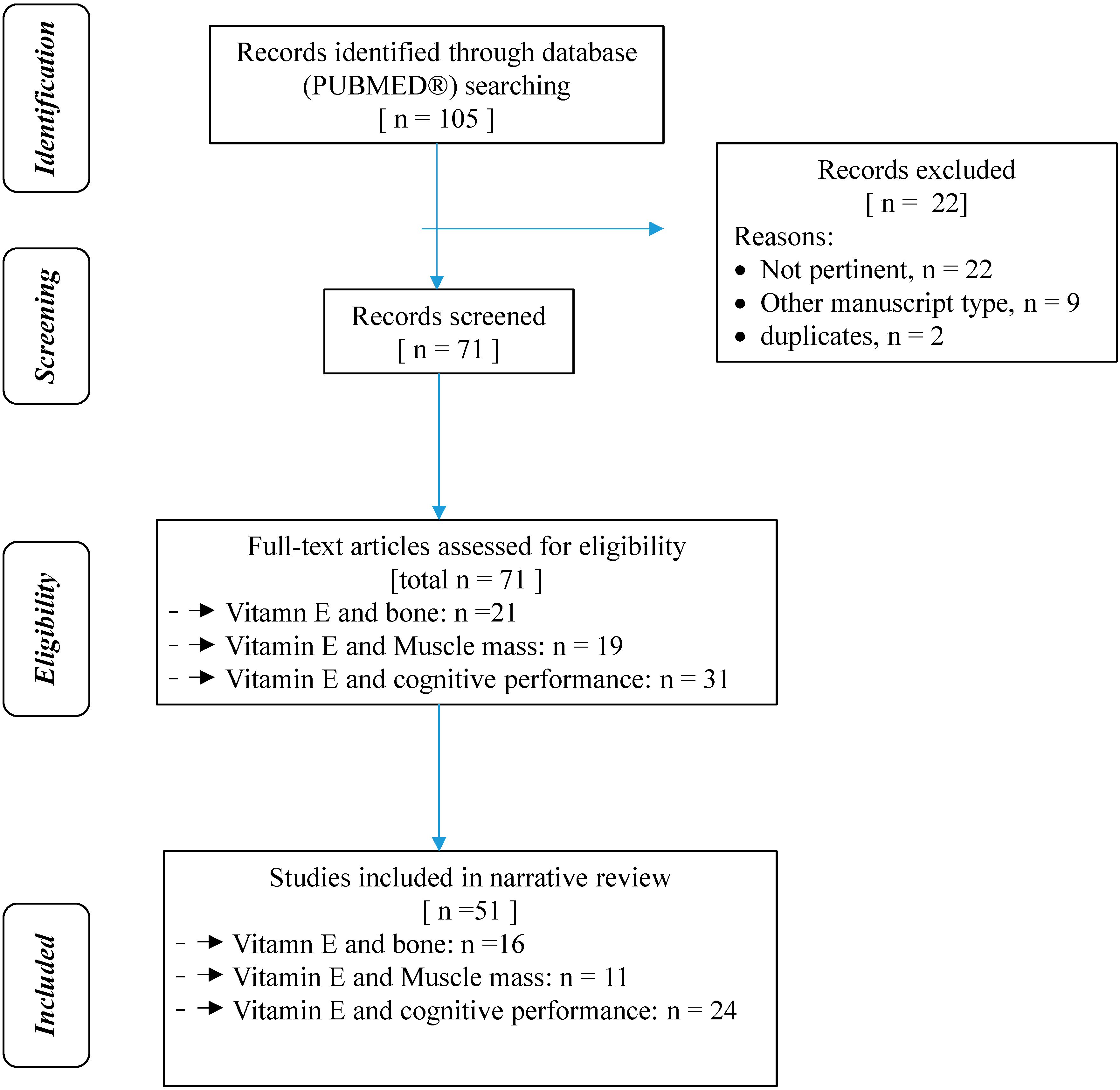
Table 1.
Summary of methodology.
3. Vitamin E and Bone Health
This research has been carried out based on the keywords: “vitamin E” or “tocopherols” or “tocotrienols” AND “osteoporosis” AND “bone mineral density”; 16 articles were sourced. Among them, two case control, five observational studies, one randomized control trial, one meta-analysis, five reviews and two animal studies have been selected and discussed.
Human studies on the effect of vitamin E in relation to bone health are still few, but the interest in this field has increasing because of suggestions of a possible protective effect of antioxidants, such as tocopherols and tocotrienols, on bone health [26,27].
During the past decade, it has become evident that the increase in oxidative stress with aging is a fundamental pathogenetic mechanism of age-related bone loss [28] and, also, possibly sarcopenia [29,30]; two important determinants that contribute to the risk of fracture [31,32,33].
The vitamin E component is a potent scavenger of free radicals, and it has been postulated that this vitamin may favorably influence bone and muscle mass due to its antioxidant properties [28,29,34,35].
In addition, antioxidants may also have the potential to affect bone through creating an alkaline environment, reducing urinary calcium excretion, and providing bioactive components [36].
Observational data published very recently in the literature indicate that vitamin E insufficiency is associated with higher fracture risk [37]. In this research two cohort studies, the Swedish Mammography Cohort (SMC; n = 61,433 women) and the Uppsala Longitudinal Study of Adult Men (ULSAM; n = 1138 men), were used in order to assess vitamin E intake and to correlate this intake with bone mineral density (BMD), evaluating also by fracture risk [37]. During 19 years of follow-up, 14,738 women in the SMC experienced a first fracture at any site (3871 hip fractures). A higher hip fracture rate was observed with lower intakes of α-tocopherol. This study demonstrated that for each 3-mg decrease in α-tocopherol intake, the BMD of the proximal femur, after multivariable adjustment, decreased by 1.1% (95% CI: 0.3, 1.8; p = 0.005), the lumbar spine (L1–L4) by 0.8% (95% CI: 20.1, 1.8; p = 0.09), appendicular lean mass by 0.8% (95% CI: 0.2, 1.4; p = 0.01), and skeletal mass muscle index (SMI) by 0.6% (95% CI: 0.05, 1.18; p = 0.03). In addition, for every 3-mg decrease in α-tocopherol intake, the multivariable adjusted OR of osteoporosis at the lumbar spine was 1.20 (95% CI: 1.03, 1.41) and at the proximal femur was 1.46 (95% CI: 1.19, 1.78).
The results of this study are in agreement with a large community-based prospective case-cohort study of elderly men and women in Norway, in which it has been found an increased risk of hip fracture at low serum concentrations of α-tocopherol, which persisted after controlling for potential confounders, including smoking, BMI, physical inactivity, education, self-rated health, vitamin D status, and hours since last meal [38]. There was a 51% (CI 17%–95%) increased risk in the lowest compared to the highest quartiles of α-tocopherol which was attenuated to 37% (CI 5%–77%) when α-tocopherol/total cholesterol ratio was the exposure considered.
Moreover, in previous cross-sectional studies, hip fracture patients had low vitamin E concentrations compared with control subjects at the time of the fracture event [39], and higher post-operative vitamin E concentrations were associated with lower concentrations of inflammatory markers [40]. Finally, high serum concentrations of vitamin E were related to better physical function after the hip fracture [41].
As regards dietary supplementation, results of a small pilot study in 34 women in Canada suggested that supplements of α-tocopherol (600 mg/day) and vitamin C (1000 mg/day) taken for six months could reduce spinal bone loss in aging [26]. In an observational study of 533 community-dwelling non-smoking postmenopausal women in Australia, the duration of use of antioxidant supplements, including vitamins C and E, was inversely associated with the bone resorption marker C terminal telopeptide in serum but not with whole body BMD [27].
Table 2 summarizes the human studies performed to investigating the influence of vitamin E intake or supplementation on bone.
Table 2.
Influence of vitamin E on bone.
In conclusion, all studies performed to date have been showed that both high intake and serum concentrations of α-tocopherol are associated with reduced risk of many common sequelae of hip fracture, including decreased physical function, incident frailty, sarcopenia, bone loss, so an adequate vitamin E intake is crucial in order to maintain bone health in elderly subjects because for each 3-mg decrease in α-tocopherol intake, the BMD of the proximal femur decreased by 1.1%. In addition, studies on the effect of dietary supplementation (α-tocopherol 600 mg/die) on BMD, although few, are promising.
Further research is needed to better investigate the potential anabolic effect of vitamin E from food sources and from supplementation on bone.
4. Vitamin E and Loss of Muscle Mass and Power
This research has been carried out based on the keywords: “vitamin E” or “tocopherols” or “tocotrienols” AND “sarcopenia” AND “muscle mass”; 11 articles were sourced. Among them, one cross-sectional study, four reviews, two epidemiological study, two double-blind studies, and two animal studies have been selected and discussed.
Sarcopenia is defined by the European Working Group on Sarcopenia in Older People (EWGSOP) [42] as a syndrome characterized by progressive and generalized loss of muscle mass and strength. Sarcopenia is a physiological phenomenon that usually starts in the fifth decade. Van Kan has investigated the prevalence of sarcopenia in the population aged 60–70 years: In this age group, the prevalence ranged from 5% to 13%, but increased to 11%–50% in subjects aged >80 years [43]. Sarcopenia becomes responsible not only for the reduction of mobility and the level of autonomy of the elderly, but also for their ability to maintain good health. The functional reduction of the quadriceps muscle predisposes to a limitation in walking, with risk of falls and fractures of the femoral neck; a survey conducted in the USA has estimated the cost-related health consequences of sarcopenia to be 20–30 billion dollars [44]. In most elderly patients, the onset of sarcopenia is multifactorial and oxidative stress has been implicated as a central mechanism in the pathogenesis of sarcopenia [45]. Oxidative damage in skeletal muscle has been associated with the atrophy and loss of muscle function and fibers in sarcopenia [46]. Moreover, the accumulation of mitochondrial and nuclear DNA damage due to oxidative stress is thought to eventually compromise function, leading to the loss of myocytes [47]. Finally, reactive oxygen species can damage muscle tissue directly, but they also provide a trigger for the expression of inflammatory cytokines, such as interleukin- (IL-) 1, tumor necrosis factor (TNF), and IL-6. In older age, a low-grade inflammatory state characterized by increased concentrations of inflammatory cytokines and acute phase proteins is common and studies conducted among community-dwelling older adults suggest that the pro-inflammatory state does have a long-term consequence for loss of muscle mass and function [48,49]. Given this background, antioxidants, such as vitamin E, should play an important role against sarcopenia.
In particular, as regards vitamin E and loss of muscle mass and function, Semba et al. have been demonstrated that plasma higher α-tocopherol status were independently associated with higher strength measures [50] and frailty syndrome [51]. In this latest study, age- and gender-adjusted levels of vitamin E decreased gradually from the non-frail to the frail group. In the logistic model adjusted for multiple potential confounders, participants in the highest vitamin E tertile were less likely to be frail than were participants in the lowest vitamin E tertile (odds ratio, 0.30; 95% confidence interval, 0.10–0.91).
Interestingly, vitamin E plays a differential role in the oxidative metabolism in the various muscle fibers (types I and II). The type I fibers abound of myoglobin and mitochondrial enzymes and reconstitute phosphocreatine via oxidative phosphorylation more efficiently than the type II fibers [52], which theoretically generate more free radicals. Thus, it has been suggested that type I fibers (slow) require more vitamin E of type II fibers (fast) [52]. Furthermore, the high concentration of vitamin E has been associated with higher levels of activity of creatine kinase, suggesting the possibility of an increased repair of skeletal muscle [53]. An interesting longitudinal study evaluated the effect of concentrations of vitamin E and other various micronutrients (B6, B12, D, folic acid, iron) on the subsequent decline in physical function on a population of 698 people 65 and older belonging to a community [54]. The average decline according to the scale score Short Physical Performance Battery (SPPB) was 1.1. In logistic regression analysis, adjusted for potential confounders, only a low concentration of vitamin E (<1.1 µg/mL (<24.9 µmol/L)) was significantly associated with a subsequent decline in physical function (OR, 1.62; 95% confidence interval, 1:11 to 2:36; p = 0.01 for association of lowest levels of α-tocopherol quartile with at least a decrease of one point in physical function). In a general linear model, the concentration of vitamin E at the base, when analyzed as a continuous measure, was significantly associated with the SPPB score at follow-up, after adjustment for potential confounding factors, and score SPPB behind (β = 0.023; p = 0.01). According to a classification and regression analysis, age greater than 81 years and vitamin E (in participants aged 70–80 years) were identified as the most important determinant for the decline in physical function. The serum concentration of both α- and γ- tocopherol were associated with better physical function after hip fracture.
As regards vitamin E supplementation and loss of muscle mass and function, several studies have shown the positive effects of vitamin E supplementation in reversing muscle damage during extensive muscle contraction (exercise) in healthy men. Vitamin E supplementation at a dose of 800 IU for 28 days resulted in lowering the expression of oxidative stress markers after a downhill run in both young and older men [55].
In another study, a longer supplementation period (12 weeks of vitamin E supplementation) lowered creatinine kinase level after exercise in young men, whereas older men showed decreased lipid peroxidation in both resting state and after exercise, indicating that vitamin E promotes adaptation against exercise induced-oxidative stress and reduced muscle damage [56]. In animal models, similar results were obtained [57,58].
Table 3 summarizes the human studies to investigating the influence of vitamin E intake or supplementation on muscle mass.
In conclusion, to date epidemiological studies demonstrated that higher alpha-tocopherol status was associated with higher strength measures, so an adequate vitamin E intake avoids frailty syndrome in older subjects. Moreover, studies on vitamin E dietary supplementation (800 IU/die) demonstrated a decreased peroxidation and reduced muscle damage in both resting state and after exercise. However, no studies have evaluated the efficacy of a vitamin E intake or dietary supplementation in the elderly patient suffering from sarcopenia. These studies are needed, given that recent epidemiological studies in community-dwelling older adults show that low blood antioxidants are associated with low skeletal muscle strength and the development of walking disability and, consequently, frailty syndrome.
Table 3.
Influence of vitamin E on muscle mass.
5. Vitamin E and Cognitive Performance
This research has been carried out based on the keywords: “vitamin E” or “tocopherols” or “tocotrienols” AND “mild cognitive impairment” AND “cognitive performance” AND “Alzheimer’s disease”; 24 articles were sourced. Among them one retrospective study, seven reviews, three case-control studies, four prospective studies, two animal studies, five observational studies, and two meta-analysis have been selected and discussed.
Epidemiological studies have reported a reduced incidence of dementia/Alzheimer’s disease (AD) in subjects with high plasma levels or high dietary intake of the combination of all natural vitamin E congeners [59,60,61], and vice versa, reduced plasma levels of α-tocopherol were found in subjects with AD, or mild cognitive impairment (MCI) [62,63,64,65].
Vitamin E is the major lipid-soluble, chain-breaking, non-enzymatic antioxidant in the human body [66], and is essential for normal neurological functions [67]. This micronutrient has thus been proposed as a preventive/therapeutic agent in AD, in which oxidative and nitrosative stress (OS/NS) promoted by free radicals seem to have a key pathogenetic role [68,69,70].
The same results have already demonstrated in animal models: at nanomolar concentrations, α-tocotrienol prevents neurodegeneration in mice and rat neurons, by regulating specific mediators of cell death [71].
However, until 2010 the role of different congeners of vitamin E mainly studied regarding cognitive performance was α-tocopherol [63,64,65] or all vitamin E congeners [59,60,61].
The few studies on cognition and plasma γ-tocopherol [72,73], and [74] δ-tocopherols yielded inconsistent results.
For the first time in a 2010 study, conducted in a population of Swedish octogenarians, a reduced incidence of AD was found in subjects with higher plasma levels of total tocopherols, total tocotrienols, and total vitamin E [60].
A 2012 study (Project-Add NeuroMed) confirmed these previous results: it was taken into account all vitamin E congeners in AD and MCI and comparing their plasma level with the relative markers of cognitive deterioration (α-tocopherylquinone, 5-nitro-γ-tocopherol) in 166 subjects with mild cognitive impairment, 168 patients with Alzheimer’s disease and 187 cognitively normal people [75]. The result was that low plasma levels of all vitamin E congeners have been associated with an increased likelihood of MCI and AD. Compared to cognitively normal subjects, AD and MCI had lower levels of total tocopherols, total tocotrienols and vitamin E total. In multivariate regression analysis-polytomic-logistics, both cases of MCI and cases of AD had an 85% lower chance of being in the highest tertile of total values of total tocopherols and vitamin E and they were, respectively, 92% and 94% less likely to be in the highest tertile of total tocotrienols compared to the lowest tertile [75].
In another study, a sample of 140 Finnish elderly people not suffering from cognitive disorders, come from the study Cardiovascular Risk Factors, Aging and Dementia (CAIDE), were followed over eight years to detect cognitive impairment, defined as the development of mild cognitive impairment (MCI) or Alzheimer's dementia. The results agree in pointing out that high levels of congeners of tocopherol and tocotrienol have been associated with a lower risk of cognitive impairment in the elderly [76]. All these results clearly testify the relevance of adequate vitamin E intake (15 mg/die is the dietary reference intake) in the economy of the antioxidant balance required to achieve healthy aging and preserve good cognitive performances.
The role of tocopherol could take a much more important therapeutically. Its use in mild form of Alzheimer’s disease could be a great help to slow its progression. This was highlighted in a randomized double-blind, placebo-controlled trial: in a group of patients it was found, after a median follow-up of two years, as the assumption of a fixed dose of tocopherol (2000 IU/die of α-tocopherol) has resulted in a better score ADCS-ADL Inventory, resulting in a delay in clinical progression of 19% per year compared with placebo or a delay of about 6.2 months in the period of follow-up [77].
As can be seen from the above studies, it emerges as vitamin E has an important role as an antioxidant against lipid peroxidation of cell membranes while preserving tissue cells from oxidative damage. Since vitamin E works both in the cytoplasm and nuclear, interacting with many genes related to inflammatory/immune response, it is important to know these correlations in order to create new frontiers for supplementation of vitamin E as correct as possible [78].
However α-tocopherol is still the only congener being tested in RCTs in subjects with AD or MCI, in doses up to 2000 IU/daily. Recent findings suggest that supplementation with high doses of α-tocopherol (800 UI/die) increased the risk for hemorrhagic stroke by 22% and reduced the risk of ischemic stroke by 10%; this differential risk pattern is obscured when looking at total stroke [79]. Further, α-tocopherol supplements can diminish the bioavailability of the other congeners: α-tocopherol supplementation can decrease plasma and tissue concentration of gamma- and δ-tocopherol [80], and compromise tissue delivery of tocotrienol [81].
It has been hypothesized that this contradictory result may be due to vitamin E-gene interactions; in particular polymorphisms of ApoE may be useful for vitamin E supplementation [78]. With regard to ApoE, ApoE4 genotype is associated with increased morbidity and mortality, and represents a significant risk factor for CVD cardiovascular disease and late-onset AD [82].
Table 4 summarizes the human studies performed to investigating the influence of vitamin E intake or supplementation on cognitive performance.
In conclusion, the results of the studies suggest that low serum levels and intake of tocopherols and tocotrienols are associated with the risk of cognitive impairment in older adults, which reinforces the hypothesis that each of the natural congeners of vitamin E plays a unique role in human health.
The complex and dynamic interactions between vitamin E and gene-interactions also need further clarification. Studies that take these factors into account can help determine the composition of vitamin E supplements for future AD prevention trials and refine dietary recommendations for healthy cognitive aging.
Table 4.
Influence of vitamin E on cognitive performance.
6. Discussion
All studies performed in order to assess vitamin E intake or serum levels of tocopherols and tocotrienols in elderly population are in agreement: older subjects are at high risk of vitamin E deficiency [4,5,6,8].
Intake of α-tocopherol below 12 mg/d has been shown to relate to risk of hydrogen peroxide-induced hemolysis [10], and there is evidence of association in adult population with several major chronic diseases, including diabetes, cancer, and cardiovascular disease [11,12,13,14].
In addition to the chronic diseases associated with a deficiency of vitamin E intake demonstrated in adults, in the elderly, the deficit of vitamin E is associated with diseases closely linked to aging, such as osteoporosis, sarcopenia, and cognitive deficits.
On the contrary, both high intake and serum concentrations of α-tocopherol have been shown to be associated with reduced risk of many common sequelae of hip fracture, including decreased physical function, incident frailty, sarcopenia, bone loss, and cognitive decline. Higher intake with diet (15 mg/die) or vitamin E supplementation (600 UI/die) may represent a potentially modifiable factor for preventing loss of bone and muscle mass and cognitive decline.
Therefore, it is important to make known the elderly regarding which foods contain the vitamin compounds of the group E in order to make richer their nutrition in this vitamin. Vitamin E is found in many plants, especially in the seeds, oil derivatives, grains, fruits, and vegetables [83], as shown in Table 5, Table 6 and Table 7. Another significant element is the type of style food taken by the elderly subjects; in fact, people who use rice as the main cereals should choose the type of cultivars most rich in vitamin E. The result obtained from a study of 58 rice varieties cultivated in Malaysia was that vitamin E can range from 19:36 to 63.29 mg/kg, and the data particularly interesting is that all varieties of rice contain more isomers of tocotrienol than tocopherol [84]. This could address the choice depending on the cultivar richest in bioactive compounds.
Regarding vitamin E supplementation, however, meta-analyses evaluating the antioxidant effect of vitamin E have reported a disappointing effect on survival [85,86,87,88,89]. Among these meta-studies, Miller demonstrated that low-dose vitamin E slightly, but non-significantly, decreased the mortality, but high-dose vitamin E increased mortality [87]. High dosage of vitamin E intake has been revealed to contribute to many clinical disorders [90], which is consistent with the increased mortality for high-dose vitamin E. Otherwise, another meta-study on vitamin E, which used the same inclusion criteria as Miller et al. [87], but adopted a different meta-analytic method, also got a disappointing result [91,92]. Such an effect could obscure the effect of vitamin E in studies without considering the dosage, which is seen in several reports [85,86,88,89]. The cooperative effect of vitamin E with other agents could also be concealed in studies pooling vitamin E alone and with other agents together, which is seen in several reports [85,86,87,89,91]. In any case, the meta-analysis conducted to date have not specifically considered the age of subjects studied and different congeners of vitamin E.
Table 5.
Content of vitamin E, α-tocopherol eq., in some foods [93].
In elderly populations it is relevant to consider the different congeners of vitamin E supplementation for its possible beneficial effect on the entire health in aging taking into account that vitamin E also affects the inflammatory/immune response [22]. The current formulation of vitamin E consists primarily of α-tocopherol, but recent research has suggested that tocotrienol, the lesser known congener of vitamin E, appears superior regarding its antioxidant properties [94] and possesses unique biological functions unrelated to antioxidant activity not shared by tocopherol [95].
Table 6.
Content of vitamin E in mg/100 g in selected food samples (Karmowski, J.; et al. [83]).
Table 7.
Content of vitamin E in mg/100 g in selected cereals (Karmowski, J.; et al. [83]).
Even among the tocopherols, particular importance is placed on the other isomers because supplementation with large doses of α-tocopherol alone has been reported to deplete the availability of γ-tocopherol, thus denying the benefits of α-tocopherol that are not shared by γ-tocopherol [96]. Therefore, it has been suggested that the full benefits of vitamin E are better achieved in the elderly by supplementation with the full spectrum of vitamin E isomers and the corresponding tocotrienols [97,98].
7. Conclusions
In conclusion, the recent literature underlines that, given the detrimental effect of low intake and serum levels of tocopherols and tocotrienols on bone, muscle mass, and cognitive function, a change in the lifestyle must be the cornerstone in the prevention of these specific age-related pathologies related to vitamin E deficient status. The optimum diet therapy in elderly for avoiding vitamin E deficiency intake and its negative correlates, such as high inflammation and oxidation which are the cause of most age-related pathologies, such as osteoporosis, sarcopenia, and cognitive impairment, must aim at achieving specific nutritional goals. These goals must be reached through accession of the elderly subjects to specific personalized dietary program aimed at achieving and/or maintaining body weight (avoid malnutrition); increase their intake of all food rich in vitamin E, such as derivatives oily seeds (in particular wheat germ oil), olive oil, nuts (hazelnuts, walnuts, almonds), and cereals rich in vitamin E (such as specific rice cultivar rich in tochotrienols) or take vitamin E supplements. Vitamin E supplementation can be correctly used in a personalized way either for the outcome from the pathology or to achieve healthy aging and longevity without any adverse effects.
Author Contributions
Mariangela Rondanelli wrote the manuscript; Simone Perna edited the manuscript; Gabriella Peroni, Milena Anna Faliva, Vittoria Infantino, Maurizio Naso and Francesca Moncaglieri edited tables and searched in literature.
Conflicts of Interest
The authors declare no conflict of interest.
References
- Marian, M.; Sacks, G. Micronutrients and older adults. Nutr. Clin. Pract. 2009, 24, 179–195. [Google Scholar] [CrossRef] [PubMed]
- Ames, B.N. Low micronutrient intake may accelerate the degenerative dis-eases of aging through allocation of scarce micronutrients by triage. Proc. Natl. Acad. Sci. USA 2006, 103, 17589–17594. [Google Scholar] [CrossRef] [PubMed]
- Maras, J.E.; Bermudez, O.I.; Qiao, N.; Bakun, P.J.; Boody-Alter, E.L.; Tucker, K.L. Intake of alpha-tocopherol is limited among US adults. J. Am. Diet. Assoc. 2004, 104, 567–575. [Google Scholar] [CrossRef] [PubMed]
- Gao, X.; Wilde, P.E.; Lichtenstein, A.H.; Bermudez, O.I.; Tucker, K.L. The maximal amount of dietary alpha-tocopherol intake in U.S. adults (NHANES 2001–2002). J. Nutr. 2006, 136, 1021–1026. [Google Scholar] [PubMed]
- Krebs-Smith, S.M.; Guenther, P.M.; Subar, A.F.; Kirkpatrick, S.I.; Dodd, K.W. Americans do not meet federal dietary recommendations. J. Nutr. 2010, 140, 1832–1838. [Google Scholar] [CrossRef] [PubMed]
- Granado-Lorencio, F.; Blanco-Navarro, I.; Perez-Sacrista, B.; Milla, I.; Donoso-Navarro, E.; Silvestre-Mardomingo, R.A. Determinants of fat-soluble vitamin status in patients aged 65 years and over. Eur. J. Clin. Nutr. 2013, 67, 1325–1327. [Google Scholar] [CrossRef] [PubMed]
- Alvarez-Hernandez, J.; Planas Vila, M.; Leon-Sanz, M.; Garcıa de Lorenzo, A.; Celaya-Perez, S.; Garcıa-Lorda, P.; Araujo, K.; Sarto Guerri, B. Prevalence and costs of malnutrition in hospitalized patients; the PREDyCESs Study. Nutr. Hosp. 2012, 27, 1049–1059. [Google Scholar] [PubMed]
- Fisberg, R.M.; Marchioni, D.M.; Castro, M.A.; Verly, E., Jr.; Araújo, M.C.; Bezerra, I.N.; Pereira, R.A.; Sichieri, R. Inadequate nutrient intake among the Brazilian elderly: National Dietary Survey 2008–2009. Rev. Saude Publica 2013, 47, 222S–230S. [Google Scholar] [CrossRef] [PubMed]
- Anlasik, T.; Sies, H.; Griffiths, H.R.; Mecocci, P.; Stahl, W.; Polidori, M.C. Dietary habits are major determinants of the plasma antioxidant status in healthy elderly subjects. Br. J. Nutr. 2005, 94, 639–642. [Google Scholar] [CrossRef] [PubMed]
- Food and Nutrition Board. Dietary Reference Intakes for Vitamin C, Vitamin E, Selenium, and Carotenoids; National Academies Press: Washington, DC, USA, 2000. [Google Scholar]
- Martin, A.; Youdim, K.; Szprengiel, A.; Shukitt-Hale, B.; Joseph, J. Roles of vitamins E and C on neurodegenerative diseases and cognitive performance. Nutr. Rev. 2002, 60, 308–326. [Google Scholar] [CrossRef] [PubMed]
- McCullough, M.L.; Feskanich, D.; Stampfer, M.J.; Giovannucci, E.L.; Rimm, E.B.; Hu, F.B.; Spiegelman, D.; Hunter, D.J.; Colditz, G.A.; Willett, W.C. Diet quality and major chronic disease risk in men and women: Moving toward improved dietary guidance. Am. J. Clin. Nutr. 2002, 76, 1261–1271. [Google Scholar] [PubMed]
- Mayer-Davis, E.J.; Costacou, T.; King, I.; Zaccaro, D.J.; Bell, R.A. Plasma and dietary vitamin E in relation to incidence of type 2 diabetes: The Insulin Resistance and Atherosclerosis Study (IRAS). Diabetes Care 2002, 25, 2172–2177. [Google Scholar] [CrossRef] [PubMed]
- Kuwabara, A.; Nakade, M.; Tamai, H.; Tsuboyama-Kasaoka, N.; Tanaka, K. The association between vitamin E intake and hypertension: Results from the re-analysis of the National Health and Nutrition Survey. J. Nutr. Sci. Vitaminol. 2014, 60, 239–245. [Google Scholar] [CrossRef] [PubMed]
- Mecocci, P.; Polidori, M.C.; Troiano, L.; Cherubini, A.; Cecchetti, R.; Pini, G.; Straatman, M.; Monti, D.; Stahl, W.; Sies, H.; et al. Plasma antioxi-dants and longevity: A study on healthy centenarians. Free Radic. Biol. Med. 2000, 28, 1243–1248. [Google Scholar] [CrossRef]
- Poljsak, B.; Milisav, I. The neglected significance of “antioxidative stress”. Oxid. Med. Cell Longev. 2012, 480895–480907. [Google Scholar] [CrossRef] [PubMed]
- Liochev, S.I. Reactive oxygen species and the free radical theory of aging. Free Radic Biol. Med. 2013, 60, 1–4. [Google Scholar] [CrossRef] [PubMed]
- Burton, G.W.; Cheeseman, K.H.; Doba, T.; Ingold, K.U.; Slater, T.F. Vitamin E asan antioxidant in vitro and in vivo. Ciba Found Symp. 1983, 101, 4–18. [Google Scholar] [PubMed]
- Palace, V.P.; Hill, M.F.; Farahmand, F.; Singal, P.K. Mobilization of antioxidantvitamin pools and hemodynamic function after myocardial infarction. Circulation 1999, 99, 121–126. [Google Scholar] [CrossRef] [PubMed]
- Palace, V.; Kumar, D.; Hill, M.F.; Khaper, N.; Singal, P.K. Regional differencesin non-enzymatic antioxidants in the heart under control and oxidative stressconditions. J. Mol. Cell. Cardiol. 1999, 31, 193–202. [Google Scholar] [CrossRef] [PubMed]
- Burton, G.W.; Cheng, S.C.; Webb, A.; Ingold, K.U. Vitamin E in young and oldhuman red blood cells. Biochem. Biophys. Acta 1986, 860, 84–90. [Google Scholar] [CrossRef]
- Pae, M.; Meydani, S.N.; Wu, D. The role of nutrition in enhancing immunity inaging. Aging Dis. 2012, 3, 91–129. [Google Scholar] [PubMed]
- Claycombe, K.J.; Meydani, S.N. Vitamin E and genome stability. Mutat. Res. 2001, 475, 37–44. [Google Scholar] [CrossRef]
- Azzi, A.; Gysin, R.; Kempná, P.; Munteanu, A.; Negis, Y.; Villacorta, L.; Visarius, T.; Zingg, J.M. Vitamin E mediates cell signaling and regulation of gene expression. Ann. N. Y. Acad. Sci. 2004, 1031, 86–95. [Google Scholar] [CrossRef] [PubMed]
- Egger, M.; Smith, G.D.; Altman, D.G. Systematic Reviews in Health Care: Meta-Analysis in Context, 2nd ed.; BMJ Publishing Group: London, UK, 2001; pp. 3–68. [Google Scholar]
- Chuin, A.; Labonté, M.; Tessier, D.; Khalil, A.; Bobeuf, F.; Doyon, C.Y.; Rieth, N.; Dionne, I.J. Effect of antioxidants combined to resistance training on BMD in elderly women: A pilot study. Osteoporos. Int. 2009, 20, 1253–1258. [Google Scholar] [CrossRef] [PubMed]
- Pasco, J.A.; Henry, M.J.; Wilkinson, L.K.; Nicholson, G.C.; Schneider, H.G.; Kotowicz, M.A. Antioxidant vitamin supplements and markers of bone turnover in a community sample of non-smoking women. J. Womens Health 2006, 15, 295–300. [Google Scholar] [CrossRef] [PubMed]
- Manolagas, S.C.; Parfitt, A.M. What old means to bone. Trends Endocrinol. Metab. 2010, 21, 369–374. [Google Scholar] [CrossRef] [PubMed]
- Cerullo, F.; Gambassi, G.; Cesari, M. Rationale for antioxidant supplementation in sarcopenia. J. Aging Res. 2012, 2012, 316943. [Google Scholar] [CrossRef] [PubMed]
- Meng, S.J.; Yu, L.J. Oxidative stress, molecular inflammation and sarcopenia. Int. J. Mol. Sci 2010, 11, 1509–1526. [Google Scholar] [CrossRef] [PubMed]
- Marshall, D.; Johnell, O.; Wedel, H. Meta-analysis of how well measures of bone mineral density predict occurrence of osteoporotic fractures. BMJ 1996, 312, 1254–1259. [Google Scholar] [CrossRef] [PubMed]
- Jarvinen, T.L.; Sievanen, H.; Khan, K.M.; Heinonen, A.; Kannus, P. Shifting the focus in fracture prevention from osteoporosis to falls. BMJ 2008, 336, 124–126. [Google Scholar] [CrossRef] [PubMed]
- Fiatarone, M.A.; Singh, N.A.; Hansen, R.D.; Finnegan, T.P.; Allen, B.J.; Diamond, T.H.; Diwan, A.D.; Lloyd, B.D.; Williamson, D.A.; Smith, E.U.; et al. Methodology and baseline characteristics for the Sarcopenia and Hip Fracture study: A 5-year prospective study. J. Gerontol. A Biol. Sci. Med. Sci. 2009, 64, 568–574. [Google Scholar] [CrossRef] [PubMed]
- Shuid, A.N.; Mohamad, S.; Muhammad, N.; Fadzilah, F.M.; Mokhtar, S.A.; Mohamed, N.; Soelaiman, I.N. Effects of alpha-tocopherol on the early phase of osteoporotic fracture healing. J. Orthop. Res. 2011, 29, 1732–1738. [Google Scholar] [CrossRef] [PubMed]
- Mehat, M.Z.; Shuid, A.N.; Mohamed, N.; Muhammad, N.; Soelaiman, I.N. Beneficial effects of vitamin E isomer supplementation on static and dynamic bone histomorphometry parameters in normal male rats. J. Bone Miner Metab. 2010, 28, 503–509. [Google Scholar] [CrossRef] [PubMed]
- Nieves, J.W. Skeletal effects of nutrients and nutraceuticals, beyond calcium and vitamin D. Osteoporos. Int. 2013, 24, 771–786. [Google Scholar] [CrossRef] [PubMed]
- Michaëlsson, K.; Wolk, A.; Byberg, L.; Ärnlöv, J.; Melhus, H. Intake and serum concentrations of α-tocopherol in relation to fractures in elderly women and men: 2 cohort studies. Am. J. Clin. Nutr. 2014, 99, 107–114. [Google Scholar] [CrossRef] [PubMed]
- Holvik, K.; Gjesdal, C.G.; Tell, G.S.; Grimnes, G.; Schei, B.; Apalset, E.M.; Samuelsen, S.O.; Blomhoff, R.; Michaëlsson, K.; Meyer, H.E. Low serum concentrations of alpha-tocopherol are associated with increased risk of hip fracture. A NOREPOS study. Osteoporos. Int. 2014, 25, 2545–2554. [Google Scholar] [CrossRef] [PubMed]
- D’Adamo, C.R.; Shardell, M.D.; Hicks, G.E.; Orwig, D.L.; Hochberg, M.C.; Semba, R.D.; Yu-Yahiro, J.A.; Ferrucci, L.; Magaziner, J.S.; Miller, R.R. Serum vitamin E concentrations among highly functioning hip fracture patients are higher than in nonfracture controls. Nutr. Res. 2011, 31, 205–214. [Google Scholar] [CrossRef] [PubMed]
- D’Adamo, C.R.; Miller, R.R.; Shardell, M.D.; Orwig, D.L.; Hochberg, M.C.; Ferrucci, L.; Semba, R.D.; Yu-Yahiro, J.A.; Magaziner, J.; Hicks, G.E. Higher serum concentrations of dietary antioxidants are associated with lower levels of inflammatory biomarkers during the year after hip fracture. Clin. Nutr. 2012, 31, 659–665. [Google Scholar] [CrossRef] [PubMed]
- D’Adamo, C.R.; Miller, R.R.; Hicks, G.E.; Orwig, D.L.; Hochberg, M.C.; Semba, R.D.; Yu-Yahiro, J.A.; Ferrucci, L.; Magaziner, J.; Shardell, M.D. Serum vitamin E concentrations and recovery of physical function during the year after hip fracture. J. Gerontol. A Biol. Sci. Med. Sci. 2011, 66, 784–793. [Google Scholar] [CrossRef] [PubMed]
- Cruz-Jentoft, A.J.; Baeyens, J.P.; Bauer, J.M.; Boirie, Y.; Cederholm, T.; Landi, F.; Martin, F.C.; Michel, J.P.; Rolland, Y.; Schneider, S.M.; et al. Sarcopenia: European consensus on definition and diagnosis: Report of the European working group on Sarcopenia in older people. Age Ageing 2010, 39, 412–423. [Google Scholar] [CrossRef] [PubMed]
- Van Kan, G.A. Epidemiology 16 and consequences of sarcopenia. J. Nutr. Health Aging 2009, 13, 708–712. [Google Scholar] [CrossRef]
- International Osteoporosis Foundation. Available online: http://www.iofbonehealth.org (accessed on 25 September 2015).
- Schwartz, R.S.; Weindruch, C.; Weindruch, R. Interventions based on the possibility that oxidative stress contributes to sarcopenia. J. Gerontol. A Biol. Sci. Med. Sci. 1995, 50, 157–161. [Google Scholar] [CrossRef]
- McKenzie, D.; Bua, E.; McKiernan, S.; Cao, Z.; Wanagat, J.; Aiken, J.M. Mitochondrial DNA deletion mutations: A causal role in sarcopenia. Eur. J. Biochem. 2002, 269, 2010–2015. [Google Scholar] [CrossRef] [PubMed]
- Carmeli, E.; Coleman, R.; Reznick, A.Z. The biochemistry of aging muscle. Exp. Gerontol. 2002, 37, 477–489. [Google Scholar] [CrossRef]
- Morley, J.E.; Baumgartner, R.N. Cytokine-related aging process. J. Gerontol. A Biol. Sci. Med. Sci. 2004, 59, M924–M929. [Google Scholar] [CrossRef] [PubMed]
- Schaap, L.A.; Pluijm, S.M.F.; Deeg, D.J.H.; Visser, M. Inflammatory markers and loss of muscle mass (sarcopenia) and strength. Am. J. Med. 2006, 119, 526.e9–526.e17. [Google Scholar] [CrossRef] [PubMed]
- Semba, R.D.; Blaum, C.; Guralnik, J.M.; Moncrief, D.T.; Ricks, M.O.; Fried, L.P. Carotenoid and vitamin E status are associated with indicators of sarcopenia among older women living in the community. Aging Clin. Exp. Res. 2003, 15, 482–487. [Google Scholar] [CrossRef] [PubMed]
- Ble, A.; Cherubini, A.; Volpato, S.; Bartali, B.; Walston, J.D.; Windham, B.G.; Bandinelli, S.; Lauretani, F.; Guralnik, J.M.; Ferrucci, L. Lower plasma vitamin E levels are associated with the frailty syndrome: The InCHIANTI study. J. Gerontol. A Biol. Sci. Med. Sci. 2006, 61, 278–283. [Google Scholar] [CrossRef] [PubMed]
- Pette, D.; Spamer, C. Metabolic properties of muscle fibers. Fed. Proc. 1986, 45, 2910–2914. [Google Scholar] [PubMed]
- Evans, W.J. Vitamin E, vitamin C, and exercise. Am. J. Clin. Nutr. 2000, 72, 647S–652S. [Google Scholar] [PubMed]
- Bartali, B.; Frongillo, E.A.; Guralnik, J.M.; Stipanuk, M.H.; Allore, H.G.; Cherubini, A.; Bandinelli, S.; Ferrucci, L.; Gill, T.M. Serum micronutrient concentrations and decline in physical function among older persons. JAMA 2008, 299, 308–315. [Google Scholar] [CrossRef] [PubMed]
- Meydani, M.; Evans, W.J.; Handelman, G.; Biddle, L.; Fielding, R.A.; Meydani, S.N.; Burrill, J.; Fiatarone, M.A.; Blumberg, J.B.; Cannon, J.G. Protective effect of vitamin E on exercise-induced oxidative damage in young and older adults. Am. J. Physiol. Regul. Integr. Comp. Physiol. 1993, 264, R992–R998. [Google Scholar]
- Sacheck, J.M.; Milbury, P.E.; Cannon, J.G.; Roubenoff, R.; Blumberg, J.B. Effect of vitamin E and eccentric exercise on selected biomarkers of oxidative stress in young and elderly men. Free Radic. Biol. Med. 2003, 34, 1575–1588. [Google Scholar] [CrossRef]
- Devi, S.A.; Prathim, S.; Subramanyam, M.V.V. Dietary vitamin E and physical exercise: I. Altered endurance capacity and plasma lipid profile in ageing rats. Exp. Gerontol. 2003, 38, 285–290. [Google Scholar] [CrossRef]
- Lee, S.P.; Mar, G.Y.; Ng, L.T. Effects of tocotrienol-rich fraction on exercise endurance capacity and oxidative stress in forced swimming rats. Eur. J. Appl. Physiol. 2009, 107, 587–595. [Google Scholar] [CrossRef] [PubMed]
- Devore, E.E.; Grodstein, F.; van Rooij, F.J.; Hofman, A.; Stampfer, M.J.; Witteman, J.C.; Breteler, M.M. Dietary antioxidants and longterm risk of dementia. Arch. Neurol. 2010, 67, 819–825. [Google Scholar] [CrossRef] [PubMed]
- Mangialasche, F.; Kivipelto, M.; Mecocci, P.; Rizzuto, D.; Palmer, K.; Winblad, B.; Fratiglioni, L. High plasma levels of vitamin E forms and reduced Alzheimer’s disease risk in advanced age. J. Alzheimers Dis. 2010, 20, 1029–1037. [Google Scholar] [PubMed]
- Morris, M.C.; Evans, D.A.; Tangney, C.C.; Bienias, J.L.; Wilson, R.S.; Aggarwal, N.T.; Scherr, P.A. Relation of the tocopherol forms to incident Alzheimer disease and to cognitive change. Am. J. Clin. Nutr. 2005, 81, 508–514. [Google Scholar] [PubMed]
- Bourdel-Marchasson, I.; Delmas-Beauvieux, M.C.; Peuchant, E.; Richard-Harston, S.; Decamps, A.; Reignier, B.; Emeriau, J.P.; Rainfray, M. Antioxidant defences and oxidative stress markers in erythrocytes and plasma from normally nourished elderly Alzheimer patients. Age Ageing 2001, 30, 235–241. [Google Scholar] [CrossRef] [PubMed]
- Perkins, A.J.; Hendrie, H.C.; Callahan, C.M.; Gao, S.; Unverzagt, F.W.; Xu, Y.; Hall, K.S.; Hui, S.L. Association of antioxidants with memory in a multiethnic elderly sample using the Third National Health and Nutrition Examination Survey. Am. J. Epidemiol. 1999, 150, 37–44. [Google Scholar] [CrossRef] [PubMed]
- Praticò, D.; Sung, S. Lipid peroxidation and oxidative imbalance: Early functional events in Alzheimer’s disease. J. Alzheimers Dis. 2004, 6, 171–175. [Google Scholar] [PubMed]
- Rinaldi, P.; Polidori, M.C.; Metastasio, A.; Mariani, E.; Mattioli, P.; Cherubini, A.; Catani, M.; Cecchetti, R.; Senin, U.; Mecocci, P. Plasma antioxidants are similarly depleted in mild cognitive impairment and in Alzheimer’s disease. Neurobiol. Aging 2003, 24, 915–919. [Google Scholar] [CrossRef]
- Parks, E.; Traber, M.G. Mechanisms of vitamin E regulation: Research over the past decade and focus on the future. Antioxid. Redox Signal. 2000, 2, 405–412. [Google Scholar] [CrossRef] [PubMed]
- Muller, D.P.; Goss-Sampson, M.A. Neurochemical, neurophysiological, and neuropathological studies in vitamin E deficiency. Crit. Rev. Neurobiol. 1990, 5, 239–263. [Google Scholar] [PubMed]
- Mangialasche, F.; Polidori, M.C.; Monastero, R.; Ercolani, S.; Camarda, C.; Cecchetti, R.; Mecocci, P. Biomarkers of oxidative and nitrosative damage in Alzheimer’s disease and mild cognitive impairment. Ageing Res. Rev. 2009, 8, 285–305. [Google Scholar] [CrossRef] [PubMed]
- Reddy, P.H. Mitochondrial dysfunction in aging and Alzheimer’s disease: Strategies to protect neurons. Antioxid. Redox Signal. 2007, 9, 1647–1658. [Google Scholar] [CrossRef] [PubMed]
- Ricciarelli, R.; Argellati, F.; Pronzato, M.A.; Domenicotti, C. Vitamin E and neurodegenerative diseases. Mol. Asp. Med. 2007, 28, 591–606. [Google Scholar] [CrossRef] [PubMed]
- Sen, C.K.; Khanna, S.; Rink, C.; Roy, S. Tocotrienols: The emerging face of natural vitamin E. Vitam. Horm. 2007, 76, 203–261. [Google Scholar] [PubMed]
- Kang, J.H.; Grodstein, F. Plasma carotenoids and tocopherols and cognitive function: A prospective study. Neurobiol. Aging 2008, 29, 1394–1403. [Google Scholar] [CrossRef] [PubMed]
- Schmidt, R.; Hayn, M.; Reinhart, B.; Roob, G.; Schmidt, H.; Schumacher, M.; Watzinger, N.; Launer, L.J. Plasma antioxidants and cognitive performance in middle-aged and older adults: Results of the Austrian Stroke Prevention Study. J. Am. Geriatr. Soc. 1998, 46, 1407–1410. [Google Scholar] [CrossRef] [PubMed]
- Ravaglia, G.; Forti, P.; Lucicesare, A.; Pisacane, N.; Rietti, E.; Mangialasche, F.; Cecchetti, R.; Patterson, C.; Mecocci, P. Plasma tocopherols and risk of cognitive impairment in an elderly Italian cohort. Am. J. Clin. Nutr. 2008, 87, 1306–1313. [Google Scholar] [PubMed]
- Mangialasche, F.; Xu, W.; Kivipelto, M.; Costanzi, E.; Ercolani, S.; Pigliautile, M.; Cecchetti, R.; Baglioni, M.; Simmons, A.; Soininen, H.; et al. Tocopherols and tocotrienols plasma levels are associated with cognitive impairment. Neurobiol. Aging 2012, 33, 2282–2290. [Google Scholar] [CrossRef] [PubMed]
- Mangialasche, F.; Solomon, A.; Kåreholt, I.; Hooshmand, B.; Cecchetti, R.; Fratiglioni, L.; Soininen, H.; Laatikainen, T.; Mecocci, P.; Kivipelto, M. Serum levels of vitamin E forms and risk of cognitive impairment in a Finnish cohort of older adults. Exp. Gerontol. 2013, 48, 1428–1435. [Google Scholar] [CrossRef] [PubMed]
- Dysken, M.W.; Sano, M.; Asthana, S.; Vertrees, J.E.; Pallaki, M.; Llorente, M.; Love, S.; Schellenberg, G.D.; McCarten, J.R.; Malphurs, J.; et al. Effect of vitamin E and memantine on functional decline in Alzheimer disease. JAMA 2014, 311, 33–44. [Google Scholar] [CrossRef] [PubMed]
- Mocchegiani, E.; Costarelli, L.; Giacconi, R.; Malavolta, M.; Basso, A.; Piacenza, F.; Ostan, R.; Cevenini, E.; Gonos, E.S.; Franceschi, C.; et al. Vitamin E-gene interactions in aging and inflammatory age-related diseases: Implications for treatment. A systematic review. Ageing Res. Rev. 2014, 14, 81–101. [Google Scholar] [CrossRef] [PubMed]
- Schürks, M.; Glynn, R.J.; Rist, P.M.; Tzourio, C.; Kurth, T. Effects of vitamin E on stroke subtypes: Meta-analysis of randomised controlled trials. BMJ 2010, 341, c5702. [Google Scholar] [CrossRef] [PubMed]
- Huang, H.Y.; Appel, L.J. Supplementation of diets with alpha-tocopherol reduces serum concentrations of gamma- and delta-tocopherol in humans. J. Nutr. 2003, 133, 3137–3140. [Google Scholar] [PubMed]
- Khanna, S.; Patel, V.; Rink, C.; Roy, S.; Sen, C.K. Delivery of orally supplemented alpha-tocotrienol to vital organs of rats and tocopherol-transport protein deficient mice. Free Radic. Biol. Med. 2005, 39, 1310–1319. [Google Scholar] [CrossRef] [PubMed]
- Liu, C.C.; Kanekiyo, T.; Xu, H.; Bu, G. Apolipoprotein E and Alzheimer disease: Risk, mechanisms and therapy. Nat. Rev. Neurol. 2013, 9, 106–118. [Google Scholar] [CrossRef] [PubMed]
- Karmowski, J.; Hintze, V.; Kschonsek, J.; Killenberg, M.; Böhm, V. Antioxidant activities of tocopherols/tocotrienols and lipophilic antioxidant capacity of wheat, vegetable oils, milk and milk cream by using photochemiluminescence. Food Chem. 2015, 175, 593–600. [Google Scholar] [CrossRef] [PubMed]
- Shammugasamy, B.; Ramakrishnan, Y.; Ghazali, H.M.; Muhammad, K. Tocopherol and tocotrienol contents of different varieties of rice in Malaysia. J. Sci. Food Agric. 2015, 95, 672–678. [Google Scholar] [CrossRef] [PubMed]
- Vivekananthan, D.P.; Penn, M.S.; Sapp, S.K.; Hsu, A.; Topol, E.J. Use of antioxidant vitamins for the prevention of cardiovascular disease: Meta-analysis of randomised trials. Lancet 2003, 361, 2017–2023. [Google Scholar] [CrossRef]
- Bjelakovic, G.; Nikolova, D.; Simonetti, R.G.; Gluud, C. Antioxidant supplements for prevention of gastrointestinal cancers: A systematic review and meta-analysis. Lancet 2004, 364, 1219–1228. [Google Scholar] [CrossRef]
- Miller, E.R.; Pastor-Barriuso, R.; Dalal, D.; Riemersma, R.A.; Appel, L.J.; Guallar, E. Meta-analysis: High-dosage vitamin E supplementation may increase all-cause mortality. Ann. Intern. Med. 2005, 142, 37–46. [Google Scholar] [CrossRef] [PubMed]
- Shekelle, P.G.; Morton, S.C.; Jungvig, L.K.; Udani, J.; Spar, M.; Tu, W.; Suttorp, M.; Coulter, I.; Newberry, S.J.; Hardy, M. Effect of supplemental vitamin E for the prevention and treatment of cardiovascular disease. J. Gen. Intern. Med. 2004, 19, 380–389. [Google Scholar] [CrossRef] [PubMed]
- Bjelakovic, G.; Nikolova, D.; Gluud, L.L.; Simonetti, R.G.; Gluud, C. Antioxidant supplements for prevention of mortality in healthy participants and patients with various diseases. Cochrane Database Syst. Rev. 2012, 14, CD007176. [Google Scholar]
- Roberts, H.J. Perspective on vitamin E as therapy. JAMA 1981, 246, 129–131. [Google Scholar] [CrossRef] [PubMed]
- Berry, D.; Wathen, J.K.; Newell, M. Bayesian model averaging in meta-analysis: Vitamin E supplementation and mortality. Clin. Trials 2009, 6, 28–41. [Google Scholar] [CrossRef] [PubMed]
- Biesalski, H.K.; Grune, T.; Tinz, J.; Zöllner, I.; Blumberg, J.B. Reexamination of a meta-analysis of the effect of antioxidant supplementation on mortality and health in randomized trials. Nutrients 2010, 2, 929–949. [Google Scholar] [CrossRef] [PubMed]
- Banca Dati Di Composizione Degli Alimenti per Studi Epidemiologici in Italia. Available online: http://www.bda-ieo.it (accessed on 25 September 2015).
- Yoshida, Y.; Niki, E.; Noguchi, N. Comparative study on the action of tocopherols and tocotrienols as antioxidant: Chemical and physical effects. Chem. Phys. Lipids 2003, 123, 63–75. [Google Scholar] [CrossRef]
- Aggarwal, B.B.; Sundaram, C.; Prasad, S.; Kannappan, R. Tocotrienols, the vitamin E of the 21st century: Its potential against cancer and other chronic diseases. Biochem. Pharmacol. 2010, 80, 1613–1631. [Google Scholar] [CrossRef] [PubMed]
- Jiang, Q.; Christen, S.; Shigenaga, M.K.; Ames, B.N. gamma-tocopherol, the major form of vitamin E in the US diet, deserves more attention. Am. J. Clin. Nutr. 2001, 74, 714–722. [Google Scholar] [PubMed]
- Brigelius-Flohé, R.; Kelly, F.J.; Salonen, J.T.; Neuzil, J.; Zingg, J.M.; Azzi, A. The European perspective on vitamin E: Current knowledge and future research. Am. J. Clin. Nutr. 2002, 76, 703–716. [Google Scholar] [PubMed]
- Wu, D.; Meydani, S.N. Age-associated changes in immune and inflammatory responses: Impact of vitamin E intervention. J. Leukoc. Biol. 2008, 84, 900–914. [Google Scholar] [CrossRef] [PubMed]
© 2015 by the authors; licensee MDPI, Basel, Switzerland. This article is an open access article distributed under the terms and conditions of the Creative Commons Attribution license (http://creativecommons.org/licenses/by/4.0/).