


Abstract
Vinyl ester resins are used in marine, wind energy, and chemical plant composites, yet their styrene-rich network burns readily. This review examines how mineral and inorganic additives (clays, layered hydroxides, metal hydroxides, phosphates, silica and silsesquioxanes, and natural minerals) alter the thermal degradation and fire behaviour of vinyl ester composites. Following PRISMA 2020, 962 Scopus records were screened, 697 full texts assessed, and 1255 formulations from 235 studies extracted into a curated, quality-flagged dataset. The decomposition pathway of the vinyl ester network is synthesised, and condensed- and gas-phase mechanisms are linked to the evidence that distinguishes them. Minerals act mainly in the condensed phase; the largest within-study gains come from phosphorus chemistry, in inorganic phosphates or mineral–organic hybrids, usually at loadings at which strength decreases. Machine-learning models of within-study changes, validated on held-out studies, explain half of the variance in the reduction in total heat release (R2 ≈ 0.50) and a third in the change in limiting oxygen index (R2 ≈ 0.37), enough to rank formulations but not to replace fire tests, and they do not predict the UL-94 rating, indicating that differences between studies, rather than the choice of model, limit data-driven design. Under-studied minerals, minimum reporting requirements, and research priorities are identified.
1. Introduction
Vinyl ester (VE) resins are methacrylated epoxy oligomers, most commonly derived from bisphenol-A diglycidyl ether and dissolved in styrene as a reactive diluent (Figure 1) [1]. The polymerisable methacrylate groups sit at the chain ends, which gives good control over the degree of crosslinking, although the crosslink density also depends on resin functionality, the molecular weight between reactive groups, styrene content, and cure conditions [2]. The cured resins combine toughness and impact tolerance [3] with hydrolytic and chemical resistance, and the secondary hydroxyl groups along the chain provide sites for bonding with particles and fibres. Almost all included studies use bisphenol-A grades (Hetron, Swancor, VER-901 and equivalents, typically 35–40 wt% styrene); novolac and brominated variants appear only occasionally.
Figure 1.
Vinyl ester resin. (a) Synthesis: methacrylic acid opens the epoxide rings of bisphenol-A diglycidyl ether (DGEBA), giving terminal methacrylate groups and secondary hydroxyl groups. (b) Curing (schematic): the resin, dissolved in 35–40 wt% styrene, is cured by radical copolymerisation, so that the methacrylate ends become crosslink points joined by short styrene sequences.
These attributes have led to the use of VE resins in wind-turbine blades, marine hulls, chemical storage tanks and pipework, pultruded profiles and corrosion-resistant linings [4,5,6], many of them settings in which fire is a credible hazard with severe consequences.
The styrene-rich aromatic network that gives chemical resistance also makes the cured resin readily combustible. Neat VE resin has a limiting oxygen index (LOI, the minimum oxygen concentration in a nitrogen–oxygen mixture that just supports flaming combustion of a specimen) of only about 19–22% in most included studies (median 20.3% across 30 neat-resin controls), achieves no UL-94 classification (UL-94 is the standard vertical-burning test, in which V-0 is the best self-extinguishing rating), and burns with a high heat release rate and dense, sooty smoke [6,7]. Styrene released early in thermal decomposition feeds the flame, and the network leaves little char, the solid carbonaceous residue that can protect the underlying material (Section 3.2.2). Flame-retardant modification is therefore essential for the fire-exposed applications listed above.
Historically, flame retardancy has been achieved with halogenated additives, most often brominated species used together with antimony trioxide as a gas-phase synergist [8,9]. Such systems are efficient at low loading, but certain halogenated flame retardants are now restricted as persistent organic pollutants, and halogenated systems generally produce corrosive, dense smoke on combustion, which hinders escape and firefighting in confined marine or industrial spaces. These environmental and safety pressures have driven the search for halogen-free alternatives.
Mineral and inorganic additives are one of the main alternative routes. They are abundant, inexpensive, and thermally stable but generally less efficient than halogenated systems at equal loading, and they are pursued for environmental and safety reasons rather than as direct replacements (Section 3.3.2). Their mechanisms range from endothermic dehydration of metal hydroxides [10,11] and barrier formation by clays [12,13] to phosphate-promoted charring, which transition metal oxides can enhance [14,15], and ceramisation by silica and silsesquioxanes [7,16], while natural minerals such as diatomite, granite dust, and hydroxyapatite offer low-cost, locally available raw materials [17,18,19] (Section 3.3).
Two obstacles recur: the limited flame-retardant efficiency of most minerals on their own, which forces high loadings, and poor interfacial compatibility. Inorganic surfaces are polar and hydrophilic and the VE resin matrix is not; the mismatch drives agglomeration, raises resin viscosity beyond what infusion and pultrusion tolerate, and concentrates stress at poorly bonded particles, so that fire performance is gained at the expense of mechanical properties. The literature responds with surface modification (silanisation, intercalation, exfoliation, grafting and hydrothermal treatment) and, increasingly, with grafting of phosphorus-, nitrogen-, boron- and silicon-bearing groups onto the mineral surface, so that one particle provides both a physical barrier and an active charring or radical-quenching chemistry [12,17,18]. Hybrid mineral–organic systems of this kind are among the best-performing formulations, second only to inorganic phosphates, although only 5 of the 8 hybrid studies that report UL-94 reach V-0, at a median total loading of 25 wt% (Section 3.5).
The primary literature on these additives in vinyl ester has grown steadily: of the 235 included studies, all identified through a Scopus search (Section 2.1), 113 appeared in 2020 or later, but only 53 report LOI, UL-94 or cone calorimetry (Figure 2). The fire behaviour of vinyl ester has its own features: the network contains 35–40 wt% styrene, decomposes in one main step between about 350 and 450 °C, and typically leaves less than 9 wt% residue at 700–800 °C in nitrogen (Section 3.2.2), and its few hydroxyl groups limit phosphorus-catalysed charring (Section 3.2.1). The only recent survey organised around the vinyl ester matrix provides a useful catalogue of filler effects [20]; the present review complements it by testing whether these effects hold across studies. Two gaps remain. First, the additive families are usually discussed one at a time, and the links between how a particle is modified, whether it then acts in the condensed or the gas phase, and which measurements show this are rarely drawn. Second, there is no quantitative synthesis: LOI, UL-94, cone calorimetry, and thermogravimetric data are reported in abundance but have not been assembled into a curated dataset from which structure–property relationships could be extracted systematically.
Figure 2.
Included studies by publication year (n = 235). Each study is assigned to one group, with mineral and inorganic additives taking precedence; the line shows the studies that report LOI, UL-94 or cone calorimetry. The year 2026 covers records up to the search date, 8 September 2026.
Machine learning on data compiled from the literature is increasingly applied to flame-retardant polymers. It has guided the design of organophosphorus flame retardants that raise the LOI of epoxy resins [21], and model selection and interpretation for the flame retardancy of organophosphorus-modified epoxy have been examined [22]; for composites, Artificial Intelligence methods have been reviewed for the prediction of mechanical properties [23]. For mineral–polymer composites, including vinyl ester, machine learning has so far addressed thermal degradation [24] but not fire response, and the most recent review of flame-retardant fibre-reinforced composites concentrates on carbon and glass fibre composites with epoxy, polyamide and poly(ether ether ketone) matrices [25].
This review therefore asks what the published record shows about how mineral and inorganic additives alter the thermal degradation and fire behaviour of vinyl ester composites, and whether that record is consistent enough to support data-driven design. It has four aims: (i) to identify and curate the relevant literature systematically, following the Preferred Reporting Items for Systematic Reviews and Meta-Analyses (PRISMA) 2020 statement, into a dataset in which every value is traced to its source and quality-flagged; (ii) to synthesise the decomposition pathway of the vinyl ester network and the condensed- and gas-phase mechanisms through which additive families act, linking each mechanism to the measurements that evidence it; (iii) to compare the families quantitatively, through within-study changes in fire and thermal properties, and to test how far machine learning can generalise these effects across studies; and (iv) to identify under-studied minerals, reporting gaps and research priorities. Both neat resins and fibre-reinforced composites are covered. Because fibre type and content change flammability, and an additive can behave differently in a laminate than in the neat resin, effects are compared only within studies, against a control with the same reinforcement (Section 2.2).
What distinguishes this review from earlier surveys, including the catalogue of filler effects in vinyl ester [20], is the way the evidence is assembled and tested. To our knowledge, it is the first review of flame retardancy in vinyl ester to select studies by a documented PRISMA procedure, to convert their results into a curated dataset of within-study changes in which every value is traced to its source, and to test with models validated on held-out studies whether this record can support data-driven design. Mechanisms are linked to the measurements that can distinguish them, so that claims of condensed- or gas-phase action can be judged by their evidence, and the gaps exposed by the dataset are turned into minimum reporting requirements (Section 4.5) and research priorities (Section 4.7).
Section 2 describes the materials and methods of the review: literature identification and screening, data extraction and quality control, outcome and effect measures, and the machine learning analysis. Section 3 presents the results: the selected studies, the thermal degradation of the vinyl ester network, the mechanisms and families of mineral and inorganic additives, the within-study effects, and what machine learning can and cannot learn from them. Section 4 discusses the strength of the evidence and sets out research priorities, and Section 5 concludes. Figure 3 summarises the scope and structure of the review.
Figure 3.
Scope and structure of this review: the material system, the degradation and flame-retardant processes, the test methods, and the workflow from literature search to research priorities, with the sections in which each is treated.
2. Materials and Methods
2.1. Literature Identification and Screening
The literature was identified and screened following the PRISMA 2020 statement [26], chosen because its flow diagram and checklist make every inclusion and exclusion decision explicit and reproducible, which is a prerequisite when the extracted records become training data for a model. Scopus was searched on 8 September 2026 without a publication year restriction, combining vinyl ester terms (“vinyl ester”, “vinylester”, “vinyl-ester resin”, “vinyl ester resin”) with mineral and inorganic additive terms (generic phrases such as “inorganic additive*”, “mineral filler*” and “inorganic compound*”, and named families from layered silicates to metal oxides) and a halogen block retained as a comparison group; the full query is given in the Supplementary Materials. Scopus was chosen because it indexes peer-reviewed journals under documented selection criteria; restricting the source to curated literature reduces the proportion of unverified or duplicated records that would otherwise enter the dataset as label noise. Studies were eligible if they reported values of at least one target property (LOI, UL-94 rating, cone calorimetry, thermogravimetric, thermomechanical or mechanical data) for vinyl ester resins or composites containing mineral or inorganic additives; organophosphorus and halogenated systems were retained as comparison groups, and studies comparing resin grades or reinforcements without an additive were kept as baselines. Before manual screening, all records were sorted by keyword rules implemented in Python 3.12 (Python Software Foundation, Wilmington, DE, USA) and pandas 2.3.3 into likely relevant, uncertain, and likely irrelevant groups; records in the last group were excluded only after manual confirmation. Subsequent machine-learning analyses utilized scikit-learn 1.8.0, CatBoost 1.2.10, and RDKit 2026.3.2. Furthermore, a generative AI tool (Claude, Anthropic, Claude Opus 5.5 Ultracode models, 2026, San Francisco, CA, USA) was used as an assistive tool for text conversion and data extraction.Every record was then screened independently by three authors (first B.I., then A.B. and then B.K.K.) on title, abstract, and keywords, and every retrieved full text was assessed in the same way against the eligibility criteria; disagreements were resolved by discussion. Three included studies were co-authored by authors of this review (see Conflicts of Interest); they were retrieved by the search like all other records, and each was screened by at least one author who was not involved in it. The review protocol was registered retrospectively, after completion of the review, on the Open Science Framework (https://doi.org/10.17605/OSF.IO/F7GQ5); the restriction to a single database is discussed in Section 4.6.
2.2. Data Extraction and Quality Control
Each formulation reported in a primary study was entered as one row together with the study’s own reference formulation, so that effects could be expressed as within-study changes. Values were taken from tables in preference to text; where text and tables disagreed, the table was used and the discrepancy recorded. Every value carries its unit in an adjacent field and a pointer to its source table or page; values available only in figures were not digitised. Full texts were converted to text with Python scripts, and candidate values were located and transcribed into the dataset with the assistance of a generative AI tool (Claude Opus 5.5 Ultracode models, 2026, Anthropic), which also wrote these scripts. B.I. then checked every extracted value against the source article, and all authors re-checked the dataset before analysis; discrepancies were corrected. Each study received a quality flag (A, internally consistent; B, minor recalculation or inconsistency; C, major internal inconsistencies or non-standard tests—for example, UL-94 ratings reported from a horizontal burning test), and all models were evaluated with and without flag-C studies. The reference for each change was the same matrix without the additive under study, which is not always the neat resin (for instance a fibre-reinforced or pre-modified matrix; 106 of the 235 studies include fibre-reinforced specimens), and each change was labelled by its contrast type (additive, modification or loading series). Additives were classified by incorporation mode (physically added, reactively grafted or structurally built into the resin), and organophosphorus and halogenated systems were retained as comparison groups.
2.3. Outcome Measures and the Degradation Stage Each Reveals
The methods used in the included studies are summarised below by the stage of degradation or combustion that each one probes, together with the information that is most often missing.
2.3.1. Flammability: LOI, UL-94, Cone Calorimetry
LOI ranks the ease of extinction of a small specimen but not its behaviour in a real fire. UL-94 records self-extinction and flaming drips of a vertical bar and gives a classification rather than a continuous value. Cone calorimetry comes closest to a developing fire and gives the peak heat release rate (pHRR), total heat release (THR), time to ignition (TTI) and smoke production, but its results depend on the incident heat flux: values at 35 and 50 kW m−2 are not interchangeable, which limits cross-study comparisons of pHRR. The fire growth rate index (FIGRA), the maximum average rate of heat emission (MARHE), and the effective heat of combustion (EHC), which distinguishes a barrier from flame inhibition, are rarely reported. LOI and UL-94 can also disagree, because they respond to different mechanisms (Section 4.2).
2.3.2. Thermal Degradation: Thermogravimetry and Calorimetry
Thermogravimetric analysis (TGA) gives the temperatures of 5% mass loss (T5%) and of the maximum mass-loss rate (Tmax) and the char yield, which is the residue remaining at 700–800 °C, in nitrogen or in air; it shows whether the residue has increased and at what temperature, and differential scanning calorimetry (DSC) and dynamic mechanical analysis (DMA) give the glass transition. Residues measured in air and in nitrogen are often not distinguished, and air residues, the more relevant to fire, are reported less often: of the 50 studies that report a thermogravimetric residue, 9 do not state the atmosphere (Section 3.5). Kinetic analysis (Kissinger or Ozawa methods) appears only occasionally [6,18].
2.3.3. Structure: Diffraction, Raman Spectroscopy and Electron Microscopy
Structural methods link dispersion to performance. The X-ray diffraction (XRD) d-spacing quantifies clay intercalation or exfoliation; the Raman ID/IG ratio grades the graphitisation of the char and hence its thermal stability; and scanning or transmission electron microscopy (SEM, TEM) shows whether the char is continuous or cracked and whether particles are dispersed or agglomerated. A char yield without morphology does not identify a mechanism, yet SEM of the char combined with Raman spectroscopy is reported only in a minority of studies.
2.3.4. Thermomechanical: DMA and Mechanics
Thermomechanical data complete the picture. A shift in Tg and a change in storage modulus reflect dispersion and crosslink density (some reactive polyhedral oligomeric silsesquioxanes (POSS) and phosphorus co-monomers lower Tg by loosening the network), while tensile, flexural and impact tests quantify the mechanical cost of loading. Mechanics and fire are reported together far less often than separately (24 of the 235 studies report both; Section 3.1), which obscures the trade-off between them. Modifiers that add crosslinks raise Tg instead: a crosslinker derived from 9,10-dihydro-9-oxa-10-phosphaphenanthrene 10-oxide (DOPO) raises it while reaching UL-94 V-0 at about 1.3 wt% P [27], and a reactive DOPO comonomer lifts it from 137 to 151 °C [28].
2.4. Effect Measures and Descriptors
Formulations were described at two levels of increasing physical meaning. Level 1 records the presence of flame-active elements (P, N, B, Si, a metal and halogen) in the additive, its loading, family and mode of incorporation, whether the specimen is a fibre laminate and, for cone calorimetry targets, the incident heat flux. Level 2 converts each additive into the mass fractions of its elements and each formulation into the mass fractions of these elements in the whole composite, computed from idealised formulas of about 130 component chemistries, so that chemically different additives become comparable; it also records particle shape and the inorganic fraction of the additive. A third level, comprising the thermophysical properties of the additive relative to the decomposition window of the resin (the onset of its own decomposition, the enthalpy and water released, particle size and surface modification), would carry the most physical meaning, but these properties are reported too rarely in the included studies to be used and are proposed as reporting requirements in Section 4.5. Resin grade and styrene content were also missing too often to serve as descriptors; the thickness of the cone calorimetry specimens, stated in 26 of the 37 cone studies, was tested as an additional descriptor (Section 2.5). Targets are within-study changes in limiting oxygen index (points), UL-94 rating (steps from no rating to V-0), peak heat release rate and total heat release (per cent reduction), and cone residue (points), taken from additive and loading-series contrasts only; mechanical property changes are treated as a secondary outcome and summarised by loading class (up to 5, 5–20 and above 20 wt%). Thermogravimetric quantities are used to characterise the neat resin (Section 3.2.2), not as prediction targets, since their prediction was addressed in our earlier work [24]. Mechanistic evidence was synthesised narratively by additive family and by the phase in which the additive acts, giving priority to studies that report evolved-gas, residue or morphology data.
2.5. Machine Learning Models and Validation
Five fire targets with at least 60 within-study pairs were modelled: the changes in LOI and UL-94 rating, the reductions in peak and total heat release rate, and the change in cone residue. A mean-prediction baseline, ridge regression, k-nearest neighbours, support vector regression, random forest and gradient boosting (scikit-learn [29]) and CatBoost [30] were compared with fixed hyperparameters. For each target, the algorithm with the highest study-grouped R2 in a preliminary run was retained: CatBoost (400 iterations, depth 4, learning rate 0.05) for the changes in LOI and UL-94 rating and the reduction in total heat release, random forest (300 trees, at least three samples per leaf) for the reduction in peak heat release rate, and gradient boosting (300 trees of depth 2) for the change in cone residue. Because this choice used the same study-grouped folds, the reported scores may be slightly optimistic. Level-2 descriptor sets were further extended with 138 composition-based statistics of the inorganic fraction (Magpie descriptors [31] computed with matminer [32]) and with extended-connectivity (ECFP4) and Molecular ACCess System (MACCS) fingerprints of the organic fraction (RDKit [33,34]); because these sets contain hundreds of descriptors, rare, constant, and highly correlated ones were removed and the 30 most important were retained inside each training fold. Generalisation was assessed by (i) study-grouped five-fold cross-validation, repeated ten times with different assignments of studies to folds, in which all formulations of a study are held out together; (ii) temporal validation, training on studies published up to 2021 and testing on those from 2022–2026; and (iii) leave-one-family-out validation, in which each additive family in turn is withheld. Random five-fold splits, which allow formulations of one study to appear in both training and test sets, were run only to quantify the optimism they introduce. Models fitted to shuffled targets (y-randomisation) served as a negative control, models were refitted without quality-C studies, and descriptor contributions were interpreted with SHapley Additive exPlanations (SHAP) values [35] computed by CatBoost. For the three cone calorimetry targets, the thickness of the cone specimens was added as a further descriptor, with missing values replaced by the median of the training folds and marked by an indicator, and the study-grouped scores were compared with and without it. Between-study heterogeneity was expressed as the one-way random-effects intraclass correlation of each within-study change, and associations between outcomes were expressed as Spearman rank correlations of within-study changes. The added value of richer descriptors was tested separately with five repeats of the study-grouped split. All analyses were run in Python 3.12 with scikit-learn 1.8, CatBoost 1.2 (which also computed the SHAP values), matminer 0.10, and RDKit 2026.03; the code was written with the assistance of a generative AI tool (Claude, Anthropic).
3. Results
3.1. Study Selection and Characteristics
The Scopus search returned 980 records; after removal of 18 duplicates, 962 were screened on title, abstract and keywords, and 6 were excluded (not vinyl ester, or organic-only additives). Of the 956 reports sought, 259 could not be assessed (238 because no full text was accessible and 21 because the retrieved file contained a different article), and 697 were assessed in full text. Of these, 472 were excluded: 289 were outside the scope or reported the target properties without extractable values, 123 reported none of the target properties, 52 gave the relevant values only in figures which were not digitised, and 8 duplicated data from another version of an included study. The remaining 225 studies were included, together with 10 studies whose full text could not be assessed but whose abstracts report extractable values, giving 235 studies (Figure 4).
Figure 4.
PRISMA 2020 flow diagram of the identification, screening, and inclusion of studies. Values reported only in figures were not digitised; ten studies whose full text could not be assessed were included on the basis of values reported in their abstracts.
Standard fire tests are the exception in this body of literature: only 53 of the included studies report LOI (42 studies), a UL-94 rating (28), or cone calorimetry (37), whereas 165 report mechanical properties, 61 thermogravimetric data, and 80 glass-transition or dynamic mechanical data, and only 24 report both a standard fire test and mechanical properties.
The 235 included studies, published between 1994 and 2026, contribute 1255 formulations; they are listed by additive family in Section 3.5. This area of the literature is recent and growing: 113 studies (48%) appeared in 2020 or later, and the median publication year is 2019. In 190 studies, the modifier is added physically; in 45, it is grafted onto the particle or reacts with the matrix; and in 16, the flame-retardant structure is built into the resin itself (a study can use more than one route). Fifteen studies contain no additive but compare resin grades, fibres or reinforcement architectures; they serve here as baselines. Data quality is mixed: 91 studies are internally consistent (flag A), 116 required minor recalculation or showed minor inconsistencies (B), and 28 contain major internal inconsistencies or non-standard tests (C; Section 2.2).
3.2. Thermal Degradation and Combustion of Vinyl Ester
The fire behaviour of a vinyl ester composite is the outcome of how its network decomposes and of how additives redirect that decomposition. Additive systems for vinyl ester have recently been surveyed [20]; here, the focus is the degradation pathway itself. This section first synthesises the pathway of the neat resin from the corpus and then describes how mineral and inorganic additives alter it; these mechanisms define the descriptors of Section 2.4 and are used to interpret the models in Section 3.6.
3.2.1. Network Structure and Its Weak Links
Vinyl ester resins are methacrylate-terminated oligomers of bisphenol-A diglycidyl ether dissolved in styrene, typically 35–40 wt% (Figure 1) [1,36]. Curing copolymerises the terminal methacrylate groups with styrene into a network in which the methacrylate ends act as crosslinks joined through short styrene sequences; the terminal position makes the unsaturation reactive and gives good control over the degree of crosslinking, although the crosslink density also depends on functionality, the molecular weight between reactive groups, the styrene content, and the cure schedule [2]. Three structural elements govern degradation (Figure 5): (i) the carbon–carbon backbone formed by styrene and methacrylate units, whose scission releases styrene-type aromatic fragments; (ii) the ester linkages of the methacrylate ends and the ether linkages of the glycidyl units, which cleave to carbonyl compounds, carbon oxides and phenolic fragments of the bisphenol-A core; and (iii) the secondary hydroxyl groups created by epoxide ring opening, which can dehydrate and are the main sites available for phosphorus-catalysed charring, although they are sparse compared with those of polyol-rich matrices (Section 3.3.1). The network is heterogeneous: differential scanning calorimetry of a commercial resin shows a broad glass transition from 66.6 to 126 °C (maximum 109 °C) [37], and glass transition temperatures reported in the corpus range from 113 to 139 °C depending on grade, cure, and method [18,36,38,39,40,41]. The way an additive is incorporated changes the mobility of the chains that later decompose: physically mixed dimethyl methylphosphonate (DMMP) lowers the glass transition maximum to 65 °C, whereas the same compound confined in diatomite pores narrows the transition to 5.1 °C and minimises the heat capacity step [37].
Figure 5.
Thermal decomposition of the neat vinyl ester network: the three weak links and their products, with the thermogravimetric and cone calorimetry ranges of the neat resins in the included studies (Table 1; Section 3.2.3).
3.2.2. Decomposition Pathway of the Neat Resin
Table 1 collects the thermogravimetric parameters of the neat resins used as controls in fifteen studies of the corpus.
Table 1.
Thermogravimetric parameters of the neat vinyl ester resins used as controls in the corpus.
In inert atmosphere, the network decomposes in one dominant mass-loss step. The temperature at 5% mass loss lies between 343 and 384 °C in all but one study [17], the maximum rate between 396 and 452 °C with most values at 412–434 °C, and the residue at 700–800 °C is small, at 0.4–8.7 wt% [15,17,36,39,40,41,42,44,47]; the two higher values (17.3 wt% at 900 °C and 19.8 wt% at 600 °C [38,43]) were measured at other end temperatures and on other resin grades. The narrowness of this window, roughly 350–450 °C, has a consequence used throughout this work: an additive can act on the decomposing resin only if its own decomposition, dehydration, or char-forming reactions overlap this window, which is the basis of the Level-3 descriptors proposed in Section 2.4. In air, the onset is 1–31 °C lower [17,39,43,44], and a second oxidative step at 531–547 °C consumes the char formed in the first step [17,46], leaving 0–2.7 wt% [17,38,39,43,44,46]. The char of neat vinyl ester is therefore both scarce and thermo-oxidatively unstable, which defines the two tasks of a flame retardant in this matrix: to increase the residue formed in the main step and to protect it against oxidation. The spread between laboratories is large (the onset differs by up to about 90 °C and the residue by an order of magnitude) and reflects resin grade, styrene content, cure schedule, heating rate (10–20 °C min−1 where stated), and atmosphere, which is not stated in three of the fifteen studies. Absolute values are therefore not pooled across studies; additive effects are expressed relative to the control of each study (Section 2.2).
3.2.3. Volatile Products and Smoke
Evolved-gas analysis shows what the decomposing network feeds to the flame. Spectra from thermogravimetry coupled with Fourier-transform infrared spectroscopy (TG–FTIR) of neat vinyl ester contain aromatic C–H bands of styrene-type fragments (about 3070, 910 and 760 cm−1); aliphatic C–H (2660–2972 cm−1); O–H of phenols, acids and water (3586–3750 cm−1); carbonyl bands of esters, acids and anhydrides (1723–1764 cm−1); C–O of aromatic ethers and esters (1150–1265 cm−1); and CO and CO2 (2178 and 2359 cm−1) [6,15,39]. These products map onto the three weak links of Section 3.2.1 (Figure 5): backbone scission releases styrene-type aromatics, ester and ether cleavage releases carbonyl compounds and carbon oxides, and the bisphenol-A units leave as phenolic fragments. Because much of this fuel is aromatic, it burns with high heat and a strong tendency to soot. In cone calorimetry, the neat resins of the corpus reach peak heat release rates of 658–1456 kW m−2 (median 915 kW m−2, n = 15) and total heat release of 79–117 MJ m−2 (median 94.6 MJ m−2, n = 13), with residues of at most 2 wt% and effective heats of combustion of 22–27 MJ kg−1 [6,15,17,18,36,38,39,40,41,42,45,46,47,48,49]; the same neat-resin data, which appear in two papers by one group [39,44], were counted once, and heat flux (35–50 kW m−2 where stated) and specimen geometry differ, so absolute values are compared only within studies. Two consequences follow for additives. Gas-phase agents that quench radicals leave more incompletely burnt products (DMMP and a DOPO-based monomer both raise CO production relative to the neat resin [17,36]), whereas condensed-phase barriers and metal compounds reduce heat release and smoke by retaining carbon in the residue [39,46]. How additives redirect the pathway is discussed next.
3.3. How Additives Alter the Degradation Pathway
Flame retardancy is exerted in two places: in the condensed phase (where the additive alters how the polymer decomposes and what residue it leaves) and in the gas phase (where it interferes with the flame itself) (Figure 6). The distinction matters for minerals because it explains both their strength and their limitation. Inorganic particles are, by their nature, mainly condensed-phase agents: they are involatile and thermally stable, and they act by obstructing, cooling or catalysing, while contributing little to the flame chemistry above the surface. This asymmetry is a useful key to the vinyl ester literature, and it explains why minerals perform best when they carry phosphorus-, nitrogen- or silicon-bearing functionality and why the largest gains in the included studies come from phosphorus chemistry (Section 3.5); the mineral supplies the barrier and the flame-active chemistry supplies what the mineral cannot.
Figure 6.
Flame-retardant mechanisms in a burning vinyl ester composite, with the evidence that distinguishes each (italics). ↑ and ↓ indicate an increase and a decrease, respectively, of the indicated property relative to the control. Minerals act mainly in the condensed phase (barrier, endothermic dilution, catalytic charring, and ceramisation); volatile phosphorus or halogen species act in the gas phase by radical quenching, and released water, carbon dioxide, or ammonia dilute the flame.
The two phases are treated separately below, and each mechanism is tied to the measurement that provides evidence for it (Table 2), since mechanisms in this field are sometimes inferred from cone calorimetry data alone.
Table 2.
Additive chemistry, typical flame-retardant mechanism (condensed or gas phase), and the characterisation evidence that distinguishes each mechanism in the vinyl ester studies cited. The assignments are typical rather than general: the same additive can act differently in another polymer, in a fibre laminate or in combination with other flame retardants. EHC, effective heat of combustion; SPR, smoke production rate; TG-IR, thermogravimetry–infrared spectroscopy; TSP, total smoke production; XPS, X-ray photoelectron spectroscopy. ↑ and ↓ indicate an increase and a decrease, respectively, of the indicated property relative to the control.
Combinations, where most recent progress lies and where synergy is not guaranteed, are examined in Section 3.3.3.
3.3.1. Condensed-Phase Action
Four condensed-phase routes recur, and most real systems combine several.
Physical barrier formation is the classic contribution of layered minerals. Montmorillonite, halloysite and vermiculite platelets are thermally stable well beyond the decomposition range of the resin and accumulate at the burning surface as the organic fraction is consumed. The usual explanation is that this layer lengthens the diffusion path of volatile decomposition products to the flame and insulates the material beneath; in vinyl ester, this is inferred from heat release curves and char morphology rather than measured directly. The expected signature is a reduction in peak heat release rate that is larger than the change in total heat release or char yield, and the included studies show this pattern: clays lower pHRR by a median of 27.3% but THR by only 8.9% (Section 3.5). Hu et al. [12] observed this behaviour for silane-modified halloysite in VE resin, and Prabhakar et al. [13] used it deliberately, infusing clay only into the surface layer of a VE/bamboo laminate, which shows that the barrier acts at the surface. A barrier that cracks, or that does not form a continuous layer because the platelets are agglomerated, loses much of its protective effect. Used alone, clays therefore give only modest gains in vinyl ester (median LOI increase 3.1 points; Section 3.5), and layered double hydroxides have not yet been fire-tested in this matrix (Section 3.4.2).
Endothermic decomposition with fuel dilution is the mechanism of the metal hydroxides. Aluminium trihydroxide (ATH) releases roughly a third of its mass as water from about 200 °C, and magnesium hydroxide (MDH) does so from about 330 °C; both absorb heat in doing so and leave a refractory oxide residue that reinforces the barrier. The mechanism is simple and inexpensive and, for magnesium hydroxide in particular, removes heat in the temperature range in which the resin decomposes. Its cost is loading: because the effect is proportional to the amount of hydroxide rather than catalytic, meaningful protection requires high loadings (median 26 wt% in the included studies; Section 3.5), with penalties in viscosity, dispersion and mechanical performance (Section 3.4.4).
Catalytic charring is the phosphorus route, and vinyl ester is a less favourable host for it. Ammonium polyphosphate (APP) decomposes to polyphosphoric acid, which dehydrates and esterifies the matrix to a crosslinked carbonaceous residue. This chemistry works best where hydroxyl groups are abundant; the vinyl ester network offers comparatively few and forms little char of its own, so phosphorus in VE resin is less efficient than in polyol-rich systems and, used alone, requires high loading. The literature responds either by adding an external char former, such as chitosan, or by binding the phosphorus into the network (Section 3.4.5).
Ceramisation and residue stabilisation is the silicon route. Silica, silsesquioxanes, and silicate minerals enrich the residue in thermally stable, glassy Si–O species, which reinforce the char mechanically and raise the temperature at which it degrades. Polyhedral oligomeric silsesquioxanes are the clearest case: the cages migrate to the surface during burning and convert to a silica-rich layer. Zhang et al. [16,55] found higher residue at 800 °C and a lower peak heat release rate for VE resin modified with octaphenyl and other phenyl silsesquioxanes, and they showed that POSS architecture and dispersion, not only silicon content, govern the outcome. The route is efficient at low loading and, unusually for an inorganic additive, can preserve optical and mechanical properties when the POSS copolymerises into the network (Section 3.4.5).
Catalytic and smoke-suppressing oxides form a fourth, smaller group. Transition metal oxides such as MoO3, Fe2O3, ZnMoO4 and Cu2O do not protect by themselves at practical loadings (5 wt% MoO3 alone lowered the LOI of VE resin from 25.5 to 21.1% [15]) but alter the decomposition chemistry of phosphorus-containing formulations, promoting phosphorus-rich crosslinked structures in the char [15]. Zhang et al. [46] added 5 wt% of ZnMoO4, Cu2O or Fe2O3 to VE resin containing 20 wt% APP; LOI was unchanged (27.9–28.6% against 28.0%), whereas the peak heat release rate fell by a further 32%, 19%. and 6% and the peak smoke production rate by 35%, 22%, and 17%, while total smoke production changed by only −4% to +3%. In an APP/pentaerythritol phosphate (PEPA) system, Zeng et al. [15] found that 5 wt% MoO3 halved the peak heat release rate (from 419 to 199 kW m−2) but raised LOI by only 1.1 points and lowered total smoke production by 8%. Because dense smoke is a particular hazard of styrenic resins in enclosed marine and industrial spaces, smoke data for this group should be reported alongside heat release.
3.3.2. Gas-Phase Action
Gas-phase action is where minerals are weakest and where chemical modification adds most.
Dilution is the one gas-phase contribution minerals make unaided. The water released by aluminium and magnesium hydroxides and the carbon dioxide released by carbonates enter the flame zone, lower the concentration of fuel and oxygen, and cool the reacting gases. The effect is real but limited by the amount of water or carbon dioxide released, the same limitation that forces high loadings, and it is best identified in cone calorimetry as a reduction in effective heat of combustion rather than in heat release rate alone, since only the former distinguishes a diluted flame from a shielded one.
Radical quenching is a mechanism that inert minerals do not provide and that some phosphorus compounds do. Volatile phosphorus species decompose in the flame to PO• and HPO• radicals, which scavenge the H• and OH• radicals that propagate combustion, so that the flame is chemically inhibited rather than physically starved. Whether a phosphorus compound acts in this way depends on its structure and volatility; ammonium polyphosphate, for example, acts mainly in the condensed phase (Section 3.3.1). Grafting a volatile phosphorus species onto a mineral is therefore more than a dispersion aid, because the particle gains an action in a phase it could not otherwise reach. The trade-off is volatility: the phosphorus must leave the condensed phase to work in the flame, yet the most volatile phosphorus compounds also migrate out of the material during service. The diatomite-confined DMMP system (DE@DMMP) of Xie et al. [17] is the clearest illustration among the included studies: dimethyl methylphosphonate is an effective gas-phase agent but too volatile to use directly, and confining it in the pores of diatomite suppressed migration while preserving the flame chemistry (Section 3.4.3).
Nitrogen contributes through non-combustible gases, since ammonia and nitrogen released on decomposition dilute the flame, and through its partnership with phosphorus (Section 3.3.3). Boron occupies an intermediate position: borates release water endothermically and form a glassy layer, so their action is largely condensed-phase, with only a minor gas-phase component.
Halogenated systems, retained in this review as a comparison group, act differently. Brominated vinyl esters release Br• and HBr, which are efficient scavengers of H• and OH•, and antimony trioxide converts to volatile SbBr3, which also quenches radicals in the flame; this explains the classic Br/Sb2O3 pairing used by de Freitas Rocha et al. [8] and in the core–shell nano-Sb2O3 particles of Xu et al. [9]. At low loading, this combination remains difficult to match.
Evidence for gas-phase action requires evolved-gas analysis. Thermogravimetry coupled to infrared spectroscopy identifies which combustible species are suppressed and which diluents appear, and the effective heat of combustion from cone calorimetry quantifies the flame inhibition. A system that reduces peak heat-release rate while leaving the effective heat of combustion unchanged is acting as a barrier; one that reduces both is acting in the flame as well. This diagnostic is under-used in the vinyl ester literature.
3.3.3. Synergy, Limits, and Antagonism
Most recent progress lies in combinations, and three pairings dominate.
Phosphorus–nitrogen synergism, in which the combination outperforms the sum of the two components acting alone, is the most exploited pairing, and intumescence is one, but not the only, way in which it appears. In intumescent systems, the phosphorus species supplies the acid that dehydrates the matrix and the nitrogen species the gas that expands the forming char into a foam; when the two decompose in the right order and temperature range, the result is a thick, low-conductivity layer far more protective than either component alone. Even without foaming, nitrogen can promote phosphorus charring and dilute the flame. In vinyl ester, the partnership appears in most high-performing formulations: APP with chitosan [53,54,56], amine-modified APP in which the nitrogen is built into the particle itself (Chu et al. [14]), and the reactive APP derivative from the same group [6]. The limitation is equally consistent: if the gas source decomposes before the acid source has formed a char, the gases escape before a foam can form, and the residue is porous rather than protective. The same partnership dominates the organophosphorus comparison group, which shows that the P–N action comes from the chemistry rather than from the mineral.
Phosphorus–silicon is the pairing most specific to mineral systems. Silicon stabilises the char and raises its degradation temperature; phosphorus supplies the flame chemistry that silicon lacks. When the silicon component is a porous mineral, it can additionally act as a reservoir, which addresses the volatility–migration problem described in Section 3.3.2. Xie et al. [17] realised this with diatomite-confined DMMP, and Tian et al. [18] extended it by combining a reactive phosphorus co-monomer with modified diatomite fillers, so that phosphorus is present both bound in the network and hosted on the mineral. Zhang et al. [5] reached the same synergy from the opposite direction, pairing lithium-containing POSS with a phosphorus ionic liquid.
Phosphorus–metal oxide combinations act on both heat and smoke, but unequally. The APP/PEPA/MoO3 system of Zeng et al. [15] and the APP/suppressant series of Zhang et al. [46] both show the oxide adding little to LOI while lowering the peak heat release rate further (Section 3.3.1); the peak rate of smoke production also fell, but total smoke production changed by less than 10%. Fire performance therefore has more than one dimension, and a reduction in heat release does not by itself imply a reduction in smoke, often the dominant hazard.
Combinations do not always improve performance; such outcomes are reported less often and are not always distinguished from true antagonism. Three effects recur, and only the third is antagonism in the strict sense, that is, a combined effect smaller than expected from the components. First, excessive loading is counterproductive: beyond the percolation threshold, additional particles tend to agglomerate, and agglomerates can act as defects rather than barriers, opening diffusion paths for volatiles and initiating mechanical failure, so that fire and mechanical performance decline together. Second, a large volume of an inert or endothermic mineral added to a phosphorus-containing formulation can dilute the phosphorus in the condensed phase and reduce char quality even as total residue rises; residue and protection are not the same. Third, a barrier filler and a gas-phase agent can work against each other, since an effective barrier reduces the flux of volatiles that the gas-phase agent needs in order to act. A combination should therefore be called synergistic only when it has been compared with each component alone at the same total loading (Section 4.3), preferably with evidence of the mechanism such as residue analysis or evolved-gas data.
3.4. Additive Families in Vinyl Ester: Evidence and Effectiveness
The additives used in vinyl ester composites are grouped here by the chemistry that governs their fire behaviour: layered silicates and clays; layered double hydroxides; naturally occurring geological minerals; metal hydroxides; phosphate-, boron- and silica-based inorganics; hybrid systems; and, as a non-mineral group, carbon nanomaterials. In this review, “filler” is used only for particulate minerals that are largely inert and “additive” for the whole class, including phosphorus compounds and reactive modifiers, which are not fillers. Two features of this literature shape what follows.
First, loadings and objectives differ sharply between families. Layered silicates and silsesquioxanes are typically used at low loading (medians of 3 and 5 wt% for clays and for silica and POSS in the included studies; Section 3.5), where the aim is to modify decomposition without disturbing the resin, whereas metal hydroxides are used at a median of 26 wt% (up to 48 wt%), where the filler becomes a second phase and the composite is re-engineered around it. Efficiency per unit mass can therefore be compared meaningfully only within a family.
Second, minerals are often combined with an organic modifier or a second flame retardant, most often a phosphorus- or nitrogen-bearing species: 14 of the 39 fire-tested studies of mineral and inorganic additives use such combinations. A mineral supplies a condensed-phase barrier but no flame chemistry, and the organic partner supplies that chemistry; single-mineral studies are therefore best read as mechanistic baselines rather than as candidate materials.
The family-by-family evidence points to four recurring problems that any mineral or inorganic system for vinyl ester must address, and each family is weighed against them below. First, the styrene-rich network is intrinsically flammable and forms little char, so a purely physical barrier is rarely sufficient. Second, and most consequential, is the trade-off between fire and mechanical performance: the families whose effect is proportional to loading, metal hydroxides above all, need high loadings for a V-0 rating (the only formulation of the metal hydroxide family in the included studies that reaches V-0 contains 37 wt%), at which viscosity, dispersion, and mechanical strength deteriorate (Section 3.5), so that fire performance is gained at the expense of the properties for which vinyl ester is chosen. Third, polar, hydrophilic mineral surfaces are incompatible with the hydrophobic styrene solution, which drives agglomeration and stress concentration. Fourth, vinyl ester is a less favourable host for phosphorus charring, since it offers few hydroxyl groups for the esterification that charring requires. The families that succeed address more than one of these problems at once, so the sections below weigh each family by what it does, how effectively it does it, and at what mechanical cost.
3.4.1. Clays and Layered Silicates
Layered aluminosilicates are the most studied nanofillers in thermosets generally, and they bring to vinyl ester the same promise and the same difficulty. Montmorillonite is a 2:1 smectite whose ~1 nm platelets, if fully exfoliated, have a very high aspect ratio, which is generally assumed to lengthen the diffusion path of volatiles; halloysite is a rolled 1:1 kaolinite sheet forming hollow tubes of 50–100 nm diameter whose lumen can be loaded with other compounds; and vermiculite expands on heating.
The difficulty is dispersion, and vinyl ester makes it acute. The gallery surfaces of montmorillonite are hydrophilic and charge-balanced by exchangeable cations, whereas the resin is a styrene solution of a hydrophobic oligomer; without organic modification, the platelets remain stacked and act as micron-scale defects rather than nanoscale barriers. The standard remedy is cation exchange with alkylammonium surfactants, and incomplete exfoliation is a likely reason for the modest and sometimes inconsistent gains reported for organoclays in this matrix (Section 3.5).
Where the interface is engineered deliberately, results improve. Hu et al. [12] modified halloysite with γ-aminopropyltriethoxysilane and then grafted a phenylphosphoric-acid/furfurylamine structure onto it, producing an organic–inorganic hybrid of halloysite nanotubes (HNT-Si@PF) that reached UL-94 V-0 and LOI 31.7% in VE resin; the tube provides the barrier and the grafted shell the char chemistry. Kamarian et al. [57] combined halloysite with ammonium polyphosphate and magnesium hydroxide in flax/VE sandwich panels, and Faraz [58] pursued the same organic–inorganic synergy with halloysite, magnesium hydroxide and chitosan-infused APP. Prabhakar et al. [13] took a different route with vermiculite clay: instead of dispersing it through the bulk, they modified the vacuum-assisted resin transfer moulding (VARTM) process to infuse a resin containing a flame retardant only into the surface layer of a VE/bamboo laminate, obtaining surface flame retardancy while leaving the load-bearing interior unfilled, since the barrier acts at the surface and need not be present throughout the part.
On their own, clays give only modest gains in vinyl ester; the included studies show a median LOI increase of 3.1 points (Section 3.5), so clay is best regarded as a barrier that needs a partner rather than as a flame retardant. Kaolin, the parent 1:1 aluminosilicate of halloysite, appears among the retrieved records only within a blocked polyurethane/brominated vinyl ester interpenetrating network [59], in which the bromine is part of the resin rather than an added flame retardant.
3.4.2. Layered Double Hydroxides
Layered double hydroxides (LDHs) have rarely been studied in vinyl ester. These brucite-like sheets with exchangeable interlayer anions are widely studied flame retardants in other polymers because they combine endothermic dehydration, release of carbon dioxide from interlayer carbonate, and a metal-oxide residue, and their interlayer can host phosphate, borate, or organophosphorus anions. The search recovered only two vinyl ester studies with layered hydroxides, and neither tested an LDH in fire: a ZnAl LDH intercalated with dodecylbenzene sulfonate was characterised structurally, thermally, and mechanically [60], while copper hydroxy dodecyl sulfate, a related layered hydroxy salt, lowered the peak heat release rate of poly(vinyl ester) from 895 to 553 kW m−2 at 15 wt% but shortened the time to sustained ignition from 65 to 21 s [48]. No LDH has yet been fire-tested in vinyl ester; by analogy with clays, LDHs used alone are unlikely to give high fire ratings, whereas phosphorus-intercalated LDHs combined with other flame retardants remain an open opportunity.
3.4.3. Natural Geological Minerals
Naturally occurring minerals are the least developed group and, because of their cost and availability, potentially one of the most useful. Their advantage is supply, not performance: they are quarried, not synthesized; many can be sourced close to where composites are made; and several are industrial by-products. For large structures such as turbine blades, tanks and marine hulls, where filler mass is measured in tonnes, this economic argument carries weight.
Diatomite has provided the best results among natural minerals so far, although in only two studies [17,18], and its advantage is structural rather than chemical. It is a biogenic silica of fossil diatom frustules with a hierarchical micro- and nanoporosity and a high specific surface area. As silica, it contributes a ceramising, thermally stable residue, and its pore network also allows it to act as a host. Xie et al. [17] used this to confine the volatile gas-phase flame retardant dimethyl methylphosphonate within the diatomite pores, forming a DE@DMMP hybrid that at 25 wt% gave UL-94 V-0, LOI 26% and a 50.5% reduction in peak heat release rate while suppressing the migration that limits the use of free DMMP. Tian et al. [18] extended the concept by pairing modified diatomite with a reactive phosphorus co-monomer carrying phosphorus in two oxidation states, so that phosphorus is present both bound within the network and hosted on the mineral. Diatomite thus illustrates a general principle: a porous mineral can be a reservoir as well as a barrier, which helps to reconcile the volatility needed for gas-phase action with permanence in service.
Siliceous rock dust and granite dust are quarry and stone-processing by-products, and the work on them comes predominantly from natural-fibre composite groups pursuing sustainable construction materials. Anbuchezian et al. [61] and Jayabalakrishnan et al. [19] incorporated them into nettle fibre/VE composites and reported improved thermal degradation resistance and flame retardation alongside wear performance. These materials behave as inert refractory fillers: they raise residue and reduce the combustible fraction without participating chemically. Their fire characterisation is generally limited, since flammability is one property among many in studies aimed at mechanical and tribological performance, and they have not been surface-modified in any of the studies retrieved. Both observations mark them as under-exploited rather than exhausted.
Micro-hydroxyapatite differs from the inert minerals in being a calcium phosphate and therefore chemically active. Extracted from animal bone and applied as a layer-by-layer coating on jute in a VE composite [62], it functioned as an intumescent green flame retardant, the phosphate providing an acid source from a renewable, waste-derived feedstock.
Basalt has rarely been studied as a particulate additive in this matrix. It appears in this literature almost exclusively as fibre reinforcement, as continuous fibre in lightweight VE laminates or as micro-filler in biocomposites assessed by thermogravimetry and dynamic mechanical analysis [63,64]; basalt powder has been added to vinyl ester only to modify tensile properties [65], and fire testing of basalt in vinyl ester is limited to fibre laminates [66]. Yet, basalt is an iron- and magnesium-rich aluminosilicate whose composition suggests possible condensed-phase activity; iron oxides can contribute to charring in combination with phosphorus flame retardants (Section 3.3.1), and the aluminosilicate fraction could act as a barrier and ceramising component. It has not been evaluated as a surface-modified particulate flame retardant in vinyl ester. Diorite, zeolite, and ochre are absent altogether; none of them appear as an additive in the titles or abstracts of the 962 retrieved records, although ochre is rich in iron oxide. Siliceous rock dust has been dispersed in vinyl ester only in three studies of one group that are not among the included studies, at 1–5 vol% or 0.5–4 wt% in nettle fibre laminates studied mainly for mechanics, wear and thermal ageing; horizontal burning was reported, but no flame retardant was combined with it [61,67,68].
3.4.4. Metal Hydroxides
Metal hydroxides are the best understood mineral flame retardants, and their limitation is that the effect is proportional to the amount added (Section 3.3.1). Protection scales with the mass of water released, so high loadings are needed (median 26 wt%, up to 48 wt%, in the included studies; Section 3.5), at which viscosity hinders infusion, dispersion becomes the main engineering problem, and mechanical properties fall. The vinyl ester literature addresses this in two ways. Malik [10] turned the chemistry of the system to advantage: in flax/VE bio-composites, magnesium hydroxide proved chemically compatible with the cellulosic fibre surface and improved interfacial bonding, so that fire retardancy and mechanical properties improved together, a rare inversion of the usual trade-off. Dou et al. [11] addressed processing, modifying an aluminium-hydroxide/APP powder with stearic acid by an uneven-nucleation method and reducing the viscosity of the system; for this family, dispersion and processability are the research focus, rather than fire performance itself. In a fibre-surface variant, Chaitanya et al. [69] grafted nano-MgO/Mg(OH)2 onto jute fibres, cutting the peak heat release rate of the fibre by more than half, although the gain at composite level was marginal because the flammable matrix dominates. At industrial scale, Romanovskaia et al. [50] found the same trade-off in pultruded glass fibre/epoxy vinyl ester profiles: alumina trihydrate with triphenyl phosphate retarded surface flame spread up to fourfold and cut smoke by about 30%, but only at high mass loadings.
3.4.5. Phosphate-, Boron- and Silica-Based Inorganics
Phosphate-based inorganics give the largest single-family gains in the included studies (Section 3.5), although at a median loading of 20 wt%, and ammonium polyphosphate dominates them. APP decomposes to polyphosphoric acid, which dehydrates and carbonises the matrix while releasing ammonia; in intumescent formulations, the gas expands the char into a foam. APP appears in 16 of the 235 included studies, alone or in combination, and 11 of these report fire tests. Beyond APP, the phosphate family in this matrix also includes ion-exchanged layered metal phosphates, such as a zirconium/zinc phosphate [70], and APP applied to jute-reinforced VE laminates [71].
Vinyl ester is a less favourable host for phosphorus, offering few hydroxyl groups for the esterification that charring requires, and the literature’s responses define the family. One strategy supplies an external carbon source: Prabhakar et al. [53,54,56] synthesised chitosan–APP compounds so that acid and carbon sources decompose together and applied them to VE and to VE/flax composites. A second builds the nitrogen into the particle: Chu et al. [14] performed cation exchange between APP and ethylenediamine and ethanolamine, producing an amine-modified APP that improved both flame retardancy and smoke suppression at reduced loading. A third, the most recent, makes the particle reactive: Du et al. [51] microencapsulated APP in a polytriazole shell formed by click chemistry that reacts with the matrix, and Chu et al. [6] grafted maleic anhydride onto amine-modified APP so that the particle copolymerises through the styrene chemistry, reaching UL-94 V-0 and LOI 28.5% at 22 wt% with mechanical performance retained. Across these studies, APP moves from a simple additive to a compatibilised and finally a covalently bound component.
Silica and silsesquioxanes form the second major sub-family. Fumed silica, biogenic silica, and POSS all enrich the residue in Si–O species. POSS is the most refined: as a cage of eight silicon atoms with tunable organic vertices, it disperses at the molecular scale and migrates to the surface during combustion. Zhang et al. [16,55] showed that architecture governs performance, comparing cage octaphenyl POSS with incompletely caged and ladder-type phenyl silsesquioxanes in VE resin: residue yield and peak heat release rate depended on structure and dispersion rather than on silicon content alone. Their more recent work [7,38] made the cage reactive, using methacryloxy- and acryloxy-functional POSS that copolymerise into the network, and at 50 wt%, it raised the LOI from 21.5% to 29.6% (MA-POSS [7]) and from 21.8% to 29.0% (AC-POSS [38]), with UL-94 V-0 and preserved optical transparency, which particulate fillers cannot offer; the cured modifiers alone, without vinyl ester, reached 43.7% and 36.5%. Biogenic silicas from agricultural waste (teff straw, rice husk, and neem husk [52,72,73]) pursue the same chemistry for sustainability reasons, although their fire characterisation is generally less complete. Fumed silica paired with rockwool fibre (Natrayan et al. [74]) and a chitosan–silica hybrid coated on VE/bamboo (Prabhakar et al. [75]) extend the same Si–O barrier chemistry to waste-derived and bio-based sources. Lithium-containing phenyl POSS (Zhang et al. [39]) adds catalytic charring to the cage, raising bending strength by 42.9% and lowering heat release rate by 32.4% at 3 wt%, and a ladder-type phenyl-vinyl POSS [76] shows that reactive vinyl groups on the cage build char without sacrificing mechanics.
Boron-based additives are scarce. Zinc borate is the only boron flame retardant applied to vinyl ester in the retrieved literature, and only in combination: with ammonium polyphosphate and chitosan, it lowered the horizontal burning rate of bamboo fabric/vinyl ester composites from 0.50 to 0.18 mm s−1 [77]. Otherwise, borates and boron nitride appear in the wider search only in non-fire contexts, such as anticorrosion coatings and self-lubricating microcapsules [78,79]. Because zinc borate and other boron compounds are established multifunctional flame retardants in other polymers, acting through endothermic water release and the formation of a glassy layer, their scarcity in vinyl ester is a transfer opportunity rather than an untried chemistry, and a second clear gap alongside LDHs.
Metal oxides complete the family. Titanium dioxide surface-functionalised with silicon and nitrogen has been used as a flame-retardant nanofiller [80], transition metal oxides act mainly on smoke (Section 3.3.1) [15,46], and alumina and antimony trioxide with ATH were compared by de Freitas Rocha et al. [8] in glass fibre polyester and vinyl ester laminates; antimony trioxide remains relevant mainly as the synergist of halogenated systems [9].
3.4.6. Hybrid Systems and Surface Modification
In fire-oriented studies, the families above are often combined, and the combinations differ in how closely the mineral and the flame-active chemistry are joined (Figure 7). In the simplest form, a mineral and an organic flame retardant are mixed as separate components: halloysite with APP and magnesium hydroxide [57], halloysite, magnesium hydroxide and chitosan–APP [58], ATH with APP [11], and APP with metal-oxide smoke suppressants [15,46]. The formulation problem is then one of proportion and dispersion.
Figure 7.
Surface modification routes for mineral particles: physical or mechanical treatment, chemical coupling and P/N/B/Si functionalisation. Only the last adds a flame-retardant action.
Because minerals act mainly in the condensed phase, their value also depends on how well they are dispersed and coupled to the styrene-cured network. Untreated, polar particles agglomerate in the hydrophobic resin, raise its viscosity beyond what infusion and pultrusion tolerate and concentrate stress at poorly bonded interfaces [11]. Physical routes (milling, ultrasonication, intercalation, or exfoliation) improve the initial dispersion but add no flame chemistry, and part of the gain is lost by re-agglomeration during cure. Chemical coupling, mostly silanisation with amino-, vinyl- or methacryloxy-silanes, bonds the particle to the matrix: vinyl-functional silanes copolymerise with styrene, and calcined, acid-treated diatomite hydrogen bonds to the resin through surface Si–OH groups [17,18]. Such coupling preserves mechanical properties but does not by itself change the fire chemistry.
The step that adds a flame-retardant action is functionalisation with phosphorus, nitrogen, boron, or silicon. In HNT-Si@PF, a phosphorus–nitrogen structure grafted onto silanised halloysite gives each particle both a barrier and a char-forming chemistry [12], and in the diatomite systems, phosphorus is hosted in the pores or bound in a co-monomer [17,18]. Reactive additives go further and copolymerise with the network: APP in a matrix-reactive polytriazole shell [51], maleic anhydride-grafted APP [6], methacryloxy- and acryloxy-POSS [7,38], and, in an early example, a reactive triazine-phosphate used alongside a mineral filler [42]. Because they neither migrate nor debond, reactive additives can improve fire performance with a smaller loss of mechanical properties than physically added particles [6]. Flame retardants built into the resin without any mineral form the organophosphorus comparison group of this review; their median LOI gain (8.7 points) exceeds that of the hybrid systems (5.5 points; Section 3.5), which shows how much of the effect comes from the flame-active chemistry itself.
3.4.7. Carbon Nanomaterials
Carbon nanomaterials are not minerals, but they form the largest group of inorganic additives in the retrieved vinyl ester literature, with 58 studies and 214 formulations (Table 3) [66,81,82,83,84,85,86,87,88,89,90,91,92,93,94,95,96,97,98,99,100,101,102,103,104,105,106,107,108,109,110,111,112,113,114,115,116,117,118,119,120,121,122,123,124,125,126,127,128,129,130,131,132,133,134,135,136,137].
Table 3.
Included studies by additive family: coverage, typical loading and median within-study effects (additive and loading-series contrasts).
Carbon nanotubes appear in 30 studies, graphene and graphite nanoplatelets in 17 and graphene oxide or its reduced form in 12; loadings are low (median 0.5 wt%), and about 40% of the studies use fibre-reinforced laminates. These studies target mechanics and the interface, and their within-study changes are consistently positive: tensile strength rises by a median of 23% (51 pairs from 18 studies), flexural strength by 13% (68 pairs from 21 studies), impact strength by 35% (27 pairs from 10 studies), and storage modulus by 28% (55 pairs from 13 studies), whereas the glass transition temperature shifts by a median of only 4.3 °C. None of the 58 studies reports LOI, UL-94 or cone calorimetry; only two, both on activated biocarbon, report a horizontal burning rate [66,137]. Outside the included set, one study reported heat release and burning rates for vinyl ester containing blistered graphene oxide, but not in units that allowed extraction [272]. The gap matters because, in a thermoplastic matrix, carbon nanoparticles reduce flammability when they form a continuous network [273]. In vinyl ester, where the loss of strength at high mineral loadings is the main obstacle to fire protection (Section 3.4), a carbon nanofiller that improves mechanics at about 0.5 wt% is a natural partner for a mineral or phosphorus flame retardant, but this combination has not been tested.
3.5. Evidence Map and Within-Study Effects
Figure 8 shows which outcomes have been measured for each family, and two patterns stand out. First, the fire tests that decide whether a composite can be used are the least reported. Of the 54 clay and layered-silicate studies, only 5 report LOI, 3 UL-94 and 6 cone calorimetry, whereas 34 report mechanical properties; of the 38 silica and POSS studies, 6, 3, and 7 report these fire tests and 28 report mechanics. Carbon nanomaterials form the largest group (58 studies), but none of them report LOI, UL-94, or cone calorimetry; this body of literature concerns mechanical and dynamic mechanical behaviour. Second, several families of direct interest for fire protection are small: natural minerals and metal hydroxides are represented by 11 studies each, phosphates by 8, and layered hydroxides by 2. The organophosphorus comparison group shows what consistent reporting looks like: of its 18 studies, 15 report LOI, 15 cone calorimetry, and 11 UL-94.
Figure 8.
Evidence map of the included studies: number of studies in each additive family that report each outcome (cell values) and the same number as a share of the family’s studies (colour). Families follow Section 3.4; organophosphorus and halogenated systems are comparison groups. A study can contribute to more than one family.
Within-study changes (Figure 9 and Table 3) place phosphates first and hybrid systems second on all three fire metrics among the families with data from at least three studies, but the order of the other families changes between metrics, and most rankings rest on few studies. Phosphates give the largest single-family gains: a median increase in LOI of 7.4 points (interquartile range 6.6–10.1; 18 pairs from 5 studies), a 58.5% reduction in peak heat release rate (13 pairs, 4 studies), and a 38.5% reduction in total heat release (12 pairs, 3 studies) at a median loading of 20 wt%, and 5 of the 8 phosphate studies report UL-94 V-0. Hybrid and combined systems follow, with a median LOI gain of 5.5 points (50 pairs from 10 studies) and a 50.5% reduction in peak heat release rate, below the organophosphorus benchmark for LOI (8.7 points) but above it for peak heat release rate (40.3%); 5 of the 8 hybrid studies that report UL-94 reach V-0, at a median total loading of 25 wt%. Clays and silica/POSS are used at low loading (median 3 and 5 wt%) and raise LOI only slightly (3.1 and 1.0 points) but reduce peak heat release rate by 27.3% and 33.8% while total heat release falls by only 8.9% and 11.8%. A lower peak with nearly the same total heat is the signature of a barrier that delays combustion rather than removing fuel (Section 3.3.1). Natural minerals (median LOI gain 3.4 points; 5 pairs from 3 studies) and metal hydroxides (2.1 points; 2 pairs from 2 studies) are too thinly sampled for their medians to be more than indicative, and no LOI data exist for layered hydroxides.
Figure 9.
Within-study effects of additive families on (a) limiting oxygen index, (b) peak heat release rate, and (c) total heat release. Each dot is one formulation compared with the control of the same study (additive and loading-series contrasts only); black ticks mark medians and grey bars interquartile ranges (shown for at least three pairs); numbers give pairs/studies. Loadings and heat fluxes differ between studies, so families are compared by their within-study effects, not by absolute values.
The mechanical cost of these gains depends on loading. For mineral and inorganic additives other than carbon nanomaterials, tensile strength rises by a median of 18.3% at loadings of up to 5 wt% (77 pairs from 27 studies) but falls by 13.9% at 5–20 wt% (28 pairs from 11 studies) and by 21.3% above 20 wt%, where all 6 pairs from 3 studies show a decrease; flexural strength follows the same pattern (+9.3%, −12.5% and −19.3%; 67 pairs from 22 studies, 25 from 10 and 11 from 4). The loadings at which phosphates and hybrid systems give their largest fire gains (medians of 20 and 15 wt%) therefore lie in the range where strength usually decreases, yet only 31 pairs from 9 studies report both a change in LOI and a strength value.
Reporting gaps limit what can be compared even where data exist. Of the 37 studies with cone calorimetry results, 6 do not state the incident heat flux, so their heat-release values cannot be placed on a common scale (Section 2.3.1); of the 50 studies that report a thermogravimetric residue, 9 do not state the atmosphere. Eighteen studies rely on horizontal burning (UL-94 HB set-up or ASTM D635), and where vertical ratings were reported from such tests, the study was flagged C. Values shown only in figures were not digitised, and 12 studies contributed values from their abstracts only (the 10 included without an assessable full text (Figure 4) and 2 whose full texts give the relevant values only in figures) so that only the changes stated in their abstracts could be used [115,240]. These gaps, rather than a shortage of studies, are the main obstacle to quantitative synthesis; their consequences for machine learning are examined next, and reporting requirements are proposed in Section 4.5.
3.6. What Machine Learning Can and Cannot Learn from the Record
How well a model appears to perform depends above all on how it is tested (Figure 10a). When formulations are split at random, so that other formulations of the same study remain in the training set, the models reproduce the change in LOI with R2 = 0.68, the reduction in peak heat release rate with 0.44, and the change in UL-94 rating with 0.48. When whole studies are held out, these fall to 0.37, 0.20, and 0.05; the reduction in total heat release (0.50) and the change in cone residue (0.61, from only 14 studies) hold up best. For the change in LOI, the mean absolute error under study-grouped validation is 2.5 points, against a standard deviation of 4.6 points in the data. An R2 of 0.37 thus means that about a third of the variation in the LOI change between formulations of unseen studies is explained; this is enough to rank candidate formulations and to decide which to test first but not to replace the measurement for an individual formulation. The gap is a property of the record rather than of the models: formulations from one study share a control, a resin grade, a specimen geometry, and a test practice, and a model trained on part of a study learns that context rather than the effect of the additive. All further results therefore use study-grouped validation. Models trained on shuffled targets give R2 between −0.45 and −0.11, so the grouped scores are not due to chance, and excluding quality-C studies changes them little for LOI and peak heat release rate (0.35 instead of 0.37 and 0.17 instead of 0.20; the total heat release and cone residue sets contain no quality-C study), whereas the UL-94 score rises from 0.05 to 0.23, a further sign that this target is unstable.
Figure 10.
Machine learning on the curated dataset. (a) Coefficient of determination (R2) for five fire targets under four validation schemes: random five-fold split (formulations of one study can fall in both training and test sets), study-grouped five-fold cross-validation (mean and range of ten repeats), temporal validation (trained on studies up to 2021, tested on 2022–2026) and leave-one-family-out validation; crosses show models fitted to shuffled targets. Numbers give pairs/studies. (b,c) Mean absolute SHAP contributions of the eight most influential descriptors for (b) the change in LOI (points) and (c) the reduction in total heat release (%).
Two stricter tests show where the limits lie. Trained on studies published up to 2021 and tested on those from 2022–2026, the models retain R2 = 0.20 for LOI and 0.19 for total heat release but show no predictive skill for peak heat release rate (0.00) and UL-94 rating (−0.04), as newer studies increasingly use reactive and hybrid chemistries that the earlier literature does not contain. The change in cone residue reaches 0.74 in this test, but on only 15 pairs from 4 studies. When an entire additive family is withheld, LOI (0.33) and total heat release (0.42) remain predictable, because the elemental make-up of the additive (phosphorus, nitrogen and silicon) carries across families, whereas the model for cone residue does not transfer to unseen families (−0.21). UL-94 scores range from −0.04 to 0.44 across the three study-level schemes (0.48 under random splits); with 80 pairs from 19 studies, they are too uncertain to interpret.
Richer chemical descriptions did not help. Under the same study-grouped protocol (five repeats with feature selection inside the training folds), replacing the presence of flame-active elements by their mass fractions in the additive and the composite (Level 2) lowered R2 for LOI from 0.39 (the Level-1 score in this five-repeat comparison) to 0.34; adding 138 composition statistics of the inorganic fraction lowered it to 0.28, and adding molecular fingerprints of the organic fraction lowered it to 0.26, with no gain for total heat release (0.44–0.45 at Levels 1–2, 0.41 with all descriptors) or peak heat release rate (0.20 to 0.17). With fewer than 30 studies per target, hundreds of candidate descriptors (of which 30 were retained in each fold) fit study-specific detail; the number of independent studies, not the number of formulations or descriptors, limits what can be learned. Specimen thickness, which affects heat transfer and pyrolysis in the cone calorimeter [274,275], did not help either. It is stated in 26 of the 37 cone studies (3 mm in 19 of them, 2–6.4 mm overall), and adding it to the descriptors changed the study-grouped R2 from 0.20 to 0.19 for the reduction in peak heat release rate, from 0.50 to 0.47 for the reduction in total heat release, and from 0.61 to 0.45 for the change in cone residue, with no gain when only studies that state the thickness were modelled. Because each change is measured against a control of the same thickness tested at the same heat flux, much of the thickness effect cancels within studies, and the narrow range of thicknesses leaves little for a model to learn.
What the models do learn is consistent with the mechanisms of Section 3.3 (Figure 10b,c). For the change in LOI, the largest contributions come from whether the specimen is a fibre laminate, the loading and the presence of nitrogen and phosphorus, and then the membership of the phosphate family; for the reduction in total heat release, the largest contributions come from loading, phosphorus and silicon dominate. Phosphorus–nitrogen chemistry for ignitability and phosphorus–silicon chemistry for heat release are the pairings that the experimental literature identifies as most effective (Section 3.3.3). The models therefore summarise the literature coherently, but they cannot yet extrapolate to a new mineral; for diorite, zeolite or ochre (Section 3.4.3), they would predict from elemental content alone. Larger and consistently reported datasets, rather than more complex models, are the prerequisite for data-driven formulation design (Section 4.5).
4. Discussion
4.1. Heterogeneity Between Studies
The quantitative synthesis of Section 3.5 and Section 3.6 rests on within-study changes because absolute values are not comparable, but even within-study effects differ more between studies than within them. For the change in LOI, 61% of the variance among 138 pairs lies between the 30 studies that report it (intraclass correlation 0.61; the models of Section 3.6 use the 136 of these pairs, from 29 studies, for which the loading is reported); for the reductions in peak and total heat release, the shares are 38% and 28%, and for the change in UL-94 rating 34%. Part of this spread is chemistry, since studies test different additives, but part is practice. Neat-resin onsets differ by about 90 °C between laboratories (Section 3.2.2); 24 cone calorimetry studies use 50 kW m−2, and 7 use 35 kW m−2; another 6 do not state the flux. A single study, however well executed, therefore provides limited evidence for a family-level claim, and the family medians in Table 3 that rest on one to three studies (natural minerals, metal hydroxides, metal oxides, layered hydroxides, and other additives) should be treated as hypotheses, not as rankings.
4.2. Fire Tests That Disagree
The fire tests used in this literature measure different things and do not substitute for one another. Within studies, changes in LOI and UL-94 rating are related (Spearman ρ = 0.63; 79 pairs from 19 studies), but of the 110 formulations for which both are reported, 11 from 7 studies reach an LOI of at least 28% without a V-0 rating, and 12 from 9 studies reach V-0 with an LOI below 28%; ignitability and self-extinction of a vertical bar respond to different mechanisms (Section 2.3.1). The change in thermogravimetric residue is unrelated to the change in LOI (ρ = −0.14; 83 pairs from 21 studies), which confirms quantitatively that residue and protection are not synonyms (Section 3.3.3), whereas the residue left in the cone calorimeter does follow the reduction in peak heat release rate (ρ = 0.51; 63 pairs from 14 studies); a residue formed under a realistic heat flux is more informative than one formed in a thermobalance. Peak and total heat release move together (ρ = 0.65; 113 pairs from 24 studies), but clays and silica/POSS lower the peak far more than the total (Table 3), so a claim of reduced heat release should state which quantity is meant. Claims of fire performance that rest on LOI or on residue alone are best regarded as preliminary.
4.3. Mineral Plus Flame Retardant: Is the Synergy Demonstrated?
Among families with data from at least three studies, hybrid and combined systems give the largest effects after phosphates (Table 3), and they are often described as synergistic. The design needed to test that claim is simple: the mineral alone, the flame retardant alone and their combination, each compared with the same control. Of the 23 studies that combine a mineral with a flame retardant in one formulation (13 of them with fire tests), only 5 contain all three arms [5,8,48,49,50]; 9 compare the combination with the flame retardant alone, and 11 with the mineral alone. In the remaining studies, the synergy is inferred rather than measured, and because the combination usually carries a larger total loading than either component, its larger effect does not by itself demonstrate an interaction. Mineral–flame retardant synergy in vinyl ester is plausible on mechanistic grounds, since it pairs a condensed-phase barrier with charring or gas-phase chemistry (Section 3.3.3), but so far only five studies have the design needed to demonstrate it.
4.4. Under-Studied Minerals and Chemistries
Section 3.4 and Figure 8 show where the record is thin, and several of the gaps are specific to vinyl ester rather than to flame retardancy in general. Diorite, zeolite, and ochre do not appear in any of the 962 retrieved records; siliceous rock dust has been used only in natural-fibre laminates without a flame retardant [61,67,68]; basalt appears almost only as fibre and in particulate form only for tensile properties [65]; diatomite appears in two recent studies [17,18]. Layered double hydroxides (two studies, neither with a fire test of an LDH [48,60]), boron compounds (zinc borate in one study [77]), and carbon nanomaterials (58 studies, none with LOI, UL-94 or cone calorimetry; Section 3.4.7) are almost absent from fire testing, although each is established in other matrices. Three directions follow from the mechanisms of Section 3.3. Porous minerals such as diatomite and, by analogy, zeolites can host volatile phosphorus compounds and so reconcile gas-phase activity with permanence, as the DE@DMMP system has shown [17]. Iron-bearing minerals such as ochre, basalt and diorite might act alongside phosphorus flame retardants as transition metal oxides do, although Fe2O3 added to ammonium polyphosphate gave the smallest gain among the oxides tested (a further 6% reduction in peak heat release rate [46]); whether iron also accelerates oxidation of that char in air has to be measured rather than assumed. And because natural minerals are rarely surface-modified in the vinyl ester literature (Section 3.4.3), grafting phosphorus-, nitrogen- or silicon-bearing groups onto them is a promising route through which to turn an inexpensive filler into an active flame retardant.
4.5. Minimum Reporting Requirements
Most of the limitations above concern reporting, not experimental work, and could be addressed at little cost. Table 4 lists the information that a study should report for its fire and thermal data to be compared with other studies and used for machine learning, together with the gap in the present corpus that each item would close. Two items need emphasis. Every study should include its own control, that is, the same matrix prepared and tested in the same way without the additive, because only within-study changes are comparable (Section 2.2 and Section 4.1). The thermophysical behaviour of the additive on its own, measured in the same atmosphere as the composite, would make the physically most meaningful descriptors available (Section 2.4) at the cost of one additional thermogravimetric run.
Table 4.
Minimum reporting requirements for fire and thermal data on vinyl ester composites, and the gap in the present corpus that each item would close.
4.6. Limitations of This Review
This review has its own limitations. It is based on a single database, Scopus, chosen to restrict the dataset to peer-reviewed records with documented indexing (Section 2.1), so studies indexed only elsewhere (for example, in Web of Science) may have been missed; of the 956 reports sought, 259 could not be assessed, and some relevant work (for example, three studies on siliceous rock dust in vinyl ester [61,67,68]) is not among the included studies. Values shown only in figures were not digitised, 12 studies contributed values from their abstracts only, and 28 studies were flagged for major internal inconsistencies or non-standard tests. Within-study effects remove some, but not all, differences in materials and methods, and most family-level effects rest on fewer than ten studies. Publication bias cannot be excluded, because formulations that failed to improve fire performance are less likely to be reported. Finally, the machine-learning results describe the present dataset and should be updated as the record grows; the curated dataset is released for that purpose (Data Availability Statement).
4.7. Research Priorities and Future Directions
Six priorities follow. First, natural minerals that are abundant and inexpensive but untested in vinyl ester (diorite, zeolite, ochre, siliceous rock combined with a flame retardant, and particulate basalt) should be evaluated with the standard fire tests, preferably after surface modification. Second, reporting should meet minimum requirements such as those in Table 4, and curated datasets should be deposited openly; without both, quantitative synthesis will remain illustrative. Third, claims of synergy should rest on designs that include the mineral alone, the flame retardant alone, and their combination. Fourth, multifunctional P/N/B/Si modifiers carrying vinyl or methacrylate groups should be developed so that they copolymerise with styrene during cure and become part of the network, as reactive POSS already does [7,38]. Fifth, scale-up and durability (weathering, water uptake, and retention of the modifier) are rarely addressed in the included studies, as are smoke toxicity and recyclability, although gas-phase phosphorus agents can raise carbon monoxide production while lowering heat release [17,36]. Sixth, machine learning-guided formulation design will become reliable as the dataset grows and reporting is harmonised; until then, models are best used to summarise the record and to identify the experiments that would be most informative. In sustainability terms, this agenda maps onto UN Sustainable Development Goal 9 (resilient industry and innovation), Goal 11 (safe, sustainable materials for cities and infrastructure), and Goal 12 (responsible production through waste-derived and bio-based additives).
5. Conclusions
This systematic review assembled the published record on mineral and inorganic additives in vinyl ester composites (235 studies and 1255 formulations, each value traced to its source and quality-flagged) and asked what it shows and whether it can support data-driven design. Four conclusions follow, one for each aim.
First, the record is large but uneven. Mechanical and dynamic mechanical data dominate, whereas only 53 of the 235 studies report LOI, UL-94 or cone calorimetry; carbon nanomaterials, the largest additive group, have not been tested by these methods in any included study; and natural minerals, metal hydroxides and phosphates are represented by 11, 11, and 8 studies.
Second, the vinyl ester network decomposes in a narrow window of about 350–450 °C and leaves little, oxidatively unstable char, and minerals act mainly in the condensed phase. The largest within-study gains therefore come from phosphorus chemistry, in inorganic phosphates (median LOI increase 7.4 points), and in mineral–organic hybrids (5.5 points) at median loadings of 15–20 wt%, where tensile and flexural strength usually decrease; grafting the flame-active groups onto the particle or copolymerising them into the network is the most promising way to limit this cost.
Third, machine learning summarises the record coherently but generalises only moderately. Held-out studies are predicted with R2 ≈ 0.50 for the reduction in total heat release and 0.37 for the change in LOI (against 0.68 for LOI under random splits), whereas the change in UL-94 rating is not predictable from the present data. The gap reflects heterogeneity between studies, which account for 61% of the variance in the LOI change, rather than the choice of model, and richer chemical descriptors did not improve prediction. At this accuracy, the models can rank candidate formulations and indicate which experiments would be most informative, but they cannot replace fire tests.
Fourth, the gaps are specific and can be closed. Diorite, zeolite, and ochre have not been tested in vinyl ester in any retrieved study; siliceous rock, particulate basalt, layered double hydroxides, borates, and carbon nanomaterials have not been evaluated by LOI, vertical UL-94 or cone calorimetry in any included study; and only 5 of 23 mineral–flame retardant studies include the three arms needed to test for synergy. Minimum reporting requirements (Table 4), designs that test each component alone and in combination, and open datasets would make future studies comparable and future models predictive, in support of safer, locally sourced fire protection for vinyl ester structures (Sustainable Development Goals 9, 11, and 12).
Supplementary Materials
The following supporting information can be downloaded at https://www.mdpi.com/article/10.3390/molecules31224209/s1. The supplementary materials include the complete analysis code (Python scripts), curated dataset, PRISMA checklist, results, and documentation (README.md) with installation requirements (requirements.txt) and a master script (run_all.py) to reproduce all analyses.
Author Contributions
Conceptualization, B.I.; methodology, B.I.; software, B.I.; validation, B.K.K., N.Z., M.A. and X.W.; formal analysis, B.I.; investigation, M.A.; resources, A.B. and X.W.; data curation, B.I. and N.Z.; writing—original draft preparation, B.I.; writing—review and editing, B.K.K. and X.W.; visualization, X.W.; supervision, B.K.K. and A.B.; funding acquisition, A.B. All authors have read and agreed to the published version of the manuscript.
Funding
This research was funded by the Science Committee of the Ministry of Science and Higher Education of the Republic of Kazakhstan, grant number BR28712729 (project “Investigation of structural, thermal and flame retardant characteristics of vinyl ester composites with modified minerals and prediction of their properties”). The scientific supervisor is A.Z. Bekeshev.
Institutional Review Board Statement
Not applicable.
Informed Consent Statement
Not applicable.
Data Availability Statement
The curated dataset (formulation level, with units, source pointers, and quality flags) and the analysis code will be deposited in Zenodo upon acceptance; until then, they are available from the corresponding author on request.
Acknowledgments
During the preparation of this manuscript, the authors used Claude (Anthropic; Claude Opus 5.5 Ultracode models, 2026) to write the Python 3.12 code for text extraction, data processing, and modelling and to assist in locating and transcribing values from the source articles. The authors verified every extracted value, have reviewed and edited the output, and take full responsibility for the content of this publication.
Conflicts of Interest
The authors declare no conflicts of interest.
Abbreviations
The following abbreviations are used in this manuscript:
| APP | ammonium polyphosphate |
| ATH | aluminium trihydroxide |
| DGEBA | diglycidyl ether of bisphenol A |
| DMA | dynamic mechanical analysis |
| DMMP | dimethyl methylphosphonate |
| DOPO | 9,10-dihydro-9-oxa-10-phosphaphenanthrene 10-oxide |
| DSC | differential scanning calorimetry |
| ECFP4 | extended-connectivity fingerprint (diameter 4) |
| EHC | effective heat of combustion |
| FIGRA | fire growth rate index |
| FTIR | Fourier-transform infrared spectroscopy |
| LDH | layered double hydroxide |
| LOI | limiting oxygen index |
| MACCS | Molecular ACCess System |
| MARHE | maximum average rate of heat emission |
| MDH | magnesium hydroxide |
| PEPA | pentaerythritol phosphate |
| pHRR | peak heat release rate |
| POSS | polyhedral oligomeric silsesquioxane |
| PRISMA | Preferred Reporting Items for Systematic Reviews and Meta-Analyses |
| SEM | scanning electron microscopy |
| SHAP | SHapley Additive exPlanations |
| SPR | smoke production rate |
| TEM | transmission electron microscopy |
| TGA | thermogravimetric analysis |
| THR | total heat release |
| TSP | total smoke production |
| TTI | time to ignition |
| VARTM | vacuum-assisted resin transfer moulding |
| VE | vinyl ester |
| XPS | X-ray photoelectron spectroscopy |
| XRD | X-ray diffraction |
References
- Behera, D.; Satapathy, H.; Banthia, A.K. Synthesis, purification and curing properties of vinyl ester network. Pigment Resin Technol. 2006, 35, 319–325. [Google Scholar] [CrossRef] [Scilit]
- Kandola, B.K.; Ebdon, J.R.; Zhou, C. Development of vinyl ester resins with improved flame retardant properties for structural marine applications. React. Funct. Polym. 2018, 129, 111–122. [Google Scholar] [CrossRef] [Scilit]
- Pączkowski, P.; Puszka, A.; Gawdzik, B. Investigation of Degradation of Composites Based on Unsaturated Polyester Resin and Vinyl Ester Resin. Materials 2022, 15, 1286. [Google Scholar] [CrossRef] [Scilit] [PubMed]
- Huo, S.; Chevali, V.S.; Ulven, C.A. Study on interfacial properties of unidirectional flax/vinyl ester composites: Resin manipulation on vinyl ester system. J. Appl. Polym. Sci. 2013, 128, 3490–3500. [Google Scholar] [CrossRef] [Scilit]
- Zhang, Z.; Qiao, L.; Bi, X.; Zhang, K.; Zhang, W.; Yang, R. Improved mechanical and flame retardant properties of vinyl ester resin composites by combination of lithium-containing polyhedral oligomeric phenyl sesquisiloxanes and phosphorus-containing ionic liquid. Polym. Degrad. Stab. 2024, 228, 110911. [Google Scholar] [CrossRef] [Scilit]
- Chu, T.; Guo, Y.; Hou, B.; Zhou, Z.; Yang, Q.; Lu, Y.; Jafari, P.; Zeng, X.; Huo, S.; Song, P. Dual enhancements of flame retardancy and mechanical property of vinyl ester resin composite via using reactive ammonium polyphosphate. Compos. Part B Eng. 2026, 316, 113564. [Google Scholar] [CrossRef] [Scilit]
- Zhang, W.; Ren, Y.; Li, L.; Wang, F.; Tian, Y.; Lu, B.; Zhang, B.; Zhang, T. Methacryloxy-functionalized POSS as a multifunctional modifier for vinyl ester resin: Enhanced thermal resistance, water resistance, and flame retardancy. Polym. Degrad. Stab. 2025, 242, 111672. [Google Scholar] [CrossRef] [Scilit]
- de Freitas Rocha, M.A.; Landesmann, A.; da Silva Ribeiro, S.P.; Martins, R.C. Enhancement of fire retardancy properties of glass fibre–reinforced polyesters composites. Fire Mater. 2019, 43, 734–746. [Google Scholar] [CrossRef] [Scilit]
- Xu, J.; Wang, T.; Ren, S.; Kang, C.; Niu, L.; Fan, J.; Li, C. Research on preparation of nano-Sb2O3@Br-VERs core-shell composite particles. Part. Sci. Technol. 2022, 40, 737–744. [Google Scholar] [CrossRef] [Scilit]
- Malik, R.A. Concurrent enhancement in fire retardancy and mechanical properties of flax/vinyl ester bio-composites via magnesium hydroxide incorporation. PLoS ONE 2025, 20, e0319421. [Google Scholar] [CrossRef] [Scilit] [PubMed]
- Dou, J.; Xie, Y.; Chen, R.; Qin, Y. Study on the Dispersion and Processing Performance of Activated Aluminum Hydroxide/Ammonium Polyphosphate Composite Flame Retardant System for Vinyl Ester Resin. Polymers 2025, 17, 667. [Google Scholar] [CrossRef] [Scilit] [PubMed]
- Hu, S.-L.; Li, Y.-M.; Fang, H.-P.; Deng, Y.; Wang, D.-Y. Organic-inorganic hybrid modified the halloysite nanotube: Toward vinyl ester resin composites with enhanced flame retardance and mechanical property. Colloids Surf. A Physicochem. Eng. Asp. 2024, 697, 134412. [Google Scholar] [CrossRef] [Scilit]
- Prabhakar, M.N.; Cabo, M.C.; Yu, R.; Gebrekrstos Weldemhret, T.; Lee, D.W.; Song, J.-I. Surface flame retardancy of clay mineral powder infused onto the top of the layer of vinyl ester/bamboo composites through a modified VARTM process. Polym. Test. 2024, 132, 108367. [Google Scholar] [CrossRef] [Scilit]
- Chu, T.; Lu, Y.; Hou, B.; Zhou, Z.; Yang, Q.; Guo, Y.; Jafari, P.; Mushtaq, A.; Zeng, X.; Huo, S.; et al. Engineering amine-modified ammonium polyphosphate for enhancing flame retardancy and smoke suppression of vinyl ester resin. Constr. Build. Mater. 2025, 475, 141174. [Google Scholar] [CrossRef] [Scilit]
- Zeng, G.; Zhang, W.; Zhang, X.; Zhang, W.; Du, J.; He, J.; Yang, R. Study on flame retardancy of APP/PEPA/MoO3 synergism in vinyl ester resins. J. Appl. Polym. Sci. 2020, 137, 49026. [Google Scholar] [CrossRef] [Scilit]
- Zhang, W.; Zhang, X.; Zeng, G.; Wang, K.; Zhang, W.; Yang, R. Flame retardant and mechanism of vinyl ester resin modified by octaphenyl polyhedral oligomeric silsesquioxane. Polym. Adv. Technol. 2019, 30, 3061–3072. [Google Scholar] [CrossRef] [Scilit]
- Xie, J.; Akhmetova, M.; Zhanturina, N.; Hou, Y.; Bekeshev, A.; Hu, W.; Wang, X.; Hu, Y.; Chu, F. Boosting the flame retardancy of vinyl ester resins via a DE@DMMP hybrid: Reducing migration and improving fire performance. Polym. Degrad. Stab. 2026, 246, 111963. [Google Scholar] [CrossRef] [Scilit]
- Tian, Y.-F.; Iztleuova, B.; Akhmetova, M.; Zhanturina, N.; Bekeshev, A.; Wang, X.; Hu, Y.; Song, L. Reactive phosphorus-containing monomers combined with modified diatomite fillers: A double-barreled approach to highly fire-safe vinyl ester resins. Polym. Degrad. Stab. 2026, 249, 112127. [Google Scholar] [CrossRef] [Scilit]
- Jayabalakrishnan, D.; Senthil Kumar, S.; Bhaskar, K.; Suthan, R. Development of vinyl-based composite building material using Himalayan nettle fiber and granite rock dusk natural ceramic: Mechanical, dry sliding wear, thermal degradation (TGA), and flame retardation properties. Biomass Convers. Biorefin. 2025, 15, 16945–16953. [Google Scholar] [CrossRef] [Scilit]
- Akhmetova, M.; Zhanturina, N.; Taskaliyev, A.; Bekeshev, A. Thermal Stability and Fire Resistance of Vinyl Ester Resin Composites: Effect of Various Fillers on Thermal Degradation and Flame Retardancy. Technobius Phys. 2026, 4, 0053. [Google Scholar] [CrossRef] [Scilit]
- Chen, Z.; Yang, B.; Song, N.; Chen, T.; Zhang, Q.; Li, C.; Jiang, J.; Chen, T.; Yu, Y.; Liu, L.X. Machine learning-guided design of organic phosphorus-containing flame retardants to improve the limiting oxygen index of epoxy resins. Chem. Eng. J. 2023, 455, 140547. [Google Scholar] [CrossRef] [Scilit]
- Li, J.; Zou, B.; Bekeshev, A.; Akhmetova, M.; Orynbassar, R.; Wang, X.; Hu, Y. Practical machine learning model selection and interpretation for organophosphorus flame retardancy in Epoxy resin. Polym. Degrad. Stab. 2025, 234, 111209. [Google Scholar] [CrossRef] [Scilit]
- Kibrete, F.; Trzepieciński, T.; Gebremedhen, H.S.; Woldemichael, D.E. Artificial Intelligence in Predicting Mechanical Properties of Composite Materials. J. Compos. Sci. 2023, 7, 364. [Google Scholar] [CrossRef] [Scilit]
- Iztleuova, B.; Imanchiyev, A.; Bekeshev, A.; Zhanturina, N.; Ussenkulova, S.; Wang, X. Empirical Benchmarking of Gradient Boosting for Thermal Degradation Prediction in Mineral–Polymer Composites. Her. Kazakh-Br. Tech. Univ. 2026, 23, 398–413. [Google Scholar] [CrossRef] [Scilit]
- Zhang, Z.; Han, F.; Li, H.; Li, T.; Yang, B.; Hu, J.; Pan, Y.-T. Flame-Retardant Fiber-Reinforced Composites: Advances and Prospects in Multi-Performance Synergy. J. Compos. Sci. 2025, 9, 703. [Google Scholar] [CrossRef] [Scilit]
- Page, M.J.; McKenzie, J.E.; Bossuyt, P.M.; Boutron, I.; Hoffmann, T.C.; Mulrow, C.D.; Shamseer, L.; Tetzlaff, J.M.; Akl, E.A.; Brennan, S.E.; et al. The PRISMA 2020 statement: An updated guideline for reporting systematic reviews. BMJ 2021, 372, n71. [Google Scholar] [CrossRef] [Scilit] [PubMed]
- Zhang, Y.; Wang, J.; Chen, X.; Yang, S.; Wang, J.; Chen, K.; Gan, X.; Zhu, L.; Xu, L.; Huo, S. An intrinsic flame-retardant and heat-resistant vinyl ester resin by crosslinking with diisocyanate, styrene and phosphorus-containing hydroxyl compound. J. Polym. Sci. 2024, 62, 1378–1386. [Google Scholar] [CrossRef] [Scilit]
- Zhao, Y.-Z.; Chu, Y.; Xu, Y.-J.; Zhu, P.; Wang, Y.-Z. Highly flame-retardant vinyl ester resins with well-balanced comprehensive performance. Chem. Eng. J. 2023, 464, 142659. [Google Scholar] [CrossRef] [Scilit]
- Pedregosa, F.; Varoquaux, G.; Gramfort, A.; Michel, V.; Thirion, B.; Grisel, O.; Blondel, M.; Prettenhofer, P.; Weiss, R.; Dubourg, V.; et al. Scikit-learn: Machine Learning in Python. J. Mach. Learn. Res. 2011, 12, 2825–2830. [Google Scholar]
- Prokhorenkova, L.; Gusev, G.; Vorobev, A.; Dorogush, A.V.; Gulin, A. CatBoost: Unbiased Boosting with Categorical Features. Adv. Neural Inf. Process. Syst. 2018, 31, 6639–6649. [Google Scholar]
- Ward, L.; Agrawal, A.; Choudhary, A.; Wolverton, C. A general-purpose machine learning framework for predicting properties of inorganic materials. npj Comput. Mater. 2016, 2, 16028. [Google Scholar] [CrossRef] [Scilit]
- Ward, L.; Dunn, A.; Faghaninia, A.; Zimmermann, N.E.R.; Bajaj, S.; Wang, Q.; Montoya, J.; Chen, J.; Bystrom, K.; Dylla, M.; et al. Matminer: An open source toolkit for materials data mining. Comput. Mater. Sci. 2018, 152, 60–69. [Google Scholar] [CrossRef] [Scilit]
- RDKit: Open-Source Cheminformatics, Version 2026.03.2. Available online: https://www.rdkit.org (accessed on 17 October 2026).
- Rogers, D.; Hahn, M. Extended-Connectivity Fingerprints. J. Chem. Inf. Model. 2010, 50, 742–754. [Google Scholar] [CrossRef] [Scilit] [PubMed]
- Lundberg, S.M.; Lee, S.-I. A Unified Approach to Interpreting Model Predictions. Adv. Neural Inf. Process. Syst. 2017, 30, 4765–4774. [Google Scholar]
- Zhang, X.; Zhang, W.; Zhang, W.; Yang, R. Enhanced mechanical and flame retardancy properties of vinyl ester resin systems with the synthesis of two flame retardants with vinyl group. Polym. Int. 2020, 69, 1196–1206. [Google Scholar] [CrossRef] [Scilit]
- Bekeshev, A.; Uzakbayeva, S.; Zhanturina, N.; Aimaganbetova, Z.; Serikbayeva, G. Thermal behavior and Fire resistant properties of Vinyl Ester Resines Modified with Dimethyl Methylphosphonate and Diatomite. Technobius Phys. 2026, 4, 0047. [Google Scholar] [CrossRef] [Scilit]
- Zhang, W.; Zhang, R.; Niu, Y.; Zhang, W.; Yang, R. Facile synthesis of acryloxy polyhedral oligomeric silsesquioxane (AC-POSS) for simultaneous improvement of flame retardancy and transparency in vinyl ester resins. Polym. Degrad. Stab. 2025, 239, 111421. [Google Scholar] [CrossRef] [Scilit]
- Zhang, X.; Geng, J.; Zhang, W.; Qian, L.; Qin, Z.; Zhang, W. Improved mechanical and flame resistance properties of vinyl ester resin composites by lithium containing polyhedral oligomeric phenyl silsesquioxane. Polym. Compos. 2021, 42, 5424–5434. [Google Scholar] [CrossRef] [Scilit]
- Duan, L.; Yang, S.; Wang, J.; Chen, K.; Wang, J.; Chen, X.; Zhang, S.; Liu, W. Synergistic Enhancement of Flame Retardancy and Mechanical Properties in Vinyl Ester Resins via DOPO-Based Flexible Chain Grafting Modification. J. Appl. Polym. Sci. 2026, 143, e70797. [Google Scholar] [CrossRef] [Scilit]
- Zhang, Z.; Zhang, J.; Huang, Y.; Zhou, H.; Yang, R.; Zhang, W. Synthesis of a novel vinyl ester resin and its glass fiber composite with good flame retardant and mechanical properties. Mater. Today Chem. 2025, 43, 102434. [Google Scholar] [CrossRef] [Scilit]
- Li, Y.-M.; Fang, H.-P.; Hu, S.-L.; Deng, Y.; Wang, D.-Y. Biomimetic soil-root-mineral system toward VER composites with enhanced mechanical property, good recyclability and excellent flame retardancy. Polym. Degrad. Stab. 2026, 246, 111943. [Google Scholar] [CrossRef] [Scilit]
- Liang, X.; Lim, T.; Zhao, X.; Hu, L.; Yuan, Q.; Wang, Z. Novel high-temperature resistant GFRP bars with DOPO-modified vinyl ester: Design, performance, and application. Case Stud. Constr. Mater. 2025, 23, e05022. [Google Scholar] [CrossRef] [Scilit]
- Zhang, X.; Zhang, W.; Pan, Y.-T.; Qian, L.; Qin, Z.; Zhang, W. Synthesis and performance of intrinsically flame-retardant, low-smoke biobased vinyl ester resin. React. Funct. Polym. 2022, 171, 105158. [Google Scholar] [CrossRef] [Scilit]
- Ji, S.; Duan, H.; Chen, Y.; Guo, D.; Ma, H. A novel phosphorus/nitrogen-containing liquid acrylate monomer endowing vinyl ester resin with excellent flame retardancy and smoke suppression. Polymer 2020, 207, 122917. [Google Scholar] [CrossRef] [Scilit]
- Zhang, X.; Zhang, W.; Zeng, G.; Du, J.; Zhang, W.; Yang, R. The Effect of Different Smoke Suppressants with APP for Enhancing the Flame Retardancy and Smoke Suppression on Vinyl Ester Resin. Polym. Eng. Sci. 2020, 60, 314–322. [Google Scholar] [CrossRef] [Scilit]
- Duan, H.; Ji, S.; Yin, T.; Tao, X.; Chen, Y.; Ma, H. Phosphorus–nitrogen-type fire-retardant vinyl ester resin with good comprehensive properties. J. Appl. Polym. Sci. 2019, 136, 47997. [Google Scholar] [CrossRef] [Scilit]
- Kandare, E.; Chigwada, G.; Wang, D.; Wilkie, C.A.; Hossenlopp, J.M. Probing synergism, antagonism, and additive effects in poly(vinyl ester) (PVE) composites with fire retardants. Polym. Degrad. Stab. 2006, 91, 1209–1218. [Google Scholar] [CrossRef] [Scilit]
- Chigwada, G.; Jash, P.; Jiang, D.D.; Wilkie, C.A. Fire retardancy of vinyl ester nanocomposites: Synergy with phosphorus-based fire retardants. Polym. Degrad. Stab. 2005, 89, 85–100. [Google Scholar] [CrossRef] [Scilit]
- Romanovskaia, N.; Minchenkov, K.; Gusev, S.; Klimova-Korsmik, O.; Safonov, A. Effects of Additives on the Mechanical and Fire Resistance Properties of Pultruded Composites. Polymers 2023, 15, 3581. [Google Scholar] [CrossRef] [Scilit] [PubMed]
- Du, H.; Ren, J.; Fu, X.; Zhang, W.; Yang, R. Simultaneous improvements of the fire safety, mechanical properties and water resistance of vinyl ester resin composites by introducing microencapsulated ammonium polyphosphate by polytriazole. Compos. Part B Eng. 2022, 238, 109908. [Google Scholar] [CrossRef] [Scilit]
- Gladston, J.A.K.; Sundararajan, S.; Krishnan, R.S.; Subbaiyan, N. Characterization of vinyl ester Biocomposites reinforced with teff straw-derived biosilica and chamaesyce hirta stem microfiber for enhanced fatigue, creep, flammability, and thermal stability performance. J. Therm. Anal. Calorim. 2026, 151, 8929–8938. [Google Scholar] [CrossRef] [Scilit]
- Prabhakar, M.N.; Song, J.-I. Influence of chitosan-centered additives on flammable properties of vinyl ester matrix composites. Cellulose 2020, 27, 8087–8103. [Google Scholar] [CrossRef] [Scilit]
- Prabhakar, M.N.; Raghavendra, G.M.; Vijaykumar, B.V.D.; Patil, K.; Seo, J.; Song, J.-I. Synthesis of a novel compound based on chitosan and ammonium polyphosphate for flame retardancy applications. Cellulose 2019, 26, 8801–8812. [Google Scholar] [CrossRef] [Scilit]
- Zhang, W.; Zhang, W.; Qin, Z.; Zhang, X.; Yang, F.; Qiao, L.; Yang, R. Mechanical and flame-retardant properties and thermal decomposition of vinyl ester resin modified by different phenyl silsesquioxanes. Polym. Adv. Technol. 2020, 31, 1836–1846. [Google Scholar] [CrossRef] [Scilit]
- Prabhakar, M.N.; Naga Kumar, C.; Lee, D.W.; Song, J.-I. Hybrid approach to improve the flame-retardant and thermal properties of sustainable biocomposites used in outdoor engineering applications. Compos. Part A Appl. Sci. Manuf. 2022, 152, 106674. [Google Scholar] [CrossRef] [Scilit]
- Kamarian, S.; Yu, R.; Song, J.-I. Synergistic effects of halloysite nanotubes with metal and phosphorus additives on the optimal design of eco-friendly sandwich panels with maximum flame resistance and minimum weight. Nanotechnol. Rev. 2021, 11, 252–265. [Google Scholar] [CrossRef] [Scilit]
- Faraz, M.I. Optimizing the synergistic effect of organic and inorganic fillers on fire-retardant and mechanical properties of vinyl ester/flax bio-composites. Front. Mater. 2024, 11, 1443089. [Google Scholar] [CrossRef] [Scilit]
- Shen, M.-Y.; Chen, C.-H. Simultaneous Full-Interpenetrating Polymer Networks of Blocked Polyurethane/Brominated Vinyl Ester: Kinetic Parameters, Thermal Properties and Flame Retardant Characteristics. Polym.-Plast. Technol. Mater. 2025, 64, 2601–2612. [Google Scholar] [CrossRef] [Scilit]
- Tsai, T.-Y.; Bunekar, N.; Yen, C.-H.; Lin, Y.-B. Synthesis and characterization of vinyl ester/inorganic layered material nanocomposites. RSC Adv. 2016, 6, 102797–102803. [Google Scholar] [CrossRef] [Scilit]
- Anbuchezian, A.; Pungaiah, S.S.; Muthukumaran, R.; Nithya, M. Influence of silicious rock dust on mechanical, thermal and flammability behaviour of Himalayan nettle fibre-reinforced vinyl ester composite. Polym. Bull. 2024, 81, 16949–16964. [Google Scholar] [CrossRef] [Scilit]
- Cheedarala, R.K.; Yu, R.; Song, J.-I. Renewable micro hydroxyapatite (mHA) extracted from animal bones, and fabricated mHA-Jute-vinyl ester bio-composite as an intumescent green flame retardant material. Mater. Adv. 2023, 4, 1171–1187. [Google Scholar] [CrossRef] [Scilit]
- Jagadeesh, P.; Mavinkere Rangappa, S.; Puttegowda, M.; Suyambulingam, I.; Siengchin, S. Thermal analysis of sustainable and micro-filler Basalt reinforced polymer biocomposites for lightweight applications. J. Build. Eng. 2023, 79, 107869. [Google Scholar] [CrossRef] [Scilit]
- Selvaraj, G.; Kaliyamoorthy, R.; Kirubakaran, R. Mechanical, thermogravimetric, and dynamic mechanical analysis of basalt and flax fibers intertwined vinyl ester polymer composites. Polym. Compos. 2022, 43, 2196–2207. [Google Scholar] [CrossRef] [Scilit]
- Anand Chairman, C.; Pritima, D.; Dhinakaran, V.; Stalin, B.; Ravichandran, M.; Balasubramanian, M. Investigations on Mechanical Properties of Basalt Powder filled Vinyl Ester Composites. IOP Conf. Ser. Mater. Sci. Eng. 2020, 988, 012094. [Google Scholar] [CrossRef] [Scilit]
- Natrayan, L.; Chennaiah, M.P.; Kaliappan, S.; Mothilal, T.; Ramya, M.; Kannan, S.; Mohanavel, V.; Soudagar, M.E.M. Development of lightweight basalt fiber-reinforced polymer composite with silane-treated activated biocarbon for enhanced mechanical, dielectric, and EMI shielding performance. J. Therm. Anal. Calorim. 2025, 150, 21519–21530. [Google Scholar] [CrossRef] [Scilit]
- Anbuchezian, A.; Sumathi, P. Effect of adding Urtica dioica–chopped fiber on load bearing, wear, fatigue, thermal stability, flammability, and water absorption behavior of rock dust dispersed vinyl ester composite. Biomass Convers. Biorefin. 2024, 14, 13491–13502. [Google Scholar] [CrossRef] [Scilit]
- Anbuchezian, A.; Pungaiah, S.S.; Jayabalakrishnan, D.; Lakshmana Kumar, S. Impact of temperature aging on behavioral changes in vinyl ester composite reinforced with Himalayan nettle fiber and silicious rock dust. Biomass Convers. Biorefin. 2025, 15, 13643–13652. [Google Scholar] [CrossRef] [Scilit]
- Chaitanya, S.; Cheedarala, R.K.; Song, J.-I. Microwave-synthesized Mg+2 doped jute fibers and their application as a reinforcement in biocomposites. Compos. Part B Eng. 2020, 197, 108154. [Google Scholar] [CrossRef] [Scilit]
- He, L.; Wu, T.; Xie, C.; Ma, Y.; Zhang, B. Intumescent flame retardants with simple ionic structure are used in vinyl ester resin. Colloids Surf. A Physicochem. Eng. Asp. 2025, 717, 136814. [Google Scholar] [CrossRef] [Scilit]
- Rodzi, K.N.M.; Misnon, M.I.; Mohd, A.F.; Kadir, M.I.A.; Yahya, M.F. The Effect of the Jute Fabric Reinforced Vinyl Ester Composite Treated with Ammonium Polyphosphate on the Physical, Flammability and Thermal Properties. Int. J. Eng. Adv. Technol. 2019, 9, 5651–5656. [Google Scholar] [CrossRef] [Scilit]
- Prabhu, G.; Senthilkumar, K.; Karthick, L. Thermal, Wear, Mechanical, Water Absorption and Barrier Properties of Rice Husk Ash Si3N4 and Si2N2O Toughened Vinyl Ester Biocomposite Coating Material. Waste Biomass Valor. 2025, 16, 4879–4894. [Google Scholar] [CrossRef] [Scilit]
- Senthilnathan, K.; Mohan, S.K. Characterization of Polyethylene Terephthalate Core-Pineapple Fibre Sandwich Composite Toughened using Surface-Treated Neem Fruit Husk Biosilica. Surf. Rev. Lett. 2025, 2550121. [Google Scholar] [CrossRef] [Scilit]
- Natrayan, L.; Kaliappan, S.; Nagajothi, G.; Panda, S.; Maranan, R.; Mohanavel, V.; Soudagar, M.M.; Arul Kumar, V. High-temperature-resistant vinyl ester composites enhanced by fumed silica and rockwool: Thermal and mechanical insights. J. Therm. Anal. Calorim. 2025, 150, 21223–21231. [Google Scholar] [CrossRef] [Scilit]
- Prabhakar, M.N.; Chalapathi, K.V.; Atta Ur Rehman, S.; Song, J.-I. Effect of a synthesized chitosan flame retardant on the flammability, thermal properties, and mechanical properties of vinyl ester/bamboo nonwoven fiber composites. Cellulose 2021, 28, 11625–11643. [Google Scholar] [CrossRef] [Scilit]
- Zhang, W.; Qin, Z.; Lan, Y.; Zhang, X.; Zhang, W.; Pan, Y.; Yang, R. Flame retardant composites of ladder phenyl/vinyl polysilsesquioxane-reinforced vinyl ester. J. Mater. Sci. 2021, 56, 457–473. [Google Scholar] [CrossRef] [Scilit]
- Chalapathi, K.V.; Song, J.-I.; Prabhakar, M.N. Impact of Surface Treatments and Hybrid Flame Retardants on Flammability, and Thermal Performance of Bamboo Fabric Composites. J. Nat. Fibers 2022, 19, 2129–2139. [Google Scholar] [CrossRef] [Scilit]
- Li, S.; Li, H.; Qu, W.; Wang, L.; Liu, J.; Zhang, X. Preparation of hydroxylated boron nitride-modified epoxy acrylate emulsion and its application in waterborne anticorrosion coating. Int. J. Electrochem. Sci. 2023, 18, 100091. [Google Scholar] [CrossRef] [Scilit]
- Li, S.; Lu, X.; Chen, Y.; Luo, J. Preparation of boron nitride/epoxy acrylate hybrid microcapsules by photo-polymerization and its application in self-lubricating coatings. Polymer 2026, 358, 130205. [Google Scholar] [CrossRef] [Scilit]
- Das, R.; Vupputuri, S.; Hu, Q.; Chen, Y.; Colorado, H.; Guo, Z.; Wang, Z. Synthesis and Characterization of Antiflammable Vinyl Ester Resin Nanocomposites with Surface functionalized Nanotitania. ES Mater. Manuf. 2020, 8, 45–63. [Google Scholar] [CrossRef] [Scilit]
- Gupta, S.; Raju Mantena, P.; Al-Ostaz, A. Dynamic Mechanical and Impact Property Correlation of Nanoclay and Graphite Platelet Reinforced Vinyl Ester Nanocomposites. J. Reinf. Plast. Compos. 2010, 29, 2037–2047. [Google Scholar] [CrossRef] [Scilit]
- Xu, W.; Ervin, E.K. First Principles Estimation of Shock Tube Tests on Nanoreinforced Composite Materials. J. Appl. Mech. 2011, 78, 061015. [Google Scholar] [CrossRef] [Scilit]
- Gauvin, F.; Cousin, P.; Robert, M. Effect of modified graphene oxide on the mechanical, thermal, and barrier properties of vinylester. J. Compos. Mater. 2018, 52, 3853–3864. [Google Scholar] [CrossRef] [Scilit]
- Sabet, S.M.; Mahfuz, H.; Terentis, A.C.; Nezakat, M.; Hashemi, J. Effects of POSS functionalization of carbon nanotubes on microstructure and thermomechanical behavior of carbon nanotube/polymer nanocomposites. J. Mater. Sci. 2018, 53, 8963–8977. [Google Scholar] [CrossRef] [Scilit]
- Kubit, A.; Bucior, M.; Kluz, R.; Ochałek, K.; Burnat, K. Effect of Nanofillers on the Mechanical Properties of Vinyl Ester Resin Used as a Carbon Fiber Reinforced Polymer Matrix. Adv. Sci. Technol. Res. J. 2022, 16, 10–21. [Google Scholar] [CrossRef] [Scilit] [PubMed]
- Rayati, S.; Ghadami, A.; Ehsani, M.; Hasanbeik, N.Y.; Ghafourihayeasl, E.; Rahdar, A.; Fathi-karkan, S.; Pandey, S. Enhanced mechanical and thermal properties of epoxy vinyl ester nanocomposites through hybridization with functionalized graphene oxide and nanoglass flakes. Inorg. Chem. Commun. 2025, 172, 113642. [Google Scholar] [CrossRef] [Scilit]
- Gryshchuk, O.; Karger-Kocsis, J.; Thomann, R.; Kónya, Z.; Kiricsi, I. Multiwall carbon nanotube modified vinylester and vinylester—Based hybrid resins. Compos. Part A Appl. Sci. Manuf. 2006, 37, 1252–1259. [Google Scholar] [CrossRef] [Scilit]
- Seyhan, A.T.; Gojny, F.H.; Tanoğlu, M.; Schulte, K. Rheological and dynamic-mechanical behavior of carbon nanotube/vinyl ester–polyester suspensions and their nanocomposites. Eur. Polym. J. 2007, 43, 2836–2847. [Google Scholar] [CrossRef] [Scilit]
- Liao, S.-H.; Yen, C.-Y.; Hung, C.-H.; Weng, C.-C.; Tsai, M.-C.; Lin, Y.-F.; Ma, C.-C.M.; Pan, C.; Su, A. One-step functionalization of carbon nanotubes by free-radical modification for the preparation of nanocomposite bipolar plates in polymer electrolyte membrane fuel cells. J. Mater. Chem. 2008, 18, 3993. [Google Scholar] [CrossRef] [Scilit]
- Liao, S.-H.; Hung, C.-H.; Ma, C.-C.M.; Yen, C.-Y.; Lin, Y.-F.; Weng, C.-C. Preparation and properties of carbon nanotube-reinforced vinyl ester/nanocomposite bipolar plates for polymer electrolyte membrane fuel cells. J. Power Sources 2008, 176, 175–182. [Google Scholar] [CrossRef] [Scilit]
- Saito, H.; Kimpara, I. Effect of CNT dispersion on interlaminar fracture toughness of CFRP laminates molded by VARTM. In Proceedings of the US-Japan Conference on Composite Materials 2008: Advanced Composites for Efficiency and Environment, Tokyo, Japan, 6–7 June 2008. [Google Scholar]
- Seyhan, A.T.; Tanoğlu, M.; Schulte, K. Tensile mechanical behavior and fracture toughness of MWCNT and DWCNT modified vinyl-ester/polyester hybrid nanocomposites produced by 3-roll milling. Mater. Sci. Eng. A 2009, 523, 85–92. [Google Scholar] [CrossRef] [Scilit]
- Yurdakul, H.; Seyhan, A.T.; Turan, S.; Tanoğlu, M.; Bauhofer, W.; Schulte, K. Electric field effects on CNTs/vinyl ester suspensions and the resulting electrical and thermal composite properties. Compos. Sci. Technol. 2010, 70, 2102–2110. [Google Scholar] [CrossRef] [Scilit]
- Liao, S.-H.; Hsiao, M.-C.; Yen, C.-Y.; Ma, C.-C.M.; Lee, S.-J.; Su, A.; Tsai, M.-C.; Yen, M.-Y.; Liu, P.-L. Novel functionalized carbon nanotubes as cross-links reinforced vinyl ester/nanocomposite bipolar plates for polymer electrolyte membrane fuel cells. J. Power Sources 2010, 195, 7808–7817. [Google Scholar] [CrossRef] [Scilit]
- Wang, X.; Liu, H.; Fang, P.; Liao, L.; Pan, C.; Liew, K.M. Interface Enhancement of Glass Fiber/Vinyl Ester Composites with Carbon Nanotubes Synthesized from Ethanol Flames. J. Nanosci. Nanotechnol. 2010, 10, 948–955. [Google Scholar] [CrossRef] [Scilit] [PubMed]
- Aviles, F.; Cauich-Rodriguez, J.V.; Rodriguez-Gonzalez, J.A.; May-Pat, A. Oxidation and silanization of MWCNTs for MWCNT/vinyl ester composites. Express Polym. Lett. 2011, 5, 766–776. [Google Scholar] [CrossRef] [Scilit]
- Mao, D.; Yaniv, Z. Carbon nanotube reinforced vinyl ester nanocomposites with improved mechanical properties. In Proceedings of the International SAMPE Technical Conference, Fort Worth, TX, USA, 17–20 October 2011. [Google Scholar]
- Chen, H.Y.; Kong, Z.X.; Wang, J.H. Influence of Carbon Nanotubes on Mechanical and Thermal Properties of Glass Fiber Reinforced Vinyl Ester Resin Composites. Mater. Sci. Forum 2011, 675–677, 419–422. [Google Scholar] [CrossRef] [Scilit]
- Kakati, B.K.; Ghosh, A.; Verma, A. Graphene Reinforced Composite Bipolar Plate for Polymer Electrolyte Membrane Fuel Cell. In Proceedings of the ASME 2011 9th International Conference on Fuel Cell Science, Engineering and Technology; ASME: New York, NY, USA, 2011; pp. 301–307. [Google Scholar] [CrossRef] [Scilit]
- Lasater, K.L.; Thostenson, E.T. In situ thermoresistive characterization of multifunctional composites of carbon nanotubes. Polymer 2012, 53, 5367–5374. [Google Scholar] [CrossRef] [Scilit]
- Pandey, G.; Wolters, M.; Thostenson, E.T.; Heider, D. Localized functionally modified glass fibers with carbon nanotube networks for crack sensing in composites using time domain reflectometry. Carbon 2012, 50, 3816–3825. [Google Scholar] [CrossRef] [Scilit]
- Liao, W.-H.; Tien, H.-W.; Hsiao, S.-T.; Li, S.-M.; Wang, Y.-S.; Huang, Y.-L.; Yang, S.-Y.; Ma, C.-C.M.; Wu, Y.-F. Effects of Multiwalled Carbon Nanotubes Functionalization on the Morphology and Mechanical and Thermal Properties of Carbon Fiber/Vinyl Ester Composites. ACS Appl. Mater. Interfaces 2013, 5, 3975–3982. [Google Scholar] [CrossRef] [Scilit] [PubMed]
- Lionetto, F.; Calò, E.; Di Benedetto, F.; Pisignano, D.; Maffezzoli, A. A methodology to orient carbon nanotubes in a thermosetting matrix. Compos. Sci. Technol. 2014, 96, 47–55. [Google Scholar] [CrossRef] [Scilit]
- Sabet, S.M.; Mahfuz, H.; Hashemi, J. An Investigation of Carbon Nanotube Dispersion in Vinyl Ester Resin Using Mechanical, Thermal and Statistical Techniques. In Proceedings of the ASME 2014 International Mechanical Engineering Congress and Exposition, Volume 2B: Advanced Manufacturing; ASME: New York, NY, USA, 2014; p. V02BT02A050. [Google Scholar] [CrossRef] [Scilit]
- Almajid, A.; Sorochynska, L.; Friedrich, K.; Wetzel, B. Effects of graphene and CNT on mechanical, thermal, electrical and corrosion properties of vinylester based nanocomposites. Plast. Rubber Compos. 2015, 44, 50–62. [Google Scholar] [CrossRef] [Scilit]
- Arabli, V.; Aghili, A. Graphene oxide/vinyl ester resin nanocomposite: The effect of graphene oxide, curing kinetics, modeling, mechanical properties and thermal stability. RSC Adv. 2016, 6, 22331–22340. [Google Scholar] [CrossRef] [Scilit]
- Shieh, Y.-T.; Wang, W.-W.; Hsieh, M.-N. Radical scavenging efficiencies of silane-grafted carbon nanotubes and their effects on crosslinking reaction of vinyl ester/styrene resin. J. Taiwan Inst. Chem. Eng. 2016, 65, 505–514. [Google Scholar] [CrossRef] [Scilit]
- Gapstur, C.M.; Mahfuz, H.; Terentis, A.C. Investigating fracture toughness behavior of CNT and GNP reinforced vinyl-ester resin by altering surface characteristics of the nanoparticles. TechConnect Briefs 2018, 1, 120–124. [Google Scholar]
- Gapstur, C.; Mahfuz, H.; Hashemi, J.; Terentis, A.C. Enhancing Fracture Toughness and Stress Energy Release Rate of Vinyl Ester Matrix Using Dual Reinforcement of CNT and GNP. MRS Adv. 2018, 3, 867–873. [Google Scholar] [CrossRef] [Scilit]
- D’Aloia, A.; Proietti, A.; Bidsorkhi, H.; Tamburrano, A.; De Bellis, G.; Marra, F.; Bregnocchi, A.; Sarto, M. Electrical, Mechanical and Electromechanical Properties of Graphene-Thermoset Polymer Composites Produced Using Acetone-DMF Solvents. Polymers 2018, 10, 82. [Google Scholar] [CrossRef] [Scilit] [PubMed]
- Mohanty, P.; Bastia, T.K.; Behera, D.; Panda, S. Chitosan Grafted Carbon Nanotubes Reinforced Vinyl Ester/UPE Blend Based Partially Bio-Nanocomposite. Asian J. Chem. 2019, 31, 1943–1948. [Google Scholar] [CrossRef] [Scilit]
- Liu, K.; He, S.; Qian, Y.; An, Q.; Stein, A.; Macosko, C.W. Nanoparticles in Glass Fiber-Reinforced Polyester Composites: Comparing Toughening Effects of Modified Graphene Oxide and Core-Shell Rubber. Polym. Compos. 2019, 40, E1512–E1524. [Google Scholar] [CrossRef] [Scilit]
- Cotet, A.; Bastiurea, M.; Andrei, G.; Cantaragiu, A.; Hadar, A. Mechanical and Thermal Behavior of Carbon Nanotubes/Vinyl Ester Nanocomposites. Mater. Plast. 2019, 56, 735–743. [Google Scholar] [CrossRef] [Scilit]
- Vemuganti, S.; Chennareddy, R.; Riad, A.; Taha, M. Pultruded GFRP Reinforcing Bars Using Nanomodified Vinyl Ester. Materials 2020, 13, 5710. [Google Scholar] [CrossRef] [Scilit] [PubMed]
- Ganesh Gupta, K.B.N.V.S.; Yadav, A.; Hiremath, M.M.; Prusty, R.K.; Ray, B.C. Enhancement of mechanical properties of glass fiber reinforced vinyl ester composites by embedding multi-walled carbon nanotubes through solution processing technique. Mater. Today Proc. 2020, 27, 1045–1050. [Google Scholar] [CrossRef] [Scilit]
- Su, C.; Wang, X.; Ding, L.; Yu, P. Enhancement of mechanical behavior of resin matrices and fiber reinforced polymer composites by incorporation of multi-wall carbon nanotubes. Polym. Test. 2021, 96, 107077. [Google Scholar] [CrossRef] [Scilit]
- Gholiha, H.M.; Ghadami, A.; Monajjemi, M.; Ehsani, M. Enhanced Physical and Mechanical Properties of Flake–Shape/Vinyl-ester Nanocomposites Through Surface Modification of Graphene and Glass Flake: A Comparison with Simulated Data. Biointerface Res. Appl. Chem. 2021, 11, 11316–11337. [Google Scholar] [CrossRef] [Scilit]
- Li, G.; Fang, H.; Hu, Y.; Chen, X.; Chu, Z.; Yang, Z. Construction of vinyl ester resins composite coatings via introducing silane-functionalized graphene oxide for enhancing comprehensive performance. Compos. Sci. Technol. 2022, 228, 109670. [Google Scholar] [CrossRef] [Scilit]
- Yadav, A.; Nayak, B.A.; Fulmali, A.O.; Prusty, R.K. Synergetic impact of both fiber surface grafting and matrix modification by carbon nanotubes and functionalized carbon nanotubes on the flexural behavior of carbon fiber reinforced polymer composites: An assessment at cryo-, room-, and elevated- in situ temperature conditions. J. Appl. Polym. Sci. 2022, 139, e53104. [Google Scholar] [CrossRef] [Scilit]
- Dang, T.K.M.; Nikzad, M.; Truong, V.K.; Masood, S.; Nguyen, C.K.; Sbarski, I. Thermomechanical Properties and Fracture Toughness Improvement of Thermosetting Vinyl Ester Using Liquid Metal and Graphene Nanoplatelets. Polymers 2022, 14, 5397. [Google Scholar] [CrossRef] [Scilit] [PubMed]
- Yang, R.; Wang, Y.; Ran, X.; Liu, W. A Comparison Study on Toughening Vinyl Ester Resins Using Different Nanocarbon Materials. Polymers 2023, 15, 4536. [Google Scholar] [CrossRef] [Scilit] [PubMed]
- Yang, S.; Fang, H.; Shu, B.; Liu, Z.; Zhou, M.; Chen, X.; Hu, Y.; Yang, Z. Graphene oxide modified tung oil-based vinyl ester coating with improved anti-corrosion performance. Prog. Org. Coat. 2023, 180, 107564. [Google Scholar] [CrossRef] [Scilit]
- Dong, B.; Wei, R.; Wang, X.; Fu, S.; Zhang, W.; Zhai, W. Flexural strength and ballistic performance of vinyl ester resin/aramid fiber composites toughened by graphene nanosheets. J. Phys. Conf. Ser. 2023, 2478, 072073. [Google Scholar] [CrossRef] [Scilit]
- Xu, C.-A.; Chu, Z.; Li, X.; Fang, H.; Zhou, W.; Hu, Y.; Chen, X.; Yang, Z. Vanillin and organosilicon functionalized graphene oxide modified ester resin composite coatings with excellent anti-corrosion properties. Prog. Org. Coat. 2023, 183, 107804. [Google Scholar] [CrossRef] [Scilit]
- Cheon, J.; Cho, D. Effect of MWCNT Anchoring to Para-Aramid Fiber Surface on the Thermal, Mechanical, and Impact Properties of Para-Aramid Fabric-Reinforced Vinyl Ester Composites. J. Compos. Sci. 2023, 7, 416. [Google Scholar] [CrossRef] [Scilit]
- Li, G.; Zhang, C.; Fang, H.; Ni, C.; Hu, Y.; Chen, X.; Chu, Z.; Yang, Z. Stable-dispersed organic/inorganic hybrids for enhanced comprehensive performances of vinyl ester resin. Polymer 2024, 294, 126700. [Google Scholar] [CrossRef] [Scilit]
- Russel, E.; Madhu, S. A study on physical and morphological properties of novel bio-cotton/E-glass fiber–reinforced vinyl ester/epoxy resin hybrid interpenetrating polymer networks composites. Biomass Convers. Biorefin. 2024, 14, 18201–18210. [Google Scholar] [CrossRef] [Scilit]
- Russel, E.; Nagappan, B.; Karsh, P.; Madhu, S.; Devarajan, Y.; Suresh, G.; Vezhavendhan, R. Effect of hygrothermal aging on novel hybrid composites: Transforming textile waste into a valuable product. Polym. Compos. 2024, 45, 3520–3535. [Google Scholar] [CrossRef] [Scilit]
- Cheon, J.; Cho, D. Effect of MWCNT anchoring to the carbon fiber surface on the interlaminar property and fracture topography of carbon fabric/vinyl ester composites: Comparisons between conventional and semi-spread carbon fabrics. Carbon Lett. 2024, 34, 619–626. [Google Scholar] [CrossRef] [Scilit]
- Xu, C.-A.; Liang, W.; Ni, C.; Li, X.; Shi, X.; Chu, Z.; Hu, Y.; Yang, Z. Silicone and nano-diamond modified graphene oxide anticorrosive coating. Surf. Coat. Technol. 2024, 479, 130584. [Google Scholar] [CrossRef] [Scilit]
- Dochev, B.; Dimova, D.; Zagorski, M.; Ublekov, F.; Tomanov, N.; Valeva, D. Investigation of the Mechanical Properties of Thermosetting Polymers Reinforced with Carbon Particles. Eng. Proc. 2025, 100, 21. [Google Scholar] [CrossRef] [Scilit]
- Alaei, Y.; Fathi, B.; Cousin, P.; Robert, M.; Benmokrane, B. Effects of oxidation and silanization on the durability and tensile properties of carbon nanotube-reinforced vinyl-ester nanocomposites. Polym. Compos. 2025, 46, S338–S356. [Google Scholar] [CrossRef] [Scilit]
- Molaei, A.; Jannesari, A. Study on structure and viscoelastic behavior of epoxy/vinyl ester interpenetrating polymer network nanocomposites containing graphene nanoplatelets/multi-wall carbon nanotubes. Polym. Eng. Sci. 2025, 65, 1228–1241. [Google Scholar] [CrossRef] [Scilit]
- Alaei, Y.; Cousin, P.; Robert, M.; Benmokrane, B. Effects of Graphene on the Moisture Absorption, Mechanical, Thermal, and Durability Properties of GFRP Bars. J. Compos. Constr. 2025, 29, 04025047. [Google Scholar] [CrossRef] [Scilit]
- Mirzapour, M.; Robert, M.; Benmokrane, B. Vinyl-ester nanocomposites based on a binary-solvent system for well-exfoliated graphene and enhanced performance. J. Reinf. Plast. Compos. 2025, 44, 821–832. [Google Scholar] [CrossRef] [Scilit]
- Molaei, A.; Jannesari, A. Synergistic enhancement of thermal stability in epoxy nanocomposites via IPN formation and GnPs/MWCNTs hybrids. Polym. Bull. 2026, 83, 576. [Google Scholar] [CrossRef] [Scilit]
- Natrayan, L.; Chennaiah, M.P.; Kaliappan, S.; Mothilal, T.; Ramya, M.; Kannan, S.; Mohanavel, V.; Soudagar, M.E.M. Light weight shielding polymer composite by using mineral fiber and activated biocarbon and their evaluation of performance. Polym. Bull. 2026, 83, 37. [Google Scholar] [CrossRef] [Scilit]
- Shah, A.P.; Gupta, R.K.; Gangarao, H.V.S.; Powell, C.E. Moisture diffusion through vinyl ester nanocomposites made with montmorillonite clay. Polym. Eng. Sci. 2002, 42, 1852–1863. [Google Scholar] [CrossRef] [Scilit]
- Hussain, F.; Dean, D.; Haque, A. Structures and Characterization of Organoclay-Epoxy-Vinylester Nanocomposites. In Proceedings of the ASME 2002 International Mechanical Engineering Congress and Exposition: Applied Mechanics and Biomedical Technology; ASME: New York, NY, USA, 2002; pp. 1–8. [Google Scholar] [CrossRef] [Scilit]
- Drozdov, A.D.; Christiansen, J.D.; Gupta, R.K.; Shah, A.P. Model for anomalous moisture diffusion through a polymer–clay nanocomposite. J. Polym. Sci. Part B Polym. Phys. 2003, 41, 476–492. [Google Scholar] [CrossRef] [Scilit]
- Balakrishnan, S.; Raghavan, D. Mechanical Properties of Chemically Functionalized Clay Vinyl Ester Nanocomposites. MRS Proc. 2003, 791, Q8.13. [Google Scholar] [CrossRef] [Scilit]
- Someya, Y.; Shibata, M. Morphology, thermal, and mechanical properties of vinylester resin nanocomposites with various organo-modified montmorillonites. Polym. Eng. Sci. 2004, 44, 2041–2046. [Google Scholar] [CrossRef] [Scilit]
- Balakrishnan, S.; Raghavan, D. Chemically Functionalized Clay Vinyl Ester Nanocomposites II—Vernonia Oil-based Surfactant. J. Reinf. Plast. Compos. 2005, 24, 5–20. [Google Scholar] [CrossRef] [Scilit]
- Ravindran, N.; Cho, E.H. Durability of glass-fiber-reinforced polymer nanocomposites in an alkaline environment. J. Vinyl Addit. Technol. 2006, 12, 25–32. [Google Scholar] [CrossRef] [Scilit]
- Yen, C.-Y.; Liao, S.-H.; Lin, Y.-F.; Hung, C.-H.; Lin, Y.-Y.; Ma, C.-C.M. Preparation and properties of high performance nanocomposite bipolar plate for fuel cell. J. Power Sources 2006, 162, 309–315. [Google Scholar] [CrossRef] [Scilit]
- Subramaniyan, A.K.; Sun, C.T. Toughening polymeric composites using nanoclay: Crack tip scale effects on fracture toughness. Compos. Part A Appl. Sci. Manuf. 2007, 38, 34–43. [Google Scholar] [CrossRef] [Scilit]
- Corobea, M.C.; Donescu, D.; Grishchuk, S.; Castellà, N.; Apostolov, A.A.; Karger-Kocsis, J. Organophilic Layered Silicate Modified Vinylester-Urethane Hybrid Resins: Structure and Properties. Polym. Polym. Compos. 2008, 16, 547–554. [Google Scholar] [CrossRef] [Scilit]
- Chandradass, J.; Ramesh Kumar, M.; Velmurugan, R. Effect of Clay Dispersion on Mechanical, Thermal and Vibration Properties of Glass Fiber-Reinforced Vinyl Ester Composites. J. Reinf. Plast. Compos. 2008, 27, 1585–1601. [Google Scholar] [CrossRef] [Scilit]
- Agag, T.; Akelah, A.; Abdelwahab, M.; Takeichi, T.; Muto, H. Vinylester resin-clay hybrids using various intercalating agents. J. Appl. Polym. Sci. 2010, 115, 2060–2068. [Google Scholar] [CrossRef] [Scilit]
- Manfredi, L.B.; Rodríguez, E.; Wladyka-Przybylak, M.; Vázquez, A. Thermal Properties and Fire Resistance of Jute-Reinforced Composites. Compos. Interfaces 2010, 17, 663–675. [Google Scholar] [CrossRef] [Scilit]
- Vishnu Mahesh, K.R.; Narasimha Murthy, H.N.; Kumara Swamy, B.E.; Sharma, S.C.; Sridhar, R.; Pattar, N.; Krishna, M.; Sherigara, B.S. Mechanical, thermal and fire retardation behaviours of nanoclay/vinylester nanocomposites. Front. Mater. Sci. 2011, 5, 401–411. [Google Scholar] [CrossRef] [Scilit]
- Akhlaghi, S.; Kalaee, M.; Jowdar, E.; Nouri, A.; Mazinani, S.; Afshari, M.; Famili, M.N.; Amini, N.; Behrouz, T. Simultaneous study of cure kinetics and rheology of montmorillonite/vinyl ester resin nanocomposites. Polym. Adv. Technol. 2012, 23, 534–544. [Google Scholar] [CrossRef] [Scilit]
- Abdelwahab, M.; Agag, T.; Akelah, A.; Takeichi, T. Synthesis and characterization of styrene modified vinylester resin-clay nanocomposites. Polym. Eng. Sci. 2012, 52, 125–132. [Google Scholar] [CrossRef] [Scilit]
- Alhuthali, A.; Low, I.M. Water absorption, mechanical, and thermal properties of halloysite nanotube reinforced vinyl-ester nanocomposites. J. Mater. Sci. 2013, 48, 4260–4273. [Google Scholar] [CrossRef] [Scilit]
- Alhuthali, A.; Low, I. Influence of halloysite nanotubes on physical and mechanical properties of cellulose fibres reinforced vinyl ester composites. J. Reinf. Plast. Compos. 2013, 32, 233–247. [Google Scholar] [CrossRef] [Scilit]
- Raghavendra, N.; Narasimha Murthy, H.N.; Krishna, M.; Vishnu Mahesh, K.R.; Sridhar, R.; Firdosh, S.; Angadi, G.; Sharma, S.C. Mechanical behavior of organo-modified Indian bentonite nanoclay fiber-reinforced plastic nanocomposites. Front. Mater. Sci. 2013, 7, 396–404. [Google Scholar] [CrossRef] [Scilit]
- Vishnu Mahesh, K.R.; Narasimha Murthy, H.N.; Kumaraswamy, B.E.; Sridhar, R.; Krishna, M.; Sherigara, B.S. The influence of montmorillonite on mechanical, thermal and fire retardation properties of vinylester/glass composites. J. Compos. Mater. 2013, 47, 2163–2178. [Google Scholar] [CrossRef] [Scilit]
- Li, W.; Ji, C.; Zhu, H.; Xing, F.; Wu, J.; Niu, X. Experimental Investigation on the Durability of Glass Fiber-Reinforced Polymer Composites Containing Nanocomposite. J. Nanomater. 2013, 2013, 352639. [Google Scholar] [CrossRef] [Scilit]
- Sepet, H.; Tarakçıoğlu, N. Effect of nanoclay addition on mechanical and thermal behavior of vinyl ester based nanocomposites obtained by casting. World J. Eng. 2014, 11, 1–8. [Google Scholar] [CrossRef] [Scilit]
- Zhu, H.-G.; Liu, M.-Y.; Yuen, R.K.; Leung, C.K.; Kim, J.-K. Thermal performance and flame retardancy studies of vinyl ester and glass fiber reinforced plastic composites containing nanoclay. J. Compos. Mater. 2014, 48, 165–177. [Google Scholar] [CrossRef] [Scilit]
- Khalili, A.; Rahmat, A.R.; Fakhari, A.; Alsagayar, Z.S. Mechanical Properties of Vinyl Ester Resin/Epoxidized Plam Oil/Nanoclay Composite. Appl. Mech. Mater. 2014, 554, 165–169. [Google Scholar] [CrossRef] [Scilit]
- Alateyah, A.I.; Dhakal, H.N.; Zhang, Z.Y. Water Absorption Behavior, Mechanical and Thermal Properties of Vinyl Ester Matrix Nanocomposites Based on Layered Silicate. Polym.-Plast. Technol. Eng. 2014, 53, 327–343. [Google Scholar] [CrossRef] [Scilit]
- Alateyah, A.I.; Dhakal, H.N.; Zhang, Z.Y.; Aldousiri, B. Low Velocity Impact and Creep-Strain Behaviour of Vinyl Ester Matrix Nanocomposites Based on Layered Silicate. Int. J. Polym. Sci. 2014, 2014, 541096. [Google Scholar] [CrossRef] [Scilit]
- Sridhar, R.; Narasimha Murthy, H.N.; Karthik, B.; Vishnu Mahesh, K.R.; Krishna, M.; Ratna, P. Moisture diffusion through nanoclay/vinylester processed using twin-screw extrusion. J. Vinyl Addit. Technol. 2014, 20, 152–159. [Google Scholar] [CrossRef] [Scilit]
- Razavi, S.M.; Dehghanpour, N.; Ahmadi, S.J.; Rajabi Hamaneh, M. Thermal, mechanical, and corrosion resistance properties of vinyl ester/clay nanocomposites for the matrix of carbon fiber-reinforced composites exposed to electron beam. J. Appl. Polym. Sci. 2015, 132, 42393. [Google Scholar] [CrossRef] [Scilit]
- Gauvin, F.; Robert, M. Durability study of vinylester/silicate nanocomposites for civil engineering applications. Polym. Degrad. Stab. 2015, 121, 359–368. [Google Scholar] [CrossRef] [Scilit]
- Mittal, G.; Dhand, V.; Rhee, K.Y.; Park, S.J.; Kim, H.-J.; Jung, D.H. Investigation of seawater effects on the mechanical properties of untreated and treated MMT-based glass fiber/vinylester composites. Ocean Eng. 2015, 108, 393–401. [Google Scholar] [CrossRef] [Scilit]
- Mittal, G.; Dhand, V.; Ryu, J.I.; Rhee, K.Y.; Kim, H.-J.; Jung, D.H. Fabrication of Modified MMT/Glass/Vinylester Multiscale Composites and Their Mechanical Properties. J. Nanomater. 2015, 2015, 506029. [Google Scholar] [CrossRef] [Scilit]
- Firdosh, S.; Narasimha Murthy, H.N.; Pal, R.; Angadi, G.; Raghavendra, N.; Krishna, M. Durability of GFRP nanocomposites subjected to hygrothermal ageing. Compos. Part B Eng. 2015, 69, 443–451. [Google Scholar] [CrossRef] [Scilit]
- Raghavendra, N.; Narasimha Murthy, H.N.; Vishnu Mahesh, K.R.; Sridhar, R.; Krishna, M. Organomodification of Indian bentonite clay and its influence on fire behavior of nanoclay/vinylester composites. Proc. Inst. Mech. Eng. Part N J. Nanoeng. Nanosyst. 2015, 229, 55–65. [Google Scholar] [CrossRef] [Scilit]
- Nguyen, Q.T.; Ngo, T.D.; Tran, P.; Mendis, P.; Bhattacharyya, D. Influences of clay and manufacturing on fire resistance of organoclay/thermoset nanocomposites. Compos. Part A Appl. Sci. Manuf. 2015, 74, 26–37. [Google Scholar] [CrossRef] [Scilit]
- Chiang, C.-L.; Chen, C.-H. In situ pultrusion of vinyl ester/nano-mica matrix composites: Process feasibility and process parameters. J. Reinf. Plast. Compos. 2016, 35, 1554–1565. [Google Scholar] [CrossRef] [Scilit]
- Mohaddespour, A.; Ahmadi, S.J.; Abolghassemi, H.; Mahjoub, S.M.; Atashrouz, S. Irradiation of poly(vinyl ester)/clay nanocomposites. J. Compos. Mater. 2018, 52, 17–25. [Google Scholar] [CrossRef] [Scilit]
- Li, Z.; Shah, A.R.; Prabhakar, M.N.; Song, J.-I. Effect of inorganic fillers and ammonium polyphosphate on the flammability, thermal stability, and mechanical properties of abaca-fabric/vinyl ester composites. Fibers Polym. 2017, 18, 555–562. [Google Scholar] [CrossRef] [Scilit]
- Firdosh, S.; Narasimha Murthy, H.N.; Angadi, G.; Raghavendra, N. Investigation of water absorption characteristics of nano-gelcoat for marine application. Prog. Org. Coat. 2018, 114, 173–187. [Google Scholar] [CrossRef] [Scilit]
- Suresh, G.; Vivek, S.; Ganesh Babu, L.; Stephen Bernard, S.; Akash, R.M.; Rajesh Kanna, S.K.; Bharani Kumar, S.; Sethuramalingam, P. Evaluation of mechanical behaviour of carbon fiber reinforced nanoclay filled IPN matrix composite. Mater. Res. Express 2019, 6, 125311. [Google Scholar] [CrossRef] [Scilit]
- Yadav, A.; Ganesh Gupta, K.B.N.V.S.; Fulmali, A.O.; Prusty, R.K.; Ray, B.C. Effect of cure kinetics and nanomaterials on glass fiber/vinyl ester composites: An assessment on mechanical, thermal and fracture morphology. Mater. Today Proc. 2020, 33, 4937–4941. [Google Scholar] [CrossRef] [Scilit]
- Alhuthali, A.; Low, I.-M. Vinyl-ester composites reinforced with natural fibers and nanofillers. In Composite Materials; Elsevier: Amsterdam, The Netherlands, 2021; pp. 227–244. [Google Scholar] [CrossRef] [Scilit]
- Sheydaei, M.; Edraki, M. Vinyl ester/C-MMT nanocomposites: Investigation of mechanical and antimicrobial properties. J. Chem. Lett. 2022, 3, 95–98. [Google Scholar] [CrossRef]
- Karbhari, V.M. Influence of Montmorillonite Organoclay Fillers on Hygrothermal Response of Pultruded E-Glass/Vinylester Composites. Polymers 2024, 16, 2157. [Google Scholar] [CrossRef] [Scilit] [PubMed]
- Balaji, V.; Rao, D.R.S.; Subburaj, V.; Karthikeyan, T.; Balaji, A.; Prabhu, P.; Purushothaman, R. Investigation on mechanical, morphological, and water absorption of coconut particles/nanoclay–reinforced vinyl esters hybrid bio-nanocomposites. Biomass Convers. Biorefin. 2024, 14, 11063–11073. [Google Scholar] [CrossRef] [Scilit]
- Jose, S.; Thomas, S.; Thomas, S.M.; George, J.S.; Kidangayil Sali, A. The effect of nano kaolinite as a filler in the coarse wool—Vinyl ester composite. J. Vinyl Addit. Technol. 2025, 31, 904–916. [Google Scholar] [CrossRef] [Scilit]
- Glodek, T.; Boyd, S.; McAninch, I.; La Scala, J.J. Properties and performance of fire resistant eco-composites using polyhedral oligomeric silsesquioxane (POSS) fire retardants. Compos. Sci. Technol. 2008, 68, 2994–3001. [Google Scholar] [CrossRef] [Scilit]
- Kandola, B.K.; Pornwannachai, W. Enhancement of Passive Fire Protection Ability of Inorganic Fire Retardants in Vinyl Ester Resin Using Glass Frit Synergists. J. Fire Sci. 2010, 28, 357–381. [Google Scholar] [CrossRef] [Scilit]
- Ku, H.; Cardona, F.; Jamal Eddine, M. Thermal properties of calcium carbonate powder reinforced vinyl ester composites: Pilot study. J. Appl. Polym. Sci. 2013, 127, 2996–3001. [Google Scholar] [CrossRef] [Scilit]
- Sarlin, E.; Saarimäki, M.; Sironen, R.; Lindgren, M.; Siljander, S.; Kanerva, M.; Vuorinen, J. Erosive wear of filled vinylester composites in water and acidic media at elevated temperature. Wear 2017, 390–391, 84–92. [Google Scholar] [CrossRef] [Scilit]
- Jagadeesh, P.; Puttegowda, M.; Mavinkere Rangappa, S.; Siengchin, S. Accelerated weathering of sustainable and micro-filler Basalt reinforced polymer biocomposites: Physical, mechanical, thermal, wettability, and water absorption studies. J. Build. Eng. 2023, 80, 108040. [Google Scholar] [CrossRef] [Scilit]
- Sriariyanun, M.; Koppiahraj, K.; Baranitharan, P.; Rajeshkumar, K.; Kavimani, V. Optimization of mechanical properties for bio-filler embedded bio-composites using hybrid optimization techniques. Environ. Prog. Sustain. Energy 2026, 45, e70165. [Google Scholar] [CrossRef] [Scilit]
- Sorathia, U.; Ness, J.; Blum, M. Fire safety of composites in the U.S. Navy. In Proceedings of the International SAMPE Symposium and Exhibition, Anaheim, CA, USA, 31 May–4 June 1998. [Google Scholar]
- Le Lay, F.; Gutierrez, J. Improvement of the fire behaviour of composite materials for naval application. Polym. Degrad. Stab. 1999, 64, 397–401. [Google Scholar] [CrossRef] [Scilit]
- Shahedifar, V.; Rezadoust, A.M. Thermal and mechanical behavior of cotton/vinyl ester composites: Effects of some flame retardants and fiber treatment. J. Reinf. Plast. Compos. 2013, 32, 681–688. [Google Scholar] [CrossRef] [Scilit]
- Raghavendra, N.; Narasimha Murthy, H.N.; Firdosh, S.; Sridhar, R.; Angadi, G.; Vishnu Mahesh, K.R.; Krishna, M. Combined influence of organo-modified Indian bentonite nanoclay and fire retardants on thermal and fire behavior of vinylester. Proc. Inst. Mech. Eng. Part N J. Nanomater. Nanoeng. Nanosyst. 2017, 231, 34–42. [Google Scholar] [CrossRef] [Scilit]
- Ravi Kumar, K.; Subbiah, R.; Balasundaram, R. Studies on Mechanical and Dielectric Properties of the Ni(OH)2 Filler Reinforced Polymer Composite Materials for Structural Application. Mater. Sci.-Medzg. 2024, 30, 59–64. [Google Scholar] [CrossRef] [Scilit]
- Karabulut, S.; Kaysadı, K.; Gümüş, F. Investigation of structural behavior in natural and synthetic fiber reinforced multilayer composites based on resin and additives. Eng. Sci. Technol. Int. J. 2025, 72, 102240. [Google Scholar] [CrossRef] [Scilit]
- Karabulut, S.; Gümüş, F.; Kaysadı, K. Effect of matrix type and NaOH treatment on the mechanical behavior of glass–flax fiber hybrid laminates. Mater. Today Commun. 2026, 52, 115222. [Google Scholar] [CrossRef] [Scilit]
- Lin, Y.-X.; Fu, T.; Guo, D.-M.; Tang, Y.-L.; He, J.-H.; Liu, C.; Wu, S.-G.; Liu, B.-W.; Chen, L.; Wang, Y.-Z. A Sandcastle-Worm-Inspired Strategy toward Antimicrobial Fouling and Fireproof Composite. ACS Mater. Lett. 2024, 6, 627–639. [Google Scholar] [CrossRef] [Scilit]
- Baikerikar, K.K.; Scranton, A.B. Photopolymerizable liquid encapsulants for microelectronic devices: Thermal and mechanical properties of systems with reduced in-mold cure times. J. Appl. Polym. Sci. 2001, 81, 3449–3461. [Google Scholar] [CrossRef] [Scilit]
- Baikerikar, K.K.; Scranton, A.B. Photopolymerizable liquid encapsulants for microelectronic devices. Polymer 2001, 42, 431–441. [Google Scholar] [CrossRef] [Scilit]
- Mazali, C.A.I.; Felisberti, M.I. Vinyl ester resin modified with silicone-based additives: II. Flammability properties. J. Appl. Polym. Sci. 2006, 99, 644–649. [Google Scholar] [CrossRef] [Scilit]
- Mazali, C.A.I.; Felisberti, M.I. Vinyl ester resin modified with silicone-based additives. I. Mechanical properties. J. Appl. Polym. Sci. 2006, 99, 2279–2287. [Google Scholar] [CrossRef] [Scilit]
- Mahfuz, H.; Powell, F.; Granata, R.; Hosur, M.; Khan, M. Coating of Carbon Fiber with Polyhedral Oligomeric Silsesquioxane (POSS) to Enhance Mechanical Properties and Durability of Carbon/Vinyl Ester Composites. Materials 2011, 4, 1619–1631. [Google Scholar] [CrossRef] [Scilit] [PubMed]
- Sham Prasad, M.S.; Venkatesha, C.S.; Jayaraju, T.; Janardhan, D. Mode-I intralaminar fracture toughness of silica particles-filled glass woven fabric-reinforced vinyl ester composites. Polym. Compos. 2012, 33, 789–795. [Google Scholar] [CrossRef] [Scilit]
- Baniani, D.D.; Jahromi, S.A.J.; Zebarjad, S.M. A study on role of nanosized SiO2 on deformation mechanism of vinyl ester. Bull. Mater. Sci. 2014, 37, 1677–1683. [Google Scholar] [CrossRef] [Scilit]
- Arabli, V.; Aghili, A. The effect of silica nanoparticles, thermal stability, and modeling of the curing kinetics of epoxy/silica nanocomposite. Adv. Compos. Mater. 2015, 24, 561–577. [Google Scholar] [CrossRef] [Scilit]
- Gauvin, F.; Cousin, P.; Robert, M. Improvement of the interphase between basalt fibers and vinylester by nano-reinforced post-sizing. Fibers Polym. 2015, 16, 434–442. [Google Scholar] [CrossRef] [Scilit]
- Shaker, K.; Nawab, Y.; Saouab, A. Influence of silica fillers on failure modes of glass/vinyl ester composites under different mechanical loadings. Eng. Fract. Mech. 2019, 218, 106605. [Google Scholar] [CrossRef] [Scilit]
- Ni, A.; Zhu, K.; Wang, J. Effects of nano SiO2-NaOH-silane coupling agent surface treatment on behavior of ramie fiber/vinyl ester resin composite. Acta Mater. Compos. Sin. 2019, 36, 2579–2586. (In Chinese) [Google Scholar] [CrossRef]
- Su, C.; Wang, X.; Ding, L.; Wu, Z. Enhancement of mechanical behavior of FRP composites modified by silica nanoparticles. Constr. Build. Mater. 2020, 262, 120769. [Google Scholar] [CrossRef] [Scilit]
- Tu, R.; Sodano, H.A. Additive manufacturing of high-performance vinyl ester resin via direct ink writing with UV-thermal dual curing. Addit. Manuf. 2021, 46, 102180. [Google Scholar] [CrossRef] [Scilit]
- Xu, C.; Lu, J.; Bai, T.; Cheng, W.; Wang, G.; Cheng, H.; Han, G. Interfacial compatibility of nano-SiO2 modified bamboo fiber/vinyl ester resin composites. Acta Mater. Compos. Sin. 2021, 38, 2768–2778. (In Chinese) [Google Scholar] [CrossRef]
- Ranjan, J.K.; Goswami, S. Mechanical and thermomechanical properties of vinyl ester/polyurethane IPN based nano-composites. Polym. Polym. Compos. 2021, 29, S117–S129. [Google Scholar] [CrossRef] [Scilit]
- Swami, M.C.; Dabade, B.M. Effect of Sea Water on Mechanical Properties of Glass Fiber Reinforced Polymer with Silicon Dioxide & Silicon Oil Fillers. Mater. Today Proc. 2022, 51, 640–645. [Google Scholar] [CrossRef] [Scilit]
- Somasundaram, S.; Pragadish, N.; Anand, S.H.; Muthukumar, S. Examining the Effects of Quenched Barley Husk Biosilica on Cotton Microfibre–Vinyl Ester Composite: Fatigue, Creep and Dynamic Mechanical Behavior. Fibers Polym. 2024, 25, 3901–3910. [Google Scholar] [CrossRef] [Scilit]
- Chennaiah, M.B.; Abraar, S.A.M.; Arun, M.; Vardhan, T.V.; Velusamy, K.; Kumar, A.M.; Gurumoothy, S.; Elsheikh, A.H.; Ramesh, B. Development of Biocomposite Food Packaging Coating Material with Silane-treated Nanosilica and Grape Seed Oil Blended Vinyl Ester. Silicon 2024, 16, 5073–5085. [Google Scholar] [CrossRef] [Scilit]
- Zhou, H.; Zhang, Z.; Zhang, W.; Yang, R.; Zhao, H.; Zhao, S. Synthesis of Phenyl and Vinyl Groups-Containing Silsesquioxane and Properties of Its Vinyl Ester Resin Composites. Polym. Mater. Sci. Eng. 2024, 40, 52–64. (In Chinese) [Google Scholar] [CrossRef]
- Gangil, B.; Ranakoti, L.; Bhandari, P.; Bisht, A.; Biswas, D.; Verma, S.K. Comparative study of physico-mechanical wear analysis of gravity die casting and centrifugal methods for waste/nanoparticle-filled polymer composites. Materialwiss. Werkstofftech. 2025, 56, 1096–1104. [Google Scholar] [CrossRef] [Scilit]
- Shunmugapriya, K.; Sezhian, M.V.; Prabagaran, S.; Kavitha, C. Investigation of Thermal Aging Behaviour on Silane Treated White Fumed Silica/Glass Fiber Reinforced Vinyl Ester Composite. Silicon 2025, 17, 219–229. [Google Scholar] [CrossRef] [Scilit]
- Chung, W.-L.; Chung, M.-R.; Huang, J.-W.; Lin, Y.-P.; Huang, Y.-J. Synthesis of polymer-grafted silica nanoparticles by RAFT polymerization and their effects on the volume shrinkage and mechanical properties of cured vinyl ester resins. J. Polym. Res. 2025, 32, 444. [Google Scholar] [CrossRef] [Scilit]
- Jamuna, R.; Kandavalli, S.R.; Balguri, P.K.; Rao, P.K.V. A Characterization Study on Toughening Vinyl Ester Composites Using Annealed Vinyl Silane Functionalized Biosilica from Foxtail Millet Husk and Nettle Fibre. Waste Biomass Valor. 2025, 16, 2139–2150. [Google Scholar] [CrossRef] [Scilit]
- Manikandan, C.; Pragadish, N. Mechanical, Wear, and Flammability Behavior of Sisal Fiber and Nanosilica Reinforced Bio Oil-Toughened Vinyl Ester Composite. Surf. Rev. Lett. 2026, 2650079. [Google Scholar] [CrossRef] [Scilit]
- Duraisamy, K.; Nagabhooshanam, N.; Kumar, D.S.; Srinivasan, D.R. Role of silane surface treatment of cellulose-rich nutmeg fiber and peanut husk waste biogenic silica on the mechanical, thermal, and laminar shear strength of vinyl ester resin biocomposites. Polym. Bull. 2026, 83, 379. [Google Scholar] [CrossRef] [Scilit]
- Behera, D.; Banthia, A.K. Thermal, Mechanical and Morphological Performance of BisGMA/TiO2 Nanocomposite. In Advanced Materials and Processing IV; Advanced Materials Research; Trans Tech Publications: Zurich, Switzerland, 2007; pp. 241–244. [Google Scholar] [CrossRef]
- Guo, Z.; Lei, K.; Li, Y.; Ng, H.W.; Prikhodko, S.; Hahn, H.T. Fabrication and characterization of iron oxide nanoparticles reinforced vinyl-ester resin nanocomposites. Compos. Sci. Technol. 2008, 68, 1513–1520. [Google Scholar] [CrossRef] [Scilit]
- Shahrajabian, H.; Ahmadi-Brooghani, S.Y.; Ahmadi, S.J. Characterization of Mechanical and Thermal Properties of Vinyl-ester/TiO2 Nanocomposites Exposured to Electron Beam. J. Inorg. Organomet. Polym. Mater. 2013, 23, 1282–1288. [Google Scholar] [CrossRef] [Scilit]
- Salehian, H.; Jenabali Jahromi, S.A. Effect of titanium dioxide nanoparticles on mechanical properties of vinyl ester-based nanocomposites. J. Compos. Mater. 2015, 49, 2365–2373. [Google Scholar] [CrossRef] [Scilit]
- Wei, Y.; Miao, Y.; Ma, L.; Tian, W.; Zhu, C. Effect of Silane-Modified Nano-Al2O3-Reinforced Vinyl Ester Resin on the Flexural Properties of Basalt Fiber Composites. Materials 2025, 18, 1727. [Google Scholar] [CrossRef] [Scilit] [PubMed]
- Sun, X.; Yu, C.; Zhang, L.; Xie, G. Strategy to Enhance Interfacial Properties: Preparation of Porous Polytetrafluoroethylene Fibers and the Adsorption of Initiators/Curing Agents. Langmuir 2025, 41, 787–794. [Google Scholar] [CrossRef] [Scilit] [PubMed]
- Malik, M.; Choudhary, V.; Varma, I.K. Effect of Non-halogen Flame Retardant Additives on the Properties of Vinyl Ester Resins and their Composites. J. Fire Sci. 2002, 20, 329–342. [Google Scholar] [CrossRef] [Scilit]
- Pashaei, S.; Syed, A.A. Investigation on Mechanical, Thermal and Morphological Behaviors of Turmeric Spent Incorporated Vinyl Ester Green Composites. Polym.-Plast. Technol. Eng. 2011, 50, 1187–1198. [Google Scholar] [CrossRef] [Scilit]
- Yusriah, L.; Mariatti, M. Effect of hybrid phenolic hollow microsphere and silica-filled vinyl ester composites. J. Compos. Mater. 2013, 47, 169–182. [Google Scholar] [CrossRef] [Scilit]
- Xu, Y.; Fang, Y.; Wang, K.; Liu, W.; Fang, H. Improving durability of glass fiber reinforced polymer composites by incorporation of ZnO/OMMT nanoparticles subjected to UV radiation and hygrothermal aging. Mater. Res. Express 2020, 7, 035301. [Google Scholar] [CrossRef] [Scilit]
- Xu, C.; Chen, C.; Zhang, Y.; Gong, W.; Ban, D. Flame Retard Modification of Vinyl Ester Resin with Phosphorous Polymer Type Flame Retardant. Chin. J. Mater. Res. 2021, 35, 843–849. (In Chinese) [Google Scholar] [CrossRef]
- Swami, M.C.; Dabade, B.M. Sea water effect on the mechanical properties of glass reinforced composite with SiO2 and TiO2 fillers. Mater. Today Proc. 2022, 56, 3330–3334. [Google Scholar] [CrossRef] [Scilit]
- Feng, X.; Shao, L.; Qiu, Y.; Tian, W.; Tao, F.; Zhu, C. Interfacial engineering of glass fiber-reinforced vinyl ester resin composites: Using polydopamine-SiO2 for property enhancement. Polym. Compos. 2024, 45, 6861–6871. [Google Scholar] [CrossRef] [Scilit]
- Sumner, M.J.; Weyers, R.Y.; Rosario, A.C.; Riffle, J.S.; Sorathia, U. Synthesis and characterization of vinyl ester networks containing phthalonitrile moieties. Polymer 2004, 45, 5199–5206. [Google Scholar] [CrossRef] [Scilit]
- Czigány, T.; Pölöskei, K.; Karger-Kocsis, J. Fracture and failure behavior of basalt fiber mat-reinforced vinylester/epoxy hybrid resins as a function of resin composition and fiber surface treatment. J. Mater. Sci. 2005, 40, 5609–5618. [Google Scholar] [CrossRef] [Scilit]
- Karger-Kocsis, J.; Castellà, N.; Grishchuk, S. Hybrid resins from polyisocyanate, vinyl ester, melamine formaldehyde and water glass: Structure and properties. Plast. Rubber Compos. 2008, 37, 204–209. [Google Scholar] [CrossRef] [Scilit]
- Grishchuk, S.; Karger-Kocsis, J. Modification of vinyl ester and vinyl ester–urethane resin-based bulk molding compounds (BMC) with acrylated epoxidized soybean and linseed oils. J. Mater. Sci. 2012, 47, 3391–3399. [Google Scholar] [CrossRef] [Scilit]
- Gupta, N.; Pinisetty, D.; Shunmugasamy, V.C. Dynamic Mechanical Properties. In Reinforced Polymer Matrix Syntactic Foams; SpringerBriefs in Materials; Springer: Cham, Switzerland, 2013; pp. 63–68. [Google Scholar] [CrossRef] [Scilit]
- Subramanian, K.; Nagarajan, R.; Saravanasankar, S.; Sukumaran, J.; De Baets, P. Dynamic mechanical and thermogravimetric analysis of PTFE blended tailor-made textile woven basalt–vinyl ester composites. J. Ind. Text. 2018, 47, 1226–1240. [Google Scholar] [CrossRef] [Scilit]
- Tarighati Sareshkeh, A.; Seyed Dorraji, M.S.; Rasoulifard, M.H. The role of g-C3N4 as nanofiller in improvement of mechanical, thermal, and X-band wave absorption properties of epoxy vinyl ester coating. Prog. Org. Coat. 2018, 125, 472–480. [Google Scholar] [CrossRef] [Scilit]
- Boztoprak, Y.; Kartal, İ. Investigation of Mechanical Properties of Vinyl Ester Composites Reinforced with Boron Nitride Particles. El-Cezeri J. Sci. Eng. 2019, 6, 43–50. (In Turkish) [Google Scholar] [CrossRef] [Scilit]
- Tóth, L.F.; Sukumaran, J.; Szebényi, G.; Kalácska, Á.; Fauconnier, D.; Nagarajan, R.; De Baets, P. Large-scale tribological characterisation of eco-friendly basalt and jute fibre reinforced thermoset composites. Wear 2020, 450–451, 203274. [Google Scholar] [CrossRef] [Scilit]
- Thooyavan, Y.; Kumaraswamidhas, L.A.; Edwin Raj, R.; Binoj, J.S.; Brailson Mansingh, B. Failure analysis of basalt bidirectional mat reinforced micro/nano Sic particle filled vinyl ester polymer composites. Eng. Fail. Anal. 2022, 136, 106227. [Google Scholar] [CrossRef] [Scilit]
- Dai, Y.; Fang, H.; Lu, Z.; Yang, Z.; Wei, Y. Toughening of vinyl ester resins by two-dimensional MXene nanosheets. Front. Chem. Sci. Eng. 2022, 16, 1651–1658. [Google Scholar] [CrossRef] [Scilit]
- Chen, W.; Wu, Z.; He, X.; Su, Y.; Zheng, G.; Oh, S.-K.; Mei, C. Achieving superior anti-corrosion properties of vinyl ester resin coatings via compositing with 3-methacryloxy propyl trimethoxysilane functionalized MXene nanosheets. Polym. Test. 2023, 127, 108203. [Google Scholar] [CrossRef] [Scilit]
- Venu, H.; Anand Chairman, C.; Ravichandran, M.; Sieh Kiong, T.; Kannan, S.; Razali, N.M.; Fouly, A. Analysis of mechanical properties of basalt fabric reinforced fly ash filled vinyl ester composites using multi criteria decision making technique. Therm. Sci. Eng. Prog. 2024, 54, 102869. [Google Scholar] [CrossRef] [Scilit]
- Devanathan, C.; Coumaressin, T.; Saravanan, K.G.; Padmavathi, R. Improvising thermo-mechanical, flame and creep degradation resistance of bamboo fibre-vinyl ester composite using Agaricus bisoporus mushroom chitosan. Biomass Convers. Biorefin. 2025, 15, 4791–4801. [Google Scholar] [CrossRef] [Scilit]
- Cao, H.; Sun, J.; Xing, Y.; Liu, B.; Du, Z.; Tian, Y.; Zhang, X.; Liang, X.; Jia, X. Active-vinyl-graft MXene nanosheets modified high modulus carbon fiber /vinyl ester resin composites featuring mechanical-engagement and chemical-bond synergistic interactions in interphase for enhancing the interfacial performance. Compos. Sci. Technol. 2026, 280, 111618. [Google Scholar] [CrossRef] [Scilit]
- Xu, Z.; Zhan, J.; Xu, Z.; Mao, L.; Mu, X.; Tao, R. A Bridge-Linked Phosphorus-Containing Flame Retardant for Endowing Vinyl Ester Resin with Low Fire Hazard. Molecules 2022, 27, 8783. [Google Scholar] [CrossRef] [Scilit] [PubMed]
- Qiu, M.; Chen, X.; Wang, J.; Wang, J.; Chen, K.; Yang, S.; Huo, S.; Wang, H. Inherent flame-retardant vinyl ester resins with improved heat resistance enabled by additional P/N-containing cross-linking points. J. Appl. Polym. Sci. 2023, 140, e53937. [Google Scholar] [CrossRef] [Scilit]
- Zhang, F.-Q.; Zhao, Y.-Z.; Xu, Y.-J.; Liu, Y.; Zhu, P. Flame retardation of vinyl ester resins and their glass fiber reinforced composites via liquid DOPO-containing 1-vinylimidazole salts. Compos. Part B Eng. 2022, 234, 109697. [Google Scholar] [CrossRef] [Scilit]
- Zhang, Z.; Bi, X.; Zhang, W.; Yang, R. A novel phosphorus/nitrogen-containing vinyl imidazolium ionic liquid for improving flame retardancy and mechanical properties of vinyl ester resin, and its carbon fiber composites. Compos. Part A Appl. Sci. Manuf. 2024, 180, 108092. [Google Scholar] [CrossRef] [Scilit]
- Tao, X.; Duan, H.; Dong, W.; Wang, X.; Yang, S. Synthesis of an acrylate constructed by phosphaphenanthrene and triazine-trione and its application in intrinsic flame retardant vinyl ester resin. Polym. Degrad. Stab. 2018, 154, 285–294. [Google Scholar] [CrossRef] [Scilit]
- Chen, C.; Xu, C.; Zhang, Y.; Gong, W.; Ban, D. Study on Vinyl Ester Resin with Additive Flame Retardant of Phosphaphenanthrene. Mater. Rep. 2022, 36, 21040246-5. (In Chinese) [Google Scholar] [CrossRef]
- Siva, P.; Varma, I.K.; Patel, D.M.; Sinha, T.J.M. Effect of structure on properties of vinyl ester resins. Bull. Mater. Sci. 1994, 17, 1095–1101. [Google Scholar] [CrossRef] [Scilit]
- Dev, S.; Shah, P.N.; Zhang, Y.; Ryan, D.; Hansen, C.J.; Lee, Y. Synthesis and mechanical properties of flame retardant vinyl ester resin for structural composites. Polymer 2017, 133, 20–29. [Google Scholar] [CrossRef] [Scilit]
- Shivakumar, K.N.; Swaminathan, G.; Sharpe, M. Carbon/Vinyl Ester Composites for Enhanced Performance in Marine Applications. J. Reinf. Plast. Compos. 2006, 25, 1101–1116. [Google Scholar] [CrossRef] [Scilit]
- Ramirez, F.A.; Carlsson, L.A.; Acha, B.A. Evaluation of water degradation of vinylester and epoxy matrix composites by single fiber and composite tests. J. Mater. Sci. 2008, 43, 5230–5242. [Google Scholar] [CrossRef] [Scilit]
- Colombo, C.; Vergani, L.; Burman, M. Static and fatigue characterisation of new basalt fibre reinforced composites. Compos. Struct. 2012, 94, 1165–1174. [Google Scholar] [CrossRef] [Scilit]
- Sadler, J.M.; Nguyen, A.-P.T.; Toulan, F.R.; Szabo, J.P.; Palmese, G.R.; Scheck, C.; Lutgen, S.; La Scala, J.J. Isosorbide-methacrylate as a bio-based low viscosity resin for high performance thermosetting applications. J. Mater. Chem. A 2013, 1, 12579. [Google Scholar] [CrossRef] [Scilit]
- Benmokrane, B.; Elgabbas, F.; Ahmed, E.A.; Cousin, P. Characterization and Comparative Durability Study of Glass/Vinylester, Basalt/Vinylester, and Basalt/Epoxy FRP Bars. J. Compos. Constr. 2015, 19, 04015008. [Google Scholar] [CrossRef] [Scilit]
- Fragassa, C.; Pavlovic, A.; Santulli, C. Mechanical and impact characterisation of flax and basalt fibre vinylester composites and their hybrids. Compos. Part B Eng. 2018, 137, 247–259. [Google Scholar] [CrossRef] [Scilit]
- Dong, Z.; Wu, G.; Xu, B.; Wang, X.; Taerwe, L. Bond performance of alkaline solution pre-exposed FRP bars with concrete. Mag. Concr. Res. 2018, 70, 894–904. [Google Scholar] [CrossRef] [Scilit]
- Chhorn, B.; Jung, W. Evaluation of Buckling Resistance of Basalt Fiber Reinforced Polymer Plate. Iran. J. Sci. Technol. Trans. Civ. Eng. 2020, 44, 229–240. [Google Scholar] [CrossRef] [Scilit]
- Zhao, X.; Wang, X.; Wu, Z.; Wu, J. Experimental study on effect of resin matrix in basalt fiber reinforced polymer composites under static and fatigue loading. Constr. Build. Mater. 2020, 242, 118121. [Google Scholar] [CrossRef] [Scilit]
- Osei Bonsu, A.; Liang, W.; Mensah, C.; Yang, B. Assessing the mechanical behavior of glass and basalt reinforced vinyl ester composite under artificial seawater environment. Structures 2022, 38, 961–978. [Google Scholar] [CrossRef] [Scilit]
- de Araújo Moura, R.C.; Lima, P.R.L.; Ribeiro, D.V. Effect of Temperature on Mechanical Behavior of Concrete Reinforced with Different Types of GFRP Bar. Polymers 2022, 14, 3437. [Google Scholar] [CrossRef] [Scilit] [PubMed]
- D’Andrea, D.; Salmeri, F.; Di Bella, G.; Totaro, M.; Risitano, G. Replacing Glass with Basalt in the Vacuum Infusion Process of Vinyl Ester Composite Laminates: Effect on the Mechanical Performance and Life Cycle Assessment (LCA). J. Compos. Sci. 2025, 9, 308. [Google Scholar] [CrossRef] [Scilit]
- Li, S.; Yao, X.; Hou, S. Mechanical properties of sustainable fiber-reinforced composites. Acta Mech. Sin. 2026, 42, 424874. [Google Scholar] [CrossRef] [Scilit]
- Iftikhar, A.; Manalo, A.; Ferdous, W.; Peerzada, M.; Seligmann, H.; Nguyen, K.; Benmokrane, B. Degradation mechanisms of fibre reinforced composites manufactured using different resin and fibre types under solar ultraviolet radiation. Compos. Part A Appl. Sci. Manuf. 2026, 210, 110134. [Google Scholar] [CrossRef] [Scilit]
- Cheedarala, R.K.; Song, J.-I. Thermally exfoliated π–π stacked blistered graphene oxide as efficient flame retardant soft nano-bundles for vinyl ester resin composites. Mater. Adv. 2021, 2, 497–510. [Google Scholar] [CrossRef] [Scilit]
- Kashiwagi, T.; Du, F.; Douglas, J.F.; Winey, K.I.; Harris, R.H.; Shields, J.R. Nanoparticle networks reduce the flammability of polymer nanocomposites. Nat. Mater. 2005, 4, 928–933. [Google Scholar] [CrossRef] [Scilit] [PubMed]
- Fateh, T.; Kahanji, C.; Joseph, P.; Rogaume, T. A study of the effect of thickness on the thermal degradation and flammability characteristics of some composite materials using a cone calorimeter. J. Fire Sci. 2017, 35, 547–564. [Google Scholar] [CrossRef] [Scilit]
- El Gazi, M.; Sonnier, R.; Giraud, S.; Batistella, M.; Basak, S.; Dumazert, L.; Hajj, R.; El Hage, R. Fire Behavior of Thermally Thin Materials in Cone Calorimeter. Polymers 2021, 13, 1297. [Google Scholar] [CrossRef] [Scilit] [PubMed]
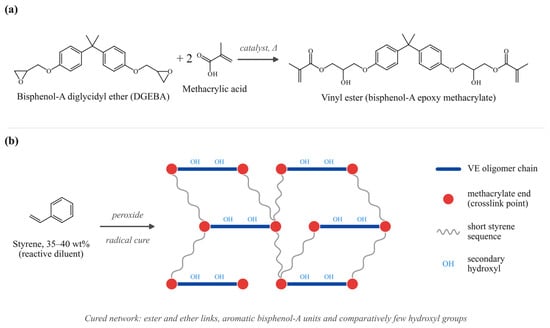
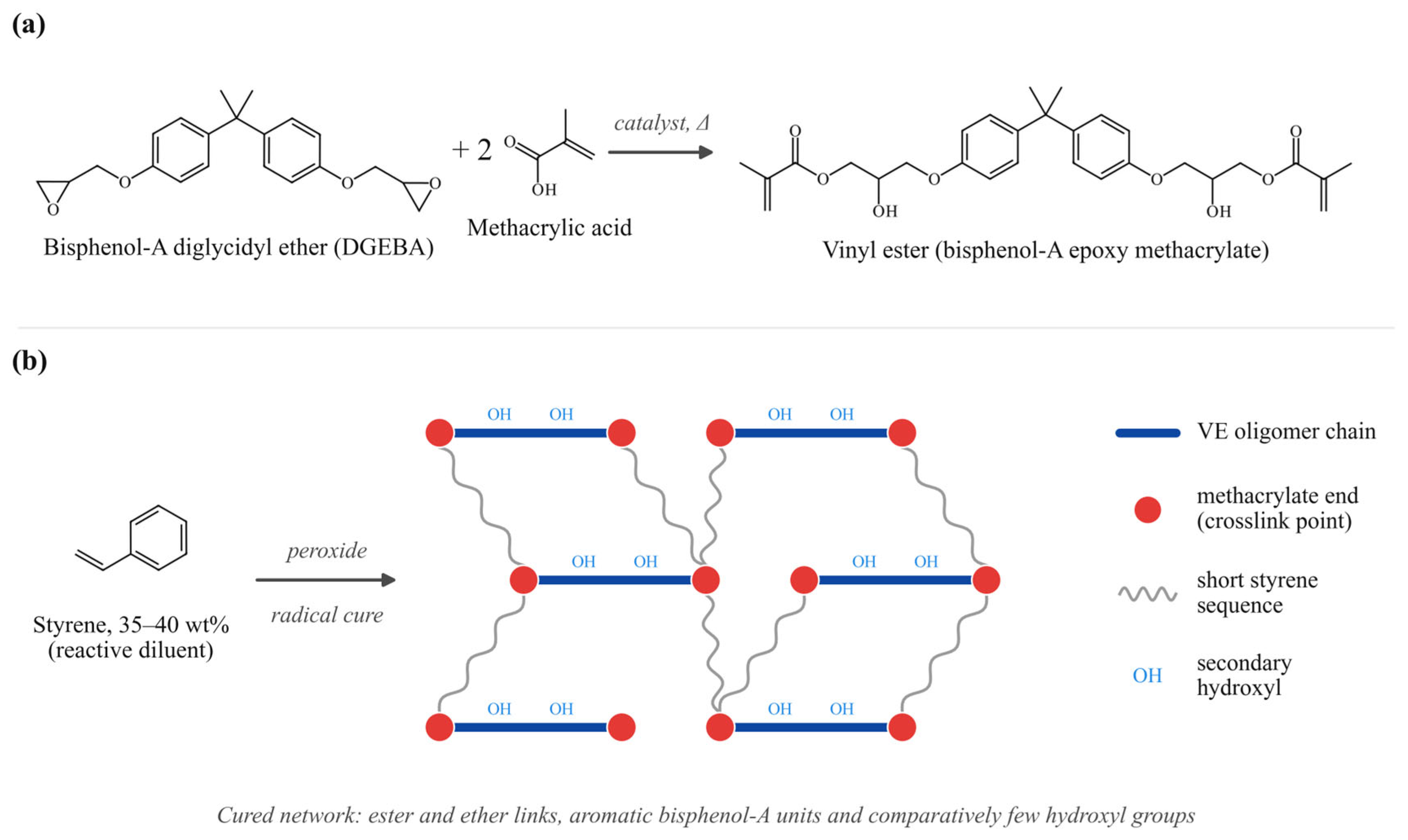
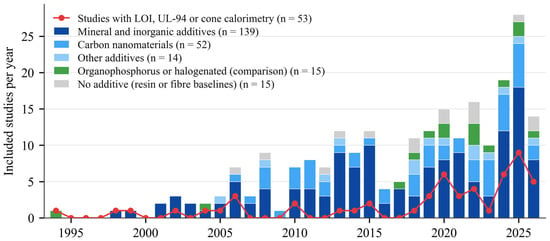
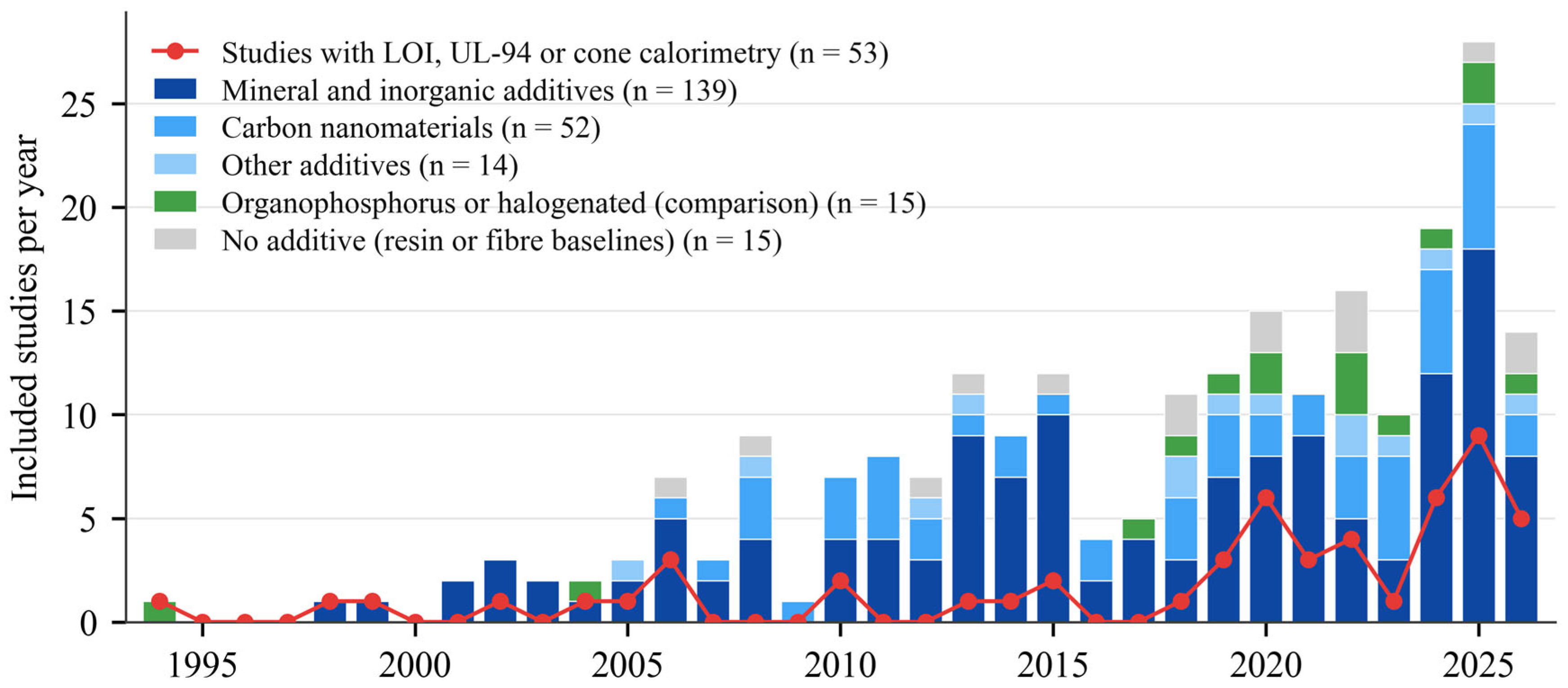
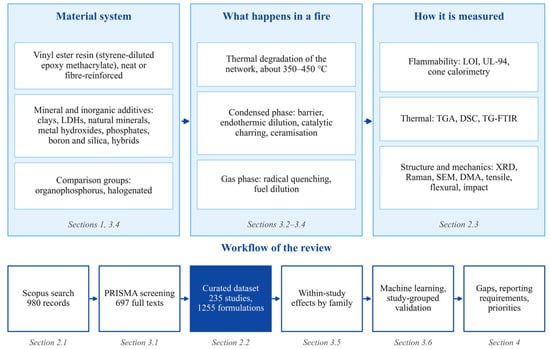
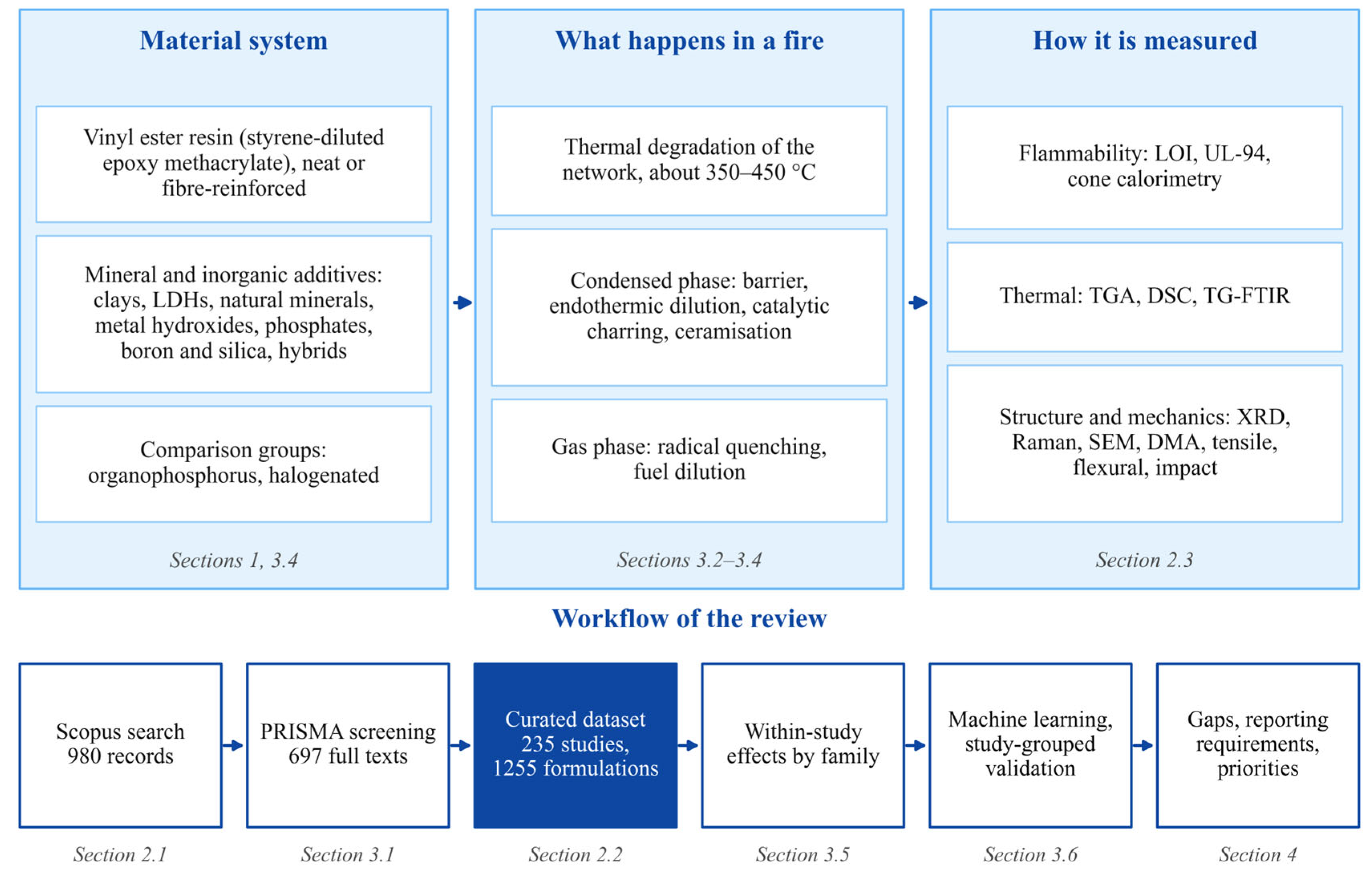
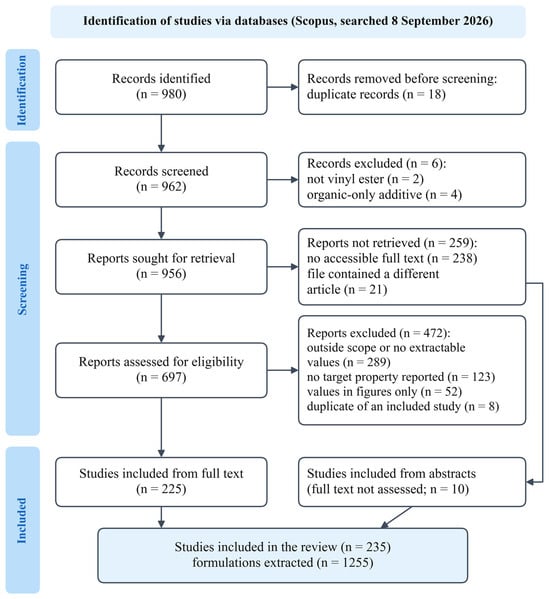
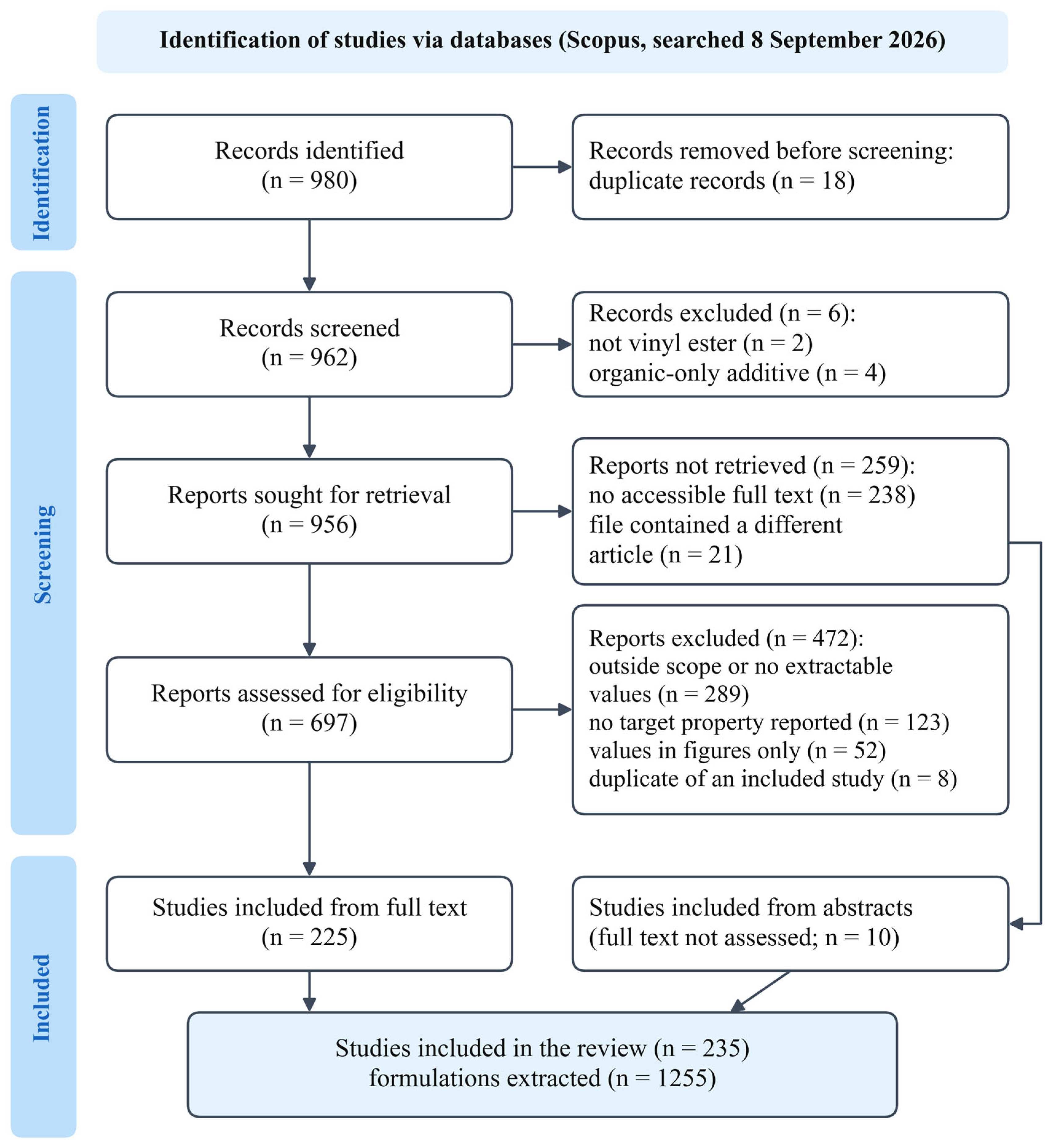
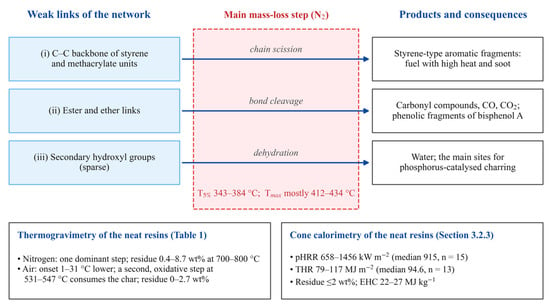
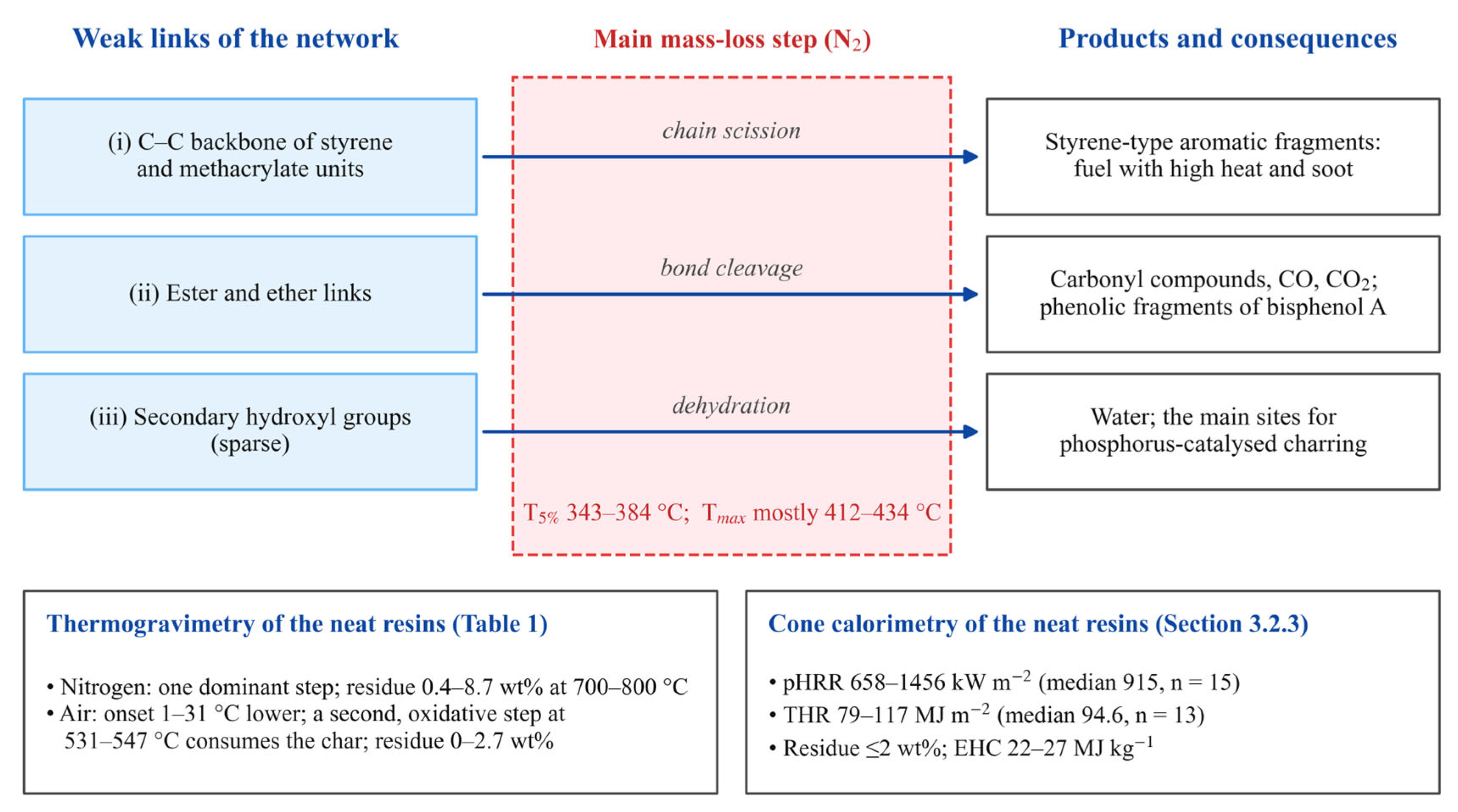
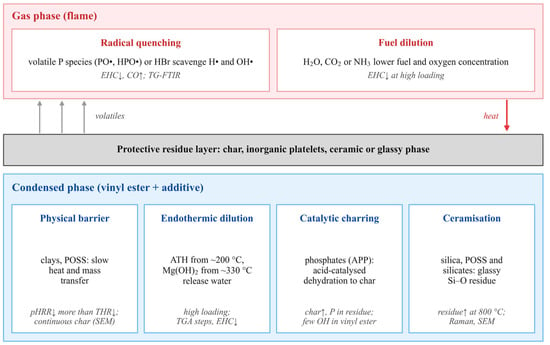
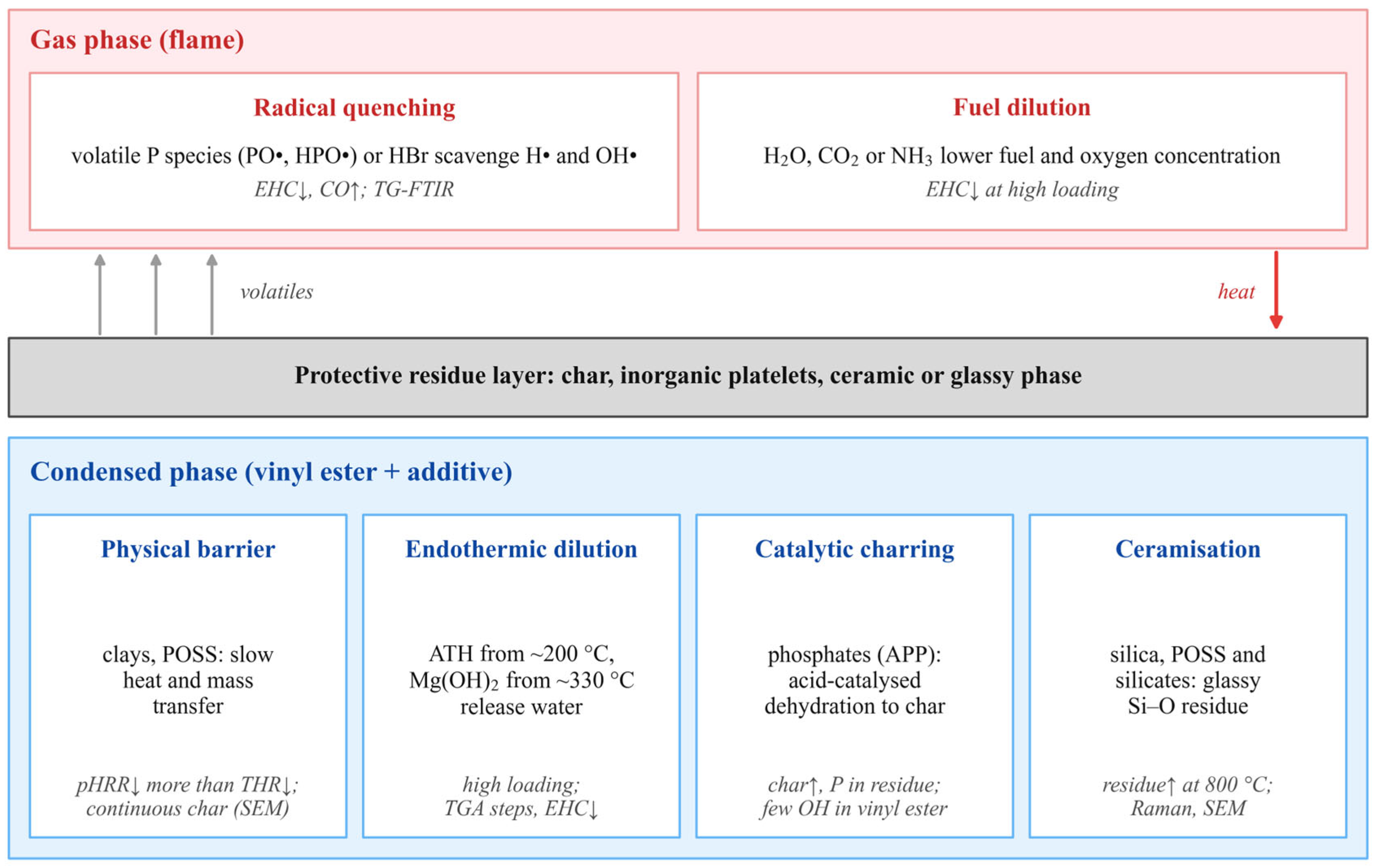
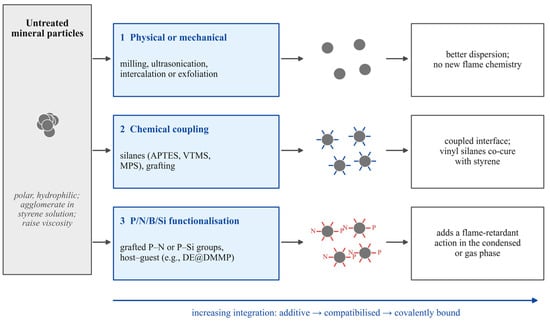
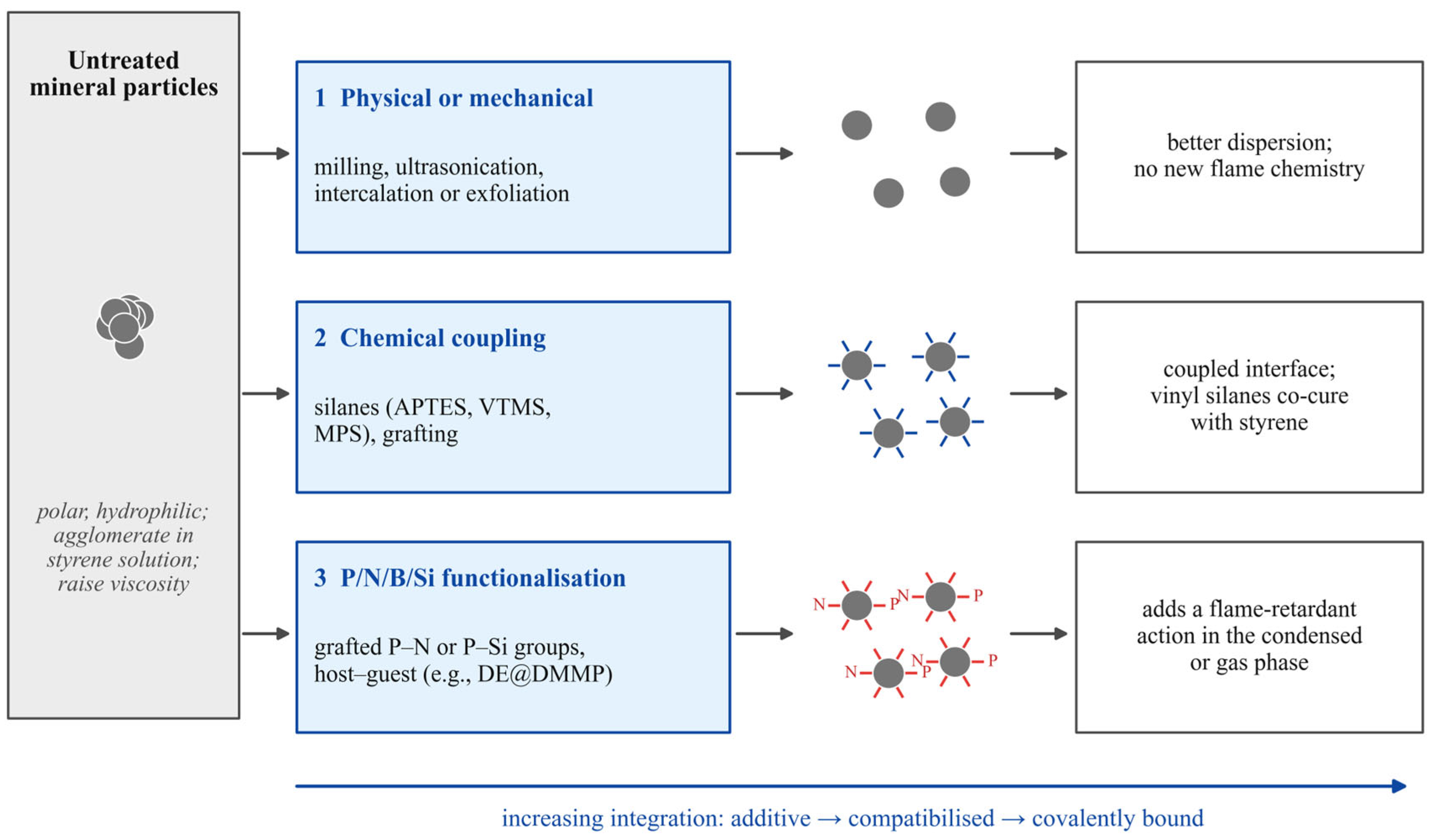
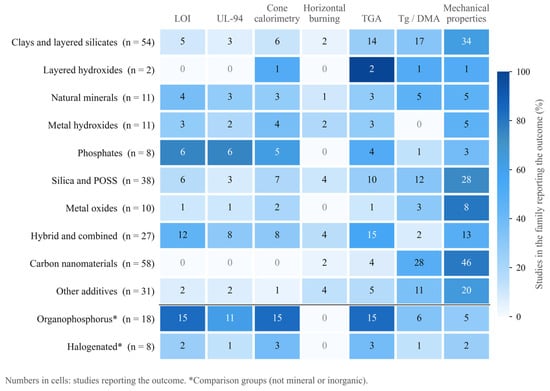
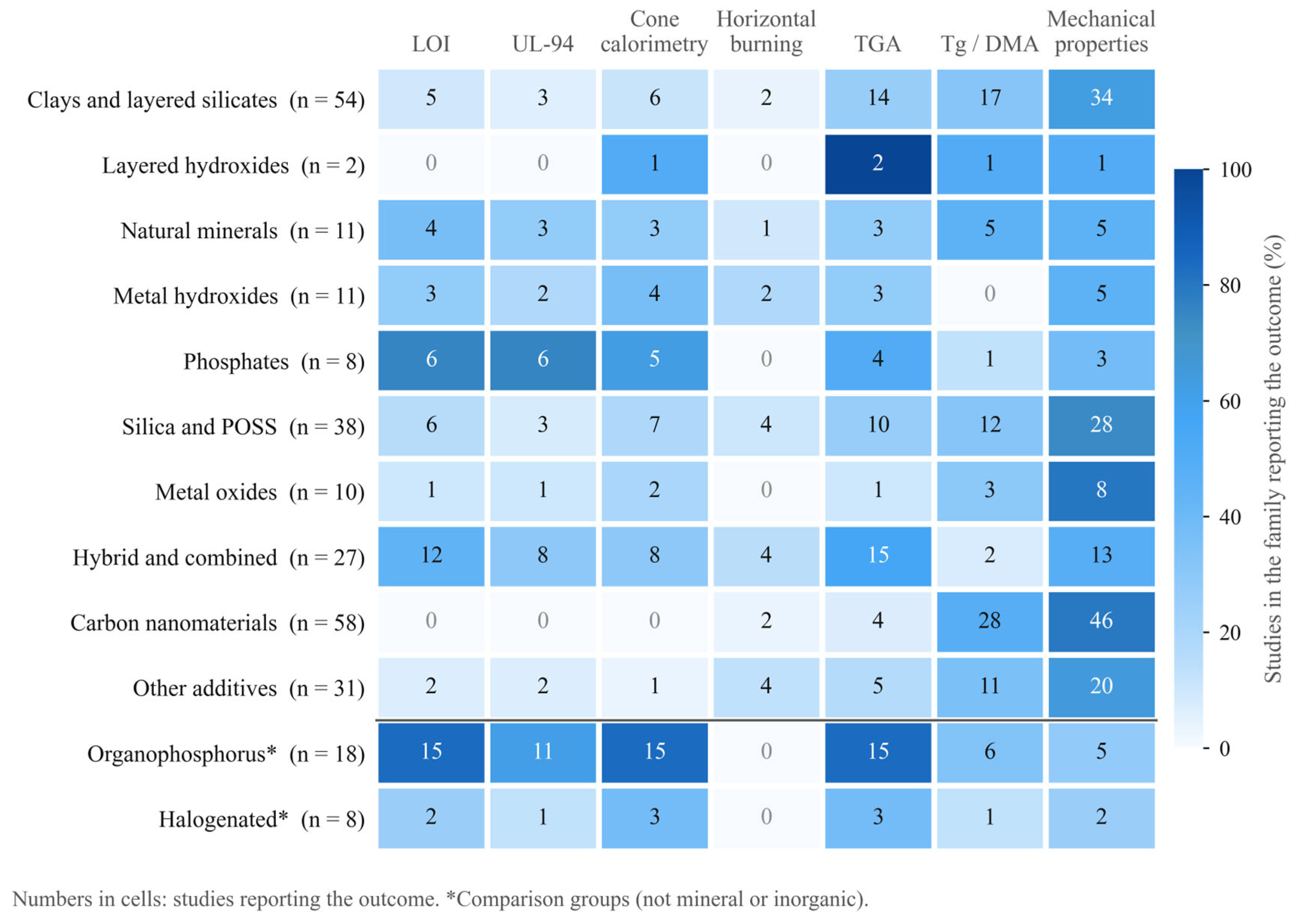
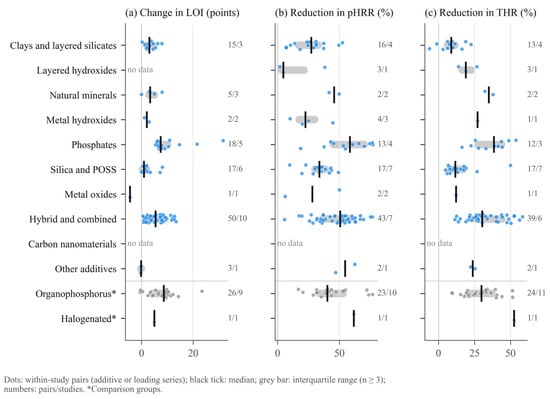
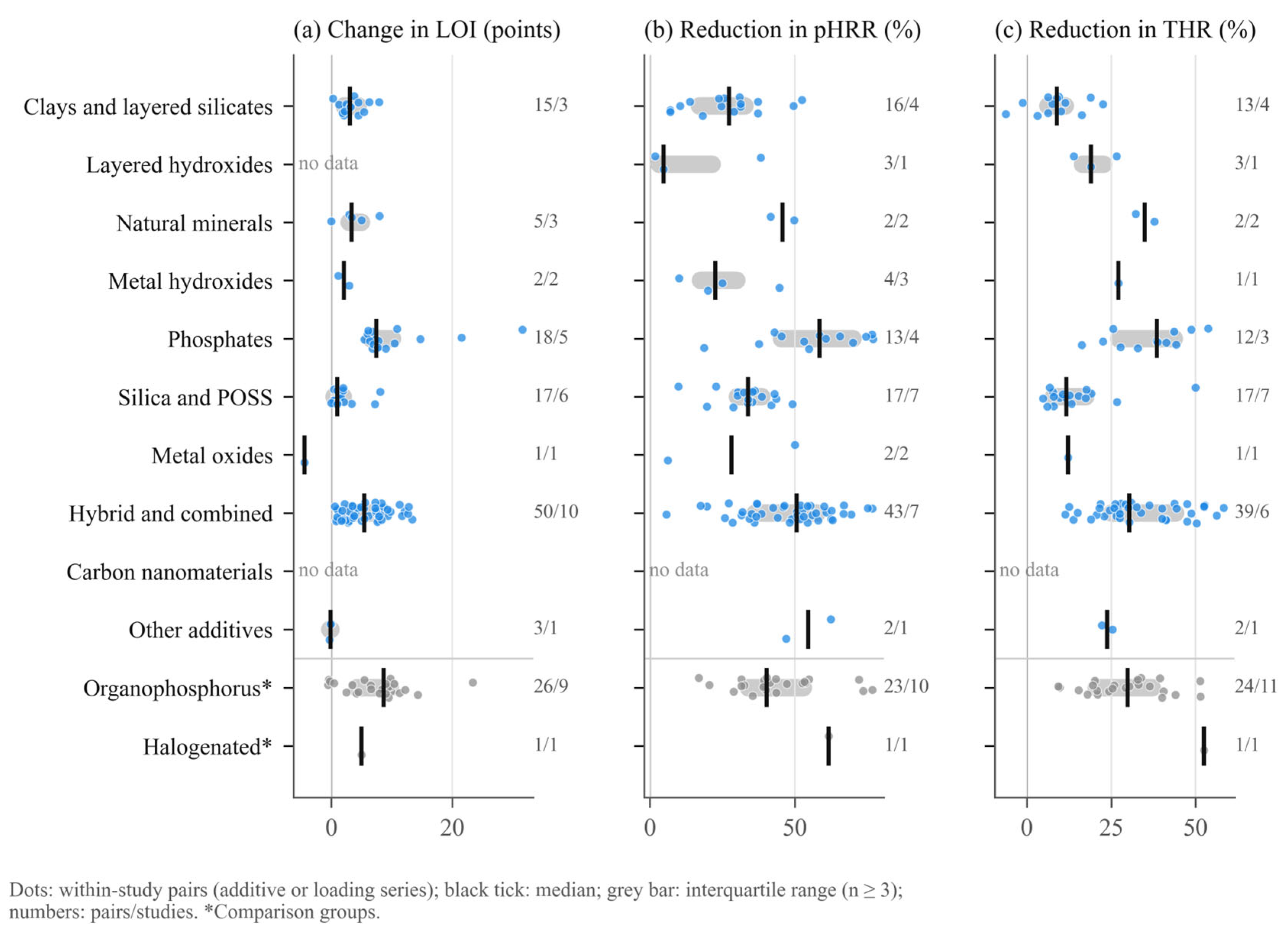
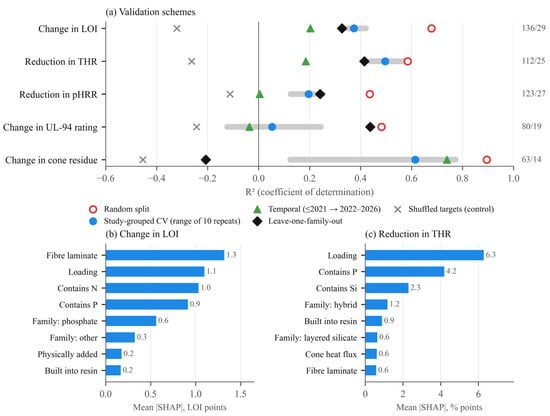
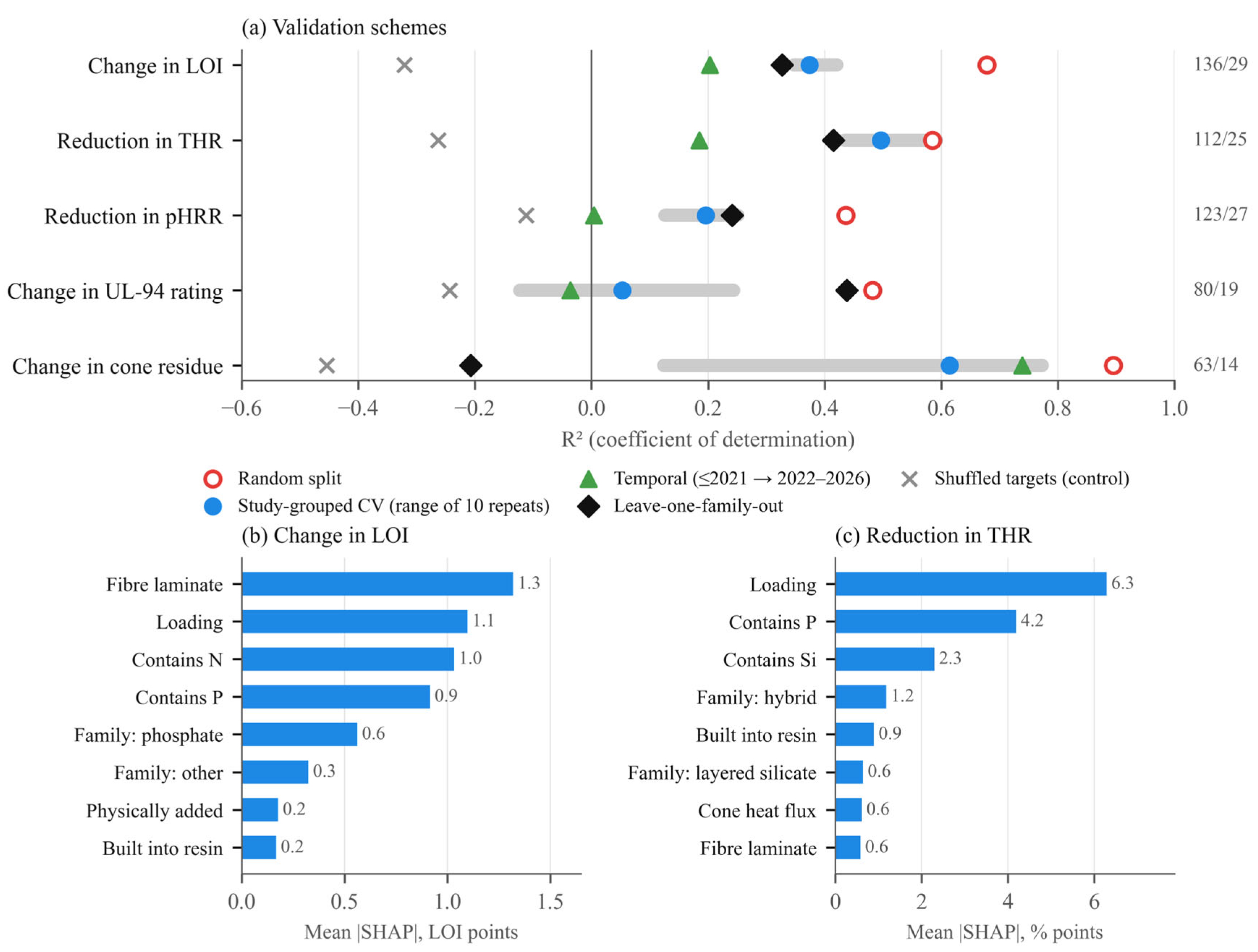

Disclaimer/Publisher’s Note: The statements, opinions and data contained in all publications are solely those of the individual author(s) and contributor(s) and not of MDPI and/or the editor(s). MDPI and/or the editor(s) disclaim responsibility for any injury to people or property resulting from any ideas, methods, instructions or products referred to in the content. |
© 2026 by the authors. Licensee MDPI, Basel, Switzerland. This article is an open access article distributed under the terms and conditions of the Creative Commons Attribution (CC BY) license.