


Abstract
The use of new psychoactive substances (NPSs) is increasing, and their chemical diversity together with potential postmortem changes demands accurate screening and confirmatory analysis in biological matrices. This study highlights the analytical value of combining ultra-high-performance liquid chromatography-high-resolution mass spectrometry (UHPLC-ESI(+/−)-Orbitrap-HRMS) and gas chromatography-mass spectrometry (GC/MS) for the broad-coverage screening of classical psychoactive substances (CPSs), NPSs, and their metabolites in a selected cohort of 25 postmortem urine samples with suspected NPS consumption; given this limited size, results should be regarded as a proof-of-concept rather than epidemiologically representative. Forty-four drugs/metabolites were identified, most confirmed against authentic standards (Level 1), while a subset of minor or emerging metabolites received tentative/probable identifications (Level 2) based on accurate mass, isotopic pattern, and fragmentation. Ketamine, one of the most prevalent drugs (88% LC/MS, 84% GC/MS), followed by cocaine (68% LC/MS, 12% GC/MS); amphetamine-type substances (ATS) showed marked technique-dependent detection (e.g., 3,4-methylenedioxyamphetamine (MDA): 48% LC/MS, 8% GC/MS). LC/MS offered broader polarity coverage. GC/MS reliably detected parent drugs and derivatizable xenobiotics. Together, both platforms provided complementary confirmed and tentative-level coverage for forensic urine screening; quantitative validation and larger cohorts are needed before diagnostic, impairment, or epidemiological extrapolation can be made.
1. Introduction
The increase in the abuse of classical psychoactive substances (CPSs) and novel psychoactive substances (NPSs), especially anesthetics and synthetic opioids, has created a public health crisis. In several countries, the rates of deaths and intoxications related to this kind of drug use have risen, as well as phenomena related to criminality, adverse events, and mental health problems, which are particularly present in school-age teenagers and young adults [1,2,3].
Despite the opioid crisis in North America, it is essential to consider that there is not a unique NPS consumption global trend, and that these phenomena could shift according to social determinants, the type of drug, consumer, region, supply, and demand. There are distinct effects for different substances, each associated with specific compounds that trigger imbalances and dysregulation in pathways across several systems (e.g., dopaminergic, serotonergic, GABAergic). Each altered pathway could produce a distinctive pharmacological profile, which is why there is an imperative need for the forensic toxicology system to determine the best methodologies for the reliable identification of any kind of drugs and their metabolites [4,5,6,7], to help elucidate the mechanism of drug-impairment, intoxication, or death in the forensic toxicology system, and the generation of adverse event treatment in clinical toxicology and emergency medicine practice [8,9,10,11,12,13].
Several methods for extracting NPSs and their metabolites have been reported in the literature, including solid-phase extraction (SPE) using various sorbents. Traditional liquid extraction (LLE) and miniaturized, eco-friendly techniques such as hollow fiber solvent bar microextraction, liquid–liquid microextraction, membrane-protected molecularly imprinted polymers, and QuEChERS or dispersive extraction have also been reported [14,15,16,17,18,19]. Urine is the preferred matrix for forensic and clinical analysis due to its easy, non-invasive collection, a broader diagnostic window (compared to blood), relatively high concentrations of drugs and metabolites, and ease of extraction, often requiring hydrolysis and chemical derivatization before chromatographic analysis [20,21,22]. Regarding instrumental analysis, publications report the use of universal detectors for targeted screening, low mass-resolution GC and LC in single quadrupole in full-scan mode, as well as triple quadrupole systems (QqQ-MS) for targeted analysis and quantification, and high-resolution LC-MS/MS for both targeted and non-targeted analysis, focusing on the simultaneous confirmation and quantification of compounds using data-dependent and independent acquisition modes [23,24,25,26]. System selection must account for the physicochemical differences between the lipophilicity of Phase I metabolites and the hydrophilicity of Phase II metabolites; steps or modifications should be applied to improve extraction efficiency. Recently, several approaches have aimed to elucidate drug–drug interactions and potential metabolites using in silico ADMETox and quantitative structure–activity relationship models, as well as in vitro analyses using cell and animal models [27,28,29].
This study aimed primarily to implement two methodological setups for the screening of NPSs, CPSs, and their metabolites; the analytical performance of both GC/MS and UHPLC-ESI (+/−)-Orbitrap-HRMS was evaluated according to ANSI/ASB 036-2019 Standard Practices for Method Validation in Forensic Toxicology for qualitative analysis [30]. The methods were applied to determine a selection of NPSs, CPSs, and their metabolites in urine using GC/MS and UHPLC-ESI (+/−)-Orbitrap-HRMS as complementary analytical methods for screening in 25 urine samples provided by the Forensic Toxicology Laboratory at the National Institute of Legal Medicine and Forensic Sciences, with suspected consumption of ketamine, opiates, and ATS. Although both platforms have been independently applied to identify NPSs and CPSs in biological matrices and characterizations of tusibi, pink cocaine, or related slang names have been reported [31], to our knowledge, no study has specifically addressed the complementarity of these two technologies in forensic biological samples in our region. While GC/MS identified parent compounds, LC/MS provided a more comprehensive profile of urinary excretion products for both parent drugs and metabolites, including phase I and phase II metabolites, demonstrating the complementary value of the two techniques for rapid and reliable screening of CPSs and NPSs in urine. This qualitative approach helps expand the forensic metabolic chemical space and provides a starting point for linking forensic analytical toxicology with clinical and epidemiological practice by describing toxicological findings in relation to the recorded manner of death. These findings inform the need for future quantitative studies in blood to establish drug–drug interaction-related impairment and support harm-reduction strategies targeting the current consumption trends in the region.
2. Results
Analysis of Forensic Samples by GC/MS and UHPLC-ESI (+/−)-Orbitrap-HRMS
A dual platform screening approach was applied to urine samples from forensic casework in order to detect CPSs, NPSs, and metabolites. Compound identification met current forensic and analytical rigor, since detected features were categorized according to identification confidence levels adapted from Schymanski et al. and used by the Metabolomics Standards Initiative (MSI) [32,33]. Confirmed Structures (Level 1) were assigned when an authentic reference standard (listed in Table S1 with supplier lot numbers and exact chemical formulas) was analyzed within the same analytical sequence. Retention time, precursor accurate mass, and experimental MS/MS or EI mass spectral library matches were required for confirmation. Level 2 was assigned to molecules where commercial reference standards were unavailable (tentative identification). This category relied on the precursor mass accuracy along with experimental spectral library matching (similarity score) supported by the accuracy of two fragmentation products, which were individually tested. It is worth noting that isomeric metabolites are reported as Level 2 annotations that are not claimed as structural confirmation since accurate mass cannot distinguish positional or regio-isomeric patterns not resolved chromatographically. Selectivity assessment showed no coeluting interferents from endogenous or exogenous compounds at the retention time and with the same mass spectra as the drugs of interest. Carryover was negligible, as solvent, sample blanks, and negative controls showed no signals for CPSs, NPSs, or metabolites. Limits of detection ranged from 21 to 438 ng/mL and 8 to 41 ng/mL for GC/MS and LC/MS, respectively (see Table 1).
Table 1.
Analytical performance results for CPSs, NPSs, and metabolites.
Table 2 details the xenobiotics of forensic interest identified in 25 screened samples and shows the informed cause of death. Identification data were anonymized to meet ethical research requirements.
Table 2.
Detailed GC/MS and UHPLC-ESI (+/−)-Orbitrap-HRMS urine screening findings.
Dissociative anesthetic ketamine was found in 22/25 (88%) and 21/25 (84%) of the samples by LC/MS and GC/MS, respectively. Norketamine, the main active metabolite, was detected in 19/25 (76%) and 5/25 (20%) of the samples by LC/MS and GC/MS, respectively. The hydroxylated forms, hydroxynorketamine and hydroxyketamine, were tentatively identified only by LC/MS in 14/25 (56%) and 16/25 (64%) of samples, respectively. Both are products of the hydroxylation of the cyclohexanone ring of ketamine and norketamine, respectively. Ketamine glucuronidation (phase II metabolism) was not detected under the present analytical conditions (Figure S1). Cocaine was identified in 17/25 (68%) and 4/25 (16%) of the samples for LC/MS and GC/MS, respectively. It is extensively biotransformed via both enzymatic and non-enzymatic pathways to the pharmacologically inactive benzoylecgonine (BE), detected in 23/25 (92%) and 13/25 (52%) of the samples by LC/MS and GC/MS, respectively, a product of cocaine hydrolysis catalyzed by carboxylesterases. Ecgonine methyl ester (EME), an inactive metabolite formed by enzymatic hydrolysis of cocaine, was detected in 9/25 (36%) and 8/25 (32%) of the samples by LC/MS and GC/MS, respectively. Ecgonine, an inactive metabolite produced by hydrolysis of BE and EME, was present in 9/25 (36%) of the samples analyzed by LC/MS. When cocaine and alcohol are used together, some cocaine undergoes transesterification, forming in the body at least two new substances. Cocaethylene was present in 8/25 (32%) of the samples for LC/MS. Ecgonine ethyl ester (EEE), an inactive metabolite formed during the hydrolysis of cocaethylene, was detected in 8/25 (32%) of the samples analyzed by LC/MS (see Figure S2) [34,35,36,37,38].
The hallucinogen Δ9-tetrahydrocannabinol, the main active constituent of Cannabis sativa, undergoes various phase I transformations until the formation of the main urinary inactive metabolite 11-nor-9-carboxy-Δ9-tetrahydrocannabinol THC-COOH, along with its phase II metabolite 11-nor-9-carboxy-Δ9-tetrahydrocannabinol-glucuronide, which were detected only by LC/MS in 14/25 (60%) and 1/25 (4%) of the samples, respectively [39,40].
Central nervous system stimulants, entactogens, and hallucinogens: MDMA was present in 7/25 (28%) and 3/25 (12%) of the samples for LC/MS and GC/MS, respectively. MDA was found in 12/25 (48%) and 2/25 (8%) samples by LC/MS and GC/MS, respectively. Both substances were also tentatively annotated indirectly through their hydroxylated forms: HHMA 8/25 (32%), HHA 4/25 (16%), HMA 3/25 (12%), and HMMA 2/25 (8%). Methamphetamine (MA) was identified in 2/25 (8%) of the LC/MS samples, and its main hepatic metabolites, 4-HA and 4-HMA, were detected in 5/25 (20%) and 1/25 (4%) of the samples analyzed by LC/MS. Figures S3 and S4 show the putative urinary metabolic products of ATS. Amphetamine was found in 3/25 (12%) of the samples by LC/MS [41,42].
Central nervous system depressants consisted mainly of the benzodiazepine oxazepam, an active metabolite of diazepam, nordazepam, and temazepam, which were present in 14/25 (56%) of the samples; midazolam and its metabolite α-hydroxymidazolam were found in 3/25 (12%) and 1/25 (4%) of the samples for LC/MS and GC/MS, respectively. Both the synthetic opioid fentanyl and the analog norfentanyl were present in 6/25 (24%) and 1/25 (4%) of the samples for LC/MS and GC/MS, respectively; the metabolites hydroxyfentanyl and hydroxynorfentanyl were found in one sample analyzed by LC/MS. Morphine-3-glucuronide, a phase II metabolite of morphine, was detected in 1 sample [43,44,45,46].
Two active substances known as adulterants, or cuttings, were detected. Lidocaine was found in 16/25 (64%) and 5/25 (20%) of the samples by LC/MS and GC/MS, respectively, and its main metabolite, hydroxylidocaine, in 7/25 (28%) samples analyzed by LC/MS. Caffeine was detected in 23/25 (92%) and 20/25 (80%) of the samples by LC/MS and GC/MS, respectively; its metabolite, dimethylxanthine, was identified by LC/MS analysis for 24/25 (96%) and 14/25 (56%) of the samples.
3. Discussion
Systematic toxicological analysis by full-scan GC/MS, combined with deconvolution and extensive low-resolution spectral libraries, has been the reference approach in forensic toxicology for decades. Its principal strengths—high reproducibility and broad library coverage, including silylated derivatives—are well documented [47,48]. Its principal limitations are equally well described: thermal lability of several analyte classes, the need to hydrolyze glucuronic adducts and derivatize polar metabolites, and limited sensitivity for highly polar and conjugated species [4,22]. LC/MS screening on Orbitrap and QTOF platforms was developed to address these constraints, and published urine screening methods report detecting several compounds using accurate-mass suspect lists, commercial, experimental, and in silico spectral libraries, and minimal sample preparation [49,50]. Our results are consistent with that body of work: the LC/MS platform returned a more complete urinary excretion profile, particularly for hydroxylated phase I metabolites and glucuronides, whereas GC/MS contributed orthogonal, EI-library-based evidence for parent compounds and for a subset of phase I metabolites. The methodological contribution of the present study is therefore not the introduction of a new platform, but the paired application of both platforms to the same authentic postmortem casework urine samples, which allows the discrepancy between the two techniques to be attributed to analyte chemistry rather than to differences in case populations, and the documentation of ketamine-centered polydrug patterns (“tusi”) in Colombian forensic casework.
Detection in urine is governed by the urinary detection window of each analyte and of its main metabolite, and not by any single elimination profile common to NPSs; reported half-lives among NPSs range from less than 1 h (e.g., cathinone) to more than 20 h for designer benzodiazepines (e.g., flubromazolam). For the substances detected here, the relevant considerations are compound-specific [51]. Ketamine has a relatively short half-life, whereas its N-demethylated metabolite, norketamine, and downstream hydroxylated species persist longer and are excreted in greater relative abundance, consistent with the higher detection frequency of norketamine, hydroxynorketamine, and hydroxyketamine than expected from the parent alone. Cocaine is rapidly hydrolyzed by carboxylesterases and plasma cholinesterase, so its detection in urine essentially marks very recent exposure, while benzoylecgonine and ecgonine methyl ester, with substantially longer half-lives, define the practical detection window; cocaethylene, formed only in the presence of ethanol, additionally documents concurrent alcohol use. ATS shows urinary-pH-dependent elimination, which limits inferences about dose or time of intake from detection frequency. THC-COOH, a terminal carboxylic metabolite excreted largely as its glucuronide, has by far the longest detection window and may reflect exposure days to weeks before death, particularly in long-term users. Consequently, differences between the time of ingestion and the time of sampling, together with analyte-specific ADME behavior and, in postmortem cases, the unknown survival interval, are expected to contribute to the observed pattern of parent-drug versus metabolite detection [52,53].
The R2 values obtained by GC/MS for several analytes—methamphetamine (0.478), nitrazepam (0.662), MDMA (0.732), thioridazine (0.792), clonazepam (0.794), MDA (0.839) and caffeine (0.841)—did not meet our predefined acceptance criterion, whereas the corresponding LC-HRMS values did. Rather than an intrinsic limitation of mass-spectrometric detection, this behavior reflects the cumulative yield of preceding steps, a pattern repeatedly described for GC/MS-based systematic toxicological analysis [54,55]. Cleavage of glucuronide and sulfate conjugates must precede extraction; enzymatic hydrolysis with β-glucuronidase is analyte-gentle but slow and incomplete for some conjugates, whereas acid or alkaline hydrolysis is faster but degrades labile analytes such as the 7-nitrobenzodiazepines and 6-monoacetylmorphine. Silylation of amino, hydroxy, and carboxylic functional groups is then required, and derivatization yields vary with steric hindrance, the electronic environment of the reactive site, water content, and reaction kinetics, so that a single set of conditions cannot be optimal across a panel spanning amphetamines, opioids, benzodiazepines, and cocaine metabolites [55]. Finally, thermally labile and adsorptive analytes may undergo partial degradation or rearrangement in the injection port and on active surfaces, producing non-reproducible mass transfer to the column and hence poor linearity [56,57,58]. In the present work, enzymatic hydrolysis and trimethylsilylation were selected as a compromise between simplicity, sensitivity, chemical coverage, reaction time, sample integrity, chromatographic behavior, and the availability of library spectra for TMS derivatives; the R2 values reported above delimit the analytes for which this compromise is unfavorable and for which LC/MS should be regarded as the method of preference.
Glucuronides were detected only by LC/MS, as expected. Conjugates carry additional hydroxyl and carboxyl functions that increase polarity and hydrogen-bonding capacity, which shortens retention on reversed-phase columns and, for acyl and ether glucuronides, reduces ionization efficiency under standard positive-mode ESI conditions; negative-mode acquisition and dedicated chromatographic conditions are commonly recommended for their determination [59]. In GC/MS, conjugated analytes are not observed as such by design: they contribute to the signal of the deconjugated parent or phase I metabolite after hydrolysis, so direct evidence of conjugation is inaccessible on that platform. This distinction is analytically relevant because direct detection of the intact conjugate—as obtained here for 11-nor-9-carboxy-Δ9-THC-glucuronide, nordazepam-glucuronide, and morphine-3-glucuronide—provides evidence of metabolic transformation in vivo that survives independently of hydrolysis efficiency, an argument advanced in favor of hydrolysis-free LC/MS screening [60]. The transformation products annotated here are consistent with the sequential oxidation, hydroxylation, and conjugation pathways described for these compound classes [61,62].
Four observations have practical consequences for forensic laboratories in the region. First, the preliminary polydrug pattern documented in Table 2 (e.g., ketamine–ATS-cocaine–caffeine), and, in particular, the frequency with which ketamine and its metabolites appear in casework locally described as “tusi”, indicates that screening panels that do not include ketamine metabolites will potentially misclassify these cases [63]. Second, the detection of lidocaine and caffeine alongside cocaine, ketamine, and its metabolites is consistent with the adulteration profiles reported for samples seized or reported worldwide [31]; for caffeine, however, the analytical finding is not interpretable in isolation, because dietary intake is ubiquitous in the Colombian population and caffeine and its metabolites, theobromine and 1,3,7-trimethyluric acid, were present in nearly all samples. Caffeine should therefore be reported as a finding of pharmacological rather than forensic significance, relevant mainly to drug–drug interactions, unless supported by the seized-material analysis of the corresponding case. Third, screening identifies substances, prior exposure, and urinary excretion hypotheses, but does not establish their contribution to death; once a xenobiotic or metabolite is identified, quantification in blood using certified reference materials and a fully validated quantitative method remains indispensable for assessing impairment and toxic or lethal exposure. Given the speed with which the NPS market changes, spectral libraries, accurate-mass suspect lists, and screening panels require continuous updating [64,65,66]. Fourth, despite the enrichment of this cohort toward ketamine/ATS positive casework, no NPSs in the strict sense were confirmed or tentatively identified: no synthetic cathinones, no benzimidazole/nitazene opioids, no designer benzodiazepines, and no phenethylamines such as 2C-B, despite the latter being repeatedly reported as a component of “tusi”-branded mixtures in the region [31]. This no-detection finding should not be read as evidence of their absence from the local drug supply; the ever-changing nature of these drugs creates the need to expand the analytical portfolio of the forensic laboratory.
The present study used a purposive sampling strategy: only casework screened presumptive positive for NPSs, CPSs, or metabolites by immunoassay were included. This enrichment was deliberate and appropriate for the study objective but introduces an unavoidable verification bias. Consequently, data reported here should not be interpreted as prevalence. Further research should address the need for quantitative analysis, using a larger sample size for prevalence and causality interpretation, and include a broad panel of biological matrices (blood, bile, vitreous humor) to assess matrix effects in recoveries.
4. Materials and Methods
4.1. Reagents and Chemicals
Acetonitrile, methanol, and ethanol of analytical grade were purchased from Mallinckrodt (Dublin, Ireland); dichloromethane was purchased from Merck (Darmstadt, Germany), and ultrapure helium 99.995% (Messer—Bucaramanga, Colombia) was used as the mobile phase in chromatographic analysis.
All standard solutions for quality control were prepared at a concentration of 10 mg mL−1 (stock solution) and then diluted to a working solution of 1 mg mL−1. Table S1 lists potential target drugs or metabolites to monitor during analysis, including their molecular formula, retention time (tR), and experimental exact and average masses.
4.2. Sample Preparation by GC/MS and UHPLC-ESI (+/−)-Orbitrap-HRMS
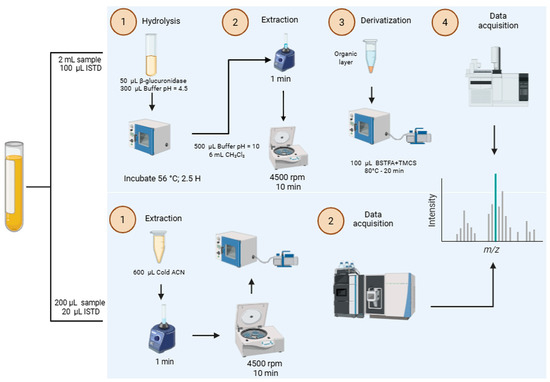
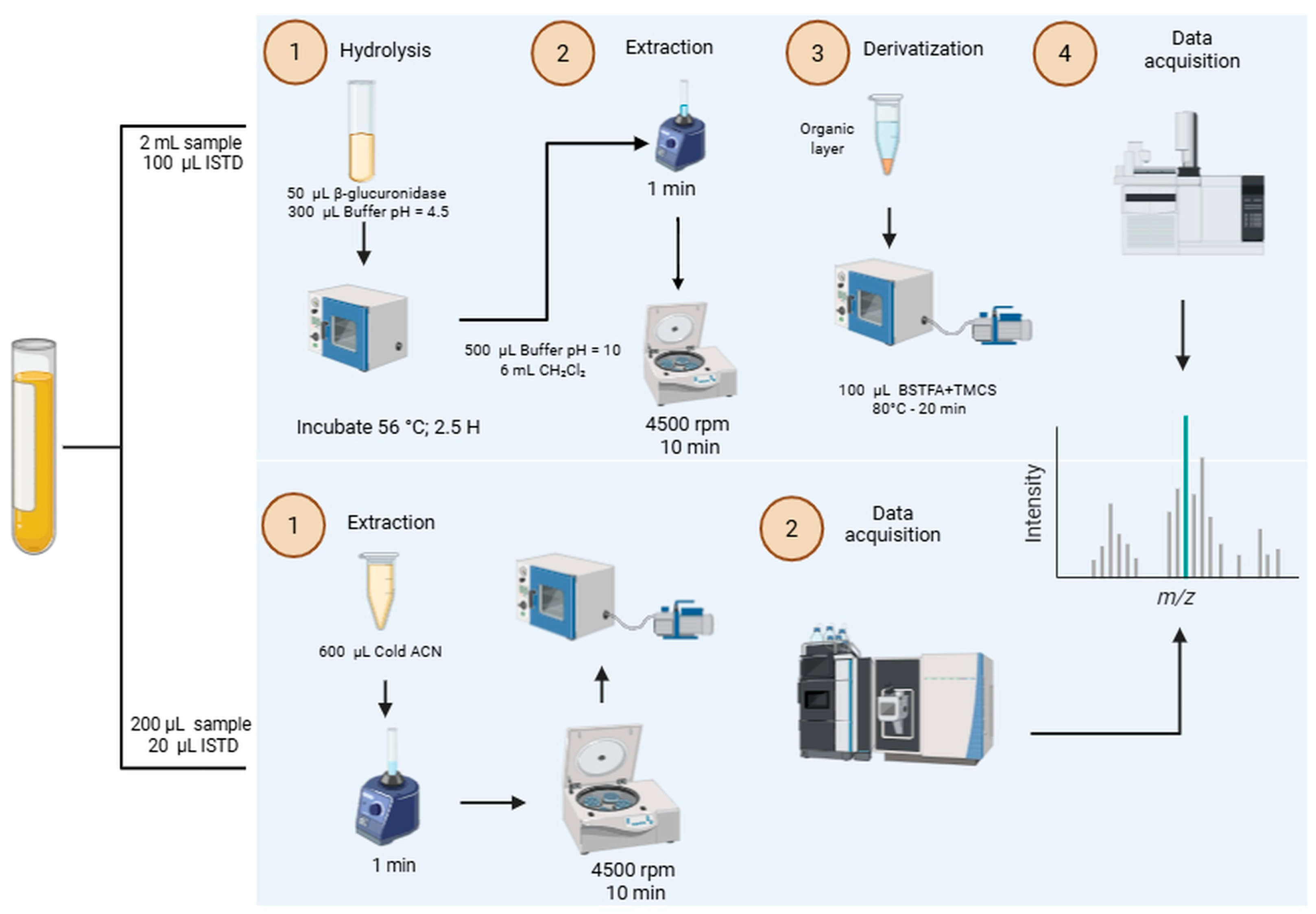
Figure 1 reports the workflow for urine analysis in both methodologies. A total of 80 authentic human urine samples of forensic origin were provided by the National Institute of Legal Medicine and Forensic Sciences, Regional Office of Pereira, corresponding to casework received during forensic procedures. Sample selection followed a purposive design intended to maximize the number of samples containing the target analytes, and was therefore not designed to estimate the prevalence of these substances in the forensic population. All samples were fully anonymized and internally coded before selection; the analyst had no access to personal identifiers, case data, or demographic information. Urine samples were previously qualitatively screened (presence/absence) by homogeneous enzyme immunoassay (EMIT®, Xerion, Bogotá, Colombia) for drugs of abuse and their metabolites, namely cocaine (as benzoylecgonine), opiates, cannabinoids (as THC-COOH), benzodiazepines, ATS (as MDMA or amphetamine), methadone, ketamine, and barbiturates. Exclusion criteria included samples with a medicolegal autopsy performed more than 48 h after death, negative (absence) EMIT results, samples with volumes below 10 mL, and samples showing visible degradation or adulteration. A total of 25 urine samples tested preliminary positive for ketamine or ATS. Aliquots of 6 mL were taken and stored at −20 °C until analysis. Two extraction methodologies were applied. Extraction methods were based on the forensic laboratory’s protocols, slightly modified to enable the identification of new molecules and their metabolites [67,68,69]. For confirmatory GC/MS analysis, 100 μL of flurazepam (ISTD) was added to 2 mL of the forensic sample, followed by 300 μL of sodium acetate buffer pH 4.5, then 50 μL of β-glucuronidase (Helix pomatia), and incubation at 56 °C for 2.5 h. The pH was adjusted to 10 by adding 500 μL of sodium tetraborate buffer, followed by 6 mL of dichloromethane. The mixture was vortexed for 1 min, then centrifuged at 2490× g for 10 min. The organic phase was dried under a gentle nitrogen flow, and 50 μL of BSTFA+TMCS mixture (99:1) and 50 μL ethyl acetate were added to the dry extract, followed by incubation at 80 °C for 20 min. A total of 1 μL was injected into the GC/MS in full scan mode. For UHPLC-ESI (+/−)-Orbitrap-HRMS analysis, 20 μL of oxazepam-d5 (ISTD) was added to 200 μL of urine, followed by 600 μL of ice-cold acetonitrile (ACN), vortex agitation for 1 min, and centrifugation for 10 min at 2490× g. The supernatant was dried under a gentle stream of nitrogen, then reconstituted with mobile phase, and 2 μL was injected into the liquid chromatograph.
Figure 1.
Workflow for urine screening analysis. Oxazepam-d5 was used as an internal standard for LC/MS, and flurazepam for GC/MS.
To check the reliability of the two methodologies, sample runs included: solvent blank, used between sample injection to clean the system and avoid carryover; matrix blank, to determine the presence of endogenous compounds that may co-elute with the analytes of interest, and isobars that could produce false positive; negative control in a real matrix, to discard solvent, reactants and system contamination, assess drifts in retention time (due to internal standard), and a positive control in both aqueous and real matrix samples enriched with reference materials at final concentrations of 100 ng/mL for LC/MS and 1000 ng/mL for GC/MS, to estimate shifts in retention times, the efficiency of the extraction, the detection capacity of the libraries and establish a contrast medium. Pooled Quality Control Samples (Pool QCs) were prepared by mixing 20 µL aliquots of each sample to assess the repeatability of retention times and analytical response. Controls were treated as samples and analyzed in the same analytical sequence as the study samples, using descriptive univariate statistics to characterize the method’s analytical performance (see Section 4.5). No inferential statistical tests were applied because the objective was to characterize analytical precision rather than test differences between independent samples.
4.3. Gas Chromatography–Mass Spectrometry Analysis
GC/MS analysis was conducted on a gas chromatograph (GC 7890A System Plus, Agilent Technologies, Palo Alto, CA, USA) coupled with a selective mass detector (Agilent Technologies, MSD 5975C) using electron ionization at 70 eV. NPSs and their metabolites were separated on a capillary column with 5–phenyl-95% poly (dimethylsiloxane) (DB-5MS 30 m × 250 μm I.D., 0.25 μm film thickness, J&W Scientific, Folsom, CA, USA). The ionization source and interface temperatures were 230 °C and 300 °C, respectively. Injection was performed via pulsed splitless mode at 270 °C in the injection port. Full-scan data were acquired over a mass range of 40–450 m/z at a rate of 3.58 scans per second. The oven was initially set to 80 °C for 1 min, then heated at 15 °C min−1 to 200 °C for 5.3 min, followed by heating at 10 °C min−1 to 300 °C for 12 min. The total run time was 38.3 min. Standard solutions of the analytes were prepared in an authentic matrix at 0.5 μg/mL. Data analysis involved an automated workflow using Agilent MSD ChemStation Software (Ver. F.01.03.2357, Agilent Technologies, Santa Clara, CA, USA) for mass spectral deconvolution, peak detection, base peak integration, and compound identification via comparison with the NIST 2023 library and an in-house library containing tR and m/z of confirmed reference standards.
4.4. Ultra-High-Performance Liquid Chromatography-High-Resolution Mass Spectrometry Analysis
The urine extracts were analyzed in a VanquishTM ultra-high-performance liquid chromatograph (UHPLC, Thermo Scientific, Waltham, MA, USA), equipped with a degassing unit, a gradient binary pump, and an autosampler maintained at 10 °C. A Zorbax Eclipse XDB C18 chromatographic column (Sigma Aldrich, St. Louis, MO, USA) of 50 mm length × 2.1 mm I.D. and 1.8 μm particle diameter was used. The flow rate of the mobile phases containing Type I water (A) and methanol (B), both containing ammonium formate (5 mM) and formic acid (0.1%), was 300 μL min−1. The elution gradient program was as follows: 100% A for 8 min, then 100% B for 5 min, followed by 100% A for 7 min. The total run was 20 min, and the injection volume was 2 μL. The UHPLC was connected to a Q-Exactive Plus Orbitrap mass spectrometer (Thermo Scientific, Bremen, Germany) with a heated electrospray ionization source (HESI-II) and polarity switching for periods <500 ms, with HCD fragmentation. The capillary voltage was 3.5 kV. The nebulizer and capillary temperatures were 350 °C and 320 °C, respectively. The mass resolution was set to 70,000 (full width at half maximum, FWHM) at m/z 200, with an automatic gain control target of 3 × 10⁶, a maximum C-trap injection time of 200 ms, and a mass range of m/z 80–1000. The ions injected into the HCD via the C-trap were fragmented with normalized collision energies from 10 eV to 40 eV. Mass spectra were collected in all-ion fragmentation mode for each collision energy, employing a mass resolution of 35,000. The instrument was fully calibrated using the Pierce LTQ Velos ESI positive ion calibration solution and the Pierce ESI negative ion calibration solution (Thermo Scientific, Rockford, IL, USA). Data were analyzed using Thermo Xcalibur 3.1 software (Ver. 4.6.67.17, Thermo Scientific, San Jose, CA, USA) and Compound Discoverer (Ver. 3.4, Thermo Scientific). The compounds were identified by comparing the tR and accurate mass (Δppm < 1) with standard substances prepared in an authentic matrix at 0.1 μg mL−1, analyzed in the same batch as the samples, and those reported in the local compound database and NIST 2020 library. Additional putative metabolite identifications were performed by comparing the observed exact masses of each molecule with those reported in NIST 2023 and in silico platforms, including mzCloud, CFM-ID, ChemSpider, DrugBank, and MassBank of North America [67,68,69,70].
4.5. Analytical Performance
Method performance for both methodologies was evaluated according to ANSI/ASB 036-2019 Standard Practices for Method Validation in Forensic Toxicology for qualitative analysis. Linear calibration curves (n = 3) were calculated using an ordinary least squares (OLS) model. Blank urine aliquots were spiked with the stock solution to obtain calibration samples in real matrix at nominal concentrations of 1, 15, 30, 60, 125, 250, 500, and 1000 ng/mL for LC/MS and 15, 30, 60, 125, 250, 500, and 1000 ng/mL for GC/MS. Replicates (n = 3) at each concentration were analyzed as described above. After visually inspecting the signal-concentration plot, we statistically evaluated, for 3 independent calibration curves, the coefficient of determination (R2), mean absolute error, slope of regression (b), and intercept (a). Calibrations were accepted after evaluation of the statistical significance for the assumptions of R2 ≥ 0.9, b ≠ 0, and a = 0. LODs for LC/MS were calculated statistically from the following equation:
where s is the residual standard deviation of the intercept Sa, and b is the calibration graph slope. Complementary, one working solution at a concentration of the LOD was prepared and used as part of the run’s quality control for each methodology. Table 1 shows the analytical performance results for all the CPSs, NPSs, and metabolites.
Carryover was addressed continuously as part of the run’s quality assurance by injecting solvent blanks after every sample, especially positive controls. Solvent blanks were required to show no detectable signal at the characteristic retention time of the target analytes. Selectivity was assessed against matrix blanks, monitoring the absence of interferers that affect identification. Negative controls in authentic matrix were used to monitor the absence of false positives throughout the assessment of characteristic ions at the tR of the target analytes. Positive controls were used to retrieve the expected mass spectra and confirm identification at the corresponding tR for each target compound. Pooled QC samples were used to assess analytical performance. For both pooled QC and positive controls, the mean, standard deviation, and relative standard deviation (%RSD) of Retention time, mass accuracy, and mass-error drift were monitored for injections across the analytical sequence (acceptance criterion: tR drift ± 0.1 min, base peak ion present, sample area and tR ≤ 20% RSD, Δppm < 1 (LC/MS). Figures S5 and S6 show a visual representation of quality assurance for the analytical run, assessing repeatability in normalized base-peak areas of ketamine for GC/MS and LC/MS.
5. Conclusions
The present study demonstrates the feasibility of a complementary UHPLC-ESI(+/−)-Orbitrap-HRMS and GC/MS strategy for the qualitative detection of selected CPSs, NPSs, and metabolites in urine. The methods were successfully applied to 25 authentic postmortem urine samples, providing useful information on the presence of multiple substances in the investigated samples and potentially contributing to preliminary toxicological characterization in postmortem investigations. The co-detection of multiple drugs or metabolites in the urine should, however, be interpreted primarily as evidence consistent with exposure and urinary excretion; this study does not establish drug–drug interactions, impairment, or a causality between drug exposure and death. Such interpretations require quantitative blood analysis, along with relevant background and forensic evidence.
Overall, the findings demonstrate the potential applicability of this approach as a complementary screening strategy in forensic toxicology. Further studies involving a broad group of molecules (e.g., synthetic cathinones, nitazene opioid) potentially present in the region, quantitative measurements in blood samples are needed to establish its analytical performance and applicability across different forensic and clinical contexts.
Supplementary Materials
The following supporting information can be downloaded at: https://www.mdpi.com/article/10.3390/molecules31193458/s1, Table S1: List of potential drugs or metabolites to monitor. Retention times (tR) and monitored ions (m/z) used for the screening gas chromatography-mass spectrometry (GC/MS) and ultra-high-performance liquid chromatography-high-resolution mass spectrometry analysis of forensic samples; Figure S1: Putative ketamine phase I metabolic products; Figure S2: Putative Cocaine metabolic products; Figure S3: Putative MDMA and MDA metabolic products; Figure S4: Putative Methamphetamine metabolic products; Figure S5: Boxplot of the normalized area of ketamine obtained by LC/MS analysis; Figure S6: Boxplot of the normalized area of ketamine obtained by GC/MS analysis.
Author Contributions
Conceptualization, E.V.-M., M.R.-M., G.T.-O. and E.E.S.; methodology, E.V.-M., M.R.-M., G.T.-O. and E.E.S.; validation, E.V.-M.; software, E.V.-M., J.C.E.-A. and A.F.G.S.; formal analysis, E.V.-M., J.C.E.-A. and A.F.G.S.; data curation, E.V.-M. and J.C.E.-A.; writing—original draft preparation, E.V.-M. and J.C.E.-A.; writing—review and editing, E.V.-M., M.R.-M., G.T.-O., J.C.E.-A., A.F.G.S. and E.E.S. All authors have read and agreed to the published version of the manuscript.
Funding
This research was funded by the Instituto Nacional de Medicina Legal y Ciencias Forenses in Pereira, Colombia, and the Ministry of Science and Technology through the project “formación del capital humano de alto nivel corte 2”. Universidad de Caldas, code BPIN 2021000100028.
Institutional Review Board Statement
This investigation was approved by the Institutional Scientific Investigation Research Department of the Colombian National Institute of Legal Medicine and Forensic Sciences (INMLCF). Bioethical approval was granted by the Comité de Ética en Investigación Científica de la Universidad Industrial de Santander (CEINCIUIS), with approval code 4110 of 4 July 2021. This Ethics Committee operates within the framework of cooperative inter-institutional agreements with the INMLCF. The biological samples derived from the study were identified and collected by professionals from the INMLCF in their routine work as Forensic pathologists and were sent to the Forensic Toxicology Laboratory for analysis. The collection of the samples was carried out in strict compliance with Colombian national laws, particularly governed by the provisions of Resolution 008430 of 1993 of the Colombian Ministry of Health, “which establishes the scientific, technical, and administrative standards for health research”, and Resolution 382 of 2015 of the INMLCF Directorate, “which regulates the registration of entities for the obtaining of cadavers, anatomical components and tissues for transplant, teaching and research purposes and dictates other provisions”.
Informed Consent Statement
Patient consent was waived due to the provisions established in Resolution 382 of 2015 of the INMLCF Directorate, “which regulates the registration of entities for the obtaining of cadavers, anatomical components and tissues for transplant, teaching and research purposes and dictates other provisions”. The identification of the human bodies remained confidential, even to the Authors, throughout the study. The information available about these individuals was limited to the cause of death.
Data Availability Statement
All data generated or analyzed during this study are included in this published article.
Acknowledgments
The authors thank the Directorate of Scientific Research of INMLCF for administrative and technical support.
Conflicts of Interest
The authors declare no conflicts of interest.
Abbreviations
The following abbreviations are used in this manuscript:
| 2C-B | 4-bromo-2,5-dimethoxyphenetylamine |
| 4-HA | 4-Hydroxyamphetamine |
| 4-HMA | 4-Hydroxymethamphetamine |
| ADME | absorption, distribution, metabolism and excretion |
| ATS | Amphetamine-type substances |
| BSTFA | N,O-Bis(trimethylsilyl)trifluoroacetamide |
| CNS | Central nervous system |
| CPS | classical psychoactive substance |
| EMIT | Enzyme-multiplied immunoassay technique |
| ESI | Electrospray ionization |
| eV | electron volt |
| GC/MS | Gas chromatography coupled to mass spectrometry |
| HHA | 3,4-Dihydroxyamphetamine |
| HHMA | 3,4-Dihydroxymethamphetamine |
| HMA | 4-Hydroxy-3-methoxyamphetamine |
| HMMA | 4-Hydroxy-3-methoxymethamphetamine |
| HNK | Hydroxynorketamine |
| HK | Hydroxyketamine |
| HRMS | High-resolution mass spectrometry |
| ISTD | internal standard |
| LC-MS/MS | Liquid chromatography coupled to tandem mass spectrometry |
| MDA | 3,4-Methylenedioxyamphetamine |
| MDMA | 3,4-Methylenedioxymethamphetamine |
| MSI | Metabolomics standards initiative |
| NK | Norketamine |
| OLS | ordinary least square |
| ppm | parts per million |
| THC-COOH | 11-nor-9-carboxy-Δ9-tetrahydrocannabinol |
| TMCS | Trimethylchlorosilane |
| UHPLC | Ultra-high performance liquid chromatography |
References
- Palamar, J.J.; Le, A.; Cleland, C.M.; Keyes, K.M. Trends in drug use among nightclub and festival attendees in New York City, 2017–2022. Int. J. Drug Policy 2023, 115, 104001. [Google Scholar] [CrossRef] [Scilit] [PubMed]
- Laing, M.K.; Ti, L.; Marmel, A.; Tobias, S.; Shapiro, A.M.; Laing, R.; Lysyshyn, M.; Socías, M.E. An outbreak of novel psychoactive substance benzodiazepines in the unregulated drug supply: Preliminary results from a community drug checking program using point-of-care and confirmatory methods. Int. J. Drug Policy 2021, 93, 103169. [Google Scholar] [CrossRef] [Scilit] [PubMed]
- Gonçalves de Araújo, K.R.; Fabris, A.L.; Junior, L.F.N.; Soares, A.L.; Costa, J.L.; Yonamine, M. Synthetic illicit opioids in Brazil: Nitazenes arrival. Forensic Sci. Int. Rep. 2024, 10, 100375. [Google Scholar] [CrossRef] [Scilit]
- Heinsvig, P.J.; Noble, C.; Dalsgaard, P.W.; Mardal, M. Forensic drug screening by liquid chromatography hyphenated with high-resolution mass spectrometry (LC-HRMS). TrAC-Trends Anal. Chem. 2023, 162, 117023. [Google Scholar] [CrossRef] [Scilit]
- Bigão, V.L.C.P.; da Costa, B.R.B.; da Silva, J.J.M.; De Martinis, B.S.; Tapia-Blácido, D.R. Use of statistical design of experiments (DoE) in Forensic Analysis: A tailored review. Forensic Chem. 2023, 37, 2024. [Google Scholar] [CrossRef] [Scilit]
- Taoussi, O.; Berardinelli, D.; Zaami, S.; Tavoletta, F.; Basile, G.; Kronstrand, R.; Auwärter, V.; Busardò, F.P.; Carlier, J. Human metabolism of four synthetic benzimidazole opioids: Isotonitazene, metonitazene, etodesnitazene, and metodesnitazene. Arch. Toxicol. 2024, 98, 2101–2116. [Google Scholar] [CrossRef] [Scilit] [PubMed]
- Becam, J.; Pelissier-Alicot, A.L.; Doudka, N.; Richez, M.; Solas, C.; Fabresse, N. Validation of a non-targeted method devoted to identification and quantitation of toxicologically relevant compounds in plasma with HRMS. J. Chromatogr. B Anal. Technol. Biomed. Life Sci. 2023, 1224, 123739. [Google Scholar] [CrossRef] [Scilit] [PubMed]
- Los, G.; Malczewski, A. Synthetic opioids in Poland—A cause for concern or a media distraction? Int. J. Drug Policy 2024, 133, 104595. [Google Scholar] [CrossRef] [Scilit] [PubMed]
- Rojek, S.; Maciów-Głąb, M.; Romańczuk, A.; Kula, K.; Synowiec, K.; Kłys, M. New psychoactive substances-96 cases of deaths related to their use based on the material originating from forensic toxicological practice. Forensic Sci. Int. 2024, 364, 112204. [Google Scholar] [CrossRef] [Scilit] [PubMed]
- Mastrovito, R.A.; Papsun, D.M.; Logan, B.K. The development and validation of a novel designer benzodiazepines panel by LC-MS-MS. J. Anal. Toxicol. 2021, 45, 423–428. [Google Scholar] [CrossRef] [Scilit] [PubMed]
- Banaszkiewicz, L.; Woźniak, M.K.; Kata, M.; Domagalska, E.; Wiergowski, M.; Szpiech, B.; Kot-Wasik, A. Rapid and simple multi-analyte LC–MS/MS method for the determination of benzodiazepines and Z-hypnotic drugs in blood samples: Development, validation and application based on three years of toxicological analyses. J. Pharm. Biomed. Anal. 2020, 191, 113569. [Google Scholar] [CrossRef] [Scilit] [PubMed]
- Meister, I.; Zhang, P.; Sinha, A.; Sköld, C.M.; Wheelock, Å.M.; Izumi, T.; Chaleckis, R.; Wheelock, C.E. High-Precision Automated Workflow for Urinary Untargeted Metabolomic Epidemiology. Anal. Chem. 2021, 93, 5248–5258. [Google Scholar] [CrossRef] [Scilit] [PubMed]
- Morales-Sánchez, V.; Largo-Taborda, W.; Vargas-Mena, E.; Moreno, C.; Rosero-Moreano, M. Analysis of Benzodiazepines in Urine Samples by Solvent Bar Microextraction using HPLC-UV. Braz. J. Anal. Chem. 2026, 13, 87–101. [Google Scholar] [CrossRef] [Scilit]
- Maghsoudi, M.; Nojavan, S.; Hatami, E. Development of electrically assisted solvent bar microextraction followed by high performance liquid chromatography for the extraction and quantification of basic drugs in biological samples. J. Chromatogr. A 2021, 1654, 462447. [Google Scholar] [CrossRef] [Scilit] [PubMed]
- Armenta, S.; Esteve-Turrillas, F.A.; Garrigues, S.; de la Guardia, M. Smart materials for sample preparation in bioanalysis: A green overview. Sustain. Chem. Pharm. 2021, 21, 100411. [Google Scholar] [CrossRef] [Scilit]
- Sevgen, S.; Kara, G.; Kir, A.S.; Şahin, A.; Boyaci, E. A critical review of bioanalytical and clinical applications of solid phase microextraction. J. Pharm. Biomed. Anal. 2024, 252, 2025. [Google Scholar] [CrossRef] [Scilit] [PubMed]
- Kusano, M.; Sakamoto, Y.; Natori, Y.; Miyagawa, H.; Tsuchihashi, H.; Ishii, A.; Zaitsu, K. Development of ‘Quick-DB forensic’: A total workflow from QuEChERS-dSPE method to GC–MS/MS quantification of forensically relevant drugs and pesticides in whole blood. Forensic Sci. Int. 2019, 300, 125–135. [Google Scholar] [CrossRef] [Scilit] [PubMed]
- Jain, B.; Jain, R.; Nowak, P.M.; Ali, N.; Ansari, M.N.; Kabir, A.; Chandravanshi, L.P.; Sharma, S. Comparison of various sample preparation methods for benzodiazepines in terms of the principles of white analytical chemistry. TrAC-Trends Anal. Chem. 2024, 171, 117524. [Google Scholar] [CrossRef] [Scilit]
- Fabris, A.L.; Pedersen-Bjergaard, S.; Øiestad, E.L.; Rossi, G.N.; Hallak, J.E.C.; Dos Santos, R.G.; Costa, J.L.; Yonamine, M. Solvent-free parallel artificial liquid membrane extraction for drugs of abuse in plasma samples using LC-MS/MS. Anal. Chim. Acta 2023, 1301, 342387. [Google Scholar] [CrossRef] [Scilit] [PubMed]
- Rao, P.K.; Dey, A.; Pratik, P.; Singh, A.; Kubavat, J. Current research trends in green analytical tools for the detection of selected illicit drugs in different matrices. Green Anal. Chem. 2023, 9, 100109. [Google Scholar] [CrossRef] [Scilit]
- Wachełko, O.; Szpot, P.; Tusiewicz, K.; Nowak, K.; Chłopaś-Konowałek, A.; Zawadzki, M. An ultra-sensitive UHPLC-QqQ-MS/MS method for determination of 54 benzodiazepines (pharmaceutical drugs, NPS and metabolites) and z-drugs in biological samples. Talanta 2022, 251, 2022. [Google Scholar] [CrossRef] [Scilit] [PubMed]
- Vargas Mena, E.; Herrera Giraldo, E.R.; Gómez Castaño, J.A. Insights into the Silylation of Benzodiazepines Using N,O-Bis(trimethylsilyl)trifluoroacetamide (BSTFA): In Search of Optimal Conditions for Forensic Analysis by GC-MS. Molecules 2024, 29, 5884. [Google Scholar] [CrossRef] [Scilit] [PubMed]
- Di Francesco, G.; Montesano, C.; Vincenti, F.; Bilel, S.; Corli, G.; Petrella, G.; Cicero, D.O.; Gregori, A.; Marti, M.; Sergi, M. Tackling new psychoactive substances through metabolomics: UHPLC-HRMS study on natural and synthetic opioids in male and female murine models. Sci. Rep. 2024, 14, 9432. [Google Scholar] [CrossRef] [Scilit] [PubMed]
- Marchei, E.; Ferri, M.A.; Torrens, M.; Farré, M.; Pacifici, R.; Pichini, S.; Pellegrini, M. Ultra-High Performance Liquid Chromatography-High Resolution Mass Spectrometry and High-Sensitivity Gas Chromatography-Mass Spectrometry Screening of Classic Drugs and New Psychoactive Substances and Metabolites in Urine of Consumers. Int. J. Mol. Sci. 2021, 22, 4000. [Google Scholar] [CrossRef] [Scilit] [PubMed]
- Li, Z.; Shi, Y.; Li, Z.; Zhao, J.; Wang, X.; Wang, K.; Su, M.; Xiang, P. Separation and identification of the synthetic cathinone isomers dipentylone and N-ethylpentylone using chromatographic and mass spectral characteristics. Forensic Chem. 2024, 37, 100551. [Google Scholar] [CrossRef] [Scilit]
- Drevin, G.; Gaulier, J.-M.; Hakim, F.; Gish, A.; Férec, S.; Renard, L.; Malbranque, S.; Briet, M.; Abbara, C. Synthetic cathinones in drug-facilitated sexual assault: A case report involving the novel generation substituted cathinone N-ethylpentedrone and a review of the literature. Forensic Sci. Int. 2024, 359, 112030. [Google Scholar] [CrossRef] [Scilit] [PubMed]
- Gao, J.; Xu, B.; Yang, R.; Zhang, H. Screening strategy for ketamine-based new psychoactive substances using fragmentation characteristics from high resolution mass spectrometry. Forensic Sci. Int. 2023, 347, 111677. [Google Scholar] [CrossRef] [Scilit] [PubMed]
- Siddig, O.; Chen, K.; Wu, X.; Ismail, M.; Song, M.; Hang, T.J. Pharmacovigilance of drug-drug interactions: A pharmacokinetic study on the combined oral administration of lurasidone and clozapine in rats by using LC-MS/MS. J. Pharm. Biomed. Anal. 2025, 252, 116473. [Google Scholar] [CrossRef] [Scilit] [PubMed]
- Correa, T.; Barbosa, J.S.; da Silva, T.V.B.; Parente, T.S.J.d.S.; Magalhães, D.d.P.; Júnior, W.P.H. A QSAR-based application for the prediction of lethal blood concentration of new psychoactive substances. Emerg. Trends Drugs Addict. Health 2024, 4, 100156. [Google Scholar] [CrossRef] [Scilit]
- ANSI/ASB Standard 036; Standard Practices for Method Validation in Forensic Toxicology. American National Standard/American Academy of Forensic Sciences: Colorado Springs, CO, USA, 2019.
- Abukahok, N.; Fitzgerald, N.D.; Palamar, J.J. An Update on the Epidemiology of Tusi (‘Pink Cocaine’). Curr. Addict. Rep. 2025, 12, 90. [Google Scholar] [CrossRef] [Scilit] [PubMed]
- Schymanski, E.L.; Jeon, J.; Gulde, R.; Fenner, K.; Ruff, M.; Singer, H.P.; Hollender, J. Identifying small molecules via high resolution mass spectrometry: Communicating confidence. Environ. Sci. Technol. 2014, 48, 2097–2098. [Google Scholar] [CrossRef] [Scilit] [PubMed]
- Sumner, L.W.; Amberg, A.; Barrett, D.; Beale, M.H.; Beger, R.; Daykin, C.A.; Fan, T.W.-M.; Fiehn, O.; Goodacre, R.; Griffin, J.L.; et al. Proposed minimum reporting standards for chemical analysis. Metabolomics 2007, 3, 211–221. [Google Scholar] [CrossRef] [Scilit] [PubMed]
- Langmia, I.M.; Just, K.S.; Yamoune, S.; Müller, J.P.; Stingl, J.C. Pharmacogenetic and drug interaction aspects on ketamine safety in its use as antidepressant-implications for precision dosing in a global perspective. Br. J. Clin. Pharmacol. 2022, 88, 5149–5165. [Google Scholar] [CrossRef] [Scilit] [PubMed]
- Figueiredo, P.R.; González, R.D.; Carvalho, A.T.P. Human Carboxylesterase 2 in Cocaine Metabolism. Mol. Catal. 2021, 515, 111938. [Google Scholar] [CrossRef] [Scilit]
- Steinmetz, A.; Moro, C.F.; Freese, L.; de Abreu, M.S.; Braum, R.L.; Barros, H.M.T.; Moura, D.J. The landscape of cocaine cytotoxicity and the role of sigma-1 receptor modulation and adulterant synergism. Arch. Toxicol. 2026, 100, 3255–3263. [Google Scholar] [CrossRef] [Scilit] [PubMed]
- Shang, L.; Zheng, X.; Zhang, T.; Deng, J.; Zhan, C.G.; Zheng, F. Effects of alcohol on metabolism and toxicity of cocaine in rats. Toxicol. Rep. 2022, 9, 1586–1594. [Google Scholar] [CrossRef] [Scilit] [PubMed]
- McCartney, D.; Irwin, C.; Arnold, J.C.; Gordon, R.; McLachlan, A.J.; McGregor, I.S. Urinary Δ9-tetrahydrocannabinol and metabolite concentrations following cannabis use: A systematic review. Pharmacol. Res. 2026, 225, 108142. [Google Scholar] [CrossRef] [Scilit] [PubMed]
- Madrid-Gambin, F.; Haro, N.; Mason, N.L.; Mallaroni, P.; Theunissen, E.L.; Toennes, S.W.; Pozo, O.J.; Ramaekers, J.G. Metabolomic profiling of cannabis use and cannabis intoxication in humans. Neuropsychopharmacology 2025, 50, 920–927. [Google Scholar] [CrossRef] [Scilit] [PubMed]
- Matey, J.M.; Zapata, F.; Menéndez-Quintanal, L.M.; Montalvo, G.; García-Ruiz, C. Identification of new psychoactive substances and their metabolites using non-target detection with high-resolution mass spectrometry through diagnosing fragment ions/neutral loss analysis. Talanta 2023, 265, 124816. [Google Scholar] [CrossRef] [Scilit] [PubMed]
- Matey, J.M.; Menéndez-Quintanal, L.M.; Zapata, F.; Montalvo, G.; García-Ruiz, C. Non-targeted detection of cathinones by high-resolution mass spectrometry based on their fragmentation pattern prediction. Application to pyrrolidine analogues in a hair case of PV8. Forensic Chem. 2025, 42, 100630. [Google Scholar] [CrossRef] [Scilit]
- Hartman, R.L.; Desrosiers, N.A.; Barnes, A.J.; Yun, K.; Scheidweiler, K.B.; Kolbrich-Spargo, E.A.; Gorelick, D.A.; Goodwin, R.S.; Huestis, M.A. 3,4-Methylenedioxymethamphetamine (MDMA) and metabolites disposition in blood and plasma following controlled oral administration. Anal. Bioanal. Chem. 2014, 406, 587–599. [Google Scholar] [CrossRef] [Scilit] [PubMed]
- Goulart dos Santos, M.; Vescovi, V.; Jéssica Alves do Nascimento, R. Analytical detection of New Psychoactive Substances in biological samples: A Systematic Review. Rev. Bras. Crim. 2025, 14, 109–133. [Google Scholar] [CrossRef] [Scilit]
- Vincenti, F.; Montesano, C.; Pirau, S.; Gregori, A.; Di Rosa, F.; Curini, R.; Sergi, M. Simultaneous quantification of 25 fentanyl derivatives and metabolites in oral fluid by means of microextraction on packed sorbent and LC–HRMS/MS analysis. Molecules 2021, 26, 5870. [Google Scholar] [CrossRef] [Scilit] [PubMed]
- Liu, P.; Liu, W.; Qiao, H.; Jiang, S.; Wang, Y.; Chen, J.; Su, M.; Di, B. Simultaneous quantification of 106 drugs or their metabolites in nail samples by UPLC-MS/MS with high-throughput sample preparation: Application to 294 real cases. Anal. Chim. Acta 2022, 1226, 340170. [Google Scholar] [CrossRef] [Scilit] [PubMed]
- Murari, M.; Pesavento, S.; Greco, F.; Vettori, A.; Tagliaro, F.; Gottardo, R. Study of metabolism and potential toxicity of nine synthetic opioid analogs using the zebrafish larvae model. Drug Test. Anal. 2024, 16, 629–637. [Google Scholar] [CrossRef] [Scilit] [PubMed]
- Alseekh, S.; Aharoni, A.; Brotman, Y.; Contrepois, K.; D’auria, J.; Ewald, J.; Ewald, J.C.; Fraser, P.D.; Giavalisco, P.; Hall, R.D.; et al. Mass spectrometry-based metabolomics: A guide for annotation, quantification and best reporting practices. Nat. Methods 2021, 18, 747–756. [Google Scholar] [CrossRef] [Scilit] [PubMed]
- Sim, J.; Kyung, S.Y.; Jo, J.; Choi, H.; Jeong, S.; Lee, N.; Kim, S. Simultaneous determination of methamphetamine, MDMA, and ketamine and their metabolites in urine using a rapid and simple HS-SPME-GC–MS method: A forensic study on drug abuse patterns in South Korea. J. Chromatogr. B 2025, 1264, 124720. [Google Scholar] [CrossRef] [Scilit] [PubMed]
- Jurowski, K.; Kobylarz, D.; Noga, M. ADME profile of phencyclidine (PCP) analogues: Emerging dissociative hallucinogens 3-MeO-PCP (CAS: 72242-03-6) and 4-MeO-PCP (CAS: 2201-35-6)—A multi-in silico approach for comprehensive prediction of absorption, distribution, metabolism and excretion relevant to clinical and forensic toxicology. Arch. Toxicol. 2026, 100, 1527–1549. [Google Scholar] [CrossRef] [Scilit] [PubMed]
- Niżnik, Ł.; Fijałkowska, O.; Ahuja, V.; Perdur, G.A.; Jurowski, K. First ADME profile of fentanyl (437-38-7)-synthetic opioid driving overdose epidemics: Comprehensive in silico studies for clinical and forensic applications. Chem. Biol. Interact. 2026, 432, 112049. [Google Scholar] [CrossRef] [Scilit] [PubMed]
- Schulz, M.; Schmoldt, A.; Andresen-Streichert, H.; Iwersen-Bergmann, S. Revisited: Therapeutic and toxic blood concentrations of more than 1100 drugs and other xenobiotics. Crit. Care 2020, 24, 195. [Google Scholar] [CrossRef] [Scilit] [PubMed]
- Grafinger, K.E.; Weinmann, W.; Pasin, D.; Gréen, H.; Stove, C.P.; Schöning, V.; Hammann, F. Machine learning in forensic toxicology: Concepts, applications and challenges in bioanalysis, ADME, and toxicodynamics. Forensic Sci. Int. 2026, 383, 112883. [Google Scholar] [CrossRef] [Scilit] [PubMed]
- Niżnik, Ł.; Fijałkowska, O.; Jurowski, K. Toxicity of fentanyl (CAS: 437-38-7) and valerylfentanyl (CAS: 122882-90-0): The first integrative in silico toxicology study with clinical and forensic implications. Arch. Toxicol. 2025, 100, 619–634. [Google Scholar] [CrossRef] [Scilit] [PubMed]
- Rygaard, K.; Katrine, M.; Nielsen, K.; Rasmussen, B.S. Overview of systematic toxicological analysis strategies and their coverage of substances in forensic toxicology. Anal. Sci. Adv. 2023, 4, 96–103. [Google Scholar] [CrossRef] [Scilit] [PubMed]
- Maurer, H.H. Pitfalls in drug testing by hyphenated low- and high-resolution mass spectrometry. Drug Test. Anal. 2020, 12, 172–179. [Google Scholar] [CrossRef] [Scilit] [PubMed]
- de Andrade, A.F.B.; Elie, M.; Weck, C.; Zacca, J.J.; de Souza, M.P.; Caldas, L.N.B.; Gonzalez-Rodriguez, J. Challenges in the identification of new thermolabile psychoactive substances: The 25I-NBOH case. Forensic Sci. Int. 2020, 312, 110306. [Google Scholar] [CrossRef] [Scilit] [PubMed]
- Rubio, N.C.; Cabarcos-Fern, P. From vial to injector: Stability, degradation, and surface interactions of non-derivatized ecgonine methyl ester in GC–MS. J. Chromatogr. B 2026, 1277, 125064. [Google Scholar] [CrossRef] [Scilit] [PubMed]
- Mayer, A.; Copp, B.; Bogun, B.; Miskelly, G. Identification and characterization of chemically masked derivatives of pseudoephedrine, ephedrine, methamphetamine, and MDMA. Drug Test. Anal. 2020, 12, 524–537. [Google Scholar] [CrossRef] [Scilit] [PubMed]
- Bardy, C.; Menéndez-Quintanal, L.M.; Montalvo, G.; García-Ruiz, C.; Serrano, B.B.; Matey, J.M. Prediction and Validation of Phase II Glucuronide Conjugates in Urine Using Combined Non-Targeted and Targeted LC–HRMS/MS Workflows and Their Validation for over 200 Drugs. Analytica 2026, 7, 18. [Google Scholar] [CrossRef] [Scilit]
- Yuan, L.; Xu, X.S.; Ji, Q.C. Challenges and recommendations in developing LC-MS/MS bioanalytical assays of labile glucuronides and parent compounds in the presence of glucuronide metabolites. Bioanalysis 2020, 12, 615–624. [Google Scholar] [CrossRef] [Scilit] [PubMed]
- Chen, J.Y.; Chen, G.Y.; Wang, S.Y.; Fang, C.C.; Chen, L.Y.; Weng, T.I. Development of an analytical method to detect simultaneously 219 new psychoactive substances and 65 other substances in urine specimens using LC-QqQ MS/MS with CriticalPairFinder and TransitionFinder. Talanta 2022, 238, 122979. [Google Scholar] [CrossRef] [Scilit] [PubMed]
- Wang, F.; Zuo, L.; Lv, M.; Wang, Y.; Ren, R.; Chen, D.; Sun, Z. Advances in online derivatization for liquid chromatography-mass spectrometry: Automation and performance enhancement. TrAC-Trends Anal. Chem. 2025, 191, 118300. [Google Scholar] [CrossRef] [Scilit]
- Qian, M.; Liu, J.-X.; Zhang, Y.; Wang, M.-D.; Shao, W.-H.; Wang, Y.; Feng, X.-S. Advances in sample pretreatment for the analysis of ketamine and its analogs: A review. Microchem. J. 2026, 221, 117012. [Google Scholar] [CrossRef] [Scilit]
- Feigel, B.; Adamowicz, P.; Wybraniec, S. Recent advances in analysis of new psychoactive substances by means of liquid chromatography coupled with low-resolution tandem mass spectrometry. Anal. Bioanal. Chem. 2024, 416, 107–124. [Google Scholar] [CrossRef] [Scilit] [PubMed]
- Krakko, D.; Tautenhahn, R.; Stutts, W.L. Implementing Annotation Confidence Scoring in Untargeted Mass Spectrometry Workflows for Small Molecule Analysis. Anal. Chem. 2026, 98, 10352–10359. [Google Scholar] [CrossRef] [Scilit] [PubMed]
- Theodoridis, G.; Fiehn, O.; Holčapek, M.; Goodacre, R.; Raftery, D.; Plumb, R.; Ebbels, T.M.; Witting, M.; Gika, H.; Wilson, I.D. What’s in a name? Metabolite identification: Challenges and pitfalls in untargeted metabolomics. Metabolomics 2026, 22. [Google Scholar] [CrossRef] [Scilit] [PubMed]
- Lukovikov, D.A.; Kolesnikova, T.O.; Ikrin, A.N.; Prokhorenko, N.O.; Shevlyakov, A.D.; Korotaev, A.A.; Yang, L.; Bley, V.; de Abreu, M.S.; Kalueff, A.V. A novel open-access artificial-intelligence-driven platform for CNS drug discovery utilizing adult zebrafish. J. Neurosci. Methods 2024, 411, 110256. [Google Scholar] [CrossRef] [Scilit] [PubMed]
- Hu, Z.; Zou, Y.; Ma, Z.; Liu, W.; Jin, X.; Yang, J. Rapid screening and identification of targeted and non-targeted illegal added drugs in functional foods by MRSIT-HRMS based on NIST screening database. Food Chem. 2023, 446, 138913. [Google Scholar] [CrossRef] [Scilit] [PubMed]
- Neumann, S.; Meier, R.; Wenk, M.; Elapavalore, A.; Nishioka, T.; Schulze, T.; Stravs, M.; Tsugawa, H.; Matsuda, F.; Schymanski, E.L. MassBank: An open and FAIR mass spectral data resource. Nucleic Acids Res. 2026, 54, D601–D606. [Google Scholar] [CrossRef] [Scilit] [PubMed]
- Gil de la Fuente, A.; Godzien, J.; López, M.F.; Rupérez, F.J.; Barbas, C.; Otero, A. Knowledge-based metabolite annotation tool: CEU Mass Mediator. J. Pharm. Biomed. Anal. 2018, 154, 138–149. [Google Scholar] [CrossRef] [Scilit] [PubMed]

Disclaimer/Publisher’s Note: The statements, opinions and data contained in all publications are solely those of the individual author(s) and contributor(s) and not of MDPI and/or the editor(s). MDPI and/or the editor(s) disclaim responsibility for any injury to people or property resulting from any ideas, methods, instructions or products referred to in the content. |
© 2026 by the authors. Licensee MDPI, Basel, Switzerland. This article is an open access article distributed under the terms and conditions of the Creative Commons Attribution (CC BY) license.