


Abstract
We report the first total synthesis of xentrivalpeptide A, a cyclic heptadepsipeptide natural product, through a convergent solution-phase strategy. The linear macrocyclization precursor was assembled from two peptide fragments, and a key DEPBT-mediated macrolactamization efficiently furnished the macrocyclic core despite the sterically demanding Val–Val cyclization junction. Late-stage installation of the side chain onto the common cyclic hexadepsipeptide core provides a potentially general route to other members of the xentrivalpeptide family. Additionally, switching the macrocyclization reagent from DEPBT to PyBOP enabled access to the diastereomeric congener 6α-epi-xentrivalpeptide A.
1. Introduction
Due to their ability to bind to undruggable protein surfaces, macrocycles have emerged as one of the most promising modalities in modern drug discovery [1,2]. Natural cyclic peptides represent a major class of bioactive macrocycles. The enormous structural diversity generated by nonribosomal peptides (NRPs) [3,4] and ribosomally synthesized and post-translationally modified peptides (RiPPs) [5] has led to clinically useful natural products, such as daptomycin and FK228, and continues to provide valuable templates for drug discovery.
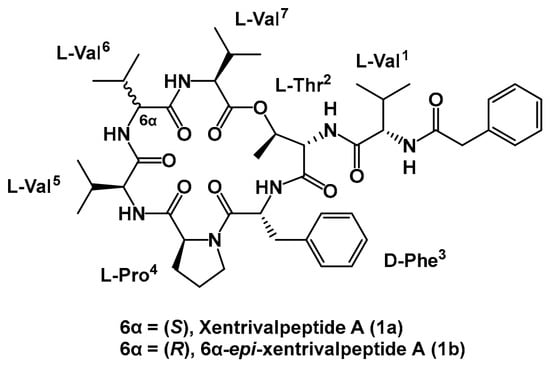
In 2012, seventeen cyclodepsipeptides, collectively named xentrivalpeptides A–Q, were isolated from the entomopathogenic bacterium Xenorhabdus sp. by Bode et al. [6]. While the structure of a representative congener, xentrivalpeptide A (1a, Figure 1), was elucidated via NMR spectroscopy, that of other derivatives was indirectly determined based on isotope labeling and extensive mass analysis. Structurally, 1a features a 19-membered macrocycle composed of 5 proteinogenic l-amino acids and 1 d-amino acid. The l-Thr2 amino acid in the macrocyclic backbone plays a pivotal role in the formation of depsipeptide linkage with l-Val7 and attachment of the N-acyl side chain, which is highly variable in nature. In terms of biological activity, only 1a has been investigated because of the low natural production of the other derivatives (~1/100 compared to 1a). 1a exhibited no biological activity against standard test sets (antibacterial, antifungal, and cytotoxic tests) and only showed an actin cytoskeletal ruffling effect against insect hemocytes [6]. Because the biological function of xentrivalpeptides remains underexplored, versatile synthetic routes must be developed for this family.
Figure 1.
Structures of xentrivalpeptide A (1a) and 6α-epi-xentrivalpeptide A (1b).
Herein, we report the first total synthesis of xentrivalpeptide A (1a). Additionally, we describe the synthesis of the unnatural epimer 6α-epi-xentrivalpeptide A (1b), as a diastereomeric analog of the natural product.
2. Results and Discussion
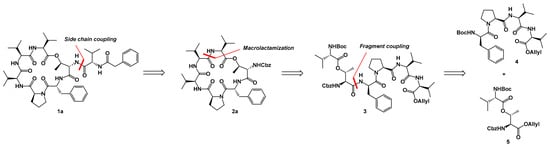
Our retrosynthetic analysis of 1a is outlined in Scheme 1. We conducted our synthesis in the conventional solution phase for the purpose of synthetic scalability. At first, we planned to install the side chain onto the common macrocyclic core 2a at a late stage to enable facile synthesis of most members of the xentrivalpeptide series, which differ in the side chain amino acid and N-acyl endcap. Selection of the macrocyclization site requires careful consideration because there are no obvious cyclization sites such as glycine or alanine, which are sterically unhindered. For this reason, we considered the following criteria beyond steric hindrance: (1) macrolactonization between l-Thr2 and l-Val7 should be excluded due to the low nucleophilicity of the hydroxyl group, and (2) the labile ester bond, which may serve as a good leaving group [7] under basic conditions, should be formed as late as possible. Therefore, we envisioned that the amide bond between l-Val6 and l-Val7 could be a suitable macrocyclization site. By using this disconnection, the l-Pro3 residue, which is known to increase the probability of β-turn [8,9], could be located in the middle of the cyclization precursor. Hence, we also anticipated that this l-Pro3 residue may offer a beneficial effect during macrocyclization through turn-like preorganization, enabling the spatial proximity of both termini [10,11]. Lastly, the orthogonally protected linear depsipeptide 3 could be prepared via fragment coupling with tetrapeptide 4 and didepsipeptide 5.
Scheme 1.
Retrosynthetic analysis of xentrivalpeptide A (1a).
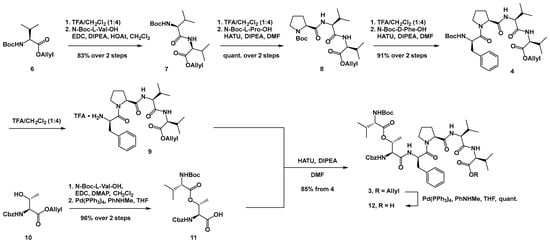
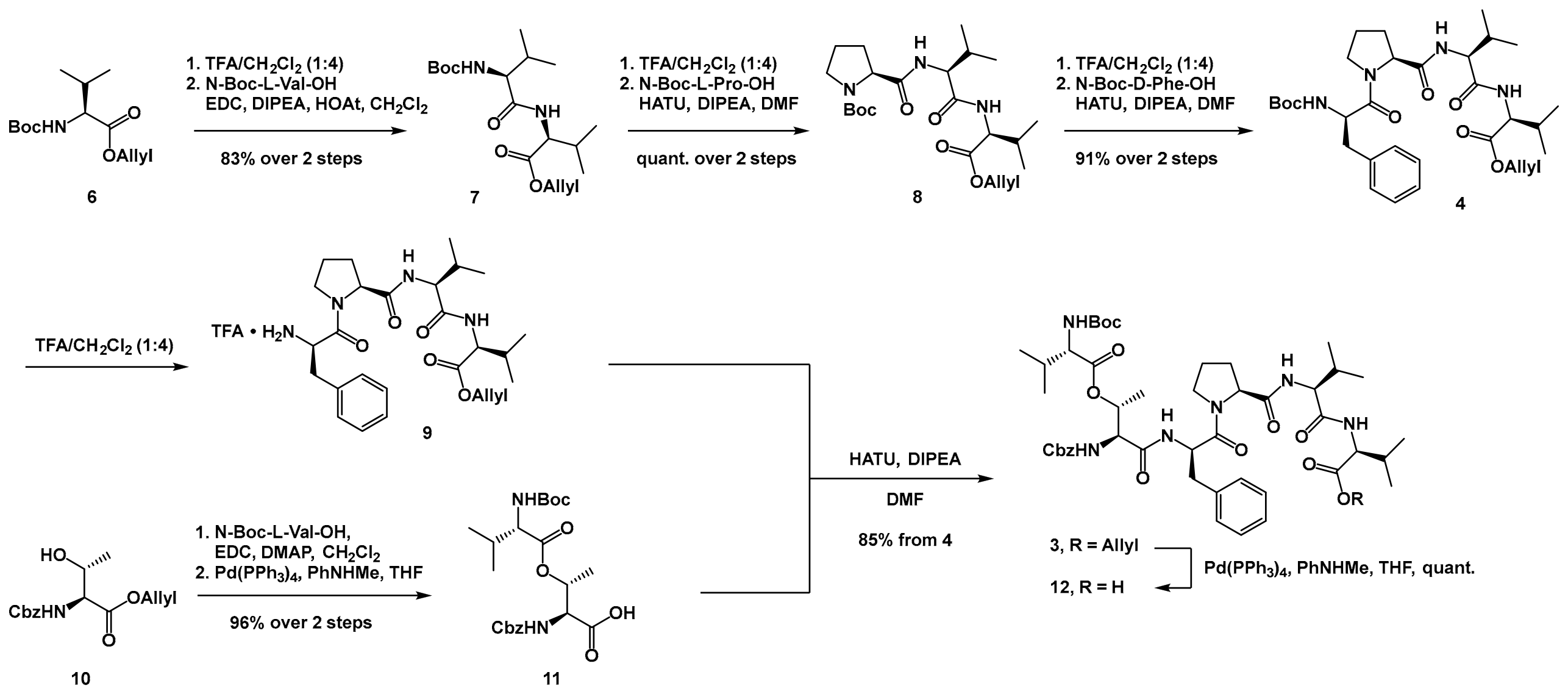
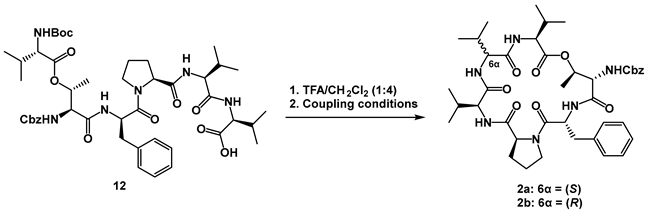
The synthesis of the macrocyclization precursor 12 commenced with the conventional peptide coupling strategy (Scheme 2). Starting from N-Boc-l-Val-OAllyl (6), an iterative Boc deprotection (using 20% TFA in CH2Cl2) and coupling cycle was performed to afford the desired tetrapeptide fragment 4 in 76% overall yield. Esterification of N-Cbz-L-Thr(OH)-OAllyl (10) with N-Boc-l-Val-OH, followed by Pd(0)-mediated allyl deprotection, afforded the didepsipeptide 11 at 96% over two steps. After Boc deprotection of 4, the resulting tetrapeptide 9 was coupled with the didepsipeptide 11 to produce the hexadepsipeptide 3 in 85% yield, which was then subjected to macrocyclization. C-terminus deprotection was conducted to afford the carboxylic acid 12.
Scheme 2.
Synthesis of cyclization precursor 12.
With the N-protected linear precursor 12 in hand, we investigated suitable conditions for the key macrocyclization to furnish the cyclic hexadepsipeptide core 2a (Table 1). For experimental convenience, an aliquot of the reaction mixture was dissolved in a solution containing a known amount of an internal peptide standard, and the reaction conversion was determined through HPLC analysis (see Supporting Information for details). Among the various combinations of coupling reagents and solvents tested, the DEPBT/DIPEA/DMF condition afforded the desired 2a in the highest conversion ratio without any detectable epimerization (entry 8). The non-hydrogen-bonding solvent CH2Cl2 generally suppressed C-terminal epimerization compared with polar DMF (entries 1–4 vs. entries 5–9) [12]. Interestingly, PyBOP-mediated macrocyclization produced significant amounts of epimer 2b in both solvents, as confirmed through LC–MS analysis (entries 3 and 7). The different extents of epimerization observed with different coupling reagents (e.g., DEPBT and PyBOP) are likely attributable to the structural differences in the corresponding activated ester intermediates [13,14], which could alter either their susceptibility to intramolecular nucleophilic attack or the local conformation around the C-terminal residue. These differences, in turn, may have affected the rate of oxazolone formation, a key pathway leading to epimerization [12,15]. When the cyclization precursor was slowly added to a solution of PyBOP and DIPEA in DMF over 12 h, diastereoselectivity was inverted, leading to the preferential formation of 2b (entry 9). This change in diastereoselectivity may be attributed to the slow addition of the cyclization precursor, which increased the initial rate of C-terminal activation compared with the standard conditions (entry 7), thereby providing a greater chance for oxazolone formation before the precursor adopted a macrocyclization-favorable conformation. From a medicinal chemistry perspective, an epimeric congener of a cyclic peptide may adopt a distinct global conformation relative to its parent compound, potentially resulting in altered biological activity [16,17]. Therefore, we sought to exploit the epimerizing condition (e.g., entry 9) for the synthesis of 6α-epi-xentrivalpeptide A (1b).
Table 1.
Screening of macrolactamization conditions.
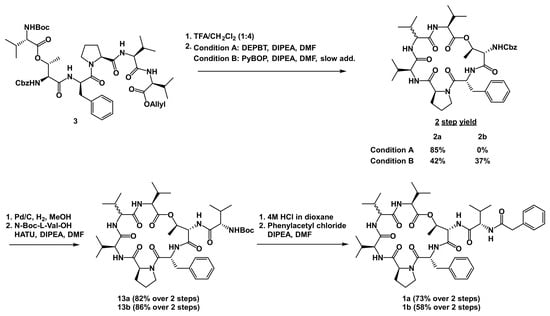
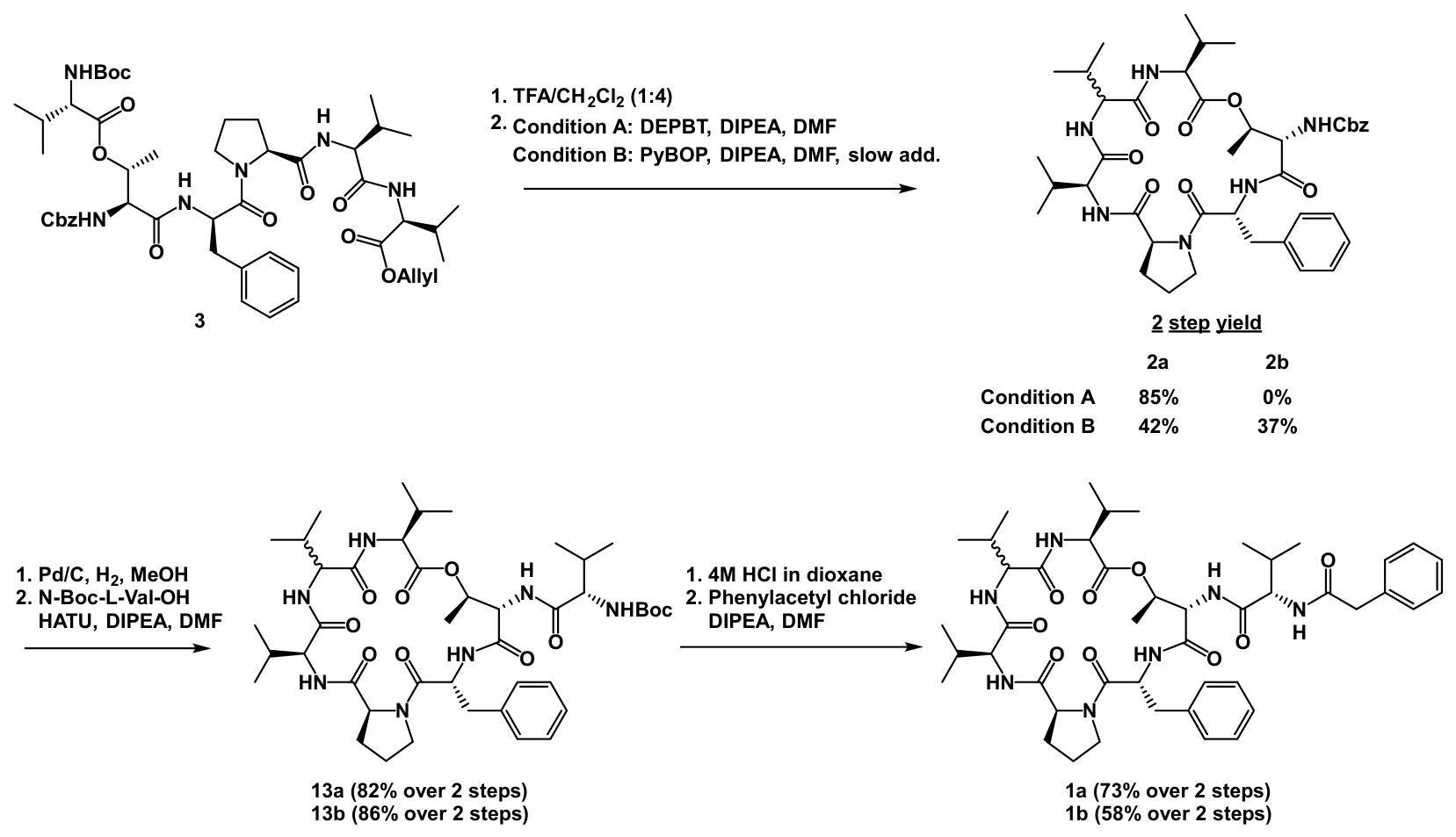
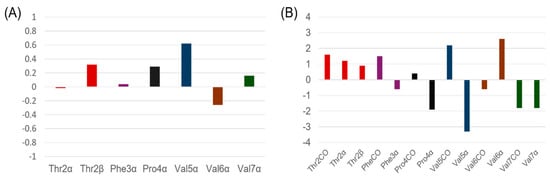
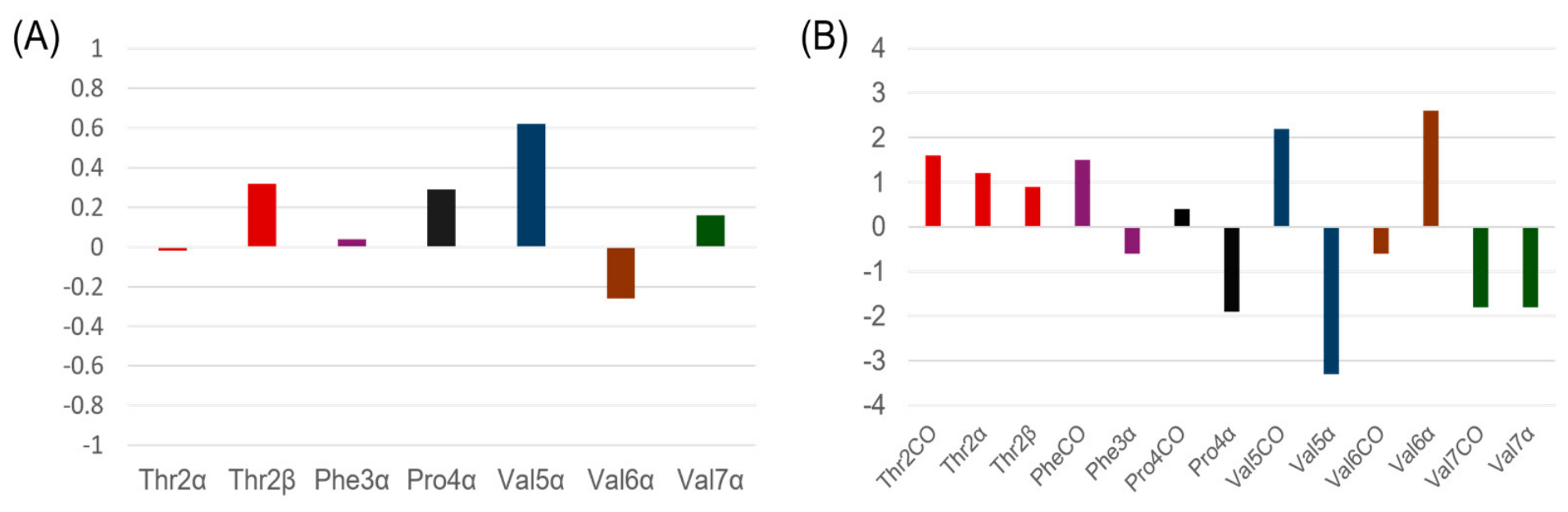
Having established optimized macrocyclization conditions for 2a and 2b, we proceeded with the final side-chain installation onto the cyclic hexadepsipeptide core to complete the synthesis (Scheme 3). Following TFA-mediated Boc deprotection, treatment with 5 equivalents each of DEPBT and DIPEA at a substrate concentration of 1 mM in DMF (condition A) afforded the desired cyclic hexadepsipeptide 2a in high yield (85% over two steps) without detectable epimerization. In contrast, PyBOP-mediated macrolactamization using a slow addition protocol for the linear substrate (condition B) afforded the 6α-epi-macrolactam 2b in 37% yield, sufficient for further transformations, along with 2a in 42% yield. The observed shift in the 2a/2b selectivity may have arisen from the different reaction scales and concentration profiles employed in the screening and preparative reactions. Hydrogenolytic Cbz deprotection of 2a and 2b, followed by coupling with N-Boc-l-Val-OH, afforded the cyclic heptadepsipeptides 13a and 13b in 82% and 86% yields over two steps, respectively. Notably, no intramolecular O-to-N acyl shift was observed [18,19], although such a rearrangement could potentially occur through nucleophilic attack of the liberated amine on the depsipeptide ester bond following Cbz deprotection. This observation is likely due to the conformationally organized nature of the cyclic hexapeptide, which may increase the energetic barrier to the formation of a five-membered cyclic transition state leading to the acyl shift. This result indicates that our synthetic strategy should be amenable to facile side-chain diversification of xentrivalpeptide analogs. Finally, a second Boc deprotection followed by acylation with the phenylacetyl endcap successfully afforded the desired natural product 1a and its epimer 1b in 73% and 58% yields over two steps, respectively. All spectroscopic data (1H and 13C NMR and HRMS) of synthetic 1a were fully consistent with the reported data (Table S1 in Supporting Information). The differences in the 1H and 13C NMR chemical shifts of the protons and carbons constituting the macrocyclic scaffold between 1a and 1b imply that epimerization at a single stereogenic center leads to an overall conformational change in the macrocycle (Figure 2; see Table S2 in the Supporting Information for details).
Scheme 3.
Synthesis of xentrivalpeptide A (1a) and 6α-epi-xentrivalpeptide A (1b).
Figure 2.
NMR chemical shift comparison between xentrivalpeptide A (1a) and 6α-epi-xentrivalpeptide A (1b). (A) Comparison of the proton chemical shifts. (B) Comparison of the carbon chemical shifts. The Y-axis represents Δδ (1b − 1a) in ppm.
3. Materials and Methods
3.1. General Information
Methylene chloride (DCM) and tetrahydrofuran (THF) were dehydrated using molecular sieve (4 Å, beads, 4–8 mesh, Sigma Aldrich, St. Luis, MO, USA) pre-activated under 100 °C. All other solvents and reagents were purchased from commercial sources and used as received. Amino acid and coupling reagents were purchased from Sigma Aldrich, TCI, ChemeScene (Monmouth Junction, NJ, USA), Combi-blocks (San Diego, CA, USA) and BLDpharm (Shanghai, China). N,N-diisopropylethylamine (DIPEA) was purchased from SAMCHUN (Pyeongtaek, Republic of Korea). Dimethylformamide (DMF) were purchased from Sigma Aldrich in a Sure/SealTM bottle and used as received. Reactions were performed under an argon atmosphere with dry solvents under anhydrous conditions unless otherwise noted. Flash column chromatography was carried out using ZEOprep 60 Å 230–400 mesh silica gel. Thin-layer chromatography (TLC) was performed on Merck glass-backed TLC Silica gel 60 F254 and visualized using a UV lamp (254 nm), KMnO4, ninhydrin, anis aldehyde or Hanessian’s stain. 1H and 13C spectra were recorded on Varian 500 MHz spectrometers. 1H NMR spectra were referenced to CDCl3 (δ 7.26 ppm) DMSO-d6 (δ 2.50 ppm) and CD3OD (δ 3.30 ppm). 13C NMR spectra were referenced to CDCl3 (δ 77.10 ppm), DMSO-d6 (δ 39.52 ppm) and CD3OD (δ 49.15 ppm). Spectral data is reported as follows: chemical shift (in ppm), multiplicity (s = singlet, d = doublet, t = triplet, q = quartet, dd = doublet of doublets, dt = doublet of triplets, ddt = doublet of doublet of triplets, dtd = doublet of triplet of doublets, m = multiplet, br = broad), coupling constant (J) in Hertz (Hz), and integration. High resolution mass spectra were obtained on a JEOL JMS-700 (double focusing) mass spectrometer (JEOL, Tokyo, Japan). Optical rotations were measured with JASCO P-2000 digital polarimeter (JASCO, Tokyo, Japan) at 25 °C using cylindrical cell of 100 mm pathlength. Melting points were determined using a melting point apparatus MP50 by Mettler Toledo and are uncorrected (Mettler Toledo, Greifensee, Switzerland). Analytical HPLC measurments were performed for determination of compound purity and optimization of macrocyclization using a YL9100 system (YOUNGIN Chromass, Anyang, Republic of Korea). Low-resolution mass spectra (ESI) were collected on an Agilent Technologies 1200 series HPLC paired to a 6130 Mass Spectrometer (Agilent, SantaClara, CA, USA). Compounds were resolved on YMC-Triart C18 4.6 mm I.D. × 250 mm S-5 12 nm column at 30 °C with a flow of 1 mL/min. The gradient consisted of eluents A (0.1% formic acid in HPLC-grade acetonitrile) and eluents B (0.1% formic acid in double distilled water). A linear gradient starting from 30% of A to 95% over 20 min at a flow rate of 1.0 mL/min. Stays constant at 95% for 5 min, then returns to 30% over 0.5 min and stays constant at 30% for 5 min.
3.2. Experimental Procedures and Characterization of Compounds
allyl (tert-butoxycarbonyl)-L-valyl-L-valinate (7) To a solution of N-Boc-l-Val-OAllyl 6 (1.72 g, 6.68 mmol) in CH2Cl2 (28 mL) was added TFA (7 mL) dropwise at 0 °C. After stirring for 2 h at room temperature, the reaction mixture was concentrated in vacuo and dried thrice azeotropically with n-heptane. The amine-TFA salt was used in the next step without further purification. To a solution of the above amine (6.68 mmol), N-Boc-l-Val-OH (2.18 g, 10.02 mmol), HOAt (909 mg, 6.68 mmol) and DIPEA (3.5 mL, 20.04 mmol) in CH2Cl2 (33 mL) was added EDC (3.84 g, 20.04 mmol) at 0 °C. After stirring overnight at room temperature, the reaction mixture was quenched with 1 M HCl and extracted with CH2Cl2. The combined organic layer was washed with saturated NaHCO3, dried over MgSO4 and concentrated in vacuo. The residue was purified by flash column chromatography on silica gel (EtOAc/Hexane = 1:5) to give 1.97 g (83% over 2 steps) of dipeptide 7 as a white solid.
- 1H NMR (500 MHz, CDCl3) δ 6.35 (d, J = 8.8 Hz, 1H), 5.95–5.84 (m, 1H), 5.33 (dd, J = 17.2, 1.5 Hz, 1H), 5.26 (dd, J = 10.4, 1.3 Hz, 1H), 5.05 (d, J = 8.8 Hz, 1H), 4.68–4.59 (m, 2H), 4.57 (dd, J = 8.8, 4.8 Hz, 1H), 3.91 (dd, J = 8.8, 6.4 Hz, 1H), 2.26–2.16 (m, 1H), 2.15–2.07 (m, 1H), 1.44 (s, 9H), 0.99–0.89 (m, 12H).
- 13C NMR (126 MHz, CDCl3) δ 171.7, 171.4, 155.9, 131.6, 119.1, 80.0, 65.9, 60.2, 57.1, 31.3, 30.7, 28.4, 19.4, 19.0, 18.0, 17.7.
- HRMS (FAB+) calcd for C18H33N2O5 (M+H+) 357.2389, found 357.2385.
- [α]25D = −24.1 (c 1.0, MeOH)
allyl (tert-butoxycarbonyl)-L-prolyl-L-valyl-L-valinate (8) To a solution of dipeptide 7 (1.45 g, 4.07 mmol) in CH2Cl2 (16 mL) was added TFA (4 mL) dropwise at 0 °C. After stirring for 1.5 h at room temperature, the reaction mixture was concentrated in vacuo and dried thrice azeotropically with n-heptane. The amine-TFA salt was used in the next step without further purification. To a solution of the above amine (4.07 mmol), N-Boc-l-Pro-OH (1.32 g, 6.11 mmol) and DIPEA (1.4 mL, 8.14 mmol) in CH2Cl2 (41 mL) was added HATU (3.10 g, 8.14 mmol) at 0 °C. After stirring overnight at room temperature, the reaction mixture was quenched with 1 M HCl and extracted with EtOAc. The combined organic layer was washed with saturated NaHCO3, dried over MgSO4 and concentrated in vacuo. The residue was purified by flash column chromatography on silica gel (EtOAc/Hexane = 2:3) to give 1.90 g (quant. over 2 steps) of tripeptide 8 as a colorless oil.
- 1H NMR (500 MHz, DMSO-d6, a mixture of rotamer) δ 8.20 (d, J = 7.7 Hz, 0.7H), 8.16 (d, J = 7.8 Hz, 0.3H), 7.67 (d, J = 8.8 Hz, 2H), 5.94–5.82 (m, 1H), 5.32 (dq, J = 17.2, 1.6 Hz, 1H), 5.21 (dd, J = 10.5, 1.6 Hz, 1H), 4.56 (dt, J = 5.5, 1.5 Hz, 2H), 4.31–4.23 (m, 1H), 4.22–4.13 (m, 2H), 3.40–3.30 (m, 1H, overlapped), 3.29–3.21 (m, 1H), 2.14–2.00 (m, 1H), 2.00–1.89 (m, 1H), 1.86–1.68 (m, 4H), 1.39 (s, 3H), 1.31 (s, 6H), 0.96–0.77 (m, 12H).
- 13C NMR (126 MHz, CDCl3, a mixture of rotamer) Major rotamer δ 172.2, 171.5, 170.9, 153.4, 132.3, 118.0, 78.4, 64.7, 59.4, 57.5, 57.1, 46.5, 31.1, 30.7, 29.7, 28.0, 22.9, 18.9, 18.2.
- HRMS (FAB+) calcd for C23H40N3O6 (M+H+) 454.2917, found 454.2916.
- [α]25D = −40.2 (c 1.0, MeOH)
allyl (tert-butoxycarbonyl)-D-phenylalanyl-L-prolyl-L-valyl-L-valinate (4) To a solution of tripeptide 8 (167 mg, 0.37 mmol) in CH2Cl2 (6.0 mL) was added TFA (1.5 mL) dropwise at 0 °C. After stirring for 6 h at room temperature, the reaction mixture was concentrated in vacuo and dried thrice azeotropically with n-heptane. The amine-TFA salt was used in the next step without further purification. To a solution of the above amine (0.37 mmol), N-Boc-d-Phe-OH (149 mg, 0.56 mmol) and DIPEA (0.13 mL, 0.74 mmol) in DMF (7.4 mL) was added HATU (281 mg, 0.74 mmol) at 0 °C. After stirring overnight at room temperature, the reaction mixture was quenched with 1 M HCl and extracted with EtOAc. The combined organic layer was washed with saturated NaHCO3, dried over MgSO4 and concentrated in vacuo. The residue was purified by flash column chromatography on silica gel (EtOAc/Hexane = 1:1 to 3:2) to give 202 mg (91% over 2 steps) of tetrapeptide 4 as a colorless oil.
- 1H NMR (500 MHz, CDCl3) δ 7.46 (d, J = 8.4 Hz, 1H), 7.32–7.18 (m, 5H), 6.70 (d, J = 8.5 Hz, 1H), 5.96–5.84 (m, 1H), 5.33 (dd, J = 17.2, 1.5 Hz, 1H), 5.25 (d, J = 10.6 Hz, 1H), 4.68–4.55 (m, 3H), 4.52 (dd, J = 8.6, 4.9 Hz, 1H), 4.45 (d, J = 8.2 Hz, 1H), 4.14 (dd, J = 8.4, 6.3 Hz, 1H), 3.54 (t, J = 9.0 Hz, 1H), 3.08–2.90 (m, 2H), 2.52 (q, J = 8.8 Hz, 1H), 2.32–2.25 (m, 1H), 2.25–2.14 (m, 2H), 1.82–1.78 (m, 2H), 1.61–1.50 (m, 1H), 1.49–1.43 (m, 1H), 1.40 (s, 9H), 0.95 (d, J = 6.9 Hz, 3H), 0.93 (d, J = 6.8 Hz, 3H), 0.89 (d, J = 6.8 Hz, 6H).
- 13C-NMR (126 MHz, CDCl3) δ 172.2, 171.4, 171.2, 171.1, 155.2, 136.0, 131.8, 129.4, 128.7, 127.3, 118.9, 80.2, 65.8, 60.2, 59.4, 57.3, 53.8, 47.1, 39.6, 31.2, 29.8, 28.4, 27.5, 24.4, 19.6, 19.1, 17.9, 17.9.
- HRMS (FAB+) calcd for C32H49N4O7 (M+H+) 601.3601, found 601.3597.
- [α]25D = −47.2 (c 0.5, MeOH)
allyl N-((benzyloxy)carbonyl)-O-((tert-butoxycarbonyl)-L-valyl)-L-threoninate (5) To a solution of N-Cbz-l-Thr-OAllyl 10 (522 mg, 1.79 mmol) and N-Boc-l-Val-OH (584 mg, 2.69 mmol) in CH2Cl2 (9 mL) was added EDC (686 mg, 3.58 mmol) and DMAP (437 mg, 3.58 mmol) at 0 °C. After stirring overnight at room temperature, the reaction mixture was quenched with 1 M HCl and extracted with CH2Cl2. The combined organic layer was washed with saturated NaHCO3, dried over MgSO4 and concentrated in vacuo. The residue was purified by flash column chromatography on silica gel (EtOAc/Hexane = 1:5) to give 846 mg (96%) of didepsipeptide 5 as a colorless oil.
- 1H NMR (500 MHz, DMSO-d6) δ 7.78 (d, J = 9.6 Hz, 1H), 7.42–7.29 (m, 5H), 7.14 (d, J = 9.3 Hz, 1H), 5.92–5.80 (m, 1H), 5.35–5.26 (m, 2H), 5.20 (dq, J = 10.5, 1.5 Hz, 1H), 5.16–5.04 (m, 2H), 4.55 (dt, J = 5.4, 1.5 Hz, 2H), 4.49 (dd, J = 9.6, 2.7 Hz, 1H), 3.78 (dd, J = 9.3, 7.2 Hz, 1H), 1.87 (h, J = 6.8 Hz, 1H), 1.36 (s, 9H), 1.16 (d, J = 6.3 Hz, 3H), 0.80 (d, J = 6.8 Hz, 3H), 0.77 (d, J = 6.8 Hz, 3H).
- 13C NMR (126 MHz, DMSO-d6) δ 170.5, 169.7, 157.2, 156.1, 137.2, 132.5, 128.9, 128.4, 128.4, 118.5, 78.8, 70.4, 66.4, 65.8, 60.2, 57.9, 30.6, 28.6, 19.3, 18.6, 16.8.
- HRMS (FAB+) calcd for C25H37N2O8 (M+H+) 493.2550, found 493.2548.
- [α]25D = −1.0 (c 1.0, MeOH)
N-((benzyloxy)carbonyl)-O-((tert-butoxycarbonyl)-L-valyl)-L-threonine (11) To a solution of didepsipeptide 5 (305 mg, 0.62 mmol) in dry THF (6.2 mL), Pd(PPh3)4 (72 mg, 0.06 mmol) and N-methylaniline (0.13 mL, 1.24 mmol) was added at room temperature. After stirring for 1.5 h, the reaction mixture was quenched with 1 M HCl and extracted with EtOAc. The combined organic layer was dried over MgSO4 and concentrated in vacuo. The residue was purified by column chromatography on a short pad of silica gel (CH2Cl2/MeOH = 10:1) to afford 285 mg (quant.) of the acid 11 as a colorless oil.
- 1H NMR (500 MHz, DMSO-d6) δ 7.45–7.26 (m, 5H), 7.11 (d, J = 9.2 Hz, 1H), 5.33–5.23 (m, 1H), 5.08 (s, 2H), 4.23 (d, J = 9.5 Hz, 1H), 3.79 (t, J = 8.1 Hz, 1H), 1.96–1.86 (m, 1H), 1.36 (s, 9H), 1.13 (d, J = 6.2 Hz, 3H), 0.80 (dd, J = 6.8, 4.0 Hz, 6H).
- 13C NMR (126 MHz, DMSO-d6) δ 171.1, 170.2, 156.6, 155.7, 136.9, 128.4, 127.9, 78.3, 65.7, 59.8, 31.3, 30.2, 28.2, 22.1, 19.0, 18.1, 16.9, 14.0.
- HRMS (FAB-) calcd for C22H31N2O8 (M−H+) 451.2081, found 450.2080.
- [α]25D = +5.1 (c 1.0, MeOH)
allyl N-((benzyloxy)carbonyl)-O-((tert-butoxycarbonyl)-L-valyl)-L-threonyl-D-phenylalanyl-L-prolyl-L-valyl-L-valinate (3) To a solution of tetrapeptide 4 (240 mg, 0.40 mmol) in CH2Cl2 (4 mL) was added TFA (1 mL) dropwise at 0 °C. After stirring for 2 h at room temperature, the reaction mixture was concentrated in vacuo, and dried thrice azeotropically with n-heptane. The amine-TFA salt was used in the next step without further purification. To the above amine (0.40 mmol), the didepsipeptide 11 (285 mg, 0.63 mmol) solution dissolved in anhydrous DMF (4 mL) was added. Subsequently, DIPEA (0.21 mL, 1.20 mmol) and HATU (456 mg, 1.20 mmol) were added to the above solution at 0 °C. After stirring overnight at room temperature, the reaction mixture was quenched with 1 M HCl and extracted with EtOAc. The combined organic layer was washed with saturated NaHCO3, dried over MgSO4 and concentrated in vacuo. The residue was purified by flash column chromatography on silica gel (EtOAc/Hexane = 3:2) to give 319 mg (85% over 2 steps) of hexadepsipeptide 3 as a clear caramel.
- 1H NMR (500 MHz, DMSO-d6) a mixture of rotamers δ 8.48 (d, J = 7.8 Hz, 0.5H), 8.32 (d, J = 8.7 Hz, 0.5H), 8.19 (d, J = 7.7 Hz, 0.5H), 8.14 (d, J = 8.5 Hz, 0.5H), 8.04 (d, J = 7.9 Hz, 0.5H), 7.78 (d, J = 8.8 Hz, 0.5H), 7.47 (d, J = 9.6 Hz, 0.5H), 7.40–7.27 (m, 5H), 7.27–7.18 (m, 2H), 7.18–7.10 (m, 33H), 7.10–7.05 (m, 1.5H), 5.94–5.82 (m, 1H), 5.32 (dtd, J = 17.2, 3.3, 1.7 Hz, 1H), 5.20 (ddq, J = 10.5, 3.0, 1.4 Hz, 1H), 5.15–4.99 (m, 2.5H), 4.92–4.84 (m, 1H), 4.69 (q, J = 7.4 Hz, 0.5H), 4.55 (dt, J = 5.5, 1.5 Hz, 2H), 4.41 (t, J = 9.0 Hz, 1H), 4.36–4.31 (m, 1H), 4.28 (t, J = 7.9 Hz, 0.5H), 4.21–4.10 (m, 2H), 3.75 (dd, J = 8.8, 7.0 Hz, 0.5H), 3.66 (t, J = 8.0 Hz, 0.5H), 3.52–3.43 (m, 1H), 3.41–3.35 (m, 0.5H), 2.94–2.84 (m, 2H), 2.84–2.77 (m, 0.5H), 2.76–2.68 (m, 0.5H), 2.21–2.11 (m, 0.5H), 2.08–1.96 (m, 2H), 1.95–1.87 (m, 1H), 1.81–1.63 (m, 3.5H), 1.59–1.53 (m, 0.5H), 1.36 (s, 4.5H), 1.35 (s, 4.5H), 1.01 (d, J = 6.2 Hz, 1.5H), 0.93–0.83 (m, 9H), 0.80 (t, J = 6.2 Hz, 6H), 0.77 (d, J = 6.8 Hz, 2H), 0.71 (d, J = 6.8 Hz, 1.5H), 0.61 (d, z = 6.8 Hz, 1H).
- 13C NMR (126 MHz, DMSO-d6) a mixture of rotamers δ 171.9, 171.4, 171.0, 170.9, 170.8, 170.3, 170.0, 169.8, 169.2, 168.5, 168.2, 156.1, 156.1, 155.7, 155.6, 137.4, 136.8, 136.6, 132.3, 129.2, 128.4, 128.4, 128.2, 127.9, 127.9, 127.8, 126.6, 118.1, 118.0, 78.3, 78.2, 70.9, 65.9, 65.8, 64.7, 64.7, 60.0, 59.5, 59.1, 58.1, 57.9, 57.6, 57.5, 57.4, 52.1, 46.6, 37.9, 32.1, 30.4, 30.1, 29.9, 29.7, 28.6, 28.1, 23.9, 21.9, 19.2, 19.1, 18.9, 18.8, 18.7, 18.5, 18.2, 18.2, 18.0, 16.5, 16.2.
- HRMS (FAB+) calcd for C49H71N6O12 (M+H+) 935.5130, found 935.5132.
- [α]25D = −22.9 (c 1.0, MeOH)
benzyl ((3S,6S,9S,12R,13S,16R,21aS)-16-benzyl-3,6,9-triisopropyl-12-methyl-1,4,7,10,14,17-hexaoxoicosahydropyrrolo[2,1-l][1]oxa[4,7,10,13,16]pentaazacyclononadecin-13-yl)carbamate (2a) To a solution of linear hexadepsipeptide 3 (269 mg, 0.15 mmol) and Pd(PPh3)4 (17 mg, 0.02 mmol) in dry THF (1.5 mL) was added N-methylaniline (0.03 mL, 0.80 mmol) at room temperature. After stirring for 2 h at the same temperature, the reaction mixture was quenched with 1 M HCl and extracted with EtOAc. The combined organic layer was dried over MgSO4 and concentrated in vacuo. The residue was purified by column chromatography on a short pad of silica gel (CH2Cl2/MeOH = 9:1 to 6:1) to afford 256 mg (quant.) of the acid 12 as a yellow solid. To a solution of the above acid 12 (65 mg, 0.07 mmol) in dry CH2Cl2 (40 mL) was subsequently added TFA (10 mL) at room temperature. After stirring for 20 min at room temperature, the reaction mixture was concentrated in vacuo to afford TFA salt as a white powder. This cyclization precursor was used in the next step without further purification. To a solution of the above cyclization precursor (0.07 mmol) and DIPEA (0.06 mL, 0.37 mmol) in DMF (73 mL) was added DEPBT (109 mg, 0.37 mmol) at room temperature. After stirring for 2 days at the same temperature, the reaction mixture was quenched with 1 M HCl and extracted with EtOAc. The combined organic layer was washed with aqueous NaHCO3, dried over MgSO4 and concentrated in vacuo. The residue was purified by flash column chromatography (Acetone/Hexane = 1:2 to 2:3) to give 48 mg (85% for 3 steps) of cyclic hexadepsipeptide 2a as a white powder.
- 1H NMR (500 MHz, DMSO-d6) δ 8.74 (s, 1H), 8.63 (d, J = 5.6 Hz, 1H), 8.12 (d, J = 9.1 Hz, 1H), 7.42–7.26 (m, 8H), 7.26–7.20 (m, 1H), 7.19–7.14 (m, 2H), 5.08–4.97 (m, 2H), 4.95–4.87 (m, 1H), 4.70 (dt, J = 10.0, 5.1 Hz, 1H), 4.54 (dd, J = 8.9, 3.6 Hz, 1H), 4.34 (dd, J = 8.6, 7.1 Hz, 1H), 3.91 (dd, J = 8.5, 3.4 Hz, 1H), 3.72 (dd, J = 6.9, 2.1 Hz, 1H), 3.63 (t, J = 9.9 Hz, 1H), 3.41–3.34 (m, 1H), 3.26 (dd, J = 12.6, 4.4 Hz, 1H), 2.76 (dd, J = 12.4, 9.4 Hz, 1H), 2.43–2.35 (m, 1H), 2.15–2.07 (m, 1H), 1.98 (h, J = 6.8 Hz, 1H), 1.85–1.76 (m, 1H), 1.71–1.55 (m, 3H), 1.42–1.31 (m, 1H), 1.16 (d, J = 6.7 Hz, 3H), 1.05 (d, J = 6.7 Hz, 3H), 0.96 (d, J = 6.7 Hz, 3H), 0.90 (d, J = 6.8 Hz, 3H), 0.87–0.83 (m, 6H), 0.76 (d, J = 6.5 Hz, 3H).
- 13C NMR (126 MHz, DMSO-d6) δ 171.7, 171.4, 170.9, 169.7, 168.9, 167.4, 155.3, 137.0, 136.7, 129.2, 128.4, 128.3, 127.8, 127.7, 126.7, 79.2, 69.2, 65.6, 62.3, 60.9, 60.5, 55.6, 54.4, 53.8, 46.6, 32.1, 29.3, 29.2, 28.3, 24.0, 19.7, 19.6, 19.1, 18.8, 18.2, 18.1, 14.1.
- HRMS (FAB+) calcd for C41H57N6O9 (M+H+) 777.4187, found 777.4188.
- [α]25D = +2.6 (c 1.0, MeOH)
tert-butyl ((S)-1-(((3S,6S,9S,12R,13S,16R,21aS)-16-benzyl-3,6,9-triisopropyl-12-methyl-1,4,7,10,14,17-hexaoxoicosahydropyrrolo[2,1-l][1]oxa[4,7,10,13,16]pentaazacyclononadecin-13-yl)amino)-3-methyl-1-oxobutan-2-yl)carbamate (13a) To a solution of cyclic hexadepsipeptide 2a (33 mg, 0.04 mmol) in MeOH (2 mL) was added palladium on activated carbon (15 mg) and the reaction flask was thoroughly sealed. After stirring for 4 h under H2 atmosphere, the reaction mixture was filtered through a pad of Celite. The filtered solution was concentrated in vacuo. The corresponding amine was directly used in the next step without further purification. To a solution of the above amine (0.04 mmol), N-Boc-l-Val-OH (28 mg, 0.13 mmol) and DIPEA (0.04 mL, 0.25 mmol) in DMF (2 mL) was added HATU (48 mg, 0.13 mmol) at 0 °C. After stirring overnight at room temperature, the reaction mixture was quenched with 1 M HCl and extracted with EtOAc. The combined organic layer was washed with saturated NaHCO3, dried over MgSO4 and concentrated in vacuo. The residue was purified by flash column chromatography on silica gel (Acetone/Hexane = 1:2 to 2:3) to give 29 mg (82% over 2 steps) of cyclic heptadepsipeptide 13a as a white powder.
- 1H NMR (500 MHz, DMSO-d6) δ 8.80–8.70 (m, 2H), 8.06 (d, J = 9.2 Hz, 1H), 7.68–7.51 (m, 2H), 7.38 (d, J = 8.7 Hz, 1H), 7.31–7.26 (m, 2H), 7.24–7.21 (m, 1H), 7.20–7.16 (m, 2H), 6.99 (d, J = 8.8 Hz, 1H), 4.94 (dt, J = 10.8, 5.4 Hz, 1H), 4.78–4.69 (m, 2H), 4.36 (dd, J = 8.6, 6.5 Hz, 1H), 3.93 (dd, J = 8.5, 3.5 Hz, 1H), 3.82 (dd, J = 8.8, 6.1 Hz, 1H), 3.71 (dd, J = 7.0, 2.2 Hz, 1H), 3.63 (t, J = 10.0 Hz, 1H), 3.18 (dd, J = 12.8, 5.0 Hz, 1H), 2.84 (dd, J = 12.7, 8.9 Hz, 1H), 2.57–2.52 (m, 1H), 2.17–2.08 (m, 1H), 2.05–1.92 (m, 2H), 1.91–1.82 (m, 1H),z 1.77–1.69 (m, 1H), 1.68–1.58 (m, 2H), 1.41 (s, 9H), 1.06 (dd, J = 9.1, 6.7 Hz, 6H), 0.96 (d, J = 6.8 Hz, 3H), 0.90 (d, J = 6.7 Hz, 3H), 0.86 (d, J = 6.6 Hz, 6H), 0.83 (d, J = 6.9 Hz, 3H), 0.81 (d, J = 6.7 Hz, 3H), 0.76 (d, J = 6.5 Hz, 3H).
- 13C NMR (126 MHz, DMSO-d6) δ 171.8, 171.4, 170.9, 170.3, 169.4, 168.8, 166.9, 155.6, 136.8, 131.5, 131.4, 129.3, 128.8, 128.7, 128.2, 126.6, 78.2, 68.2, 62.4, 61.1, 60.6, 59.8, 55.4, 53.6, 52.2, 46.6, 35.8, 32.2, 30.8, 30.1, 29.3, 29.2, 28.3, 28.2, 24.0, 19.6, 19.6, 19.3, 19.2, 18.9, 18.1, 18.0, 17.9, 13.8.
- HRMS (FAB+) calcd for C43H68N7NaO10 (M+Na+) 864.4847, found 864.4844.
- [α]25D = +11.2 (c 1.0, MeOH)
Xentrivalpeptide A (1a) The cyclic heptadepsipeptide 13a (35 mg, 0.04 mmol) was treated with 4 M HCl in 1,4-dioxane (2 mL) and stired for 1.5 h at room temperature. The reaction mixture was concentrated in vacuo to afford HCl salt as a white powder. The amine was used in the next step without further purification. To a solution of the above amine (0.04 mmol) and DIPEA (0.04 mL, 0.21 mmol) in DMF (2 mL) was added phenylacetyl chloride (0.02 mL, 0.12 mmol) at 0 °C. After stirring overnight at room temperature, the reaction mixture was quenched with 1 M HCl and extracted with EtOAc. The combined organic layer was washed with saturated NaHCO3, dried over MgSO4 and concentrated in vacuo. The residue was purified by flash column chromatography on silica gel (CHCl3/MeOH = 19:1) to give 26 mg (73% over 2 steps) of xentrivalpeptide A (1a) as a white powder.
- 1H NMR (500 MHz, CD3OD) See Table S1.
- 13C NMR (126 MHz, CD3OD) See Table S1.
- HRMS (FAB+) calcd for C46H66N7O9 (M+H+) 860.4922, found 860.4921.
- [α]25D = −17.1 (c 0.36, CHCl3)
- Melting point 94–96 °C
benzyl ((3S,6R,9S,12R,13S,16R,21aS)-16-benzyl-3,6,9-triisopropyl-12-methyl-1,4,7,10,14,17-hexaoxoicosahydropyrrolo[2,1-l][1]oxa[4,7,10,13,16]pentaazacyclononadecin-13-yl)carbamate (2b) To a solution of the above acid 12 (319 mg, 0.36 mmol) in dry CH2Cl2 (40 mL) was subsequently added TFA (10 mL) at room temperature. After stirring for 20 min at room temperature, the reaction mixture was concentrated in vacuo to afford TFA salt as a white powder. This cyclization precursor was used in the next step without further purification. To a solution of PyBOP (926 mg, 1.78 mmol) and DIPEA (0.31 mL, 1.78 mmol) in DMF (130 mL) was added a solution of the cyclization precursor (0.36 mmol) in DMF (50 mL) via syringe pump over a period of 10 h at room temperature. After stirring for 2 days at the same temperature, the reaction mixture was quenched with 1 M HCl and extracted with EtOAc. The combined organic layer was washed with aqueous NaHCO3, dried over MgSO4 and concentrated in vacuo. The residue was purified by flash column chromatography (EtOAc/Hexane = 1:1 to 2:1) to give 103 mg (37% over 3 steps) of epimerized cyclic hexadepsipeptide 2b as a white powder, along with 115 mg of 2a.
- 1H NMR (500 MHz, DMSO-d6) δ 8.65 (s, 1H), 7.99 (d, J = 9.4 Hz, 1H), 7.40–7.26 (m, 8H), 7.22 (t, J = 7.8 Hz, 2H), 7.19–7.13 (m, 2H), 6.76 (s, 1H), 5.03 (s, 2H), 5.02–4.96 (m, 1H), 4.85 –4.77 (m, 1H), 4.26–4.21 (m, 2H), 4.20–4.16 (m, 1H), 4.03 (dd, J = 7.2, 3.0 Hz, 1H), 3.96 (dd, J = 9.4, 6.9 Hz, 1H), 3.66–3.59 (m, 1H), 3.48–3.40 (m, 1H), 3.00–2.95 (m, 2H), 2.21–2.11 (m, 2H), 2.09–2.01 (m, 1H), 2.00–1.92 (m, 1H), 1.82–1.65 (m, 3H), 0.93 (d, J = 6.6 Hz, 3H), 0.90 (dd, J = 6.8, 4.2 Hz, 6H), 0.86 (d, J = 6.8 Hz, 3H), 0.79 (d, J = 6.7 Hz, 6H), 0.69 (d, J = 6.8 Hz, 3H).
- 13C NMR (126 MHz, DMSO-d6) δ 171.9, 171.7, 171.1, 170.6, 170.1, 167.4, 155.9, 137.7, 136.8, 129.7, 128.3, 127.9, 127.9, 127.6, 126.1, 79.2, 69.4, 65.7, 61.0, 59.7, 57.2, 57.1, 51.4, 46.9, 46.6, 46.6, 36.2, 30.2, 29.3, 29.2, 28.8, 24.5, 19.2, 19.1, 18.8, 17.7, 17.1, 14.6.
- HRMS (FAB+) calcd for C41H57N6O9 (M+H+) 777.4187, found 777.4184.
- [α]25D = +8.0 (c 1.0, MeOH)
tert-butyl ((S)-1-(((3S,6R,9S,12R,13S,16R,21aS)-16-benzyl-3,6,9-triisopropyl-12-methyl-1,4,7,10,14,17-hexaoxoicosahydropyrrolo[2,1-l][1]oxa[4,7,10,13,16]pentaazacyclononadecin-13-yl)amino)-3-methyl-1-oxobutan-2-yl)carbamate (13b) To a solution of cyclic hexadepsipeptide 2b (39 mg, 0.05 mmol) in MeOH (2 mL) was added palladium on activated carbon (15 mg) and the reaction flask was thoroughly sealed. After stirring for 2.5 h under H2 atmosphere, the reaction mixture was filtered through a pad of Celite. The filtered solution was concentrated in vacuo. The corresponding amine was directly used in the next step without further purification. To a solution of the above amine (0.05 mmol), N-Boc-l-Val-OH (33 mg, 0.15 mmol) and DIPEA (0.05 mL, 0.30 mmol) in DMF (2 mL) was added HATU (57 mg, 0.15 mmol) at 0 °C. After stirring overnight at room temperature, the reaction mixture was quenched with 1 M HCl and extracted with EtOAc. The combined organic layer was washed with saturated NaHCO3, dried over MgSO4 and concentrated in vacuo. The residue was purified by flash column chromatography on silica gel (Acetone/Hexane = 1:2) to give 36 mg (86% over 2 steps) of cyclic heptadepsipeptide 13b as a white powder.
- 1H NMR (500 MHz, DMSO-d6) δ 8.47 (s, 1H), 7.80 (d, J = 7.2 Hz, 1H), 7.55 (s, 1H), 7.29 (d, J = 7.0 Hz, 2H), 7.23 (t, J = 7.4 Hz, 2H), 7.20–7.14 (m, 2H), 6.75 (d, J = 9.1 Hz, 1H), 5.03 (q, J = 8.5 Hz, 1H), 4.89 (d, J = 6.8 Hz, 1H), 4.36–4.15 (m, 4H), 3.97 (dd, J = 9.7, 7.5 Hz, 1H), 3.83 (dd, J = 9.1, 6.3 Hz, 1H), 3.57–3.41 (m, 2H), 3.02–2.89 (m, 2H), 2.24–2.14 (m, 1H), 2.14–2.04 (m, 2H), 2.02–1.95 (m, 1H), 1.94–1.86 (m, 1H), 1.85–1.79 (m, 1H), 1.79–1.67 (m, 2H), 1.37 (s, 9H), 0.94–0.88 (m, 9H), 0.87–0.84 (m, 9H), 0.81 (d, J = 6.8 Hz, 3H), 0.78–0.72 (m, 6H).
- 13C NMR (126 MHz, DMSO-d6) δ 172.3, 171.2, 171.1, 171.0, 170.5, 170.1, 167.2, 155.6, 137.7, 129.6, 127.9, 126.2, 78.3, 69.0, 59.5, 59.2, 57.4, 54.8, 51.6, 47.0, 38.2, 36.2, 30.4, 30.3, 29.2, 29.2, 29.0, 28.1, 24.6, 19.3, 19.2, 19.0, 18.9, 17.8, 17.4, 14.6.
- HRMS (FAB+) calcd for C43H68N7O10 (M+H+) 842.5028, found 842.5031.
- [α]25D = +2.6 (c 0.1, MeOH)
6α-epi-Xentrivalpeptide A (1b) The cyclic heptadepsipeptide 13b (20 mg, 0.02 mmol) was treated with 4 M HCl in 1,4-dioxane (1 mL) and stired for 2 h at room temperature. The reaction mixture was concentrated in vacuo to afford HCl salt as a white powder. The amine was used in the next step without further purification. To a solution of the above amine (0.02 mmol) and DIPEA (0.01 mL, 0.07 mmol) in DMF (1 mL) was added phenylacetyl chloride (0.01 mL, 0.07 mmol) at 0 °C. After stirring overnight at room temperature, the reaction mixture was quenched with 1 M HCl and extracted with EtOAc. The combined organic layer was washed with saturated NaHCO3, dried over MgSO4 and concentrated in vacuo. The residue was purified by flash column chromatography on silica gel (Acetone/Hexane = 2:3) to give 12 mg (58% over 2 steps) of 6α-epi-xentrivalpeptide A (1b) as a white powder.
4. Conclusions
In summary, the first total synthesis of xentrivalpeptide A was achieved in 15 steps in the longest linear sequence with 33% overall yield using a solution-phase condensation strategy. Notably, switching the coupling reagent from DEPBT to PyBOP in the macrolactamization step enabled access to 6α-epi-xentrivalpeptide A. The modular nature of this synthetic strategy should facilitate its extension to the preparation of other members of the xentrivalpeptide family. Further studies exploring the biological activities of this natural product are ongoing.
Supplementary Materials
The following supporting information can be downloaded at https://www.mdpi.com/article/10.3390/molecules31183340/s1, which includes an NMR assignment table comparing natural and synthetic xentrivalpeptide A, detailed optimization procedures and HPLC traces for the macrolactamization, and copies of the 1H and 13C NMR spectra; Table S1: Comparison of 1H and 13C NMR spectral data of natural and synthetic xentrivalpeptide A (1a); Table S2: Comparison of 1H and 13C NMR spectral data of 6α-epi xentrivalpeptide A (1b) and xentrivalpeptide A (1a); Figure S1: Structure of the internal standard used for the HPLC analysis.
Author Contributions
J.H. conceived and designed the study; Y.L. and J.H. prepared the compounds and collected their spectral data; J.H. wrote the paper. All authors have read and agreed to the published version of the manuscript.
Funding
This work was supported by the 2024 Inje University research grant.
Institutional Review Board Statement
Not applicable.
Informed Consent Statement
Not applicable.
Data Availability Statement
Data are contained within the article and Supporting Information.
Conflicts of Interest
The authors declare no conflicts of interest.
Abbreviations
The following abbreviations are used in this manuscript:
| DEPBT | 3-(diethoxyphosphoryloxy)-1,2,3-benzotriazin-4(3H)-one |
| PyBOP | benzotriazol-1-yloxytripyrrolidinophosphonium hexafluorophosphate |
| TFA | Trifluoroacetic acid |
| HATU | O-(7-azabenzotriazol-1-yl)-N,N,N′,N′-tetramethyluronium hexafluorophosphate |
| DIPEA | N,N-Diisopropylethylamine |
| EDC | 1-Ethyl-3-(3-dimethylaminopropyl)carbodiimide |
| DMAP | 4-Dimethylaminopyridine |
| THF | Tetrahydrofuran |
| HOAt | 1-Hydroxy-7-azabenzotriazole |
| DMF | N,N-Dimethylformamide |
References
- Vinogradov, A.A.; Yin, Y.; Suga, H. Macrocyclic Peptides as Drug Candidates: Recent Progress and Remaining Challenges. J. Am. Chem. Soc. 2019, 141, 4167–4181. [Google Scholar] [CrossRef] [Scilit] [PubMed]
- Garcia Jimenez, D.; Poongavanam, V.; Kihlberg, J. Macrocycles in Drug Discovery─Learning from the Past for the Future. J. Med. Chem. 2023, 66, 5377–5396. [Google Scholar] [CrossRef] [Scilit] [PubMed]
- Winn, M.; Fyans, J.K.; Zhuo, Y.; Micklefield, J. Recent Advances in Engineering Nonribosomal Peptide Assembly Lines. Nat. Prod. Rep. 2016, 33, 317–347. [Google Scholar] [CrossRef] [Scilit] [PubMed]
- Süssmuth, R.D.; Mainz, A. Nonribosomal Peptide Synthesis—Principles and Prospects. Angew. Chem. Int. Ed. 2017, 56, 3770–3821. [Google Scholar] [CrossRef] [Scilit] [PubMed]
- Ongpipattanakul, C.; Desormeaux, E.K.; DiCaprio, A.; van der Donk, W.A.; Mitchell, D.A.; Nair, S.K. Mechanism of Action of Ribosomally Synthesized and Post-Translationally Modified Peptides. Chem. Rev. 2022, 122, 14722–14814. [Google Scholar] [CrossRef] [Scilit] [PubMed]
- Zhou, Q.; Dowling, A.; Heide, H.; Wöhnert, J.; Brandt, U.; Baum, J.; Ffrench-Constant, R.; Bode, H.B. Xentrivalpeptides A–Q: Depsipeptide Diversification in Xenorhabdus. J. Nat. Prod. 2012, 75, 1717–1722. [Google Scholar] [CrossRef] [Scilit] [PubMed]
- Pelay-Gimeno, M.; Albericio, F.; Tulla-Puche, J. Synthesis of Complex Head-to-Side-Chain Cyclodepsipeptides. Nat. Protoc. 2016, 11, 1924–1947. [Google Scholar] [CrossRef] [Scilit] [PubMed]
- Haque, T.S.; Little, J.C.; Gellman, S.H. Stereochemical Requirements for β-Hairpin Formation: Model Studies with Four-Residue Peptides and Depsipeptides. J. Am. Chem. Soc. 1996, 118, 6975–6985. [Google Scholar] [CrossRef] [Scilit]
- Metrano, A.J.; Abascal, N.C.; Mercado, B.Q.; Paulson, E.K.; Hurtley, A.E.; Miller, S.J. Diversity of Secondary Structure in Catalytic Peptides with β-Turn-Biased Sequences. J. Am. Chem. Soc. 2017, 139, 492–516. [Google Scholar] [CrossRef] [Scilit] [PubMed]
- White, C.J.; Yudin, A.K. Contemporary Strategies for Peptide Macrocyclization. Nat. Chem. 2011, 3, 509–524. [Google Scholar] [CrossRef] [Scilit] [PubMed]
- Hur, J.; Jang, J.; Sim, J.; Son, W.S.; Ahn, H.; Kim, T.S.; Shin, Y.; Lim, C.; Lee, S.; An, H.; et al. Conformation-Enabled Total Syntheses of Ohmyungsamycins A and B and Structural Revision of Ohmyungsamycin B. Angew. Chem. Int. Ed. 2018, 57, 3069–3073. [Google Scholar] [CrossRef] [Scilit] [PubMed]
- Magano, J. Large-Scale Amidations in Process Chemistry: Practical Considerations for Reagent Selection and Reaction Execution. Org. Process Res. Dev. 2022, 26, 1562–1689. [Google Scholar] [CrossRef] [Scilit]
- El-Faham, A.; Albericio, F. Peptide Coupling Reagents, More than a Letter Soup. Chem. Rev. 2011, 111, 6557–6602. [Google Scholar] [CrossRef] [Scilit] [PubMed]
- Li, H.; Jiang, X.; Ye, Y.; Fan, C.; Romoff, T.; Goodman, M. 3-(Diethoxyphosphoryloxy)-1,2,3- Benzotriazin-4(3H)-One (DEPBT): A New Coupling Reagent with Remarkable Resistance to Racemization. Org. Lett. 1999, 1, 91–94. [Google Scholar] [CrossRef] [Scilit] [PubMed]
- Goodman, M.; McGahren, W.J. Mechanistic Studies of Peptide Oxazolone Racemization. Tetrahedron 1967, 23, 2031–2050. [Google Scholar] [CrossRef] [Scilit] [PubMed]
- Appavoo, S.D.; Huh, S.; Diaz, D.B.; Yudin, A.K. Conformational Control of Macrocycles by Remote Structural Modification. Chem. Rev. 2019, 119, 9724–9752. [Google Scholar] [CrossRef] [Scilit] [PubMed]
- Anwar, A.F.; Elbatrawi, Y.M.; Degen, D.; Ebright, R.H.; Del Valle, J.R. Total Synthesis of Marformycins A and D. Org. Lett. 2024, 81, 9886–9894. [Google Scholar] [CrossRef] [Scilit] [PubMed]
- Sohma, Y.; Sasaki, M.; Hayashi, Y.; Kimura, T.; Kiso, Y. Novel and Efficient Synthesis of Difficult Sequence-Containing Peptides through O–N Intramolecular Acyl Migration Reaction of O-Acyl Isopeptides. Chem. Commun. 2004, 76, 124–125. [Google Scholar] [CrossRef] [Scilit] [PubMed]
- Schwochert, J.; Pye, C.; Ahlbach, C.; Abdollahian, Y.; Farley, K.; Khunte, B.; Limberakis, C.; Kalgutkar, A.S.; Eng, H.; Shapiro, M.J.; et al. Revisiting N-to-O Acyl Shift for Synthesis of Natural Product-like Cyclic Depsipeptides. Org. Lett. 2014, 16, 6088–6091. [Google Scholar] [CrossRef] [Scilit] [PubMed]

Disclaimer/Publisher’s Note: The statements, opinions and data contained in all publications are solely those of the individual author(s) and contributor(s) and not of MDPI and/or the editor(s). MDPI and/or the editor(s) disclaim responsibility for any injury to people or property resulting from any ideas, methods, instructions or products referred to in the content. |
© 2026 by the authors. Licensee MDPI, Basel, Switzerland. This article is an open access article distributed under the terms and conditions of the Creative Commons Attribution (CC BY) license.