


Abstract
International trade has become increasingly digital, yet cross-border transactions remain document-heavy and fragmented across organizations. Blockchain offers a possible response, but firm-level implementation in Chinese cross-border digital trade remains uneven. Prior research often treats blockchain adoption as a binary decision, leaving limited understanding of how implementation varies among adopters and relates to performance. This study examines the extent of blockchain technology adoption (BTA) among adopting firms, jointly analyzing its antecedents and performance outcomes. Adoption extent refers to the degree to which a firm commits resources, integrates blockchain into operations, and applies it across key cross-border trade functions. Drawing on the Technology–Organization–Environment framework, Diffusion of Innovation theory and the Resource-Based View, the study links eight antecedents to adoption extent and adoption extent to firm performance. Survey data from 438 blockchain-adopting import and export firms across nine Chinese provincial-level regions were analyzed using partial least squares structural equation modeling. Trading partner pressure shows the strongest positive association with BTA, whereas insecurity shows the strongest negative association. Indirect associations run through BTA between five antecedents and both performance dimensions, with a stronger association for operational than financial performance. The study shows how ecosystem pressure and governance risk relate to blockchain implementation and performance among adopters.
1. Introduction
The pace of digital transformation in international trade has been accelerating, but cross-border transactions are still among the most document-heavy and coordination-intensive activities in global commerce. The International Chamber of Commerce Digital Standards Initiative (ICC DSI) identified 36 key trade documents across global supply chains, of which only 21 currently have standardized electronic versions [1]. The Organisation for Economic Co-operation and Development (OECD) estimates that a 10% improvement in the policy measures most relevant to paperless trade could increase global goods exports by up to 18% [2]. A single international transaction routinely involves importers, exporters, freight forwarders, customs brokers, shipping lines, port authorities, banks, insurers, and regulators operating under heterogeneous legal regimes, data standards, and IT systems. The resulting coordination frictions increase transaction costs, delay shipments, and heighten compliance risk [3].
Existing digital infrastructures—electronic data interchange (EDI), single-window customs platforms, and e-commerce systems—have improved information transmission but have not eliminated cross-organizational fragmentation. The United Nations Global Survey on Digital and Sustainable Trade Facilitation reports that while paperless trade implementation reached 72% globally in 2025, cross-border paperless trade stood at only 49% [4]. Three structural frictions sustain this cross-border implementation gap despite partial digitalization. Information asymmetry arises because firms cannot independently verify data provided by other organizations. Reconciliation inefficiency arises from the repetitive entry and matching of the same information through intermediaries. Trust deficits remain, since cross-border coordination still depends on costly intermediaries that cannot completely eliminate the risk of fraud.
Chinese cross-border trade is an especially stark illustration of these frictions. Despite the world’s largest export volume [5] and active state-level blockchain initiatives, firm-level deployment remains uneven. Blockchain offers one possible response. Its core features—shared recordkeeping, distributed validation, immutable logs, and smart contracts—are useful wherever multiple organizations need to coordinate around time-sensitive and trust-sensitive information. Major application areas include customs exchange, trade finance, logistics tracking and provenance verification [3,6]. Yet technical potential does not ensure organizational adoption. Contrasting outcomes among cross-border blockchain platforms illustrate that deployment depends on multiple ecosystem and institutional preconditions [7,8] beyond technical capability.
These observations reveal three limitations in prior literature. First, much research treats blockchain adoption as a binary event, obscuring variation in firms’ actual deployment extent [9], despite long-standing information systems evidence that technology use extends from initial adoption into routinization and infusion [10,11]. Second, blockchain’s value as an inter-organizational infrastructure depends on cross-actor participation, governance, and interoperability—characteristics especially salient in cross-border trade, yet empirical evidence from this context remains limited [12,13]. Third, performance evidence remains limited and inconsistent, contingent on complementary capabilities and adoption extent [14,15,16].
This study examines blockchain technology adoption (BTA) among Chinese cross-border trade firms by jointly analyzing its antecedents and performance consequences. BTA is defined as adoption extent among firms that have already deployed blockchain. It refers to the degree to which a firm commits resources, integrates blockchain into organizational processes, and applies it across key cross-border trade functions. The study samples are adopters only. All hypotheses concern variation in adoption extent within this population. Drawing on the Technology–Organization–Environment (TOE) framework, Diffusion of Innovation (DOI) theory, and the Resource-Based View (RBV), the study addresses two research questions:
RQ1. How do technological, organizational, and environmental conditions shape adoption extent among adopting firms?
RQ2. To what extent is BTA associated with firms’ financial performance and operational performance?
This study makes three contributions. First, it shifts the question from whether firms adopt blockchain to how far adopters take it. Adoption extent is associated primarily with ecosystem pressure rather than with perceived innovation attributes. Governance risk constrains it even after adoption. Second, it integrates TOE, DOI and RBV within one firm-level model that links technological, organizational and environmental antecedents to BTA and BTA to operational and financial performance, thereby extending blockchain adoption research from antecedent identification to adoption–performance explanation. Third, it examines this framework in Chinese cross-border digital trade, where ecosystem platforms, regulatory heterogeneity and Pilot Free Trade Zone (PFTZ) initiatives shape firm-level blockchain implementation conditions.
2. Literature Review and Theoretical Framework
2.1. Blockchain Technology in Cross-Border Trade
Cross-border digital trade depends on digitally mediated documentation, verification, logistics coordination, payment settlement and regulatory compliance across multiple organizations. Yet existing digital infrastructures have not fully resolved information asymmetry, reconciliation inefficiency and trust deficits across jurisdictions. Against this background, blockchain has emerged as a coordination infrastructure for cross-border trade. Decentralized recordkeeping, immutable transaction logs, cryptographic verification and programmable smart contracts address long-standing issues of international transactions, including document fraud, information asymmetry and settlement latency, in applications such as trade finance, customs clearance, logistics tracking and provenance certification [3,6,17].
China is a particularly relevant setting for studying the adoption of blockchain technology in cross-border trade. Trade scale is accompanied by sustained state support for blockchain innovation [18]. Official reporting recorded 66 representative blockchain application cases across the country by 2023 [19]. In the field of customs and trade facilitation, China and Singapore jointly built a blockchain-enabled international trade single-window interconnection [8]. Case evidence from Shenzhen also demonstrates the potential of consortium blockchain in cross-border transaction coordination [20]. However, the deployment at the firm level is still uneven under the evolving cross-border data governance [21], which makes China an informative setting for studying BTA antecedents and performance consequences. Synthesizing this literature is challenging due to construct ambiguity, as BTA has been operationalized in heterogeneous ways in prior work—ranging from technology implementation to broader process and governance transformation—leading to inconsistent findings [9,12].
Several challenges that affect the adoption of blockchain technology in cross-border trade reported in the previous literature. At the technological level, firms face coordination failures in multi-party workflows, document fraud, information asymmetry, and settlement latency—which blockchain aims to solve [3,17,22]. Integration with existing enterprise resource planning (ERP), logistics and customs compliance systems is also a barrier [20,23,24]. Technical implementation adds further complexity through consensus mechanisms, cryptographic key management and smart contract governance [25]. Cross-border data security risks arise as a result of differing legal regimes and localization requirements [26]. At the organizational level, blockchain initiatives face strategic inertia and cross-departmental coordination challenges across operations, IT, compliance and finance [27] and significant heterogeneity in firms’ resources, human capital and digital readiness [3]. On the environmental dimension, the value of blockchain is contingent upon ecosystem participation, which exposes firms to pressures for adoption by dominant platforms and anchor partners [7,28]. Firms are also subjected to heterogeneous regulatory regimes that at once enable and constrain the deployment of blockchain [29,30]. Together, these challenges motivate the choice of antecedents examined in this study (see Table 1).
Table 1.
Mapping between cross-border trade challenges, model variables, and theoretical sources.
Two gaps are particularly relevant. Most studies consider adoption as a binary phenomenon and examine antecedents or performance outcomes separately, rather than incorporating them into a framework that considers adoption extent [9,39]. Similarly, evidence on performance implications is both scant and contradictory [14,15,16]. The context has also received little empirical attention [12,13] despite the pronounced inter-organizational nature of blockchain in the cross-border trade context, including multi-stakeholder ecosystems, regulatory heterogeneity, and network-dependent value creation. Addressing both gaps requires a framework that specifies why firms adopt blockchain, how adoption is related to firm performance, and which contextual conditions shape these relationships.
2.2. Theoretical Background
The TOE framework [33] groups antecedents of firm-level technology adoption into three contextual domains. The technological context covers the internal and external technologies relevant to the firm. The organizational context refers to firm characteristics such as structure, managerial commitment, and resource availability. The environmental context concerns the industry setting in which the firm operates, including competitors, trading partners, and regulators. Since TOE functions as a taxonomy rather than a substantive theory, researchers typically draw on complementary theories to specify context-appropriate constructs [38,40]—a practice widely followed in blockchain research [30,41,42].
DOI theory [31] complements TOE by identifying the innovation attributes—relative advantage, compatibility, and complexity—that shape firms’ perceptions of a technology within the technological context. Studies combining TOE and DOI report stronger explanatory power for complex, infrastructure-like innovations involving multiple stakeholders [43].
While TOE and DOI explain why firms adopt blockchain, they do not address how adoption relates to firm performance. The RBV addresses this gap, holding that sustained competitive advantage stems from valuable, rare, inimitable, and non-substitutable (VRIN) resources [36]. Although blockchain itself is widely available, its strategic value rests on firms’ capability to combine it with complementary organizational assets [44]. Strategic value, on this account, lies not in ownership of the technology but in the extent of BTA—that is, in the extent to which resources are committed, blockchain is operationally integrated and applied across key functions [42,45]. Performance outcomes thus depend on complementary capabilities and sustained process integration [45].
Across these three perspectives, TOE and DOI specify conditions that enable BTA, whereas RBV ties BTA to firm performance. BTA therefore sits at the center of the framework, bridging upstream conditions and performance outcomes through resource commitment, operational integration, and functional coverage.
2.3. Research Model
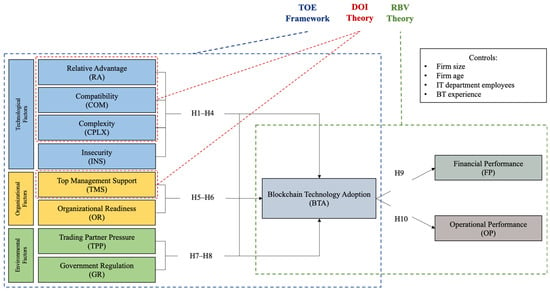
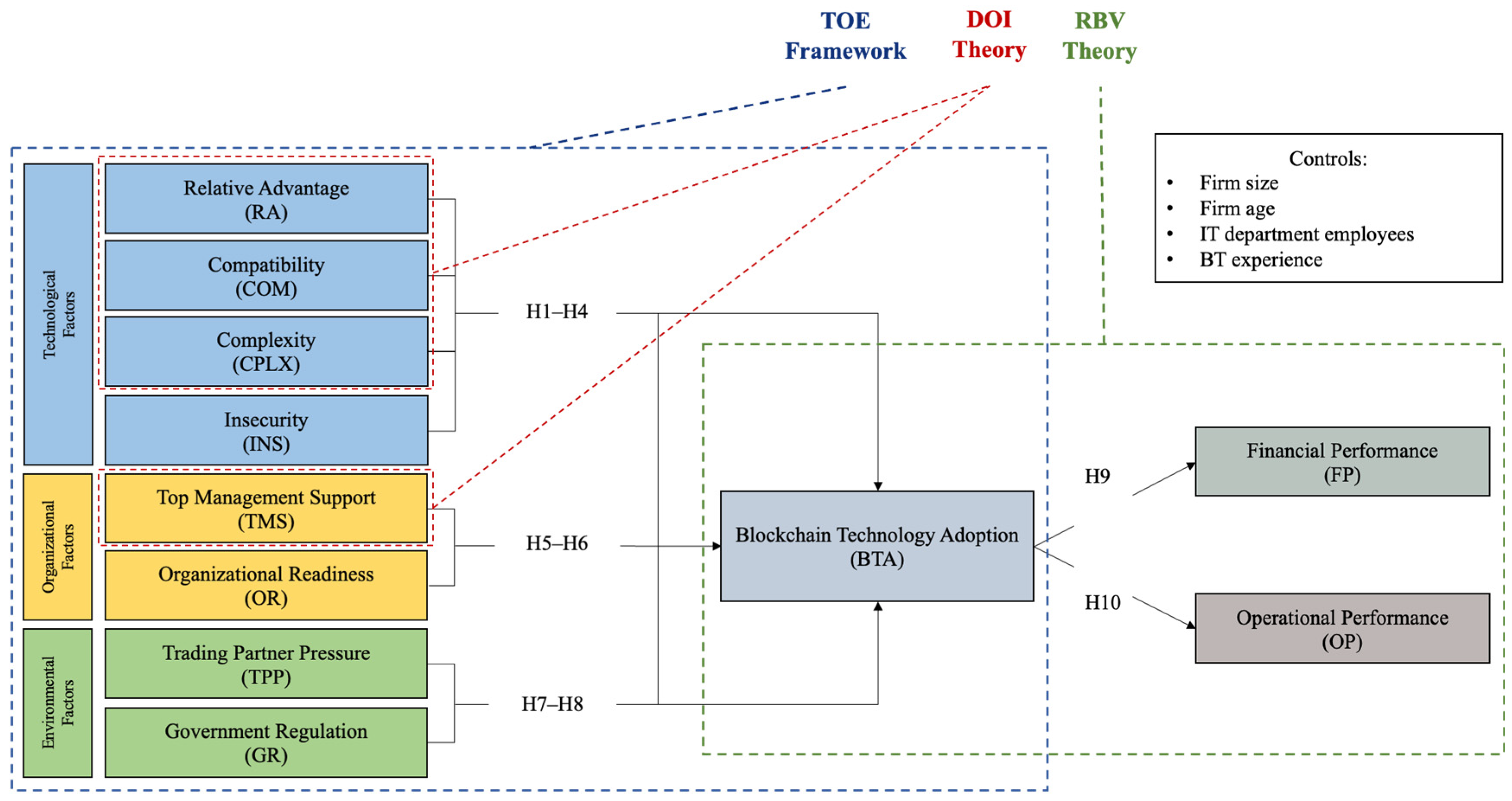
The above review suggests the need for an integrated model relating eight antecedents to BTA and two performance outcomes. Each antecedent is linked to a specific cross-border trade problem and based on the most appropriate theoretical tradition. Four technological factors are included—relative advantage (RA), compatibility (COM), complexity (CPLX), and insecurity (INS). Two organizational factors follow—top management support (TMS) and organizational readiness (OR). Two environmental factors complete the set—trading partner pressure (TPP) and government regulation (GR). The two performance outcomes are financial performance (FP) and operational performance (OP). Table 1 maps cross-border trade challenges onto model variables and theoretical sources, while Figure 1 presents the proposed model and hypothesized relationships.
Figure 1.
Conceptual model. BTA denotes the extent of adoption among firms that have already deployed blockchain.
2.4. Hypotheses Development
All hypotheses concern the extent of blockchain technology adoption among adopting firms.
Relative advantage (RA). RA captures the degree to which blockchain is perceived as superior to the solutions it replaces [31]. In cross-border trade, blockchain’s immutable ledgers, cryptographic verification, and smart contracts directly address document fraud, information asymmetry, and settlement latency by enabling trust-minimized multi-party workflows [17,46]. Meta-analytic evidence confirms that RA is consistently the strongest DOI predictor of technology adoption [39,41].
H1.
Relative advantage is positively associated with blockchain technology adoption.
Compatibility (COM). COM refers to the degree to which blockchain aligns with existing systems, procedures, and practices [31]. There are two levels of compatibility at issue in cross-border trade. The internal compatibility issues involve legacy ERP, logistics and customs compliance systems [20,23]. External compatibility issues involve partner platforms, consortium standards, and cross-border data infrastructure, an alignment that determines whether adoption yields coordination benefits or isolated deployments [7]. Higher compatibility reduces internal integration costs and external friction in the ecosystem [42].
H2.
Compatibility is positively associated with blockchain technology adoption.
Complexity (CPLX). CPLX captures the perceived difficulty of implementation and maintenance of blockchain [31]. Distributed consensus, cryptographic key management, smart contract programming, and node governance require specialized capabilities that are largely unavailable in most trading firms [25]. In cross-border environments, these requirements are magnified through multi-party coordination across heterogeneous technical and regulatory environments [24]. Higher complexity increases the learning cost and the risk of project failure [30,47].
H3.
Complexity is negatively associated with blockchain technology adoption.
Insecurity (INS). INS captures the perceived risks relating to data security, privacy governance and the institutional accountability within blockchain systems [29]. Security- and governance-related concerns have been increasingly identified as important deterrents to the adoption of blockchain technology, although these are not classical DOI attributes. In cross-border trade, shared ledgers expose sensitive commercial data to the consortium members under different legal regimes. Cross-border data flows are subject to heterogeneous localization requirements [25,26,48]. The immutability of blockchain increases control concerns further, since erroneous records cannot be easily corrected [25]. When perceived governance risk outweighs expected coordination benefits, adoption is likely to be constrained [39].
H4.
Insecurity is negatively associated with blockchain technology adoption.
Top management support (TMS). TMS reflects the degree to which senior leaders actively champion blockchain initiatives [49]. In cross-border trade, these initiatives span operations, IT, compliance, and finance, requiring cross-departmental coordination and sustained investment that routinely encounter organizational inertia [27,50]. TMS signals institutional legitimacy, accelerates resource mobilization, and enables firms to progress from pilot projects to routine use.
H5.
Top management support is positively associated with blockchain technology adoption.
Organizational readiness (OR). OR represents a firm’s financial resources, human capital, and technology infrastructure available for blockchain deployment [34]. In cross-border trade, beyond hardware and network infrastructure capable of participating in distributed ledgers, firms need a workforce with sufficient digital literacy to operate and improve blockchain-integrated trade processes [3]. Firms with richer prior IT knowledge are better equipped to assimilate new technologies into existing workflows [27]. OR thus works through two pathways—reducing technical barriers to deployment and strengthening the capacity to translate deployment into routinized practices.
H6.
Organizational readiness is positively associated with blockchain technology adoption.
Trading partner pressure (TPP). TPP is the extent of demand by customers, suppliers, or logistics partners that compels firms to adopt blockchain-based systems [28]. As the coordination benefits of blockchain are only realized when ecosystem participants operate on compatible protocols, dominant players—platform operators, anchor logistics providers, and major importers—can effectively impose adoption as a precondition for commercial access, turning a strategic choice into a relational compliance requirement [39,51]. This coercive power is especially centralized in cross-border e-commerce platforms [7,17].
H7.
Trading partner pressure is positively associated with blockchain technology adoption.
Government regulation (GR). GR signifies policies, standards, and regulatory frameworks of blockchain and digital trade [29,30]. Supportive regulation—Regional Comprehensive Economic Partnership (RCEP) digital trade provisions, blockchain pilot zone designations, and electronic documentation standards—reduces legal uncertainty [29]. Regulatory ambiguity and data localization, however, pose compliance costs that can hinder adoption [26]. In China, where blockchain is promoted alongside data governance [21], the net effect is expected to be positive.
H8.
Government regulation is positively associated with blockchain technology adoption.
BTA and financial performance (FP). BTA may enhance FP through lower documentation costs, blockchain-enabled trade finance, and reduced supply chain risk [14]. From an RBV perspective, such returns are attained when firms develop complementary capabilities that link process improvements to competitive differentiation [15,16]. Empirical evidence suggests that BTA is positively related to FP in such conditions [14,52].
H9.
Blockchain technology adoption is positively associated with financial performance.
BTA and operational performance (OP). BTA is expected to contribute to OP through transaction efficiency, process reliability and quality of coordination [15]. Smart contracts automate customs declaration, letter-of-credit issuance and multi-party settlement in cross-border trade, immutable provenance records reduce discrepancies in documentation, and shared ledgers eliminate redundant reconciliation [3,52]. There is evidence from Chinese listed firms that blockchain investment improves operational business processes and supply chain management [37].
H10.
Blockchain technology adoption is positively associated with operational performance.
3. Research Methodology
3.1. Survey Design and Development
Measurement items were adapted from validated scales and contextualized to firm-level blockchain deployment in cross-border trade. The measurement of each variable can be found in Appendix A (Table A1). English items were translated into Chinese and back-translated by bilingual speakers to ensure semantic equivalence in line with Brislin’s [53] procedure. The questionnaire screened for blockchain adoption, collected firm and informant characteristics and measured the eight antecedents, BTA, FP and OP. Antecedent items were adapted from Bag, Rahman, Gupta and Wood [30], Maroufkhani et al. [54], Lin [29], and Abed [28]. BTA items were adapted from Kim and Garrison [55] and Fosso Wamba et al. [56], with three items capturing resource commitment, operational integration and functional coverage. The three items are treated as reflective indicators of a common underlying degree of adoption extent rather than as separately estimated dimensions; as each facet is represented by a single item, BTA is estimated as a single first-order reflective construct, and the study does not claim to estimate distinct resource-commitment, operational-integration and functional-coverage subdimensions. FP and OP items were adapted from Paladino [57], Shashi et al. [58] and Kim et al. [59]. All items were adapted for blockchain use in cross-border trade and measured on seven-point Likert scales.
To mitigate common method bias (CMB), both procedural and statistical remedies were applied. Procedurally, predictor and outcome items were separated into different sections of the questionnaire, item wording was adapted to the study context, and respondent anonymity was assured [60]. Statistically, post hoc diagnostics of common method variance were applied.
3.2. Pilot Test
A two-stage pilot test assessed the clarity and psychometric properties of the instrument. Ten professors specializing in cross-border digital trade reviewed the questionnaire for content validity, and their responses were excluded from empirical analysis. A field pilot administered via Wenjuanxing from 24 May to 23 June 2025 yielded 59 valid firm-level responses from import/export firms in the Yunnan PFTZ. RA3 was removed for a low factor loading (0.445), while OP4 was retained for theoretical relevance despite a marginal loading (0.634). OP4, despite a marginal pilot loading of 0.634, loaded at 0.905 in the main sample, supporting its retention. All other constructs met recommended thresholds [61].
3.3. Data Collection
The main survey was administered between August and November 2025 through two channels. The first was the sample service of Wenjuanxing (www.wjx.cn), a respondent panel of enterprise managers matched against the study’s eligibility criteria, namely senior management or IT leadership in import/export firms that had adopted blockchain. This channel returned 233 questionnaires, of which 101 were valid. The second comprised institutional contacts with PFTZ authorities, customs agencies and trade associations, which posted the survey link in WeChat working groups of cross-border trade firms, returning 369 questionnaires, of which 337 were valid. Pilot test participants were excluded. The lower validity rate for the Wenjuanxing channel (43.3%) relative to the institutional channel (91.3%) likely reflects the panel’s broader initial pool, which required more extensive screening against the blockchain-adoption criterion, whereas institutional contacts had already been informally pre-qualified through professional networks.
Screening items confirmed blockchain adoption, informant position and firm location, and an attention-check item was embedded. Adoption was defined as any current use of blockchain in cross-border trade operations, including pilot deployments. As the survey was anonymous, position was self-reported and firm names were not collected, and submissions were restricted to one per IP address and device. All items were compulsory, and informed consent was obtained at the outset.
The target population was import/export firms in nine Chinese provinces and municipalities with both PFTZ status and documented blockchain applications, namely Shanghai, Tianjin, Chongqing, Guangdong, Zhejiang, Fujian, Liaoning, Shaanxi, and Yunnan. As no population frame or allocation rules were available, recruitment followed a convenience design with regional coverage rather than a probability-based design.
Responses were excluded if they failed the blockchain-adoption screening item, originated outside the target regions, came from an ineligible informant, failed the attention check, or were completed in under 200 s [62]. Most exclusions arose from the adoption screening item. After screening, 438 valid firm-level cases were retained from the 602 returned questionnaires, a valid-completion rate of 72.76% rather than a response rate, as the number of invitations issued was not recorded. A priori G*Power 3.1 analysis (multiple linear regression, fixed model, f2 = 0.15, α = 0.05, power = 0.95, eight predictors) indicated a minimum sample of 160 firms, well below the final 438 cases. A two-tailed test was retained as a conservative choice despite the directional nature of the hypotheses.
3.4. Respondent Profiles
The demographic characteristics of respondents are shown in Table 2. The 438 firms were located in nine target regions, with the largest shares in Guangdong, Yunnan and Shanghai. The sample was dominated by SMEs, with 73.29% of firms employing fewer than 500 employees. This threshold follows common international conventions (fewer than 500 employees). Official Chinese SME classification standards, by contrast, apply substantially lower headcount thresholds for wholesale-trade firms (typically under 200–300 employees), with classification evaluated jointly with revenue criteria. Most firms had been in business for 6–20 years. The key informants were CIOs or heads of IT, CEOs or general managers, or owners or founders, and a plurality reported 1–4 years of blockchain experience. The sample is appropriate for examining firm-level BTA.
Table 2.
Demographic information of informants (N = 438).
4. Data Analysis
4.1. Measurement Model
To evaluate the model using PLS-SEM, this study first verified the reliability and validity of the constructs as shown in Table 3. All outer loadings exceeded the 0.70 threshold, ranging from 0.711 (RA7) to 0.938 (CPLX1 and CPLX3). All constructs demonstrated strong reliability—Cronbach’s alpha and composite reliability (rho_a and rho_c) coefficients surpassed the 0.70 threshold—and convergent validity, with AVE values above the 0.50 cutoff, as detailed in Table 3 [61].
Table 3.
Descriptive statistics, factor loadings, composite reliability and convergent validity.
4.2. Discriminant Validity
Discriminant validity was assessed with the Fornell–Larcker criterion and the heterotrait–monotrait ratio (HTMT) as shown in Table 4 [63]. Under the Fornell–Larcker criterion, the square root of each construct’s AVE exceeded its correlation with any other construct. The more restrictive HTMT test, shown in Table 4, indicates that all ratios fell below the 0.85 threshold, with the highest being 0.848 (BTA–RA), confirming discriminant validity. Bootstrap confidence intervals for HTMT were also inspected. The upper bound of the 95% BCa interval was below 0.90 for all construct pairs [63]. For RA–BTA, the upper bound reached 0.897, which is close to this threshold; RA6–RA8 are worded closer to realized outcomes than perceived attributes, which may inflate both this proximity and RA’s comparatively lower AVE and loadings. The comparatively low OP–FP HTMT (0.158), despite both constructs’ shared dependence on BTA, suggests the two performance dimensions capture distinct outcome domains with limited additional shared variance. Conversely, the comparatively strong HTMT values between COM/GR and the performance outcomes (COM–OP = 0.725; GR–FP = 0.677), despite null structural paths to BTA, likely reflect shared method variance among same-informant perceptual measures rather than a substantive pathway, consistent with the common-method-bias caveat in Section 4.3.
Table 4.
Discriminant validity (heterotrait–monotrait ratio—HTMT).
4.3. Structural Model
The R-squared of the model is 0.788 for BTA, 0.350 for OP, and 0.222 for FP (R-squared adjusted = 0.782, 0.342, and 0.213, respectively). Path coefficients are reported in Table 5.
Table 5.
Evaluation of the structural model (path coefficients).
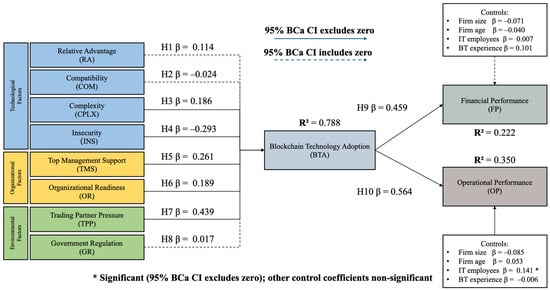
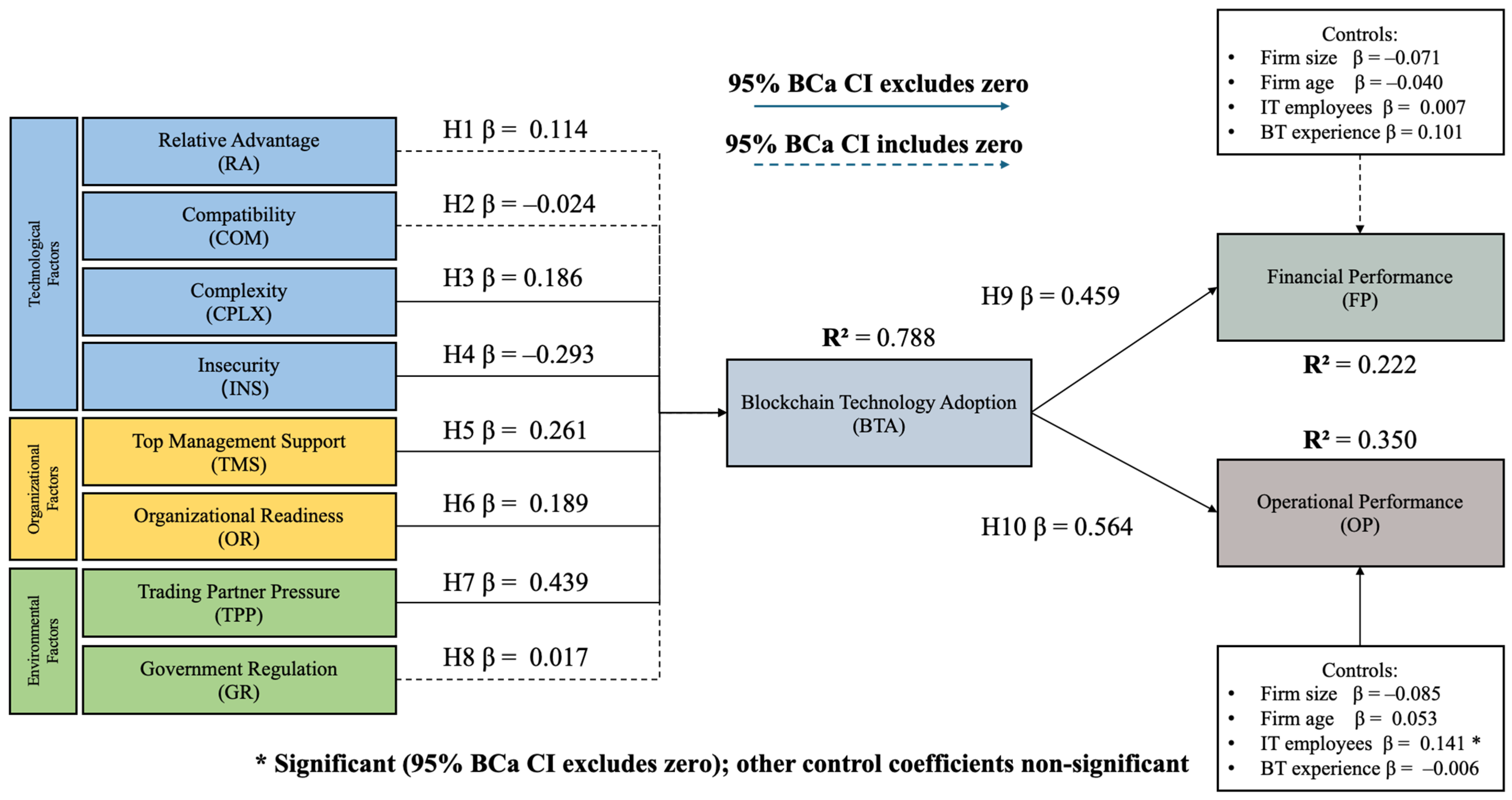
Bootstrapping with 10,000 subsamples, a fixed random seed and bias-corrected and accelerated (BCa) confidence intervals (two-tailed) was performed to assess path significance. A path is treated as significant if its 95% BCa confidence interval excludes zero; p-values are reported for reference. Results are summarized in Figure 2. Six of the ten hypotheses were supported. TPP exhibited the strongest positive association with BTA (β = 0.439, CI [0.352, 0.528], f2 = 0.324), supporting H7. INS was strongly negatively associated with BTA (β = −0.293, CI [−0.380, −0.221], f2 = 0.150), supporting H4. TMS (β = 0.261, CI [0.159, 0.364]) and OR (β = 0.189, CI [0.085, 0.291]) were positively associated with BTA, supporting H5 and H6. The confidence interval for RA included zero (β = 0.114, CI [−0.001, 0.217], f2 = 0.012); H1 was not supported. COM (β = −0.024) and GR (β = 0.017) showed no significant association with BTA, rejecting H2 and H8. CPLX was positively associated with BTA (β = 0.186, CI [0.085, 0.299]), the opposite direction from H3; H3 was therefore rejected. BTA showed strong positive associations with both FP (β = 0.459, CI [0.335, 0.575], f2 = 0.271) and OP (β = 0.564, CI [0.480, 0.639], f2 = 0.488), supporting H9 and H10.
Figure 2.
Main model results via PLS-SEM analysis. BTA denotes the extent of adoption among firms that have already deployed blockchain.
Among four firm-level controls, only IT Employees → OP was significant (β = 0.141, CI [0.030, 0.246]), while other control paths were non-significant, suggesting the robustness of hypothesized relationships to firm-level heterogeneity.
Common method bias was assessed with two post hoc diagnostics. All inner-model VIF values were below 5.0 (Table 6; highest 4.933, RA → BTA), indicating no evidence of harmful collinearity [61,64]. A full-collinearity test [64] was also conducted, in which every construct was regressed on an unrelated random variable; six of the eleven constructs exceeded Kock’s more conservative threshold of 3.3 (highest: BTA, VIF = 5.18), while the remaining five fell below it (Table 6). This more stringent diagnostic is less reassuring than the inner-model VIFs alone, and the possibility of common method bias cannot be fully excluded; results should be interpreted with this caveat in mind. Harman’s single-factor test on all 44 reflective items produced six components with eigenvalues above one, with the first accounting for 44.525% of the variance, below the 50% threshold [61].
Table 6.
Variance inflation factors (VIF).
Channel heterogeneity was examined by adding a channel dummy to the model with paths to BTA, FP and OP, coded 0 for the Wenjuanxing panel and 1 for institutionally recruited respondents. The dummy was not associated with BTA (β = −0.027, CI [−0.153, 0.096]) or FP (β = −0.104, CI [−0.276, 0.072]), but was negatively associated with OP (β = −0.222, CI [−0.386, −0.073]), indicating that institutionally recruited respondents reported lower operational performance than panel respondents. All hypothesized path coefficients remained substantively unchanged, and no hypothesis classification differed from the main model.
The model yielded a standardized root mean square residual (SRMR) of 0.072, within the acceptable limit [61]. A formal cross-validated predictive ability test (CVPAT) [65,66] was conducted to benchmark PLS-SEM against a linear-model alternative. PLS-SEM significantly outperformed the LM benchmark for BTA (loss difference = −0.041, p = 0.006), but the LM benchmark significantly outperformed PLS-SEM for both performance outcomes (FP: loss difference = 0.509, p < 0.001; OP: loss difference = 0.391, p < 0.001) as indicated in Table 7. This indicates that while the antecedent structure predicts adoption extent well out-of-sample, the model’s predictive advantage does not extend to the downstream performance pathways, and the strength of the BTA→FP/OP associations (H9, H10) should be interpreted with this limitation in mind.
Table 7.
Q2 of the model.
4.4. Mediation Analysis
Because BTA is theorized as the central pathway linking antecedents to firm performance, specific indirect effects through BTA were examined (Table 8). Five antecedents exhibited significant indirect effects on both FP and OP via BTA. The strongest was TPP → BTA → OP (β = 0.248, CI [0.201, 0.301]), followed by TPP → BTA → FP (β = 0.202, CI [0.137, 0.274]). Significant indirect paths were also found for INS, TMS and OR, and for CPLX subject to the same conditionality as its direct path. For RA, the indirect association with FP met the confidence-interval criterion (β = 0.052, CI [0.0006, 0.1057]), although the lower bound was very close to zero, whereas the indirect association with OP did not (β = 0.064, CI [−0.0002, 0.1212]). The evidence for an indirect role of BTA in the RA–performance relationships is therefore mixed and limited.
Table 8.
Specific indirect effects through BTA.
5. Discussion
The integrated TOE–DOI–RBV framework captures the adoption–performance relationships within a single analytical structure, addressing the fragmentation in prior research that examined antecedents and outcomes separately [14,30]. The effect sizes show that the largest positive effect is environmental (TPP, f2 = 0.324), while government regulation, the other environmental-dimension antecedent, shows a negligible effect (GR, f2 = 0.001). The largest negative effect is a perceived-governance-risk factor (INS, f2 = 0.150), reflecting insecurity around cross-border data and coordination. The organizational dimension (TMS, f2 = 0.124; OR, f2 = 0.060) falls between these, while the classical DOI attributes are uniformly weak (CPLX, f2 = 0.045; RA, f2 = 0.012; COM, f2 = 0.001). This ordering suggests that innovation attributes alone might not fully encompass the main correlates of adoption extent in this setting. The model’s explanatory power (R2 = 0.788 for BTA, 0.350 for OP, 0.222 for FP), acceptable fit (SRMR = 0.072) and absence of harmful collinearity support its applicability to the cross-border trade context.
5.1. Trading Partner Pressure as the Leading Antecedent
The prominence of blockchain in cross-border trade reflects its networked nature, in which value depends on shared participation, interoperable protocols, and coordinated data exchange across firms [3,7]. The TradeLens collapse shows the opposite pattern: strong technology backing alone cannot compensate for weak ecosystem participation.
The size of the TPP effect can be explained by three mechanisms described in previous research [51]: a coercive-hierarchical channel operating through dominant platforms such as Cainiao, JD Worldwide and Alibaba’s International Digital Commerce Group, which can make protocol compatibility a condition of relational access; a network-externality channel in which anchor-firm commitments cascade to suppliers; and a state-coordinated mimetic channel operating through customs single-window pilots and PFTZ-level blockchain corridors. These channels were not separated here, but the observed coefficient is consistent with their combined operation and offers one way to unpack the unitary institutional pressure construct in recent blockchain work [22].
5.2. Organizational Mobilization
TMS (β = 0.261, f2 = 0.124) and OR (β = 0.189, f2 = 0.060) were both positively associated with BTA. Blockchain initiatives in cross-border trade span operations, IT, compliance, and finance, requiring sustained cross-functional coordination [27]. TMS provides strategic authorization and resource-mobilization support to take firms beyond pilot deployment, while OR captures the infrastructure, technical skills and financial capacity through which blockchain is absorbed into existing workflows.
The larger TMS coefficient relative to OR can be explained in the context of the composition of the sample. In an adopter-only sample, baseline readiness is likely already above the threshold for participation, so there is little variance left for OR to explain. In such situations, greater adoption extent appears to be more closely tied to managerial approval and cross-functional collaboration than to baseline readiness. The RA path was not significant (β = 0.114, f2 = 0.012). Its modest effect is consistent with perceptual homogeneity. RA had the lowest standard deviation among antecedent constructs (M = 5.32, SD = 1.25), suggesting that adopters generally agreed that blockchain provides superior benefits over incumbent systems. What appears to distinguish firms in adoption extent is therefore less their evaluation of blockchain benefits than the ecosystem and organizational conditions under which they operate. This reading is consistent with the diffusion principle that the attributes of innovation become less important as adoption approaches routinization [31].
5.3. Insecurity and Governance Risk
Insecurity is particularly salient in cross-border digital trade, where blockchain deployment intersects with heterogeneous data governance regimes. INS was strongly negatively associated with BTA (β = −0.293, f2 = 0.150) and was the only significant negative antecedent. Although this finding is consistent with perceived risk theory [32], its strength in an already-adopting sample suggests a broader interpretation. INS appears to capture not only transactional risk but also governance risk at the interface between blockchain architecture and cross-border data flows.
Two sources are especially relevant. Shared ledgers reveal sensitive commercial data to consortium members subject to different legal systems. Firms operating in multiple jurisdictions therefore encounter overlapping obligations under instruments such as China’s Personal Information Protection Law (PIPL) and the European Union’s General Data Protection Regulation (GDPR), with no firm-level mechanism for reconciling conflicting requirements. A second source lies in the contradiction between blockchain’s immutability and the legal expectation of revocability—the right to correct, delete, or rectify records—which is both technical and institutional in nature [25], generating governance risk beyond firm-level remediation.
Transactional risk is often reduced by experience, contracts or technological improvement. By contrast, governance risk is created when technology design meets institutional requirements and is largely unresponsive to firm-level remediation. The asymmetry between TPP and INS thus reflects a defining tension of blockchain in Chinese cross-border trade—firms attracted to ecosystem inclusion but constrained by unresolved governance questions.
5.4. Complexity Reconsidered
Contrary to H3, CPLX was positively and significantly related to BTA (β = 0.186). A supplementary estimation excluding INS shows that this coefficient becomes non-significant (β = −0.022, CI [−0.098, 0.058]). The positive association is therefore conditional on the inclusion of INS rather than a net association, which is consistent with the high construct correlation between the two.
Once governance risk is accounted for, the residual component of perceived complexity is positively associated with BTA. One interpretation is a sophistication signal: firms may associate technical complexity with tamper resistance, auditability and execution reliability, particularly where the architecture is abstracted from end users by service providers [68]. This interpretation is most plausible in settings with visible architectural cues, application-layer abstraction, and reliability-prioritizing transactions, conditions that broadly describe blockchain in cross-border trade but were not directly tested here. Another interpretation is path dependence, where firms with high sunk investment are more likely to extend deployment than retreat [27]. A third cannot be excluded in a cross-sectional design: deeper deployment may itself raise experienced complexity.
The result also raises a unit-of-analysis question for DOI. DOI was conceptualized for individual decisions regarding discrete innovations, while blockchain is an inter-organizational infrastructure adopted by firms in ecosystems. Complexity at the individual decision level could operate as a barrier, while complexity at the infrastructure level could operate as a credibility cue. This does not invalidate DOI but suggests that the complexity prediction applies more cleanly to adoption initiation than to post-adoption extension, a stage distinction consistent with the IS implementation-stage tradition [10,11]. Given the entanglement of complexity and insecurity, this reading remains tentative. An alternative, measurement-level explanation should also be noted: CPLX and INS are the only two negatively framed constructs in the instrument (HTMT = 0.823), and their entanglement is also consistent with a shared item-valence method factor rather than a purely substantive relationship. The pattern is not decisive, since both constructs also correlate moderately with RA, TMS and OR, but the measurement-artifact interpretation should be considered alongside the substantive one.
5.5. BTA and Firm Performance
Both performance outcomes were positively related to BTA with the operational link notably stronger than the financial link. BTA was positively related to OP (β = 0.564, f2 = 0.488) and FP (β = 0.459, f2 = 0.271). Mediation analysis revealed that five antecedents (TPP, INS, TMS, OR and CPLX) exerted significant indirect effects on both performance dimensions via BTA, with the CPLX effects conditional on the inclusion of INS, whereas the evidence for RA was mixed across the two outcomes. The results suggest that BTA links contextual conditions to firm performance [36]. This is consistent with the CVPAT results (Section 4.3), which show that the model’s predictive advantage over a simple linear benchmark, while strong for adoption extent itself, does not extend to the downstream performance outcomes.
The VRIN framework offers one way to understand the OP–FP magnitude gap. Smart-contract automation, immutable provenance, and shared-ledger reconciliation are most closely associated with operational outcomes that meet the valuable and rare criteria. Non-imitability and non-substitutability usually depend on tacit integration and ecosystem embeddedness that are built over longer horizons. Because this study is cross-sectional, it cannot establish the temporal order between operational gains and financial returns. The observed OP–FP gap is therefore consistent with the VRIN interpretation, but it does not directly test it.
SMEs account for 73.29% of the sampled firms, a segment frequently described in past studies as having minimal pricing power and a weaker bargaining position against platform operators [28,30]. Firm-size moderation was not tested in the present study, and any size-contingent reading therefore remains tentative.
5.6. Non-Significant Findings and Contextual Conditions
COM (β = −0.024) and GR (β = 0.017) were not significantly associated with BTA. For COM, the high construct correlations with TPP (HTMT = 0.747) and GR (HTMT = 0.776) are consistent with variance shared across these constructs, given that partner-platform alignment and regulatory harmonization may overlap substantially with internal system fit. An additional interpretation concerns measurement-context fit. Classical COM was conceptualized as firm-level alignment between an innovation and existing systems, whereas blockchain compatibility in this setting also operates at the ecosystem level—fit between a firm and the consortium it joins. The DOI-derived COM measure captures the firm-level concept, and the non-significant result is therefore consistent with a conceptual–operational gap rather than indicating that compatibility is irrelevant.
For GR, the descriptive distribution offers a sample-specific account. GR shows a moderately high mean and constrained spread (M = 5.07, SD = 1.30, the second-smallest standard deviation among antecedent constructs after RA), suggesting that perceptions of policy support are largely homogeneous across the sampled firms. This homogeneity is consistent with the uniformly supportive policy environment within which sampled firms operate, established through the Chinese 14th Five-Year Plan and PFTZ-level digital trade reforms. The constrained variance limits GR’s statistical capacity to account for variation in adoption extent in this sample, and the non-significant GR coefficient is therefore consistent with sample-level policy homogeneity rather than with GR being unrelated to BTA more generally. This reading is consistent with recent work that considers government support as a contextual condition rather than a direct driver [69].
5.7. Comparison with Prior Studies
The results align with prior TOE-based work in reporting positive associations for top management support and organizational readiness [29,30,54]. They diverge in two respects. First, relative advantage, identified as the dominant innovation attribute in earlier adoption studies [39,41], is weak in this setting. Second, complexity is not negatively associated with BTA, contrary to the canonical diffusion prediction [31], although its positive coefficient holds only once governance risk is accounted for. One plausible explanation for both divergences is the study’s focus on firms that have already adopted blockchain: perceptions of benefits are homogeneous once firms have adopted, and complexity does not operate as a deterrent to continued deployment.
5.8. Theoretical Contributions
The integrated TOE–DOI–RBV framework contributes to the blockchain adoption literature in three ways. First, the study moves from adoption status to adoption extent. Stage models treat adoption as an early phase distinct from later routinization and infusion [10], and post-adoptive use varies widely among adopters [11]. A binary measure therefore cannot capture deployment extent. Within this population, environmental conditions dominate technological perceptions. Trading partner pressure yields the largest effect size (f2 = 0.324), which no DOI attribute approaches. Prior blockchain adoption research has relied mainly on perceived-attribute frameworks [9]. The present finding qualifies that emphasis. For inter-organizational infrastructures, continued deployment reflects ecosystem requirements more than technology perceptions.
Second, it enhances the integration of TOE, DOI, and RBV. TOE and DOI are usually treated as parallel or additive frameworks in prior work [40,43]. The findings align with a conditional integration of DOI delineating what firms assess about blockchain, TOE contextualizing these assessments in environmental and organizational conditions, and RBV connecting adoption extent to performance through operational integration and routinized use. Technological perceptions differ widely in the weight of explanation (INS f2 = 0.150 vs. COM f2 = 0.001). This is consistent with the f2 hierarchy logic that TOE contexts correspond to differential salience among attributes, and RBV links adoption to firm-level performance.
Third, the positive association between complexity and BTA holds only conditionally on governance risk and is not observed as a net effect. This suggests that perceived complexity and perceived governance risk are empirically entangled in inter-organizational settings, and that the canonical negative-complexity prediction cannot be assessed without separating the two.
5.9. Managerial Implications
The findings provide practical insights for three audiences. For cross-border trade firms, the prominence of TPP indicates that blockchain decisions are better treated as ecosystem positioning than as internal IT investment: firms with weaker ecosystem ties are likely to lag in adoption extent regardless of internal motivation. The strong negative INS effect further implies that governance concerns, particularly those relating to cross-border data flows, persist even among firms that have already adopted and warrant attention alongside technical implementation.
For platform operators, anchor enterprises and system integrators, technical sophistication is necessary but not sufficient. Durable partner participation is likely to depend on reducing governance concerns rather than on compliance pressure alone. Architectures combining selective disclosure, jurisdiction-aware access controls and reconciliation pathways between immutability and the right to rectification under regimes such as PIPL and GDPR are therefore likely to better serve adopters.
For policy makers, the contrast between a non-significant GR effect and a strong negative INS effect suggests that among already-adopting firms, governance risk is more closely associated with adoption extent than is further general policy signaling.
5.10. Limitations
This study has several limitations. The sample consists of firms that have already adopted blockchain. Adoption extent is therefore observed under selection, and its variance is restricted, coefficients may be attenuated, and the findings do not speak to what distinguishes adopters from non-adopters. BTA was measured perceptually as continuous adoption extent without distinguishing maturity stages. As each of its three facets is represented by a single item, a higher-order specification is not identified. All perceptual variables were reported by a single informant at one point in time, and no marker variable was included in the instrument. Firm identifiers were not collected, so the one-firm-one-questionnaire principle could not be verified at the firm level. Operational performance was also lower among institutionally recruited respondents, and the source of this difference cannot be identified in a cross-sectional design. The cross-sectional design does not permit causal inference, particularly for the temporal ordering of operational and financial outcomes. Complexity and insecurity are strongly correlated, and the positive CPLX coefficient is not robust to the exclusion of insecurity, so it remains tentative. The sample is drawn from nine Chinese regions with PFTZ and digital trade initiatives, which strengthens contextual consistency but limits regulatory heterogeneity, and is dominated by SMEs, which constrains generalizability to larger firms.
6. Conclusions
Against the backdrop of accelerating digital transformation in international trade and persistent cross-organizational frictions, this study examined how adoption extent is associated with contextual conditions and firm performance in cross-border digital trade. Within a unified TOE–DOI–RBV framework, the study treats BTA as a continuous measure of adoption extent rather than the binary intention or declarative usage measure dominating earlier work. This distinction matters once the analytical interest shifts to performance consequences.
The findings indicate that BTA in cross-border trade is not primarily driven by perceptions of innovation attributes, but is most strongly associated with ecosystem pressure, supported by organizational mobilization and constrained by governance risk embedded in cross-border data flows. In turn, BTA is linked to firm performance, and the link is notably stronger for operational than financial outcomes.
Taken together, the study contributes context-specific evidence on adoption extent, a conditional integration of TOE, DOI and RBV, and a qualification of the canonical complexity prediction, with implications for firms, platform operators and policy makers.
Future Research Directions
Several research directions follow from this study. The first is longitudinal, tracing whether operational gains translate into financial returns over time. A second concerns cross-jurisdictional comparison, where heterogeneous data governance regimes such as China’s PIPL, the EU’s GDPR and the RCEP digital trade chapter may shape adoption in divergent ways. Blockchain rarely operates in isolation. Its interaction with e-commerce platforms, customs single-window systems and AI-enabled compliance tools deserves attention as these infrastructures co-evolve. Designs combining adopters and non-adopters would separate the correlates of adoption extent from those of the adoption decision itself. Finally, stage-stratified work could clarify whether antecedent effects vary across deployment stages of blockchain-enabled digital trade infrastructures.
Author Contributions
Conceptualization, Q.Y. and M.L.; methodology, Q.Y.; software, Q.Y.; validation, Q.Y. and M.L.; formal analysis, Q.Y.; investigation, Q.Y.; resources, Q.Y.; data curation, Q.Y.; writing—original draft preparation, Q.Y.; writing—review and editing, M.L.; visualization, Q.Y.; supervision, M.L.; project administration, M.L.; funding acquisition, Q.Y. All authors have read and agreed to the published version of the manuscript.
Funding
This research received partial funding from the Scientific Research Fund Project of the Yunnan Provincial Department of Education, China (Grant No. 2025J0573).
Institutional Review Board Statement
The study was conducted in accordance with the Declaration of Helsinki and approved by the Ethics Review Committee of the National Institute of Development Administration (ECNIDA 2025/0132, 24 July 2025).
Informed Consent Statement
Informed consent was obtained from all subjects involved in the study.
Data Availability Statement
The data presented in this study are available on request from the corresponding author due to confidentiality agreements with the participating firms.
Acknowledgments
During the preparation of this manuscript, the authors used Anthropic’s Claude (Opus 5) and QuillBot (V44) for the purposes of language editing, including grammar, clarity and sentence structure. The authors have reviewed and edited the output and take full responsibility for the content of this publication.
Conflicts of Interest
The authors declare no conflicts of interest. The funders had no role in the design of the study; in the collection, analyses, or interpretation of data; in the writing of the manuscript; or in the decision to publish the results.
Appendix A. Measurement Items and Descriptive Statistics
This Appendix provides the full measurement instrument together with item-level descriptive statistics (N = 438). All items used a seven-point Likert scale ranging from 1 (strongly disagree) to 7 (strongly agree). Items were adapted from previously validated scales and contextually adjusted to reflect blockchain technology adoption in cross-border trade settings.
Table A1.
Measurement items, sources and item-level statistics.
References
- ICC DSI. Key Trade Documents and Data Elements; ICC DSI: Paris, France, 2024. [Google Scholar]
- OECD. The Digitalisation of Trade Documents and Processes: Going Paperless Today, Going Paperless Tomorrow; OECD: Paris, France, 2025. [Google Scholar]
- Böhmecke-Schwafert, M. The role of blockchain for trade in global value chains: A systematic literature review and guidance for future research. Telecommun. Policy 2024, 48, 102835. [Google Scholar] [CrossRef] [Scilit]
- United Nations. Digital and Sustainable Trade Facilitation: Global Report 2025; United Nations: Manhattan, NY, USA, 2025. [Google Scholar]
- WTO. Global Trade Outlook and Statistics; WTO Publications: Geneva, Switzerland, 2025. [Google Scholar]
- Rachana Harish, A.; Liu, X.; Wang, X.; Pan, S.; Dai, H.-N.; Li, M.; Huang, G.Q. Blockchain For Logistics 4.0: A Systematic Review and Prospects. Transp. Res. Part E Logist. Transp. Rev. 2025, 201, 104269. [Google Scholar] [CrossRef] [Scilit]
- Jovanovic, M.; Kostić, N.; Sebastian, I.M.; Sedej, T. Managing a blockchain-based platform ecosystem for industry-wide adoption: The case of TradeLens. Technol. Forecast. Soc. Change 2022, 184, 121981. [Google Scholar] [CrossRef] [Scilit]
- WCO; WTO. The Role of Advanced Technologies in Cross-Border Trade: A Customs Perspective; WTO Publications: Geneva, Switzerland, 2022; ISBN 978-92-870-7099-9. [Google Scholar]
- Duan, K.; Pang, G.; Lin, Y. Exploring the current status and future opportunities of blockchain technology adoption and application in supply chain management. J. Digit. Econ. 2023, 2, 244–288. [Google Scholar] [CrossRef] [Scilit]
- Cooper, R.B.; Zmud, R.W. Information Technology Implementation Research: A Technological Diffusion Approach. Manag. Sci. 1990, 36, 123–139. [Google Scholar] [CrossRef] [Scilit]
- Jasperson, J.; Carter, P.E.; Zmud, R.W. A Comprehensive Conceptualization of Post-Adoptive Behaviors Associated with Information Technology Enabled Work Systems. MIS Q. 2005, 29, 525–558. [Google Scholar] [CrossRef] [Scilit]
- Lei, C.F.; Ngai, E.W.T. Blockchain from the information systems perspective: Literature review, synthesis, and directions for future research. Inf. Manag. 2023, 60, 103856. [Google Scholar] [CrossRef] [Scilit]
- Hubenova, T.; Lindeque, J.P.; Peter, M.K. Explaining the non-adoption of blockchain technology in global value chains: A micro-foundational perspective. J. Ind. Bus. Econ. 2024, 51, 397–429. [Google Scholar] [CrossRef] [Scilit]
- Sharma, P.; Shukla, D.M.; Raj, A. Blockchain adoption and firm performance: The contingent roles of intangible capital and environmental dynamism. Int. J. Prod. Econ. 2023, 256, 108727. [Google Scholar] [CrossRef] [Scilit]
- Culot, G.; Podrecca, M.; Nassimbeni, G. Blockchain adoption and operational performance: A secondary data analysis on effects and contingencies. Int. J. Oper. Prod. Manag. 2024, 44, 69–99. [Google Scholar] [CrossRef] [Scilit]
- Bakici, T.; Agi, M.A.N.; Kose, T.; Treiblmaier, H. Blockchain success in the post-adoption phase: Extending the information systems success model with supply chain complexity. Int. J. Prod. Res. 2026, 64, 63–83. [Google Scholar] [CrossRef] [Scilit]
- Lin, H.-F. Examining the determinants of blockchain technology-enabled maritime supply chain system adoption intention: Does market turbulence play a moderating role? Mar. Policy 2025, 174, 106616. [Google Scholar] [CrossRef] [Scilit]
- Office of the Central Cyberspace Affairs Commission. China Blockchain Innovation and Application Development Report (2023); Office of the Central Cyberspace Affairs Commission: Beijing, China, 2024. [Google Scholar]
- Office of the Central Cyberspace Affairs Commission. China Blockchain Innovation Application Casebook (2023); Office of the Central Cyberspace Affairs Commission: Beijing, China, 2024. [Google Scholar]
- Fu, Z.; Dong, P.; Li, S.; Ju, Y. An intelligent cross-border transaction system based on consortium blockchain: A case study in Shenzhen, China. PLoS ONE 2021, 16, e0252489. [Google Scholar] [CrossRef] [Scilit] [PubMed]
- Chen, M. Developing China’s approaches to regulate cross-border data transfer: Relaxation and integration. Comput. Law Secur. Rev. 2024, 54, 105997. [Google Scholar] [CrossRef] [Scilit]
- Mishra, N.K.; Sahoo, S.; Agarwal, S.; Sharma, P.P.; Ilahi, F. Impact of institutional pressures and security on blockchain technology adoption and organization performance: An empirical study. J. Technol. Transf. 2025, 50, 245–270. [Google Scholar] [CrossRef] [Scilit]
- Anthony Jnr, B. Enhancing blockchain interoperability and intraoperability capabilities in collaborative enterprise-a standardized architecture perspective. Enterp. Inf. Syst. 2024, 18, 2296647. [Google Scholar] [CrossRef] [Scilit]
- Nasser, A.; Ouzayd, F.; Ech-cheikh, H. Blockchain technology in maritime single window and port community systems: A bibliometric analysis and systematic literature review. Telemat. Inform. Rep. 2025, 18, 100206. [Google Scholar] [CrossRef] [Scilit]
- Sedlmeir, J.; Lautenschlager, J.; Fridgen, G.; Urbach, N. The transparency challenge of blockchain in organizations. Electron. Mark. 2022, 32, 1779–1794. [Google Scholar] [CrossRef] [Scilit] [PubMed]
- Nguyen, S.; Chen, P.S.-L.; Du, Y. Blockchain adoption in container shipping: An empirical study on barriers, approaches, and recommendations. Mar. Policy 2023, 155, 105724. [Google Scholar] [CrossRef] [Scilit]
- Dehghani, M.; William Kennedy, R.; Mashatan, A.; Rese, A.; Karavidas, D. High interest, low adoption. A mixed-method investigation into the factors influencing organisational adoption of blockchain technology. J. Bus. Res. 2022, 149, 393–411. [Google Scholar] [CrossRef] [Scilit]
- Abed, S.S. Social commerce adoption using TOE framework: An empirical investigation of Saudi Arabian SMEs. Int. J. Inf. Manag. 2020, 53, 102118. [Google Scholar] [CrossRef] [Scilit]
- Lin, H.-F. Blockchain adoption in the maritime industry: Empirical evidence from the technological-organizational-environmental framework. Marit. Policy Manag. 2023, 51, 1474–1496. [Google Scholar] [CrossRef] [Scilit]
- Bag, S.; Rahman, M.S.; Gupta, S.; Wood, L.C. Understanding and predicting the determinants of blockchain technology adoption and SMEs’ performance. Int. J. Logist. Manag. 2023, 34, 1781–1807. [Google Scholar] [CrossRef] [Scilit]
- Rogers, E.M. Diffusion of Innovations, 5th ed.; Free Press: New York, NY, USA, 2003. [Google Scholar]
- Featherman, M.S.; Pavlou, P.A. Predicting e-services adoption: A perceived risk facets perspective. Int. J. Hum.-Comput. Stud. 2003, 59, 451–474. [Google Scholar] [CrossRef] [Scilit]
- Tornatzky, L.G.; Fleischer, M. The Processes of Technological Innovation; Lexington Books: Lexington, KY, USA, 1990. [Google Scholar]
- Iacovou, C.L.; Benbasat, I.; Dexter, A.S. Electronic data interchange and small organizations: Adoption and impact of technology. MIS Q. 1995, 19, 465–485. [Google Scholar] [CrossRef] [Scilit] [PubMed]
- Zhu, K.; Kraemer, K.L.; Xu, S. The Process of Innovation Assimilation by Firms in Different Countries: A Technology Diffusion Perspective on E-Business. Manag. Sci. 2006, 52, 1557–1576. [Google Scholar] [CrossRef] [Scilit]
- Barney, J. Firm Resources and Sustained Competitive Advantage. J. Manag. 1991, 17, 99–120. [Google Scholar] [CrossRef] [Scilit]
- Huang, L.; Zhou, T. How does blockchain technology enhance firm operation and cooperation? Int. Rev. Econ. Financ. 2024, 92, 34–49. [Google Scholar] [CrossRef] [Scilit]
- Baker, J. The Technology–Organization–Environment Framework. In Information Systems Theory: Explaining and Predicting Our Digital Society; Dwivedi, Y.K., Wade, M.R., Schneberger, S.L., Eds.; Springer: New York, NY, USA, 2012; Volume 1, pp. 231–245. [Google Scholar]
- Mishra, N.K.; Raj, A.; Jeyaraj, A.; Gupta, R. Antecedents and Outcomes of Blockchain Technology Adoption: Meta-Analysis. J. Comput. Inf. Syst. 2024, 64, 342–359. [Google Scholar] [CrossRef] [Scilit]
- Oliveira, T.; Martins, M.F. Literature review of information technology adoption models at firm level. Electron. J. Inf. Syst. Eval. 2011, 14, 110–121. [Google Scholar]
- Raj, A.; Jeyaraj, A. Antecedents and consequents of industry 4.0 adoption using technology, organization and environment (TOE) framework: A meta-analysis. Ann. Oper. Res. 2023, 322, 101–124. [Google Scholar] [CrossRef] [Scilit]
- Chittipaka, V.; Kumar, S.; Sivarajah, U.; Bowden, J.L.-H.; Baral, M.M. Blockchain technology for supply chains operating in emerging markets: An empirical examination of technology-organization-environment (TOE) framework. Ann. Oper. Res. 2023, 327, 465–492. [Google Scholar] [CrossRef] [Scilit]
- Marzi, G.; Marrucci, A.; Vianelli, D.; Ciappei, C. B2B digital platform adoption by SMEs and large firms: Pathways and pitfalls. Ind. Mark. Manag. 2023, 114, 80–93. [Google Scholar] [CrossRef] [Scilit]
- Kant, N. Blockchain: A strategic resource to attain and sustain competitive advantage. Int. J. Innov. Sci. 2021, 13, 520–538. [Google Scholar] [CrossRef] [Scilit]
- Heredia, J.; Castillo-Vergara, M.; Geldes, C.; Carbajal Gamarra, F.M.; Flores, A.; Heredia, W. How do digital capabilities affect firm performance? The mediating role of technological capabilities in the “new normal”. J. Innov. Knowl. 2022, 7, 100171. [Google Scholar] [CrossRef] [Scilit]
- Mishra, A.; Kundu, T.; Kapoor, R.; Goh, M. Blockchain adoption in cross-border cold supply chains: Cost, Efficiency and Trust. Transp. Res. Part E Logist. Transp. Rev. 2025, 201, 104236. [Google Scholar] [CrossRef] [Scilit]
- Agi, M.A.N.; Jha, A.K. Blockchain technology in the supply chain: An integrated theoretical perspective of organizational adoption. Int. J. Prod. Econ. 2022, 247, 108458. [Google Scholar] [CrossRef] [Scilit]
- Yang, Y.-C.; Chen, Y.-C. Risk management of transaction security using blockchain technology in the international logistics industry. Sustain. Futures 2025, 10, 101537. [Google Scholar] [CrossRef] [Scilit]
- Clohessy, T.; Acton, T. Investigating the influence of organizational factors on blockchain adoption: An innovation theory perspective. Ind. Manag. Data Syst. 2019, 119, 1457–1491. [Google Scholar] [CrossRef] [Scilit]
- Benchis, M.P.; Shahzad, K.; Dan, S. Comparative analysis of blockchain adoption in the public and private sectors. A technology-organization-environment (TOE) framework approach. J. Innov. Knowl. 2025, 10, 100746. [Google Scholar] [CrossRef] [Scilit]
- DiMaggio, P.J.; Powell, W.W. The iron cage revisited: Institutional isomorphism and collective rationality in organizational fields. Am. Sociol. Rev. 1983, 48, 147–160. [Google Scholar] [CrossRef] [Scilit]
- Vu, N.; Ghadge, A.; Bourlakis, M. The impact of Blockchain adoption on supply chain performance: Evidence from food industry. Int. J. Prod. Res. 2025, 63, 5402–5427. [Google Scholar] [CrossRef] [Scilit]
- Brislin, R.W. Back-translation for cross-cultural research. J. Cross-Cult. Psychol. 1970, 1, 185–216. [Google Scholar] [CrossRef] [Scilit]
- Maroufkhani, P.; Tseng, M.-L.; Iranmanesh, M.; Ismail, W.K.W.; Khalid, H. Big data analytics adoption: Determinants and performances among small to medium-sized enterprises. Int. J. Inf. Manag. 2020, 54, 102190. [Google Scholar] [CrossRef] [Scilit]
- Kim, S.; Garrison, G. Understanding users’ behaviors regarding supply chain technology: Determinants impacting the adoption and implementation of RFID technology in South Korea. Int. J. Inf. Manag. 2010, 30, 388–398. [Google Scholar] [CrossRef] [Scilit]
- Fosso Wamba, S.; Queiroz, M.M.; Trinchera, L. Dynamics between blockchain adoption determinants and supply chain performance: An empirical investigation. Int. J. Prod. Econ. 2020, 229, 107791. [Google Scholar] [CrossRef] [Scilit]
- Paladino, A. Investigating the Drivers of Innovation and New Product Success: A Comparison of Strategic Orientations. J. Prod. Innov. Manag. 2007, 24, 534–553. [Google Scholar] [CrossRef] [Scilit]
- Shashi; Centobelli, P.; Cerchione, R.; Singh, R. The impact of leanness and innovativeness on environmental and financial performance: Insights from Indian SMEs. Int. J. Prod. Econ. 2019, 212, 111–124. [Google Scholar] [CrossRef] [Scilit]
- Kim, C.-B.; Chung, I.-S.; Joo, H.-Y. Effects of AEO-MRA on the Performance of Exporters and Importers in Korea. J. Korea Trade 2019, 23, 52–67. [Google Scholar] [CrossRef] [Scilit]
- Podsakoff, P.M.; MacKenzie, S.B.; Lee, J.Y.; Podsakoff, N.P. Common method biases in behavioral research: A critical review of the literature and recommended remedies. J. Appl. Psychol. 2003, 88, 879–903. [Google Scholar] [CrossRef] [Scilit] [PubMed]
- Hair, J.F.; Risher, J.J.; Sarstedt, M.; Ringle, C.M. When to use and how to report the results of PLS-SEM. Eur. Bus. Rev. 2019, 31, 2–24. [Google Scholar] [CrossRef] [Scilit]
- Leiner, D.J. Too fast, too straight, too weird: Non-reactive indicators for meaningless data in internet surveys. Surv. Res. Methods 2019, 13, 229–248. [Google Scholar] [CrossRef]
- Henseler, J.; Ringle, C.M.; Sarstedt, M. A new criterion for assessing discriminant validity in variance-based structural equation modeling. J. Acad. Mark. Sci. 2015, 43, 115–135. [Google Scholar] [CrossRef] [Scilit]
- Kock, N. Common Method Bias: A Full Collinearity Assessment Method for PLS-SEM. In Partial Least Squares Path Modeling: Basic Concepts, Methodological Issues and Applications; Latan, H., Noonan, R., Eds.; Springer International Publishing: Cham, Switzerland, 2017; pp. 245–257. [Google Scholar]
- Liengaard, B.D.; Sharma, P.N.; Hult, G.T.M.; Jensen, M.B.; Sarstedt, M.; Hair, J.F.; Ringle, C.M. Prediction: Coveted, Yet Forsaken? Introducing a Cross-Validated Predictive Ability Test in Partial Least Squares Path Modeling. Decis. Sci. 2021, 52, 362–392. [Google Scholar] [CrossRef] [Scilit]
- Sharma, P.N.; Liengaard, B.D.; Hair, J.F.; Sarstedt, M.; Ringle, C.M. Predictive Model Assessment and Selection in Composite-Based Modeling Using PLS-SEM: Extensions and Guidelines for Using CVPAT. Eur. J. Mark. 2023, 57, 1662–1677. [Google Scholar] [CrossRef] [Scilit]
- Shmueli, G.; Sarstedt, M.; Hair, J.F.; Cheah, J.-H.; Ting, H.; Vaithilingam, S.; Ringle, C.M. Predictive model assessment in PLS-SEM: Guidelines for using PLSpredict. Eur. J. Mark. 2019, 53, 2322–2347. [Google Scholar] [CrossRef] [Scilit]
- Bigiotti, A.; Mostarda, L.; Navarra, A.; Pinna, A.; Sestili, D.; Tonelli, R.; Vaccargiu, M. Blockchain Agnostic Protocols: An Analysis of the State of the Art. ACM Comput. Surv. 2025, 58, 30. [Google Scholar] [CrossRef] [Scilit]
- Tan, C.N.-L.; Liu, D.; Dou, J.; Chung, H.F.L. AI capabilities and sustainable competitiveness in logistics: A mediated moderation model of resilience, government support and intervention. J. Enterp. Inf. Manag. 2025, 1–36. [Google Scholar] [CrossRef] [Scilit]

Disclaimer/Publisher’s Note: The statements, opinions and data contained in all publications are solely those of the individual author(s) and contributor(s) and not of MDPI and/or the editor(s). MDPI and/or the editor(s) disclaim responsibility for any injury to people or property resulting from any ideas, methods, instructions or products referred to in the content. |
© 2026 by the authors. Licensee MDPI, Basel, Switzerland. This article is an open access article distributed under the terms and conditions of the Creative Commons Attribution (CC BY) license.